1. Department of Medicine, Faculty of Medicine, University Malaya
cAse report
A previously healthy 13-year-old girl was diagnosed with SLE in May 2012 when she presented with alope -cia, malar rash, arthralgia in the hand and knee joints, hypocomplementaemia, positive antinuclear antibody and a highly positive anti-dsDNA (1141 IU/ml). She achieved rapid improvement with 25 mg of oral predni -solone (0.5mg/kg/day) and 200 mg of hydroxychloro-quine (HCQ) daily (3.5mg/kg/day). Five months later when her prednisolone was tapered to 10 mg daily, she developed bilateral lower limb oedema and frothy uri-ne. During hospitalisation, investigations revealed sig-nificant proteinuria (5.31g/24hr) and WHO class IVa lupus nephritis. She received 500 mg of intravenous (IV) methylprednisolone daily for three days and was then maintained on 25 mg of prednisolone daily (0.5 mg/kg/day).
Her admission was uneventful until day-7 when she developed fever and cough. She received fourteen days of piperacillin/tazobactam for presumed hospital acqui -red pneumonia. P-rednisolone and HCQ were continued during this period. Additional investigations were per-formed because of persistent fever. Urine, blood and stool cultures were negative. Echocardiogram and CT scan of brain, thorax, abdomen, and pelvis were normal.
A few days later, the patient complained of dull hea-dache, nausea, neck stiffness and double vision. She was found to have a new left sixth nerve palsy. Due to strong personal beliefs, the parents of the patient did not consent for a lumbar puncture (LP). MRI of the brain showed multiple recent lacunar infarcts with increased left temporal leptomeningeal enhancement (Figure 1) which suggested either CNS lupus or active infection. Ta-king into consideration that her SLE was active with ot-her organ involvement, the clinical team diagnosed CNS lupus. Daily 500 mg of mycophenolate mofetil (MMF), a lower than standard starting dose, was introduced.
Her fever continued despite receiving oral predni-solone, MMF, and two weeks of antibacterial antibiotics.
Cryptococcal meningitis and SLE:
a diagnostic and therapeutic challenge
Khairullah S1, Sulaiman H1, Yahya F1, Jasmin R1, Cheah TE1, Sockalingam S1, Bick J1, Chin Teck NG1
AbstrAct
Cryptococcal meningitis is a rare occurrence in syste-mic lupus erythematosus (SLE). The risk factors of de-veloping this infection are duration of SLE, intensity of glucocorticoid use, and SLE-related intrinsic immune abnormalities. Early recognition and prompt initiation of antifungals can prevent complications and improve survival. There is a dearth of evidence with regards to optimal treatment of cryptococcosis in nonHIV infect -ed and non-transplant patients. The general consensus is to follow treatment guidelines for HIV-positive pa-tients with cryptococcal meningitis. We describe a girl with active SLE and cryptococcal meningitis, and dis-cuss the diagnostic and therapeutic challenges faced in this case.
Keywords: Cryptococcal meningitis; Systemic Lupus
Erythematosus;
IntroductIon
Approximately 20-55% of patients with SLE die from serious infections during the course of their illness1.
Genetic and intrinsic immunological abnormalities, as well as the use of immunosuppressive agents increase the susceptibility to common and opportunistic infec-tions. Cryptococcal meningitis is a rare infection in SLE patients. The presenting symptoms and signs can mi-mic central nervous system (CNS) lupus, which could delay the diagnosis. Although cryptococcal meningitis is curable, it is associated with high morbidity and mor-tality if antifungals are not initiated promptly. Here we describe the case of a young girl with active SLE and cryptococcal meningitis.
ther diagnostic challenge as it could represent either a sequelae of SLE or cryptococcal infection. At the time of the neurological deficit, she was on 10 mg of pre -dnisolone and 200 mg (3.5mg/kg/day) of HCQ daily. As the CSF had demonstrated a significant improve-ment a week prior to the neurological event, and the stroke occurred during a recent reduction of steroid dosage, we believed active SLE was very likely, al -though cryptococcal-related brain infarction could not be confidently ruled out. The patient was pulsed with another course of IV methylprednisolone at 250 mg daily for three days. She was restarted on 500 mg of MMF daily, much earlier than originally planned. Compared to standard dosing, both medications were given at a lower dose. In addition, she was maintained at 25 mg (0.5 mg/kg) of prednisolone and 200 mg of HCQ daily. She completed four weeks of daily IV AMP-B at 0.7mg/kg/day and daily oral fluconazole at 800mg. The plan was to administer an additional eight weeks of 800 mg of fluconazole daily (consolidation phase) and then to begin a maintenance dose of 600--800 mg, depending on tolerability, clinical response and degree of immunosuppression.
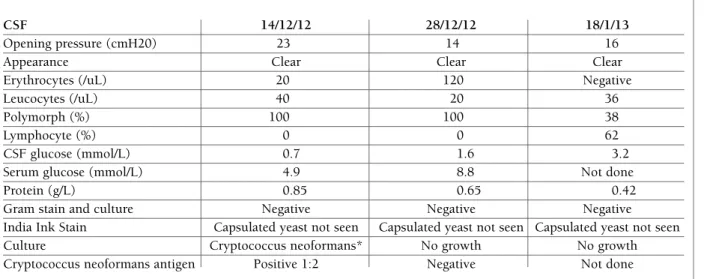
Over the next few weeks, the patient made a remar -kable recovery with only minimal residual right-sided weakness. Her SLE was inactive. Her cryptococcal in-fection was under control as evidenced by absence of symptoms, normal opening pressure during the third LP with normal protein level and glucose in the CSF (Table I). During her last clinic review in March 2013, Parental consent for LP was finally obtained. The
ope-ning pressure was 23 cmH2O and the cerebrospinal
fluid (CSF) findings were consistent with meningitis caused by Cryptococcus neoformans (Table I). Blood cul-tures were negative for Cryptococcus, and there was no obvious lung or skin involvement. Her HIV antibody was negative. The patient was treated with daily 35mg (0.7 mg/kg/day) IV amphotericin B (AMP-B). Flucy-tosine was not available in Malaysia. Mycopheno late mofetil was temporarily withheld, with the plan to reintroduce it when the induction phase of antifungals was completed. Prednisolone was also tapered at a fas-ter rate compared to patients without active infection. An LP on day-10 of antifungals showed significant im-provement in opening pressure (13 cmH20), normal
CSF glucose and protein levels, and negative fungal stain, cryptococcal antigen and fungal culture (Table I). Despite the improvement in CSF findings, her heada-che did not resolve. A change of her antifungal regime was made by adding fluconazole 800 mg daily to the induction phase therapy. The combination of IV AMP-B and oral fluconazole was to be continued for a total of four weeks (new induction phase).
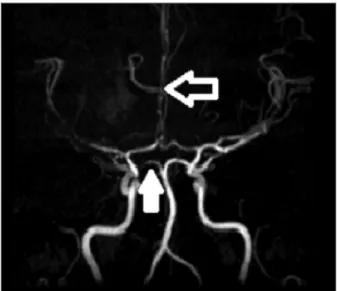
Unfortunately the patient developed right-sided he-miparesis on day-17 of antifungal treatment. MRI brain established the presence of new infarcts at the left tha-lamus and caudate nucleus (Figure 2a and 2b). MR an-giography showed narrowing at the posterior circula-tion arteries (Figure 3). There was no abscess or meningeal enhancement. The MRI findings posed ano
-tAble I. summAry of csf results from three lumbAr punctures
CSF 14/12/12 28/12/12 18/1/13
Opening pressure (cmH20) 23 14 16
Appearance Clear Clear Clear
Erythrocytes (/uL) 20 120 Negative
Leucocytes (/uL) 40 20 36
Polymorph (%) 100 100 38
Lymphocyte (%) 0 0 62
CSF glucose (mmol/L) 0.7 1.6 3.2
Serum glucose (mmol/L) 4.9 8.8 Not done
Protein (g/L) 0.85 0.65 0.42
Gram stain and culture Negative Negative Negative
India Ink Stain Capsulated yeast not seen Capsulated yeast not seen Capsulated yeast not seen
Culture Cryptococcus neoformans* No growth No growth
Cryptococcus neoformans antigen Positive 1:2 Negative Not done
a misdiagno sis of CNS lupus, especially when there is evidence of SLE flare in other organs3.
Corticosteroids, immunosuppressants, and SLE di-sease activity predispose patients to infections1,3,4. In
addition, intrinsic defects in immune system also play an important role. Data from HIV-negative patients there was no evidence of infection. We adjusted her SLE
regime with an increment of MMF from 500 mg to 1 g daily, HCQ from 200 mg to 400 mg daily, and a reduc-tion of prednisolone from 25 mg to 20 mg daily. The flu-conazole was reduced from 800 mg to 600 mg daily.
dIscussIon
Cryptococcal meningitis is an opportunistic infection commonly identified as an AIDS-defining illness, es-pecially in Southeast Asia and Africa. Cryptococcus
neo-formans is found in soil that is contaminated with bird
excreta and causes infection in immunosuppressed pa-tients2. Infection is acquired by inhalation of the yeast
spores and can affect any organ in the body with a pre-ference for the lungs and the CNS2. The most common
manifestation is meningo-encephalitis with patients complaining of headache, fever, lethargy and confu-sion. Occasional signs include meningism, papilloede-ma, cranial nerve palsies and reduced levels of cons-ciousness2. The signs and symptoms can often lead to
fIGure 1.Increased left temporal leptomeningeal enhancement at the sylvian fissure
fIGure 2.New infarct at left thalamus. (A) Hyperintensity at left thalamus (diffusion weighted imaging); (B) Hypointensity at left thalamus (apparent diffusion coefficient)
A
with cryptococcosis revealed approximately a quarter of patients had previous glucocorticoid therapy while only a tenth had rheumatic disorders5. Glucocorticoids
are widely used in SLE to control disease activity. One of the undesirable side effects of long-term and/or high intensity glucocorticoids is alteration in the immune system with an increased susceptibility to fungal in-fections6. Active lupus itself is also a risk factor for this
opportunistic infection. There are case reports that des-cribed SLE patients with cryptococcosis without any previous exposure to immunosuppressants7-9. These
cases supported the hypothesis that intrinsic immunological abnormalities may also contribute to the pa -thogenesis.
Cerebrovascular disease (CVD) is relatively uncom-mon in SLE, occurring in only 5-20% of cases10. In
ad-dition to traad-ditional risk factors, vasculitis and anti-phospholipid antibodies play an important role in CVD among patients with SLE10. The typical appearance of
vasculitis in MRI is multiple infarcts in the cortical and subcortical areas with a predilection for the middle ce-rebral artery territory11. One of the diagnostic
challen-ges in this case was the presence of cerebral infarction. The infarction could be related to SLE, or an early or late complication of cryptococcal meningitis which could occur in approximately one in three patients12.
The most common areas affected in cryptococcosis are the basal ganglia, internal capsule and thalamus12.
We also faced a dilemma in therapeutic choice. Due to lack of data from randomised control trials (RCTs)
in non-HIV and non-transplant patients, the treatment of cryptococcal meningitis follows that of HIV-positi-ve patients12,13. The US guidelines recommend the use
of IV AMP-B (0.7-1.0 mg/kg/day) and oral flucytosine (100 mg/kg/day in four divided doses) as induction therapy for at least 4 weeks, consolidation therapy with oral fluconazole (400 mg/day) for 8 weeks, followed by maintenance phase with oral fluconazole (200 mg/day) for a further 6 to 12 months14. A recent
land-mark RCT concluded the efficacy of induction treat-ment with AMP-B and flucytosine. This combination improved survival, demonstrated faster cryptococcal clearance from CSF and reduced rate of complications, when compared to AMP-B alone or combination of AMP-B and fluconazole15. No similar RCT has been
performed in non-HIV immunocompromised subjects. Unfortunately, flucytosine is not readily available in many countries, including Malaysia, mainly due to con-cerns about costs and potential side effects16. Hence an
alternative regime was recommended - induction the-rapy either with AMP-B monothethe-rapy (1 mg/kg/day IV) or AMP-B (0.7 mg/kg/day IV) and fluconazole (800 mg/day orally), both for 2 weeks followed by consoli-dation therapy with fluconazole (800 mg/day orally) for 8 weeks14. However, combination therapy with
amphotericin B and fluconazole had no survival bene-fit in HIV-positive patients in a recent RCT15, although
it was proven to be efficacious in the past17,18. The
ra-tionale of initial AMP-B monotherapy, and not combi-nation of AMP-B and fluconazole in our patient was the concern of a potential drug interaction between prednisolone and fluconazole that might cause an un-desired elevation in glucocorticoid levels. There was also published evidence of an antagonistic reaction between AMP-B and fluconazole, although such fin-ding was only reported when fluconazole was admi-nistered at 400 mg daily17.
After induction and consolidation phase, most ex-perts recommend lifelong treatment if the patients have significant ongoing immunosuppression or persistent disease5,13. This is also partly due to the high relapse rate
in approximately 15-20% of patients without mainte-nance therapy13. Our patient is likely to receive long term
fluconazole in view of the chronic nature of her SLE.
conclusIon
Cryptococcal meningitis should be considered in pa-tients with SLE with or without glucocorticoid
thera-fIGure 3.Beaded appearance of both ACAs(black arrow) and left PCA
py who present with neurological symptoms and signs. As the disease is related to the intensity of glucocorti-coid therapy and SLE disease activity, lowest glucocorticoid dose should be given in active SLE for the short -est duration to achieve remission. Cerebral infarction in patients with SLE may be part of CNS lupus or se-condary to cryptococcal meningitis. Early detection of the infection and initiation of AMP-B and flucytosine significantly reduce mortality and complications of this potentially curable disease. The combination of am -photericin B and fluconazole is an alternative but lac-king mortality data. Because of high relapse rate, long term fluconazole is recommended during chronic im-munosuppression for SLE.
correspondence to Chin Teck NG
Department of Medicine, University of Malaya, Lembah Pantai, Kuala Lumpur 59100, Malaysia
E-mail: [email protected] references
1. Fessler BJ. Infectious diseases in systemic lupus erythematosus: risk factors, management and prophylaxis. Best practice & Re-search Clinical Rheumatology 2002;16(2):281-291.
2. Bicanic T, Harrison TS. Cryptococcal meningitis. British Medi-cal Bulletin 2004;72:99-118.
3. Gonzalez LA, Vasquez G, Restrepo JP et al. Cryptococcosis in systemic lupus erythematosus:a series of six cases. Lupus 2010;19:639-645.
4. Weng CT, Lee NY, Liu MF et al. A retrospective study of catas-trophic invasive fungal infections in patients with systemic lu-pus erythematosus from southern Taiwan. Lulu-pus 2010;19:1204-1209.
5. Pappas PG, Perfect JR, Cloud GA. Cryptococcosis in human im-munodeficiency virus-negative patients in the era of effective azole therapy. Clinical infectious Diseases 2001;33:690-699.
6. Lionakis MS, Kontoyiannis DP. Glucocorticoids and invasive fungal infections. Lancet 2003;362:1828-1838.
7. Matsumura M, Kawamura R, Inoue R et al. Concurrent presen-tation of cryptococcal meningoencephalitis and systemic lupus erythematosus. Mod Rheumatol 2011;21:305-308.
8. Mok CC, Lau CS, Yuen KY. Cryptococcal meningitis presenting concurrently with systemic lupus erythematosus. Clin Exp Rheumatol 1998;16:169-171.
9. Huston KK, Gelber AC. Simultaneous presentation of crypto-coccal meningitis and lupus nephritis. J Rheumatol 2005; 32: 2501-2502.
10. Kitagawa Y, Gotoh F, Koto A et al. Stroke in systemic lupus eryt-hematosus. Stroke 1990;21:1533-1539.
11. Pomper MG, Miller TJ, Stone JH, et al. CNS Vasculitis in au-toimmune disease: MR Imaging findings and correlation with angiography. Am J Neurorad 1999;20:75-85.
12. Lan SH, Chang WN, Lu CH et al. Cerebral infarction in chro-nic meningitis: a comparison of tuberculous meningitis and cryptococcal meninigitis. QJ Med 2001;94:247-253. 13. Day JN. Cryptococcal Meningitis. Practical Neurology
2004;4:274-285.
14. Perfect JR, Dismukes WE, Dromer F et al. Clinical practice gui-delines for the management of cryptococcal disease: 2010 up-date by the Infectious Diseases Society of America. Clinical In-fectious Diseases 2010;50:291-322.
15. Day JN, Chau TTH, Wolbers M et al. Combination antifungal therapy for cryptococcal meningitis. New England Journal of Medicine 368;14:1291-1302.
16. Sloan D, Dlamini S, Paul N et al. Treatment of acute cryptococ-cal meningitis in HIV infected adults with an emphasis on re-source-limited settings. Cochrane Database Syst Rev 2008;4:CD005647.
17. Pappas PG, Chetchtisakd P, Larsen RA et al. A phase II rando-mized trial of amphotericin B alone or combined with flucona-zole in the treatment of HIV-associated cryptococcal meningi-tis. Clin Infect Dis 2009; 48:1775-1783.
18. Brouwer AE, Rajanuwong A, Chierakul W et al. Combination antifungal therapies for HIV-associated cryptococcal meningi-tis: a randomized trial. Lancet 2004; 363:1764-1767.