Deposited in Repositório ISCTE-IUL:
2018-10-11
Deposited version:
Post-print
Peer-review status of attached file:
Peer-reviewed
Citation for published item:
Prada, M., Rodrigues, D. & Garrido, M. V. (2016). Deliberate choices or strong motives: exploring the mechanisms underlying the bias of organic claims on leniency judgments. Appetite. 103, 8-16
Further information on publisher's website:
10.1016/j.appet.2016.03.012
Publisher's copyright statement:
This is the peer reviewed version of the following article: Prada, M., Rodrigues, D. & Garrido, M. V. (2016). Deliberate choices or strong motives: exploring the mechanisms underlying the bias of organic claims on leniency judgments. Appetite. 103, 8-16, which has been published in final form at https://dx.doi.org/10.1016/j.appet.2016.03.012. This article may be used for non-commercial purposes in accordance with the Publisher's Terms and Conditions for self-archiving.
Use policy
Creative Commons CC BY 4.0
The full-text may be used and/or reproduced, and given to third parties in any format or medium, without prior permission or charge, for personal research or study, educational, or not-for-profit purposes provided that:
• a full bibliographic reference is made to the original source • a link is made to the metadata record in the Repository • the full-text is not changed in any way
NOTICE: this is the author’s version of a work that was accepted for publication in
Appetite. Changes resulting from the publishing process, such as peer review, editing, corrections, structural formatting, and other quality control mechanisms may not be reflected in this document. Changes may have been made to this work since it was submitted for publication. A definitive version was subsequently published as:
Prada, M., Rodrigues, D., & Garrido, M. V. (2016). Deliberate choices or strong motives: Exploring the mechanisms underlying the bias of organic claims on leniency judgments. Appetite, 103, 8-16. doi:10.1016/j.appet.2016.03.012
Deliberate choices or strong motives: Exploring the mechanisms underlying the bias of organic claims on leniency judgments
Marília Pradaa, David Rodriguesa,b, and Margarida V. Garridoa
aInstituto Universitário de Lisboa (ISCTE-IUL), CIS - IUL b Goldsmiths, University of London
Note: Marília Prada, David Rodrigues and Margarida V. Garrido, Department of Social and Organizational Psychology, ISCTE-IUL, CIS-IUL, Lisboa, Portugal. Correspondence concerning this article should be addressed to M. Prada, ISCTE-IUL, Av. das Forças Armadas, Office AA110, 1649-026, Lisbon, Portugal.
Abstract
Organic claims can influence how a product is perceived in dimensions that are unrelated with the food production method (e.g., organic food is perceived as more healthful and less caloric than conventional food). Such claims can also bias how the consumers of organic food are perceived and how other people judge their behavior. Schuldt and Schwarz (2010) have shown that individuals evaluating a target with a weight-loss goal are more lenient in judging the target forgoing exercise when the target had an organic (vs. conventional) dessert. This impact of organic claims on leniency judgments has been interpreted either as a halo or a licensing effect. In the current research we aim to replicate and extend Schuldt and Schwarz's (2010) results by examining the mechanisms that are more likely to explain the observed leniency judgments. In Experiment 1, we observed that leniency towards a target that has consumed an organic meal is only observed when the target intentionally chooses such organic meal (vs. choice determined by the situation). These findings suggest that the impact of organic claims on leniency judgments is not merely based on a halo effect. Instead, a licensing account emerges as the most probable mechanism. In Experiment 2, we further found that stronger (vs. weaker) motives for forgoing exercise influenced leniency judgments to the same extent as having had an organic meal. Understanding the mechanisms that shape consumers’ decisions may have important implications to prevent bias in their judgments about food and exercise.
Keywords: Organic claims; Food labeling; Leniency judgments; Attribution; Halo effect; Licensing effect.
Highlights
× Organic claims bias judgments in dimensions unrelated to food production method
× Organic claims promote higher leniency towards forgoing exercising × Experiment 1 shows that eating organic only promotes leniency if the target
intentionally choses the meal (vs. choice determined by the situation)
× Experiment 2 shows that perceivers are sensitive to the nature of the situational constraints with higher leniency observed when the target has stronger (vs. weaker) motives to forgo exercise
× Overall results suggest a licensing account as the mechanism responsible for the organic claims bias on leniency judgments
New trends in eating behavior emerge all the time. These trends can be found in a myriad of products (e.g., "superfoods" and "free-from" foods such as gluten-free or lactose-free), fad diets (e.g., the blood-type, Atkins, Paleo diets) and lifestyles (e.g., vegetarianism, macrobiotic) that promise to be the ultimate "healthy" option.
Simultaneously, obesity and overweight rates are so alarming (13% and 39% of adults, respectively) that they are currently considered a global epidemic (WHO, 2015). A large amount of research has been exploring the causes of this phenomenon and how it can be counteracted, for example through strategies such as social
marketing campaigns and educational programs (e.g., Lowe, Fraser, & Souza-Monteiro, 2015).
Research in the eating behavior domain has suggested that food choice and consumption are largely influenced by automatic responses to contextual food cues (for a review, see Cohen & Babey, 2012). Marketing practices such as food pricing, communication, and packaging are examples of such cues (for a review, see Chandon & Wansink, 2012). Literature has also shown that specific attributes presented in the labels of food products may determine consumers' perception and behavior (e.g., Belei, Geyskens, Goukens, Ramanathan & Lemmink, 2012). For instance, several food-labeling systems (e.g., the nutritional traffic light) have been developed by governmental health organizations worldwide to help consumers make healthier choices (for a review, see Hawley et al., 2013). Indeed, there is evidence that traffic light labels influence food consumption by increasing (vs. decreasing) consumption of "green" (vs. "red") foods (Temple et al., 2011). However, labels can also have
negative effects, since highlighting some attributes can bias consumers and lead them to choose unhealthier options. For instance, Schuldt (2013) showed that the visual features of the nutritional information label were sufficient to determine consumer
perception. Specifically, participants judged a chocolate bar to be healthier when its calories label was green (vs. red), despite the fact that the information about the calories was held constant in both conditions. Likewise, the mere inclusion of certain words or designations in food labels may be enough to bias healthiness judgments. For example, a product with "fruit sugar" (vs. "sugar", Sütterlin & Siegrist, 2015) is perceived as more healthful, as are "free-from" products compared to conventional ones (even when the product is free from a fictitious ingredient, such as "MUI-free"; Priven, Baum, Vieira, Fung, & Herbold, 2015).
Food labeling can provide both objective (e.g., recommended serving size) and subjective (e.g., relative nutrition claims such as "low-fat") consumption cues
(Wansink & Chandon, 2006). Regarding the former, studies have shown, for example, that a reduction in the serving size suggested in the package (e.g., single serving of pizza reduced from 280 grams/ 400 calories to 140 grams/ 200 calories), leads to a decrease in the anticipated guilt of consumption and to an increase in purchase intentions and choice behavior (Mohr, Lichtenstein, & Janiszewski, 2012). The effects of subjective consumption cues were also demonstrated, suggesting that individuals tend to engage in overgeneralizations following claims about nutrient content (see Andrews, Netemeyer, & Burton, 1998). For example, a "low-fat" label can lead to the underestimation of calories, the overestimation of the appropriate serving size and to an increase in the actual consumption of the product (Ebneter, Latner, & Nigg, 2013; Wansink & Chandon, 2006).
It is noteworthy that these labeling effects have been found across different types of food products, from those perceived as more hedonic (e.g., candy) to those perceived as more utilitarian (e.g., granola; Wansink & Chandon, 2006). Likewise, products (e.g., bread) labeled as "Low Carb" or "CarbConscious" were perceived as
more healthful, less caloric and more adequate for weight management, than the same products void of these claims (Labiner-Wolfe, Lin, & Verrill, 2010). Nonetheless, one could argue that such bias in product perception can be expected because the claims are related to product composition (e.g., fat or carbohydrate content). What about claims that refer to properties unrelated to composition, such as ethical claims? These claims may include the "eco-friendly" (e.g., Sörqvist et al., 2013), "fair-trade" (e.g., Bratanova et al., 2015; Schuldt, Muller, & Schwarz, 2012), "locally produced" (e.g., Bratanova et al., 2015) and "organic" labels (e.g., Ellison, Duff, Wang, & White 2015; Lee, Shimizu, Kniffin, & Wansink, 2013; Schuldt & Hannahan, 2013; Schuldt & Schwarz, 2010). In this paper we will focus on the latter.
The "organic" claim only explicitly informs consumers about the food
production method (e.g., efficient use of on-site resources through wide crop rotation, prohibition of genetically modified organisms and strict limits on synthetic pesticides and fertilizers; European Commission, 2014). Yet, individuals infer other unrelated proprieties. When compared to conventional products, organic food is perceived more positively in several evaluative dimensions concerning sensory proprieties, nutritional judgments and value-related judgments. These inferences are remarkable considering that the results of numerous studies comparing organic and conventional food
production methods are not consensual regarding the nutritional superiority and health benefits of organic food (for reviews, see Baránski et al., 2014; Dangour et al., 2010; Smith-Spangler et al., 2012; Williams, 2002).
Several studies have consistently shown that people perceive organic (vs. conventional) food as more healthful when judging both this general food category (e.g., Schuldt & Hannahan, 2013) and specific food exemplars (e.g., "grapes"; Sörqvist et al., 2015). Likewise, health emerges as the primary reason for purchasing
organic food (for a review, see Hughner, McDonagh, Prothero, Schultz, & Stanton, 2007). Since individuals tend to categorize organic food as healthy (vs. unhealthy; e.g., Oakes & Slotterback, 2001), the association between organic and healthiness may influence judgments in other dimensions. Indeed, individuals consider that organic (vs. conventional) food has fewer calories (e.g., Lee et al., 2013; Schuldt & Schwarz, 2010; Sörqvist et al., 2015), can be eaten more often (e.g., Schuldt & Schwarz, 2010), tastes better (e.g., Sörqvist et al., 2015; Wiedmann, Hennigs, Behrens, & Klarmann, 2014; cf. Schuldt & Hannahan, 2013), has better nutritional qualities (e.g., vitamins, Sörqvist et al., 2015; less fat or more fiber, Lee et al., 2013) and has more benefits for mental performance (e.g., Sörqvist et al., 2015). In line with these judgments, consumers report a higher willingness to pay for organic products (Lee et al., 2013; Sörqvist et al., 2015; Van Loo, Caputo, Nayga, Meullenet, & Ricke, 2011; Wiedmann et al., 2014). Interestingly, and as noted by Pagliarini, Laureati and Gaeta (2013), most studies comparing organic and conventional products only show preference for the former when the consumers taste and evaluate the product in the full knowledge that the product is organic (vs. blind taste). These results suggest that the preference for organic products derives from their associations with healthiness and not so much from their actual perceptual attributes.
There is plenty of evidence that organic claims can bias judgments in several evaluative dimensions on a wide range of products (e.g., candy, meat, wine, or even water). These findings have often been interpreted as reflecting a halo effect (i.e., the positive influence of a given positive attribute on other unrelated attributes;
Thorndike, 1920). The halo effect is well established in impression formation literature, whereby a target person described with a positive personality trait (e.g., warmth) or positive physical attributes (e.g., attractiveness) is evaluated more
positively in several dimensions (e.g., competence, happiness; Asch, 1946; Dion, Berscheid, & Walster, 1972). In the context of food perception, this effect is generally referred to as health halo (Chandon & Wanskink, 2007).
The healthfulness of the food someone chooses to eat may also have implications for how that person is perceived by others. For example, a target described as typically eating an "unhealthy" breakfast (e.g., pie) is judged more negatively (e.g., more overindulgent, lazy, overweight, less attractive, athletic and clean, and even less likely to date/marry) than a target who eats a "healthy" breakfast (e.g., oatmeal; Oakes & Slotterback, 2004). Thus, a more indirect way of assessing the impact of the organic attribute can be achieved by asking participants to evaluate the consumer, rather than the product itself. For example, a person who purchases organic foods and environmentally-friendly products (vs. conventional products) is perceived as more cooperative, altruistic, and ethical (Mazar & Zhong, 2010).
In a recent study, Schuldt and Schwarz (2010, Experiment 2) presented a scenario describing a target person (a female college student) who was trying to achieve a weight-loss goal by eating healthy and exercising daily. In a specific day, the target was considering forgoing exercise because she had schoolwork to do. The target had a healthful meal for dinner (roasted vegetables and rice) and the
manipulation consisted in the choice of the dessert: no dessert, organic dessert, or conventional dessert. Participants were asked to consider the circumstances and to judge how adequate it was for the target to forgo exercise (i.e., leniency towards missing exercise). Participants were more lenient when the target chose the organic dessert over the conventional one, suggesting an association between organic and healthfulness. The authors advanced two possible explanations for these results: a halo account (described above) or a licensing account. The licensing effect has been
shown in situations where, after making a first choice that activates a positive self-concept (e.g., doing charity), individuals feel free to choose a more self-indulgent option (e.g., a more hedonic item). In other words, a licensing effect reflects the impact of an initial virtuous behavior on a subsequent choice (Khan & Dhar, 2006). This mechanism has been investigated in the context of organic claims. For example, Mazar and Zhong (2010) showed that after simulating purchasing "green" products (vs. conventional products), individuals tended to behave in a more self-serving way in a subsequent task (e.g., sharing less money in a dictator game, or taking more money than they should for their participation in the experiment). Also, Eskine (2012) showed that exposure to organic (vs. conventional) foods resulted in reduced
prosocial behavior and harsher moral judgments. Altogether, these findings have been interpreted as evidence that the exposure to organic products establishes moral
credentials that license subsequent deviating or self-serving behavior.
The literature we reviewed clearly shows that organic claims influence evaluations of food products in a wide range of dimensions, as well the perception of the organic food consumer. However, it remains unclear, which of the suggested mechanisms - halo and/ or licensing accounts - drives these results. In the present paper we aim to replicate Schuldt and Schwarz's (2010, Experiment 2) results and to extend them by investigating the role played by choice (of consuming an organic meal) and by the nature of the situational constraints (for forgoing exercise). The examination of these moderators is likely to clarify the mechanisms responsible for the organic claims bias on leniency judgments. In Schuldt and Schwarz's (2010, Experiment 2) original scenario, the target was responsible for choosing the dessert ("...she chose to eat the organic ice-cream", p. 150) and had a good justification to forgo exercise ("Tonight, Susie has lots of homework to do and so she is a bit busier
than normal", p. 150). In the current studies, we further examined these two issues. The first is the intentionality of the target’s behavior (i.e., the choice of a particular meal). Such issue is relevant because there is classic evidence indicating that a particular action is particularly informative about the actor when it is driven by free will and not by situational pressure or constraints (e.g., Jones & Davis, 1965; Jones, Davis, & Gergen, 1961). Therefore, Experiment 1 examines the role of the perceived freedom of choice of a particular meal in the leniency judgments. The second issue is related to the nature of the situational pressures underlying a given behavior. The literature has indicated that, despite the general tendency to attribute a given behavior to a particular dispositional characteristic of the target (e.g., "she skipped exercising because she is lazy"; the fundamental attribution error - Ross, 1977; or
correspondence bias - Gilbert & Jones, 1986), individuals are able to acknowledge the situations that explain those behaviors (e.g., Gilbert, Pelham & Krull, 1988;
Quattrone, 1982). Therefore, Experiment 2 examines the role of the situational factors (e.g., the motives to forgo training) in the leniency judgment.
To sum up, in two experiments we compared the impact of food production (conventional vs. organic) on leniency judgments. In Experiment 1 we also tested the role of the locus of attribution of meal choice (chosen by the target-person vs.
determined by the situation). In Experiment 2 we focused on the target's motives (weaker vs. stronger) for forgoing exercise.
Experiment 1
The current study is based on the paradigm developed by Schuldt and Schwarz (2010, Experiment 2). As in the original study, we focused on the comparison
between the two key conditions of food production (conventional vs. organic food). Due to the additional variables we have introduced (see below), we did not include a
third condition (i.e., no food), which would hamper the definition of a full design and the plausibility of the scenario.
We introduced different types of products in order to generalize the effect to different food types. While Schuldt and Schwarz (2010, Experiment 2) used an organic dessert (either a cookie or ice-cream), we used vegetable-based or meat-based lasagna. Both types of food were included because prior research suggests that the perceived healthfulness of the product category may (or may not) moderate the processing of nutritional information (see Mohr et al., 2012). Therefore, we did not advance any particular hypothesis regarding food type. Importantly, we manipulated the perceived freedom in choosing the meal either by presenting a target that
intentionally chose a particular meal or by constraining the target’s choice to a single available option. We argue that the attributional process involved in having a target choosing a meal, or having that choice being constrained by the situation, will have important implications on leniency judgments towards that target. People often draw dispositional inferences from situationally induced behavior of others (Gilbert & Jones, 1986; Ross, 1977). For example, Jones and Harris (1967) showed that
perceivers made dispositional inferences (e.g., that a person is pro-Castro) even when they knew that the target's behavior (e.g., writing a pro-Castro essay) was not freely chosen. However, subsequent research - mostly inspired by the works of Quattrone (1982) and Gilbert and colleagues (1988) - has established that, after a relatively automatic dispositional inference, people can correct that inference by considering the particular circumstances in which the behavior occurred. In sum, when there is
perceived choice, the behavior of the target is seen as more diagnostic of his/her intentions. In contrast, when the behavior is constrained by the situation, dispositional inferences are less likely. A parallel effect has been documented in the eating
behavior domain (e.g., Finkelstein & Fishbach, 2010), indicating that individuals who freely chose to eat healthy made inferences about how much they valued having healthy eating habits, as well as inferences about their progress towards attaining a particular health goal. These inferences of value and commitment were not observed in imposed consumption conditions, which were not perceived as indicators of the individual’s priorities.
We expected to obtain a main effect of food production (e.g., Schuldt & Schwarz, 2010), that is, higher leniency when the target eats organic (vs.
conventional) food. This pattern of results could be explained both by a halo or a licensing account. However, we also expected an interaction between food production and choice. Specifically, choice should moderate leniency towards the target, such that when the target actually chooses an organic (vs. conventional) meal, individuals are expected to judge forgoing exercise as more acceptable. We argue that if leniency derives solely from a halo effect (organic food is seen as healthier and less caloric, hence the target can skip exercise), then it should be equally observed in both choice and no choice conditions (when the target eats exactly the same organic meal). However, if leniency is only observed when the target freely choses to eat organic, this would support a licensing account.
Method Participants and Design
Participants were 192 Portuguese individuals who voluntarily participated in an online survey (89.1% female, Mage= 22.59, SD = 6.02, 75% students). Based on a question about dietary habits 17 participants that reported having a non-conventional diet (e.g., vegetarian, vegan, macrobiotic, etc.) were excluded from the initial sample (N = 209).
Individuals in our sample indicated not being frequent organic food buyers (t-test against the scale midpoint 4): meat (M = 2.97, SD = 1.89), t(191) = - 7.53, p < .001, d = 1.09, and vegetables (M = 3.68, SD = 1.97), t(191) = - 2.28, p = .024, d = 0.33. Still, they considered healthy eating to be very important (M = 6.61, SD = 0.59), t(191) = 60.95, p < .001, d = 8.82, and they reported having such habits (M = 4.50, SD = 1.51), t(191) = 6.18, p < .001, d = 0.89. Participants reported exercising on average 1.51 days per week (SD = 1.68) and the majority (79.2%) reported having a normal body mass index1 (i.e., 18.5 ≤ BMI ≤ 24.9).
Participants were randomly distributed by the factors: 2 (Food Production: Organic vs. Conventional) x 2 (Meal Choice: Choice vs. No choice) x 2 (Food Type: Meat vs. Vegetables). All factors were manipulated between-participants.
Procedure and Materials
The study was conducted in Qualtrics®. Participants were invited (e.g., institutional email, social networking websites) to collaborate on a web survey about perception and evaluation of food. By clicking on a hyperlink, participants were directed to a secure webpage in which they were again informed about the goals of the study and its expected duration (approximately 10 minutes). Instructions highlighted that there were no right or wrong answers. After providing informed consent, participants read a brief description about a person facing a choice (procedure adapted from Schuldt & Schwarz, 2010; Experiment 2). This was a description of an alleged 20-year-old university female student with a weight-loss goal:
"Joana is a university student. She is currently trying to lose weight by eating healthy meals and exercising regularly. For example, last night Joana had a toasted sandwich and a salad for dinner and, afterwards, she went on her usual 3-km run. Tonight Joana is very busy with schoolwork. She just had dinner in a restaurant near her place and she is trying to decide whether or not to skip her usual run in order to save time. For starters, she had tomato and cottage cheese salad. The restaurant menu included five main courses..."
The manipulation was included in the second part of the last sentence of this scenario (see Table 1 for the full description of the eight experimental conditions). Table 1
Manipulation of Food Production (Organic vs. Conventional), Meal Choice (Choice vs. No Choice) and Food Type (Meat vs. Vegetables).
Meal Choice
Choice No Choice
Food Production
Organic ... and Joana chose organic meat [vs. organic vegetables] lasagna.
..., however the only available dish at the moment was organic meat [vs. organic vegetables] lasagna.
Conventional ... and Joana chose meat [vs.
vegetables] lasagna. ..., however the only available dish at the moment was meat [vs. vegetables] lasagna.
In the same screen, individuals were then questioned about their leniency towards the target behavior “Under these circumstances, do you think it would be okay for Joana to skip her usual 3-km run tonight?” (1 = Not at all okay; 7 = Very okay). Next, they rated the meal on two criteria: calories (1 = Low in calories; 7 = High in calories) and healthfulness (1 = Very unhealthful; 7 = Very healthful).
Participants were then asked about their organic food shopping habits ("How often do you buy organic meat [vegetables]?"; 1 = Never; 7 = Always), the importance
attributed to healthy eating ("In your opinion how important is it to eat healthy?"; 1 = Not at all important; 7 = Very important) and healthy eating habits ("How healthy would you rate your eating habits?"; 1 = Very unhealthy; 7 = Very healthy). We also
included control questions regarding participants' dietary styles (i.e., conventional, vegetarian, vegan, macrobiotic, etc.), exercise habits (i.e., average number of days they exercise per week), height and weight (to calculate BMI). Finally, we asked participants to indicate to what extent they agreed with four sentences regarding organic and vegetarian food2: "Compared to conventional food, organic food
[vegetarian food] has less calories"; "...is more healthful" (1 = Completely disagree; 7 = Completely agree). Upon completing the task, participants were thanked and debriefed.
Results
Impact of Food Production, Choice and Food Type on Exercise Leniency
Our main hypotheses were tested with a 2 Food Production x 2 Choice x 2 Food Type ANOVA model with leniency towards the target skipping exercise as the dependent variable. Food Type (i.e., meat-based vs. vegetables-based) did not
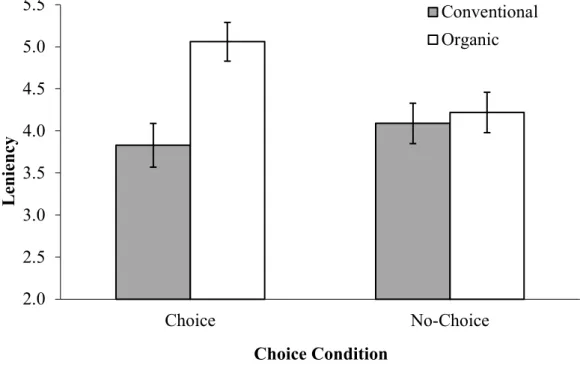
influence leniency towards the target, F < 1, nor did Choice, F(1,184) = 1.43, MSE = 4.00, p = .233, η2p = .008. As predicted, a main effect of Food Production (i.e., organic vs. conventional) emerged, F(1,184) = 7.86, MSE = 21.96, p = .006, η2p = .041. Participants were significantly more lenient toward the target forgoing exercise when she had eaten an organic meal (M = 4.64, SD = 1.70) rather than a conventional one (M = 3.97, SD = 1.66). Importantly, this effect was moderated by Choice,
F(1,184) = 5.11, MSE = 14.28, p = .025, η2p = .027 (see Fig. 1). No other main or interaction effects were significant, all Fs < 1.
Fig. 1. Mean leniency ratings (7 = highest) as a function of food production method (conventional vs.
organic) and choice condition (choice vs. no-choice).
As shown in Fig. 1, food production influenced judgments of leniency when the target freely chose the meal (MOrganic = 5.06; SD = 1.35; MConventional = 3.83; SD =1.75), but not when the choice was determined by the situation (MOrganic = 4.22; SD = 1.92; MConventional = 4.09; SD = 1.59). This interaction remained significant when the several individual characteristics assessed - BMI, healthy eating habits, exercise habits - were controlled for.
Impact of Food Production, Choice and Food Type on the Evaluation of the Meal
In line with our predictions, results showed a main effect of Food Production on the ratings of calories, F(1,184) = 11.77, MSE = 19.38, p = .001, η2p = .060, such that the organic meal was perceived as having fewer calories (M = 4.41, SD = 1.40) than the conventional meal (M = 5.09, SD = 1.29). A main effect of Food Type was also observed, F(1,184) = 19.01, MSE = 31.29, p < .001, η2p = .094, such that the
2.0 2.5 3.0 3.5 4.0 4.5 5.0 5.5 Choice No-Choice Leniency Choice Condition Conventional Organic
vegetable-based meal was perceived as having fewer calories (M = 4.30, SD = 1.26) than the meat-based meal (M = 5.12, SD = 1.40). No other results were significant (all ps > .087).
Regarding ratings of healthfulness, results showed again a main effect of Food Production, F(1,184) = 16.48, MSE = 23.82, p < .001, η2p = .082, such that the organic meal was evaluated as more healthful (M = 4.52, SD = 1.32) than the conventional meal (M = 3.76, SD = 1.21). A main effect of Food Type was also observed, F(1,184) = 17.43, MSE = 25.20, p < .001, η2p = .087, with the vegetable-based meal being perceived as more healthful (M = 4.54, SD = 1.18) than the meat-based meal (M = 3.81, SD = 1.35). Choice also influenced this variable, F(1,184) = 5.08, MSE = 7.35, p = .025, η2p = .027. The meal was evaluated as more healthful when chosen (M = 4.38, SD = 1.27) than when determined by the situation (M = 3.96, SD = 1.34).
Beliefs about Vegetarian and Organic Food (vs. Conventional Food)
We additionally explored whether participants viewed the general categories of organic and vegetarian food more positively than conventional food. Since ratings were always comparative, the absence of differences against the scale midpoint in a given dimension would signal that they were equal to conventional food. Vegetarian food was perceived as more healthful (M = 4.56, SD= 1.56), t(191) = 4.94, p < .001, d = 0.71, and with fewer calories than conventional food (M = 4.57, SD= 1.71), t(191) = 4.60, p < .001, d = 0.67. Organic food was perceived as more healthful (M = 5.61, SD= 1.28), t(191) = 17.52, p < .001, d = 2.54, than conventional food albeit similar in terms of calories (M = 3.99, SD= 1.67), t < 1. This is noteworthy given the results obtained with the exercise leniency variable and will be further addressed in general discussion.
In sum, our findings confirm the impact of an organic claim on exercise leniency: when the target was described as having had an organic meal, participants’ leniency towards her missing exercise was enhanced. These results replicate past research (Schuldt & Schwarz, 2010; Experiment 2). Importantly, our study extends this research by showing that the effect on leniency (which was unaffected by food type, i.e., meat/vegetables lasagna) was qualified by choice. As expected, we observed that the positive impact of organic claims on leniency judgments was only observed when the target was responsible for choosing the meal. This intentionality is in line with attributional theories, suggesting that intentionality is a necessary
condition to make dispositional inferences (for a review, see Silvera & Laufer, 2005).
If eating organic per se is not enough for the leniency effect to emerge, then an interpretation of our findings as a mere halo effect is unlikely. Instead, our results support a licensing account.
However, an important question remains unexamined, that is, whether the motive for forgoing exercise influences leniency. As in the original study (Schuldt & Schwarz, 2010; Experiment 2), the scenario we used in our first experiment stated that schoolwork was the motive why the target was considering forgoing exercise. Taking into consideration that the target was a college student, schoolwork can be seen as a plausible motive to do so. To test the role of the situational constraints, in the second experiment we varied the strength of the motives justifying why Joana was
considering forgoing exercise.
Experiment 2
In this second experiment we examined whether the situational constraints presented for skipping exercise influenced leniency judgments. Attribution literature has shown that the nature of the situational constraints can moderate the interpretation
of a target’s behavior, as well as the respective inferences that are made about the target (e.g., Overwalle, Drenth, & Marsman, 1999; Ramos, Garcia-Marques,
Hamilton, Ferreira, & van Acker, 2012). For example, the behavior "John arrived late to an important meeting …” allows for different inferences about John, depending on the situational motives advanced for that behavior: "because he was having lunch with a friend" or "because he had a car accident" (for other examples, see Ferreira, Morais, Ferreira, & Valchev, 2005). As in the second situation there is a stronger motive for the behavior, judgments about John's behavior are likely to be less harsh.
In the current study, we manipulated the strength of the situational motives by changing a single sentence in the scenario: Joana was considering forgoing the training because she was either “helping a friend choosing a dress”, or “helping a friend going through a breakup”. The former motive was weaker than the latter. Besides replicating the impact of food production on leniency judgments, we also expected a main effect of the motives. Specifically, forgoing exercise should be deemed more acceptable in conditions where the target eats organic or has a stronger motive to do it. In contrast, those who eat conventional food or have a weaker motive to skip the training should be judged less leniently.
Method Participants and Design
Participants were 192 Portuguese individuals who voluntarily participated in an online survey (75.5% female, Mage= 24.31, SD = 6.33, 66.7% students). Based on a question about dietary habits, nine participants who reported having a
non-conventional (e.g., vegetarian, vegan, macrobiotic, etc.) diet were excluded from the initial sample (N = 201).
1.66), t(191) = - 8.28, p < .001, d = 1.20, and reported a moderate knowledge of organic food (M = 3.91, SD = 1.63), t < 1 (t-tests against the scale midpoint: 4). Still, they considered healthy eating to be very important (M = 6.60, SD = 0.79), t(191) = 45.41, p < .001, d = 6.57, and reported having such habits (M = 4.65, SD = 1.14, t(191) = 7.92, p < .001, d = 1.15. Participants reported exercising on average 2.47 days per week (SD = 2.14).
Participants were randomly distributed by the factors: 2 (Food Production: Organic vs. Conventional) x 2 (Motives: Weaker vs. Stronger). Both factors were manipulated between-participants.
Procedure and Materials
As in Experiment 1, data were collected in Qualtrics® and participants were invited (e.g., institutional email, social networking websites) to collaborate on a web survey about the perception and evaluation of food. General instructions were also identical. After providing informed consent, participants read the scenario, which was adapted to include the manipulation of the motives to forgo exercise. Specifically:
"Joana is a university student. She is currently trying to lose weight by eating healthy meals and exercising regularly. For example, last night Joana had a sandwich and a salad for dinner and, afterwards, she went on her usual 3-km run. Tonight Joana is busy because she will help a friend [choosing a dress] or [who is going through a breakup]. She just had dinner in a restaurant near her place and she is trying to decide whether or not to skip her usual run in order to save time. For starters, she had tomato and cottage cheese salad. The restaurant menu included five main courses and Joana chose [lasagna] or [organic lasagna]".
The measures were also identical to Experiment 1 (i.e., leniency towards forgoing exercise; calories and healthfulness of meal; importance attributed to healthy eating and healthy eating habits, and dietary style and exercise habits as control questions). We included items about organic food shopping habits (1 = Rarely; 7 =
Frequently), knowledge (1 = Low; 7 = High) and also items regarding beliefs towards organic food ("Organic food has less calories"; "...is more healthful"; 1 = Completely disagree; 7 = Completely agree).
Additionally, in the final part of the questionnaire we included three items to check the motives manipulation. First, we asked participants to rate Joana in eight personality traits ("Joana seems... irresponsible, understanding, jealous, organized, incompetent, arrogant, cultured, and warm"; 1 = Not at all; 5 = Very; e.g., Ferreira, Garcia-Marques, Toscano, Carvalho, & Hagá, 2011; Jerónimo, Garcia-Marques, & Garrido, 2004). Second, we asked participants to evaluate how altruistic (1 = Not at all altruistic; 5 = Very altruistic) and righteous (1 = Not at all righteous; 5 = Very righteous) was Joana's helping behavior. Upon completing the task, participants were thanked and debriefed.
Results Manipulation Check of the Motives
As expected, participants in the stronger (vs. weaker) motives conditions evaluated the target’s behavior as more altruistic (M = 3.93, SD = 1.36 vs. M = 3.55, SD = 1.28), and as more righteous (M = 4.54, SD = 0.68 vs. M = 4.19, SD = 0.94), t(190) = 2.00, p = .047, d = 0.29 and t(190) = 2.96, p = .003, d = 0.43, respectively.
To check if the impressions formed about the target varied across conditions we computed a single index based on the personality trait ratings (α = .779). Negative trait ratings (e.g., arrogant or irresponsible) were reverse-coded so that higher mean scores (maximum 5) reflected a more positive impression of the target. There was a main effect of Motives, F(1,188) = 21.03, MSE = 5.88, p < .001, η2p = .101, such that participants in the stronger motive conditions (M = 4.01, SD = 0.50) reported a more positive impression of the target than participants in the weaker motive conditions (M
= 3.66, SD = 0.56). Likewise, we observed a marginal impact of Food Production: participants in the organic food conditions (M = 3.90, SD = 0.54) evaluated the target more positively than participants in the conventional food conditions (M = 3.77, SD = 0.57), F(1,188) = 3.19, MSE = 0.89, p = .076, η2p = .017. Food Production and
Motives condition did not interact, F < 1. The three measures were averaged into a single index (α = .762). As expected, higher scores on this index were observed in the stronger motives (M = 4.05, SD = 0.48) than in the weaker motives condition (M = 3.60, SD = 0.52), t(190) = 4.86, p < .001, d = .071.
Impact of Food Production and Motives on Leniency Judgments
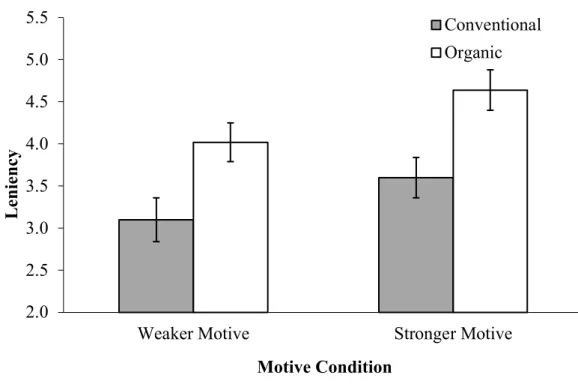
Our main hypotheses were tested with a 2 Food Production x 2 Motives ANOVA model with exercise leniency as the dependent variable. As predicted, and replicating the results from Experiment 1, there was a main effect of Food Production such that participants were more lenient when the target had consumed an organic meal (M = 4.33, SD = 1.45) rather than a conventional one (M = 3.35, SD = 1.72), F(1,188) = 18.48, MSE = 46.18, p < .001, η2p = .090. Importantly, there was also a main effect of Motives, such that leniency was higher when the target had a stronger motive to forgo training (M = 4.09, SD = 1.64), instead of a weaker one (M = 3.56, SD = 1.65), F(1,188) = 6.03, MSE = 15.07, p = .015, η2p = .0313. The interaction between Food Production and Motives was non-significant, F < 1 (see Fig. 2). These results were the same when we controlled for the individual characteristics assessed (i.e., healthy eating habits, exercise habits).
3 An additional mediation analysis showed that the motives manipulation had a direct impact on the evaluations participants made about the target, B = 0.35, SE = 0.07, p < .001. In turn, these evaluations had a direct impact on leniency judgments, B = 1.16, SE = 0.22, p < .001. The impact of the motives conditions on leniency judgments was non-significant, B = 0.13, SE = 0.24, p = .577, but instead mediated by the evaluations made about the target, B = 0.41, SE = 0.11, CI [0.214; 0.657].
Fig. 2. Mean leniency ratings (7 = highest) as a function of food production method (conventional vs.
organic) and motives (weaker vs. stronger).
Moreover, as shown in Fig. 2, Food Production and Motives seemed to have an additive effect on leniency. Indeed, the highest leniency judgments were observed in the organic/stronger motive condition (M = 4.64, SD = 1.26) as compared to any other condition: conventional/stronger motive (M = 4.02, SD = 1.56), t(188) = 1.90, p = .058, d = 0.28; organic/weaker motive (M = 3.60, SD = 1.80), t(188) = 3.22, p = .001, d = 0.47; conventional/weaker motive (M = 3.10, SD = 1.62), t(188) = 4.73, p < .001, d = 0.69.
Impact of Food Production and Motives on the Evaluation of the Meal
As in Experiment 1, there was a main effect of Food Production on the ratings of calories, F(1,188) = 55.96, MSE = 108.60, p < .001, η2p = .229, such that the organic meal was perceived as having fewer calories (M = 4.22, SD = 1.37) than the conventional meal (M = 5.72, SD = 1.40). Food Production also influenced
2.0 2.5 3.0 3.5 4.0 4.5 5.0 5.5
Weaker Motive Stronger Motive
Leniency
Motive Condition
Conventional Organic
healthfulness ratings, such that the organic meal (M = 4.23, SD = 1.37) was perceived as more healthful than the conventional one (M = 2.62, SD = 1.43), F(1,188) = 63.99, MSE = 125.22, p < .001, η2p = .254. Motives did not influence ratings in either
dimension (ps > .209).
Beliefs about Organic Food (vs. Conventional Food)
As in Experiment 1, we analyzed participants’ beliefs about organic food when compared to conventional food. Again, the absence of differences against the scale midpoint in a given dimension signals that both food production methods are perceived as equivalent. Compared with conventional food, organic food was
perceived as more healthful (M = 5.99, SD = 1.11), t(191) = 2.32, p = .021, d = 0.34, and as less caloric (M = 4.32, SD = 1.90), t(191) = 24.81, p < .001, d = 3.59.
General Discussion
The mere labeling of a product as "organic" influences the way consumers perceive it - for instance, as more healthful and as having better nutritional quality than conventional food - and how much they are willing to pay for it (e.g., Lee et al., 2013). Moreover, previous studies suggest that consumers infer that organic food has fewer calories and can be eaten more often than conventional food (e.g., Schuldt & Schwarz, 2010). Also, individuals consider more acceptable forgoing exercise when a target person consumed organic food (Schuldt & Schwarz, 2010). The impact of the organic attribute on leniency judgments towards forgoing exercise suggests that participants perceive the organic-meal choice as a way to attain a weight-loss goal (e.g., Fishbach & Dhar, 2005).
Leniency towards a target that has eaten organic food has been explained as either a halo effect (e.g., Chandon & Wanskink, 2007; Schuldt & Schwarz, 2010;
Thorndike, 1920) or as a licensing effect (e.g., Khan & Dhar, 2006; Mazar & Zhong, 2010; Schuldt & Schwarz, 2010). The first mechanism would operate based on associative processes, namely that organic food is more healthful and less caloric, and thus forgoing exercise after consuming organic food would be deemed more
acceptable. Leniency towards the target can also be explained by a licensing effect. Simply put, this effect refers to the fact that a person that initially performed a virtuous action feels freer to subsequently behave in a self-indulgent way (Khan & Dhar, 2006). In the same way, someone that eats an organic meal is less likely to receive harsh judgments when forgoing exercise (Schuldt & Schwarz, 2010). The results of our first experiment are likely to shed some light on the mechanism responsible for the leniency judgments. Replicating Schuldt and Schwarz (2010; Experiment 2), we observed higher leniency towards the target when the meal was organic (vs. conventional). This is particularly interesting considering that, as in the original study, the food product described in our scenario (i.e., lasagna) is known to be high in calories. Participants in our Experiment 1 also evaluated the general organic food category as healthier than conventional food, but as similar in calories. Still, when judging the specific meal presented in our scenario, participants in the organic conditions rated the meal as healthier and also as less caloric than those in the conventional condition. This pattern of results is congruent with a halo account.
Importantly, we extended this paradigm by manipulating whether the target choses or not the organic meal. Note that if the impact of food production on leniency judgments is accounted by the halo effect, then no differences should emerge across choice conditions. In other words, since the consumed organic meal was the same, it should not matter whether the target intentionally chose it or the choice was
judgments: the organic claim only influenced leniency judgments towards forgoing exercise when the organic meal was actually chosen by the target. Moreover, choice had a direct impact on healthfulness ratings of the meal. Specifically, the meal was perceived as more healthful when intentionally chosen by the target (vs. no choice). This finding is not surprising considering that the scenario stated that the target had a weight-loss goal. Altogether, the pattern of results supports a licensing account.
In our second experiment, we presented the target as responsible for the meal choice (organic vs. conventional) and examined the role played by the situational constraints (i.e., motives presented for skipping exercise) on leniency judgments. Results indicated, once again, that when the target ate an organic meal higher leniency was observed. The organic meal was perceived as more healthful and as less caloric than the conventional meal (replicating the results of Experiment 1). Beliefs about the general organic food category yielded similar results regarding healthfulness and calories. In the organic meal conditions, the impressions formed about the target were also more positive (albeit marginal, this effect is in line with Mazar & Zhong, 2010). Participants also took into consideration how strong (vs. weak) was the motive for skipping training. This was visible both in the impressions formed about the target (which were more positive in the stronger motive) and on leniency judgments. Namely, when the target was thinking about forgoing exercise in order to help a friend going through a breakup (vs. helping a friend to choose a dress) higher leniency was observed. This effect seems compatible with a licensing account. Furthermore, the experimental condition that led to the highest leniency was the organic/strong motive condition, suggesting that these factors may have an additive effect.
In our view, future studies focusing on moderators of organic claims bias on leniency judgments could also consider other moderators such as consumers'
environmental concerns, which along with health concerns, often emerge as a driver for organic food consumption (e.g., Hoffmann & Schlicht, 2013; Hughner et al., 2007). Indeed, pro-environmental values have sometimes been shown to moderate the impact of organic claims in the judgment of products (e.g., Schuldt & Schwarz, Experiment 1, cf. Lee et al., 2013). Also, in line with the results of our first
experiment, the manipulation of the target's dietary style (vegetarian vs. omnivorous) could also be of interest. Specifically, we found out that participants evaluated the vegetable-based meal as having fewer calories than the meat-based meal and generally held the belief that vegetarian (vs. conventional) food was less caloric. Previous studies have shown that people hold consumption stereotypes (i.e., beliefs about the others based on what they eat; for a review, see Vartanian, 2015), such that vegetarian targets are perceived as more virtuous (Ruby & Heine, 2011). This, allied to the belief of vegetarian food as less caloric (which seems to be supported by the fact that vegetarians have lower BMI in comparison to omnivourous; see Clarys et al., 2014), establishes the grounds for expecting a direct impact on leniency judgments.
To conclude, our studies replicated the findings by Schuldt and Schwarz (2010; Experiment 2) such that people that eat organic food were more likely to be excused when forgoing training. We extended these results by investigating the moderating role of attributional processes related to both the intentionality of the target’s behavior and the situational constraints that shaped the target’s behavior. Overall, our data emphasizes the importance of considering moderating variables, as it seems that the impact of an organic claim on leniency judgments is not necessarily a direct consequence of a health halo. Indeed, these results are in line with recent
evidence regarding the relation between exercise and food consumption. For example, Chang and Lin (2015) showed that after exercising (vs. no exercise) dieters consumed
more food, especially if exercising was framed as "work". When exercise was framed as “fun” the amount of food consumed after exercising decreased. Then, it seems that people need to feel that they have somehow earned their "reward". The reward can be eating more after working hard at the gym, or forgoing exercise simply because they chose to eat organic.
As in Schuldt and Schwarz's (2010; Experiment 2), our participants were asked to evaluate the behavior of another person (i.e., the target). There is data suggesting a self-other discrepancy in the eating behavior domain, such that
individuals tend to view themselves as eating more healthily than others (Sproesser, Kohlbrenner, Schupp, & Renner, 2015). If so, our results suggest that the organic bias may be even stronger when individuals are deciding about their own exercise
routines.
Research on the impact of food-labeling on people's perception and behavior is of utmost importance to help consumers make more healthful choices. It is known that people tend to overgeneralize food proprieties based on certain claims (Andrews, et al., 1998) and are prone to perceive food in a dichotomous way (healthy vs.
unhealthy; Oakes & Slotterback, 2001). When people perceive a given claim as signaling that the product is healthful, seeking nutritional information is less likely (Williams, 2005) and beliefs about the healthiness of foods directly influence food intake (Provencher, Polivy, & Herman, 2009). Also, it has also been suggested that people who are already facing health risks (e.g., overweight) are more vulnerable to be biased by such claims (e.g., "low-fat"; Wanskink & Chandon, 2006). Hence, some claims may lead to biased (or even harmful) categorizations. For example, perceiving Oreo cookies made with organic sugar and flour (Schuldt & Schwarz, 2010;
Experiment 1) as a healthful choice, or justifying the absence of exercise just by eating organic food.
The popularity of organic food is rising, and more organic products are available every day. The range includes fruits and vegetables as well as much less healthful options like candy or potato chips. Thus, the investigation of the impact of the organic claim is currently very relevant. Understanding the mechanism underlying the impact of such claims on different types of judgments (and the limits to this impact) is key to prevent unwarranted inferences from food claims. Awareness of the sources of bias may help consumers make more informed and healthier food choices and assist health regulators in the definition of appropriate guidelines for food labeling.
Acknowledgments
Part of this research was funded by Fundação para a Ciência e Tecnologia with grants awarded to the second (SFRH/BPD/73528/2010) and the third authors (PTDC/MHC-PCN/5217/2014), and a Marie Curie fellowship awarded to the third author (FP7-PEOPLE-2013-CIG/631673).
We thank Helena Rosa, Ana Mota and Ruben Trilho for their help in data collection.
References
Andrews, J. C., Netemeyer, R. G., & Burton, S. (1998). Consumer generalization of nutrient content claims in advertising. Journal of Marketing, 62, 62.
doi:10.2307/1252287
Asch, S. E. (1946). Forming impressions of personality. The Journal of Abnormal and Social Psychology, 41, 258–290. doi:10.1037/h0055756
Barański, M., Średnicka-Tober, D., Volakakis, N., Seal, C., Sanderson, R., Stewart, G. B., … Leifert, C. (2014). Higher antioxidant and lower cadmium
concentrations and lower incidence of pesticide residues in organically grown crops: a systematic literature review and meta-analyses. British Journal of Nutrition, 112, 794–811. doi:10.1017/s0007114514001366
Belei, N., Geyskens, K., Goukens, C., Ramanathan, S., & Lemmink, J. (2012). The best of both worlds? Effects of attribute-induced goal conflict on consumption of healthful indulgences. Journal of Marketing Research, 49, 900–909.
doi:10.1509/jmr.10.0155
Bratanova, B., Vauclair, C.-M., Kervyn, N., Schumann, S., Wood, R., & Klein, O. (2015). Savouring morality. Moral satisfaction renders food of ethical origin subjectively tastier. Appetite, 91, 137–149. doi:10.1016/j.appet.2015.04.006 Chandon, P., & Wansink, B. (2007). The biasing health halos of fast-food restaurant
health claims: Lower calorie estimates and higher side-dish consumption intentions. Journal of Consumer Research, 34, 301–314. doi:10.1086/519499 Chandon, P., & Wansink, B. (2012). Does food marketing need to make us fat? A
review and solutions. Nutrition Reviews, 70, 571–593. doi:10.1111/j.1753-4887.2012.00518.x
Chang, C. A., & Lin, Y. (2015). Physical activity and food consumption: The
moderating role of individual dieting tendency. Journal of Health Psychology, 20, 490-499. doi:10.1177/1359105315573469
Clarys, P., Deliens, T., Huybrechts, I., Deriemaeker, P., Vanaelst, B., De Keyzer, W., … Mullie, P. (2014). Comparison of nutritional quality of the vegan,
vegetarian, semi-vegetarian, pesco-vegetarian and omnivorous diet. Nutrients, 6, 1318–1332. doi:10.3390/nu6031318
Cohen, D. A., & Babey, S. H. (2012). Contextual influences on eating behaviours: Heuristic processing and dietary choices. Obesity Reviews, 13, 766–779. doi:10.1111/j.1467-789x.2012.01001.x
Dangour, A. D., Lock, K., Hayter, A., Aikenhead, A., Allen, E., & Uauy, R. (2010). Nutrition-related health effects of organic foods: A systematic review. American Journal of Clinical Nutrition, 92, 203–210.
doi:10.3945/ajcn.2010.29269
Dion, K., Berscheid, E., & Walster, E. (1972). What is beautiful is good. Journal of Personality and Social Psychology, 24, 285–290. doi:10.1037/h0033731 Ebneter, D. S., Latner, J. D., & Nigg, C. R. (2013). Is less always more? The effects
of low-fat labeling and caloric information on food intake, calorie estimates, taste preference, and health attributions. Appetite, 68, 92–97.
doi:10.1016/j.appet.2013.04.023
Ellison, B., Duff, B. R. L., Wang, Z., & White, T. B. (2016). Putting the organic label in context: Examining the interactions between the organic label, product type, and retail outlet. Food Quality and Preference, 49, 140–150.
doi:10.1016/j.foodqual.2015.11.013
Eskine, K. J. (2012). Wholesome foods and wholesome morals?: Organic foods reduce prosocial behavior and harshen moral judgments. Social Psychological and Personality Science, 4, 251–254. doi:10.1177/1948550612447114
European Commission (2014, September). What is organic farming? Retrieved from http://ec.europa.eu/agriculture/organic/organic-farming/what-is-organic-farming/index_en.htm
Ferreira, M., Morais, A., Ferreira, D., & Valchev, N. (2005). O João entornou o café, logo é desastrado, mas foi empurrado, logo não é desastrado. Frases
implicativas de traços com continuações situacionais e neutras para o estudo das Inferências Espontâneas de Traços [John spilled the coffee, therefore he is clumsy, but he was pushed, so he is not clumsy. Trait-implying sentences with situational and neutral continuations to the study of spontaneous trait
inferences]. Laboratório de Psicologia, 3, 13–22. doi:10.14417/lp.781
Ferreira, M., Garcia-Marques, L., Toscano, H., Carvalho, J., & Hagá, S. (2012). Para uma revisão da abordagem multidimensional das impressões de personalidade: O culto, o irresponsável, o compreensivo e o arrogante [For a revision of the multidimensional approach to personality impressions: The cultured, the irresponsible, the understanding and the arrogant]. Análise Psicológica, 29, 315-333. doi:10.14417/ap.55
Finkelstein, S. R., & Fishbach, A. (2010). When healthy food makes you hungry. Journal of Consumer Research, 37, 357–367. doi:10.1086/652248
Fishbach, A., & Dhar, R. (2005). Goals as excuses or guides: The liberating effect of perceived goal progress on choice. Journal of Consumer Research, 32, 370– 377.doi:10.1086/497548
Gilbert, D. T., & Jones, E. E. (1986). Perceiver-induced constraint: Interpretations of self-generated reality. Journal of Personality and Social Psychology, 50, 269– 280. doi:10.1037/0022-3514.50.2.269
Gilbert, D. T., Pelham, B. W., & Krull, D. S. (1988). On cognitive busyness: When person perceivers meet persons perceived. Journal of Personality and Social Psychology, 54, 733–740. doi:10.1037/0022-3514.54.5.733
Hawley, K. L., Roberto, C. A., Bragg, M. A., Liu, P. J., Schwartz, M. B., & Brownell, K. D. (2012). The science on front-of-package food labels. Public Health Nutrition, 16, 430–439. doi:10.1017/s1368980012000754
Hoffmann, S., & Schlicht, J. (2013). The impact of different types of concernment on the consumption of organic food. International Journal of Consumer Studies, 37, 625–633. doi:10.1111/ijcs.12044
Hughner, R. S., McDonagh, P., Prothero, A., Shultz, C. J., & Stanton, J. (2007). Who are organic food consumers? A compilation and review of why people
purchase organic food. Journal of Consumer Behaviour, 6, 94–110. doi:10.1002/cb.210
Jerónimo, R., Garcia-Marques, L., & Garrido, M. V. (2004). Comportamentos e traços de personalidade: Traços gerados para comportamentos de duas
dimensões de personalidade [Behaviors and personality traits: Traits generated for two personality dimensions]. Laboratório de Psicologia, 2, 33-47.
doi: 10.14417/lp.776
Jones, E. E., & Davis, K. E. (1965). From acts to dispositions the attribution process in person perception. Advances in Experimental Social Psychology, 2, 219– 266. doi:10.1016/s0065-2601(08)60107-0
Jones, E. E., Davis, K. E., & Gergen, K. J. (1961). Role playing variations and their informational value for person perception. The Journal of Abnormal and Social Psychology, 63, 302–310. doi:10.1037/h0048514
Jones, E. E., & Harris, V. A. (1967). The attribution of attitudes. Journal of
Experimental Social Psychology, 3, 1–24. doi:10.1016/0022-1031(67)90034-0 Khan, U., & Dhar, R. (2006). Licensing effect in consumer choice. Journal of
Marketing Research, 43, 259–266. doi:10.1509/jmkr.43.2.259
Labiner-Wolfe, J., Jordan Lin, C., & Verrill, L. (2010). Effect of low-carbohydrate claims on consumer perceptions about food products' healthfulness and
helpfulness for weight management. Journal of Nutrition Education and Behavior, 42, 315-320. doi:10.1016/j.jneb.2009.08.002
Lee, W. J., Shimizu, M., Kniffin, K. M., & Wansink, B. (2013). You taste what you see: Do organic labels bias taste perceptions? Food Quality and Preference, 29, 33–39. doi:10.1016/j.foodqual.2013.01.010
Lowe, B., Fraser, I., & Souza-Monteiro, D. M. (2015). Changing food consumption behaviors. Psychology and Marketing, 32, 481–485. doi:10.1002/mar.20793 Mazar, N., & Zhong, C. B. (2010). Do green products make us better people?
Psychological Science, 21, 494–498. doi:10.1177/0956797610363538 Mohr, G. S., Lichtenstein, D. R., & Janiszewski, C. (2012). The effect of
marketer-suggested serving size on consumer responses: The unintended consequences of consumer attention to calorie information. Journal of Marketing, 76, 59–75. doi:10.1509/jm.10.0073
Oakes, M. E., & Slotterback, C. S. (2001). Judgments of food healthfulness: Food name stereotypes in adults over age 25. Appetite, 37, 1–8.
doi:10.1006/appe.2001.0405
Oakes, M. E., & Slotterback, C. S. (2004). Prejudgments of those who eat a “healthy” versus an “unhealthy” food for breakfast. Current Psychology, 23, 267–278. doi:10.1007/s12144-004-1001-6
Overwalle, F., Drenth, T., & Marsman, G. (1999). Spontaneous trait inferences: Are they linked to the actor or to the action?. Personality and Social Psychology Bulletin, 25, 450-462. doi:10.1177/0146167299025004005
Pagliarini, E., Laureati, M., & Gaeta, D. (2013). Sensory descriptors, hedonic perception and consumer’s attitudes to Sangiovese red wine deriving from
organically and conventionally grown grapes. Frontiers in Psychology, 4. doi:10.3389/fpsyg.2013.00896
Priven, M., Baum, J., Vieira, E., Fung, T., & Herbold, N. (2015). The influence of a factitious free-from food product label on consumer perceptions of
healthfulness. Journal of the Academy of Nutrition and Dietetics, 115, 1808– 1814. doi:10.1016/j.jand.2015.03.013
Provencher, V., Polivy, J., & Herman, C. P. (2009). Perceived healthiness of food. If it's healthy, you can eat more!. Appetite, 52, 340-344.
doi:10.1016/j.appet.2008.11.005
Quattrone, G. A. (1982). Overattribution and unit formation: When behavior engulfs the person. Journal of Personality and Social Psychology, 42, 593–607. doi:10.1037/0022-3514.42.4.593
Ramos, T., Garcia-Marques, L., Hamilton, D., Ferreira, M., & Van Acker, K. (2012). What I infer depends on who you are: The influence of stereotypes on trait and situational spontaneous inferences. Journal of Experimental Social
Psychology, 48, 1247-1256. doi: 10.1016/j.jesp.2012.05.009
Ross, L. (1977). The intuitive psychologist and his shortcomings: Distortions in the attribution process. Advances in Experimental Social Psychology, 10, 173– 220. doi:10.1016/s0065-2601(08)60357-3
Ruby, M. B., & Heine, S. J. (2011). Meat, morals, and masculinity. Appetite, 56, 447– 450. doi:10.1016/j.appet.2011.01.018
Silvera, D. H., & Laufer, D. (2005). Recent developments in attribution research and their implications for consumer judgments and behavior. In F. Kardes, P. M. Kardes, & J. Nantel (Eds.), Applying social cognition to consumer-focused strategy (pp. 53-77). Mahwah, NY: Lawrence Erlbaum.
Schuldt, J. P. (2013). Does green mean healthy? Nutrition label color affects perceptions of healthfulness. Health Communication, 28, 814–821. doi:10.1080/10410236.2012.725270
Schuldt, J. P., & Hannahan, M. (2013). When good deeds leave a bad taste. Negative inferences from ethical food claims. Appetite, 62, 76–83.
doi:10.1016/j.appet.2012.11.004
Schuldt, J. P., Muller, D., & Schwarz, N. (2012). The “fair trade” effect: Health halos from social ethics claims. Social Psychological and Personality Science, 3, 581–589. doi:10.1177/1948550611431643
Schuldt, J. P., & Schwarz, N. (2010). The ‘organic’ path to obesity? Organic claims influence calorie judgments and exercise recommendations. Judgment and Decision Making, 5, 144–150.
Smith-Spangler, C., Brandeau, M. L., Hunter, G. E., Bavinger, J. C., Pearson, M., Eschbach, P. J., … Bravata, D. M. (2012). Are organic foods safer or healthier than conventional alternatives? Annals of Internal Medicine, 157, 348.
doi:10.7326/0003-4819-157-5-201209040-00007
Sörqvist, P., Haga, A., Langeborg, L., Holmgren, M., Wallinder, M., Nöstl, A., … Marsh, J. E. (2015). The green halo: Mechanisms and limits of the eco-label effect. Food Quality and Preference, 43, 1–9.
doi:10.1016/j.foodqual.2015.02.001
Sörqvist, P., Hedblom, D., Holmgren, M., Haga, A., Langeborg, L., Nöstl, A., & Kågström, J. (2013). Who needs cream and sugar when there is eco-labeling? taste and willingness to pay for “eco-friendly” coffee. PLoS ONE, 8, e80719. doi:10.1371/journal.pone.0080719
Sproesser, G., Kohlbrenner, V., Schupp, H., & Renner, B. (2015). I eat healthier than you: Differences in healthy and unhealthy food choices for oneself and for others. Nutrients, 7, 4638–4660. doi:10.3390/nu7064638
Sütterlin, B., & Siegrist, M. (2015). Simply adding the word “fruit” makes sugar healthier: The misleading effect of symbolic information on the perceived healthiness of food. Appetite, 95, 252–261. doi:10.1016/j.appet.2015.07.011 Temple, J. L., Johnson, K. M., Archer, K., LaCarte, A., Yi, C., & Epstein, L. H.
(2011). Influence of simplified nutrition labeling and taxation on laboratory energy intake in adults. Appetite, 57, 184–192.
doi:10.1016/j.appet.2011.04.018
Thorndike, E. L. (1920). A constant error in psychological ratings. Journal of Applied Psychology, 4, 25–29. doi:10.1037/h0071663
Van Loo, E. J., Caputo, V., Nayga, R. M., Meullenet, J.-F., & Ricke, S. C. (2011). Consumers’ willingness to pay for organic chicken breast: Evidence from choice experiment. Food Quality and Preference, 22, 603–613.
doi:10.1016/j.foodqual.2011.02.003
Vartanian, L. R. (2015). Impression management and food intake. Current directions in research. Appetite, 86, 74–80. doi:10.1016/j.appet.2014.08.021
Wansink, B., & Chandon, P. (2006). Can “low-fat” nutrition labels lead to obesity? Journal of Marketing Research, 43, 605–617. doi:10.1509/jmkr.43.4.605 Wiedmann, K.-P., Hennigs, N., Behrens, H. S., & Klarmann, C. (2014). Tasting
green: An experimental design for investigating consumer perception of organic wine. British Food Journal, 116, 197–211. doi:10.1108/bfj-04-2012-0090
Williams, C. M. (2002). Nutritional quality of organic food: Shades of grey or shades of green? Proceedings of the Nutrition Society, 61, 19–24.
doi:10.1079/pns2001126
Williams, P. (2005). Consumer understanding and use of health claims for foods. Nutrition Reviews, 63, 256–264. doi:10.1111/j.1753-4887.2005.tb00382.x World Health Organization (WHO, January 2015). Obesity and overweight. Fact