Nanomaterials 2018, 8, x; doi: FOR PEER REVIEW www.mdpi.com/journal/nanomaterials Review
1
Multifunctional nanocarriers for lung drug delivery
2
Jorge F. Pontes 1,2 and Ana Grenha 1,2,3,*
3
1 Centre for Marine Sciences (CCMAR), University of Algarve, Campus de Gambelas, 8005-139 Faro, Portugal;
4
5
2 Drug Delivery Laboratory, Centre for Biomedical Research (CBMR), University of Algarve, Campus de
6
Gambelas, 8005-139, Faro, Portugal
7
3 Department of Chemistry and Pharmacy, Faculty of Sciences and Technology, University of Algarve,
8
Campus de Gambelas, 8005-139 Faro, Portugal
9
* Correspondence: [email protected]; Tel.: +351-289-244-441; Fax: +351-289-800-066
10
Received: date; Accepted: date; Published: date
11
Abstract: Nanocarriers have been increasingly proposed for lung drug delivery applications. The
12
strategy of combining the intrinsic and more general advantages of the nanostructures with
13
specificities that improve the therapeutic outcomes of particular clinical situations is frequent. These
14
include surface engineering of the carriers, by means of alteration of the materials structure (i.e.
15
chemical modifications), the addition of specific ligands so that predefined targets are reached, or
16
even the tuning of the carrier properties to respond to specific stimuli. The devised strategies are
17
mainly directed to three distinct areas of lung drug delivery, encompassing the delivery of proteins
18
and protein-based materials, either for local or systemic application, the delivery of antibiotics and
19
the delivery of anticancer drugs, the latter two comprising local delivery approaches. This review
20
addresses the applications of nanocarriers aimed at lung drug delivery of active biological and
21
pharmaceutical ingredients, focusing with particular interest nanocarriers that exhibit
22
multifunctional properties. A final section addresses the expectations regarding the future use of
23
nanocarriers in the area.
24
Keywords: Antibiotics, cancer, drug delivery, lung delivery, nanocarriers, nanopharmaceuticals,
25
proteins.26
27
1. Introduction28
The appearance of new therapies and alternative strategies for the delivery of drug molecules
29
has been changing the paradigm of therapeutic approaches [1-3]. Indeed, therapeutic solutions have
30
been implemented around one of two possible objectives: one is the development of better and more
31
effective therapies, usually involving new drugs; the other relies on exploring different ways to
32
deliver molecules, potentiating their action and, in many cases, simultaneously, eliminating adverse
33
effects or, at least, decreasing their impact. The latter approach has been often used for drug
34
repurposing, finding new applications for de‑risked compounds, with potentially lower overall
35
development costs and shorter development timelines. The literature displays some recent and
36
valuable reviews on the topic of drug repurposing [4,5]. The adverse effects derived from
37
pharmaceuticals have always caused concern, as some can be devastating, leading to therapeutic
non-38
compliance. Thus, exploring delivery strategies is as important as the discovery of new molecules
39
and targets, providing the molecules with specific orientation towards their targets, avoiding major
40
biological stresses and, overall, improving the therapeutic quality [6]. Actually, in many cases, the
41
two referred approaches are addressed at a time.
42
Considering that, in most cases, the delivery of unformulated drug molecules is not successful,
43
formulation plays a role of utmost importance in therapy. Conventional drug delivery systems
encompass numerous restrictions, which include limited targeting, low therapeutic index, poor
45
aqueous solubility, and the potentiation of drug resistance [7]. The design and production of systems
46
in which drug molecules are included in a carrier, being either embedded in the matrix or adsorbed
47
to the surface, is frequently the next step towards a more effective therapy. The reasons justifying the
48
need for drug formulation are in the annals of pharmaceutical technology, going from a simple
49
protection of drugs to the more complex targeting of cells or tissues. In between, the need to achieve
50
control over drug release has also been a hallmark of drug delivery research. A useful historical
51
perpective on the generations of controlled drug delivery systems is available in [8]. In fact, in an era
52
where drug molecules are expected to answer to increasingly complex environments, their
53
formulation takes on a role never seen. That role assumed, a great variety of advanced drug delivery
54
systems has been reported through the years, with important variations on their properties, including
55
size and composition. Size is one of the most relevant features in the field. In this context, both micro-
56
and nanocarriers have been reported to be viable approaches, the final selection being objectively
57
dependent on the specific application that is envisaged. The potential of micron-sized carriers has
58
been highlighted for different applications [9-13], but lies out of the scope of this review. As for the
59
nanoscaled carriers, in drug delivery these fall into the designation of nanopharmaceuticals, defined
60
by Rivera Gil et al as “pharmaceuticals where the nanomaterial plays the pivotal therapeutic role or
61
adds additional functionality to the previous compound” [14]. The International Organization for
62
Standardization defines nanoparticles as those having at least one dimension less than 100 nm [15].
63
In turn, the American Food and Drug Administration (FDA) indicates that products involve
64
nanotechnology, and should therefore be evaluated as such, when they are “engineered to exhibit
65
properties or phenomena attributable to dimensions up to 1000 nm” [16]. This broader definition is
66
the most typically seen in academic research in drug delivery and will be adopted in this review.
67
Therefore, all submicron systems will be considered nanocarriers.
68
As well indicated in the historical description of [8], after an initial period back in the 1980s and
69
1990s, where many micron-sized formulations became popular and reached the market,
70
nanotechnology has been leading the interest of drug delivery scientists since the turn of the new
71
century. In fact, the first mention to a system capable of encapsulating a molecule and providing its
72
transport through a membrane dates back to 1965, under the name of liposome [17], which is, indeed,
73
a nanosystem. From that point on, many other nanoformulations were described and explored, some
74
of them consisting in particulate-based systems, with significant structural differences comparing
75
with the vesicle-based systems comprised by liposomes. Particulate carriers at the nanoscale include
76
polymeric nanoparticles [18], solid lipid nanoparticles [19,20], nanostructured lipid carriers [21,22]
77
and magnetic and silica nanoparticles [23,24]. Probably, issues like increased stability [6], the closer
78
interaction with cell structures [25], the propensity to provide increased drug absorption [26] and the
79
great ability for surface functionalisation [27] have driven the higher popularity of these materials.
80
Regrettably, the clinical translation of nanoparticulate-based systems is very limited so far and only
81
one formulation is available in the market: Abraxane®, marketed since 2005 [28]. This comprises
82
albumin-conjugated paclitaxel, being used in metastatic breast cancer and non-small-cell lung cancer
83
[29]. In this manner, despite the extensive research on particulate-based nanopharmaceuticals, their
84
market absence is notorious, mainly due to tightened regulations. Even so, there are many
85
nanoformulations currently undergoing clinical trials focusing varied routes of administration, and
86
it is expected that some of them make their way into the market in some years [30].
87
From the referred formulations undergoing a translational process and to the knowledge of the
88
authors of this review, none is directed to lung drug delivery. Nevertheless, this is a delivery route
89
that has been gaining popularity in recent years, essentially owing to its non-invasiveness and the
90
increased demonstration of its potential, not only for local therapies, but also to provide systemic
91
action. Actually, according to the World Health Organization (WHO), chronic obstructive pulmonary
92
disease (COPD), lower respiratory infections and lung cancer are, respectively, the third, fourth and
93
sixth causes of death worldwide [31], which illustrates the existing therapeutic limitations. In
94
addition, numerous other respiratory disorders are characterised by an urgent and unmet therapeutic
95
need. The myriad of routes of administration poses the question of which one is the most adequate
to deliver a drug intended to treat a specific disease. In parallel, the search for routes of administration
97
other than the oral has been increasing for some years. The lung is now being taken into high
98
consideration for this purpose, as clearly demonstrated in Figure 1, where the number of publications
99
per year that specifically refer to “lung drug delivery”, as retrieved from ISI Web of Science, can be
100
observed. It has been considered a viable alternative in the delivery of drugs and the popularity of
101
this delivery route is reflected in the growing number of publications, especially from 2014 onwards,
102
indicating a clear interest from the scientific community.
103
104
105
106
107
108
109
110
111
112
113
114
115
116
117
118
Figure 1 – Number of scientific publications under the topics of “lung drug delivery” (blue) and “lung
119
drug delivery and nano” (orange) on ISI Web of Science, as function of the publication year (last
120
updated in January 2020).
121
The established popularity of the lung route relies on several advantages and specific features.
122
Apart from the already mentioned ability to provide either local or systemic effect, characteristics
123
such as high vascularisation and extensive area available for absorption are highly appealing for
124
systemic delivery, while the low metabolic activity compared with the oral route serves both
125
modalities [32]. Furthermore, the possibility to use lower doses and the low incidence of systemic
126
side effects are relevant pros for local delivery [33]. A very useful and up-to-date review on the
127
challenges and opportunities of lung delivery can be found in [33]. Despite the mentioned
128
advantages, some limitations are also to be referred, which mainly include the mucociliary clearance
129
as the main mechanism of defence, the patient variability on pathophysiological aspects of the organ
130
and the need to endow the drugs with suitable aerodynamic properties to reach a specific area of the
131
lung [34]. Regarding the latter aspect, the aerodynamic diameter of the drugs or carriers to be
132
delivered through inhalation assumes a crucial role. The aerodynamic diameter is the diameter of a
133
spherical particle with density of 1 g/cm3 and the same settling velocity as the particle of interest. In
134
this context, it is reported that the smaller airways can be reached by particles with aerodynamic
135
diameter lower than 5 μm, while those with less than 2 μm may arrive to the respiratory zone, which
136
includes the alveoli [32].
137
Drugs have been administered by inhalation for millennia, but inhaled therapeutics have been
138
used predominantly to manage common pulmonary diseases like asthma and COPD. In these areas,
139
inhalable drugs have been dominating the market. Systemic formulations, in turn, have been facing
140
many limitations, with significant technical hurdles requiring being addressed before success is
141
achieved. Nevertheless, it has become consensual that, given the offered advantages, the posed
142
challenges are worth addressing. The possiblities have long been debated, especially considering the
143
emergence of biological drugs that are degraded in the gastrointestinal tract and, so, rely uniquely
144
on injection to find efficacy. The scientific community has, thus, been recognising the potential of the
145
lung to be used as a systemic pathway, and many of the papers contributing to Figure 1 deal with
146
systemic lung delivery, although so far this interest is not mirrored by the market. In fact, inhalable
insulin is one of the exceptions to mention, appearing first as Exubera®, from Pfizer (2006), but being
148
discontinued one year after approval [35,36], the company justifying the withdrawal with ‘comercial
149
reasons’. Another product of inhalable insulin became available in 2014, as Afrezza®, from Mannkind
150
Corporation, and incorporates the Technosphere® technology [36,37]. These inhalable insulin
151
products are not based on nanotechnologies, but the scientific community has been recognising the
152
potential of nanocarriers in lung delivery and nanoformulations have been increasingly proposed, as
153
can be also observed in Figure 1. An integrated analysis of this figure shows that publications
154
involving nanosystems usually comprise more than half of the total number of publications on the
155
topic of lung delivery, which demonstrates well their popularity. In fact, the superiority of
156
nanosystems has been demonstrated in certain applications of the respiratory field, as will be
157
described in the following sections of the review. The nanocarriers permit drug protection, provide
158
a greater ability to interact with the tissues and cells, owing to the high surface area, often allowing
159
specific targeting and/or controlled drug release [38]. However, the proposal of nanocarriers must
160
not be blind and it is important to note that some applications may take greater benefit from the use
161
of microcarriers, for example if the therapeutic target is phagocytic cells such as macrophages.
162
Moreover, despite the large amount of works describing nanocarriers for lung delivery applications,
163
it is worth saying that a closer reading of the searched documents reveals that many of the works
164
propose the nanocarriers as having potential from a conceptual point of view, but a much smaller
165
amount approaches the practical concept of preparing the carriers for inhalation, endowing them
166
with the required properties, namely aerodynamic, for the purpose.
167
While initial approaches on the development of drug nanocarriers essentially addressed issues
168
of drug stability and control over the release, these were rapidly replaced or completed with
169
advanced techniques of particle engineering. Thus, the proposal of more complex carriers naturally
170
came along, with particle engineering techniques endowing the nanocarriers with specific properties
171
well beyond their role of carrying a drug or molecule of interest. Such carriers were named as
172
multifunctional and their applications have been explored in all areas of delivery. The
173
multifunctional nanocarrier can be one composed of a material that provides, itself, a specific
174
function, or one that was modified to exhibit a determined feature. Lung delivery can strongly benefit
175
from the features of these carriers. In fact, while most asthma and COPD drugs are delivered to the
176
lung with relatively low efficiency and still ensure therapeutic efficacy, drugs aimed at a systemic
177
action or used to treat orphan diseases or cancer, require optimisation of delivery efficiency. This will
178
render the treatment cost-effective, while potentiating clinical effectiveness and minimising side
179
effects.
180
Considering the interest of nanocarriers within the context of lung drug delivery, this review
181
will focus on their applications, placing particular emphasis on the functionality that is provided by
182
the proper carriers. For the effects of the review, only works addressing directly the issue of
183
pulmonary administration of the carriers, either by adequate in vitro testing or by suitable in vivo
184
delivery, will be considered, thus going beyond the theoretical concept of suitability for lung delivery
185
purposes. The specific features of the carriers will be referred and the achieved outcomes described.
186
The envisaged applications of the nanocarriers in lung delivery are diverse, but particularly address
187
the delivery of proteins or protein-based materials, either for local or systemic effect [39,40], cancer
188
treatment [41,42] and local delivery of antibiotics [43,44]. Therefore, the review will specifically focus
189
on these topics. As an introductory element to the following sections, Table 1 depicts the major
190
respiratory diseases, along with their main limitations and the potential improvements imparted by
191
pulmonary delivered therapy.
192
193
Table 1 – General overview of the major respiratory diseases, along with their main limitations and improvements imparted by pulmonary delivery of the
194
drugs. Indication of the application, in each disease, of the drug classes addressed in the review.
195
196
CFTR: Cystic fibrosis transmembrane conductance regulator; COPD: chronic obstructive pulmonary disease
197
n.a.: not applicable; *conventional therapy already administered via inhalation
198
Respiratory
disease Main limitations Improvements from lung delivery Proteins Antibiotics
Anticancer drugs
Asthma
Low therapeutic efficacy of delivered drugs; inefficient control of the disease; airway inflammation
n.a.* x
COPD
Persistent inflammation; parenchymal lung tissue destruction; abnormalities of the small airways
n.a.* x x
Pneumonia Low amount of drug reaches infection site;
antimicrobial resistance
Higher drug accumulation in infection site;
co-localisation of drug and infectious agent x x
Cystic fibrosis
Thick viscous mucus; recurrent lung infections; progressive impairment of lung airways
Mucus-penetrating carriers; increased lung drug retention; delivery of genetic material to restore CFTR function
x x
Tuberculosis
Reduced amount of drug reaches infection
site; antimicrobial resistance; long
therapeutic regimen
Co-localisation of drug and infectious agent; reduction of antibiotic resistance incidence; possibility of add-on therapy (along with oral); reduce treatment duration
x
Lung cancer
Non-specificity of drugs; difficulties to reach the affected tissues; severity of systemic adverse effects
Vectorisation to cancer cells; reduction of
2. Lung drug delivery mediated by multifunctional nanocarriers
199
Multifunctional nanocarriers can be produced from a wide range of materials. In parallel, it is
200
also wide the number of molecules that can be associated to the carriers to provide specific effects
201
and improve their perfomance, either being adsorbed or chemically-bound. This variety arises from
202
the necessity to meet different challenges and address a vast number of diseases with intrinsic
203
different characteristics.
204
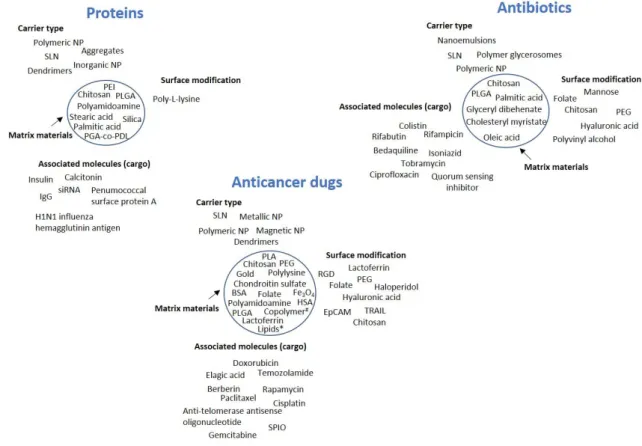
In the present section, the three main topics mentioned above will be approached. As a summary
205
of the contents, Figure 2 provides a depiction of the type of carriers used in each topic, along with the
206
materials selected for nanoparticle matrix and surface modification, when applicable, and also the
207
associated molecules of interest.
208
209
Figure 2 – General overview of the types of nanocarriers used in the delivery of proteins,
210
antibiotics and anticancer drugs, along with the materials applied in the carrier matrix (inside the
211
circle), the ligands used for surface functionalisation and the associated molecules of interest (the
212
cargo). The circle indicates the carrier. BSA: bovine serum albumin, EpCAM: epithelial cell adhesion
213
molecule, HSA: human serum albumin, IgG: immunoglobulin G, NP: nanoparticles, PEG:
214
polyethylene glycol, PEI: polyamidoamine, PGA-co-PDL: poly(glycerol
adipate-co-ω-215
pentadecalactone), PLA: polylactic acid, PLGA: polylactic-co-glycolic acid, RGD: tripeptide
Arg-Gly-216
Asp, siRNA: small interfering RNA, SLN: solid lipid nanoparticles, SPIO: superparamagnetic iron
217
oxide, TRAIL: tumor necrosis factor-related apoptosis-inducing ligand, #copolymer based on
218
methoxy poly(ethylene glycol)-poly(ethylenimine)-poly(L-glutamate), *lipids: glyceryl
219
monostearate, cholesterol.
220
2.1. Delivery of proteins and protein-based materials
221
The marked biotechnological advances observed in recent decades resulted in the appearance
222
of many protein-based drugs. Fundamentally, the oral delivery of these molecules is prevented by
223
the degrading effect of abundant protease content and the possibilities of delivery are essentially
reduced to injection-based strategies. However, this approach is more expensive and not appreciated
225
by the patients, mainly due to the discomfort associated with the administration, but also because of
226
some issues related with aesthetics, including bruising and skin marks that may compromise
227
therapeutic compliance [45]. The pulmonary route thus appears as a sound alternative when a
228
systemic effect is desired, but protein-based drugs also find applications in the treatment of local lung
229
diseases. In fact, the first inhaled protein reaching the market was recombinant human DNase
230
(rhDNase), indicated in the treatment of cystic fibrosis and available since the late 90s. Inhalable
231
insulin appeared approximately 10 years after and lessons learnt from its development resulted in
232
the current availability of many elegant inhalation devices and formulations. So far, no other inhaled
233
biological drug aimed at systemic delivery reached the market, despite those being the drugs
234
focusing most of the attention within the context of systemic delivery mediated by inhalation. None
235
of the referred marketed formulations encompasses the use of nanocarriers. Actually, members of
236
our group participated in the first work proposing the inhalation of insulin encapsulated in polymeric
237
nanoparticles, dated back to 2005 [39,46,47]. At that time, chitosan was proposed as matrix material,
238
resulting in non-toxic nanoparticles and endowing the system with mucoadhesivity [48]. In order to
239
provide the nanoparticles with suitable aerodynamic properties to reach the alveolar zone, a
nano-240
in-micro system was developed, using spray-drying to microencapsulate the nanoparticles in
241
mannitol microspheres. These, expectedly released the nanoparticles after dissolving in the lung
242
lining fuid, providing the release of the protein that could, thus, be absorbed systemically [39]. An in
243
vivo study in rats evidenced that microencapsulated insulin-loaded chitosan nanoparticles
244
administered intratracheally (IT, 16.7 IU/kg) induced a more pronounced and prolonged
245
hypoglycemic effect compared with insulin solution, as observed in Figure 3 [47], thus demonstrating
246
the contribute of the carrier itself to the observed therapeutic effect. A similar approach was later on
247
proposed by other authors, using poly-L-lysine to modify the surface of self-assembled pure insulin
248
nanoaggregates, benefiting from the adhesive properties of poly-L-lysine. After IT administration to
249
diabetic rats, the modified nanostructures (5 IU/kg) induced hypoglycemic effect as stronger as
250
subcutaneous delivery (1 IU/kg), but increasing the drug half-life from 1.28 h to 2.75 h. Although not
251
statistically significant, the hypoglycemic effect obtained from nanoparticles was also more
252
prolonged, achieving 23.4% relative bioavailability [49].
253
254
255
256
257
258
259
260
261
262
263
264
265
266
267
Figure 3 – Hypoglycemic profiles following intratracheal administration to rats of
268
microencapsulated insulin-loaded chitosan nanoparticles (INS-loaded CS NPs) prepared using
269
chitosans of different MW (CS 113 and CS 213), and control formulations (mean ± SD, n ≥ 3): (♦)
270
Microencapsulated INS-loaded CS NPs — CS 113; (■) Microencapsulated INS-loaded CS NPs — CS
271
213; (○) Microencapsulated blank (without insulin) CS NPs — CS 113; (□) Mannitol microspheres
272
containing INS; (∆) Suspension of INS-loaded CS NPs — CS 113; (●) INS solution in PBS pH 7.4;
273
*Statistically significant differences from microencapsulated blank CS NPs (p < 0.05); #Statistically
274
significant differences from INS solution (p < 0.05). Reprinted with permission from [47].
Solid lipid nanoparticles (SLN) were also proposed for this end and were reported to provide
276
homogeneous distribution through the lung upon delivery to diabetic rats by nebulisation, showing
277
relative bioavailability of insulin of 22.3% comparing with subcutaneous injection [50]. An approach
278
similar to that referred above of chitosan nanoparticles microencapsulated in mannitol microparticles
279
was later reported for the systemic delivery of calcitonin. The inhalable carriers had mass median
280
aerodynamic diameter (MMAD) of 2.7 μm and fine particle fraction (FPF) of 64%, the latter
281
representing the fraction of particles with aerodynamic diameter lower than 5 μm [51]. After IT
282
administration, around 85% relative bioavailability was determined, comparing with subcutaneous
283
delivery. The bioavailability was also superior to that obtained after inhalation of native calcitonin
284
[52]. Another approach in the same line, proposed the delivery of IgG mediated by
poly(lactic-co-285
glycolide) acid (PLGA)-based nanoparticles produced by double emulsification and subsequently
286
spray-dried to acquire suitable aerodynamic properties. Leucine was further included to improve
287
aerosolisation. MMAD around 4 μm and FPF of approximately 50% indicated suitability to reach the
288
deep lung, while a prolonged release up to 35 days was observed in PBS pH 7.4, enabling applications
289
where prolonged release is envisaged [53].
290
More than simply avoiding injections, the driving force fostering investment on systemic drug
291
delivery through the lung relies on the improvement of pharmacokinetics, which could be an
292
advantage for drugs currently delivered through the oral, buccal or transdermal routes. The studies
293
reported above reinforce the potential of the lung to provide an access to the systemic compartment,
294
but above all, they show that the nanocarriers can play a role in improving the therapeutic
295
performance. Nevertheless, one of the limitations that is relatively tranversal to works on lung
296
delivery is the fact that, in most cases, the in vivo testing of inhalable formulations is performed by IT
297
administration, which does not mimic the reality when human delivery is concerned. This aspect still
298
requires some advancement in order to better predict in vivo outcomes.
299
The delivery of drugs that are specifically directed to the lung, is the other side of the picture of
300
lung delivery. Local treatment of lung diseases usually aims at low systemic bioavailability in order
301
to avoid the risk of unwanted side effects in other organs due to rapid drug translocation via the
air-302
blood barrier. Some respiratory pathologies are ineffectively treated with existing small
molecule-303
based therapies. RNAi effectors, such as small interfering RNA (siRNA), have shown to enable the
304
post-transcriptional silencing of key molecular disease factors that cannot be readily targeted with
305
conventional small molecule drugs [54]. Therefore, some therapeutic alternatives are currently being
306
proposed in this context. The type of cell that is targeted in this approach is variable and depends on
307
the specific airway disease. Epithelial cells are key players in cystic fibrosis, for instance, while
308
dendritic cells, macrophages and T lymphocytes are the targets in inflammatory diseases like asthma
309
or COPD [54]. The local therapeutic response to siRNA can be markedly enhanced through the use
310
of nanoparticles, essentially due to the possibility to provide specific cell targeting. The period of time
311
that siRNA is retained in the lung plays an important role on the success of the approaches. This
312
period is affected by rapid elimination due to mucociliary clearance, translocation to systemic
313
circulation and secondary organs, and phagocytosis by alveolar macrophages. The complexation of
314
siRNA with polyethylenimine (PEI), forming polyplexes, was demonstrated to reduce the
315
translocation and extend siRNA retention time in lung, while preventing substantial phagocytosis by
316
macrophages and avoiding extensive mucociliary clearance [55]. Additionally, it has been shown in
317
several occasions [56,57] that the contact of nanoparticles with the surfactant present in the alveolar
318
zone leads to the coating of nanocarriers by a biomolecular corona, composed of lipids and proteins.
319
This corona affects nanoparticle hydrophobicity and possibly enhances biorecognition, with
320
consequences on the subsequent interactions with cells and other biological entities. Most works
321
report a negative impact of this process on the therapeutic outcomes. Interestingly, with regards to
322
the delivery of siRNA, recent works have suggested that modifying the surface of siRNA-loaded
323
nanoparticles with lung surfactant (by a simple incubation) provides improved siRNA transfer
324
activity due to facilitated cellular uptake [54]. Improved transfection efficiency of pDNA was also
325
reported previously in presence of lung surfactant [58]. siRNA-dendrimer (polyamidoamine,
326
generation 4) complexes of ~100-130 nm were microencapsulated in trehalose-inulin microparticles,
which displayed aerodynamic diameters of 4.5 – 5.5 μm, adequate to reach the deep lung. These
328
microparticles dissolved in aqueous medium, releasing the nanocomplexes, which showed enhanced
329
cellular uptake and transfection in RAW264.7 macrophages, comparing with native siRNA [59].
330
Protein-based molecules are, in many cases, regarded as sensitive and their manipulation in delivery
331
devices such as inhalers is often feared. A study demonstrated the stability of mRNA upon
332
nebulisation, showing no effect of nebulisation on protein duration of action or the cytotoxicity of the
333
formed PEI polyplexes [60].
334
Inhalable vaccines have also been the focus of several works and, although many pulmonary
335
vaccines have been proposed, only few involve nanocarriers. An interesting approach was reported
336
that uses a double emulsion formed by water/PLGA in organic/lactose-water, with IgG, the model
337
antibody, dissolved in the inner aqueous phase. The emulsion was spray-dried, resulting in PLGA
338
nanoparticles within lactose microparticles. Suitable properties for inhalation were observed, with
339
60% FPF. Submicron-particles were released after contact with aqueous medium, and approximately
340
70% IgG released after 6 days in pH 7.4 [53]. Another approach reported poly(glycerol
adipate-co-ω-341
pentadecalactone) (PGA-co-PDL) nanoparticles that were modified to express on their surface the
342
pneumococcal surface protein A, which is an important antigen of S Pneumoniae (~20 mg antigen/mg
343
of nanoparticles). Nanoparticles of approximately 150 nm were then microencapsulated in leucine
344
microparticles to provide respirability. The latter registered MMAD of 1.7 μm and 74% FPF, which
345
grants the ability to reach the broncho-alveolar zone, potentiating the uptake by dendritic cells, as
346
demonstrated experimentally [61]. Silica nanoparticles were also reported for this end. Nanoparticles
347
were associated with plant-derived H1N1 influenza hemagglutinin antigen (HAC1) and proposed as
348
inhalable vaccine against influenza virus. A mucosal adjuvant (bis-(3’,5’)-cyclic dimeric guanosine
349
monophos-phate (c-di-GMP)) was further tested. After IT vaccination of mice, the double-adjuvanted
350
vaccine (nanoparticles plus mucosal adjuvant) were observed to induce high systemic antibody
351
responses, comparable to the systemic vaccination control. Moreover, local IgG and IgA responses
352
were observed in the bronchoalveolar lavage [62].
353
The described works clearly demonstrate that the lung provides a suitable route for the delivery
354
of protein-based molecules, serving, in this context, the purpose of both systemic and local delivery.
355
2.2. Delivery of antibiotics
356
The delivery of antibiotics to the lung seems a very reasonable approach in the treatment of
357
infections that are based in that organ. In fact, the most common routes of delivery of antibiotics are
358
the oral and parenteral, even if the treatment of respiratory infections is intended. Addressing local
359
lung infections requires reaching effective concentrations of drug in the organ, which implies the
360
administration of significantly high doses and a general exposure of the organism to the drugs. The
361
direct administration to the infection site would, thus, permit using lower doses and avoid or
362
decrease systemic exposure, with the consequent reduction of systemic side-effects. Additionally, the
363
more targeted delivery is a premise to decrease the incidence of antimicrobial resistance, an important
364
current goal in antibiotic therapy [63,64]. Antibiotic resistance has been, for many years, one of the
365
greatest public health problems. The increasing misuse of these molecules, ever since their discovery,
366
has been making bacteria progressively resistant, by means of the development of specific cellular
367
mechanisms. This has been continuously and consistently posing a renewed challenge to the
368
treatment of infectious diseases [65].
369
The market makes available some formulations of inhaled antibiotics, including tobramycin,
370
colistin and aztreonan, which are mainly directed to the treatment of infections associatied with cystic
371
fibrosis conditions [66]. Other applications have been reported occasionally, such as the use of
372
aerosolised antibiotics in hospital-acquired pneumonia [67]. Research in the area has been increasing
373
consistently and a recent review on inhalable antibiotic formulations is available in [66]. Along with
374
the discovery of new antibiotics, the development of delivery systems to improve the therapeutic
375
performance of the molecules has been object of scientific efforts and both approaches are, in fact,
376
effective countermeasures against antibiotic resistance. The search for new drug molecules is known
377
to be slower than the development of drug delivery systems that lead the antibiotics to the intended
site of action. Of the marketed formulations referred above, none is based on nanocarriers, but the
379
literature provides many works reporting their use to improve the performance of lung delivered
380
antibiotics, addressing, among others, the improvement of kinetic profiles and issues related with
381
side effects. One of the most popular respiratory infections is tuberculosis, caused by Mycobacterium
382
tuberculosis, which primarily accumulates and replicates inside alveolar macrophages located in the
383
alveolar zone of the lung [68]. Despite the existence of effective therapy of tuberculosis for many
384
decades, the fact is that it still remains a global epidemic, being a major healthcare problem, as
385
portrayed by the last data published by WHO [69]. Not only the established therapy is prolonged
386
and associated with severe side effects, which decreases therapeutic compliance, but also the issues
387
of co-morbility with HIV and the existing bacterial resistance are relevant. A great number of works
388
propose the use of nanocarriers for tuberculosis treatment, in many cases envisaging lung delivery
389
applications. Very frequently, the developed carriers involve strategies of surface chemical
390
functionalisation, namely mannosylation. The rationale behind this approach is based on the fact that
391
bacterial hosts, the macrophages, have several surface receptors that are likely to be used as
392
therapeutic targets [70,71]. The mannose receptor is one of the main, which may provide a favourable
393
interaction with some units and chemical groups present on the carriers’ surface, including the
394
mannose units, but also others like fucose and N-acetylglucosamine [72]. In principle, considering
395
that the bacteria are hosted by the macrophages located in the alveoli, this is the zone to be reached
396
in the design of any strategy aimed at treating tuberculosis by lung delivery.
397
SLN have been proposed as carriers for this end. Rifabutin-loaded SLN prepared with glyceryl
398
dibehenate (~100 nm) were further encapsulated in mannitol microparticles to acquire adequate
399
aerodynamic properties to reach the alveolar zone (~44% of particles with less than 6.4 μm). An in
400
vivo test in a murine model of infection (Mycobacterium tuberculosis strain H37Rv) demonstrated that
401
the inhalation of the dry powder permitted effective delivery of the antibiotic to the lung, along with
402
drug distribution to liver and spleen. Moreover, an enhancement of antibacterial activity was
403
observed compared to nontreated animals [43]. Another formulation of SLN, this time composed of
404
palmitic acid and cholesteryl myristate and loaded with rifampicin (~ 400 nm), was further
freeze-405
dried to obtain an inhalable powder. MMAD around 5 – 7 μm and FPF within 30% and 50% were
406
determined. The SLN were mannosylated to improve their targeting ability, which was verified
407
experimentally, with increased macrophage uptake (~80%) compared to non-functionalised SLN
408
(~40%) [71,73]. Rifampicin was also the chosen antitubercular drug to encapsulate in
polymer-409
glycerosomes, which showed to be more stable than conventional liposomes [74]. These are
410
phospholipid/glycerol vesicles combined with trimethyl chitosan or hyaluronic acid (80 – 110 nm).
411
Upon nebulisation, MMAD of approximately 4 µm was obtained along with FPF up to 77%. In any
412
case, the aerodynamic performance of the carriers was always better than that of the free drug and
413
drug incorporation in the vesicles was found to increase its efficacy against Staphylococcus aureus.
414
Following IT administration to rats, glycerosomes promoted the accumulation of rifampicin in the
415
lung, with lower systemic distribution, and low accumulation in other organs. The formulation
416
containing hyaluronic acid was found to perform more favourably [75]. Although it was not
417
discussed, the use of hyaluronic acid might be beneficial due to a favourable interaction of its
N-418
acteylglucosamine units with CD44 [76,77] and mannose receptors [78]. Chitosan and chitosan-folate
419
were further used to functionalise oleic acid-based nanoemulsions loaded with rifampicin, which
420
were nebulised to render adequate respirability (MMAD of 3 – 4 μm and FPF of 62-73%). It was found
421
that chitosan-folate provided increased cell internalisation, proposed to result from a favourable
422
interaction with macrophages by both chitosan units and folate groups. Additionally, this
423
formulation provided in vivo higher lung drug content and reduced plasma drug concentration [79].
424
Chitosan nanoparticles prepared by ionic gelation with tripolyphosphate were also proposed a
425
couple of times as carriers in antitubercular drug delivery. A first work described the association of
426
isoniazid and used spray-drying with lactose and leucine to reach an FPF of 45% [80]. More recently,
427
similar nanoparticles associated bedaquiline (size varying within 70 and 700 nm depending on
428
preparation conditions). A powder form of the nanoparticles was obtained by freeze-drying,
429
registering 28% FPF and 3.38 μm MMAD, which was better than the conventional DPI formulation
used as control (15% FPF and MMAD of 4 μm). The study determined absence of toxicity of the
431
nanoparticles in vivo in rats and further demonstrated higher drug concentration in lungs upon
432
inhalation of the microencapsulated nanocarriers [81]. Frequently, the choice of chitosan as
433
nanoparticle matrix material is not explicitly justified, leaving the readers with the sensation that the
434
polymer is only used because of its high popularity, a natural consequence of its favourable
435
properties regarding mucoadhesion and absence of toxicity. In this latter work, the authors justified
436
the positive results with a possible favoured uptake of nanoparticles by alveolar macrophages
437
mediated by an interaction of chitosan positive charges (from amino groups) with the negatively
438
charged surface of macrophages. However, most of the works fail to point out that the strong affinity
439
of macrophages by chitosan is possibly a result of the recognition of N-acetylglucosamine units of the
440
polymer by macrophage surface receptors, as was proposed in a work from our group reporting
441
chitosan microparticles as antitubercular drug carriers [78,82]. The use of chitosan as matrix material
442
was also proposed in genipin-crosslinked carboxymetylchitosan nanoparticles loaded with isoniazid
443
and rifampicin, which were freeze-dried to obtain a powder. After inhalation by rats, a greater
444
accumulation of drugs was observed in the lung upon delivery of the carriers compared with the free
445
drugs. Additionally, extended residence time of drugs in the lung was achieved and lower levels in
446
other organs (liver, kidney) were registered [83].
447
As a whole, several nanoparticle-based formulations are proposed in the frame of tuberculosis
448
therapy, in most cases showing improved results attributed to specific functionalisation of their
449
surface or benefits from their proper composition (e.g. chitosan). In order to provide adequate
450
respirability, the nanocarries are either nebulised or transformed in inhalable powders using spray-
451
or freeze-drying. In the works showing in vivo results, the delivery by inhalation tipically provided
452
increased lung concentrations of the drug and lower systemic exposure.
453
Other lung diseases work as a door for opportunistic infections, cystic fibrosis being a major
454
example. This is a genetic disorder caused by mutations in the cystic fibrosis transmembrane
455
conductance regulator (CFTR) gene. This gene is of the utmost importance, as it encodes a protein
456
that forms an ion channel in epithelial cell membranes. The genetic disfunction may translate into
457
different defects of the protein, in any case ending up in bronchial obstruction that occurs due to the
458
secretion and accumulation of a thick and sticky mucus in the airways. The accumulation of mucus
459
creates the adequate conditions for bacterial colonisation, which tipically involves Pseudomonas
460
aeruginosa and Staphilococcus aureus [84-86]. This justifies that cystic fibrosis therapy requires regular
461
administration of antibiotics, apart from bronchodilators and mucolytics.
462
A solution of tobramycin for inhalation was the first approved aerosolised antibiotic to be used
463
against P. aeruginosa and, recently, a dry powder form of tobramycin has become available. However,
464
this drug shows poor mucus penetration, rapid clearance and suboptimal concentrations at the site
465
of infection, which are frequently not enough to stop the complications derived from the bacterial
466
infection [87]. The need for better therapies is one of the emmergent objectives in the field of cystic
467
fibrosis. Nanotechnology can bring forth some solutions in this context. Mucus penetration is, indeed,
468
a major issue. If it is possible to overcome this barrier, enabling a more effective delivery of drugs,
469
infections can be eliminated with higher efficiency. In a very interesting work, Schneider et al. (2017)
470
demonstrated that mucus penetrating nanoparticles (polystyrene nanoparticles coated with
471
polyethylene glycol - PEG) of size up to 300 nm have higher retention in the lung and more uniform
472
distribution compared with similar sized nanoparticles devoid of PEG and, thus, mucoadhesive [88].
473
Regretably, no biological assays were reported so far, either in vitro or in vivo. Colistin was
474
encapsulated in PLGA nanoparticles which were further surface-modified with chitosan (270 nm) or
475
polyvinyl alcool (PVA, 330 nm) and then spray-dried to reach adequate aerodynamic properties.
476
MMAD less than < 5 μm was obtained when lactose was used as carrier, while the use of mannitol
477
resulted in MMAD < 8 μm. In vitro assays revealed increased ability of chitosan-modified particles to
478
penetrate artifical mucus and also suggested a role of the nanoparticles in potentiating the
anti-479
biofilm activity of colistin, possibly due to the ability of nanoparticles to penetrate the biofilm and to
480
sustain drug release [89]. A previous work from the same group, where tobramycin was encapsulated
481
in similar nanoparticles, demonstrated in vivo that PVA-modified nanoparticles reached the alveoli,
while particles modified with chitosan tend to appear in the upper airways, possibly as a consequence
483
of their specific aerodynamic characteristics [90]. Ciprofloxacin was self-assembled with
PEG-g-484
phthaloyl chitosan nanoparticles (218 nm) and further microencapsulated by spray-drying in
485
swellable alginate microparticles (volume mean diameter of 3.9 μm). Upon IT delivery to rats, the
486
encapsulated molecule was found in higher concentration in lung tissue and lung lavage comparing
487
with the administration of the control consisting of a physical mixture of lactose and micronised drug
488
[91].
489
Importantly, many bacteria regulate pathogenicity via a cell-to-cell communication system that
490
is known as quorum sensing. This is dependent on cell density and involves the production of
491
virulence factors to coordinate group behaviours [92]. Antibacterial strategies based on the inhibition
492
of quorum sensing are currently growing and this represents, indeed, a novel form of therapy. A very
493
interesting approach in the delivery of antibiotics for the treatment of Pseudomonas aeruginosa
494
infection involved SLN (< 100 nm) loaded with a quorum sensing inhibitor. Nebulisation has resulted
495
in MMAD of 2.2 μm and FPF around 85% was determined, enabling the deposition of a certain
496
fraction in the bronchial region. The SLN demonstrated to penetrate into artifical sputum, but the
497
most important finding was that the proper SLN have anti-virulent effect, acting in addition to the
498
quorum sensing inhibitor to decrease the virulence factor pyocyanin [93].
499
As can be verified, under the scope of antibiotic delivery, a great deal of attention is given to
500
tuberculosis. Anyway, the number of works addressing antibiotic delivery mediated by nanocarriers
501
that present a certain degree of multifunctionality while providing real demonstration of potential
502
for lung delivery, represents only a fraction. Apart from tuberculosis, Pseudomonas aeruginosa and
503
Staphilococcus aureus are the two main targets, being frequently associated with cystic fibrosis and
504
pneumonia, although they can be also involved in hospital-acquired lung infections, for instance. It
505
was demonstrated in the several works described that the nanocarriers can provide extra strength to
506
antibiotic-mediated therapies.
507
2.3. Applications in cancer therapy
508
The WHO refers to lung cancer as one of the most lethal [94]. In 2018, 18.4% of cancer-related
509
deaths were of lung cancer, and the number of new cases (11.8%) was one of the highest, on par with
510
breast cancer [95]. WHO has a set of goals to fight cancer aggresively, and the development of new
511
strategies in cancer treatment is a priority worldwide. Lung cancer can be categorised into non-small
512
cell lung cancer (NSCLC) and small cell lung cancer (SCLC). NSCLC is considered aggressive and
513
comprises approximately 85% of all occurrences, in which various subtypes are included such as
514
adenocarninoma and squamous cell lung cancer. SCLC is even more aggressive, comprising the
515
remaining 15% of cases [96]. The high probability of metastasis derived from SCLC, and the
516
frequently late diagnosis, contribute to the high mortatility [97,98]. At earlier stages, the treatment for
517
both types of lung cancer is surgery, enabling the removal of the affected area. However, at later
518
stages, chemotherapy and radiation are the valid options, often to reduce the tumor mass before any
519
surgical procedure [97,99]. Regretably, these options have great impact on patient’s physiology, as
520
both cancerous and healthy cells are attacked, resulting in symptoms that are difficult to manage. As
521
a consequence, patient susceptibility to other diseases is increased.
522
The scientific community has been working to develop more targeted therapies, which is
523
facilitated by the increasing information on molecular pathways, specific receptors and cancer
524
microenvironment, enabling different treatment approaches. Although the intravenous route is the
525
most used to deliver anticancer drugs, inclusive in lung cancer, the use of the lung route is an
526
alternative yet to be fully explored in lung cancer therapy. This approach would allow a more
527
targeted delivery, reaching directly the affected area, possibly with higher effectiveness than that
528
provided by systemic delivery. Importantly, the lung can be considered the main route for the
529
delivery of anticancer drugs in cases of lung cancer, but can also be used as add-on therapy for the
530
treatment of lung metastasis secondary to other cancers. Overall, it is considered that this approach
531
would potentially enable the use of lower doses of anticancer drugs, with reduced systemic exposure
and consequent residual metabolisation of the molecules [100]. This strategy further helps on the
533
reduction of adverse effects, contributing for the increased quality of life of the patients.
534
The number of nanocarriers proposed for an application in lung cancer mediated by lung
535
delivery is high. In most cases, a therapeutic effect is envisaged, but some of the works address
536
diagnostic purposes. Although this is of great importance in cancer, especially at early stages of
537
development, these strategies will not be detailed further, as they are out of the scope of the review.
538
For further reading on this matter, Silva et al. (2019) and Mottaghitalab et al. (2019) comprise two
539
comprehensive reviews on potential diagnostic stategies [101,102]. Therefore, only works on
540
nanocarriers envisaging therapeutic approaches will be considered.
541
The general observation of the literature indicates that, in most cases, the proposal of
542
nanocarriers for an application in cancer therapy implies functionalisation, that is, carriers with some
543
sort of surface modification that benefits their interaction with the tumour environment. One of the
544
strategies often reported in this context relies on the use of a matrix that is added of molecules
545
potentially recognised by cell receptors prevailing in cancer cells comparing with healthy cells. Such
546
an approach was already discussed briefly in the previous section, referring to carriers endowed with
547
cell targeting ability mediated by mannose moieties. In the context of lung cancer,
lactoferrin-548
chondroitin sulfate nanocomplexes (~190 nm) were reported to co-deliver doxorrubicin (Dox) and
549
elagic acid. The latter was first converted into water soluble nanocrystals due to its hydrophobicity.
550
The nanocomplexes were prepared by electrostatic interaction between lactoferrin and chondroitin
551
sulfate and the two drugs incorporated during this process. Due to the overexpression of CD44 and
552
lactoferrin receptors on the surface of lung cancer cells, these nanocomplexes were shown to have
553
favoured cell recognition, mediated by chondroitin sulfate and lactoferrin content, respectively. The
554
authors further hypothesised that clathrin-mediated endocytosis could have contributed favourably
555
to the internalisation of nanocomplexes, as their size is within the range of the pore size of the clathrin
556
receptor (up to 200 nm) [103]. Therefore, the functionality of these carriers is provided not only by
557
their size but also by their composition, which ensures specific targeting ability. To provide adequate
558
aerodynamics for lung delivery, the nanocomplexes were then microencapsulated into a mannitol
559
matrix, reaching FPF close to 90% and MMAD of 2.56 um. After IT insufflation of the
560
microencapsulated nanocomplexes in tumour-bearing mice, tumour growth biomarkers were
561
quantified and revealed lower levels when the inhalable formulation was used, in comparison with
562
the inhalation of free drugs or intravenous administration [42].
563
These cell recognition strategies were also addressed in works with gold nanoparticles. Such
564
carriers have strong interest in cancer therapy, finding applications in photothermal therapy,
565
radiotherapy and also as drug carriers. Their inhalation has been demonstrated to provide lung
566
accumulation, which can be useful in lung cancer therapy [104]. A very recent review on the topic is
567
available in [105]. Gold nanoparticles (2 nm) that were coated with functional derivatives of thiolated
568
PEG have shown invisibility towards the immune system provided by PEG [106], but also enabled
569
attaching other moieties to provide specific targeting. The surface of the nanocarriers was thus
570
modified with the ligand RGD, a peptide with relatively high and specific affinity for integrins
571
overexpressed in tumour neovasculature [107,108]. A mice model of single-nodule lung
572
adenocarcinoma [109] was used to establish which route of administration, either inhalation or
573
intravenous delivery, would be more effective on adenocarcinoma targeting using the nanocarriers.
574
The biodistribution data demonstrated higher concentration of the carriers upon inhalation [110]. In
575
another approach, gold nanoparticles were loaded with temozolomide (~40 nm), an alkylating agent
576
already in use in other cancer types. The IT administration to healthy mice indicated the safety of
577
gold nanoparticles upon quantification of lactate dehydrogenase and the tumour markers
578
carcinoembryonic antigen and alpha-fetoprotein. The proper carriers were reported to induce
579
oxidative damage and ability to inhibit cell proliferation and cell cycle in G1-phase, while the delivery
580
of drug-loaded carriers to mice bearing lung cancer demonstrated a synergic effect between the
581
carriers and the loaded drug [111].
582
The optimisation of the interaction of nanocarriers with cancer cells has also been reported using
583
SLN. A complex nanodelivery system based on SLN was proposed, being composed of