Perspectives for cancer immunotherapy mediated by
p19Arf plus interferon-beta gene transfer
Bryan E. Strauss,* Gissele Rolemberg Oliveira Silva, Igor de Luna Vieira, Otto Luiz Dutra Cerqueira, Paulo Roberto Del Valle, Ruan Felipe Vieira Medrano, Samir Andrade Mendonc¸a
Laborato´rio de Vetores Virais, Centro de Investigac¸a˜o Translacional em Oncologia, Instituto do Cancer do Estado de Sao Paulo (ICESP), Hospital das Clinicas HCFMUSP, Faculdade de Medicina, Universidade de Sao Paulo, Sao Paulo, SP, BR.
Strauss BE, Silva GR, Vieira IL, Cerqueira OL, Del Valle PR, Medrano RF, Mendonc¸a SA. Perspectives for cancer immunotherapy mediated by p19Arf plus interferon-beta gene transfer. Clinics. 2018;73(suppl 1):e479s
*Corresponding author. E-mail: [email protected] / [email protected]
While cancer immunotherapy has gained much deserved attention in recent years, many areas regarding the optimization of such modalities remain unexplored, including the development of novel approaches and the strategic combination of therapies that target multiple aspects of the cancer-immunity cycle. Our own work involves the use of gene transfer technology to promote cell death and immune stimulation. Such immunogenic cell death, mediated by the combined transfer of the alternate reading frame (p14ARF in humans and p19Arf in mice) and the interferon-bcDNA in our case, was shown to promote an antitumor immune response in mouse models of melanoma and lung carcinoma. With these encouraging results, we are now setting out on the road toward translational and preclinical development of our novel immunotherapeutic approach. Here, we outline the perspectives and challenges that we face, including the use of human tumor and immune cells to verify the response seen in mouse models and the incorporation of clinically relevant models, such as patient-derived xenografts and spontaneous tumors in animals. In addition, we seek to combine our immunotherapeutic approach with other treatments, such as chemotherapy or checkpoint blockade, with the goal of reducing dosage and increasing efficacy. The success of any translational research requires the cooperation of a multidisciplinary team of professionals involved in laboratory and clinical research, a relationship that is fostered at the Cancer Institute of Sao Paulo.
KEYWORDS: Melanoma; Immunotherapy; Immunogenic Cell Death; Translational Medicine; Viral Vectors.
’ INTRODUCTION
The progression of cancers depends, in part, on the ability of tumor cells to escape immunosurveillance (1). Tumor cells accomplish this by a variety of mechanisms, collec-tively termed immunoediting, which include the hijacking of signaling events to promote an immunosuppressive micro-environment and selecting tumor cells that are no longer recognized by the immune system (2,3). The goal of immuno-therapy is to enhance, if not reboot, the cancer-immunity cycle, starting with tumor cell killing by an immunogenic mechan-ism, enhancing the function of antigen-presenting cells (APCs) and stimulating cytolytic and helper T (Th) cell responses, thus completing the cycle (4). Each round through the immunity cycle may amplify the antitumor immune response since the killing of the tumor cells may release additional antigens that would then contribute to broaden the T cell repertoire.
Immunotherapies that directly target tumor cell killing typically rely on the induction of immunogenic cell death (ICD). Such therapeutic approaches include treatment with certain chemotherapeutic agents, such as anthracyclines and oxaliplatin, or the application of oncolytic viruses. These agents promote the release of tumor antigens in conjunction with the release of signals that activate APCs, including ATP, high mobility group box-1 (HMGB1) and interferon-b(IFNb), and the exposure of calreticulin on the surface of tumor cells (5). Alternatively, tumor vaccines may provide one or more critical antigens and may even deliverex vivo-modified dendritic cells (DCs) to stimulate an antitumor immune response. Checkpoint blockade typi-cally relies on the use of monoclonal antibodies to reverse the negative regulation of T cells due to their expression of inhibitory molecules, such as cytotoxic T lymphocyte-associated molecule-4 (CTLA-4) or programmed cell death protein 1 (PD-1) (4). Alternatively, adoptive cell transfer (ACT) can be used, where autologous T cells may be selected/ modified ex vivo, expanded, and returned to the patient
to induce tumor cell killing. In particular, chimeric antigen receptor (CAR) T cells have recently gained much attention, especially for the treatment of B cell leukemias (6) and lymphomas (https://www.fda.gov/NewsEvents/Newsroom/ PressAnnouncements/ucm 581216.htm). Since each of these immunotherapies targets particular points in the cancer-immunity cycle, their combination may also lead to an even greater efficacy (4).
DOI:10.6061/clinics/2018/e479s
Copyright&2018CLINICS–This is an Open Access article distributed under the terms of the Creative Commons License (http://creativecommons.org/licenses/by/ 4.0/) which permits unrestricted use, distribution, and reproduction in any medium or format, provided the original work is properly cited.
No potential conflict of interest was reported.
Received for publication on December 4, 2017. Accepted for publication onMay 22, 2018
The promise of immunotherapies has justifiably gained considerable attention over the past few years. However, the role of gene transfer/gene therapy in this setting has not yet been fully explored. For example, oncolytic viruses induce cell killing as a result of viral replication leading to cell lysis but do not necessarily encode a transgene, such as granu-locyte macrophage-colony stimulating factor (GM-CSF). The application of oncolytic viruses is often referred to as viro-therapy, a close cousin of gene viro-therapy, but not a gene transfer approach per se. In fact, Imlygic (talimogene laherparepvec, T-Vec, an oncolytic herpes virus encoding GM-CSF) was considered a first in-class product when it was approved by the U.S. Food and Drug Administration (FDA) (7). The recently approved CAR T cell approaches Kymriah and Yescarta for the treatment of B cell leukemia and some large B cell lympho-mas, respectively (6), (https://www.fda.gov/NewsEvents/ Newsroom/PressAnnouncements/ucm581216.htm) have been classified by the FDA as cell-based gene therapies; that is, the gene transfer aspect is not performed directly in the patient, but a vector encoding the CAR is applied to T cellsex vivo.
To the best of our knowledge, no in situ cancer gene therapy approach that acts as an inducer of ICD, character-ized by the release of ATP, calreticulin and HMGB1, has been described to date. Nevertheless, gene therapy approaches that induce an immune response are known. The transfer of the thymidine kinase (TK) gene derived from the herpes simplex virus by means of nonreplicating adenoviral vectors (Ad-TK) has been extensively explored (8). In transduced tumor cells, TK, in conjunction with cellular enzymes, con-verts prodrugs (ganciclovir, valacyclovir, acyclovir) into their active forms to block DNA replication and induce cell death. The Ad-TK approach, also termed gene-mediated cytotoxic immunotherapy (GMCI), is known not only for the asso-ciated bystander effect but also for its ability to stimulate an antitumor immune response (8). Several clinical trials are being or have been performed, including a phase III trial for the treatment of high-grade glioma, where time to death, but not overall survival, was increased (9).
Also in development are approaches that combine GMCI with other therapeutics that boost the antitumor response, including the association of Ad-TK with FMS-like tyrosine kinase 3 ligand (FLT3L) gene transfer (10). A particularly interesting approach is the use of Toca 511 (vocimagene amiretrorepvec), a nonlytic, replicating retroviral vector that spreads among tumor cells for the delivery of the cytosine deaminase (CD) gene, which converts 5-fluorocytosine into 5-fluorouracil (5FU) and has been shown stimulate anti-tumor immune responses (11). In a phase I trial, compared to an external control, Toca 511 significantly improved the overall survival of patients with high-grade glioma (12). While a variety of gene transfer approaches can be con-sidered immunotherapies, further improvements may result in more robust responses in a larger number of patients.
A role for the p19Arf and IFNb gene transfer in cancer immunotherapy
Our work has focused on cancer gene therapy using adenovirus-mediated gene transfer to elicit both cell death and activation of an immune response against tumors. Here, we will provide an overview of one immunotherapeutic approach that utilizes a specialized vector to deliver the cDNA encoding the alternate reading frame (ARF; p14ARF in humans and p19Arf in mice) and IFNb proteins to cancer cells.
Our group is also developing additional modalities descri-bed elsewhere, including a review in this issue of Clinics, which involve the use of our specialized vector for the transfer of the cDNA encoding the tumor suppressor p53. The following discussion will provide an overview of the development of our gene transfer approach and of the evidence suggesting that the transfer of p19Arf and IFNb
indeed acts as an immunotherapy in mouse models of melanoma and lung cancer.
The antitumor activities of p53 are frequently related to its role as a regulator of transcription of a variety of target genes, which in turn direct cell death, inhibit the cell cycle and DNA repair, and block angiogenesis, among others (13,14). Although quite complex, key regulators of p53 include the human homolog of murine double minute-2 (HDM2), which directs p53 for degradation, and p14ARF, which disrupts the interaction between MDM2 and p53, thus freeing p53 to act (15). Despite variable reports, published data indicate that up to 90% of melanomas retain p53 in the wild-type form (16). However, p53 is essentially dormant due to the loss of agonistic or gain in antagonistic factors, including the lack of p14ARF in 50% and the overexpression of HDM2 in 56% of melanomas (16-18). We reason that the endogenous wild-type p53 (p53wt) may be activated in response to gene transfer and that the activated p53, a powerful transcription factor, may be harnessed to not only act as a tumor suppressor but also drive the expression of the transgene encoded by the gene transfer vector as described below. Thus, we expect to establish dynamic interactions among the gene transfer vector, the therapeutic gene(s) and endogenous p53.
Our gene transfer platform involves a nonreplicating, recombinant, serotype 5 adenovirus (Ad5) in which trans-gene expression is controlled by a p53-responsive promoter, PGTxb, called PG for simplicity. The chimeric promoter
includes 13 copies of a p53-responsive element (PG), a TATA box (Tx) and the first intron of the rabbitb-globin gene (b), as
previously detailed (19). The PG promoter can be used to drive the expression of the p53 cDNA, establishing a positive feedback mechanism that is initiated due to leaky transcrip-tion even in p53-null cells (20,21). Alternatively, the PG pro-moter may be employed to drive the transcription of any gene of choice as long as p53 is present in the cell. Expression from the PG promoter is 5 to 7 times higher than that seen from typical, constitutive promoters, such as the cytomega-lovirus (CMV) immediate early promoter enhancer or the retroviral long terminal repeat (LTR) (19-21). In fact, we have developed three viral platforms, namely, retrovirus, adeno-virus and adeno-associated adeno-virus, in which transgene expres-sion is dependent on p53 (19,22,23). Such vectors are expected to have utility in not only models of cancer gene therapy but also other conditions that involve cellular stress, such as hypoxia (22,24).
After developing the PG vectors, our next task was to use these to deliver the p19Arf cDNA and assess whether endogenous p53 could be activated. Indeed, the transfer of p19Arf, but not p53, resulted in increased p53 activity in B16 mouse melanoma cells (with endogenous p53wt). However, we noted that this activation was accentuated when gene transfer was combined with chemotherapeutic agents, result-ing in increased cell death bothin vitroandin vivo(25).
Since we wished to maximize cell death and induce immune stimulation, we decided to perform simultaneous transfer of p19Arf and IFNbbecause the p53/Arf and type I
The presence of p53 has been shown to increase cell death and minimize viral replication in cells treated with recom-binant type I interferon protein (rIFN) (26). Interestingly, one report form the literature suggests that ARF, not p53, is actually the critical factor that mediates the apoptotic response to rIFN (27). Such interactions are to be expected since both type I IFN and the p53/Arf pathways play important roles in regulating cell death (28). Indeed, we noted that compared to single gene transfer, the combined transfer of p19Arf and IFNb(p19Arf+IFNb) mediated by
our p53-responsive Ad5 vector resulted in enhanced B16 cell death regardless ofin vitroorin vivoapplication. In a mouse model of in situ gene therapy (that is, injection of viral particles directly into the tumor mass), only the com-bined gene transfer approach was associated with extensive tumor cell killing and prolonged survival, although IFNb
gene transfer could also delay tumor progression (29). From this study, we learned that the combined, but not indivi-dual, gene transfer was especially effective for the induction of cell death.
In a later study, we examined both the critical aspects of the adenovirus-mediated gene transfer and the specific mechanism of cell death in response to p19Arf and IFNb
gene transfer. In this work, improvements to vector design involved the use of the RGD tripeptide included in the knob domain of the adenovirus fiber protein, thus broadening the spectrum of cells that may be transduced since virus-cell interaction depends on integrins but not the coxsackievirus and adenovirus receptor (30-32). We also explored the use of a single vector for the simultaneous transfer of the p19Arf and IFNb cDNA, finding that both co-transduction
and IRES-mediated expression of two proteins from a single transcript were equally effective (32). As expected, combined, but not single, gene transfer resulted in enhanced killing of B16 cells. However, we uncovered an important bystander effect, where the presence of exogenous p19Arf was shown to sensitize the melanoma cells to secreted IFNb produced
by neighboring cells that had received the IFNb vector. In addition, we provided functional and molecular evidence indicating that the presence of the adenoviral vector itself was important for mediating the antiviral response that contributed to cell killing. In other words, gene transfer was more effective than the pharmacological activation of the p53/Arf and type I IFN pathways (32).
The mechanism of cell death was also explored, revealing that apoptosis was not responsible for cell death in response to combined gene transfer, since caspase activity was not required for cell killing. Instead, we observed that combined, but not individual, gene transfer activated critical mediators of necroptosis. Moreover, only combined gene transfer was associated with the presentation of all three classic markers of ICD, namely, calreticulin, ATP and HMGB1. As expected, involvement of the p53 pathway was revealed by elevated levels of p53 target genes (p21/Cdkn2a, Puma, Phlda2), as well as p53 itself, when B16 cells were treated with combined gene transfer both in vitro and in vivo. Interestingly,
com-bined gene transferin vivoin a model ofin situgene therapy was associated with vesicular and perinuclear staining of LC3b, suggesting a potential role for autophagy in our model.
Microarray analysis of B16 cells after ex vivo gene transfer revealed increased expression of genes associated with the immune response, p53 activity, cell death and antiviral response and decreased expression of cell cycle-related transcripts. Therefore, the multimodal cell death mechanism was consistent
with necroptosis associated with the release of ICD markers and an antiviral response (31,32).
The cellular response to p19Arf + IFNb gene transfer shows that our approach is effective at killing tumor cells by a mechanism that is expected to promote an antitumor immune response. In another study using the B16 mouse mela-noma cell line, several parameters of this immune response were revealed. For example, B16 cells were transducedex vivo, and then the dying cells were applied as a prophylactic vaccine in syngeneic immunocompetent mice. Later, naïve B16 cells were implanted in the opposite flank, representing a tumor challenge. While vaccinations involving IFNb gene transfer alone or in combination with p19Arf were effective in slowing challenge tumor growth, only the combined approach was significantly associated with increased survival (33). With optimization, tumor progression at the vaccination site could be completely eliminated in both immunocompetent C57BL/ 6 or T cell-deficient BALB/c nude mice (both endowed with high activity of natural killer (NK) cells); however, this protection was lost in innate and adaptive immunodeficient NOD-SCID mice, suggesting a critical involvement of NK cells. Gene expression analysis revealed substantial upre-gulation of Ulbp1, IL-16, Killer/DR5 and FAS/Apo1, which are critical factors for the NK cell response, albeit only in association with the combined gene transfer approach. Evi-dence for ade factoimmune response was revealed by the depletion of either CD4+or CD8+T cell populations, which
reversed the protective effect of the prophylactic vaccine. Mor-eover, the vaccination approach promoted a Th1 cytokine profile. Strikingly, the optimized prophylactic vaccination protocol provided significant protection against tumor growth even when the challenge was applied 70 days post-vaccination. Alternatively, subcutaneous Tm1 tumors were first established before the application of a therapeutic vaccine consisting of dying Tm1 cells in response toex vivo
gene transfer and resulted in a significant reduction of tumor progression only in response to the combined p19Arf+IFNb
treatment (33). In other words, our gene transfer approach with p19Arf+IFNbcan be classified as immunotherapy.
Although the vaccination approach involving p19Arf +
IFNb gene transfer provided evidence for an effective
anti-tumor immune response, we also wished to explore whether
in situ cancer gene therapy using our vectors can serve as
immunotherapy. To this end, we first confirmed the induc-tion of ICD in Lewis lung carcinoma (LLC, mouse lung carcinoma, p53wt) cells only in response to the combined gene transfer (34). We then showed that a prophylactic vaccination model using LLC cells in C57BL/6 mice was especially effective in slowing challenge tumor growth when the vaccine cells had been treated with the combination of p19Arf+IFNb.In situgene therapy showed that both IFNb
alone and in combination with p19Arf could significantly delay tumor progression, although the association of cisplatin with gene therapy resulted in nearly complete tumor inhi-bition only in the presence of p19Arf+IFNb. Indeed,in situ
gene therapy followed by subcutaneous injection of naïve LLC cells resulted in greatly enhanced inhibition of the challenge tumor when the primary tumor had been treated with p19Arf+IFNbrather than IFNbalone. In addition,
micro-array analysis of tumors treated within situgene therapy revealed a gene signature consistent with an immune response and chemotactic enrichment, suggesting the presence of neu-trophils and CD8+ T cells. In one study, the presence of
the granulocyte population reversed the benefit of in situ
gene therapy (34). In this study, we revealed, among other findings, that our in situgene transfer approach initiates an antitumor immune response and can be considered immunotherapy.
Taken together, these results reveal that the p19Arf +
IFNb gene transfer strategy promotes an immune response
that includes the participation of NK cells, neutrophils, a Th1 response and, importantly, CD4+and CD8+T cells (31,35).
The cellular response to combined gene transfer has been shown to induce ICD and, specifically in the case of B16, cell death consistent with necroptosis (31,35). While the studies performed to date have been interesting, some developments
remain before we can affirm that our approach indeed holds promise for clinical application.
’ CHALLENGES AND PERSPECTIVES FOR THE P19ARF+IFNb IMMUNOTHERAPY
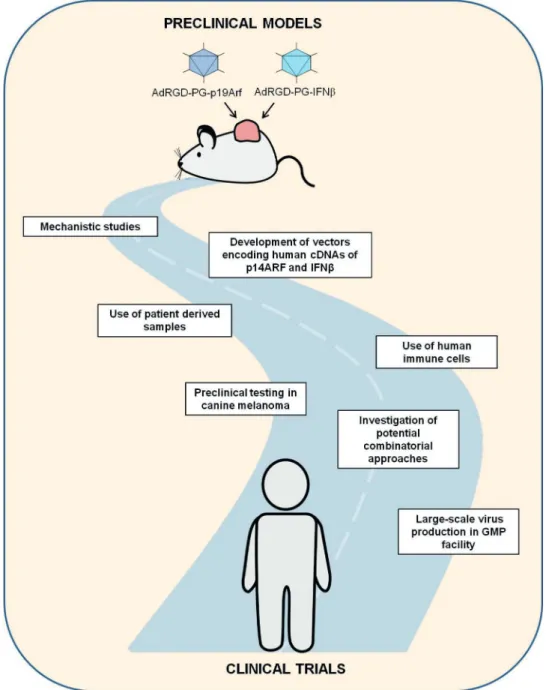
As described in the following sections, we are looking forward to the next phase of our investigation where we face the challenge of further developing our approach and incor-porating more clinically relevant models. In other words, we are poised to advance on our journey along translational research (Figure 1). We are concerned with the interactions of the p19Arf+IFNb gene transfer approach with respect to
Figure 1 -Schematic representation of the challenges and perspectives of continuing along the road of translational research. Critical
not only the tumor cell response but also the impact on the tumor microenvironment. While the use of mouse models aids in such studies, especially when the immune response is to be examined, it is critical to determine the behavior of human tumor cells and even the activation of human immune cells upon p14ARF + human IFNb (hIFNb) gene transfer. Another critical step towards the preclinical evalua-tion of our immunotherapeutic approach involves the use of alternative models of tumor treatment.
Potential impact of p19Arf +IFNb on tumor angiogenesis
Since both the p53/Arf and IFN pathways are known to impact the tumor microenvironment, the study of such interactions may show the potential of our gene therapy approach in inhibiting angiogenesis and possibly metastasis. Tumor cells, nontumor cells, and noncellular components are partners working together for the survival of solid cancers (36). Nontumor cells are important components of the micro-environment, promoting tumorigenesis through a variety of cell types and mechanisms (37). The network of blood vessels is a critical component of the tumor microenvironment and provides oxygen, nutrients, immune surveillance and a route for metastasis, essentially fueling tumorigenesis (38). Failure of many cancer treatments can be explained, in part, by mechanisms that include poor biodistribution of drugs and an unfavorable tumor microenvironment (39). Thus, the impact of novel treatments on the tumor microenvironment must not be overlooked.
In addition to the well-known tumor suppressor activity of p53, its influence can reach beyond the single tumor cell (40). Depending on whether it is wild type or mutant, the p53 protein can modulate the extracellular matrix (41,42) and induce the secretion of proinflammatory proteins (43-45) and lactate, resulting in the acidification of the tumor boundary (46,47). p53 also coordinates the crosstalk between cancer and noncancer cells (48,49).
A p53-dependent and independent role for p19Arf in the angiogenic switch has been shown to accelerate tumor growth (50). Alternatively, p14ARF can sequester hypoxia-inducible factor 1a(HIF-1a), thus inhibiting HIF-1 transacti-vation in a p53-independent manner (51). Notably, p14ARF has been shown to suppress angiogenesis by blocking the translation of the vascular endothelial growth factor (VEGF)-A transcript (52). Thus, (VEGF)-Arf can play a role in inhibiting tumor angiogenesis.
Type I IFNs are also recognized for their ability to block angiogenesis (28). For example, IFNb has been shown to upregulate inducible nitric oxide synthase (iNOS), thus blocking angiogenesis and tumor progression in a xenograft model of human prostate carcinoma (53). IFNa and IFNb
have also been shown to block the production of essential mediators of angiogenesis, including basic fibroblast growth factor (bFGF), VEGF and interleukin (IL)-8 (28). Thus, each of the central players in our gene transfer approach may nega-tively impact tumor angiogenesis, but this point remains to be experimentally tested.
Gearing up for the study of p14ARF +hIFNbgene transfer in human cells
Despite good results in preclinical models, many promis-ing candidate drugs do not successfully cross the bridge between the bench and bedside (54). As discussed above,
the combined p19Arf+IFNbgene transfer approach
trig-gered cell death mechanisms with remarkable immunogenic features, leading to reduced tumor burden and increased survival in animal models, which are desirable character-istics for any cancer therapeutics in development. Although our gene transfer approach seems promising, the transla-tion of these results from mouse models to human cells represents a major step forward toward clinical relevance.
Mice and humans share many functional gene sequences but greatly diverge with respect to transcriptional regulation (55). Reliance on mouse models to predict human physiology and response to therapy is severely limited, and a critical step in closing this gap is the inclusion of studies performed in human cells. While patient-derived xenograft (PDX) models may be preferred (56), the use of established cell lines comes with ease of use and a wealth of knowledge in the literature about their genotype and response to various treatments. For example, a variety of human melanoma cell lines with distinct genotypes, especially with respect to p53, are widely available. Nonetheless, the transition to human cell lines comes with an additional task with respect to our gene transfer approach. The cellular response to IFNbis species specific; that is, mouse cells treated with human IFNb, or vice versa, will produce
distinct antiproliferative responses (57). Thus, we have to be particularly careful to match the cDNA encoded in the vectors with the species being treated. The assays described for B16 and LLC cells above used only mouse cDNA. To initiate tests in human cells, a new set of vectors harboring human pro-tein coding sequences must be constructed. Human cDNA (p14ARF and hIFNb) encoded by the p53-responsive
ade-noviral vectors and applied to human melanoma cell lines creates the opportunity to test the induction of cell death, cooperation between the p53/Arf and IFN pathways and the mechanism of cell death. Since human melanoma cell lines are known to harbor either wild-type or mutant p53, we would also have the opportunity to explore the specific role of p53 in our gene transfer approach. For this, an addi-tional set of vectors encoding human cDNA, with expres-sion under the control of the constitutive CMV promoter, will be required.
The new vector constructs encoding human cDNA with either constitutive or p53-dependent expression will enable a deeper investigation of the molecular basis of the approach, including their behavior in cell culture and immunodeficient animals, the study of the contribution of p53 to the cellular response, and, possibly, their combined use with pharma-cotherapeutic approaches.
Seeking clinical relevance: use of patient-derived tumor samples
these cells can be inoculated into immunocompromised animals to generate xenografts, which may be either hetero-topic or orthohetero-topic, providing the opportunity to study these cellsin vivo(62).
While models based on human cell lines in monolayer cultures and their corresponding xenografts are widely used in cancer research, many limitations exist regarding this approach. Human cancers are known to have extremely heterogeneous cell populations comprising both neoplastic cells and stromal cells that actively contribute to tumor progression (63-66). Additionally, samples derived from different patients have unique sets of mutations, leading to differences in several signaling pathways and individual series of carcinogenic events (67). The establishment and propagation of these cell lines over time imply that only certain subpopulations will be selected, and the resulting clonality may not be representative of the original tumor heterogeneity (67,68). Therefore, the number of effective therapeutic tools that emerge from studies using cultured patient-derived cells is still small (59,69).
In contrast, PDXs involve the implantation of tumor tissues from patients directly into immunocompromised recipient mice (70). Unlike cancer cell lines, PDX models do not requirein vitroculture steps, thus avoiding the selection
of distinct cell populations and the exclusion of stromal components. The in situ physiological conditions encoun-tered by these grafted cells in host mice, such as oxygen pressure, nutrients and metabolites, are similar to those found at the site of the patient’s primary tumor. Experi-mental data suggest that overall genomic and gene expres-sion profiles of PDXs are representative of the patients of origin and are stable throughout sequential in vivo genera-tions (71).
Taking this into account, the establishment of each PDX is individually performed, preserving intra- and intertumor heterogeneity and providing a clear advantage when used for oncologic drug discovery and preclinical development (72). Evidence in the literature indicates success in predicting personalized anticancer treatments previously investiga-ted using PDX models (73-75). Through the PDX approach, mutations in melanoma have been mapped in more detail, which provides complementary diagnostic data with greater predictive power to indicate the therapeutic approach to be adopted (76,77).
Another important feature recapitulated by the PDX model is the maintenance of a three-dimensional (3D) arr-angement. Cells grown on a flat surface differ greatly from their 3D counterpartsin vivobecause of reduced cell-cell and extracellular matrix-cell interactions, a limitation already encountered with the traditional model of cancer cell lines (78-80). However, the culture model in 3D environments represents an intermediate approach between traditional cell culture and animal models, since it largely recapitulates the architecture of tissuesin vivo(81-83).
Given that samples from patients are generally scarce and difficult to obtain, the use of 3D culture models enable the use of traditional cancer cell lines, prior to PDX models, for the standardization of viral infection kinetics, pharmacoki-netics, molecular biology, biochemistry and imaging techniques. In addition, 3D cultures are less costly and labor-intensive than animal studies and should be prioritized at a preliminary stage. Experimental data show that the pattern of gene expression, mRNA splicing, intracellular signaling, cytoskeletal organiza-tion and secreorganiza-tion profile of cells grown in 3D cultures more
closely resemble what is observedin vivothan when grown
in two-dimensional (2D) cultures (84-88).
Initially, 3D cell cultures were derived from breast devel-opment studies and breast cancer models (89). Later, these methods were adapted for a variety of cells derived from different organ systems (90). Melanoma spheroids grafted in collagen gel matrix reproduce the architecture of a tumor encountered in vivo, including a gradient of oxygen and nutrients and a hypoxic and necrotic central zone (90,91). In this model, tumor heterogeneity is recreated in a manner similar to that found in patients, where only cells growing at the periphery have differential activity of the extracellular signal-regulated kinase (ERK). Consequently, small-molecule inhibitors of the mitogen-activated protein kinase (MAPK) pathway do not affect cells in the core of the spheroid (92,93). This observation highlights important implications that must be considered for the translation of novel targets for future therapies, both in terms of molecular responses and biodistri-bution of therapeutic agents, including adenoviral vectors.
Another important consequence of cell culture in a 3D environment is the enrichment of‘cancer stem cell’
subpopu-lations (94). Cancer stem cells represent rare subpopusubpopu-lations that have important characteristics including the capacity for autorenewal, tumor initiation and increased resistance to chemotherapy. Evidence suggests that cancer stem cells are the main cell type responsible for metastasis and tumor repopulation after debulking in response to chemotherapy (95-98). In 3D models of melanoma, a valuable strategy for obtaining, and consequently studying, this subpopulation is to culture melanocytes over extended periods of time in modified culture media (99). The use of these strategies contributes to physiologically relevant findings and greater chances of success in clinical trials.
Ex vivomodels for the activation of human
immune cells
Since our strategy relies on not only the induction of tumor cell death but also the potential modulation of the tumor microenvironment, especially the tumor immune environ-ment, it is crucial to investigate this interaction. As long as we use syngeneic mouse models, such assays are readily available. However, the transition to human models, includ-ing established cell lines or primary tumor samples, gives rise to a critical issue when considering tumor-immune interactions.In vivomodels where human cells are implanted
in mice create a situation where immunodeficient animals are necessary to minimize species incompatibility as described above, although this also means that the immune response cannot be evaluated. While mouse models with a humanized immune system are available, they are quite complex and associated with limitations in the emulated immune response (100). Alternatively,in vitro models permit the evaluation of
specific aspects of the interaction between human immune cells and human tumor cells that have undergone some manipulation, such as gene transfer. Although such ex vivo
to established cell lines or primary samples. To model DC activation, we isolate mononucleated cells from blood and culture them with GM-CSF and IL-4 to induce the dif-ferentiation of monocytes to DCs. At that point, it is possible to modulate the maturation of the DCs by co-culture with previously treated tumor cells. A mature DC is expected to express co-stimulatory CD80, CD86, CD83 and MHC-II molecules. The state of maturation is thought to be dependent on the kind, duration and intensity of stimuli given to dif-ferentiated DCs
In addition to the characterization of mature DCs based on their immunophenotype, it is crucial to assess their ability to activate naïve T cells, as DCs are known to induce the T cell activation, marked by increased proliferation and change in differentiation markers such as CD4, CD8, Foxp3, RORgt, GATA-3 and T-bet. The activated T cells can then be co-cultured with tumor cells in vitro to induce tumor cell cytolysis and T cell proliferation. Ultimately, these activated T cells can be transplanted into immunosuppressed tumor-bearing mice used to generate the mature DCs to enable the assessment of T cell homing to the tumor and the induction of tumor cell death. Thus, the cancer-immunity cycle can be explored, although some adaptations may be necessary.
A critical issue when usingex vivomodels of DC and T cell
activation is the donor source used to acquire these cells. To minimize immune differences, the tumor, DC and T cells should come from the same patient. Nevertheless, DCs from cancer patients have been shown to generate a T cell response associated with increased regulatory T (Treg) cells (101). Moreover, the fusion of DCs with cancer cells has been shown to be superior to simple mixing of DCs with tumor cells in a vaccine model (102). Thus, the experimental design may greatly influence the result obtained with respect to both DC and T cell activation and functional assessment.
Beyond the mouse: preclinical testing of gene therapy in canine melanoma
Few animal models recapitulate the entire cancer devel-opmental process, starting with benign neoplasms, progres-sing to primary tumors and giving rise to metastases. Most murine models of human cancer involve the investigation of certain aspects of the complex interactions among the tumor, host and therapeutic modalities. As described above, we face difficult choices between established mouse or human cell lines and patient-derived cells since each of these cells has a different genetic profile. In addition, we encounter a serious limitation when human cells are implanted in immunodefi-cient mice. However, the study of cancer in dogs represents an important strategy in translational oncology. Spontaneous cancer can develop in dogs due to their relatively long life expectancy and exposure to environmental conditions that are similar to those experienced by humans (103,104). Dogs also have a complex immune system, including mature immune development accompanied by typical Treg cell responses (105).
In dogs, melanoma is the malignancy most commonly found on the digits and in the oral cavity. Canine and human melanomas share histological and biological similarities, including cell morphology, disease progression and response to therapies. Similar to human melanomas, canine melano-mas are chemoresistant tumors (106).
Although not completely understood, the pathogenesis of canine melanoma involves the loss of function of tumor
suppressor proteins, such as PTEN and p16/INK4a, common alterations that contribute to the origin of this cancer in both dogs and humans (107). BRAF is mutated in more than 56% of human cutaneous melanoma (108), but low rates of mutations of this gene are described in canine (109) and human mucosal melanoma (110). Both canine and human mucosal melanoma show the activation of cancer-related signaling pathways, such as AKT and MAPK, and are sen-sitive to the inhibition of these pathways (111).
These biological similarities between canine and human tumors may be responsible for the observed concordance in treatment responses. In veterinary medicine, many of the chemotherapy protocols are based on those used to treat humans (112). Moreover, sequencing of the canine genome was recently completed, and assay reagents and platforms are now commercially available, creating an opportunity to investigate tumor biology and drug response in dogs (113). Therefore, spontaneously occurring tumors in dogs may be considered preclinical models.
Various clinical trials of cancer therapies performed in dogs complement the use of the typically used murine cancer models for the development of new treatments (105,114-116). For example, gene therapy using herpes simplex virus TK and canine IFNb combined with a subcutaneously
deli-vered cellular vaccine expressing human IL-2 and GM-CSF significantly prolonged disease-free and overall survival while maintaining the quality of life of dogs with melanoma (117). In another study, the administration of the adenovector CD40L in stage III canine oral melanoma resulted in com-plete remission with 2 intratumor injections before cytor-eductive surgery (118).
For both veterinary patients and their owners, this is an opportunity to participate in clinical trials of experimental therapies. However, for humans, these trials in veterinary patients are considered preclinical tests. This situation is referred to as a co-clinical trial, where the same drug is tested in both human and canine patients who have the same tumor type or mutation spectrum (105). With regards to gene therapy, co-clinical trials provide a unique opportunity to reveal mechanisms of pathogenesis and to identify correla-tions between outcomes in canines and humans.
Clinical trials in pets must be performed with informed consent of their owners and must be approved by an accre-dited animal care institute. The scientific motivation and translational study must be balanced in relation to the ethical and clinical perceptions of animal care. In general, pet dogs are treated in studies with designs that are similar to those used in clinical trials in human. However, the historical con-ventions of phase I, II and III studies may be less rigid while focus is maintained on developing the technical and bio-logical aspects of the treatment strategy (119).
In the future, it is reasonable to expect clinical researchers will view naturally occurring cancers in dogs and other ani-mals as complementary models to the translational study of new therapies. This approach may provide early toxicity detection, optimization of clinical trial design, reduction of costs and improvement in the future care of both canine and human cancer patients.
Potential combinatorial approaches involving the p19Arf+IFNb immunotherapy
encoding p14ARF and IFNb under conditions that more
closely resemble human cancer, it is reasonable to presume that future translational approaches will most likely be applied in combination with other treatment modalities, a practice well established in the clinic for chemo, radio and targeted therapies (120) and notably underscored by the combined use of CTLA-4 and PD-1 checkpoint blockers (121).
Indeed, in view of the synergistic results obtained with dual CTLA-4 and PD-1 blockade in melanoma, their com-bined use was rapidly approved by the FDA and has highlighted the capability of targeting multiple immune pathways to provide benefit for patients who otherwise would not respond to cancer immunotherapy (122). Combi-natorial approaches are also expected to circumvent acquired immunological resistance mechanisms and fuel the field of immunotherapy to move steadily forward (122).
However, caution is warranted, as, along with improved therapeutic results, there is a price to pay when targeting multiple checkpoint modulators, with an increase in auto-immunity and a series of immune-related adverse events (123). Although in the case of p19Arf+IFNbgene transfer,
we have not observed any signs of an autoimmune response, such as vitiligo in the melanoma model, we cannot rule out the possibility that such responses may be generated. New therapies, including ours, will require careful optimization and development to avoid these toxicities while still induc-ing antitumor immunity.
In fact, combinatorial strategies employing current and novel immunotherapeutic modulators and their mechanisms of action are being intensively studied in both preclinical and clinical settings (122). Furthermore, regarding the potential combinatorial approaches for our vectors, the immunomo-dulatory functions exerted by IFNbare likely a critical target
to be exploited. For example, in melanoma, a type I IFN signature correlated with CD8+T cell infiltration and IFNb
production by tumor-associated DCs has been shown to be critical for mediating antitumor immunity (124) This func-tion may prove to be particularly useful for the so-called cold tumors, which, in response tob-catenin signaling, lack the production of CCL4 and fail to recruit CD103+DCs and
produce IFNb within the tumor microenvironment and,
consequently, are deprived of the CXCL9/10 chemokines that drive T cell influx (125). Accordingly, these nonin-flamed tumors represent a challenge that current immu-notherapeutic strategies have not yet been able to successfully target. Moreover, type I IFNs are notorious for increasing the expression of MHC-I molecules on tumor cells (126). Therefore, if we were to consider the disruption in the MHC-I pathway as a hallmark of immune evasion and therapy inefficacy (127), the use of IFNb, especially under
conditions where its expression levels and dynamics are controlled, could render tumor cells visible to the immune system, avoiding primary resistance to subsequent combi-natorial immunotherapies.
In addition to these immunomodulatory functions, type I IFNs can promote different inhibitory mechanisms to regu-late the amplitude and duration of the response, including the production of the indoleamine 2,3-dioxygenase (IDO) enzyme and, of special interest to our group, the expression of PD-L1 in both tumors and tumor-infiltrating immune cells (28,126). Although these inhibitory pathways may seem as an impediment to our therapeutic approach at first, we hypothesize that they actually create a potential opportunity for us to combine checkpoint modulators with our treatment
regimen and ensure effective targeting of the IFNb-mediated
immunity cycle.
Combinatorial approaches can also augment cell death or even modulate pathways involved in ICD, potentially circumventing intrinsic defects or genetic alterations that may affect the ability of treated cells to elicit optimal anti-tumor immunity upon p19Arf + IFNb gene transfer. For
example, the use of other ICD inducers, such as doxorubicin and mitoxantrone chemotherapy, could be an interesting approach to induce caspase 3 activity along with the p19Arf+
IFNbnecroptotic cell death and to change a resistant/non-ICD
scenario to abona fide ICD or remediate the capability of some agents to trigger ER stress responses, autophagy-dependent accumulation of ATP and HMGB1 release from the nucleus (128).
Our gene transfer approach promotes cell death and immune stimulation, thus creating a variety of opportunities for us to explore and optimize various aspects, including the development of vaccination strategies and the direct applica-tion of our vectors into the tumor mass. Nevertheless, many key aspects remain to be investigated, most importantly, the use of patient-derived tumor and immune cells to validate the evidence gathered from mouse models and the explora-tion of tumor responses in alternative models, such as spon-taneously arising cancers in dogs. In terms of technological development, the production of viruses of pharmaceutical quality, that is, by following good manufacturing practices (GMP), is a critical step that is not currently available in Brazil. Nonetheless, the know-how required to conduct preclinical studies and clinical trials is readily available in our community and may be further supported by interna-tional collaborations.
The translational road ahead of us is long but certainly exciting. The goal of translational medicine is to evaluate therapeutic strategies that are successfully developed in preclinical models in clinical trials performed in humans. In addition, although we envision it as a straightforward path, the translational road should be seen as a two way road, with exchange of information between the bench and bedside, and vice versa. In this regard, it is critical that a multidisciplinary team of basic and clinical scientists work together to ensure that a clinically relevant and viable approach is developed as we progress along the road of translational research.
’ ACKNOWLEDGMENTS
This research was supported by grants from FAPESP (IVL, 2016/18197-3; MGL, 2012/05066-7; PRDV, 2013/16074-3; RFVM, 2013/09474-5; and BES, 2013/25167-5, 2015/26580-9).
’ AUTHOR CONTRIBUTIONS
Strauss BE, Silva GR, Vieira IL, Cerqueira OL, Del Valle PR, Medrano RF and Mendonc¸a SA wrote and reviewed the text. Medrano RF designed
thefigure.
’ REFERENCES
1. Hanahan D, Weinberg RA. Hallmarks of cancer: the next generation. Cell. 2011;144(5):646-74.
2. Schreiber RD, Old LJ, Smyth MJ. Cancer immunoediting: integrating immunity’s roles in cancer suppression and promotion. Science. 2011; 331(6024):1565-70, http://dx.doi.org/10.1126/science.1203486. 3. Mittal D, Gubin MM, Schreiber RD, Smyth MJ. New insights into cancer
4. Chen DS, Mellman I. Oncology meets immunology: the cancer-immunity cycle. Immunity. 2013;39(1):1-10, http://dx.doi.org/10.1016/j.immuni. 2013.07.012.
5. Galluzzi L, Kepp O, Chan FK, Kroemer G. Necroptosis: Mechanisms and Relevance to Disease. Annu Rev Pathol. 2017;12:103-30, http://dx.doi. org/10.1146/annurev-pathol-052016-100247.
6. Prasad V. Immunotherapy: Tisagenlecleucel - the first approved CAR-T-cell therapy: implications for payers and policy makers. Nat Rev Clin Oncol. 2018;15(1):11-2, http://dx.doi.org/10.1038/nrclinonc.2017.156. 7. Rehman H, Silk AW, Kane MP, Kaufman HL. Into the clinic: Talimogene
laherparepvec (T-VEC), a first-in-class intratumoral oncolytic viral ther-apy. J Immunother Cancer. 2016;4:53, http://dx.doi.org/10.1186/s40425-016-0158-5.
8. Aguilar LK, Guzik BW, Aguilar-Cordova E. Cytotoxic immunotherapy strategies for cancer: mechanisms and clinical development. J Cell Bio-chem. 2011;112(8):1969-77, http://dx.doi.org/10.1002/jcb.23126. 9. Westphal M, Ylä-Herttuala S, Martin J, Warnke P, Menei P, Eckland D,
et al; ASPECT Study Group. Adenovirus-mediated gene therapy with sitimagene ceradenovec followed by intravenous ganciclovir for patients with operable high-grade glioma (ASPECT): a randomised, open-label, phase 3 trial. Lancet Oncol. 2013;14(9):823-33, http://dx. doi.org/10.1016/S1470-2045(13)70274-2.
10. Chandran M, Candolfi M, Shah D, Mineharu Y, Yadav VN, Koschmann C, et al. Single vs. combination immunotherapeutic strategies for glioma. Expert Opin Biol Ther. 2017;17(5):543-54, http://dx.doi.org/10.1080/ 14712598.2017.1305353.
11. Ostertag D, Amundson KK, Lopez Espinoza F, Martin B, Buckley T, Galvão da Silva AP, et al. Brain tumor eradication and prolonged sur-vival from intratumoral conversion of 5-fluorocytosine to 5-fluorouracil using a nonlytic retroviral replicating vector. Neuro Oncol. 2012;14(2): 145-59, http://dx.doi.org/10.1093/neuonc/nor199.
12. Cloughesy TF, Landolfi J, Hogan DJ, Bloomfield S, Carter B, Chen CC, et al. Phase 1 trial of vocimagene amiretrorepvec and 5-fluorocytosine for recurrent high-grade glioma. Sci Transl Med. 2016;8(341):341ra75, http://dx.doi.org/10.1126/scitranslmed.aad9784.
13. Zilfou JT, Lowe SW. Tumor suppressive functions of p53. Cold Spring Harb Perspect Biol. 2009;1(5):a001883, http://dx.doi.org/10.1101/ cshperspect.a001883.
14. Beckerman R, Prives C. Transcriptional regulation by p53. Cold Spring Harb Perspect Biol. 2010;2(8):a000935, http://dx.doi.org/10.1101/ cshperspect.a000935.
15. Wang S, Zhao Y, Aguilar A, Bernard D, Yang CY. Targeting the MDM2-p53 Protein-Protein Interaction for New Cancer Therapy: Progress and Challenges. Cold Spring Harb Perspect Med. 2017;7(5): pii: a026245.
16. Giglia-Mari G, Sarasin A. TP53 mutations in human skin cancers. Hum Mutat. 2003;21(3):217-28, http://dx.doi.org/10.1002/humu.10179. 17. Polsky D, Bastian BC, Hazan C, Melzer K, Pack J, Houghton A, et al.
HDM2 protein overexpression, but not gene amplification, is related to tumorigenesis of cutaneous melanoma. Cancer Res. 2001;61(20):7642-6. 18. Sharpless E, Chin L. The INK4a/ARF locus and melanoma. Oncogene.
2003;22(20):3092-8, http://dx.doi.org/10.1038/sj.onc.1206461. 19. Bajgelman MC, Strauss BE. Development of an adenoviral vector with
robust expression driven by p53. Virology. 2008;371(1):8-13, http://dx. doi.org/10.1016/j.virol.2007.11.015.
20. Tamura RE, da Silva Soares RB, Costanzi-Strauss E, Strauss BE. Autoregulated expression of p53 from an adenoviral vector confers superior tumor inhibition in a model of prostate carcinoma gene therapy. Cancer Biol Ther. 2016;17(12):1221-30, http://dx.doi.org/ 10.1080/15384047.2016.1235655.
21. Strauss BE, Bajgelman MC, Costanzi-Strauss E. A novel gene transfer strategy that combines promoter and transgene activities for improved tumor cell inhibition. Cancer Gene Ther. 2005;12(12):935-46, http://dx. doi.org/10.1038/sj.cgt.7700846.
22. Bajgelman MC, Medrano RF, Carvalho AC, Strauss BE. AAVPG: a vig-ilant vector where transgene expression is induced by p53. Virology. 2013;447(1-2):166-71, http://dx.doi.org/10.1016/j.virol.2013.09.004. 23. Strauss BE, Costanzi-Strauss E. pCLPG: a p53-driven retroviral system.
Virology. 2004;321(2):165-72, http://dx.doi.org/10.1016/j.virol.2003.12.021. 24. Bajgelman MC, Dos Santos L, Silva GJJ, Nakamuta J, Sirvente RA,
Chaves M, et al. Preservation of cardiac function in left ventricle cardiac hypertrophy using an AAV vector which provides VEGF-A expression in response to p53. Virology. 2015;476:106-14, http://dx.doi.org/10.1016/ j.virol.2014.12.009.
25. Merkel CA, da Silva Soares RB, de Carvalho AC, Zanatta DB, Bajgelman MC, Fratini P, et al. Activation of endogenous p53 by combined p19Arf gene transfer and nutlin-3 drug treatment modalities in the murine cell lines B16 and C6. BMC Cancer. 2010;10:316, http://dx.doi.org/10.1186/ 1471-2407-10-316.
26. Takaoka A, Hayakawa S, Yanai H, Stoiber D, Negishi H, Kikuchi H, et al. Integration of interferon-alpha/beta signalling to p53 responses in tumour suppression and antiviral defence. Nature. 2003;424(6948):516-23, http://dx.doi.org/10.1038/nature01850.
27. Sandoval R, Xue J, Pilkinton M, Salvi D, Kiyokawa H, Colamonici OR. Different requirements for the cytostatic and apoptotic effects of type I interferons. Induction of apoptosis requires ARF but not p53 in osteo-sarcoma cell lines. J Biol Chem. 2004;279(31):32275-80, http://dx.doi. org/10.1074/jbc.M313830200.
28. Medrano RFV, Hunger A, Mendonc¸a SA, Barbuto JAM, Strauss BE.
Immunomodulatory and antitumor effects of type I interferons and their application in cancer therapy. Oncotarget. 2017;8(41):71249-84, http:// dx.doi.org/10.18632/oncotarget.19531.
29. Merkel CA, Medrano RF, Barauna VG, Strauss BE. Combined p19Arf and interferon-beta gene transfer enhances cell death of B16 melanoma in vitro and in vivo. Cancer Gene Ther. 2013;20(5):317-25, http://dx.doi. org/10.1038/cgt.2013.23.
30. Mizuguchi H, Koizumi N, Hosono T, Utoguchi N, Watanabe Y, Kay MA, et al. A simplified system for constructing recombinant adenoviral vec-tors containing heterologous peptides in the HI loop of their fiber knob. Gene Ther. 2001;8(9):730-5, http://dx.doi.org/10.1038/sj.gt.3301453. 31. Hunger A, Medrano RF, Strauss BE. Harnessing combined p19Arf and
interferon-beta gene transfer as an inducer of immunogenic cell death and mediator of cancer immunotherapy. Cell Death Dis. 2017;8(5):e2784, http://dx.doi.org/10.1038/cddis.2017.201.
32. Hunger A, Medrano RF, Zanatta DB, Del Valle PR, Merkel CA, Salles TA,
et al. Reestablishment of p53/Arf and interferon-bpathways mediated
by a novel adenoviral vector potentiates antiviral response and immu-nogenic cell death. Cell Death Discov. 2017;3:17017, http://dx.doi.org/ 10.1038/cddiscovery.2017.17.
33. Medrano RF, Catani JP, Ribeiro AH, Tomaz SL, Merkel CA, Costanzi-Strauss E, et al. Vaccination using melanoma cells treated with p19arf and interferon beta gene transfer in a mouse model: a novel combination for cancer immunotherapy. Cancer Immunol Immunother. 2016;65(4): 371-82, http://dx.doi.org/10.1007/s00262-016-1807-8.
34. Catani JPP, Medrano RFV, Hunger A, Del Valle P, Adjemian S, Zanatta
DB, et al. Intratumoral Immunization by p19Arf and Interferon-bGene
Transfer in a Heterotopic Mouse Model of Lung Carcinoma. Transl Oncol. 2016;9(6):565-74, http://dx.doi.org/10.1016/j.tranon.2016.09.011. 35. Medrano RFV, Hunger A, Catani JPP, Strauss BE. Uncovering the
immunotherapeutic cycle initiated by p19Arf and interferon-bgene
transfer to cancer cells: An inducer of immunogenic cell death. Oncoimmunology. 2017;6(7):e1329072, http://dx.doi.org/10.1080/ 2162402X.2017.1329072.
36. Chen F, Zhuang X, Lin L, Yu P, Wang Y, Shi Y, Hu G, Sun Y. New horizons in tumor microenvironment biology: challenges and opportunities. BMC Med. 2015;13:45, http://dx.doi.org/10.1186/s12916-015-0278-7.
37. Wang M, Zhao J, Zhang L, Wei F, Lian Y, Wu Y, et al. Role of tumor microenvironment in tumorigenesis. J Cancer. 2017; 8(5):761-73, http:// dx.doi.org/10.7150/jca.17648.
38. Carmeliet P. Angiogenesis in health and disease. Nat Med. 2003;9(6): 653-60, http://dx.doi.org/10.1038/nm0603-653.
39. Junttila MR, de Sauvage FJ. Influence of tumour micro-environment heterogeneity on therapeutic response. Nature. 2013;501(7467):346-54, http://dx.doi.org/10.1038/nature12626.
40. Muller PA, Vousden KH. p53 mutations in cancer. Nat Cell Biol. 2013; 15(1):2-8, http://dx.doi.org/10.1038/ncb2641.
41. Sun Y, Cheung JM, Martel-Pelletier J, Pelletier JP, Wenger L, Altman RD, et al. Wild type and mutant p53 differentially regulate the gene expres-sion of human collagenase-3 (hMMP-13). J Biol Chem. 2000;275(15): 11327-32, http://dx.doi.org/10.1074/jbc.275.15.11327.
42. Petignat P, Laurini R, Goffin F, Bruchim I, Bischof P. Expression of matrix metalloproteinase-2 and mutant p53 is increased in hydatidiform mole as compared with normal placenta. Int J Gynecol Cancer. 2006;16(4): 1679-84, http://dx.doi.org/10.1111/j.1525-1438.2006.00643.x.
43. Lujambio A, Akkari L, Simon J, Grace D, Tschaharganeh DF, Bolden JE, et al. Non-cell-autonomous tumor suppression by p53. Cell. 2013;153(2): 449-60, http://dx.doi.org/10.1016/j.cell.2013.03.020.
44. Yeudall WA, Wrighton KH, Deb S. Mutant p53 in cell adhesion and motility. Methods Mol Biol. 2013;962:135-46, http://dx.doi.org/10.1007/ 978-1-62703-236-0.
45. Scian MJ, Stagliano KE, Anderson MA, Hassan S, Bowman M, Miles MF, et al. Tumor-derived p53 mutants induce NF-kappaB2 gene expression. Mol Cell Biol. 2005;25(22):10097-110, http://dx.doi.org/10.1128/MCB. 25.22.10097-10110.2005.
46. Zhang C, Liu J, Liang Y, Wu R, Zhao Y, Hong X, et al. Tumour-associated mutant p53 drives the Warburg effect. Nat Commun. 2013;4:2935, http://dx.doi.org/10.1038/ncomms3935.
47. Zhang C, Lin M, Wu R, Wang X, Yang B, Levine AJ, et al. Parkin, a p53 target gene, mediates the role of p53 in glucose metabolism and the Warburg effect. Proc Natl Acad Sci U S A. 2011;108(39):16259-64, http:// dx.doi.org/10.1073/pnas.1113884108.
48. Fontemaggi G, Dell’Orso S, Trisciuoglio D, Shay T, Melucci E, Fazi F,
49. Caunt M, Hu L, Tang T, Brooks PC, Ibrahim S, Karpatkin S. Growth-regulated oncogene is pivotal in thrombin-induced angiogenesis. Cancer Res. 2006;66(8):4125-32, http://dx.doi.org/10.1158/0008-5472.CAN-05-2570.
50. Ulanet DB, Hanahan D. Loss of p19(Arf) facilitates the angiogenic switch and tumor initiation in a multi-stage cancer model via p53-dependent and independent mechanisms. PLoS One. 2010;5(8):e12454, http://dx. doi.org/10.1371/journal.pone.0012454.
51. Fatyol K, Szalay AA. The p14ARF tumor suppressor protein facilitates nucleolar sequestration of hypoxia-inducible factor-1alpha (HIF-1alpha) and inhibits HIF-1-mediated transcription. J Biol Chem. 2001;276(30): 28421-9, http://dx.doi.org/10.1074/jbc.M102847200.
52. Kawagishi H, Nakamura H, Maruyama M, Mizutani S, Sugimoto K, Takagi M, et al. ARF suppresses tumor angiogenesis through transla-tional control of VEGFA mRNA. Cancer Res. 2010;70(11):4749-58, http://dx.doi.org/10.1158/0008-5472.CAN-10-0368.
53. Cao G, Su J, Lu W, Zhang F, Zhao G, Marteralli D, et al. Adenovirus-mediated interferon-beta gene therapy suppresses growth and metas-tasis of human prostate cancer in nude mice. Cancer Gene Ther. 2001; 8(7):497-505, http://dx.doi.org/10.1038/sj.cgt.7700333.
54. Adams DJ. The Valley of Death in anticancer drug development: a reassessment. Trends Pharmacol Sci. 2012;33(4):173-80, http://dx.doi. org/10.1016/j.tips.2012.02.001.
55. Yue F, Cheng Y, Breschi A, Vierstra J, Wu W, Ryba T, et al; Mouse ENCODE Consortium. A comparative encyclopedia of DNA elements in the mouse genome. Nature. 2014;515(7527):355-64, http://dx.doi.org/ 10.1038/nature13992.
56. Morton JJ, Bird G, Keysar SB, Astling DP, Lyons TR, Anderson RT, et al. XactMice: humanizing mouse bone marrow enables microenvironment reconstitution in a patient-derived xenograft model of head and neck cancer. Oncogene. 2016;35(3):290-300, http://dx.doi.org/10.1038/ onc.2015.94.
57. Qin XQ, Beckham C, Brown JL, Lukashev M, Barsoum J. Human and mouse IFN-beta gene therapy exhibits different anti-tumor mechanisms in mouse models. Mol Ther. 2001;4(4):356-64, http://dx.doi.org/10.1006/ mthe.2001.0464.
58. Johnson JI, Decker S, Zaharevitz D, Rubinstein LV, Venditti JM, Sche-partz S, et al. Relationships between drug activity in NCI preclinical in vitro and in vivo models and early clinical trials. Br J Cancer. 2001; 84(10):1424-31, http://dx.doi.org/10.1054/bjoc.2001.1796.
59. Sausville EA, Burger AM. Contributions of human tumor xenografts to anticancer drug development. Cancer Res. 2006;66(7):3351-4, http://dx. doi.org/10.1158/0008-5472.CAN-05-3627.
60. Maqsood MI, Matin MM, Bahrami AR, Ghasroldasht MM. Immortality of cell lines: challenges and advantages of establishment. Cell Biol Int. 2013;37(10):1038-45, http://dx.doi.org/10.1002/cbin.10137.
61. Shay JW, Wright WE, Werbin H. Defining the molecular mechanisms of human cell immortalization. Biochim Biophys Acta. 1991;1072(1):1-7. 62. Kim MP, Evans DB, Wang H, Abbruzzese JL, Fleming JB, Gallick GE.
Generation of orthotopic and heterotopic human pancreatic cancer xenografts in immunodeficient mice. Nat Protoc. 2009;4(11):1670-80, http://dx.doi.org/10.1038/nprot.2009.171.
63. MacDougall JR, Matrisian LM. Contributions of tumor and stromal matrix metalloproteinases to tumor progression, invasion and metastasis. Cancer Metastasis Rev. 1995;14(4):351-62, http://dx.doi.org/10.1007/ BF00690603.
64. Hwang RF, Moore T, Arumugam T, Ramachandran V, Amos KD, Rivera A, et al. Cancer-associated stromal fibroblasts promote pancreatic tumor progression. Cancer Res. 2008;68(3):918-26, http://dx.doi.org/10.1158/ 0008-5472.CAN-07-5714.
65. Olumi AF, Grossfeld GD, Hayward SW, Carroll PR, Tlsty TD, Cunha GR. Carcinoma-associated fibroblasts direct tumor progression of initiated human prostatic epithelium. Cancer Res. 1999;59(19): 5002-11. 66. Jamal-Hanjani M, Quezada SA, Larkin J, Swanton C. Translational
implications of tumor heterogeneity. Clin Cancer Res. 2015; 21(6):1258-66, http://dx.doi.org/10.1158/1078-0432.CCR-14-1429.
67. Daniel VC, Marchionni L, Hierman JS, Rhodes JT, Devereux WL, Rudin CM, et al. A primary xenograft model of small-cell lung cancer reveals irreversible changes in gene expression imposed by culture in vitro. Cancer Res. 2009;69(8):3364-73, http://dx.doi.org/10.1158/0008-5472. CAN-08-4210.
68. McGranahan N, Swanton C. Clonal heterogeneity and tumor evolution: Past, present, and the future. Cell. 2017;168(4):613-28, http://dx.doi.org/ 10.1016/j.cell.2017.01.018.
69. Hutchinson L, Kirk R. High drug attrition rates--where are we going wrong? Nat Rev Clin Oncol. 2011;8(4):189-90, http://dx.doi.org/10.1038/ nrclinonc.2011.34.
70. Morton CL, Houghton PJ. Establishment of human tumor xenografts in immunodeficient mice. Nat Protoc. 2007;2(2):247-50, http://dx.doi.org/ 10.1038/nprot.2007.25.
71. Reyal F, Guyader C, Decraene C, Lucchesi C, Auger N, Assayag F, et al. Molecular profiling of patient-derived breast cancer xenografts. Breast Cancer Res. 2012;14(1):R11, http://dx.doi.org/10.1186/bcr3095.
72. Cassidy JW, Caldas C, Bruna A. Maintaining Tumor Heterogeneity in Patient-Derived Tumor Xenografts. Cancer Res. 2015;75(15):2963-8, http://dx.doi.org/10.1158/0008-5472.CAN-15-0727.
73. Hidalgo M, Bruckheimer E, Rajeshkumar NV, Garrido-Laguna I, De Oliveira E, Rubio-Viqueira B, et al. A pilot clinical study of treatment guided by personalized tumorgrafts in patients with advanced cancer. Mol Cancer Ther. 2011;10(8):1311-6, http://dx.doi.org/10.1158/1535-7163.MCT-11-0233.
74. Herter-Sprie GS, Kung AL, Wong KK. New cast for a new era: preclinical cancer drug development revisited. J Clin Invest. 2013;123(9):3639-45, http://dx.doi.org/10.1172/JCI68340.
75. Julien S, Merino-Trigo A, Lacroix L, Pocard M, Goéré D, Mariani P, et al. Characterization of a large panel of patient-derived tumor xenografts representing the clinical heterogeneity of human colorectal cancer. Clin Cancer Res. 2012;18(19):5314-28, http://dx.doi.org/10.1158/1078-0432. CCR-12-0372.
76. Harris AL, Joseph RW, Copland JA. Patient-derived tumor xenograft models for melanoma drug discovery. Expert Opin Drug Discov. 2016; 11(9):895-906, http://dx.doi.org/10.1080/17460441.2016.1216968. 77. Pimiento JM, Larkin EM, Smalley KS, Wiersma GL, Monks NR,
Fedorenko IV, et al. Melanoma genotypes and phenotypes get personal. Lab Invest. 2013;93(8):858-67, http://dx.doi.org/10.1038/labinvest.2013.84. 78. Griffith LG, Swartz MA. Capturing complex 3D tissue physiology in vitro. Nat Rev Mol Cell Biol. 2006;7(3):211-24, http://dx.doi.org/ 10.1038/nrm1858.
79. Pampaloni F, Reynaud EG, Stelzer EH. The third dimension bridges the gap between cell culture and live tissue. Nat Rev Mol Cell Biol. 2007; 8(10):839-45, http://dx.doi.org/10.1038/nrm2236.
80. Jorgens DM, Inman JL, Wojcik M, Robertson C, Palsdottir H, Tsai WT, et al. Deep nuclear invaginations are linked to cytoskeletal filaments -integrated bioimaging of epithelial cells in 3D culture. J Cell Sci. 2017; 130(1):177-89, http://dx.doi.org/10.1242/jcs.190967.
81. O’Brien LE, Zegers MM, Mostov KE. Opinion: Building epithelial architecture: insights from three-dimensional culture models. Nat Rev Mol Cell Biol. 2002;3(7):531-7, http://dx.doi.org/10.1038/nrm859.
82. Abbott A. Cell culture: biology’s new dimension. Nature. 2003;
424(6951):870-2, http://dx.doi.org/10.1038/424870a.
83. Langhans SA. Three-dimensional in vitro cell culture models in drug discovery and drug repositioning. Frontiers in Pharmacology. 2018;9:e6, http://dx.doi.org/10.3389/fphar.2018.00006.
84. Roskelley CD, Desprez PY, Bissell MJ. Extracellular matrix-dependent tissue-specific gene expression in mammary epithelial cells requires both physical and biochemical signal transduction. Proc Natl Acad Sci U S A. 1994;91(26):12378-82, http://dx.doi.org/10.1073/pnas.91.26.12378. 85. Cukierman E, Pankov R, Stevens DR, Yamada KM. Taking cell-matrix
adhesions to the third dimension. Science. 2001; 294(5547):1708-12, http://dx.doi.org/10.1126/science.1064829.
86. Birgersdotter A, Sandberg R, Ernberg I. Gene expression perturbation in vitro--a growing case for three-dimensional (3D) culture systems. Semin Cancer Biol. 2005;15(5):405-12, http://dx.doi.org/10.1016/j.semcancer. 2005.06.009.
87. Li C, Gawandi V, Protos A, Phillips RS, Amster IJ. A matrix-assisted laser desorption/ionization compatible reagent for tagging tryptophan resi-dues. Eur J Mass Spectrom (Chichester). 2006;12(4):213-21, http://dx. doi.org/10.1255/ejms.814.
88. Ghosh S, Spagnoli GC, Martin I, Ploegert S, Demougin P, Heberer M, Reschner Three-dimensional culture of melanoma cells profoundly affects gene expression profile: a high density oligonucleotide array study. J Cell Physiol. 2005;204(2):522-31, http://dx.doi.org/10.1002/ jcp.20320.
89. Roskelley CD, Srebrow A, Bissell MJ. A hierarchy of ECM-mediated signaling regulates tissue-specific gene expression. Curr Opin Cell Biol. 1995;7(5):736-47, http://dx.doi.org/10.1016/0955-0674(95)80117-0. 90. Smalley KS, Lioni M, Noma K, Haass NK, Herlyn M. In vitro
three-dimensional tumor microenvironment models for anticancer drug dis-covery. Expert Opin Drug Discov. 2008;3(1):1-10, http://dx.doi.org/ 10.1517/17460441.3.1.1.
91. Beaumont KA, Mohana-Kumaran N, Haass NK. Modeling Melanoma In Vitro and In Vivo. Healthcare (Basel). 2013;2(1):27-46, http://dx.doi.org/ 10.3390/healthcare2010027.
92. Haass NK, Sproesser K, Nguyen TK, Contractor R, Medina CA, Nathanson KL, et al. The mitogen-activated protein/extracellular signal-regulated kinase kinase inhibitor AZD6244 (ARRY-142886) induces growth arrest in melanoma cells and tumor regression when combined with docetaxel. Clin Cancer Res. 2008;14(1):230-9, http://dx.doi.org/ 10.1158/1078-0432.CCR-07-1440.
93. Zhuang L, Lee CS, Scolyer RA, McCarthy SW, Palmer AA, Zhang XD, et al. Activation of the extracellular signal regulated kinase (ERK) pathway in human melanoma. J Clin Pathol. 2005;58(11): 1163-9, http:// dx.doi.org/10.1136/jcp.2005.025957.
95. Gupta PB, Chaffer CL, Weinberg RA. Cancer stem cells: mirage or reality? Nat Med. 2009;15(9):1010-2, http://dx.doi.org/10.1038/nm0909-1010. 96. Jordan CT, Guzman ML, Noble M. Cancer stem cells. N Engl J Med.
2006;355(12):1253-61, http://dx.doi.org/10.1056/NEJMra061808. 97. Yu J, Vodyanik MA, Smuga-Otto K, Antosiewicz-Bourget J, Frane JL,
Tian S, et al. Induced pluripotent stem cell lines derived from human somatic cells. Science. 2007;318(5858):1917-20, http://dx.doi.org/10.1126/ science.1151526.
98. Yu Z, Pestell TG, Lisanti MP, Pestell RG. Cancer stem cells. Int J Biochem Cell Biol. 2012;44(12):2144-51, http://dx.doi.org/10.1016/j.biocel.2012. 08.022.
99. Mo J, Sun B, Zhao X, Gu Q, Dong X, Liu Z, et al. The in-vitro spheroid culture induces a more highly differentiated but tumorigenic population from melanoma cell lines. Melanoma Res. 2013;23(4):254-63, http://dx. doi.org/10.1097/CMR.0b013e32836314e3.
100. Morton JJ, Bird G, Refaeli Y, Jimeno A. Humanized Mouse Xenograft Models: Narrowing the Tumor-Microenvironment Gap. Cancer Res. 2016;76(21):6153-8, http://dx.doi.org/10.1158/0008-5472.CAN-16-1260. 101. Ramos RN, Chin LS, Dos Santos AP, Bergami-Santos PC, Laginha F,
Barbuto JA. Monocyte-derived dendritic cells from breast cancer patients
are biased to induce CD4+CD25+Foxp3+regulatory T cells. J Leukoc
Biol. 2012;92(3):673-82, http://dx.doi.org/10.1189/jlb.0112048. 102. Pinho MP, Sundarasetty BS, Bergami-Santos PC, Steponavicius-Cruz K,
Ferreira AK, Stripecke R, et al. Dendritic-tumor cell hybrids induce tumor-specific immune responses more effectively than the simple mixture of dendritic and tumor cells. Cytotherapy. 2016;18(4):570-80, http://dx.doi.org/10.1016/j.jcyt.2016.01.005.
103. Patronek GJ, Waters DJ, Glickman LT. Comparative longevity of pet dogs and humans: implications for gerontology research. J Gerontol A Biol Sci Med Sci. 1997;52(3):B171-8, http://dx.doi.org/10.1093/gerona/52A.3.B171. 104. Bukowski JA, Wartenberg D, Goldschmidt M. Environmental causes for sinonasal cancers in pet dogs, and their usefulness as sentinels of indoor cancer risk. J Toxicol Environ Health A. 1998;54(7):579-91, http://dx.doi. org/10.1080/009841098158719.
105. Paoloni M, Khanna C. Translation of new cancer treatments from pet dogs to humans. Nat Rev Cancer. 2008;8(2):147-56, http://dx.doi.org/ 10.1038/nrc2273.
106. Murphy S, Hayes AM, Blackwood L, Maglennon G, Pattinson H, Sparkes AH. Oral malignant melanoma - the effect of coarse fractiona-tion radiotherapy alone or with adjuvant carboplatin therapy. Vet Comp Oncol. 2005;3(4):222-9, http://dx.doi.org/10.1111/j.1476-5810. 2005.00082.x.
107. Koenig A, Bianco SR, Fosmire S, Wojcieszyn J, Modiano JF. Expression and significance of p53, rb, p21/waf-1, p16/ink-4a, and PTEN tumor suppressors in canine melanoma. Vet Pathol. 2002;39(4):458-72, http:// dx.doi.org/10.1354/vp.39-4-458.
108. Davies H, Bignell GR, Cox C, Stephens P, Edkins S, Clegg S, et al. Mutations of the BRAF gene in human cancer. Nature. 2002;417(6892): 949-54, http://dx.doi.org/10.1038/nature00766.
109. Mochizuki H, Kennedy K, Shapiro SG, Breen M. BRAF Mutations in Canine Cancers. PLoS One. 2015;10(6):e0129534, http://dx.doi.org/ 10.1371/journal.pone.0129534.
110. Buery RR, Siar CH, Katase N, Gunduz M, Lefeuvre M, Fujii M, et al. NRAS and BRAF mutation frequency in primary oral mucosal melanoma. Oncol Rep. 2011;26(4):783-7, http://dx.doi.org/10.3892/or.2011.1385. 111. Fowles JS, Denton CL, Gustafson DL. Comparative analysis of MAPK
and PI3K/AKT pathway activation and inhibition in human and canine melanoma. Vet Comp Oncol. 2015;13(3):288-304, http://dx.doi.org/ 10.1111/vco.12044.
112. Withrow SJ, Vail DM. Withrow & MacEwen’s Small Animal Clinical Oncology. St. Louis: Saunders Elsevier; 2007.
113. Lindblad-Toh K, Wade CM, Mikkelsen TS, Karlsson EK, Jaffe DB, Kamal M, et al. Genome sequence, comparative analysis and haplotype struc-ture of the domestic dog. Nastruc-ture. 2005;438(7069):803-19, http://dx.doi. org/10.1038/nature04338.
114. Decker WK, da Silva RF, Sanabria MH, Angelo LS, Guimarães F, Burt BM, et al. Cancer Immunotherapy: Historical Perspective of a Clinical Revolution and Emerging Preclinical Animal Models. Front Immunol. 2017;8:829, http://dx.doi.org/10.3389/fimmu.2017.00829.
115. Glikin GC, Finocchiaro LM. Clinical trials of immunogene therapy for spontaneous tumors in companion animals. ScientificWorldJournal. 2014;2014:718520, http://dx.doi.org/10.1155/2014/718520.
116. Finocchiaro LME, Glikin GC. Recent clinical trials of cancer immunogene therapy in companion animals. World J Exp Med. 2017;7(2):42-8, http:// dx.doi.org/10.5493/wjem.v7.i2.42.
117. Finocchiaro LM, Fondello C, Gil-Cardeza ML, Rossi ÚA, Villaverde MS,
Riveros MD, et al. Cytokine-Enhanced Vaccine and Interferon-bplus
Suicide Gene Therapy as Surgery Adjuvant Treatments for Spontaneous Canine Melanoma. Hum Gene Ther. 2015;26(6):367-76, http://dx.doi. org/10.1089/hum.2014.130.
118. Westberg S, Sadeghi A, Svensson E, Segall T, Dimopoulou M, Korsgren O, et al. Treatment efficacy and immune stimulation by AdCD40L gene therapy of spontaneous canine malignant melanoma. J Immunother. 2013; 36(6):350-8, http://dx.doi.org/10.1097/CJI.0b013e31829d8a1b.
119. Khanna C, London C, Vail D, Mazcko C, Hirschfeld S. Guiding the optimal translation of new cancer treatments from canine to human cancer patients. Clin Cancer Res. 2009;15(18):5671-7, http://dx.doi.org/ 10.1158/1078-0432.CCR-09-0719.
120. Ramakrishnan R, Gabrilovich DI. Novel mechanism of synergistic effects of conventional chemotherapy and immune therapy of cancer. Cancer Immunol Immunother. 2013;62(3):405-10, http://dx.doi.org/10.1007/ s00262-012-1390-6.
121. Sharma P, Allison JP. Immune checkpoint targeting in cancer therapy: toward combination strategies with curative potential. Cell. 2015;161(2): 205-14, http://dx.doi.org/10.1016/j.cell.2015.03.030.
122. Ott PA, Hodi FS, Kaufman HL, Wigginton JM, Wolchok JD. Combination immunotherapy: a road map. J Immunother Cancer. 2017;5:16, http:// dx.doi.org/10.1186/s40425-017-0218-5.
123. June CH, Warshauer JT, Bluestone JA. Is autoimmunity the Achilles’heel
of cancer immunotherapy? Nat Med. 2017;23(5):540-7, http://dx.doi. org/10.1038/nm.4321.
124. Fuertes MB, Kacha AK, Kline J, Woo SR, Kranz DM, Murphy KM, et al.
Host type I IFN signals are required for antitumor CD8+ T cell
responses through CD8{alpha}+dendritic cells. J Exp Med. 2011;208(10):
2005-16, http://dx.doi.org/10.1084/jem.20101159.
125. Corrales L, McWhirter SM, Dubensky TW Jr, Gajewski TF. The host STING pathway at the interface of cancer and immunity. J Clin Invest. 2016;126(7):2404-11, http://dx.doi.org/10.1172/JCI86892.
126. Zitvogel L, Galluzzi L, Kepp O, Smyth MJ, Kroemer G. Type I interferons in anticancer immunity. Nat Rev Immunol. 2015; 15(7):405-14, http://dx. doi.org/10.1038/nri3845.
127. Sharma P, Hu-Lieskovan S, Wargo JA, Ribas A. Primary, Adaptive, and Acquired Resistance to Cancer Immunotherapy. Cell. 2017; 168(4):707-23, http://dx.doi.org/10.1016/j.cell.2017.01.017.