Universidade Nova de Lisboa Faculdade de Ciências e Tecnologia
Departamento de Informática
Dissertação de Mestrado em Engenharia Informática 1º Semestre, 2008/2009
Integrating the Theme Approach with Aspectual Scenarios
Ana Sofia Conceição Penim Nº 26222
Orientador
Prof. Doutor João Araújo Júnior
Lisboa
Nº do aluno: 26222
Nome: Ana Sofia Conceição Penim
Título da Dissertação: Integrating the Theme Approach with Aspectual Scenarios
Palavras-Chave:
• Desenvolvimento de software orientado a aspectos
• Desenvolvimento baseado em cenários
• Abordagem Theme
• UML
• Cenários negativos
Keywords:
• Aspect-oriented software development
• Scenario based development
• Theme approach
• UML
• Negative Scenarios
Acknowledgments
I would like to thank many people for the help and support through the last two semesters.
First, I would like to express my gratitude to my supervisor, Prof. Dr. João Araújo, for having accepted guiding me through the last year, for helpful discussions, for sharing his knowledge and encouraging me to move forward. Also, I would like to thank Prof. Dra. Fernanda Barbosa and Prof. Dr. Pedro Barahona for approving the first part of this work and allowing me to proceed.
Secondly, to all the friends that have accompanied me: to Manuel Pimenta, for the time spent listening to me, for all the ideas and for all the times that he read and criticized previous versions; to Hélio Dolores, for his friendship, despite not seeing each other. To all my other closest friends: Mário, Pablo, Ana, Andreia, João, Albat. I will never forget you.
Finally, I would like to thank my parents Fernando and Lurdes for all the support, care and love throughout my whole life: the person I am today I owe it to you; and also to my grandmother "Milita" - you are always in my heart and I know I can always count on you.
Thank you all.
Obrigada a todos.
Resumo
A área de Engenharia de Requisitos orientada a aspectos lida com requisitos "crosscutting", isto é, requisitos que estão dispersos pelo documento de requisitos e interligados com outros. Existem diversas abordagens de requisitos orientadas a aspectos - Theme, proposta por Baniassad e Clarke [7] é uma delas. Esta abordagem é caracterizada pela identificação de um conjunto de acções associadas a verbos presentes nos documentos de requisitos. Estas acções são posteriormente analisadas a fim de encontrar comportamentos "crosscutting", cada uma delas constituindo potencialmente um Theme. O problema desta abordagem é a falta de expressividade do seu mecanismo de composição, mesmo quando os modelos da abordagem são integrados com modelos de análise (como por exemplo, diagramas UML).
A abordagem MATA [24] disponibiliza mecanismos de composição poderosos, baseados em transformação de grafos que usam modelos UML, em particular modelos comportamentais (como por exemplo, diagramas de sequência ou actividade). Estes modelos expressam cenários que constituem uma técnica bastante popular e usada para especificar o comportamento de um sistema. Portanto, o resultado da integração destas duas abordagens será sinergético.
No entanto, e porque num sistema não acontecem apenas as situações esperadas, os cenários podem também ser utilizados para ilustrar situações indesejadas, possibilitando assim o seu tratamento. Consideram-se então também cenários negativos, além dos habituais positivos: a sua representação é idêntica, diferindo apenas na visão optimista, e geralmente assumida, do comportamento do sistema. Estes cenários podem ser identificados com Theme e mapeados para MATA.
Concluindo, esta dissertação tem tem dois principais objectivos: primeiro, a integração das abordagens de Theme e cenários aspectuais (especificados em MATA); segundo, a extensão da abordagem Theme de modo a incluir a modelação de cenários negativos. O resultado passa então pela sinergia de técnicas complementares, incluindo nestas a especificação de situações inesperadas, onde é integrada a modelação de aspectos comportamentais e estruturais.
Abstract
Aspect-oriented requirements engineering emerged to deal with crosscutting requirements, i.e. requirements that are scattered in the requirements document and tangled with other requirements.
There are several aspect-oriented requirements approaches - Theme, proposed by Baniassad and Clarke [7], is one of them. This approach is characterized by the identification of a set of actions associated to verbs present in requirements documentation. These actions are then analyzed in order to identify crosscutting behaviours, each one constituting a potential theme. One problem with this approach is that the composition mechanism is not expressive enough even when the Theme models are integrated to analysis models (e.g. UML diagrams).
The MATA approach [24] provides powerful composition mechanisms, based on graph transformations that used UML models, in particular behaviour models (e.g. sequence or activity like diagrams). These models express scenarios that constitute a very popular and used technique to specify a system’s behaviour. Therefore, the result of the integration of these two approaches will be synergetic.
Also, considering that in a system not only the expected situations happen, scenarios can also be used to illustrate unexpected situations, making their treatment possible. Negative scenarios are thus also considered, besides the positive ones: their representation is similar, only differing from an optimist and mostly assumed vision of the system’s behavior. These scenarios could be identified with Theme and mapped into MATA.
In summary, the objective of this dissertation is twofold: firstly, we will integrate Theme with Aspectual Scenarios (specified in MATA); secondly, we will extend Theme to include the modeling of negative scenarios. The result will be the synergy between two complementary techniques, including the specification of undesirable situations, where behavioral and structural aspect modeling are integrated.
Acronyms
Below we have a list of acronyms used in this thesis.
ACRONYM EXPANSION
AOP Aspect-Oriented Programming
UML Unified Modeling Language
MATA Modeling Aspects using a Transformation Approach AORE Aspect-Oriented Requirements Engineering
AOSD Aspect-Oriented Software Development
AOCRE Aspect-Oriented Component Requirements Engineering
XML Extensible Markup Language
AORA Aspect-Oriented Requirements Analysis
MD-AORE
Multi-Dimensional Aspect-Oriented Requirements Engineering
Table of Contents
Acknowledgments ... III Resumo ... V Abstract ... VII Acronyms ... IX List of Figures ... XV List of Tables ... XIX List of Listings ... XXI
Chapter 1 Introduction ... 1
1.1 Motivation and Objectives ... 2
1.2 Organization of the Document ... 4
Chapter 2 Aspect-Oriented Requirements Engineering ... 5
2.1 Main Concepts of Aspect-Oriented Software Development (AOSD)... 5
2.2 Aspect-Oriented Requirements Engineering Approaches ... 9
2.2.1 Aspect-Oriented Component Requirements Engineering (AOCRE) ... 10
2.2.2 Separation of crosscutting concerns from requirements to design via a use case approach ... 12
2.2.3 Aspect-Oriented Requirements Engineering (AORE) with ARCaDe ... 13
2.2.4 Vision and Aspects ... 15
2.2.5 Aspect-Oriented Requirements Analysis (AORA) ... 16
2.2.6 Multi-Dimensional Separation of Concerns (MD-AORE) ... 17
2.2 Summary ... 19
Chapter 3 The Theme Approach ... 21
3.1 Concepts ... 21
3.2 Theme/Doc ... 24
3.3 Theme/UML ... 25
3.4.1 Deciding on Themes ... 30
3.3.2 Operating on Themes ... 30
3.3.3 Operating on Requirements ... 31
3.3.4 Themes, Requirements and Aspects ... 31
3.4 Adding new functionalities ... 35
3.5 Summary ... 36
Chapter 4 Scenarios in System Development ... 37
4.1 Main application of scenarios ... 37
4.1.1 Scenarios in requirements discovery ... 38
4.1.2 Authoring Use Cases ... 40
4.1.3 A Scenario-based design method for human-centred interaction design ... 41
4.1.4 User stories in agile software development ... 42
4.1.5 Use Cases, Test Cases... 43
4.2 Negative Scenarios and Misuse Cases ... 43
4.2.1 Misuse Case Analysis ... 44
4.2.2 Eliciting hostile roles ... 44
4.2.3 Iliciting misuse cases ... 45
4.2.4 Eliciting exception scenarios, requirements and further use cases ... 45
4.2.5 Use/Misuse Cases relationships ... 46
4.2.6 Design trade-off and conflict analysis ... 47
4.3 Aspectual Scenario-based approaches ... 47
4.3.1 Scenario modelling with aspects ... 47
4.3.2 Modelling Aspects Using a Transformation Approach (MATA) ... 51
4.3.3 Aspect-Oriented Requirements with UML ... 53
4.3.4 An aspectual Use-Case Driven Approach ... 53
4.3.5 Visualizing Aspectual Scenarios with Use Case Maps ... 54
4.4 Summary ... 55
Chapter 5 Modeling Aspectual Scenarios with Theme ... 57
5.1 Applying the Approach to a Case Study ... 59
5.1.1 Analyzing Requirements ... 60
5.1.2 Identifying Themes ... 61
5.1.2.1 Refining Themes ... 62
5.1.3 Identifying Crosscutting Themes ... 65
5.1.4 Identifying Actors, Use Cases, Misuse Cases and Scenarios ... 70
5.1.5 From Aspects to Aspectual Scenarios ... 74
5.1.6 Refining and Composing the Scenarios with MATA ... 75
5.2 Conceptual Model ... 87
5.3 Summary ... 90
Chapter 6 Case Study: Phone Features ... 91
6.1 Analyzing Requirements ... 92
6.2 Identifying Themes ... 93
6.2.1 MisThemes ... 96
6.3 Identifying Crosscutting Themes ... 97
6.4 Identifying Actors, Use Cases, Misuse Cases, Scenarios and Negative Scenarios 100 6.5 Composing the Scenarios ... 103
6.6 Summary ... 109
Chapter 7 Evaluation – Comparison with the used approaches ... 111
7.1 Applying the criteria ... 112
7.2 Summary ... 112
Chapter 8 Conclusions ... 115
8.1 Contributions ... 117
8.2 Future Work ... 117
References ... 119
Appendix A Toll Collection System ... 123 Appendix B Phone Features ... 125 Appendix C Composition on Theme Approach ... 129
List of Figures
Figure 2-1 Tangling and Scattering ... 6
Figure 2-2 Aspects and core in the asymmetric paradigm ... 7
Figure 2-3 Separation of different features in the symmetric paradigm ... 8
Figure 2-4 The AOCRE process ... 11
Figure 3-1 Themes related by concept sharing ... 22
Figure 3-2 Themes related by crosscutting ... 22
Figure 3-3 High-level view of the Theme Approach activities ... 23
Figure 3-4 The Theme Proces ... 23
Figure 3-5 Theme/Doc process ... 24
Figure 3-6 Overview of the Theme/UML process ... 25
Figure 3-7 Theme/UML composition ... 26
Figure 3-8 Individual Theme view ... 26
Figure 3-9 Composition relationship: concept sharing ... 27
Figure 3-10 General view of the composition process ... 28
Figure 3-11 Template notation ... 28
Figure 3-12 Activities involved in choosing themes and deciding on their responsibilities .... 29
Figure 3-13 General view of the analysis process ... 29
Figure 3-14 Abstract example of a Theme/Doc relationship view ... 32
Figure 3-15 Example - relationship view ... 33
Figure 3-16 Abstract example of a Theme/Doc relationship view ... 33
Figure 3-17 Example - relationship view with crosscutting ... 34
Figure 3-18 Example - Composition relationship ... 35
Figure 3-19 Composing new themes ... 35
Figure 4-1 Business use case ... 38
Figure 4-2 Atomic Requirement in the Volere Template ... 39
Figure 4-3 Requirements Knowledge ... 40
Figure 4-4 Scenarios throughout the life-cycle ... 42
Figure 4-5 Misuse Case ... 44
Figure 4-6 Documenting threats with use and misuse cases ... 45
Figure 4-7 Documenting exceptions ... 46
Figure 4-9 IPS (a) and a conforming sequence diagram (b) ... 48
Figure 4-10 Template for non functional concerns ... 49
Figure 4-11 Synthesis from multiple sequence diagrams ... 50
Figure 4-12 Inputs to instantiation of IPSs ... 50
Figure 4-13 Instantiating an IPS aspect (a: IPS aspect; b: Concrete sequence diagram; c: OR integration; d: IN integration) ... 51
Figure 4-14 MATA rules ... 52
Figure 4-15 Basic elements of UCM notation ... 55
Figure 5-1 Process Model ... 58
Figure 5-2 Relationship view ... 63
Figure 5-3 Mandatory crosscutting ... 68
Figure 5-4 Optional crosscutting... 68
Figure 5-5 Relating Themes ... 69
Figure 5-6 Use Cases diagram ... 72
Figure 5-7 Composing Themes on Theme Approach ... 75
Figure 5-8 Sequence Diagram - Gizmo Validation ... 83
Figure 5-9 Sequence Diagram - Amount to pay ... 84
Figure 5-10 Sequence diagram - Exit Toll Gate ... 84
Figure 5-11 Sequence diagram - Pass Single Toll ... 85
Figure 5-12 Sequence Diagram - Composed Scenario - Exit Toll Gate ... 86
Figure 5-13 Sequence Diagram - Composed Scenario - Pass Single Toll ... 87
Figure 5-14 Conceptual Model ... 89
Figure 6-1 Relationship view ... 96
Figure 6-2 Relating Themes ... 99
Figure 6-3 Use Cases Diagram ... 101
Figure 6-4 Sequence Diagram - Audio ... 104
Figure 6-5 Sequence Diagram - Game ... 105
Figure 6-6 Sequence Diagram - Voice Call ... 105
Figure 6-7 Sequence Diagram - Composed Scenario - Game ... 106
Figure 6-8 Sequence Diagram - Composed Scenario - Voice Call ... 107
Figure 6-9 Sequence Diagram - Invalid PIN ... 108
Figure 0-1 Sequence Diagram - Enter Toll Gate ... 123
Figure 0-2 Sequence Diagram - Composed Scenario - Enter Toll Gate ... 124
Figure 0-2 Sequence Diagram - Base Scenario - Message Service ... 126
Figure 0-3 Sequence Diagram - Composed Diagram - Media Player ... 127
Figure 0-4 Sequence Diagram - Composed Scenario - Message Service ... 128
Figure 0-1 Composition on Theme Approach ... 129
List of Tables
Table 1 Themes vs. Use Cases: Relating stereotypes ... 68
Table 2 Themes, Use Cases and Scenarios... 73
Table 3 Misthemes, Misuse Cases and Negative Scenarios ... 74
Table 4 Themes, Use Cases and Scenarios... 101
Table 5 Misthemes, Misuse Cases and Negative Scenarios ... 103
Table 6 Comparison table ... 113
List of Listings
Listing 1 Negative Scenario - Invalid Gizmo ... 81 Listing 2 Negative Scenario - Invalid Entrance... 81 Listing 3 Negative Scenario - Pass without gizmo ... 81 Listing 4 Aspectual Scenario - Gizmo Validation ... 82 Listing 5 Aspectual scenario - Amount to pay ... 83 Listing 6 Base Scenario - Exit Toll Gate ... 84 Listing 7 Base Scenario - Pass Single Toll ... 85 Listing 8 Composed Scenario - Exit Toll Gate ... 85 Listing 9 Composed Scenario - Pass Single Toll ... 86 Listing 10 Aspectual Scenario - Audio ... 103 Listing 11 Base Scenario - Game ... 104 Listing 12 Base Scenario - Voice Call ... 105 Listing 13 Composed Scenario – Game ... 106 Listing 14 Composed Scenario - Voice Call ... 107 Listing 15 Negative Scenario - Invalid PIN ... 108 Listing 16 Negative Scenario - No credit ... 108 Listing 17 Composed unexpected Scenario ... 108 Listing 18 Base Scenario - Enter Toll Gate ... 123 Listing 19 Composed Scenario - Enter Toll gate ... 123 Listing 20 Base Scenario - Media Player ... 125 Listing 21 Base Scenario - Message Service ... 125 Listing 22 Composed Scenario - Media Player ... 126 Listing 23 Composed Scenario - Message Service ... 127
Chapter 1
Introduction
With time, hardware and software complexity has increased, leading to maintenance problems. To solve this issue a new paradigm, which attempted to address it by emphasizing units of logic and re-usability in software, has aroused: the object-oriented one. In that approach, each object could be viewed as an independent unit with a distinct role or responsibility.
Thus, the object-oriented paradigm is one of the most important contributions to software development in its history, being based on powerful concepts, including encapsulation, modularity, polymorphism, and inheritance.
However, it is not always possible to modularize all the properties of a certain system using object-orientation. That is the case of crosscutting concerns, leading to pieces of code repeated in different places and making it difficult to maintain and to evolve. Also, from a reuse perspective, modules can contain code relating to many concerns. The phenomenon of having code for a concern scattered across multiple parts of the system is known as scattering. When, in turn, multiple concerns are intermixed in the code, this is called tangling [7].
Aspect-oriented programming (AOP) [14] was introduced to provide a solution to the scattering and tangling problems, liberating developers from the "hegemony of the dominant decomposition". In the object-oriented paradigm, the dominant decomposition refers to the modularity of classes and methods, whereas the hegemony refers to the set of decisions that a developer is forced to make and that lead to scattering and tangling, typically when considering non functional requirements such as logging, security, safety, persistence, performance, or availability.
Therefore, aspect-oriented programming attempts to aid programmers in the modularization of crosscutting concerns, which can be seen as a goal, feature, concept, non-functional property or "kind" of functionality [7].
Separation of concerns entails breaking down a program into distinct parts that overlap in functionality as little as possible [7]. Crosscutting concerns are concerns that "cut" across multiple modules in a program, that is, that do not get properly encapsulated in their own modules. This increases the system’s complexity and makes evolution more difficult.
Once again, aspect-oriented programming attempts to solve this problem by allowing the programmer to express crosscutting concerns in standalone modules called aspects, which allow a developer to specify behavior that overlays an existing class model. An aspect can then be defined as a concern whose functionality is triggered by other concerns.
Aspects are used in requirements as well, and they define their own models or are normally integrated into other approaches. In the former case we have Theme [7], which integrates its models with other models such as UML models (e.g. Theme/UML). Some other approaches already integrate aspects into existing models such as viewpoints [18], use cases [13] or scenario-based approaches [25]. A scenario is used to describe a system’s behavior regarding its response to outside requests from users. A complete set of scenarios specifies all the possible behaviors of a system, bounding its scope. Scenarios are normally used in the context of use case driven approaches.
A scenario may be seen as an instance of a use case, representing a single path through the use case, being this path the main flow or one of the possible variations, such as options, error conditions, etc. However, a system is not only defined by all the "positive situations": it is possible, and very probable, that some unexpected situation may happen, such as threats or viruses, thus it is desirable for those situations to also be considered during the system’s requirements analysis. By the identification of these "negative scenarios", one may also specify how the system should react in order to deal with this kind of situation.
However, their applicability is not limited to object-oriented systems: they can also be modelled to represent crosscutting behavior, i.e., aspects.
1.1
Motivation and Objectives
In this dissertation, Theme was chosen as it is one of the most well-known aspect-oriented requirements and analysis approach [7]. It provides a simple mechanism to organize information pertaining to a system’s requirements. Theme can be seen as an action performed by the system. All the possible actions are identified via analysis of the requirements documentation, more precisely by finding all the action words, i.e. verbs, presented in it, being then analyzed in order to recognize crosscutting behavior, i.e., aspects. To compose the base behavior with the aspectual one,
the Theme approach considers the use of templates, and Aspect-J like composition operators. However, these mechanisms provided lack of expressiveness as they cannot express parallel or conditional composition in a simple way. To achieve a more expressive composition, a technique based on UML named MATA (Modeling Aspects using a Transformation Approach) was considered [24].
In order to represent an aspect and the way it affects the system, two sequence diagrams are specified: one showing the base behavior, i.e., the behavior that is constrained by the aspect and the second one depicting the aspect itself. The composition of these two behaviors is achieved by means of graph transformations that specified where, in the base, the aspect should occur.
By integrating the Theme approach with MATA, the previously referred lacks of the first are surpassed, resulting in a more intuitive and comprehensible vision of the system. MATA emerges as an obvious choice of a composition mechanism at scenario level, considering the use of use cases and corresponding sequence diagrams, thus composing the base of the approach itself. Furthermore, and due to the large acceptance of UML in the community, the whole process becomes more clear and intuitive.
Concluding, this dissertation has as objectives:
• To present a study regarding the state-of-the-art of the several approaches related to this work, namely the ones concerning scenarios, aspects and aspectual scenarios;
• To integrate Themes and scenarios (use cases and negative use cases - "misuse cases") to represent themes and "misthemes", which are also considered to enhance the system comprehensibility as well as its completeness;
• To describe the above use cases and misuse cases via sequence diagrams, establishing a base for the composition process;
• To compose the aspectual and base behavior defined in terms of sequence diagrams using MATA, thus surpassing the Theme’s lack of expressiveness regarding its composition mechanism at scenario level;
• To illustrate the previous steps, applying them to a case study.
1.2
Organization of the Document
This document is structured as follows:
• In Chapter 2 a survey of Aspect-Oriented Requirements Engineering (AORE) is presented,
• In Chapter 3 the Theme Approach is described with a certain level of detail, since it constitutes the main approach considered for this dissertation, being decomposed in several sections, each one describing different concepts of the approach.
• Chapter 4 encompasses an overview of the use of scenarios in system development, where the main application of scenarios, negative scenarios, misuse cases and aspectual scenario-based approaches are described.
• Chapter 5 presents the proposed approach, using a toll collection system as auxiliary case study.
• In Chapter 6 the approach is applied on a case study.
• Chapter 7 provides a comparative analysis of both proposed and effectively used approaches.
• Finally, Chapter 8 includes some conclusions regarding this dissertation work.
• Appendix A presents further examples regarding the “Toll Collection System” case study.
• Appendix B provides further examples regarding the “Phone Features” case study.
• Appendix C provides an example regarding the composition mechanism on the Theme Approach.
Chapter 2
Aspect-Oriented
Requirements Engineering
This chapter presents a survey on Aspect-Oriented Requirements Engineering (AORE). It is divided into two main parts: first, the main concepts of Aspect-Oriented Software Development are described; secondly, some existing AORE approaches are presented.
2.1
Main Concepts of Aspect-Oriented Software Development (AOSD)
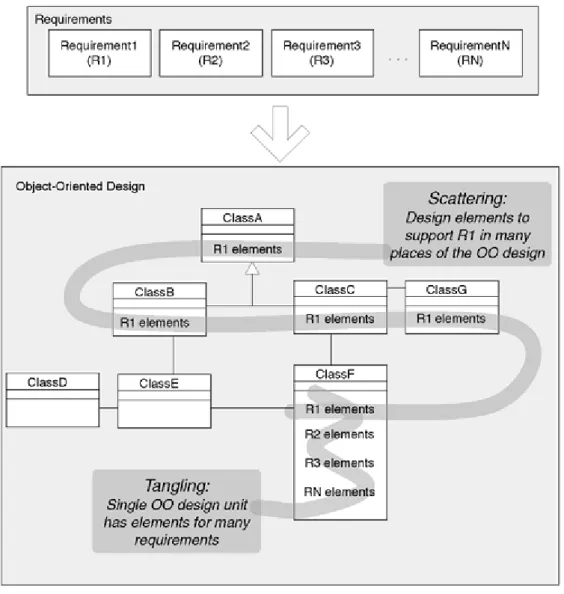
A concern can be seen as a system’s functionality, as something that the system must take into account, i.e., as a property that the system must provide. An aspect, as described in [7], is a particular kind of concern, whose functionality is triggered by other concerns and in multiple situations. Separating concerns into aspects avoids the need to explicitly trigger their functionalities within the code related to other concerns, tangling the two concerns, and also the scattering inherent to triggering in multiple places. These phenomena can be seen in Figure 2-1.
Figure 2-1 Tangling and Scattering
Aspects are a "programmatic construct" and provide active support for separating concerns in source code.
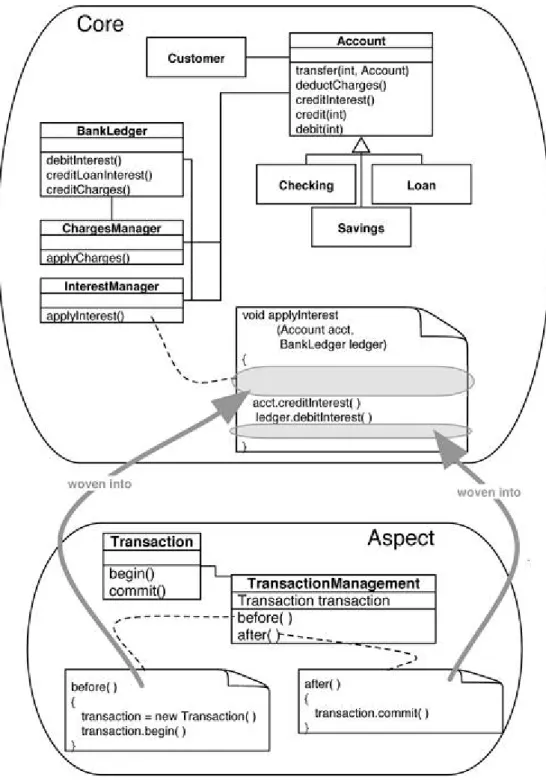
At the beginning of aspect orientation, developers used object-oriented methods and languages (such as standard UML - Unified Modeling Language) for designing their aspects, but UML was not designed to provide constructs to describe aspects. In what concerns designing aspects, there is a need for special design constructs that enable the separation of crosscutting functionalities, seeing as it is the only way to improve the whole process and offer traceability to aspect-oriented code. There are two approaches that stand out in the aspect-oriented language development world: the asymmetric and the symmetric approaches. The asymmetric approach, as shown in Figure 2-2, considers aspects as external events or modules, separate from the core of the program, that are triggered when required; they add dynamic behavior to a system and its main functionality, leaving it to retain only the structure and behavior that pertains to the system’s domains. Hence, an aspect
will be treated as a highly used operation that is invoked along a core execution thread, seeing as it only justifies its existence if it is triggered more than once.
Figure 2-2 Aspects and core in the asymmetric paradigm
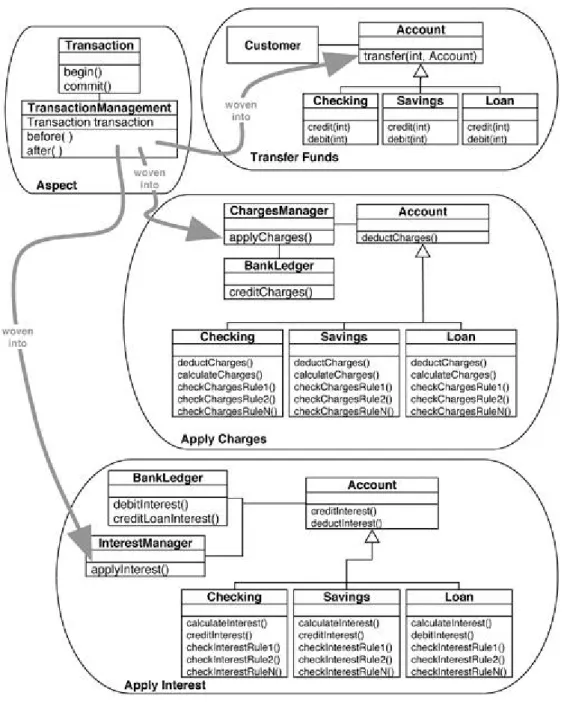
In the symmetric separation model, depicted in Figure 2-3, besides the modularization of aspects, the core is also analyzed for further modularization. An entire system is therefore made up of bits of
separate functionality that could be thought of as features or concerns, which can then be recombined in various ways to form a functioning whole.
Figure 2-3 Separation of different features in the symmetric paradigm
The duplication described above, despite of looking worse than scattering, is required in order to provide a complete view of the system from the perspective of a particular concern, enhancing the separate understandability of it. This understandability is achieved because only and all relevant functionality for a concern is present within the concern module (locality), which also enhances maintainability.
2.2 Aspect-Oriented Requirements Engineering Approaches
Requirements engineering is the process of reasoning about the problem domain and discovering the stakeholders’ needs [3]. The understanding of these needs will take the form of a requirements specification that will constitute a connection between the problem domain and the solution domain. Aspect-oriented requirements engineering (AORE) attempts to treat crosscutting properties in a systematic manner, thus facilitating the reasoning about their impact in the problem domain as well as modularizing such properties in the requirements specification in order to map and trace them to the solution domain [3].
The need for an effective separation of concerns has long been recognized by requirements engineering approaches. Viewpoint-oriented techniques [18] consist of partitioning a system’s requirements based on subjective perspectives derived from stakeholder’s views. Use cases provide descriptions of the system from the perspective of its use by the actors that interact with it.
However, despite the subjective perspectives provided by viewpoints or use cases, they do not treat non-functional properties, which often form good candidates for aspects, in a systematic manner. There are some approaches that do treat them, such as PREView [20], but they only warn the requirements engineer about the possibility of these properties affecting certain viewpoints and do not clearly tell how they constrain or influence specific requirements in the system.
AORE [3] has as an objective to solve these problems by "providing a systematic means for the identification, modularization, representation and composition of crosscutting properties, both
functional and non-functional ones, during requirements engineering" [3]. AORE techniques consist on providing a fine-grained specification of how a requirements-level aspect constrains or influences specific requirements in a system. By understanding exactly the composition between aspectual and non-aspectual requirements, the understanding of their interaction, inter-relationships and conflicts is enhanced, thus helping to identify trade-offs early on in the development life cycle and undertake develop negotiations with the affected stakeholders.
An aspect may be represented by a single requirement or a coherent set of requirements that may constrain or influence the specified behavior of several other requirements or may influence them by altering their specified behavior.
AORE is characterized by four main characteristics:
• The existence of a process to identify crosscutting properties in a requirements specification, which may be accomplished by providing intuitive guidelines for this purpose, identifying specific keywords or action words in a requirements specification, or using specific tool support based on semantic analysis of requirements documents.
• The capability to modularize crosscutting properties belonging to a particular concern in one requirements-level module.
• The existence of appropriate means to represent requirements-level aspects, which might change depending on the application domain or availability of relevant tools, being it graphical or assuming a semi-structured format.
• The capability to compose, aspectual and non-aspectual requirements in order to understand exactly how requirements-level aspects affect other system requirements.
2.2.1 Aspect-Oriented Component Requirements Engineering (AOCRE)
This approach [11] consists of identifying and specifying the functional and non-functional requirements related to "key aspects" of a system that each component provides or requires. A component may have many or few aspects and an aspect may share component services. These "overlapping" aspects are an obvious consequence of high-level categorization of the systemic properties of components, helping requirements engineers to better understand the related component characteristics. Thus, aspect characterization may be seen as a way to encapsulate multiple and systematic perspectives into components, improving the understanding and reasoning about component data, functionality, constraints and inter-relationships.
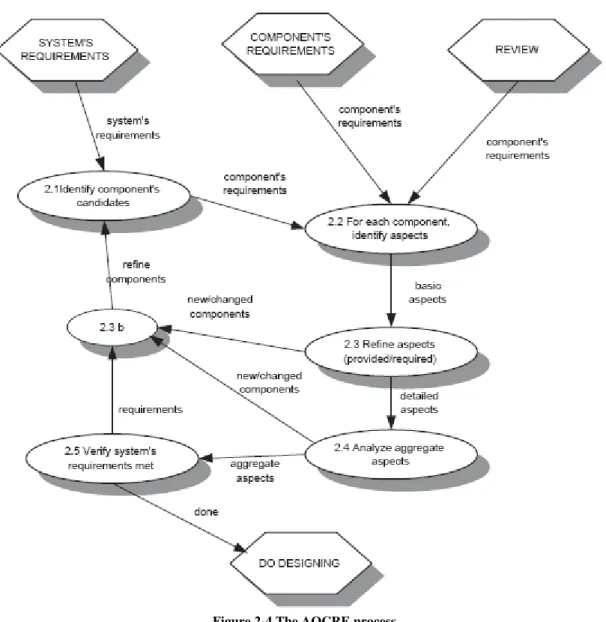
The approach begins, as shown in Figure 2-4, with the analysis of general application requirements, individual or groups of components requirements, which allows iterative top-down and bottom-up requirements refinement. The engineers proceed by characterizing the components’ aspects and their details, provided and required details, functional and non-functional properties and reasoning about the inter-related components’ aggregate aspects. The identified components and aspects are refined into detailed component designs.
Figure 2-4 The AOCRE process
For each component, possibly from stakeholder requirements and object services, aspects for which the component provides or requires services from other components are identified. After identifying a component’s provided and required aspects, inter-component relationships can be analyzed. Aggregate aspects can be identified and specified for groups of interrelated components. This allows Engineers to reason about aspect-oriented requirements for a set of related components. Aspect-oriented component requirements are useful when designing and implementing components, providing a set of functional and non-functional constraints that can refine a design and a specification that can be used to test the implementation. Components at requirements-level can be refined directly to matching software components at design-level or can be split, merged or even revised, like requirements-level component aspects.
2.2.2 Separation of crosscutting concerns from requirements to design via a use
case approach
Despite the several different approaches on Aspect-Oriented Software Development, none of those cover the software development from requirements to design. This approach [21], adapting a use case driven approach, aims to explicitly provide the reasoning and separation of crosscutting concerns, including the non-functional ones, from requirements artifacts to design artifacts.
Use cases, as explained in more detail in [21], are used to represent the most important business concepts and events that occur in the system, being those functional or not, showing all the actors and theirs interactions. Then, they are specified in more detail and structured for the next stages: the analysis and design activities which will result in classes and subsystems.
In order to deal with non-functional concerns, the authors of this approach have included in the requirements activities the NFR Framework, treating those concerns as goals to be achieved.
The NFR Framework begins with the decomposition of each non-functional concern into more specific ones, which are then operationalized via certain mechanisms. During these stages, contributions and conflicts are analyzed, establishing the impact of the non-functional concerns on each other and identifying priorities. Finally, the operationalizations are accepted or rejected.
Non-functional concerns are normally crosscutting, thus their adequate treatment is an important step in Aspect-Oriented Software Development. In order to separate crosscutting behavior in use cases, the crosscutting behavior will be placed in a separate use case (crosscutting use case) that will be connected to the use cases it affects via a new kind of relationship named crosscuts. The information about the composition between the crosscutting use case and the ones affected by it are described in a composition table.
Each analysis class should represent the specific behavior of an entity that collaborates to fulfill the use cases. The separated entity that encapsulates the crosscutting behavior is represented in a crosscutting class.
Each identified crosscutting requirement should originate a crosscutting class, which, in turn, can represent more than one analysis classes necessary to concretize a crosscutting behavior.
When the analysis classes have been identified and specified, the interactions between each of the use case and their corresponding analysis objects are represented in collaborations diagrams. Separation of crosscutting concerns should also be maintained in the interactions diagrams, thus crosscutting objects that affect analysis objects interactions should not be included in the interaction diagram - the information about how a crosscutting object will affect analysis objects interactions should be described in a composition table.
Aspects are characterized by adding new behavior or structure to classes and are stereotyped with «aspect». The crosscutting behavior will be modeled as operations and new structure as properties in the aspectual class. The composition tables continue to be used in order to determine the join points and the composition rules.
It is possible to determine the classes affected by the aspect by analyzing the composition table of its aspectual class. A "crosscuts" association is used to model the relationship between an aspect and the classes affected by it.
2.2.3 Aspect-Oriented Requirements Engineering (AORE) with ARCaDe
Techniques such as viewpoints and use cases are helpful when dealing with separation of stakeholders’ concerns but do not guarantee any consistency between those and global requirements and constraints. The AORE approach, supported by the Aspectual Requirements Composition and Decision support tool (ARCaDe), and as described in [19] [18], which is one of the AORE approaches and not the general AORE methodology, aims at resolving these issues by supporting separation of crosscutting functional and non-functional properties at the requirements level, defining composition rules in modules that represent coherent abstractions and follow well-defined templates. The composition rules, including actions and operators, specify how an aspectual requirement influences or constrains the behavior of a set of non-aspectual requirements. With an early modularization, it is possible and easier to establish trade-offs between aspectual requirements, providing support for negotiation and decisions among stakeholders, as well as to determine their mapping and influence on artifacts at later development stages.
This approach’s first stage consists of identifying and specifying both concerns and stakeholders’ requirements using viewpoints, use cases, goals or problem frames. By relating these concerns and requirements through a matrix it is possible to see which concerns crosscut the modules encapsulating stakeholders’ requirements and qualify them as candidate aspects. Having these
relationships defined, the next step consists of defining the composition rules. Once the composition rules have been defined, identification and resolution of conflicts between candidate aspects are accomplished in three steps:
• A contribution matrix showing the positive or negative contribution of each aspect to the other is built;
• Weights are attributed to those aspects that contribute negatively to each other regarding a set of stakeholders’ requirements;
• Conflicts are solved with the stakeholders using the previous defined prioritization.
Conflict resolution might originate a revision of the requirements specification. In this case, the requirements are recomposed and possibly new conflicts are resolved. This process is repeated until all conflicts have been resolved.
The stakeholder requirements are identified using viewpoints and specified using XML, which is also used to specify the identified aspects and the composition rules that relate viewpoints with aspects. Viewpoint requirements, aspectual requirements and composition rules are defined using pre-defined templates, being supported by the ARCaDe tool. XML has been chosen due to its capability to be extensible, since it is not possible to anticipate the various types of composition operators and actions that might be required. Viewpoints and concerns are described in a similar way in XML: a Viewpoint or Concern tag, respectively, denotes the start of a Viewpoint or Concern. Sub-viewpoints and sub-requirements are nested under their correspondent viewpoints or requirements, respectively. Each requirement has a unique id, which identifies it in the viewpoint. Viewpoint and Concern names are also unique. After identifying and describing viewpoints and concerns, they are linked using a matrix. Analyzing the previous matrix, a concern is identified as a candidate aspect if it crosscuts several viewpoints. When a candidate aspect is identified, the XML specification of the corresponding Concern is transformed to reflect this fact, being the Concern tag replaced with an Aspect tag.
The relationships between aspectual requirements and viewpoint requirements are defined using composition rules - a Composition tag encapsulates a coherent set of composition rules. Here, in opposition to what happens in the previous sections, each Requirement tag has at least two attributes: the aspect or viewpoint it is defined in and a unique id which identifies it within its defining scope. Any sub-requirements belonging to a viewpoint requirement must be explicitly excluded or included in the Constraint imposed by an aspectual requirement; this is accomplished using an include or exclude value in the optional children attribute. The Constraint tag defines an
action and operator defining how the viewpoint requirements are to be constrained by the specific aspectual requirements.
The composition rules are also used to compose aspects and viewpoints, leading to the identification of conflicts among aspects whose requirements constrain the same or overlapping sets of viewpoint requirements. The contribution table shows in what way an aspect contributes to the other, negatively or positively.
The detected conflicts can be resolved by attributing weights to the cells of the aspect vs viewpoint matrix, constructed as the concern/viewpoint matrix previously presented.
2.2.4 Vision and Aspects
Requirements elicitation consists in capturing and organizing all the system information. In this approach [8], the several viewpoints are described using templates, their relationships are illustrated in viewpoint diagrams and their interactions are shown in sequence diagrams.
Each NFR is described using a template in which its name, description and influence on viewpoints and use cases are described. Furthermore, since a NFR may be related with other ones, contributions and priority are also described.
After the requirements elicitation stage, the relevant viewpoints to the system are identified and specified in terms of their name, sources, actors, use cases, NFRs, relationships with other viewpoints and history. A viewpoint can also be represented as a UML class with the stereotype «Viewpoint».
Actors and use cases of the system’s viewpoints are identified via requirements analysis and are documented in a template containing the use case’s name, description, related actors and viewpoints. The specifications of its primary and secondary scenarios are also included, as well as other scenarios related to it via «extends» or «include». Non-functional requirements are also listed. Use cases define the functionalities of a system available to their actors; actors and use cases can be associated to more than one viewpoint.
Having identified NFRs, viewpoints and their use cases, one must check which viewpoints and use cases are influenced by a NFR and for each viewpoint/use case which NFRs affect it. This is done by analyzing the previously described templates.
After the identification and specification of use cases, it is possible to check whether there is a use case included by more than one use case of one or more viewpoints or if there is a use case that extends more than one use case, that is, if any use case crosscuts several use cases, thus being
identified as an aspectual use case. An aspectual use case would crosscut several viewpoints. Viewpoints can also be part of other viewpoints, defining a viewpoint aggregation. If two viewpoints are associated, then there must exist an interaction between the actors of those viewpoints.
The identification and resolution of conflicts are treated the same way as in the AORE approach. For candidate aspects in conflict with the same viewpoints and use cases, weights are attributed to them. The authors also suggest creating two other similar tables to relate aspectual use cases to viewpoints and to relate aspectual use cases to use cases.
2.2.5 Aspect-Oriented Requirements Analysis (AORA)
The idea behind this approach [6] is to provide a contribution for aspect-orientation by integrating non-functional with functional requirements, also taking in account their crosscutting nature and influence over each other. The whole process is constituted by four main tasks, namely "Concerns Identification", "Concerns Specification", "Concerns Modelling in UML" and "Concerns Composition", each one being composed by several sub-tasks.
A concern is a conceptual subject of interest in a system, being possibly defined by a coherent set of requirements, each one defining a property that the future system must provide. Therefore, the first task is responsible for identifying all the concerns of a system, by means of its stakeholders and sources. The identified concerns can then be decomposed into subconcerns. Important information about each concern should be registered in a template that should be filled iteratively and incrementally as the several tasks are applied. In this stage, rows Name, Source, Stakeholder and
Description must be defined. The remaining rows, Responsibilities, Contributions, Priorities and
Required concerns, will be filled in the next step. The next step, specification of concerns, consists of four subtasks, each one responsible for identifying responsibilities, contributions between concerns in order to detect possible conflicts, priorities and required concerns, respectively. The empty rows left in the previous step must be filled here. A UML requirements analysis model can be build based on the collected information - for this, an extended use case is used. In order to better characterize the relationships between concerns, new stereotypes are defined:
• «overlap»: used when a given concern is required by another concern and may improve its behavior;
• «bind»: used when a given concern is required by and constrains the behavior of another concern.
The final task is composed by four subtasks and supports conflict management between concerns, resulting in context-dependent compositions, which are defined by identifying match points, crosscutting concerns, handling conflicts and defining composition rules for each match point. Analyzing the Required concerns row, it is possible to identify the (match) points where the composition will take place. A match point for a concern consists of a set of concerns required by the first one. In order to facilitate conflicts resolution, it may be useful to relate each match point to the stakeholders related to it, since the composition rules are defined for each match point. Thus, when a conflict emerges, one can easily verify those of the system’s stakeholders that need to be contacted to manage the conflict. Furthermore, the crosscutting concerns can also be identified as the ones that are required by more than one other concern. Based on the Contribution row it is possible to check if, for a given match point, any of the involved concerns contribute negatively to any other. A conflicting situation may arise if more than one concern is to be applied in a certain match point and if negative contributions between them are involved. If two concerns contribute negatively to each other and have the same priority one needs to verify the Priority row: if each concern has the same priority a trade-off must be negotiated with the stakeholder; if they have different priorities, the dominant concern is the one with the higher priority. The final subtask consists in defining the composition rules that define the order in which the concerns will be applied in a particular match point. These rules are composed by a set of LOTOS [9] based operators.
2.2.6 Multi-Dimensional Separation of Concerns (MD-AORE)
There are several different approaches to Requirements Engineering proposing techniques for the decomposition and composition of concerns; however all of them use a dominant dimension as the base composition, with other dimensions crosscutting them - it is a two-dimensional separation. As what happens with non-functional requirements, the functional ones are also responsible for crosscutting situations. In this mostly used two-dimensional separation, the influence of those functional requirements and their associated trade-offs are simply ignored.
This new model [15] [16] proposes to deal with requirements decomposition in a uniform fashion, i.e. being those functional or non-functional. In this context, and as a key characteristic of the approach, a meta-concern space is defined and the notion of a compositional intersection is introduced. A meta-concern space makes it possible to derive concrete system-specific concerns
based on the specific features of the problem domain. The compositional intersection is responsible for the identification of suitable sets of concerns as a basis to discover trade-offs between them. In this multi-dimensional approach, concerns imply any coherent set of requirements. A concern space at requirements level is defined as a hypercube, with each of its faces representing a particular concern of interest. By treating all concerns in the same manner, it is possible to choose any set of concerns as a base to project the influence of another concern or set of concerns onto this base. In this proposal, concern identification is based on the observation that certain concerns, both functional and non-functional, appear time and again during system development.
Like in the previously described approaches, well-defined templates based on XML were chosen to represent both the abstract concerns as well as their concrete realizations. The definition of concerns and respective requirements is done in the same manner as in Section 2.2.3.
Having categorised the various requirements of the system into concrete concerns, the next step consists of defining composition rules for each concern. The composition rules are defined in a way similar to that shown in Section 2.2.3. The main difference is that a concern constrains other concerns and not only viewpoints.
In order to identify trade-off points, the interactions of a concern with other concerns with reference to some base are observed. The previously mentioned notion of a composition intersection, denoted by ∩, defines a constraint to the potential combinations of concerns to be used as a base for the combinations of concerns that are involved in trade-offs. Trade-offs are analyzed based on the positive, negative or "none" contribution that one concern may have on another with respect to the base identified via the compositional intersection.
Like in the previous approaches, a contribution matrix will display, on each cell, the type of contribution and also the compositional intersection set used to find the contribution. Empty cells denote the inexistence of a relationship.
After dealing with and analyzing trade-offs, architectures choices may be discussed. Each concern in the multi-dimensional separation leads to a number of architecture choices, which are unlikely to be the same and could even result in conflicts, influencing the final architecture choice. The previous trade-off analysis is also useful in the early resolution of these conflicts via stakeholders negotiations and prioritization of concerns.
2.2
Summary
This chapter has described the main concepts of AOSD, such as the notions of aspect and various phenomena related to it, namely scattering and tangling.
Also, besides the description of the AORE process itself, some AORE approaches were briefly explained. These approaches relate aspects to components, use cases or viewpoints.
Having defined the role of aspects in Requirements Engineering and how they may affect a system, the next Chapter introduces another aspect-oriented approach which constitutes the main one under this work.
Chapter 3
The Theme Approach
Themes [7] are more general than aspects and more closely encompass concerns as described for the symmetric approach, since themes are individual concerns regardless of whether they are aspects or separated concerns that would be located in the core. However, the terms crosscutting and aspect are defined as in the asymmetric paradigm: as a functionality that is triggered in multiple situations.
In this Chapter we present the Theme approach by describing its main concepts, the main parts (Theme/Doc and Theme /UML) and its process.
3.1
Concepts
A theme is, at a requirements-level, a subset of responsibilities and, at a design level, includes the structure and behavior required to carry them out.
A concern can be seen as an interest related to the development, operation, use or evolution of the system.
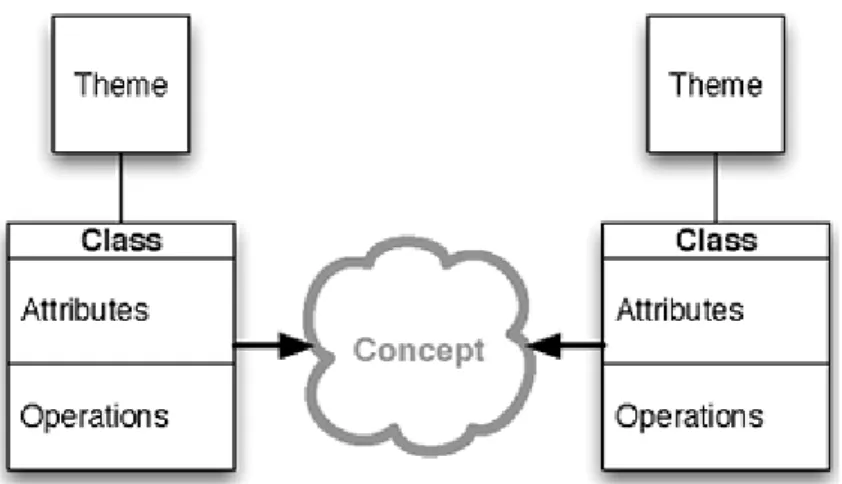
Inter-Theme relations are similar to those between aspects or features and the rest of the system; this fact allows for overlapping to occur in two ways: concept sharing and crosscutting. It is also possible, however rare, for themes to be completely independent.
Different themes may have design elements that represent the same core concepts in the domain. Concept sharing (Figure 3-1) is one category of crosscutting in the symmetric separation model
and is not discussed in the asymmetric one. Encapsulation in this manner has the benefit of locality.
Figure 3-1 Themes related by concept sharing
In asymmetrical crosscutting the behavior in one theme is triggered by behavior in other themes, as seen in Figure 3-2. Aspect and crosscutting themes are used synonymously and are always themes that have behavior triggered together with behavior in other themes. Base themes are the themes that trigger aspect themes and might be themes that share concepts with other themes or even aspects themselves and have their own base.
Figure 3-2 Themes related by crosscutting
While independent themes and themes that share concepts can operate without knowledge of one another, crosscutting themes require an abstract knowledge of the themes they crosscut and cannot operate independently.
The Theme approach [7], which lets one identify and design separate themes that are then combined forming the whole system, consists of two parts: Theme/Doc and Theme/UML as shown in Figure 3-3 and Figure 3-4.
Figure 3-3 High-level view of the Theme Approach activities
Figure 3-4 The Theme Proces
3.2
Theme/Doc
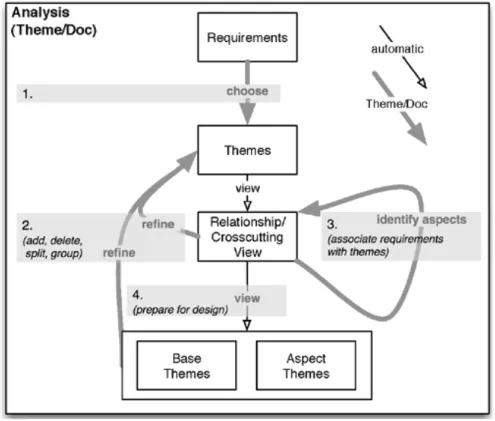
Theme/Doc assists in identifying the main themes in requirements documents and also provides heuristics for identifying, through the analysis of the themes’ responsibilities, which of those are crosscutting or aspects.
Therefore, the process begins with an initial set of themes. The identification process involves sorting through a theme’s responsibilities and trying to recognize a coherent set of behavior, as shown in Figure 3-5.
Figure 3-5 Theme/Doc process
To identify aspects using the Theme approach, one need to look for tangling in the requirements, that is, find themes that share a requirement. However, even if two concerns are described together in a requirement, this is not enough to identify as aspect. To locate an aspect we have to check several conditions:
1. The requirement has to be split up to isolate themes;
2. If one theme is dominant in the requirement, then the theme should be responsible for that requirement rather than the requirement being shared between themes;
3. If the behavior of the dominant theme is triggered by other themes mentioned in the requirement, then there is a trigger relationship between two themes;
4. If the dominant theme is triggered in multiple situations, then it is crosscutting and becomes the aspect; the triggering themes become the base.
3.3
Theme/UML
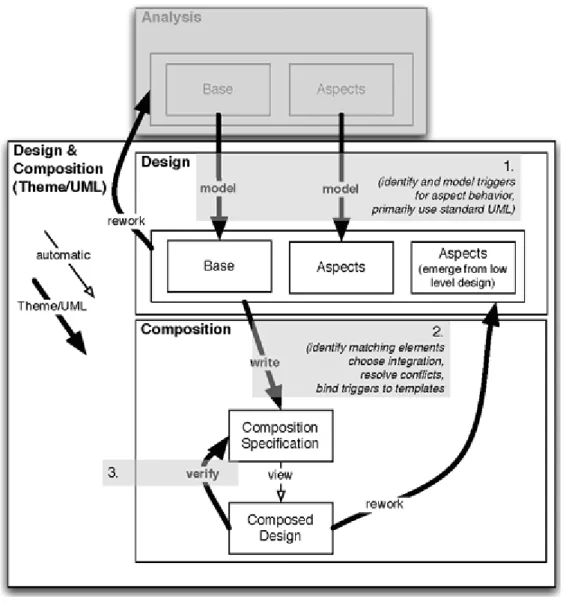
Each of the themes identified in the requirements merits separate design models through Theme/UML (see Figure 3-6).
Figure 3-6 Overview of the Theme/UML process
In what concerns modularization, although Theme/Doc might identify some themes as crosscutting, or even if it detects some kind of overlapping between them, all of them can be designed separately. All the classes and methods pertinent to each of those concerns would be designed within the themes, making easier to work with a single feature or concern.
Modularized concerns require a way to connect to the rest of the system, so Theme/UML devised a "composition relationship", shown in Figure 3-7, that identifies those parts of the theme design that establish that connection. When crosscutting is involved, it is also required to identify when and where the dynamic behavior should happen and in the remaining types of overlapping, one must simply identify the correspondent theme designs and define their integration.
Figure 3-7 Theme/UML composition
The individual-theme view (Figure 3-8), showing all the requirements connected to one theme and also themes crosscut by it, helps to determine which objects and behavior should be modeled in Theme/UML.
Figure 3-8 Individual Theme view
Theme/UML provides a means to consider the concerns of each theme separately by allowing one to work with separate design models for each concern. However, since all concerns must work together in an executing system, one needs to specify in some point the relationships between the separate models and verify those decisions. Thus, the goal is to have a modularized design, with the concerns separated wherever possible, constituted by a set of themes designs, each containing all and only those design elements that relate to the requirements the theme represents, therefore avoiding the phenomenon of scattering and tangling
In inter-theme relationships - composition relationships - one can identify two types of overlapping: aspect-oriented crosscutting identifies dynamic behavior that is similarly triggered across themes;
concept sharing relates to having design elements that represent a given core concept, scattered across themes.
When it comes to a single core concept being represented in the same way across themes, one can simply draw a composition relationship between themes, with a match[name] tag, as one can see in Figure 3-9.
Figure 3-9 Composition relationship: concept sharing
On the other hand, when a theme contains a design for crosscutting behaviour there is a need for templates, which are used as placeholders for real design elements, that can be specified through the use of a Theme/UML - tag bind[].
Having defined all the relationships between themes, a composition relationship can be applied to compose the design (see Figure 3-10). With the composed design, one can verify if the composition relationships are written as they were supposed to or even used it as a guide for a possible implementation in a non-aspect-oriented language. Despite of the fact that this approach intends to avoid non modular characteristics, a phenomenon known as tangling, the composed design will display them.
Figure 3-10 General view of the composition process
When composing themes, design elements that have the same name are defined as relating to the same concept, being merged on the output. All the classes, attributes and methods belonging to the input classes that match will appear in the composed output. In what concerns relationships defined in the input themes, they are all added to the output; however, all redundant relationships are excluded and the duplications are added just once. This duplication does not include aggregation relationships that appear for a subclass and also for its super class, since they are not classified as duplicates, and are thus added. To specify triggering operations, there are template parameters, signaled by "< >", as shown in Figure 3-11, which are applied to aspect themes. For every triggering operation a sequence diagram is drawn according to the specification present in the composed theme.
Figure 3-11 Template notation
3.4
The Theme Process
The Theme approach treats concerns as a unit of modularity in a way similar to the object-oriented treatment of entities; each of those concerns becomes a theme, be it a base or a crosscutting one.
In order to identify the previously mentioned concerns, one needs to elect a set of them from the system’s requirements and iterate over that same set, adding, deleting, splitting or even grouping themes that come up, evaluating their potential to be treated and modeled separately (Figure 3-12and Figure 3-13).
Figure 3-12 Activities involved in choosing themes and deciding on their responsibilities
Figure 3-13 General view of the analysis process
3.4.1 Deciding on Themes
The starting point for the Theme/Doc approach is finding a set of potential themes of your system, that is, identify all the behavior described in the requirements that could potentially be a theme. There are several approaches to apply on this stage:
1. Choose Carefully Up Front Approach: this approach consists of reading through the listed
requirements and pinpointing key descriptions of functionalities that may become system features; it is therefore a tiring approach at its beginning, seeing as one must assess with special care what concerns are described by the requirements. The main task becomes splitting up the themes that are more abstract or whose requirements do not form a cohesive set of functionality when grouped.
2. Start With Everything Approach: this approach consists of choosing all verbs, or actions
words, written in the requirements, saving time during the first step of going through the documentation, however resulting in a possibly huge set of potential themes. The main task here is to identify which of the chosen terms are real themes and to group verbs, thus forming bigger themes.
3. Combination of the two approaches: like the name says, this approach is neither extremely
conservative nor extremely liberal and consists of reading through the list of requirements and identifying behavioral patterns, concerns or features in their possible representations; the set of themes obtained should only require some grouping and segmenting in order to become a good set of themes.
3.3.2
Operating on Themes
On the initial set of themes, it is possible to find behaviors associated with a particular theme that do not belong together, which is not desired since the themes must be coherent and cohesive.
Applying the Start with everything approach will give rise to many finely grained themes - some of the names of these themes may have the same literal meaning or might be synonymous in the sense that two events always happen together - so the solution is to regroup them into a larger theme. On
the other hand, it is possible to find some themes too trivial or too unrepresentative of the system’s functionality to keep - those themes should be deleted.
3.3.3
Operating on Requirements
When a requirement is not that interesting from a design perspective, it can be postponed until more information becomes available.
Requirement adding might be done in a normal way, simply introducing them into a given set, or they might be the outcome of the splitting of existing ones. Either way, new requirements may influence a set in a way that generates new themes, edits the ones already existent or even change their grouping.
3.3.4
Themes, Requirements and Aspects
Using this approach, one must achieve multiple themes, each of them being responsible for implementing a cohesive set of system requirements. Despite of the possibility for themes to implement many requirements, those should only be implemented by only one theme.
After ensuring that a shared requirement cannot be split to untangle multiple themes, there are three rules to apply to see if the requirement reveals an aspect:
1. If one of the themes dominates a shared requirement, then the dominant theme may be an aspect;
2. Aspect behavior is triggered by some behavior in the base and can happen implicitly at triggers locations; if there were no aspect/base relationship, then the behavior would have to be triggered explicitly from the location in the base;
3. If a theme’s behavior is triggered in only one place, then it doesn’t make sense to make it into an aspect.
Just because a theme crosscuts another theme, it does not mean that the crosscutting theme will always crosscut others or that the base theme chosen will always be the base theme – a theme can be crosscut and crosscutting at the same time.
For theme refinement there is a Theme/Doc view called theme relationship view or relationship view, as shown in Figure 3-14.
Figure 3-14 Abstract example of a Theme/Doc relationship view
In order to better understand what a theme is and how themes and requirements should be related let’s consider a brief example [7], involving the construction and evaluation of a simple expression evaluation system (EES). The following requirements from [7] must be considered:
• R1) An evaluation capability that determines the result of evaluating an expression.
• R2) A display capability that depicts expressions textually.
• R3) A check-syntax capability that optionally determines whether expressions are syntactically and semantically correct.
• R4) The check-syntax, display, and evaluation operations should all be logged.
Analyzing the requirements, one could identify a set of action words: “evaluation”, “display”, “check-syntax” and “log” – each of these defines a potential theme.
Each theme was identified via some requirement, thus they must be linked.
Regarding the “evaluation” theme, it was identified in requirement R1; “display” was identified in requirement R2; requirement R3 identified “check-syntax”; finally, requirement R4, which identifies the “log” theme, also refers other themes in its description, namely “check-syntax”, “display” and “evaluation”. All these relationships can be represented through a link, connecting the theme with the requirement (or requirements) that mention it.
Regarding the presented requirements and identified themes, the resulting relationship view can be seen in Figure 3-15.
Figure 3-15 Example - relationship view
Aspects can be identified by looking up requirements that are shared between themes. Crosscutting relationships are shown in a special Theme/Doc view called a crosscutting relationship view, as shown in Figure 3-16.
Figure 3-16 Abstract example of a Theme/Doc relationship view
Again, considering the EES system, we can apply the defined heuristics to identify crosscutting behavior.
First, Figure 3-15 shows that R4 is a shared requirement, then some of the linked themes should be responsible for it. Analyzing the R4 description, we can see that the “log” action is a necessary action when considering “check-syntax”, “display” or “evaluation”, thus being the responsible
theme for R4. It also defines a crosscutting relationship with the other mentioned themes, affecting its behavior. Theme represents a crosscutting relationship with a grey arrow, from the theme that affects other theme behavior to the affected theme. To show that a theme is responsible for a requirement, a simple link is used.
Figure 3-17 depicts a crosscutting relationship.
Figure 3-17 Example - relationship view with crosscutting
To compose the “log” behavior with the other themes (base themes), one should specify where, in the base, the crosscutting behavior should occur. Thus, in the “log” theme, a template should be placed, specifying which “parameter” should be replaced in the design by the elements in the theme to be crosscut; this parameter is the one responsible for triggering the crosscutting behavior. To specify that replacement, a “bind[]” tag is used, specifying the methods to be considered on the composition: these methods identify pointcuts, i.e., points in the execution where behavior can be join.
For instance, Figure 3-18 shows that, when evaluating the method “Expression.check()”, the “LoggedClass.loggedOp()” is triggered, i.e., logging will occur when expressions are checked.
Figure 3-18 Example - Composition relationship
3.4 Adding new functionalities
Contrary to what happens in the object-oriented approach, a new functionality can be added to a system without making any changes to the existing design, since each concern, as derived from the new requirements, is considered to be a theme in its own right. So, new themes can be designed separately and composed with the full design using a composition relationship, as shown in Figure 3-19.
Figure 3-19 Composing new themes