ABSTRACT
RESUMO
Submitted on 12/18/2012 and approved on 08/07/2015. 1 Financial support: Capes and Fundação Araucária.
2 Universidade Estadual do Oeste do Paraná, Programa de Pós-graduação em Agronomia, Marechal Cândido Rondon, Paraná, Brazil. [email protected] 3 Universidade Estadual do Oeste do Paraná, Programa de Pós-graduação em Agronomia, Marechal Cândido Rondon, Paraná, Brazil. [email protected]
4 Universidade Estadual do Oeste do Paraná, Laboratório de Tecnologia de Sementes e Mudas, Marechal Cândido Rondon, Paraná, Brazil. [email protected] 5 Universidade Estadual do Oeste do Paraná, Marechal Cândido Rondon, Paraná, Brazil. [email protected]
*Corresponding author: [email protected]
Influence of foliar fertilization with manganese on germination, vigor
and storage time of RR soybean seeds
1This study aimed to evaluate the influence of foliar fertilizer doses containing Mn of phenological stages of suggested application in RR soybeans, to recover management damages with glyphosate at postemergence application on seed vigor in post-harvest and post six months storage. The seeds originated from a field experiment conducted , which included two applications of glyphosate, concomitant with foliar fertilizer in growth stages V4 and V6, with 0.00, 113.50 and 227.00 mg ha-1 doses of Mn2+. Germination, GSI (Germination Speed Index), electrical conductivity
tests and the first count of seeds were conducted. The application of Mn did not affect the physiological quality of RR soy in postharvest. However, in post-storage, higher doses of Mn had a negative effect on tests of abnormal seedlings, GSI and electrical conductivity. The applications of Mn, regardless of the developmental stage, did not interfere in the germination and first count tests, with and without storage. The electrical conductivity test showed a higher correlation with the seed germination test in the post-harvest treatment.
Key words: Glycine max L., physiological quality, micronutrients, glyphosate.
Vanessa Leonardo Ignácio2*, Ivair André Nava3, Marlene de Matos Malavasi4, Eloir Paulo Gris5
http://dx.doi.org/10.1590/0034-737X201562050004
Influência da fertilização foliar com manganês para a germinação, vigor e tempo de
armazenamento de sementes de soja RR
Este trabalho propôs avaliar a influência de doses de fertilizante foliar com Mn e de estádios fenológicos de aplicação sugeridas, em soja RR, para se recuperar de injúrias do manejo com glyphosate em pós-emergência, sobre o potencial fisiológico das sementes em pós-colheita e pós-armazenamento de seis meses. As sementes foram originadas de um experimento realizado a campo, que contou com duas aplicações do herbicida, concomitantes com fertilizante foliar, nos estádios fenológicos V4 e V6, com doses de 0,00; 113,50 e 227,00 mg ha-1 de Mn2+.
Foram conduzidos testes de germinação, de IVG (índice de velocidade de germinação), de condutividade elétrica e de primeira contagem em sementes. A aplicação de Mn não influenciou a qualidade fisiológica da soja RR em pós-colheita. Já, em pós-armazenamento, as doses mais elevadas de Mn tiveram efeito negativo nos testes de plântulas anormais, de IVG e de condutividade elétrica. As aplicações de Mn, independentemente do estádio fenológico, não interferiram nos resultados dos testes de germinação e de primeira contagem, com e sem armazenamento. O teste de condutividade elétrica apresentou maior correlação com o teste de germinação de sementes no tratamento pós-colheita.
INTRODUCTION
Soybean (Glycine max L.) is the oilseed crop that has presented the highest growing rate in Brazil over the last three decades. It corresponds to about 49% of the national sowing fields (Brasil, 2013). The increase in productivity is associated with technological advances and the efficient management of the producers. The grain is the main source of vegetable protein, essential component of animal feeding production, and adding to that, its use in human feeding is also increasing. (Juhász et al, 2013).
Along with the increasing modernization of RR transgenic soybean crop (Randup Ready®), major
changes to improve the production process are required from seed producers. Thus, the vigor tests have been used as routine tools by the seed industry to determine their physiological quality (Vieira et al., 2002).
Also, the RR soy has presented increased production throughout the country in the recent years, which led to increased use of herbicides with the active ingredient glyphosate, especially in postemergence, given the low cost and practicality in using this management (Franchini et al. 2008)
At the same time, professionals observed leaf yellowing after applying the herbicide where it got in contact with the leaves, indicating a possible manganese deficiency (Mn) (Nava et al., 2012).
Glyphosate can cause stress, phytotoxic effects, affect photosynthesis and nutrient balance (Zobiole et al., 2010a). As highlighted by Taiz & Zeiger (2004), any stress causes negative effect on the normal growth and development of plant species, leading to a concern about the herbicide use in RR soybean crops. This stressful effect could lead to a smaller increase in seed mass, which would indicate malformed seeds (Marcos Filho, 2005). Thus, the application of glyphosate has potential to negatively influence the physiological quality of RR soybean seeds (Albrecht et al., 2009).
Aiming to find a correction of Mn deficiency in RR soybeans, the foliar application is more efficient than soil application (Mann et al., 2002) and research has shown significant responses to Mn, which has increased the commercial use of foliar fertilizer in crops (Staut, 2009).
Such studies show that the Mn application in soybean, regardless of the cultivar, increases grain yield, germination, electrical conductivity, and the emergence speed index (Mann et al., 2002). In Brazil, it is noticed the use of foliar application with Mn to mitigate these potential damages by glyphosate (Zobiole et al., 2010b). According to Malavolta et al. (1997), Mn plays a key role in cell elongation and in situations of deficiency, it
can inhibit lipid synthesis or secondary metabolites, such as gibberellic acid and isoprenoids. It also participates as catalyst in enzymatic activities such as malato desidrogenase, acid phosphatase, superoxide dismutase, among others (Burnell, 1988).
In terms of physiological vigor of seeds, its determination is important since this can be affected by several factors: genetic composition, environmental conditions during production, mother-plant nutrition, stage of ripening and harvest, size and seed mass, seed age, mechanical integrity and environmental conditions during storage (Sá, 1994; Carvalho & Nakagawa, 2000). Soybean seeds can have longevity exceeding 10 years if stored in permeable containers (paper, cotton, jute and woven polypropylene bags) and kept under warehouse environment at 20-25 °C and 65% to 70% relative humidity, thus maintaining germination for a between-harvest period of 6-8 months, although marked reductions in vigor can be found (Villela & Menezes, 2011).
Storage can bring advantages, because it acquires a regulatory function in the market regarding the trade of grains for consumption and for seed. Thus, storage is mandatory once the harvest period hardly coincides with the proper time of sowing (Biagi et al., 2002). However, seeds, in general, do not present higher quality during the storage period. Even under exceptional conditions, its deterioration process is irreversible (Carvalho & Nakagawa, 2000).
However, there are not so many studies on the actual influence of using the fertilizer with Mn in RR soybeans for seeds production, especially on the result of management with glyphosate. Due to a possible damage arising from the mentioned herbicide, either alone or combined with Mn, it is supposed that interferences may occur concerning the physiological performance of seeds. In this context, the study aims at evaluating the influence of foliar fertilizer with Mn at different do-ses and growth stages in RR soybean crops, managed with glyphosate in postemergence on the physiological potential of seeds produced and stored for a period of six months and the correlation between germination and vigor.
MATERIAL AND METHODS
The research used seeds from a field experiment and performed from October 2010 (seeding) to March 2011 (harvest) in an area with direct planting system, located in Palotina - PR (24 ° 16 ’04 “S, 53 ° 46’49" W, 310 m altitude). The climate is tropical, hot and humid (Cfa) according to Koppen, Type 2 soil, medium class texture, Red Latosol (Oxisol) (Embrapa, 2006).
according to the soil analysis and recommendations of Embrapa (2010), being applied in the line 248 kg ha-1 of
the formulated 00:20:20 NPK (N2: P2O5: K2O) without Mn in its formulation. Regarding the presence of Mn in the soil, the analysis showed 82.00 mg dm-3 before
sowing, being classified as High content. Other nutrients presented no deficiency in the soil. (Embrapa, 2010).
The treatments of the field experiment consisted of a randomized block design (RBD), factorial with additional treatment [(3x2) +1], three doses of foliar fertilizer with Mn and two phenologically distinct soybean stages: V4 (over 50% of trefoil developed in the 4th node) and V6 (over 50% of trefoil developed in
the 6th node), with four replications. The additional
treatment – Control - received no herbicide and fertilizer, only hand weeding to keep it free of weeds.
The culture received two applications of glyphosate in postemergence as a way of management for weed control of plots in the 7 treatments; the timing of Mn application was concomitant with the herbicide (V4 and V6). The doses of fertilizer with Mn were: 0.00, 113.50 and 227.00 mg ha-1 Mn2+, representing the most usual
doses recommended by the management for this type of management.
The commercial herbicide Randup Ready ® with the concentration of glyphosate isopropylamine salt of 648 g.L-1 was used at a dose of 2.5 L.ha-1. As foliar fertilizer
the commercial product Broadacre Mn® with 50% Mn
m/v was used. The applications in the plots were performed with manual spraying equipment, equipped with a CO2 cylinder of known volume and constant pressure. The harvest was manual in 2.7 m2 per plot.
After the reaping for this preliminary experiment, the seeds were separated in 7 treatments, or suggested managements, for the seed quality evaluation:
1. Mn 0,00 mg.ha-1 application at the V4 soy growth
stage, glyphosate as herbicide.
2. Mn 113,50 mg.ha-1 application at the V4 soy
growth stage, glyphosate as herbicide. 3. Mn 227,00 mg.ha-1 application at the V4 soy growth stage, glyphosate
as herbicide. 4. Mn 0,00 mg.ha-1 application at the V6
soy growth stage, glyphosate as herbicide.
5. Mn 113,50 mg.ha-1 application at the V6 soy
growth stage, glyphosate as herbicide. 6. Mn 227,00 mg.ha-1 application at the V6 soy growth stage, glyphosate
as herbicide.
And 7. No Mn nor herbicide application, named Control.
For the germination and vigor tests, the Completely Randomized Design (CRD) was used, with 7 treatments and 4 repetitions.
Tests were conducted in the Technology Laboratory of Seeds and Seedlings for the evaluation of the seed quality. The tests were applied twice: once, in the seeds after harvesting in the field experiment (postharvest) and another for seeds after six months of storage in a cool dry place (after storage), simulating a conventional warehouse of seeds.
The following determinations were carried out:
- Degree of humidity: determined with 4 replicates
of 15 seeds of each treatment using the oven method at 105 ± 3 °C for 24 hours. The results were expressed as percentages, along with calculating the coefficient of variation (Brasil, 2009).
- Mass of a thousand seeds: the methodology
established by the Rules for Seed Analysis (Brasil, 2009) was used: eight replicates of 100 seeds, and the results were expressed in grams, along with calculating the coefficient of variation.
- Germination test: conducted with four replicates
of 25 seeds for each treatment, using rolls of germination paper in germination chamber at 25 °C. The moistening was carried out with the amount of water equivalent to 2.5 times the mass of dry substrate. The tests were interpreted 4 and 7 days after seeding, according to the criteria set out in the Rules for Seed Analysis (Brasil, 2009). The results were expressed as a percentage of normal seedlings, those that had all structures developed, and abnormal seedlings.
- Germination Speed Index (GSI): methodology
proposed by Krzyzanowski et al. (1999), using the following formula:
GSI = G1/N1 G2/N2 + + ... + Gn / Nn
In which:
GSI = Germination Speed Index;
G1, G2, Gn = number of normal seedlings computed from the first day until the last.
N1, N2, Nn = number of days after sowing from the first to the last count.
- Electrical Conductivity: four replicates of 50
seeds were weighed on a precision scale of 0.01 g and placed in glass beakers (200 mL capacity) containing 75 mL of deionized water for 24 hours at 25 °C (Krzyzanowski et al., 1999). After this period, the conductivity reading was performed with a digital conductivity meter with results expressed in ìmhos cm -1 g-1.
- First Count: it was performed in combination with
For germination and vigor tests a completely randomized design (CRD) was used, with seven treatments and four replications. Data were subjected to analysis of variance and the factors that had significant effect by the F test (Fisher) had their averages analyzed by the Tukey test at 5% probability. Pearson’s linear correlation coefficients test was also performed. The analyses were carried out using the statistical computer program GENES - VS 2009.7.0 (Cruz, 2006).
RESULTS AND DISCUSSION
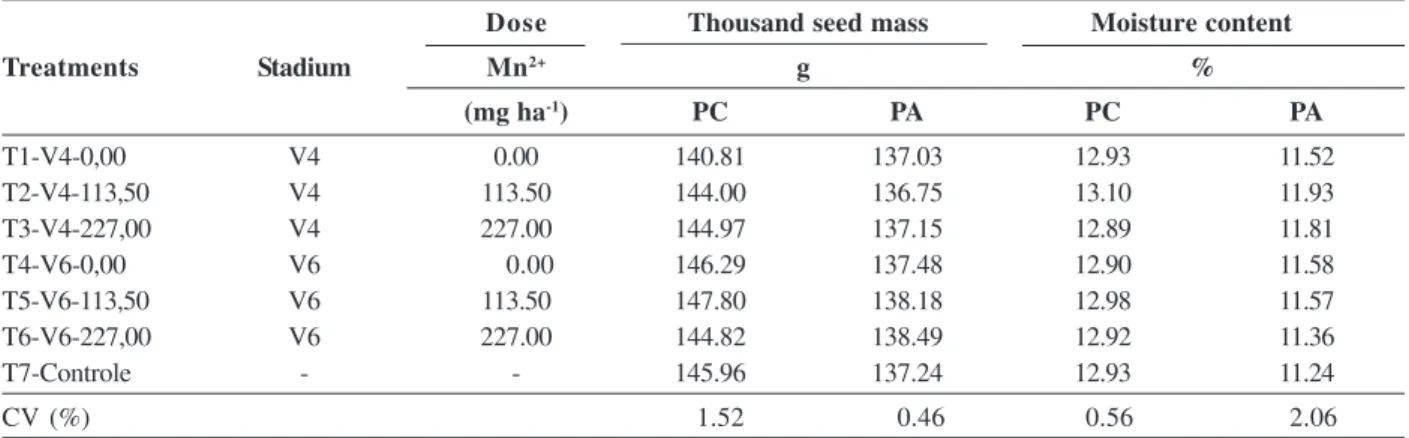
Table 1 shows the treatments and humidity values and mass of a thousand RR soybean seeds for postharvest and post-storage. It is noted that the seeds tended to ba-lance their moisture and after six months, the change in all treatments achieved similar values, probably following the fluctuations of relative humidity (Amaral & Baudet, 1983).
The results of variance analysis tests for the seeds at postharvest presented no statistically relevant difference (p > 0,05) among the treatments, indicating that the management used in the crop, herbicide and Mn applications, did not cause any differences in the physiological quality of the seeds.
Similar results were found by Melarato et al. (2002), who worked on foliar applications and different Mn do-ses and stages of soybean, without storage, presenting no significant result for the product and concluding that Mn does not influence the physiological potential of seeds produced.
This indicates that postharvest seed had similar germination and vigor, regardless of the type of treatment received concerning the glyphosate with Mn fertilizer. The same result was obtained by Mann et al. (2002), who found no differences in fresh soybean seeds and only further decreased vigor after accelerated aging test. It is noteworthy that the seed moisture during harvest was
within the ideal range (13%), which minimizes the influence on the physiological quality.
According to Marcos Filho (2005), fresh seeds have high physiological potential due to a faster restoration of membrane integrity. Based on that, no differences were observed in germination and vigor for the postharvest treatment which presented an average of 92,28%, although, as the time passed, this speed came out slower, which is observed in Table 2.
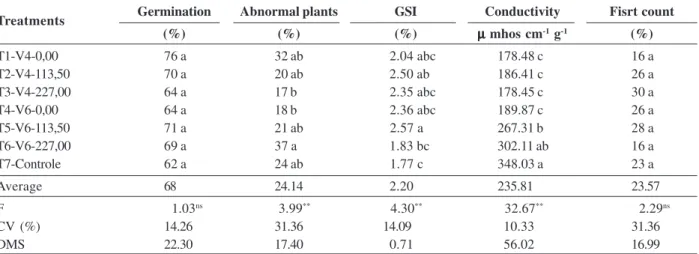
It can be observed in Table 2, the results of the variance analysis of the seeds in post-storage. Significant effects of the treatments were noticed, and an average comparison was conducted.
No significant difference was found for germination tests and the first count. This effect may be related to seed moisture. Amaral & Baudet (1983) explained that the germination percentages in terms of an initial humidity between 11.4% and 13.4% show no significant differences throughout the storage period regardless of the packaging used.
Added to that, the initial moisture values (Table 1) of seeds after storage, demonstrate that treatments with Mn did not influence directly on moisture and, consequently, on germination tests. Also, Cerqueira & Costa (1981), storing soybean seeds at 10% and 14% humidity, concluded that there was no interference of the initial moisture content with the seed quality during storage, due to the higroscopic equilibration of seeds.
Also, in aged seeds after extended storage or even after exposure to unfavorable environmental conditions, germination may not be affected, but the vigor is significantly reduced. Thus the main aspect of this type of analysis is the demonstration that stored seeds do not lose germinability, simultaneously showing different aging rates (Marcos Filho, 2005).
To test abnormal seedlings, it was noticed that the treatment with the lowest absolute average was 227.00 mg ha-1 Mn in the V4 stage and, contradictorily, the
Table 1: Treatments, thousand seed mass, moisture content in postharvest (PC) and post-storage (PA). CV – coefficient of variation Dose Thousand seed mass Moisture content
Treatments Stadium Mn2+ g %
(mg ha-1) PC PA PC PA
T1-V4-0,00 V4 0.00 140.81 137.03 12.93 11.52
T2-V4-113,50 V4 113.50 144.00 136.75 13.10 11.93
T3-V4-227,00 V4 227.00 144.97 137.15 12.89 11.81
T4-V6-0,00 V6 0.00 146.29 137.48 12.90 11.58
T5-V6-113,50 V6 113.50 147.80 138.18 12.98 11.57
T6-V6-227,00 V6 227.00 144.82 138.49 12.92 11.36
T7-Controle - - 145.96 137.24 12.93 11.24
CV (%) 1.52 0.46 0.56 2.06
treatment with the higher average was 227.00 at the V6 stage, indicating that the Mn effect was positive at the highest dose but at the early stage of culture.
Therefore, it is relevant to comment on the high rate of fungal diseases found in seeds during the test, but not quantified and/or analyzed in this experiment due to the long storage time and no chemical treatment against these fungi. The reason might be that seeds are in contact with their coats in the standard germination test (paper roll) and thus, promote greater infection by pathogens, as mentioned by Scheeren et al. (2006), acting directly on soybean seedlings formation, but not affecting the germination.
The results obtained in the GSI test indicate that the treatment with 113.50 mg Mn ha-1 applied at the V6 stage
had the highest average compared to the others, not differing significantly from the treatments T1 V4-0.000, T2 V4-113.50, T3 V4-227.00 and T4 V6-0.00; the control treatment (T7) showed the lowest average between the treatments, differing statistically only from treatments T5 V6-113.50 and T6 V4-113.50.
In this test, the Mn application associated with glyphosate management favored directly on seeds quality. Mann et al. (2002), have observed the positive effect of fertilizer to increase the emergence speed index of RR soybean in their work. For Lopes (1999), the Mn application favors the seeds vigor, especially after aging. It is noteworthy that higher doses in advanced stage of culture have more deleterious effect due to the fact that it would be depositing large amounts of micronutrients in a greater leaf area, which results in possible antagonistic interaction with other nutrients in the plant. If we consider the concept of crop fertilization, which is calculated based on their nutritional needs, considering the amount of nutrients present in the soil
for absorption and efficiency of each element (Malavolta et al., 1997), it is noteworthy that in this experiment, the Mn application took into account the management with glyphosate and its possible deficiency against the herbicide and not the mentioned factors.
Therefore, there are many interactions of the nutrients in the plant system, in addition to strict compatibility problems. The presence of a nutrient in the solution can negatively affect the absorption of other. It was previously reported that excessive presence of metal ions such as Fe, Mn and Al, reduces Cu availability to plants and this effect is independent of the soil type. Also Fe deficiency, in most cases, is caused by imbalance regarding other metals such as Mo and Mn (Lopes, 1999).
Likewise, Fernandes et al. (2007), evaluated the quality of bean seeds as a result of foliar application of fertilizer with Mn at different doses and stages and found that seed germination was not affected and the ESI decreased with fertilizer application, indicating controversial effects in other leguminous plants.
In the electrical conductivity test, the treatment with the highest averages, and therefore the lowest vigor, was the dose 227.00 mg ha-1 at stage V6 and Control, not
differing statistically from each other. This indicates that the application of high Mn doses with glyphosate or no Mn dose without herbicide was harmful to the seed vi-gor. The lowest doses at the initial stage of crop V4 had the lowest value, corresponding to lower release of exudates, indicating high physiological potential, revealing lesser degree of disorganization in the membrane systems of cells.
In this context, it must be remembered that the commercial product used as fertilizer has the manganese sulfate (MnSO4) in its composition, a type of salt that
Table 2: Results of germination tests, abnormal plants, GSI, conductivity and first count of seeds in post-storage of RR soybeans
Germination Abnormal plants GSI Conductivity Fisrt count
(%) (%) (%) µµµµµ mhos cm-1 g-1 (%)
T1-V4-0,00 76 a 32 ab 2.04 abc 178.48 c 16 a
T2-V4-113,50 70 a 20 ab 2.50 ab 186.41 c 26 a
T3-V4-227,00 64 a 17 b 2.35 abc 178.45 c 30 a
T4-V6-0,00 64 a 18 b 2.36 abc 189.87 c 26 a
T5-V6-113,50 71 a 21 ab 2.57 a 267.31 b 28 a
T6-V6-227,00 69 a 37 a 1.83 bc 302.11 ab 16 a
T7-Controle 62 a 24 ab 1.77 c 348.03 a 23 a
Average 68 24.14 2.20 235.81 23.57
F 1.03ns 3.99** 4.30** 32.67** 2.29ns
CV (%) 14.26 31.36 14.09 10.33 31.36
DMS 22.30 17.40 0.71 56.02 16.99
Averages followed by the same letter in the column do not differ statistically from each other. The Tukey test at 5% probability was applied. **
-significant by the F test at 1% probability. ns - not significant by the F test.
may interfere in the osmotic balance of seeds. Also, it is known that saline and water stress produced by salts exert negative effects on soybean seeds vigor (Moraes & Menezes, 2003).
The adverse results produced by these solutes may have been due to the osmotic and/or ionic effect that hinder water absorption or facilitate the penetration of ions into the cells (Van Der Moezel & Bell, 1987).Then, large do-ses of foliar fertilizer with Mn in the crop can cause these characteristics and affect the physiological quality.
One hypothesis to explain the differences among treatments in the conductivity test is the fact that Mn is involved in the lignin formation, one of the substances present in the cell wall that provides waterproofing characteristics and may exert significant effect on the capacity and speed of water absorption through the integument. Therefore, it alters the amount of leached released to the external environment, solutes such as sugar amino acid and inorganic ions such as Mn2+, leading
to lower levels of lignin in the soybean seeds coat, which may relate to the higher values of electrical conductivity (Panobianco et al., 1999; Marcos Filho, 2005).
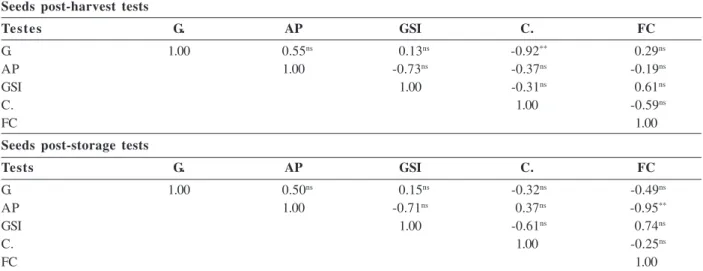
According to Malavolta et al. (1997), Mn is required for the peroxide dismutase activity, which protects cells from the harmful effects of free radicals. Thus, changes in unsaturated fatty acids are likely to occur by the action of these free radicals in situations of deficiency or Mn unavailability, resulting in the disruption of cell membrane (Carvalho, 1994), which would explain the high conductivity values found in the control treatment. The matrices of Pearson’s correlation between the tests of germination and seeds vigor of RR soybeans are presented in Table 3. For post-harvest tests, the electrical conductivity shows the highest correlation value with that
in the germination test. There is 92% negative correlation between variables. These results agree with Araujo et al. (2011), who also worked on a leguminous plant (green beans) and obtained similar negative results of Pearson’s correlation values around 90% between germination and electrical conductivity.
In post-storage tests, the treatments T6 V6-227.00 and Control were responsible for the reduction in the correlation coefficient in the conductivity test for germination, once these showed higher conductivity readings, causing increased data variance that interfered with the significance of the results. The variable that most correlated with germination was the number of abnormal seedlings, showing 50% positive correlation.
CONCLUSIONS
The application of foliar fertilizer containing Mn at the RR Soybean, managed with Glyphosate, do not influence the physiological quality of the post-harvest seed, apart from the growth stage when the application was performed.
In post-storage, the higher doses of the foliar Mn had negative influence in abnormal seedlings and GSI stages in both growth stages. On the other hand, the electrical conductivity was negative only at the V6 Growth Stage at the suggested dose of Mn 227,00 mg.ha-¹
The applications of fertilizer with Mn in the treatments with and without glyphosate, regardless of developmental stage, did not interfere with germination and first count in the post-harvest and post-storage.
The electrical conductivity test showed higher correlation with the seed germination test in postharvest treatment.
Table 3: Pearson’s correlation coefficients between the variables analyzed in the tests for germination and seeds vigor in postharvest
and post-storage
Seeds post-harvest tests
Testes G. AP GSI C. FC
G. 1.00 0.55ns 0.13ns -0.92** 0.29ns
AP 1.00 -0.73ns -0.37ns -0.19ns
GSI 1.00 -0.31ns 0.61ns
C. 1.00 -0.59ns
FC 1.00
Seeds post-storage tests
Tests G. AP GSI C. FC
G. 1.00 0.50ns 0.15ns -0.32ns -0.49ns
AP 1.00 -0.71ns 0.37ns -0.95**
GSI 1.00 -0.61ns 0.74ns
C. 1.00 -0.25ns
FC 1.00
REFERENCES
Albrecht LP, Albrecht AJP, Braccini AL, Barbosa AP, Sacuchi AV, Silva AFM & Silva MR (2009) Altas doses de glyphosate aplicados em soja RR e seu efeito sobre o desempenho agronômico e a qualidade fisiológica das sementes. Informativo Abrates, 19:232.
Amaral ADS & Baudet LM (1983) Efeito do teor de umidade da semen-te, tipo de embalagem e período de armazenamento, na qualidade de sementes de soja. Revista Brasileira de Sementes, 5:27-36.
Araujo RF, Zonta JB, Araujo EH & Zonta FMG (2011) Teste de condutividade elétrica para sementes de feijão mungo-verde. Revis-ta Brasileira de Sementes, 33:123-130.
Biagi JD, Bertol R & Carneiro MC (2002) Armazéns em unidades cen-trais de armazenamento. In: Lorini I, Miike LH & Scussel VM (Eds.) Armazenagem de grãos. Campinas, IBG. p.157-174.
Brasil (2009) Regras para análise de sementes. Brasília, SNDA/DNDV/ CLAV. 395p.
Brasil (2013) Soja. Disponível em: <http://www.agricultura.gov.br/ve-getal/culturas/soja>. Acessado em: 15 de fevereiro de 2013. Burnell JN (1988) The biochemistry of manganese in plants. In: Graham
RD, Hannam RJ & Uren NC (Eds.) Manganese in soils and plant. Dordrecht, Kluwer Academic. p.125-137.
Carvalho NM (1994) O conceito de vigor em sementes. In: Vieira RD & Carvalho NM (Eds.) Testes de vigor em sementes. Jaboticabal, Funep. p.01-30.
Carvalho NM & Nakagawa J (2000) Sementes: ciência, tecnologia e produção. 3ª ed. Campinas, Fundação Cargill. 588p.
Cerqueira WP & Costa AV (1981) Influência da umidade inicial de armazenamento sobre a qualidade fisiológica de semente de soja (Glycine max (L.) Merrill). Revista Brasileira de Armazenamento, 6:35-40.
Cruz CD (2006) Programa Genes: Biometria. Viçosa, Editora UFV. 382p. Embrapa - Empresa Brasileira de Pesquisa Agropecuária (2006) Sistema Brasileiro de Classificação de Solos. 2ª ed. Rio de Janeiro, Embrapa. 306p.
Embrapa - Empresa Brasileira de Pesquisa Agropecuária (2010) Tecnologias de Produção de Soja - Região Central do Brasil 2011. Londrina, Embrapa Soja. 255p.
Fernandes DS, Soratto RP, Kulczynski SM, Biscaro GA & Reis CJ (2007) Produtividade e qualidade fisiológica de sementes de feijão em consequência da aplicação foliar de manganês. Pesquisa Agropecuária Brasileira, 42:419-426.
Franchini JC, Babujia LC, Pereira AS, Souza RA & Hungria M (2008) Alterações na nutrição mineral da soja induzidas por transgenia e manejo com herbicidas. In: 30ª Reunião de Pesquisa de soja da Re-gião Central do Brasil, Rio Verde. Resumos, Embrapa Soja. p.296-298.
Juhász ACP, Pádua GP, Wruck DSM, Favoreto L & Ribeiro NR (2013) Desafios fitossanitários para a produção de soja. Informe Agropecuário, 34:66-75.
Krzyzanowski FC, Vieira RD & França-Neto JB (1999) Vigor de semen-tes: conceitos e testes. Londrina, ABRATES. 218p.
Lopes AS (1999) Micronutrientes - filosofias de aplicação e eficiência agronômica. São Paulo, ANDA. 64p.
Malavolta E, Vitti GC & Oliveira AS (1997) Avaliação do estado nutricional das plantas: princípios e aplicações. 2ª ed. Piracicaba, Potafos. 319p.
Mann EM, Resende PM, Mann RS, Carvalho JG & Pinho EVRV (2002) Efeito da aplicação de manganês no rendimento e na qualidade de sementes de soja. Pesquisa Agropecuária Brasileira, 37:1757-1764.
Marcos Filho J (2005) Fisiologia de sementes de plantas cultivadas. Piracicaba, Fealq. 495p.
Melarato M, Panobianco M, Vitti GC & Vieira RD (2002) Manganês e potencial fisiológico de sementes de soja. Ciência Rural, 32:1069-1071.
Moraes GAF & Menezes NL (2003) Desempenho de sementes de soja sob condições diferentes de potencial osmótico. Ciência Rural, 33:219-226.
Nava IA, Gonçalves AC, Schwantes D, Strey L, Roweder FA & Sousa RFB (2012) Efeitos da fertilização foliar com manganês em soja transgênica cultivada no inverno manejada com glifosato. Recursos Rurais, 8:05-11.
Panobianco M, Vieira RD, Krzyzanowski FC & França Neto JB (1999) Electrical conductivity of soybean seed and correlation with seed coat lignin content. Seed Science and Technology, 27:945-949. Sá ME (1994) Importância da adubação na qualidade de sementes. In:
Sá ME & Buzetti S (Eds.) Importância da adubação na qualidade dos produtos agrícolas. São Paulo, Ícone. p.65-98.
Scheeren BR, Arias ERA & Arias SMS (2006) Qualidade fisiológica de sementes de soja tratadas com fungicidas em diferentes períodos de armazenamento, em Alto Garças, MT. Revista Ensaios e Ciência, 10:47-54.
Staut LA (2009) Adubação foliar com nutrientes na cultura da soja. Disponível em: <http://www.cpao.embrapa.br/portal/artigos/artigos/ artigo5.html>. Acessado em: 12 de Julho de 2009.
Taiz L & Zeiger E (2004) Fisiologia vegetal. 3ª ed. Porto Alegre, Artmed. 719p.
Van Der Moezel PG & Bell DT (1987) The effect of salinity on the germination of some Western Australian Eucalyptus and Melaleuca species. Seed Science & Technology, 15:239-246.
Vieira RD, Penariol AL, Perecin D & Panobianco M (2002) Condutividade elétrica e teor de água inicial das sementes de soja. Pesquisa Agropecuária Brasileira, 37:1333-1338.
Villela FA & Menezes NL (2011) O Potencial de Armazenamento de Cada Semente. Disponível em: <http://www.seednews.inf.br/_html/ site/content/reportagem_capa/imprimir.php?id=31>. Acessado em: 01 de novembro de 2011.
Zobiole LHS, Oliveira Jr RS, Kremer RJ, Constantin J, Yamada T, Castro C, Oliveira FA & Oliveira Jr A (2010a) Effect of glyphosate on symbiotic N2 fixation and nickel concentration in glyphosate-resistant soybeans. Applied Soil Ecology, 44:176-180.