Brain teasers: putting up a fight
Cláudia Martins1 [email protected]
1Escola Superior de Educação, Instituto Politécnico de Bragança, Portugal
Abstract
Our underlying question echoes the concern of many teachers: how can we motivate today’s students in our increasingly technological era? Considering that the current educational system dates back to the Industrial Revolution, it is wholly unfit to grapple with students’ interests and engagements. There are scholars who liken the educational organisation to an assembly line, according to which pupils are grouped in a class by “date of manufacture”, disregarding all personal traits and constraints that necessarily distinguish all students from Basic Education to Higher Education. Despite growing discussions and numerous attempts to change systems throughout the world, we are still obsessed with the use of coursebooks, with standardising testing, with the distinction between bright/ academic/ high-mark and non-bright/ non-academic/ low-mark students and with a number of unfathomable dichotomies. We seek to discuss a number of inconsistencies we perceive in the Portuguese education system and how they may hamper an up-to-date educational approach and prevent the dethroning of the prevailing mainstream education paradigm. The current Finnish system, considered to be among the best in the world, may serve as the role model, stressing out that standardisation does not equal quality no more than frenetic evaluation equals acquisition of knowledge and lifelong skills. Critical thinking may entail the answer and enable us as teachers to tease students’ brains, as well as ours, bringing in a sense of purpose and the bigger picture to have a saying in the game. But will a selection of classroom strategies and activities that bring about critical thinking suffice if we are confronted with a blind administrative and bureaucratic monster? Can teachers and students alike put up a fight? Can our brains be teased into forward motion?
Keywords:traditional education; modern school; critical thinking.
1 Introduction
This paper aims to raise a number of questions concerning the education system, particularly in Por-tugal, in order to understand the extent to which they may be “slaughterhouses of minds” (Comenius as cited in Sharma, 2002). We intend to achieve this by presenting a historical perspective of the birth of school systems in Europe and a selection of concerns that were put forth following the Renais-sance period, leading ultimately to the democratisation of education. Afterwards, we shall focus on the modern school, highlighting some critical voices, as well as compare the Finnish system with the Portuguese. The purpose of such comparison is not to revere the Finnish system, but rather to grasp the structural changes set in motion that enabled Finland to have now one of the best systems in the world, according to the 2015 PISA results. In line with the Finnish intention to produce “cognitive dissonance” (Scheinin as cited in Crouch, 2015, para. 6), the last part of our paper seeks to present the underlying principles of critical thinking (CT), which, in our view, may entail a possible solu-tion for our current state of chaos (Robinson, 2010). Through the descripsolu-tion of a set of approaches and strategies for teachers, we wish to assert the importance of CT in teaching, and particularly in language teaching.
2 Established national school systems
fear of harsh physical punishment. From Ancient Greece and Rome to the Renaissance, the situa-tion remained stagnant. It was in the aftermath of the Renaissance that the Protestant Reformasitua-tion emphasised the need for universal education and established vernacular schools in Germany where children learnt reading, writing and religion (Guisepi, s/d, para. 1-2).
Throughout this period, a triad of influential figures could be mentioned. To begin with, John Amos Comenius (1592-1670) stated that observing a child’s nature was to be taken into account if effective education was to be achieved (Kirylo, 2016, p. 82) and stressed that children were not miniature adults, a predominant belief up to the 17th century (Philippe Ariès (1960, 1962) upheld that the invention of ‘childhood’ occurred somewhere between the 17th and the 20th centuries). Moreover, Comenius believed that schools were “slaughterhouses of minds” and “places where minds are fed on words” (cf. Sharma, 2002, p. 66-67). On the other hand, John Locke (1632-1704) sustained the theory of the ‘tabula rasa’, according to which children were born with no innate knowledge, though possessing a number of faculties, i.e. perceiving, discriminating, comparing, thinking and recalling. Due to this, education systems would have to introduce pictures (such as Comenius’s ‘Orbis Pictus’), models, field trips (what is now known as out-of-school education) and the respect for first-hand observation (Kirylo, 2016, p. 84-85). Finally, Jean-Jacques Rousseau likened children to plants, who mature intellectually, physically and emotionally through time. As Comenius, Rousseau (1712-1778) regarded children as innately good who would be distorted by social institutions, schools included (Kirylo, 2016, p. 84-85).
Inspired by Rousseau’s premises, Prussia pioneered in establishing the first national school system still in the 18th century, being followed in the subsequent century by France and England (Bowen, 2003, p. 129, 321), where school was free and compulsory (an idea carried out by Queen Victoria as a means to hold off the hanging fear of the French Revolution being replicated on British ground – Black, 2000). Notwithstanding, schools worldwide started being attended by all children, including lower classes ones, but only until the age of 10-11, since only the “brightest” would be allowed to continue.
Therefore, schools gained ground in most European countries from 19thcentury onwards, attempt-ing to blur distinctions between men and women, lower and upper classes, in a growattempt-ing process of democratising education. At the same time, a myriad of reflections about childhood cropped up, of which the following are worth mentioning: Pestalozzi’s (1746-1822) schools for physically active children in Switzerland; Herbart’s (1776-1841) attention to educators (no longer a bully, but duly qualified); Froebel’s (1782-1852) introduction of the kindergarten or the gardens for children (in line with Rousseau’s plants); and Montessori’s (1870-1952) work with intellectually challenged children (‘idiot children’ in that time’s terminology), for whom she developed her renown pedagogical ap-proach, and observation that children who attended schools for the poor showed lack of progress (cf. Sharma, 2002, p. 98, 115, 137; Kirylo, 2016, p. 105).
Henceforth, we witnessed “a multiplication of children’s ages in 20thcentury child psychology” from Beauvais’s viewpoint (2016), particularly developmental psychologists, such as Vygotsky (1896-1934), Piaget (1896-1980) or Gardner (1943-), all of whom would influence teaching methodology during the 20thcentury.
3 School in modern times
The question haunts teachers: how are we to motivate our students in this increasingly technological era, where focus and attention is so difficult to hold and keep? Robinson relates to this feeling by drawing attention to the education system itself, which is grounded on the fact that there is no longer a connection, or coherence for that matter, between the birth of established national education systems and the present moment in history. If children and young adults are experiencing the most intense stimulating period in the history of humankind, how can we reason with them in an education system that was designed and conceived for a different age, 18thand 19thcenturies, the Enlightenment and the Industrial Revolution periods? According to that mind-set, there were two types of people: “academic/ smart people vs. non-academic/ non-smart people”, and children from the lower classes would most frequently not be part of the former group. Established national education systems were (and still are) modelled on basis of the interests of industrialisation: they are organised in factory lines with ringing bells, dispersed facilities specialised into separate subjects; pupils are put in “batches”, going through the system by age group (or “date of manufacture”, in Robinson’s terminology). This practice, which resulted from the democratisation of education and thus useful for the purpose of reaching the vast majority of the population, totally disregarded students’ personal traits, constraints, learning styles, among others.
Owing to all these factors, but not only, many students cannot grasp the purpose of attending school and this might explain the numbers of yearly dropouts around the world. The old formula of working hard plus doing well at school no longer equals going to college and getting a job, often a job for life.
As a case in point, in 2016, according to the National Statistics Institute (PORDATA, 2017), the dropout statistics in Portugal were 14% – 17.4% for men and 10.5% for women –, a steady decrease since 1992, which presented then a 50% dropout. On the other hand, the education indicators from Eurostat (2017) show that:
[e]arly leaving from education and training has been falling continuously in the EU since 2002, for both men and women. The fall from 17.0% in 2002 to 11.0 % in 2015 represents steady progress towards the Europe 2020 target of less than 10%.
In spite of the slight disparity, there appears to be a consistent decrease of dropouts in Portugal, although one could question the strategies used to avoid students from leaving school.
Another valuable tool is the international survey conducted by the Organisation for Economic Co-operation and Development – PISA (Programme for International Students Assessment) – which focuses on the assessment of core school subjects, namely science, reading and mathematics, although a more innovative feature was introduced in 2015: collaborative problem solving. This new skill intended to understand “how well students can extrapolate from what they have learned and can apply that knowledge in unfamiliar settings, both in and outside of school” (OCDE, 2016, p. 3). Based on the 2015 PISA data, Estonia and Finland appear among the top 5 countries in the world with the best results at the core subjects, preceded by Singapore, Japan and Chinese Taipei (OCDE, 2016, p. 4), whereas Portugal appears on the 23rd position.
3.1 The case of Finland
It is common knowledge that Finland stands as the hallmark of excellence in education mainly in Europe, not only following the release of the 2000 PISA results (despite its recent slips in 2015), but also for the fact that it embodies the revolution that a large number of educational critics have been recommending. Finland is said to have the most thoroughly-trained, highly-motivated and constraint-free teachers, and competition to enter education universities is fierce. From Jakku-Sihvonen & Niemi’s viewpoint: “Teacher education is now research-based, meaning that it must be supported by scientific knowledge and focus on thinking processes and cognitive skills used in conducting research” (as cited in Sahlberg, 2010, p. 10).
system (Sahlberg, 2010, p. 1). These professionals inspire students to become fully engaged in learn-ing: “In Finland, teachers are largely free from external requirements such as inspection, standardised testing and government control” (Crouch, 2015, para. 4). Moreover, Butler (2016) states, in his ar-ticle, that: “Driven by a commitment to equality (…), it [Finland] outlaws school selection, formal examinations (until the age of 18) and streaming by ability. Competition, choice, privatisation and league tables do not exist. “Teaching to the test” is an alien concept.” (para. 13).
Concomitantly, Sahlberg (2010) elicits that external assessment gives way to “individualized ed-ucation and creativity (…)” and, as a result, “the progress of each student in school is judged more against his or her individual progress and abilities rather than against statistical indicators” (p. 6-7). Moreover, “determining students’ academic performance in Finland is seen as a responsibility of the school, not the external assessors” (p. 6-7). It is commonly accepted that “external standardized testing” will narrow the curriculum and inescapably lead to “teaching to the test” and “unhealthy competition among schools” (p. 6-7).
Nonetheless, this was not always so: prior to the 1990s, “there was strict central direction and control over schools, state-prescribed curriculums, external school inspections and detailed regulation, giving the Finnish government a strong grip on schools and teachers” (Sahlberg, 2010, p. 6-7). However, after that decade:
a new culture of education [was created] characterised by trust between educational authorities and schools, local control, professionalism and autonomy. Schools became responsible for their own curriculum planning and student assessment, while state inspections were abandoned. (Crouch, 2015, para. 13)
3.2 The case of Portugal
The Finnish case is the precise opposite of what happens in most European countries, Portugal included, where teaching is nowadays spent between administrative duties, testing, often resulting in teaching overload. Furthermore, Portuguese politicians have been unable to create coherence as far as education is concerned and the succession of political parties in power have always attempted to heavily undermine previous governments’ decisions and policies and to rewrite them from their own perspectives, disregarding the common good of the nation. Apart from this, the teaching profession has evolved from a highly-respected figure in society (especially during the dictatorship of 1933-1974) to becoming the culprit for the malfunctioning of education, thus being mistrusted. Only 2% of Portuguese youth considers entering the teaching profession, compared to the European average of 5% (cf. Faria et al., 2016, p. 4). The general idea is that anyone can become a teacher and people choose this path for financial interests and for the misconceived idea that teachers do very little. The manner in which teachers are recruited by the Ministry of Education also stands as a hindrance to changing teacher’s social status, since most struggle year after year to acquire a position in aquadro de zona(teaching zone) or an agrupamento de escola (school grouping). Thus, the National Council for Education conveys its purpose to reform the teacher recruitment system in Portugal, by means of the creation of complete and coherent recruitment systems (cf. Faria et al., 2016, p. 7).
In addition to this overall suspicious atmosphere, it is worth mentioning the overwhelming power of publishers. Coursebooks published by Leya and Porto Editora have somewhat replaced the Ministry’s recommendations and guidelines: teachers will often rely on these books for various aspects of their practice. Teacher coursebooks are so packed with materials (including worksheets, further practice, songs, videos, links to additional resources and even tests) that they leave no place for teachers’ own thinking nor for their autonomy to be exercised. From our perspective, the bigger picture in Portuguese education has become rather grim – a true “slaughterhouse of the mind” in Comenius’s words – and has inevitably led to a frightening lack of motivation from the teachers’ part, which is likely to be passed on to students and emphasise their growing awareness of the uselessness of education.
Scheinin (as cited in Crouch, 2015, para. 15-16) argues that the Finnish school intends to disturb students’ thinking, to bring about “cognitive dissonance”, which is only possible by the training of “good didacticians”, teachers that are always willing to experiment.
4 Is critical thinking the answer?
In line with what Scheinin presents as “cognitive dissonance”, Robinson (2010) raises the issue of divergent thinking and creativity, to which we add also CT. This is understood to be the so-called 21st century skills, which encompass the 4 Cs: communication, CT, collaboration and creativity. For the purpose of this paper, we will draw attention to only one of these skills, that of CT.
For Turouskaya & Turouskaya (2001, p. 51), thinking is the extraordinary process we use all the time to make sense of our lives and of the world we live in. Wilkinson & Nanni (2014) elaborate on this premise by stating that “[q]uestioning and expressing doubt are the foundations of critical thinking” (p. 83) in itself. As such, CT “is a key component of a liberal arts education” (Wilkinson & Nanni, 2014, p. 85). This means that thought-provoking, fruitful topics for discussion must be provided and, at the same time, the incitement to “probing inquisitiveness, a keenness of mind, a zealous dedication to reason, and a hunger or eagerness for reliable information” (Facione, 2015, p. 10).
Despite general misconceptions, Iakovos (2011, p. 82) maintains that “the ability to think critically constitutes a kind of intelligence which students do not necessarily or naturally possess, but it is a skill which can [should] be taught in the classroom (…) [as such is] not likely to develop spontaneously.” Based on various authors, Iakovos (2011, p. 82) proposes that CT involves “questioning (…) taken-for-granted assumptions”, asking questions, based on evidence, evaluating and reflecting on ideas and distinguishing between opinions and facts. Iakovos cites Lipman (1984, 1988), who establishes a difference between ordinary thinking (simple and straightforward) and CT, which is far more complex and guided by standards of objectivity, unity and consistency.
For teachers and students alike to become critical thinkers, they must be defined by a set of features:
a) be open-minded, b) take a position (or change a position) when they are convinced by evi-dence, c) take into account the entire situation, adopting a holistic approach, d) seek precision and objectivity in information, making use of credible and reliable sources of information, e) deal in an orderly manner with the elements of a complex whole, f) search for options and alternative solutions, g) look for reasons, h) seek a clear statement of the issue, i) keep the original problem in mind, j) remain relevant to the point, and be sensitive to the feelings and knowledge level of others. (Ennis, 1989 cited in Iakovos, 2011, p. 83)
Despite the apparent benefits of implementing CT, it is obvious for Iakovos (2011, p. 83) that most teachers favour reactive thinking rather proactive thinking, correct answers instead of possible answers, leaving no room for alternative ways of thinking or of answering. Creativity and CT demand learners to improvise, come up with (alternative) solutions, cooperate among themselves and take risks. Ornstein (1995), as cited by Iakovos (2011), presents an extensive list of guidelines for teachers, which are as follows:
As Shirkhani & Fahim (2011, p. 112) argue, in typical school settings, CT skills are addressed separately as independent processes and have been traditionally peripheral in foreign language classes and not even the communicative approach has been able to develop these skills. For students to become proficient, they need to think critically and creatively when using the target language, going beyond linguistic factors and regarding contents taught as purposeful and potentially broadening their horizons as language learners, but also as people. The same authors (Shirkhani & Fahim, 2011) uphold that the best activities to implement in the classroom are those “which require the learners to think, cooperate, ask questions from themselves and others” (p. 113), followed by feedback so that students realise that thinking is a part of the process of learning.
Within language teaching approaches, Iakovos (2011, p. 83) refers to project-based learning and problem-based learning (PBL), considering the latter the most appropriate for the purpose of CT, because it gives difficulties a central place in teaching by presenting learners with an engaging prob-lem, question or puzzle. PBL may foster CT by stimulating active learning. Taking Ennis (cited in Iakovos, 2011) approach into account, PBL divides CT into four components, consisting of specific skills which are susceptible to being taught: “a) defining and clarifying, b) asking appropriate ques-tions to clarify or challenge, c) judging the credibility of a source, and d) solving problems and drawing conclusions” (p. 84). This approach undoubtedly demands other materials from teachers beyond tradi-tionally set coursebooks and workbooks, and thus “a variety of strategies and materials” (Turouskaya & Turouskaya, 2001, p. 51) should be used.
Therefore, for Lipman (1984, 1988), teachers should shift their teaching strategies:
a) from guessing to estimating; b) from preferring to assessing; c) from grouping to classifying; d) from believing to assuming; e) from interring to inferring logically; f) from associating concepts to grasping principles; g) from noting relationships to noting relationships among relationships; h) from supposing to hypothesizing; i) from offering opinions without reasons to offering opinions with reasons; and j) from making judgments without criteria to making judgments with criteria. (cited in Iakovos, 2011, p. 82)
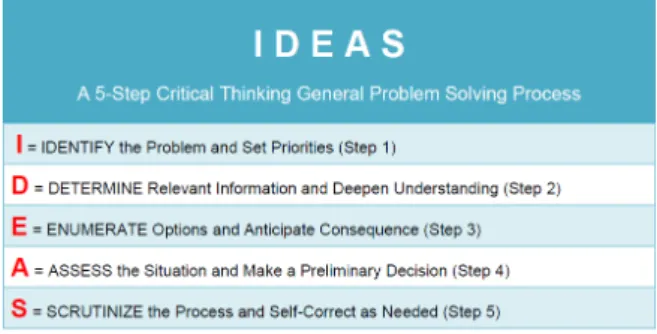
Additionally, Facione (2015) considers CT “a collaborative, noncompetitive endeavour” (p. 8), through which students listen to all sides, take all facts into account and decide what is most relevant, rendering then a thoughtful judgement. According to this author, CT encompasses cognitive skills and dispositions, namely interpretation, analysis, evaluation, explanation and self-regulation. The debate as a teaching strategy is presented by Turouskaya & Turouskaya (2001) as “a perfect problem-solving tool”, because it puts forth “a structured opportunity to address a controversial issue”, in which all students can participate and engage, “stand up for themselves and argumentatively present their position” (p. 53). In line with this, Facione (2015) puts forth a five-step process directed to problem-solving (Fig. 1).
Fig. 1: Five-step problem solving process (Facione, 2015, p. 27).
enhance students’ written and oral communication skills, as well as their motivation and engagement into the learning process.
5 Concluding remarks
The birth of national school systems occurred in Prussia in the 18th century, being followed by France and England, and the 20th century witnessed the full-blown democratisation of education. Despite its obvious advantages, many problems have been identified since then, especially in later decades of the previous century. A striking issue is the inadequacy of the school nowadays to meet our students’ interests and engagements and cater for their needs.
We can identify a number of difficulties in the Portuguese system, namely: the incoherence of educational policies created by our successive governments; administrative, teaching and testing load (“teaching for testing”); the disrespect for the profession; professional instability and the seductive power of coursebooks. Based on the Finnish example, we can put forth some suggestions that would foster a brighter future for our education, such as a solid and coherent national education policy (e.g. formulated by an independent agency), the rebuilding of teachers’ social status, the freedom from central power and thus time to discuss, research and experiment, the reduction of teaching hours and the release from the grip of coursebooks and testing. These suggestions would demand serious structural changes, ranging from curricula in Basic Education to Secondary School, from teacher training and teachers’ mindset.
Finally, bearing in mind 21st century demands, we presented selected strategies and approaches to critical thinking, one of the 21st century skills, according to various authors, with a view to inciting teachers to bring about the Finnish “cognitive dissonance”.
At the end of this paper, a question arises: Can teachers and students alike put up a fight? Can both our brains be teased into forward motion and dethrone the mainstream education system in Portugal?
6 References
Ariès, P. (1962). Centuries of Childhood: A Social History of Family Life. [Translated from the French “L’enfant et la vie familiale sous l’ancien régime” (1960)]. New York: Vintage.
Beauvais, C. (2016). Ages and ages: the multiplication of children’s ‘ages’ in early twentieth-century child psychology.History of Education, 304-318.
Black, B. J. (2010).On Exhibit: Victorians and Their Museums. Charlottesville, USA: The University Press of Virginia.
Bowen, J. (2003). A History of Western Education. The Modern West Europe and the New World (volume III). London/ New York: Routledge.
Butler, P. (2016). No grammar schools, lots of play: the secrets of Europe’s top education system. The Guardian. Retrieved from: https://www.theguardian.com/education/2016/sep/20/grammar-schools-play-europe-top-education-system-finland-daycare
Crouch, D. (2015). Highly trained, respected and free: why Finland’s teachers are different. The Guardian. Retrieved from: https://www.theguardian.com/education/2015/jun/17/highly-trained-respected-and-free-why-finlands-teachers-are-different
Eurostat. (2017).Europe 2020 indicators – education. Retrieved from: http://ec.europa.eu/eurostat/statistics-explained/index.php/Europe_2020_indicators_-_education
Faria, E, Rodrigues, I. P., Gregório, M. C., Ferreira, S. (2016). Relatório Técnico – Formação inicial de educadores e professores e acesso à profissão. Lisboa: Conselho Nacional de Educação.
Guisepi, R. (s/d). The history of education. Retrieved from: http://history-world.org/history_of_education.htm
Iakovos, T. (2011). Critical and Creative Thinking in the English Language Classroom.International Journal of Humanities and Social Science, 1(8), 82-86. USA: Centre for Promoting Ideas.
Kirylo, J. D. (2016).Teaching with Purpose: An Inquiry into the Who, Why, And How We Teach. Lanham/ Boulder/ New York/ London: Rowman and Littlefield.
PORDATA. (2017).Taxa de abandono precoce de educação e formação: total e por sexo – Portugal. Retrieved from: http://www.pordata.pt/Portugal/Taxa+de+abandono+precoce+de+educa%C3%A7%C3%A3o-+e+forma%C3%A7%C3%A3o+total+e+por+sexo-433
Robinson, K. (2010). Changing education paradigms. Retrieved from: https://www.youtube.com/watch?v=zDZFcDGpL4U
Robinson, K. & Aronica, L. (2015). Creative Schools: The Grassroots Revolution That’s Transforming Education. London: Penguin Books.
Sahlberg, P. (2010). The Secret to Finland’s Success: Educating Teachers. Stanford Cen-ter for Opportunity Policy in Education Research Brief. Retrieved from: https://pdfs.semanticscholar.org/a6a0/b0091c0f61493e9ea6ed98a0bc7cf90e207d.pdf
Sharma, G.R. (2002).Western Philosophy of Education. New Delhi: Atlantis.
Shirkhani, S. & Fahim, M. (2011). Enhancing critical thinking in foreign language learners.Procedia – Social and Behavioral Sciences, 29, 111-115. Elsevier.
Thadphoothon, J. (2005). Promoting Critical Thinking in Language Learning Through Computer-Mediated Collaborative Learning: A Preliminary Investigation. Unpublished doctorate thesis. Australia: Univer-sity of Canberra.
Turouskaya, F. A. & Turouskaya, I. S. (2001). Teaching critical thinking in a Foreign Language.Education et Sociétés Plurilingues, 10, 51-54.
Wilkinson, P. J. & Nanni, A. C. (2014). Online Resources for Teaching Critical Thinking Skills to ELLs: A pilot Study. 4th CELC Symposium Proceedings – Alternative Pedagogies in the English Language &