University of Minho
Informatics Department
Master Course in Informatics Engineering
GB
A Contract-based Slicer for Boogie Programs
Márcio João Carvalho Coelho
Informatics Department - University of Minho
Supervised by:
Professor Pedro Henriques Rangel, University of Minho Professor Daniela Carneiro da Cruz, University of Minho
Acknowledgements
Sometimes there is the need to have something in your to help you to identify who are the real friends you have that are always by your side. Would be impossible for me to finish this work, with these results, if I did not have special friends like I have. I am grateful for that and I want to express my deepest feeling of gratitude to my friends and family, one by one.
To Professor Pedro Rangel Henriques, I am very grateful for all the support and help given through these two years of work, and for the great contribution for my academic results. Muito Obrigado por tudo Professor.
I would like to thank Professor Daniela da Cruz for her enormous help in the development of the tool. Without her support I would not be able to finish the tool. It is impossible for me to quantify all the help she gave me in this work. Muito Obrigada Professora Daniela.
To Professor Jorge Sousa Pinto, for all the insights. Muito Obrigado Professor Jorge.
To Nuno Oliveira, for his presence and support in carrying out my tasks. For his advice, sugges-tions and concerns. He has always a kind word to say, and I will never forget the funny moments we had in that lab. Obrigado Nuno.
To Tiago Veloso, for his work with this latex template. Obrigado Tiago.
I would also like to thank my team mates from the 2004/2005 class. For all the great experiences that we had together, and for the unforgettable moments we had during this long walk. I will never forget you guys. Obrigado pessoal.
To my best friend Sofia Fernandes, who always believed in me. Without you it would not be the same person I am today. I will not thank you for existing but for being by my side since the beginning. Muito Obrigada Sofia.
Last, and not least, to my parents and brother for the unconditional support, patience and mo-tivation that helped me dealing with the stress. They have never gave up of supporting me along these seven tough years.Pai, Mãe e Rui, Obrigado por tudo.
Abstract
In the context of the Informatics Engineering MSc. degree (MEI), second year, this document describes and discusses a master thesis project in the area of source code analysis using slicing and program verification techniques.
Design-by-Contract is an approach that allows a programmer to specify the expected behaviour of a component by the means of preconditions, postconditions and invariants. These annotations (or contracts) can be seen as a form of enriched software documentation and they are used to verify that the program is correct with respect to these contracts. On one hand, slicing the program to extract the code that is relevant for the contracts reduce the size of the program and improves its verification. On the other hand, using the contract to slice a program in a finer, more sensible semantic way, enables to optimise the code reducing it to the minimum necessary to keep the postcondition true.
Following the last research direction, Daniela da Cruz introduced in her Ph.D. thesis the concepts of Assertion-based Slicing and Contract-based Slicing to explore (at an intra-procedural or inter-procedural level) the optimisation of code according to the semantics expressed by contracts. Her approach is based on the source code analyses and her slicing uses annotations present in the procedures.
This thesis focuses on the study of BoogiePL language and its use as an intermediate repres-entation for annotated programs in order to build slices of Boogie programs (instead of slicing the source code). Boogie compiler is used to generate the verification conditions in SMT just for the computed slice; these conditions can be then passed to the Z3 Prover to ensure that all contracts are preserved when invoking annotated procedures. The final objective is to make possible the comparison between the SMT code produced by this approach and the code currently generated by GamaSlicer, expecting to obtain a more efficient solution.
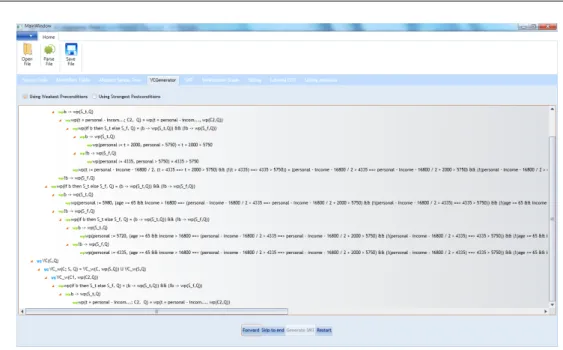
To implement that idea, a tool called GamaBoogie was developed. That tool, at the end, offers more than its main functionality in slicing and verifying. Actually it allows to inspect and visualise boogie programs; this functionality seems to be very useful for Boogie program comprehension.
Resumo
No contexto do Mestrado em Engenharia Informática (MEI), segundo ano, este documento é uma dissertação que descreve e discute um projeto de tese de mestrado na área de análise de código fonte utilizando técnicas de slicing e de verificação de programas.
Design-by-Contract é uma abordagem que permite ao programador especificar o comporta-mento esperado de um componente por meio de pré-condições, pós-condições e invariantes. Estas anotações (ou contratos) podem ser vistos como uma forma de enriquecer a documenta-ção do software e são usados �para verificar se o programa está correto com reladocumenta-ção a esses contratos. Por um lado, fazer o slicing do programa para extrair o código que é relevante para os contratos, pode reduzir o tamanho do programa e melhorar a sua verificação. Por outro lado, usando o contrato para fazer o slicing de um programa de forma mais sensível à semântica, per-mite otimizar o código reduzindo-o ao mínimo necessário para manter o contrato válido.
Seguindo a direção da última pesquisa, Daniela da Cruz introduziu na sua tese de doutoramento os conceitos de Assertion-based Slicing e Contract-based Slicing para explorar (a nível intra-procedimento ou inter-intra-procedimento) a otimização de código de acordo com a semântica expressa por contratos. A sua abordagem é baseada na análise de código fonte e o slicing aplicado a tais programas utiliza anotações presentes nos procedimentos.
Esta tese centra-se no estudo da linguagem BoogiePL e no seu uso como uma representação intermédia para programas anotados a fim de construir slices de programas Boogie (em vez de fazer o slicing ao nível do código fonte). O compilador Boogie é usado para gerar as condições de verificação em SMT apenas para o slice calculado; essas condições podem ser passadas para o Prover Z3 para garantir que todos os contratos são preservados quando invocados os procedimentos anotados. O objetivo final é tornar possível a comparação entre o código final produzido por esta abordagem e o código atualmente gerado pelo GamaSlicer, com a expetativa de obter uma solução mais eficiente.
Para implementar essa ideia, uma ferramenta chamada GamaBoogie foi desenvolvida. Essa ferramenta, no final, oferece mais do que sua funcionalidade principal de slicing e verificação. Na verdade, permite inspecionar e visualizar programas Boogie; esta funcionalidade demonstrou ser útil para a compreensão de programas Boogie.
Contents
Contents iii
List of Figures v
List of Listings vii
1 Introduction 3
1.1 Objectives . . . 4
1.2 Outcomes . . . 4
1.3 Outline . . . 4
2 Program Verification 5 2.1 Software verification Techniques . . . 5
2.1.1 Dynamic verification . . . 5
2.1.2 Static verification . . . 6
2.2 Manual/Semi-automated Techniques. . . 7
2.2.1 Tool-chain of subparts. . . 7
3 Verification Condition Generator 11 3.1 The algorithm . . . 11
3.2 Satisfiability Modulo Theories solver . . . 14
3.3 Z3 . . . 14
4 Boogie 15 4.1 Boogie Program Language . . . 15
4.1.1 Procedures . . . 15
4.1.2 Implementations . . . 16
4.1.3 Basic blocks . . . 16
4.1.4 Passivization . . . 17
4.2 Boogie Program Verifier. . . 19
4.3 Summary . . . 21
5 Program Slicing 23 5.1 Static slicing . . . 25
5.2 Dynamic slicing . . . 26
5.3 Conditioned slicing . . . 27
6 Slicing programs with contracts 29 6.1 Postcondition-based Slicing. . . 30
6.2 Precondition-based Slicing . . . 31
CONTENTS
6.4 Assertion-based Slicing and GamaSlicer . . . 33
6.4.1 GamaSlicer Architecture . . . 33
6.4.2 Slicing with GamaSlicer . . . 34
7 GamaBoogie 39 7.1 GamaBoogie Architecture. . . 44 7.1.1 Editor. . . 45 7.1.2 Visual Inspector . . . 47 7.2 Slicing Algorithms . . . 53 7.3 Slicing in GamaBoogie . . . 56 7.4 Summary . . . 60 8 Conclusion 61 8.1 Future Work . . . 61 Bibliography 63 A Boogie Example 71 B Context-free Grammar 73
List of Figures
2.1 Program Verification Architecture . . . 7
2.2 Boogie Architecture . . . 9
3.1 VCGen algorithm . . . 12
3.2 Procedure power . . . 12
3.3 Applying the VCGen algorithm . . . 13
4.1 Transforming a loop in Boogie . . . 18
4.2 Boogie pipeline . . . 20
6.1 GamaSlicerarchitecture . . . 33
6.2 VCGenerator. . . 35
6.3 Precondition-based slicing applied to program in Listing 6.4 . . . 37
6.4 Specification-based slicing applied to program in Listing 6.4 . . . 37
7.1 Boogie Internal Structure . . . 40
7.2 Control Flow Graph (CFG) of maxarray. . . 41
7.3 Directed Acyclic Graph (DAG) of maxarray . . . 42
7.4 CFG of maxarray with dead blocks . . . 43
7.5 GamaBoogie Architecture. . . 44
7.6 GamaBoogie Editor component architecture. . . 45
7.7 Spec# Source Code editor . . . 46
7.8 Boogie Source Code editor . . . 46
7.9 GamaBoogie Visual component architecture . . . 47
7.10 Part of the Identifier Table. . . 48
7.11 Block Flow Graph window . . . 49
7.12 Command Flow Graph window . . . 49
7.13 Block Acyclic Graph window . . . 50
7.14 Passified Commands window. . . 50
7.15 GamaBoogie Data Flow Graph . . . 51
7.16 Weakest Precondition window . . . 52
7.17 Weakest Preconditions & Passify Commands window . . . 52
7.18 Information sent to the Prover window . . . 53
7.19 GamaBoogie Slicer component architecture . . . 57
7.20 GamaBoogie Slicer overview . . . 57
7.21 GamaBoogie Slicer Original Code . . . 58
7.22 GamaBoogie Slicer New Code . . . 59
7.23 GamaBoogie Slicer New Source Code . . . 59
LIST OF FIGURES
List of Listings
2.1 Method maxInteger annotated in JML . . . 8
2.2 Method maxInteger transformed in Boogie . . . 8
2.3 Method maxInteger written in C♯language with Code Contracts . . . 9
4.1 Spec# program example . . . 18
5.1 Program example 1 . . . 25
5.2 A static slicing of program 5.1 . . . 26
5.3 A dynamic slicing of program 5.1 . . . 27
5.4 A conditioned slicing of program 5.1 . . . 28
6.1 Example for postcondition-based slicing . . . 30
6.2 Example for precondition-based slicing . . . 31
6.3 Example for specification-based slicing . . . 32
6.4 Example for precondition and specification-based slicing . . . 36
6.5 Simple sequence of assignments. . . 36
7.1 Program example: Maximum of an Array . . . 39
7.2 Program example: Source Example 2 . . . 54
List of Acronyms
BoogiePL Boogie Program Language. 4,8,15,61
CFG Control Flow Graph. v,41–43,49
CIL Common Intermediate Language. 8
CS Conditioned slicing. 27
DAG Directed Acyclic Graph. v,41,42,49
DS Dynamic slicing. 26
DbC Design-by-Contract. 6,29
JML Java Modeling Language. 3,6,7,9
LCFG Labeled control flow graph. 33,34
PV Program Verification. 3,5,6,61
SMT Satisfiability Modulo Theories. 8,11,14
SS Static slicing. 26
VCC Verifier for Concurrent C.6,8
VCGen Verification Condition Generator. 3,7,11,33
VC Verification condition. 11,20,53
WLP Weakest liberal precondition. 20,50,52
Chapter 1
Introduction
Nowadays, more than ever, there is a strong concern to verify software program because it is vital for society. Hospitals, banks, governments and industries use software systems that can not have errors. Such errors can have drastic economic and human consequences. In the past (before the year 2000) the aerospace industry lost over a billion dollars due to severe bugs in the software [61].
There is a way to ensure that a software satisfies its functional specification by constructing a mathematical proof. A proof of correctness should mainly detect if a program is inconsistent with respect to its assertions (this is, if it will not perform the intended task). However, a proof itself can be erroneous. As a mathematician can err in formulating a proof, a program prover can make a similar mistake. The use of verification tools can help in reducing this kind of errors, such asJava Modeling Language (JML)[34] and Spec♯[6].
Of course, the use of software verification tools cannot guarantee the absence of errors but can avoid certain kind of errors; sometimes these tools can go further by allowing the programmer to derive parts of a program automatically from logical specifications. These specifications provide a representation of the program’s intended meaning or goal; they say what the program is supposed to do rather than how to do it. Thus they are easier to understand than the details of the program itself, and can be directly accepted or rejected depending on whether they match or fail to match the user requirements of the program.
The dream of ideal software development (without errors) recalls for the use ofProgram Verific-ation (PV)techniques [51]. Due to the need expressed by those companies that use safety critical systems, some software houses decided to specialise in PVinstead of following with software development. The idea of of applying deduction to programs goes back to the late 1960s [5]. With
PVit is possible to say if a program is correct for a given specification.
A VCGen is a program that reads a piece of code together with a specification and produces a set of proof obligations whose validity implies the partial correctness of the code with respect to its specification. This set will be passed to a prover and the program is correct if the proof obligations are valid.
Slicing was first proposed in 1979, by Weiser in his PhD thesis [66] and was then used to ease program debugging, software testing, software metrics, software maintenance, program compre-hension and so on. Slicing can be use to extract the statement relevant to a particular computation. The Slicing executed in GamaSlicer is done in the source program. Several program verifiers of .NET use an intermediate verification language. So if the Slicer is executed in this intermediate level, between the source program and theVerification Condition Generator (VCGen), we must be able to reduce the verification time.
GamaSlicer is a tool designed by Daniela da Cruz [24], that have a VCGen and a Slicer that allows to slice programs annotated with pre and postconditions in Java+JML.
lan-CHAPTER 1. INTRODUCTION
guage is a typed imperative language with procedures and arrays. Boogie Program Language (BoogiePL)[29] can be used to represent programs written in an imperative source language ( like an object-oriented .NET language ) and is accepted as input to Boogie, the Spec♯static pro-gram verifier.
GamaBoogie will work with Boogie language, where will be implemented the Contract-based Slicing [25] algorithm and then the Boogie Compiler will be responsible for generate the SMT code.
1.1 Objectives
In this context, the objectives of this master thesis work are :
1. Study the different areas involved, namely program verification and semantic slicing. 2. Study Boogie system (architecture and functionalities) and Boogie Programming Language. 3. Develop a tool for slicing Boogie programs.
1.2 Outcomes
To accomplish the objectives above a deep study of Boogie system and BoogiePL was done, aiming at using this language as an intermediate representation for annotated programs.
A tool called GamaBoogie was developed to slice the intermediate Boogie program. That tool generates the verification conditions in SMT just for the computed slice; these conditions can be then passed to the Z3 Prover to ensure that all contracts are preserved when invoking annotated procedures.
Moreover, GamaBoogie offers more than its main functionality in slicing and verifying. Actually it allows to inspect and visualise boogie programs; this functionality seems to be very useful for Boogie program comprehension.
1.3 Outline
The state-of-art concerning Program Verification using VCGens appears inChapter 2andChapter 3.
Chapter 4introduces Boogie framework, i.e. Boogie language and program verifier.
InChapter 5, the concept of slicing is presented and several variants are defined. The special case, crucial for this project, of slicing programs with contracts is introduced inChapter 6; there Assertion-based Slicing is defined and the tool GamaSlicer is described.
Chapter 7 gives all details about GamaBoogie, the main contribution of the present Master Thesis.
Chapter 2
Program Verification
Program Verification (PV)is a technique that ensures that a given program is correct for a given specification. This technique appeared in the early 1970s; after a long period almost in standby, it became more and more active in the last decade [51].
Along the years, Software Verification was applied to different contexts and with different pur-poses. Some of these contributions are:
Reliability higher assurance in program correctness by automated proofs. Developer productivity feedback on errors while typing program.
Refactoring check that suggested program transformations preserve program meaning (e.g.
re-factoring using Type Constraints; automated support for program rere-factoring using invari-ants).
Program Optimisations automatically transform program so that it takes less time and memory
power.
2.1 Software verification Techniques
Verification techniques can be divided into two major groups:
• dynamic verification
• static verification
2.1.1 Dynamic verification
Dynamic verification techniques refer to techniques that check the software for bugs during the execution of software.
This phase of software verification is also know as Testing or Experimentation, because it in-volves the execution of a system or a component. Basically, a number of test cases are chosen, where each test cases consist of test data. The goal of this phase is to check that a software:
• meets the business and technical requirements that guided the design and development of the application; and
CHAPTER 2. PROGRAM VERIFICATION
Although the tests phase can be performed at any time in the development process, depending on the testing method employed, most of the effort relies after the requirements have been defined and the coding process has been completed. Test Driven Development differs from traditional models, as the effort of testing is on the hands of the developer and not in a formal team of testers.
Testing methods
There are two main methodologies: white-box and black-box. These approaches describe the point-of-view taken by a test engineer when designing the test cases.
Black-Box Black box is testing that ignores the internal mechanism of a system or component
and focuses solely on the outputs generated in response to selected inputs and execution condi-tions [11].
This method takes into account the inputs for an application and what are the expected results outputs for each one of these inputs.
One of the advantages of this method is its ease to use, as testers do not have to concern/know the implementation code.
White-Box White box testing is testing that takes into account the internal mechanism of a system
or component [11].
Also known as glass-box testing because the testers have knowledge of the internal code. Essentially, the purpose of white box testing is to cover testing as many of the statements, decision point, and branches in the code base as much as possible.
2.1.2 Static verification
Static verification techniques refer to those that inspect the code before its execution. They are also known as Analysis techniques. They are useful for proving correctness of a program.
The group of static verification techniques can also be divided in two groups: the manual or semi-automatic techniques and the fully automated techniques.
Techniques requiring substantial manual effort, like interaction with tools that construct a proof; techniques that use refinement steps to construct programs from specifications; and techniques that require annotations from the programmer fall in the first group Manual/Semi-automated Tech-niques. Techniques such as (bounded) model checking and (abstract) static analysis fall in the second group Fully Automated Techniques.
PVprocess is applied to a program annotated with a specification.
To implement verification the verification process, a tool (a language processor) is required. This tool recognises and transform the annotations. To verify automatically a program, the specification should be written in a formal language and added to the program.
In this context,Design-by-Contract (DbC)has appeared in 80’s [54], this approach allows de-velopers to specify programs using pre- and postconditions, loop invariants and additional asser-tions; these logic statements are embedded in the source code in the form of annotations.
Nowadays, there are some languages that support these kinds of annotations: a subset of Pascal [37] from 1986; Spec♯ [6]; Verifier for Concurrent C (VCC) [59, 26]; Java Modeling Language (JML)Esc/Java [34]; KeY [4] and Code Contracts [33,32]
2.2. MANUAL/SEMI-AUTOMATED TECHNIQUES
2.2 Manual/Semi-automated Techniques
There are two tasks involved in Manual/Semi-automated Techniques: reason about the program structures, transforming them to classical logic expressions; and reason about the data types. To handle these tasks, there are two ways: using a tool-chain of subparts; or a monolithic logic/system [51].
Tool-chain of subparts or semi-automatic system, is when we can choose what techniques and tools we will use. These actions can be separate or together, depends the tool that we use. In the end there is a tool-chain of subparts and we obtain the result.We will focus in this approach.
Monolithic logic/system is one unique system that does everything and the user interactions are easier, like the KeY tool [5].
2.2.1 Tool-chain of subparts
In a tool-chain of subparts there are two stages. The first stage is to translate the annotation into a set logic formulas; this step is calledVerification Condition Generator (VCGen). In the second stage, the set of conditions are passed to an automatic theorem prover. This workflow is depicted inFigure 2.1.
VCGen
Proof
Obligations
Prover
Annotated
Program
Figure 2.1: Program Verification Architecture
Tool chains based in Spec♯,JMLand Code Contracts work on this way.
But there is a huge difference between Spec♯orJMLand Code Contracts or Boogie.
Spec♯needs to track the evolution of C♯ andJMLof Java. So if there is a new version of the main language, the tool will no longer support the same language.
On the other hand, Code Contracts are embedded in the program language itself (C♯), thus taking advantage of the existing language compiler, its supporting IDE and tools [33,32]. Another advantage is that the developer does not need to learn a new specification language.
Listing 2.1 shows a small example (method maxInteger) with its annotations written inJML. Through this specification we are requiring that both variables must be greater or equal than zero (precondition = a ≥ 0 && b ≥ 0) and after program termination, the result should reflect the maximum number of the two integers received as parameters (postcondition = (a > b ? a : b)).
CHAPTER 2. PROGRAM VERIFICATION
1 //@ requires a >= 0 && b >=0;
//@ ensures \result == (a > b ? a : b);
3 public int maxInteger(int a, int b){
int result; 5 if( a >= b ) { result = a; 7 } else { 9 result = b; } 11 return result; }
Listing 2.1: Method maxInteger annotated in JML
procedure maxInteger(P#a: int, P#b: int) returns ($result: int);
2 requires P#a >= 0;
requires P#b >= 0;
4 ensures $result == (if P#a > P#b then P#a else P#b);
6 implementation maxInteger(P#a: int, P#b: int) returns ($result: int){
var L#result: int where $in_range_i4(L#result);
8
anon1:
10 // result := @ite(>=(a, b), a, b);
L#result := (if P#a >= P#b then P#a else P#b);
12 // return result; $result := L#result; 14 goto #exit; 16 anon2: // empty 18 #exit: 20 }
Listing 2.2: Method maxInteger transformed in Boogie
UsingVCCtool, we can also translate code written in C language to an intermediate language calledBoogie. Then it is converted into theSatisfiability Modulo Theories (SMT)language before being passed to a prover, aSMTsolver. InListing 2.2we have the method maxInteger translated intoBoogielanguage.
Spec♯works in a similar way asVCC. This is possible because several languages of Microsoft translate to Boogie. Currently there are five tools that transform an annotated program into Boogie, as depicted inFigure 2.2.
Each of these tools generates annotated Common Intermediate Language (CIL) bytecode, which Boogie translates to Boogie Program Language (BoogiePL)and then uses the weakest precondition calculus to generate verification conditions, which are then passed to an automatic theorem prover.
These tools are:
Spec♯ Spec♯ is an extension to language C♯, that allows to add annotations in the form of a precondition, postcondition and invariants.
2.2. MANUAL/SEMI-AUTOMATED TECHNIQUES HAVOC HAVOC (Heap Aware Verifier Of C) is a tool for specifying and checking properties of
software systems written in C, in the presence of pointer manipulations, unsafe casts and dynamic memory allocation. HAVOC deals with the low-level intricacies of C and provides reachability as a fundamental primitive in its specification language [19].
VCC As referred, VCC, is a language that extends C with design-by-contract features, like pre-conditions, postconditions and invariants. VCC is also a tool that proves correctness of annotated concurrent C programs or finds problems in them.
Chalice Chalice is a language that explores specification and verification of concurrency in
pro-grams. The Chalice program verifier analyses annotated programs and checks that the given annotations are never violated [52].
Dafny Dafny, is an imperative language that supports static verification. Include standard
pre-and postconditions, framing constructs, pre-and termination metrics [50].
V.C. Generator SMT Solver (Z3) Verification condition Spec# Spec# Compiler Boogie C C Dafny Chalice
HAVOC VCC Dafny Chalice
Figure 2.2: Boogie Architecture
Finally, in Listing 2.3 we have an example of Code Contracts. It is very similar to the JML
illustrated inListing 2.1, but instead of the annotations we have contracts.
public int maxInteger(int a, int b){
2 Contract.Requires(a >= 0 && b >= 0);
CHAPTER 2. PROGRAM VERIFICATION 4 int result; 6 if (a >= b) { result = a; 8 } else { 10 result = b; } 12 return result; }
Chapter 3
Verification Condition Generator
AVerification Condition Generator(VCGen) reduces the problem of proving the correctness of a program with respect to its specification to a set ofVerification conditions (VCs)which only deal with the underlying data types of the variables in the language. This set of verification conditions are first-order logic formulas. In particular, all iterative or recursive reasoning with respect to proving the correctness of loops or of recursive procedures are resolved by theVCGen, automatically, and does not appear in the verification conditions produced.
At the end, this set of VCswill be passed to a theorem prover and the program is correct if all the proof obligations are valid. Otherwise the program is said to be wrong with respect to its specification.
The classic algorithm of aVCGenis based on the use of the weakest-precondition calculus [42] and takes as input a program and a postcondition (the precondition in this case only gives rise to a verification condition as will be shown).
In the following subsections a brief overview of this algorithm is given. Also, a description of some of the technologies used to implement aVCGennowadays is presented.
3.1 The algorithm
The theoretically most efficient algorithms for generatingVCsare based uponweakest precondition (WP) [43].
The weakest precondition of a program is calculated by the function wp defined inFigure 3.1. In the same figure, the function VCG calculates the set ofVCusing the previous functions. Please notice that the notationQ[x7→ e]used denotes the substitution ofxforeinQ.
This is a backward algorithm that iterates from the last statement to the first. We start with the postcondition and the last statement, with this we obtain an intermediate condition that will be a postcondition for the previous statement.
The clause for while loops contains two verification conditions. The first condition refers to the loop initialisation and termination, respectively. The second designates the preservation of the loop invariant.
As an example we will apply theVCGenalgorithm to power procedure and specification, show inFigure 3.2. We start by calculating inFigure 3.3, VC(power,w=xy). The same figure, shows the calculation of VCG({y≥0} power {w=xy}).
CHAPTER 3. VERIFICATION CONDITION GENERATOR wp(skip, Q) = Q wp(x := e, Q) = Q[x7→ e] wp(C1; C2, Q) =wp(C1,wp(C2, Q)) wp(ifbthenCtelseCf, Q) = (b→wp(Ct, Q))∧ (¬b →wp(Cf, Q)) wp(whilebdo {I}C, Q) = I V C(skip, Q) =∅ V C(x := e, Q) =∅ V C(C1; C2, Q) = V C(C1, wp(C2, Q))∪ V C(C2, Q)
V C(if b then Ctelse Cf, Q) = V C(Ct, Q)∪ V C(Vf, Q)
V C(while b do{I} C, Q) = {(I ∧ b) → wp(C, I), (I ∧ ¬b) → Q} ∪ V C(C, I)
V CG({P }C{Q}) = {P → wp(C, Q)} ∪ V C(C, Q)
Figure 3.1: VCGen algorithm
int power(x, y) {y >= 0} z := y; w := 1; while(z > 1)do{w = xy−z∧ z ≥ 0} { w := w∗ x; z := z− 1; } returnw; {w = xy}
3.1. THE ALGORITHM VC(power,w=xy) = VC(z:=y;w:=1,wp(while z≥1 do {I}Cw,w=xy)) ∪VC(while z≥1 do {I}Cw,w=xy) = VC(z:=y;w:=1,I)∪{I∧z≥1→wp(Cw,I)}∪{I∧z<1→w=xy} ∪VC(Cw,I) = VC(z:=y,wp(w:=1,I))∪VC(w:=1,I) ∪{w=xy−z ∧z≥0∧z≥1→wp(w:=w*x,wp(z:=z-1,I))} ∪{w=xy−z ∧z≥0∧z<1→w=xy} ∪VC(w:=w*x,wp(z:=z-1,I)∪VC(z:=z-1,I) { I≡w=xy−z∧z≥0} = ∅ ∪ ∅ ∪{w=xy−z ∧z≥0∧z≥1→wp(w:=w*x,w=xy−(z−1)∧z-1≥0)} ∪{w=xy−z ∧z≥0∧z<1→w=xy}∪ ∅ ∪ ∅ = {w=xy−z∧z≥0∧z≥1→w*x=xy−(z−1)∧z-1≥0, w=xy−z∧z≥0∧z<1→w=xy} VCG({y≥0}power{w=xy}) = {y≥0→wp(power,w=xy)}∪VC(power,w=xy) = {y≥0→wp(z:=y;w:=1,wp(while z≥1 do {I}Cw,w=xy))} ∪{w=xy−z ∧z≥0∧z≥1→w*x=xy−(z−1)∧z-1≥0, w=xy−z∧z≥0∧z<1→w=xy} = {y≥0→wp(z:=y;w:=1,I), w=xy−z∧z≥0∧z≥1→w*x=xy−(z−1)∧z-1≥0, w=xy−z∧z≥0∧z<1→w=xy} { I≡w=xy−z∧z≥0} = {y≥0→wp(z:=y;wp(w:=1,w=xy−z∧z≥0)), w=xy−z∧z≥0∧z≥1→w*x=xy−(z−1)∧z-1≥0, w=xy−z∧z≥0∧z<1→w=xy} = {y≥0→1=x0∧z≥0, w=xy−z∧z≥0∧z≥1→w*x=xy−(z−1)∧z-1≥0, w=xy−z∧z≥0∧z<1→w=xy}
CHAPTER 3. VERIFICATION CONDITION GENERATOR
At the end of this computation process, the result that outcomes is the following set of proof obligations.
1. y≥0→1 =x0∧z≥0
2. w =xy−z∧z≥0∧z≥1→w * x =xy−(z−1)∧z-1≥0 3. w =xy−z∧z≥0∧z < 1→w =xy
Nowadays, the modern verification condition generators useSMTlanguage as the target lan-guage of the verification conditions andZ3as theorem prover to check the validity of such condi-tions. Following, a description of this tool is given.
3.2 Satisfiability Modulo Theories solver
The problem of determining whether a formula expressing a constraint has a solution (also known as satisfiability problem) is one of the most fundamental problems in theoretical computer science. One of the ways to the constraint satisfaction problem is given by the propositional satisfiability SAT. In this approach, the goal is to decide whether a formula over boolean variables, formed using logical connectives, can be made true by choosing true/false values for its variables. But, usually, problems are described in a more expressive logic, such as first-order logic, where formulas are formed using logical connectives, variables, quantifiers, function and predicate symbols. It is in this context that theSMT [17] appears where the interpretation of some symbols is constrained by a background theory.
To sum up, aSMTinstance is a formula in first-order logic, where some function and predicate symbols have additional interpretations, and theSMTsolver aims at determining whether such a formula is satisfiable.
3.3 Z3
Z3is a SMT solver from Microsoft Research that integrates a host of theory solvers in an expressive and efficient combination[28]. Z3 integrates several decision procedures and is used in program analysis, verification and test-case generation. It is possible with Z3 to solve decision problems for quantifier-free formulas with respect to combinations of theories, such as arithmetic, bit-vectors, arrays, and uninterpreted functions. In the next version, Z3 2.0, it will be available: proofs; non-linear arithmetic (Gröbner Bases) [1]; and improved array & bit-vector theories.
Chapter 4
Boogie
Boogie is both the name of a language and a tool.
“Boogie is an intermediate verification language, designed to make the prescription of verification conditions natural and convenient. It serves as a common intermediate representation for static program verifiers of various source languages, and it abstracts over the interfaces to various theorem provers.”[56]
Along this chapter, it will be discussed the different features of both the Boogie Program Verifier and the Boogie language. InSection 4.1it is explained the most important language statements for this work with a brief description. InSection 4.2it is explained the verification conditions generation through Boogie.
4.1 Boogie Program Language
Boogie is an intermediate language for program analysis and program verification [29,35]. The Boogie Language was previous known asBoogie Program Language(BoogiePL).
BoogiePL concepts relations, and features will be introduced based onBoogiePLgrammar. The grammar is written extended BNF where the meta-level symbols∗,+,?will be used respectively to indicate a sequence, a nonempty sequence, and an optional syntactic entity. It will be used| for alternatives.
A Boogie program consists of a theory that is used to encode the semantics of the source language, followed by an imperative part.
The imperative part is composed of a set of declarations and has the following form: Program ::= Decl*
Decl ::= TypeDecl | ConstantDecl | FunctionDecl | AxiomDecl | VarDecl | ProcedureDecl | ImplementationDecl
The most important alternatives are ProcedureDecl and ImplementationDecl. InSubsection 4.1.1
we describe the ProcedureDecl specification. AtSubsection 4.1.2we have more details about the implementation declaration.Subsection 4.1.3contains the information about blocks and the com-mands that are part of such basic block.
4.1.1 Procedures
CHAPTER 4. BOOGIE
ProcedureDecl ::= procedure Id Signature ”;”Spec∗
| procedure Id SignatureSpec∗Body
Signature ::= ParamList [ returns ParamList ]
Spec ::= requires Expression ”;”
| modifies [ IdList ] ”;”
| ensures Expression ”;”
Basically, a procedure specification consists of three kinds of clauses.
A precondition (requires clause) specifies a boolean condition that holds in the initial state of each execution trace of the procedure. Generally, it is the caller’s responsibility to establish the precondition at a call site, and the implementation gets to assume the precondition to hold on entry.
A postcondition (ensures clause) specifies a boolean condition that relates the initial and final states of each finite execution trace of the procedure. Generally, it is the implementation’s re-sponsibility to establish the postcondition on exit, and the caller gets to assume the postcondition to hold upon return.
The modifies clause lists those global variables that are allowed to change during the course of the procedure’s execution traces.
Syntactically, the specification consists of any number of preconditions (requires clauses),
modifies clauses, and postconditions (ensures clauses).
A signature declares zero or more arguments, being in-parameters, or out-parameters.
4.1.2 Implementations
A procedure implementation is declared as follows:
ImplementationDecl ::= implementation Id Signature Body
Body ::= ”{”LocalV arDecl∗Block+”}”
LocalVarDecl ::= var IdTypeList ”;”
The implementation is composed of zero or more local variables followed by one or more basic blocks, seeSubsection 4.1.3.
The execution of an implementation consists of a sequence of basic blocks, beginning with the first listed basic block, (entry) and then continuing to other basic block, as per the block’s transfer-of-control manifesto, ending when the return statement is reach.
For every implementationP, the program must also contain a procedure declaration forP.
4.1.3 Basic blocks
A block has a label and a sequence of commands, followed by a control transfer command. Block ::= label cmd* transfercmd;
cmd ::= passive | assign | call
passive ::= assert expr ; | assume expr ;
assign ::= var ([expr , expr ])? := expr ; | havoc var+; call ::= call var* := procname ( expr*) ;
transfercmd ::= goto label+; | return ;
The assert and assume commands indicate conditions to be check or logical formulas to be use, respectively, in the verification. If the given expression evaluates to true, then each of these commands proceeds like a no-op. If the condition evaluates to false, the assert command goes
4.1. BOOGIE PROGRAM LANGUAGE
wrong, which is a terminal failure. For the assume command, if the condition evaluates to false, one is freed of all subsequent proof obligations, thus indicating a terminal success.
The havoc command assigns an arbitrary value to each indicated variable; when present, the variable’s where clause constrains this value.
The goto command jumps nondeterministically to one of the indicated blocks. The return command ends the implementation.
The call command is defined in terms of the specification of the procedure being called. The assert and assume commands result from one of the transformations performed during the translation of a program inCommon Intermediate Language(CIL) to Boogie. Such transformation is called passivization and it will be explained in the next subsection.
4.1.4 Passivization
The weakest precondition for a program assumes stateless blocks. So, there are two ways of getting rid of assignments:
• Establish dynamic single assignment form (DSA), i.e. there is at most one definition for each variable on each path.
– Replace definitions/uses with new incarnations. For instance, the assignment x :=
x + 1will bexi+1:= xi+ 1.
– Replace havocxwith new incarnationsxn+1
– At join points unify variable incarnations.
• Eliminate assignments by replacing:x := Ewith assumex = E. Thus, a procedurepis said to be passive if:
• variables are assigned at most once in every execution path of body ofp
This means that a program is transformed into a single-assignment program. Single-assignment forms were introduced in the 1980s in the area of compiler design, as intermediate representations of code.
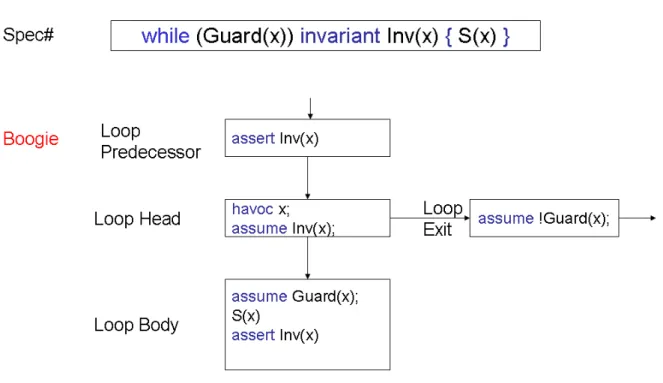
However, loops introduce back edges in control flow graph. But the technique explained above can only deal with acyclic graphs. To get rid of such back edges, we will need to:
• Duplicate loop invariantP by using:assert P = assert P ; assume P; • Check loop invariant at loop entry and exit.
• Delete back edges after “havoc”-ing loop targets. As depicted in Figure4.1.
CHAPTER 4. BOOGIE
Figure 4.1: Transforming a loop in Boogie
To illustrate the idea, consider the Spec# source program in Listing4.1, taken from[7].
1 int M(int x) requires 100 <= x: 3 ensures result == 0; { 5 while {0 < x} invariant 0 <= x; 7 { x = x - 1; 9 } return x; 11 }
Listing 4.1: Spec# program example
After translate the program to Boogie we obtain the following code: Start: assume 100 <= x;
goto LoopHead; LoopHead: assert 0 <= x;
goto Body, After; Body: assume 0 < x; x := x - 1; goto LoopHead; return; After: assume¬(0 < x); r := x; assert r = 0; return r;
4.2. BOOGIE PROGRAM VERIFIER
The next step is to cut the back edges, so the loop-free program is: Start: assume 100 <= x;
assert 0 <= x; goto LoopHead; LoopHead: havoc x;
assert 0 <= x; goto Body, After; Body: assume 0 < x; x := x - 1; assert 0 <= x; return; After: assume¬(0 < x); r := x; assert r = 0; return r;
The passive form of the program is then: Start: assume 100 <=x0;
assert 0 <=x0; goto LoopHead; LoopHead: skip;
assert 0 <=x1; goto Body, After; Body: assume 0 <x1; x2:=x1 - 1; assert 0 <=x2; return; After: assume¬(0 <x1); r1:=x1; assertr1= 0; return r;
4.2 Boogie Program Verifier
To verify a program, Boogie generates a set of verification conditions in a first step — logical formulas whose validity implies that the program satisfies the correctness properties under con-sideration. The verification conditions are then processed with the help of a theorem prover, where a successful proof attempt shows the correctness of the program, and a failed proof attempt may give an indication of a possible error in the program.
The Boogie pipeline is depicted in Figure4.2.
There are different ways for the generation of the verification conditions. But each one can have a dramatic impact on the performance of the underlying theorem prover. Boogie performs a series of transformations on the program, essentially producing one snippet of the verification condition from each basic block of the Boogie language procedure implementation being verified. The verification condition is represented as a formula in first-order logic. It is then passed to a first-order automated theorem prover to determine the validity of the verification condition (and thus the correctness of the program).
CHAPTER 4. BOOGIE Boogie Invariant Inference VC Generation Theorem Proving BoogiePL
Figure 4.2: Boogie pipeline
Stmt wp(Stmt,Q) wlp(Stmt,Q) x:=E Q[x:=e] Q[x:=e] assert E E∧Q E⇒Q assume E E⇒Q E⇒Q S ; T wp(S,wp(T,Q)) wlp(S,wlp(T,Q)) S□T wp(S,Q)∧wp(T,Q) wlp(S,Q)∧wlp(T,Q)
Table 4.1: Weakest precondition and Weakest liberal precondition of a statement
In particular, Boogie is based on the weakest liberal precondition (wlp) to the calculation of the verification conditions.
For any statementS and predicateQ on the post-state ofS, theWP ofS with respect to Q, denotedwp(S, Q), is a predicate on the pre-state ofS, characterizing all pre-states from which every non-blocking execution of S does not go wrong and terminates in a state satisfying Q.
wlp(S, Q)characterizes the pre-states from which every non-blocking execution ofSeither goes
wrong or terminates in a state satisfyingQ. Table4.1show the calculation of bothwpanswlpfor a given statement.
The way how Boogie generates theseVCmake possible to construct an error trace from a failed proof.
where Q[x:=E] denote the substitution ofEforxinQ, that is:
Q[x := E] = let x = E in Q end
The problem of useWPis the redundancy. In wp(S; T,Q), which expand towp(S, Q)∧wp(T, Q), Q is duplicated and that result in an exponential size of the formula generated. But usingweakest liberal precondition (WLP)to compute theWPcan reduce such complexity to quadratic instead of exponential. The connection betweenWPandWLPis described in [30]:
(∀Q • wp(S, Q) ≡ wp(S, true) ∧ wlp(S, Q)) (4.1)
In [49], the authors call to the following property, a ”dream property”:
wlp(S, Q)≡ (wlp(S, false) ∨ Q) (4.2)
With this we can compute wp(S,Q) for a Q that is not the literal true, compute wp(S,true)∧ wlp(S,Q) compute wlp(S,Q) for a Q that is not the literal false, compute wlp(S,false)∨Q compute
4.3. SUMMARY
wp(S,true) and wp(S,false), apply the syntactic transformations suggested in (1).
4.3 Summary
In this chapter we present the Boogie framework. It was introduced and explained the internals of Boogie Program Verifier and described the Boogie programming language.
Chapter 5
Program Slicing
Slicing was first proposed in 1979, by Weiser in his PhD thesis [66] and was then used to ease program debugging [60,3,65,44], software testing [15,40], software metrics [47,57], software maintenance [21, 36], program comprehension [41,53] and so on. Slicing can be use to extract the statement relevant to a particular computation.
Program slicing, in its original version, is a decomposition technique that extracts from a program the statements relevant to a particular computation. A program slice consists of the parts of a program that potentially affect the values computed at some point of interest referred to as a slicing criterion.
Weiser defined a program sliceS as a reduced, executable program obtained from a program
P removing statements, such thatSpreserves the original behaviour of the program with respect to a subset of variables of interest and at a given program point.
Executable means that the slice is not only a closure of statements, but also can be compiled and run. Non-executable slices are often smaller and thus more helpful in program comprehension.
The slices mentioned so far are computed by gathering statements and control predicates by way of a backward traversal of the program, starting at the slicing criterion. Therefore, these slices are referred to as backward slices [62]. In [12], Bergeretti and Carr� were the first to define a notion of a forward slice. A forward slice is a kind of ripple effect analysis, this is, it consists of all statements and control predicates dependent on the slicing criterion. A statement is dependent of the slicing criterion if the values computed at that statement depend on the values computed at the slicing criterion, or if the values computed at the slicing criterion determine if the statement under consideration is executed or not.
Both backward or forward slices are classified as static slices. Static means that only statically available information is used for computing slices, this is, all possible executions of the program are taken into account; no specific inputI is taken into account.
Since the original version proposed by Weiser [64], various slightly different notions of program slices, which are not static, have been proposed, as well as a number of methods to compute slices. The main reason for this diversity is the fact that different applications require different program properties of slices.
Some of these variants include:
• Dynamic slicing: Korel and Laski proposed an alternative slicing definition, named dynamic slicing in [45, 46], where a slice is constructed with respect to only one execution of the program corresponding just to one given input. It does not include the statements that have no relevance for that particular input.
• Quasi-static slicing Venkastesh introduced in 1991 the quasi-static slicing in [63], which is a slicing method between static slicing and dynamic slicing. A quasi-static slice is constructed
CHAPTER 5. PROGRAM SLICING
with respect to some values of the input data provided to the program. It is used to analyse the behaviour of the program when some input variables are fixed while others vary. • Simultaneous dynamic slicing Hall proposed the simultaneous dynamic slicing in [39],
which computes slices with respect to a set of program executions. This slicing method is called simultaneous dynamic program slicing because it extends dynamic slicing and sim-ultaneously applies it to a set of test cases, rather than just one test case.
• Conditioned slicing Canfora et al introduced in [18] the concept of conditioned slicing. A conditioned slice consists of a subset of program statements which preserves the behaviour of the original program with respect to a slicing criterion for any set of program executions. The set of initial states of the program that characterise these executions is specified in terms of a first order logic formula on the input.
• Union Slicing Beszedes et al [14, 13] introduced the concept of union slice and the com-puting algorithm. A union slice is the union of dynamic slices for a finite set of test cases; actually is very similar to simultaneous dynamic program slicing. An union slice is an ap-proximation of a static slice and is much smaller than the static one.
In this chapter, are only discussed the most relevant ones with respect to the work discussed in this document: static slicing (inSection 5.1), dynamic slicing (inSection 5.2) and conditioned slicing (inSection 5.3).
Program example Listing 5.1corresponds to a program, taken from [18]. This program will be
used as running example in the next sections.
Initially the program reads the integers test0, n and a sequence of n integers a as input and compute the integers possum, posprod, negsum and negprod. The integers possum and pos-prod accumulate the sum and pos-product of the positive numbers in the sequence, respectively. On the other hand the integers negsum and negprod accumulate the sum and product of the abso-lute value of the negative numbers in the sequence, respectively. Whenever an input is zero, the greatest sum and product are reset if the value of test is non zero (true).
5.1. STATIC SLICING
1 main() {
int a, test0, n, i, posprod, negprod, possum, negsum, sum, prod;
3 scanf(”%d”, %test0); scanf(”%d”,&n);
i = posprod = negprod = 1; 5 possum = negsum = 0; while(i<=n){ 7 scanf(”%d”,&a); if (a > 0) { 9 possum += a; posprod *= a; 11 } else if (a < 0){ negsum -= a; 13 negprod *= (-a); } else if (test0){ 15 if (possum >= negsum){ possum = 0; 17 } else { negsum = 0; } if (posprod >= negprod){ 19 posprod = 1; } else { negprod =1; } 21 } i++; 23 } if (possum >= negsum) { 25 sum = possum; }
27 else { sum = negsum; }
if ( posprod >= negprod) { 29 prod = posprod; } else { 31 prod = negprod; } 33 printf(”Sum: %d\n”, sum);
printf (”Product : %d\n” , prod );
35 }
Listing 5.1: Program example 1
5.1 Static slicing
Based on the original definition of Weiser, a static slice consists of only the parts of the program that affect the values computed at some point of interest referred to as a slicing criterion C=(p,V), where p is a program point and V is a set of variables of interest.
A static slice preserves the behaviour of the original program with respect to the slicing criterion for the program execution.
Definition 1 (Static slicing). A static sliceSof a programP on slicing criterionC = (p, Vs)is any syntactically correct and executable program with the following properties:
• S can be obtained fromP by deleting zero or more statements fromP.
• WheneverP halts, on inputI, with state trajectoryT, thenSalso halts, with the same input
CHAPTER 5. PROGRAM SLICING
where
Definition 2 (Projection). LetC = (p, Vs)be a static slicing criterion of a programP andT =< (p1, σ1), (p2, σ2),..., (pk, σk) >a state trajectory ofP on inputI. ∀i, 1 ≤ i ≤ k:
P rojC′ (pi, σi) = {
λ if pi̸= p
< (pi, σi|Vs) > if pi= p
Listing 5.2shows a static slice of the program5.1on the slicing criterion C = (I, 34, prod).
1 main() {
int a, test0, n, i, posprod, negprod, prod;
3 scanf(”%d”, %test0); scanf(”%d”,&n);
i = posprod = negprod = 1; 5 while(i<=n){ scanf(”%d”,&a); 7 if (a > 0) { posprod *= a; 9 } else if (a < 0){ negprod *= (-a); 11 } else if (test0){ if (posprod >= negprod){ 13 posprod = 1; } else { negprod =1; } 15 } i++; 17 } if ( posprod >= negprod) { 19 prod = posprod; } else { 21 prod = negprod; }
23 printf (”Product : %d\n” , prod );
}
Listing 5.2: A static slicing of program5.1
5.2 Dynamic slicing
Thedynamic slicing (DS)was proposed by Korel and Laski [2,45], where a slice is constructed with respect to only one execution of the program corresponding just to one given input. It does not include the statements that have no relevance for that particular input.
Definition 3 (Dynamic Slicing). A dynamic slice of a program P on a dynamic slicing criterion C = (I, p, Vs)is any syntactically correct and executable program P’ obtained from P by deleting zero or more statements, and whenever P halts, on input I, with state trajectory T, then P’ also halts, on the same input I, with state trajectory T’, andP roj(p,Vs)(T ) = P roj(p,Vs)(T′).
The difference between static and dynamic slicing is that dynamic slicing assumes fixed input for a program, whereas static slicing does not make assumptions regarding the input. [62]
To clarify the difference between static and dynamic slicing, consider a program unit with an iteration block containing an if-else block. Consider that thestatic slicing (SS) contain the if-else block. In the case ofDSwe consider a particular execution of the program, where only one
5.3. CONDITIONED SLICING
part of the block is executed. So, in this particular execution case, the dynamic slice would contain only the statements in the if block or else block.
The slicing criterion in this variant is C=(I,p,V), where I is a set of tuples, variable and value.
Listing 5.3shows a dynamic slice of the program5.1on the slicing criterion C = (I, 34, prod) where I =< (test, 0), (n, 2), (a1, -1), (a2, -2) >.
main() {
2 int a, test0, n, i, posprod, negprod, prod;
scanf(”%d”, %test0); scanf(”%d”,&n);
4 i = posprod = negprod = 1; while(i<=n){ 6 scanf(”%d”,&a); if (a < 0){ 8 negprod *= (-a); } 10 i++; } 12 if ( posprod >= negprod) { prod = posprod; 14 } else { prod = negprod; 16 }
printf (”Product : %d\n” , prod );
18 }
Listing 5.3: A dynamic slicing of program5.1
5.3 Conditioned slicing
Theconditioned slicing (CS)was presented by Canfora, Cimitile, and Lucia [18]. This slicing can see as a bridge between the two extremes of static and dynamic analysis [41].
A conditioned slice consists of a subset of program statements which preserves the behaviour of the original program with respect to a slicing criterion for any set of program executions. The set of initial states of the program that characterise these executions is specified in terms of a first order logic formula on the input. This allows a programmer to further specialise a program by eliminating statements which do not contribute to the computation of the variables of interest when the program is executed in one of the initial states of interest.
Definition 4 (Conditioned Slicing Criterion). LetVi be the set of input variables of a programP, and F be a first order logic formula on the variables in Vi. A conditioned slicing criterion of a programP is a tripleC = (F (Vi), p, Vs)wherepis a statement inP andVsis the subset of the variables inP which will be analysed in the slice.
Definition 5 (Conditioned Slicing). A conditioned slice of a program P on a conditioned slicing
criterionC = (F (Vi), p, Vs)is any syntactically correct and executable program P’ such that: P′ is obtained from P by deleting zero or more statements; whenever P halts, on input I, with state trajectory T, where I ∈ C(I′, Vi′), I′ ∈ S(F (Vi)), Vi′ is the set of input variables ofP, and S is the satisfaction set, then P’ also halts, on input I, with state trajectory T’, andP roj(p,Vs)(T ) =
P roj(p,Vs)(T′).
Listing 5.4shows a conditioned slice of the program5.1on the slicing criterion C = (F(Vi), 34, prod) whereVi= {n}∪1≤i≤n{ai} and F(Vi)=∀i, 1≤i≤n ,ai > 0.
CHAPTER 5. PROGRAM SLICING
main() {
2 int a, test0, n, i, posprod, negprod, prod;
scanf(”%d”, %test0); scanf(”%d”,&n);
4 i = posprod = negprod = 1; while(i<=n){ 6 scanf(”%d”,&a); if (a > 0){ 8 posprod *= a; } 10 i++; } 12 if ( posprod >= negprod) { prod = posprod; 14 }
printf (”Product : %d\n” , prod );
16 }
Listing 5.4: A conditioned slicing of program5.1
As discussed in the previous sections, program slicing is a well-recognised technique that is used mainly at source code level to highlight code statements that impact upon other statements. Slicing has many applications because it allows a program to be simplified by focusing attention on a sub-computation of interest for a chosen purpose. Some of these applications include: debug-ging, software maintenance, reverse engineering, program comprehension, testing and measure-ment.
Chapter 6
Slicing programs with contracts
Program verification goal is to establish that a program performs according to some intended spe-cification. Typically, what is meant by this is that the input/output behaviour of the implementation matches that of the specification (this is usually called the functional behaviour of the program), and moreover the program does not ‘go wrong’, for instance no errors occur during evaluation of expressions (the so-called safety behaviour).
In recent years program verification has been closely linked with the so-calledDesign-by-Contract
(DbC) approach to software development [55], which facilitates modular verification and certified code reuse. The contract for a software component can be regarded as a form of enriched soft-ware documentation that fully specifies the behaviour of that component. In terms of verification terminology, a contract for a component is simply a pair consisting of a precondition and a post-condition written in a formal language (usually a logical one) generally designated as an annota-tion language. It certifies the results that can be expected after execuannota-tion of the component, but it also constrains the input values of the component. The development and broad adoption of annotation languages for the major programming languages reinforces the importance of using
DbCprinciples in program development. These include for instance the Java Modeling Language (JML) [16]; Spec# [8], a formal language for C# API contracts; and the ANSI/ISO C Specification Language (ACSL) [10].
Program verification and slicing techniques used in the context of source code analysis, are apparently unrelated areas. However, one point of contact that has been identified between sli-cing and verification is that traditional dependency-based slisli-cing, applied a priori, facilitates the verification of large programs. In this paper we explore the idea that it makes sense to slice pro-grams based on semantic, rather than syntactic, criteria – the contracts used inDbCand program verification are excellent candidates for such criteria.
A typical case of being useful to calculate the slice of a program based on a specification is the reuse of annotated code. Suppose one is interested in reusing a module whose advertised con-tract consists of preconditionPand postconditionQ, in situations in which a stronger precondition
P′ is known to hold, or else the desired postconditionQ′ is weaker than the specifiedQ. Then from a software engineering perspective it would be desirable to eliminate, at source-level, the code that may be spurious with respect to the specification(P′, Q′).
Although the basic ideas have been published for over 10 years now, assertion-based slicing is still not very popular . The widespread usage of code annotations, as explained above, is however an additional argument for promoting it.
From now one, the expression assertion-based slicing [9] will be used to encompass postcondition-based (Section 6.1), precondition-based (Section 6.2), and specification-based (Section 6.3) forms of slicing. All these algorithms work at the intra-procedural level. To read about the differences among these algorithms and improved versions of them please see [9].
CHAPTER 6. SLICING PROGRAMS WITH CONTRACTS
x := x+100;
2 x := x+50;
x:= x-100
Listing 6.1: Example for postcondition-based slicing
Daniela da Cruz in [9] also presents a tool, GamaSlicer, that implements all the algorithms and animates there execution. Due to the central role of GamaSlicer in this master work, it will be introduced inSection 6.4. In that section it is describedGamaSlicerarchitecture and features, and also exemplified all how it applies the slicing to a given program. Although brief, this presentation clarifies what is expected from GamaBoogie.
6.1 Postcondition-based Slicing
The idea of slicing programs based on their specifications was introduced by Comuzzi et al. [22] with the notion of predicate slice (p-slice), also known as postcondition-based slice.
The algorithm proposed by Comuzzi runs in quadratic time on the length of the sequence. The algorithm first tries to slice the entire program by removing its longest removable suffix, and then repeats this task, considering successively shorter prefixes of the resulting program, and removing their longest removable suffixes. Schematically:
for j = n + 1, n, . . . , 2 for i = 1, . . . , j− 1
if valid(wpreci(S, Q)→ wprecj(S, Q)) then S← remove(i, j − 1, S)
For instance in a program with 999 statements the following pairs(i, j) would be considered in this order:
(1, 1000), (2, 1000), . . . , (999, 1000), (1, 999), (2, 999), . . . , (998, 999), (1, 998), . . .
To understand the idea of p-slices, consider a programS and a given postconditionQ. It may well be the case that some of the commands in the program do not contribute to the truth ofQ
in the final state of the program, i.e. their presence is not required in order for the postcondition to hold. In this case, the commands may be removed. A crucial point here is that the considered set of executions of the program is restricted to those that will result in the postcondition being satisfied upon termination. In other words, not every initial state is admissible – only those for which the weakest precondition of the program with respect toQholds.
Consider for instance Listing 6.1. The postconditionQ = x≥ 0yields the weakest precondition
x≥ −50. If the program is executed in a state in which this precondition holds and the commands
in lines 2 and 3 are removed from it, the postconditionQ will still hold. To convince ourselves of this, it suffices to notice that after execution of the instruction in line 1 in a state in which the weakest precondition is true, the conditionx≥ 50will hold, which is in fact stronger thanQ.
Applications In their paper Comuzzi and Hart give a number of examples of the usefulness of
postcondition-based slicing, based on their experience as software developers and maintainers. Their emphasis is on applying slicing to relatively small fragments of big programs, using postcon-ditions corresponding to properties that should be preserved by these fragments. Suppose one