Faculdade de Ciências
Departamento de Biologia Animal
Clams from Tagus estuary: microbiological, physiological
and chemical responses to depuration, transport and
environmental stress
Patrícia Sofia Laranjeira Anacleto
Doutoramento em Biologia
Especialidade em Biologia Marinha e Aquacultura
2014
Faculdade de Ciências
Departamento de Biologia Animal
Clams from Tagus estuary: microbiological, physiological
and chemical responses to depuration, transport and
environmental stress
Patrícia Sofia Laranjeira Anacleto
Tese orientada pelo Investigador Principal Doutor Rui Afonso Bairrão da Rosa e
pelo Investigador Auxiliar Doutor António Manuel Barros Marques, especialmente
elaborada para a obtenção do grau de Doutor em Biologia
Especialidade em Biologia Marinha e Aquacultura
2014
Doctoral dissertation in Biology
(specialization scientific area in Marine Biology and Aquaculture) presented to the University of Lisboa
Dissertação apresentada à Universidade de Lisboa para obtenção do grau de Doutor (especialidade Biologia Marinha e Aquacultura) _________________________________________________________ Patrícia Sofia Laranjeira Anacleto 2014
Durante a realização desta tese de doutoramento, várias pessoas estiveram envolvidas, directa ou indirectamente, no trabalho e a quem quero expressar os meus sinceros e profundos agradecimentos.
Em primeiro lugar, agradeço especialmente aos meus orientadores que foram excepcionais e são um exemplo a seguir:
‐ Doutor António Marques, que sempre me incentivou a realizar este doutoramento e me deu suporte para que tal fosse possível. Além de sempre me motivar e apoiar incansavelmente, esteve sempre presente em todas as fases deste trabalho científico, desde os longos embarques no rio Tejo até às noitadas no laboratório com as amêijoas. Além de um grande amigo, ajudou‐me a ultrapassar todos os obstáculos impostos e a conseguir superar todas as dificuldades que encontramos na investigação. Agradeço também todos os conhecimentos científicos e experiência que me transmitiu diariamente e por toda a disponibilidade constante sempre demonstrada. Quero ressaltar também toda a sua paciência em me “aturar” e todo o seu positivismo transmitido que foram uma mais‐ valia e vontade de continuar em frente. ‐ Doutor Rui Rosa, que me aceitou como sua doutoranda e me deu esta oportunidade única de trabalhar também noutra área diferente e tão interessante da habitual (“Food”). É um privilégio tê‐lo como orientador e trabalhar num local tão magnífico como é a “Guia”. A minha profunda gratidão pela amizade, simpatia, motivação, confiança, empenho, entusiasmo e inspiração em todas as etapas deste trabalho científico. Agradeço também todos os conhecimentos científicos transmitidos e financeiros disponibilizados. É extraordinário trabalhar com uma pessoa que tem uma visão científica tão abrangente, com ideias inovadoras constantes e com um espírito incondicional para o mundo científico.
Agradeço à Doutora Maria Leonor Nunes pelo seu apoio, orientação e supervisão atenta nas várias fases deste trabalho. Tem sido sempre um privilégio poder contar com a sua dedicação, inspiração, sabedoria, empenho, confiança e motivação. Além disso, agradeço prontamente todas as suas sugestões, críticas e esclarecimento de dúvidas no decorrer deste trabalho científico.
Agradeço às instituições de acolhimento, o Instituto Português do Mar e da Atmosfera (IPMA, I.P.) e ao Laboratório Marítimo da Guia (Centro de Oceanografia, Faculdade de Ciências da Universidade de Lisboa; LMG‐CO, FCUL, UL), por terem proporcionado as condições necessárias à realização deste trabalho científico.
Agradeço a todas as pessoas da Divisão de Aquacultura e Valorização (DivAV) do IPMA que estiveram envolvidas neste trabalho científico. Em especial à Dra. Ana Luísa Maulvault pela amizade dentro e fora do meio científico, pelo apoio e ajuda sempre demonstrados no trabalho prático, em particular quando incluía fazer noitadas e passar fins‐de‐semana com as amêijoas, muitas vezes com um odor insuportável. Toda a sua boa‐disposição e energia constantes foram uma mais‐valia para que esses momentos fossem menos duros.
Agradeço também o apoio prestado e amizade demonstrada da Doutora Milena Chaguri e da Doutora Paula Martin, durante as suas estadias em Portugal e que certamente levaram boas recordações para o Brasil. Assim como eu trouxe do Brasil e agradeço à Milena pela grande amizade e pelos passeios maravilhosos por Botucatu. Agradeço à Doutora Narcisa Bandarra, Doutor Rogério Mendes e Doutora Sónia Pedro pela colaboração no trabalho desenvolvido nos laboratórios de Nutrição, Bioquímica e Microbiologia. Muitos outros colegas foram fundamentais no apoio dado, entre os quais o Doutor Carlos Cardoso, Doutora Sara Barrento, Júlia Ferreira, Engª Patrícia Oliveira, Doutora Helena Silva, Doutora Helena Lourenço, Doutora Cláudia Afonso e Dra. Vera Barbosa. E agradeçço a todos os restantes colegas…
Do Laboratório Marítimo da Guia, agradeço a todos os colegas pelo companheirismo e disponibilidade demonstrados. Em especial à Dra. Vanessa Lopes, Doutor Tiago Repolho, Dr. Miguel Baptista e Dra. Ana Rita Lopes pelo apoio constante que deram durante as experiências, pela vossa amizade e por serem simplesmente espectaculares.
Agradeço ao Doutor Mário Diniz por me ter gentilmente recebido na Faculdade de Ciências e Tecnologia da Universidade Nova de Lisboa (FCT/UNL) e por todos os seus conhecimentos científicos e colaboração no trabalho aí desenvolvido. Igualmente, quero agradecer à Dra. Diana Madeira e Dra. Vanessa Mendonça pela ajuda e apoio na realização das análises laboratoriais.
Quero agradecer ao Doutor Patrick Freire do Instituto Nacional de Investigação Agrária e Veterinária (INIAV, I.P.) pela sua disponibilidade, ensinamentos, apoio e boa‐disposição sempre demonstradas. Quero também agradecer à Dra. Tânia Chança pelo grande apoio e ajuda nas últimas experiências com as amêijoas e desejar boa sorte para a conclusão do seu mestrado. À Doutora Inês Guinote pela simpatia e bons momentos de convívio, principalmente nas horas de almoço.
Agradeço à Professora Doutora Maria Luísa Carvalho do laboratório do Centro de Física Atómica da Faculdade de Ciências e Tecnologia da Universidade Nova de Lisboa (CFA, FCT/UNL) assim como a todas as meninas da sua equipa de investigação (Sofia, Ana, Diana, Marta) pela colaboração, apoio e ajuda na determinação de elementos químicos no aparelho de EDXRF.
Agradeço a todos os pescadores que colaboraram gentilmente e com entusiasmo na recolha de amostras no estuário do Tejo, em particular ao Sr. Jorge Camarão Jerónimo, Sr. Sandro Pinto, Sr. Pedro Patacas e Sr. Daniel.
Agradeço ao Aquário Vasco da Gama, e em especial à Dra. Fátima Gil e Dra. Sara Chalante por serem tão amáveis e cederem microalgas sempre que necessário.
Agradeço à Fundação para a Ciência e Tecnologia (FCT) pelo financiamento da minha bolsa de doutoramento (Ref: SFRH/BD/69274/2010) que possibilitou a execução desta tese e também aos projectos MUSSELSALIVE “Development of best practice and new technology for grading, handling, transportation, conditioning and storage of mussels for SMEs in the European mussel industry” (Ref: 243452) e SHELLPLANT “Development of a novel production system for intensive and cost effective bivalve farming” (Ref: 232273) que financiaram muitos dos reagentes e material.
Agradeço a todos os meus amigos, pelo seu apoio, amizade, motivação e pelos bons momentos partilhados.
Agradeço à minha família, e de um modo muito especial aos meus pais pelo amor incondicional, educação, carinho, apoio e incentivo em todos os momentos da minha vida. Obrigado por sempre me proporcionarem as melhores condições e serem o meu grande suporte. Agradeço especialmente à minha irmã Andreia por todo o apoio incondicional, pela grande ajuda que me deu nos trabalhos com as amêijoas, inclusive quando consistia em “lavar sistemas” e por toda a motivação, amizade e carinho que foram constantes e fundamentais durante estes anos. Agradeço também toda a ajuda e força do João Pedro que foram muito importantes e fundamentais.
Por último, mas não menos importante e decerto o primeiro, agradeço ao Nuno, pelo seu amor, amizade, carinho, companheirismo, incentivo, compreensão, paciência, apoio incondicional e motivação constantes, o que sempre me transmitiu segurança e vontade de concluir esta tese. Obrigada por tudo o que fizeste por mim e continuas a fazer. Sei que posso contar sempre contigo. Quero também agradecer ao Lucky, o meu gatinho “mais que tudo”, pelos seus miminhos e carinhos que recebi aquando da escrita da tese. De igual modo, agradecimentos felinos ao Savi, à Sasha e ao Suri.
Obrigado a todos aqueles que de alguma forma contribuíram e participaram em mais uma etapa da minha vida.
List of abbreviations and units 1 List of figures 9 List of tables Abstract Resumo Resumo alargado List of papers CHAPTER 1 General introduction CHAPTER 2 Portuguese consumers’ attitudes and perceptions of bivalve molluscs CHAPTER 3 Microbiological composition of native and exotic clams from Tagus
estuary: Effect of season and environmental parameters
CHAPTER 4 Microbiological responses to depuration and transport of native and exotic clams at optimal and stressful temperatures
CHAPTER 5 Physiological responses to depuration and transport of native and exotic clams at different temperatures
CHAPTER 6 Effects of depuration on metal levels and health status of bivalve molluscs CHAPTER 7 Ecophysiology of native and alien invasive clams in an ocean warming context CHAPTER 8 Effect of warming on nutritional quality of native and alien invasive clams CHAPTER 9 General discussion and conclusions ANNEX 13 17 19 21 25 27 77 89 101 113 127 145 159 173 199
% percentage / per € euros ± approximately °C degree Celsius atm atmosphere cm centimetre(s) dw dry weight eV electronvolt g gram(s) g relative centrifugal force or G‐force h hour(s) Kcal kilocalories kDa kilodalton keV kiloelectronvolt kg kilogram(s) kJ kilojoule(s) km2 square kilometre kPa kilopascal kV kilovolts L litre(s) log logarithm m metre(s) M molar concentration mA milliampere(s) mg milligram(s) min minute(s) mL millilitre(s) mM milimolar mm millimetre(s) mt metric tonne(s) ng nanogram(s) nm nanometer(s)
nmol nanomole PFU plaque forming units pg picogram(s) ppt part per thousand PSU practical salinity units rpm revolutions per minute s or sec second(s) t tonne(s) U units V volt(s) v/v volume per volume W watt(s) w/v weight per volume ww wet weight γ gamma λ wavelength μg micrograma(s) μL microlitre(s) μm micrometre(s) μM micromolar μmol micromole χ2 chi‐square test ω omega AA arachidonic acid ADP adenosine 5’‐diphosphate AEC adenylate energy charge AI atherogenicity index AIS alien invasive species AMP adenosine 5’‐monophosphate ANOVA analysis of variance APW alkaline peptone water As arsenic ASP amnesic shellfish poisoning ATP adenosine 5’‐triphosphate BGA brilliant green agar BPW buffered peptone water
Br bromine BSA bovine serum albumin Ca calcium CAT catalase Cd cadmium CDNB l‐chloro‐2,4‐dinitrobenzene CFU colony‐forming units CI condition index Cl chlorine Co cobalt CO2 carbon dioxide Cr chromium CS citrate synthase CTMax critical thermal maximum CTMin critical thermal minimum Cu copper D.O. dissolved oxygen DDT dichloro‐diphenyl‐trichloro‐ethane DGPA Direcção Geral das Pescas e Aquicultura DHA docosahexaenoic acid DL detection limits DNA deoxyribonucleic acid DR Diário da República DSP diarrhetic shellfish poisoning DT22 depurated and transported clams at 22 °C DT4 depurated and transported clams at 4 °C e.g. for example EA erucic acid EC European Commission EDTA ethylenediaminetetraacetic acid EDXRF energy dispersive X‐ray fluorescence ELISA enzyme‐linked immunosorbent assay EPA eicosapentaenoic acid etc. Et cetera EU European Union FA fatty acids
FAAS flame atomic‐absorption spectrometry FAME fatty acid methyl esters FAO Food and Agriculture Organization of the United Nations FC faecal coliforms FDA Food and Drug Administration Fe iron GA gadoleic acid GISP Global Invasive Species Programme GPX glutathione peroxidise GR glutathione reductase GSH reduced glutathione GST glutathione S‐transferase h/H hypocholesterolemic/hypercholesterolemic indice H2O water H2O2 hydrogen peroxide HAB harmful algal blooms HAV hepatitis A virus Hg mercury HO hydroxyl radical HPLC high performance liquid chromatography HPP high pressure processing HSC70 heat shock cognate 70 HSP24 heat shock protein 24 HSP70 heat shock protein 70 HSR heat shock response HTA hexadecatrienoic acid HVA homeoviscous adaptation Hx hypoxanthine HxR inosine i.e. is est/that is/in other words ICMSF International Commission on Microbiological Specifications for Foods IMP inosine 5’‐monophosphate INE National Institute of Statistics IPCC Intergovernmental Panel on Climate Change IPMA Portuguese Institute for the Sea and Atmosphere IS internal standard
ISO International Organization for Standardization K potassium LA linoleic acid LL legal limit LT100 temperature required for 100% of mortality LT50 time/temperature required for 50% mortality MDA malondialdehyde MDH malate dehydrogenase meHg methylmercury Mg magnesium MG Mytilus galloprovincialis Mn manganese MPLs maximum permissible limits MPN most probable number MRD maximum recovery diluent MUFA monounsaturated fatty acids n or N number of replicates n.a. not analysed n‐3 omega‐3 fatty acids n‐6 omega‐6 fatty acids Na sodium NBT nitroblue tetrazolium ND not detected NE not eliminated Ni nickel NLV Norwalk‐like virus NOAA National Oceanic and Atmospheric Administration NSP neurotoxic shellfish poisoning O2 oxygen OA oleic acid p or p‐value probability of the test statistic PA palmitic acid PAHs polycyclic aromatic hydrocarbons Pb lead PBS phosphate‐buffered saline solution PBST phosphate‐buffered saline solution Tween‐20
PCBs polychlorinated biphenyls PCDD polychlorinated dibenzo‐p‐dioxins PCDF polychlorinated dibenzofurans Pcrit critical oxygen partial pressure pH measure of the acidity or basicity of an aqueous solution PO2 oxygen partial pressure POPs persistent organic pollutants PSP paralytic shellfish poisoning PUFA polyunsaturated fatty acids Q10 thermal sensitivity QMRA quantitative microbial risk assessment r correlation coefficient RAS recirculation aquaculture system RASFF Rapid Alert System for Food and Feed Rb rubidium RL recommended limit RMRs routine metabolic rates ROS reactive oxygen species RP Ruditapes philippinarum S sulphur SA stearic acid SARF Scottish Aquaculture Research Forum SD standard deviation SDS sodium dodecyl sulfate Se selenium SFA saturated fatty acids SNIRH National Information System of Water Resources SOD superoxide dismutase SP Scrobicularia plana sp. or spp. specific epithet of species not identified. Single or several species within a genus Sr strontium
SRTEM Salmonella rapid test medium
T22 non‐depurated clams and transported at 22 °C T4 non‐depurated clams and transported at 4 °C TBARS thiobarbituric acid reactive substances
TBT tributyltin TBX tryptone bile X‐glucuronide agar TCBS thiosulphate citrate bile salt sucrose agar TI thrombogenicity index Toff cessation temperature Ton onset temperature Tpeak temperature of maximal induction TPHs total petroleum hydrocarbons TSA trypticase soy agar TSI triple sugar iron agar TVC total viable counts UK United Kingdom UL undetected limits USA United States of America USEPA United States Environmental Protection Agency UV ultraviolet light UV‐Vis ultraviolet–visible VA vaccenic acid VP Venerupis pullastra WB western blot WHO World Health Organization WTTC World Travel & Tourism Council XLD xylose–lysine–desoxycholate agar XOD xanthine oxidase solution Zn zinc
CHAPTER 1 General introduction
Fig. 1. World production (fisheries and aquaculture) between 1950 and 2011 in tonnes (t) of the most important groups of seafood (a) and the most representative bivalve groups (b). Fig. 2. World production (fisheries and aquaculture) between 1950 and 2011 in tonnes (t) of
main produced bivalves’ species.
Fig. 3. Major bivalve producing countries (fisheries and aquaculture) of different bivalve mollusc groups, data in tonnes (t) from 1950 to 2011. Fig. 4. National production (fisheries and aquaculture) in tonnes (t) of the most representative bivalves from the Portuguese coast between 1950 and 2012. Fig. 5. Imports and exports of bivalves by Portugal, data in value (€ million) from 1988 to 2013. Fig. 6. Main importers of bivalves from Portugal, data in tonnes (t) from 1988 to 2013. Fig. 7. Main exporters of bivalves to Portugal, data in tonnes (t) from 1988 to 2013. Fig. 8. National trade chain of live bivalve molluscs from harvest to consumers. Fig. 9. Hypothetical physiological performance curves for ectothermic animals. Fig. 10. Conceptual model of greater invasive eurythermality. CHAPTER 2 Portuguese consumers’ attitudes and perceptions of bivalve molluscs Fig. 1. Preferred bivalve species in Portugal (n = 1419).
CHAPTER 3 Microbiological composition of native and exotic clams from Tagus estuary: Effect of season and environmental parameters
Fig. 1. Map showing Tagus estuary (Portugal) and sampling locations (Trafaria for V. pullastra and Barreiro for R. philippinarum).
Fig. 2. Seasonal variations of Escherichia coli levels in (A) Venerupis pullastra, and (B) Ruditapes
philippinarum clams, sediment (log CFU/100 g) and harvesting waters (log CFU/100 mL)
from Trafaria and Barreiro.
Fig. 3. Seasonal variations of TVC levels in (A) Venerupis pullastra and (B) Ruditapes
philippinarum clams, sediment (log CFU/g) and harvesting waters (log CFU/mL) from
Trafaria and Barreiro.
Fig. 4. Seasonal variations of Vibrio spp. levels in (A) Venerupis pullastra and (B) Ruditapes
philippinarum, sediment (log CFU/g) and harvesting waters (log CFU/mL) from Trafaria
and Barreiro.
CHAPTER 4 Microbiological responses to depuration and transport of native and exotic clams at optimal and stressful temperatures
Fig. 1. Map of Portugal with the enlarged portion of Tagus estuary. Dark filled circles indicate the samplings sites (Trafaria for V. pullastra and Alcochete for R. philippinarum).
Fig. 2. Cumulative mortality rate (%) of native (Venerupis pullastra, VP) and exotic clams (Ruditapes philippinarum, RP) subjected to different treatments: A) depuration and semi‐ dry simulated transport at 4 or 22 °C; B) non‐depurated clams subjected to semi‐dry simulated transport at 4 or 22 °C.
Fig. 3. TVC levels (log CFU/g) of native (Venerupis pullastra, VP) and exotic clams (Ruditapes
philippinarum, RP) subjected to different treatments: A) depuration and semi‐dry
simulated transport at 4 or 22 °C; B) non‐depurated clams subjected to semi‐dry simulated transport at 4 or 22 °C.
Fig. 4. Escherichia coli levels (CFU/100 g) of native (Venerupis pullastra, VP) and exotic clams
(Ruditapes philippinarum, RP) subjected to different treatments: A) depuration and semidry simulated transport at 4 or 22 °C; B) non‐depurated clams subjected to semi‐dry simulated transport at 4 or 22 °C.
Fig. 5. Vibrio spp. levels (log CFU/g) of native (Venerupis pullastra, VP) and exotic clams
(Ruditapes philippinarum, RP) subjected to different treatments: A) depuration and semi‐ dry simulated transport at 4 or 22 °C; B) non‐depurated clams subjected to semi‐dry simulated transport at 4 or 22 °C.
CHAPTER 5 Physiological responses to depuration and transport of native and exotic clams at different temperatures
Fig. 1. Map of Portugal with enlarged portion of the Tagus estuary. Dark dots indicate the samplings sites (Trafaria for V. pullastra and Alcochete for R. philippinarum).
Fig. 2. Schematic representation of the experimental design.
Fig. 3. Survival rate (%) of native (Venerupis pullastra, VP) and exotic (Ruditapes philippinarum, RP) clams subjected to different treatments: A) depuration and semi‐dry transport at 4 or 22 °C; B) non‐depurated clams subjected to semi‐dry transport at 4 or 22 °C.
Fig. 4. Condition index (CI) of native (Venerupis pullastra, VP) and exotic clams (Ruditapes
philippinarum, RP) subjected to different treatments: A) depuration and semi‐dry
transport at 4 or 22 °C; B) non‐depurated clams subjected to semi‐dry transport at 4 or 22 °C.
Fig. 5. Changes in levels of ATP‐related compounds (μmol/g, wet weight) of native (Venerupis
pullastra, VP) and exotic clams (Ruditapes philippinarum, RP) subjected to depuration
Fig. 6. Changes in levels of ATP‐related compounds (μmol/g, wet weight) of native (Venerupis
pullastra, VP) and exotic clams (Ruditapes philippinarum, RP) subjected to semi‐dry
transport at 4 or 22 °C without depuration.
Fig. 7. K‐value (%) of native (Venerupis pullastra, VP) and exotic clams (Ruditapes philippinarum, RP) subjected to different treatments: A) depuration and semi‐dry transport at 4 or 22 °C; B) non‐depurated clams subjected to semi‐dry transport at 4 or 22 °C.
Fig. 8. A.E.C. value (%) of native (Venerupis pullastra, VP) and exotic clams (Ruditapes
philippinarum, RP) subjected to different treatments: A) depuration and semi‐dry
transport at 4 or 22 °C; B) non‐depurated clams subjected to semi‐dry transport at 4 or 22 °C.
Fig. 9. Glycogen content (g/100 g, wet weight) of native (Venerupis pullastra, VP) and exotic clams (Ruditapes philippinarum, RP) subjected to different treatments: A) depuration and semi‐dry transport at 4 or 22 °C; B) non‐depurated clams subjected to semi‐dry transport at 4 or 22 °C.
CHAPTER 6 Effects of depuration on metal levels and health status of bivalve molluscs
Fig. 1. Map of Portugal with enlarged portion of the Tagus estuary. Dark dots indicate the samplings sites (Alcochete for RP, Algés for MG and Sítio das Hortas for SP). Fig. 2. Glycogen content (g/100 g, wet weight) of RP, MG and SP during the depuration time. Fig. 3. Toxic elements concentration (Hg, Cd, Pb and As; mg/kg wet weight) of RP, MG and SP during depuration time. Values represent mean ± standard deviation (n = 3). CHAPTER 7 Ecophysiology of native and alien invasive clams in an ocean warming context
Fig. 1. Effect of environmental warming on the cumulative mortality rates (%) of native (Ruditapes decussatus) and alien invasive (Ruditapes philippinarum) clams.
Fig. 2. Effect of environmental warming on the thermal tolerance limits (CTMax, °C) of native (Ruditapes decussatus, n=60) and alien invasive (Ruditapes philippinarum, n=60) clams. Fig. 3. Effect of environmental warming on the routine metabolic rates (RMRs, µmol O2/g/h wet
weight) of: A) native (Ruditapes decussatus) and B) alien invasive (Ruditapes
philippinarum) clams.
Fig. 4. Effect of environmental warming on thermal sensitivity (Q10 values) of: A) native (Ruditapes decussatus) and B) alien invasive (Ruditapes philippinarum) clams.
Fig. 5. Effect of environmental warming on the valve closure behaviour (as % of open and closed valves) of: A) native (Ruditapes decussatus) and B) alien invasive (Ruditapes
Fig. 6. Effect of environmental warming on the routine metabolic rates (RMR, µmol O2/g/h wet weight) as a function of oxygen partial pressure (PO2; KPa) in: A) native (Ruditapes
decussatus) and B) alien invasive (Ruditapes philippinarum) clams.
Fig. 7. Effect of environmental warming on: A) heat shock response (HSP70/HSC70, μg/μg total protein) and B) lipid peroxidation (expressed as MDA concentration, nmol/min/µg total protein) of native (Ruditapes decussatus) and alien invasive (Ruditapes philippinarum) clams.
Fig. 8. Representative western blot from both clam species exposed to 30 °C, showing differences in HSP70 levels between these species.
Fig. 9. Effect of environmental warming on the antioxidant enzyme activities of native (Ruditapes decussatus) and alien invasive (Ruditapes philippinarum) clams. A) glutathione‐S‐transferase (GST, nmol/min/µg total protein), B) catalase (CAT, nmol/min/µg total protein) and C) superoxide‐dismutase (SOD, U/µg total protein). Fig. S1. Map of the sampling area (red circles) in Tagus (R. philippinarum) and Sado (R. decussatus) estuaries. CHAPTER 8 Effect of warming on protein, glycogen and fatty acid content of native and invasive clams Fig. 1. Effect of warming on A) protein and B) glycogen contents (mg/g dw) of the native clam (R. decussatus) and the invasive clam (R. philippinarum). CHAPTER 9 General discussion and conclusions No figures
CHAPTER 1 General introduction
Table 1. Biochemical composition of the most consumed bivalve molluscs in Portugal. Table 2. Hazards associated with bivalve molluscs’ consumption.
Table 3. Examples of Escherichia coli accumulation factors in bivalve species. Table 4. European criteria for the classification of bivalve mollusc harvesting areas.
Table 5. Regulatory levels for toxins from harmful algal blooms (HAB) and chemical contaminants in live bivalve molluscs.
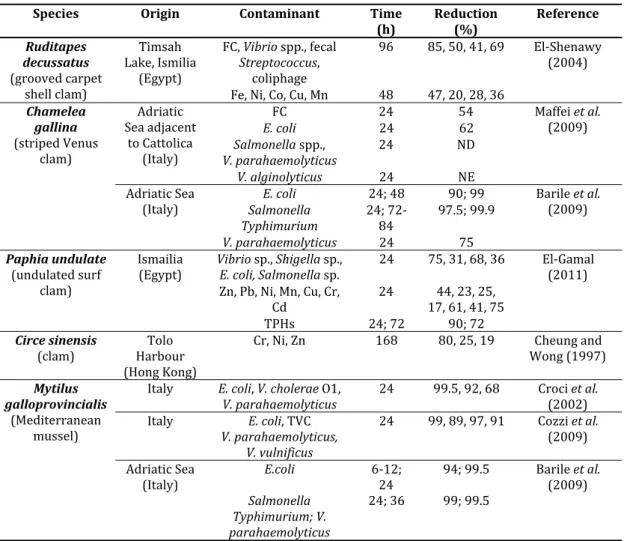
Table 6. Recommended temperature range, minimum salinity limit, permissible loading densities and maximum depth per tray for depuration of different bivalve species. Table 7. Examples of the effect of depuration on the elimination of microbial and chemical
contaminants from bivalves.
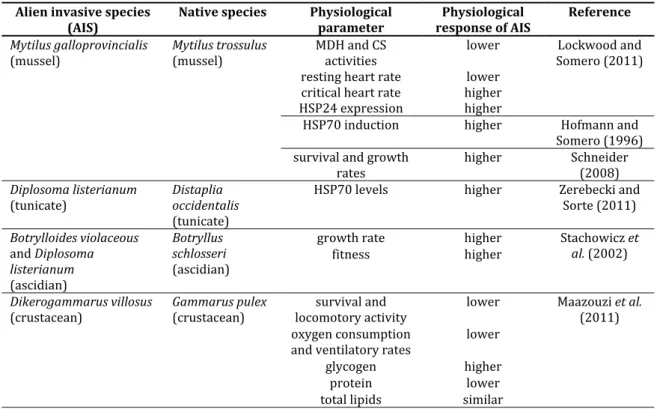
Table 8. Physiological responses of native and alien invasive species (AIS) to temperature increase.
CHAPTER 2 Portuguese consumers’ attitudes and perceptions of bivalve molluscs Table 1. Demographic characteristics of survey respondents (n = 1778) and Portuguese
population with internet access. Table 2. Consumption of bivalves and reasons (%). Table 3. Consumers’ pattern of clams (%) and perceived knowledge of risks associated with its consumption (n = 1419). Table 4. Consumers’ quality criteria (%) for choosing different bivalve species. Table 5. Consumer’s quality criteria (%) for choosing clams (n = 1419).
Table 6. Consumers’ attitude to pullet carpet shell clam (Venerupis pullastra) with respect to criteria of participants’ demographics and socio‐economic status (n = 370). Frequency of consumption and amount per meal (%).
Table 7. Consumers’ attitude to Japanese carpet shell clam (Ruditapes philippinarum) with respect to criteria of participants’ demographics and socio‐economic status (n = 270). Frequency of consumption and amount per meal (%).
CHAPTER 3 Microbiological composition of native and exotic clams from Tagus estuary: Effect of season and environmental parameters
Table 1. Seasonal variation of physico‐chemical parameters of the water samples at the two sampling locations (Trafaria and Barreiro).
Table 2. Results of two‐way ANOVA evaluating the effects of season and species (Venerupis pullastra and Ruditapes philippinarum) on TVC, Escherichia coli and Vibrio spp. levels. Table 3. Occurrence of Salmonella spp. and Vibrio spp. in clams (Venerupis pullastra, VP, and
Ruditapes philippinarum, RP), water and sediment from Trafaria and Barreiro over a
one‐year period.
Table 4. Pearson correlation coefficients between clams, water and sediment samples in each pathogenic bacteria studied. Table 5. Pearson correlation coefficients between the environmental parameters and pathogenic bacteria levels. CHAPTER 4 Microbiological responses to depuration and transport of native and exotic clams at optimal and stressful temperatures Table 1. Summary of criteria used for scoring behavioural clam activity. Table 2. Results of two‐way ANOVA evaluating the effects of simulated transport temperature (4 and 22 °C) and species (Venerupis pullastra and Ruditapes philippinarum) on cumulative mortality, TVC, Escherichia coli and Vibrio spp. levels.
Table 3. Pearson correlation coefficients between cumulative mortality, TVC, Escherichia coli and Vibrio spp. levels in each treatment of Ruditapes philippinarum.
Table 4. Pearson correlation coefficients between cumulative mortality, TVC, Escherichia coli and Vibrio spp. levels in each treatment of Venerupis pullastra.
CHAPTER 5 Physiological responses to depuration and transport of native and exotic clams at different temperatures
Table 1. Summary of criteria used for scoring behavioral clam activity.
Table 2. Results of two‐way ANOVA evaluating the effects of transport temperature (4 and 22 °C) and species (Venerupis pullastra and Ruditapes philippinarum) on survival, CI, K and A.E.C. values and glycogen content.
Table 3. Pearson correlation coefficients between survival, CI, ATP‐related compounds (IMP, ATP, ADP, AMP, Hx and HxR), K and A.E.C. values and glycogen content in each treatment of Ruditapes philippinarum.
Table 4. Pearson correlation coefficients between survival, CI, ATP‐related compounds (IMP, ATP, ADP, AMP, Hx and HxR), K and A.E.C. values and glycogen content in each treatment of Venerupis pullastra.
Table 5. Results of two‐way ANOVA evaluating the effects of transport temperature (4 and 22 °C) and species (Venerupis pullastra and Ruditapes philippinarum) on ATP‐related compounds (IMP, ATP, ADP, AMP, Hx and HxR).
CHAPTER 6 Effects of depuration on metal levels and health status of bivalve molluscs
Table 1. Elemental concentration (mg/kg dw; n = 4) and detection limits (mg/kg, D.L.) of certified reference materials (average ± standard deviation) analysed by FAAS and EDXRF.
Table 2. Biometric data (length, width, height, total weight, edible weight and total meat yield), condition index (CI) and cumulative mortality rate (%) during the depuration time of the three bivalve species (RP, MG and SP).
Table 3. Elemental composition (mean ± standard deviation; wet weight) of RP, MG and SP during the depuration time: macro elements (S, Cl, K and Ca; mg/kg, ww) and trace elements (Fe, Zn, Br Cu, Se, Rb and Sr; mg/kg, ww). Table 4. Effect of depuration time on change in concentration (% reduction/increase) of macro (S, Cl, K and Ca), trace (Fe, Zn, Br, Cu, Se, Rb and Sr) and toxic elements (Hg, Cd, Pb and As) of RP, MG and SP. Table S1. Results of two‐way ANOVA evaluating the effects of depuration time and species (RP, MG and SP) on glycogen content, macro (S, Cl, K and Ca), trace (Fe, Zn, Br, Cu, Se, Rb and Sr) and toxic elements (Hg, Cd, Pb and As) concentration. Table S2. Results from Pearson correlation coefficients between macro, trace and toxic elements of RP, MG and SP. CHAPTER 7 Ecophysiology of native and alien invasive clams in an ocean warming context Table 1. Results of two‐way ANOVA evaluating the effects of temperature and species (Ruditapes decussatus and Ruditapes philippinarum) on routine metabolic rates (RMRs), heat shock
response (HSP70/HSC70 levels), lipid peroxidation (MDA levels) and glutathione S‐ transferase (GST), catalase (CAT) and superoxide‐dismutase (SOD) activities. CHAPTER 8 Effect of warming on protein, glycogen and fatty acid content of native and invasive clams Table 1. Fatty acid quantitative composition (mg/g dw) of the native (Ruditapes decussatus) and invasive clams (Ruditapes philippinarum) at different temperatures. CHAPTER 9 General discussion and conclusions Table 1. Main risks associated with bivalve molluscs’ consumption and higher‐risk population. Table 2. Seasonal bacterial variation (E. coli, Vibrio spp., TVC and Salmonella spp.) in clams
(Venerupis pullastra and Ruditapes philippinarum), water and sediment from Trafaria and Barreiro.
Table 3. Microbiological responses (TVC, E. coli and Vibrio spp. levels) of native (Venerupis pullastra, VP) and invasive clams (Ruditapes philippinarum, RP) to depuration and
semidry simulated transport at two temperatures (4 and 22 °C).
Table 4. Significant reduction/increase (%) on concentration of essencial and toxic elements of three bivalves’ species depurated (Ruditapes philippinarum, RP, Mytilus
galloprovincialis, MG and Scrobicularia plana, SP).
Table 5. Physiological responses (mortality, condition index, breakdown products of ATP and glycogen content) of native (Venerupis pullastra, VP) and invasive clams (Ruditapes
philippinarum, RP) to depuration and semidry simulated transport at two temperatures
(4 and 22 °C).
Table 6. Physiological (CTMax, RMRs, Q10 values, HSP70/HSC70 levels, MDA and antioxidant enzyme activities) and biochemical responses (protein, glycogen and fatty acids contents) of native (Ruditapes decussatus, RD) and invasive clams (Ruditapes
philippinarum, RP) to environmental warming.
Bivalves are extremely important in Portuguese economy and gastronomy, being clams the main species consumed. Nevertheless, bivalve consumption raises specific food safety concerns, particularly due to the accumulation of biological contaminants, including microbial and chemical, as they are filter‐feeders inhabiting estuaries constantly subjected to contamination and climate variability. In this context, the main objectives of this dissertation were to investigate the bivalve consumption behaviour, to compare the microbiological, chemical and physiological responses of native and invasive clams to depuration and transport in semi‐dry conditions at optimal and stressful temperatures, and to assess the impact of warming in bivalve metabolism, oxidative stress and nutritional quality. Bivalve consumer's presented risky behaviours that differed according to their demographic and socio‐economic characteristics. Higher bacterial levels were observed in invasive species, regardless of season and environmental parameters (higher Escherichia coli and total viable counts in winter and Vibrio spp. in summer). Depuration was an efficient process to reduce the levels of E. coli and toxic elements (particularly Pb) in different bivalves to levels considered as acceptable for human consumption, but not to eliminate Vibrio spp. Transport at 4 °C was indeed the best solution to maintain good physiological conditions of clams and to avoid the Vibrio spp. growth. Despite invasive clam species demonstrated higher survival at lower temperatures compared to the native ones, they also revealed similar upper thermal tolerance limits. Distinct physiological requirements and mechanisms of defence against warming were observed: while the invasive closes the valves, the native uses glycogen and fatty acids as energy sources, and displayed higher metabolism, activity of antioxidant enzymes, heat shock proteins and lipid peroxidation. Overall, the main outputs of this dissertation allowed to correctly predict the risks associated with bivalve consumption to greatly improve the knowledge of stress physiology in native and invasive clams.
Keywords: native and invasive clams; microbial and chemical contamination; physiology;
Os bivalves são extremamente importantes na economia e gastronomia portuguesa, sendo as amêijoas as principais espécies consumidas. Contudo, o seu consumo levanta preocupações acrescidas de segurança alimentar devido à acumulação de contaminantes biológicos, incluindo os microbiológicos e químicos, dado que são organismos filtradores que habitam em estuários constantemente sujeitos a contaminação e variabilidade climática. Neste contexto, os objetivos desta dissertação foram investigar o comportamento dos consumidores de bivalves, comparar as respostas microbiológicas, químicas e fisiológicas de amêijoas nativas e invasoras à depuração e transporte em condições semi‐secas a diversas temperaturas, e avaliar o impacto do aquecimento no metabolismo, stress oxidativo e qualidade nutricional. Os consumidores de bivalves apresentaram comportamentos de risco que diferem de acordo com as suas características demográficas e socioeconómicas. Foram observados níveis mais elevados de bactérias nas espécies invasoras, independentemente da época do ano e parâmetros ambientais (Escherichia coli e contagens totais de viáveis no inverno e Vibrio spp. no verão). A depuração revelou‐se eficiente na redução dos níveis de E. coli e elementos tóxicos (particularmente Pb) em diferentes bivalves para níveis considerados aceitáveis para consumo humano, mas não é eficiente na eliminação do Vibrio spp. O transporte a 4 °C permitiu melhores condições fisiológicas das amêijoas e evitou o crescimento de Vibrio spp. Apesar das amêijoas invasoras demonstrarem maior sobrevivência a temperaturas baixas em relação às nativas, mostraram igualmente limites de tolerância térmica superiores similares. Distintos requisitos fisiológicos e mecanismos de defesa contra o aquecimento foram observados: enquanto a invasora fechou as valvas, a nativa usou glicogénio e ácidos gordos como fontes de energia, e revelou maiores taxas metabólicas, atividades de enzimas antioxidantes, proteínas de choque térmico e peroxidação lipídica. Os resultados desta dissertação permitem compreender os riscos associados ao consumo de bivalves e os mecanismos fisiológicos de tolerância ao stress em amêijoas nativas e invasoras.
Palavras‐chave: amêijoas nativas e invasoras; contaminação microbiológica e química;
Os moluscos bivalves são muito apreciados pelos consumidores Europeus tanto do ponto de vista gastronómico como socioeconómico. Estes organismos apresentam um elevado valor nutricional contribuindo para uma dieta saudável. Contudo, sendo organismos filtradores, podem acumular bactérias patogénicas, vírus, contaminantes químicos tóxicos, entre outros, constituindo um potencial perigo de saúde pública. Assim, torna‐se necessário desenvolver estratégias de monitorização e assegurar uma fiscalização rigorosa ao longo do seu circuito de comercialização, de modo a tornar estes produtos seguros para o consumidor. Por outro lado, sendo as alterações climáticas uma realidade, é expectável que num futuro próximo o aquecimento dos oceanos e zonas costeiras possa vir a afetar a sobrevivência e os processos fisiológicos dos bivalves. Neste contexto, este estudo teve como principais objetivos: a) conhecer o perfil dos consumidores de bivalves e os seus comportamentos de risco; b) analisar a influência da época do ano e dos parâmetros ambientais na ocorrência de bactérias patogénicas em espécies nativas e invasoras; c) avaliar e comparar as respostas microbiológicas, químicas e fisiológicas de espécies de bivalves em duas etapas críticas do seu circuito de comercialização, nomeadamente a depuração e o transporte em condições semi‐secas a diversas temperaturas; e d) avaliar o impacto do stress térmico no metabolismo, stress oxidativo e qualidade nutricional de duas espécies de amêijoas.
Do inquérito elaborado a nível nacional, verificou‐se que as amêijoas são as espécies mais consumidas, nomeadamente Venerupis pullastra, Ruditapes decussatus e Ruditapes philippinarum, as quais estão também entre as principais espécies capturadas no estuário do Tejo. Contudo, estes bivalves podem representar um perigo para a saúde pública devido a diversos comportamentos de risco dos consumidores: captura de especímenes em áreas poluídas ou compra direta aos pescadores, muitas vezes sem informação sobre o local de colheita; consumo de amêijoas cruas ou levemente cozinhadas ao vapor, e consumo de animais com conchas partidas e/ou fechadas após cozinhadas. As atitudes e preferências dos consumidores portugueses variaram consideravelmente de acordo com as suas características demográficas e socioeconómicas. Assim, os consumidores mais jovens (<25 anos), do sexo masculino, com nível de educação básica, com baixos rendimentos mensais do agregado familiar (≤800€) e que habitam junto ao litoral estão entre os consumidores com maiores comportamentos de risco em relação aos bivalves. Da comparação realizada entre espécies nativas (V. pullastra) e invasoras (R. philippinarum) provenientes do estuário do Tejo, verificou‐se que esta última apresentou
maior nível de contaminação microbiológica, nomeadamente Escherichia coli, Vibrio spp., Salmonella spp. e contagens totais de viáveis (CTV), refletindo a menor qualidade das águas e sedimento oriundo do interior do estuário do Tejo. Além disso, constatou‐se que a ocorrência destas bactérias em ambas as amêijoas é influenciada pela época do ano e por parâmetros ambientais. Assim, os níveis mais elevados de Vibrio spp. foram encontrados no verão, principalmente na espécie invasora e nas amostras de sedimento, coincidindo com níveis baixos de precipitação e elevada salinidade e temperatura, enquanto os níveis mais elevados de E. coli e CTV foram observados durante o outono‐inverno, particularmente nas amostras de água e sedimento, quando ocorreram maiores teores de oxigénio dissolvido, pH e precipitação, assim como temperatura e salinidade mais baixa. Relativamente à presença de Salmonella spp., que ocorreu em ambas as espécies de amêijoas e no sedimento do Barreiro, coincidiu geralmente com níveis elevados dos indicadores de contaminação fecal (E. coli). Tendo em conta que ambas as espécies de amêijoas mostraram níveis de E. coli acima do limite legislado (230 unidades formadoras de colónias/100 g de peso húmido) para a área de produção de bivalves de categoria A, investigou‐se se a depuração seria um processo eficiente na redução das bactérias. Como seria de esperar, os níveis de E. coli e CTV foram reduzidos em 24 e 48h de depuração, respetivamente, contrariamente aos níveis de Vibrio spp. que aumentaram. Além disso, a depuração demonstrou ser igualmente eficiente na redução de elementos tóxicos, particularmente o Pb na lambujinha Scrobicularia plana (39 e 60% de redução após 2 e 8 dias, respetivamente) para níveis abaixo dos limites máximos permitidos. Os níveis de elementos tóxicos variaram entre as três espécies de bivalves (R. philippinarum, Mytilus galloprovincialis and S. plana) provenientes do estuário do Tejo, provavelmente devido à variabilidade da poluição existente junto às zonas de produção de bivalves e às características biológicas destas espécies (as amêijoas geralmente vivem enterradas no sedimento, enquanto os mexilhões são organismos intertidais). Em termos fisiológicos, a depuração não afetou as espécies de bivalves estudadas, exceto a S. plana, que utilizou todas as reservas bioquímicas (glicogénio), com o consequente aumento das taxas de mortalidade, particularmente após 4 dias (25%).
O transporte de bivalves vivos em condições ótimas, isto é a temperaturas baixas (4 °C) é extremamente importante para manter a qualidade e a salubridade destes produtos, embora atualmente se constate que em muitos casos as amêijoas são sujeitas a grandes variações de temperatura ao longo da cadeia de comercialização. De facto, constatou‐se que, em termos microbiológicos, a qualidade das amêijoas V. pullastra e R. philippinarum foi assegurada a 4 °C, pois os níveis de E. coli diminuíram e os níveis de CTV aumentaram
lentamente, enquanto os níveis de Vibrio spp. mantiveram‐se constantes. Em contraste, o transporte a temperaturas mais elevadas (22 °C) induziu o crescimento de Vibrio spp. e o aumento dos níveis de CTV. Constatou‐se igualmente ser importante assegurar uma depuração prévia das amêijoas de modo a garantir a sua segurança para os consumidores, uma vez que em condições ótimas, se obtiveram níveis de CTV abaixo do limite recomendado (até 120h e 96h de transporte para a V. pullastra e R. philippinarum, respetivamente), teores de E. coli dentro dos limites de segurança para o consumo humano e níveis de Vibrio spp. constantes. Do ponto de vista fisiológico, verificou‐se que ambas as espécies apresentaram melhores condições quando mantidas a 4 °C, i.e. maior sobrevivência (5 e 14 dias para a espécie nativa e invasora, respetivamente), redução lenta do índice de condição (IC), catabolismo lento da adenosina trifosfato (ATP) com consequente acumulação de hipoxantina e inosina, percentagem baixa do valor‐K e da carga energética adenílica (CEA), e diminuição lenta do teor de glicogénio. Concluiu‐se ainda que todos estes parâmetros, à exceção da CEA, são indicadores de stress úteis para avaliar o estado fisiológico destas espécies de amêijoa. A espécie nativa revelou geralmente melhores condições fisiológicas (IC e glicogénio mais elevados, mas valor‐K e CEA mais baixos) do que a invasora (maior sobrevivência, especialmente a 4 °C).
A avaliação dos limites de tolerância térmica superiores da espécie invasora R. philippinarum e nativa R. decussatus revelou valores idênticos para as duas espécies. No entanto, ambas revelaram diferentes requisitos fisiológicos e mecanismos de defesa contra o stress térmico. Assim, a espécie nativa apresentou melhor qualidade nutricional, mas desenvolveu respostas celulares energeticamente mais dispendiosas para suportar o aumento de temperatura, através da utilização de glicogénio e ácidos gordos como fontes de energia. Além disso, apresentou maiores taxas metabólicas, atividade de enzimas antioxidantes (glutathiona‐S‐transferase, GST; catalase, CAT; e superóxido dismutase, SOD), proteínas de choque térmico (HSP70) e peroxidação lipídica (concentração de malonaldeído). Por outro lado, a espécie invasora apenas utilizou os ácidos gordos como fonte de energia, e recorreu ao encerramento das valvas como mecanismo de defesa, contra o stress térmico, conferindo‐lhe uma proteção adicional às condições adversas e assegurando maiores sobrevivências. Em relação ao efeito do stress térmico na qualidade nutricional destas espécies de amêijoas, constatou‐se que o maior efeito negativo foi a perda de ácidos gordos n‐3 polinsaturados, nomeadamente os ácidos eicosapentanóico (EPA) e docosahexanóico (DHA), conduzindo a uma menor qualidade de ambas as espécies para os consumidores.
Este estudo permite compreender os potenciais riscos microbiológicos e químicos associados ao consumo de bivalves, tendo em conta a sua origem e condições usadas ao longo do circuito de comercialização. Esta análise é particularmente relevante para que os consumidores, produtores e comerciantes estejam atentos, informados e implementem as melhores práticas para garantir produtos de elevada qualidade. Além disso, as respostas fisiológicas das amêijoas durante a depuração, transporte e stress térmico permitem compreender as suas capacidades adaptativas.
This thesis includes seven papers that are listed below, each corresponding to a chapter (2 to 8). Five of the papers are already published in peer‐reviewed international journals and another two papers are in press. CHAPTER 2: Portuguese consumers’ attitudes and perceptions of bivalve molluscs Patrícia Anacleto, Sara Barrento, Maria Leonor Nunes, Rui Rosa, António Marques Published in Food Control (2014) 41: 168–177 DOI: 10.1016/j.foodcont.2014.01.017 CHAPTER 3: Microbiological composition of native and exotic clams from Tagus estuary: Effect of season and environmental parameters Patrícia Anacleto, Sónia Pedro, Maria Leonor Nunes, Rui Rosa, António Marques Published in Marine Pollution Bulletin (2013) 74(1): 116–124 DOI: 10.1016/j.marpolbul.2013.07.019 CHAPTER 4: Microbiological responses to depuration and transport of native and exotic clams at optimal and stressful temperatures Patrícia Anacleto, Ana Luísa Maulvault, Milena Chaguri, Sónia Pedro, Maria Leonor Nunes, Rui Rosa, António Marques Published in Food Microbiology (2013) 36(2): 365–373 DOI: 10.1016/j.fm.2013.07.002
CHAPTER 5: Physiological responses to depuration and transport of native and exotic clams at different temperatures
Patrícia Anacleto, Ana Luísa Maulvault, Sara Barrento, Rogério Mendes, Maria Leonor Nunes, Rui Rosa, António Marques
Published in Aquaculture (2013) 408–409: 136–146 DOI: 10.1016/j.aquaculture.2013.05.035
CHAPTER 6: Effects of depuration on metal levels and health status of bivalve molluscs Patrícia Anacleto, Ana Luísa Maulvault, Maria Leonor Nunes, Maria Luísa Carvalho, Rui Rosa, António Marques
CHAPTER 7: Ecophysiology of native and alien invasive clams in an ocean warming context
Patrícia Anacleto, Ana Luísa Maulvault, Vanessa M. Lopes, Tiago Repolho, Mário Diniz, Maria Leonor Nunes, António Marques, Rui Rosa
Published in Comparative Biochemistry and Physiology – Part A: Molecular & Integrative Physiology (2014) 175: 28–37
DOI: 10.1016/j.cbpa.2014.05.003
CHAPTER 8: Effect of warming on protein, glycogen and fatty acid content of native and invasive clams
Patrícia Anacleto, Ana Luísa Maulvault, Narcisa Bandarra, Tiago Repolho, Maria Leonor Nunes, Rui Rosa, António Marques
In press in Food Research International DOI: 10.1016/j.foodres.2014.07.023
CHAPTER 1
1. General introduction
1.1 Economic importance of bivalve molluscs
1.1.1 Worldwide
1.1.2 Portugal
1.2 Main benefits associated with bivalve consumption
1.3 Main risks associated with bivalve consumption
1.3.1 Bacteria
1.3.1.1 Escherichia coli
1.3.1.2 Salmonella spp.
1.3.1.3 Vibrio spp.
1.3.2 Viruses
1.3.3 Parasites
1.3.4 Chemicals contaminants
1.3.5 Toxins from harmful algal blooms (HAB)
1.3.6 Classification of bivalve molluscs harvesting areas
1.4 Trade chain of live bivalves in Portugal
1.4.1 Depuration
1.4.2 Transport
1.5 Stress physiology in bivalve molluscs
1.5.1 Thermal tolerance limits and metabolism
1.5.2 Differences between alien invasive and native species
1.5.3 Oxidative stress biomarkers
1.5.4 Heat shock response
1.6 General aims and thesis outline
1.7 References
1.1 Economic importance of bivalve molluscs
1.1.1 Worldwide
World bivalve mollusc production (from fisheries and aquaculture) has consistently increased in the last sixty years, growing from nearly 1 million tonnes in 1950 to about 14.5 million tonnes in 2011, contributing 9.4% of the total amount in 2011 (FAO, 2014). During this period, the average annual growth in bivalve production was approximately 4.2%, though considerably higher in early 1990s (Fig. 1a). Crustaceans followed the same trend of bivalves, ranging from 0.7 to 12 million tonnes in this period (average annual growth rate 4.5%), whereas cephalopods grew at a slower annual rate (average 2.2%), varying between 0.6 and 3.8 million tonnes (Fig. 1a). In 2011, bivalve molluscs from fisheries represented almost 10% of the total world fishery production, whereas farmed bivalves represented 21% in volume and 11% in value of the total world aquaculture production. Such differences are mainly attributed to two factors: the rapid growth in the aquaculture sector and a sharp increase in Chinese bivalve production (Pawiro, 2010).
Figure 1. World production (fisheries and aquaculture) between 1950 and 2011 in tonnes (t) of the most important groups of seafood (a) and the most representative bivalve groups (b) (data source: FAO, 2014).
Global bivalve production from aquaculture has consistently increased over the years, mainly between 1990 and 2011 ranging from 3.3 to 12.8 million tonnes, respectively, with an average increase of 6.0% annually during this period. Aquaculture contribution to the overall bivalve production increased from 27.9% in 1950 to 87.8% in 2011, whereas bivalves from fisheries exhibited a downward trend during this period, declining from 72.1% to 12.2%.
Presently, the bulk of global bivalves production consists mainly of clams (38.1%, including cockles and ark shells) and oysters (32.5%) followed by scallops, pectens
0 5 10 15 20 25 1950 1960 1970 1980 1990 2000 2010 Q u an ti ty ( m illi on t) Years Molluscs Bivalves Crustacea Cephalopods a) 0 1 2 3 4 5 6 1950 1960 1970 1980 1990 2000 2010 Qu an ti ty (m il li on t) Years Oysters Clams Mussels Scallops, pectens b)
(16.4%) and mussels (13.0%). However, until early 1990s the production of these species has steadily increased (Fig. 1b). It is noteworthy that the increased production of clams since the 1990s is largely due to the exponential growth of Japanese carpet shell, Ruditapes philippinarum. This is one of the most relevant species farmed worldwide, accounting with 3.7 million tonnes in 2011. Overfishing and irregular yields of the native (European) grooved carpet shell, Ruditapes decussatus, led to the introduction of R. philippinarum into European waters. Consequently, R. philippinarum populations are currently the major contributor to clam landings in Europe (FAO, 2014). Other bivalve species with significant world production are: constricted tagelus Sinonovacula constricta (745 thousand tonnes), Pacific cupped oyster Crassostrea gigas (673 thousand tonnes), blood cockle Anadara granosa (438 thousand tonnes), yesso scallop, Patinopecten yessoensis (426 thousand tonnes), Chilean mussel Mytilus chilensis (289 thousand tonnes), American sea scallop Placopecten magellanicus (281 thousand tonnes), blue mussel Mytilus edulis (235 thousand tonnes) and American cupped oyster Crassostrea virginica (192 thousand tonnes). The bulk of these species contribute with 23% of the world total bivalve production in 2011 (Fig. 2).
Figure 2. World production (fisheries and aquaculture) between 1950 and 2011 in tonnes (t) of main produced bivalves’ species (data source: FAO, 2014).
China is by far the leading producer of bivalve molluscs with 10.5 million tonnes in 2011 and representing 71.9% of the global production and 81.9% of the global bivalve aquaculture production in that year, which is substantially due to the high production of clams (including cockles and ark shells) and oysters (8.4 million tonnes; Fig. 3). United States of America (USA) and Japan were the second and third largest producers, far behind China with a production of 698 and 656 thousand tonnes, respectively. Other main bivalve producing countries are Republic of Korea, Chile, Spain, France, Peru, Thailand, Canada, Italy and Mexico (Fig. 3). 0 500 1000 1500 2000 2500 3000 3500 4000 1950 1960 1970 1980 1990 2000 2010 Qu an ti ty (1 0 3t) Years Ruditapes philippinarum Crassostrea gigas Sinonovacula constricta Patinopecten yessoensis Anadara granosa
Figure 3. Major bivalve producing countries (fisheries and aquaculture) of different bivalve mollusc groups, data in tonnes (t) from 1950 to 2011 (data source: FAO, 2014).
1.1.2 Portugal
Portugal is the eighth biggest per capita seafood consumer worldwide and the highest in the European Union (EU), with an annual average of 61.1 kg, well above the average world per capita consumption (18.4 kg; 2009; FAO 2014). Among seafood, bivalve molluscs are greatly appreciated by consumers (2.5 kg/capita in 2009; INE/DGPA, 2010) from a social, gastronomic and economic point of view. Generally, bivalve species are preferably consumed live/raw (e.g. oysters) as a guarantee of freshness or lightly cooked (e.g. clams and mussels). Nowadays, bivalves’ role in Portuguese gastronomy is increasing due to tourism, particularly in coastal regions (e.g. Ericeira, Sesimbra, Sines and Figueira da Foz), and to the popular shellfish festivals (e.g. Olhão, Faro, Setúbal, Ílhavo and Esposende). The Algarve tourism industry emphasizes gastronomic tourism as an important complement for the sustainability of the bivalve activity (WTTC, 2003).The national production of bivalves has shown important progress in the last years, particularly clams and cockles (Fig. 4). The exception occurred with C. gigas that revealed a deep decrease in production in the last years after 10 years‐period without any production (1976‐1986). The main cause of this decline in the most productive areas of oysters was the industrial pollution, mainly attributed to the introduction and uses of
0 500 1000 1500 2000 2500 3000 3500 4000 4500 5000 1950 1960 1970 1980 1990 2000 2010 Qu an ti ty (t h ous an d t) Years China USA Clams, cockles and ark shells 0 100 200 300 400 500 600 700 800 1950 1960 1970 1980 1990 2000 2010 Q u an ti ty (t ho us an d t) Years China Spain Chile New Zealand Mussels 0 500 1000 1500 2000 2500 3000 3500 4000 1950 1960 1970 1980 1990 2000 2010 Qu an ti ty (t ho us an d t) Years China USA Korea Oysters 0 200 400 600 800 1000 1200 1400 1600 1950 1960 1970 1980 1990 2000 2010 Qu an ti ty (t ho u san d t) Years China Japan USA Peru Scallops, pectens
tributyltin (TBT) as an antifouling paint additive on ships to avoid the attachment of marine organisms in marine infrastructures (Rato, 2009).
Figure 4. National production (fisheries and aquaculture) in tonnes (t) of the most representative bivalves from the Portuguese coast between 1950 and 2012 (data source: EUROSTAT, 2014; FAO, 2014). 0 4000 8000 12000 16000 20000 1950 1960 1970 1980 1990 2000 2010 Qu an ti ty (t ) Years Ruditapes decussatus 0 200 400 600 800 1000 1950 1960 1970 1980 1990 2000 2010 Qu an ti ty (t ) Years Ruditapes philippinarum Venerupis pullastra 0 1000 2000 3000 4000 5000 1950 1960 1970 1980 1990 2000 2010 Qu an ti ty (t ) Years Cerastoderma edule 0 50 100 150 200 250 300 350 400 450 1950 1960 1970 1980 1990 2000 2010 Qu an ti ty (t ) Years Callista chione 0 500 1000 1500 2000 2500 3000 3500 1950 1960 1970 1980 1990 2000 2010 Qu an ti ty (t ) Years Spisula solida 0 200 400 600 800 1000 1950 1960 1970 1980 1990 2000 2010 Qu an ti ty (t ) Years Chamelea gallina 0 2000 4000 6000 8000 10000 12000 1950 1960 1970 1980 1990 2000 2010 Qu an ti ty (t ) Years Crassostrea gigas 0 200 400 600 800 1000 1200 1400 1600 1950 1960 1970 1980 1990 2000 2010 Qu an ti ty (t ) Years Mytilus edulis
Other factor was the occurrence of several epizootics, namely the “oyster gill disease” that is caused by an iridovirus (Comps et al., 1976). This disease reduced the filtering capacity and killed young and stressed animals. Associated to this problem was the phenomenon of abnormal shell growth (Key, 1981). Additionally, the “foot disease”, protozoan diseases, ineffective or absent management strategy to protect natural beds, overharvesting and non‐existence of hatcheries, may also have been responsible for the oysters mortality in the latest years (Ruano, 1997).
During the last years, R. decussatus and the common edible cockle Cerastoderma edule greatly contributed to national bivalve production (representing 29.7% and 19.7%, respectively of the total bivalve production in 2012), followed by R. philippinarum (11.1%), solid surf clam Spisula solida (7.8%), M. edulis (5.3%), C. gigas (4.2%), pullet carpet shell clam Venerupis pullastra (3.9%), striped venus Chamelea gallina (2.8%) and smooth callista Callista chione (2.8%; Fig. 4).
Since early 1990s, the national bivalve demand and consumption have increased to a level where production is not sufficient, and therefore imports usually exceed exports with an inevitable negative trade balance, i.e. a deficit (Fig. 5; EUROSTAT, 2014). Total bivalve trade in Portugal has expanded continuously during the past three decades to reach € 24.9 million and € 19.2 million in imports and exports, respectively, in 2013, representing an increase of 3517% and 793%, respectively, during that period. By far the most important bivalve products in terms of import volume are traded preserved or processed (e.g. 89.3% in 2013; i.e. traded as frozen, dried, salted, in brine, smoked or cooked), but in terms of export volume bivalves are equally traded live, fresh or chilled (e.g. 48.2% in 2013), as well as preserved or processed (e.g. 51.8% in 2013).
Figure 5. Imports and exports of bivalves by Portugal, data in value (€ million) from 1988 to 2013 (data source: EUROSTAT, 2014). 0 5 10 15 20 25 30 1988 1991 1994 1997 2000 2003 2006 2009 2012 Va lu e (€ m illi on ) Years Imports Exports
In terms of quantity and value, clams, cockles and ark shells are the most important bivalves imported, with an average growth rate per year of 13.5%. In 2013, clams accounted 74.6% and 61.5% of the total bivalve quantity and value, respectively, followed by mussels (22.2 and 30.3%), scallops/pectens (2.3 and 7.1%) and oysters (0.9 and 1.2%; Fig. 6). Clams are mainly supplied by Vietnam, Spain and Netherlands. Interestingly, preserved or processed clams are responsible by 72.9% of the total volume of national bivalve imports in 2013, which is particularly due to clams from Vietnam, representing 82.2% of all clams imported by Portugal (Fig. 6). On the other hand, the main import countries of mussels to Portugal are Spain, New Zealand and Netherlands, whereas the major importers of oysters to Portugal are France and Spain, and the most relevant importers of scallops and pectens to Portugal are Spain, Netherlands, France, Peru and Vietnam (Fig. 6).
Figure 6. Main importers of bivalves from Portugal, data in tonnes (t) from 1988 to 2013 (data source: EUROSTAT, 2014). Note: Data includes bivalves with or without shell, live, fresh or chilled, frozen, dried, salted or in brine and also smoked and cooked in shell. The detailed classification codes used by Eurostat are presented in Annex.
Regarding exports, clams are the most important species in terms of quantity and value, accounting 73.0% and 59.7% in 2013, respectively, followed by mussels (17.3% and
0 1000 2000 3000 4000 5000 6000 7000 8000 9000 1988 1991 1994 1997 2000 2003 2006 2009 2012 Q u an ti ty (t ) Years Vietnam Spain Netherlands Clams, cockles and ark shells 0 500 1000 1500 2000 2500 1988 1991 1994 1997 2000 2003 2006 2009 2012 Q u an ti ty (t ) Years Spain New Zealand Netherlands Mussels 0 500 1000 1500 2000 2500 3000 1988 1991 1994 1997 2000 2003 2006 2009 2012 Qu an ti ty (t ) Years France Spain Oysters 0 100 200 300 400 500 600 700 1988 1991 1994 1997 2000 2003 2006 2009 2012 Qu an ti ty (t ) Years Spain Netherlands France Peru Vietnam Scallops, pectens