arXiv:1302.4403v1 [hep-ex] 18 Feb 2013
EUROPEAN ORGANISATION FOR NUCLEAR RESEARCH (CERN)
CERN-PH-EP-2012-365
Submitted to: New. J. Phys.
Search for
W H
production with a light Higgs boson decaying
to prompt electron-jets in proton–proton collisions at
√s = 7
TeV with the ATLAS detector
The ATLAS Collaboration
Abstract
A search is performed for W H production with a light Higgs boson decaying to hidden-sector particles resulting in clusters of collimated electrons, known as electron-jets. The search is performed with 2.04 fb−1of data collected in 2011 with the ATLAS detector at the LHC in proton–proton collisions at√s = 7TeV. One event satisfying the signal selection criteria is observed, which is consistent with the expected background rate. Limits on the product of the W H production cross section and the branching ratio of a Higgs boson decaying to prompt electron-jets are calculated as a function of a Higgs boson mass in the range from 100 GeV to 140 GeV.
Search for W H production with a light Higgs boson
decaying to prompt electron-jets in proton–proton
collisions at
√s = 7 TeV with the ATLAS detector
The ATLAS Collaboration
Abstract. A search is performed for W H production with a light Higgs boson
decaying to hidden-sector particles resulting in clusters of collimated electrons, known
as electron-jets. The search is performed with 2.04 fb−1 of data collected in 2011 with
the ATLAS detector at the LHC in proton–proton collisions at√s = 7 TeV. One event
satisfying the signal selection criteria is observed, which is consistent with the expected background rate. Limits on the product of the W H production cross section and the branching ratio of a Higgs boson decaying to prompt electron-jets are calculated as a function of a Higgs boson mass in the range from 100 GeV to 140 GeV.
1. Introduction
Recently, the production of a boson with a mass of about 125 GeV has been observed by the ATLAS [1] and CMS [2] collaborations. The observation is compatible with the production and decay of the Standard Model (SM) Higgs boson [3–5] at this mass. Strengthening or rejecting the SM Higgs boson hypothesis is currently of utmost importance and thus a search for non-SM Higgs boson decays is of high interest. In this Letter, a search for a Higgs boson decaying to a new hidden sector of particles is presented. The masses and couplings of the hidden-sector particles are chosen such that the Higgs boson decay cascade results in jets consisting exclusively of electrons (“electron-jets”) and weakly interacting neutral particles [6, 7]. This is the first search performed for this particular channel. Moreover, in addition to a recently discovered state consistent with the SM Higgs boson, there may be other scalar fields that couple to the W boson and decay to electron-jets. These scalars arise in the Higgs boson sector in many extensions of the SM, and electron-jets could be the primary discovery channel for these new states. The search is performed in the Higgs boson mass range between 100 GeV and 140 GeV. The analysis examines the associated Higgs boson production mechanism, pp → W H, assuming SM couplings between the Higgs boson and the W boson.
Many models of physics beyond the SM contain a light hidden sector, which is composed of as yet unobserved fields that are singlets under the SM group SU(3) × SU(2) × U(1) and that can be probed at the LHC [6–17]. Models of this hidden sector vary from simple modifications of the SM [12, 13] to models motivated by string theory [14] to so-called unparticle models [15].
In the present analysis two models, discussed in Ref. [7], are considered. These differ in the way the Higgs boson decays, either via a three-step cascade (Fig. 1 left) or a two-step cascade (Fig. 1 right) to hidden-sector particles. In both models the masses of particles in a hidden-sector cascade are taken to be substantially lower than the Higgs boson mass, thus the Higgs boson decay has a two-jet topology. The models feature
a dark photon γd that kinetically mixes with the SM photon [16, 17], a neutral weakly
interacting stable scalar nd and two hidden scalars hd,1 and hd,2. A value of the kinetic
mixing parameter ǫ larger than 10−5
implies dark photons with very short lifetimes;
thus the chosen value of ǫ = 10−4
, recommended in Ref. [7], ensures that the decay products are prompt. The dark photon mass must be less than 2 GeV for these models to provide a viable explanation of the results of cosmic-ray and dark matter direct-detection experiments [18–21], which observe an unexpected excess of cosmic electrons and/or positrons, while there is no observed proton excess. For a dark photon mass
below 210 MeV, the dark photons decay exclusively to e+e−
pairs; Dark photon masses of 100 MeV and 200 MeV are considered in this analysis.
The signal has a distinct two-jet topology with each electron-jet having a multiplicity of ≥ 4 electrons per jet, where the electrons are highly collimated. The specific hidden-sector parameters are given in Table 1, and the chosen masses of the
H d,1 h d,1 h d,2 h d,2 h d,2 h d,2 h d n d n d γ d γ d γ d γ d γ d γ + e -e + e -e + e -e + e -e + e -e + e -e miss T E Electron jet Electron jet H d,2 h d,2 h d γ d γ d γ d γ + e -e + e -e + e -e + e -e Electron jet Electron jet
Figure 1. Diagrams illustrating the Higgs boson decay to hidden-sector particles in
the (left) three-step and (right) two-step models. Each hd,2 particle can decay to a
pair of dark photons γd or stable scalars nd, with the corresponding branching ratios
given in Table 1. Parameter mhd,1 10 GeV mhd,2 4 GeV mnd 90 MeV mγd 100, 200 MeV ǫ 10−4 three-step model BR(hd,1 → hd,2hd,2) 1 BR(hd,2 → γdγd) 0.8 BR(hd,2 → ndnd) 0.2 two-step model BR(hd,2 → γdγd) 1 BR(hd,2 → ndnd) 0
Table 1. Parameters of the benchmark hidden-sector models: hidden-sector particle
masses, the γ − γd kinetic mixing, and decay branching ratios of hd,1 and hd,2 in the
three-step and two-step models.
Higgs boson are 100 GeV, 125 GeV and 140 GeV. The results of the analysis are expected
to be robust with respect to the specific choice of the hd,1, hd,2 and nd masses as long
as these masses are significantly smaller than the Higgs boson mass, i.e. mhd,1|2 ≤ 10
GeV. In particular, as long as the hd,1 and hd,2 scalars are much lighter than the Higgs
boson, the hd,1 and hd,2 are boosted, and their decay products are collimated, resulting
in two distinct electron-jets. Also in the three-step model, the results are expected to be
robust against the explicit choice of the branching ratio of the hd,2 particle into weakly
interacting neutral particles, nd, as long as this branching ratio is relatively small, i.e.
to visible decay products with greater than 90% probability; for larger branching ratios,
there will be a considerable fraction of events where only one (or neither) hd,1 particle
decays to visible decay products.
In this analysis, the W boson produced in association with the Higgs boson is reconstructed in the W → eν and W → µν decay modes in order to achieve a high efficiency for online event selection and a high signal-to-background ratio. The signal topology is consequently an isolated large transverse momentum lepton accompanied by missing transverse momentum and two or more electron-jets.
The sensitivity of this analysis is approximately two orders of magnitude greater than that of a previous search for similar signatures which was performed by the CDF collaboration [22]. The direct searches for prompt decays of dark photons into electron or muon pairs, as well as a search for a Higgs boson decaying into displaced muon-jets, were reported in Refs. [23–26].
2. The ATLAS detector
The ATLAS detector [27] is a multi-purpose particle physics detector with forward-backward symmetric cylindrical geometry‡. The inner detector (ID) provides precise reconstruction of tracks with |η| < 2.5. It consists of three layers of pixel detectors close to the beam pipe, four layers of silicon microstrip detector modules in the barrel region with pairs of single-sided sensors (SCT) providing eight hits per track at intermediate radii, and a straw-tube transition radiation tracker (TRT) at the outer radii, providing about 35 hits per track (in the range |η| < 2.0). The TRT offers substantial discriminating power between electrons and charged hadrons over a wide momentum range (between 0.5 GeV and 100 GeV) via the detection of X-rays produced by transition radiation.
The ID is surrounded by a thin superconducting solenoid providing a 2 T axial
magnetic field. A high-granularity lead/liquid-argon (LAr) sampling calorimeter
measures the energy and the position of electromagnetic showers with |η| < 3.2. The
total thickness of this calorimeter is more than 24X0 in the barrel and above 26X0 in
the endcaps. LAr sampling calorimeters, with copper or tungsten as absorber, are used to measure hadronic showers in the endcap (1.5 < |η| < 4.9), while an iron/scintillator tile hadronic calorimeter measures hadronic showers in the central region (|η| < 1.7). The muon spectrometer (MS) surrounds the calorimeters and consists of three large superconducting air-core toroids, each with eight coils, a system of drift tubes and
‡ ATLAS uses a right-handed coordinate system with its origin at the nominal pp interaction point at the centre of the detector. The positive x-axis is defined by the direction from the interaction point to the centre of the LHC ring, with the positive y-axis pointing upwards, while the beam direction defines the z-axis. The azimuthal angle φ is measured around the beam axis with the polar angle θ is the angle from the z-axis. The pseudorapidity is defined as η = − ln tan(θ/2). The cone separation is defined as
∆R =p(∆φ)2+ (∆η)2. The transverse momentum p
Tis defined as the momentum perpendicular to
the beam axis: pT=
q p2
cathode strip chambers for precision tracking (|η| < 2.7), and fast tracking chambers for event selection in real time (|η| < 2.4).
A three-level trigger system [28] selects events to be recorded for offline analysis. The level-1 trigger is implemented in hardware, operating synchronously with the collisions, and uses a subset of detector information to reduce the event rate from 20 MHz to a maximum level-1 output rate of 75 kHz. This is followed by two software-based trigger levels, level-2 and the event filter, which together reduce the recorded event rate to approximately 300 Hz.
3. Signal and background simulation
Simulated data samples are used to estimate the signal acceptance and efficiency, to optimize the signal selection criteria and to cross-check our understanding of the backgrounds. The final background estimate is determined from the data as described in Section 6.
The signal Monte Carlo (MC) samples are generated with MadGraph [29] to simulate the Higgs boson production and decay to the hidden sector and BRIDGE [30] to simulate the hidden-sector cascades resulting in electron-jets. The output of these two programs is then interfaced to PYTHIA [31] for subsequent hadronization and modelling of the underlying event (UE). All leptonic decays modes of the W boson
(eνe, µνµ, τ ντ) are included in the signal samples.
The most important sources of background are SM W/Z+jets and t¯t processes. A less important source of background comes from pair production of bosons, W W/ZZ/W Z, hereafter referred to as diboson production. These processes result in a lepton + jets event topology. In addition, multi-jet events in some instances can be misidentified as W -bosons.
Samples of simulated W (→ ℓν)+jets and Z(→ ℓℓ)+jets events (ℓ = e/µ/τ) are generated using ALPGEN [32] with the MLM matching scheme [33] and interfaced to
HERWIG [34] for parton shower and fragmentation processes and to JIMMY [35] for
UE simulation. Simulated samples for t¯t processes are generated with MC@NLO [36] interfaced to HERWIG for parton showering. To study the possible dependence on the specific choice of MC generator, alternate W/Z+jets samples are also generated using SHERPA [37] with an UE modelling according to Ref. [38], and alternate top-quark production samples are generated with POWHEG [39] interfaced to PYTHIA for hadronization. The diboson processes are generated with HERWIG. Taus are decayed with TAUOLA [40] in both signal and background samples.
The event yields for W → ℓν, Z → ℓℓ (ell = e/µ) and t¯t processes, which give the largest contribution to background, are scaled using the measured production cross sections [41, 42]. The contributions from W (→ τν) and Z(→ ττ), which are minor sources of background, are obtained using next-to-next-to-leading-order cross-section calculations [43]. The multi-jet background is obtained using normalized data templates [41], since the rate with which multi-jet events mimic the combined signature
of a prompt charged lepton accompanied by missing transverse momentum is difficult to simulate accurately.
The GEANT4 toolkit [44] is used for a detailed simulation of the detector response [45]. The effect of multiple pp interactions per bunch crossing (pile-up) is modelled by overlaying simulated inelastic proton–proton collisions over the original
hard-scattering event. The simulated events are then passed through the same
reconstruction and analysis chain as the data.
To calibrate the electron energy and to match the resolution of the electron energy and muon momentum observed in data, corrections are applied to electrons in data and electrons and muons in simulated MC samples according to the prescriptions of Refs. [46, 47].
4. Data samples and trigger selection
The data sample for this analysis was collected by the ATLAS detector in proton– proton collisions at a centre-of-mass energy of 7 TeV in early 2011. The data sample used was required to be recorded during LHC stable-beam conditions when the ATLAS detector components relevant to this analysis were operating within nominal parameters.
The total integrated luminosity of the selected data sample is 2.04 fb−1
with a 3.7% uncertainty [48, 49].
For the W → eν channel, at least one reconstructed electron trigger object with transverse energy above 22 GeV in the region of |η| ≤ 2.5 is required. For the W → µν channel, a muon candidate trigger object in the region of |η| ≤ 2.4 having transverse momentum above 18 GeV, reconstructed in both the inner detector and muon spectrometer, is required. The muon trigger object must be consistent with having originated from the interaction region.
5. Event selection and electron-jet reconstruction
Signal events are required to have exactly one reconstructed W boson candidate in the eν or µν decay channel and at least two jets identified as electron-jets.
5.1. W boson selection
A W -decay electron candidate is required to pass the tight electron selection criteria
[41, 46] with pT > 25 GeV and |η| ≤ 2.47. Electrons in the transition region between
the barrel and endcap calorimeters (1.37 < |η| < 1.52) are rejected. A W -decay muon candidate is required to be identified in both the ID and the MS subsystems and to have
pT > 20 GeV and |η| < 2.4. To increase the robustness against track mis-reconstruction,
the difference between the ID and MS pT measurements is required to be less than 15
GeV [41].
To reduce background from multi-jet events, electron and muon candidates are
∆R = 0.4 around the electron (muon) divided by the electron (muon) pT is required to be less than 0.3 (0.2).
W boson candidates are required to have missing transverse momentum Emiss
T ≥
25 GeV and exactly one isolated electron or muon. Events with two or more isolated same-flavour leptons are rejected, substantially reducing the background from Drell–Yan production.
The lepton candidate from the W boson decay is required to match the object that satisfies the trigger selection criteria: the distance between the trigger object and the reconstructed W → ℓν (ℓ = e/µ) lepton is required to be ∆R < 0.1.
To reduce the background from cosmic rays, heavy-flavour production and photon conversions, the W candidate is required to originate from the primary vertex. In events
with multiple vertices along the beam axis, the vertex with the largestP p2
T, where the
sum is over all tracks associated with the vertex, is taken to be the primary vertex of the event. The longitudinal and transverse impact parameters of the charged-lepton track with respect to the primary vertex must be less than 10 mm and 0.1 mm, respectively. 5.2. Electron-jet pair selection
In this search, the signature of the Higgs boson decay is two or more electron-jets. Electron-jet candidates are formed from jets reconstructed in the calorimeters using an
anti-kt jet clustering algorithm [50] with a radius parameter R = 0.4.
The electrons in an electron-jet are too closely collimated to be identified efficiently with the algorithm used to identify electrons from W boson decays. Instead, electron-jets are identified with three discriminating observables, which are described in detail
below: the jet electromagnetic fraction (fEM), the jet charged particle fraction (fCH)
and the fraction of high-threshold hits originating from transition radiation in the TRT
(fHT).
In electron-jets, the electrons typically deposit all of their energy in the electromagnetic calorimeter, so that the fraction of the jet energy deposited in the electromagnetic calorimeter divided by the total jet energy deposited in both the
electromagnetic and hadronic calorimeters, fEM, is typically close to unity. The
slight degradation of fEM towards lower values is due to the occasional leakage of
electromagnetic showers into the hadronic calorimeter, calorimeter noise and electron-jets overlapping with ordinary electron-jets. Hadronic electron-jets reaching the calorimeters mainly
consist of π±
and photons from π0 decays. Most π±
deposit a sizable fraction of their energy in the hadronic calorimeter, while photons deposit almost all their energy
in the electromagnetic calorimeter. The distribution of fEM is further broadened by
fluctuations of the electromagnetic and hadronic showers in the detector. The pedestal corrections for noise in the hadronic calorimeter can sometimes lead to reconstructed energies in the hadronic calorimeter that are less than zero, resulting in a value of
fEM slightly higher than unity. The simulation models this situation accurately. The
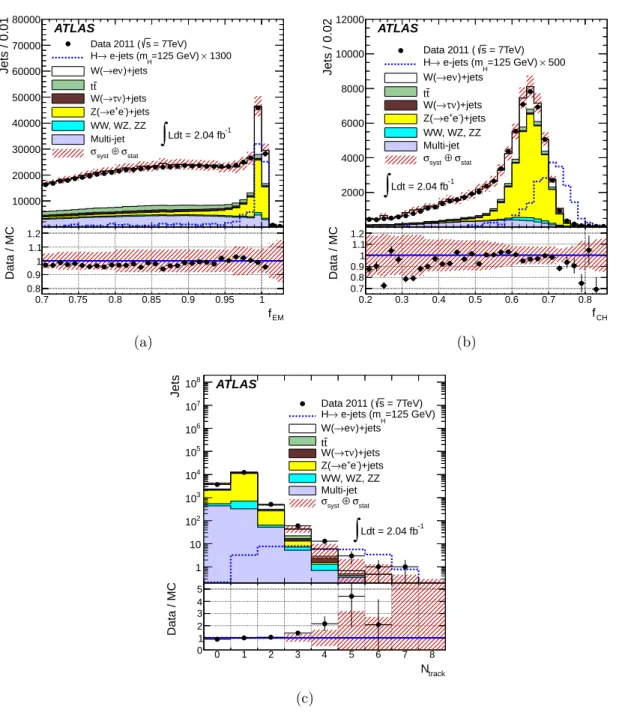
0.7 0.75 0.8 0.85 0.9 0.95 1 Jets / 0.01 10000 20000 30000 40000 50000 60000 70000 80000 = 7TeV) s Data 2011 ( 1300 × =125 GeV) H e-jets (m → H )+jets ν e → W( t t )+jets ν τ → W( )+jets -e + e → Z( WW, WZ, ZZ Multi-jet stat σ ⊕ syst σ -1 Ldt = 2.04 fb
∫
ATLAS EM f 0.7 0.75 0.8 0.85 0.9 0.95 1 Data / MC 0.8 0.9 1 1.1 1.2 (a) 0.2 0.3 0.4 0.5 0.6 0.7 0.8 Jets / 0.02 2000 4000 6000 8000 10000 12000 = 7TeV) s Data 2011 ( 500 × =125 GeV) H e-jets (m → H )+jets ν e → W( t t )+jets ν τ → W( )+jets -e + e → Z( WW, WZ, ZZ Multi-jet stat σ ⊕ syst σ -1 Ldt = 2.04 fb∫
ATLAS CH f 0.2 0.3 0.4 0.5 0.6 0.7 0.8 Data / MC 0.7 0.8 0.9 1 1.1 1.2 (b) 0 1 2 3 4 5 6 7 8 Jets 1 10 2 10 3 10 4 10 5 10 6 10 7 10 8 10 = 7TeV) s Data 2011 ( =125 GeV) H e-jets (m → H )+jets ν e → W( t t )+jets ν τ → W( )+jets -e + e → Z( WW, WZ, ZZ Multi-jet stat σ ⊕ syst σ -1 Ldt = 2.04 fb∫
ATLAS track N 0 1 2 3 4 5 6 7 8 Data / MC 0 1 2 3 4 5 (c)Figure 2. Distribution of the jet electromagnetic fraction, fEM, after the W → eν
selection (a), the jet charged particle fraction, fCH, after the fEMselection (b) and the
number of associated tracks, Ntrack, fulfilling the criteria of Section 5.2 after the fEM
and fCHselection (c). Data are shown by dots with error bars and are compared to the
expectation from Standard Model processes, given by stacked histograms of different colors. The signal distributions in the three-step model of a hidden sector with dark
photon mass mγd= 100 MeV are presented as dashed histograms with arbitrary scale
(a and b) and with the nominal scale (c), where nominal scale implies the SM value for W H production cross section and 100% branching ratio of a Higgs boson decaying to electron-jets. The hatched bands represent the quadratic sum of statistical and systematic uncertainties of the Standard Model background prediction described in Section 7.
having fEM ≥ 0.99.
Since fEM only provides limited background rejection additional variables are
exploited. The quantity fCH is defined as the fraction of the jet energy deposited in
calorimeter cells that are associated with tracks within the jet:
fCH =
X
“track−cells”
Ecell
Ejet . (1)
A track is associated with a jet if it is within a distance of ∆R = 0.4 from the jet axis
and has pT ≥ 400 MeV. The “track-cells”, i.e. calorimeter cells associated with tracks
within the jet, consist of the cells within a cone of ∆R = 0.2 around each of the tracks associated with the jet, giving the sum of energy deposits of charged particles within the jet in both the electromagnetic and hadronic calorimeters.
Signal electron-jets consist exclusively of electrons and should have large fEM and
fCH. Hadronic jets with large fEM are expected to contain mostly neutral pions decaying
to photons and, therefore, fewer charged tracks and low fCH. Photons that convert to
electron–positron pairs in the material they traverse before entering the calorimeter
increase the value of fCH.
Additional rejection of hadronic jets is achieved by exploiting the identification of electrons using transition radiation. The discriminating quantity is the fraction of
TRT hits on a track, fHT, that exceed the high discriminator threshold in the
read-out electronics of the TRT straws. Detailed studies of this quantity are reported in Refs. [46, 51]. This high-threshold setting corresponds to the size of the large energy
deposit from transition radiation in the straw-tube gas. The distribution of fHT for
tracks from electrons has a maximum at fHT ∼ 0.2, while it peaks at zero and then
decreases monotonically for charged hadron tracks. A requirement that fHT≥ 0.08 has
an efficiency of over 95% for electrons in the momentum range relevant to this analysis and at the same time effectively rejects charged hadrons. Exploiting the selection criteria described above, a jet is classified as an electron-jet if it satisfies the following requirements:
• jet pseudorapidity |η| ≤ 2.0,
• jet transverse momentum pT ≥ 30 GeV,
• jet electromagnetic fraction fEM ≥ 0.99,
• jet charged particle fraction fCH≥ 0.66 and
• number of tracks associated with the jet Ntrack ≥ 2, where the tracks must satisfy
the following criteria:
– track pseudorapidity |η| ≤ 2.0,
– track transverse momentum pT ≥ 5 GeV,
– number of hits in the pixel detector NPIX≥ 2,
– total number of pixel and SCT hits NPIX+ NSCT ≥ 7,
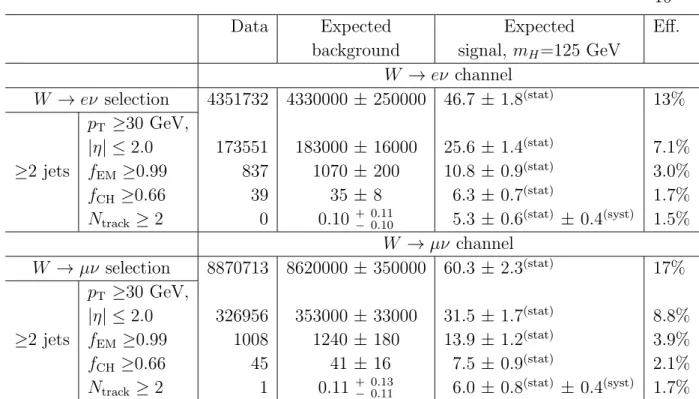
Data Expected Expected Eff.
background signal, mH=125 GeV
W → eν channel
W → eν selection 4351732 4330000 ± 250000 46.7 ± 1.8(stat) 13%
≥2 jets
pT ≥30 GeV,
|η| ≤ 2.0 173551 183000 ± 16000 25.6 ± 1.4(stat) 7.1%
fEM ≥0.99 837 1070 ± 200 10.8 ± 0.9(stat) 3.0%
fCH ≥0.66 39 35 ± 8 6.3 ± 0.7(stat) 1.7%
Ntrack ≥ 2 0 0.10 + 0.11− 0.10 5.3 ± 0.6(stat) ± 0.4(syst) 1.5%
W → µν channel W → µν selection 8870713 8620000 ± 350000 60.3 ± 2.3(stat) 17% ≥2 jets pT ≥30 GeV, |η| ≤ 2.0 326956 353000 ± 33000 31.5 ± 1.7(stat) 8.8% fEM ≥0.99 1008 1240 ± 180 13.9 ± 1.2(stat) 3.9% fCH ≥0.66 45 41 ± 16 7.5 ± 0.9(stat) 2.1%
Ntrack ≥ 2 1 0.11 + 0.13− 0.11 6.0 ± 0.8(stat) ± 0.4(syst) 1.7%
Table 2. The expected number of background and signal events in 2.04 fb−1 of
data, as well as the number of events observed in the data, after applying the various signal selection criteria for the W → eν and W → µν channels. The “≥2 jets” in the first column denotes the requirement of two or more jets per event, satisfying the corresponding selection criteria. The signal predictions correspond to the
three-step model with mH = 125 GeV and mγd=100 MeV. The signal efficiencies are the
fraction of signal events satisfying all the selection criteria up to and including that particular criterion. They are given with respect to the signal sample including all three
decay modes of the W boson (eνe, µνµ, τ ντ). The background expectations include
statistical and systematic uncertainties, and are determined using the MC method (see Section 6). The statistical uncertainty shown for the signal is due to Monte Carlo statistics; the systematic uncertainty is only given for the final event selection and its detailed composition is given in Table 4.
Good agreement is observed between data and MC simulation in the fEM, fCH and
track-related distributions at the different stages of selection, as can be seen in Fig. 2. The number of events observed in the data and the yields expected for the background and the signal as the selection criteria are applied are shown in Table 2. The background yield given here is determined by MC.
6. Background estimation
The dominant background in this search is due to the associated production of a W boson with hadronic jets which mimic the electron-jet signature. Detailed MC studies of the background contamination from hadronic jets faking electron-jets have shown that the high electron content in those jets originates either from final-state photon radiation
Method of background estimation Estimated background yield
Matrix (baseline) 0.41 ± 0.29 (stat) ± 0.12 (syst)
ABCD (cross-check) 0.46 ± 0.32 (stat) ± 0.10 (syst)
MC (cross-check) 0.21 ± 0.05 (stat)+− 0.230.21 (syst)
Table 3. Estimated number of background events after the final selection, including
statistical and systematic uncertainties, from three different methods. The matrix method is used for the background estimate while the ABCD and MC methods provide a cross-check of the matrix method.
A background prediction from MC simulation would depend on the modelling of final-state photon radiation and parton showering and hadronization, which would introduce large uncertainties in the background rate. Instead, the background contamination in the signal region is estimated from the data using a simplified matrix method [52] which is completely data-driven. Two alternative background estimates were tried and found to be consistent with the matrix method result. One of these estimates – referred to as the ABCD method below – is based on data; the second estimate is based on Monte Carlo simulation.
In the matrix method, one defines a “loose” electron-jet selection criterion by
relaxing the minimum track pT requirement from 5 GeV to 2 GeV. The fraction f
is the ratio of the number of jets passing the nominal signal selection NT to that passing
the loose selection NL:
f = NT
NL
. (2)
The number of fake electron-jet background events passing the nominal selection criteria for two electron-jet candidates and entering the signal region is therefore:
nbkgd = f2nfake, (3)
where nfake is the number of background events passing the loose criterion for both
electron-jet candidates. On the other hand, the number of fake electron-jet events in which neither electron-jet candidate passes the nominal selection criterion is
nloose = (1 − f)2nfake. (4)
Combining Eqs. (3) and (4) yields
nbkgd =
f2
(1 − f)2nloose = ¯f
2n
loose, (5)
where ¯f is referred to below as the fake factor. In this way the number of background
events is derived directly from the data events failing to pass the nominal criteria for
both electron-jet candidates (nloose), where the signal contamination has been checked
to be small.
The fake factor ¯f is measured from background-enriched data samples where the
by reversing the W -candidate electron or muon selection criteria to select a sample of multi-jet background with kinematic characteristics similar to those of the signal sample. A fake factor is obtained from the jets in this sample. In the second sample, the fake
factor is determined from a sample of jets that originate from electrons in Z → e+e−
decays. The tight selection criteria and the lepton isolation criteria are applied to one leg of the Z boson candidate, and the invariant mass of this electron and the candidate
jet, me,jet, is required to fall in the range 80 GeV < me,jet < 100 GeV. The two fake
factors are found to be consistent within statistical uncertainties: 0.44 ± 0.02 (stat) and 0.47 ± 0.03 (stat), respectively. The first value is used in the analysis and the difference between these two estimates is taken as a systematic uncertainty in the fake factor. The
resulting value is ¯f = 0.44 ± 0.04, where the uncertainty is the sum of the statistical
and systematic uncertainties added in quadrature.
In the ABCD method used to cross-check the results, events are assigned to one of
four regions according to whether or not the jets meet the fEM and the track-quality
conditions of the electron-jet classification. These two conditions are chosen because they are less correlated than other selection variables that could have been used. The background yield in the signal region is thus given by
nbkgd = NApredicted =
NB· NC
ND · c
MC , (6)
where cMC = 0.36 is the correction factor determined from MC simulation that corrects
for the effect of the correlations between the two selection criteria. Ni is the number of
events observed in region i. The regions are defined as:
(A) Signal region: Two jets with fEM ≥ 0.99 are required; for both jets Ntrack ≥ 2,
i.e. the number of tracks associated with the candidate jets and fulfilling the requirements of the electron-jet selection must be greater than two (see Section 5.2). (B) Anti-track quality region: At least one jet must fail the associated track requirements of the electron-jet selection. Each of the two candidate jets must have two associated tracks separated by ∆R < 0.1, both tracks satisfying looser
requirements pT ≥ 2 GeV and fHT > 0. At least one of these tracks must fail the
requirement fHT > 0.08.
(C) Anti-fEM region: At least one jet must fail the condition fEM ≥ 0.99.
(D) Anti-track quality and anti-fEM region: Both conditions “B” and “C” are
fulfilled.
In the second cross-check of the matrix method, the background prediction is obtained by using data templates and simulated samples with the appropriate cross sections scaled by the measured integrated luminosity, as described in Section 3.
The resulting background yields, together with the evaluated statistical and
systematic uncertainties, are given in Table 3. The estimates from the different
Systematic Source Systematic Uncertainty
(i) Monte Carlo statistics 13%
(ii) Luminosity 3.7%
(iii) σ × BR +3.7−4.3%
(iv) Electron efficiency 5%
(iv) Muon efficiency 3%
(v) fEM modelling 3%
(v) fCH modelling 0.1%
(vi) fHT modelling 1%
(vii) Electron energy scale 0.5%
(vii) Electron energy resolution 0.2%
(vii) Muon momentum resolution 0.5%
(viii) Pile-up <0.1%
Total 15%
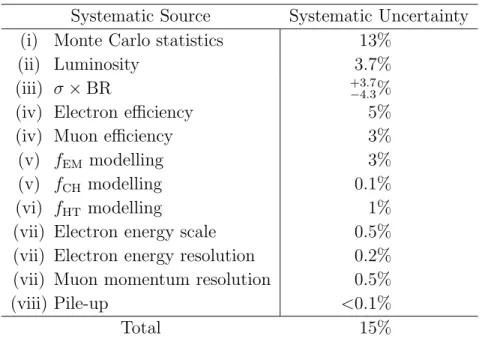
Table 4. Systematic uncertainties for the signal. The numbers in parentheses refer to
the descriptions in the numbered list in the text. All uncertainties are applied to the combination of W → eν and W → µν channels; the only exceptions are the specific electron and muon uncertainties in items (iv) and (vii), and are applied separately. The total uncertainty is conservatively rounded and is given for the combination of channels.
7. Systematic uncertainties
The systematic uncertainties considered for the signal are given in Table 4 and described in detail below:
(i) Monte Carlo statistics: The uncertainty due to the limited number of Monte Carlo signal events is 13%.
(ii) Luminosity: The uncertainty in the integrated luminosity is determined to be 3.7% [48, 49].
(iii) Signal cross sections: The uncertainty of the SM W H production cross section
at Higgs mass mH = 125 GeV is +3.7%−4.3% [53]. For 100 GeV and 140 GeV Higgs mass
the corresponding uncertainties are ±4% [53].
(iv) Electron and muon efficiency: The combined uncertainty on the efficiency of the lepton trigger, identification and isolation as well as transverse impact parameter requirements is found to be 5% for electrons and 3% for muons. The uncertainties were derived using data-driven methods [46, 47].
(v) Jet electromagnetic and charged particle fractions (fEM and fCH): The
uncertainty due to possible mismodelling of these parameters, which impacts the
signal acceptance, are studied by comparing the measured fEM and fCH line shape
for jets, which are matched to electron from W -decay, to the one predicted by the
(vi) Fraction of high-threshold hits in the TRT (fHT): Mismodelling of the fHT distribution in the simulation has been previously studied [46, 51]. The impact of this mismodelling on the signal efficiency was checked using the data samples, enriched with highly collimated pairs of electron tracks, and is found to be less than 1%.
(vii) Electron and muon energy/momentum scale and resolution: These
uncertainties are evaluated by varying the corresponding correction factors, described in Section 5.1, within their systematic uncertainties. This results in the corresponding uncertainties of 0.2%, 0.5% and 0.5% for electron/muon energy resolution and electron energy scale respectively.
(viii) Pile-up impact: The effect of additional inelastic collisions overlapping with the primary hard scatter (pile-up) on the signal efficiency has been evaluated using simulated signal samples and found to be negligible.
The systematic uncertainties on the background determinations are estimated in the following ways:
• Matrix method: The uncertainty is assessed by varying the fake factor within its uncertainty and is summed in quadrature with the statistical uncertainty on the number of events observed in the loose region. An uncertainty due to possible signal contamination is also taken into account. These result in an 80% uncertainty in the background yield.
• ABCD method: The uncertainty is assessed by employing different region selections in the ABCD method and the difference between yields is treated as a systematic uncertainty. The uncertainty due to limited statistics in region B is also considered. The resulting uncertainty in the background yield is 70% with this method.
• MC method: The largest contributions to the uncertainty on the background yield are the systematic uncertainty on the MC-based prediction on the probability of two or more jets to be incorrectly identified as electron-jets (100%), modelling
of fHT (50%), fCH (10%), fEM (10%), the choice of MC generator (10%) and
uncertainties on the cross section for multi-jet processes (10%). The assigned theoretical uncertainties on the cross sections are 4% (W → ℓν, Z → ℓℓ), 5% (W → τν, Z → ττ, W Z/ZZ) and 7% (t¯t, W W ), respectively [41,42]. Limited MC sample sizes contributes a 5% uncertainty. The total uncertainty of background estimation with MC method is 110%.
8. Results and interpretation
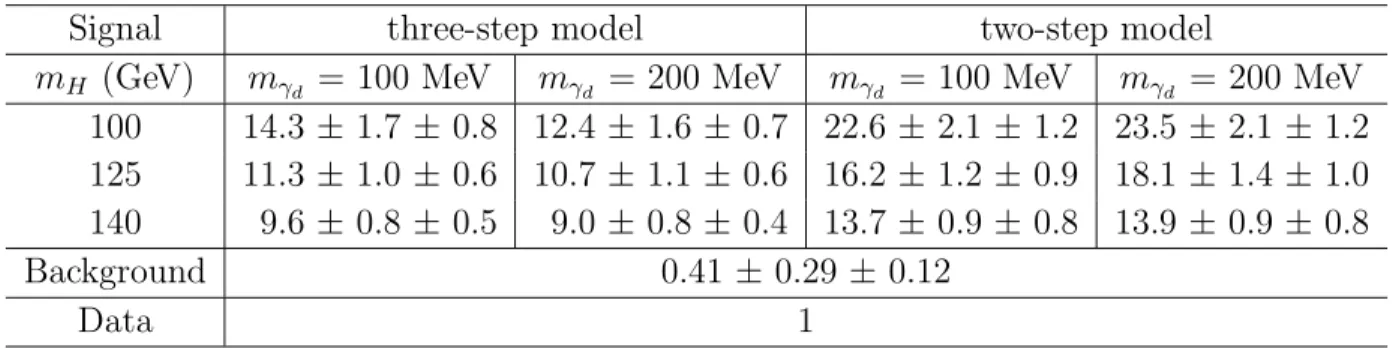
The observed and predicted event yields after the final selection are shown in Table 5. The event yield in the signal region is consistent with the background-only hypothesis, with one data event passing the final selection in the W → µν channel and no data events passing the final selection in the W → eν channel.
Signal three-step model two-step model
mH (GeV) mγd = 100 MeV mγd = 200 MeV mγd = 100 MeV mγd = 200 MeV
100 14.3 ± 1.7 ± 0.8 12.4 ± 1.6 ± 0.7 22.6 ± 2.1 ± 1.2 23.5 ± 2.1 ± 1.2
125 11.3 ± 1.0 ± 0.6 10.7 ± 1.1 ± 0.6 16.2 ± 1.2 ± 0.9 18.1 ± 1.4 ± 1.0
140 9.6 ± 0.8 ± 0.5 9.0 ± 0.8 ± 0.4 13.7 ± 0.9 ± 0.8 13.9 ± 0.9 ± 0.8
Background 0.41 ± 0.29 ± 0.12
Data 1
Table 5. Numbers of expected and observed events after final selection. Expected
signal yields are provided for both the three-step and two-step models with dark photon masses of 100 and 200 MeV. Statistical (first) and systematic (second) uncertainties are presented separately. The results are given for the combination of the W → eν and W → µν channels. One candidate event is observed in the data in the W → µν channel.
Model mγd (MeV) Observed Expected
three-step 100 0.39 0.37
three-step 200 0.45 0.44
two-step 100 0.29 0.28
two-step 200 0.24 0.24
Table 6. The 95% CL upper limits on the signal strength, σ(W H) × BR(H →
e-jets)/σSM(W H), for a Higgs boson mass of 125 GeV for different choices of the
hidden-sector model parameters. Here, σ(W H) is the W H production cross section times the
sum of the branching ratios for the W boson decaying to leptons (eνe, µνµ, τ ντ),
σSM(W H) is the corresponding SM expectation and BR(H → e-jets) is the branching
ratio for Higgs boson decays to electron-jets.
Consequently one estimates a 95% confidence limit on the signal strength, σ(W H)×
BR(H → e-jets)/σSM(W H), where σ(W H) denotes the W H production cross section
times the sum of the branching ratios for the W boson decaying to leptons (eνe, µνµ, τ ντ)
and σSM(W H) is the corresponding SM expectation [53] for this quantity (σSM(W H) =
223+8−10 fb for the Higgs boson mass of 125 GeV). BR(H → e-jets) denotes the branching
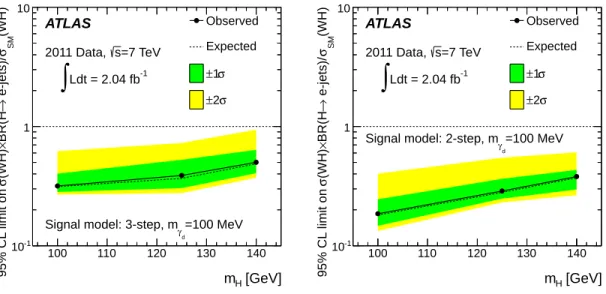
ratio for Higgs boson decays to electron-jets. The results are presented in Fig. 3 and Table 6 for both the three-step and two-step models. Only one limit is presented in Fig. 3 for each of the two-step and three-step models, because the results are compatible within
the statistical uncertainty of the signal for both dark photon masses mγd = 100 MeV
and 200 MeV. Limits are derived using the CLs technique [54]. The likelihoods are given by the Poisson distribution for the total number of events in the signal region and are calculated using the number of expected and observed events, whereby the results of the electron and muon channels are summed and enter the likelihood function together. The corresponding signal and background systematic uncertainties are incorporated into the likelihoods as nuisance parameters with Gamma probability density functions [55].
Assuming that the W H cross section has the SM value, for the specific set of hidden-sector parameters chosen here, the analysis excludes Higgs boson branching ratios to
electron-jets between 24% and 45% for mH = 125 GeV at 95% confidence level.
[GeV] H m 100 110 120 130 140 (WH) SM σ e-jets)/ → BR(H × (WH) σ 9 5 % C L l im it o n -1 10 1 10 -1 Ldt = 2.04 fb
∫
=7 TeV s 2011 Data, =100 MeV d γSignal model: 3-step, m
ATLAS Observed Expected σ 1 ± σ 2 ± [GeV] H m 100 110 120 130 140 (WH) SM σ e-jets)/ → BR(H × (WH) σ 9 5 % C L l im it o n -1 10 1 10 -1 Ldt = 2.04 fb
∫
=7 TeV s 2011 Data, =100 MeV d γSignal model: 2-step, m
ATLAS Observed Expected σ 1 ± σ 2 ±
Figure 3. Observed and expected 95% CL upper limits on the signal strength,
σ(W H) × BR(H → e-jets)/σSM(W H), as a function of the Higgs boson mass for the
(left) three-step and (right) two-step models of a hidden sector with a dark photon mass
mγd = 100 MeV. The dark (light) shaded band contains 68% (95%) of the outcomes
of pseudo-experiments generated under the background-only hypothesis.
9. Conclusions
A search is presented for a light Higgs boson decaying to a light hidden sector and subsequently into highly collimated jets of electrons, which are expected to be seen in the detector as distinct objects called “electron-jets”. The analysis has been performed
using 2.04 fb−1
of proton–proton collision data at√s=7 TeV, collected with the ATLAS
detector at the LHC in 2011.
The search is performed in the W H production mode with the choice of hidden-sector parameter space resulting in Higgs boson decaying into prompt electron-jets. The electron-jet identification method presented here provides good discrimination against background sources and avoids sensitivity to the detailed topology of the electrons within the electron-jet.
The observed data are consistent with the Standard Model background hypothesis. Consequently, 95% confidence level limits are set on the W H production cross section times the branching ratio into electron-jets, assuming the two benchmark models of a hidden sector and the condition of a dark photon mass below 210 MeV.
10. Acknowledgements
We thank CERN for the very successful operation of the LHC, as well as the support staff from our institutions without whom ATLAS could not be operated efficiently.
We acknowledge the support of ANPCyT, Argentina; YerPhI, Armenia; ARC, Australia; BMWF and FWF, Austria; ANAS, Azerbaijan; SSTC, Belarus; CNPq and FAPESP, Brazil; NSERC, NRC and CFI, Canada; CERN; CONICYT, Chile; CAS, MOST and NSFC, China; COLCIENCIAS, Colombia; MSMT CR, MPO CR and VSC CR, Czech Republic; DNRF, DNSRC and Lundbeck Foundation, Denmark; EPLANET, ERC and NSRF, European Union; IN2P3-CNRS, CEA-DSM/IRFU, France; GNSF, Georgia; BMBF, DFG, HGF, MPG and AvH Foundation, Germany; GSRT and NSRF, Greece; ISF, MINERVA, GIF, DIP and Benoziyo Center, Israel; INFN, Italy; MEXT and JSPS, Japan; CNRST, Morocco; FOM and NWO, Netherlands; BRF and RCN, Norway; MNiSW, Poland; GRICES and FCT, Portugal; MERYS (MECTS), Romania; MES of Russia and ROSATOM, Russian Federation; JINR; MSTD, Serbia; MSSR, Slovakia; ARRS and MVZT, Slovenia; DST/NRF, South Africa; MICINN, Spain; SRC and Wallenberg Foundation, Sweden; SER, SNSF and Cantons of Bern and Geneva, Switzerland; NSC, Taiwan; TAEK, Turkey; STFC, the Royal Society and Leverhulme Trust, United Kingdom; DOE and NSF, United States of America.
The crucial computing support from all WLCG partners is acknowledged gratefully, in particular from CERN and the ATLAS Tier-1 facilities at TRIUMF (Canada), NDGF (Denmark, Norway, Sweden), CC-IN2P3 (France), KIT/GridKA (Germany), INFN-CNAF (Italy), NL-T1 (Netherlands), PIC (Spain), ASGC (Taiwan), RAL (UK) and BNL (USA) and in the Tier-2 facilities worldwide.
References
[1] ATLAS Collaboration. Observation of a new particle in the search for the Standard Model Higgs boson with the ATLAS detector at the LHC. Phys. Lett. B, 716:1–29, 2012, arXiv:1207.7214 [hep-ex].
[2] CMS Collaboration. Observation of a new boson at a mass of 125 GeV with the CMS experiment at the LHC. Phys. Lett. B, 716:30–61, 2012, arXiv:1207.7235 [hep-ex].
[3] P. W. Higgs. Broken symmetries, massless particles and gauge fields. Phys. Lett., 12:132–133, 1964.
[4] F. Englert and R. Brout. Broken Symmetry and the Mass of Gauge Vector Mesons.
Phys. Rev. Lett., 13:321–323, 1964.
[5] G.S. Guralnik, C.R. Hagen, and T.W.B. Kibble. Global Conservation Laws and Massless Particles. Phys. Rev. Lett., 13:585–587, 1964.
[6] A. Falkowski, J. T. Ruderman, T. Volansky, and J. Zupan. Hidden Higgs Decaying to Lepton Jets. JHEP, 1005:077, 2010, arXiv:1002.2952 [hep-ph].
[7] A. Falkowski, J. T. Ruderman, T. Volansky, and J. Zupan. Discovering higgs boson decays to lepton jets at hadron colliders. Phys. Rev. Lett., 105(24):241801, 2010, arXiv:1007.3496 [hep-ph]. [8] M. J. Strassler and K. M. Zurek. Echoes of a hidden valley at hadron colliders. Phys. Lett. B,
651(5-6):374 – 379, 2007, arXiv:0604261 [hep-ph].
[9] N. Arkani-Hamed, D. P. Finkbeiner, T. R. Slatyer, and N. Weiner. A theory of dark matter. Phys. Rev. D, 79:015014, 2009, arXiv:0810.0713 [hep-ph].
[10] N. Arkani-Hamed and N. Weiner. LHC Signals for a SuperUnified Theory of Dark Matter. JHEP, 12:104. mult. p, 2008, arXiv:0810.0714 [hep-ph].
[11] M. Baumgart, C. Cheung, J. T. Ruderman, L.-T. Wang, and I. Yavin. Non-abelian dark sectors and their collider signatures. JHEP, 0904(04):014, 2009, arXiv:0901.0283 [hep-ph].
[12] B. Patt and F. Wilczek. Higgs-field portal into hidden sectors. 2006, arXiv:0605188 [hep-ph]. [13] H. Davoudiasl, R. Kitano, Tianjun Li, and H. Murayama. The new minimal standard model.
Phys. Lett. B, 609(1-2):117 – 123, 2005, arXiv:0405097v2 [hep-ph].
[14] D. J. Gross, J. A. Harvey, E. Martinec, and R. Rohm. Heterotic string theory (I). The free heterotic string. Nucl. Phys. B, 256:253 – 284, 1985.
[15] H. Georgi. Unparticle physics. Phys. Rev. Lett., 98(22):221601, 2007, arXiv:0703260 [hep-ph]. [16] B. Holdom. Searching for epsilon charges and a new U(1). Phys. Lett. B, 178(1):65 – 70, 1986. [17] K. R. Dienes, C. F. Kolda, and J. March-Russell. Kinetic mixing and the supersymmetric gauge
hierarchy. Nucl. Phys. B, 492:104–118, 1997, arXiv:9610479v2 [hep-ph].
[18] HEAT Collaboration, S. W. Barwick, et al.. Measurements of the Cosmic-Ray Positron Fraction from 1 to 50 GeV. The Astrophysical Journal Letters, 482(2):L191, 1997, arXiv:9703192 [astro-ph].
[19] Fermi LAT Collaboration, A. A. Abdo, et al.. Measurement of the Cosmic Ray e++ e−Spectrum
from 20 GeV to 1 TeV with the Fermi Large Area Telescope. Phys. Rev. Lett., 102:181101, 2009, arXiv:0905.0025 [astro-ph].
[20] PAMELA Collaboration, O. Adriani, et al.. An anomalous positron abundance in cosmic rays with energies 1.5-100 GeV. Nature, 458:607–609, 2009, arXiv:0810.4995 [astro-ph].
[21] J. Chang, J.H. Adams, H.S. Ahn, G.L. Bashindzhagyan, M. Christl, et al.. An excess of cosmic ray electrons at energies of 300-800 GeV. Nature, 456:362–365, 2008.
[22] CDF Collaboration, T. Aaltonen, et al.. Search for anomalous production of multiple leptons in association with W and Z bosons at CDF. Phys. Rev. D, 85:092001, 2012, arXiv:1202.1260v2 [hep-ex].
[23] ATLAS Collaboration. A search for prompt lepton-jets in pp collisions at sqrt(s) = 7 TeV with the ATLAS detector. 2012, arXiv:1212.5409 [hep-ex].
[24] CMS Collaboration. Search for light resonances decaying into pairs of muons as a signal of new physics. JHEP, 07:098. 30 p, 2011, arXiv:1106.2375 [hep-ex].
[25] D0 Collaboration, V. M. Abazov, et al.. Search for events with leptonic jets and missing transverse energy in ppbar collisions at sqrts=1.96 tev. Phys. Rev. Lett., 105:211802, 2010, arXiv:1008.3356 [hep-ex].
[26] ATLAS Collaboration. Search for displaced muonic lepton jets from light Higgs boson decay in proton-proton collisions at sqrts=7 TeV with the ATLAS detector. 2012, arXiv:1210.0435 [hep-ex].
[27] ATLAS Collaboration. The atlas experiment at the cern large hadron collider. JINST, 3:S08003, 2008.
[28] ATLAS Collaboration. Performance of the atlas trigger system in 2010. Eur. Phys. J. C, 72:1849, 2012, arXiv:1110.1530 [hep-ex].
[29] J. Alwall, P. Demin, S. de Visscher, R. Frederix, M. Herquet, et al.. MadGraph/MadEvent v4: The New Web Generation. JHEP, 0709:028, 2007, arXiv:0706.2334 [hep-ph].
[30] P. Meade and M. Reece. BRIDGE: Branching Ratio Inquiry/Decay Generated Events. 2007, arXiv:0703031 [hep-ph].
[31] T. Sjostrand, S. Mrenna, and P. Z. Skands. PYTHIA 6.4 Physics and Manual. JHEP, 0605:026, 2006, arXiv:0603175 [hep-ph].
[32] M. L. Mangano, M. Moretti, F. Piccinini, R. Pittau, and A. D. Polosa. ALPGEN, a generator for hard multiparton processes in hadronic collisions. JHEP, 0307:001, 2003, arXiv:0206293 [hep-ph].
[33] J. Alwall, S. Hoche, F. Krauss, N. Lavesson, L. Lonnblad, et al.. Comparative study of various algorithms for the merging of parton showers and matrix elements in hadronic collisions.
Eur. Phys. J. C, 53:473–500, 2008, arXiv:0706.2569 [hep-ph].
[34] G. Corcella et al.. HERWIG 6.5: an Event Generator for Hadron Emission Reactions With Interfering Gluons (Including Supersymmetric Processes). JHEP, 0101:010, 2001, arXiv:0011363 [hep-ph].
[35] J M Butterworth et al.. Multiparton Interactions in Photoproduction at HERA. Z. Phys. C., 72(4):21, 1996, arXiv:9601371 [hep-ph].
[36] S. Frixione and B. R. Webber. Matching NLO QCD computations and parton shower simulations. JHEP, 0206:029, 2002, arXiv:0204244 [hep-ph].
[37] T. Gleisberg et al.. Event generation with SHERPA 1.1. JHEP, 02:007, 2009, arXiv:0811.4622 [hep-ph].
[38] T. Sj¨ostrand and M. van Zijl. A multiple-interaction model for the event structure in hadron
collisions. Phys. Rev. D, 36:2019–2041, 1987.
[39] S. Frixione, P. Nason, and C. Oleari. Matching NLO QCD computations with Parton Shower simulations: the POWHEG method. JHEP, 0711:070, 2007, arXiv:0709.2092 [hep-ph].
[40] N. Davidson, G. Nanava, T. Przedzinski, E. Richter-Was, and Z. Was. Universal Interface of TAUOLA Technical and Physics Documentation. 2010, arXiv:1002.0543 [hep-ph].
[41] ATLAS Collaboration. Measurement of the inclusive W± and Z/γ cross sections in the electron
and muon decay channels in pp collisions at√s = 7 TeV with the ATLAS detector. Phys. Rev. D,
85:072004, 2012, arXiv:1109.5141 [hep-ex].
[42] ATLAS Collaboration. Measurement of the top quark pair production cross-section with ATLAS in the single lepton channel. Phys. Lett. B, 711:244–263, 2012, arXiv:1201.1889 [hep-ex]. [43] K. Melnikov and F. Petriello. Electroweak gauge boson production at hadron colliders through
O(α2
s). Phys. Rev. D, 74:114017, 2006, arXiv:0609070 [hep-ph].
[44] J. Allison, K. Amako, J. Apostolakis, H. Araujo, P.A. Dubois, et al.. Geant4 developments and applications. IEEE Trans.Nucl.Sci., 53:270, 2006.
[45] ATLAS Collaboration. The ATLAS Simulation Infrastructure. Eur. Phys. J. C, 70:823–874. 53 p, 2010, arXiv:1005.4568 [physics.ins-det].
[46] ATLAS Collaboration. Electron performance measurements with the ATLAS detector using the 2010 LHC proton-proton collision data. Eur. Phys. J. C, 72:1909, 2012, arXiv:1110.3174 [hep-ex].
[47] ATLAS Collaboration. Muon Momentum Resolution in First Pass Reconstruction of pp Collision Data Recorded by ATLAS in 2010. 2011, cds.cern.ch/record/1338575/files/ATLAS-CONF-2011-046.pdf.
[48] ATLAS Collaboration. Luminosity Determination in pp Collisions at√s=7 TeV Using the ATLAS
Detector at the LHC. Eur. Phys. J. C, 71:1630, 2011, arXiv:1101.2185 [hep-ex].
[49] ATLAS Collaboration. Luminosity Determination in pp Collisions at √s = 7 TeV using the
ATLAS Detector in 2011. 2011, cds.cern.ch/record/1376384/files/ATLAS-CONF-2011-116.pdf.
[50] M. Cacciari, G. P. Salam, and G. Soyez. The anti-kt jet clustering algorithm. JHEP, 04:063,
2008, arXiv:0802.1189 [hep-ph].
[51] ATLAS Collaboration. Performance of Particle Identification with the ATLAS Transition
Radiation Tracker. 2011, arXiv:1109.5925 [physics.ins-det].
[52] ATLAS Collaboration. Measurement of the top quark-pair production cross section with ATLAS in pp collisions at sqrts=7 TeV. Eur. Phys. J. C, 71:1577, 2011, arXiv:1012.1792 [hep-ex]. [53] LHC Higgs Cross Section Working Group, S. Dittmaier, C. Mariotti, G. Passarino, and
R. Tanaka (Eds.). Handbook of LHC Higgs Cross Sections: 2. Differential Distributions. CERN-2012-002, CERN, Geneva, 2012, arXiv:1201.3084 [hep-ph].
[54] A. L. Read. Presentation of search results: The CL(s) technique. J. Phys. G, 28:2693–2704, 2002. [55] K. Cranmer, G. Lewis, L. Moneta, A. Shibata, and W. Verkerke. Histfactory: A tool for creating statistical models for use with roofit and roostats. Technical Report CERN-OPEN-2012-016, New York U., New York, 2012.
The ATLAS Collaboration
G. Aad48, T. Abajyan21, B. Abbott111, J. Abdallah12, S. Abdel Khalek115,
A.A. Abdelalim49, O. Abdinov11, R. Aben105, B. Abi112, M. Abolins88,
O.S. AbouZeid158, H. Abramowicz153, H. Abreu136, B.S. Acharya164a,164b ,a,
L. Adamczyk38, D.L. Adams25, T.N. Addy56, J. Adelman176, S. Adomeit98,
P. Adragna75, T. Adye129, S. Aefsky23, J.A. Aguilar-Saavedra124b,b, M. Agustoni17,
S.P. Ahlen22, F. Ahles48, A. Ahmad148, M. Ahsan41, G. Aielli133a,133b,
T.P.A. ˚Akesson79, G. Akimoto155, A.V. Akimov94, M.A. Alam76, J. Albert169,
S. Albrand55, M. Aleksa30, I.N. Aleksandrov64, F. Alessandria89a, C. Alexa26a,
G. Alexander153, G. Alexandre49, T. Alexopoulos10, M. Alhroob164a,164c, M. Aliev16,
G. Alimonti89a, J. Alison120, B.M.M. Allbrooke18, L.J. Allison71, P.P. Allport73,
S.E. Allwood-Spiers53, J. Almond82, A. Aloisio102a,102b, R. Alon172, A. Alonso36,
F. Alonso70, A. Altheimer35, B. Alvarez Gonzalez88, M.G. Alviggi102a,102b, K. Amako65,
C. Amelung23, V.V. Ammosov128 ,∗, S.P. Amor Dos Santos124a, A. Amorim124a,c,
S. Amoroso48, N. Amram153, C. Anastopoulos30, L.S. Ancu17, N. Andari115,
T. Andeen35, C.F. Anders58b, G. Anders58a, K.J. Anderson31, A. Andreazza89a,89b,
V. Andrei58a, X.S. Anduaga70, S. Angelidakis9, P. Anger44, A. Angerami35,
F. Anghinolfi30, A. Anisenkov107, N. Anjos124a, A. Annovi47, A. Antonaki9,
M. Antonelli47, A. Antonov96, J. Antos144b, F. Anulli132a, M. Aoki101, S. Aoun83,
L. Aperio Bella5, R. Apolle118,d, G. Arabidze88, I. Aracena143, Y. Arai65,
A.T.H. Arce45, S. Arfaoui148, J-F. Arguin93, S. Argyropoulos42, E. Arik19a,∗,
M. Arik19a, A.J. Armbruster87, O. Arnaez81, V. Arnal80, A. Artamonov95,
G. Artoni132a,132b, D. Arutinov21, S. Asai155, S. Ask28, B. ˚Asman146a,146b, L. Asquith6,
K. Assamagan25,e, R. Astalos144a, A. Astbury169, M. Atkinson165, B. Auerbach6,
E. Auge115, K. Augsten126, M. Aurousseau145a, G. Avolio30, D. Axen168, G. Azuelos93,f,
Y. Azuma155, M.A. Baak30, G. Baccaglioni89a, C. Bacci134a,134b, A.M. Bach15,
H. Bachacou136, K. Bachas154, M. Backes49, M. Backhaus21, J. Backus Mayes143,
E. Badescu26a, P. Bagnaia132a,132b, Y. Bai33a, D.C. Bailey158, T. Bain35, J.T. Baines129,
O.K. Baker176, S. Baker77, P. Balek127, F. Balli136, E. Banas39, P. Banerjee93,
Sw. Banerjee173, D. Banfi30, A. Bangert150, V. Bansal169, H.S. Bansil18, L. Barak172,
S.P. Baranov94, T. Barber48, E.L. Barberio86, D. Barberis50a,50b, M. Barbero83,
D.Y. Bardin64, T. Barillari99, M. Barisonzi175, T. Barklow143, N. Barlow28,
B.M. Barnett129, R.M. Barnett15, A. Baroncelli134a, G. Barone49, A.J. Barr118,
F. Barreiro80, J. Barreiro Guimar˜aes da Costa57, R. Bartoldus143, A.E. Barton71,
V. Bartsch149, A. Basye165, R.L. Bates53, L. Batkova144a, J.R. Batley28, A. Battaglia17,
M. Battistin30, F. Bauer136, H.S. Bawa143,g, S. Beale98, T. Beau78, P.H. Beauchemin161,
R. Beccherle50a, P. Bechtle21, H.P. Beck17, K. Becker175, S. Becker98,
M. Beckingham138, K.H. Becks175, A.J. Beddall19c, A. Beddall19c, S. Bedikian176,
V.A. Bednyakov64, C.P. Bee83, L.J. Beemster105, M. Begel25, S. Behar Harpaz152,
C. Belanger-Champagne85, P.J. Bell49, W.H. Bell49, G. Bella153, L. Bellagamba20a,
O. Benary153, D. Benchekroun135a, K. Bendtz146a,146b, N. Benekos165,
Y. Benhammou153, E. Benhar Noccioli49, J.A. Benitez Garcia159b, D.P. Benjamin45,
M. Benoit115, J.R. Bensinger23, K. Benslama130, S. Bentvelsen105, D. Berge30,
E. Bergeaas Kuutmann42, N. Berger5, F. Berghaus169, E. Berglund105, J. Beringer15,
P. Bernat77, R. Bernhard48, C. Bernius25, F.U. Bernlochner169, T. Berry76,
C. Bertella83, A. Bertin20a,20b, F. Bertolucci122a,122b, M.I. Besana89a,89b, G.J. Besjes104,
N. Besson136, S. Bethke99, W. Bhimji46, R.M. Bianchi30, L. Bianchini23,
M. Bianco72a,72b, O. Biebel98, S.P. Bieniek77, K. Bierwagen54, J. Biesiada15,
M. Biglietti134a, H. Bilokon47, M. Bindi20a,20b, S. Binet115, A. Bingul19c, C. Bini132a,132b,
C. Biscarat178, B. Bittner99, C.W. Black150, J.E. Black143, K.M. Black22, R.E. Blair6,
J.-B. Blanchard136, T. Blazek144a, I. Bloch42, C. Blocker23, J. Blocki39, W. Blum81,
U. Blumenschein54, G.J. Bobbink105, V.S. Bobrovnikov107, S.S. Bocchetta79,
A. Bocci45, C.R. Boddy118, M. Boehler48, J. Boek175, T.T. Boek175, N. Boelaert36,
J.A. Bogaerts30, A. Bogdanchikov107, A. Bogouch90,∗, C. Bohm146a, J. Bohm125,
V. Boisvert76, T. Bold38, V. Boldea26a, N.M. Bolnet136, M. Bomben78, M. Bona75,
M. Boonekamp136, S. Bordoni78, C. Borer17, A. Borisov128, G. Borissov71,
I. Borjanovic13a, M. Borri82, S. Borroni42, J. Bortfeldt98, V. Bortolotto134a,134b,
K. Bos105, D. Boscherini20a, M. Bosman12, H. Boterenbrood105, J. Bouchami93,
J. Boudreau123, E.V. Bouhova-Thacker71, D. Boumediene34, C. Bourdarios115,
N. Bousson83, S. Boutouil135d, A. Boveia31, J. Boyd30, I.R. Boyko64,
I. Bozovic-Jelisavcic13b, J. Bracinik18, P. Branchini134a, A. Brandt8, G. Brandt118,
O. Brandt54, U. Bratzler156, B. Brau84, J.E. Brau114, H.M. Braun175,∗,
S.F. Brazzale164a,164c, B. Brelier158, J. Bremer30, K. Brendlinger120, R. Brenner166,
S. Bressler172, T.M. Bristow145b, D. Britton53, F.M. Brochu28, I. Brock21, R. Brock88,
F. Broggi89a, C. Bromberg88, J. Bronner99, G. Brooijmans35, T. Brooks76,
W.K. Brooks32b, G. Brown82, P.A. Bruckman de Renstrom39, D. Bruncko144b,
R. Bruneliere48, S. Brunet60, A. Bruni20a, G. Bruni20a, M. Bruschi20a,
L. Bryngemark79, T. Buanes14, Q. Buat55, F. Bucci49, J. Buchanan118, P. Buchholz141,
R.M. Buckingham118, A.G. Buckley46, S.I. Buda26a, I.A. Budagov64, B. Budick108,
L. Bugge117, O. Bulekov96, A.C. Bundock73, M. Bunse43, T. Buran117, H. Burckhart30,
S. Burdin73, T. Burgess14, S. Burke129, E. Busato34, V. B¨uscher81, P. Bussey53,
C.P. Buszello166, B. Butler143, J.M. Butler22, C.M. Buttar53, J.M. Butterworth77,
W. Buttinger28, M. Byszewski30, S. Cabrera Urb´an167, D. Caforio20a,20b, O. Cakir4a,
P. Calafiura15, G. Calderini78, P. Calfayan98, R. Calkins106, L.P. Caloba24a,
R. Caloi132a,132b, D. Calvet34, S. Calvet34, R. Camacho Toro34, P. Camarri133a,133b,
D. Cameron117, L.M. Caminada15, R. Caminal Armadans12, S. Campana30,
M. Campanelli77, V. Canale102a,102b, F. Canelli31, A. Canepa159a, J. Cantero80,
R. Cantrill76, T. Cao40, M.D.M. Capeans Garrido30, I. Caprini26a, M. Caprini26a,
D. Capriotti99, M. Capua37a,37b, R. Caputo81, R. Cardarelli133a, T. Carli30,
G. Carlino102a, L. Carminati89a,89b, S. Caron104, E. Carquin32b,
G.D. Carrillo-Montoya145b, A.A. Carter75, J.R. Carter28, J. Carvalho124a,i,
E. Castaneda-Miranda173, V. Castillo Gimenez167, N.F. Castro124a, G. Cataldi72a,
P. Catastini57, A. Catinaccio30, J.R. Catmore30, A. Cattai30, G. Cattani133a,133b,
S. Caughron88, V. Cavaliere165, P. Cavalleri78, D. Cavalli89a, M. Cavalli-Sforza12,
V. Cavasinni122a,122b, F. Ceradini134a,134b, A.S. Cerqueira24b, A. Cerri15, L. Cerrito75,
F. Cerutti15, S.A. Cetin19b, A. Chafaq135a, D. Chakraborty106, I. Chalupkova127,
K. Chan3, P. Chang165, B. Chapleau85, J.D. Chapman28, J.W. Chapman87,
D.G. Charlton18, V. Chavda82, C.A. Chavez Barajas30, S. Cheatham85, S. Chekanov6,
S.V. Chekulaev159a, G.A. Chelkov64, M.A. Chelstowska104, C. Chen63, H. Chen25,
S. Chen33c, X. Chen173, Y. Chen35, Y. Cheng31, A. Cheplakov64,
R. Cherkaoui El Moursli135e, V. Chernyatin25, E. Cheu7, S.L. Cheung158,
L. Chevalier136, G. Chiefari102a,102b, L. Chikovani51a,∗, J.T. Childers30,
A. Chilingarov71, G. Chiodini72a, A.S. Chisholm18, R.T. Chislett77, A. Chitan26a,
M.V. Chizhov64, G. Choudalakis31, S. Chouridou9, B.K.B. Chow98, I.A. Christidi77,
A. Christov48, D. Chromek-Burckhart30, M.L. Chu151, J. Chudoba125,
G. Ciapetti132a,132b, A.K. Ciftci4a, R. Ciftci4a, D. Cinca62, V. Cindro74, A. Ciocio15,
M. Cirilli87, P. Cirkovic13b, Z.H. Citron172, M. Citterio89a, M. Ciubancan26a,
A. Clark49, P.J. Clark46, R.N. Clarke15, W. Cleland123, J.C. Clemens83, B. Clement55,
C. Clement146a,146b, Y. Coadou83, M. Cobal164a,164c, A. Coccaro138, J. Cochran63,
L. Coffey23, J.G. Cogan143, J. Coggeshall165, J. Colas5, S. Cole106, A.P. Colijn105,
N.J. Collins18, C. Collins-Tooth53, J. Collot55, T. Colombo119a,119b, G. Colon84,
G. Compostella99, P. Conde Mui˜no124a, E. Coniavitis166, M.C. Conidi12,
S.M. Consonni89a,89b, V. Consorti48, S. Constantinescu26a, C. Conta119a,119b, G. Conti57,
F. Conventi102a ,j, M. Cooke15, B.D. Cooper77, A.M. Cooper-Sarkar118, K. Copic15,
T. Cornelissen175, M. Corradi20a, F. Corriveau85,k, A. Cortes-Gonzalez165,
G. Cortiana99, G. Costa89a, M.J. Costa167, D. Costanzo139, D. Cˆot´e30, G. Cottin32a,
L. Courneyea169, G. Cowan76, B.E. Cox82, K. Cranmer108, S. Cr´ep´e-Renaudin55,
F. Crescioli78, M. Cristinziani21, G. Crosetti37a,37b, C.-M. Cuciuc26a,
C. Cuenca Almenar176, T. Cuhadar Donszelmann139, J. Cummings176, M. Curatolo47,
C.J. Curtis18, C. Cuthbert150, P. Cwetanski60, H. Czirr141, P. Czodrowski44,
Z. Czyczula176, S. D’Auria53, M. D’Onofrio73, A. D’Orazio132a,132b,
M.J. Da Cunha Sargedas De Sousa124a, C. Da Via82, W. Dabrowski38, A. Dafinca118,
T. Dai87, F. Dallaire93, C. Dallapiccola84, M. Dam36, D.S. Damiani137,
H.O. Danielsson30, V. Dao104, G. Darbo50a, G.L. Darlea26b, J.A. Dassoulas42,
W. Davey21, T. Davidek127, N. Davidson86, R. Davidson71, E. Davies118,d, M. Davies93,
O. Davignon78, A.R. Davison77, Y. Davygora58a, E. Dawe142, I. Dawson139,
R.K. Daya-Ishmukhametova23, K. De8, R. de Asmundis102a, S. De Castro20a,20b,
S. De Cecco78, J. de Graat98, N. De Groot104, P. de Jong105, C. De La Taille115,
H. De la Torre80, F. De Lorenzi63, L. De Nooij105, D. De Pedis132a, A. De Salvo132a,
U. De Sanctis164a,164c, A. De Santo149, J.B. De Vivie De Regie115, G. De Zorzi132a,132b,
W.J. Dearnaley71, R. Debbe25, C. Debenedetti46, B. Dechenaux55, D.V. Dedovich64,
J. Degenhardt120, J. Del Peso80, T. Del Prete122a,122b, T. Delemontex55,