Key Centre of Design Computing and Cognition, University of Sydney, 2001, pp. 253-264.
A GENERATIVE DESIGN SYSTEM APPLIED TO SIZA’S SCHOOL OF ARCHITECTURE AT OPORTO
LUISA CALDAS AND JOÃO ROCHA
Massachusetts Institute of Technology USA
Abstract. A new generative design system based on a genetic algorithm
is tested within the framework of Alvaro Siza’s School of Architecture at Oporto, Portugal. The system works over a detailed three-dimensional description of the building and uses natural lighting and overall environmental performance as objective functions to guide the generation of solutions. This paper researches the encoding of architectural design intentions into the system, using constraints derived from Siza’s original design. Experiments using this generative system were performed on three different geographical locations to test the algorithm’s capability to adapt solutions to different climatic characteristics within the same language constraints.
1. Introduction
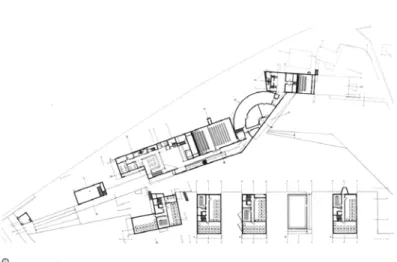
The School of Architecture at Oporto was designed and constructed from 1984 to 1996 by Álvaro Siza. Faced with a challenging site steeply sloping towards the Douro river, Siza opted for distributing the academic activities among different spatial units, creating a remarkable piece of architecture. Studios and faculty rooms are housed in towers E, F, G and H; the library, auditoriums and administrative services are in the northernmost buildings (see Figure 1).
During the design period, Siza's sketches and concepts have evolved in order to create a diversity of spatial configurations. These architectural relations can be seen in the final organization of the buildings, such as long corridors that unite, under the entrance level, the four studio towers, or the exterior communal space that visually and physically relates the towers with the remaining buildings. For a more detailed analysis, see Testa (1999).
Figure 1. School of Architecture plan. Tower H is on the right lower corner.
2. Scope of research
Previous work described the development and testing of a new generative design system (Caldas and Norford, 1999, 2000) based on a genetic algorithm and a building simulation software, the DOE-2.1 program developed for the US Department of Energy by Lawrence Berkeley National Laboratory (Winkelman, 1993; Sullivan et al., 1992). While the GA works as a search and optimization engine, DOE-2.1 assesses the behavior of each solution in terms of its use of natural lighting, thermal performance and yearly energy consumption.
In this study we approached the integration of architectural design intentions into the generative system, using Siza’s School of Architecture at Oporto as a test bed, since its clear but complex composition rules provided an excellent framework to work upon. Due to the large dimension of the project, the study focused solely on one of the studio towers.
Tower H was chosen for its rich spatial configurations and use of a variety of architectural light sources: fenestrations of different proportions and sizes facing distinct orientations (some including overhangs), zenithal light as roof monitors in the top floor, and a loggia in the south façade. From a computational perspective, tower H also presents some challenging features. The internal relations between the different spaces and their light sources give rise to a multiplicity of interactions that are hard to predict and make the resort to computational analysis an interesting option.
The generative system works over a complete three-dimensional description of the building, including its geometry, orientation, spatial organization, construction materials, internal finishes, etc. In this study, building geometry,
space layout and construction materials were left unchanged, and the algorithm’s search space related only to elevation design solutions. However, it should be noted that when the algorithm is working upon the building façade, it is considering all the factors mentioned above, an overall appreciation of the three-dimensional and material piece of architecture.
3. Objectives
The objectives of this research are twofold: first, to study the incorporation of language constraints into the generative design system, so that solutions generated are within certain design intentions. Second, to examine the generative system results from the perspective of the existing design by Álvaro Siza, an architect well known for his control of light, and to analyze to what extent the inclusion of factors other than light could make solutions follow a different path.
4. Generative System
The fact that Tower H mainly houses studio teaching rooms makes a strong case for the careful control of natural light in order to maintain adequate daylighting levels for drawing tasks while precluding direct sun over the drafting tables and excessive solar gains in the rooms.
For the existing building layout, the software generates a population of façade solutions that take into account the use of daylighting in the space, the subsequent use of artificial lighting, and the energy consumed to heat and cool the building. Solutions that make maximum use of natural lighting are preferred, but the control of heat gains and losses introduces a balance point to be achieved. If maximum amounts of daylighting were the single criterion, maximum opening sizes allowed within language constraints would always be the best solution. However, above a certain level more natural light will bring no benefits and will carry with it disadvantages such as high thermal gains or losses that will need to be offset by mechanical systems. It is this elusive balance point that the computer tries to locate. However, solutions provided by this generative system should not be regarded as an optimum response to a given problem, but as useful information on the overall interaction of different elements of the building that may provide guidance for further developments during the design process.
As mentioned above, the DOE-2.1 program is used to calculate the fitness of each solution. For each individual space in Tower H, virtual photocells were placed at chosen locations (typically the furthest points from the windows were a certain light level is to be achieved) and desired illuminances values were
specified according to the type of occupation and tasks performed. Generally, we used 500 lux for studios and other working spaces and 300 lux for service areas. Available daylighting levels at those reference points are calculated for each hour of the year, for the building geographical location and corresponding climate. The artificial lighting system is supposed to be continuously dimmable and to provide just enough light to make up for the difference between available daylight and desired setpoints. Artificial lighting is accounted both as electric energy consumption and as a cooling load into the building. The program then performs hourly heating and cooling load calculations, and computes annual energy consumption in the building due to all those factors. That value represents the fitness of that individual, and is then passed into the genetic algorithm to further guide the search process.
5. Encoding Design Rules Generating Constraints
Due to the need of finding elements that would lead to the development of a method to understand and encode Siza's design intentions (rules), a visit to the School of Architecture took place in January 2000. The analysis of the drawings and the visit to the building allowed us to infer design rules that we consider to be applicable to the existing elevations. Those rules relate both to compositional axes of the facades and to general proportions of the openings. In tower H, different rules seem to apply to each elevation, while maintaining a strong coherence in the overall design of the building and in the relations with internal spaces (for example, long horizontal windows are always used in the architecture studios).
The south elevation presents a strong symmetry axis for the openings, but introduces other elements such as overhangs and the loggia. The north façade is also mostly symmetrical in its composition, with a single asymmetrical element. However, east and west façades obey quite different rules. We considered the east elevation to be organized by two vertical axes along which the ends of the different openings are aligned. The small openings present in the west elevation relate to the interior spaces they serve (service areas like stairs and restrooms). As for the proportions of the openings, the majority of them tend to be long horizontal windows, with many variations in size and placement according both to the characteristics of internal spaces and elevation compositional rules.
This interpretation of existing design rules was followed by the determination of areas of search for the generative mechanism, implemented as constraints to the algorithm. The search areas are bounded by maximum and minimum dimensions the openings can assume, and those limits were made distant enough to allow for a significant search space that could promote the
emergence of a rich variety of solutions. Other constraints implement the compositional axes determined during the analysis stage.
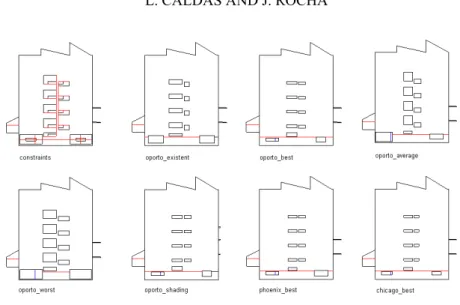
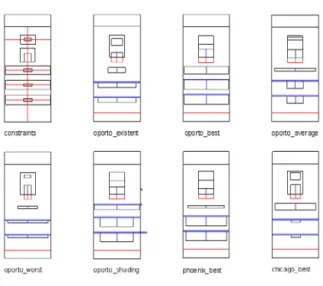
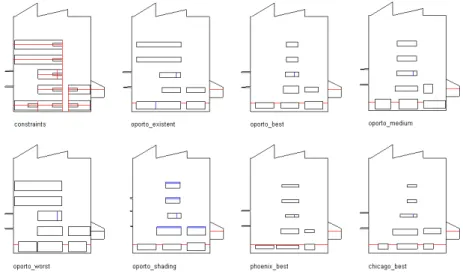
In figures 3, 4, 5 and 6, the upper left corner image represents the constraints applied. Compositional axes are represented by the lighter lines. For each opening, the smaller area represents the lower bound to the algorithm, and the larger area the upper bound. For horizontal windows, an additional constraint prevents the appearance of vertical openings. This set of constraints are proposed by us as being able to control the generation of solutions within certain architectural intentions that we relate to Siza's design.
A parametric matrix of constraints is thus the main mechanism for encoding architectural design intentions. Changing the constraints would allow for the exploration of many different design solutions, a path we did not pursue in this work.
6. Experiments with the Generative System
The algorithm was run for three climates with distinct characteristics, to test its capability of adapting architectural design solutions to different environmental requirements while subject to the same language constraints. Apart from Oporto, where the existing building is located, the other climates chosen were Phoenix, Arizona, and Chicago, Illinois, both in the USA.
Oporto’s climate is mild, with average monthly temperatures in the coldest months (December and January) around 10ºC. The warmest months (July and August) have average monthly temperatures of 20ºC. The lowest temperature registered in the weather file used was 2.8ºC in December, and the highest was 30.4ºC in August.
Phoenix’s climate is much hotter and dryer, with temperatures peaking at 44.4ºC in June. Average monthly temperatures in July reach almost 34ºC. Average monthly temperatures in the coldest months (December and January) are similar to Oporto’s case, around 11ºC.
Chicago’s climate is characterized by extremely low temperatures in the winter. The minimum temperature registered in the file used was -22.8ºC in January. Average monthly temperatures are -2.2ºC in December and -3.3ºC in January and February. In summer (July) they are situated around 24ºC.
7. Results 7.1. OPORTO
Results from the generative system (GS) ranged from an almost exact coincidence with Siza’s solutions to some radical departures from the existing
design. In figure 2, three-dimensional models of both Siza’s and GS solutions are displayed. The two images on the left show east and north elevations, with Siza’s on the left and GS on the right. The two images on the right show west and south elevations, with Siza’s on the right and GS on the left.
Figure 2. Three-dimensional models of Siza’s and GS solutions
In the north façade (figure 3), the large horizontal stripes generated by the algorithm very approximately resemble those created by Siza (except for the melodic variations in height in the original design), denoting that in Oporto’s mild climate the use of natural light in the studios clearly offsets the heat losses through the large glazing areas, as Siza may have predicted. Heat gains are not a significant issue in this orientation. It can be observed in fig. 3 that as the quality of solutions decreases (oporto_best, oporto_average, oporto_worst), window sizes decrease too.
This may contradict the common supposition that reduced glazing areas should be used in north facades, at least in climates that are not too severe in winter.
Towards the west (figure 4), the algorithm used small window sizes as Siza did, even further reducing them. This was due to the lower illuminance levels that the service areas (stairs and restrooms) require and to the reduced size of the spaces. It can be observed in figure 4 that as the openings get larger, the quality of the solutions decrease. West orientation is particularly dangerous regarding heat gains, thus Siza never placed studios facing west except in tower G, where he used large vertical fins to protect the openings from the sun (see figure 1).
Figure 3. North elevations
In the south orientation (figure 5) the generative system solutions present more significant modifications in relation to the existent. In Siza’s design, the 2nd and 3rd floors have south facing studios with long horizontal windows shaded by 2-meter deep overhangs. The algorithm solutions tend to suggest these overhangs may be too deep. When the overhang depth is kept as 2 meters (oporto_best), window sizes assume the largest dimensions allowed by the constraints. The deep overhangs block the admittance of daylight into the room, and to counteract that effect the algorithm increases the openings size. When overhang depth is a variable (oporto_shading), the algorithm reduces it to 0.5m, and also reduces window sizes to a dimension closer to that used by Siza. The shallower overhangs allow more daylighting into the studios while still blocking direct sun and high solar gains, since in the hottest months the sun is high in the south quadrant and can be controlled with shallow overhangs. On cold winter months, when the sun is lower in the sky, useful solar gains are still admitted into the rooms, reducing the need for heating.
Figure 4. West elevations
In the 6th floor, the solution from the GS for the south facing loggia has to be understood in conjunction with the roof monitors solutions (which can be seen in figure 3 or in the 3-D images of figure 2). The 6th floor is basically occupied by a single space, lit from above by two roof monitors, from the south by a loggia window, and with blank walls in all other directions. The algorithm increases the south-facing loggia window to the maximum allowed by the constraints, and reduces the glazed area of the roof monitor that lits the space closer to the loggia. The roof monitor faces north and is a large source of heat losses in winter, particularly because warm air rises to the glazed areas. Increasing the south opening permits reducing the roof monitor without losing too much daylight in the studios. On the other hand, the second roof monitor assumes the largest dimensions possible in the GS solution (as in Siza’s design), since that area of the 6th floor has no other light source. This result suggests the tilt of the roof could be varied to allow for a larger roof monitor in that location.
The 4th and 5th floor south solutions have to be analyzed together with east results (figure 6), since in those floors the studios share both south and east openings. The GS increases south facing windows in relation to the existing design, and simultaneously reduces east facing ones. East orientation is unfavorable due to high solar gains during the morning in summer months, and to reduced daylighting levels during the afternoon for most of the year. South facing openings perform better both in terms of natural light admission and control of heat gains. When the algorithm has the possibility of trading between the two options, it consistently favors south.
Figure 5. South elevations
This happens because the GS evaluates for each hour of the year the interactions between the several elements of the solution, like east and south facing windows in the same room.
Figure 6 shows that as the size of east facing windows increase, the quality of solutions decrease. However, when the algorithm was allowed to place overhangs in the east façade too (oporto_shading), it significantly increased window sizes in the 2nd floor, while placing quite deep overhangs to shade the low morning sun. It should be noted that the studio in the 2nd floor has only east facing windows. For the studios on the 4th and 5th floors, which have both east and south facing windows, the GS kept east openings small (although slightly larger than in the unshaded case) with shallow overhangs, and privileged south facing openings again.
Annual energy consumption for the different solutions is: oporto_existent 96.44 mwh; oporto_best 89.99 mwh; oporto_average 96.23 mwh; oporto_worst 110.56 mwh; oporto_shading 87.58 mwh; phoenix_best 119.02 mwh; chicago_best 226.7 mwh. For Oporto’s climate, the worst solution found by the GS has about 26% higher energy consumption than the best solution with shading as a variable. Siza’s design consumes about 10% more energy than the GS solution.
7.2. PHOENIX
For both Phoenix and Chicago only the best solution found by the GS is shown. Under the hot Phoenix climate, the main differences in GS solutions relatively to Oporto were: in the south, unshaded windows (4th floor) were significantly reduced, even though shaded ones remained quite large. East windows were
made much smaller too. This reflects the effect of high heat gains in that geographical location. West windows remained small, as they did for Oporto, to avoid heat gains too. The north façade suffered almost no alteration, since it is only marginally affected by direct solar gains.
Figure 6. East elevations
7.3. CHICAGO
The extremely cold Chicago climate originated some interesting changes in relation to Oporto and Phoenix solutions. For north facing studios, the windows were reduced to the minimum dimensions allowed by the constraints, due to high heat losses through the glazing and to the absence of solar gains which would be beneficial in Chicago’s cold climate. This façade-level solution may allow for an extrapolation in terms of spatial organization, suggesting that north-facing studios should be avoided in this type of climate.
Towards the south, unshaded windows were made quite large since they couple daylight admission with useful solar gains. However, shaded windows were reduced to minimum dimensions, as both natural light and solar gains are blocked, and heat losses prevail. When overhang depth was used as a variable, the algorithm reduced it to the minimum allowed, and simultaneously increased window sizes (this result is not shown in the images). It can be concluded that south shading may be undesirable in this climate. Towards the east, rooms that have only east-facing windows received average-sized openings (1st and 2nd floors), a compromise between positive factors like daylight admission and morning solar gains, and negative ones like high heat losses through the glazing. For studios with both east and south facing
windows, east ones were made quite small since once again south was preferred. West fenestration received minimum dimensions.
8. Conclusions and Further work
The Generative System proved to be flexible enough to incorporate constraints that allow the user to manipulate certain architectural design intentions. The close coincidence between GS and Siza’s solutions in some situations was of particular interest. On the other hand, the departures from the existing design proposed by the algorithm suggests that this generative system may be a useful tool in exploring multiple paths during the design process.
Another interesting dimension of the GS is its capability to account for interactions between different elements of the building, and to make the design for each specific element dependent on its integrated role on the architectural whole. The relations between the solutions for the loggia and the roof monitors, or between south and east facing windows in some of the studios, are a demonstration of that capability. The possibility of extrapolating from the algorithm’s results to other dimensions like building geometry or spatial organization suggested new directions for further work where these aspects may also be manipulated by the generative system.
The GS was able to generate, within language constraints, solutions that have low energy consumption levels, and this result can be analyzed from two perspectives: first, reducing energy consumption adds to a building’s sustainability, an issue of current concern to the architecture discipline. Secondly, high consumption levels work as indicators of problems happening in the architecture of the building, showing that it might be poorly adapted to the climate. In cases where mechanical systems are not installed to offset those deficiencies, users will eventually suffer from discomfort inside the building.
The range of solutions the GS offered to the different geographical locations showed that the system is able to adapt the architectural design to the climate where it is located, even within the same language constraints.
The ultimate objective in the development of this software is its inclusion as a generative system operating in early conceptual phases of the design process. As mentioned before, solutions must not be interpreted as definite or optimal answers, but as diagnosis of potential problems and as suggestions for further architectural explorations, building thus an innovative and promising interaction between architecture and computation.
Acknowledgements
Luisa Caldas developed this work as part of her Ph.D. dissertation in Architecture at Massachusetts Institute of Technology, with a grant from PRAXIS XXI program, Fundação para a Ciência e a Tecnologia, Portugal. João Rocha is also a Ph.D. student in Architecture at Massachusetts Institute of Technology with a grant from PRAXIS XXI. We would like to thank William Mitchell for advising us in this study, and Álvaro Siza, Peter Testa and Leslie Norford for their kind support.
References
Cagan, J. and Mitchell, W. J.: 1993, Optimally directed shape generation by shape annealing, Environment and Planning B, 20, 5-12
Caldas, L. and Norford, L.: 1999, A genetic algorithm tool for design optimization, Proceedings of ACADIA ’99, pp. 260-271
Caldas, L. and Norford, L.: 2000, Energy design optimization using a genetic algorithm, Automation in Construction, Special Issue 2000 (forthcoming)
Damsky, J. and Gero, J.: 1997, An evolutionary approach to generating constraint-based space layout topologies, in Junge, R. (ed.), CAAD Futures1997, Kluwer, Dordrecht pp. pp. 855-874.
Huang, W. and Lam, H.: 1997, Using genetic algorithms to optimize controller parameters for HVAC systems, Energy and Buildings, 26, 277-282
Krishnakumar, K.: 1989, Micro-genetic algorithms for stationary and non-stationary function optimization, in Rodriguez, G. (ed.), Intelligent Control and Adaptive Systems, 7-8 November (pp. 289-296), Philadelphia, Pennsylvania: SPIE – The International Society for Optical Engineering
Radford, A. and Gero, J. S.: 1978, On the design of windows, Environment and Planning B, 6 (1), 41-45
Radford, A. and Gero, J. S.: 1978, A dynamic programming approach to the optimum lighting problem, Engineering Optimization, 3 (2), pp. 71-82.
Sullivan, R., Lee, E. and Selkowitz, S.: 1992, A method for optimizing solar control and daylighting performance in commercial office buildings, ASHRAE/DOE/BTECC Conference on the Thermal Performance of the Exterior Envelopes of Buildings V.
Testa, P.: 1999, Evolutionary space in the architecture of Álvaro Siza, A+U. Architecture and Urbanism, 355, 8-13
Winkelman, F.: 1993 Daylighting calculation in DOE-2, Lawrence Berkeley National Laboratory Report, LBL-11353.