:;.
"l!J1Jl- 4(1)
UNlVERSIDADE NOVA DE USBOA
~
~
Faculdade de EconomiaINP,
~
1/8
A THEORY OF SYNERGY
Jorge Vasconcellos e
Sa
. Working Paper NQ 77I
I
-
\I
I
!
UNIVERSIDADE NOVA DE
~ISBOAFaculdade de
Economia
Travessa
Estevao Pinto
Alto de Campolide
A THEORY Of SYNERGY
I - INTRODUCTION
Several scholars hove recently stressed the importance of the concept of synergy (Anker. 1934; Singh una ~l(\ntgcmery. 19d7; Lubatkin, 1987; Hill and lloskbsOD, J987). Two reasonS have been
advflnced~ First. increHsing levels of ecoHomic t technologic dlld
competitive c01nplexity impose the :1eed to achieve higher strategic benefits un urganizatiocs (Ansoff. 1984; Thomas, 1(86). Second. i t is becomin::;:; ir:creasingly accepted that corporate strategy must go beyond' t:le cash Ilk10agerncnt of EGG and similar models in orcer to creati':l a C01:lpctitive advaotage for the organit:.ation B:-" a 'Whole (Scherer, 1986; pnts~ 1985; Hammer mesh.
1986).
Synergy remains t however, an elusive concept.
Accortling to Porter (l985J, l1ill defined notions of what constitutes synergy underlay many companies' acquisitions problen::/' (PP.318)~ Besides this conce;>tual problejJl,"ChattvrJee (1986) has. a Iso indicated tll~t, "A more r igorQus ft'iurework shou] d
be developed which links the potentii-il for cr~'oting econou:ic value not only to the decision to diversify. but also to the type of acquisition (related or unrelated) and the ffiudc (de novo or acquisition) of diversification"
(PP.138).
Consequently, in order for the ,~oncept of syn<;rgy to be useflll
one 2lust possess .1 t.heory
of
syrergy which states lJ, c€tailed terms it.s causes and the circ.umstances under which those causes are predicted to Pt> cspec iully strong (Singh and :·Iontgo!aery. 1987). Such a detailed theory of syner3Y will lead to com:] usions about which acqul.s~tlon strategies greatest potential for creeting economic value (Salter and 11eiahold, 1979iPorter t 1987).
Presenting such a theory of synergy is the aim of this paper. This paper wiiI:
lst - devele'!J a ,-'ctailcd list of the causes of synergy_ 2nd. - aggregate the dHferent causes, according to their nature into broader categories.
3rd - predict when synergy will or ..ill not be created.
II - THE Cm;CEPT 0, SYXERGY
A conct'pt should be defined by its roots and by its CO!l;;:lOfl
• "S . .. (. . . ) . . h
usage. Synergy comes f rom t he :;1t"eeK ynergr.a JOlnt \-taCK WJue is derived from "syner,sein". LlA<-)oing. to work togetaer. rlcc*,pted sources such as the \;'eLster dictionary define. synergy i>b the combined or cooper-ati ve action of different forces, such as drugs in the human body I or the action of 'sever<ll orgillls to
perform cQ1nplex -movement""
From the roots and common usage of the word synergy two
basic points emerge: •
1st - Synergy requires diversity, involving two or more agents, orgkl\\S, drugs, divitiioo$. etc. That is, one may speak of synergy only if there 1s diversity (Pitts, 1985; ;!Ul mid Hoskissol!. 1987) ,.
2nd - There is nothing in the concept of synergy which -requires that the overall effect !}e greater t:hc;n the sum of the
.
parts •The
conceptof synergy
requireswerking
together, itdoes
not specify the end result,' Indc~tl. in ::nedicine two dru:;s can be used simultaneous] y, so thnt the effect of one,Pf t.he drugs partially ,offsets SONt: undesirable effect of thE' other drug. In the organizat ions field. Ansof f I 1965 and 198/.; ::ew;nan and Logan. 1985; Scott 1980, ' and Sch~rer J979, r.ave all Pointed Olit t.hat synergy can be nega'tive (2+2:0;3) as welJ os positive (2+2=5).
Consequently, syr:ergy should be defined as the coperative work of different PiJrts towards ,) common end (1). 1':l(S definition is in accord<lnce with that of authors suc-h as Day, J077, Haugen, 1975; Ansoff, 1965; and Hill and liQskisson I 19B?~ _
This definition enhances:
A - Cooj?eratiun \;hich is related to resource sharing and consequentlY the parts cannot be totally autOl:omous.
B - Parts of. eot the ~reater whole. to w:'1ich the parts belong
c -
Different t r.ot equal~ and consequently the concept of synergy de;r.arks itself from experience and size effect:,..D - C9~
J:2J!
and so synergy is distinct fror~ situationsof parasitislr. suc!~ as one Si3U receiving funds frw:;' :mother SllU. One cannot speak of synergy unless the benefit of the first SoU is
greater tha:1 the loss of the second "51m, so that the overall net effect is positive.
H9re s;lccical1y. syncr3Y exists if over a certain period of time the performance of a diversified corporation is different from what the i;JVerage perfor;nnnce ot its (livisions would be 1£
they were ir,cc;:tende,H. busir.esses.
(1) - implying a net result which can he greater or smdller than
the
sum of the ports.Schematicolly, in the case of a corp>')ration with two equally sized divisions, one may speak of synergy. i f
LA
+ LIl
LX
= ..- - - (A,B) 2
•
where
LX - Performance of a c!:iversified corporation :x: with divisions A
and B (A,B).
LA - Perform,mce of the division A if i t was an independent business.
LB - Performance of the division B i f it was an independent business
/
I
How can we demonstrate that the performance .'0£ a diversified
organization is be different from whClt the pt:!r'formance of its divisions would be- if, they were independent businesses?
Let's hypothE>size that an organization i.s speduHzeu in
market A at IT'.oment one, ;ind at mow_cnt . two, diver~Hies into
market E· (through internal development or Bquibition}. Th"
difference
between the organization at moment on£: UWl t .. "t) can bl!"seen in:
1 -,VQlur.e - the organization at moment two has a greater sales
volume
2 - lliversity - tht) organization has no.... built diversity into its operations,
. If synergy exists it ~ust therefore be explained in terms of the consequences of th.e changes· in volu,l1l? and diversity
experie:1ced by the oT...I'!anization. Concerning the impact on "voluCk', can distinguish she effects {w:lich are a consequence of sales per year) frO'll ex?erience effects (which def,end on the cu:nul ati ve vol urne of sules).
Size and. experi.encc ef.fect~ will be observed as long as the organization (liversifies into related market::;, making possible
the shlflring of rt~sourc-e.s
C.
warehouses, distribution systems, mac.hinery, sales force etc.). ihese types of llffects: ('ould alsoFIGURE ONE
1 reliance" on'
rreater
productivity
strengths . ~ ...twer
training costs'
~uantity
discounts
.
2 input effects .. prl.ce
greater
bargaining power.••
~[tnOnopsony/oligopsony
shopping around
lknowledge/expertise
C
acc~5s
fco
pyrights
property rights' patents
ADVANTAGES • ~ "
..
, • fleases
l'
p>ubl1c goods ••
4
Lcrademarks
goodwill and
yisibility
[
'
geometric law
discontlnvities
4 economies of
machinery.
~. . . .
w Hprice
1 M ~
1\1ore operations are
mecanized
sea e
«-•fixed costs ..•..••
~•• (discontinvities in acessory resources)
t
i
5' low of qreat
SIZE
,..;
numbers •.••
~... impact on inventory
costs
'"
6 k t (POli tical mark.et
~
mar e 'power.. larger sates
1
, .
[lOWer
threat
of bankruptcy
X
~tlP.tficlency
'!?oli tics - coalition formation
DISADVANTAGES • • • •
2 Higher transportation costs
3 More complex' information processing
4 Lower motivation
5 Antitrust threat/Consumer groups surveillance
6 Decision making problems
in
terms of:
{~~~i~iiy
occur in the_ organization if it chose to remain specialized and grow in a single market.
Diversity effects, on the other hrmct.· cun never he achieved within a sing:e mnrket. They re(',uire diver.sity within the organization in order to occur. gxar::ples are transfers of
know-how among clivision~. reciprocal buying (where a division induces a supJ!1ier to bt:y from another division of the S8r:le compa:1Y), interdivisional cash managcr:\(mt,· and the trans/Jort
of
image from one It.arket to another.
Since i t is tbe joint effect of si.ze~ expeHence and diversity which explaiqs synergy. we shall next analyze these three
effects in detail.
•
III • I - SIZE SFFECTS
/
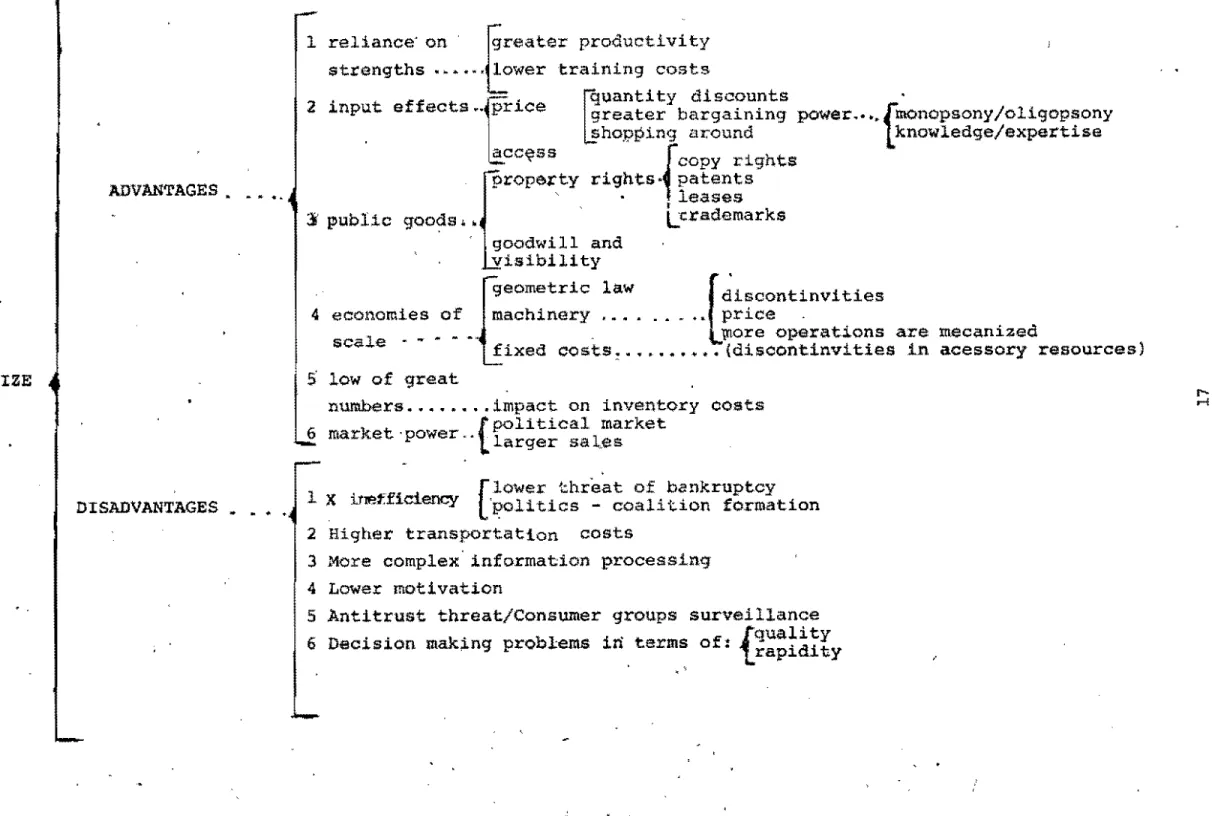
Table one presents a typology of size effe(ts~ l;,1hen a firm diversifies, if i,ncreases its siz",. and conse'quently certain
advantages and d:isadv8fJt{1ges occur. He call both of these size
effects.
There are six main types of size advantage8: 0) reliance on strentghs. (2) inp',lt effects,(3) public gcoc.s,(4) econo;:lles of
scal~. (5) ti1e law of great nUl:'.bers and. (6) market power.
(l)Adam Smith. in bis work the
rt::
ca lth of Nations". observed that the amount of sp0cializatv.m is limited by tte size of a market. The same happens inside or-ganizations. Contrar{ to smaller organizations where workers tend to perform a lu-:ger nu:uber oftasks~ larger organizations allow for gr'1!Jter w-orker
specialization. Since speCialization ....ill be bd",CU upon the workersf strentghs. prod UC' ti vity w111 increase * Al so I due to
specialization. .. training are now
the tice and therefore the cost
}Q\.Jer
C
~obinson, 1978)required fOT
(2) Size can also have a positive impact in terms of inputs. Larger firms pay lower price!l due to quantity discount$ from suppliers, greater ba'rgaining power due to monopsony. oligopsony. (lr the use of specialists in procuring various_
types of raw :rlaterials nnd If.et"chamlise. Shopping around is more feasible when bl.ying large rather than small quantities due to transaction CQsts~ lis a consequence, l~rgcr firms have greater access to suppliers.(Pfeffer and Salancikt 1978; Archer nnd
faerber, 1966 ).
•
(3) Economists define puhlic goods (as opposed to private goods) as the ty?e of goods \':hich cJn b'e used. by one entity (person. division), without affecting the usage that another
entIty may make of the same goods.
Exampl~s of. public goods within organizapons are property rights (copyrights. pate:1L:,.. trademarkB, leaseholds) and the visibility or -goodwill
0::
the organization. Sinc.e the marginal cost of using these types of goods is zero, size will represont :a benefit here too.(Abell and !iar:r.1ond. 1979)(4)
As
size increases, economiesof
scale occur. Thereare
several reasons for this.
/
,
(A) First, there is the geometric law which states that as the area ( of a bujlding, warehousL'. etc) doub"le-s, its volume
increases threefold. Since cost is related to the area and the output to volume. a net benefit occurs as size increases {!Ialdi ane i~'hitcomb-. 1967 ).
(B) The second cause of economies of' scalr~ refFlr(;s certain dis·:mtinuities between -cost and machinery ( Shephtf.r.:i. 1979); th.' price nf machinery increases less than propol'tio[,:"lly to its cap-acity (Scherer. 1979); and in larger orbanizat~ons it is economically conpensalor:l to mechanize SO':le operatior,s which are perfomed manually in smaller organizations (Pitts, 1986).
(C). Fixed costs are a third cause of economies of scale. h'ith higher volume, the cost per unit of production of
ancilatory' activities (such as security, medical department, food services, secretariill department. ~tc. ) decreases.
These fixed costs are called accountants as indir.~:.:t expenses~
(5) Another size advantage camps from the statistical law of great numbers. As the number of buyers increases their variances in tents of idyosi:Jcracies and special characteristics diCiinish. Lo.ler variance among buyers means lower variance of _sales. The probnbility of, stockoJt is consequently lO\t,'er. 111eaning
that costs of inventory will increHS~ less th;ln proportionallj to sales; (Whitin and PesLon, 1954 )_
(6) Harket power is a final advi:lntagt:: of size. Larger firms influence their enviroo'IJents to n gteat extent. They can influence both thei r politicol environment (throup.J luwer probaBty of bankruptcy-Dooley. 1969) and their economic environment (by l)ushilli! thc·ix products more strotlgly into the market a.nd by charging higher pri<:es fat the!'.l) ~ ,There is evidence tnat with all else equal t larg(-! firms benefit from a superior
image when compared to smaller fir;:,G a benefit which can be
translated into premium prices.(Cooper. J979).
Besides advantages, an increase in size can also bring some dlsadvantages'to organizations.
(1). Larger organ'izations experience a lower sense of the need to survive. The int.err.al environr.lent of the f'rg.n.nizatioll b02cwrt!$ 'increasingly ;>oHtic.81 as well (Blair. 1972. Towscnd. 1970). Consequently x -inefficiency arises ( Leibenstein, 1966).
).
-
~(2) Transportution costs tend to be higher for )arger firms since they must go farther to obtain rdW ;nateri;)~s: components, energy and labor (Scherer ct. l;ll. 1975).
(3) Size also means that information processing is increasingly conplex, requiring more elahorate infornation. control anJ structural Hrra:1gements~(Kotz and KBhn, 1978).
(4) Hotivation can be more difficult in lar'~f2'r· organizfltiol'3 because workers tend to identify and prefer tv wr:rk :in
slI'.aller work units (Porter and Lowler, 1965; Quinn Gnd ;'langione, 1913).
(5) . The greater visibihty ex[)erienced by larger organizations may put them under Special surveiLl<Jnce of (:oll$umer groups and under a hiSher threat of antitrust. It ca:-J therefore be said that a certain type o f ' risk increases :.,ilh size. ( Druckel'. 1973; Porter. 1.9(0).
(6) Finally, as firms grow, th hierarchy between decision makers and the market Decomes ::)Ore conplex. Doth the speed and the quality of decision maldng can, i.n Elccordnnce. suffer.
'(Starr, 1975; Williamsoll, J9(7)
The inflllcnce of both size advantages and disRdv.clntuges is a concave profitability (rettru cn aSbets) curve where profitability .first increases to 3 certain level <'lno then starts dQcrcnsing. Profi,tubility ir:crease!ct as 101;g <.IS the
advantl1ges of size out\·,eiBh its ;;!isadn'(ltages. After a certain level of si~e, however J th.e dismh'[mtages !:>tart incn:Msing and
the advantoges beeo!!:e exha'Jsted~
FIGURE TWO
r
r::::
efficiency 1Learning
curve_~•...
organizationADVANTAGES • . • ••.
Z.
Better use "of equipment3
Process
innovation4
Product redesign
5
Image/Goodwill
.... :_.-,,-~
EXPERIENCE
..
~ Attachment to routines emphasis on hierarchyDISADVANTAGES;
Lower adaptability ..•
The specific sha:;e of the concave profitability curve (the behaviour of 'its first and second d..,riv3tes), varies consicier.;J.bly from rr.arket to market depending upon tbe exte:1t of the presence
of
the size advantages and t1i5advan~a2es in those markets.III. 2 - EXP~J\IEtlCE EFFEG'S
When diversifying into a new market, there is an increase in
sales per yearf as well as an incre41se in the cU:Julativ"e sales
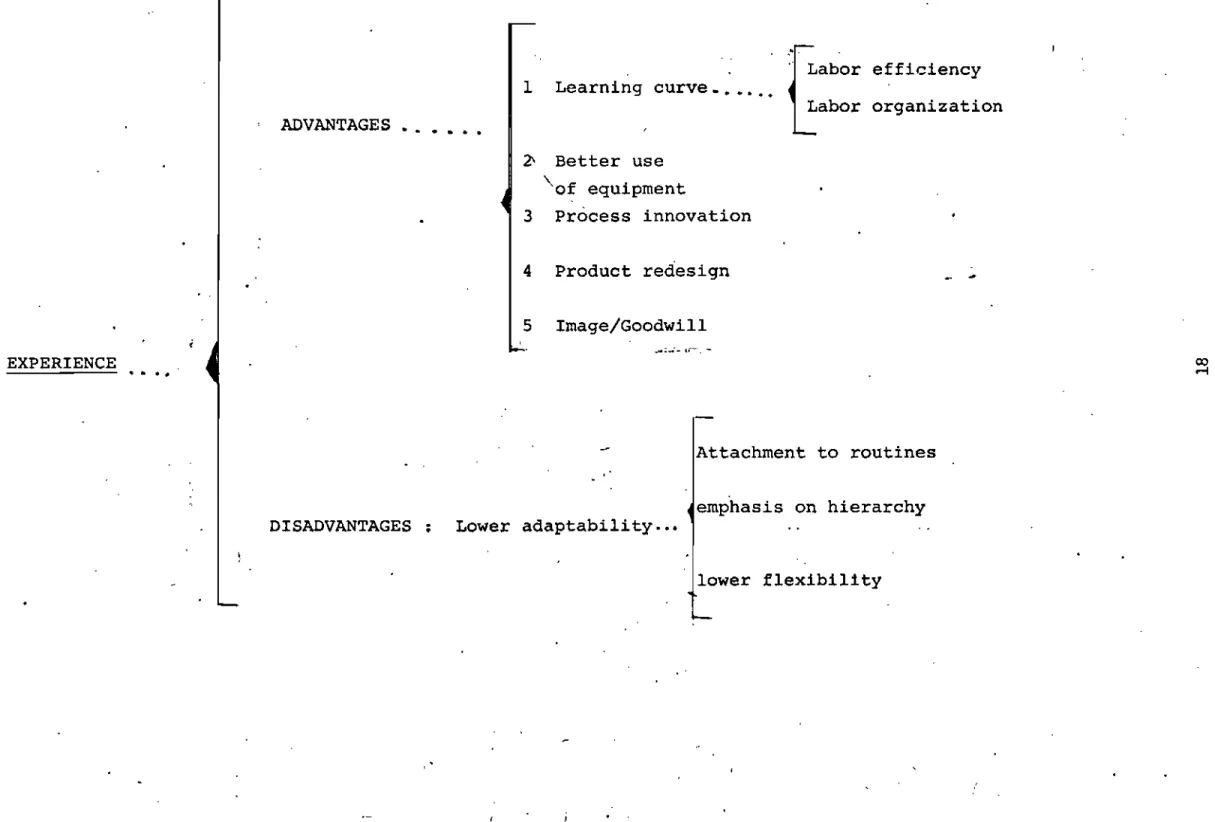
volume of the oq,ani.zotion (experience effect). Experience has severa) advant3ges:(1)' the learning curvt;;(2) better use of equipment.(3)· process innovation.(4) prod::lct rr,odiHcations (better knowlEcg.e of how to adapt the product to customer nefds),
ami (5) bet-ter imc,.ge .(HeddJeYt 1976; Henderson, 1980t tho:npson,
1981).
Indeed, ceterjs paribus. older firms benefit from u better
image than younger ones~ since cusi::on:ers tend to nss0s-iate firms the age of a firm with survival of the fittest.
fIGOHF, T\-:O AB{)CT HER£
It has beer: point~d out that experience may also bring some
disadvantages. Indeed, as experience increaACS, the adnptnhility of 'the firci a~ a '..hole n:ay decrease. .\5 eXjler ience grows, organizations tcr:d to revelo!; stri(tcr routin~s, h; !:lOre attache,! to hiear'chical rC:!2tiofls and ~o be>'::o:ne less flexlhle (Blair~ 1972; Albernathy and \"'aync, 1974).
DIVERSITY r~,FECTS
Besides siz€ and ~xperience effects, there is a third type of effect which occt:rs ",:-:e:-, a firm diversifies. \,'p shall call this
type diversity effects. Diversity effects ar0 those which cannot be achieved by an increase in sales i:1 till:" sume product market cannot flchiev~. This distinguishes diversity effects from size a:1u exp€':rience effects which may occur both vith an increase in size in a sin3le Froduct 'Harket or with diversification (AS long as the markets which the fin:: diversifies into arc related, and therefore alJow for resource sharing, tnmsfer of knowJedge, and other benefits).
. FIGURE THREE
I
Lower personnel costs
1
Risk decreaSE!j
Lower capital costs
(in terms of both\
critical .
~..
~..
Higher R&D benefit.
contingencle,s and '-
"<
•Hi9he~
motivation
variance)
Cross subsidization
-
Monetary· . .
~•
~Vertical integration related
Reciprocal buying
2
Externalities.~~.~ LADVANTAGES ~
...
m
Technolog1cal ••••
~(Transferof knowledge/Knowhow)
HConsumption . . .
~ ~ranSfer
of
I~age
.
Costumers perception
..
High risk. R&D projects
3
Greater organi
High risk business ventures
zat~onal
possi
DIVERS.ITY
bilities
. Access to retailers
1,
Specific to vertical
integration,(~ncreasein'risk)
DISADVANTAGES ••••
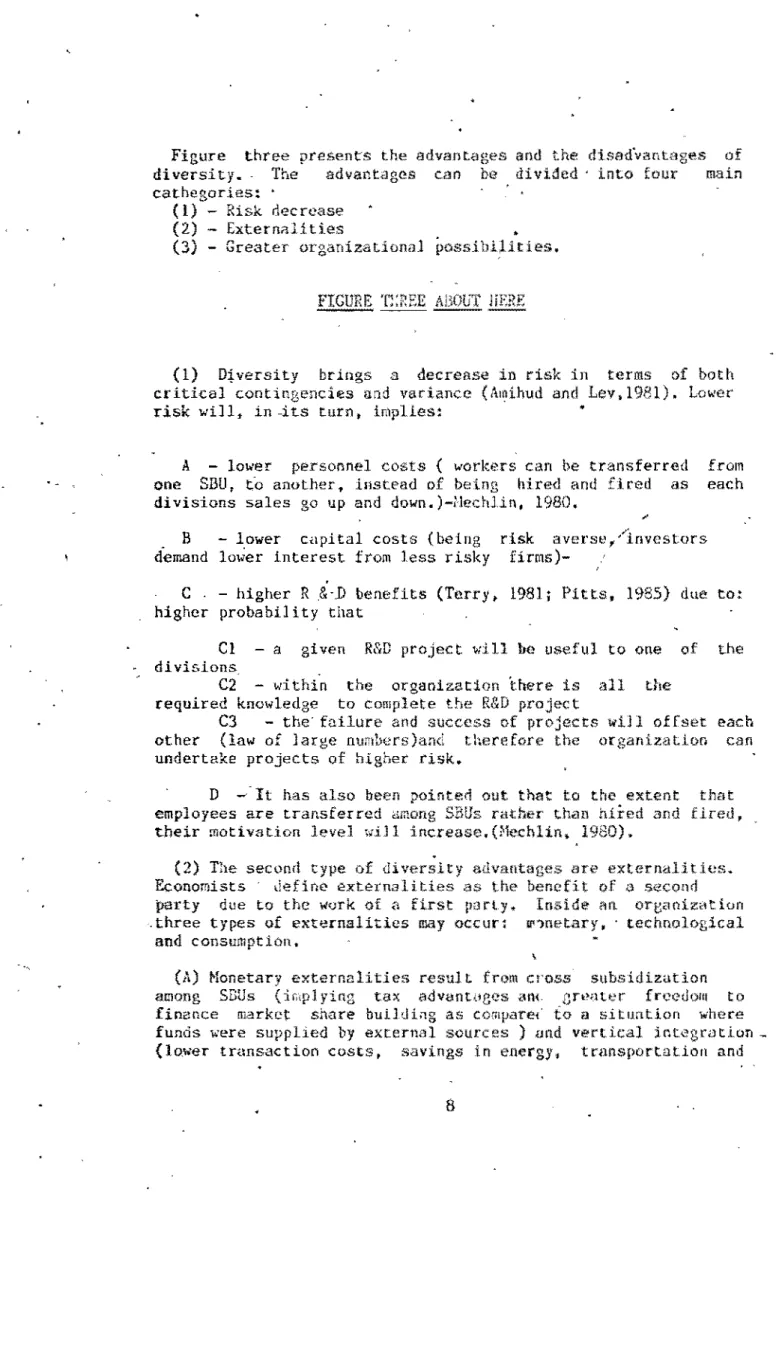
Figure thtee Dtesents the advantages and the disad'vantoges of diversity. The advantages can he divided' into four main
cathegorie5~ .
(1) Risk rlecrease
(2) Externalities •
(3) - Greater organizat.ional p{)ssibl~lities.
•
FIGURE 'r.:REE ABOuT IiERE
(l) D~versity brings a decrease in risk in terms of both critical contingencies u:1d variance (AI~ihud and Lev,1981). Lower risk ... ill~ in -its turlJ, ir,iplles! •
A - lower personnel costs { workers can be transferred from
one SBU, fa another~ illstead of being hired and £:ired as each
divisions sales go up and down.)-i'lechlin. 1980.
/
B - lower capital costs (being risk 3verst),,'invcstors demand lower interest from less risky firms)
C - higher R ,&·li benefits (Te.rrYt 1981i Pitts, 1985) due: to!
higher probability that
Cl a given R&D project will bo useful to one of the di visions
C2 within the organization there is all the required knowledge to complete the R&D project
C3 - the' failure and success of projects will offset each other (lUI'J of Jarge nU;li>ers)am: therefore the organization can
undertake projects of higher risk.
D ~-It has also heen ~ointed out that to tho extent that
employees are transferred dffiong SBUs rather than hired and fired, their motivation level >lill increase.(tiechlin~ 1980)~
(2) The second type of diversity advantages are externalities. Economists u>?fine ext!?tnalities as the bencfi t of i3 second
party due to the wGrk of a first p3rty~ Inside Fin oTt;:anizl:'Ition .three types of externalities rnay occur! w~netary, technological
and consumption.
(:\) Honetary externalities result. from Ci'OSS subsidization
at:lQng SBUs (:ihplying tax adventdeeS 3n,_ JT<·nter fr~C'do1!1 to finance market share buiJ tHil!; as ccmvarct'
to
a situation where funds ....·ere su~plied by external sources) and vertical int0grvtion_ {lower transaction costs, savings tn energYl transportation anddistribution j et.c) - Kitching, 1974; ~inn and Hchagell~ 1981;
Harrigan, 1985.
(D) 'fechnologici:ll externalities regard the transfer, of :Zouw-how among
snus,
That know-how can respect to hoI<.' to set up a distri bution channel, how to train the sa10S fo!"cc j ?low tu advertise ugiven product, hm. to Bolve a w8chine breakdm.n. which type of supplier is more reliablt' in terms of fluality I'md d~)ivery. etc.( Bere.1979; Yavi!::z, ~e\"man 1932 ).Techno1ogicdl cxter:-;a'.d-ties (yay
also involve a specific skUl of the l~6.D, engineering, manufactur lng or any other deP<lrtn:cnt \1hicn the orgBnization possesses, and which will be useful in the new market (h'clls.
1984).
ee)
Consu.~ptiQn (>xter::alHies nrc related' to' the market pL:.H::e.They are lwither ~Lonet8ry in their cssenct:' 001: based in knQt.I-how.
Two main types of consumption externalities exist: transfer of image among SHUs (where
onc.snu
benefits fro,,, th~ image .anothersau
enjoys in the market) a:,d externalitius rc1<:.ted to consu21ers'perceptions.(Lor~ng€, eLul. 1986; Hells, 1984) / ...
. .
Sometimes the cllstor1f'r perceives the product "purch;]sed 8S being larger than what,l& supplieu by an organizdtiof\. This leads firms to add net·! 'i
tems
to their product line so that the total offering is as brano as the C\l?ton~rsr perct:j)tion ·of the product. That' is the .paBon behind the broadennin::;. of thC" off(.'r of computer orga;)iz'Jtions, [ron hardware into service. software and cowlUlmicat.ions :,-etworks. .SimiLul y, auditing firms h:we diversified into bc~rvices suc::-, £is taxation, '-!cCotmting. management consultir:.g and managc~lent recrultin;;;.(Hiles and Snm,', 1980).
(3) Finally a diversified orgiDnization can do thtn~;s that no speCialized organizat ion can without thrci.ltenning its very exist<lnce. Exr.Hnple:: are the engage;r.ent in high risk
rV:,;)
Vr:>jectsor business v(;,!lturt-;;. Another eXd::1ple is E'asier aeces;. to retailers when they prefer to deal with suppliers whi:::::' offer a broad line of products such as in the autonob1Je and the 2,fOcery products induEitry (Porter. JS~'~O e 1985). Still diver::>ified 'organizatiml;;" Cdn also impose rec-iprocd] lJuyin; ....here one 5!3U buys from;1 given Sll;'plier if 0"': only if the supplier burs froM another SElf of the same organization. (A))e!!. 1975; SLeiner. 1975).
Besides advantages, diversity can gIso bring two maio types of disadvantazes. So:ne di;;Ddvantagcs nre specific to vel:"tical
integration (higher risk duc to concentration of resources). Other disadvanta!'es o pertain to diversity - in Bene-ral. Since
diversity imp;les an increUBe,in infort:lf}tion processin2: needs, it
requires more cDmplex structure,. infor::<ation, control and coordinatioTi syste'l"S (Gn] braitn and :iathason. 1979; Hal'~brick 1983); rUII and H03kisson. J987).
It is the jQint. effect of size, experience and diversity which explains hCM the overall -perfoYnsnce af an ort:,anization can be different f:om the average performance a.f its division if they were independent 7lusinesses (tlwt is how synergy can occur).
Positive synergy will exist only i f a certain "\ divel'si f ieation move implies size I expcr ience and di versi t y advantages which outweisth their disadvantages. :;:egnUve synergy will exist whe:l. the advantages 3!?soc;i.ated with sizif. experience a'nd divers'ity are less i"IPOrt8:1t than their." f1isadynntages
111
Scheme •I.
, t'l-:rease {advantage
in size- disadvantages of size
diversificatio~ increase advantage of Level
(1) in ...
experience
.. ofexperience { disadvantages Synergy
of
diversity
As a consequence~ the syperglstic potentiu] of any
diversificution tnove :lll1st De evaluated Oll a case by case basis by
assessing the extent of the size. 0xp!!rience and dh'Cfsity advantages and dis3Jvantagt's ihlplied by that diversification move
(Allen ct al. 1<)81; Salter o,.ci ~\Cin;'o\JJ 1981)
(1) means ~implies.
.FIGURE FOUR
SYllergy effect
,
"
,
,
v
.
I
~o
1 2 NN:;;;::::
Ditersi ty ano
volume level
• -I • , • , \ l , ._~1
23
4
5
6
7
8
9
Y Number of markets
(divisions)
NOTE: One assumes that:l - each diversification
st~p(through'internal
development or acquisition)
..
leads to a new division specialized in a given market; 2 - each diversificatIon move brings
the
It is I?os$ible~ ho...evcr I to develop certain general rules
regarding synergy., The next section will present a model which in general tenr.s indicates when synergy
is
expected to be positive and large. positive sad low, and I~egative.IV SY~JERGY
.Mill.
DIVEil.SIFiC,\:'10NLet's suppose that an organization specialized in' a sing,le market starts a process of civersification Kllien over time* will lead the organization' to ado new market.s (through inten,:>l developnent or acquisition) to its operations.
We shall assume that each division handles £l single mar~et
and that consf''1uC''::t1Yt as the nutlDor of mark~':.s the orgadzation operates in increases, so does its number of divisions. For simplification purposes i t .will also be as",w:led that each new oorket (division) brings a similar amount of increase in diversity and volume (sdles) to the organizP-tion. FJnally. it is l1ypothesized that the organization does not function tiS a simple
holding~ buying and selling £inns which remain totally autonomous from each other.' but as an integrated e:otity where the heed office perfor;ns some functions for the divisions and there is an exchange of resources a~ong th~m.
The questicn is As the or9;anizatioll kee;>l:' on adding new markets (afld divisions) to i~s opt~rations. ~()W .'1hould we ex[,cct the overall organiz'J: 100 to perform conpDred to the overage performance of its divisions if th..ey were independent businesses?
Based on the model of synerg)" developed above and on the existant empirical evidence, one should expect the fo110\>l10g relationship should be expected between synergy find di yersification. sholJl d be expee ted.
(see figure fou~)
INSr::::T FIGi]~f. FOU;~ ABOU;' :mRE
The vertical axis of figure four represents the level of
synergy. tn3t is, the q'Jotient betv:een the ELlA or tbc diversified organization ancl the average of its divisions. The horizontal axis represents the dLversifitution process. ,,:here c~ch step in the process represents the introduction of a now market and
division to the realm of the organization.. For simplification reasons, one vssumes that the increase in volume and diversity implied by each new market division is bi;nilar.
As can be seen. the diagram has three nain zones. In the first zone, t.he SYIlC'rgy level is po.siti'le a:)(j increasing. in the secon.d
zone, synergy is decreasing, and in the third zon~. synergy is negative. yle will next expJain why one should expect a curve. of
such n shaVe in the diagram of synergy.
•
FIRST ZO:;E (Synergy positive and increasing).
Two reasons lead to expect that in the- early stages of a diversification _move (Jow level of size and div,.?rsity) synergy ...-ill be positive aoci incr('asfng~
First,
by
increasingits total
voluMeof sales
and
diversity? the corporation LS able to exploit
> the size, experience and diversity advantagqs which we~.e discllssed above.ObelL .. ) Since diversity is low, there is little difficulty in exploiting experience and size.' benefits. Low diversity (high relatedness) means that c-xperience and knm-:-how is transferable from'one'division to another. Quantity discounts occur because (li visions purchase the same type of inputs. Fixed costs are shared ;;::::lOng divisions. t;arer.\>uses harbour [)ro£:llcts
from various divisions, and so on,.(J\aker? i9'34; L~!.'ange et a1 1976) •
. Second, the disadvantages of size and diversity are expected to be relatively sinal I at this stage since as has been pointed out, -they tend to occur ot high levels of size and diversity.
(Scherer, .1979; Shepherd. 1979),
For these reasons i t should be expected that as firms
add volume and Jiversity to their operations. s;'aergy will
increase~
After a certain level of diversity and volume however, synergy
will
start decreasing.seCOND ZOirE :Synergy positive and decreasing
Several reasons contribute to this. First as has bt>etl pointed out (Pfefier and Sal,;l:ncik, 1977) after a certain Jevel,
marginal increases in volume and diversity will brin:; diminishing returns (law of diminishin;t, ret;lrns): Savings in machinery hi1:1t; fixed costs become variable; the leArning ~urve frntt~urs;
augments b specialization bring no fur,thcr significunt benefit!:>; discontinuities in resources are exploited to their full extenL (3aio, 1954 :;:lnd 1956) 1:i:;h levell'> of diversity also mcan that the ilr1<:lgc, the knowhow cnd 'expcrtise and the in[1ucnc;c 'Jpon
the various stakeholders is now more difficult to transport from one
oi
vision to another. The consmler perceives the divisional products as iJJlrel{Jted and therefore he is less induced to buy one when he buys another of the sameorganizatio~;
and so on.
(Tare,
1977;
Brock~1975).
High levels of
diversity havea
negative effect 00 the pos~ibility of exploiting site:e Hod experience benefits, High diversity (Low relatedness) among the narket ,,'hich the organizution is in, means that the divisiondJ inputs are dlfferent. Therefore. theft' is less room for quantity rli,sccounts. the activities of fewer departments car: be share:! 3hlOHg the divisions. maddnery differs from division to division. each divisio:l has its 0",'[1 learnIng curve, and so on • (Wells? 19H4;Porter. 1987). .
/'
/
!
Finally, at, high levels of volume and d'iversity, their disadvantages be~O)fle'l Significant. The complexity of the information processing requi.res e] aborate strut;.; tures ~
inforrJation, control and coordination systems (Hann<:ln and Freeman. 1977). Decision ::laking becomes slot.'er and its qual it Y
SUiftTS fror.: the ,":'l:nbcr of hicn:rchical layers belween decision
makers and the murkct;O':ilJi':L:lson, . Fn6). T:-Ie -orgdnizatioo
develops attachE',ent. to routines and hierarchy losing flexibiJ i ty (Albernathy and i>iclYflO, 1974). ::otivation is ::.lore difficult (Quir:fl end Nangione, 1973). the organization environment becol::es highly political and prone to the formati.on of coalitions (Tot.'send,
1970}.
THIRD Z():~E n<:fgative synergy .
Three reasons contribute to the existance of negative
< synergy.
At high levels of vQlume and diversity t e adv~otage
of size,
experience and diversity <re eXhclli.'::>tt'd or minimal du~~ to t.he 18\1
of diminishing retur:1S ( Rcbicson~ 1954; 13; int 1956).
Furtherl:!Ofe. as has hee:1 pointed out, ( Terry, 1981i Aaker j
1984; Porter, 1985)the advantuges 0': diversity beco!re
disadvantages. That is, both consunption and technQlogical positi.ve externallties may become neg?tive ~ externalities. For instance, the i:nage of one division may nann another division (e.g. pharmaceutical ;:-roducts and food, subcompacts and luxury cars, low price items and high quality products), ar.d the
experience and kno~~how of one narket may be pernicious when • applied to another rl1ar~et. (1)
Third, since volume and diversity are now very large, their disArlvontoses prevail (x ir:eficiency. low motjvation~ decision making proble!r.s. cOr.lplex information and control s),stt,ms I
coalitio:1 :ormation for political purposes, etca).(Arrow, 1974j Williamson. 1975; A!drich~ 1950).
As a C'onscquenct? of the experience, size and diversity advantages being low and t!wir disadvfmtagcs being
importal1t, synergy can be expected to be negatiVE! (Scherer.
1986; Ansoff, 1984)
(1) In such a case tr.e best option for an organization is to
grant corr,plete autonomy to its divisions and achieve
,
zero
( and not negative) synergy.
f
CONCLUSION
There has recently been a rene~~d interest in the concept
of synergy - to predict success in mer?,.Pts, and to advise ,.ihich
diversification strategies organizations shopld
follow. Tbis requires advancements in the exploration of the
concept of synergy. Such has been the purpose of thjs ortic] e.
The basic contributions of this articl~ can be summarized
as follows!
1 - There are lIot one, but three t:lain causes of synergy: . size, experience a:ld diversity effects. '\]1 three contribute to
the possibility that the pcrfQrmanct of n diversified corporation will be difl crent from the Plera;:;e performance of its divisions i f they were independent' bus .nesscs. That is. all three i:nply the possibility that a diver ;ificatiun r:1()ve
creates econo~ic
value.
2 - Size and experience advnntages can be culled by an o'rganization either throllgh spc<:ializa~ion in a single pr.oduct market or by related diversification. Diversity advantages are those lhhich only diversity among If'..drkets can bring about.
3 - There are several types of size, experience and diversity effects. It is the level of thelr presence when an organization diversifies inLo a new market w~)ich '.dll determine the amount of sYj-lergy tbat will' be created. As a consequence, the synergistic potenlinl of <l diversification move must be evaluated
on a case by case basis.
4 - It is possible however. to develop certi::1in general rules regardine synergy. Based on the caus.es <;>f synergy and its behaviQr as a function of slze j experience and divcrsity, it can
be expected th:it ~s 'nn organization st;;Jrt.s <1 -diversification
process. the amOU:lt of synergy will first increase, then
decrease alld f i noll y be zero ~
4'
5
- Resour::e s!turing. arid synergy are not synony[l:ou$~Resource sharing is only one oE the causes of synergy, the others
being:
-
,
risk decreasals ( vhich dim'tnishs personna], capital and
R&D costs. "
an increase in the orga:1izatiofl" s possi bilities (in terms of market power. accest; to rQtai]er.s~ etc).
input ef[ -'-cts (lo~/eL price, ]O\ver tran.sportut.lon costs,
etc)~
higher productivity of the r<)SOUrCi;$ due to employees' specialization und learning, mechanization of activities and the geometric Jaw.
6 - There can be t.hree basic categories of resource sharing; Public resourcC's (leases, patents, imnge and
visibility of the organiZ3tion as a whole) half public resources (implyinG technologL:al, cOrlsu!::ption and ;notletary external Hies) - o.nd private resources (such as machinery I
warehouses, sales force, trucks. etc.).
7 - Last, at high levels of diversity ,:m:1 vol ume. the d1sadvantGses of sizl.!t experience and diversity vill prevail over their 8dvantages~ Consequently, syt1ergy ~ill be neg;ltive.
In such a
CUSE.the best option for ao orgaoizatioo woald
be
to give complett? autonomy to its div:islons. and by becoming apure holding, ilchicVQ
zero level
ofsynergy.
,,
/
!
BIBLIOGRAf'IIY
1 - Anker, DilVid A. (1984). Strategi<: ::arket _~J~Jhl;\erwnt, JOlln
Wiley ,~ So-:)s, ::cv," York.
2 - Abell, D.F. l1nd J.S. ftammond (1979), Stratt':;iC i1arktot
P13nni;!;;~, Prentict: Hall, EnglewooD Cliffs, :;CW
J«rsey.
3 -
Allen, 0.T.
(1975), Industrial Reciprocity:-;' stati",tical anal ysis) JOlln!!1 J£f..
Law ~ f:cOl\OTilics, l~). October, PP. 507-52D. 4 - Allen. ::.G. and A.n.
Oliver and E.l!.Schwallic, (1981) thekey
tv successful 3(!qui;;;;itions, Jourrldl-.
of ;:'usin~,s~ Strat€''Sy,Fall. Pp. 15.
5 - Aldrich. 11. E. _ (1979), Organiz3tions and I::nvi rom1;ents. PrentLce-Hall, Englewood
Cliffs.
~E'WJerst'j'.
6 - tdbernathYt Hand k. Kiyne. (1974), Limits of t!1t; Learning Curve, Harvard BUbi Ilt;SS Revi€'w I Sept. -October, PP. 1OiY-l19.
. .
,
"
7 - Ansuff, H.I. (1965). The Conc,:,J!1.
£i
Corp5~rJ:1tl'rtcGraw-1Iill. New York. \
8- - Ansoff, H.L (1984) • Ir:Jplantic Stratc'iic Prentice-Hall, Englewood Cliffs, ;~cw Jersey.
9 - Am:i.hud. y. and B.Lev, (J9t31) Risk Reductio: "IS a danagerlal
Motive for Cor_gl(}~,i;;n''''e ~'leq~ds. Th~ Be]] JfYJrnnJ of ;':coponics,
Auto~n. PP1 605-617.
10 - Arc/)('r. S.!L dod LG. Faerber (19G6), Firm Si7--'~ ami tlw Lflst
of E:x:::ernalJy Se~Jred capital, Journal of Fi~.,~f. p;;, 69-03-: 11 - Arrow·K. (1974), T;,e Li;:1its
i.:l
(.lrfjdJ1ization. ;:.1.). :iorton &. Co •• New York.12 - Bain, J.B. (1<;:4) Economics of Scale, Conc€'J~traticr. and the condition in t,,'en::-y fll<l:wfacturing industries, AnerlC;-HI EconQmic Review, M•• PP. 15-39,
,13 - Ba~n. J,S. (1956) R:lrrlpr~ to nel, c(,:~lpl'titionj t;ambridge. Mass: Edrvard [niversity Presho - -
1" - Bair:., J~S. (l956) ?"Hri('fs ':;0 ;lt~\1 CO::>:1ctitiQ"t CaFlbrid&e. ilarvarrl Ulliverslty ['res:,;. - -
15 -
uartlHt, C.A. (1984), Organization "-mti Contro] of Global_ Enterprise: influeEce~ Chdra(;turistics and guideJines, papertlnd
presented at "the Co1]?~1Uit::Yl ~ COf'1Jl,"Ution in (;]0';,,'.1 Jnr:nstric_~
Harvard Business school, April.
16 - Lerc" Norndl1 (l96S') , ;:hlt's DHf,frent About Coni.l:low~rate Mana;;c, lent I l!Z!n'f~rd ;:u::;i ness l'\ev i i?'W I :\ove"-Ibt!r-U,,'ceuoer I pp, L12.
17 - l3Jair, J .~'i. V. 0'172) j?follo!11ic Conc('ntrati~H\. Harcourt ;kace Jovanovich. Inc. r.;C\) y{Jrk~
18 - Brock, C.',1.(l975)
I!!£
U.S. Ctmpt,tcr lnqustrt. Can:Lrl:1s.e.Mass: Sellinger.
19 - Coopt.'r. A.C, (1979) Strategic nan3gcment. ;~ew Ventures and Smal] Business. in Slr<::.t(H;ic "il:~'ZE:!.ent. edt by D.':":. Schendel aile
C.C.1rl. HMer, pp, 316-327, Little 0rown U Co, 1:o;:>::on.
20 - Day? C.S. (1979) lJiHgnosing the Product Putfolio, Journd1 ·of t!,arkE;tin;;:., voL 30.
r?,
29-39.21 - Drucker. P.F. (1973) Hi):!<1~enpf!!l Tasks1.
Respons.1bi} iqc>s, :larp~r & 1\0\;., :~ew York •.
/
22 - Dooley. ?C. (1969). The Interloc;~i ng Di rcc~6.rate. American Econocic Rc~. vol .59. June, PP. 314-23.
.
\23 - Calbraith, J.R. and D.A. Nathason, (1979). The role of
orgnIliZntional structUre nnd process in btrateg}' iT~plplllentHtiol')
in D.E,. Scht:!tdel and C.i:.Hofer (eds)~. -.~:;...:...::.. Stf?te'-'ic ~lun;~"(>',:e'lt. ~~--,Q.::--,.---~--Boston, Little Brown, 1979.
24 - Haldi, J. and D. :Jhitcomc, (1967) Econo<nz;:; o£ SC;l.]e in
IndustrL1J Pldntst Journq.L2! Pulitic-ill rconoli~. n.7.August:- pp.
373-85
25 -'Hannan. cl.T. dn;} J. Freeman, (1977). The populat ion £cology of OrgAnizations. AJI~ric!:.!l.]ourndl or SociO)O')'f, voJ.B2. n.5.
pp~929-965.
26 - fI<J!nbrick\ D. (1983), tligh Profit Stratf!Cies in nature
capitu] goods illcm..:t::ries: A contjnger.cy approHct" .\c~JJ('my of
flano:;e1
'(!0--.!:
Journal. 26, pp, 687 - 707.27 - Hawmermesh, ii.G. ·(1986), ~~akin::! Strntez; ~9r~. Ne .... York~ JQ!1n i.,'i1-ey & Sons, Xcw YOTL
28 - Hnrrigan. K.n" (19;35) Vertical Integration ,md Corporate Strategy. ,k{l(kl1lY
.::f
,':an,:v:,':,cnt .10tl(I1.11, 2;.,. fl.2, PIl. 307-425.29 - Hflu:~en. IT.A. and T.C. LongetlCc.. An em;>irlc;ll test for
synerl1islfl in ::lc:-r~c=, The Jul2.Ul.4
E1
Fjnance. v?J.30. n.4.30 - HeddJe;,'. 3. (1976) A fu;rh!!N~nta1 approach to strategy deve1opmen:, ~ Rn:F'r. P1WHlir
,r-.
vo1.9 .. ~(.'ce::tbf'r, pp, 2-9.31 - Hencer:nr:, B.D. (19S0). The experience curve revisited. The
BOSlt;rl ; ] ! Gr21I.;!_ Fcr6fwct'iv,"c-, .:.22(>.
32 - HilJ - C.!';~L. flnd R~.E. Hosklsson.
(l987)
;:tan''ize;r.eflt ~._':')S_~"~. vo) .12.
n.2.
pp,331-342.
33 - Leibenstein, H. (19(16" A] locative Efficiency vs x inne!1cicncy, Am0ric::n Econowic licviclA, vol. 56. June, pp, 392
415.
34 - Lornn~0 •. Pq 'iI.F. :-iorton a:1d S.GoshaL (1986). Strdteaic
Cont ~~est Publishin~ Co. St.Pau].
of
35 -
Lubtntkin. ~l. (1987) Nerger Strategiesand
Stockholdervalue, StrtJ.tl~r;ic tl,tmlgC":cnt Jourllill, vo':".3. n.l. PP.
39-55.
36 - l'~echlin, G.l:. Hnd D.3erg (l9BO). EvalwJ::ing Reser;rch ROI is not enougl:, IL1rvdrd J)iI,-;l ~;cc;s Revlc',•. , Sept. - Octobo/ f PP, 93.
37 - Newv.1.lln iI. Jr. and J.P. Lor,ilfl (l9S5)~ StraUhie Po"l lev ;);')d
Central :i:Hli:1f;emenr.:..' '. S'(uth '\'lester Publishing Co. Cincin,}(jti~
Ohio.
33 - Porter, L.\1. and E.A. Lawer, (1985) Propcrti.es of OrganlzutionaJ Strl,cture in rpJulion to job attitudes und job
behaVlor, f£;1fJ:!2l.£ii£.Q.Lr~HJletinJ 11.1, PP. 23-51.
39 - Porter >1. (1980). COClmctiti ve Stti.ltegv J Free Pre-ss, New York.
40 - Porter, :1.(1937), From CQJ;lpditive A(lvantage to Corporate Strat('gy. ~£!ill:!l fh:sine:ss RC!vie'd, ~;<J.y-Junc. PP. 43-59.
41 - • ofe...' fcr. J an( \ r " ,;~,.~ C _0 ar:C1< (10' 1 'I ~<::L 7) f 7hc Exterr.dJ C~~:'J.trol of
Harper :. Row, !~ew York.
42 - Pitts, R.A. and c~e~ Snow. ( 1 <.ig{J)
CompeL Hive §££.£!!~ John Wiley
e,
Sons. S{>W York~43 -
Robinson, Z.A.G. (1958). The StrUC"ture of Cn:~lrL't i tiVt;Im:~ustrv. The Vni versJty of Chicago Press!
Cbic.t~o-.-M+ - Salter ~ :i and i,r.HJ·:e"o_nhold. (1979). '.JiYE'rsifjCc1ti<)l1 'J'hnJugh
.~c(J\lisiti\ln: Strutegies For Crcuting Econ )r;ic ';alve, t'ref! Press,
Ne;r York~
4S - Salter, H.S. flnd W.A. t-Jeinhold (1931), Choosin3 COlilp3tibJe
23
46 - Scherer,. F•.H. A. Beckenstein, E.Kaufer ,and R.D. Nurpr.y
(1975). 1'h,~ &onollli.:£ :'b1tir},~ (1Ilt·ration! An International Co'nurlsonsSt:H1h C;Plhrid"':2...L ,.u;:;sachushNS.
...
-_.
.
.
47 - Sc:hQrer. F.>I.(1979) J,nCustrial ;hrkct. Structure .an.d E.r;QnQr'i~
Performance..!.. ffdnd :;c;ially. Chic<!xo.,
48 - Scherer I..
ni.
(t986) l. ;-:er:;ers, Sell-off~! dnd ~:Elml\\;Hii11 Behavior, ift L.C. ThoJ1lDS. (elis) The !:c.(;t;OMics of bU2t("",'ic Plannlw,;, Lexin9,;tOIl. book,_ LC~l}lj;j:on,_ i:assachussets •.49 - Sr:ott •. J.:J,., (930)
nu.tl.i.t::.
Tb~oryill
r.()rlV}O'1(,L'ite i·:crgersill
.Econo)'11c0:
Corporation Ln,' ~ Securities l(eguJatior~, Little~.Brown. & Co" B~sto:l.
so -
Sheoherd. ,:.J.::;. (1919L ~e f£onomics' of Industrial Organizntior: Prentice t Hall L. EI'U.twoO(t Cliff:,. J~ew Jersey.'51 - Steiner, P~O. 0(75). '}ler~€'rs! :'lotivE's, efft>cts, polkies, Ann. Harpo"ur: Uni
v~rs'i
tv of.~licl1i.fl.~n
Press.52 - Singh,
H. and. C.A. Hontgomery (19-87), CorporHttvAquisition Strategies ,arid LconOlr.ic t'ertormance. ,~C"i? ~]ana<'>L'-ml~..!l.t ,Journal f v'ol1?,
:1.4, PDt., .377-387,. '53 - Tarr,J... p.G'J~ (l\i77-L Th~ )lini::tum Qu.timal SC£lJe_~l.llin.1;.iJL ..the Nid - 19708, \10rkiJ1!l paper n.3,- j"lashin"gtolt D.C.4., Federal
Tl,"sde COlniss_~o":l, Hureu.:.l of CcorlOmic~.
54 - Terry, R.J •• 0(81) Tell Suggestions [or Ae'1uisitioll Success,
Manager1£'11 PlannHg" Sept-Oct.. V? 13~16.
55 -:- Thoflk'1s, L.G •• (1986) The Economics 21 Strate:;,ic Pldr:n:im;:
11
survey of the i:1 Th~ Econorics of StrAte,-:ic PLI.1nin;l. eeL
Lacy Glenn Thola::ls t ,-,exington Eooks, Lexington :-;assachusset::;.
56 - Thompson. D,i.{" (1931) The experit-He£> curve effects pn costs
and price§:I!dP] iCdtJpns [(!f, pllhlic poLicy, in rt'g'..,l,:q.!,~:l
!!!!3rke!J.~u: tl-nli ~,~_':. in:~r~st, t.L~ t.u)uerston. ~:fJi"es ,\1.
C'1nr.an
and F.;j~ ?;icosia cds. Perg:;lmoo Press, :--:c..., 'iork.
57 - 'fowsenrl, R. (1970) QQ tbe Org,aniz,ltion. Alfred Knoff, ~ew
York.
58 i'lel'1$, J.R. (1984)
l!!.
Search of Svnerg,y: Strategies !Q!:.relAted divers if iC:1 t ion. Vcctord 1 lJi so,ertdtion. l1drva ni Graduate
School-of BusifH:ss :\dnnnistratiofl •
. 59 - v:ilJiamson. D.E. (1975) ~:Clr:<.ets noel l1ieHlrc~ie.s: AnaJy:;i.:; and antitrust if.1plicatiQflS I The Free Pr~';'·. Xew York.
60 - Williamson. D.E. (1967) Hierarchical Control il;)d optimum
.firm size, Joarnal of Political economy, 75~ April, pr. 123-38.
61 - Wind~ Y. and V. i:achej,:Hl, (1981) Designing Product and Business Portfolios. IidTvard lIusbess Reyh",'. Jan. t feb.. pp,
155-165.
62 - Whitin, T.~.!. and >1.:1. Peston (t954), Random VarjaU2.!!!?..L risk and returns to sCllle, Quaterly Journal of Economics, vel 68. November,
pp,~:)3-L~:-63 - Yavitz, O. and \.,I.l!. !'Je"l'imil» (19R2) StrUt03.Y
l!l
Action, FreePress, New York.
.I'
,
/LIST!;,
DOSULTIMO;; WO?J:ING P6l:ERo
n'
62 - BAROS", Jose Pedro:
"TechnioalProgress,
Wages
and
Emploment
~na Contraotual Eoonomy
w~thInoomplete
lnformatlon". (Ag06to,1986).
n'
63 - BALEIHAS,
Rui
Nuno: "FunQaesd.
Produoilo
Enoadeadas
para ..
Industria TransformdQra
Portugueca", (Feverelro"
1966) .
n'
64 - NUNES,Luis
Catela:"0
Consumode
Energia
ParaUsos
Domestioo6 em
Portugal:
Uma
AphoaQao da FU~QaoTrans log" . (OUtubro, 1986).
n'
65 - MACEDO,Jorge. Braga
de:
"Lo
Portugal
etL'
Europe :
La Trantntlonla Plus Longue", (Abrll,
1987),n~ 66 - LUZ. Silvia ¥.ar~a Dias: "Merca:lo de Futuros e Establl1'ZZlcao
de Precos;
Introduq~oa Literatura",
(Novembro.
1186). ..
.
n'
67 - BARCIA,
Paulo eCOELlIO,
J. Dia8: "ConstructiveDual Methods
for
Nonlinear
Disorete
Programming
Problems" .
(Haio,' 1987).'. nt
6S - LEITE,
Ant6n~oP.
M,: ,"Prio:lpg of Network Systems andConsumption
Extern.liUe.". (Junho,
1957),,/
n' 69 -ABREU, Orlando
Crespo:
"Ajustamentos Salariais". (Maio,1981)
n~
70 - LUCENA,
Diogo : ~Environment Monitoring and OrganizationStruoture I". (Selembro, 1987),
,
nO
71 - LUC'ENA, Dl.ogo: "A Note on tbE.J RepresE.Jntation of Informat.1on
Struoture". (Setembro, 1987).
LUCENA
1 Diogo ; "Environment Monitoringand
t"':rganizationStruoture
II".
(Setembro. 1997).ANTUNES,
Antonio
Pa,. e
GASPiIH, Vitor " Trib1.ltZly ao •InoentlvoB e InveetimentOB: Analise
OUalitativa" .tNovembro. 1987).
•
.
n' 74 - BAROSA,
JOG$ Pedro: "OptJ.ICal Wage RigldJ.ty· A Suggested Methodology to Test the Theory and anApplicatlon".
(OUtubro. 1987).
n' 75 - CABRAL,
L, M. B.: "ThreeNotes
on Symmetrio Games,nth
Asymmetrio Equilibrie".(Novembro,
1987).nt
16 - LUCENA,
Diogo: "To Search or Not to Search". (Fevereirn, 1987) nQ 17 - SA. Jorge VasaonoeloB e; "1\ Theory of Synergy". (Fevereiro.1987).
Oualguer inforrt..lc~o scbre os Working P:t;a:rs j£\ pub1ic-ados