Eleven Sports: Delivering customer
value through a different positioning.
Lourenço Brito e Faro
Dissertation written under the supervision of João Flórido
Dissertation submitted in partial fulfilment of requirements for the
MSc in Management with Specialization in Strategy &
Entrepreneurship, at the Universidade Católica Portuguesa,
31/05/2019.
1
Abstract
Title: Eleven Sports: Delivering customer value through a different positioning. Author: Lourenço Brito e Faro
In 2018, Eleven Sports decided to enter the Portuguese market of football matches broadcast with the acquisition of some of the major European football leagues. With a low pricing strategy and a different communication strategy, Eleven Sports seeks to achieve a competitive advantage through a different positioning in the industry.
This study aims to understand if this different positioning is creating more customer value, and if that is enough to generate a sustainable competitive advantage.
To answer this, I have examined the perception of the customer on the Eleven Sports’ service through the conduction of two surveys and two focus groups.
The findings show that Eleven Sports’ strategy is perceived well by the customers, however, it is not enough for them to change from Sport TV to Eleven Sports. Findings show that what sells the most are the leagues where Portuguese teams are playing, hence the firm who owns the Portuguese league will own the market.
2
Resumo
Em 2018, a Eleven Sports decidiu entrar no mercado português da transmissão de jogos de futebol, por meio da aquisição de algumas das principais ligas de futebol europeias. Com uma estratégia de preços baixos, a Eleven Sports procura obter uma vantagem competitiva através de um posicionamento diferente das empresas que atualmente compõem o setor.
Este estudo procura entender se esse posicionamento diferente está a gerar mais valor para o consumidor, e se esse valor é suficiente para gerar uma vantagem competitiva.
Para responder a isso, examinei a perceção do consumidor em relação ao serviço da Eleven Sports, através da realização de dois questionários e dois Focus Groups.
Os resultados mostram que a estratégia da Eleven Sports é bem recebida pelos consumidores, mas não é suficiente para eles mudarem da Sport TV para a Eleven Sports. Os resultados mostram que o que mais vende em Portugal são as ligas em que as equipas portuguesas estão a jogar, pelo que a empresa detentora dos direitos da Liga Portuguesa será dona do mercado.
3
Acknowledgments
After this long path, I feel the need to thank to people that were extremely important in order to conclude this master with success.
Firstly, thank you to my parents for the opportunity that they gave me to study in the best business school in Portugal, and for all the experiences that they provided me and allowed me to become the man that I am today.
I would also like to acknowledge the example of strength and resilience that both of my brothers are and how that example kept me going by acknowledging that to quit was never an option.
Thank you Madalena for all the support and for being with me no matter what. Even when you were abroad, I always felt supported, and if I am concluding this master’s degree, a big part of it is thanks to you.
Thank you to my friends in Porto: Pia, Nuno, António and Manel for keeping this friendship very present despite the distance. Thank you, Susana and Carol, for the support and for being the perfect persons to relax with.
I would also like to acknowledge my friends in Lisbon, specially António, Zé and Maria who were especially present during the time that I was writing this thesis.
Thank you, Vera, Sérgio, Pedro and João for the support during this Master. We did it.
A special acknowledgement to Joana that was almost everyday working with me and push me towards success, by keeping me motivated.
Thank you to my supervisor João Flórido for all the support and patience. You really push me towards success and there are no words to thank your sympathy.
Thank you to Católica for the opportunity to study in the best business school in Portugal. I feel that I’ll be leaving this school ready to embrace the professional world.
4 Table of Contents Abstract ... 1 Acknowledgments ... 3 1. Introduction ... 6 1.1. Problem Statement ... 7 1.2. Research Questions ... 8 2. Literature Review ... 6 2.1. Competitive Advantage ... 9 2.1.1. Resource-based Theory ... 9 2.1.1.1. VRIO Framework ... 10 2.1.1.1.1. Value ... 10 2.1.1.1.2. Rareness ... 10 2.1.1.1.3. Imitability ... 10 2.1.1.1.4. Organization ... 10 2.1.2. Dynamic Capabilities ... 10 2.2. Product Positioning ... 12 2.3. Consumer Decision ... 12 2.3.1. Pricing ... 13 2.3.2. Product/Service offering ... 14 2.3.3. Place ... 14 2.3.4. Promotion ... 15 2.4. Customer Value ... 15
2.4.1. Customer Value as a source of Competitive Advantage ... 17
3. Methodology ... 18
3.1. Research Approach ... 18
3.2. Quantitative data ... 18
3.2.1. Survey ... 18
3.2.1.1. Questionnaire 1 ... 18
3.2.1.1.1. Optimal Price Calculation ... 19
3.2.1.1.2. What leads people to subscribe football channels... 19
3.2.1.2. Questionnaire 2 ... 18
3.2.2. Qualitative data ... 20
3.2.2.1. Focus Groups ... 20
4. Data Analysis ... 21
5
4.1.1. Quantitative data ... 21
4.1.1.1. Questionnaire 1 ... 21
4.1.1.2. Questionnaire 2 ... 22
4.1.2. Qualitative data ... 22
4.2. Eleven Sports’ Positioning ... 23
4.2.1. Price ... 23 4.2.1.1. Questionnaire 1 ... 23 4.2.1.2. Questionnaire 2 ... 25 4.2.2. Product ... 26 4.2.2.1. Questionnaire 1 ... 26 4.2.2.2. Focus Group ... 29 4.2.3. Promotion ... 29 4.2.3.1. Focus Group ... 30 4.2.4. Place ... 31 4.2.4.1. Questionnaire 1 ... 31 4.2.4.2. Focus Group ... 31
4.3. Eleven Sports’ Stream ... 32
4.3.1. Questionnaire 1 ... 32 4.3.2. Focus Group ... 34 5. Conclusions ... 35 5.1. Main Findings ... 35 5.1.1. Positioning ... 35 5.1.2. Stream ... 36
5.2. General Market Findings ... 37
5.3. Limitations and Future Research ... 38
References ... 20
Appendix I - Sample Characteristics ... 45
Appendix II - Data Analysis... 46
Appendix III - Dispatch n.º 13878/2013 ... 52
Appendix IV - ANACOM figures ... 53
Appendix V - Questionnaire 1 ... 53
Appendix VI - Questionnaire 2 ... 61
Appendix VII - Focus Group ... 62
Script ... 62
6
1. Introduction
In the last twenty years in Portugal, sports broadcasting transmissions were mostly ensured by Sport TV. Sport TV is the biggest paid television channel in Portugal, and its portfolio of broadcasting rights accounts for the major European football leagues and other sports that may have relevance in the Portuguese reality.
In most of the biggest European football leagues, broadcasting rights are sold by an entity that sells all the games of their specific league. In Portugal, however, it is the clubs that own their broadcasting rights for the games in their own stadium, and if a company wants to transmit those games, it needs to negotiate directly with the clubs.
This difference between the Portuguese and the other major European football leagues lead Sport Lisboa e Benfica, one of the biggest football clubs in Portugal, to decide in 2013, not to sell their rights to Sport TV and started to broadcast their own games in their TV channel called Benfica TV. This was probably the first major loss of Sport TV in the transmission of football. Between 2013 and 2016, Sport Lisboa e Benfica has also bought the exclusivity rights to broadcast the Premier League (English League), one of the most viewed leagues in Europe. However, after 2016, Sport TV bought back the English Premier League rights, recovering some of the losses that they previously had.
In 2018, Eleven Sports announced that they had bought, surprisingly, the rights to broadcast in Portugal some of the major leagues in Europe, including the Champions League that they call “the jewel of the crown”, La Liga (Spanish League), Bundesliga (German League) and Ligue 1 (French League).
This entrance of Eleven Sports in the market is being perceived as a good thing: competition will always be better for the customer.
Eleven Sports, by claiming that the Portuguese consumer is tired of the hostile environment that Portuguese football is facing (corruption scandals, the increase of TV commentary programs about officials), says that they have a different service to offer, that will be improving customer experience by turning the sports broadcast less about controversy and more about the passion. This includes spending more time of the pre-match on the stadium, more interviews to the players and coaches, more analysis to the tactics. In sum, more talk about football matches and less about everything that is happening “outside” the matches.
7 Eleven Sports is keen in changing the sports broadcast industry in Portugal by providing their services at a lower price than Sport TV is practicing now.
While Sport TV is charging 23.99€ for the lowest service, Eleven Sports is offering their service at 9,99€ per month, with the possibility to have a discount if the customer chooses to pay the whole year (99€), giving 8,25€ on average per month.
1.1. Problem Statement
In order to be able to transmit on Portuguese TV, Eleven Sports entered the market with NOWO, the smallest broadcaster in Portugal with a market share of 4,8% of all the market. This brought some problems to the consumers since this operator was not offering their service in all of the Portuguese territory, bringing possible geographical problems to some of the potential consumers.
To mitigate these limitations, Eleven Sports is offering the possibility to watch the games in a live internet stream on the mobile phone or in the computer, with a cost of 9,99€ per month. This is an innovative way of providing the service to the customer. In fact, this allows the customer to have access to Eleven Sports content without the need to change TV operator. Although it is possible already to watch Sport TV broadcast as an online stream, this is only offered has a complement to the TV package, not as a different service itself.
In middle February, Eleven Sports was able to make an agreement with the rest of the major telecommunication operators MEO, NOS and Vodafone, and was finally able to broadcast their content to all the Portuguese territory. However, this investigation started before this agreement was reached.
Nowadays, Eleven Sports has access to the same distribution channels has Sport TV, and despite having Sport Lisboa e Benfica in the market providing a significant amount of interesting product for the Portuguese consumer, we can consider that there are two main players and two main options for the consumer to buy. Hence, Sport TV and Eleven Sports will be competing based on their product and their price, with different strategies but for the same consumer target: Portuguese people passionate for football.
Since the market is not big, the main problem will be to understand how the consumer perceives Eleven Sports service in terms of quality, and how can Eleven Sports leverage what they have to achieve a competitive advantage over Sport TV.
8
1.2. Research Questions
After comparing both Eleven Sports and Sport TV strategies, it seems clear that they are pursuing very different approaches to the same market. While Sport TV was already in the market with a premium product at a premium price, Eleven Sports is offering a not so valuable product, but for a much more affordable price. It seems that Eleven Sports is trying to position differently of Sport TV by having a lower quality product, with lower prices and with a different communication. Hence, my first research question is:
Q1: is Eleven Sports achieving a competitive advantage by positioning differently from the competition, through a different combination of the factors that determine a competitive advantage?
On the other hand, despite Eleven Sports offering its product through the TV if the consumer not wish to discard their contract with the TV operator, it is also be giving the possibility for the costumer to buy the service directly from Eleven Sports through a stream “On-demand” option. This possibility is different from the ones offered in the market until today and allows the consumer to jump one distribution channel level. It has advantages such as not needing a TV connection: this option only is dependent on an Internet connection and can be used in any IOS or Android device. Hence, the second research question that I will be answering is:
Q2: is there a potential in market for the firms to start distributing straight to the customer jumping the distributors and create value to the customer?
9
2. Literature Review
2.1. Competitive Advantage 2.1.1. Resource-based Theory
Resources can be defined as combination of tangible and intangible assets in control of a firm, and that can be used to implement strategies that improve a firm’s efficiency and effectiveness. These include routines and organizational processes, information and knowledge (Barney, Ketchen and Wright, 2011; Daft, 1983; Learned, Christensen, Andrews and Guth, 1969; Porter, 1981).
Barney’s resource-based theory is based on the assumption that resources are heterogeneous across the industry, thus assumes that not all firms within the same industry have access to the same resources.
Market imperfections (barriers to acquisition, imitation and substitution of key resources or inputs), make these resources not perfectly mobile across an industry leading to a possible long-term heterogeneity (Barney, 1991 and Olivier, 1997).
As already mentioned, while resources are factors owned or control by the firm, capabilities are referred as the capacity of a firm to, usually by combining more than one resource, deploy them, through organizational processes, in order to achieve a desired outcome (Amit and Schoemaker, 1993)
Possessing inimitable resources or capabilities may be an important cause of sustaining a competitive advantage (Lippman and Rumelt, 1982; Wernerfelt, 1984; Barney, 1986; Rumelt, 1991, Peteraf, 1993; Amit and Schoemaker, 1993; Dosi and Teece, 1993).
Competitive advantage is achieved when a firm is implementing a different value-creation strategy that, due to the nature of the resources that the firm possesses, cannot be replicated by the competition (Barney, 1991; Conner and Prahalad, 1996; Nelson, 1991; Peteraf, 1993; Wernerfelt, 1984, 1995).
Companies have a sustained competitive advantage when they are able to routinely produce a product or a delivery system with features that better fit the key buying attribute criteria of the majority of the customers in the market targeted (Hall, 1992).
10
2.1.1.1. VRIO Framework
To be a source of competitive advantage, resources are characterized according to the VRIO framework (Barney, 1991).
2.1.1.1.1. Value
The value of a resource will be determined by the fit of the resource to the strategy pursued by an organization, and the fit of this organization to its external environment (Black and Boal, 1994).
2.1.1.1.2. Rareness
Resource’s rareness depends on the combination between the perceived value of the resource (trade-off between perceived quality and perceived value, and a negative relationship between perceived value and perceived sacrifice (Dodds, Monroe and Grewal, 1991; Teas and Agarwal, 2000)) when integrated in a firm’s specific resource combination and the physical or perceived physical rareness of the resource in the factor market (Black and Boal, 1994; Hoskisson, Wan, Yiu and Hitt, 1999).
2.1.1.1.3. Imitability
Imitability arises from the imperfect factor markets that provides restricted information to the competition and costs of recreating the specific combination of resources (Black and Boal, 1994).
There are two sources of inimitability: some resources cannot be imitated since they are protected by property rights, patents or contracts. Others are protected by knowledge barriers (Miller and Shamsie, 1996). Property rights may allow a firm to achieve a sustained competitive advantage since it reduces opportunistic behavior and allows for firm-specific investments (Mahoney, 2001). These are called “isolating mechanisms” and are important for firms investing in innovative activities since they can protect the firm’s profit from the competition (Teece, 1986; Ghemawat, 1991).
2.1.1.1.4. Organization
Resource must produce value, and that value must be realized by the firm itself and not by the other parties along the supply chain (Arend and Lévesque, 2010). The organization “O” in VRIO is related with the firms’ procedures and policies coordinated to fully exploit the competitive potential of its capabilities and resources (Barney and Hesterly, 2012), hence poor organizational procedures, policies and processes may erode a resource’s potential of being a
11 source of competitive advantage, even if that resource is valuable, rare and imperfectly imitable (Barney and Clark, 2007).
Furthermore, the organization operates as an “adjustment factor”, that either prevents or allows a firm to fully realize and exploit the benefits incorporate in its valuable, rare and difficult to imitate resources (Barney and Clark, 2007).
Moreover, the organization “O” criterion requires some adaptation to account for different processes, policies and skills that allows this full exploitation of the resources (Kozlenkova, Samaha and Palmatier, 2014).
2.1.2. Dynamic Capabilities
Dynamic capabilities are related with the capacity of a firm to achieve new forms of competitive advantage in rapid changing environments (Teece, Pisano and Shuen, 1997).
Dynamic capabilities are strategies and processes that an organization develops (such as product development, alliancing and strategic decisions) that create value in dynamic markets through the manipulation of the existing resources to generate a value creating strategy (Eisenhardt and Martin, 2000). They are the reason managers decide to alter their resource base - by acquiring and selling resources, integrating them together and recombining them – to generate new value-creating strategies hence new sources of competitive advantage (Grant, 1996; Pisano, 1994).
This approach emphasizes the development of management capabilities, difficult to-imitate combination of organizational, functional and technological skills. It integrates and draws upon research in such areas as the product and process development, intellectual property, management of R&D, technology transfer, manufacturing, human resources, and organizational learning (Teece, Pisano and Shuen, 1997).
Dynamic capabilities themselves are not a source of competitive advantage. Competitive advantage arises from the resource configuration that managers build by using the dynamic capabilities (Eisenhardt and Martin, 2000).
Superior firms in the global marketplace have been firms that can demonstrate timely observance and hasty and flexible product innovation, coupled with management capabilities to effectively coordinate and reset up internal and external expertise (Teece, Pisano and Shuen, 1997).
12
2.2. Product Positioning
To compete, firms seek to demarcate their products or services from the rest of the competition (Moorthy, 1988). In fact, when firms are choosing how they want to position their new product, managers need to create an appropriate package of benefits that are different from the ones offered by the competition on critical dimensions, and match it with a specific target segment of customers that seek for that different dimension hence are not being fully satisfied with what the market is offering (Shapiro, Dolan and Quelch, 1985).
Decisions of positioning are influenced by different factors, such as the product features, firm’s marketing strategy, target consumer characteristics, competition and the industry technology (Kaul and Rao, 1995).
Product positioning is related to the customer perception regarding the place that a given product or brand occupies in a given market. This position may be accomplished by combining the benefits of the brand with the needs of a customer group. Moreover, positioning requires the differentiation of the company’s offering from the competition, by comparing a specific feature such as price of performance attribute (Day, 1981). Firms should identify the most desirable characteristics of a product for consumers and develop their product positioning strategy. Hence, a successful product positioning is established on the factors that drive consumers to choose a product versus other products from competitors (Wolf, 1997).
Furthermore, since brands have an important role on the product positioning, brand positioning is important to delineate the strategy for firm’s marketing, aiming to build key brand associations in the minds of customers in order to differentiate the brand and achieve a superior competitive position (Keller and Lehmann, 2006).
There are two ways of positioning in a market: by positioning a new product or by repositioning an existing product (Kaul and Rao, 1995).
Positioning a new product appears when a firm is launching a new product in the market. This decision is not merely built upon the question of “what is the customer valuating and how can I serve that?” but can also be a reaction on the competitor’s position in the market (Kaul and Rao, 1995).
This decision is more important in new products that are extensions and improvements of existing products rather than in new products that are highly innovative and completely different from the existing products (Kaul and Rao, 1995).
13 Product differentiation strategies advocate a brand through the perception of something that is relevant, unique and valued by buyers (Porter, 1985; Carpenter and Nakamoto, 1994 and Pearce and Robinson, 2011).
Repositioning a new product is related with the redesign of a new product. This may happen when the basic characteristics of the market (consumer utility perception) have changed hence leading the firm to change its existing products to match this change on the consumer tastes (Kaul and Rao, 1995). Differences in marketing mix elements affects brand perception and ideal points, and repositioning can influence the response to other marketing mix variables (Moore and Winer, 1987).
Once the firms know how it wants to present itself on the market when comparing to its competition, hence the positioning plan is completed, the firm implements strategic procedures through the construction of an adequate marketing mix (Ampuero and Vila, 2006). Marketing Mix is defined by 4 P’s: Product, Price, Promotion and Place. Each P represents a group of decision elements that together defines what the firms are offering to their target market. This mix should be done in a unique way so that customers view it as being superior to the ones offered by the competition, reflecting what firms will pursue as competitive advantage (Brooksbank, 1994). Each of the P’s will be further explained.
Firms should identify the most desirable characteristics of a product for consumers and develop their product positioning strategy. Hence, a successful product positioning is established on the factors that drive consumers to choose a product versus other products from competitors (Wolf, 1997).
2.3. Consumer Decision
Consumers are rational and will choose a product, from a set of products that can be chosen, that maximizes their utility (Kaul and Rao, 1995). The utility of a product depends on the individual perception of the product when comparing to the alternatives offered by the market and by the relative importance given to the different product attributes (Kaul and Rao, 1995). We consider product attributes the abstract traits of the product that define consumer perceptions thus, it is the value that the customer will only perceive after experiencing the product (Kamakura and Russell, 1993), contrasting with product characteristics that are the physical features that define the product (Kaul and Rao, 1995).
Consumer decision is related with the comparison of products based on the attributes rather than on the characteristics. Although these characteristics does not enter directly on the
14 consumer decision process, they still play an important role by influencing the product attributes, thus product attributes are decided simultaneously by the levels of product characteristics, elements of marketing mix and price (Kaul and Rao, 1995).
2.3.1. Pricing
Although experience shows that customers will often pay significantly higher prices for better service, better quality, preferred brand or image, and customer convenience, a low price can help to get the endogenous feedback process going and the firm can increase its price once the feedback momentum is strong enough (Horsky, 1990).
When pricing a new product, it is important to look into the product with the customer lens, and price should be low enough to make it a seductive investment, when comparing to its alternatives (Dean, 1969). One way of doing this is through penetration price that entails using low initial prices as an entering wedge to get mass market early (Dean, 1969).
Price promotions are important to generate awareness, since a price deal makes the product more attractive for the consumer a new product (Hinkle, 1965).
One of the pricing strategies that can be adopted by the firms is Customer-value based pricing. In this strategy, product’s pricing is based on the perceived value of the product. For this strategy to work, firms need to find how are consumers are valuating the competitor’s product, and what value are they perceiving from their own product (Riaz and Tanveer, n.d).
Value-based strategy is established on the customer’s judgment of the value of the product, rather than on the product’s cost. It is focused on creating long-term value for the customer, and the success of value-based strategy is in the recognition that the willingness to pay of the customer depends on its value requirements, rather than on the vendor’s. Buyers compare the prices and benefits of products and choose the ones that maximize their perceived value. The goal of this pricing strategy is to generate more profitable pricing by capturing higher value (Harmon, Raffo and Faulk, 2005).
2.3.2. Product/Service offering
Entering business can leverage their marketing mix by offering a product that is not currently being offered by the competitors. They may seek for a product differentiation strategy that can be achieved by offering a product that has a different appearance or by providing a different service that can include different product repair and warranty work, customer training or may even add the product delivery and installation (Bressler, 2012).
15 It should be what consumer’s desires to serve as guidelines to the product design, and the product attributes should delivery the consumers’ desired benefits. Furthermore, it is important that the product design and differentiation strategy requires that the products functional, structural and physical characteristics be consistent with consumer’s expectations and preference of the products. Product positioning and differentiation are meaningful concept if it is based on the consumer perceptions of the difference among competing products and their preferences for it (Wind, 1988).
2.3.3. Place
This element of the Marketing Mix can be defined as the strategy of the organizations to distribute the product to the end user (Goi, 2011). Choosing the accurate place is very important for the firms. They should acknowledge how they could deliver the product at the right place and at the right time, and which channel they should be using to deliver that product (Copley, 2004).
It is possible to empower the business effectiveness by an efficient choice of location. Businesses can leverage their place by striving for superior distribution channels (Bressler, 2012). Smaller firms can compete in three ways effectively: by developing long-term relationships, by providing exceptional service or by developing economies of scale (Perkins 2004).
Competitive advantage through effective placing distribution can be achieved if the entering businesses are able to potentiate their technology in order to save costs (Bressler, 2004).
2.3.4. Promotion
Promotion may be defined as the set of advertising, sales promotion, public relations, direct marketing and personal selling (Khan, 2014). It has as main goal to make potential consumers aware of the choices available regarding product and/or services. For a product or service to be successful it needs to be clearly communicated to the target market (Khan, 2014).
Sales promotions are techniques to give incentives to enhance sales and can be translated into the offering of discounts or samples. They are important to increase short-term sales and to construct longer term relationships with consumers (Khan, 2014).
Differentiating the business through a promotional program can be achieved by offering more promotional programs or through the creation of promotions that are more visible for the customer that the firm is targeting (Bressler, 2012). Promotions generate awareness for the product and may influence the consumer to buy it (Wolf, 1997).
16
2.4. Customer Value
Finding what features customers want in a product or a service allows a firm to formulate a unique value proposition (communicate the unique benefits and utility that a firm’s product has when comparing to the competitors). Acknowledging what consumers valuate, creating value for them and sustaining it over time has increasingly becoming essential elements for every market-oriented firm core business strategy (Drucker, 1985; Porter, 1985, 1998; Slater and Narver, 1998 and Desarbo, Jedidi and Sinha, 2001).
Customer preferences have heterogeneous interpretations of customer-perceived value, hence multiple customer segments may assign different importance weights to the value drivers (perceived quality and price) (Desarbo, Jedidi and Sinha, 2001; and Zeithaml, 1988). The main goal of an organization is to discover needs and wants of their customer target and satisfy those needs and wants in a more effective and efficient way than its competitors (Slater and Narver, 1998).
According to the literature, customer value needs to follow four requirements in order to be effective (Doyle, 2001):
a) Customers must perceive that brand’s offer has important benefit;
b) This benefit must be perceived as unique and not offered by the rest of the brands; c) The advantage generated through the offering this feature needs to be sustained and not
easy to imitate by the rivals;
d) It needs to be effectively communicated to the market.
Firms create customer value when the benefits to the customer associated with the product or service exceed the offering’s life-cycle cost to the customer. This life-cycle cost includes operating costs, disposal costs, search costs and purchase costs (Slater and Narver, 2000). Customers may employ some form of processing value independently at each purchase stage. In the “prepurchase” stage, it is expected that the customer weight the expected costs of a product (the price asked by the firm plus any nonmonetary costs that may be anticipated), against its expected benefits and then making the decision to buy or not, depending if the latter outweigh the former. In the “postpurchase” stage, the customer may reassess the product's value by weighing the actual costs of the product (the price paid plus any nonmonetary costs incurred) against the actual benefits and be inclined to rebuy if the latter outweigh the former (Parasuraman, 1997).
17
2.4.1. Customer Value as a source of Competitive Advantage
Quality and product innovation are no longer a clear source of competitive advantage (Woodruff, 1997; Butz and Goodstein 1996). Creating value is becoming one of the biggest concerns of the managers. Furthermore, firms are getting more customer oriented and their strategic decisions such as differentiating are made in order to create value for this specific stakeholder (Hanzaee and Norouzi, 2012).
A significant number of small businesses entering in an industry use differentiation as the basis for their competitive strategy (Box and Miller, 2011). Differentiated positioning is a consequence of past decision that may have produced a certain reputation with consumer, location for the facilities, etc. These actions contribute to the construction of a competitive advantage and may be used as defendable positions, since it would take a long time for competitors to match them (Hall, 1992).
In order to achieve a competitive advantage, firms are required to deliver greater value to the customers than their competition. A four-stage process of how business should move in order to develop a strategy that will allow them to achieve a competitive advantage was developed (Bressler, 2012):
1. Stage 1: Despite not being able to control the economic conditions of the industry, managers may be able to develop a culture that favors innovation within the business, and may be able to leverage the timings of business activities;
2. Stage 2: Managers possesses a major deal of control when developing technical expertise and industry knowledge. By developing a strong leadership team, managers have the opportunity to exercise good judgement when selecting new team members who may possess the characteristics and skills to accomplish the organization’s goals. 3. Stage 3: Managers have the opportunity to demonstrate the skills that they have to
leverage the marketing mix variables.
4. Stage 4: Effective actions during the first three stages may lead to increased customer satisfaction, the creation of “raving fans” and the increase of the re-purchased rates. Hence, effective strategy should not be based only on an effective combination of the marketing mix elements rather it should include a better customer relationship management that will likely result in a sustainable competitive advantage (Bressler, 2012).
18
3. Methodology
3.1. Research Approach
This thesis will be using primary data, with the main source of data being quantitative data. Two questionnaires were developed to gather this quantitative data, and two focus group were conducted to deeper the knowledge and confirm the results of the questionnaire.
It should be referred that when this investigation was done, Eleven Sports’ was not present in the three main television operators in Portugal (Vodafone, MEO and NOS), hence they did not have the dimension in terms of subscribers that they have now.
3.2. Quantitative data 3.2.1. Survey
Survey research is important to gather information regarding the characteristics, attitudes and behaviors of a population, by distributing a standardized questionnaire to a sample of individuals (McLafferty, 2003)
To reach the maximum amount of answers dilute some bias, the questionnaires were self-administrated and were distributed through: social media (Facebook, Instagram, Whatsapp and Linkedin) and asked personally to students at Católica Lisbon School of Business and Economics. I also exploited the networks and social media of some of my direct contacts in order to get more answers and dilute the bias.
Distributing the survey via online may arise some sampling questions, since they may not represent the targeted population (McLafferty, 2003). Thus, I am assuming a bias on both questionnaires. This bias is explained by the usage of the distribution channels described above.
3.2.1.1. Questionnaire 1
This survey was constructed under the indirect survey technique. This technique consists in presenting to respondents different product profiles with systematically varied prices, and respondents are asked to indicate if they would like to purchase the product at that price or not (Breidert, Hahsler and Reutterer, 2006; (Camron and James, 1987).
All of the questions were multiple choice question to perceive what they valuate when watching a game of football and the importance that they give to each league. In most of the questions, the leagues were treated as separate elements in order to get the most accurate information about each league possible.
19 To avoid biased questions, the first question that people answered was if they liked to watch football in any kind of way (Stadium, TV or Online). People who answered “No” are being excluded from some calculations. They are not being excluded from all of the calculations because they still provide information regarding the willingness to pay price and the importance attribution.
3.2.1.1.1. Optimal Price Calculation
To calculate the optimal price in Eleven Sports optic, participants of the survey were randomly asked if they would pay a given price that ranged from 5€ to 45€. With the results, the proportions of how many participants would pay a given price for each league were calculated and by multiplying a population of 3,9 million of TV consumers1, it is possible to get the
expected revenue that each league would give at each given price.
3.2.1.1.2. What leads people to subscribe football channels
To analyze what leads people to subscribe paid football channels, a Logit model was created. Since the number of people that are Eleven Sport’s customers is still too narrow, I will be assuming that the variables that lead people to be a Sport TV customer are also the ones that would lead people to become Eleven Sports customer, hence I will be creating a proxy to what leads people to be Eleven Sports’ customer, with Sport TV customers.
Logit model was used because it is the most accurate way to estimate an independent variable that only has two outcomes possible (Hoetker, 2007). If an Ordinary-Least Square (OLS) model was used it would fail to account for the discrete nature of the dependent variable, since the results would be smaller than 0 and bigger than 1.
By creating a model where the independent variable is whether a person being a Sport TV customer, 𝑦𝑖∗, related to a vector of dependent observable variables 𝑋
𝑖, when 𝑦𝑖∗ is bigger than
0 the individual will be a Sport TV customer.
𝑦𝑖∗ = 𝛼𝑋𝑖+ 𝜀𝑖
In order to understand the impact of each of the independent variables in the dependent variable, Average Partial Effects (APE) was used. Since some of the independent variables are discrete, I will not be using the means of the variables to collect the impact on the model. The mean value of a discrete variable will not represent any respondent.
20 I will be working with a maximum of α = 5%, meaning that I will be allowing for a 5% mistake in every independent variable. For a variable that has a p-value smaller than 95%, I will be considering that it is not statistically significant.
3.2.1.2. Questionnaire 2
In the second survey, direct survey technique was used. In direct surveys, respondents are asked to say how much they would be willing to pay for a given product (Breidert, Hahsler and Reutterer, 2006).
To access the willingness-to-pay of the consumers, an auction was simulated. According to the literature, auctions may be useful to sellers if they are uncertain about customer’s valuations. In fact, an auction can be important because it is able to provide valuable insights regarding the fair price of a given product. Furthermore, this technique should be used to acknowledge consumer’s valuations and to facilitate firm’s future pricing decisions (Breidert, Hahsler and Reutterer, 2006).
This auction was conducted in a “Name-your-own-price” way. This is a pricing mechanism where it is the buyer who determines the price by making a bid, which the seller can either accept or reject (Spann et al., 2004). One of the design possibilities that can be used in this pricing mechanism is the single bid possibility. In this option, respondents only have one possibility to bid their price for a certain product: if the bid is not successful, there is no possibility to bid for the same product again (Spann et al., 2004).
When asking for the bid, an open question was presented where respondents only needed to write their bid. If options were presented, the likelihood that respondents would be answering values not presented in the list would be low (Schawrz, 1999).
3.2.2. Qualitative data
Qualitative data is fundamental to gain insights concerning important questions allowing the investigator to identify generalized patterns of behavior (Bettis, Gambardella, Helfat and Mitchel).
3.2.2.1. Focus Groups
A Focus Group is an informal conversation about a specific topic among selected individuals (Beck, Trombetta and Share, 1986). It implies one or more groups of discussion, where
participants are asked to focus collectively about a topic previously selected by the researcher, and presented to them, in the majority of the cases, as a set of questions. The participants
21 (usually between 6 and 8 people), may be drawn together specifically for the purpose of the research (Wilkinson, 1998). It is expected that participants interact with each other and with the moderator. These interactions are what differentiate the focus groups from the one-to-one interviews (Krueger and Morgan, 1998).
Two Focus Groups sessions were conducted, and both were recorded with two different devices in order to gather all the information possible.
Participants were asked to watch a game of football in the online platform of Eleven Sports and provide insights about it. A small questionnaire was run in the end of the session to collect demographic data about each participant and to deeper understand the engagement of each during the session.
The main goal was to understand what the consumers valuates when they are watching football that cannot be translated into numbers. According to the theory, qualitative research is important to understand the world from the perspective of those who are studied (consumers) (Pratt, 2009).
4. Data Analysis
4.1. Sample characterization 4.1.1. Quantitative data
4.1.1.1. Questionnaire 1
Questionnaire 1 had 597 answers, from which 424 were considered as valid.
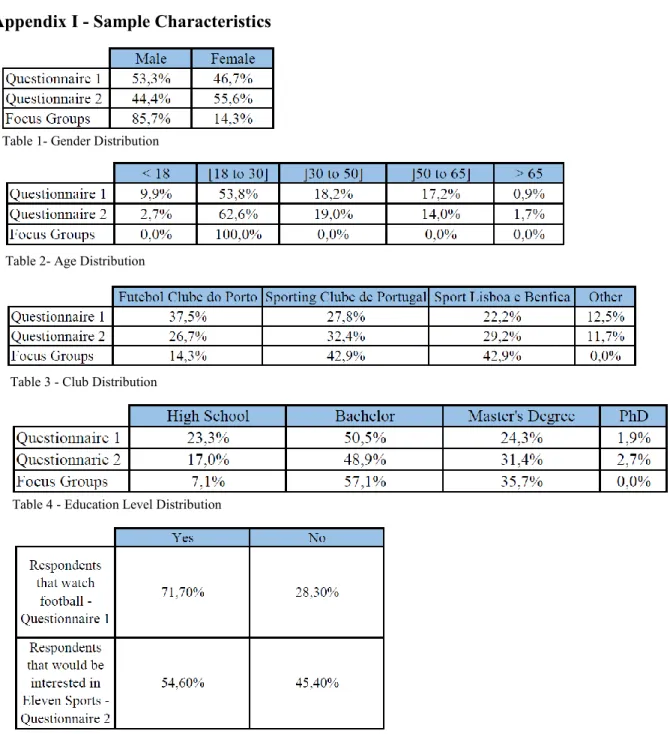
The sample has a good gender approximation to the Portuguese population. According to the latest figures of PorData, Portuguese population has 52.2% of women whereas the survey has a 53.3% female representation [Table 1].
For the remaining demographic characteristics, and has explained in Chapter 3, I am considering some bias on the sample since the distribution was made mainly through my social media.
Regarding the age distribution, 53.8% of the respondents are comprehend within the age range of 18 to 30 years old, followed by 18.2% of people with age between 31 and 50 years old. [Table 2]. This bias can be explained since the majority of my connections are from this age range.
22 Respecting to the club supported, the most represented club in the sample is Futebol Clube do Porto with 37.5%, followed by Sporting Clube de Portugal and Sport Lisboa e Benfica with 27.8% and 22.2% respectively. Because I lived in Porto, most of my contacts are from Futebol Clube do Porto. [Table 3]
In regard the education level distribution of the sample, 50.5% of the respondents had a Bachelor, 24.3% had a Master’s Degree and 23.3% is concluding High School. The remaining 1.9% has a PhD [Table 4].
Looking into the first question where respondents were asked whether they watched football in any way possible (Stadium, TV or Online), 71.7% answered positively, while the remained 28.3% said that they did not watch football [Table 5].
4.1.1.2. Questionnaire 2
Questionnaire 2 had 401 answers and were all considered valid. The sample had 55.6% of men answering and 44.4% of women. [Table 1].
Regarding the age distribution, 62.6% of the respondents are comprehend within the age range of 18 to 30 years old, followed by 19.0% of people with age between 31 and 50 years old. [Table 2]. This bias can be explained since the majority of my connections are from this age range.
Regarding the club supported, 32.4% of the sample is a Sporting Clube de Portugal supporter, followed by Sport Lisboa e Benfica and Futebol Clube do Porto with 29.2% and 26.7% respectively. Supporters from the rest of the clubs had an 11.7% of representation [Table 3]. Concerning the education level distribution, 48.9% has a Bachelor Degree, followed by 31.4% with a Master Degree and 17.0% has the High School concluded. The remaining 2.7% of the sample has a PhD [Table 4].
Looking into the first question where respondents were asked if they would pay at all to have access to Eleven Sports’ product, 54.6% of the respondents said that they were not interested in paying for Eleven Sports’ product and the remaining 45.4% said that they would [Table 5].
4.1.2. Qualitative data
The first Focus Group had eight participants while the second had six participants, leading to a total of 14 people that participated in this study.
23 The average age of the sample is 23.1 years old, with a range from 19 to 28 and a mode of 23. This age bias can be explained by two factors: First, since I have very limited resources I had to search for participants in my contact list, hence having more participants with ages similar to mine. Second, since the main goal of these Focus Groups is to study what consumers perceive regarding the streaming platform, it may be related to younger generations.
Regarding the team supported, 42.9% of the sample supported Sport Lisboa e Benfica and Sporting Clube de Portugal and 14.3% were supporters of Futebol Clube do Porto. This has also a bias that can be explained by the fact that both the Focus Groups were conducted in Lisbon [Table 3].
At the end of each Focus Group, a small survey was run in order to gain some insights that might not be perceived during the interview. In this survey, 100% of the participants said that they enjoyed participating in the Focus Group, and attributed, on average, a 9.1 out of 10 grade when asked to evaluate the relevance of the topic.
When asked if, at any point, they felt that they were not able to give their sincere opinion for being more people present in the room, 100% of the participants answered “No”.
When asked if the questions were hard to interpreter, participants answered, on average, 0,6 out of 10 meaning that there was no relevant difficulty.
When asked if they felt that the questions asked were relevant, participants answered, on average, 9,6 out of 10 meaning that there they felt that the questions were extremely relevant.
4.2. Eleven Sports’ Positioning 4.2.1. Price
4.2.1.1. Questionnaire 1
When analyzing the survey, the first thing that I wanted to know was how people valuated different football leagues and what are they willing to pay, individually per month, for each of them. At first, I calculated the willingness to pay and the importance of each league for all the sample, and concluded that the most important league is the Champions League with a score of 5,89 out of 10 and with a willingness to pay of 14,78€, followed by Liga NOS (Portuguese League) with an importance of 5,71 out of 10 and a willingness to pay of 14,65€, and Premier League with an importance of 4,20 and a willingness to pay of 15,14€. It may seem strange that the willingness to pay for the Champions League that score the highest on importance is lower
24 than the willingness to pay of Liga NOS and Premier League, however this is an expected result since Champions League games are less often than the ones from internal Leagues.
After analyzing these results, I decided to change the data and to do the same calculations but only with people that answered “yes” to whether they like to watch football. The results were considerable different. Champions League is still the most important league for the respondents, but now it has a score of 8,21 out of 10 and people are willing to pay 14,92€. Champions League is still followed by Liga NOS and Premier League with a result of 7,97 and 5,85 related to the importance and a willingness to pay of 14,81€ and 14,71
After acknowledging the average price that people are willing to pay for each league, I tested the probability of a customer to pay for each league at each of the prices that were randomly presented (5€, 10€, 15€, 20€, 25€, 30€, 35€, 40€ and 45€).
After calculating for each league and each price the proportion of people that is willing to pay that price for that specific league, in Figure 3, we can see that, for instance, 65.9% of the people that were asked if they would pay 5€ to have a monthly access to Liga NOS answered affirmatively.
Assuming that the respondents are rational, it is plausible to assume that if a respondent is willing to pay 10€ for a specific league, it will also pay a smaller price for the same league. After calculating the weighted average of each League in each price, the real proportions of people that would pay a specific price for a specific league may be found on Figure 5.
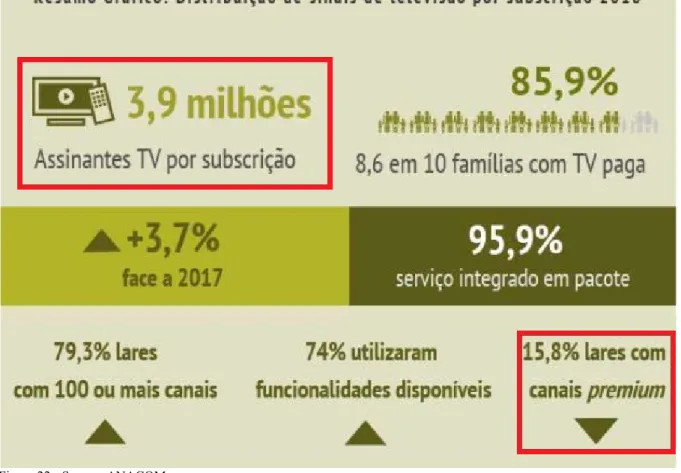
According to ANACOM, in 2018 there were 3,9 million Portuguese paying to a broadcaster distribution to have access to TV at home, hence we can assume that, by multiplying the percentage of people that were willing to pay for a given league at a given price by the population and by the price itself, we get the expected revenue of an organization if they sold each league independently for each of the prices.
Please notice that I am trying to calculate the importance of each league separately, when in reality the leagues are sold as a bundle. These calculations are to obtain all the data possible for each league individually, and to perceive the impact that each of the leagues has on the consumer decision.
To comprehend the optimal price that the customers are willing to pay for each league, I have multiplied the proportion of respondents that are willing to pay each price level by the price itself, and then multiplied that proportion by the whole population. This will provide the revenue that sellers should expect for each price level, if they sold each league separately.
25 In Figure 6 and in Graph 1 are a table and a graphic representation that illustrates this expected revenue:
In Figure 6, we can see that, according to the results obtained on the survey, the optimal price to sell Liga NOS in Portugal is 20€ with an expected revenue of more than 6,5 million euros, and to sell Champions League is 15€ with an expected revenue of almost 4,5 million euros. This results allow us to validate the price of Sport TV and the price of Eleven Sports; knowing that we cannot assume the exact price that people are willing to pay for each service, since we are asking the price for each league separately, in the literature, customer value tells us that between two services with the same price the customer will choose the one that will provide them with greater value.
It is important to notice that, except for the Champions League, all the leagues owned by Sport TV have more importance for the consumer than the ones owned by Eleven Sports, hence when selling all the services as a bundle rather than individually, Sport TV’s package will have much more value for the consumer than Eleven Sports.
In this case, if a consumer would pay 20€ to have access to Liga NOS content, it will also pay 20€ to have access to Liga NOS, Premier League, Serie A and Europa League.
On the other hand, if people are willing to pay 15€ to have access to the Champions League games, they will also be willing to pay 15€ to have access to Champions League, La Liga, Bundesliga and Ligue 1, despite their willingness to pay being lower.
Hence, since Eleven Sports is selling its service at a price of 9,99€ per month, we can validate this price and inclusively affirm that this price is actually lower than the optimal one. According to the literature, this could be interpreted has a sales promotion, and it is a strategy to enter the market: neglecting the short-term revenue by having lower prices in order to gain market share and build longer term relationships with the consumers.
4.2.1.2. Questionnaire 2
On the Questionnaire 2, an auction was simulated in order to access what people are willing to pay for Eleven Sports’ product.
As said, from the 401 respondents, only 219 were interested in acquiring Eleven Sports service. This first question was used as a triage to guarantee that the results of the auction were not biased down. The auction accounted for 219 respondents and had an average price of 16.3€. This price is, as expected, slightly higher than the price from the Questionnaire 1. This
26 difference is explained in the literature by the increase on the Customer Value. On the Questionnaire 1, the optimal price for the most valuable league of Eleven Sports – Champions League – was 15€. By increasing customer value, i.e. offering a bundle of 4 Leagues including Champions League, it is normal that the willingness to pay is higher.
4.2.2. Product
4.2.2.1. Questionnaire 1
To understand the product position of each league, I have combined the average importance and the average willingness to pay price in a graphic. As expected, by following the exponential trend grey line on the Figure 7, we can observe that the bigger the importance a league has, the bigger the price people are willing to pay for it.
We can cluster all the leagues in three main groups:
Top Leagues: Liga NOS and Champions League (Figure 8); Middle Leagues: Premier League, Europa League (Figure 9);
Lower Leagues: Serie A, La Liga, Bundesliga and Ligue 1 (Figure 10).
Moreover, since football is an industry moved by passion rather than by reason, it is normal that despite being Champions League the league with the biggest importance, it is Liga NOS that has the biggest willingness to pay price.
Looking at Figure 10, we can see that from the four Lower Leagues – leagues with less importance and consequently lower willingness to pay price – one is offered by Sport TV (Serie A) and three are offered by Eleven Sports (Bundesliga, La Liga and Ligue 1).
From the Middle Leagues (leagues with moderate importance and moderate willingness to pay price) Premier League and Europa League are both offered by Sport TV [Figure 9].
From the Top Leagues: (leagues with high importance and high willingness to pay price) Liga NOS and Champions League are offered by Sport TV and Eleven Sports respectively [Figure 8].
If we assume the trend-line as the optimal relationship between importance and price, we can conclude that, by comparing the leagues position in the graph with the trend line, Sport TV leagues [Figure 12] are above the trend line hence providing more value than the ones from Eleven Sports [Figure 11].
27 I also wanted to understand the impact of the importance attributed to each league on the decision of subscribing a paid football channel.
Before constructing the model, I have removed all the respondents that said that they did not watch football in any possible way (Stadium, Online or TV). These people will not be the ones targeted by a football broadcast channel.
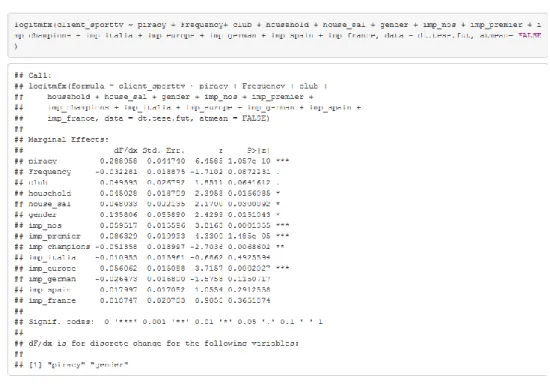
In order to study what is impacting this decision, a Logit model was used [Figure 1], since the dependent variable is discrete. client_sporttv was used has dependent variable: this variable provides information on whether a respondent is a customer of Sport TV or not, and will be 1 if the respondent is and 0 if he is not.
As independent variables, some demographic aspects were included such as the gender (gender), which club does the participant supports (club), household number (household), household salary (house_sal).
Moreover, some non-demographic questions such as: if the people, when watching football games, do it in pirate websites (piracy), with which frequency do people watch a game of football (Frequency), what importance do they give to each league independently:
Portuguese League (imp_nos);
Champions League (imp_champions); Premier League (imp_premier); Europa League (imp_europa,); Italian League (imp_italy); Spanish League (imp_spain); German League (imp_germany); French League (imp_france)
Since a Logit model is being used, the coefficients cannot be interpreted directly. Average Probability Effect was run [Figure 2], and to isolate the impact of each independent variable, RStudio was programmed to not use the mean for the remainder independent variables. Since some of the independent variables are also discrete, using the mean would not be indicating any individual in the sample.
From the results in Figure 2, we can conclude the following: With 99.9% confidence, we can affirm that:
28 o In a scale that goes from 0 to 10 points, by increasing the importance to having access to the Portuguese and English League games in 1 point, the likelihood of a person to become a Sport TV customer increases in 5.95% and 8.63% respectively. On the other hand, by increasing the importance to having access to the Europa League games in one point, it reduces the probability of becoming a Sport TV customer in 5.61%;
o A person that watches football matches in illegal websites has 18.95% less chance of being a Sport TV customer;
With 99% confidence, we can affirm that:
o In a scale that goes from 0 to 10 points, by increasing the importance to having access to the Champions League games in 1 point, the likelihood of a person to become a Sport TV customer decreases in 5.14%;
With 95% confidence, we can affirm that:
o Increasing the household size in 1 person, increases the likelihood of that person to be a Sport TV customer in 4.50%;
o Increasing the household salary in one level2 increases the likelihood of that
person to be a Sport TV customer in 4.80%;
o Men are 13.58% more likely to be a Sport TV customer than women.
For the remaining variables, we can affirm with 95% confidence that they do not impact the decision of being a Sport TV customer.
As we comprehend above, from the 8 main football leagues that are being studied only 4 of them have an impact on the decision of being a customer of Sport TV. It is interesting to see that, from the leagues owned by Eleven Sports, only Champions League has a negative impact on the decision of a person to become subscriber of their main competitor. The other four leagues are irrelevant.
With these results, we can confirm that in Portugal, only Liga NOS, Premier League, Champions League and Europa League have enough value for a consumer to be able to pay to have access to their content. Three of these four leagues (Liga NOS, Champions League and Europa League) have Portuguese teams present.
2 Household Salary was asked in levels rather than in absolute values. Those levels can be found on Appendix V
29
4.2.2.2. Focus Group
These results are corroborated by the Focus Groups participants. When asked what leagues they usually watch [Figure 13], all of the 14 respondents said that they watched Liga NOS, specially the games of their club.
Premier League and Europa League were the second leagues more referred by the participants, followed by Champions League, Serie A and La Liga.
It is important to notice that all of the participants who said that they usually watch Serie A, they referred that they only do it because “Ronaldo is there”. This means that since Cristiano Ronaldo only moved to Serie A this season that this league gained importance only this year. On the other hand, some participants referred that they no longer watch La Liga because “Ronaldo isn’t there anymore”.
One participant also said that he does not follow Champions League anymore because “it moved to Eleven Sports”. Again, this is a sign that Eleven Sports, despite having one of the most attractive leagues in its portfolio, it is still not sufficiently attractive for some consumers to subscribe their channel.
A different aspect captured by the Focus Group was the transmission itself. Participants were asked to comment if they think that Eleven Sports’ transmission is different from Sport TV’s. Some participants said: “I think it is a transmission that does not differentiate in anything important. In addition, it has a less attractive content”; other participant added: “More of the same”. In a different Focus Groups, participants said that Eleven Sports has “no value”. Other participant that earlier affirmed, when asked if he identified more or less with the comments of Eleven Sports when comparing to the ones of Sport TV, answered “Of course I do! Football is not a science! Some commentators of Sport TV like to comment the games as if it were science instead of letting us watch the artists [referring to the players]”. However, the same participant, at the end of the Focus Groups said regarding Eleven Sports service “it has low offer: who owns Liga NOS [Portuguese League] wins [the market]”.
4.2.3. Promotion
Eleven Sports launched its service at 9,99€ per month, but giving the possibility to pay 99,99€ for the whole year. This promotion was a cost saving opportunity for the customers since they have the possibility to pay 8,33€, on average per month to have access to the same service that they would have if they paid 9,99€ monthly.
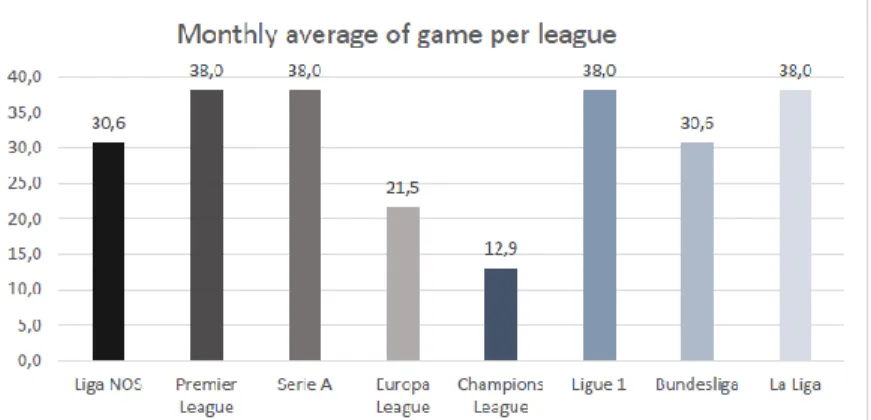
30 By analyzing Figure 14 that illustrates the amount of games per league each month, we can see that Champions League (which we concluded it is the league in the possession of Eleven Sports with biggest value) has very few games when comparing with the rest of the competitions (except with Europa League). Additionally, while the season is going, the number of games decreases with time too.
Furthermore, the promotion offered by Eleven Sports of paying, on average, 8.33€ per month if the customer wants to pay the whole year at once, is explained by the fact that their most important product (having the exclusivity of the Champions League games) loses value as the football season advances. This is a way of retaining customers while the product still has all of its value.
In Figure 15 we can see the average of games per month of each league, illustrating the differences in the number of games available between Champions League and Europa League and the rest of the national Leagues.
One can argue that despite decreasing the number of games, its value increases by assuming that the best teams will be winning their games, the best teams will be facing each other more at the end of the season, however since the probability of a Portuguese team to be present is exponentially smaller, the interest that a Portuguese consumer may have in the games is relative.
4.2.3.1. Focus Group
According to the Focus Group, the most important games to have access are the ones of their own club: “I only watch Portuguese League. If Sport Lisboa e Benfica is in any other League, I will watch it too”; “I watch Portuguese League: mainly Sporting Clube de Portugal and Futebol Clube do Porto” or even “For me, I watch all the games of Sporting Clube de Portugal independently of the competition”.
Aligning this with the Portuguese law Dispatch n.º 13878/2013 (see Appendix III - Dispatch n.º 13878/2013) that states that: at least a game of Champions League, per round, where a Portuguese club is playing and the final of any UEFA competition, needs to be broadcasted in a non-exclusive channel, we can conclude that, in fact, Eleven Sports service is more valuable in the beginning of the season than in the end of it, per month.
31
4.2.4. Place
4.2.4.1. Questionnaire 1
According to the Questionnaire 1, from all the people who watch football, only 5.6% are Eleven Sports’ customer [Figure 16].
The reasons for this low percentage of customers can be comprehend on the Figure 17Error!
Reference source not found.. According to this figure, 39.3% said that the price is the main
reason for not being Eleven Sports’ customer, followed by the fact that they entered the market with NOWO and the lack of interest in the product with 30.5% and 18.4% respectively. Despite one of the main problems is solved (Eleven Sports is now available in all the TV operators, hence the fact that they are only present in NOWO is no longer a limitation), by removing the 30.5% of people that said that they are not customers of Eleven Sports because they are not NOWO clients, there is still the question of almost 40% of the respondents assuming that the major reason for not subscribing Eleven Sports is the price and the content that they are selling. This is a very interesting fact since one of Eleven Sports’ strategy is to compete with a lower price, however it seems that the price is not sufficiently low to make their product attractive enough for a consumer to buy it, when comparing with the competition. Although the previous results validated the price that Eleven Sports is asking, when the respondents are asked the willingness to pay per league individually, it seems that, in the reality, when they are taking the decision of subscribing or not Eleven Sports they are including, as counterpart the fact that they are already paying for Sport TV. Thus, the problem here may not be the price itself, rather the product when compared with the competition.
This is explained in the literature by the comparison between the “prepurchase” and the “postpurchase” stage. In the “postpurchase” stage, customer may be including as nonmonetary cost the opportunity cost of being a Sport TV client against the subscription of Eleven Sports.
4.2.4.2. Focus Group
According to some participants of the focus group, not being NOWO customer was decisive for the decision of not subscribing the channel. “I am not a NOWO subscriber and I wouldn’t change ‘just because’. Also, I am passionate about Sport Lisboa e Benfica and they only had three games that I could not watch at home, and instead of breaking the contract with Vodafone, I preferred to go to a restaurant.”
32 These results may be different now since, as referred above, this investigation was conducted when Eleven Sports was only in the TV broadcasting market offering with NOWO. Nowadays, having their content on the rest of the operators might have changed these perceptions.
4.3. Eleven Sports’ Stream
Eleven Sports’ also entered the market by offering a disruptive way of watching football that allows the customer to view anywhere and anytime, not needing to subscribe any broadcaster distributor.
4.3.1. Questionnaire 1
As stated by Figure 18, 53,7% of the games watched by the respondents are in TV, 26,4% are on the Stadium, while 19,9% are watched Online.
One of the ways used to watch games online is through pirate websites. In fact, Figure 19 shows that 86,5% of the sample, when using online via to watch football, do it through a pirate website. According to the Questionnaire 1, 68,4% of the inquires believes that having an online stream to watch football matches in a legal way is a good idea and would be interested in acquiring it, depending on the price.
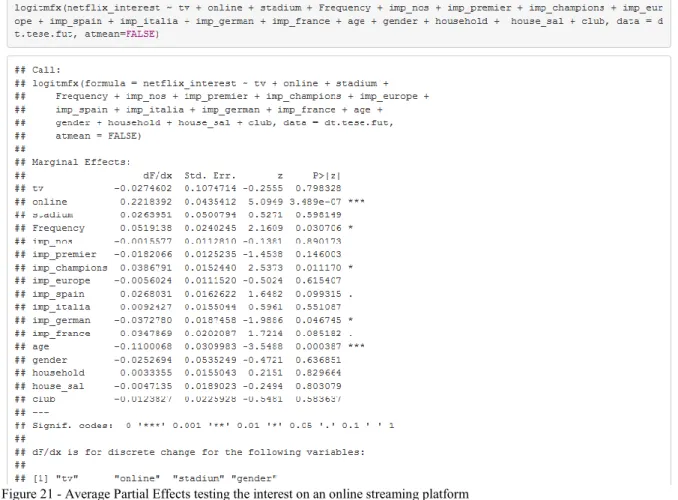
To better understand what may influence the interest of the consumers in having access to a streaming platform like this, I will be estimating a Logit model [Figure 20]. As explained above, Logit models are used when the dependent variable assumes discrete values, hence this model will be providing the percent change effect that the independent variables have on the independent variable.
The independent variable used was netflix_interest. This is a dummy variable that assumes value 1 if the respondents answered that they would be interested in having access to a streaming platform that would allow them to watch football matches without the need of having a contract with the TV operators, and 0 if they were not interested.
As independent variables, some demographic aspects were included such as the gender (gender), age (age), which club does the participant supports (club), household number (household), household salary (house_sal).
Moreover, some non-demographic questions such as: if people watch football on TV (tv), Online (online) or on the Stadium (stadium), with which frequency do people watch a game of football (Frequency), what importance do they give to each league independently: