EDEN 2004 ANNUAL CONFERENCE
New Challenges and
Partnerships in an Enlarged
European Union
Open, Distance and E-Learning in Support of
Modernisation, Capacity Building and
Regional Development
Proceedings of the EDEN 2004 Annual Conference
Budapest University of Technology and Economics, Hungary
16-19 June, 2004
Edited by
András Sz
űcs and Ingeborg Bø
on behalf of the European Distance and E-Learning Network
European Distance and E-Learning Network
EDEN 2004 Annual Conference
Budapest, Hungary
Published by the European Distance and E-Learning Network
Editors: András Szűcs Ingeborg Bø Editorial co-ordination: Anna Wagner Ildikó Mázár
The EDEN Secretariat mailing address EDEN Secretariat
Budapest University of Technology and Economics H-1111 Budapest, Egry J. u. 1 Hungary Tel: (36) 1 463 1628, 463 2537 Fax: (36) 1 463 1858 E-mail: [email protected] http://www.eden-online.org
Copyright 2004 European Distance Education Network and the Authors
All Rights Reserved
No part of the material protected by this copyright may be reproduced or utilized in any form or by any means, electronic or mechanical, including photocopying, recording or by any storage or retrieval system, without written permission from the copyright owner.
ISBN 963 216 052 5
A conference at the right time, at a special place, in good company
EDEN is continuing its series of conferences, following the professional development and policy mainstream in the European distance and e-learning with a dedicated event in 2004, the year earmarking a development of great significance in the European Union: the ever-largest extension of the EU, resulting in the accession of ten new Member Countries.
The integrating Europe should benefit from solutions which support the even more active modernisation of the continent. Enhanced by information and communication technologies and by the further development and deployment of e-learning in all sectors, innovative education is centrally positioned for contributing to this process. The EDEN conference addresses the core questions of how distance and e-learning can best play a role in capacity building and support modernisation. Since its establishment in 1990-91, in another historical period of the European development, EDEN has been dealing with the issues of European integration and East-West collaboration with special attention. The 2004 conference is organised in the spirit of welcoming the new Member States and also for continuing, in a renewed context, the East-West co-operation and pan-European dialogue. It has been a long way from the first mention of distance education in the Maastricht Treaty in 1992 to the current e-learning programme achievements. The unique moment in 2004 offers also an opportunity to evaluate this far-reaching process, in which technology-supported learning has become mainstream. The EU eLearning Initiative Action Plan has already provided essential momentum for the modernisation process of education. The EU eLearning Programme will now face further challenges in the transforming situation. This leads to the need of rethinking how ICTs and e-learning can be best used for supporting modernisation and capacity building. On the other hand, it is worth assessing, according to our latest knowledge, what e-learning is worthwhile using for - and what not.
In order to support a really efficient and beneficial European integration in the years to come, it is most timely and relevant to survey and evaluate the experience available, with the analysis of achievements of the numerous EU projects from the perspective of the joining countries and also, in a broader sense, in the context of the East-West collaboration and assistance.
The conference themes covered in the papers include the link between e-learning and the modernisation process in the new Europe, the state of the art in technology and methodology, the new challenges created by the EU enlargement for the human resource development, the consolidation and “maturing” process – the evolution of discourse about distance and e-learning throughout the last decade, further the ways how new markets, interests, collaborations help establish new kinds of partnership, and the success stories of distance and e-learning in the context of regional development, capacity building and European co-operation.
We started to organise the conference in the autumn of 2003 in the expectant atmosphere of approaching the enlargement date. The EDEN 2004 Conference is already being held in an EU member state in Budapest – the large celebrations are just over, the EDEN community looks forward to meet the new challenges and opportunities.
András Szűcs Ingeborg Bø
Acknowledgement and thanks are given to the Programme Committee
Chair:
Ingeborg Bø, President of EDEN, Executive Director, Norwegian Assocation for Distance Education, Norway
Co-Chair:
Ákos Detrekői, Rector, Budapest University of Technology and Economics, Hungary
Committee members:
Claudio Dondi, Vice-President of EDEN, President, Scienter – Research and Technical Assistance Centre on Learning System, Italy
Peter Floor, Chair, European ODL Liaison Committee
Boris Galabov, Head, National Centre of Distance Education, Bulgaria
Maruja Gutierrez-Diaz, Head of Unit, European Commission – DG Education and Culture Carl Holmberg, Chair, EENet – European Experts' Network for Education and Technology,
Swedish Agency for Flexible Learning
Ákos Jobbágy, Director, Department of Studies, Budapest University of Technology and Economics, Hungary
László Karvalics, Director, UNESCO Information Society and Trend Research Institute, Hungary
Nikitas Kastis, President, Multimedia Educational Innovation Network, MENON EEIG, Chair, EDEN Open Classroom Working Group
Grazyna Klimowicz, Foundation for the Development of the Education System, Poland Baard Krogshus, EUREKA-EUROLEARN, Norway
Jan Lojda, President, Czech Association of Distance Teaching Universities, Czech Republic Károly Molnár, Vice-Rector, Budapest University of Technology and Economics, Hungary Serge Ravet, Chief Executive Officer, EIfEL – the European Institute for e-Learning Dangoule Rutkauskiene, Head, Distance Education Centre at Kaunas University of
Technology, Lithuania
András Szűcs, Secretary General, EDEN
Alan Tait, Vice-President of EDEN, Chair of EDEN NAP Steering Committee, Dean, Faculty of Education and Language Studies, The Open University UK
Ferenc Tátrai, Executive Director, European Social Fund, National Programme Bureau, Hungary
Johan Van Oost, President, E.F.ODL – European Federation for Open and Distance Learning Sarolta Zárda, Director-General, Számalk Education Ltd. Co., Hungary
TABLE OF CONTENTS
STATE OF ART AND PERSPECTIVES – IN SEARCH FOR THE ROLE OF ICTS IN LEARNING
Present and New Emerging Technologies; Challenges and Opportunities for European Distance
Education and E-Learning 1
Per R. Stokke, Norwegian University of Science and Technology, Norway
Can Technology Make Lifelong Learning a Reality? 7
Dejan Dinevski, University of Maribor, Peter Kokol, Centre for Interdisciplinary and Multidisciplinary Research and Studies, Slovenia
Moving from Good Intentions to Reality. Implementing ICT in Teacher Education 13
Tjalve Gj. Madsen, Bergen University College, Norway
The “Process of Maturing”: Coming of Age of Distance and E-Learning Practice at
Athabasca University 19
Corinne Bossé and Brian Powell, Athabasca University, Canada
INTEGRATION OF ICTS AND E-LEARNING AT UNIVERSITIES: STRATEGIES,
MODELS AND IMPLEMENTATION PRACTICE
‘E-Learning’ Meets ‘Digital Media’: New Strategic Questions for Higher Education 25
Jim Devine, IADT: Dun Laoghaire Institute of Art. Design & Technology, Ireland
Old Universities in New Environments: New Technology and Internationalisation Processes in
Higher Education 31
Jan Olof Nilsson & Kjell Nilsson, Department of Sociology, Lund University, Sweden
Sustainability of E-Learning for Universities 36
Salvatore Valenti and Tommaso Leo, DIIGA, Università Politecnica delle Marche, Italy
LIVIUS: The European Virtual University for a New E-Learning Model 41
Maria Amata Garito, University of Rome “La Sapienza”, Faculty of Psychology and NETTUNO, Italy
The Challenge of a Distance-Learning Professional Doctorate in Education 45
John Butcher and Sandy Sieminski, The Open University, United Kingdom
One Site Fits All: Creating Faculty-Tailored and Reusable Study Skills Websites for Students
in Open and Distance Learning – A Case Study from The Open University UK 51
vi
Sharing Teaching Resources in the Spanish Group 9 (G9) of Universities: Learning from
Experience 57
Manuel Benito Gómez, Jesús Romo Uriarte, Virtual Campus, University of the Basque Country, Spain
The Swedish Net University Agency – National and Regional Promotion and Co-Operation
Concerning Distance Education 60
Per Westman, The Swedish Net University Agency, Sweden
Open University in Finland 64
Minna Laitinen-Karipohja, University of Helsinki, Open University, Finland
Universities of Applied Sciences: A New Frontier for eLearning? 67
Benedetto Lepori and Chiara Succi, University of Lugano, Switzerland
E-Learning in Process and Chemical Engineering Education – What’s the Learning behind the e? 74
Boris Gauss, Christopher Hausmanns, Leon Urbas, Berlin Technical University, Germany
New Student and Teacher Roles – Quality Reforms Netbased Learning on Campus 80
Hilding Sponberg, Gjøvik University College, Norway
University of Padova: “E-Learning Project” for Strategic Change 86
Luciano Galliani, Faculty of Education, University of Padova, Italy
Cecilia Dal Bon, Department of Educational Sciences, University of Padova, Italy
Organisational Capacity Development – The Fragmented and the Systemic Perspective from
Another Point of View 92
Marquis Bureau MBureau Consultants, Joan Collinge, Simon Fraser University, Canada
Transforming a Campus Based Course to a Net Based – Practical Experiences in Continuing
Engineering Education 98
Lars-Åke Mikaelsson, Bengt Nykvist and Jörgen Pålsson, Mid Sweden University, Sweden
The Managers’ Handbook. On-Line E-Book for University Continuing Education in Europe 102
Helka Urponen, Continuing Education Centre, University of Lapland, Finland Frank Moe, Centre for Continuing Education, University of Bergen, Norway
Danguole Rutkauskiene, Distance Education Centre, Kaunas University of Technology, Lithuania
The Role of ICT – eLearning in the Convergence Phenomena in the Development of Different
Lifelong Learning Systems 107
Péter Soltész, Hungary
New Perspectives in Open and Distance Learning Fostered by the Institutional Initation of
Adult Education 113
Éva Szalma, Lajos Papp, András Szűcs, Budapest University of Technology and Economics, Distance and Adult Education Centre, Hungary
COLLABORATION, KNOWLEDGE TRANSFER AND CAPACITY BUILDING THROUGH E-LEARNING IN THE NEW EU MEMBER STATES AND EASTERN EUROPE
The Extension of ICT in the “New Enlarged Europe” and the Role of Cedefop 117
Nikolaos Mylonakis, Cedefop, Greece
A First Look at the State of E-Learning in CEE Countries 121
Krisztián Forrai, Oktopusz Foundation, Hungary
What Motivates Faculty to Teach Online? A Two-Country Comparison 124
Susan Glanz, St. John’s University, USA
Experience and Perspectives of the Bertelsmann Foundation in the Development and Transfer
of E-Learning Projects to Eastern Europe 130
Christian Hasiewicz, Clemens Wieland, Bertelsmann Foundation, Germany
The Budapest Distance Study Centre and the German-Hungarian Cooperation in Distance
Higher Education 134
Gerhard E. Ortner, Fred Nickolmann, University of Hagen, Germany Gábor Halász, Budapest Distance Study Centre, Hungary
British Council and the Brokering of Distance Education Relationships 137
William Mitchell and Liz Dempsey, British Council, United Kingdom
The Potential for Engagement between the University of London External Programme and
Eastern European Nations Joining the European Union in 2004 142
Richard Arnold, University of London External Programme, United Kingdom
ToHoSa-CA: Ideas Adapted to New Changes in Education for Central Asia 147
Carlos Machado,Vrije Universiteit Brussel, Jean Pierre Roose, Erasmus Hogeschool, Belgium
Economic Education Online – Tansforming and Scaling Qualifying Programmes to Russia 153
Hans Kaminski, Irina Sorvina, Heiko Feeken, Institute for Economic Education, Carl von Ossietzky University, Oldenburg, Germany
Knowledge Transfer Partnerships – Integrating the Library in Learning Support 159
Lone Jensen, The Library of the Aarhus School of Business, Denmark
Capacity Building by Distance Learning in the Field of Environmental Protection for a New
EU-Member Country. Experience of a German-Latvian Cooperation Project 163
Dorothe Lütkemöller, Institute for Environmental and Sustainability Communication, University of Lüneburg, Germany
viii
Lithuanian Videoconferencing Network: The Core Factors for its Effective Operation 169
Danguole Rutkauskiene, Distance Education Centre at Kaunas University of Technology Aleksandras Targamadze, Informatics Department at Kaunas University of Technology
Egle Pociute, Baltic Education Technologies Institute Vaidotas Rutkauskas, LieDM project, Lithuania
Applying Modern Educational Technologies in Romania: The Impact of E-Learning Platforms 176
Constantin Hutanu, Moise Achim, Nicolae Ludusan, “1 Decembrie 1918” University Aurel Vlaicu, Bogdan Orza, Technical University of Cluj-Napoca
Catalina Hutanu, County Hospital of Alba Iulia, Romania
CONCEPT AND PRACTICE OF EUROPEAN COLLABORATION AND NETWORKING IN E-LEARNING
Encouraging the Development of Distance Education? The Role of the European Union 183
Kay MacKeogh – Oscail, National Distance Education Centre, Ireland
Using Technology to Promote Learning across an Enlarged European Union: Experience
Emerging Across the New Europe 190
Rob Mark, Queen’s University Belfast, Northern Ireland, United Kingdom Ebba Ossiannilsson, Lund University, Sweden
CASES OF DISTANCE AND E-LEARNING APPLICATIONS FOR REGIONAL DEVELOPMENT
Globalization, Modernization and Rural Inclusion: The Role of Community Based E-Learning
in Addressing Regional Development 197
Alan Bruce, Universal Learning Systems, Dublin, Senan Cooke, Dunhill Multi-education Centre Co. Waterford, Ireland
Use of Distance and E-Learning to Successfully Widen Access to Higher Education for
Mature Students in Rural Areas in the North East of England 202
Rosie Crane, Northumbria University, Newcastle upon Tyne, United Kingdom
Finland Educational Network Combining Present and New Forces as Parts of a Robust,
Apt and Educationally Equal Eastern Finland 207
Anni Virnes, Eastern Finland Distance Learning Network Leena Suonio, Eastern Finland Educational Network, Finland
Home Care in Europe: Combating Social Exclusion through Apel/Validation on a Distance
Learning Course in the Care Sector 213
Brec’hed Piette and Bangor, Ian McGregor-Brown, University of Wales, Bangor, United Kingdom Kate Sevón and Helen Hellberg, Swedish Agency for Flexible Learning, Sweden
Learn More by Spending Less Time in School? Flexible and eLearning Methods as a Means
to Support Regional and Local Development 219
Distance Education Perspectives: Teaching English Language in Tourism Studies at UNED 224
Raquel Varela, Elena Bárcena and Tim Read, Universidad Nacional de Educación a Distancia, (UNED), Spain
E-LEARNING IN CORPORATE ENVIRONMENTS: DEVELOPMENT, IMPLEMENTATION AND ACADEMIC PARTNERSHIPS
E-Learning by Doing: Design and Implementation in a Spanish Savings Bank 230
Sergio Vasquez Bronfman, ESCP-EAP (Paris, London, Berlin, Madrid), France
E-Learning and E-Business: The Need for SMEs to Work Smarter in the New Europe 236
Josephine Browne, Institute of Art, Design and Technology, Dun Laoghaire,
Georgina Sweetnam, Venturepoint (Dun Laoghaire Rathdown County Enterprise Board), Ireland
E-Learning and E-Advice – An Exploration of the Process of Partnership in Extending the
Boundaries of Learning for Small Businesses 241
Laurence Solkin and Susannah Quinsee, City University, United Kingdom
Engineering on Precious Stones and Metals. Distance Education Enables Cooperation of
University, Society and Industry in Rural Areas 247
Rigmor Sterner and Lennart Widenfalk, Luleå University of Technology, Sweden
E-LEARNING AND THE LEGAL ENVIRONMENT
Legal Aspects of E-Learning in the Information Society 251
Jürgen Taeger, University of Oldenburg, Janine Horn, Oldenburg Institute of Informatics (OFFIS), Germany
RION – Legal Informatics Online. A Call for European Cooperation 257
Jürgen Taeger, Wolfgang Seiler, University of Oldenburg, Germany
Application of the New EU Copyright Laws to E-Learning 262
Richard Niven, The Open Polytechnic of New Zealand, New Zeland
From an Australian-Polish Experiment to EMDEL Project Leonardo Da Vinci, 2001-2004 269
Anna Grabowska, Distance Education Centre at Gdansk University of Technology, Poland
INNOVATIVE E-LEARNING SOLUTIONS IN SCHOOLS: CONCEPT AND EXPERIENCE
Lessons Learnt From the First SCHOOL + Microcosmos Pilot Regarding Educational Innovation 274
Juana Sancho, Fernando Hernández, Alejandra Bosco, Verónica Larraín, Jorg Müller, Xavi Giró, Silvina Casablancas and Anna Nuri, Centre for the Study of Change in Culture and Education, Scientific Parc of Barcelona, University of Barcelona, Spain
x
Promoting the Use of ICT in Primary Schools: The Activ-E Project 279
Albert Sangrà, Cristina Girona, Adolfo Montalvo, Universitat Oberta de Catalunya, Spain
Distance Learning and Teachers’ Use of New Technologies in Greek Primary Schools 285
Christodoulos Antonios1, 2, Antoniou Panagiotis1, Siskos Apostolos1, Polykratis Mattheos2
1
Democritus University of Thrace, Department of Physical Education and Sport Science, Komotini, Greece
2
1st and 2nd Primary Schools of Agios Stefanos, Attica, Greece
The Need for a Strategic Thinking on Sustainable Digital Environment for E-Learning 291
Roni Aviram, Nimrod Matan, Ben Gurion University, Israel Henrik Hansson, Stockholm University, Sweden
MEASURING AND IMPROVING QUALITY AND EFFECTIVENESS OF ELECTRONIC DISTANCE EDUCATION
Adaptive Knowledge Transfer in E-Learning Settings on the Basis of Eye Tracking and
Dynamic Background Library 295
Maja Pivec(1) , Alexandra M. Preis(1) , Victor Manuel García Barrios(2) , Christian Gütl(2) , Heimo, Müller (1), Christian Trummer(1) , Felix Mödritscher (2)
(1)
Department of Information Design, University of Applied Sciences FH Joanneum, Graz, Austria
(2)
Institute for Information Systems and Computer Media (IICM), Faculty of Computer Science at Graz University of Technology, Austria
Quality Assessment of a Hypermedia-Based Teaching Material with the “INTERFACE” System 302
Károly Hercegfi, Orhidea Edith Kiss, Krisztina Bali, Budapest University of Technology and Economics, Hungary
Statistical Analysis of Student Satisfaction Enquiry Related to E-Learning Challenge at
Dennis Gabor College 308
Sarolta Zárda, Géza Bognár, Dennis Gabor College, Hungary
Definition of A Model of Ex Ante Evaluation for Elearning Project Financed by ESF
(European Social Fund) 312
Claudia Montedoro, Viviana Ruggeri, Saverio Pescuma, Isfol, Italy
Towards a Framework for Exploring Success Factors in Online Learning 318
Mark Stansfield, Thomas Connolly and Evelyn McLellan, School of Computing, University of Paisley, United Kingdom
Collaborative Learning: A Critical Success Factor in Distance Learning 323
Lars Mattila, Ann Hägerfors, Lulea University of Technology, Computer and Systems Science, Sweden
The Balanced Scorecard for Methodology: A Tool for Improvement in Higher Education 330
In Cyberspace No One Can Hear You Scream: Supporting Online Learners 336
Steve Wheeler, Mark Townsend and Graeme Horton, Faculty of Education, University of Plymouth, United Kingdom
Web Assignments Checker in Science Teaching 340
David Pundak, Shmaryahu Rozner, Arie Maharshak, ORT Braude Engineering College, Israel
THE LINGUISTIC ASPECTS OF E-LEARNING
Language in E-Learning: Language Management 345
José Lambert, K.U.Leuven, Ann Opsomer, EuroPACE, Belgium
MiLCA – Distance Education in Computational Linguistics 351
Aljoscha Burchardt, Stephan Walter, Manfred Pinkal, Department of Computational Linguistics and Phonetics, Saarland University, Germany
Educational Software & Multimedia: Towards a European Dimension 357
Jeffrey Earp, Lucia Ferlino, Michela Ott, Institute for Educational Technology, National Research Council of Italy (ITD-CNR), Italy
The Bologna Challenge: Catering for Diversity through Academic Writing Online 363
Kris Van de Poel and Tineke Brunfaut, University of Antwerp, Belgium
STRUCTURING DIGITAL KNOWLEDGE – LEARNING OBJECTS AND CONTENT MANAGEMENT
An Advanced E-Learning Concept: MINDMAP 368
Jeanne Schreurs and Rachel Moreau, Limburgs Universitair Centrum, Belgium
A Proposal of a Methodology for Evaluating Learning Objects 375
Rita Falcão and Alfredo Soeiro, Universidade do Porto, Portugal
Context Mediation or Learning Objects Exchange 379
Yevgen Biletskiy, University of New Brunswick, Canada, Olga Vorochek, Zoya Dudar, Alexander Medovoy, Kharkiv State University of Radio-Electronics, Ukraine
E-Learning and the Filtering of Knowledge 385
Sylvia van de Bunt-Kokhuis, Vrije Universiteit Amsterdam/Haagse Hogeschool, The Netherlands, Henrik Hansson, Stockholm University, Sweden
Delivering Mathematics in Distance Education 392
Mike G. Pearson, University of Cambridge, United Kingdom, Igor Podlubny, Technical University of Kosice, Slovakia, Vera Olah, Janos Bolyai Mathematical Society, Hungary
xii
Virtual Campuses – From Global Architecture to Local Solutions 397
Danail Dochev, Institute of Information Technologies,Bulgarian Academy of Sciences,
Radoslav Pavlov, Institute of Mathematics and Informatics, Bulgarian Academy of Sciences, Bulgaria, Ottó Hutter, István Simonics, Computer and Automation Research Institute, Hungarian Academy of Sciences, Hungary, Polyxeni Arapi, Distributed Multimedia Systems Lab., Technical University of Crete, Greece
Learning Content Management Systems: Advanced Technology for Online Course
Development, Management and Delivery 404
Steven Shaw, Concordia University & Eedo Knowledgeware Corporation
Vivek Venkatesh, Gretchen Lowerison, Dai Zhang, Dennis Dick, Concordia University, Canada
E-Learning Formats for Web-Based Learning: Bridging the Gap Between Information Portals
and Learning Platforms 410
Elke Brenstein & Claudia Domes, Humboldt University, Michael Wache, Berlin, Germany
APPLICATIONS OF NEW MULTIMEDIA TECHNOLOGIES IN E-LEARNING
Multimedia Authoring for E-Learning Applications 416
Ranjan Parekh, Jadavpur University, India
The Model of Digital Video Production – Case Study: Course Production at the University
of Oulu, Department of Information Processing Science 422
Kari Liukkunen, Univers ity of Oulu, Finland
Using Educational Technology in Regional Master’s Programmes at the University of Oulu 428
Kari Liukkunen and Kari Pankkonen, University of Oulu, Finland
The MoTFAL Project – Mobile Technologies for Ad-Hoc Learning 434
Eleni Malliou, Stavros Savvas, Sofoklis Sotiriou, Ellinogermaniki Agogi, Greece Fragoulis Maounis, Antonis Miliarakis, Manolis Stratakis, FORTHnet S. A., Greece Kostas Tsolakidis, University of Aegean, Greece
Ildikó Mázár, European Distance and E-Learning Network, United Kingdom
DEVELOPMENT, IMPLEMENTATION AND EVALUATION OF VIRTUAL ENVIRONMENTS AND LABORATORIES
Evaluating LAB@FUTURE, a Collaborative E-Learning Laboratory Experiments Platform 440
Jean-Pierre Courtiat, CNRS-LAAS, France, Costas Davarakis, Systema Technologies S. A., Greece Martin Faust, ARTEC-University of Bremen, Germany, Sven Grund, Alexandra Totter, Swiss Federal Institute of Technology, Switzerland, Hannes Kaufmann, Vienna University of Technology, Austria Daisy Mwanza, University of Helsinki, Finland
Realization of a Distributed Remote Laboratory with Experiments Located in Romania
and Austria 446
Michael E. Auer, Carinthia Tech Institute Villach, Austria, Doru Ursutiu, University Transylvania, Brasov, Romania
Online Hands-On Trainings – Real Worlds in Virtual Environments 452
Jens-Thomas Meyer, Anthimos Georgiadis, Simone Schwarz, University of Applied Sciences Nordostniedersachsen, Department of Automation Technology, Germany
Internet-Based Learning – The Online Laboratory Distillation Column 460
Andreas Klein, Christopher Hausmanns, Guenter Wozny, Dept. of Process Dynamics and Operation, Berlin Technical University; Leon Urbas, Centre for Human-Machine-Systems, Berlin Technical University, Germany
SHORT PAPERS
Experience in Initial and Further Teacher Education in an eLearning Environment 465
Sónia Hetzner and Esther Paulmann, FIM-NewLearning, University of Erlangen-Nürnberg, Germany
A Producer Based Support Model for Teachers from the University of Art and Design (UIAH) 472
Eva-Maria Hakola, The Virtual University Unit of the University of Art and Design, Helsinki, Finland
Blended Learning in Higher Education for Student Groups Having Different Learning Strategies.
The Integrated Learning Content Management System at Dennis Gabor College 475
György Ágoston, Attila Budai, Dennis Gabor College, Hungary
The Success of E-Learning in Hungary – From the Perspective of the Learners’ Attitude 481
Ildikó Sediviné-Balassa, Dénes Gábor College, Judit Vidékiné-Reményi, Budapest University of Technology and Economics, Hungary
The European eCompetence Initiative – A Network for Elearning Excellence in Higher Education 485
Dirk Schneckenberg, University of Dortmund, Center for Research on Higher Education and Faculty Development, Germany
ZEUS: “Satellite Network of Rural Schools” 491
Sotiriou S., Orphanakis M., Pyrini A., Savas St., Ellinogermaniki Agogi, Tsolakidis C., University of the Aegean, Sotiriou M., Tsiopoulos E., Q-Plan, Prevedourou D., Tiropanis Th., Athens Information Technology, Mpithas S., Prevedouros, INTRACOM, Tavlaki E., Agapiou G., Hellenic Telecommunications Organisation, Nikoyiannis A., Hellas SAT, Greece
Management and Coaching (Tutoring) in Organizations – How to Create Attractive Fields of Studies with New Partners Building Interdisciplinary Competence Across Traditional Subject Areas? 497
Tove Johannesen, Nord-Trøndelag Univerisity College, Steinar Nistad, Aalesund University College, Norway
Artificial Intelligence for Distance and E-Learning Development in Knowledge Society 501
xiv
Networks of Competence Managing Open and Distance Learning 507
Christian-Andreas Schumann and Kay Grebenstein, Westsächsische Hochschule Zwickau (FH) – University of Applied Science, Germany
Partners with Clinical Practice. Evaluating the Student and Staff Experiences of On-Line
Continuing Professional Development for Qualified Nephrology Practitioners 513
Judith Hurst & Susannah Quinsee, City University, United Kingdom
From Curriculum Design to Internet Delivered M.SC. The Irish Universities Nutrition
Alliance (IUNA) Experience 519
Aideen I. Mc Kevitt, University of Ulster/Trinity College Dublin, Michael J. Gibney, Trinity College Dublin, Albert Flynn, University College Cork, Clive W. Mulholland, University of Ulster, J. J. Strain, University of Ulster, Ireland
Learners – Teachers On-Line Mutual Support 522
Agnieszka Chrząszcz, Piotr Gaś, Jan Kusiak, Distance Education Study Centre Ryszard Tadeusiewicz, AGH – University of Science and Technology, Kraków, Poland
MixerPC: A Tool for E-Learning 528
Ivan Boscaino, Maria Rita Laganà, Marco Righi, Computer Science Department, University of Pisa, Italy
Plovdiv Electronic University: Regional Cooperation in Higher Education on the Base of
E-Learning and E-Library 532
1
PRESENT AND NEW EMERGING TECHNOLOGIES;
CHALLENGES AND OPPORTUNITIES FOR EUROPEAN
DISTANCE EDUCATION AND E-LEARNING
Per R. Stokke, Norwegian University of Science and Technology, Norway
Abstract
This paper discusses the present and future impact on distance education and e-learning (DE&E-learning) of presently available and new emerging technologies. It argues that DE&E-learning practitioners, teachers and learners alike, should strive to improve their individual skills, and thus the practical application of presently available information and communication technologies (ICT), and that centralized attempts at industrializing teaching and learning should be countered by a more individual entrepreneurial and teacher/learner/technology approach to DE&E-learning. The impact of the extremely rapid emergence of truly incredibly powerful new technologies will not only result in continuing and rampant change in DE&E-learning, but also change many learning institutions as we now know them, as well as our present concept of social values in a new Europe.
Introduction
Leading practitioners [1] in the DE&E-learning community argues that “…we do not need a detailed understanding of computers, software and networks…” This view have contributed to a peculiar detached estrangement in many DE&E-learning practitioners relationship to presently available ICT, and it prevents many from realizing the revolutionary potential of new emerging technologies. It has also inspired many failed or failing government supported attempts by large prestigious international teaching institutions at “industrializing teaching and learning” [2] on a large centrally controlled scale. A basic theme in this paper is that the full potential of present day, well known, off the shelf technologies and softwares, are not even being fully understood, nor are they being used [3] to their full extent by the individual practitioners in the DE&E-learning community. It argues for a better and more intimate insight into, knowledge of, and familiarity with these technologies among individual teachers and educators. The paper also encourages a more individual entrepreneurial and teacher/learner/technology centric approach to DE&E-learning, and argues that a personal familiarity with new technologies enables an increased awareness of the value, scale, scope and reach of individually owned intellectual capital as the ultimate “means of production” in the new information society. Another important, and for some an even more intimidating and frightening theme, is that the extremely rapid emergence of truly incredibly powerful new technologies [4, 5] will not only have a potential for continuing and rampant change in DE&E-learning, but also for a radical change of universities and learning institutions as we know them, and perhaps even for our present concept of and framework for social values in a new Europe.
The paper also comments briefly on the unused potential of some of the very many advanced technologies that are available today as off the shelf products, and outlines how they can be used to greatly enhance and advance the power, scope and reach of DE&E-learning [5]. It then goes on to a brief discussion of some of the most revolutionary emerging technologies, and envisions the repetitive shocks of paradigm change these technologies will come to be inflicted upon the European, and on the global, learning community, as the 21st century matures into a new technological, social, and cultural reality.
Presently Available Technologies
Peter Cochrane, previous head of the Research Department at British Telecom Laboratories, and author of the famous book “Tips for time Travellers” [6], stressed in his keynote [3] on Communications Technology at the 2003 World Technology Summit in San Francisco last June, that even well known, off the shelf technologies, were not being used today to their full extent. This view was reiterated by keynote speakers at the Emerging Technologies Conference at MIT in September 2003 [4]. Many experienced, skilled, but traditional educators do not have sufficient skills and familiarity with ICTs to exploit these to their full extent in DE&E-learning. Most universities and very many businesses have, or can make available, ISDN and/or IP-based video conferencing equipment. Such equipment have the power to bring any teacher “live” into any classroom independent of time and space, and without the cost and time restraints of physical travel. Inexpensive web casting technology and free software, combined with currently available broad band Internet access, have the power to distribute this type of video teaching globally and real time via Internet to any broad band web-connected student in the world. Free recording software have the potential to capture such live video/web-casts for upload to a web site and later study by students world wide at their leisure, virtually independent of time and space. Present state of IP based video conferencing and commercially available band width enables live video interaction real time, with any student and between any teacher and any number of students world vide. The same is true for any digital medium: written text, sound, picture, video recordings, and/or any combination of two or more of these.
We have, since 1999, experimented with the practical application of a host of presently available, off the shelf ICTs. The aim has been to gain familiarity, increase individual skills, and explore the potential of such technologies in DE&E-learning for both teachers and learners. This experiment resulted in the development of a series of rather unique course, built around online live digital access to a national and international network of teachers, researchers, consultants and industry executives as virtual guest lecturers. Traditionally, guest lecturers would have to be physically present in the class room. However, the application of presently available ICT made all guest lecturers available real time, via video conference exclusively for the students in the class room, or via web cast for a global audience with the proper access to the course web. In addition, recordings of all lectures were made available on the course web as streaming video synchronized with slides and accompanying multimedia demos for later perusal at the students’ leisure. Supplementing this main core of live and recorded digital knowledge products were the traditional reading assignments, all of whom were made available or accessible as digital full text documents or books via the course web. Many science journals now offer online copies of their articles for teaching purposes, and while online bookstores make it possible to purchase most traditional books online, many are now offering an increasing number of e-books for purchase and download online. Most university libraries offer online access to a large number of digital full text documents and books. The traditional reading assignments normally constitute the bulk of the knowledge transfer in a traditional course-based learning experience. However, the new multimedia technologies makes it possible to substitute much of the traditional written text with rich and powerful multimedia demos offered online as streaming video. These courses used online multimedia demos from a global network of suppliers as a test for this new concept. Multimedia demos can be short recordings edited and cast especially for teaching, communication and demonstration purposes, or they can be ad hoc recordings illustrating real life processes and occurrences, much like TV reports and feature stories.
All in all, these courses illustrate the power of individual teacher/learner skills, and the concept of so called “virtual learning enterprises” [7]. Operating almost exclusively in “marketspace” [8], and built around a “virtual value chain” [9] characteristic of the knowledge economy [10], they use ad hoc or permanent knowledge networks for their incoming and outgoing logistics. Based on initially unstructured information and unrefined knowledge components [11]as their basic resource and raw material, they can easily be viewed as the first modest precursors of virtual learning enterprises.
3
Emerging New Technologies
“The future is already here, it’s just unevenly distributed”. This famous quote from the science fiction writer William Gibson [12] rings as true today as when it was first published in 1984. New technologies emerge [4] and become realities [13] and science fact long before they gain attention and wide application in business, industry, academia and among the individual teachers and learners. Some emerging technologies are science fact today, and the potential impact of these and other emerging technologies in DE&E-learning is truly awesome.
New breakthroughs in bandwidth-, transistor-, and network technologies [14], the three key technologies for further advances in ICT, are making present day capabilities obsolete before the general public and educators have managed to come to terms with “what is”, and much less so of “what will be”. Wireless networks of unimaginable bandwidth, and transistor capacity pushing Moor’s law towards its quantum limits and beyond, will shortly enable digital networking and global communication with holographic 3D video of close to real life quality and capacity. Mobile computing with flexible and even foldable screens as cheap and pervasive as is paper today, will enable high quality, real time communication truly independent of time and space, and economy of both scale and scope will work together to make these capabilities available to the entire world population.
Such capabilities, morphing into ubiquitous- and pervasive computing will revolutionize education and the dissemination of knowledge. Tomorrow, the traditional, as well as today’s advanced concepts of learning and education will be obsolete. Digital information, sourced in a global market, will increasingly serve as the ultimate raw material for the manufacturing of a vide variety of digitized knowledge products to be distributed and sold in a ubiquitous global knowledge market independent of time and space. Open learning and distance education will increasingly be organized as virtual and ubiquitous enterprises competing for the best knowledge resources in a global market “space” and developing, marketing, selling and distributing a host of advanced, high quality digital knowledge products tailored for different markets anywhere and anywhen. Universities and other learning institutions will seize to be the sole framework of teaching and learning, but will presumably be the new frameworks for a novel culture of direct physical and social contact, discourse and intercourse as the ultimate value and luxury in a networked an digitized world.
In the next five years, a number of powerful, miniaturized and cheap technologies will converge to gather and intelligently deploy vast amounts of information, enabling a world in which objects can sense, reason, communicate and act. Where for every physical entity or event, there will be a virtual collaborating double. Where the time between stimulus and response will approach zero. Where information, insight and knowledge will be bought and sold in a market that rewards those who build trust and harness the real-time economy.
Ray Kurzweil, one of the world’s leading authorities on artificial intelligence, reflects on the future in his 1999 book “The Age of Spiritual Machines” [5]. In this book he build powerful arguments for visions that in five years from now computers will be able to perform a trillion calculations per second, and will enable simultaneous translation of most language pairs. Fifteen years in the future computers will enable the memory capacity and computational ability of the human brain, and interaction with computers will involve gestures and two way spoken communication. Most learning will be conducted through “software-based teachers”. Twenty five years from now computers will have the capacity of 1.000 human brains, and the majority of communication does not involve a human. Computers will have read all available human- and machine-generated literature and will be learning on their own. Machines will claim to be conscious. Towards the end of this century he claims that there will no longer be a clear distinction between humans and computers, that most conscious entities will not have a permanent physical presence, and that the goal of education, and of intelligent beings, is discovering new knowledge to learn…!
Challenges and Opportunities
Strategy used to drive the use of technology, in business as well as in distance education. Today, and increasingly in the future, technology actually drives strategy by enabling totally new approaches to old and new business- and educational problems. This development demands new strategic approaches for DE&E-learning as virtual enterprises [7] beyond our traditional perspectives. No longer can we view technology as a constant [10]. It’s an exponential variable in the equation of DE&E-learning. In this development, the dichotomy of autonomy vs. heteronomy [1] is irrelevant and the question of knowledge supply is equally important to that of knowledge demand, and vice versa.
While Otto Peters [2] fully embraces the importance and enormous potential of ICT in DE&E-learning, his earlier statements [15, 16] about the industrialization of teaching, DE&E-learning, and distance education have, perhaps unintentionally, inspired many failed or failing government supported attempts, by large prestigious international teaching institutions, at “industrializing teaching and learning” on a large centralized scale.
In 1993 Hammer and Champy published the land mark book “Reengineering the Corporation; A manifesto for business revolution” [17] In this, sometimes controversial study, and in related papers, they express their logic in statements such as: “Don’t Automate, Obliterate…”, and: “Most companies use computers to speed up, not break away from, business processes and rules that are decades, if not centuries, out of date…”, and finally: “But the power of computers can be released by ‘reengineering’ work: abandoning old ways of working and creating entirely new ones”.
Similarly, Accenture (formerly Andersen Consulting), in their 1995 scenarios of “DaVinci Virtual Corporation” [18] used the sub title: “Challenging your assumptions”. Today, in Accenture’s updated vision of what they now call “Ubiquitous Corporation” [19], they have changed the subtitle to “Challenging your imagination”.
As for business, so also for academia and universities in general and DE&E-learning in particular, the challenge today and for the future is to understand that harnessing the power and potential of the new ICTs in themselves demand entirely new strategies and new approaches. Organizing the new type of value chain required for the new “virtual learning enterprises” of today’s knowledge economy, and yet again of the future “automaton, or alien intelligence economy” [20], requires both new assumptions of what is and what will be, as well as courage and imagination to see the endless, almost unimaginable opportunities that these technologies offer today and in the future.
Thus, an alternative way of reaching the goal of DE&E-learning as “virtual enterprises” [7] will require better personal skills, insight and familiarity with these technologies among practicing teachers, educators and learners, and a more individual entrepreneurial and teacher/learner/technology (TLT) centric approach to DE&E-learning. A personal familiarity with present and new technologies enables an increased awareness of the value, scale, scope and reach of individually owned intellectual capital as the ultimate “means of production” in the new information society. The old, useless and rather confrontational paradigm of polarization, of the teacher’s role vis-à-vis the learner [1], would seize to be a valid concern in a TLT centric approach. This dichotomy, that seems to linger as a ghost from the past in many distance learning environments, will loose its relevance in a wired world much like the old political polarization and confrontation between capitalism and communism today becomes increasingly obsolete when new technology and insight enables new politics and realizing old Marxist social goals as a consequence of free individual access too, and private ownership of information and knowledge as the basic “means of production” in the emerging knowledge economy. The new century will offer new and frightening challenges, for DE&E-learning in particular and for Europe and the World in general. In his 2000 book “After the Internet: Alien Intelligence” [21], James Martin defines the new concept of Alien Intelligence: “Machine intelligence that is used to think as humans cannot. Most computing today is used merely to emulate human thought processes. In the next economy, machine/alien intelligence will feed on itself and grow like a chain reaction, linked across the planet on a ubiquitous Internet. It will change virtually every aspect of our lives: business, investing, science, health care, entertainment, and more.”
5
In a pending paper [20] by the present author and Martin Illsley the following table presents a framework for the evolutionary power of technology on economy, business and the resulting social and cultural realities.
Industrial Economy Knowledge Economy Automaton*/Alien Intelligence [5, 21] Economy
Vertical Integration Virtual Integration Ubiquitous Integration
Portfolio of products Portfolio of businesses Portfolio of capabilities Portfolio of human relationships Portfolio of online realities Portfolio of automata* relationships machine/structure metaphor human resource metaphor knowledge network metaphor automata network metaphor Material/Monetary
Corporation DaVinci Virtual Corporation UbiqCorp Ubiquitous Corporation Challenging disorder Challenging assumptions Challenging imagination *Automat(on/a): Software agents or device(e/s) that contains its own power source and can perform a complicated series of actions, including responses to external stimuli, without human intervention. RFID tags are the first primitive pre-cursors. Networks of automata are designed to mimic human behavior [22].
Figure 1. A framework for emerging technology, economies, business and a new social and cultural reality This framework outlines a future where the industrial economy of the 20th century and the knowledge economy of the dawn of the 21st century will evolve into a new economy and a new social and cultural reality. We will propose the name Automaton or Alien Intelligence Economy for this next evolutionary step that will be dominated by pervasive computing and ubiquitous technologies dominated by automata [22] relationships and alien intelligence [21]. Such a future is truly a challenge for anyone’s imagination, and will probably be perceived by most “humans” as extremely challenging, threatening and intimidating. But the opportunities for human growth and development are exiting and staggering.
References
1. FRED LOCKWOOD (2003)Foreword in: Distance Education in Transition
2. OTTO PETERS (2003)Distance Education in Transition; New Trends and Challenges, 3rd edition, Studien und Berichte der Arbeitsstelle Fernstudienforschung der Carl von Ossietzky Universität oldenburg volume 5, Bibliotheks- und Informationssystem der Universität Oldenburg, p. 235 3. PETER COCHRANE (2003) Communications Technology Keynote, World Technology Summit, San
Francisco, June 2003. See streaming video of keynote presentation at: http://wtn.net/webcast/summit/2003/day1/d1h0940b.html
4. Emerging Technologies Conference at MIT, September 2003. http://www.etc2003.com/index2.shtml
5. RAY KURZWEIL (1999) The Age of Spiritual Machines: How We Will Live, Work, And Think In
The New Age Of Intelligent Machines. Orion, p. 388
6. PETER COCHRANE (1998)Tips for time Travellers, McGraw-Hill,p.225
7. PER R.STOKKE (2004) Open Learning and Distance Education as Virtual Enterprises; 21st ICDE World Conference on Open Learning & Distance Education, Hong Kong, February 2004
http://www.apertura.ntnu.no/prs/pdf/ICDE03%20manus.pdf see animated Web-based ppt presentation at: http://www.apertura.ntnu.no/prs/ICDEx/ICDE%20slides.pps (click “browse” in the top line menu, and then “full screen”)
8. JEFF.F.RAYPORT AND JOHN J.SVIOKLA (1994) Managing in the Marketspace. Harvard Business Review, November-December 1994
9. JEFF.F.RAYPORT AND JOHN J.SVIOKLA (1995) Exploiting the Virtual Value Chain. Harvard Business Review, November-December 1995
10. PAUL ROMER (1986) Increasing Returns and Long Run Growth, Journal of Political Economy, v. 94, pp. 1002-1037
11. PER R.STOKKE &BERNT BREMDAL (1994) Information Refineries and the Manufacturing of
Industrial and Corporate Knowledge. Proceedings, International Seminar on the Management of
Industrial and Corporate Knowledge, ISMICK’94, pp. 45-60 http://www.apertura.ntnu.no/prs/pdf/ismick94.pdf
12. WILLIAM GIBSON (1984) Neuromancer, HarperCollins, p. 317
13. ACCENTURE (2002)Reality Online; The business impact of a virtual world. Outlook Special
Edition, September 2003
http://www.accenture.com/xdoc/en/ideas/outlook/special2002_7/Reality_online.pdf 14. WADE ROUSH (2003) The Internet Reborn, Technology Review, October 2003, pp. 28-37 15. OTTO PETERS (1967)Distance Education at Universities and Higher Education Institutions:
Didactical Structure and Comparative Analysis – A Contribution to The Theory of Distance Education
16. OTTO PETERS AND DESMOND KEEGAN (EDS)(1994)Otto Peters on distance education. The
Industrialization of Teaching and Learning. Rutledge Studies in Distance Education
17. MICHAEL HAMMER AND JAMES CHAMPY (1993) Reengineering the Corporation; A manifesto for
business revolution, Harper, p. 272
18. ANDERSEN CONSULTING (1995)The Spirit of DaVinci. Unpublished note by Joe Carter.
http://www.apertura.ntnu.no/sos1008/diverse/pdf/ACDavinci.pdf 19. ACCENTURE (2000)UbiCorp: A Vision of the Ubiquitous Corporation.
http://www.accenture.com/xd/xd.asp?it=enweb&xd=services%5Ctechnology%5Ctech_ubicorp.x ml&xt=print.xslt
20. PER R.STOKKE &MARTIN ILLSLEY (in prep.) Emerging Technologies, Organizational
Challenges, and New Strategic Opportunities; How science and technology will revolutionize business in the 21st century.
21. JAMES MARTIN (2000) After the Internet: Alien Intelligence. Regnery, p. 479
22. MICHIO KAKU (1998) Visions; How Science Will Revolutionize the 21st Century and Beyond.
Oxford, p. 415 Author
Adjunct Professor, Per Rudolf Stokke
Norwegian University of Science and Technology Department of Sociology and Political Science NTNU, 7491 Trondheim, Norway
7
CAN TECHNOLOGY MAKE LIFELONG LEARNING A REALITY?
Dejan Dinevski, University of Maribor
Peter Kokol, Centre for Interdisciplinary and Multidisciplinary Research and Studies, Slovenia
Abstract
“Technology can make lifelong learning a reality” is written in one of the listed references. Is this true? In the paper the connection between the e-learning and the lifelong learning is explored.
The term “lifelong learning”, just like frequently used “university continuing education” are both not well defined and there is a substantial lack of statistical data on both. The concept of lifelong learning in the EU member states differ significantly and their efforts seem to be partly mismatched. More or less, one of the main common denominators is the inseparable connection with e-learning and/or open and distance learning. It seems that modern information technology support is going to be the foundation of the efficient and cost-effective lifelong learning. To come to this point the e-learning has still to become inexpensive, user friendly, actively motivating, multimedia supported and widely accessible.
Introduction
The related terms of »lifelong learning« and »university continuing education« both describe very broad ideas. They are consequently very expansive and not consistently defined. In fact the problem is that there are too many definitions of the terms including the ones from UNESCO, Council of Europe, European Commission, EUCEN (European Universities Continuing Education Network) etc.
In our context the most relevant definition for lifelong learning (LLL) is the one from European Commission [1] which says that it is »all learning activity undertaken throughout life, with the aim of
improving knowledge, skills and competences within a personal, civic, social and/or employment-related perspective«. This includes all forms of learning: formal (courses and examinations), non-formal
(without examinations) and informal (without either courses or examinations). In this policy document the concept of “European lifelong learning area” (which mirrors the earlier one of a European research area) is the area where citizens can move freely to “learn, work and make the most of their knowledge and skills to meet the aims of the EU to be more prosperous, tolerant and democratic”.
For the »continuing education« (CE) we will refer to EUCEN [2] which states that it is »any form of
education, both vocational or general, resumed after an interval following the continuous initial education«. This includes: full-time and part-time programmes for older adults leading to
qualifications; courses taken for vocational reasons or for love of the subject; courses leading (but not necessarily) to credits, diplomas and degrees; courses taken by graduates (but not always so). The definition is rather hazy, but it has been generally used by the authors describing the continuing education in Europe. On the other hand the term “university continuing education” (UCE) is not frequently used in the EU official documents where lifelong learning is used instead (in almost identical meaning). Synonyms for general understanding of continuing education are also “adult education” (used for example in Finland) or “permanent university education” (used in Spain) and also “post-experience education”. Almost all agree that UCE is education for adults returning to university education after a break following their initial education but sometimes it is limited to vocational educational activities.
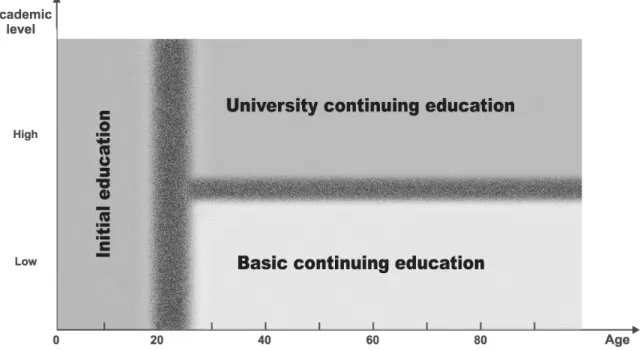
In fact lifelong learning in its definition covers the whole education area: initial education, basic continuing education and university continuing education. All the listed components are graphically represented in Fig. 1 (a slightly different form of which is presented in [2]). According to some writers, the usage of lifelong learning term is so all-encompassing that it is in danger of losing all meaning [3].
Fig. 1: Lifelong learning (the whole area) and university continuing education
Let us mention here that also the related terms like “adult student”, “part-time student”, “higher education” and “further education” are not understood in one universal way, but depend on the society, tradition and culture of the country.
The central concerns of the continuing education according to Taylor [4] are: • individual and cultural education for personal growth and understanding, • facilitating the pleasure of intellectual discovery and debate,
• civic and collective education to meet the needs of the community and to enhance democratic structures,
• developing adult students critical faculties,
• disseminating the core value of university education, • awareness of scientific, environmental and social issues,
• developing effectiveness and capability through intellectual and specialized skills,
• generally bringing together the expertise and values of the university and the life experience and real life issues of the regional community.
Information technology and Lifelong learning
“Technology can make lifelong learning a reality” [5] is in a nutshell presented the North American point of view. With electronic tools, people can (theoretically) learn virtually anytime and anyplace they choose without obstacles in place, time and social status.
UNESCO’s “Policy Paper for Change and Development in Higher Education” urges higher education institutions to make greater use of the advantages offered by the advancements of communication technologies so that »each university should become an open university offering possibilities for distance learning and learning in various points in time« [6]. E-learning is not seen as a shift from the traditional to open learning, but rather as a support to conventional learning processes with the use of modern information technology and distance educational methods. Modern implementation of e-learning in educational institutions can be considered as the result of the convergence process of distance and conventional education.
9
As recent reports demonstrate clearly, the pace of e-learning and ODL is accelerating, and it is likely to occupy a growing part of the landscape in higher education. According to the cited UNESCO report, [6] open and distance learning is one of the most rapidly growing fields of education, and its potential impact on all education delivery systems has been greatly accentuated through the development of Internet – based information technologies, and in particular the World Wide Web. E-learning at the tertiary levels shows a two-fold development pattern. On the one hand, numerous single model open universities have emerged to absorb large numbers of new learners, while, on the other hand, increasing numbers of traditional universities have begun to offer their programmes also through distance education. The development of new information and communication technologies has reinforced this trend. In the book where the role of “Net Generation” is explored [7], the new ways of learning for the new generation are presented.
The new learning process brings up the following shifts: • from linear to hypermedia learning,
• from instruction to construction and discovery, • from teacher-centered to learner-centered education,
• from absorbing material to learning how to navigate and how to learn, • from school to lifelong learning,
• from one-size-fits-all to customized learning, • from learning as torture to learning as fun, and,
• from the teacher as transmitter to the teacher as facilitator.
Tapscott’s research leads him to conclude that the “Net Generation” is a force for educational transformation. They process information differently than previous generations, learn best in highly customizable environments, and look to teachers to create and structure their learning experience. Furthermore, the importance of understanding the behavioral patterns of the network generation exceeds merely appreciating that they are comfortable working online. A crucial element for successfully delivering virtual courses entails transforming the educational experience so that it is meaningful to the information-age learner.
Due to the overall development and wide implementation of e-learning and because of high number of students that will participate in LLL it is evident that e-learning is going to be the foundation on which LLL will be built. Nevertheless, to come to this point, e-learning has still to become inexpensive, user-friendly, actively motivating, multimedia supported and widely accessible.
How can LLL benefit from technology and innovation in learning processes?
Users/learners of Lifelong learning services to be offered by universities and other educational institutions are expected to be mostly adults with different levels of background knowledge and different levels of ICT skills. Therefore it is crucial that LLL e-learning platforms are operating in friendly, easy to use and robust environment. On the other hand, the didactics will have to be designed in such a way that the learning process is motivating for the learner and that it supports the knowledge generation (constructivistic learning). As far as the high quality access is concerned there is a new technology coming up, namely the m(mobile)-learning which will make the learning possible practically anywhere and anytime.
In the majority of e-learning programs offered today, the burden for learning is placed entirely on the shoulders of the learner. When “e-students” go to a course web site, they enter a menu of activities: announcements, documents, assignments, external links, communications and tools. Students are expected to navigate this material on their own, without much support. They are generally offered email links to faculty and other students, but not much more. “Collaborative learning” is trying to
solve this situation by creating a virtual social space that must be managed for the teaching and learning needs of the particular group of people inhabiting that space. Such a common space is very important for the motivation and effective learning of UCE students that lack the social component of traditional student’s environment. Such a system also allows for something that is often overlooked in the e-classroom: recognizing and acknowledging the most valuable contributors. All these qualities are beneficial to the adult learner who is using the information technology as the means of interaction with the faculty, teachers and fellow students.
As far as technology aspect is concerned, the e-learning support is being upgraded with new features. We believe that the personalization of the e-learning services is going to play an important role in the friendliness and intimacy experience of the learners.
Personalization of e-learning services
The necessary technology development itself seems to make (some) learners feel uncomfortable. The variety of new technology features, services and functionalities may limit rather than stimulate the critical motivation in learners.
The personalization of the technology platform offers the learning organizations a method for enhancing the learners’ intimacy through their web site, which is, without any doubt, an additional motivation factor for the learner to whom the computer represents a major learning media. The technology providers will be forced to offer both highly sophisticated and at the same time “simple to use” e-learning functionalities. One of the major solutions to combine these two directions is the personalization of the e-learning technology platform.
In February 1999, the Gartner Group stated that, “matching direct or inferred reader requests through content personalization will be the most dramatic development in the Internet (...) through 2002, and will help differentiate the Web as a new medium”. Clearly, this is an important technology, and is being applied in many Internet systems in use today. Recent studies, for example [8], reports that relative advantage, compatibility, ease of use, and trialability significantly impacts the intended use of the personalization features on a web site. On the other hand visibility, image and result demonstrability were found not to have a significant impact on intent to use the personalization features on a web site. The study also found that the personalization features should be easy to use and should exhibit some advantage to the users to ensure adoption and use.
Three aspects of a Web site affect its utility in providing the intended service to its users. These are the content provided on the Web site, the layout of the individual pages, and the structure of the entire Web site itself [9]. The relevance of each of the objects comprising a Web page to the users’ needs will clearly affect their level of satisfaction. The structure of the Web site, defined by the existence of links between the various pages, restricts the navigation performed by the user to predefined paths and therefore defines the ability of a user to access relevant pages with relative ease. However, the definition of relevance is subjective. It is here that there is a potential mismatch between the perception of what the user needs, on the part of the Web site designer, and the true needs of users. This may have a major impact on the effectiveness of a Web site.
Personalization technology involves software that learns patterns, habits, and preferences. Personalization is a toolbox of technologies and application features used in the design of an end-user experience. Features classified as “Personalization” are wide-ranging, from simple display of the end-user’s name on a Web page, to complex catalog navigation and product customization based on deep models of users’ needs and behaviors. Similarly, personalization technologies range from commonplace use of databases, cookies, and dynamic page generation, to esoteric pattern matching and machine-learning algorithms, rule-based inferencing, and data mining [10].
As far as the technological process is concerned, personalization can be considered a three-step process in which customer information (their preferences, behavior, and profile) is taken as input, business rules are evaluated, and customized content is generated as output [11].
11
When developing a complete e-learning technology solution (model, software and portal), presented in [12], we proposed and implemented some personalization features that are especially appropriate for e-learning systems. In details the personalization itself is presented in [13]. Some special features of the personalization of e-learning services are presented in [14].
The users of the e-learning portal can be more productive if the portal is following their needs and interests. There are several common “personalization” solutions. For instance, for the purpose of the role division, one is provided, after authentication, with specific content and outlook. This “personalization” is driven by fix role categories of the users (teacher, learner, administrator etc.). Basically, this is not a part of personalization but authentication, or better, security service. However, it raises a notion about user segmentation in general and personalization provision for them. Authentication is important but not required for identification of users. Personalization is performed according to some kind of profiles, whether aggregated or individual. We also have to distinguish between registered users and anonymous users and treat the latter as potential customers with triggering some special “program” to retain them. They should be offered by relevant content (and possibly presentation) as soon as possible. We have to take into account that the personalization ideal is constrained also by a today’s hardware and a need to provide personalization in real-time. The goal should be to achieve personalization without or with little user intervention as possible with tracking their usage data.
Important trends and conclusion
Some important trends that impact (the growing of overall) adult education are: • companies operate more and more in global markets,
• labor markets become world-wide and network based,
• Bologna process, Lisbon strategy, eEurope programmes, other EU-level policies, • market driven higher education, stronger competition,
• complex systems become basis of top products and production, • innovation and exploitation of technology is crucial,
• use of mobile information network and open information sources,
• ICT enables new ways of learning, info flow and profit and knowledge management,
• society emphasizes the citizens motivation to learn, people want to be challenged in new ways. It is more or less evident that lifelong learning in general and the university continuing education will experience consistent expansion in the future. Lifelong learning has a very high priority in European policies and action plans. At the present time there is a lot of terminology differences and variety of concepts in Europe but on the other hand it seems that EU will solve problems in diversity of models and statistics data with common actions within the European area of lifelong learning. There is practically no doubt that the foundation of LLL provision is going to be the information technology and e-learning together with the emerging m(mobile)-learning technologies. Information technology supported learning is creating new means of communication between students and teachers and as a consequence new ways of knowledge transfer, such as collaborative learning are evolving. As several shifts of the learning process are identified, one can conclude that the influence of e-learning on education will be very extensive. New social relations are being born between the key players of e-learning (students, university/faculty, teachers/instructors, support staff and administrators). Some research works suggest that a driving force for educational transformation is actually the new generation of learners – the so-called “Network generation”.
One of the most important new technology solutions in e-learning is going to be the personalization which makes the e-learning systems friendlier and can (when implemented properly) significantly diminish the technology barrier effect of the learner’s access to the e-learning processes and e-educational institutions. Through the personalization, the learning organizations can help learners to