BJRS
RADIATION SCIENCES
07-02A (2019) 01-06ISSN: 2319-0612
Accepted: 2019-01-27
Determination of natural radionuclides in waste generated
in the potable water treatment plants of the Zona da Mata
of the state of Pernambuco- Brazil
A. M. A. Albuquerque
a; F. C. S. S. França
a; P. B. Silveira
b; A. C. Almeida
a; E. E. G.
Farias
b; C. A. Hazin
b; E. V. Honorato
baFederal University of Pernambuco/UFPE/Nuclear Energy Department, 50740-540 Recife, PE, Brazil bRegional Center for Nuclear Sciences, Brazilian Nuclear Energy Commission, 50740-540 Recife, PE, Brazil Federal
ABSTRACT
The water intended for human consumption must have qualities that meet the criteria required by health agen-cies. To meet these requirements, waters from natural sources are generally subject to purification procedures, which aim to minimize the presence of components that may present a potential health risk. Studies show that the processes of purification of water for human consumption are quite effective in the removal of the radionu-clides. The material precipitated during the purification process may accumulate the radionuclides present in the treated water and this material is indicated as TENORM by the United States Environmental Protection Agency. This residue may have significant levels of radioactivity and, when discarded in the environment, without any treatment, can generate a problem of environmental impact and a risk to the health of the population. Thus, the present study aimed to evaluate the residues generated in PWTPs from the state of Pernambuco, from the de-termination of 226Ra and 228Ra, included in the potability criteria, and of the gamma-emitting, in order to cor-roborate the studies of this TENORM . The results obtained are in accordance with the literature and the classi-fication of the residues generated in the PWTPs as concentrators of the radioactive components contained in the water supplied to the system, indicating the need for studies on the impact of the release of this residue to the environment, which is the usual way of disposal of this residue in the study region, considering the established patterns of radiation protection and the possible associated ecological risks.
1. INTRODUCTION
The water intended for human consumption must meet the criteria for drinking water, estab-lished by health agencies, for the purpose of preserving the health of the population [1; 2]. These criteria are generally achieved by the application of treatment technologies which promote the re-moval of impurities by coprecipitation with added chemical reagents in the treatment process or by filtration mechanisms which retain them in the treatment system [3; 4; 5; 6].
The studies carried out by Baeza et al (2008) and Wisser (2003) showed that the treatment pro-cesses are effective for the removal of radionuclides from the treated water, with removal efficiency close to 100% [3; 4]. These radionuclidees thus end up concentrating on the waste generated in the treatment, with the potable water treatment plants - PWTPs being included in the group of indus-tries that tend to concentrate radioactive materials of natural occurrence -TENORM, the residue generated in the treatment being evidenced as a TENORM, which indicates the need to characterize its radiological aspect [7; 8; 9; 10; 11].
Fonollosa et al (2015) observed in their literature review study, for the presence of radionu-clides in the PWTPs, that natural radionuradionu-clides, such as uranium, thorium, radio, lead and poloni-um, are more abundant in the PWTPs residues, exhibiting concentrations of activity ranging from 10 to 7000 Bq.kg-1[9]. The composition of these residues, as regards the presence and concentration of activity, is distinct for different regions and treatments, depending on the characteristics of the water being treated, the geology of the study area and anthropic activities [6; 7; 8; 9; 12; 13].
Another important factor, which points out the need to study the residues generated in the PWTPs in relation to their radiological content, is the form of discard applied to them, being of great relevance the dispersion of radionuclides by TENORM. In the region under study, this con-cern is evidenced by the common release of this residue into the environment without any previous treatment, in rainwater networks or directly in rivers and the like, which can lead to the dispersion of these elements in the environment and consequent risk [8; 5; 6].
The present study therefore has the relevant objective of evaluating the residues generated in the PWTPs of Zona da Mata in the state of Pernambuco, based on the radiological characterization of
the natural radionuclides present in the residue and determination of 226Ra and 228Ra, due to their radioecological importance.
2. MATERIALS AND METHODS
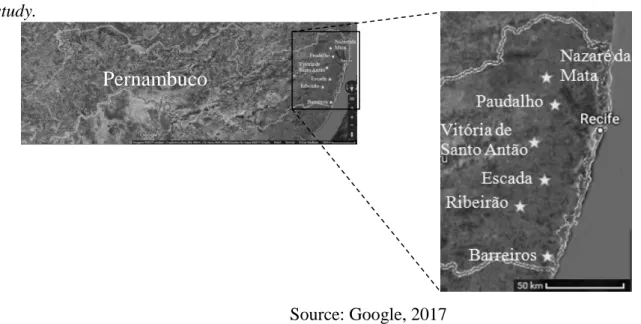
2.1. SamplingThe residue samples were collected in six PWTPs located in the Zona da Mata of the state of Pernambuco, in the municipalities of Barreiros, Escada, Nazaré da Mata, Paudalho, Ribeirão and Vitória de Santo Antão (Figure 1).
Figure 1: Satellite location with highlight to the municipalities of the PWTPs selected for the
study.
Source: Google, 2017
The PWPTs participating in the study present a complete cycle of treatment and use of aluminum sulphate as a coagulant, being this configuration the most used in the world and applied in 70% of Brazilian PWTPs [6; 14].
Waters treated in the PWTPs of the study area come from surface water sources, located in the vicinity of PWTs. These sources are generally of low quality and are impacted by the release of
Nazaré da Mata Paudalho
household, industrial and agricultural waste. They present classification of quality of classes 2 and 3, according to the CONAMA Resolution nº 357/2005, which deals with the classification of water bodies. [14; 15].
In the studied region, the municipality of Paudalho presents greater agricultural development, and the municipality of Vitória de Santo Antão presents greater industrial development, being the development of these significantly different from the others [16].
The collections were carried out from July to August 2015, in the period characterized as a rainy season, in which pluviometric indices are recorded that can reach the region up to 1044 mm [17]. This period was chosen, considering that in the literature the highest concentrations of activity are found in the rainy season, for surface water sources, due to the contribution of substances to the bodies of water in this period [7; 8; 12].
The residues were collected with the aid of plastic containers directly from the discharge systems of the decantation and filtration tanks, composing six representative samples of each PWTP [8; 12]. After the collection, the samples were taken to the Environmental Analysis Laboratory of the Regional Nuclear Science Nucleus of the Northeast CRCN / NE, and preceded by pre-treatment. The pretreatment process consisted of drying the oven samples at 80 ° C until constant weight, with subsequent homogenization and spraying until the entire sample passed through a 63 μm mesh sieve.
The pretreated samples were packed in standard laboratory containers, made of acrylic with a volume of 12.5 cm3, and then sealed to allow the growth of the short half-life descendants of 222Rn, after about 30 days, the samples were taken to counting.
2.2. Determination of radionuclides
In the literature, the characterization of the radiological aspect of the PWTPs residues is widely performed by gamma spectrometry, since this technique provides detailed information on the pres-ence of different radionuclides in a simple way [7; 8; 9; 11].
To determine the radionuclides, the samples were submitted to the gamma spectrometry tech-nique in the CRCN / NE environmental analysis laboratory. The equipment used was a hiperpure
germanium gamma spectrometer with high efficiency, and with 2.6 keV resolution in the 1332 keV energy of the 60Co, intrinsic efficiency of 40%, and coupled to a Canberra multi-channel analyzer of 8,192 channels, with acquisition managed by Genie-2000 Canberra software.
In order to increase the identification capacity of gamma emitters with low activity levels com-monly present in this type of sample, it was selected a counting time of 80,000 seconds [3; 7; 8].
The counting efficiency was determined using the curve generated by the reading of a sample prepared with the same geometry of the analyzed samples, doped with 5 mL of standard solution of 152Eu, 133Ba and 241Am, provided by IRD/CNEN - Institute of Radioprotection and Dosimetry / National Commissions Nuclear Energy.
In addition to the concentration of radionuclides present in the samples, the activity concentra-tions of 226Ra and 228Ra were calculated. This calculation was performed through the weighted average of the concentration of activity of the isotopes indicated in Table 1, assuming as a weighting factor the probability of emission.
Table 1: Gamma energies used for determination of 226Ra and 228Ra.
Radionuclides Issuer Energy (keV) Probability of emission (%)
226 Ra 214 Pb 214 Pb 214 Bi 214 Bi 295.21 351.92 609.31 1120.29 18.7 35.8 45.0 14.9 228 Ra 228 Ac 228Ac 911.21 968.97 26.6 16.2
To evaluate the quality of the applied method, some samples were sent to the Laboratory of the Envi-ronmental Impact Analysis Service (SEAIA-IRD / CNEN). The obtained concentrations were compared by the t-student test, to evaluate the accuracy of the analysis, with the results belonging to the same distribution with 95% confidence.
3. RESULTS AND DISCUSSION
Due to the indication of the residues of the PWTPs as a TENORM, in the literature are observed studies that aim to characterize them regarding the presence of natural radionuclides [7; 8; 9; 12; 18]. The present study also had this objective, being pioneers in the radiological survey of PWTP residues in the region under study. The results obtained can be observed in Figure 2.
Figure 2: Activity concentration of radionuclide in the residues.
As can be seen in Figure 1 the radionuclides found in the residues of the PWTPs under study by gamma spectrometry were: 40K, 212Bi, 212Pb, 214Bi, 214Pb, 228Ac and 234mPa, with activity
concentrations ranging from 10 to 524 Bq.kg-1 . These results are in accordance with the literature, regarding the presence of 40 K and the uranium and thorium series descendants, with activities found close to the lower levels described [7, 8, 9, 12, 13].
The literature relates the concentration of radionuclides to the type of treatment technology and the quality of the water to be treated, where this quality depends on the geology of the study area and the anthropic actions [3, 4, 6, 7, 8, 12, 13]. In this aspect, the concentrations found in the resi-dues studied vary between PWPTs due to the aspects of the treated water, since the same type of treatment is applied in all of them.
The agricultural and industrial development of the municipalities showed no relation with the levels found. The municipalities of Paudalho and Vitória, which have significantly greater agricul-tural and industrial development respectively, did not present concentration differences that indicate some relation [16]. It is possible, however, that there is a local influence of some anthropic activity in the vicinity of the sources used for water supply.
The concentrations found were higher in the Barreiros and Ribeirão PWTPs, located in the south of the state, and smaller in the Nazaré da Mata and Paudalho PWTPs, located in the north of the state, indicating a gradual reduction in the north direction, corroborating the possible relation-ship with the geology conditions of area.
For a better understanding of the contribution of the radionuclides present in the residues, the correlation between them was verified, as can be observed in Table 2. The isotope of Bi and Pb, and Ac-228, representatives of the 238U and 232Th series, presented a strong correlation, whereas K-40 and 234mPa presented a low correlation, and the correlation of 40K and 234mPa was negative. This aspect is possibly related to the characteristics of the treatment technology applied [3, 4, 7, 12].
Table 2: Correlation between the radionuclides in the residue.
K-40 Bi-212 Pb- 212 Bi- 214 Pb- 214 Ac- 228 Pa-234m
K-40 1 Bi- 212 0.732844 1 Pb- 212 0.465097 0.900604 1 Bi- 214 0.309839 0.824738 0.974661 1 Pb- 214 0.773156 0.965205 0.878985 0.8196 1 Ac- 228 0.601261 0.819374 0.916355 0.875165 0.889893 1
Pa- 234m -0.3399 0.344813 0.58212 0.716082 0.325696 0.376727 1
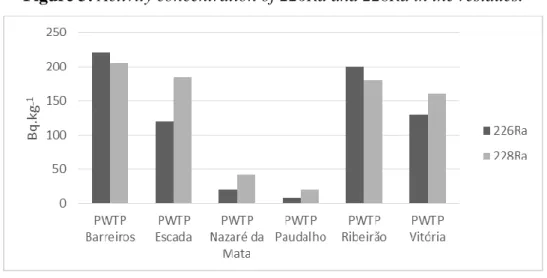
From the obtained results 226Ra and 228Ra were also calculated, due to their radiological im-portance. The results obtained can be observed in Figure 3
Figure 3: Activity concentration of 226Ra and 228Ra in the residues.
The values found are in agreement with the literature, where, for example, in the study by Chmielewska et al (2014) concentrations for 226Ra were obtained from 48 to 243 Bq.kg-1, and for 228Ra from 80 to 3654 Bq.kg -1 [9,19]. The concentrations of the present study are possibly a co-sequence of the characteristics of the water under treatment and the high removal rate of these radi-onuclides in the conventional PWTP [3, 4, 7, 12].
The levels found do not show that the residues under study can be released into the environ-ment, since the risk aspect of this TENORM is not associated to their levels, since they are general-ly low, but rather to the volume generated [9,10] . An in-depth study of the radioecological conse-quences of this release is therefore necessary.
4. CONCLUSION
The results corroborate the classification of the residues generated in the PWTPs as concentra-tors of the radioactive components contained in the water supplied to the system. The evaluated
residues presented concentration of activity of the natural radionuclides of 40K and of the U and Th series in the range described in the literature, with higher concentrations in the PWTPs located to the south of the state, possibly due to the geological condition of the study area. The risk associated with the dispersion of radionuclides in the environment increases the need for studies to evaluate the release of PWTP residues, considering radiation protection standards.
ACKNOWLEDGMENT
The authors would like to thank the colleagues who contributed to the study and CNEN for the financial support.
REFERENCES
[1] BRASIL - MINISTÉRIO DA SAÚDE. Portaria nº 2914 de 12 DE DEZEMBRO 2011. Brasí-lia: ministério da Saúde, 2011.
[2] WHO - World Health Organization. Guidelines for drinking-water quality - 4th ed. 4.Guidelines. I.World Health Organization. ISBN 978 92 4 154815 1 (NLM classification: WA 675), 2011.
[3] BAEZA, A. SALAS, F. LEGARDA, F. Determining factors in the elimination of uranium and radiumfrom groundwaters during a standard potabilization process. Science of the total
envi-ronment v. 406, p. 24–34, 2008.
[4] WISSER, S. Balancing Natural Radionuclides in Drinking Water Supply. Doctoral Thesis, Johannes Gutenberg-University, Mainz, 2003
[5] SABESP - Companhia de Saneamento Básico do Estado de São Paulo. Usos benéficos de lodos
de estações de tratamento de água. Available at:
<http://www.sabesp.com.br/sabesp/filesmng.nsf/DF6C53CCF001D57A832573F00072C0DD/$ File/sabesp_lodos_ETA.pdf>. Last accessed: Jun. 2017.
[6] DASSANAYAKE, K. B.; JAYASINGHE, G. Y.; SURAPANENI, C. H. A review on alum sludge reuse with special reference to agricultural applications and future challenges. Waste
Management, v38, p321-335, 2015.
[7] PALOMO, M.; PEÑALVER, A.; AGUILAR, C.; BORRULL, F. Presence of Naturally Occurring Radioactive Materials in sludge samples from several Spanish water treatment plants.
Journal of Hazardous Materials v. 181, p. 716–721, 2010a.
[8] KLEINSCHMIDT, R.; AKBER, R. Naturally occurring radionuclides in materials derived from urban water treatment plants in southeast Queensland, Australia. J. Environ. Radioact. v. 99, p. 607–620, 2008.
[9] FONOLLOSA E.; NIETO A.; PENALVER A.; AGUILAR C.; BORRULL F. Presence of radi-onuclides in sludge from conventional drinking water treatment plants: A review. Journal of
Environmental Radioactivity v. 141, 2015.
[10] USEPA - United States Environmental Protection Agency. A Regulators’ Guide to the
Management of Radioactive Residuals from Drinking Water Treatment Technologies.
United States, Environmental Protection Agency, 2005.
[11] GAFVERT, T.; ELLMARK, C.; HOLM, E. Removal radionuclides at a water work.
Jour-nal Enviromental Radioativity 141, 2015.
[12] PALOMO, M.; PEÑALVER, A.; AGUILAR, C.; BORRULL, F. Radioactivity evaluation of Ebro river water and sludge treated in a potable water treatment plant located in the South of Catalonia (Spain). Applied Radiation and Isotopes v. 68, p. 474–480, 2010b.
[13] BAEZA, A.; SALAS, A. ; GUILLÉN, J; MUÑOZ-SERRANO, A. Association of naturally occurring radionuclides in sludges from Drinking Water Treatment Plants previously optimized for their removal. Chemosphere v. 97, p. 108–114, 2014.
[14] IBGE - Instituto Brasileiro de Geografia e Estatística. Atlas de saneamento 2011. Rio de Janeiro: IBGE, 2011.
[15] CONAMA-Conselho Nacional do Meio Ambiente. Resolução Nº 357, de 17 de março de
2005. Publicado em DOU nº053, de 18/03/2005, p58-63.
[16] IBGE - Instituto Brasileiro de Geografia e Estatística. Painel das cidades. Available at: <http://cidades.ibge.gov.br/painel/economia.php>. Last accessed: Jul. 2017.
[17] APAC- Agência Pernambucana de Águas e Clima. Estações do ano. Available at: <http://www.apac.pe.gov.br/meteorologia/estacoes-do-ano.php>. Last accessed: Jul. 2017. [18] LYT LE, D. A.; SORG, T.; WANG, LILI; CHEN, A. The accumulation of radioactive
con-taminants in drinking water distribution systems. Water research v. 50, p. 396 – 407, 2014. [19] CHMIELEWSKA, I.; CHALUPNIK, S.; BONCZYK, M. Natural radioactivity in drinking
underground waters in Upper Silesia and solid wastes produced during treatment. Appl. Radiat