" # ! ! $ ! % & '! ( ! & ) ' ! "0 % & ! % 1 '! ' ' ! 2 3 4 & ! ! 4 ' 5 3 ( % 1 '! 6 4 ! !' 4 ! ! 2 ! 7! 8' 7! 3 ! ! 4 9 1 '! ' 2 ' ( 4 & ! ! 4 ' 5 $ 3 3 ( 9 1 '! 2 ' " + 2 ! 4 & 4 ' 5 3 ( 9 1 '! :' ; $ 3 2 4 & '; 4 ' 5 3 ( 9 1 '! ( ! & ) ' ! 4 & '; 4 ' 5 3 ( 4 ! 9 ' ! ! ( (! *+ ' '! ! ! ( ' ! ! !' *< % $ = ' *+ 5 $ > ? % :@ @/...A@,-.. B 4 ' 5 3 ( ? % @ @--C-/@,-.D
,-./
I want to express my profound gratitude to my advisor, Professor Carlos Duarte for his immense transmission of knowledge and the way he allied high demand with friendship abundance. Thank you Carlos for being an inspiration on a daily basis, for the times you’ve always been there for me, for being both compassionate and strict, for motivating me to be a better researcher, for inspiring me into becoming a professor. Thank you for being a great advisor, and a dear friend.
I would like to thank Pedro Gonc¸alves, a constant presence during great part of my PhD and a person who tough me very much about commitment and about being a great professional, and for always having a smile on his face every single day I’ve worked side by side with him at LaSIGE.
I thank the support and the contributions of Gonc¸alo Grac¸as and F´abio Rito which were very important to my thesis, with whom I loved to work with and only regret not having had the opportunity to work again.
I want to thank all the institutions that helped me carrying out this thesis work and without which this PhD would never be possible: Universidade Internacional para a Terceira Idade (UITI), Universidade S´enior de Massam´a e Monte Abra˜ao (USMMA), Universidade S´enior de Odivelas, and an uncountable number of Senior Home facilities across the country which kindly took part in several of the studies.
I would very much like to thank professors Lu´ıs Carric¸o and Tiago Guerreiro for the valuable contributions and advises given that helped developing this thesis work or helped me becoming a better researcher.
I thank to various people with whom I’ve crossed my path during this PhD and whom I’ve always treasured the presence, friendship and advices. Thank you Andr´e Nogueira, Christoph Jung, Lu´ıs Almeida, Miguel Garcia, Vinicius Cogo, Andr´e Rodrigues, Rui Lopes, Ricardo Pinto, David Costa, Daniel Costa and Hossein RZ. I’d especially would like to thank Jan Egil Nordvik whose unexpected friendship and advices helped me greatly - Jan, I will now happily drink that Portvinsfat.
I will always be grateful to my dearest friends and LaSIGE colleagues Diogo Lima, Lu´ıs Duarte, Jo˜ao Craveiro, N´adia Fernandes and Tiago Gonc¸alves who helped me get here with invaluable good times and never-ending support. It’s the time I spent with you the one I treasure the most.
my PhD.
I’m grateful to my friends Lu´ıs Sousa, Diogo Albuquerque, Diogo Pinto, Jo˜ao Alves, Filipe Rodrigues, Ricardo Batista, Catarina Marques, Catarina Venceslau, Carolina Sim˜oes, Renata Milhano, Rui Pedro Caldeira, Jaime Carvalho, David Silva and Ruben Reis, for giving me all the friendship and support I ever needed during the last five years and for always motivating me to keep going.
Thank you F´abio Silva and Clara Patr´ıcio for giving me the unexpected and effortless friendship I always looked for but never though it existed. And thank you for the motivation and strength you gave me during the final two years of my thesis.
To my girlfriend and best-friend Beatriz Szwarc I thank you for giving me your World and for all the support in the darkest hours of this PhD. I don’t think I would ever finished this without you in my life.
I’d like to thank my brothers Paulo and Pedro for always being my closest friends and for teaching me so much about life and commitment.
A final word goes to my parents, to whom I owe everything I am, and who I will always look up to. The education you gave me is something I would only dream to pass on to my children. It’s the sacrifices, the advices and the love you gave me that brought me here.
A populac¸˜ao na maioria dos pa´ıses do mundo est´a a envelhecer, e esse envelhecimento traz consigo um aumento da dependˆencia na terceira idade juntamente com outros proble-mas. Desses problemas um dos mais preocupantes ´e o isolamento social, com os idosos a ficarem mais tempo em suas casas provocando uma diminuic¸˜ao dr´astica da quantidade e qualidade de interac¸˜oes sociais com os outros. Essa diminuic¸˜ao pode por sua vez levar a situac¸˜oes dr´asticas de degradac¸˜ao da sa´ude e ao aumento do risco de mortalidade. Os servic¸os de redes sociais (SNS), como o Facebook, constituem-se como o ve´ıculo ideal para aumentar essas mesmas interac¸˜oes sociais muito devido ao facto da maioria dos adultos ou da maior parte dos familiares dos idosos serem tipicamente utilizadores destes servicos, tornando-os um meio atrativo para este segmento da populac¸˜ao. Ainda assim, e embora o uso dos SNS entre a populac¸˜ao idosa tenha aumentado significativamente nos ´ultimos dez anos, actualmente apenas cerca de um terc¸o dessa populac¸˜ao faz uso destes. Raz˜oes para esta falta de ades˜ao est˜ao n˜ao s´o relacionadas com a complexidade de desenho e de interface destes servic¸os, com problemas de privacidade e com incapacidades sensoriais resultantes do envelhecimento mas tamb´em com o facto do PC, tecnologia tipicamente usada para lhes aceder, n˜ao se mostrar a forma ideal de intermediac¸˜ao entre esta populac¸˜ao e estes servic¸os. Desta forma, existe n˜ao s´o a necessidade de perceber e resolver problemas de interface relacionados com o SNS mais usado (Facebook) por forma a torn´a-lo mais inclusivo ou acess´ıvel, como tamb´em existe a necessidade de possibilitar que o acesso a este servic¸o seja efectuado atrav´es de tecnologia que incentive os idosos a procurarem de forma activa a comunicac¸˜ao com os seus amigos e familiares.
Esta tese defende que o desenvolvimento deste tipo de soluc¸˜oes deve basear-se em TV, n˜ao s´o porque esta ´e, nos dias de hoje, a tecnologia mais utilizada pela segmento mais velho da populac¸˜ao, mas tamb´em porque a mesma ´e entendida por estes como uma tecnologia menos intimidante que todas as outras, sendo facilmente associada a sentimentos de relaxamento bem como usada para apoiar ou desencadear atividades sociais em ambientes dom´esticos. Al´em disso, argumentamos tamb´em que, para lidar com as capacidades e diferenc¸as que caracterizam os idosos bem como a sua interac¸˜ao com a tecnologia, o desenvolvimento de soluc¸˜oes inclusivas baseadas em TV tamb´em se deve apoiar em diversas alternativas de interac¸˜ao e por isso em interfaces multimodais.
por parte da populac¸˜ao idos. Focou-se tamb´em na forma como diversos trabalhos baseados em aplicac¸˜oes para TV ilustram esta tecnologica como um potencial ponto de entrada vantajoso para o uso de redes sociais, bem como, na forma como trabalhos passados experimentaram diferentes formas de interac¸˜ao, mantendo o controlo remoto como a modalidade principal.
De seguida, o trabalho desenvolveu-se em diversas etapas relacionadas com a identificac¸˜ao de recomendac¸˜oes de desenho de aplicac¸˜oes TV baseadas nas caracter´ısticas e preferˆencias da populac¸˜ao idosa. Foram usadas v´arias t´ecnicas de recolha de requisitos bem como de-senvolvidos e testados com idosos variados prot´otipos funcionais. Os resultados mostraram acima de tudo que aquando do desenvolvimento de aplicac¸˜oes deste tipo para idosos devem ser suportadas v´arias formas de interac¸˜ao a fim de adequar a mesma `as amplas caracter´ısticas desta populac¸˜ao e por forma a compensar os decl´ınios sensoriais e mo-tores relacionados com o envelhecimento. Adicionalmente como resultado desta an´alise identific´amos mais de trinta recomendac¸˜oes desenho deste tipo de aplicac¸˜oes.
No que diz respeito `as tecnologias sociais, esta tese comec¸ou por aprofundar atrav´es de uma extensa pesquisa bibliogr´afica o entendimento das diversas raz˜oes que contribuem para a falta de adoc¸˜ao de SNS por parte da populac¸˜ao idosa bem como se traduziu na identificac¸˜ao dos diversos dom´ınios referentes `a interac¸˜ao desta populac¸˜ao com este tipo de servic¸os. A isto seguiram-se v´arias etapas de recolha de requisitos atrav´es de ques-tion´arios online, discuss˜oes em grupos de foco bem como de entrevistas semi-estruturadas. Nestas foi discutido o papel das redes sociais, a forma como os idosos percecionam e interagem com estas, e a receptividade desta populac¸˜ao para o uso da TV como forma de mediar essas mesmas redes. Como resultado de todas estas fases de trabalho, identifi-camos recomendac¸˜oes de desenho de redes sociais direccionadas para as caracter´ısticas da populac¸˜ao idosa e abrangendo treze dom´ınios diferentes: dos mais importantes rela-cionados com o papel da fam´ılia, o controlo de mecanismos de privacidade e princ´ıpios de desenho de interfaces, `a importˆancia da multimodalidade, da capacidade de agrupar contactos e funcionalidades, fotos, reciprocidade de interac¸˜oes e tangibilidade das func¸˜oes.
Seguindo as recomendac¸˜oes relativas ao desenho de aplicac¸˜oes TV e de SNS direc-cionadas para a populac¸˜ao idosa e tendo como principal objectivo aumentar o uso de SNS por parte da populac¸˜ao idosa e por consequˆencia reduzir o isolamento social dos mesmos, desenh´amos e implement´amos um prot´otipo multimodal access´ıvel baseado no Facebook e em TV, o “You, Me & Tv”. Este prot´otipo foi desenvolvido seguindo uma abordagem de desenho centrado no utilizador bem como de desenho participativo. Neste processo, base´amo-nos na simplificac¸˜ao da interface do utilizador mantendo apenas as funcional-idades mais importantes para a populac¸˜ao idosa, alterando parcialmente a localizac¸˜ao e/ou o agrupamento destas funcionalidades, e recorrendo a mecanismos multimodais e
fotos f´ısicas em formatos digitais utilizando uma cˆamera colocada por cima da TV e oferecendo a hip´otese de partilhar a foto resultante atrav´es do prot´otipo. A outra suporta a possibilidade de partilhar o que os utilzadores est˜ao a ver na TV. O prot´otipo foi usado e avaliado durante um per´ıodo de 3 a 6 semanas por trˆes idosos com os resultados a indicarem um claro potencial deste sistema para aumentar as interacc¸˜oes sociais online e offline entre idosos e (principalmente) os seus parentes, bem como o importante papel da TV na mediac¸˜ao deste acesso sobretudo para idosos que ainda n˜ao eram utilizadores de Facebook, a importˆancia do controlo remoto e a forma como este deve ser mantido como o principal meio de interac¸˜ao, e como tanto a fala como os gestos podem ajudar em tarefas de produc¸˜ao de conte´udo (escrita ditada) e de visualizac¸˜ao (navegar entre fotos). Atrav´es da avaliac¸˜ao manifestamente positiva do prot´otipo em termos de usabilidade, verifica-se como relevantes muitas das recomendac¸˜oes identificadas durante os passos anteriores desta tese.
Em trac¸os gerais, o trabalho desenvolvido nesta tese responde a trˆes diferentes quest˜oes de pesquisa: 1) quais os factores que limitam a adopc¸˜ao de redes sociais por parte da populac¸˜ao idosa; 2) como estes factores devem ser considerados no desenho de servic¸os de redes sociais que consideram as caracteristicas dos idosos; e 3) quais as caracter´ısticas dos sistemas multimodais baseados em TV que podem contribuir para aumentar a adopc¸˜ao de redes sociais por idosos. Adicionalmente, esta tese tamb´em responde a duas diferentes hip´oteses, validando que atrav´es do uso de servic¸os de redes sociais focados em TV e em capacidades multimodais, a populac¸˜ao idosa pode aumentar o n´umero de interac¸˜oes sociais com membros da fam´ılia ou amigos pr´oximos, mas n˜ao validando que o mesmo sistema seja capaz de ajudar no desenvolvimento de novas relac¸˜oes de amizade.
Palavras-chave: idosos, multimodalidade, redes sociais, televis˜ao, Facebook, desenho centrado no utilizador
World population is ageing with social isolation increasing as a result. While Social Network Services (SNS) like Facebook constitute the ideal vehicle for increasing social interactions, only about one-third of this population makes use of them. Reasons for this lack of uptake are related to design complexity, privacy issues and age-related impairments, with traditional technology like the PC also proving to be insufficient for mediating older adults access to these services. This thesis argues for the development of SNS solutions based on Television (TV) and multimodal mechanisms, as TV is not only older adults’ most frequently used technology, but also perceived as less intimidating and associated with social interchanges, and as resorting to several modalities can help accommodating differences and to overcome disabilities typically present in this population. With this in mind, we drew recommendations for the design of TV-based applications targeting older adults by performing inquiring techniques and testing distinct TV-based multimodal prototypes. We followed this with a full literature survey on older adults’ use of social applications as well as several other inquiries regarding SNS and receptiveness of TV for social tasks. As a result, we formulated recommendations targeting the appropriate design of an inclusive SNS which span thirteen distinct domains. Recommendations focus mainly but not only on family, privacy, multimodality and UI design. Building on these and focusing on user-centered design (UCD) and participatory design we implemented a multimodal SNS and TV based prototype (You, Me & TV) and evaluated it during a period of 3 to 6 weeks with 3 participants. Results clearly indicate a potential for the system to increase online and offline interactions for older adults, the relevancy of TV in mediating this access for non-adopters of Facebook, the importance of remote controller to be kept as the primary way of interaction, how speech and gestures can help in content production and visualization purposes and how photos also play a relevant role.
Keywords: older adults, multimodality, social network services, television, Facebook, user-centered design
List of Figures xviii
List of Tables xxi
1 Introduction 1
1.1 Problem and Motivation . . . 1
1.2 Research Goals . . . 4
1.3 Relation to GUIDE Research Project . . . 5
1.4 Research Methodology Employed . . . 6
1.5 Contributions . . . 7
1.5.1 List of Publications . . . 9
1.6 Dissertation Structure . . . 12
2 Related Work 15 2.1 Older Adults Limitations . . . 15
2.1.1 Sensory Characteristics . . . 16
2.1.2 Cognitive Characteristics . . . 18
2.1.3 Motor Characteristics . . . 21
2.2 TV and Older Adults . . . 24
2.2.1 TV-based Interaction . . . 25
2.2.2 TV as a Social Solution . . . 32
2.3 Summary . . . 35
3 Design of TV Applications targeting Older Adults 37 3.1 Methodology . . . 37
3.2 Stakeholders Research Stage . . . 39
3.2.1 Inquiring Older Adults . . . 39
3.2.2 Inquiring Developers . . . 40
3.3 Multimodal Interaction User Study . . . 42
3.3.1 User Test Application . . . 42
3.3.2 User Study Procedure . . . 43
3.3.3 Results . . . 45 xi
3.4.2 Prototyping Electronic Program Guide Application . . . 51
3.4.3 User Study Procedure . . . 53
3.4.4 User Study Results . . . 55
3.5 Recommendations for the Design of TV Applications targeting Older Adults 58 3.5.1 Interaction Modalities . . . 59
3.5.2 Multimodality . . . 60
3.5.3 Adaptation . . . 61
3.5.4 TV-based UI . . . 63
3.6 Summary . . . 64
4 Drawing Recommendations for the Design of a Social Network Service tar-geting Older Adults 67 4.1 Methodology . . . 67
4.2 Gathering Literature Requirements . . . 68
4.2.1 Procedure . . . 69
4.2.2 Social Applications and Older Adults . . . 71
4.2.3 SNS use by Older Adults . . . 76
4.2.4 Social Network Services Developed for Older Adults . . . 81
4.2.5 Discussion . . . 84
4.3 Gathering Older Adults Requirements . . . 93
4.3.1 Inquiring Older Adults About SNS . . . 93
4.3.2 Generating Discussion on Older Adults’ Facebook Use . . . 103
4.3.3 Generating Discussion on Older Adults TV-Related Use . . . 108
4.4 Recommendations for the Design of a SNS targeting Older Adults . . . . 114
4.4.1 Family . . . 114
4.4.2 User Interface . . . 116
4.4.3 Privacy . . . 118
4.4.4 Photos and Media Relevance . . . 119
4.4.5 Multimodality . . . 121
4.4.6 Direct Communication . . . 122
4.4.7 Knowing New People . . . 123
4.4.8 Personalization and Adaptation . . . 123
4.4.9 Grouping . . . 124 4.4.10 Tangible Value . . . 125 4.4.11 Offline Role . . . 126 4.4.12 Gender . . . 126 4.4.13 Reciprocity . . . 126 4.5 Summary . . . 127 xii
5.1.1 Procedure . . . 129
5.1.2 Results . . . 131
5.2 You, Me & TV prototype . . . 132
5.2.1 Design Decisions . . . 132
5.2.2 Implementation Decisions . . . 135
5.2.3 Main Functionalities . . . 136
5.2.4 Multimodal Architecture . . . 139
5.2.5 Adaptation and Personalization Interface . . . 140
5.3 Validation . . . 140
5.3.1 Participants . . . 141
5.3.2 Procedure . . . 141
5.4 Results . . . 142
5.4.1 Older adults acceptance . . . 142
5.4.2 Multimodality importance . . . 145
5.4.3 Benefits of personalisation and adaptation . . . 146
5.4.4 Usability and User Experience . . . 147
5.5 Discussion . . . 149
5.6 Summary . . . 152
6 Conclusions and Future Work 155 6.1 Dissertation Overview . . . 155
6.2 RQ1: What are the factors limiting SNS adoption by older adults? . . . . 156
6.3 RQ1.1: How these factors should be considered when designing SNS targeting older adults? . . . 158
6.3.1 Age-related impairments . . . 158
6.3.2 UI complexity . . . 160
6.3.3 UI functions . . . 162
6.3.4 Older Adults Self-Belief . . . 164
6.3.5 Technology . . . 165
6.4 RQ2: What characteristics multimodal TV-based platforms have that could contribute to older adults adoption of SNS? . . . 165
6.5 H1: By using TV-based multimodal SNS, older adults increase interactions with family members and close friends. . . 166
6.6 H2: By using SNS, older adults establish new friendships. . . 167
6.7 Limitations and Future Work . . . 168 A Survey Script: Stakeholders Research - Inquiring Older Adults 171
C User Trial Script: GUIDE Adaptive Interaction User Study 193
D Survey: Older Adults, Technology and Facebook 209
E You, Me &TV: Focus Groups Pre-Questionnaire 217
F Evaluation of You, Me & TV: SUS and UEQ Questionnaires (Portuguese
ver-sion) 219
Bibliography 242
1.1 Representation of the methodology of work followed during this thesis. . 7 2.1 Applications built with visual impairments in mind. BigLauncher (left),
Simple Senior Phone (middle) and GrandPhone Launcher (right). . . 17 2.2 Applications built with hearing impairments in mind. BioAid (left),
Hear-ing Aid with Replay (middle) and uSound (right). . . 18 2.3 Screens of mElderly, an application that prioritizes most used older adults
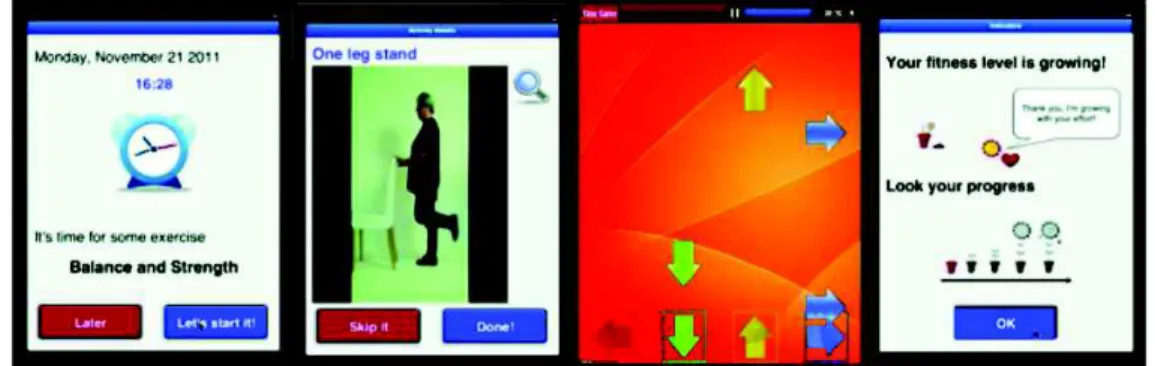
functions on the smart-phone. . . 20 2.4 Screens of the Stepmania application where users: are alerted to start
a session; follow video tutorials for interaction; play games; positive reinforcement and self-monitoring is used with a flower metaphor . . . . 21 2.5 Screen-shots of Clevermind user interface. . . 22 2.6 Visualization of the growing plant metaphors within the app to motivate
older people through conditioning, goal setting, and self-monitoring. . . . 23 2.7 Flower user interface consisting of a general overview (left), and a day
overview (right). . . 24 2.8 An example of a SimplePromenade virtual walk (left), GUI displaying a
virtual instructor remembering a particular movement protocol and user scores (right). . . 24 2.9 Iatrino and Modeo (2006) writing task approaches:: Multi-press with
timeout keyboard and visual feedback or TNT (left), multi-press with timeout keyboard (middle), virtual keyboard (right). . . 26 2.10 Remote controls used in the study (left), mean and standard deviations
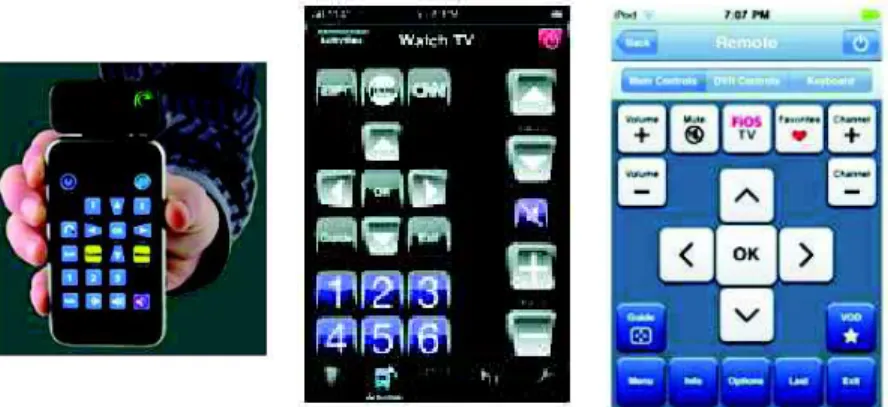
values of writing speed per method (right). . . 27 2.11 WeSlide: selection of ’G’ . . . 28 2.12 Some smart-phone touch-based RCs examples: the reRemote (left); the
redEye remote (middle); and the Verizon FIOS app . . . 28 2.13 RemoteTouch controller (left) and the mapping from the RemoteTouch
controller to the screen (right) . . . 29 2.14 Touchless Finger-Count in the context of interactive television . . . 29 2.15 Pointing devices and virtual keyboards used in Barrero et al. (2016) . . . 30 2.16 IntegraTV general interface (left); and speech-based interface (right). . . . 31
2.19 Eldy TV Software . . . 34 2.20 Screens of iNeighbour TV features . . . 34 3.1 The User Centered Design Approach . . . 38 3.2 Screen-shots of the UTA prototype . . . 43 3.3 User-trials photos. Colour selection screen (on the left), and participant
using a Wii remote (on the right). . . 45 3.4 Screenshots of the UIA Flash-based (low fidelity) prototype . . . 50 3.5 Screen-shots of the UIA high fidelity mockup (left) and UIA high fidelity
prototype (right). . . 51 3.6 Screen-shots of the UIA final prototype . . . 52 3.7 Screen-shots of the EPG mock-ups . . . 53 3.8 Screen-shots of the EPG high fidelity mock-ups . . . 54 3.9 Similarities between all adapted versions of the EPG. . . 55 3.10 Modality preferences by task . . . 58 4.1 Graphic showing distribution of answers regarding participants
technologi-cal self-characterization . . . 96 4.2 Reasons for limited use of Facebook for actual users (left) and for
non-users (right). . . 98 4.3 Reasons behind the use of TV . . . 102 4.4 Differences between users of Facebook and non-users of this SNS. . . 110 4.5 Older adults preferred modalities for interact with TV. . . 113 5.1 The low-fidelity prototypes used in the focus groups. . . 130 5.2 Home page with the news-feed . . . 133 5.3 Group and sub-group manager . . . 133 5.4 Volume and font size configuration (personalization) . . . 133 5.6 The news-feed . . . 137 5.7 Pictures that user took with Kinect camera. . . 138 5.8 A group with 3 members of user family. . . 139 5.9 Frequency of use of U1, U2 and U3 . . . 143 5.10 Feature usage by U1, U2 and U3 . . . 145 5.11 Social interactions of U1, U2 and U3 . . . 146 5.12 Evolution of SUS scores for U1, U2 and U3 . . . 148 5.13 Evolution of UEQ scores for U1, U2 and U3 . . . 149
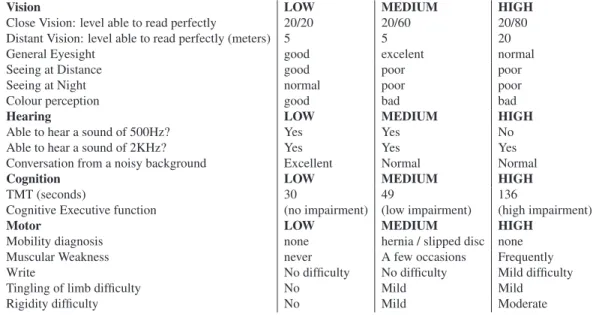
3.1 K-Means Cluster Centers for visual, hearing, cognitive and motor variables 40 3.2 Subjective ratings of the UIA. . . 56 4.1 Journals and Conferences included in the survey . . . 70 4.2 Additional relevant Journals and Conferences included in the survey . . . 71 4.3 Related Work and Domains . . . 85 4.4 Participants’ age range distribution. . . 94 4.5 Willingness to use Facebook. . . 97 4.6 Facebook use vs Technical Expertise) . . . 99 4.7 Facebook use vs Number of people the participant lives with . . . 100 4.8 Participants’ age range distribution. . . 109 5.1 Participants description . . . 141 5.2 Usage of different modalities relative to specific tasks. . . 147
Introduction
This introduction constitutes a broad overview of all the research reported in this thesis. It begins by discussing the motivation and main problems for the research. It follows with the definition of a set of resultant research questions and hypothesis, continues with a description of the methodology employed and the contributions made and concludes with a review of the dissertation’s structure.
1.1
Problem and Motivation
Population all over the world is ageing (Eurostat European Commission, 2012). At the beginning of this millennium, the world population aged 60 years or over numbered 600 million, triple the number reported in 1950. In 2009, these numbers had surpassed 700 million. By 2050, 2 billion older persons are projected to be alive, implying that they will once again triple over a span of 40 years (United Nations, 2010). Additionally, the population of older persons is itself ageing. Today, persons aged 80 years or over account for close to 1 in every seven older persons. And by 2050, this ratio is expected to increase to nearly one person among every five older person (United Nations, 2010).
As people get old, old-age dependency ratios increase (Commission, ECFIN) along with several other problems, such as cognitive impairments and motor disabilities as well as social limitations (Lutz et al., 2008; McLaughlin et al., 2009; Age, 2010). One of the most concerning issues is loneliness, which typically “kicks in” at retirement age. Older adults spend a lot of time alone in their homes resulting in low quantity and quality of contact with others which contributes to increasing social isolation (Cornwell and Waite, 2009). This resulting decrease of social contact can lead to drastic health degrading situations (Joinson, 2008; Sundar et al., 2011) and the increase in their mortality risk (Alaoui and Lewkowicz, 2013).
For older adults, loneliness and social isolation can mean, above everything else, the absence of contact with their stronger ties, usually family members but sometimes also close friends. For that reason, these are the primary motivations for the use of social and
communication technologies since these appeared (Santana et al., 2005; Lindley, 2012; Raffle et al., 2010; Judge et al., 2011). Thus, (off-line) social networks are the only way to fight isolation as these serve a significant number of functions, providing social and emotional support, information resources and ties to other people (Sundar et al., 2011).
Social Network Services (SNS) are the online equivalent to (offline) Social Networks. In the words of Burke, “SNS are designed to connect people with friends, family and other strong ties, as well as to efficiently keep in touch with a larger set of acquaintances and new ties, without having to share the same space” (Burke et al., 2011). A growing body of evidence suggests there are many social and cognitive benefits for older adults that make use of these technologies to create content and actively participate in reciprocal information sharing with family and friends, or even for other purposes like information seeking and learning (Karahasanovic et al., 2009; Bothorel et al., 2011; Judge et al., 2011; Cornejo et al., 2013; Lindley, 2012; Baecker et al., 2014; Harley et al., 2014).
Facebook, as the most popular SNS (Statista, 2018), constitutes the ideal vehicle for this use. With their family and friends already using this service, it becomes an attractive medium for enticing older adults to engage in an online presence. This is, in fact, the main reason why SNS developed specifically for older adults have not achieved popularity, with their younger counterparts not being interested in using these tailored new solutions (Chen, 2009; Waycott et al., 2013). Recent numbers also show the increased tendency for Facebook popularity among older adults, with about half of online elderly making use of it (Pew Research Center, 2015b). Still, and although the use of SNS among the oldest segment of the population has increased a lot in the last ten years (e.g. from 11% to 35% in the U.S.), only about one third makes use of them. This is especially relevant if we consider that about 65% of all adults use these services and that this percentage increases to 90% in younger adults (Pew Research Center, 2015a).
Reasons for this lack of uptake are complex, and much of the literature overlaps. Design complexity is one of the central problems with the majority of SNS UI overlooking age-related impairments (Gibson et al., 2010; Cornejo et al., 2013; Baecker et al., 2014; Lindley, 2012; Hope et al., 2014; Norval et al., 2014). Additionally, privacy issues (not understanding who can see what, being afraid of revealing too much, etc.) (Gibson et al., 2010; Norval et al., 2014; Hope et al., 2014; Waycott et al., 2013; Baecker et al., 2014), preconceptions about Facebook and SNS use (security problems, misuse, excessive use, or using SNS as a tool for making new friends) (Harley et al., 2014; Hope et al., 2014; Gibson et al., 2010; Lehtinen et al., 2009), and loss of more profound ways of communication (Burke et al., 2011; Hope et al., 2014) are other very relevant issues. Consequently, and because few recommendations or guidelines exist, there is the need of understanding and studying how these issues should be tackled to achieve a better inclusive design of this kind of services.
age-related changes in older adult’s physical, social and cognitive resources, they in many cases are unable to learn or make use of them (McLaughlin et al., 2009; Sayago et al., 2007). This is also the case for SNS access (Xie et al., 2012; Michailidou et al., 2015). Hence, the challenges are not only resolving interface problems related with well-known (and used by everyone) SNS like Facebook but also providing technology that encourages older people to actively engage in technology-mediated communication and support of an active life (Lindley et al., 2008).
In this context, we argue that the development of this kind of solutions should be based on familiar technology like Television (TV) especially if this can be allied with accessibility concerns. Not only TV is the most used technology by older adults (Bobeth et al., 2012; Heart and Kalderon, 2013; Mitzner et al., 2010), but is also perceived as a less intimidating technology (Coleman et al., 2010; Obrist et al., 2008). Additionally, watching TV is also associated with relaxation, safety and comfort, all factors that contribute to familiarity and ease of use, particularly in older adults (Tsekleves et al., 2009; Gawlinski, 2003). And research has shown that when performed in the right contexts and “contrary to the popular belief, watching TV is far from an isolating, antisocial, experience” (Lull, 2014): contributing to “structuring daily life, to satisfying old peoples’ needs for reflection and contemplation and to remain socially integrated” ( ¨Ostlund, 2010); promoting commu-nication and well-being particularly in geriatric care and with family and friends (Rice et al., 2007; Geerts et al., 2008); and supporting social activities in the domestic setting (Bernhaupt et al., 2008; Chorianopoulos, 2008; Geerts et al., 2008). Thus, because of all these reasons, this platform should be explored to introduce social applications and reduce the gap between old and new technology (Karahasanovic et al., 2009; Plaza et al., 2011). Moreover, to deal with older adults disabilities and differences when interacting with technology, we advocate that the development of inclusive TV-based solutions should also resort to multimodal interfaces or the use of several alternative modalities of interaction. This is supported both by primordial findings regarding these interfaces advantages in terms of user satisfaction (Hauptmann and McAvinney, 1993; Oviatt, 1997; Oviatt et al., 1997), robustness (Keates and Robinson, 1998; Oviatt, 1999), efficiency (Oviatt, 1997; Brewster, 1998; MacKenzie and Soukoreff, 2002; Oviatt, 1997), and especially flexibility (Keates and Robinson, 1998; Brewster and Crease, 1999; Brewster, 1998; Oakley et al., 2001) and by several examples of how multimodality has made interaction easier for older adults in the most recent years, and especially in the communication and SNS context (Lindley et al., 2009; Vetere et al., 2009; Raffle et al., 2010; Judge et al., 2011; Baecker et al., 2014; Neves et al., 2015; Karahasanovic et al., 2009; Cornejo et al., 2013; Waycott et al., 2013).
Finally, there is the need to understand how adaptation and personalization mechanisms can be paired with multimodal interaction to help older adults interact. This is drawn from several past projects which resorted to adapting dynamic characteristics (Stephanidis et al.,
1998) or changing layout and font size (Gajos et al., 2007) to fit older adults’ characteristics. Or by other more recent research, which has verified that personalization and adaptation are highly appreciated by older adults when considering SNS profile presentation (Kara-hasanovic et al., 2009), and SNS features (Burke et al., 2011; Lindley, 2012). Or even other studies focused on the differences concerning awareness and communication needs (Judge et al., 2011), and regarding distinct chunks of information (Grosinger et al., 2012) among older adults. In common, all these studies evidenced the need for these differences to be considered when designing a service usable by older adults, and again, the importance of adaptation mechanisms to tackle that.
1.2
Research Goals
From the description just provided, several research goals can be identified for this thesis, which are formulated into a set of research questions and hypothesis:
RQ1 What are the factors limiting adoption of SNS by older adults?
As the use and adoption of social network services, and particularly Facebook, by older adults is still low, there is the need for, first of all, understanding what the reasons behind this limited use are. Also contributing to this understanding should be the factors behind applications developed in recent years targeting older adults communication with family members and friends, as these also constitute the basics of fighting social isolation. RQ1.1 How these factors should be considered when designing SNS targeting older
adults?
After identifying the relevant factors limiting adoption, there is the need of understanding and studying how these issues should be tackled to achieve a better inclusive design of this kind of services. In this, the focus should be on learning which features should be kept and how they should be designed and which UI elements are more understandable and easy to interact with. The focus should also be on which type of contacts should be favoured and which are less important, which interaction modalities can help overcoming limitations, or which functions are missing that would contribute to greater use. Condensing all these findings into the design of a more accessible and inclusive service can be the step forward needed for increasing older adults interaction with the service and their social inclusion as a consequence.
RQ2 What characteristics multimodal TV-based platforms have that could contribute to older adults adoption of SNS?
Considering all the reasons appointed for older adults TV adoption, and the potential role of multimodality, there is the need to understand to what extent these can help in the adoption of SNS. For this to happen it is necessary to inquire about the receptiveness of older adults regarding modern TV capabilities and multimodal mechanisms or the use of modalities that can be alternative to remote controls. Additionally the study of what modalities are preferred for what TV-related activities can generate further understanding on both modern TV, older adults interaction, accessibility manners, and this population use of SNS. In this context, input modalities like speech and gestures (pointing) should be compared with the traditional remote control interaction (and between each other). Finally, visual and audio output and the way they are adapted to each user characteristics should also be studied concerning representing another potential advantage.
H1 By using TV-based multimodal SNS, older adults increase interactions with family members and close friends.
In this context, it is expected that by using the prototype, older adults increase interaction with family members. This increase should be considered for both the online and the offline contexts and could be in the form of likes, comments, and shares for the first, and in the way of visits, phone calls or any other kind of human interactions, for the latter. Additionally, while several examples of social applications exist, most of them use PC and Tablet devices as a vehicle for older adults adoption, and very few solutions existed regarding the use of TV for older adults social interaction with the very few being focused only on Remote Control (RC) interaction. Is also of particular interest understanding if by adding multimodal features to a TV-based Facebook-based, older adults can increase social interactions, be it online or offline ones.
H2 By using SNS, older adults establish new friendships.
Similar to the previous hypothesis, a Facebook-based prototype built taking into considera-tion both accessibility concerns and recommendaconsidera-tions identified in RQ1.1, is expected to be able to forge new relations between older adults and other online users, establishing new friendships. We will consider as a new friendship any people who are added as a friend on the service which they did not know before or are “friends of friends” of one of their contacts. Similarly, any interactions “in the flesh” with people they did not know before will be considered a new friendship, if this is a result of an online interaction.
1.3
Relation to GUIDE Research Project
Part of this thesis’ work was done in the context of a research project, GUIDE (Gentle User Interfaces for Elderly People). This European FP7 project focused on the provision of alternative ways for older adults to interact with TV-based applications in a more natural
and accessible way. It made use of distinct UI configurations and multimodal feedback to adapt the experience to each user. It also provided a toolbox to assist developers in the implementation of accessible TV applications, by making use of simulation mechanisms and code annotation to respectively let developers understand the effects of any impairment on the perception of the rendered UI and support an adaptive mechanism capable of adjusting or replacing UI components to fit specific user characteristics.
This thesis’s work relates to the GUIDE project in several phases. Work performed during the development of several test applications as well as the project’s final applications concluded with various findings which are part of this document. More specifically, the identification of guidelines for the development of TV-based applications targeting older adults contributed to informing the design of TV-based applications like the SNS prototype developed for this thesis work. The analysis of several user trials which culminate in strong evidence that TV and multimodal features should be used as the main entry point when considering older adults adoption of technology, also contribute to answering to RQ2. Thus, GUIDE acted as a catalyst for the beginning of this thesis, providing valuable guidelines for the development of following applications and supporting the type of technology that should be used.
1.4
Research Methodology Employed
This thesis work followed a traditional user-centred-design (UCD) methodology (depicted in fig. 1.1), strongly based on iterative prototyping (Goldman and Narayanaswamy, 1992) and contextual design (Beyer and Holtzblatt, 1997). The main justification for this is the fact that UCD allows for a detailed understanding of users’ difficulties as well as for the identification of cultural and social issues, very relevant for matters relating to SNS and technology adoption. At the same time, by resorting to iterative prototyping, solutions developed to test both TV and SNS approaches have its origin in the requirement gathering process, and evolve both as a result of participatory design phases, and practical user studies. Finally, contextual design tackles all design steps taking into consideration requirement gathering stages centred on the target population perspectives. Thus, the methodology followed offered some agility, necessary for supporting the revisit of the last three phases as more results were obtained.
This thesis work began with the necessary study of related research performed on the subjects of TV and SNS, all in the context of older adults. Two of the main tasks were the requirement analysis of all relevant findings performed in the context of GUIDE, and the realisation of a full literature survey concerning the use of social applications and SNS by the target population. While the latter was necessary for a better understanding of all the dimensions influencing older adults use of these services, the first culminated with a set of recommendations which informed the design of TV-based applications.
Figure 1.1: Representation of the methodology of work followed during this thesis.
Following this, we adopted several requirement gathering techniques, inquiring older adults mainly about SNS and traditional and modern TV capabilities and habits by per-forming online and offline questionnaires, and contextual interviews on senior universities and health-care institutions. These were conducted for gathering a better understanding of technology perception, both in the context of the GUIDE project, as well as in early phases of this thesis and the context of several user studies and prototype design.
The participatory design was also one of the primary tools used for the contextual design of prototypes. Focus groups were run for discussing the design of both TV and Facebook-based prototypes. Paper-based prototypes were used in the context of these focus groups.
Informed by all previous phases, prototyping happened in several stages of this thesis. In GUIDE with the development of several TV-based multimodal functional prototypes. And in the final steps of the PhD with the development of SNS-based applications for TV (as a way of evaluating how older adults interact in an SNS context, and if social interactions increase).
Starting in the requirement gathering, and extending to the prototyping phase, we tried to validate with older adults every decision and recommendation implemented in the prototypes. We also evaluated several use-cases of longitudinal use of the TV-based SNS prototype developed.
1.5
Contributions
The following details the main contributions made by this thesis:
• Design of Accessible Multimodal TV-based Applications Under the context of the GUIDE project, a contribution was made regarding the design of accessible multimodal TV-based applications which are part of this thesis.
– A list of guidelines concerning the design of multimodal TV-based applications for older adults. Throughout the realisation of several user-trials with TV-based prototypes and test-applications, it was possible to collect and conclude on several interaction habits, user interface preferences and features, and main problems that characterise older adults interaction with TV-based applications and multimodal features. By testing several options, it was also possible to turn several solutions into guidelines for the development of more inclusive and accessible TV-based applications for this segment of the population. • Design of Social Network Services targeting Older Adults As part of this thesis
work several contributions were made regarding the understanding of older adults interaction and limitations using SNS, and consequently regarding the design of TV-based multimodal prototypes targeting the increase of social interaction and tackle loneliness.
– A full literature review of social applications and SNS and their use by older adults. This was performed taking special consideration to the main journals and conferences in the relevant areas of HCI and Social aspects of HCI and relevant cited publications from these sources from the last ten years. A list of main domains approached by these publications was identified from which a list of recommendations targeting the inclusive design of SNS was reasoned and discussed.
– A list of guidelines concerning the design of Social Network Services tar-geting older adults characteristics. Taking the previous steps as the basis for performing online questionnaires and semi-structured interviews, we draw rec-ommendations and formulated guidelines to be followed when designing new solutions and new prototypes of SNS or Facebook-based solutions, especially relevant for the contexts of TV-based applications.
– Design of a TV-based Facebook-based prototype with multimodal features capable of inciting older adults to increase social interactions. A fully func-tional prototype based on Facebook was constructed and evaluated with three older adults over a period of three to six weeks. The prototype was built with multimodal features like the possibility of interacting with speech and gestures. Functionalities related to TV sharing were also integrated. The domains previ-ously identified, as well as the guidelines for developing TV-based applications, were considered. Results show the possibility of increasing older adults social interactions with family and close friends, both online and offline, by making use of these technologies. Results also confirm the importance of multimodality and focus on family, as well as the relevance of domains and recommendations identified in the previous steps of this thesis.
1.5.1
List of Publications
All results presented in this thesis have been validated through the publication of conference and journal articles and a book chapter. A complete list of publications is shown next. 1.5.1.1 Design of Accessible Multimodal TV-based Applications
These are the publications related with the development of TV-based applications with multimodal features developed mainly within the context of GUIDE project.
• Coelho et al. (2011).Developing accessible TV applications. Jos´e Coelho, Carlos Duarte, Pradipta Biswas, Patrick Langdon. In Proceedings of the ASSETS11, 13th international ACM SIGACCESS Conference on Computers and Accessibility, Dundee, Scotland, pp. 131-138, ACM Press, 2011.
In this paper the GUIDE accessibility approach on how to develop accessible TV applications is explained. Integrating multimodal interaction, adaptation techniques and the use of simulators in the design process, it is shown how to adapt User Interfaces to the individual needs and limitations of older adults. For this, we relied on the identification of the most relevant impairment configurations among users in practical user-trials and drawn a relation with user specific characteristics. As the main contribution for this thesis, the paper also provides guidelines for more accessible and centred TV application development.
• Coelho et al. (2012b).Involving All Stakeholders in the Development of TV Ap-plications for Elderly. Jos´e Coelho, Carlos Duarte, Tiago Guerreiro, Pedro Feiteira, Daniel Costa, David Costa, Bruno Neves, Fernando Alves, Pradipta Biswas, Patrick Langdon. In International Journal on Advances in Intelligent Systems Volume 5, Number 3 & 4, pp. 427-440, IARIA journals, 2012.
This paper continues the description of the GUIDE accessibility approach focusing on the multimodal interaction techniques and on saving efforts from the developers’ point of view. TV users, developers and manufacturers were confronted and evaluated new interaction and design paradigms with particular interest for a novel way of acquiring and providing knowledge from and to the users with an application called User Initialization Application.
• Coelho et al. (2013a).Designing TV Interaction for the Elderly - A Case Study of the Design for All Approach. Jos´e Coelho, Tiago Guerreiro, Carlos Duarte. In A Multimodal End-2-End Approach to Accessible Computing, Human-Computer Interaction Series 2013, pp. 49-69, Springer, London, UK, 2013.
This chapter builds on the knowledge gained from designing, prototyping and evaluating different TV applications, supported by multimodal interaction, and aimed at the older segment of the population, to offer an extensive list of guidelines specific for designing TV interaction.
1.5.1.2 Design of Social Network Services targeting Older Adults
These are the publications related to the study of the main domains of SNS and older adults and the design of SNS solutions based on taking the characteristics of the older segment of the population into consideration.
• Coelho and Duarte (2016).A literature survey on older adults’ use of social net-work services and social applications. Jos´e Coelho, Carlos Duarte. In Computers in Human Behavior, Volume 58, pp. 187-205, Elsevier, 2016
Considering the vast amount of research surrounding the emergent field of SNS, along with other meaningful social applications, and its use by the older segment of the population, in this paper we reviewed all the work performed in this area with particular relevance for the last ten years. A total of thirteen domains were identified related to how these services can be improved to consider older adults characteristics: from the most important associated with family role and privacy control, to issues related to the design of user interface, the importance of multimodal interaction and adaptive solutions to compensate age-related declines, to several other focusing on the importance of groups, photos, cultural and health information. Main contributions are given in a set of recommendations which result from discussions on each domain and which aim at the design of a more inclusive SNS solution.
• Gomes et al. (2014).Designing a Facebook Interface for Senior Users. Gonc¸alo Gomes, Carlos Duarte, Jos´e Coelho, Eduardo Matos. In The Scientific World Journal, Volume 2014, 8 pages, Hindawi Publishing Corporation, 2014
In this paper is reported the work performed through a series of direct observations, interviews and focus groups for identifying recommendations for the design of SNS targeting older adults. It is also reported how these recommendations served as the design basis for a prototype for older adults which supported sharing and viewing of Facebook content. Lastly, the paper also indicates how this prototype was compared with Facebook’s native mobile application. Main results showed that while the latter does not meet older adults concerns like privacy and family focus, the built prototype supported relevant use cases in a usable and accessible manner.
• Coelho and Duarte (2015).Socially Networked or Isolated? Differentiating Older Adults and the Role of Tablets and Television. Jos´e Coelho, Carlos Duarte. In Proceedings of INTERACT 2015, 15th International Conference on Human-Computer Interaction, Lecture Notes in Human-Computer Science, Volume 9296, pp. 129-146, Springer, Bamberg, Germany, 2015
This paper describes a study to investigate the main difficulties and motivations towards Facebook use and adoption among older adults and inquire about the possibilities of using Tablet and Television as alternatives to the traditional PC for accessing this kind of services.
Main contributions are findings that show correlations between self-belief in technical skills, motor limitations and tablet use and the use of Facebook and the way UI complexity constitutes a barrier. Additionally in the paper are also identified distinct groups and distinct feelings about the use of TV as a vehicle for social interaction.
• Coelho et al. (2015).Prototyping TV and Tablet Facebook Interfaces for Older Adults. Jos´e Coelho, F´abio Rito, Nuno Luz, Carlos Duarte. In Proceedings of INTERACT 2015, 15th International Conference on Human-Computer Interaction, Lecture Notes in Computer Science, Volume 9296, pp. 110-128, Springer, Bamberg, Germany, 2015
In this paper we focus on the potential of TV and Tablet devices to improve the ability of older adults to interact with SNS. The paper reports findings from a study composed of semi-structured interviews and focus groups which show good receptiveness from older adults to perform social tasks on both TV and Tablet-based applications, for interacting using alternative modalities like speech or back-of-device tapping, and for the use of adaptation mechanisms. Informed by the study results the main contributions are the two prototypes, and a collection of recommendations regarding the design of TV and tablet-based interfaces for this population.
• Coelho et al. (2017)”You, me & TV” - Fighting Social Isolation of Older Adults with Facebook, TV and Multimodality. Jos´e Coelho, F´abio Rito, Carlos Duarte. In International Journal of Human-Computer Studies, Vol 98, pp. 38-50, Elsevier, 2017
Finally, in this paper are presented three in-depth case studies of the use of TV-based multimodal Facebook prototype developed and reported in the previous publications. The prototype is presented in more detail as well as its TV shows sharing functionality, its feature for turning printed photos into digital versions, and multiple interaction modalities - remote control, voice and gestures-. Main contributions are the results which show that participants accepted the prototype, rating it highly regarding usability, and showing that (especially for previously non-Facebook-users) it improves both their online and offline interaction with relatives.
1.5.1.3 Other Related Publications
These papers express secondary work performed during this thesis which was also accepted for publication after being peer-reviewed:
• Coelho et al. (2013b). TV Applications for the Elderly: Assessing the Accep-tance of Adaptation and Multimodality. Jos´e Coelho, Pradipta Biswas, Tiago Guerreiro, Gokc¸en Aslan, Carlos Duarte, Patrick Langdon. In Proceedings of the
ACHI2013, 6th International Conference on Advances in Computer-Human Interac-tions, pp. 232-242, IARIA, Nice, France, 2013.
• Coelho et al. (2012a). Building Bridges Between Elderly and TV Application Developers. Jos´e Coelho, Carlos Duarte, Pedro Feiteira, David Costa, Daniel Costa. In Proceedings of the ACHI2012, 5th International Conference on Advances in Computer-Human Interactions, pp. 53-59, IARIA, Valencia, Spain, 2012.
• Coelho and Duarte (2011b). The contribution of multimodal adaptation tech-niques to the GUIDE interface. Jos´e Coelho, Carlos Duarte. In Proceedings of the International Conference on Universal Access in Human-Computer Interaction, pp. 337-346, Springer, 2011.
• Coelho and Duarte (2011a). Building Supportive Multimodal User Interfaces. Jos´e Coelho, Carlos Duarte. In SUI2011, Workshop of Supportive User Interfaces, ACM SIGCHI Symposium on Engineering Interactive Computing Systems (EICS 2011), Pisa, Italy, 2011.
The author has also co-authored other peer-reviewed publications, describing minor or parallel aspects of the hereby described work:
• Duarte et al. (2011a). Eliciting interaction requirements for adaptive multi-modal TV based applications. Carlos Duarte, Jos´e Coelho. In Proceedings of the International Conference on Universal Access in Human-Computer Interaction, pp. 337-346, Springer, 2011.
• Biswas et al. (2011). Multimodal adaptation through simulation for digital TV interface. Pradipta Biswas, Patrick Langdon, Carlos Duarte, Jos´e Coelho. In Proceedings of Euro ITV 2011, 9th International Interactive Conference on Interactive Television, pp 231-234, ACM Press, Valencia, Spain, 2011.
• Duarte et al. (2011b). GUIDE: Creating Accessible TV Applications. Carlos Duarte, Patrick Langdon, Christoph Jung, Jos´e Coelho, Pradipta Biswas, Pascal Hamisu. In Proceedings of AAATE 2011, 11th European Conference for the Ad-vancement of Assistive Technology, Everyday Technology for Independence and Care, Volume 29, pp 905-912, IOS Press, Maastricht, The Netherlands, 2011.
1.6
Dissertation Structure
The introduction has provided an overview, motivation, challenges and goals for the research reported in this thesis. The contributions were also briefly described. The remainder of this thesis goes into further detail and is structured as follows:
Chapter 2 analyses previous related work in the fields of older adults characterisation and relation with TV-based technology. Special relevance is also given to the integration of multimodal mechanisms and how these have proven to be valuable in the past concerning older adults interaction.
Chapter 3 describes all the work performed regarding the identification of recommen-dations to follow in the design of TV-based solutions targeting older adults. Taking related work findings as the basis, it describes several requirement gathering, participatory design, prototype development phases and user studies performed both in and out of GUIDE context.
Chapter 4 describes all the work performed regarding the identification of recom-mendations to follow in the design of an SNS-based solution targeting older adults. An extensive survey reviewing SNS and social applications use by older adults, a description of a set of inquiries performed with this population, and the design and use of Facebook-based prototypes to pre-validate some of the dimensions identified, are described.
Chapter 5 focuses on both the design and evaluation of a TV-based Facebook-based prototype. It describes how all design recommendations regarding both TV and SNS were considered, how longitudinal use-cases were carried out with older adults using the prototype and draws results regarding both the number, type and nature of interactions resulting from its use.
Finally, Chapter 6 concludes on the relevant findings of all this thesis work, answering each research question and hypothesis formulated, and provides directions for future work.
Related Work
This chapter constitutes a broad overview of the most meaningful work developed in the past years concerning the most relevant areas of this thesis work. It begins by focusing on older adults age-related limitations, giving a general understanding of what can influence older adults adoption of technology, and how past research has tackled these issues. It continues with a thorough explanation of how the use of TV and TV-based applications has evolved into being an advantageous entrance point for more complex technology and services by this segment of the population, especially when tied together with multimodal features. The chapter ends with an overview of how TV-based technologies have been used as social solutions.
2.1
Older Adults Limitations
It is common to define “Aging” as the progressive loss of function with advancing age and increasing rates of health problems (Sundar et al., 2011). Additionally, Parra (2013) also describes it as the process we all undergo from the moment of our birth, being characterised by a continuous growth of knowledge but a decline of our capabilities after our 50s or 60s.
Therefore, and independently of health, there are three main areas where ageing manifestation affects older adults. Sensory limitations, or the ones which hinder the capacity to capture and interpret information, like visual and hearing. Cognitive limitations, or the ones which block the ability to process, reason on, and produce information. And motor limitations, or the ones which hinder the capacity to perform physical activities. As a consequence of all these limitations, people also tend to aggravate their social context, which typically leads to an increase of dependence from others and a decrease in quality of life (ECFIN), 2008). In this section, we detail each type of older adults limitation and explain how these influence their capacity for daily living and interacting with any technological devices.
2.1.1
Sensory Characteristics
Sensory changes with old age may affect the processing of information, as it impacts the perceptual abilities, especially sight and hearing, which are essential to function in certain aspects of everyday life (Fisk et al., 2009).
2.1.1.1 Visual Impairments
Visual impairment commonly afflicts the older population and inconveniences their daily lifestyle. Most people over age 50, will eventually experience some visual impairment, which can vary in degree from person to person (Pak and McLaughlin, 2010), and will need to wear glasses to correct their visual defects.
The two main impairments related to vision, are visual acuity and colour perception. Vi-sual acuity declines rapidly after age 60, translating into more difficulties on the perception of details in visual images (Pak and McLaughlin, 2010). Decreases in colour perception make distinguishing between colours with similar hues and low contrast harder (Farage et al., 2012). Additionally, with age, there is also a decline in the eye’s accommodation capability which is called presbyopia, which makes focusing harder causing difficulties in near objects viewing (Fisk et al., 2009). All these impairments (and others like loss of peripheral vision and disability glare) are not only explained by age-related modifications but also by diseases which are prevalent in old age like Cataracts (Saxon et al., 2009), Glaucoma (Shari, 2008) and Diabetic Retinopathy (Jackson and Owsley, 2003).
These visual impairments have a substantial impact on the generality of daily activities performed by older adults (reading, driving, etc.) where technological related activities are included. As most of the information is still conveyed visually (Pak and McLaughlin, 2010), and although the majority of design guidelines cannot be extrapolated from their interaction context, there are some which should be taken into account: both Shari (2008) and Farage et al. (2012) evidenced that small texts, and tiny icons should be avoided, and highly saturated, or contrasting colours are recommended; Becker (2004) indicated that elaborate font styles or pattern backgrounds should also be avoided; Morrell (2001) and Phiriyapokanon (2011) advised for limiting the amount of information on screen to improve visual search efficiency and attention (although these are also related with cognition). Additionally, multimodal interfaces could also play a role in compensating visual problems by employing feedback in other modalities (audio, touch, haptic).
Past research also developed applications which took into consideration these rec-ommendations. The best examples are applications for smart-phones and tablets which focused on making fonts, icons and colours more suitable for older adults by increasing their size and maximising contrasts or compensating visual impairments with audio feed-back and input. BigLauncher, Simple Senior Phone, GrandPhone Launcher ((fig. 2.1) shows screen-shots of these), Phonotto, Large Launcher, and Necta Launcher (Zapata et al., 2015; de Souza and Silva, 2016) are examples of these applications.
Figure 2.1: Applications built with visual impairments in mind. BigLauncher (left), Simple Senior Phone (middle) and GrandPhone Launcher (right).
Most of IT applications with accessibility concerns are also suitable to compensate visual impairments that come with age, mainly by employing multimodal mechanisms or dictation. Examples of these are given with the following: No-Look-Notes incorporated multi-touch input (Bonner et al., 2010), WebAnywhere facilitated navigation using voice and audio output for outputting website content (Bigham et al., 2008), and Penpal was an electronic pen which made possible to scan and read out loud any text document (Visu et al., 2011).
Finally, this type of impairments in old age can have not only physical consequences like injuries from falling or traffic accidents but also related emotional effects that under-mine the psychological well-being. Therefore, age-related visual impairments can by itself lead to social isolation.
2.1.1.2 Hearing
Hearing or auditory age-related changes are the second main limitation affecting older adults and begin gradually from 40 years old accelerating after age 55 (Davis, 1991). At the beginning of the century, about 78% of people over 65 had a disability of this kind, with 7% having problems hearing any sound, 19% loud sounds and 68% speech (Dalton et al., 2003).
Hearing impairments in old age is mainly due to changes which cause disturbances in the inner ear metabolism (Fozard and Gordon-Salant, 2001). These changes can be grouped into three different categories (Saxon et al., 2009): a conductive hearing loss which typically results in a reduction of sound level perception; a sensorineural hearing loss which usually occurs from disorders in the inner ear or damage to the nerve pathways to the brain; and mixed hearing loss which involves the two previous losses. As a result of all these, older adults have not only problems in understanding speech-like sounds (especially
Figure 2.2: Applications built with hearing impairments in mind. BioAid (left), Hearing Aid with Replay (middle) and uSound (right).
in noisy or echoing environments) but are also usually unaware of those problems. And even though in its generality this type of loss can be offset with the use of hearing aids, these require an adaptation process that for some older people presents difficulties.
Ideally, to compensate for the hearing loss in older adults, auditory signals should be combined with other sensory channels, such as flashing lights or vibrations, to convey the same information to the hearing-compromised older adult (Farage et al., 2012). Taking this as a prominent example, multimodal interfaces could play an important role when compensating hearing declines by providing additional feedback (visual, touch, haptic).
Several applications developed to ease this population interaction with smart-phones and tablets also focused on the hearing-loss dimension, and while some were already mentioned, others like WisePhone concentrate on keeping the volume to maximum or adapted to each user necessities (de Souza and Silva, 2016), and BioAid iPhone app, the Hearing Aid with Replay, and uSound (Tiwari et al., 2016) processed sound from the microphone and delivered it over headphones in real time (fig. 2.2 shows screen-shots for the last three), thereby compensating hearing impairments of each user.
Finally, considering we mainly communicate with others using verbal communication, hearing loss naturally limits the ability to understand and participate in social activities that require communication. This results, among other psychological problems, in loss of independence and social isolation (Cavanaugh and Blanchard-Fields, 1990; Saxon et al., 2009), reducing the quality of life (Dalton et al., 2003).
2.1.2
Cognitive Characteristics
As they start ageing, a significant number of older people starts having mild symptoms of cognitive decline that occur as part of the normal ageing process (Craik and Jennings, 1992; Douglas et al., 2008) and non-communicable diseases (like Dementia and Alzheimer’s
disease) (Cheng et al., 2014; Cholerton et al., 2016). According to Lane and Snowdon (1989), 35% of subjects with 65 years and over have an age-related cognitive impairment, and this number increases to 85% on individuals aged over 80 years (Larrabee and Crook, 1994).
As a way of defining all cognitive characteristics influenced by ageing, we can say that a product adequate for younger adults might be unusable by their older counterparts because of increased difficulties related with memory, attention and spatial cognition.
In terms of memory, there are several distinct types to be considered (Pak and McLaugh-lin, 2010): working (or the capability of retaining information during a task), semantic (or the capacity for storing factual information), prospective (or the capability to remember to perform functions in the future) and procedural (or the ability to perform activities using previously acquired skills). From these, only long-term memory (composed by semantic and prospective) remains relatively unchanged with ageing (Fisk et al., 2009; Cavanaugh and Blanchard-Fields, 2014), while working memory is the most affected with older adults holding many items for shorter periods of time (Pak and McLaughlin, 2010; Farage et al., 2012). Thus, declining memory capacity negatively impacts daily activities such as speech and language comprehension (Cavanaugh and Blanchard-Fields, 2014), reasoning and problem-solving (Fisk et al., 2009), as well as the ability to learn new procedural tasks or forge new memories.
Attention can be described as older adults capacity to process information, and can be divided into three aspects (Fisk et al., 2009): attentional capacity (or the capability of splitting attention resources across various tasks), selectivity (or the capacity of focusing on a single item or task while ignoring interferences) and vigilance (or the ability to maintain concentration on a particular task over a more extended period of time). All three decline significantly with age (Pak and McLaughlin, 2010). However, selectivity is notably more difficult to retain as older adults seem to have more trouble concentrating on one factor while ignoring other distracting stimuli. Additionally, vigilance can also be a big issue as older adults are more susceptible to being distracted by irrelevant surrounding stimuli and being slower in performing tasks that take several seconds or minutes to complete (Cavanaugh and Blanchard-Fields, 2014; Fisk et al., 2009).
Spatial cognition is the ability to retain and reconstruct location-based representations of the world, and are usually related to the ability to navigate information hierarchies (Fisk et al., 2009). Research has shown that older adults not only have more difficulties than their younger counterparts on tasks involving the constructing of mental models like navigating mobile phone menus (Gilbert and Karahalios, 2009) but also prefer shallow navigation systems for online navigation (Zaphiris et al., 2002).
Considering all these three dimensions, cognition is of extreme relevance when consid-ering interface design (Brewster, 2002; Fisk et al., 2009). In the first place, to compensate for declines in working memory, displaying all necessary information for each specific
Figure 2.3: Screens of mElderly, an application that prioritizes most used older adults functions on the smart-phone.
user to perform a task (instead of expecting the user to remember it) would be ideal (Pak and McLaughlin, 2010). In the second place, and considering procedural memory, it is advisable to make use of older adults crystallised knowledge by building upon previously learned mental-models and procedures, and avoiding technical expressions (Fisk et al., 2009). In third place, and when focusing on attention issues, both Fisk et al. (2009) and Pak and McLaughlin (2010) suggested that not only avoiding clutter and unnecessary items that may distract the user but also draw him/her to essential elements through other sensory channels could help. This last recommendation highlights the potentially decisive role of multimodality also for related cognitive issues. Additionally, drawing attention to important or most frequently performed actions can be a form of avoiding all three dimensions issues - attentional capacity, selectivity and vigilance - at the same time (Pak and McLaughlin, 2010). Finally, clear structure of tasks and consistency of information are additional vital requirements to reduce complexity and cognitive load (Phiriyapokanon, 2011): namely by employing essential function unity (i.e. one key one function), page function unity (i.e. one page one function), using wizards for complex tasks, coloring and labeling information, and providing consistent navigation bars or menus.
Research has focused on these recommendations. Examples of that are GrandPhone Launcher, WisePhone, Help Launcher Deluxe and mElderly (shown in fig. 2.3), appli-cations which focused on prioritising most essential contacts and actions, making more accessible for older adults to use a smart-phone (de Souza and Silva, 2016).
Moreover, research on serious games is also relevant as these serve the purpose of cognitive stimulation. Good examples are games like Cogniplus (GmbH, 2007) (providing a wide range of animated cognitive games for improving health prevention), Posit Science (Ball et al., 2010) (offering a wide range of brain-train programs), Byun and Park (2011) monitoring cognitive games (keeping track of older adults cognitive metrics and informing