INSTITUTO SUPERIOR DE ECONOMIA E GESTÃO
MESTRADO EM: ECONOMIA
DISSERTAÇÃO
DOES POSITIONAL CONSUMPTION
GENERATE TECHNOLOGICAL INNOVATION?
JOÃO PEDRO RAMALHO BERNARDINO
Orientação: Profª. Doutora Tânya Vianna de Araújo
Co-orientação: Prof. Dr. Fernando Miranda Borges Gonçalves
Júri:
Presidente: Prof. Doutor Miguel Pedro Brito St. Aubyn
Vogais:
Prof. Doutor José Maria Castro Caldas
Profª. Doutora Tânya Vianna de Araújo
Prof. Dr. Fernando Miranda Borges Gonçalves
O consumo positional orientado por anseios de estatuto n˜ao produz, de forma
plaus´ıvel, ganhos de bem-estar para a sociedade, e ´e nesse caso uma fonte de
in-eficiˆencia econ´omica. Enquanto que alguns autores prop˜oem pol´ıticas para
corre-sponder a este problema, outros argumentam que estas causariam mais danos do
que benef´ıcios. Um dos argumentos mais relevantes contra a interven¸c˜ao pol´ıtica
´e o de que o consumo posicional gera inova¸c˜ao, dessa forma produzindo benef´ıcios
econ´omicos mais vastos. O presente trabalho pretende contribuir para esta discuss˜ao
atrav´es do estudo da rela¸c˜ao entre o consumo posicional e a inova¸c˜ao tecnol´ogica.
Para tal, parte-se de pressupostos te´oricos comummente aceites sobre elementos que
estruturam a rela¸c˜ao em quest˜ao, e infere-se sobre as suas causas e consequˆencias.
Para al´em de permitir uma melhor compreens˜ao do processo, os resultados do estudo
indicam que o consumo posicional gera, provavelmente, menos benef´ıcios sobre a
in-ova¸c˜ao tecnol´ogica do que alternativas de afecta¸c˜ao de recursos de natureza material.
Esta conclus˜ao funda-se em trˆes argumentos, relacionados com o papel relativo da
inova¸c˜ao tecnol´ogica como estrat´egia de marketing em mercados posicionais, com a
exigˆencia dos consumidores posicionais sobre o desempenho material das inova¸c˜oes,
e com a capacidade das inova¸c˜oes geradas pelo consumo posicional para oferecerem
benef´ıcios de bem-estar.
Palavras-Chave: consumo posicional, preferˆencias relativas, inova¸c˜ao,
Positional consumption led by wants linked to status concerns arguably does not
produce welfare gains to society and is a source of economic inefficiency. While
some authors propose policy remedies to bring a better collective outcome, others
argue that they would cause more damage than benefits. One of the most
impor-tant arguments against intervention is that positional consumption generates
inno-vation, thereby producing wider economic benefits. This work aims to contribute to
the discussion by studying the relation between positional consumption and
techno-logical innovation. It departs from commonly accepted theoretical assumptions on
elements structuring the relation, and infers on its causes and possible outcomes.
Be-sides achieving a better comprehension of the process, results indicate that positional
consumption is likely to generate lower benefits from technological innovation than
alternative resource allocations of material nature. This conclusion is founded on
three arguments, related to the relative role of technological innovation as a
market-ing strategy in positional markets, the exigency of positional consumers towards the
material achievements of innovations, and the ability of those innovations to deliver
welfare gains.
Keywords: positional consumption, relative preferences, innovation, agent-based
1. Introduction . . . 9
2. Methodological approach . . . 12
3. Review of critical topics . . . 13
3.1 Consumer behaviour and its drivers . . . 13
3.2 Positional consumption and its economic consequences . . . 18
3.3 Innovation . . . 22
3.3.1 Innovation as a source of economic development . . . 22
3.3.2 Drivers of innovation . . . 24
3.3.3 Other issues - new product positioning and the consumer-adoption process . . . 25
3.4 Policy on positional consumption and effects on innovation . . . 27
3.4.1 Policy . . . 27
3.4.2 Effects on innovation . . . 29
4. Fundamentals of positional consumption as a driver of technological innovation 32 4.1 Fundamentals of existence of a relation . . . 33
4.1.1 Which dimensions of innovation are affected by positional con-sumption? . . . 34
4.1.2 Strategies to attract demand . . . 35
4.1.3 Product value formation systems . . . 37
4.1.4 Are positional attributes improvable through technological in-novation? . . . 39
4.2 Fundamentals of intensity of the relation . . . 41
4.2.1 Internal factors . . . 43
5.2 Methodology . . . 58
5.3 The model . . . 59
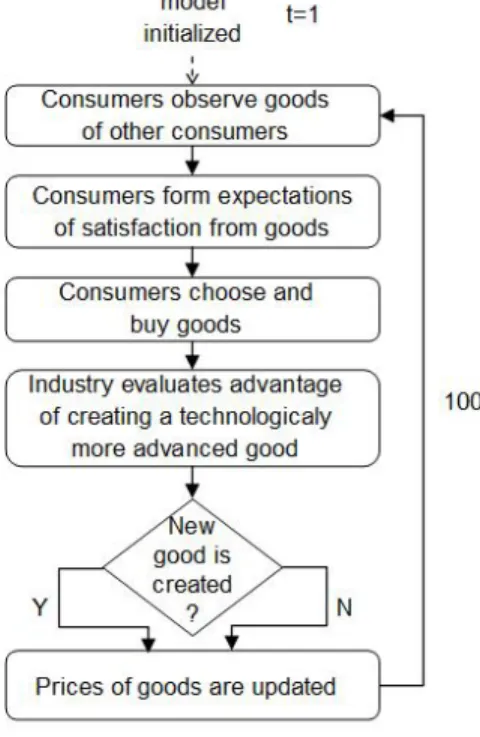
5.3.1 Structure of the model . . . 59
5.3.2 Consumer Incomes . . . 61
5.3.3 Prices of Goods . . . 63
5.3.4 Consumer Network . . . 63
5.3.5 Utilities . . . 65
5.3.6 Consumer choices . . . 66
5.3.7 Innovation: creation of new goods . . . 67
5.4 Results . . . 68
5.4.1 Scenarios . . . 68
5.4.2 Baseline simulation - modelling positional competition and tech-nological innovation . . . 70
5.4.3 Income inequality . . . 72
5.4.4 Hirsch Conjecture . . . 74
5.4.5 Consumer network . . . 76
5.5 Synthesis . . . 80
6. Positional consumption or another resource allocation for innovation? . . . 84
4.1 Examples of positional goods, attributes, and propensity to drive tech-nological innovation . . . 42
5.1 Model structure . . . 61
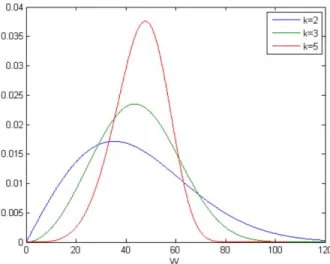
5.2 Profiles of income distributions defined by a Weibull distribution . . . 62
5.3 Examples of neighborhood in a network of 10 consumers with a neigh-borhood size of 4 . . . 64
5.4 Number of goods over time . . . 71
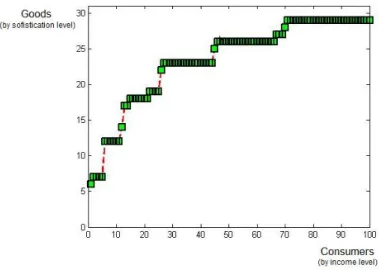
5.5 Matching between consumers and goods, at t= 100 . . . 71
5.6 Number of new goods with different income distributions . . . 73
5.7 Number of new goods as a function of the share of consumer income available to positional spending . . . 75
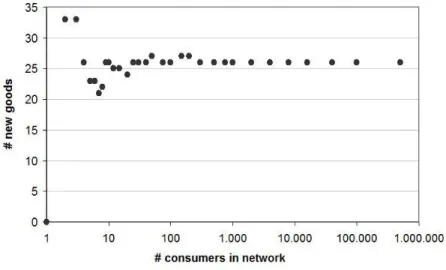
5.8 Number of new goods as a function of number of consumers . . . 77
5.9 Number of new goods as a function of size of social neighborhood, with different investment costs of R&D . . . 78
O desejo inicial de aplicar a simula¸c˜ao computacional a esta tem´atica foi poss´ıvel
em grande parte devido `a minha Orientadora, Profa. Tˆanya Ara´ujo, que
acompan-hou o meu trabalho com entusiasmo e proactividade. A necessidade que tive de obter
orienta¸c˜oes nos campos do comportamento dos consumidores e da inova¸c˜ao foi
ple-namente suprimida pelo meu Co-orientador, Prof. Fernando Gon¸calves, com quem
abri horizontes e muito aprendi. A ambos, pelo privil´egio de ter contado com o seu
empenho e amabilidade, o meu agradecimento profundo.
O meu ex-chefe, Carlos Marques, incentivou-me e criou as condi¸c˜oes para poder
realizar este curso, e devo-lhe isso. `A empresa TIS.PT agrade¸co a flexibilidade
ofere-cida que permitiu conciliar o trabalho com um Mestrado que fiz por iniciativa pr´opria.
Alguns amigos, colegas e familiares, sem referˆencia especial, partilharam do meu
entusiasmo com este trabalho e com isso deram-me uma motiva¸c˜ao adicional.
Tamb´em sem men¸c˜ao particular, gostaria de referir todos aqueles professores que,
desde a fase inicial da minha vida at´e hoje, contribu´ıram apaixonadamente para a
minha forma¸c˜ao pessoal e t´ecnica, e que tive a felicidade de ter nessa qualidade.
A minha mulher, Filipa, abdicou de tempo em fam´ılia e assumiu
despropor-cionadamente tarefas dom´esticos para eu poder concluir este trabalho. Sem a ajuda
dela teria sido muito mais dif´ıcil.
A minha m˜ae e a minha av´o C´elia desde cedo se empenharam de perto para que
fosse um aluno dedicado e proporcionaram-me sempre todas as condi¸c˜oes poss´ıveis.
O meu pai foi o grande respons´avel pelo que sou, e ´e sobretudo a ele que devo
a energia e inspira¸c˜ao nas coisas que fa¸co. H´a quase seis anos, quando terminei a
minha Licenciatura em Engenharia Civil, ofereci-lhe uma garrafa de vinho do Porto,
Consumption led by utility gains dependent on the consumption of other individuals
is referred to in economics as positional consumption. Positional consumption is
de-fined in opposition to material consumption, which provides utility directly through
the intrinsic characteristics of the product rather than a relative evaluation of the
product in comparison to those consumed by others. Mainstream economic theory
implicitly assumes that all consumption is material. However, the consequences to
welfare of the two types of consumption are rather different; because the value of
positional goods depends on the consumer behaviour of other individuals, unlike
with material consumption it cannot be assumed that the aggregate utility to
soci-ety increases with the level of consumption. On the contrary, with status seeking
consumption the aggregate utility achieved by consumers is theoretically not
improv-able, because the status of an individual is obtained at the cost of the status of other
individuals. If one individual increases its status, the status of others in the group is
reduced at an equivalent level. This phenomenon can be included in the category of
externalities, since the action of an individual causes damage to others in the form
of utility losses. The economic consequence of positional behaviour is an inefficient
allocation of resources and, consequently, a loss of welfare.
Some authors argue that policy intervention should be used to recoil the process
of positional behaviour and bring the economy to a more efficient equilibrium, with
advocator of policy action, claims that progressive consumption taxation would be
an appropriate remedy (see e.g. Frank 1999). On the other hand, other authors,
grounded on libertarian concerns, deny that policy intervention would be preferable
to letting the market function on its own and argue that the social costs of policy
would be greater than its benefits.
Among various reported objections to policy intervention, one of the most
impor-tant is grounded on the role of consumption in the generation of innovation. Giving
incentives to consume less would ignore the fact that consumption supplies the
posi-tive externality of stimulating innovation, which brings further benefits to society.
This work intends to contribute to this discussion by providing a better
under-standing of the relation between positional consumption and technological innovation.
The fundamental question put in the first place is:
i Does positional consumption generate technological innovation?
As it will become clear, the answer depends on the particular type of positional
consumption. It is therefore crucial to identify the main causes for the existence and
intensity of such relation:
ii What are the fundamentals for existence and intensity of a relation between
positional consumption and technological innovation?
For the discussion on the effects of policy, the issue of intensity of the relation is
particularly relevant because positional consumption compares to alternative ways of
allocating resources. A third issue important for policy and also discussed is whether
the technological innovation caused by positional consumption is welfare enhancing:
According to the literature review carried out by the author, specific research
dedicated on the issue of the relation between positional consumption and innovation
has not been developed until the present time.
A general description of the methodological approach used in this work is given in
Chapter 2. A review of critical topics and assumptions to the purpose of this work is
provided in Chapter 3, comprising four main themes: consumer behaviour, positional
consumption, innovation, and policy on positional consumption and effects on
inno-vation. Chapter 4 theoretically builds on the characteristics of positional consumer
behaviour, generation of innovations and producer marketing behaviour, to discern on
the fundamental factors establishing a possible relation between positional
consump-tion and technological innovaconsump-tion, in terms of existence, intensity and social utility.
Chapter 5 presents a model representing the process of generation of innovation by
positional consumption, aiming at a formal comprehension of the process and also the
study of some of its factors of influence. Departing from previous findings, Chapter
6 concludes with a discussion on the relative benefits of positional consumption as
a generator of technological innovation, as opposed other possible uses of resources.
The methodology used in this work follows a theoretical approach. Deductive
rea-soning is conducted in Chapter 4 to identify conditions for existence, intensity and
welfare enhancement of technological innovation caused by positional consumption.
Commonly accepted assumptions on elements structuring the relation under analysis
- including the nature of positional consumer behaviour, generation of innovations
and producer marketing behaviour - are used to infer conclusions on its causes and
possible outcomes. A detailed description of relevant basic assumptions is presented
without explicit notice throughout the review of critical issues in Chapter 3.
The model presented in Chapter 5 is built on an agent-based approach, and is
used to conduct an experimental investigation of a system of positional
consump-tion and innovaconsump-tion. The model partially incorporates the fundamental aspects of
the phenomenon of relation between positional consumption and technological
inno-vation identified in Chapter 4. Agent-based modelling is an appropriate approach
to model and simulate the system in question because of the existence of
interact-ing agents, continteract-ingency of their decisions on past decisions and presence of feedback
loops, a set of elements that commonly set the stage for a higher emergent properties
of the system. However, unlike common mathematical models, this simulation
ap-proach does not allow generalizing results, only providing suitable data for induction
from controlled laboratory experimentation. A justification for the methodological
This chapter reviews topics critical for the object of research of this work.
Un-derstanding consumer behaviour and its drivers is essential both to comprehend why
positional consumption is a reality and to comprehend attitudes of consumers towards
new products and innovation. A review of the of the drivers of consumer behaviour
is given in section 3.1. A perspective of the discussion carried out on the topic of
positional consumption, and its economic consequences, is described in section 3.2.
Innovation in the economy is reviewed in section 3.3, comprising its importance to
economic development, its main drivers, and the concepts of new product positioning
and adoption process. Finally, a description of the present discussion on policy on
positional consumption and its effects on innovation is provided in section 3.4.
3.1
Consumer behaviour and its drivers
Consumption of positional type takes place within the higher edifice of
consump-tion. Before describing direct causes of positional consumption and the way it might
influence innovation, it is relevant to understand the more general motivations of
consumption.
According to marketing theory, consumer choices are framed by wants that
ulti-mately satisfy human needs. A need is a state of ”felt deprivation of some generic
satisfaction arising out of the human condition” (Kotler 2000). Needs are not socially
needs, corresponding to ”desires for specific satisfiers of these ultimate needs”.
Hu-man wants are continually shaped and reshaped by social forces and institutions.
Products, and consumption, exist to satisfy needs and wants. Maslow presented a
widely disseminated theory of human needs, which also explains the most basic
mo-tives of consumption. According to him there are at least five sets of basic needs
(Maslow 1943): physiological, safety, love, esteem, and self-actualization. Different
sets of needs are related to each other, arranged in a hierarchy of urgency of
satis-faction. The needs in the lower levels in hierarchy will monopolize consciousness and
tend of itself to monopolize the various capacities of the human organism to seek its
satisfaction. Higher level needs are minimized, even forgotten, until the lower level
needs are not fairly well satisfied. The two lower sets of basic needs - physiological
and safety - belong to the category of physical needs, love and esteem are categorized
as social needs, and self-actualization needs belong to the category of needs of self.
Economists assume that consumers are utility maximizers, that is, they use their
limited resources to acquire a bundle of goods that will render them the highest utility,
which corresponds to satisfying the most of their needs. In evaluating a good, the
consumer considers its set of attributes and places different values on these various
attributes reflecting what he or she is seeking. Each product offers the customer
a certain total utility at a certain price, and the consumer chooses which product
maximizes the value-to-cost ratio.
Marketeers have gone much further than economists in trying to understand
con-sumer behaviour, especially in studying the process of wants creation, not only by
the needs that they serve but also by the complete set of circumstances that lead to
them, including social, cultural, economic and situational contexts. For the purpose
of this work it is relevant to note the importance of social environment for consumer
the main groups of social influence to a consumer. Reference groups are all those
groups that influence a person’s attitudes, opinions and values. Some are primary
groups, such as family, close friends, neighbours, and fellow workers, and others are
secondary groups, such as organizations they belong to. People are also influenced by
groups they are not members of, such as aspirational groups. There are three ways
in which a person may be influenced by reference groups: reference groups expose
the person to possible new behaviours and life styles; persons normally desire to ”fit
in” their reference groups and that influences the person’s attitudes and self-concept;
reference groups create pressures for conformity that may affect the person’s actual
product and brand choices. The influence of reference-groups tends to be stronger
when the product is visible and conspicuous to other people. Family plays an
endur-ing role in influencendur-ing the consumer’s attitudes, opinions and values. From family
the person acquires a mental set not only towards religion, politics and economics
but also towards personal ambition, self-worth and love. Role and status refer to the
position of the person within groups. A role consists of a set of activities that the
person is supposed to perform according to the definition and expectations of the
individual and the persons around him or her. Each role has a status attached to
it, which reflects the general esteem accorded to that role in society or the group.
A person’s roles and statuses influence not only general behaviour but also buying
behaviour.
Mainstream economics science assumes that consumers are sovereign in the
mar-ket, i.e. it is consumers’ wants that define what is produced in the market. Therefore,
wants are created by consumers themselves and producers just adapt to them by
of-fering whatever is requested by those wants. Moreover, it is also widely assumed
in economics research that consumers know best what is good for them, and that
considered. On the other hand, the consumer sovereignty hypothesis is rejected by
economists who note that the relation between consumers’ wants and production also
functions in the opposite direction. As noted e.g. by John Kenneth Galbraith (1958
p.127), this is made clear by the approach of marketeers towards sales; in his work,
the marketeer tries to bring wants in consumers that relate to their basic needs. It
is a task of the marketeer to engender a connection between needs and wants, and
the ways in which that could be done are multiple, including advertising, innovation
and product design strategies1. This, Galbraith asserts, is one of the reasons why
the creation of consumer wants depends on the productive process by which they are
satisfied.
The contradiction between the assumption of consumers knowing what is best for
them - suggested by Alfred Marshal as a ”starting-point” simplification for economic
research purposes (cited by Galbraith 1958) - and reality, can be explained on
psy-chological and social grounds. This has been deeply investigated by Tibor Scitovsky
and later by others. Scitovsky (1976, p.4) noted for example that ”[w]e gradually
dismantled the Laws of God and came to believe in man as the final arbiter of what
is best for him. That was a bold idea and a proud assumption, but it set back by
gen-erations all scientific inquiry into consumer behaviour, for it seemed to rule out - as a
logical impossibility - any conflict between what a man chooses to get and what will
be best satisfy him. Economists today consider the two synonymous. (. . . ) That
ap-proach overlooks the fact that tastes are highly variable, easily influenced by example,
custom, and suggestion, and constantly changed by the accumulation of experience”.
Prospect theory, developed by Daniel Kahneman and Amos Tversky (1979),
intro-1
duced the challenge at an eminent level to assumptions of standard economics on
rationality and utility carriers; prospect theory offered as a descriptive model of risky
choice in which the carriers of utility are not states of wealth, but gains and losses
relative to a neutral reference point, contrary to the standardreference-independence
assumption where states of endowment are the carriers of utility (Kahneman 2003).
Psychological and biological research has made clear why people are not
ratio-nal in their consumption decisions. The roots for less than ratioratio-nal behaviour lie in
the evolutionary development of the human mind (see e.g. Shermer 2008). Human
mind traces have been shaped in the hunter gatherer world of our ancestors, where
”survival of the fittest” carved the evolution of our emotions and reason. In the past
human history that defined our traits, the requirements for survival were somewhat
different than in today’s world, and the way our mind was designed does not fit the
homo economicus simplification assumed by economists. In fact, human emotions
often surpass reason. Although this may not seem logical even from an
evolution-ary perspective, the fact is that back in hunter gatherer societies humans frequently
needed to take decisions essential for survival or reproduction that could not be
rea-soned - either due to lack of intelligence, processing time, or purpose of intents - and
had instead to rely on instinctively forged emotions. For example, evolution explains
why people are often too risk averse, on rational standards. In the past, when there
were no institutions to secure our economic (or other kind of) decisions - like laws,
en-forcement authorities, or a monetary system - the effectively rational decisions more
often than today relied on securing short term benefits than waiting for long term
rewards. However, due to limitations of human reasoning, such behaviour more prone
to short term preferences was, and still is, driven by our emotions. Another
impor-tant form of irrationality is the fact that humans tend to be ineffective at predicting
predictions on happiness caused by future events, both at the positive and negative
side of happiness. Because of this, decisions do not maximize happiness, or utility, as
conventionally supposed. These examples of forms of irrationality apparently were
useful to survival and reproduction of our ancestors, but it may not perfectly fit our
current quest for wellbeing.
3.2
Positional consumption and its economic consequences
Evolutionism also explains why people are more prone to emulation than rational
behaviour would lead them to. And, because products often possess attributes valued
by consumers for their social significance, consumption is often used as a vehicle to
emulation of the buyer of the product. Yet, even if consumers were totally rational,
emulative behaviour would still be justified to a certain extent for the individual
consumer, since social status potentially renders real benefits to their social and
economic life.
The competitive search for emulation through the possession of goods or usufruct
of services does not directly contribute to an increase in wellbeing, contrary to what
is conventionally assumed by economists for any kind of product or service desired by
consumers. Since emulation, or status, is achieved by any individual at the expense
of the relative position of other individuals, the aggregate utility gathered through
status seeking will be null for all individuals. Competition for status is therefore
arguably2 a zero-sum game, because status is of scarce supply.
2
The same is true for any other goods or services’ functionalities of imposed limited
supply. For example, available homes close to a school of high ratings, and therefore
wanted by parents for this attribute, are physically limited. This constrained supply
generates a competition for those available slots, while the net utility achieved by
the winners is fixed, and independent of the number of contestants and final house
prices.
In both cases, individual consumption decisions do not produce the best outcome
for the collective. Consumers use resources in the process of competition for their
relative standing, while their welfare is on aggregate not improved. Consumers would,
if they could, agree together on a better outcome for all.
Those goods whose value to consumers depends on the way other consumers
consume it or its substitutes, are commonly designated in economics as positional
goods. The term was coined by Fred Hirsch (1976), who more broadly defined the
positional economy as relating ”to all aspects of goods, services, work positions,
and other social relationships that are either (1) scarce in some absolute or socially
imposed sense or (2) subject to congestion or crowding through more extensive use”.
Hirsh made a distinction between the positional economy and thematerial economy.
The later term encompasses items valued by consumers in an absolute sense, i.e. those
whose value does not depend on any ranking in desirability. Positional behaviour is
a source of external costs, because whenever an individual embraces it he or she will
cause a cost to other individuals, materialized in the loss of value from their own
consumption or activities.
The ideas entailed in the new definitions of Hirsch were not completely new at the
time of his writings. A prior major breakthrough by a prominent economist in the
description of behaviour associated with emulation and its economic consequences
and conspicuous consumption as two forms of quest for status and a result of human
need for esteem and emulation. His main economic conclusion was that
conspicu-ous consumption and conspicuconspicu-ous leisure are both a waste of resources. The term
”Veblen effects” became later known as the phenomenon by which the demand for
a consumers’ good is increased because it bears a higher rather than a lower price
(Leibenstein 1950).
In a time when prominent economists were investigating the relation between
income and consumption growth, James Duesenberry (1949) made the case for a
rel-ative income theory of consumption. In earlier decades, the economic discipline had
been seeking recognition as an exact science, capable of explaining economic
phe-nomena through objective mathematically formalized systems; inherently, social and
psychological aspects of consumption tended not to be considered within theories of
consumer demand. Duesenberry, on the contrary, produced a consistent theory of
consumer behaviour where social factors played a considerable part in determining
consumer behaviour. Duesenberry’s model recognized the importance of habit
for-mation and considered that levels of expenditures could be increased not by changes
in income or prices, but through an interdependence of preference systems that
pro-moted a general desire for distinction and encouraged individuals to emulate the
consumption behaviour of others (Mason 2000b).
Adding to the role of marketing mentioned in the previous section, Galbraith took
the arguments of Duesenberry to make another point for the dependence between
wants and the process by which they are satisfied. With emulative consumption,
”the more wants are satisfied, the more new ones are born”. Galbraith’s ultimate
point was that the case for consumption as welfare enhancing cannot be made, when
it is generated within the process by which it is satisfied: ”Consumer wants can have
for a society that seeks to satisfy them. But the case cannot stand if it is the process
of satisfying wants that creates the wants. For then the individual who urges the
importance of production to satisfy these wants is precisely in the position of the
onlooker who applauds the efforts of the squirrel to keep abreast of the wheel that is
propelled by his own efforts” (Galbraith 1958).
Although it initially drew some attention by economists, the relative consumer
preferences theory of Duesenberry eventually lost ground in the economic research
agenda. Milton Friedman’s permanent income theory, which assumed consumers’
wants to be only dependent on their income, became the dominant reference for
decades (Mason 2000b). Empirical support for Duesenberry’s relative income theory
of consumption came with findings on happiness, which have shown that happiness
does not increase with economic growth (Easterlin 1972). When asked to rate their
level of happiness, people did not provide significantly different answers on average in
different stages of economic growth, which suggests that an increase in consumption
is not translating into more welfare.
Fred Hirsch’s book, ”Social Limits to Growth” (Hirsch 1976), brought renewed
attention to the matter. Hirsch drew severe economic consequences from positional
consumption by saying that ultimate limits to welfare were imposed by the social
nature of consumption. He argued that the range of private consumption containing
a social element was much wider than generally recognized, and increasing. Since
material needs - mostly physiological and safety needs - are almost completely fulfilled
in developed societies, the growth in consumption increasingly bears on consumption
of social significance. And therefore, ”the satisfaction that individuals derive from
goods and services depends in increasing measure not only on their own consumption
but on consumption by others as well”. Consequently, as the economic output grows,
of conclusion had already been expressed by Galbraith (1958, p.129): ”As a society
becomes increasingly affluent, wants are increasingly created by the process by which
they are satisfied” and thus ”in technical terms, it can no longer be assumed that
welfare is greater at an all-round higher level of production than at a lower one. It
can be the same.”
Presently, the most eminent claim for policy action aiming the recoil of the
po-sitional economy comes from Robert Frank (1999, 2003). In various pieces of work,
he provides extensive description of positional behaviour in the real world economy,
and provides multiple comparisons with similarly wasteful collective practises. One
example is an arms race between two countries, where mutual escalation of
expendi-ture on armaments driven by context dependent fear for political independence, does
not enhance security for either nation. The overall effect is a reduced welfare, since
the extra spending comes at the expense of domestic consumption.
3.3
Innovation
3.3.1 Innovation as a source of economic development
Innovation seems to be the greatest driver of economic development in the
long-run. Economic growth can theoretically occur either by increasing inputs such as
labour, capital, and raw materials, or by increasing the productivity of those inputs.
Technical innovation allows increasing productivity, and is widely pointed as the
fundamental long-run driver of economic change. Furthermore, innovation is also a
factor of stimulation of demand, by contributing to the fulfilment of its new wants,
and in that way is instrumental in keeping the pace of production (see also sections
4.2 and??).
by Schumpeter. Schumpeter saw a process ofcreature destruction as the essential fact
of capitalism, consisting of an ”industrial mutation that incessantly revolutionizes
the economic structure from within incessantly destroying the old one, incessantly
creating a new one”. This process is driven by innovations in its various forms: ”the
fundamental impulse that sets and keeps the capitalist engine in motion comes from
the new consumers’ goods, the new methods of production or transportation, the new
markets, the new forms of industrial organization that capitalist enterprise creates”
(Schumpeter 1950, p.83). Schumpeter saw innovation and technological change as the
major explanation for the empirically observed business cycles. In this, he embraced
the work of Nikolai Kondratiev, who drew methodological foundations to explain
long-run economic cycles on the basis of the historical framework (see e.g. Freeman
and Lou¸c˜a 2001). Kondratiev saw the irregularity in the replacement of capital goods
as the main source of cycles, and concluded that they were caused by the appearance
of technological innovations.
Following a growing recognition of the central role of innovation to economic
de-velopment, extensive research on innovation has taken place in the last three decades.
Major milestones on innovation research have been the recognition of economic change
as an evolutionary process with innovation at its centre as opposed to an orthodox
equilibrium view of economics (Nelson and Winter 1982), the analytical framework
of systems of innovation (see e.g. Porter 1990; Lundvall 1992; Edquist 1997), or the
concept of the knowledge-based economy (Drucker 1993).
On the political side, nowadays national Governments and international
institu-tions take concrete steps to promote innovation through incentives and cooperation,
generally with the expressed aim of increasing local competitiveness. Examples of
this recognition are publications of international institutions on the importance of
and the OECD publications e.g. onThe Knowledge-Based Economy (1996) and
Na-tional Innovation Systems (1997), as well as the presently very significant political
economic instruments to stimulate R&D and innovation.
3.3.2 Drivers of innovation
Theories were developed to analyse and understand the nature of innovation and
how it occurs. Each of them focuses on different fields, and the tendency has been
to recognize the systemic nature of innovation development, where multiple factors
intervene. For the purposes of the present work, relevant lines of research refer to
the core originators of innovation, i.e. to which factors are essential for innovation
to occur. In the 1950s the dominant assumption was that innovation departed from
advances in science and technology, which lead to the development of new products.
It is recalled as the technology push theory, and configures a simple linear process
where scientific and technological advances push new products into the markets. An
alternative market pull theory developed in the 1960s assumes, in opposition to the
former, that innovation results from a process where the market needs pull a new
product into the market. Researchers were later inclined to regard the real world
as a mixed reality between these two theories. According to the push-pull theory,
different functions of the firm, the technological and scientific community and the
marketplace are linked in the process of innovation (see e.g. Galanakis 2006).
The mere assumption that positional consumption drives technological innovation
implies the existence of a market pull generated by consumers’ needs, as foreseen by
the technology pull theory. The model considered in Chapter 5 configures such case,
by assuming that technological innovation occurs whenever there is a latent demand
for an innovative product sufficient in size and willingness to pay to compensate for
that for technological product innovation to happen there must be a demand for it,
or at least an expectation that it will happen. Within the sphere of private demand,
a distinction is made between material demand and positional demand, and this
work particularly analyses the role of the later as a potential driver of technological
innovation.
3.3.3 Other issues - new product positioning and the consumer-adoption process
A useful concept for the analyses developed in the following chapter is that ofproduct
positioning. For various reasons, products have a limited life cycle, and to achieve
their sales and profit objectives companies need to put new innovative products into
the market. Product positioning involves tailoring a product marketing program
-including product attributes, image, and price, as well as packaging, distribution, and
service - to best meet the needs of consumers within a particular market segment.
A product’s position is how potential buyers see the product, and is expressed
relative to the position of competitors. The central issue of product positioning is
to understand the dimensions consumers use to evaluate products of the class in
question and make purchase decisions (Kotler 2000). Those dimensions relate to
product attributes, and consequently firms try to understand which attributes most
matter to consumers and what potential for further satisfaction of latent needs exists
in the market. Once consumer perceptions are understood, and a positioning choice
of the product is selected, firms take steps to align the marketing program behind
the positioning choice.
One distinctive aspect shaping new product positioning is change. According to
Trout and Rivkin (1996), nowadays the danger of losing market position is especially
great, due to four primary reasons:
• The quick and unpredictable shifting of consumer attitudes
• The increase in competition within the global economy
• The increase in competition among creative executives
As a consequence, they argue that it is a time not so much for positioning as for
repositioning.
New product positioning is important not only in the way the product is designed,
but also in terms of how it is diffused in the consumer market. For the later aspect,
the behaviour of consumers towards innovations is an essential issue. The
consumer-adoption process is about the way how potential costumers come to learn about the
new product, try it, and eventually adopt or reject it. Costumers have different
at-titudes towards novelty, and how they will react to it and its attributes. Different
identifiable types of costumers commonly adhere to a new product in different phase
of its presence in the market. The presently dominating theory on how firms should
frame the costumer population and elaborate their product marketing strategy is the
early-adopter theory. According to it, marketing efforts should be directed first to
those persons who are likely to adopt the product early (Rogers 1995, pp.252-80).
Individuals can be distinguished for their innovativeness, which refers to ”the degree
to which an individual is relatively earlier in adopting new ideas than the other
mem-bers of his social system”. The groups of individuals can be split into: 1) innovators,
2) early adopters, 3) early majority, 4) late majority, and 5) laggards. These groups
can be represented in a bell-shaped curve of the adoption process, representing their
volume and order of appearance in the market. To the early-adopter theory, Moore
(2004) added that the most difficult step is making the transition between visionaries
(early adopters) and pragmatists (early majority). If successful, a firm can create a
3.4
Policy on positional consumption and effects on innovation
3.4.1 Policy
As mentioned above, Hirsch’s conjecture on social limits to growth originated a
de-bate on possible political actions to better accommodate positional behaviour in the
economic life. Hirsch himself assumed a prudent position on policy remedies against
positional consumption (Hirsch 1976, p.178). He justified his prudence on the lack
of knowledge of the costs and benefits of applying such kind of policies, although
he provided enlightenment on the issues. His main conclusion for policy was that
the most promising available means of minimizing costs implied by positional
com-petition was to reduce the stakes for which positional comcom-petition is played. In the
scope of education and job positions, this would translate into a reduction of income
differentials, although it would not fully solve the problem since people compete not
only for wages but also for job prestige. Alternative methods of allocation could be
conceived, including restrictions to choice, which is already a practise in education
positions. Although it pointed to directions for policy, Hirsch’s work did not offer
an operational blueprint for such advance, given the existence of restrictions and
uncertainties related to those policies.
Before Hirsch, Duesenberry (1949, pp 92-104) had already suggested the need
for intervention in an economic system with interdependent consumer preferences.
His abstract model of an economy with interdependent preferences of consumption
on income led to the conclusion that welfare maximization can be achievable only
through progressive income taxation. Authors like Layard (1980), Ng (1986) and
others also suggested income taxation to bring the balance of private and public
expenditure to a level consistent with welfare objectives.
consumption taxation (Frank 1999, 2003)3. Frank’s reasoning for a progressive
con-sumption taxation proposal is founded on the observation that high-end consumers
influence the consumption decisions of lower-end consumers, forcing an effect of
”ex-penditure cascades”. High-end consumers set the standard of what is ’special’, and
consumers at the following social stages are obliged to keep up to maintain the social
status of their possessions. Offering one rose in an under-developed country may
be special, but to give something special in an affluent country the number of roses
offered must be multiplied by a few4. A house regarded as ’big’ is much bigger in the
2000’s than it was in the 1970’s. Progressive consumption taxation would
discour-age high-end consumption and, consequently, erode the ”expenditure cascade” that
follows.
A simple model developed by Frank and Levine (2007) incorporating context
dependence of consumption (based on Duesenberry’s model) predicts a clear link
between income inequality and observed savings rates, with the savings rate of any
reference group declining when income inequality within that group rises, due to
increased positional spending. This prediction is supported by available
empiri-cal evidence. Moreover, such relation between inequality and positional spending
(and savings rates) arguably contradicts the conventionally believed trade-off
be-tween equality and economic efficiency (Frank 1999, pp 227-50), a notion primarily
3
The defence by economists of consumption tax as opposed to an income tax is not original to Frank, although for different reasons. It has been made prominently by distinguished economists throughout the history of economic thought, including John Stuart Mill, Marshal, and Irving Fisher (Kaldor 1955). More recently, expenditure taxation has been advocated and extensively detailed in terms of its implementation and possible effects, most notably the ”flat tax” by Hall and Rabushka (1995) and the more progressive ”X tax” by David Bradford (2003), with some impact on USA policy (see e.g. Viard, Carroll and Ganz 2008). The main reasons for the defence of these authors of consumption taxation are the simplification of the tax system, its ability to tax people in accordance with what they consume rather than what they earn (thereby stimulating savings) and its fairness. To this, Frank added the advantage of slowing positional consumption to a level more consistent with collective interests.
4
formally introduced by Duesenberry (1949, p.103).
Progressive consumption taxes would, according to Frank, transfer the use of
resources from wasteful positional consumption to other more useful purposes, like
savings. And an increase in savings would likely promote economic growth in the
long-run.
3.4.2 Effects on innovation
The generation of innovation by the process of positional consumption is a core issue
for the policy under discussion.
The relation between interdependent preferences and the growth in sales of new
goods has been pointed out as an important issue by Duesenberry (1949, pp 104-10).
He argued that the ”orthodox” theory of demand could not explain the phenomenon
of adoption of new goods, and built a model of interdependent preferences that could.
An eminent recognition of the relation between the desire to achieve ”distinction”
and innovation within a broader cultural sense has been introduced by Pierre Bordieu
(1984), the sociologist known for his theory of economic, cultural and social capital
and for observing the close relation between judgments of taste and social position.
According to his theory, new cultural products are developed and consumed in ”a
permanent revolution in tastes”, and a cycle of innovation takes place in which new
cultural forms are continuously introduced by those at the top of the social hierarchy,
to be subsequently copied by others lower down the hierarchy (Trigg et al. 2008).
Critics of policy remedies over positional consumption generally do not
ques-tion that posiques-tional consumpques-tion is a market failure. However, several do quesques-tion
that it should be a matter of State intervention. Kashdan and Klein (2006),
com-menting on the work of Frank, present the most extensive set of arguments against
more libertarian sensibilities about politics, government, and society, they argue that
Frank ”overstates the problem, overlooks various voluntary solutions, overlooks
un-intended consequences of using taxation, and neglects the Smithian incumbency on
those proposing coercion”. Among several objections to State intervention, they
point that consumption by the wealthy ones is a driver of innovation. And, therefore,
reducing positional consumption would remove the positive effect of consumption in
its role as a force of innovation. Previous criticism to intervention on the grounds of
the generation of innovation by positional consumption came from Gershuny (1983),
who praised the benefits of technical change arguing against the ideas presented by
Hirsch.
Progressive consumption taxation would weigh taxes on high-end consumers. How
would this affect innovation? Hayek argued on the importance of high-end
consump-tion to innovaconsump-tion: ”What today may seem extravagance or even waste, because it
is enjoyed by the few and even undreamed of by the masses, is payment for the
ex-perimentation with a style of living that will eventually be available to many” (cited
by Kashdan and Klein 2006). In this respect, Kashdan and Klein add that ”in the
dynamics of a growing economy, the wealthy provide a market for goods that must be
expensive in order to supply to be viable. The wealthy pay extra to enjoy the benefits
of new goods, which, if suitable to human existence, will later become inexpensive
and widely adopted”. To internalize the costs of the competition for positional goods
would therefore cease the positive externalities of the process towards innovation.
In a reply to Kashdan and Klein, Frank (2006) countered their arguments on
innovation by noting that alternative capital allocation caused by positional taxation
would also drive technological innovation. In the short run, Frank argues, ”the tax
would not change the total level of spending. Rather, it would shift the composition
research and development. Additionally, a higher rate of investment would, in the
long run, cause an increase in the consumption level in relation to the low-savings
trajectory through income growth.
Still, the issue remains on how would positional consumption compare to other
resource allocations as a way of stimulating innovation and, ultimately, economic
development. The author of this work is not aware of previous detailed analyses on
DRIVER OF TECHNOLOGICAL INNOVATION
Being innovation as crucial as it is to economic progress, for the purposes of
un-derstanding the consequences of the positional economy and related policies it is
important to better comprehend the relation between positional consumption and
innovation. This chapter identifies and analyses fundamentals of positional
consump-tion as a driver of technological innovaconsump-tion, and draws some initial conclusions on how
their effects compare to the generation of innovation from resource allocation
alter-natives. Firstly, it is identified under which circumstances - type of product and its
positional attributes - does this relation occur and how (4.1). Secondly, an account
on the fundamentals of the intensity of the relation is provided, including a
compar-ison with those of spending with material purposes (4.2). Finally, assuming that the
generation of technological innovation by positional innovation may be regarded as
useful only in the extent to which it is welfare enhancing, we will see that it may not
necessarily happen (4.3).
Before proceeding, a more precisedefinition of the object of researchmust be
provided, both in the scope of positional consumption and technological innovation.
Hirsch’s definition of positional products refers to those that provide utility which
is scarce in some absolute or socially imposed sense or subject to congestion or
crowd-ing through extensive use. However, the eminent case of positional products refers to
on the subject and the discussions that followed among economists. In this work,
any further references to positional consumption relate to products providing socially
scarce utility.
Innovation is a broad concept with multiple interpretations; in a wide sense, it can
be seen as a way of ”finding strategies to better deal with the surrounding environment
and to improve some utility function” (Ara´ujo and Mendes 2009). This work focuses
on innovation in the economic dimension. As a definition for it, we use the one
including all stages from fundamental research to commercialization1. The inclusion
of fundamental research in the definition of innovation is relevant here because it is
perceived as crucial for economic progress. Moreover, the object of study is restricted
to innovation in thetechnological sense2, excluding other possible fields of innovation;
this approach is used due to the arguable notion that it is mostly innovation of the
technological kind that brings benefits to economic development in the long-run.
Finally, for reasons explained in the following section, the analyses below become
relevant in relation to the product as an object of innovation; they therefore confine
to it, not covering other elements of the marketing strategy.
4.1
Fundamentals of existence of a relation
Is there a relation between positional consumption and technological innovation? The
answer certainly depends largely on the exact object of positional competition, and
particularly on whether that object can be improved through technological
innova-1
As a reference we depart from the theory of W. Rupert Maclaurin, who included in the definition of technological innovation the stages of: fundamental science, applied research, engineering devel-opment and production engineering (referenced by Godin 2008). Maclaurin’s work on technological change apparently included the first full-length discussion and theory of what came to be known as the linear model for innovation (Godin 2005, 2008).
2
tion. The question to make is rather: under which circumstances does the influence
of positional consumption over technological innovation exist?
Producers want to sell their products to make profits. On the other hand, when a
technological innovation successfully meets consumers’ needs and wants, they respond
by buying the product. The conjunction of these two forces acts as an incentive for
producers to pursue technological innovation. However, technological innovation is
not the only possible way of attracting demand. The following sections clarify the
conditions for its existence.
4.1.1 Which dimensions of innovation are affected by positional consumption?
Innovation, from a producer perspective, can take various forms. They can be reduced
to four dimensions of change (Bessant and Tidd 2007):
• Product innovation: changes in products
• Process innovation: changes in the ways in which products are created and
delivered
• Position innovation: changes in the context in which the products are
intro-duced (like a change in the advertised purpose of the product)
• Paradigm innovation: changes in the underlying mental models which frame
what the organization does (like shifting from a tailored made to a mass
pro-duction process)
Product innovation may involve technologically driven improvements, depending
on the type of attributes valued by the consumers and on the expected marginal
Process innovation may also involve technological innovation. However, the
in-centive for producers to innovative in this area is in principle independent of the type
of consumption in cause, since its main advantage is a better use of resources and,
consequently, lower production costs. The benefits of reducing production costs are
independent of other factors. In this sense, it cannot be said that positional
con-sumption adds to technological innovation any more than what is achieved through
other types of consumption.
Position innovation seems prone to happen with positional innovation. However,
it clearly does not directly involve technological change.
Paradigm innovation, according its definition, is about reframing the model of
business in some way. Although it may require extensive product and process
in-novation, it is not itself fundamentally about technological innovation. Moreover,
like with process innovation, there are no a priori reasons to believe that positional
consumption influences possible paradigm innovations in a different way than other
types of consumption.
Of the four dimensions of change, for the reasons specified only product innovation
is identified as being of major relevancy for the study of the influence of positional
consumption in technological innovation. The proceeding analyses in this work will
therefore focus on product innovation only.
4.1.2 Strategies to attract demand
In their quest for demand for their products, producers continuously make efforts
for consumers to perceive them as being desirable in relation to their competitors
and/or in relation to products consumers already possess. This permanent urgency
of producers can be sought through distinct vehicles:
• Communication
• Price
• Distribution
These forms coincide with the four Ps of the marketing mix famously spread in
the marketing literature, namely: product, promotion, price and place (Kotler 2000).
A review of their nature in relation to the possiility of existence of technological
innovation is provided here.
Obtaining favourable consumers’ perceptions through the product object can
involve several elements. Marketeers distinguish three levels of product: the core
product, the formal product and the augmented product. Thecore product refers to
the core benefit(s) or service(s) provided to the buyer like hope, pleasure or nostalgia.
Theformal product is the larger ”packaging” of the core product and consists of what
the market recognizes as the tangible offer, including its quality, features, styling,
brand name and packaging. The augmented product is the totality of benefits that
the costumer receives or experiences by obtaining the product and includes services
like installation, delivery, maintenance or warranty (Kotler 2000). For this work, we
should regard that improvements in the product are achievable through some form of
product innovation. And technological innovation is a possible way available to the
producer of improving the product, particularly through provision of the elements of
quality, features or augmented product services.
Communication is used, among other aims, to create or alter the perception by
consumers of the products. Communication allows bringing favourable views of the
product attributes, and their usefulness. This way of achieving the intended
better-ment of consumers’ perceptions does not involve any form of product technological
Price can be used to influence users’ perceptions in three completely distinct
ways. First, price is a product attribute in itself, for its economic nature; consumers
prefer products with a lower price, because it requires a lower economic effort for the
purchase.
Price can also be a signal for quality; in this case, contrary to the former,
con-sumers may prefer more expensive products because a high price leads them to believe
that the product is of a better quality. Price acts in this way as a form of
communi-cation to the consumer.
Finally, price can act as a way to achieve exclusivity. With a very high price,
a given product’s sales can be restricted to high-end consumers, and in that way
promote the consumer’s views of the product attribute of exclusivity, potentially
addressing their social and self needs.
Distributionrefers to the channels, coverage, locations, inventory and transport
by which the product is delivered to the costumer. It is a rather important marketing
strategy for products valued on status concerns. However, like the previous, this
marketing element does not directly involve technological product innovation.
Of these distinct possible strategies of improving users’ perceptions of a product,
we may conclude that only the first one - the product itself - directly involves product
technological innovation.
4.1.3 Product value formation systems
Clarification is provided here on the value formation system of products according
to their nature of being material or positional. Speaking generally of material
prod-ucts or positional prodprod-ucts is a simplification of speech. In fact, prodprod-ucts may be
valued by consumers both for material and positional reasons. As mentioned above,
and needs. A product usually possesses several relevant attributes to the consumer’s
value judgement. We may classify them in three groups, according to their value
formation system:
• Material attributes, i.e. attributes valued independently of other people’s choices;
• Positional attributes, i.e. attributes with a value for consumers dependent on
other consumers’ choices;
• Mix-valuated attributes, i.e. attributes simultaneously valued on material and
positional grounds.
One may easily think of attributes of the three kinds, for example, for the
au-tomobile. Safety, reliability or fuel economy can generally be considered material
attributes, since they are valued by the user for a strict economic, functional or
safety reason. Luxury, provided by items such as a hornet button coated with gold,
has no particular material usefulness and may be thus regarded as purely positional.
Other attributes of the automobile, like power, space or comfort may be valued both
materially and positionally, depending on the type of consumer needs being fulfilled.
The multiattribute nature of products makes it possible that different versions of a
same type of product rival in different markets for positionality. While cars with gold
coated gadgets compete in the positional market for luxury, speedy cars compete
in the positional market for power. Simultaneously, the same products may rival
in a material market, due to their material attributes. Therefore, products may be
simultaneously material and positional, i.e. they may be valued by consumers for
both types of value creation system. Due to the multiattribute nature of consumers’
product valuation system, the analysis below focuses on the attribute rather than the
4.1.4 Are positional attributes improvable through technological innovation?
The first condition for a type of consumption to generate technological innovation
is that costumers’ needs and wants, and their perceptions of the product, must be
potentially deliverable through some form of improvement in the product elements
prone to technological innovation - predominantly their quality, features or augmented
product services.
This condition seems to take place with all forms of material consumption. In this
type of consumption, utility is by definition originated directly by benefits intrinsically
delivered by the product, independently of extrinsic factors like the consumption
patterns of other consumers. And benefits intrinsically delivered by the product are
related to its quality, features or services, rather than brand name, packaging or
styling.
The same may not necessarily happen with consumption of positional nature,
where the benefits perceived by consumers may not depend on attributes subjectable
to technological innovation. For example, consider an automobile having exclusivity
as the single attribute valued by the consumer, and that exclusivity is an attribute
perceived by the consumer solely on the basis of the brand name of the car (a brand
commonly used by high-end consumers). In this case, no technological innovation can
directly influence the utility perceived by the consumer, since there is no connection
between user valuation criteria and product elements prone to technological
innova-tion. Consequently, the producer would not have any direct incentive to innovative
on the product itself, but only to maintain the status of its brand.
To better establish the connection between attributes of different types of
con-sumption and technological innovation, it is helpful to classify product attributes in
Non-technological attributes: Attributes for which consumer valuation cannot be im-proved through technological innovation. Non-technological attributes are
al-ways intangible objects, like exclusivity, prestige or beauty.
Technological attributes: Attributes whose valuation can be improved through tech-nological innovation. Techtech-nological attributes may be tangible - power,
relia-bility - or intangible objects - environmental friendliness, drivearelia-bility or also
prestige (if prestige can be improved through technology).
Technological intensity as an attribute: A product can be attractive to consumers by possessing top innovative technological features. As noted by Rogers (1995,
p.213), ”[o]ne motivation for many individuals to adopt an innovation is the
desire to gain social status”. To be at the top of technological innovativeness is,
obviously, a relative concept in relation to other products of the same class, and
therefore the attribute is a positional one. This type of attribute is a particular
case of technological attributes in general. One possible actual example of
technology as an attribute comes e.g. with top generation mobile phones, which
some consumers appear to value mainly for its technological innovativeness, and
the status it confers, in relation to previous models.
Consumption of a product will potentially generate technological consumption
only if it includes technological attributes.
In line with the definition of material products, which implies that they are
in-ternally valued only by their intrinsic characteristics, it does not seem conceivable to
identify an attribute that cannot be incorporated in the definition of technological
attributes. A material product is valued by consumers through material attributes,
of technological nature. Assuming this, we may assert that all attributes of material
products are potentially subject to technological innovation.
On the contrary, positional goods include attributes not improvable through
tech-nological attributes. These are intangible attributes not related directly with quality,
features or services. Some positional products (theoretically at least, and as
exempli-fied above) may even not include any technological attribute, and therefore not being
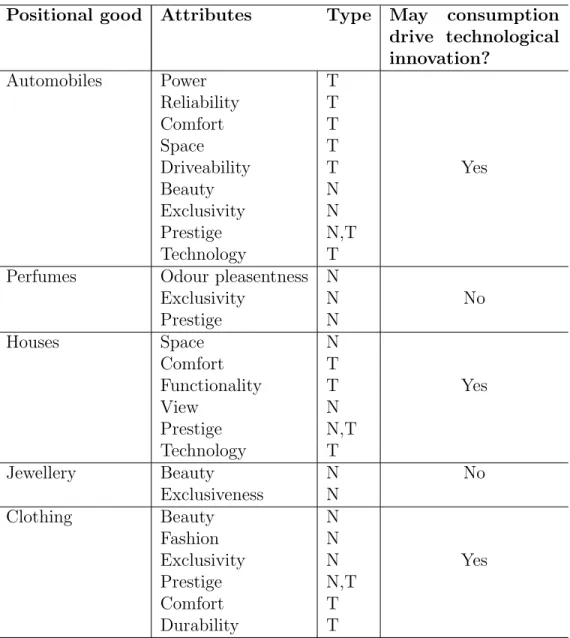
potentially subject to technological innovation in any degree. Table 4.1 presents
possi-ble examples of positional goods and their ability to generate technological innovation
according to the nature of their attributes to consumers. The contents presented in
the table are subjective, non-exhaustive, and variable within goods of the same class
and across demand segments.
According to the assumptions of the examples of positional products and
at-tributes in the table, positional consumption of automobiles, houses and clothing
potentially generates technological innovation, but not perfumes or jewellery.
In those products where the potential for technological innovation exists - i.e.
technological innovation can lead an increase in consumers’ valuation of the product - ,
we may question whether it occurs and what determines its existence. The economic
answer is simple: technological innovation occurs if the expectations of producers
on marginal returns from investments in technological innovation are favourable in
comparison to the other possible strategies to attract demand.
4.2
Fundamentals of intensity of the relation
The previous section identified factors that determine the existence of technological
innovation, when consumption of positional nature is its cause. This section looks
Positional good Attributes Type May consumption drive technological innovation?
Automobiles Power T
Reliability T
Comfort T
Space T
Driveability T Yes
Beauty N
Exclusivity N
Prestige N,T
Technology T
Perfumes Odour pleasentness N
Exclusivity N No
Prestige N
Houses Space N
Comfort T
Functionality T Yes
View N
Prestige N,T
Technology T
Jewellery Beauty N No
Exclusiveness N
Clothing Beauty N
Fashion N
Exclusivity N Yes
Prestige N,T
Comfort T
Durability T
Legend: T - technological type; N - non-technological type
Tab. 4.1: Examples of positional goods, attributes, and propensity to drive technological innovation
First of all, a definition of intensity must be provided. Two types of intensity will
be mentioned: absolute intensity and intensity to consumption. Absolute intensity
of technological innovation refers to the absolute level of innovation carried out per