ICNS Proceedings
Man e
arcia
i
ICNS Proceedings
Manuel Garcia-Ruiz, Jordi Nofre (Editors)
Manuel Garcia-Ruiz, Jordi Nofre (Editors)
ICNS Proceedings
Claire Downey
Adam Eldridge, Dorrie Chetty and Nayyar Hussain Gergely Olt
Nancy Gonlin and April Nowell Jonas Kapitza
Christine Mady
Christian Morgner and Mariko Ikeda Diana Raiselis and Kai Sachse Karin Leivategija
Sylwia Dudek-Mańkowska and Mirosław Grochowski
Nancy Gonlin
Nicolas Houel, Laurent Lescop and Dany Joly Rupert Griffiths and Nick Dunn
Salomé Vincent Allison Peacock
Florian Guérin, Magali de Raphélis, Sandra Mallet Olga Kolesova, Irina Skalaban,
Anastasia Pogorelskaya, Gleb Cherepanov Maria Giaever Lopez
© Manuel Garcia-Ruiz, Jordi Nofre (eds), 2020
Manuel Garcia-Ruiz, Jordi Nofre (eds), ICNS Proceedings. First edition November 2020
ISBN: 978-972-8048
Composition (in characters Arial, body 10)
Conception and graphic work: Manuel Garcia-Ruiz Cover: Manuel Garcia-Ruiz
Cover Page: Manuel Garcia-Ruiz
Authors are the solely responsible for their own work, and they keep all their respective rights, being authorized to reproduce totally or partially their own work.
©Claire Downey
©Adam Eldridge, Dorrie Chetty and Nayyar Hussain ©Gergely Olt
©Nancy Gonlin and April Nowell ©Jonas Kapitza
©Christine Mady
©Christian Morgner and Mariko Ikeda ©Diana Raiselis and Kai Sachse ©Karin Leivategija
©Sylwia Dudek-Mańkowska and Mirosław Grochowski ©Nancy Gonlin
©Nicolas Houel, Laurent Lescop and Dany Joly ©Rupert Griffiths and Nick Dunn
©Salomé Vincent ©Allison Peacock
©Florian Guérin, Magali de Raphélis, Sandra Mallet
©Olga Kolesova, Irina Skalaban, Anastasia Pogorelskaya, Gleb Cherepanov ©Maria Giaever Lopez
© David Kendall
Contacts:
ISCTE, Instituto Universitário de Lisboa, Av. Das Forças Armadas, 1649-026 Lisboa Tel.: +351 217903000 • Fax: +351 217964710 E-mail: [email protected]
Index
PREAMBLE ... 8
‘THE NIGHTS WILL BE ALWAYS OURS’: AN INTRODUCTION TO THE PROCEEDINGS BOOK OF THE 1ST
INTERNATIONAL CONFERENCE ON NIGHT STUDIES
JORDI NOFRE AND MANUEL GARCIA-RUIZ ... 10 SHAPE SHIFTING: ARCHITECTURE IN A WAKEFUL CITY
CLAIRE DOWNEY ... 16 IT’S THERAPY AND IT’S FUN.LATE NIGHT SALONS IN LONDON
ADAM ELDRIDGE,DORRIE CHETTY AND NAYYAR HUSSAIN ... 30 THE SOCIO-POLITICAL CONTEXT AND MANAGEMENT OF URBAN CONFLICTS RELATED TO NIGHT TIME TOURISM.THE CASE OF POST-SOCIALIST BUDAPEST
GERGELY OLT ... 43 LIFE AFTER DARK IN THE CITIES OF THE ANCIENT WORLD
NANCY GONLINAND APRIL NOWELL ... 61 OUT AT NIGHT.A HUMAN-GEOGRAPHIC RESEARCH ON THE USERS OF NOCTURNAL WORK AND LEISURE TRIPS
JONAS KAPITZA ... 75 EXPLORING THE NIGHTLIFE ATMOSPHERE AND RHYTHMS OF BEIRUT’S LEISURE STREETS
CHRISTINE MADY ... 90 CULTURAL POLICIES AND NIGHT-TIME ECONOMIES IN GERMANY/BERLIN AND JAPAN/TOKYO
CHRISTIAN MORGNERANDMARIKO IKEDA ... 103 CLUBSTERBEN. THREATS TO BERLIN’S CLUB CULTURE AND RESPONSES FROM NIGHTTIME GOVERNANCE
DIANA RAISELIS AND KAI SACHSE ... 121 CLUB CULTURE IN POST-SOVIET ESTONIA.THE EMERGENCE AND CHALLENGES OF A CREATIVE URBAN NIGHT
KARIN LEIVATEGIJA ... 139 WARSAW AT NIGHT: MAPPING NIGHTLIFE HOTSPOTS
SYLWIA DUDEK-MAŃKOWSKAAND MIROSŁAW GROCHOWSKI ... 154 URBAN NIGHTSCAPES OF THE LATE CLASSIC MAYA OF MESOAMERICA
PUBLIC LIGHTING AND PARTICIPATORY DEMOCRACY, THE CONTRIBUTION OF PUBLIC TRANSPORT DRIVERS IN NANTES MÉTROPOLE TO THE EVALUATION OF NOCTURNAL URBAN AMBIANCES
NICOLAS HOUEL,LAURENT LESCOP AND DANY JOLY ... 184 MORE-THAN-HUMAN NIGHTS. INTERSECTING LIVED EXPERIENCE AND DIURNAL RHYTHMS IN THE NOCTURNAL CITY
RUPERT GRIFFITHS AND NICK DUNN ... 203 CONSENTING TO DARKNESS, SURVIVING THE DARK. ENTERING THE NIGHT OF THE NIGHT IN NANTES
SALOMÉ VINCENT ... 221 NIGHT MOVES - CONSIDERING MUNDANE DEPICTIONS OF THE URBAN NIGHT
ALLISON PEACOCK ... 235 NIGHT-TIME AS A STRATEGIC REFERENT IN MAKING AN INTERMEDIARY CITY MORE ATTRACTIVE. THE CASE OF THE REIMS GRAND CENTRE URBAN PROJECT (FRANCE)
FLORIAN GUÉRIN,MAGALI DE RAPHÉLIS AND SANDRA MALLET ... 240 STUDENTS' NIGHT LIFE IN A SIBERIAN UNIVERSITY CITY: TOP-DOWN AND BOTTOM-UP NOCTURNAL ACTIVITIES
OLGA KOLESOVA,IRINA SKALABAN,ANASTASIA POGORELSKAYA AND GLEB CHEREPANOV ... 260 ‘TEMPORARY AUTONOMOUS HOME’: INTEGRATION AND BELONGING ON THE MARGINS OF LATE-NIGHT LEISURE
MARIA GIAEVER LOPEZ ... 274 DISAPPEARING INTO NIGHT. VISUAL ESSAY
Preamble
The night has been the subject of multiple readings by the social and human sciences, as well as it has inspired multiple narratives throughout history, literature and popular culture. However, the study of nightlife, practices, and actors only gained attention in recent years.
The appearance of “mayors of the night” with the intention of improving urban governance during this period and thus guaranteeing needs, rights and services is the result of a progressive change in the local political paradigm, which begins to face this space-time as a “new” opportunity for its economic, social and cultural development. We could say that the night and the activities that take place in it begin to be projected as forms of tourist attraction, whether for their leisure activities such as discos, parties or other forms of fun; or because of its cultural potential, such as the White Nights.
Contemporary urban night implies having active professionals, capable of reacting to any incident, such as the case of health professionals, but also maintaining those professions – often illegal – that tend to be considered problematic or hidden as could be prostitution. Surveillance and control during this period is also a good example of active professions, such as the case of the police, surveillance companies, video-doorman, or firefighters.
It has never been so easy to commute in the urban space, public transport normally meets the needs of users, and the emergence of new forms of transport resulting from the circular economy, both of people and goods, completes the demand, not without controversy.
There are many different ways to approach the night, but here we collect some of the communications that participated during the I International Conference on Night Studies, that took place on-line, due to the COVID-19 pandemic, on July 2nd -4th, 2020. These communications are also on-line
‘THE NIGHTS WILL BE ALWAYS OURS’:
AN INTRODUCTION TO THE PROCEEDINGS BOOK OF THE
1st INTERNATIONAL CONFERENCE ON NIGHT STUDIES
Jordi Nofre and Manuel Garcia-Ruiz
Everybody's talking at me I don't hear a word they're saying Only the echoes of my mind People stopping, staring I can't see their faces Only the shadows of their eyes («Everybody's Talkin’», Fred Neil, 1966).
This singer-songwriter Fred Neil’s words could depict what many of us, night scholars, felt some few years ago. We knew they were some colleagues in other places of the world that were researching on night-related topics, but very few of us had had the opportunity to meet all together in ‘our own house’: A transdisciplinary conference on night studies. For that very reason, the realization of the 1st
International Conference on Night Studies was not a full stop but, above all, the beginning of a vibrant, amazing, cross-disciplinary research about the multiple spatial, social, economic, cultural, political, environmental, and public health-related aspects of the night (both urban and rural; from both Global North and South) that are still waiting to be explored.
Growing knowledge on the urban night in both Global South and North appears as crucial towards enhancing new opportunities of collaborations to deepen our knowledge in the field of night studies and break with the invisibility (and even marginalization) that, to date, has featured our research field in the academic sphere of social sciences and humanities. After the realization of our 1st Conference, now we can affirm that ‘the night’ has consolidated its position as an exciting, emerging scholar field, although enormous challenges are jeopardizing its normal evolution towards a consolidated interdisciplinary field. In this sense, nightlife is still considered as a synonym of vice, sin and immorality at the institutional level in most countries across the world –especially under these pandemic times, while such a perverse vision about the night is also shared by many young and old scholars who belong to conservative (even reactionary) forces – although they are often deftly camouflaged as leftists. But, as we could witness during the conference, and thru the papers that compose this volume, the study of the night goes far beyond the study of night leisure, or club culture. A transdiciplinar Night Studies
discipline encompass a wild range of topics, visions and analysis, that cover different aspects of the social life, extending and completing the traditional studies more focuses on day-light-time. Contributions from many disciplines enrich this field that we claim, and we feel necessary, to completely understand, mediate, work and exploit properly and free of stereotypes inherited from other times.
Our main mission should be to demonstrate that the study of ‘the night’ is much more necessary than ever, especially in the present days in which, in many cities across the globe, the night has become an arena of the clash between the newly-emerged pandemic politics and anti-pandemic politics. These are a continuation of the myth of the night for the thugs, the unhealthy and the fear. There a is needed to reflect, think and act to break those stigmatic views on the night, and embrace a more healthy and inclusive night that guarantees the wellbeing of everybody and the success of every party. We should stop and remember that our living in society strongly depends on night activities, night workers, and freedom. We need to gain consideration, and bring bright to this emerging field, that has always been there, but always eclipsed.
This Proceedings Book is an excellent example of what has been exposed, a compilation of papers covering different aspects, topics and problems from different disciplines worldwide about and on the night.
* * *
Claire Downey (from the School of Architecture & School of Modern Languages and Applied Linguistics at the University of Limerick) explores mechanisms for generating possibility within nocturnal urban landscapes situated in Limerick, Ireland, and Paris, France, with the aim of moving beyond the scope of entertainment venues by proposing a wakeful city to explore interventions in mobility, temporary installations, community participation and the reuse of emptied structures.
Adam Eldridge, Dorrie Chetty and Nayyar Hussain (from the School of Social Sciences at the University of Westminster) focus on London based hair salons open beyond traditional opening hours to consider the ways in which they enable practices of community and belonging. For the authors, the salons examined play a particularly crucial role in their local community, serving as points of introduction and as landmarks for new and established migrant communities, since these salons are important sites of conviviality within the capital and warrant greater policy intervention to ensure their sustainability.
Gergely Olt (from the Institute of Sociology at the Centre for Social Sciences Hungarian Academy of Sciences – Centre of Excellence) situates their geographical focus on southern-east Europe (i.e., Budapest, in Hungary) to analyze the management of nightlife-derived conflicts. To do this, Olt puts particular emphasis on the work of the Night Mayor of Budapest, advocacy groups of entrepreneurs and political representation of the residents struggling against negative effects of the nighttime
economy. For the author, the situation of the legal state, transparency of business and political relations and equality before the law is central for a more just management of conflicts, where even the most vulnerable groups involved can get closer to their goals. In this sense, Olt suggests that instead of a local focus on conflicts the broader political and social context needs to be examined to understand how conflict management and conflict resolution could work.
Nancy Gonlin (from the Bellevue College) and April Nowell (from the University of Victoria) recall us that ancient urban dwellers transformed their nocturnal environment through the artifacts, features, and buildings they utilized, some of which were particularly associated with the dark. Also, the authors remark that nocturnal quotidian practices shaped the archaeological record as much as diurnal ones, yet archaeologists have not routinely considered the night in their reconstructions of the past. In their paper, Gonline and Nowell examine the material record in conjunction with ancient writing to search for laborers in the night, those who worked the “nightshift” in antiquity.
Jonas Kapitza (from the Karlsruhe Institute of Technology & the Institute of Geography and Geoecology) focuses on nighttime mobility in Germany by perfoming a quantitative data evaluation of the 2017 MiD survey on nighttime trips, i.e., when they take place and which characteristic features the persons who make these trips have. The author shows that most nocturnal leisure trips tend to take place on weekends, nightly trips to work during the week. Also, Kapitza shows that leisure trips are mainly made by young, well-educated city dwellers, whereas work trips are made primarily by older, less well educated, mainly male persons, as well as residents living more peripherally.
Christine Mady (from the Notre Dame University-Louaize) focuses on Beirut’s leisure streets, which gained international reputation for their vibrant nightlife. Her research builds on popular media, mapping and photographic documentation conducted in 2018 to analyze the streets’ morphology, rhythms and contextual traits. Her findings indicate that the inherent street morphology and relation to the city centre contribute to their popularity, versatility and attractive nightlife.
Christian Morgner (from the School of Media, Communication and Sociology at the University of Leicester) and Mariko Ikeda (from the Faculty of Arts and Design and the University of Tsukuba) addresses the rise of night-time economies in two major countries in the Global North (Germany and Japan) from a cultural policy perspective, focusing in particular on Berlin and Tokyo as major night-time hubs. Building on existing research, which has typically focused on major Western economic hubs like London and New York, the authors makes two main contributions by (1) comparing the development of cultural policy in two distinct global regions and (2) highlighting the role of culture and cultural histories, spaces and meanings in shaping relevant policies.
Diana Raiselis (from the Alexander von Humboldt Foundation /Alexander von Humboldt Stiftung) and Kai Sachse (from the Freie Universität Berlin) explores how Clubsterben (“club dying”) and the precariousness of clubs in urban space has been a topic in Berlin public discourse since the early
2000s. The authors argue that Clubsterben is a result of specific political and policy circumstances. Based on three key case studies, Raiselis and Sachse propose a working definition of Clubsterben, identifies threats to club culture spaces, and explores how a nighttime governance entity aims to mitigate them through innovation.
Karin Leivategija (from theEstonian National Museum) explores the position of 90s alternative club culture among the bigger societal processes, and the rights and opportunities of youth to actively engage with the nocturnal urban space, form identities and create a sense of community. I explore the strategies and practices used for producing and experiencing the scene. In proposing that, Leivategija discusses the official regulation and public attitude towards the alternative music based
club scene throughout the past 30 years.
Sylwia Dudek-Mańkowska (from the , Urban Laboratory Mirosław Grochowski at the Faculty of Geography and Regional Studies, University of Warsaw) identify and examine the structure of nightlife industry and the level of concentration of nightlife industry premises in the most attractive part of the central district of Warsaw. The author shows that, just like retail commerce, restaurants and coffee shops prefer location on main streets and near tourists attractions, while bars and clubs are grouped in small clusters and typically are located in adjacent areas. Dudek-Mańkowska also shows that the city “goes to bed early” even in the most attractive, central location with potential to develop nightlife activities, although the central part of the city cannot be considered a nightlife entertainment district.
The paper of Nancy Gonlin (from the Anthropology Department at the Bellevue College) shows that archaeology is uniquely suited to answer long-term questions of urban adaptation, and in particular, how humans coped with nocturnal dimensions of city life. To demonstrate that, the author presents a case study that well illustrates the challenges and opportunities of the night and how these reflect inequalities is the culture of the Late Classic Maya (600-900 CE) of Mexico and Central America (Mesoamerica).
Nicolas Houel, Laurent Lescop, and Dany Joly (from the Laboratoire Ambiances, Architectures, Urbanités, UMR 1563 – ENSA Nantes 6) presents L’Observatoire de la nuit (The Observatory of the night), a participatory evaluation and design method regarding nocturnal urban ambiances based on dematerialized questionnaires, with digitally mapped-out contributions. The evaluations deal with the conditions of use and temporality of the nocturnal public space. The authors shows how the such evaluations produce precise knowledge regarding the real activities unfolding. For the authors, the observatory must be seen as crucial for accompanying political and technical decisions made by local authorities.
Rupert Griffiths and Nick Dunn (from the Lancaster Institute for the Contemporary Arts, Imagination Lancaster at the Lancaster University) presents a paper that is sited at the intersection of two perspectives on the urban night—first, lived experience and the affective dimension of the nocturnal
city; and second, the wider rhythms of the city and the sky above that inscribe themselves into both humans and our non-human companions. The paper asks what methods we, as researchers, can develop to be attentive to the urban night so as to bring these two perspectives together. To do this, the discuss two methods that we have used to inhabit and describe the urban night—one a perambulatory autoethnography of urban edge-lands described through text and photography, the other an ethnography of urban temporality using photographic and sound field recording technique.
Salomé Vincent (from the UFR Géographie, and UR Médiations, at the Sorbonne Université) explores the deconstruction of the fear of darkness in public space. Vincent remarks that, contrary to a widely held idea, no police statistics show that night is more criminogenic than the day. For that very reason, the author suggests that the challenge is to reach a consent to urban darkness, since it guarantees frameless spaces that leave room for all the expressions of the night. That is why Vincent proposes that the deconstruction of the fears of darkness allows an empowering and alternative experience of the city.
Allison Peacock (from Concordia University) analyzes the first-person perspective of Night Moves, Night Walk, or Night Drive (local TV programme in Southern Ontario, Canada in late 1980s) through an interdisciplinary lens that considers the subject of experiencing space through cultural geography and choreography, while reflecting on major urban issues underlying the aesthetic nostalgia embedded in this depiction of Toronto.
Florian Guérin (from the UMR 5281 ART-Dev, Université Paul Valéry Montpellier 3), Magali de Raphélis (from the EA 3312 CRDT, EA 2076 Habiter, Université de Reims Champagne-Ardenne), and Sandra Mallet (IATEUR – ESI-Reims, EA 2076 Habiter, Université de Reims Champagne-Ardenne) analyse the nocturnal dimension to the Reims Grand Centre project. Their paper brings out a shift in approach by those involved in urban design, with an increased sensitivity to nocturnal matters. For the authors, this provides a way of improving user comfort and developing new evening and night-time usages, although they also point out that this attention to the nocturnal dimension is incomplete, seeking to make places more attractive only to certain parts of the population, leading to various pre-existing usages being displaced or pushed out, thereby increasing social and behavioral normativity.
Olga Kolesova (from the Russian Academy of Science Newspaper 'Poisk'), Irina Skalaban (from the Department of Social Work and Social Anthropology at the Novosibirsk State Technical University), Anastasia Pogorelskaya (from the World Politics Department at the National Research Tomsk State University), and Gleb Cherepanov (from the National Research at the University in Saint Petersburg) provide the overview of the research conducted in two Siberian university cities, namely Tomsk and Novosibirsk. By analyzing the results of surveys conducted among students of both cities and digital traces of night life facilities, the authors provide the in-depth analysis into the peculiarities and difficulties arising in both cities night life. In conclusion some practical advice is provided to make night life of Siberian university cities meet the demands of current students.
The paper of Maria Giaever Lopez (from the Department of Sociology at the Centre for the Study of Democracy, University of Westminster) focuses on ‘free parties’ organized by groups of young people gathered as sound systems. Giaver López argue that these nights articulate a sense of belonging and feeling at home as well as non-traditional ways of participation in the foreign culture that constitute a deeper meaning to this migrant community than the regulated late-night leisure.
To close this book, we have a visual essay by David Kendall (from Goldsmiths, University of London, Sociology, Centre for Urban and Community Research) who considers how light energy production, consumption and pollution influences sustainable development and stimulates ecological change in Qatar and along the Arabian Peninsula.
Shape Shifting: Architecture in a
Wakeful City
Claire Downey
University of Limerick, School of Architecture + School of Modern Languages and Applied Linguistics
[email protected] / @clairecity ORCID: 000000031495457X
Abstract
Murray Melbin writes that as we move into the night, ‘we redesign our community to be ever wakeful’(1987, 9). He is not specifically addressing urban or architectural design, and yet, he raises an increasingly important question: what should a wakeful city look like? If the intention of urban architecture – its predetermined usage, its ability to fit within a particular neighbourhood or act as landmark – has largely been determined by the diurnal context, the night offers not a new frontier, but a new inclusiveness, one that addresses the needs of a diverse nocturnal population.
Certainly, the nocturnal and diurnal city share a defined footprint, a unique configuration of solid mass and open space, articulated as building, bridge, plaza or park. The night city is differentiated in the passage through, and perception of, these set pieces; in gradients of darkness and shifting zones of activity. This paper asks how the built city can both condition and participate in the economic, social and cultural movements of the night. Specifically, it looks at how architecture frames our experience of the exterior, night city. It investigates how this framing encourages, or not, the appropriation of urban spaces, identifying points of access, exclusion and opportunity. By understanding how articulations of architecture – envelopment, permeability, scale, edge, recess – influence nocturnal spatial practice, alternatives in building and lighting can be imagined. These alternatives become increasingly significant as cities such as Paris, France, where much of this research is based, grow darker, working to reduce energy consumption and light pollution.
Architecture is never neutral. It has the ability to contribute positively to the experience, sustainability and security of the night city. Moving beyond the scope of entertainment venues, the wakeful city must explore interventions in mobility, temporary installations, community participation
and the reuse of emptied structures. This contribution fits within an ongoing, doctoral research project, exploring mechanisms for generating possibility within nocturnal urban landscapes situated in Limerick, Ireland, and Paris, France.
Keywords: Architecture, Darkness, Night Walking, Urban Night
Introduction
The urban night is being redesigned. This does not mean it is being constructed on top of, or somehow outside of, the diurnal city. Acts of redesign do not necessarily require building. Rather, there is a constant repositioning going on, a responsiveness that sees cities adapt to the spatial and temporal imperatives generated by its inhabitants. At night, these imperatives include what Murray Melbin (1978; 1987) terms, a new wakefulness.
Melbin has written two seminal texts well known to contemporary night studies. In ‘Night as Frontier’, published in The American Sociology Review (1978), and subsequent book, Night as Frontier,
Colonizing the World After Dark (1987), Melbin outlines the expansion of human activity into the
temporal frontier of the American night. He defines frontier as a ‘pattern of sparse settlement in space or time, located between a more densely settled and a practically empty region’ (1978, p. 6). The use of the word ‘or’ allows Melbin to separate considerations of time from space, in order to concentrate on the incessant occupation of a supposed temporal wilderness. What had once been a geographic expansion is now a movement in time. If Melbin acknowledges that time is always used ‘in some place’ (1978, pp. 5-6), his analogy remains problematic for the urban night. In actuality, he advances the possibility of an urban landscape that is simultaneously constructed, or ‘full’, and one that is yet to be filled by ever-expanding needs and services. It is unclear where frontier and ‘settled centre’ meet (Melbin, 1987, p. 37), or if the existing city might offer some resistance. A more realistic depiction would be an ever-evolving night of interdependencies, including populated zones of accommodation, conflict and hope which, while not fully potentialized, provide an opportunity for space and time to move forward in concert.
The current paper looks to reinsert considerations of the built landscape into the ‘inextricably interwoven’ (Massey, 1994, p. 261) relationship of nocturnal space and time. Rather than relegating space to ‘absence’ (Massey, 1994, p. 261), particularly under the guise of nocturnal darkness, it addresses the continual lines being drawn, in time, between objects in space, light, shadow and people. These relationships are ever-present, expressed in a multiplicity of space-times across the night city. Focus is therefore directed at how the built city, and specifically the architectures surrounding exterior public space, act not as passive backdrop, but as integral participants in the social use of nocturnal landscapes. The word architecture can be expanded to the plural architectures, to include the fields of planning, landscape, lighting and urban design, which are equally integral to this framing (Waterman, 2018, p. 4). The goal, as related to the author’s ongoing, interdisciplinary dissertation project, is to firstly
identify those conditions within the built frame that encourage the appropriation of urban space in darkness, and secondly to use that knowledge to begin to generate positive place experiences within the night city. Melbin’s work provides a useful starting point.
In the introduction to Night as Frontier, Colonizing the World After Dark, Melbin states that as we move into the night, ‘we redesign our community to be ever wakeful’ (1987, p. 9). While Melbin is not specifically addressing issues related to urban or architectural design, he raises a pertinent question. What should a wakeful city look like? If the intention of urban architecture – its programmes and landmarks, the layout of its streets and neighbourhoods – has largely been determined by the diurnal context, the night offers not a new frontier, but an opportunity for reweaving space-time relationships. A contextual refocusing becomes necessary, to address both altered perceptions of the city in darkness, as well as the ability of built infrastructures to respond to the needs of diverse nocturnal populations. The relevance of reconsidering nocturnal architectures comes as cities such as Paris, where much of the current research project has been conducted, grow darker, working to reduce energy consumption and light pollution. How form, materiality, scale and other physical attributes of a wakeful yet darkening city, will influence night-time experience merits greater consideration.
Figure 1. 11:00 pm. Cour du Commerce Saint-André, Paris. Shadow begins to create its own space, to fill the built
Peripheral stirrings of a wakeful city
While advancing into the night our destiny is to be carried along by the momentum we stir up and to accommodate to conditions we introduce.…Now we do more than merely expand in time. We redesign our community to be ever wakeful,and in the course of that, as proprietors andinhabitants of it, we are also changing. (Melbin, 1987, p. 9)
In the quote above, Melbin foresees a night in progression, where increased actions imply reactions. The word ‘redesign’ infers a form of adaptation to new criteria, new programmes. Ideally, changes in the social organization of a community would be reflected in the configuration of place. Even adhering to Doreen Massey’s aptly founded view that human beings can and do belong to multiple communities – of family, cultures, interests and localities – simultaneously, across different time zones (Masey, 1994, pp. 153-154), one can recognize that changes in social communities affect built environments. These changes are manifested in large and small ways; in hours of passage and opening, in the walking across of thresholds and the closing of gates, in the construction of new typologies or the use of existing structures in new ways. If greater, more diverse populations are investing the urban night they will leave traces of their wakefulness. Whether in planned or spontaneous constructions, architecture must evolve to accommodate the momentum that nocturnal populations have, as Melbin says, ‘stirred up’ (1987, p. 9). How architectures will do this, relates to an overall understanding of how humans position themselves in relationship to shifting space-time parameters.
In Eyes of the Skin (2005), Finnish architect, Juhani Pallasmaa, states that architecture is in fact, our ‘primary’ human instrument for relating to space and time (p. 17). While introducing aspects of phenomenology within an embodied approach to architectural design, Pallasmaa explains how architecture helps domesticate otherwise limitless abstractions of space and time (2005, p. 17). It does this by providing knowable and accessible parameters that act to strengthen our sense of ‘being-in-the-world’ (Pallasmaa, 2005, p. 11). The experience of belonging unfolds as we move through the city, involved in everyday spatial practices. If the city on paper, drawn from a bird’s eye perspective is, much like the aerial night view, disconnected from urban dwelling, the ability to appropriate space relies on physical immersion. Here, at the level of the city street, it is peripheral vision that integrates us within a spatial-temporal context (Pallasmaa, 2005, p. 13). From the perimeter comes a sense of heightened awareness, enhanced by shadow, materiality and tactility, allowing the pedestrian to project themselves into their surroundings. While darkness reduces sharpness of vision, the emergence of deep shadows opens our ‘peripheral sensing’ (Pallasmaa, 2005, p. 46), allowing previously undetected spatial configurations to be imagined.
Finding possibility in the built landscape of the nocturnal city means coming to terms with its ‘dual character’ (Dunn, 2016, p. 10). On one hand, there is the aforementioned planned city, with its unique configuration of solid mass and open space articulated as building, bridge, street, plaza or park. This footprint is not static – cities, like its citizens are in constant movement – but it is a landscape ‘to which form and meaning have already been attached’1 (Ingold, 2000, p. 153). On the other hand, the night
city has its own distinct atmospheres (Edensor, 2017; Shaw, 2014). Darkness overlays the known city with shifting synergies of illumination and shadow. The spatial context is both familiar and different, as cartography is retraced and rescaled (Dunn, 2016, p. 14). Within that difference we find the agency to interject alternate scenarios. Manifested in part, in the ways in which we chose to interact with and employ the night city.
This is not to assume that existing civic, commercial and cultural infrastructures will allow all inhabitants to interact equally with the built city at all times. As Henri Lefebvre observes, beyond allocated infrastructural provisions, urban populations need alternate spaces and times of simultaneity, encounter and exchange, not predicated solely on profit (1996, p. 147). The particularities of night, provide additional challenges to defining alternate space-times, being both physically connected to diurnal frameworks and in need of more responsive programmes. At night, zones of activity shift (Gwiazdzinski, 2005, p. 80). Buildings thought to be important by day, such as centres of power or consumerism, grow silent, their doors closed on empty streets. At the same time, other spaces open, noise and activity move to new zones or overlay diurnal activity centres with alternate uses. Disconnections arise between how the night city is lived and how it came to be conceived. It is why, the need for alterity within the night city must be manifested not only in expanded programmes – diversification of cultural venues, increased access to services and transportation, places of agency, inclusion and reflection – but also in the physical implication of the built landscape. Planners and architects can seek agency within the realities of the present, albeit non-potentialized nocturnal setting. Through ‘on the ground’ experimentation they can propose structures, either permanent or ephemeral, which will in turn create condition for social life (as praxis) to take shape (Lefebvre, 1996, p. 15I). What is interesting, suggests Lefebvre, is to identify the connective times, rhythms and places deemed to be ‘“successful”’ or ‘favourable to happiness’ (1996, p. 151), learn from those examples and continue the momentum towards the genesis of a new project.
What we do not have is a spatial frontier. And here, to complete the discussion of Melbin, it is important to acknowledge the problematic use of terms such as ‘frontier’ and ‘colony’ in architecture. While cities have edges and borders, there exist identifiable and often violent associations accompanying representations of frontier and colonial architecture that cannot be ignored. There was a sentence taken out of the quote which opens this section. It states, ‘Pioneers who dispersed geographically imposed themselves on their milieu and also were affected by their new environments’ (Melbin, 1987, p. 9). The word ‘imposed’ speaks volumes to the entitlements of colonisation. As Rob Shaw writes, the ‘night as frontier’ metaphor risks replicating ‘uncritical Eurocentric models of spatial expansion into an uninhabited land’, while at the same time, ignoring the night’s ‘historically diverse, contested and complex nature’ (2015, p. 637).
That the contemporary urban night is not a ‘vast unchartered territory just waiting to be uncovered and colonized’ (Roberts & Eldridge, 2009, p. 21) is well established. Still, there remain lines of ‘negotiation’ to be critically navigated (Shaw, 2015, p. 640). Shaw suggests employing the term ‘contact zones’, taken from postcolonial theory, to identify those places where the many populations that make
up the night engage in overlapping spatial practices (2018, p. 94). These populations are understood to have multiple perspectives according to age, gender, race, sexual orientation and status. They are also understood by Lefebvre, and additionally, Michel de Certeau (1984), as being not only the consumers of spatial and temporal frameworks, but also the producers.
Walking is one spatial practice, notably detailed by De Certeau, that involves navigating a multiplicity of encounters within the built nocturnal landscape. From the moment the walker steps into the night, edging the city’s ‘seams’ (Lynch, 1960, p. 46) or engaging with zones of contact, their path creates a momentum. Their movements echo those of Joachim Schlör’s ‘pedestrian investigators’ who, each with their own distinct footsteps, not only added to our knowledge of the city at night but moved this knowledge forward (Schlör, 2016, p. 269). Those points where paths converge and diverge provide clues to how nocturnal space is appropriated, and under what conditions the built frame acts to encourage contact, both with other night walkers and with the city itself.
Valorizing darkness in urban architecture
If light is scarce then light is scarce; we will immerse ourselves in the darkness and there discover its own particular beauty. (Tanizaki, 2002, p. 48)
In January 2019, France began implementing strict new legislation2 to reduce light pollution:
decreasing hours of illumination, while working to change the types of lighting technologies permitted. The city of Paris is by no means dark, but it is slowly getting darker. For people who design buildings, being asked to consider what architecture is, or becomes, without light, can seem counterintuitive. The interactions of natural light, including moonlight, with built structures are undeniable. With the advent of artificial lighting, new interactions were made possible in both the design and use of each structure. Lighting would enable the Enlightenment desire for legibility to be fully expressed, allowing that ‘each street might be read by the citizen as denoting its role, nature, and moral status’ (Vidler, 2011, p. 210). Still today, a lit façade or blinking sign tells us much about the purpose of a building. Architectural illumination has become an integral design tool, and through lighting design, a distinct profession.
Lighting, however, requires some level of darkness to be fully appreciated. In Towards a New
Architecture, Le Corbusier states, ‘our eyes are constructed to enable us to see form in light’
(1927/1960, p. 8), but he was not excluding the importance of shade. In fact, he contends that the very ‘elements of architecture are light and shade, walls and space’ (1927/1960, p. 11). By placing light and shade on equal footing, he acknowledges, quite simply, that one allows us to see the other (1927/1960, p. 31). The reality is that values of light and dark are fluid and interdependent. Perception lies not in the dominance of light or dark, but, as Nina Morris points out, in a continual state of ‘instability’ (2011, p. 316).
Over-illumination in the urban setting is cumulative. Public street lighting joins advertising signage and building lights, to create what architect and critic Sam Jacob describes as ‘a shock and awe charm
offensive’ (2014, p. 19). If judicious lighting enriches architecture, the homogenising (Edensor, 2015, p. 432) effects of too much light causes the bulk and mass of the building to feel immaterial, ringing out ‘every nuance’ (Jacob, 2014, pp. 19-20). Contemporary lighting designers are well versed in the effects of over-lighting. The current paper leaves the important discussion of technological and creative solutions in lighting to the experts in the discipline, choosing instead to focus on what happens to our understanding of built things when the lights are turned off, or at least turned down.
Figure 2: 10:48 pm. Rue Pastourelle. With streetlights extinguished, pedestrians continue to pass through the
narrow street, sporadically illuminated by apartment lights and approaching vehicles. Source: (Author 2019)
Where the public is conditioned by a brightly lit city, it is important to demonstrate how changes in lighting levels and technologies will not make the city dark, only darker. Light from essential infrastructure, apartment windows and passing cars are but some of the elements that will continue to illuminate the night (Figure 2). We are far from what Merleau-Ponty described as a of ‘pure profoundness without plans, without surfaces, without distance from it to me’ (1945/1990, p. 328). Rather, to step back from a dominate discourse of light means thinking of darkness not as the binary absence of light (Dunn, 2016, p. 49), but as a potentially rich material with which we can generate ‘good’ experiences of the nocturnal landscape.
The material of darkness is described by Nick Dunn as ‘porous’ and ‘deep and gelatinous’ (2016, p. 10). Darkness permeates qualities of mass, profile and texture, contributing to how we perceive and navigate nocturnal space. As it simultaneously ‘squeezes and stretches place’ (Dunn, 2016, p. 10), it
dilutes absolute distinctions (Merleau-Ponty, 1948/2004, p. 39) between the spaces it fills and the objects it envelops. Darkness is also a transient entity, able to alter space-time experiences and yet, leave no permanent trace. For these reasons and more, composite fluidities of light, darkness and shadow can be used to generate possibility in design. The outline of a shadow could, for example, inspire new shapes in nocturnal architectures, that attach to, or overlay diurnal forms. Or forms that like shadow, remain mobile.
Figure 3. 12:20 am, Rue Cherubini. Night divides building façades horizontally, the lower floors illuminated by
streetlights, the top floors disappearing into darkness. The perspective view causes divisions to read as diagonal lines. Source: (Author 2020).
Not all building shadows are easily discernible in the night-time city. Instead, streetlamps, which in Paris’ narrow streets are often attached to the building facade, act to divide building elevations, washing sidewalks and lower building floors with light, while upper floors appear darker. Eventually, rooflines disappear. The night sky seems to descend or, to use Schivelbusch’s metaphor of the nocturnal street as exterior ‘room’ (1988, p. 150), the ceiling drops. As could be expected, a distinctive change in sidewalk light levels is experienced when restaurants and other venues close. Observed repeatedly in the streets of Paris was a funnelling of perspective, triangular slices of darkness and light converging on an illuminated cross street or monument (Figure 3). Low shadows from trees, awnings and urban furnishings provide some textural relief. Variations occurs as streetlights are illuminated later in summer months, while business opening hours remain largely constant.
Figures 4-5: 11:25 pm, Rue Colbert. When captured in the spaces between buildings, the night sky adds to our
reading of profile, while generating new and dynamic forms. 10:52 pm, Rue Cléry. Building setbacks and gaps allow the sky to become further complicit in defining spatial frames. Source: (Author 2020).
Finding potential in existing built landscapes
Considering the large amount of built space already existing within Paris and other global cities, one way that architecture can participate in improving nocturnal experience is by facilitating reuse and adaptation. In 2010, the City of Paris conducted an extensive study into the ‘state’ of its nights. One conclusion drawn was the need to improve access to existing venues (Mairie de Paris, 2010, 42), while finding new venues that could be adapted for community, cultural or festive uses. The city has progressively responded to public demand, facilitating more late-night openings for libraries, museums, sports venues and through the summer months, 24-hour access to many city parks4.
Matthias Armengaud of Paris-based AWP Architects, who have conducted extensive research on urban nights and nocturnal mobilities, affirms that buildings have a right to be something other at night. They also, he adds, ‘have the right to be nothing at all, to sleep’5 (Perrin, 2017, p. 59). Being other
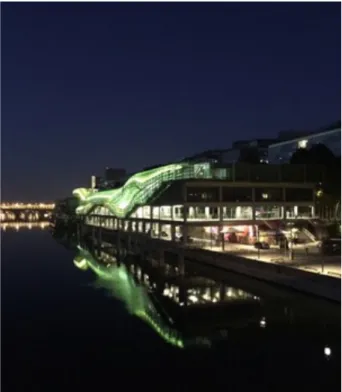
things includes a school used after hours as a social centre, or an office sharing space in night and day shifts. A multi-use building, such as the converted Les Docks project by Jakob + MacFarlane Architects (Figure 6), accommodates a variety of programmes across a near 24-hour period, including: a fashion, design and exhibition centre, restaurant, public terraces and late-night dance club. It is also a beacon. Since it opened in 2012, the green of the Yann Kersalé designed lighting has become a point of reference along the Seine river. While Les Docks is a large and complex project, most co-opted spaces will need little to no built intervention. They develop from what can collectively be called non-potentialized social space: a ‘locus of possibilities’ (Lefebvre, 1974/1991, p. 191) within the built
landscape. They can be sited anywhere in the city from the perimeter, to the vacant plaza of an office tower, to the historic centre. On any given night, many of these spaces will have already been appropriated, by youth on skateboards, musicians and couples in search of privacy. Some practices will create points of tension with the planned city. And yet, as Andreina Seijas writes ‘unintended’ appropriations of urban areas can ‘provide relevant information on how to design inclusive night-time interventions’ (Seijas, 2017). Seijas, is referencing the often-spontaneous takeover of grassy areas and alleyways as people meet with friends, or simply rest, in the cool night of the Arabian cityX; uses that
are not always accommodated by city plans and regulations. Similar unplanned appropriations can be found in the European city. They might point to a need for alternate lighting, the addition of street furniture, including for garbage disposal, the passage of mobile services from health and safety, to food trucks and libraries: all of which impact the design of night-time spaces. This is not to reinforce controlled ‘regularity’, as in Robert Williams’ discussion of reterritorialized space (2008, p.521), but to accept a participatory and fluid design response to diverse population needs.
Figure 6: 5:22 am. Les Docks, Cité de la Mode et du Design. Red lights mark the entrance to a still active night
club in this multi-use converted port structure. The now darkened design centre and roof-top restaurant complete the buildings near 24-hour activity cycle. Jakob + MacFarlane Architects. Lighting Yann Kersalé. Source: (Author 2018).
Not every structure will have a nocturnal use. As Armengaud pointed out, buildings have the right to shut down at night, to recuperate from the day. But even sleeping buildings interact with the night. They form the walls to the illuminated room of nocturnal street (Schivelbusch, 1988, p. 150). They can be solid, permeable or reflective. Unlike the walls of an interior room, however, they have depth and
mass that allows them not only to envelop and dominate but also, to read as negative space to the positive space of the street. An example can be taken from the author’s repeated night walks across Paris’ Ile de la Cité. Before the devastating fire in 2019, the island saw over 30,000 tourists-a-day visiting Notre Dame Cathedral. And yet after midnight, with few permanent residents and a surplus of vacant government buildings (most with interior lights turned off in accordance with regulations), architecture recedes into silence and shadow. This is not a bad thing, on the contrary, it is what must be accepted to lessen the encroachments of light pollution. Pedestrians continue to wander the centrally located island. They come together along the river quays (Figure 7), where the island’s rough, fortress-like walls provide a buffer between the movements of city and the quiet expanse of the river.
Figure 7: 10 pm. Ile de la Cité. Set below street level, submerged in shadow, the island’s quays are taken over by
summer diners, their view animated by reflected light. Source: (Author 2019)
Moving forward
Marc Augé writes that we are always creating two spaces simultaneously, the one we choose to pass through and the one we choose not to pass through (1992, p. 109). As a research practice, walking at night allows these choices to be further investigated. Photographs included within the current paper were taken in the course of individual or accompanied night walks through the streets of Paris. They represent the first steps of a field methodology that moves from observation to generating alternative architects within the darkened nightscape. In identifying what operations will induce more
positive experiences of nocturnal urban space, and eventually justifying those findings, it becomes important to determine what specifically urban qualities are sought out at night and how these qualities might differ depending on the identity of the individual walker. If the scope of these questions goes beyond the necessary focus of the ongoing dissertation, they remain relevant to an overall understanding of how the built landscape interacts with urban darkness.
In a short survey of urban characteristics gleaned from books and articles on night studies, many references to illumination and shadow can be found, but also: complexity, depth, diversity, enclosure, legibility, mystery, opacity, permeability, porosity, reflectivity, scale, texture, thickness, transparency and visibility. Researchers investigating the urban night continue to add to this list, and very importantly, to define what these words mean in the context of the urban night. It is useful to understand, particularly in developing design pedagogies, what particular qualities of urban darkness are valued and why. For example, what constitutes transparency in a darkened city? Or, will the same complex urban topographies found to be attractive by day, prove difficult to navigate at night? Equipped with greater critical tools, students and design professionals can better consider how their projects will not only be interpreted in darkness, but how implicated these design decisions are in meeting the needs of nocturnal populations.
Architecture, like darkness, is never neutral. ‘its power depends on the temporal and spatial contexts in which it is experienced’ (Edensor, 2017, p. 179). It is therefore essential for those involved in architecture(s) to engage with the environmental, spatial and social complexities surrounding the urban night; that they as designers become part of the conversation and invested in generating better night-time experiences.
Notes
1 See Barentine (2009), for a detailed account of new French lighting legislation. The complete transcript of the ‘Arrêté du 27 décembre 2018 relatif à la prévention, à la réduction et à la limitation des nuisances lumineuses’ is found at: https://www.legifrance.gouv.fr/eli/arrete/2018/12/27/TREP1831126A/jo/texte
2 Ingold (2000). The quote refers to Ingold’s concept of building perspective as related to, and co-existing with his definition of dwelling perspective.
3 See annual progress reports, or ‘Bilan des Actions’, for details of nocturnal openings and other targeted actions. Available from the Paris Mayor’s Office, Conseil de Nuit, at: https://www.paris.fr/pages/le-conseil-de-la-nuit-3365
4 Perrin (2019). Interview with Matthias Armengaud, translated from the original French, ‘La nuit, le bâtiment a le droit d’être autre chose... Il a le droit de n’être rien du tout, de dormir.’
5 Merleau-Ponty (1990). Translated from the French, the full sentence reads, ‘Même des cris ou une lumière lointaine ne la peuplent que vaguement, c'est tout entière qu'elle s'anime, elle est une profondeur pure sans plans, sans surfaces, sans distance d'elle à moi’ (p. 328).
6 The conference ‘After Dark: Nocturnal Landscapes and Public Spaces in the Arabian Peninsula’, was organized by the Graduate School of Design and Center for Middle Eastern Studies at Harvard University. Information on the conference is found at http://cmes.fas.harvard.edu/event/after-dark-nocturnal-landscapes-and-public-space-arabian-peninsula
References
Augé, M. (1992). Non-Lieux, Introduction à une anthropologie de la surmodernité. Paris: Éditions du Seuil.
Barentine, J. (2019). France adopts national light pollution policy among most progressive in the world. International Dark Sky Association, Blog. Retrieved from:
https://www.darksky.org/france-light-pollution-law-2018/
De Certeau, M. (1988). The practice of everyday life. (S. Rendall, Trans.). Berkeley: University of California Press. (Original French published 1980)
Dunn, N. (2016). Dark matters: A manifesto for the nocturnal city. Alresford: Zero Books.
Edensor, T. (2013). The gloomy city: Rethinking the relationship between light and dark. Urban Studies, 52(3), 422–438. doi: 10.1177/0042098013504009
Edensor, T. (2017). From light to dark: Daylight, illumination and gloom. Minneapolis: University of Minnesota Press.
Ingold, T. (2000). The perception of the environment. London and New York: Routledge. doi: 10.4324/9780203466025
Gwiazdzinski, L. (2005). La nuit, dernière frontière de la ville. Paris: Editions de l’Aube.
Jacob, S. (2013). We live half at night. In Vers une climate, Building (with) the unstable (pp. 18-21). [Exhibition catalogue]. Cornell University, Ithaca, New York: John Hartell Gallery. Retrieved from: https://issuu.com/awparchitecture/docs/awp-towards_a_climate-building__wit
Le Corbusier. (1960). Towards a new architecture. (F. Etchells, Trans.). New York: Holt, Rinehart & Winston. (Original French published 1923)
Lefebvre, H. (1991). The production of space. (D. Nicholson-Smith, Trans.). Maldon: Blackwell Publishing. (Original French published 1974)
Lefebvre, H. (1996). Writings on cities. (E. Kofman & E. Lebas Eds. & Trans.). Oxford, UK: Blackwell Publishing.
Lynch, K. (1960). The image of the city. Cambridge, Mass: MIT Press.
Mairie de Paris. (2010). Les nuits de Paris: Acts des États Généraux de la nuit à Paris. Paris: Mairie de
Paris. Retrieved from
https://drive.google.com/file/d/0B7WOfZJICAvFNFQyR1lDcG1idXM/view
Massey, D. B. (1994). Space, place, and gender. Minneapolis: University of Minnesota Press.
Melbin, M. (1978). Night as frontier. American Sociological Review, 43(1), 3-22. doi: 10.2307/2094758 Melbin, M. (1987). Night as frontier, colonizing the world after dark. New York: The Free Press. Merleau-Ponty, M. (1990). Phénoménologie de la perception, Paris: Gallimard. (Originally published
1945)
Merleau-Ponty, M. (2002). The world of perception. London & New York: Routledge. (Original French published 1948)
Morris, N. (2011). Night walking: Darkness and sensory perception in a night-time landscape installation. Cultural Geographies, 18(3), 315-342. doi: 10.1177/1474474011410277
Pallasmaa, J. (2005). The eyes of the skin: Architecture and the senses. [Revised and extended edition]. Chichester: Wiley-Academy.
Perrin, L. (2017). Les architectes créent la nuit urbaine. Hemispheres, 12 (September), 59-63. Retrieved from https://issuu.com/hes-so/docs/hemispheres12
Roberts, M., & Eldridge, A. (2009). Planning the night-time city. London: Routledge.
Schivelbusch, W. (1995). Disenchanted night: The industrialization of light in the nineteenth century. (A. Davies, Trans.). Berkeley: University of California Press. (Original work published 1983)
Schlör, J. (2016). Nights in the big city: Paris, Berlin, London 1840-1930. (P. G. Imhof & D. R. Roberts, Trans.). London: Reaktion Books. (Original German published 1991)
Seijas, A. (2017). Designing for darkness: Three challenges to designing nocturnal landscapes. Ciudades Sostenibles Blog . Inter-American Development Bank. Posted April 13. Retrieved from https://blogs.iadb.org/ciudades-sostenibles/en/darkness-nocturnal-landscapes-latinamerican-cities/
Shaw, R. (2014). Beyond night-time economy: Affective atmospheres of the urban night. Geoforum, 51(1), 87-95. doi: 10.1016/j.geoforum.2013.10.005
Shaw, R. (2015). Night as fragmenting frontier: Understanding the night that remains in an era of 24/7. Geography Compass, 9(12), 637-647. doi: 10.1111/gec3.12250
Shaw, R. (2018). The Nocturnal City. Kindle Edition London: Routledge.
Tanizaki, J. (2001). In praise of shadows. London: Vintage Classics. (Original work published 1933) Vidler, A. (2011). The Scenes of the Street and Other Essays. New York: The Monacelli Press. Waterman, T. (2018). Making Meaning: Utopian Method for Minds, Bodies, and Media in Architectural
Design. Open Library of Humanities, 4(1), 4. doi: 10.16995/olh.109
Williams, R. (2008). Night spaces: Darkness, deterritorialization and social control. Space and Culture, 11(4), 514-532. doi: 10.1177/1206331208320117
It’s Therapy and it’s Fun.
Late Night Salons in London
Adam Eldridge, Dorrie Chetty and Nayyar Hussain
School of Social Sciences University of Westminster
[email protected] | @adeldridge ORCID: 0000-0002-9262-8983
Abstract
Night-time cultures have long been examined through such themes as community, gentrification and urban change. The uses and experiences of time (in both normative and non-normative ways), migration, belonging and conviviality serve as further useful concepts for the discussion below. This paper takes as its focus London based hair salons open beyond traditional opening hours and considers the ways in which they enable practices of community and belonging. The salons examined play a particularly crucial role in their local community, serving as points of introduction and as landmarks for new and established migrant communities. Based on empirical work in hair salons on the edge of central London, the paper argues that these spaces are important sites of conviviality within the capital and warrant greater policy intervention to ensure their sustainability.
Keywords
Night, hair salons, conviviality, migration
Introduction
The impetus for this paper started with a half-day workshop about nightlife in Brixton, south London, followed by a guided walk. Brixton represents many of the dominant themes that circulate through accounts of nightlife; what was once a predominantly working class and Black and minority ethnic area has, as a result of successive waves of gentrification and development, become a
well-known nightlife area and subject to considerable economic pressures (Roberts, et al, 2020; Hubbard, 2018). It was while on the guided walk the lead author of this paper noticed many of the hair salons in and around the busy commercial streets remained open well into the night. Discussing these spaces with nightlife and migration scholars it became apparent that in many neighbourhoods dotted around the outskirts of central London there were many well-known hair salons similarly catering to local communities after dark. Anecdotes about salons open until 23.00pm and in one case 3.00am were discussed as a matter of fact. As this project was developing, the importance of these salons to local community networks became further evident in a well-publicised campaign involving some hair salon owners in Peckham, south east London (Brinkhurst-Cuff, 2017; Johnston, 2018). Rye Lane, a well know street with several salons was threatened with significant upheaval owning to plans to redevelop the local train station alongside the lane, which would necessitate moving the salons to a new purpose built site. As we came to discover, and is discussed in more depth later, despite the evident centrality of hair salons to local communities and the myriad roles they play in their local area, in Peckham and elsewhere they are very much subject to the pressures of London’s population churn and seemingly endless (re)development.
The paper begins with a discussion of community and conviviality, what these terms might mean after dark, and their relevance when discussing hair salons. Work on subcultures and leisure identities offer much guidance for thinking about the formation and practice of communities after dark (Malbon, 1996; Blackman, 2005) but here we want to think more about the fleeting, spontaneous and unplanned ways that sociability and communities might be generated and practiced in the night. This discussion is thus guided by the question of how research on night spaces such as hair salons enable belonging and conviviality, and the ways these are lived and practised. After a discussion of the research methods, the paper presents original findings based on semi-structured interviews with salon managers across three sites in London. We argue that as well as playing important and multiple roles in their local community, especially for new migrants, hair salons serve as an example to expand upon theories of social connection and understanding in diverse, multicultural cities.
Community and Belonging
A range of terms have been used to understand and explain the ways people in diverse cities come together and the sorts of social relations and interactions that occur as a result. Rubbing along (Watson, 2009), superdiversity (Vertovec, 2007), conviviality (Wessendorf, 2014, Neal, et, al, 2019; Wise and Noble, 2016) and others (Neal, et al, 2019) seek to explain and analyse the manner in which social relations are constantly being made, remade, challenged or remodelled in cities such as London. Against the backdrop of London’s constant redevelopment and population churn, residents, tourists, existing and new communities share the city in everyday and institutional spaces; in education and work places (Amin, 2002), cafes (Hall, 2009), parks, markets and swimming pools (Watson, 2019, 2006), and, more fleetingly, on public transport, pavements, and the like. These different spatial scales entail
different intensities of connection and disconnection resulting from the constant flow of bodies, affects, technologies, and practices. Attempts to explain what belonging, community or indeed conviviality might mean in the shifting context of London is therefore complex, not least due to the multiple ways that we might both speak around and about these subjects (Vertovec, 2007) at a range of different scales.
In this paper we take the night as a way of adding further focus to questions of belonging, community, and conviviality. Much of the literature concerned with belonging recognises the ways in which it is articulated with temporality, not least in that familiarity might entrench a sense of being in place and identity (Altman, and Low, 1992). Annual events, ceremonies, memories of one’s childhood home or school, the presence of loved ones, and the various routines we regularly perform provide a sense of continuity and belonging that is experienced or understood as embedded in specific sites. Belonging has long been conceived in this way, and the familiar, home, rootedness, and fixity circulate through some of the literature which takes a critical eye to the question of place attachment and spatial identity.
Equally, there is a significant body of work which also conceives belonging more in terms of flow, mobility, diversity and migration (Gustafso, 2011, 209, 2014). Following this account, emphasis shifts from understanding our social connections through notions of fixity and stasis to instead ‘how’ social connections are made, the practices through which they become legible, and the extent to which we, as social actors, experience and perform belonging in a globalised and mobile world. Our focus here on the night adds further nuance to this work. As noted, subcultures are an important theme when thinking about identity and belonging in the night. There are also spaces from bowling alleys (Jackson, 2020) to local pubs (Eldridge and Roberts, 2008) where a sense of attachment can be experienced after dark, where communities are entangled in broader networks of belonging and identification, and where practices of belonging are refined and learnt. The night, in contrast, is also sometimes considered in terms of how we might feel we do not belong. Evidence from the London Night Time Commission’s (2019) Think Night report documents high level of concern about safety after dark in the capital. Gender, class, disability, age and ethnicity further inform the extent to which we feel comfortable venting out at night, and whether we feel it is accessible. Evidence from numerous other sites also explore how a change in demographic or use will also influence people’s sense of comfort and belonging at night, be that in the areas we ordinarily live, in bars we might once have felt a strong sense of familiarity in, or even in cities where we might not live but visit regularly go for leisure (Garcia, 2015). Gentrification is a common theme here, as is tourism, where a sense of belonging via familiarity is challenged as a result of significant change.
Belonging, and how it might change over time or even across the day is a further significant them in studying nightlife. While it is therefore articulated with the temporal, it is not necessarily reducible to fixity or stability. To consider belonging at night opens up further questions about how people might feel more or less included in spaces after dark and might have a different sense of belonging once night falls. Indeed, as Garcia (2016) has extensively documented, mobility is also integral to one’s sense of
comfort and belonging, such as in research which found clubbers regularly commuting between Britain and Berlin and feeling more embedded in the night-time cultures and networks of another country than at ‘home’.
Our sense of inclusion and hence belonging at night is therefore fraught and subject to flows of movement and mobility, to shifting terrains owing to gentrification or tourism, and, furthermore, is marked heavily by gender, ethnicity, religion, disability, and (sub)cultural capital. Our point here is while we approach belonging in terms of practises of belonging and conceive it alongside rather than in opposition to migration and mobility, we also want to recognise that the night adds further complexity to how comfortable, at home, or in place different communities might feel across time.
Further to this point, our analysis of the salons was informed by critical work on community, especially ‘community as practice’ as discussed by Blockland (2017) and Jackson (2019). Community is of course somewhat different to conviviality, further muddying our terms, but our approach in taking on this notion of community very much owes to the above cited authors and the work of Neal, et al, (2019). In their discussion of conviviality and community, they raise the problematic associations that might be assumed by work that takes conviviality as a point of departure. In accounts critical of this term, conviviality is assumed to mean the erasure of conflict or the flattening of hierarchies, and is strongly associated with positivity or a ‘happy clappy togetherness’ (Wise and Noble, 2016: 245). As Neal, et al, explain:
[C]onviviality has become a little stuck, bogged down in demands that it delivers on, or at least evidences meaningful interaction and transformative potential, as well as responding to concerns that it marginalizes issues of multiple subjugations and power relations (Neal, et al, 2019: 70)
Echoing their approach, we also want to work with the multiple ‘everyday practices of multi-ethnic interaction’ (Neal, at al, 2019: 70), and how they are understood, while also remaining attentive to the forms of community that might also emerge in spaces such as hair salons, as spaces of and for conviviality. This approach echoes Berg and Nowicka who argue that conviviality research seeks to understand ‘the often subtle, unmarked quotidian practices, routines and acts of improvisation’ that typically occur in areas of superdiversity (2019, 3). This approach focuses typically on shared spaces and sites including playgrounds, public transport and leisure venues where interaction is productive and generative. To speak of the productive aspects of conviviality does not erase tensions or rest on an apolitical sense of universal harmony – that assumed ‘happy clappy togetherness’, as Wise and Noble characterise it (2016). Our understanding of community also seeks to avoid the ways that community can lend itself towards notions of cultural inclusion, and therefore exclusion; cohesion, which might presume a lack of conflict or tension; and nostalgia, which can also be conceived as a defensive response to change (Stewart, 1993). As understood here, we take Berg and Nowicka’s question ‘under what circumstances do daily encounters and activities become convivial?’ (2019; 17) as a central question and point of departure. The everydayness and routineness of attending a hair salon, the unremarkable interactions that might occur, and the important work that goes into working through