186
Article submitted on January 24, 2016 and accepted for publication on August 03, 2017. [Translated version] Note: All quotes in English translated by this article’s translator. DOI: http://dx.doi.org/10.1590/1679-395158911
of a business-oriented background
Denise Gutierrez Castro1 Edson Keyso de Miranda Kubo2 Milton Carlos Farina2 1Universidade Federal do ABC (UFABC), Santo André – SP, Brazil 2Universidade Municipal de São Caetano do Sul (USCS), São Caetano do Sul – SP, Brazil
Abstract
Organizational identification is a recurring theme in the study of behavioral aspects in different organizations. This research aims to analyze the identification of civil servants of a federal University, who are managers graduated in business administration. Through the observation of official documents, and semi-structured interviews analyzed with the software Atlas TI 7.0, and participant observation, a case study was carried out in a Brazilian Higher Education Institution of the Federal Government. The study counted on the support of the Rector and the approval of the institution’s Ethics Committee. The analysis for organizational identification was carried out using the proposed model based on a map of identification and a map of frustration (KREINER and ASHORTH, 2004; ROCHA and SILVA, 2007). Stability, quality of life, training opportunities, the flexibility to propose new workflows and living together with resourceful persons contribute to organizational identification. On the other hand, political decisions, lack of work continuity, absence of defined procedures, career plan, lack of planning of actions, communication problems, bureaucracy, uneven workload and knowledge of specific legislation leads to frustration, under the context of the managerial rationality. Therefore, the identification process of these civil servants was ambivalent and their educational background in business administration was one of the factors that contributed most to this identification.
Keywords: Organizational identification. Public administration. Business administration.
A atuação de administradores de empresas em órgãos públicos: a identificação organizacional diante de uma formação voltada a negócios
Resumo
A identificação organizacional é um tema recorrente no estudo de aspectos comportamentais em diferentes organizações. O objetivo desta pes-quisa foi analisar como se configura a identificação organizacional de servidores públicos de uma universidade federal, que exercem cargo de administradores e que são formados em Administração de Empresas. Por meio da observação de documentos oficiais da instituição, entrevistas semiestruturadas foram analisadas com o programa computacional Atlas TI 7.0, e com base em observação participante foi realizado um estudo
de caso em uma instituição brasileira de Ensino Superior do governo federal, que contou com o apoio oficial de seu reitor e com a aprovação de seu comitê de ética em pesquisa. Procedeu-se à análise da identificação organizacional segundo o modelo proposto para um mapa de identifi-cação e um mapa de frustração (KREINER e ASHFORTH, 2004; ROCHA e SILVA, 2007). Com a identifiidentifi-cação com a organização contribuem a esta-bilidade, a qualidade de vida, as oportunidades de capacitação, a flexibilidade para propor novos fluxos de trabalho e a convivência com pessoas capacitadas. Não obstante, as decisões políticas, a falta de continuidade dos trabalhos, a ausência de procedimentos definidos, o plano de car-reira, a falta de planejamento de ações, os problemas de comunicação, a burocracia, a carga de trabalho desigual e o conhecimento de legisla-ções específicas resultam em frustração, no contexto da racionalidade do gerencialismo. Portanto, o processo de identificação desses servidores se mostrou ambivalente e a formação em Administração de Empresas foi um dos fatores que mais contribuiu com esse tipo de identificação.
Palavras-chave: Identificação organizacional. Administração pública. Administração de empresas.
El desempeño de los administradores de la empresa en organismos públicos: la identificación organizacional frente a una formación orientada a los negócios
Resumén
La identificación organizacional es un tema recurrente en el estudio de aspectos comportamentales en diferentes organizaciones. El objetivo de esta investigación fue analizar cómo se configura la identificación organizacional de servidores públicos de una universidad federal, que ejercen cargo de administradores y que son graduados en Administración de Empresas. Por medio de la observación de documentos oficiales de la institución, entrevistas semiestructuradas analizadas con el software Atlas TI 7.0 y de la observación-participante, se realizó un estudio de caso en una institución brasileña de enseñanza superior del gobierno federal, que contó con el apoyo oficial del rector y con la aprobación del comité de ética. Se realizó un análisis sobre la identificación organizacional según el modelo propuesto de un mapa de identificación y un mapa de frustración (KREINER y ASHORTH, 2004; ROCHA y SILVA, 2007). Para la identificación con la organización contribuyen la estabilidad, la calidad de vida, las oportunidades de capacitación, la flexibilidad para proponer nuevos flujos de trabajo y la convivencia con personas capacitadas. No obstante, las decisiones políticas, la falta de continuidad de los trabajos, la ausencia de procedimientos definidos, el plan de carrera, la falta de planificación de acciones, problemas de comunicación, la burocracia, la carga de trabajo desigual y el conocimiento de legislaciones específicas resultan en frustración, bajo el contexto de la racionalidad del gerencialismo. Por lo tanto, el proceso de identificación de esos servidores se presentó como ambivalente y la formación en Administración de Empresas fue uno de los factores que más contribuyó para ese tipo de identificación.
INTRODUCTION
In Brazil, when comparing the fields of action related to business administration courses versus public administration courses, there is a great chance that professional graduates in the former will go on to work for public agencies as administrators. This is due to the fact that technical-administrative staff are governed by Law no. 11.091/2005, which establishes the Career Plan of the Technical-Administrative Positions in Education. In this plan, the only established requirement is that to hold the position of administrator an undergraduate degree must be obtained in administration, be it public or business administration. Contrary to the position defended by Bresser-Pereira (2010), this plan does not take into account the distinctions and specificities of public administration, which thus cannot be considered interchangeable with business administration.
For Bresser-Pereira (2010), business administrators are not able to immediately hold positions as public administrators. Therefore, there may be conflicts of organizational identification between the beliefs of business administrators and the bodies in which these professionals go on to play the role of public administrator. Research related to behavioral and organizational identification aspects remain relevant of late (CARDOSO, HANASHIRO and BARROS, 2016; CAVAZOTTE, ARAUJO and ABREU, 2017), mainly due to recognition of the importance of the relationship between the identity of the individual and the organization.
In the study of this relationship, the subject of organizational identification has been investigated within the areas of organizational studies and organizational behavior (CAVAZOTTE, ARAUJO and ABREU, 2017; CARDOSO, HANASHIRO and BARROS, 2016; FREITAS, 2010 and CHREIM, 2002). The analysis of organizational identification is performed by considering, in a general way, the level at which the individual defines onself, taking into consideration the characteristics of the organization in which one is located. For Ashforth and Mael (1989) and Lane (2000), organizational identification is the process by which the subject’s beliefs about the organization in which he/she works are references to his/her identity. This means that, through the process of organizational identification, the individual integrates attributes of this organization into his/her self-definition.
Under this context, there is a need to understand how professionals coming from business administration degrees identify with the public agencies in which they work, and the difficulties they face in performing their roles, among other factors, as a way of enhancing organizational identification. We therefore seek to answer the following question: How is the organizational identification of public employees of a federal university, who hold positions as administrators and who are graduates of business administration courses, configured?
This article is divided into five parts, starting with this introduction and followed by presentation of the theoretical background on organizational identification and public administration. Subsequently, the methodology used for the research is presented, followed by the analysis and discussion of results and, finally, the conclusion.
ORGANIZATIONAL IDENTIFICATION
In this section, the several concepts underlying the organizational identification construct are presented, highlighting the similarities and differences between prior studies.
Ashforth, Harrison and Corley (2008) argued that organizational identification is the process by which an individual defines him-/herself, communicates that definition to others, and uses it to guide his/her life and work. This identification generates in the employee the feeling that he/she belongs to the organization, which influences his/her self-esteem and motivates him/her to pursue self-development.
Berger and Luckmann (2005) argued that the environment and the social group in which individuals are inserted contribute to their construction of reality and how they understand and interpret situations; that is, the place and the people surrounding an individual can determine that individual’s degree of identification with the organization in which they work.
Kreiner and Ashforth (2004) presented an expanded identification model in order to demonstrate how the process of organizational identification occurs. They indicated that it can manifest in four dimensions: (a) neutral or apathetic identification, (b) overidentification, (c) disidentification, and (d) ambivalent or conflicting identification (Figure 1).
Overidentification occurs when work is the top priority for an individual, and their attitudes and thoughts revolve around their professional activities. Dukerich, Kramer, and Parks (1998) argued that in this case, personal identity commits itself and belongs to the identity of the organization. In this way, employees send the organization their individual characteristics through projection, and absorb characteristics of it as if these characteristics were already their own through the process of introjection (PAGÉS, BONETTI, GOULEJAC et al., 1987). Dukerich, Kramer, and Parks (1998) also confirmed that, in such a context, there is a dependency relationship composed of affectionate feelings from the individual toward the company, which generates negative consequences such as the individual’s lack of criticality in relation to organizational actions and policies. Opposed to this dimension is disidentification. Dukerich, Kramer and Parks (1998) found that in this case the individual defines him-/herself as totally differentiated from the organization; that is, he/she has attributes and principles that are divergent from those promoted by the organization. The individual then consciously segregates his/her personal principles from those of the organization, highlighting the differences between what is and what is not. This situation aggravates aggressive feelings of resistance to what is determined by the organization’s representatives.
Another possible dimension is that of conflicting or ambivalent identification, in which the individual identifies, yet at the same time disidentifies, with the organization or some of its attributes. In this case, the individual identifies with certain aspects of the organization that he/she considers positive, and disidentifies with those considered negative.
In a scenario of low identification and low disidentification, one has a neutral or apathetic identification (DUKERICH, KRAMER and PARKS, 1998). This situation can be associated with a process of self-protection, in which the individual does not establish an identity linked to the organization and is able to develop, at any time, a differentiated culture within the organization without identifying with a specific group.
Figure 1
Expanded identification model
Source: Adapted from Kreiner and Ashforth (2004, p. 6).
IDENTIFICATION G
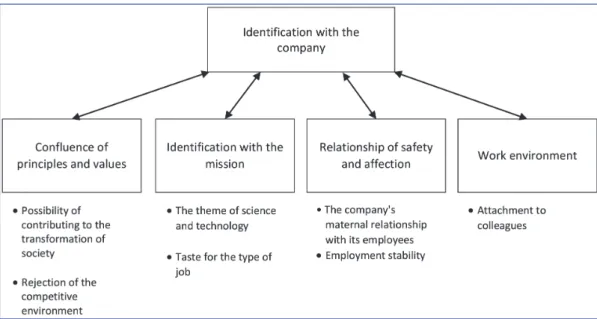
The literature has demonstrated other ways of understanding the process of organizational identification. One of these forms was developed by Rocha and Silva (2007), who presented one set of factors that aid the identification process, and another set that undermine the identification process and thereby contribute to a scenario of disidentification. These factors were brought together by Rocha and Silva (2007) in two maps: the identification map and the map of frustration.
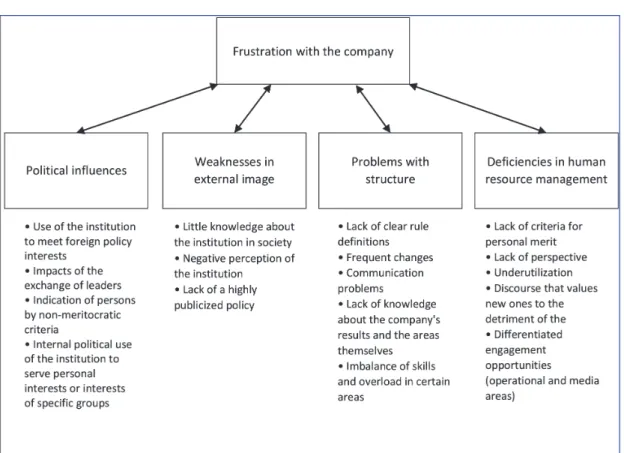
The identification map points to aspects that help employees identify with an organization and maintain that identification in a context of change. The frustration map, in turn, presents aspects that contribute to individuals’ frustration in relation to their organization and make it difficult for them to identify with it.
Figure 2 shows the identification map proposed by Rocha and Silva (2007). Figure 2
Identification Map
Source: Adapted from Rocha and Silva (2007, p. 703).
As shown in Figure 2, when it comes to a public company, employment stability is one of the factors of organizational identification, while another is the maternal relationship the company has with its employees. This relationship was observed in Rocha and Silva’s (2007) analysis of the identification process and how it unfolds in individuals’ behavior. The authors found that the image was used repeatedly by interviewees in their study to demonstrate the relationship they had with the organization. Figure 3 presents the frustration map elaborated by Rocha and Silva (2007).
Figure 3 Frustration Map
Source: Adapted from Rocha and Silva (2007, p. 704).
Figure 3 shows that aspects such as the lack of clearly defined rules, communication problems, society’s lack of knowledge about the institution, and the indication of people by non-meritocratic criteria contribute to disidentification with the organization. It is important to emphasize that this map presents both internal factors (such as the imbalance of competences and overload in certain areas) and external factors (negative perception of the institution), which are manifested as favorable for disidentification.
The maps of identification and frustration of employees in relation to the company in which they work may be related to the structure of the organization. This structure systematizes both the technical aspects and the behavioral aspects that people must enact or present within the organization. According to Fogaça and Coelho Junior (2015), relationships between the dimensions of organizational structure and the dimensions of psychological well-being may occur. According to Fogaça and Coelho Junior’s (2015) analysis of part of the judiciary, for federal public servants autonomy was the structural aspect they cited and defended most in terms of giving them freedom of creation and quick solutions to problem.
Therefore, the following section outlines the concepts and models that can contribute to an investigation and categorization of topics related to identification and frustration with a public university as employer. This discussion also serves as a reference for the codification of information obtained during the data collection stage.
PUBLIC ADMINISTRATION AND BUSINESS ADMINISTRATION
Bachelor’s degrees in public administration have been on offer for more than 50 years in Brazil. For Bresser-Pereira (2010), public administration is an area of knowledge whose objective is to study the State apparatus, and is closer to political science or law than to economics and business administration.
Frustration with the company
Weaknesses in external image • Little knowledge about the institution in society
According to Pinto and Behr (2015), from 1970 an objective was to implement a managerial approach within public administration in countries such as the USA, Great Britain, and Brazil, especially from 1995, with the aim of modernizing and debureaucratizing public organizations.
According to Di Giacomo (2005), the main characteristics of public administration, or public management, that have existed in Brazil since 1990 are: (a) an emphasis on effectiveness; (b) agility in the functions of planning, organizing, leading, controlling, and coordinating; (c) decentralization; (d) delegation of authority; and (e) performance control.
Nevertheless, Vilas Boas, Pereira, Teixeira et al. (2012) stated that in Brazil there has been a hybrid model, known as Tupiniquim
public administration, which involves characteristics such as patrimonialism, bureaucracy, managerialism, and social management. In this context, managerialism has influenced public administration through a rationality that emphasizes a market logic, managerial modernization, and instrumentalization of the State to obtain greater efficiency (FARIA and FARIA, 2017; MISOCZKY, ABDALA and DAMBORIARENA, 2017). Thus, a predisposition to view the public sector as naturally inefficient and lacking in instrumentalization and modernization has been noted from a neoliberal perspective (DAGNINO, 2004). Since the 1980s, Brazilian public administration has become the target of a speech full of managerial adaptations, with the label of the participatory aspect, but not verisimilar in practice (PAULA, 2005). However, this apparatus for modernizing and increasing the efficiency of administration does not guarantee social inclusion in the benefits of development (DAGNINO, 2004; FARIA and FARIA, 2017). On the other hand, Bresser-Pereira (2010) affirmed that the Brazilian public administration model, which has adopted managerialism as a basis for its reform, has a dialectic relationship with the social State, in which the size of the Brazilian State requires modernization of administrative apparatus to ensure efficiency and quality of public services. In this model of public administration, it is up to the State to offer society efficient and high-quality public services, rendered in a timely manner, that work well and at minimal cost (DI GIACOMO, 2005). Public administrators have the function of managing the State apparatus efficiently, but in a way that differs from that of business administrators (BRESSER-PEREIRA, 2010). Business administrators seek to expand their organization to increase profits for the benefit of the organization’s owners, while State organizations aim to further the public good. While one competes in the market, the other is monopolistic, in the sense that there are no competitors of the State since it performs functions exclusive of its responsibility, especially those established in the Federal Constitution.
In public administration, there is sovereignty and state power. Consideration should also be given to their ability to define public laws and policies aimed at the community and to implement these effectively. In this sense, it is emphasized that training of public administrators must incorporate theories that explain the functioning of the State, as a normative and organizational institution, and its relationship with society (BRESSER-PEREIRA, 2010). Thus, training of public administrators transcends rational and quantitative techniques of strategies, management, and decision making.
Bresser-Pereira (2010) argued that there are considerable differences in the training of public administrators compared to that of company administrators. The broad understanding of the former regarding norms governing the public sector is one of these differentials, along with a more focused vision in meeting the needs of society. Bresser-Pereira (2010) added that public servants cannot be seen as merely executing decisions made by politicians on behalf of their constituents, since they must also help politicians formulate or reformulate these decisions. In terms of training, undergraduate courses in public administration cannot be limited to teaching students strategies and methods of management and control, and quantitative methods of administration and decision making; an overview of society and how it is coordinated is also needed.
Public employees should bear in mind that State-owned enterprises have two distinct objectives: (a) meeting stakeholders’ needs, which aim to serve the public interest; and (b) serving shareholders, to cater to private profit interests (BARBALHO and MEDEIROS, 2014).
For Saravia (2010), there are many elements that differentiate the two forms of administration. While private companies’ actions are guided by strategic planning, public administrators work within more rigid governmental planning systems, which are guided by the Federal Constitution and by public policies.
One point that has often been discussed when it comes to public administration, and which is constantly compared to private administration scenarios, is bureaucracy. Abrucio (2007) suggested that bureaucracy is an instrument that needs to be professionalized and constantly evaluated through goals and indicators that help reduce political interference with state actions.
In public administration, undergraduate courses are based on disciplines that aim to provide an understanding of the logic of the State, government planning, public law, and public and budget accounting, which is intended to increase the effectiveness of public policies. In business administration, strategic planning and the private nature of business decision making are in focus through disciplines that emphasize market satisfaction, such as marketing, managerial accounting, and financial and budgetary administration, among others (SARAVIA, 2010). Public administration is therefore surrounded by specifics that distinguish it from business administration in certain respects, and requires graduates to be more focused on understanding the role of the State and the guiding principles of public administration.
It should be noted that, despite these differences between business administration and public administration, managerialism— in line with concepts of market rationality and private companies that are considered a natural focus of business administration courses—has infiltrated and influenced the discourse of modernization regarding Brazilian public administration.
METHODOLOGY
This article investigates how the process of organizational identification occurs in graduates of business administration that work in the public sector. It does so by evaluating the effects of this identification on their vision and behavior in relation to the public institution in which they carry out their activities.
The research used a descriptive-analytical case study developed through a qualitative approach. For this, Yin’s (2001) definition of case study was adopted; that is, as an empirical investigation of a contemporary phenomenon in a real-life context. Minayo (2004) and Triviños (2009) affirmed that the qualitative approach is a method through which researchers can understand the dynamics of the phenomenon in its complexity, working in a universe of meanings, motives, aspirations, and beliefs, among others, with the aim of understanding the human reality.
Triangulation (YIN, 2001) can be achieved by conducting interviews, analyzing official documents, and carrying out participant observation. The scenario chosen for the research was a federal university. The research subjects were public employees who had graduated from a business administration course, and who went on to act as administrators. The university was selected based on observations regarding the background of the technical-administrative staff. As of 2015, of the 751 total technical and administrative public employees in its staff, 72 were managers, and among these 71 had an (undergraduate) degree in business administration.
In addition, this university has recognized the shortage of public employees who have graduated with a degree in public administration, which resulted in the university offering a specialized course in public management in 2010 and 2013 to mitigate possible work deficiencies or identification problems. Such conditions made this university a suitable case within this research.
• What contributes to or hinders the performance of your activities?
• How do you relate to this university, and how does the university impact your life?
• What kind of feelings have you developed in relation to the performance of your activities, and in relation to this university?
• Do you have plans to move to another area within this university? Which area, and why?
• In any situation during the performance of your activities, have you encountered values and understandings that differ compared to your own? How did you react to this?
During the interviews, interviewees were able to make additions or clarifications, so that the themes could be deepened as needed. The interviews were recorded with the previous consent of the interviewees, and then transcribed to ensure reliability of the data in the analysis process. The interview proposal, questionnaire, and free and informed consent form were approved by the research Ethics Committee, and formal authorization was obtained from the institution’s dean, given the interest in this issue of organizational identification.
After the data were collected, theoretical triangulation (YIN, 2001) was conducted to understand the studied phenomenon and the developed case study based on the contrasting theoretical perspectives on the subject. This included documentary analysis and participant observation (THIOLLENT, 1994).
Box 1
Information obtained through participant observation and document analysis
Items used for participant observation and documentary
analysis Topics on which information obtained
Career Plan for Federal Public Employees and Law
n. 8.112/1991 Public employee stability, rights, duties, and prohibitions Notice of public tender for the position of administrator Prerequisites and job assignments
Announcement of specialized course in public management,
promoted by the university itself Justification for the course creation and curriculum matrix University website University’s public servers, pedagogical projects, history, and
management reports
Minutes of meetings of the university’s highest council The need to create specialized course in public management for technical-administrative employees
Conviviality with university managers and participation in external and internal meetings
Organization and performance of the public employees interviewed (tacit information)
Discussions via participation in an event for the university
administrators, organized by the university itself The role of administrators in public management
Source: Elaborated by the authors.
Participation in informal and formal meetings with managers and members of the university’s highest council, and participation in discussions on the role of the administrator in public management and in internal events sponsored by the institution, allowed participant observation and access to documents, such as minutes of meetings, which were subsequently analyzed.
Box 2 shows the sociodemographic data of the interviewees, who were selected based on the criteria that they had graduated with a degree in business administration and were acting as managers in the case university.
Box 2 Interviewees
Respondent
pseudonym Sex Marital status (years)Age Time at institution Degree level (university degree)Background
A1 Female Married 33 8 years Master’s degree
Business administration (AE) A2 Male Single 28 1 year, 5 months Specialization AE A3 Male Married 44 6 years, 6 months Master’s degree AE A4 Male Married 40 5 years, 2 months Specialization AE A5 Male Married 35 3 years, 3 months Specialization AE A6 Male Single 33 7 years, 4 months Specialization AE A7 Male Married 31 5 years, 5 months Specialization AE A8 Male Single 40 3 years Undergraduate AE A9 Male Single 38 5 years, 6 months Doctorate AE A10 Male Married 34 9 years Specialization AE A11 Female Single 45 4 years, 9 months Specialization AE A12 Male Single 29 1 year, 2 months Specialization AE A13 Male Married 34 7 years, 4 months Specialization AE
Source: Elaborated by the authors.
Among the interviewed actors, 85% were male. Their average age was 35 and the average time working for the institution was five years. As the university had only been in existence for nine years at the time of the study, the group can be said to have experienced, on average, half of the university’s lifespan.
ANALYSIS AND DISCUSSION OF RESULTS
From the mapping of the organizational identification process, based on the expanded identification model proposed by Kreiner and Ashforth (2004), it was observed that the majority of aspects mentioned by the interviewed group seemed to present characteristics of an ambivalent identification. In this dimension, actors identify with certain aspects of the organization that they consider positive, and disidentify with those seen as negative.
Box 3
Representative responses regarding positive and negative impressions revealing an ambivalent organizational identification
Actor Positive aspects Negative Aspects
A1 “After three or four years of work here, I made the decision to stay in this institution for the long term; I did not try other placements in the private sector, nor did I apply for other public positions, because my idea was to do a master’s degree. I already had tried to do the course in private companies, but, of course, they would not release me. … here I saw that I had this opportunity to realize that dream, which was actually old, and I saw that in private companies, I would not have the opportunity to do the master’s degree. … [here] I was sure that I would be working, and I would be able to accomplish both the master’s degree, which I finished last year, and now do a doctorate course.”
“The feeling I have is that it has a lot of political influence [...] On the exchange of directors, I went through a lot because of this, I went through some four or five new leaders, and had a new leader for two months before they went away, so what I felt is that there really is no continuity of work, a plan for the department, for example, a strategy … It was the plan of the leader of that moment. Then, I would open a process to acquire a piece of equipment or a service, I would carry out the whole process, which, you know, is complex, then the manager would change and the new boss would say … ‘No need, this does not go forward, it starts from scratch,’ and ask the opposite of what was requested ... then, a lot of work I did simply died, or did not serve anything because of these exchanges.”
A1 “Here there are not many ties that the old public agencies have; for example, here we can change a lot, improve many things. For example, we hire 99% of things via electronic trading, even work is done electronically ... Since we are new, we are learning, we are already doing what is new in public administration. When you compare our deadlines with other public agencies, we work very fast, things go very fast.”
“The first week was a shock to me, so I came to have some regrets. I thought … what am I doing here? Because I felt, as soon as … I entered the purchasing area, there is no way, in public administration, in the area of acquisitions and contracts, you have to know Law no. 8.666. Then the team of that time did the right thing, I arrived and knew nothing, Law no. 8.666 was simply given to me to read ... today, I understand why they did it, because we cannot work [without it], because we are all bound by this law, but for those who came from private companies, they had no knowhow.”
A4 “I would recommend it for the environment, which is great, the person learns a lot, has enough courses, the staff is receptive. I feel that the environment here is warm, familiar, my boss values me.”
“I think the work within the university could be better distributed, in some areas they have too many divisions, and more people would give more flexibility ... Since leaders are chosen by election, by vote, they always have the political stamp, so it is very difficult to escape from it ... I do not feel I belong to the university because I always had the intention of one day leaving.”
Source: Elaborated by the authors.
According to Box 3, the interviewees identified, at a certain level, with the organization, mainly with regard to their work environment and with what is “new” in public administration in terms of computerization and electronic trading. However, there are some points in which the public employees were against the institution’s positioning, such as with regard to political aspects that generate discontinuity of work, ignorance of the laws, and lack of flexibility in certain sectors. Due to these negative aspects, some even said that they did not see themselves as members, and that they wanted to leave the institution at some point.
Regarding taking an undergraduate course in business administration, some interviewees reported that the motivation for this choice was a desire to work in a family business or join a large company. In addition, among the factors that led them to enter the public area, they mentioned family connections, stability, and quality of life, as reported by A1, A2, A10, and A7:
I decided to take the business administration course, not thinking about starting a business or being an entrepreneur, but thinking about becoming a professional of a large company. And in my professional life I walked a different path, I worked in the commercial area for a long time, in an insurance company. The first determining factor to work here was the proximity of my residence, quality of life, stability, job security, even more with the current [economic] crisis, if I was in the old job, that would be a problem. (A2)
My father had a company and we worked with him, and when I started the administration course, it was to help me in his company. (A10)
Regarding the choice of course, I confess that at the time I did not have much guidance … the notion I had was [that the person] who made money was the executive, and to be an executive [you had to start as an] administrator, so it was a very simple view I had at the time. (A7)
Only one respondent stated that his/her initial motivation was to enter a public career. He/she said that he/she chose a degree business administration because, at the time of his/her course selection, courses specifically in public administration were scarce.
My reason for doing business administration is very different from most, I did directed to public post tender, because most of the disciplines they have in the course of administration, because it is a general course, deal with accounting, law, economics, and I could not choose to do a bachelor’s degree in public administration because where I studied I did not have this option. The only course I knew of was integral, so it was not feasible for those who work, but if where I studied there had been an undergraduate course in public administration I would have opted for that instead of business administration. (A4)
Adaptation to the public sector and its daily routines was reported as difficult by the majority of respondents. The fact that public administration presents a series of procedures defined by law, and how to request a set of administrative routines, were the reasons most cited by the interviewees as hindering the process of adaptation to the public sector:
I did not even have knowledge of … the law, having had a contact, nothing; for me, that reality was totally new, so it was a shock because I had to meet a very intense work pace, very insane in terms of speed, because everything there in the company where I worked was resolved by email, word of mouth, go and do, or just send an email with an OK, and suddenly arrive at a public agency, and reading a law, which for me made no sense at all, and start to realize that in public administration everything you need has to follow a protocol, a receipt, a form. I was very surprised by that, so it was very complicated because only the law, for those who are totally new to it, does not make any sense, I did not understand anything. What helped me was that later I ended up changing area, and the service there was more operational, it was more about providing service. I did not need to do bids, so I got it … it was easier to adapt. (A1)
My first job was difficult, I came from the rhythm of a private company, so I needed to slow down a bit, because I was very anxious, wanting to see things happen fast, and in public agencies this is not how it works, because we have to follow laws, rules. (A4)
The quotes from A1, A4, and A12 highlight the perception of a discrepancy between the dynamics of business administration and that of public administration, which refers to a connotation of slowness within public administration due to laws and rules. A12’s quote also shows that he/she had a total lack of knowledge of public administration in terms of subjects, which refers to the fact that the knowledge he/she had gained was predominantly managerial (BRESSER-PEREIRA, 2010; PAULA, 2005). Regarding the need for training, due to their education in business administration most of the interviewees highlighted the importance of specific training that contributes to the execution of public administration routines. Corroborating Bresser-Pereira’s view (2010), the interviewees highlighted the lack of content on public administration in the Bachelor’s of Business Administration courses, and the difficulties they faced in executing public administration routines when entering their public functions.
In fact, public administration has nothing to do with private administration, it is totally different; that’s what I usually tell people, I’ve had 10 years of experience in private institutions. So you have a base on which you can turn around, but at private institutions you can do anything that is not against the law; in public institutions you can only do what is in the law, so you try to turn around to implant things that you learned in private life, bring that reality into public life, being within the law. I think it is more complicated in this sense, but in the matter of learning, they passed me the whole service and they taught me within the same department, because I really would not know how, I would have to study on my own, and it is very difficult ... I would have had to take some [additional] course if they had not taught me. (A6)
I had to make some adjustments, even try to take courses and training, because there are differences between public administration and business administration, especially with regard to laws that people use a lot here, such as administrative law, public budgeting. As I had had no contact with these areas, it was something innovative, new situations, where I had to seek to deepen my knowledge of these concepts of public administration, because my background in business administration is very different. (A8)
Several courses are required in the area [in which] you are performing your activities. So, for example, I did activities in the field of contracting materials, so I had to take some courses on how to manage storage, how to hire contractors, how to control them … when I changed to another area, I needed to take a course on hiring service providers, how to supervise them. (A10)
It is important to emphasize how the actors interviewed recognize the distinctions between public administration and private administration, and the impact of such divergences on their activities. According to the statements by A6, A8, and A10, public administration involves issues of obtaining authorization according to the law, which entails specificities of administrative law and the public budget, which are subjects not addressed within business administration courses, as pointed out by A8 above. Some actors, for example, mentioned discomfort with public administration practices, and emphasized the need for additional training:
I have not gotten used to it, I have not adapted myself, because although I do not manage the company, I am part of the corporate structure, so I still have the vision of a private company. I am resilient to redundancy, I understand the principle I don’t remember right now, when the person cannot do and approve by herself, processes that we do today in a way that turn out to be quite costly. I do comply with the provisions in the legislation, in the procedures, but I still see them in a very critical way. (A10)
And even then, there were no defined procedures, so in this first period, what we did was to call other public agencies, other federal universities, and ask: I have this need, how do you do it there? So it was more or less like that, and later, when we were a bit more structured, there came the opportunity for the training courses, which helped me so much. It was very useful indeed, because it is one thing to read Law 8.666, another thing to take a course [in it], because something that is very important is interaction with the other participants. So then I started to ask questions, and saw how they did certain things in practice — how do I hire such a service. The lecturer is interpreting the law, teaching you, explaining to you what that set of rules is, and why that set of rules, because I think what is most frightening is you see a lot of deadlines, a lot of rules, and I do not understand the purpose. Everything has a reason, and it was very important for me to have participated in training courses, and to understand why, … it [taught me about] protecting the public patrimony, the public money, which is interesting, because at least then we can understand the logic of the business. So it helped me a lot. (A1)
This was the first public agency that I worked at; before, I worked with customer services, and had a very different role from the one I perform here. (A11)
Based on the above, the interviewees seemed to understand that it is necessary to undergo training in public administration routines, since they had had little or no contact to such aspects in their business administration courses. A13 mentioned that the institution shares this understanding, but pointed out that as the number of employees increases, opportunities to access training will decrease, due also to cuts in the institution’s budget:
the people that had attended before helped me to understand this bureaucratic part of things … and since the availability of courses was greater at the time I went in, it was easier because the university was still starting and still had more budget. Even nowadays, because of the large number of people who are entering, the reduction of funds and the immediate impact it has here, [people want] things [quickly], but forget the bureaucracy, which entails delays. So maybe the new people who are going to enter will have a greater difficulty adapting, that is my thinking. Unfortunately, it will be not possible to train everyone, even more with the decrease of budget. Then, it will also depend a lot on the dissemination of knowledge among colleagues. But sometimes we do not have the time to explain the details of a bidding, an electronic trading session, how to purchase a good or service. (A13)
As noted above, the university itself decided to offer a specialized course in public management, in order to mitigate the ignorance of the dynamics of public administration, to administrative employees. However, only 30 positions were offered in 2010, and 40 in 2013. With respect to the disparities between expectation and reality in a public institution according to professionals trained in business administration, several cited problems generated by the stability of public employment determined by Law no. 8.112/1990. The following excerpts illustrate this:
What changes a lot is about people, here. Because of the [mandated employment] stability, it is difficult to demand productivity; for example, that is something quite present in a private company, because it has to make profit, otherwise someone can be fired, but here practically there is no such thing, what you see here is an inertia, ... In the business administration course we see goals, objectives, and you see that often has no purpose, it’s that business, let’s work day-to-day without much concern for the performance of the organization. (A9)
What is difficult is people, the law exists for everyone, what exists are idiosyncrasies in certain people, the kinks, the peculiarities, things that people have. For example, I needed to collect a signature [within a certain] time … the frills they have here and the lack of commitment, proactivity … if it was in a company, [the employee whose signature I needed] would be sent away and it is finished, it is solved, but here it does not happen … So we have to... put up with, tolerate [this slowness]. (A9)
It is important to note that although stability is generally perceived positively by individuals belonging to a public organization, it also has negative effects. For instance, the difficulty of mobilizing people to fulfill certain goals was cited as a negative example found in the context of the case institution. In the testimonies of A9 and A7, there is also a connotation of superiority of the administration of companies over that of public entities in terms of performance, objectivity, and commitment. Respondents A9 and A7 reinforced the idea of managerialism by referring to managerial modernization, which would not be present in the university in question because it is public. Nevertheless, it should be emphasized that the influence of managerialism, which was present in the discourses and in the perceptions of the interviewees, leaves aside reflections on effective public spaces, the political and cultural agenda, and projects of social inclusion that characterize the actions and dynamics of a public organization (MISOCZKY, ABDALA and DAMBORIARENA, 2017; DAGNINO, 2004; FARIA and FARIA, 2017). The analysis of the institution’s documents and the participant observations contributed to showing that the university is concerned about the lack of knowledge about public administration demonstrated by employees upon joining the institution. Participation in meetings, informal conversations, and coexistence with public employees who act as administrators reinforced the interview findings regarding aspects of identification and frustration with the organization.
Based on the proposal of Rocha and Silva (2007), this study sought elaborate a map of identification and another of frustration for the case study developed in this research. Using these maps, an overview could be obtained of the aspects that contribute to the identification process, as well as those that need action from the institution to minimize frustration.
The following aspects were considered to contribute to organizational identification:
• Interacting with qualified people: The university environment contributes to this via an intense exchange of knowledge and experiences and encourages public employees’ pursuit of qualifications;
• Flexibility to propose new workflows, so that these actors adapt to the institution’s procedures and participate more in institutional processes;
• Growth Opportunities, since the institution has created a specialized course focused on the area of public administration, and offers opportunities for training;
• Quality of life;
• Stability.
These aspects are summarized in Figure 4.
Figure 4
Identification map: Case study
Source: Elaborated by the authors.
For the map of frustration with the organization, the following aspects were found:
• Absence of defined procedures, due to the vast amount of legislation involved;
• Difficulties related to stability, due to the constraints of firing employees in cases where there is no results-oriented approach;
• Unequal workload, since in some sectors the workload is higher than that of others, with people conducting activities via excessive schedules at certain periods of the year;
• Lack of continuity of work, which is related to the lack of defined procedures;
• Need for specific knowledge on legislation that has not been previously available and which led to the need for specific training;
• Strict career plans, which represent a motivational cause for actors leaving the institution because the plans do not allow career changes;
• Bureaucracy, which represents frustration with the organization: Most of the actors reported that in their business administration courses, as in their previous experiences, they were accustomed to more agile routines and leaner procedures, which is not always possible in public administration;
• Decisions motivated by political interests, which refers to the fact that, within the public institution, some decisions can be based on political bias, which directly interferes in the execution of the administrators’ activities.
These aspects are shown in Figure 5.
Figure 5
Map of frustration: Case study
Source: Elaborated by the authors.
The maps shown in Figures 4 and 5 show an overview of the aspects that facilitate identification and disidentification with the organization studied. The consolidation of these aspects facilitates understanding of employees’ identification and frustration with the organization, besides providing a more accurate vision of the actions needed by the studied public agency, which can potentially improve the satisfaction of public employees in the performance of their activities.
FINAL CONSIDERATIONS
In answering the question that guided this article, it is inferred that the process of identification of business administration graduates occupying an administrative post in public agencies is ambivalent. This is because, although codes such as quality of life, stability, and participation in internal decisions were cited as facilitating identification, they are in conflict with bureaucracy, policy-based decisions, and lack of communication.
observed that the influence of managerialism predominated in the interviewees’ discourse, as a rationality that attends to market logic and that constitutes the core of business administration courses, as demonstrated by the data collected during interviews, documentary analysis, and participant observation.
The case university in this study presented itself as a favorable environment, with actions aimed at furthering the qualifications of its employees and actively involving them in decision-making processes. Regarding the aspects that lead to frustration with the organization, it is important to note that most—such as bureaucracy, lack of strategic planning, and decisions guided by political interests—are characteristics that are perceived as common to public agencies. This was also seen in the literature review, which pointed out the managerialist influence in the managerial modernization of public administration.
Adaptation to the public sector and its daily routines was reported as difficult by most respondents. According to the analysis of the data obtained, this difficulty seems to have arisen from their having taken a business administration undergraduate course, the content of which differs from that of public administration, since the latter presents a series of procedures defined by law and requires a set of specific administrative routines. This factor were the most frequently cited by the interviewees as difficult to overcome and adapt to.
REFERENCES
ABRUCIO, F. L. Trajetória recente da gestão pública brasileira: um balanço crítico e a renovação da agenda de reformas. Revista de Administração Pública, v. 41, n. esp, p. 67-86, 2007.
ASHFORTH, B. E.; HARRISON, S. H.; CORLEY, K. G. Identification in organizations: an examination of four fundamental questions. Journal of Management, v. 34, n. 3, p. 325-374, 2008.
ASHFORTH, B. E.; MAEL, F. Social identity theory and the organization.
The Academy of Management Review, v. 14, n. 1, p. 20-39, 1989. BARBALHO, F. A.; MEDEIROS, J. J. Transparência e legitimação de objetivos institucionais em empresas estatais: um estudo de caso sobre a Petrobras. Cadernos EBAPE.BR, v. 12, n. esp, p.469-493, 2014. BERGER, P. L.; LUCKMANN, T. A construção social da realidade: tratado de sociologia do conhecimento. 25. ed. Petrópolis: Vozes, 2005. BRESSER-PEREIRA, L. C. Democracia, estado social e reforma gerencial.
Revista de Administração de Empresas, v. 50, n. 1, p. 112-116, 2010. CARDOSO, M. A. F.; HANASHIRO, D. M. M.; BARROS, D. L. P. Um caminho metodológico pela análise semiótica de discurso para pesquisas em identidade organizacional. Cadernos EBAPE.BR, v. 14, n. 2, p. 351-376, 2016.
CAVAZOTTE, F. S. C. N.; ARAUJO, F. F.; ABREU, A. L. Identificação organizacional entre funcionários públicos brasileiros: um estudo no setor cultural. Revista Brasileira de Gestão de Negócios, v. 19, n. 64, p. 289-306, 2017.
CHREIM, S. Reducing dissonance: closing the gap between projected and attributed identity. In: MOINGEON, B.; SOENEN, G. (Ed.). Corporate and organizational identities. Abingdon: Routledge, 2002. p. 75-90. DAGNINO, E. Construção democrática, neoliberalismo e participação: os dilemas da confluência perversa. Política e Sociedade, v. 3, n. 5, p. 139-164, 2004.
DI GIACOMO, W. A. O new public management no Canadá e a gestão pública contemporânea. Revista Interfaces Brasil/Canadá, v. 5, n. 1, p. 155- 170, 2005.
DUKERICH, J. M.; KRAMER, R. M.; PARKS, J. M. The dark side of organizational identification. In: WHETTEN, D.; GODFREY, P. (Ed.).
Identity in organizations: building theory through conversations. Thousand Oaks: Sage, 1998. p. 245-256.
FARIA, J. R. V.; FARIA, J. H. Concepção de Estado e a administração pública no Brasil no âmbito do plano diretor de reforma do Estado.
Administração Pública e Gestão Social, v. 9, n. 3, p. 140-147, 2017. FERNANDES, M. E. R.; MARQUES, A. L.; CARRIERI, A. P. Identidade organizacional e os componentes do processo de identificação: uma proposta de integração. Cadernos EBAPE.BR, v. 7, n. 4, p. 687-703, 2009. FOGAÇA, N.; COELHO JUNIOR, F. A. A hipótese “trabalhador feliz, produtivo”: o que pensam os servidores públicos federais. Cadernos EBAPE.BR, v. 13, n. 4, p. 759-775, 2015.
FOMBELLE, P. W. et al. Leveraging customer’s multiple identities: identity synergy as a driver of organizational identification.
Journal of the Academy of Marketing Science, v. 40, n. 4, p. 587-604, 2012.
FREITAS, M. E. Identidade e identidades: somos o branco e o arco-íris. In: CARRIERE, A. P. et al. (Ed.). Identidade nas organizações. Curitiba: Juruá, 2010. p. 11-14.
GODOY, A. S. Entendendo a pesquisa científica. In: HANASHIRO, D. M. et. al. (Ed.). Gestão do fator humano:uma visão baseada em stakeholders. São Paulo: Saraiva, 2007. p. 351-371.
KREINER, G. E.; ASHFORTH, B. E. Evidence toward an expanded model of organizational identification. Journal of Organizational Behavior, v. 25. n. 1, p. 1-27, 2004.
LANE, S. A stakeholder approach to organizational identity. Academy of Management Rewiew, v. 25, n. 1, p. 43-62, 2000.
MINAYO, M. C. S. O desafio do conhecimento:pesquisa qualitativa em saúde. 8. ed. São Paulo: Hucitec, 2004.
MISOCZKY, M. C.; ABDALA, P. R. Z.; DAMBORIARENA, L. A trajetória ininterrupta da reforma do aparelho de Estado no Brasil: continuidades nos marcos do neoliberalismo e do gerencialismo. Administração Pública e Gestão Social, v. 9, n. 3, p. 184-193, 2017.
PAGÉS, M. et al. O poder das organizações. 2. ed. São Paulo: Atlas, 1987. PAULA, A. P. P. Administração pública brasileira entre o gerencialismo e a gestão social. Revista de Administração de Empresas, v. 45, n. 1, p. 36-49, 2005.
PINTO, J. F.; BEHR, R. R. Contradições na avaliação de desempenho dos servidores técnico-administrativos em educação na universidade pública. Cadernos EBAPE.BR, v. 13, n. 4, p. 795-820, 2015. ROCHA, C. B.; SILVA, J. R. G. Identificação de funcionários com empresas públicas no contexto de mudanças: o caso Finep. Revista de Administração Pública, v. 41, n. 4, p. 685-706, 2007.
SARAVIA, E. J. Administração pública e administração de empresas: quem inspira a quem? Revista ADM.MADE, v. 14, n. 3, p. 1-8, 2010. THIOLLENT, M. Metodologia de pesquisa-ação. 6. ed. São Paulo: Cortez, 1994.
TRIVIÑOS, A. N. S. Introdução à pesquisa em ciências sociais:a pesquisa qualitativa em educação. 5. ed. São Paulo: Atlas, 2009. VILAS BOAS, A. A. et al. Administração pública tupiniquim: reflexões a partir da Teoria N e da Teoria P de Guerreiro Ramos. Cadernos EBAPE.BR, v. 10, n. 2, p. 284-301, 2012.
Denise Gutierrez Castro
Master of Management from the Universidade Municipal de São Caetano do Sul; Technical-management public employee at the Universidade Federal do ABC, Santo André, SP, Brazil. E-mail: [email protected]
Edson Keyso de Miranda Kubo
Doctor of Management from the Fundação Getulio Vargas-Escola de Administração de Empresas de São Paulo; Professor of the Postgraduate Course of Management at the Universidade Municipal de São Caetano do Sul, São Caetano do Sul, SP, Brazil. E-mail: [email protected]
Milton Carlos Farina