Abstract
Flotation plays a relevant role in the concentration of iron ores. Conventional flotation technology employing mechanical machines and columns and also circuits combining both types of cells have been utilized in the iron ore industry. The top size of particles in the flotation circuit feed is 150 µm and the slimes below 10 µm are removed as overflow in hydrocyclone classification. The conventional flotation technology faces difficulties in achieving tailings with iron grades lower than 12% and concentrates with SiO2 grades lower than 1%, and requires long residence times, resulting in large volume machines and huge footprints. The pneumatic flotation technology was evalu-ated in the reverse flotation of quartz from an iron ore sample of the Iron Quadrangle, Brazil. Bench and industrial scale tests were conducted in pneumatic flotation ma-chines at low residence time. Both tests were carried out in open circuit stages with the objective of comparison with mechanical cells. The bench scale tests were carried out in three stages (rougher, cleaner and recleaner) in an 11 L pneumatic cell aiming at final concentrate with maximum 2% SiO2 while the industrial tests were carried out in a 25 m3 pneumatic cell in the rougher stage aiming at comparison with a circuit of five
14 m3 cells in the rougher stage and four 14 m3 cells in the scavenger stage. The collision
and particle-bubble adhesion occur in a step before the pulp reaches the pneumatic cell vessel. The results indicate the possibility of achieving concentrates with a SiO2 content of approximately 1% and tailings with iron contents lower than 10% with three stages (rougher, cleaner and recleaner) without the need of scavenger stages. Furthermore, the residence time was three times shorter than that required for conventional mechanical cells. The speed of the pulp at the entrance of the pneumatic cell strongly affects the quality of the concentrate.
Keywords: froth flotation, pneumatic flotation, iron ore.
Neymayer Pereira Lima
Engenheiro de Minas, Dsc
Diretoria de Planejamento e Desenvolvimento de Ferrosos, Vale S.A.
Belo Horizonte – Minas Gerais - Brasil [email protected]
Antônio Eduardo Clark Peres
Professor Emérito
Universidade Federal de Minas Gerais – UFMG Escola de Engenharia
Departamento de Engenharia Metalúrgica e de Materiais (UFMG – DEMET)
Belo Horizonte – Minas Gerais - Brasil [email protected]
Tatiane Aparecida Rocha Gonçalves
Engenheira de Minas, Msc
Diretoria de Planejamento e Desenvolvimento de Ferrosos, Vale S.A.
Mariana - Minas Gerais - Brasil [email protected]
Comparative evaluation
between mechanical and
pneumatic cells for quartz
flotation in the iron ore industry
Mining
Mineração
http://dx.doi.org/10.1590/0370-44672016710179
1. Introduction
The flotation of iron ores is per-formed in circuits consisting of mechani-cal cells, columns, or a combination of both types of machines. The feed consists of particles in the size range between 10 μm and 150 μm. The slimes (fraction < 10
μm) are removed in hydrocyclones and the top size is limited to 5% to 10% > 150 μm. This wide range of particles size impairs process selectivity due to the possible dif-ferences in behavior concerning properties such as hydrophobicity, specific surface
area, weight, etc. (Lima et al., 2013).
The flotation mechanism was inves-tigated by Tomlinson and Fleming (1963), using a probabilistic concept between the probabilities of collision (Pc), adhesion (Pa) and a stable aggregate formation (Ps):
Pf = Pc x Pa x Ps
Different probability parameters are associated with different particle sizes in the flotation pulp. Thus, coarse particles have a high Pc and a low Pa, which helps
to explain the difficulty of collecting these particles in the flotation process. Studies carried out by Hewitt et al. (1994) showed
that the Pa increases with decreasing
particle size and with increasing degree of hydrophobicity, the latter being achieved with increased collector dosage. Further-more, fine particles have a low Pc and adhesion and high probability of retaining the bubble.
Current flotation systems utilized in the iron ore industry (mechanical cells
and columns) are not effective for collect-ing quartz particles larger than 150 µm and smaller than 45 µm, and the loss of fine particles of iron minerals in the tail-ings fraction is high. Furthermore, these systems require multiple stages and long residence times to produce concentrates with maximum 2% of SiO2 within market
specifications and with minimal loss of iron in the tailings. Entrainment of par-ticles into the froth phase is an important factor in the performance of the flotation process, especially concerning fine particle recovery. It has been observed that the entrained gangue recovery is often propor-tional to the water recovery (Trahar, 1981, Neethling and Cilliers, 2009), although there is sometimes a non-linear
relation-ship at low water recoveries, followed by a linear increase at higher water recoveries (Engelbrecht and Woodburn, 1975; Zheng
et al., 2006, Neethling and Cilliers, 2009).
A simplified model was proposed by Neethling and Cilliers (2002) to predict the entrainment factor as a function of the water recovery and the froth height. This investigation confirmed the experi-mentally observed relationship between
gangue and water recovery, including its dependence on particle size, by using physics-based models for the liquid and solids behavior in the froth. It was con-cluded that there is a significant particle size effect on entrainment, in agreement with experimental observation (Neethling and Cilliers, 2009). Equation 2 was used as a simplified model for the calculation of entrainment.
⎟
⎟
⎠
⎞
⎜
⎜
⎝
⎛ −
≈
g axial froth setJ
D
h
Ent
ν
5 , 12
exp
Where: Ent : Entrainment; Vset : Particle
settling velocity, hfrot: Froth height, DAxial:
Axial dispersion coefficient (particle dis-persion), Jg: Superficial gas velocity.
The entrainment of fine iron min-eral particles (<45 µm) into the froth can be one of the reasons for the diffi-culty in achieving tailings with low iron content (<12%) in traditional machines (mechanical and column cells) in the quartz reverse flotation of iron ores. The pneumatic flotation system was introduced in 1987, with the first
opera-tion in Pennsylvania for coal flotaopera-tion. Since then, the technology has been widely used for fine coal slurries, indus-trial minerals, ferrous ores, non-ferrous metal-bearing ores such as copper, lead, nickel and zinc, for the precious metals platinum, gold, and silver. The pneumatic machines have been used in a wide range of particle sizes, from 80%
passing 45 µm to 80% passing 1000 µm (Ören et al., 2012).
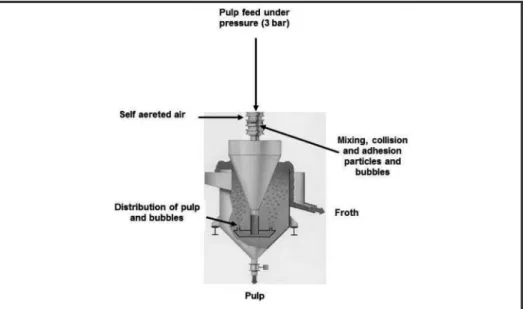
Figure 1 illustrates a pneumatic flotation machine, where the pulp must be pumped at high pressure (2.5 to 3.0 bar) to promote the suction of air (self-aerated air) and the collision between mineral particles and bubbles under high energy.
The pressurized conditioned pulp feed to the pneumatic machine shown in Figure 1 promotes the self-aeration to the feed pipe: when the air mixes with the pulp, small diameter bubbles are created. Collision and adhesion with particles take place ahead of the distributor and the hydrophobic par-ticles adhered to bubbles immediately migrate to the froth phase, while the hydrophilic particles follow the pulp phase to the underflow. The residence time is very low, not requiring proba-bilistic effects between particles and
bubbles in the cell as in conventional machines (Imhof et al., 2002).
The main features of the pneu-matic flotation are (Imhof et al., 2002;
Uliana et al., 2013):
• the mechanisms of collision and
adhesion between particles and bubbles which occur with high efficiency, before the pulp reaches the cell vessel, reducing the required residence times;
• low turbulence, reducing the
likelihood of detachment of coarse particles, leading to concentrates with low SiO2 content;
• low drag of fine iron mineral
particles to the froth, resulting in tail-ings fraction with low iron content;
• generation of small diameter
bubbles with high collection efficiency;
• simplicity of operation and
maintenance due to the absence of moving parts.
This paper reports the results and discussion of an investigation into the pneumatic machine used in the reverse flotation of quartz for in comparison with the conventional machines.
eq. 2
Figure 1
2. Materials and methods
2.1 Bench scale tests
Bench scale tests were carried out in a pneumatic flotation machine of 11 L in the rougher, cleaner and recleaner continuous stages aiming to produce the final product (iron concentrate) with SiO2 content below 2% and final tailings with maximum 10% of Fe. The tests were conducted in open circuit, where the first concentrate was used to feed the next stage. The recleaner concentrate was the final product, the combination of rougher, cleaner and recleaner tailings were the final tail-ings. The gas flowrate was controlled by a compressor.
The following conditions were used in the pneumatic flotation machine tests
based on preliminary tests to define the best conditions for reagents dosages, pH, and physical operating conditions:
• pulp solids concentration: 50%
by weight;
• pulp flowrate: 376 litres/hour; • residence time: 2.5 minutes in each
stage, 7.5 minutes total. The residence time was calculated dividing the pulp flowrate by the cell net volume;
• cornstarch dosage: 500g/t, added
during the pulp conditioning for 3 minutes;
• collector (etheramine EDA-C by Clariant) dosage: 80g/t, added during the
pulp conditioning after the cornstarch for 1 minute;
• pH: 10.5.
Feed, concentrates, and tailings were sampled for chemical analysis (Fe and SiO2) and determination of size distribu-tion and percent solids.
A representative iron ore sample from the Iron Quadrangle was used in the tests. Comparative tests in a 2600 mL conventional mechanical cell were conducted with the same sample and with the same reagents dosages and pH described above. Kinetic flotation tests were carried out in the mechani-cal bench smechani-cale machine, collecting tailings every two minutes for chemical analyses (Fe and SiO2). All the tests, pneumatic and mechanical cells, were done in duplicate.
2.2 Industrial scale tests
Industrial scale tests were carried out to validate the bench scale results and the scale up. The tests were done
in parallel with the conventional cir-cuit: one pneumatic rougher cell of 25 m3 was compared with nine
me-chanical cells of 14 m3 each. Figure 2
shows the comparative circuits for the industrial tests.
Figure 2 Comparative circuits for the industrial tests.
3. Results and discussion
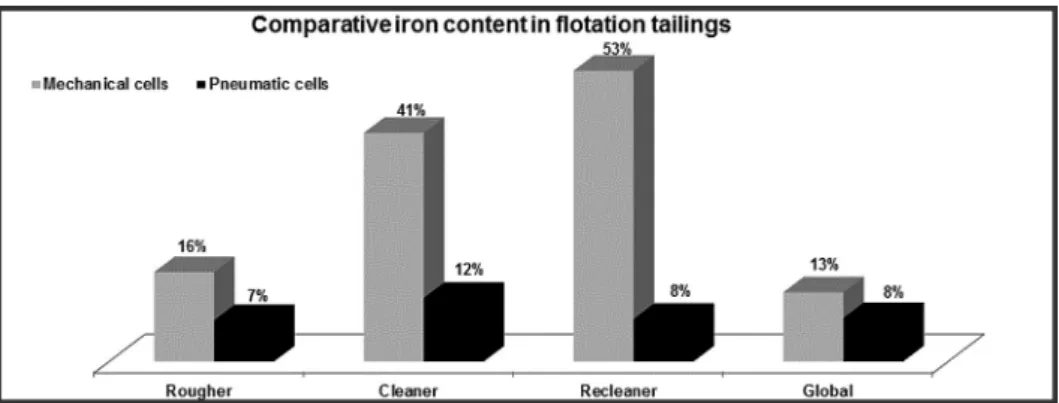
Figure 3 compares the Fe content in the rougher, cleaner and recleaner
tailings for pneumatic and mechanical bench scale machines.
The content of Fe in the pneumatic flotation tailings is almost stable in each stage. On the other hand, the Fe grades in the mechanical cells tailings are higher than those in the pneumatic cell, increasing from rougher to cleaner to recleaner. The higher grades of Fe in
the tailings of the mechanical cell are related to the fractions of <45 µm, as shown in Figure 4. The entrainment is the main hypothesis for the higher losses of fine particles of iron bearing minerals in the tailings of the mechani-cal cell.
The loss of fine particles of iron minerals by entrainment can be related to the water recovery in the froth as stated by Neethling and Cilliers (2002). Figure 5 shows the water recovery in the froth for the different stages in the mechanical and pneumatic cells.
The water recovery is lower in all stages of the pneumatic cell compared to
those in the mechanical cell.
Figure 6 shows the correlation between
water recovery and iron recovery in the froth for mechanical cell and pneumatic cells.
Iron recovery in the froth strongly correlates (R2 = 0.9537) with the water
recovery in the froth for the mechanical cell. On the other hand, the correlation is weak (R2 = 0.3605) for the pneumatic cell,
indicating that entrainment is less relevant in this machine, regarding Fe recovery to the froth. The high water recovery on the froth for the mechanical cell is in
agree-ment with the study of Lima et al (2016), where more than 96% of water in the froth and close to 90% of Fe recovery were observed in the scavenger stage.
Figure 7 compares the perfor-mance of the mechanical and pneumatic cells, over cumulative flotation time, in terms of grades of SiO2 in the final concentrate and iron in the tailings.
The Pneumatic cell produced an iron concentrate with 0.8% SiO2 after 7.5 minutes while the mechanical cell pro-duced an iron concentrate with 2% SiO2 after 16 minutes. The grade of iron in the pneumatic cell tailings was close to 6% during the three stages while this grade increased to 9% to 30% in the mechanical cells.
Figure 4
Content of Fe in the <45µm in the tailings.
Figure 5
Water recovery in the froth.
Figure 6
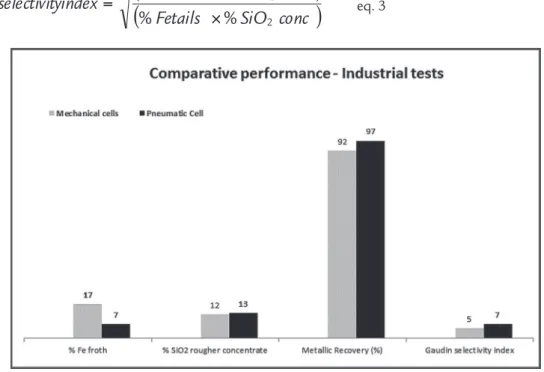
Figure 8 compares the results of the industrial flotation tests, regarding % of Fe in the froth, % of SiO2 in the rougher con-centrate, metallic recovery and Gaudin
selec-tivity index. The most outstanding feature is the low iron grade in the froth (tailings), but the enhanced metallic recovery and higher value of Gaudin’s selectivity index are also
relevant. Gaudin´s selectivy index was used to compare the separation efficiency between the two flotation machines. Equation 3 was used to calculate this index.
The industrial tests showed that the froth depth is not so relevant in the pneu-matic performance as is in the mechanical
cells. Other physical parameters require bet-ter investigation regarding pneumatic flota-tion, such as the pulp density, pulp velocity,
and ratio between air and pulp flow rates. These parameters seem to affect and control the pneumatic flotation performance.
4. Conclusions
The pneumatic cell has a great po-tential for quartz reverse flotation in the iron ore industry, with the possibility of reducing the flotation time and increasing the metallic recovery. One stage of pneu-matic flotation can replace the rougher and scavenger stages of mechanical cells, with a strong decrease in the footprint
and enhanced flotation performance for iron ore. The results of the investigation involving bench scale and industrial tests indicated that the entrainment of fine iron bearing mineral particles is lower in the pneumatic cell. Although there is greater operational simplicity, the effect of some parameters requires better
in-vestigation and understanding regarding the pneumatic cell, such as pulp density, pulp velocity, and the ratio between air and pulp flow rates. The bench scale pneumatic cell of 11 L of volume can be easily operated to estimate results for the industrial scale cell but the scaling up still requires investigation.
Figure 7 Comparative grades of SiO2 in the concentrate and Fe in the tailings.
eq. 3
(
)
(
Fetails
SiO
conc
)
tails
SiO
Feconc
yindex
selectivit
Gaudin
2
%
%
2
%
%
´
=
Figure 8 Comparative industrial performance be-tween the pneumatic and mechanical cells.
References
Received: 28 March 2017 - Accepted: 18 April 2017.
IMHOF, R.M., BATTERSBY, M.J.G., CIERNIOCH, G. Pneumatic flotation – an innovative application in the processing of potash salts. In: SME ANNUAL ME-ETING, 2002.
HEWITT, D., FORNASIERO, D., RALSTON, J. Bubble particle attachment effi-ciency. Minerals Engineering, v.7, n.5/6, p. 657–665, 1994.
LIMA, NEYMAYER P., GEORGE E.S. VALADÃO; ANTÔNIO E.C. PERES. Effect of amine and starch dosages on the reverse cationic flotation of an iron ore. Mine-rals Engineering, 2013.
LIMA, NEYMAYER P. PINTO, THIAGO C.S., TAVARES, ALINE, C., SWEET, JENNI. The entrainment effect on the performance of iron ore reverse flotation.
Minerals Engineering 96-97, 53-58, 2016.
NEETHLING, S.J., CILLIERS, J.J. The entrainment of gangue into a flotation froth.
International Journal of Mineral Processing, v.64, p.123-134, 2002.
NEETHLING, S.J., CILLIERS, J.J. The entrainment factor in froth flotation: Model for particle size and other operating parameter effects. International Journal of Mineral Processing, v.93, p.141-148, 2009.
ÖREN, E., MARKWORTH, L., HEEVER, J.V.D. Pneumatic flotation challenges conventional technology. A wide range of bubble sizes, online control of froth le-vel, turbulence-free operation and no need for a blower or compressor comprise a user- friendly system. Engineering and Mining Journal, p.60-61, November 2012.
TOMLINSON, H.S., FLEMING, M.G. Flotation rate studies. In: INTERNATIO-NAL MINERAL PROCESSING CONGRESS. Proceedings... Cannes, 1963, v.6,
p. 563-579.
TRAHAR, W.J. A rational interpretation of the role of particle size in flotation. Inter-national Journal of Mineral Processing, v.8, p. 289-327, 1981.
ULIANA, A. JÚNIOR, L.C.A., QUINTÃO, A.O., CASTRO, G., ARAÚJO, V. Apli-cação de células pneumáticas de flotação no processo de minério de ferro da Sa-marco Mineração S.A. Tecnol. Metal. Mater. Min., São Paulo, v.10, n.4, p.
359-364, out/dez 2013.