Jaroslav HOMIŠIN1
RESEARCH AND APPLICATION OF UNIVERSAL REGULATION
SYSTEM IN ORDER TO MASTER THE SOURCE OF MECHANICAL
SYSTEMS EXCITATION
Summary. In general terms the mechanical systems (MS) means the system of driving and driven machines arranged to perform the required work. We divide them into MS operating with constant speed and MS working with a range of speed. In terms of dynamics we understand MS as a system of masses connected with flexible links, it means systems that are able to oscillate. Especially piston machines bring heavy torsional excitation into the system, which causes oscillation, vibration, and hence their noise. Governing of the torsional vibration, as a source of MS excitation, on a basis of results of our research, can be achieved by applying a pneumatic coupling tuned by the proposed universal control system. On this basis, it can be concluded that with given connection a new continuous tuning method in steady state a connection of MS is created.
Therefore, the aim of project will be the research, application and analysis of the function of universal control system for governing the MS excitation source with proposed method.
Keywords: mechanical system, vibration and noise of mechanical systems, governing the source of mechanical systems excitation, control system, continuous tuning (tuning during the operation) of mechanical systems.
BADANIA I ZASTOSOWANIE UNIWERSALNEGO SYSTEMU
REGULACJI POZWALAJ CEGO ZAPANOWA
Ć
NAD RÓD
Ł
EM
WZBUDZANIA UK
Ł
ADÓW MECHANICZNYCH
Streszczenie. Ogólnie przez pojęcie układów mechanicznych (UM) rozumiemy układy napędowe oraz napędzane maszyn ustawione wobec siebie w taki sposób, aby mogły wykonywać wymagan pracę. Dzielimy je na UM pracuj ce na stałych obrotach oraz na UM pracuj ce w zakresie obrotów roboczych. Z punktu widzenia dynamiki UM traktujemy jako układy mas powi zanych ze sob w sprężysty sposób, a więc układy, które mog drgać. Przede wszystkim maszyny tłokowe wprowadzaj do danych układów znaczne wzbudzenie skrętne, które powoduje rozedrganie, wibracje, a przez to także wydawany przez układy hałas. Opanowanie drgania skrętnego jako ródła budzenia UM na podstawie wyników naszych badań można osi gn ć przez zastosowanie sprzęgła pneumatycznego strojonego przez zaprojektowany uniwersalny układ regulacji. Oparaj c się na tym, możemy stwierdzić, że dzięki temu poł czeniu powstaje nowy sposób płynnej regulacji UM w ustalonym stanie. Dlatego też celem projektu będ badania, zastosowanie
1
oraz analiza działania uniwersalnego systemu regulacji przy zapewnieniu zapanowania nad ródłem wzbudzania UM w zaprojektowany przez nas sposób.
Słowa kluczowe: układ mechaniczny, rozedrganie i hałas spowodowany przez układy mechaniczne, opanowanie ródła wzbudzania układów mechanicznych, system regulacji, płynna regulacja (strojenie podczas pracy) układów mechanicznych.
1. INTRODUCTION
Any MS in terms of how we understand the dynamics of the system means masses connected with flexible links between them, it means systems that are able to oscillate. Piston machines, which are classified as either MS drivers or driven units, bring to those systems extensive torsional vibration. This means that MS with internal combustion engines, compressors and pumps can be characterised as torsionally oscillating mechanical systems (TOMS). In the range of operating speed it can occur a very intensive resonance between the excitation frequencies (reciprocating machines) and the natural frequency of the system. Consequently, there comes to vibration and related over-stress in the whole MS. Excessive dynamic stress often causes malfunction of various parts of the system, such as.:
o shaft fatigue fractures, o gear-box failure,
o deformation and failure of flexible couplings etc.
Therefore, applies the rightful need to control their dangerous torsional vibration.
2. SCIENTIFIC OBJECTIVES OF THE PROJECT
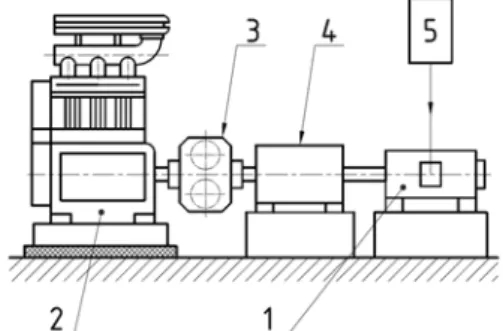
The overall objective of the presented project will be the research, application and analysis of the universal control system function to ensure the governing of the source of excitation in a different types of MS. Among the primary source of MS excitation belongs torsional vibration. Governing the source of MS excitation will be provided by a new way, which consists of continuous tuning, it means tuning during operation in steady state conditions, by patents [1] [2]. The essence of a patent [2] is that each MS must contain a pneumatic coupling (2) controlled by control system (5) (Fig. 1). The pneumatic couplings control with universal control system implemented by us, whose principle of operation result from patents [11], [12], [13], will be provided on the basis of closed-loop control (Fig. 2). Implementation of MS continuous tuning can continuously adjust the properties of pneumatic coupling to the systems dynamics so that torsional vibration doesn’t occur during its operation.
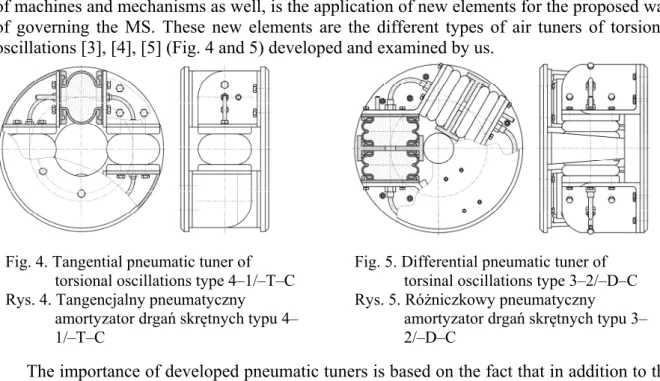
On a basis of patents fundamental, the MS will be presented by a laboratory mechanical system (LMS) by Fig. 3 and pneumatic connection will be realised by pneumatic coupling developed by us. [3], [4], [5] (Fig. 4 and 5).
To reach the stated objective, it is necessary to focus on the resolution of the following partial objectives:
1. Realization of the LMS for the possibility to provide two operating modes, namely work at constant speed and work with a range of speed;
2. Research and realization of an universal control system to ensure the governing of the LMS excitation source in its various working conditions;
4. Realization of experimental measurements on the LMS focused onto governing the LMS excitation source for following cases:
4.1. fault-free operation of piston device of the LMS running in its various working modes,
4.2. case of an accidental failure of piston device in various working modes of the LMS.
3. PRESENT STATE OF THE PROBLEM
Currently, the torsional vibration is reduced under acceptable value by appropriate adjustment, respectively tuning of mechanical system with application of appropriately selected flexible coupling based on a dynamic calculation. Thus the essence of system‘s tuning is an appropriate adjustment of the basic dynamical properties, especially dynamic torsional stiffness of the flexible coupling to the dynamics of the system.
Regarding to the general characteristics of flexible couplings, ie, their dynamic torsional rigidity and damping coefficient, it should be noted that they are affected by material (metal, rubber, plastics), shape, number and dimensions of the flexible members. Consequently they depend on various factors, which can be divided into stable and unstable factors [8]. The shape, number, size and various design modifications of flexible elements can be added to the group of stable factors, while the material of flexible elements belongs to the group of unstable factors, because of change of their original characteristics as a result of fatigue and aging. With change of original properties there comes to change of coupling’s characteristics M k = f (φ) (compared to initial characteristics), and thus to change of its basic characteristics, which largely positive impact on the value of dangerous torsional oscillation of the mechanical system [6] [7][8].
It should be emphasized that any linear or nonlinear elastic coupling has only one characteristic, tightly fixed to the used elastic element. In the case of linear coupling it is only one characteristic of a constant dynamic torsional stiffness. Dynamic torsional stiffness of the nonlinear coupling varies in some range, obviously its characteristics depends on the operating mode of the system. To change the properties of connections due to appropriate dynamic tuning of TOMS means to use other flexible element of coupling or other flexible shaft couplings.
Effects such as: temperature of flexible coupling’s elements and the number of cycles means that due to effect of the external forces, any member of the flexible coupling is exposed to fatigue or aging. Consequently, there comes to change of coupling‘s characteristics, and thus to change of its basic properties. This fact causes, that a suitably tuned TOMS becomes an untuned system. Flexible coupling in this case it acts no as a tuner, but rather as an exciter of torsional oscillations.
It should be noted that this method of tuning will be suitable only in cases where no previously unforeseen (random) effects during the operating mode can occur, especially in the turbomachinery and reciprocating machinery [6], [7]. In the case of accidental failure in MS operation mode a very intense resonance of lower harmonic excitation occurs, which is usually ignored in design stage. Due to this fact intense torsional excitation causes increased torsional oscillation, vibration and hence the noise mechanism.
Fig. 1. Principle of MS continuous tuning
Rys. 1. Zasada płynnego strojenia UM
Fig. 2. Control circuit ensuring the continuous tuning of mecha- nical system
Rys. 2. Obwód reguluj cy zape- wniaj cy płynne strojenie układu mechanicznego
Fig. 3. Laboratory mechanical system Rys. 3. Laboratoryjny układ mechaniczny
4. EXPECTED CONTRIBUTIONS
Research in field of the governing of dangerous torsional vibration as a source of MS excitation, has high economic benefits, because its primary function is to extend the life and performance of different parts of the system, and thereby ensuring their smooth operation without vibration and noise.
It must be noted that the proposed project solves the control of dangerous torsional vibration with direct optimization of MS, which is characterized by continuous tuning of the system during their operation in steady state. Therefore, the proposed method should be seen as a way of governing the excitation source of MS, thereby governing the vibration and noise of the entire plant themselves. In view of the scientific field Elements of machines and mechanisms, we understand the proposed control method as a new and very promising contribution to the area of the current methods for solving the size of the torsional vibration of given systems. The basic principle of the proposed control method consists in the continuous tuning of MS with pneumatic couplings - pneumatic tuners of torsional vibration regulated by the proposed universal control system [9], [10]. Continuous tuning of MS during operation in steady state is characterized by an appropriate adaptation of the basic dynamical properties, particularly the dynamic torsional stiffness of pneumatic tuner to the dynamics of the system. Adaptation will be provided by the proposed universal control system that forms a closed-loop feedback control system (on Fig. 2).
Thereby we can continuously change, thus adjust the dynamic properties of pneumatic tuner to the dynamics of MS, so that dangerous torsional vibration doesn’t occur during the working mode. Control circuit according to Fig. 2 consists of regulated MS (1 – LMS characterized on Fig. 3) and piezoelectric mechanical vibration sensor (2), which transers the electrical signal to the controller - a microprocessor (3), proportional to the size of the mechanical vibration ACH. Microprocessor (3) based on embedded control algorithm will process the electrical signal, with the intention of seeking the minimum ACHmin, and control
the actuator (4 - as an pneumatic distributor). Controlling the actuator we regulate the Action variable pS, ie by the intake or discharge of gaseous media we will increase or decrease the pressure in the pneumatic tuner.
Construction and operation of the universal control system providing smooth changes of the basic characteristics of pneumatic tuners will result from granted patents [11], [12], [13].
of machines and mechanisms as well, is the application of new elements for the proposed way of governing the MS. These new elements are the different types of air tuners of torsional oscillations [3], [4], [5] (Fig. 4 and 5) developed and examined by us.
The importance of developed pneumatic tuners is based on the fact that in addition to the basic requirements for flexible couplings (balancing axial, radial and angular shaft misalignment) they are able to provide very important requirements that current flexible couplings do not provide. These are:
1. Ensuring stable and constant dynamic properties and stable flexible torque load transmission over the whole life of MS.
1.1 Stable flexible transmission is ensured by the use of gaseous medium (in our case air) in pneumatic tuners as flexible material, which has a dominant influence on basic characteristics of the tuner and which throughout its whole lifetime is not subject to aging or fatigue [14], [15].
2. Ability for continuous tuning of MS during its operation, the ability for a continuous adaptation of tuner‘s dynamic properties to the dynamics of the system.
2.1 Based on changes of gaseous medium‘s pressure pS in pneumatic tuners, we are changing, ie, tuning the dynamic torsional stiffness ked = k0 + k.pS which has a dominating influence on the natural frequency of the system O ked Ired. From where results the basic principle of continuous tuning of any MS with air tuners, whose basic property is adapting the natural angular frequency of the system Ω0 to the angular frequency of excitation ωb in order to avoid resonance (ΩO ≠ωb) and subsequently dangerous torsional vibrations of the system in the range of its operating modes.
5. CONCLUSION
The sequence of steps to achieve the general objective of the present project, which is: „ Research, application and analysis of the universal control system functioning for ensuring the governing the source of MS excitation, which causes vibration and noise the entire installation”, apparent from the following sub-objectives of the project:
1. Realization of the MS in the laboratory with the possibility of its continuous tuning with a pneumatic tuner of torsional vibrations controlled by an universal control system and with the possibility of providing its work at constant speed and in a range of operating speeds.
2. Providing a proper air tuner of torsional vibrations for the continuous tuning of the LMS. Fig. 4. Tangential pneumatic tuner of
torsional oscillations type 4–1/–T–C Rys. 4. Tangencjalny pneumatyczny amortyzator drgań skrętnych typu 4– 1/–T–C
3. Research, construction and realization of an universal control system for ensuring the governing the excitation source of LMS in various operating modes.
4. Completion, practical modification and verification of closed-loop system for the realization of continuous tuning of the LMS in its various operating modes.
5. Realization of experimental measurements on LMS characterized by closed-loop control system at its various operating modes.
6. Evaluation of measured data from LMS characterized by closed-loop control system at its various operating modes.
Acknowledgment
This paper was written in the framework of Grant Project VEGA: „1 / 0 6 8 8 / 1 2 – Research and application of universal regulation system in order to master the source of mechanical systems excitation”.
Bibliography
1. Homišin J.: Mechanická sústava optimálne vyladená pneumatickou spojkou. ÚV SR 5274/2009.
2. Homišin J.: Plynulo riadená mechanická sústava. ÚV SR 5275/2009.
3. Homišin J.: Pneumatická pružná hriadeľová spojka s diferenčnými členmi. ÚV SR 5278/2009.
4. Homišin J.: Pneumatická spojka bez prepojenia pružných dutých telies v tvare kotúča. ÚV SR 5276/2009.
5. Homišin J.: Pneumatická spojka so zabudovaným škrtiacim prepojením pružných dutých telies. ÚV SR 5277/2009.
6. Zoul V.: Torzní vibrace v pohonech a způsob jejich snižování. ČSVTS, Praha 1984.
7. Böhmer J.: Einsatz elastischer vulkan-kupplungen mit linearer und progressiver drehfeder-charakteristik, mtz, 44/5, 1983.
8. Homišin J. a kol.: Súčasné trendy optimalizácie strojov a zariadení. C–Press, Košice 2006, 9. Homišin J.: Methods of tuning torsionally oscillating mechanical systems using pneumatic
tuners of torsional oscillations. Transactions of the tu of košice, 3/4, England 1993, pp. 415–419.
10.Homišin J.: Príspevok k statickej optimalizácii torzne kmitajúcej mechanickej sústave. Strojnícky časopis, 4/96, s. 272–279.
11.Homišin J.: Regulačný systém pre zabezpečenie plynulej zmeny charakteristiky pneu-matických spojok. P SR 259225/87.
12.Homišin J.: Regulačný systém pre realizáciu plynulého ladenia mechanickej sústavy. P SR 276927/92.
13.Homišin J.: Regulačný obvod torzne kmitajúcej mechanickej sústavy. P SR 278499/97. 14.Krejčí O.: Pneumatická vibroizolace. DDP, Liberec 1986.
15.Homišin J.: Dominantný vplyv plynného média na zmenu charakteristických vlastností pneumatického ladiča. IM 4/1, 1997, s. 51‒57.
16.Homišin J.: Dostrajanie ukadów mechanicznych drgajacych skretnie przy pomocy sprzegie pneumatycznych. Kompendium wyników pracy naukowo-badawczych autora. ATH Bielsko-Biała 2008.
17.Kaššay P., Urbanský M.: Úvod do problematiky prechodových dejov v torzne mechanických sústavách, MVK KČSaM, 51, Košice – Slovenský Raj 2010.