Proceedings of the
Proceedings of the
15th European Conference on
Knowledge Management
Polytechnic Institute of Santarém
Polytechnic Institute of Santarém
Portugal
4-5 September 2014
Volume 1
Edited by
Carla Vivas and Pedro Sequeira
Volume 1
The Proceedings of the
15
th
European Conference on
Knowledge Management
ECKM 2014
The Santarém School of Management
and Technology
Polytechnic Institute of Santarém,
Santarém, Portugal
4!5 September 2014
Volume One
Edited by
Copyright The Authors, 2014. All Rights Reserved.
No reproduction, copy or transmission may be made without written permission from the individual authors.
Papers have been double!blind peer reviewed before final submission to the conference. Initially, paper abstracts were read and selected by the conference panel for submission as possible papers for the conference.
Many thanks to the reviewers who helped ensure the quality of the full papers. These Conference Proceedings have been submitted to Thomson ISI for indexing.
Further copies of this book and previous year’s proceedings can be purchased from http://academic!bookshop.com E!Book ISBN: 978!1!910309!35!3
E!Book ISSN: 2048!8971
Book version ISBN: 978!1!910309!34!6 Book Version ISSN: 2048!8963
CD Version ISBN: 978!1!910309!36!0 CD Version ISSN: 2048!898X
The Electronic version of the Conference Proceedings is available to download from
DROPBOX. (http://tinyurl.com/ECKM2014) Select Download and then Direct Download to access the Pdf file.
Published by Academic Conferences and Publishing International Limited Reading
UK
44!118!972!4148
ii
Paper Title Author(s) Page
No.
Knowledge Management in Municipalities: What Affects Customer Satisfaction?
Elisabeth Brito, Leonor Pais, Lisete Mónico and Liliana Jorge
164
Sustainability of Open Distance E!Learning Institutions as Knowledge Producers: A Theoretical Perspective
Sheryl Buckley and Apostolos Giannakopoulos 173 The ICT Systems Developments in Maintenance – From
Data Processing Into Knowledge Driven Approaches
Jaime Campos 182
The Specific Valorisation of Competitive Intelligence Profiling on the Software Industry
Alexandru Capatina and Gianita Bleoju 189 Knowledge Management Practices for Corporate Social
Responsibility: A Family Business Perspective
Antonio José Carrasco Hernández and Daniel Jimenez Jimenez
198
Towards a Methodology for Lessons Learned Practice in Complex Product Development
Koteshwar Chirumalla 205
The Development of the Polish Qualifications Framework as an Application of Knowledge Management in Public Policy
Agnieszka Ch"o#!Domi#czak $ukasz Sienkiewicz and Katarzyna Trawi#ska!Konador
214
Designing and Testing an AHP Methodology to Prioritize Critical IC Elements for Product Innovation
Ricardo Costa and Ana Paula Ramos 223 Knowledge Management on PMO’s Perspective: A Sys!
tematic Review
José Adson Cunha, José Figueiredo, Florinda Matos and João Thomaz
233
COBIT5 An Approach to Analysing an Organization’s Knowledge and Knowledge Management During due Diligence
Bostjan Delak, Nadja Damiji and Grzegorz Marek
Majweski 242
Knowledge and Intellectual Capital in Smart City Renata Paola Dameri, Francesca Ricciardi and Bea! trice D’Auria
250
Exploring the Impact of Mental Models on Teamwork and Project Performance
Brit!Eli Danielsen, Rune Kristiansen Valle, Trine
Marie Stene 258
KMSS: A Knowledge Management System for Senology Souad Demighaand Corinne Balleyguier 268 The Knowledge Fecundity Framework: Enabling
Integrative Knowledge Management Strategy
Sally Eaves 278
Knowledge Transfer – a Means to Manage the Interplay Between Changes and Time!usage in Construction Projects
Anandasivakumar Ekambaram, Agnar Johansen, Jan Alexander Langlo and Pedro Rondón
288
A Conceptual Model to Design a Collective Intelligence System Supporting Technology Entrepreneurship
Gianluca Elia, Alessandro Margherita, Giuseppe Vella, Francesca Grippa and Andrea Cappilli
297
Virtual Communities of Practice – Experiences From VCoP
Martina Ergan, Tone Vold and Etty Nilsen 306 The Role of Competence Brokering in Regional
Innovation and Development
Leif Estensen, Terje Bakken and Anandasivakumar Ekambaram
311
Knowledge Absorption in Organisations – Development of a Conceptual Process Model
Nina Evans and Rachelle Bosua 321 Epistemology: The Feeble Philosophical Foundation of
Knowledge Management
Doron Faran 330
Engaging to Perform: Job Satisfaction as a Mediator Pedro Ferreira and Elizabeth Real de Oliveira 336 Wiki as a Knowledge Management Tool: The Case of a
Non!Profit Administrative Entity
xvii
Cristina Castro is a PhD Student at University of Coimbra. Master in Work, Organizational and Personnel Psychology at Uni!
versity of Coimbra and at University of Barcelona, granted with a WOP!P Master Scholarship for 2007!2009. Learning & Qual! ity Manager in a worldwide Financial Company, responsible for knowledge management, training and performance en! hancement in Service Areas. Knowledge management is her main research interest.
Behiye Tüzel Çavu!o"lu In 2004 Çavu"o#lu started her professional career at Near East University Department of Economics
as a lecturer. Since 2013 she has been continuing her career also with vice chairman.She has many published articles and conference proceedings.Çavu"o#lu also acting as a member of board at Knowledge Management Research Center.
Hui Chen is a PhD candidate at School of Business and Economics, Loughborough University. She holds an MSc in Information
Management from University of Sheffield and a BSc from Renmin University of China. Her main research interests are: Identi! fication and Classification of Shareable Tacit Knowledge Associated to Experience, Knowledge Sharing, Knowledge Manage! ment and Records Management.
Koteshwar Chirumalla is postdoc researcher at the Division of Design and Visualisation at Mälardalen University, Sweden.
He received his Ph.D. in the area of Product Innovation, with a focus on lessons learned practice. His research is focused on the development of new knowledge management methods and tools to support the early stages of product innovation projects.
Dr Agnieszka Chlon#Dominczak is an Assistant Professor at Warsaw School of Economics and Educational Research Institute.
Previously a Deputy Minister in the Ministry of Labour and Social Policy. Co!author of the pension reform in Poland intro! duced in 1999. Consultant of World Bank, ILO and the OECD. Researcher and author of publications in demography, pen! sions, labour markets and education.
Rozina Chohan is a PhD student based at Lancashire Business School, UCLan, Preston, United Kingdom. She is also based at
Department of Computer Science Shah Abdul Latif University, Khairpur, Pakistan. Her background is BSc. in Computer Sci! ence, MSc. in IT Service Management. Rozina Chohan is a corresponding author and can be contacted at: RCho! [email protected]
Stephanie Conn graduated from the University of Ulster with a Bachelor of Science in Creative Computing and is currently
undertaking a MSc in Professional Practice whilst in employment by the University of Ulster under a Knowledge Transfer Partnership project. The knowledge!base company is Mervyn Stewart Ltd, Belfast, the two year project is focused on Knowl! edge Management in the Motor Retail Industry.
Ricardo V. Costa is a lecturer at Maia University Institute – ISMAI, where he coordinates the Business Management Course
(first cycle), and a researcher at UNICES. He graduated in Economics at Universidade do Porto, and received is Phd in Business Management from Universidade de Vigo, in Spain. He got an Executive MBA in Business Strategy from Escuela de Negocios Caixanova, in Vigo, and attended the “Program in International Management” at Georgetown University in Washington. His main research interests are intellectual capital, product innovation and corporate finance.
Vitor Costa I hold a master degree in work and organizational psychology from University of Beira Interior, Covilhã, Portugal.
Presently, I’m a work and organizational psychology Ph. D. candidate at University of Beira Interior. My research interests are knowledge management, absorptive capacity, strategic human resources management and innovation.
Carla Curado is a tenured Assistant Professor of Organizational Behavior and Human Resources Management at ISEG, Eco!
nomics and Business School at Universidade de Lisboa. She received her PhD in management from the Technical University of Lisbon. She currently teaches postgraduate, master and doctoral programs related to strategy and organizational behavior
Brit#Eli Danielsen. Training manager of N!USOC (Norwegian User Support and Operations Centre), NTNU Social Research,
CIRiS. Rune Kristiansen Valle. Master student in psychology, NTNU
Boštjan Delak, Ph.D, CISA, CIS, is a senior consultant at ITAD, Technology Park, Ljubljana, Slovenia. From 2008 he conducted
more than 60 IS audits and from 1998 he delivered more than 70 IS due diligences in 15 countries across Central and Eastern Europe. His research interest is IS due diligence.
Souad Demigha is a Doctor in Computer Science from the University of Paris1 Sorbonne (Paris). She is a researcher at CRI
(Centre de Recherche en Informatique) at the Sorbonne University and Lecturer at the University of Paris XI (Orsay). Her Re! search field deals with : information systems, medical imaging, elearning systems, artificial intelligence (case!based reason! ing), knowledge! based systems, knowledge management and data warehousing systems. She is the author or co!author of 21 international scientific papers.
Designing and Testing an AHP Methodology to Prioritize Critical IC
Elements for Product Innovation
Ricardo Costa and Ana Paula Ramos
Research Unit UNICES, at Maia University Institute – ISMAI; Portugal
[email protected]Abstract: Intellectual capital has for the past decades been evidenced as an important source of competitive advantages
and differentiation at the firm level. At the same time, innovation has become a critical factor for companies to ensure their sustainability and even their survival in a globalized market. Having in mind these two crucial concepts for business success, this study intends to build on the relationships between intellectual capital and product innovation at the firm level. Specifically, we will design and test a model based on the Analytic Hierarchy Process (AHP), whose aim is to allow the prioritization of intellectual capital elements according to their relative importance for product innovation performance at the firm level. The main goal of this research is to build a diagnosis and action tool that helps business managers incorporate an intellectual capital perspective to their product innovation initiatives. This framework will help managers to better understand which intellectual capital elements are more critical to their product innovation efforts, and thereby systematize actions and clarify resource allocation priorities to improve their product innovation capabilities.In order to validate the practicability of this proposal, the methodology was empirically applied to a Portuguese innovative small and medium enterprise (SME).
Keywords: intellectual capital, product innovation, analytic hierarchy process, Portugal, AHP, SMEs
1. Introduction
Competitiveness is nowadays a key concern for nearly every firm, maybe more than ever. The business landscape has for the past years become more and more demanding, with a widespread economic and financial crisis adding to an already challenging environment, shaped by complex structural trends such as globalization, technological evolution, accelerated product cycles and rapid changes in consumers’ needs and expectations (Daneels, 2002).
Against this backdrop, two critical factors for the competitiveness of firms assume particular relevance: intellectual capital (IC) and innovation.
In fact, as the “resource!based view of the firm” stream of research began to highlight (Barney, 1991; Wernerfelt, 1984), resources and competencies of intangible characteristics, as opposed to the traditional “land, labour and financial capital”, have gradually emerged as critical success factors to corporations. It is now abundantly clear that intangible assets are driving value creation in today’s global economy (Dumay and Garanina, 2013; OECD, 2012).
At the same time, innovation has become one of the most crucial drivers of long term development (Leiponen, 2005; Lederman, 2010). At the firm level, innovation is a key aspect for business success in the current competitive arena, representing one of the best ways for reaching competitive advantages (Delgado!Verde et al., 2011).
As we will argue in our literature review section, several studies have linked intangible assets, and IC in particular, to the firms’ ability to innovate. It thus seems especially relevant for managers to be able to analyse and manage this relationship, so that actions can be taken and strategies corrected in order to develop and improve the firm’s innovation capabilities. The main goal of this article is thus to try to address this need. Specifically, we will design and test a model to allow the prioritization of IC elements according to their relative importance to product innovation success at the firm level.
The structure of the paper is as follows: the following section proposes a brief review of the literature regarding IC, product innovation, the relationships between those concepts, and the benefits of measuring IC. The next section presents our proposed methodology to prioritize IC indicators for product innovation performance, using AHP. We will then describe the application of the model within a SME. Finally, some insights and conclusions will be extracted and discussed.
Ricardo Costa and Ana Paula Ramos
2. Literature review
2.1 Intellectual capital
Research on IC gained steam in the mid!nineties as a natural corollary of the resource and knowledge!based views of the firm. The aim was to understand the implications of those theories for the daily management of corporations, through the analysis of the intangible assets’ contribution to an organization (Roos et al., 2001). Descriptions of IC abound in the literature, although there isn’t yet a clear, internationally accepted single definition. For the purpose of this study, we will thus define IC as “the stocks or funds of knowledge, intangible assets, and ultimately intangible resources and capabilities, which allow for the development of basic business processes of organizations, enabling the achievement of competitive advantages” (Martín!de!Castro et al., 2011, pp. 650). IC is thus a multidimensional concept. It is nowadays generally accepted that the main components of IC can be structured into three dimensions: human capital, structural capital and relational capital (Guthrie et al., 2012).
Human capital represents those intangible resources that are linked to the individual and generate value to the company. Human capital includes such diverse elements as individual values and attitudes, aptitudes, and know!how (Subramaniam and Youndt, 2005).
Structural capital is the knowledge that the company has managed to internalize and that remains in the organisation, either in its structure, its processes or its culture, even when the employees leave. Bueno & Salmador (2000) refer to structural capital as the systematized and explicit knowledge that has been internalized by the organisation, such as its values, culture, routines, protocols, procedures, systems, technological breakthroughs and intellectual property. In other words, it refers to the organisation’s intelligence, which, unlike human capital, belongs in fact to the company.
The relational capital concept is based on the consciousness that companies are actively and permanently connected to multiple external entities. All valuable relationships of this kind, with customers, suppliers and other relevant stakeholders, represent relational capital (Roos et al. 2001).
2.2 Product innovation
Innovation is in the core of economic change, and its role as the main driver of long term development is today widely acknowledged (Leiponen, 2005). Both at the macro and at the micro level, policies focused on employment creation and social welfare have been aiming at strengthening the innovative ability of enterprises and regions to enhance their competitiveness (Bullinger et al., 2004). At the firm level, innovation is nowadays considered to be inevitable. To succeed in today’s complex economic environment, or even to remain viable, corporations must respond with innovation (Govindarajan and Trimble, 2005).
In the Oslo Manual (OECD, 2005), different types of innovations are distinguished: product innovations, process innovations, marketing innovations and organisational innovations. Among these distinct types of innovations, product innovation stands out as an element of particular importance to any business. Companies must develop new products, at least on occasion, to maintain or gain competitive advantages, and their ability to create new products has been linked to performance and even long!term survival (De Jong and Vermeulen, 2006; Linzalone, 2008). This study will therefore focus on product innovation.
2.3 Relationships between IC and product innovation
The relationship between intangible assets and innovation has been analysed in several empirical studies, generally concluding that intangible assets are positively and significantly associated with the firms’ innovative capabilities. For example, Cañibano et al. (2002) found that innovative, technology!intensive companies are typically those where intangible assets assume a more critical role. Del Canto and Gonzalez (1999) argue that intangible resources have a decisive impact on the "absorption" ability of firms, that is, on their ability to recognize and exploit opportunities abroad, and also on their "transformation" ability, meaning the aptitude to continuously redefine their product portfolios based on the opportunities created within the company. The European Commission (2006) contends that there are strong links and contingencies between research and development, innovation, human capital and relational capital. Other studies state that firm!level knowledge is
Ricardo Costa and Ana Paula Ramos
associated with a higher degree of innovation (Thornhill, 2006; Bueno et al., 2010), and that knowledge assets can play a critical role in the different phases of the NPD process (Linzalone, 2008).
The specific analysis of the relationship between IC and product innovation is scarcer. However, some recent studies have shown that the distinct components of IC (human capital, structural capital and relational capital), either individually or combined, have a significant positive relationship with the outcomes of product innovation efforts at the firm level (Chen et al., 2006; Costa et al., 2011; Delgado!Verde, 2011; Dorrego et al., 2013; Fernandez!Jardón et al., 2014; Hsu and Fang, 2009; Santos Rodrigues et al., 2010; Subramanian, 2012; Subramaniam and Youndt, 2005; Wu et al., 2008).
2.4 Measuring intellectual capital
According to Marr (2004), organizations measure IC for different reasons: to formulate and assess strategy; to influence people’s behaviour; and to externally validate performance, which includes reporting and benchmarking. The European Comission (2006) argues that as the future potential of an enterprise lies not within its financial capital but in its IC, measuring the enterprise’s IC will enable it to manage its intangible resources better and increase its staff’s confidence and motivation. An IC framework will function as an internal navigation tool to help develop and allocate resources – create strategy, prioritise challenges, monitor the development of results and thus facilitate decision!making. Chiucchi (2008) also notes that the implementation of an IC measurement system positively affects managerial competences since the analysis of company drivers and cause and effect relationships not only increases the understanding of the business but it also improves the quality of the company management, making it more rational and professional. According to Sveiby (2010), the most interesting reason for measuring intangibles is the learning motive.
The increasing awareness of the benefits of measuring and managing IC is reflected in the growing number of its measurement frameworks (Marr, 2004). In fact, Sveiby (2010) identifies over 40 models or frameworks that cover both the financial and non!financial measures of IC. However, none of those models actually tries to assess the drivers of intangible value creation within a product innovation context. Just as Yu and Humphreys (2013) state that measuring IC constitutes a learning process and an experience that enhances a firm’s future earnings potential, we argue that measuring and managing IC within a product innovation context can enhance the firm’s ability to successfully launch new products and services, and thus become more competitive and profitable. Yet, most companies do not identify core IC indicators in many areas that directly influence business value, and those that do frequently use them in an inefficient manner (Kim and Kumar, 2009). The remaining of this article tries to address this issue, by offering some clues regarding the possibilities of modelling and prioritizing IC indicators within a product innovation context.
3. A methodology to prioritize critical IC elements
Having argued that product innovation is a key source of competitiveness and that IC can decisively influence its success, it is only natural for us to stress that these two concepts and their relationships cannot be ignored by business managers. Moreover, they should be measured and managed carefully.
3.1 The AHP method
The AHP analysis, proposed by Saaty (2008), is a pair!wise comparison methodology that results in breaking down a complex problem and then combining the solutions. It has been broadly acknowledged that the AHP analysis is one of the best methodologies to prioritize various indicators. Furthermore, the AHP approach needs only a small number of respondents with experience and knowledge (Kim and Kumar, 2009).
The basic principle of this tool lies in analyzing several alternatives from different criteria. Thus, a hierarchy is built, where at the top is the problem to be taken into consideration. The next layer consists in the criteria or strategies to be considered; and the last layer resides in several alternative activities or actions (for each of the criteria from the second level).
Based on comparative judgments, a positive matrix of choices is derived from these criteria. A ranking structure is achieved afterwards as a vector of priorities, based on the theory of eigenvectors. The same procedure is applied for the alternatives considered with respect to every criterion. Then, weights beard by the criteria are applied to the considered alternatives and lastly, the corresponding totals for each alternative are
Ricardo Costa and Ana Paula Ramos
calculated. Within the very abstract and fuzzy framework of IC, the step by step approach provided by AHP, breaking down the problem into smaller parts that can be more easily handled, represents an important advantage.
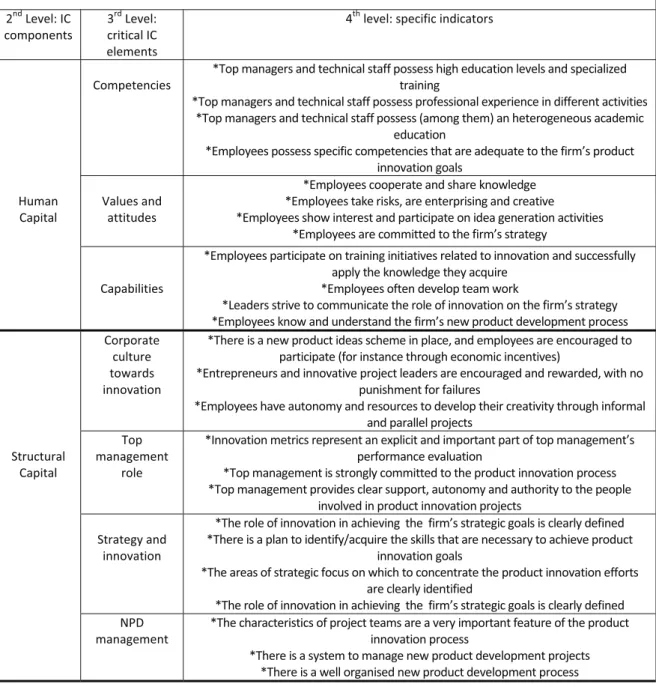
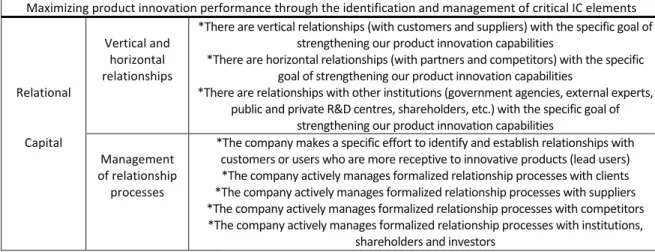
The first level of our proposed hierarchical structure encompasses the organization’s goal (in our specific case, maximizing product innovation performance through the identification and management of critical IC elements). Second level variables are the basic IC components (human capital, structural capital and relational capital), as vital drivers of product innovation performance; the particular intangible elements that refer to each second level component are grouped in third level variables, which are those IC elements considered to be more critical to product innovation success. At the last level, the specific indicators for each IC element are provided. For this purpose, we used the indicators and structure suggested by Costa et al. (2011), Dorrego et al. (2013) and Fernandez!Jardón et al. (2014). Table 1 presents our suggested hierarchical structure.
Table 1: The AHP model hierarchy: critical IC elements for product innovation 1st Level: organization’s goal
Maximizing product innovation performance through the identification and management of critical IC elements 2nd Level: IC
components
3rd Level: critical IC elements
4th level: specific indicators
Competencies
*Top managers and technical staff possess high education levels and specialized training
*Top managers and technical staff possess professional experience in different activities *Top managers and technical staff possess (among them) an heterogeneous academic
education
*Employees possess specific competencies that are adequate to the firm’s product innovation goals
Human Capital
Values and attitudes
*Employees cooperate and share knowledge *Employees take risks, are enterprising and creative *Employees show interest and participate on idea generation activities
*Employees are committed to the firm’s strategy
Capabilities
*Employees participate on training initiatives related to innovation and successfully apply the knowledge they acquire
*Employees often develop team work
*Leaders strive to communicate the role of innovation on the firm’s strategy *Employees know and understand the firm’s new product development process Corporate
culture towards innovation
*There is a new product ideas scheme in place, and employees are encouraged to participate (for instance through economic incentives)
*Entrepreneurs and innovative project leaders are encouraged and rewarded, with no punishment for failures
*Employees have autonomy and resources to develop their creativity through informal and parallel projects
Structural Capital
Top management
role
*Innovation metrics represent an explicit and important part of top management’s performance evaluation
*Top management is strongly committed to the product innovation process *Top management provides clear support, autonomy and authority to the people
involved in product innovation projects Strategy and
innovation
*The role of innovation in achieving the firm’s strategic goals is clearly defined *There is a plan to identify/acquire the skills that are necessary to achieve product
innovation goals
*The areas of strategic focus on which to concentrate the product innovation efforts are clearly identified
*The role of innovation in achieving the firm’s strategic goals is clearly defined NPD
management
*The characteristics of project teams are a very important feature of the product innovation process
*There is a system to manage new product development projects *There is a well organised new product development process
Ricardo Costa and Ana Paula Ramos 1st Level: organization’s goal
Maximizing product innovation performance through the identification and management of critical IC elements
Relational
Vertical and horizontal relationships
*There are vertical relationships (with customers and suppliers) with the specific goal of strengthening our product innovation capabilities
*There are horizontal relationships (with partners and competitors) with the specific goal of strengthening our product innovation capabilities
*There are relationships with other institutions (government agencies, external experts, public and private R&D centres, shareholders, etc.) with the specific goal of
strengthening our product innovation capabilities Capital
Management of relationship
processes
*The company makes a specific effort to identify and establish relationships with customers or users who are more receptive to innovative products (lead users) *The company actively manages formalized relationship processes with clients *The company actively manages formalized relationship processes with suppliers *The company actively manages formalized relationship processes with competitors *The company actively manages formalized relationship processes with institutions,
shareholders and investors
The next step is to compare the relative importance of components. For that purpose a questionnaire must be built, pairing components, elements and indicators, questioning which of each pair is more important with regards to the objective, and how much more important. In order to help the respondent to assess the pair! wise comparisons, Saaty created a nine point intensity scale of importance between two elements (Saaty, 2008). The suggested numbers to express degree of preference between the two elements A and B are shown in Table 2.
Table 2: The fundamental scale for pair!wise comparisons (Saaty, 2008)
Intensity of importance Definition Explanation
1 Equal importance Two activities contribute equally to the objective 3 Moderate importance Experience and judgment slightly favor one activity over
another
5 Strong importance Experience and judgment strongly favor one activity over another
7 Very strong or demonstrated importance
An activity is favored very strongly over another; its dominance demonstrated in practice
9 Extreme importance The evidence favoring one activity over another is of the highest possible order of affirmation
2,4,6,8 For compromise between the above values
Sometimes one needs to interpolate a compromise judgment numerically because there is no good word to
describe it
The questionnaire is then built and presented to respondents. Next is an example of the pair!wise questionnaire for level 2 IC components:
Level 2 – IC Components:
How important is “Human Capital” when compared to “Strutural Capital”?
Q1 9 8 7 6 5 4 3 2 1 2 3 4 5 6 7 8 9 How important is “Human Capital” when compared to “Relational Capital”?
Q2 9 8 7 6 5 4 3 2 1 2 3 4 5 6 7 8 9 How important is “Strutural Capital” when compared to “Relational Capital”?
Q3 9 8 7 6 5 4 3 2 1 2 3 4 5 6 7 8 9
The next step, the calculation of relative weights based on the answers to our questionnaire, is conducted using Microsoft Excel. As previous research suggested (Saaty, 2008), three steps are employed. They are: (a) Using questionnaire results to insert the data in Excel, building binary comparison matrices for each level of the hierarchical structure;
(b) Calculating relative weights: (b.1) Sum of each column of the matrix;
Ricardo Costa and Ana Paula Ramos
(b.2) Dividing each element of the matrix by the sum of the corresponding column, obtaining a new standardized matrix;
(b.3) Calculating the average of each line of the standardized matrix (sum and divide by n variables considered), obtaining the column vector “w” (relative weight). The sum of the vector must equal 1;
(c) Verifying matrix consistency:
(c.1) Multiplying the sum of each column of the original matrix (step b.1) by vector “w” (step b.3), obtaining a new vector (consistency measure);
(c.2) If the matrix is consistent, the vector calculated in step c.1 will have values ideally equal to 1.
3.2 Testing the AHP methodology: Empirical results
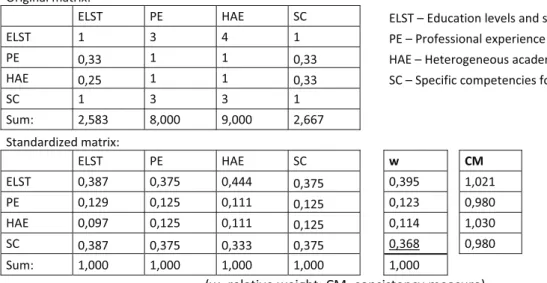
In this section, the implementation of our proposed model is demonstrated on a real firm, a Portuguese innovative SME. The firm is located in northern Portugal and operates in the chemical industry. Creating innovative products is one of its core strategic aims. It has around 100 employees and an annual turnover estimated at €72 million. The questionnaire was presented to the firm’s CEO, as suggested by the Oslo Manual (OECD, 2005), since he represents the key informant that better knows the subject of the research and who is most available to communicate it to the researcher. From the interview and presentation of our questionnaire it became apparent that the interviewee generally understood the concept of IC, recognizing its importance to the company's product innovation performance. This study was labelled as very pertinent, as he recognized the interest to build a model that in an intuitive way depicts the relative importance of each IC element to the firm’s innovation strategy. Regarding the actual results from the completion of the questionnaire, we will now present some partial outcomes, including level 2 IC components, level 3 elements for human capital and level 4 indicators for the human capital element “Competencies”:
Level 2 – IC Components: Original matrix: HC SC RC HC – Human Capital HC 1 4 1 SC – Structural Capital SC 0,25 1 0,33 RC – Relational Capital RC 1 3 1 Sum: 2,250 8,000 2,333 Standardized matrix: HC SC RC w CM HC 0,444 0,500 0,429 0,458 1,030 SC 0,111 0,125 0,143 0,126 1,011 RC 0,444 0,375 0,429 0,416 0,971 Sum: 1,000 1,000 1,000 1,000
(w=relative weight; CM=consistency measure) Level 3 ! Human capital elements:
Original matrix:
Comp V&A Cap Comp – Competencies Comp 1 0,25 0,25 V&A – Values and Attitudes
V&A 4 1 1 Cap – Capabilities
Cap 4 1 1
Sum: 9,000 2,250 2,250 Standardized matrix:
Comp V&A Cap w CM
Comp 0,111 0,111 0,111 0,111 1,000 V&A 0,444 0,444 0,444 0,444 1,000 Cap 0,444 0,444 0,444 0,444 1,000 Sum: 1,000 1,000 1,000 1,000
(w=relative weight; CM=consistency measure)
Ricardo Costa and Ana Paula Ramos
Level 4 ! Indicators for human capital element “Competencies”:
Original matrix:
ELST PE HAE SC ELST – Education levels and specialized training ELST 1 3 4 1 PE – Professional experience
PE 0,33 1 1 0,33 HAE – Heterogeneous academic education HAE 0,25 1 1 0,33 SC – Specific competencies for product innovation
SC 1 3 3 1 Sum: 2,583 8,000 9,000 2,667 Standardized matrix: ELST PE HAE SC w CM ELST 0,387 0,375 0,444 0,375 0,395 1,021 PE 0,129 0,125 0,111 0,125 0,123 0,980 HAE 0,097 0,125 0,111 0,125 0,114 1,030 SC 0,387 0,375 0,333 0,375 0,368 0,980 Sum: 1,000 1,000 1,000 1,000 1,000
(w=relative weight; CM=consistency measure)
After applying the same process to all levels, we were able to depict the final results using our original hierarchical structure, as shown in Figure 1:
Maximizing product innovation performance through the identification and management of critical IC elements
Level 1 - Strategic Goal: Level 2 - IC Components: Human Capital 45,8% Level 3 - IC Elements: Competencies 11,1% Structural Capital 12,6% Relational Capital 41,6% Values and attitudes 44,4% Top management role 18,5% Strategy and innovation 30,4% NPD management 12,2% Vertical and horizontal relationships 50% Management of relationship processes 50% Corporate culture towards innovation 39% Capabilities 44,4% Level 4 - IC Indicators: Education levels & specialized training 39,5% Cooperation & knowledge sharing 35,7% Innovation metrics part of performance evaluation 23,1% Role of innovation in strategic goals clearly defined 28,6% Project teams very important for product innovation 18,7% Vertical relationships 65,5% Identify and establish relationships with lead users
26,4% New product ideas scheme in place 10,4% Training initiatives & successful application 47,2% Professional experience 12,3% Take risks, are
enterprising and creative 13,6% Strongly committed to the product innovation process 10,4% Identification of necessary skills to innovation goals 14% There is a system to manage NPD projects 23,4% Horizontal relationships 18,7% Formalized relationship processes with clients 25,5% Entrepreneurs & project leaders encouraged & rewarded 23,1% Team work 7% Heterogeneous academic education 11,4% Interest and participation on ideageneration activities 41,1%
Clear support & autonomy to product innovation projects 65,5% Identification of areas of strategic focus 57,4% There is a well organised NPD process 57,9% Relationships with other institutions 15,8% Formalized relationship processes with suppliers 27% Autonomy & resources to develop parallel projects 65,5% Leaders communicate the role of innovation on strategy 20,1% Specific competencies for Product Innovation 36,8% Committment to thefirm’s strategy 9,6% Formalized relationship processes with competitors 13% Knowledge & understanding of the NPD process 25,7% Formalized relationship processes with o/ stakeholders 8%
Figure 1: An application of the AHP model hierarchy
Ricardo Costa and Ana Paula Ramos
This map depicts the hierarchization of all critical IC components, elements and particular indicators in what concerns their importance to product innovation success, as per the perception of the firm’s CEO. We can see for example that human capital is considered to be the most important IC component, as opposed to structural capital which ranked as the least important; the elements ‘capabilities’ and ‘values and attitudes’ assume equal importance within the human capital component; the most valued specific human capital items are ‘training initiatives and their successful application’, ‘interest and participation on idea generation activities’ and ‘education levels and specialized training’.
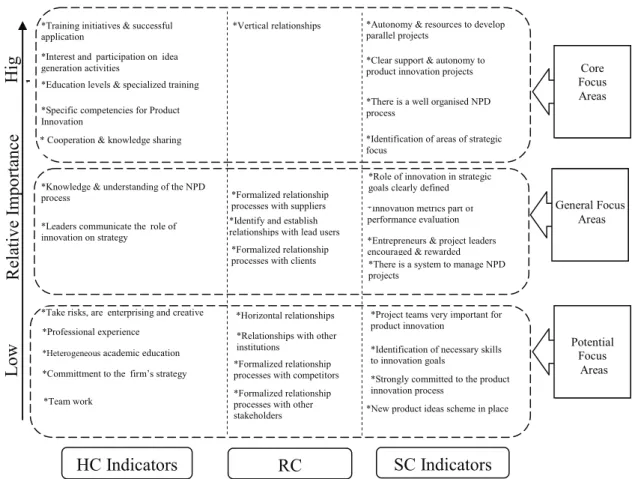
Building on Kim and Kumar’s (2009) proposal, from this results we can put together a second map oriented to the practical envisage of the prioritized elements from an operational perspective. Figure 2 shows which areas should be subject to a more careful and urgent attention (core focus areas), helping the firm to visualize more intuitively the specific IC elements where it should focus its resources and efforts, in order to improve its product innovation performance.
The empirical testing of the proposed AHP methodology was thus, in our opinion, very successful, fully meeting the goals that were initially set. Not only the company acknowledged its interest and understood its variables and modus operandi without major difficulties, but also the handling of the responses allowed the construction of a preference hierarchy and the identification of focus areas, which was recognized as meaningful and useful for the company’s product innovation strategy.
HC Indicators
RC
SC Indicators
H
ig
h
R
el
at
iv
e
Im
p
o
rt
an
ce
L
o
w
Core Focus Areas General Focus Areas Potential Focus Areas*Training initiatives & successful application
*Interest andparticipation onidea
generation activities
*Education levels & specialized training
* Cooperation & knowledge sharing *Specific competencies for Product Innovation
*Leaders communicate therole of
innovation on strategy
*Knowledge & understanding of the NPD process
*Professional experience
*Take risks, areenterprising and creative
*Team work
*Heterogeneous academic education
*Committment to thefirm’s strategy
*Vertical relationships
*Identify and establish relationships with lead users
*Horizontal relationships *Formalized relationship processes with clients
*Relationships with other institutions
*Formalized relationship processes with suppliers
*Formalized relationship processes with competitors *Formalized relationship processes with other stakeholders
*Innovation metrics part of performance evaluation *Role of innovation in strategic goals clearly defined
*Project teams very important for product innovation
*New product ideas scheme in place *Strongly committed to the product innovation process
*Identification of necessary skills to innovation goals
*There is a system to manage NPD projects
*Entrepreneurs & project leaders encouraged & rewarded *Clear support & autonomy to product innovation projects
*Identification of areas of strategic focus
*There is a well organised NPD process
*Autonomy & resources to develop parallel projects
Figure 3: Focus areas for IC development towards product innovation success
4. Conclusions
In today’s competitive environment, product innovation should be regarded as a priority by any business. However, firms in general and SMEs in particular are confronted with two paradoxical issues when it comes to innovation: intensify innovation efforts to develop new products, and in doing so, become more vulnerable by engaging in projects characterized by very high levels of risk. Indeed, product innovation projects are very risky in nature since, generally, they take more time than expected, cost more material resources than those planned, and do not always produce the anticipated benefits with respect to performance. SMEs are particularly vulnerable to this dilemma, as the typical scarcity of resources at their disposal dramatically
Ricardo Costa and Ana Paula Ramos
reduces their margin of error (Rhaiem, 2012). At a time when there is growing evidence of IC’s relevance for product innovation performance, this dilemma strongly reinforces the importance of IC management as a means to increase the odds of product innovation success at SMEs.
Against this backdrop, this research aimed to design a diagnosis and action tool to help business managers incorporate an intellectual capital perspective into their product innovation efforts. We understand our proposal as a relevant contribution for both the literature and practice of IC and product innovation, as it stresses the importance of identifying and prioritizing those intangible elements that are decisive to the success of product innovation initiatives at SMEs. In fact, the proposed AHP methodology represents a particularly effective way of conducting this process, ultimately allowing managers to concentrate on the most critical factors that drive product innovation within their firm. Additionally, we cannot forget that accepting the importance of IC and embracing it as a management priority is the final result of a learning process that involves talking about IC, understanding its contribution to the value creation process, thinking about how and when it impacts corporate phenomena ! that is, “the pragmatic dimension” of IC (Giuliani and Marasca, 2011). The implementation of this methodology can also contribute to this learning path, as it will inevitably trigger a brainstorming process regarding IC inside the firm, ultimately helping it to develop a better understanding of how distinct IC elements impact its product innovation efforts. The authors acknowledge that this paper has a few limitations and possibilities for future research. In fact, although the framework is conceptually applicable to any firm, the effectiveness of the methodology was tested in only one SME. In order to generalize the findings, future research should test the model validity on a representative sample, ideally in different industries and even countries.
We should also stress that our main goal was not to develop a standardized IC model, but to propose a methodology that can help managers systematize and prioritize critical IC elements that are suitable for their particular reality. In fact, although we admit that identifying standardized indicators could help many organizations understand the importance of IC management within their product innovation strategy, IC is ultimately firm!specific and closely tied to the organization. Therefore, our proposed IC variables must be understood as a starting point, which can (and should) be subject to adaptations depending on the reality of each firm.
References
Barney, J. (1991) “Firm Resources and Sustained Competitive Advantage”, Journal of Management Vol.17, No 4, pp. 99! 120.
Bontis, N. (1999) “Managing Organizational Knowledge by Diagnosing Intellectual Capital: Framing and Advancing the State of the Field”, International Journal of Technology Management, Vol. 18, No. 5!6!7!8, pp. 433–462.
Bueno, E. and Salmador, Mª P. (2000) Perspectivas sobre Dirección del Conocimiento y Capital Intelectual, Instituto Universitario Euroforum Escorial, Octubre, Madrid.
Bueno, E., Aragon, J. A., Salmador, Mª. P. and Garcia, V. (2010) “Tangible Slack versus Intangible Resources: the Influence of Technology Slack and Tacit Knowledge on the Capability of Organizational Learning to Generate Innovation and Performance”, International Journal of Technology Management, Vol. 49, No. 4, pp. 314!337.
Bullinger, H.!J., Auernhammer, K. and Gomeringer, A. (2004) “Managing innovation networks in the knowledge!driven economy”, International Journal of Production Research, Vol. 42, No. 17, pp. 3337!3353.
Cañibano, L., Sanchez, P., García!Ayuso, M. and Chaminade, C. (2002) Directrices para la Gestión y Difusión de Información sobre Intangibles, MERITUM Project, available at
http://www.uam.es/personal_pdi/economicas/palomas/DIRECTRICES%20MERITUN%20!% 20ESPANOL.pdf Chen, Y., Lin, M. and Chang, C. (2006) “The Influence of Intellectual Capital on New Product Development Performance –
The Manufacturing Companies of Taiwan as an Example”, Total Quality Management, Vol. 17, No. 10, December 2006, pp. 1323!1339.
Chiucchi, M.S. (2008) “Exploring the benefits of measuring intellectual capital. The Aimag case study”, Human Systems Management, Vol. 27, No. 3, pp. 217!30.
Costa, R. V., Figueroa, P. and Fernández!Jardón, C. (2011) “An Empirical Analysis of the Influence of Human Capital on Product Innovation Performance”, International Journal of Engineering and Industrial Management, Vol. 3/2011, pp. 127!149.
Daneels, E. (2002) “The Dynamics of Product Innovation and Firm Competences”, Strategic Management Journal, Vol. 23, No. 12, pp. 1095–1121.
De Jong, J. and Vermeulen, P. (2006) “Determinants of Product Innovation in Small Firms ! A Comparison Across Industries”, Small Business Journal, Vol. 24, No. 6, pp. 587!609.
Del Canto, J. and González, I. (1999) “A Resource!based Analysis of the Factors Determining a Firm’s R&D Activities”, Research Policy, Vol. 28 (1999), pp. 891!905.
Ricardo Costa and Ana Paula Ramos
Delgado!Verde, M. (2011) “The Role of IC Assets on the Radicalness of Innovation”, UAM!Accenture Working Papers, Autonomous University of Madrid, Faculty of Economics
Delgado!Verde, M., Martín!de Castro, G., Navas!López, J.E. (2011) “Organizational Knowledge Assets and Innovation Capability: Evidence from Spanish Manufacturing Firms”, Journal of Intellectual Capital, Vol. 12, No. 1, pp. 5!19. Dumay J., Garanina, T. (2013) “Intellectual Capital Research: a Critical Examination of the Third Stage”, Journal of
Intellectual Capital, Vol. 14, No. 1, pp. 10!25.
EC ! European Commission. (2006) RICARDIS: Reporting Intellectual Capital to Augment Research, Development and Innovation in SMEs, Luxembourg
Fernández!Jardón, C., Costa, R. V. and Dorrego, P. F. (2014) “The Impact of Structural Capital on Product Innovation Performance: an Empirical Analysis”, International Journal of Knowledge!Based Development, Vol. 5, No. 1, pp. 63!79. Dorrego, P. F., Costa, R. V. and Fernández!Jardón, C. (2013) “Product Innovation and Relational Capital: Evidence from
Portugal”, The Electronic Journal of Knowledge Management, Vol. 11, No. 4, pp. 295!308.
Giuliani, M., Marasca, S., (2011) “Construction and valuation of intellectual capital: a case study”, Journal of Intellectual Capital, Vol. 12, No. 3, pp. 377 – 391.
Govindarajan, V. and Trimble, C. (2005) “Organizational DNA for Strategic Innovation”, California Management Review, Vol. 47, No. 3, pp. 47!76.
Grimaldi, M. and Cricelli, L. (2009) "Intangible asset contribution to company performance: the “hierarchical assessment index”", VINE ! The Journal of Information and Knowledge Management Systems, Vol. 39, No. 1, pp. 40!54. Guthrie, J., Ricceri, F. and Dumay, J. (2012) “Reflections and projections: a decade of intellectual capital accounting
research”, British Accounting Review, Vol. 44, No. 2, pp. 68!82.
Hsu, Y.H. and Fang, W. (2009) “Intellectual Capital and New Product Development Performance: The Mediating Role of Organizational Learning Capability”, Technological Forecasting and Social Change, Vol. 76, No. 5, pp. 664–677. Kim, D., and Kumar, V. (2009) “A framework for prioritization of intellectual capital indicators in R&D”, Journal of
Intellectual Capital, Vol. 10, No. 2, pp. 277 – 293.
Lederman, D. (2010) “An International Multilevel Analysis of Product Innovation”, Journal of International Business Studies, Vol. 41, No. 4, pp. 606!619.
Leiponen, A. (2005) “Skills and Innovation”, International Journal of Industrial Organization Vol. 23/2005, pp. 303!323. Linzalone, R. (2008) “Leveraging Knowledge Assets to Improve New Product Development Performances”, Measuring
Business Excellence, Vol. 12, No. 2, pp. 38!50.
Marr, B. (2004) “Measuring and Benchmarking Intellectual Capital”, Benchmarking: An International Journal, Vol. 11, No. 6, pp. 559 – 570.
Martín!de!Castro, G., Delgado!Verde, M., López!Saez, P. and Navas!López, J.E. (2011) “Towards 'an intellectual capital! based view of the firm’: origins and nature”, Journal of Business Ethics, Vol. 98, No. 4, pp. 649!662.
OECD ! Organisation for Economic Co!Operation and Development. (2005) Guidelines for Collecting and Interpreting Innovation Data, Oslo Manual (3rd. Edition), OECD, Paris
OCDE ! Organisation for Economic Co!Operation and Development. (2012) Corporate Reporting on Intangible Assets: A Progress Report, OECD Corporate Governance Committee Meeting, 18!20 April 2012, retrieved from
http://www.oecd.org/daf/ca/Intangible%20Assets.pdf
Petty, R. and Guthrie, J. (2000) “Intellectual Capital Literature Review: Measurement, Reporting and Management”, Journal of Intellectual Capital, Vol. 1, No. 2, pp. 155–76.
Rhaiem, M. (2012) “Innovate or Perish: Success Factors and Sources of Failure”, Journal of International Business and Economics, Vol. 12, No. 3, pp. 102!121.
Roos, G., Bainbridge, A. and Jacobsen, K. (2001) “Intellectual Capital Analysis as a Strategic Tool”, Strategy and Leadership, Vol. 29, No. 4, pp. 21!26.
Saaty, T. L. (2008) “Decision making with the analytic hierarchy process”, International Journal of Services Sciences, Vol. 1, No. 1, pp. 83!98.
Santos Rodrigues, H., Figueroa Dorrego, P. and Fernández!Jardón, C.M. (2010) “The Influence of Human Capital on the Innovativeness of Firms”, International Business and Economics Research Journal, Vol. 9, No. 9, pp. 53!63. Sveiby, K. E. (2010) Methods for Measuring Intangible Assets, available at: www.sveiby.com/
articles/intangibleMethods.htm (accessed 10 July 2013).
Subramaniam, M. and Youndt, M. (2005) “The Influence of Intellectual Capital on the Types of Innovative Capabilities”, Academy of Management Journal, Vol. 48, No. 3, pp. 450!463.
Subramanian, A. (2012) “A Longitudinal Study of the Influence of Intellectual Human Capital on Firm Exploratory Innovation”, IEEE Transactions on Engineering Management, Vol. 59, No. 4, pp. 540!550.
Thornhill, S. (2006) “Knowledge, Innovation and Firm Performance in High ! and Low – Technology Regimes”, Journal of Business Venturing, Vol. 21 (2006), 687!703.
Vaona, A. and Pianta, M. (2008) “Firm Size and Innovation in European Manufacturing”, Small Business Economics, Vol. 30, No. 3, pp. 283–299.
Yu, A., Humphreys, P. (2013) “From measuring to learning? – Probing the evolutionary path of IC research and practice”, Journal of Intellectual Capital, Vol. 14, No. 1, pp. 26!47.
Wernerfelt, B. (1984) “A Resource!based view of the firm”, Strategic Management Journal, Vol. 5, No. 2, pp. 171!180. Wu, W., Chang, M. and Chen, C. (2008) “Promoting Innovation Through the Accumulation of Intellectual Capital, Social Capital,
and Entrepreneurial Orientation”, R&D Management, Vol. 38, No. 3, pp. 265!277.