Major Article
Journal of the Brazilian Society of Tropical Medicine Vol.:52:e20180103: 2019 doi: 10.1590/0037-8682-0103-2018
Corresponding author: Paulo das Neves Pires.
e-mail: [email protected]
Orcid: 0000-0002-2586-9955
Received 26 March 2018
Accepted 27 December 2018
Hansen’s disease deformities in a high risk area in
Mozambique: A case study
Abdoulaye Marega
[1], Paulo das Neves Pires
[1], Jaibo Mucufo
[1]and Artur Muloliwa
[2][1]. Faculty of Health Sciences, Lúrio University, Nampula, Mozambique. [2]. Nampula Provincial Health Directorate, Ministry of Health, Nampula, Mozambique.
Abstract
Introduction: Hansen’s disease is no longer a public health problem in Mozambique, since 2008 (incidence under 1 / 10,000 inhabitants). The country is one of the most affected in the world and Nampula province’s Murrupula district (incidence 1.7 / 10,000) has a high deformity rate (22% in 2010). This study aimed to identify high deformity rate associated determinants and proposals for better health program results. Methods: This study involved a descriptive quantitative survey, systematic observation of patients and health professionals, and a survey of community volunteers. Data were analyzed using Epi Info 7.2. Pearson's chi-square and Fisher’s exact test were used to assess statistical association with deformity, with a significance level of 5% and 95% confidence interval. Ethical procedures followed the Helsinki declaration (2013). Results: Among 238
subjects, 175 were patients and 63 leprosy health staff. Most patients relied on subsistence agriculture facing social exclusion (43, 25%). The waiting time from first symptoms to diagnosis was over one year for 63%. Deformity affected 116 subjects
(68%), particularly those who considered the disease as God’s desire (p = 0.01), and practiced traditional treatments (p = 0.001).
Among leprosy health staff, 35 (52%) were not trained on diagnosis and management. Conclusions: High deformity rate is associated with low economic status, the belief that the disease is God’s desire, the use of traditional healers, late diagnosis, and poor disease management. A health education program targeting professionals and population, with infection screening and self-care groups can prevent deformities.
Keywords: Deformity. Hansen’s disease. Leprosy. Nampula. Mozambique.
INTRODUCTION
Leprosy (Hansen’s disease) has been a health problem since ancient times. It is a chronic granulomatous infection caused by Mycobacterium leprae (Hansen bacillus, discovered in 1940, an intracellular acid-fast rod) and a zoonosis (animal reservoirs
are the pangolin and non-human primates). It affects superficial tissues, especially the skin, peripheral nerves and nasal mucosa
(due to the agent’s tropism for lower temperature areas)1-3. Leprosy is often a family infection with an incubation period
of three to five years. Targeting peripheral nerves, it has high
incapacitating potential causing deformities, mutilations and physical disability. The disease can affect patients’ physical
appearance, causing hopelessness, feelings of rejection, stigma, and discrimination4.
Leprosy incidence worldwide diminished from 265,661 new
cases in 2005 to 210,758 in 2015, with 1,335 in Mozambique5.
Mozambique had the highest prevalence of leprosy in Africa in 2007 (1.4 / 10,000 inhabitants) and was one of the countries most affected by the disease worldwide. The Mozambican epidemiological situation is heterogeneous, with wide prevalence variation among regions (Nampula Provincial
Health Directorate [NPHD]: research proposal, 2013). Hansen’s
disease is a public health problem in Nampula province (one of the highest prevalence rates, 2.1 / 10,000, with a detection rate of 5.2 / 100,000), Murrupula district (1.7 / 10,000), with a high deformity rate among new cases (NPHD provincial
report, 2013).
Asymptomatic carriers could explain the transmissibility of the disease and screening household contacts would be useful to control this infection6. The disease affects mainly poor families.
incidence, the spread of leprosy is causing deformities in impoverished areas dispersed throughout the country.
Deformities and disabilities due to leprosy are preventable, but in Mozambique this situation is distressing. In Nampula, according to the 2010 Leprosy National Program (LNP) Report, the deformity rate in Murrupula was at 12% and 22% in 2009 and 2010, respectively.
The Mozambican Government launched a social campaign to prevent deformities and implemented a rehabilitation program (PRID), to reduce disease impact. Community-based rehabilitation groups were created, aiming to improve living conditions7,8.
However, Nampula keeps reporting new cases of deformities, particularly in Murrupula. A 2008 NPHD study revealed 493 new cases in the first half of 2007, 9.7% with deformity grade
two. A patient’s total degree of disability is determined by adding degrees given to each eye, hand and foot, being proportional to the severity of the disease9.
Facing these challenges, the LNP in Nampula province is aiming to reduce deformities and disabilities caused by leprosy among new patients, by studying its causes and setting up self-care groups.
General: This study aimed toidentify factors contributing to the high deformity rate among leprosy patients in Murrupula and propose management measures to improve patients’ health and productivity.
Specific:
a) Describe patients affected by leprosy in Murrupula between 2006
and 2013.
b) Characterize deformity cases.
c) Analyze solutions by leprosy management staff.
d) Produce recommendations to reduce the deformity rate.
METHODS
In this descriptive study, quantitative with documentary and
desk review, we applied a survey and systematic observation
to patients, and surveys with those involved in LNP treatment and management.
Target groups:
1) Patients diagnosed between 2006 and 2013 with leprosy.
2) LNP staff: health professionals, district health department representatives, district administrator, traditional leaders, and self-care volunteers.
The study period corresponds to the launching of self-care groups, when the district should be organized in structural and functional terms for PRID. Murrupula district has a population
of 170,072 inhabitants (2013) concentrated in five main villages
(Headquarters, Nihessiue, Chinga, Cazuzo, and Namitotelane). The study covered people from all villages, including members
of the four self-care groups and the district's LNP network. The study population (238) was set according to the universe of leprosy patients and people working with LNP living in
Murrupula:
• 175 people affected by Hansen’s disease. • 63 LPN staff members.
Data collection used survey models set according to target
groups. A team of nine local data collectors, fluent in Macua
(local language) and Portuguese (the official language in Mozambique), were trained and equipped with respective surveys. To validate data collection tools and study feasibility, a survey pilot test was conducted at the district headquarters and Naache locality, with subjects other than study participants. Data were introduced, treated and analyzed using Epi Info 7.2, with a double check for quality control. Pearson’s chi-square and Fisher’s exact test were used to assess the association among
identified factors and deformity rates, with a significance level of 5% and 95% confidence interval (CI).
Ethical considerations
The research protocol was approved by Lúrio University’s Institutional Committee for Health Bioethics. It included the principal researcher’s commitment statement and ethical
statements as well as absence of conflicts of interest declarations
from all researchers. Before the surveys, an informed consent form was presented to each participant, in simple language, and was signed after being explained and understood. All patients with acute illness were referred and transported to the nearest health care facility. This study followed all the tenets of the
Helsinki Declaration (2013).
RESULTS
Patients
In 175 patients living in 12 localities, we observed 171, four abandoned after the survey; 68% (116) showed low sensibility
and deformities (degree one, 51, 30%; degree two, 65, 38%), 32% (degree zero, 55) without detectable lesions. Table 1 details the sample characteristics.
Most patients lived in Murrupula town, Nihessiue and Namitotelane. We found three children (2%) and six adolescents
(3%) with the disease. Mostly, deformities affected the nose,
foot and hand.
The principal patients’ concepts about the disease, its consequences and treatment are presented in Table 2. Standard leprosy complete treatment duration varied according to disease level, 12 months with lepromatous leprosy and six months with tuberculoid leprosy.
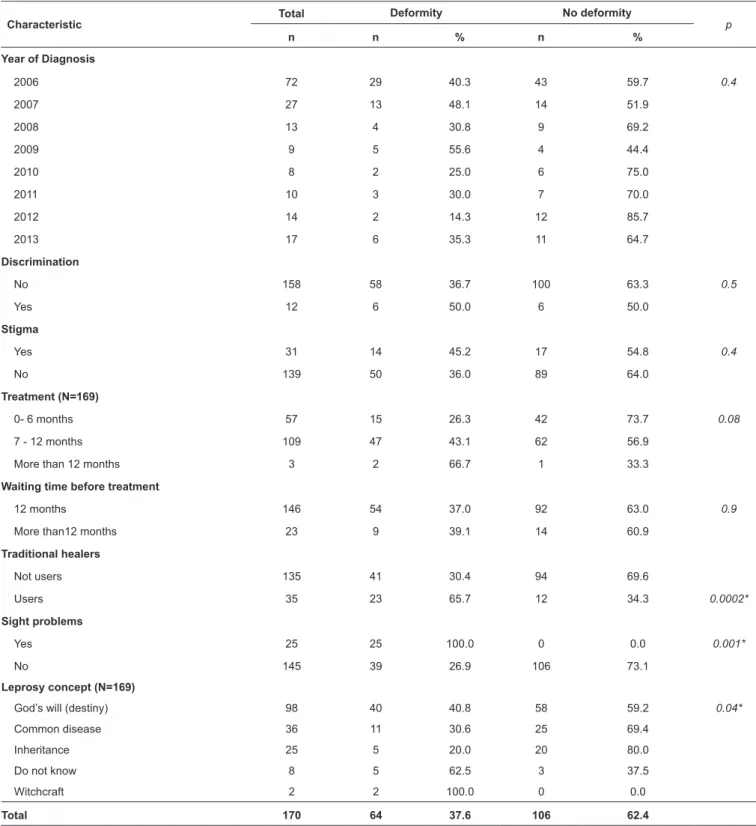
We verified a high leprosy deformity incidence in 2007 and
2009 (respectively 40% and 56%), less in 2010 and 2012 (25%
and 14%) and increasing again in 2013 (35%).
We found a statistically significant association between the
presence of deformity and the concept of the disease’s cause as God’s desire or “destiny” (p = 0.04).
Traditional healers treated 26% of patients and 66% of those presented deformity, showing that the use of traditional healers
is significantly associated with deformity (OR = 0.2, 95% CI:
0.0 – 0.5; p = 0.0002) (Table 3).
Analyzing body deformity distribution showed 48% of
patients with three or more affected organs, 33% with one and
19% with two. The most affected organ was the nose (28 patients,
TABLE 1: Leprosy patients’ demographic, social and economic characteristics.
Variable (survey number) * Characteristic n %
Gender (n = 173)
Female 89 51
Male 84 49
Age (n = 173) Adults (> 25 years) 152 88
Residence (n = 175)
Murrupula (Umuato, Umpuata, Tucua) 73 47
Nihessiue (Lupo, Naha, Lepa, Mulhania), 47 26
Namitotelane (Nacocolo, Namiope, Namicope) 44 25
Other districts (Alto Ligonha, Mogovolas) 8 2
Education (n = 173)
Completed primary education 101 58
Did not attend school 51 35
Marital status (n = 173)
Married or “living together” 87 50
Single, divorced or widow 86 50
Religion (n = 172)
Islamism 77 45
Christian 54 32
No religion 32 18
Animism 9 5
Occupation (n = 173) Small farmer (subsistence agriculture), 150 87
Additional income (n = 173)
Do not have 122 71
Family support 33 19
Public subsidy 9 5
Food availability (n = 174) Facing food scarcity 96 55
Average daily meals number (n = 172)
Two meals per day 127 74
One meal per day 31 18
Three meals per day 14 8
Health care access (n = 173)
Do not have any means of transportation 151 87
Have a bicycle 19 11
*Surveyed subjects number variation follows survey validated responses; n: subjects number; %: percentage of total surveyed subjects.
Evaluating total deformity grade in each patient (62) we found 42% with grade 4, 32% with grade 2 and 26% with grade 6 (3 affected organs: hand, foot and eye, excluding the nose).
Sight problems occurred in 39% of patients with deformity
and none of those without deformity. Among 170 patients, 7% felt discriminated (by family or neighbors) and 18% auto-excluded.
Considering treatment duration, 65% of patients had
between 7 and 12 months (multibacillary leprosy), 34% between
1 and 6 months (paucibacillary leprosy) and 2% more than 12 months. The study contributed to diagnosing 14 new leprosy cases detected during data collection, referred and transported to Murrupula Health Centre.
Leprosy National Program staff
The 63 subjects were mostly men (39, 62%) between 25
to 44 years old (58%) and between 25 to 29 years (24%);
19 (30%) are illiterate and 34 (54%) had completed primary school. Regarding their function, 32 (51%) were community volunteers and 13 (21%) community leaders. The majority, 40 (63%) practiced subsistence agriculture as their main activity.
TABLE 2: Patients’ concepts about leprosy disease and treatment.
Variable (survey number) * Characteristic n %
Cause of leprosy (n = 171)
God’s desire / “destiny” (1) 99 58
Common disease 37 22
Genetic inheritance (intra-family transmission). 25 15
Treatment (n = 172)
Is curable 168 98
Looks for treatment in HU 164 95
Distance to the health unit (n = 172)
Less than 10 km 104 61
More than 11 km 68 40
Discrimination and stigma (n = 175)
Do not feel stigma 144 82
Feels stigmatized 31 18
Feels being discriminated 12 7
Deformities (n = 171)
Frequency (Grade 1 and 2) 116 68
Diagnosis year 2006 74 43
Diagnosis year 2007 27 16
Waiting time between diagnosis and treatment (n = 173).
12 months after diagnosis 146 86
Patients who initiated treatment 12 months after diagnosis without deformity 92 63
Patients who initiated treatment 12 months after diagnosis with deformity 54 37
Treatment duration (n = 173)
7 to 12 months 116 67
One to six months 57 33
Traditional healers (n = 175)
Use traditional healers to treat the disease 28 24
Deformity rate in those that use traditional healers to treat the disease 23 82
* Surveyed subjects number variation follows survey validated responses; n: subjects number; %: percentage of total surveyed subjects; (1): leprosy infection
is believed to be pre-determinate by God.
been affected by leprosy and 75% had observed deformities in their patients.
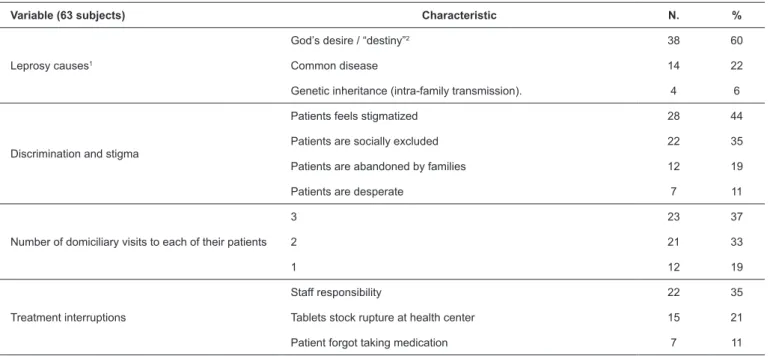
The LNP staff’s concepts about the disease, its consequences, treatment and management are presented in Table 4.
To better disease management, LNP staff suggested several
proposals pointing two statistically significant propositions:
training health staff and volunteers on leprosy diagnosis and treatment (p=0.03) and providing communication access among volunteers, patients and leprosy program managers (p=0.02).
Table 5 presents mostly mentioned propositions.
DISCUSSION
The leprosy incidence in Murrupula district might be increasing in three localities and we found new cases in children and adolescents. The high occurrence of deformity among leprosy patients reveals the persistence of the problem in these communities.
The disease affects mainly people with low-income, illiterate, relying on subsistence agriculture, and facing food scarcity. Patients’ social isolation (absence of a partner), stigma
and discrimination, income unavailability, lack of food, and
low literacy, all contributed to increasing the probability of
deformities. Even though most patients completed primary school, the surveys were taken in Macua due to the limited facility with the Portuguese language. The language difficulties
also limited the effectiveness of attempts to educate patients about leprosy. The same was shown in a Brazilian study, where the highest number of leprosy patients, especially with
incapacitating lesions, had a low socioeconomic profile10.
Many patients said they did not practice any religion, which might explain their social exclusion in the community. In African societies, especially rural settings, religious practice is
usually the primary mean of socialization; hence it is rare to find
someone without faith. The fact that 10% declared themselves animists might also contribute to social exclusion since it is rejected by both Christianity and Islam.
Regarding patient’s perception about the disease and the
degree of deformity, our findings show a statistically significant
TABLE 3: Leprosy deformity rate per year, sample’s social characteristics and treatment.
Characteristic Total
Deformity No deformity
p
n n % n %
Year of Diagnosis
2006 72 29 40.3 43 59.7 0.4
2007 27 13 48.1 14 51.9
2008 13 4 30.8 9 69.2
2009 9 5 55.6 4 44.4
2010 8 2 25.0 6 75.0
2011 10 3 30.0 7 70.0
2012 14 2 14.3 12 85.7
2013 17 6 35.3 11 64.7
Discrimination
No 158 58 36.7 100 63.3 0.5
Yes 12 6 50.0 6 50.0
Stigma
Yes 31 14 45.2 17 54.8 0.4
No 139 50 36.0 89 64.0
Treatment (N=169)
0- 6 months 57 15 26.3 42 73.7 0.08
7 - 12 months 109 47 43.1 62 56.9
More than 12 months 3 2 66.7 1 33.3
Waiting time before treatment
12 months 146 54 37.0 92 63.0 0.9
More than12 months 23 9 39.1 14 60.9
Traditional healers
Not users 135 41 30.4 94 69.6
Users 35 23 65.7 12 34.3 0.0002*
Sight problems
Yes 25 25 100.0 0 0.0 0.001*
No 145 39 26.9 106 73.1
Leprosy concept (N=169)
God’s will (destiny) 98 40 40.8 58 59.2 0.04*
Common disease 36 11 30.6 25 69.4
Inheritance 25 5 20.0 20 80.0
Do not know 8 5 62.5 3 37.5
Witchcraft 2 2 100.0 0 0.0
Total 170 64 37.6 106 62.4
TABLE 5: Leprosy National Program staff’s proposals for better leprosy management.
Proposals(1) n %
Leprosy education program for communities in target villages 51 81
Health staff training on leprosy early diagnosis and deformity risk identification 46 73
Produce and distribute information and educational materials
43 68
Transport means for volunteers
Regular training for community health volunteers
Implementation of economically sustainable initiatives for patients 39 62
Establishment of a social insertion center 33 52
(1)health professionals, community leaders and leprosy national program volunteers suggest activities to reduce leprosy incidence and deformity rate; n:
subjects number; %: percentage of total surveyed subjects.
TABLE 4: Leprosy National Program staff’ concepts about the disease and its management
Variable (63 subjects) Characteristic N. %
Leprosy causes1
God’s desire / “destiny”2 38 60
Common disease 14 22
Genetic inheritance (intra-family transmission). 4 6
Discrimination and stigma
Patients feels stigmatized 28 44
Patients are socially excluded 22 35
Patients are abandoned by families 12 19
Patients are desperate 7 11
Number of domiciliary visits to each of their patients
3 23 37
2 21 33
1 12 19
Treatment interruptions
Staff responsibility 22 35
Tablets stock rupture at health center 15 21
Patient forgot taking medication 7 11
N.: subjects’ number; %: percentage of total surveyed subjects; (1) : leprosy national program’ volunteers and community leaders’ opinions on leprosy causes;
(2) : leprosy infection is believed to be pre-determinate by God.
Similarly, most health volunteers have this concept of disease as punishment of God. We can relate this interpretation with local culture, in which leprosy is a “damned” disease, a victim of the wrath of supernatural beings (the spirits).
Such views may cause delays in seeking care. These results
corroborate other studies in Zambezi valley (Zambézia and Sofala provinces) and in Namaita (Nampula)11.
Furthermore, we found a statistically significant association
between the use of traditional healers and deformity degree (p = 0.001). The Namaita study reveals that leprosy patients practiced traditional healing regularly. The complexity of the “evil world” in Africa, explains the frequency and diversity of traditional healers who, in Macua society, intervene in disease treatment12.
The LNP staff also showed low literacy, economic status and leprosy training. Another study in Brazil showed that late
diagnoses in most individuals was due to the population’s lack
of information about leprosy symptoms, health professionals’ poor training, the insidious evolution of the disease, leading many of them to physical disabilities13.
Concerning factors contributing to the persistence of Hansen’s disease, we found a long period between diagnosis and treatment, failure in patients follow up and low adherence
to treatment. Other studies in Brazil confirm our results: deficient health care organization, failure to avoid dropouts, no
leprosy care, an important strategy to eliminate the disease14.
To achieve this, our leprosy program staff pointed information regarding the target community and education and training health staff and volunteers on leprosy diagnosis and treatment.
CONCLUSION
Although Mozambique has removed leprosy from health programs priorities, the Murrupula population reveals a growing incidence with new cases in children and adolescents and a high deformity rate.
The affected population feels discriminated and they belong to a low socio-economic and literacy degree stratum. The high rate of deformities is associated with the concept of the disease as "God’s desire, destiny and spirits," the practice of traditional healing and the delay in diagnosis by health professionals.
Despite the significant number of health professional training
on leprosy diagnosis and treatment, frequent staff rotation prevented a consolidation of leprosy control in the district. As a result, patients with early signs and symptoms are not diagnosed and treatment is only started when they have mutilations.
Acknowledgments: We wish to acknowledge the Murrupula District Health
Board, community volunteers and population participants.
Conflict of Interest: The authors declare that there is no conflict of interest.
Financial Support: Funding was provided by the Nampula Provincial Health Directorate and Lúrio University, Nampula.
REFERENCES
1. Ernâni A. A lepra no Brasil (Resumo histórico). Manual de
Leprologia. São Paulo. Serviço Nacional de Lepra, Brasil. Empresa Gráfica da “Revista dos Tribunais” SA. 1960; p. 11-29. http://bvsms.
saude.gov.br/bvs/publicacoes/manual_leprologia.pdf
2. Pilly E. Maladies Infectieuses. Lille. Editions Crouan & Roques. 1979; p. 256-61.
3. Darvin SS, Fred AL. Leprosy [Internet]. Medscape reference. 2014 [Updated: Jun 16, 2017; cited 2014]. https://emedicine.medscape. com/article/220455-overview
4. Ndeve A, Phaff C, Benfica AHMC. Manual Nacional sobre Lepra. 2ª edição. Maputo. Programa Nacional de Controlo da Lepra. Direcção Nacional de Saúde Pública. Ministério de Saúde. República de Moçambique. 2012; p. 7-176.
5. World Health Organization. Global leprosy update, 2015: time
for action, accountability and inclusion. Weekly epidemiological record. 2 September 2016, 91th year, No 35, 2016, 405-420.
6. Matos HJD, Duppre N, Alvim MFS, Vieira LMM., Sarno EN,
Struchiner CJ. Epidemiologia da hanseníase em coorte de contatos
intradomiciliares no Rio de Janeiro (1987-1991). Cad. Saúde
Pública. 1999;15(3):533-42.
7. Deepak S, Hansine PE, Braccini C. Self-care groups of
leprosy-affected people in Mozambique. Lepr Rev.2013;84(4):283-91.
8. Ndeve A, Compostella L, Catalini N, Lorusso V, Hippke W,
Molide J et al. Manual de Lepra, Clínica geral e especial. Edição
PNCTL. Maputo. Ministério de Saúde. República de Moçambique. Associação Italiana Amigos de Raoul Fellereau. 2001. p. 97.
9. Baialardi KS. O estigma da hanseníase: relato de uma experiência
em grupo com pessoas portadoras. Hansen Int. 2007;32(1):27-36.
10. Rosário LJC. A Narrativa Africana de Expressão Oral. 2ª edição
Revista e Atualizada. Texto Editores Lda. Maputo. 2008. p. 320 - 29.
11. Zamparoni, Valdemir, Lepra: doença, isolamento e segregação
no contexto colonial em Moçambique. História, Ciências, Saúde - Manguinhos [en linea] 2017, 24 (Enero-Marzo) : [Fecha de consulta:
29 de noviembre de 2018] Disponible en:<http://www.redalyc.org/
articulo.oa?id=386150412002> ISSN 0104-5970
12. da Silva Sobrinho, Reinaldo Antonio, de Freitas Mathias, Thais Aidar,
Alves Gomes, Eunice, Barbosa Lincoln, Patrícia, Avaliação do grau de incapacidade em hanseníase: uma estratégia para sensibilização
e capacitação da equipe de enfermagem. Revista Latino-Americana
de Enfermagem [en linea] 2007, 15 (Noviembre-Diciembre) : [Fecha
de consulta: 29 de noviembre de 2018] Disponible en:<http://www.
redalyc.org/articulo.oa?id=281421879011>.
13. Sobrinho RAS, Mathias TAF. Perspectivas de eliminação da
hanseníase como problema de saúde pública no Estado do Paraná, Brasil. Cad. Saúde Pública. Rio de Janeiro, fev. 2008; 24(2):303-14.
http://www.scielo.br/pdf/csp/v24n2/08~
14. Bowers B, Withington S, Bakirtzief Z, Chen M, Garas M,
Bizuayehu G. et al. Guía técnica de rehabilitación comunitaria y lepra: Afrontando las necesidades de rehabilitación de las
personas afectadas de lepra y promocionando su calidad de vida.
Organización Mundial de la Salud. International Federation of