ISSN 0103-8478
Maria Aparecida da SilvaI Bruna Mirelly de Sousa PessottiII Surama Freitas Zanini*I
Geraldo Luiz ColnagoIII Maria Regina Alves RodriguesIV Louisiane de Carvalho NunesI
Marcos Santos ZaniniI Isabella Vilhena Freire Martins I
Intestinal mucosa structure of broiler chickens infected experimentally with
Eimeria
tenella
and treated with essential oil of oregano
Morfometria intestinal de frangos de corte infectados experimentalmente com
Eimeria tenella e tratados com óleo essencial de orégano
ABSTRACT
In the first trial a total of 250 day-old male chicks were distributed into five treatments and given the following diets: a diet with growth promoter; a diet without added growth promoter; a diet added with avilamycin only; diet supplemented with 0.5g of oregano oil kg diet-1; 1.0g of oregano oil kg diet -1. In other trial a total of 288 day-old chicks was used and
distributed into four treatments, which were given the following diets: a diet with anticoccidial agent; a diet without anticoccidial agent; a diet supplemented with 0.5g of oregano oil kg diet-1; a 1.0g of oregano oil kg diet-1. In the first trial the nonmedicated group had the highest crypt depth which differs from chickens fed with growth promoter or with 0.5 and 1.0g of oregano oil kg diet-1. The broilers fed with positive control (antibiotic and anticoccidial) had the highest villous: crypt ratio compared with the negative control that had the lowest villous:crypt ratio and the highest oocyst excretion in litter (P<0.05) In the second trial it was observed that broilers fed with non anticoccidial agent had the highest cecal lamina propria thickeness which differ from chickens fed with anticoccidial agent in diet or supplemented with 1.0 of oregano oil kg diet-1 (P<0.05).
Key words: broiler, Origanum oil, intestinal morphometric,
Eimeria, coccidiosis.
RESUMO
Inicialmente, foram utilizados, neste estudo, 250 pintos de um dia de idade distribuídos em cinco tratamentos: dieta com promotor de crescimento; dieta sem promotor de crescimento; dieta contendo somente antibiótico; dieta com
0,5g de orégano óleo kg de ração-1 ou com 1,0g de orégano óleo kg de ração-1. No outro ensaio, foram utilizados 288 pintos de um dia de idade distribuídos em quatro grupos: dieta com anticoccidiano; dieta sem anticoccidiano; dieta com 0,5g de orégano óleo kg dieta-1 ou 1,0g de orégano óleo kg de ração-1. No primeiro ensaio, o grupo tratado sem promotor de crescimento apresentou a maior profundidade de cripta quando comparada com os animais tratados com promotor de crescimento ou com 0,5 e 1,0g de orégano óleo kg de ração-1. Os frangos que receberam a dieta com promotor de crescimento (antibiótico+anticoccidiano) apresentaram uma maior relação vilo:cripta em comparação com os frangos do controle negativo, os quais tiveram a menor relação vilo:cripta e uma maior excreção de oocistos por grama de fezes (P<0.05). No segundo ensaio, observou-se que os frangos alimentados com dieta sem anticoccidiano tiveram uma maior espessura de lâmina própria cecal, diferindo dos frangos tratados com anticoccidiano ou com 1,0 de orégano óleo kg de ração-1 (P <0,05).
Palavras-chave: frangos de corte, morfometria intestinal,
Eimeria, óleo de orégano, coccidiose
INTRODUCTION
Restrictions on the use of animal growth promoter during the last few years have encouraged the use of essential oils because of their metabolic properties. Some properties have been attributed to
IDepartamento de Medicina Veterinária, Centro de Ciências Agrárias, Universidade Federal do Espírito Santo (UFES), CP 16,
29500-000, Alegre, ES, Brasil. E-mail: [email protected]. *Autor para correspondência.
IIPrograma de Pós-graduação em Biotecnologia, UFES, Alegre, ES, Brasil.
this plant, such as its useful antimicrobial effect (ELGAYYAR et al., 2001) related to carvacrol and thymol compounds that are primary components of oregano essential oil (KOKKINI et al., 1997). GIANNENAS et al. (2003) observed that after the infection with Eimeria tenella the supplementation with dietary oregano oil resulted in body weight gain and feed conversion ratio not differing from the non-infected group but lower than those of the lasoalocid group. The purpose of these studies was to evaluate possible harmful effect of oregano essential oil on intestinal mucosa structure of broiler chickens after experimental infection with E. tenella.
MATERIAL AND METHODS
Experimental design
Two studies were conducted using in the first trial a total of 250 day-old male Cobb chicks. The broilers were housed indoors on twenty five floor pens and distributed in a completely randomized design divided into five treatment groups with five replicates each (ten birds/box) and given the following diets: a diet with 10mg kg-1 avilamycin plus 66mg kg-1
salinomycin (positive control); a diet without added avilamycin and salinomycin (negative control); diet with added avilamycin at 10mg/kg, only; a diet supplemented with 0.5g of oregano oil kg diet-1; a diet
supplemented with 1.0g of oregano oil kg diet-1. In the
second trial a total of 288 day-old male Cobb chicks were used . The broilers were housed indoors on twenty four floor pens and distributed in a completely randomized design divided into four treatment groups with six replicates each (twelve birds/box) and given the following diets: a diet with anticoccidial agent; a diet without anticoccidial agent; a diet supplemented with 0.5g of oregano oil kg diet-1; a diet supplemented
with 1.0g of oregano oil kg diet-1. In starter phase (from
0 to 21 days of age), the anticoccidial agent was nicarbazin at 125g tonne-1 and in the grower (from 21 to
40 days of age) salinomycin at 66g tonne-1 was used.
Diets
In all of experiments, the feeding program consisted of a starter diet until 21d and a finisher diet until 42d. The birds were fed with a start diet containing 22% CP and 2900kcal ME kg-1, and growing diet with
19% CP and 3000kcal ME kg-1. The basal start diet had
1.5% of soybean oil and the growing diet had 2% of soybean oil. Oregano oil supplementation was obtained by isometrically replacing soybean oil in the basal diet. The oregano essential oil was obtained by hydrodistillation in a modified Clevenger-type apparatus, and their analyses were performed by gas-chromatograph with flame ionization detector (GC/FID). Compositions are then expressed as percent of normalized peak areas according to RODRIGUES (2002) and are presented in table 1.
Data collection
Parasitological analysis
In the first trial the number of oocysts per gram litter was determined at 16 and 28 days of age using the procedure described by CONWAY AND MCKENZIE (1991). The litter sample was collectedand pooled for the chickens within each pen totalizing five repetitions per treatment. In the second trial each broiler chicken was experimentally infected with Eimeria tenella at 20 days of age by oral inoculation. The oocysts were preserved in 2% potassium dichromate solution to induce sporulation and kept in a refrigerator (2-5°C) until use. Each bird was challenged with 5x10⁴
oocysts/chicken of E. tenella. Prior to infection, at 19 days of age, the number of oocysts per gram litter was determined. Excreted oocysts were investigated from 7 and 14 days after infection with E. tenella. Therefore, at 19, 27 and 34 days of age, litter samples were collected from each pen. Pens were used as the experimental units. The litter sample was collectedand pooled for the chickens within each pen totalizing six repetitions per treatment.
Intestinal morphometry
luminal epithelium to the muscularis mucosa (SUN et al., 2005). In the morphometric analysis of the jejunum and ceca a magnification 100x was used. Five villous height and crypt depth in jejunum and cecal lamina propria measurements were taken from each section. The average of the five measurements was treated as an experimental unit. Pictures of villus height, crypt depth, and cecal lamina propria were obtained with a camera with measurements made using the software of SigmaScan Pro 5.
In the second trial, intestinal morphology was determined at 144 hours post-infection with
Eimeria tenella and at 42 days of age. Four-centimeter segment of ceca were collected from six individuals/ treatments and were preserved in Bowin solution for morphometric examination. The material collected were submitted from the processing inclusion in paraffin, according to the histopathological routine techniques. Paraffin sections of 7µm thick and was stained with haematoxylin and eosin. Thickness of cecal lamina propria was measured, from the basement membrane of the luminal epithelium to the muscularis mucosa (SUN et al., 2005). The morphometric analysis of the ceca was determined in the same condition of the first trial.
Table 1 - Components of the Origanum vulgare essential oil obtained by comparison with terpenes standards and yield (%).
Peak Retention time Compounds PM FM *C (%)
1 10,05 α-tujeno 136 C10H16 2,15
2 10,35 α-pineno** 136 C10H16 0,51
3 12,56 Sabineno 136 C10H16 5,47
4 12,67 β-pineno** 136 C10H16 0,27
5 13,74 mirceno** 136 C10H16 1,71
6 14,40 α-felandreno 136 C10H16 2,27
7 15,18 α-terpineno** 136 C10H16 7,00
8 15,67 p-cimeno** 134 C10H14 20,38
9 15,93 limoneno** 136 C10H16 6,22
10 16,06 1,8-cineol** 154 C10H18O 0,09
11 16,74 cis/trans β-ocimeno 136 C10H16 0,62
12 17,97 γ-terpineno** 136 C10H16 8,31
13 18,47 trans sabineno hidratado 154 C10H18O 0,97
14 19,95 terpinoleno** 136 C10H16 3,41
15 20,56 cis sabineno hidratado 154 C10H18O 2,36
16 20,87 linalol** 154 C10H18O 1,40
17 22,16 Trans-p-mentenol 154 C10H18O 0,28
18 23,11 Cis-p-mentenol 154 C10H18O 0,09
19 25,19 Borneol 154 C10H18O 0,23
20 26,07 4-terpineol** 154 C10H18O 11,92
21 27,03 α-terpineol** 154 C10H18O 2,78
22 27,43 trans-piperitol 154 C10H18O 0,10
23 29,31 cis-piperitol 154 C10H18O 0,06
24 30,26 éter do metil timol 164 C11H16O 1,41
25 30,89 éter do metil carvacrol 164 C11H16O 2,60
26 31,30 acetato de linalila 196 C12H20O2 0,21
27 31,88 geraniol/ nerol 154 C10H18O 5,30
28 34,41 timol** 150 C10H14O 7,88
29 34,99 carvacrol** 150 C10H14O 0,50
30 40,55 acetato de geranila/nerila 196 C12H20O2 0,08
31 42,53 β-cariofilleno 204 C15H24 1,12
32 48,43 germacreno 204 C15H24 0,05
33 52,36 espatulenol 220 C15H24O 1,25
34 52,66 óxido de cariofileno 220 C15H24O 0,98
a
Statistical analysis
The experimental data was submitted to an analysis of variance using the System for Statistical and Genetic Analyses, developed by UFV (1997). Significant differences among averages were determined by SNK test at P<0.05 throughout these studies. Coccidia was exponentially multiplied , not linearly, so pen oocyst counts were log 10 transformed prior to analysis.
RESULTS AND DISCUSSION
The extraction yield of oregano essential oil was determined to be 1.20wt% ± 0.18wt%, achieved after about 3h of extraction. The chromatogram of oregano essential oil shows that terpinen-4-ol, γ -terpinene and thymol are the major components, followed by α-terpinene, p-cymene and α-terpineol, which means a chemical profile very similar to that found by RODRIGUES (2002).
Both villous height and crypt dept are important indicators of broilers digestive health and directly related to the absorptive capacity of mucous membrane (BUDDLE & BOLTON, 1992). From a theoretical point of view, villous height reflects a balance between the mitotic activity of the crypt enteric cells (CERA et al., 1988) and the desquamation produced principally by external aggressors (NABUURS, 1995). In the current study of Trial 1, it was verified significantly treatment effects on crypt dept and villous:crypt ratio in jejunum (P<0.05, Table 2). The nonmedicated group had the highest duodenal crypt depth which differs from chickens fed with growth promoter antibiotic or with 0.5 and 1.0g of oregano oil kg diet-1. Although the antimicrobial and antioxidant
properties of plant oils are well known and confirmed in numerous studies (MANZANILLA et al., 2004) there
is only slight evidence on morphological and histological investigations referring to active plants oils action in animals fed on diets supplemented with plant extracts. In the present investigation, in which oregano oil was introduced into chicken diets, some morphological changes in gastrointestinal tract walls were registered. GIANNENAS et al. (2003) observed that the oregano oil in broilers diet infected with
Eimeria tenella resulted in body weight gains and feed conversion ratios not differed from the non-infected group, but was higher than those of the infected control group and these parameters correspond with the lesion extent score and oocyst numbers and indicates that oregano essential oil exerted an anticoccidial effect against E. tenella.
The villous:crypt ratio is an indicator of the likely digestive capacity of the small intestine. The broilers fed with antibiotic plus anticoccidial agent in the diet had the highest ratio of villous height to crypt depth while that nonmedicated group had the lowest villous:crypt ratio (P<0.05). An increase in this ratio corresponds to an increase in digestion and absorption (MONTAGNE et al., 2003). On the other hand, a decrease in villus:crypt ratio is indicative of a higher rate of enterocyte-cell migration from the crypt to the villous. It has suggested that reduced microbial activity in digesta or microbial activity at the level of the brush border would reduce both damage to enterocytes and the need for cell renewal in the gut (HUGHES, 2003).
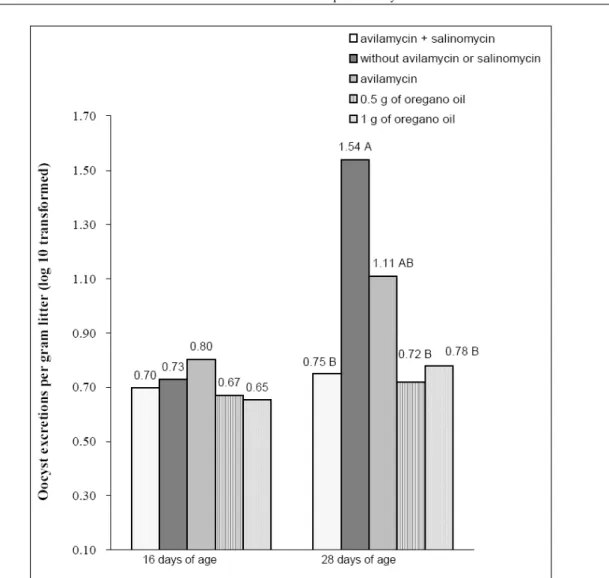
In Trial 1 no significant dietary effects were observed on oocyst excretions at 16 days of age (P>0.05) however, at 28 days of age it was observed that the nonmedicated group had the highest oocyst excretion in litter (P<0.05). The opposite was observed for broilers fed with anticoccidial agent or basal diet supplemented with oregano oil (P<0.05, Figure 1).
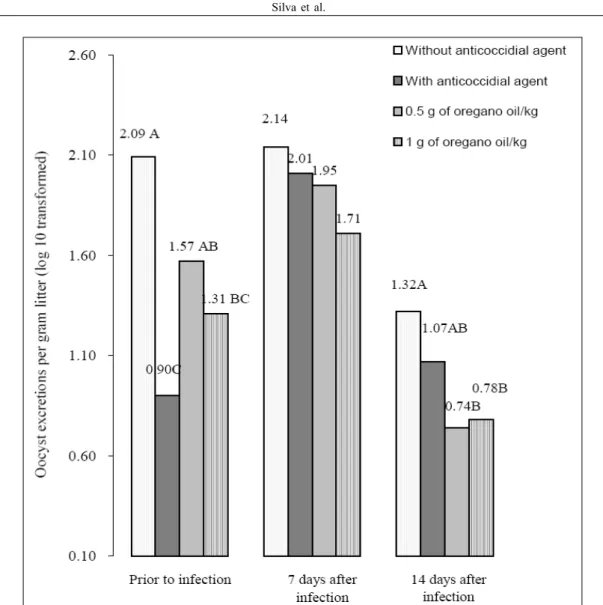
In Trial 2, after challenge with E. tenella
and treated with the oregano essential oil or
Table 2 - Effects on intestinal integrity from feeding oregano oil to broilers chickens at days of age in Trial 1.
Diet Villous height Crypt depth Villous:crypt
Positive control (with antibiotic and anticoccidial) 1219.47 215.86 B 5.94 A
Negative control (without antibiotic and anticoccidial) 1173.83 343.80 A 3.56 B
Only antibiotic 1282.07 245.31 AB 5.28 AB
0.5g of oregano oil kg-1 1013.72 227.42 B 4.52 AB
1.0g of oregano oil/kg-1 994.92 241.92 B 4.22 AB
ionophorous antibiotic, the excreted oocysts of feces were investigated and the results are shown in a figure 2. At 19 days of age, it was observed that broilers fed with basal diet without anticoccidial agent had the highest oocyst excretion in litter (P<0.05). The opposite was observed for broilers fed with basal diet with anticoccidial agent which did not differ from chickens fed with 1.0g of oregano oil/kg diet (P<0.05). At 34 days of age, the broilers fed with basal diet supplemented oregano oil had the lowest oocyst excretion which did not differ from chickens fed with anticoccidial agent in the diet (P<0.05).
Morphological evaluation of cecum wall from broilers orally challenged with Eimeria tenella
was observed at 144 hours after infection and broilers fed basal without anticoccidial agent had the highest cecal lamina propria thickeness which differ from
chickens fed with anticoccidial agent in diet or supplemented with 1.0 of oregano oil kg diet-1 (P<0.05,
Table 3). At 42 days of age, the absence of anticoccidial agent in diet resulted in the highest cecal lamina propria thickeness which differ from chickens fed diet supplemented with 1.0 of oregano oil kg diet-1 (P<0.05,
Table 3). The result of a reduction in cecal lamina propria thickness in birds fed with oregano oil in the diet provides an indirect indicator of reduced pathogen infection in the ceca. It is suspected that addition of antibiotics or essential oils may be efficient at reducing the pathogen load. GREATHEAD & KAMEL (2006) observed that the addition of thymol:carvacrol (1:1) in diet from broilers infected with E. acervulina resulted in improved intestinal integrity probably by reducing the impact of coccidiosis on intestinal integrity.
CONCLUSIONS
The results of these studies indicated that oregano essential oil exerted an anticoccidial effect were similar to the ionophorous antibiotic verified through the intestinal morphometric and excretion of oocysts.
COMMITTEE ON BIOETHICS AND SAFETY
The protocol of animal experimentation is in accordance to CONCEA and was approved by the Ethics Committee in Use of Animals of Espirito Santo Federal Univesity from Protocol No. 01/08.
Figure 2 - Oocyst excretions of broilers chickens non-infected or infected experimentally by Eimeria tenella in Trial 2.
Table 3 - Effect on segment of ceca from feeding oregano oil to broilers chickens infected with Eimeria tenella oocysts in Trial 2.
---Diameter of cecal lamina propria, microns---Diet
144 hours after infection 42 days of age
Positive control (with anticoccidial agent) 302.92 B 853.25 AB
Negative control (without anticoccidial agent) 840.18 A 967.51 A
0.5g of oregano oil kg-1 516.01 AB 486.92 B
1.0g of oregano oil kg-1 350.14 B 469.00 B
ACKNOWLEDGMENTS
The authors are grateful to the Banco Nordeste (BNB) e Fundação de Apoio a Ciência e a Tecnologia do Espírito Santo (FAPES) for financial support.
REFERENCES
BUDDLE, J.R., BOLTON, J.R. The pathophysiology of diarrhoea in pigs. Pigs News Information, v.13, p.41N-45N, 1992.
CERA, K.R. Effect of age, weaning and postweaning diet on small intestinal growth and jejunal morphology in young swine.
Journal Animal Science, v.66, p.574-584, 1988.
CONWAY, D.P., MCKENZIE, M.E. Poultry Coccidiosis diagnostic and testing procedures. 2.ed. New York: Pfizer, 1991. 168p.
ELGAYYAR, M. et al. Antimicrobial activity of essential oils from plants against selected pathogenic and saprophytic microorganisms. Journal of Food Protection, v.64, p.1019-1024, 2001.
GIANNENAS, I. et al. Effect of dietary supplementation with oregano essential oil on performance of broilers after experimental infection with Eimeria tenella. Archives of Animal Nutrition, v.57, p.99-106, 2003. Disponível em: < h t t p : / / w w w . i n f o r m a w o r l d . c o m / s m p p / content~db=all?content=10.1080/0003942031000107299>. Doi: 10.1080/0003942031000107299.
GREATHEAD, H., KAMEL, C. Encapsulated plant extracts to fight coccidiosis. Feed Mix,v.14, p.18-21, 2006. HUGHES, R.J. Energy metabolism of chickens physiological limitations. A report for the Rural Industries Research
and Development Corporation, RIRDC Publication, n.2, p.151, 2003.
KOKKINI, S. et al. Phytochemistry, v.44, n.5, p.883-886, 1997
MANZANILLA, E.G. et al. Effect of plant extracts and formic acid on the intestinal equilibrium of early-weaned pigs. Journal of Animal Science, v.82, p.3210–3218, 2004.
MONTAGNE, L. et al. A review of interactions between d i e t a r y f i b r e a n d t h e i n t e s t i n a l m u c o s a , a n d t h e i r consequences on digestive health in young non-ruminant animals. Animal Feed Science and Technology, v.108, p.95-117, 2003. Disponível em: <http://www.sciencedirect.com/ s c i e n c e ? _ o b = A r t i c l e U R L & _ u d i = B 6 T 4 2 4 8 W B 6 W 8 -2&_user=687358&_rdoc=1&_fmt=&_orig=search&_sort=d& v i e w = c & _ a c c t = C 0 0 0 0 3 7 8 9 9 & _ v e r s i o n = 1 & _ u r l V e r s i o n = 0 & _ u s e r i d = 6 8 7 3 5 8 & md5=a10356ab60f5c612fca6f5ebf2706c92>. Doi: 10.1016/ S0377-8401(03)00163-9.
NABUURS, M.J.A. Microbiological, structural and functional changes of the small intestine of pigs at weaning. Pig News Information, v.16, p.93N-97N, 1995.
RODRIGUES, M.R.A. Estudos dos óleos essenciais presentes em manjerona e orégano. 2002. 148f. Tese (Doutorado em Química) - Instituto de Química, Universidade Federal do Rio Grande do Sul, Porto Alegre, RS.
SUN, X et al. Broiler performance and intestinal alterations when fed drug-free diets. Poultry Science, v.84, p.1294-1302, 2005.