Poultry Science Journal
ISSN: 2345-6604 (Print), 2345-6566 (Online)http://psj.gau.ac.ir
Effects of Artichoke
(Cynara scolymus
L.) Leaf Meal and Vitamin E
on Productive Performance, Intestinal Microflora and Morphology
in Japanese Quail
Samadi Fand Sahneh M
Department of Animal and Poultry Physiology, Animal Science Faculty, Gorgan University of Agricultural Sciences and Natural Resources, Gorgan, Iran.
Poultry Science Journal 2015, 3 (1): 87-98
Please cite this article as:Samadi Fand Sahneh M. 2015. Effects of Artichoke (Cynara scolymus L.) leaf meal and vitamin E on productive performance, intestinal microflora and morphology in Japanese quail. Poult. Sci. J. 3 (1): 87-98.
© 2015 PSJ. All Rights Reserved
Abstract Article history:
Received: April 13, 2015 Revised: June 12, 2015 Accepted: June 23, 2015
A total of 240, one-day-old quail chicks (Coturnix coturnix japonica) were used to study the effects of Artichoke leaf meal (ALM) and vitamin E in diet on growth performance, ileal microbial populations and intestinal morphology in a 42-d trial. This experiment was performed as a completely randomized design with 4 replicates of 15 quails each, using a 4 × 2 factorial arrangement with diet and gender as the main effects. Four dietary treatments were formulated by addition of 2 levels (1.5 and 3 percent) of ALM and 300 mg/Kg vitamin E to the basal diet. Supplementing basal diet with ALM did not improve growth performance at different rearing periods, whereas dietary vitamin E increased feed intake and body weight gain at day 21 of age (P<0.05). The ileal populations of lactobacillus and coliforms was not affected by dietary ALM treatments, whereas vitamin E increased the population of total aerobic bacteria (P≤0.04). The ileal villus height (P≤0.01) and crypt depth (P≤0.008) were reduced in quails fed on diets with ALM and vitamin E. The quails fed diets containing 3 percent ALM and 300 mg/Kg vitamin E had higher villus height:crypt depth ratio. The thickness of muscularies (P≤0.04) and mucosa (P≤0.0007) layers were decreased in birds fed diets containing ALM than control birds. Birds treated with ALM and vitamin E showed a shorter intestinal length (P≤0.02) and a lower pancereas relative weight. The results of this study showed that supplementing diet by ALM (1.5 and 3%) and 300 mg/Kg vitamin E did not improve growth performance, ileal microbiota pupolations and intestinal morphometric indices in Japanese quail.
Corresponding author: Firooz Samadi, Ph.D [email protected] [email protected]
Keywords:
Introduction
The modification of gut microbial population is used to improve growth performance and feed efficiency. The global ban on application of antibiotic growth promoters in poultry diets as a result of their potential side effects was led to identification and evaluation of alternative feed additive options to satisfy
consumer's demands (Hertrampf, 2001; Humphrey et al., 2002). The removal of
antibiotic growth promoters from animal feed was expected to result in increased intestinal disorders as a result of gut pathogens proliferation and consequently
reduced feed efficiency and animal performance (Hughes et al., 2005). Hence, the
possibility of growth-promoting and antioxidative properties for certain medicinal
plants has recieved more attention (Papadopoulou et al., 2005; Liu et al., 2006). Most
of these plants contain phenolic compounds which frequently documented as
antimicrobial (Zhu et al., 2004) and antioxidant agents (Gronbaek et al., 1995; Knekt
et al., 2002) benefiting animals through modulation of gut function.
The importance of Artichoke as a medicinal plant is related to its phenolic
compounds such as caffeoylquinic acid derivatives and flavonoids (Llorach et al.,
2002; Wang et al., 2003; Joy and Haber, 2007) mainly accumulated in the leaves
(Sanchez-Rabaneda et al., 2003). The antioxidant function of phenolic compounds is
resulted from its radical-scavenging properties (Wang and Huang, 2004). It has been reported that, Artichoke extract exert beneficial effects in birds challenged
with mycotoxins (Stoev et al., 2004). Moreover, Azcona et al. (2005) demonstrated a
higher metabolizable energy during the first 21 days in chicks fed on diets with Artichoke extract. Advanteges were also reported for the use of Artichoke extract during the first weeks of life chicks (Mariani, 1998).
Few experimental studies have been published on the effects of ALM in Japanese quail. Therefore, this study was carried out to investigate the effects dietary ALM and Vitamin E on growth performance, intestinal morphology and microbial population in Japanese quail.
Materials and Methods Plant meal preparation
Artichoke leaves were collected at vegetative stage from the research farm
(latitiude: 37°00' - 37°30'N; longitude: 54°00' - 54°30'E; altitude: 155 m) of Gorgan
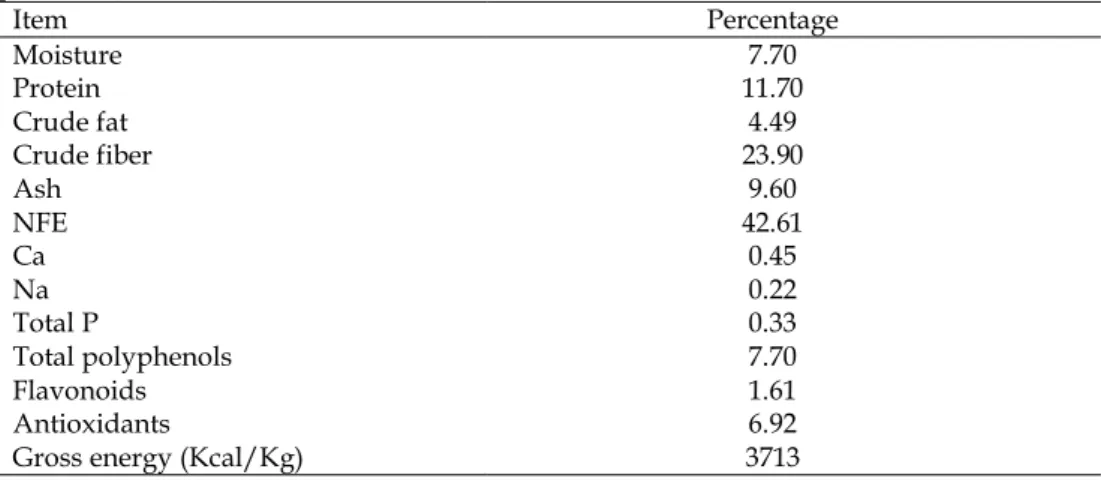
University of Agricultural Sciences and Natural Resources, Gorgan, Golestan province, Iran. Collected leaves were dried in shadow and ground with a laboratory mill to pass through a 3-mm screen (Iran khodsaz gristmill, ELS 300C, Iran). Nutrient compositions of Artichoke leaves were determined proximate analysis (AOAC, 1999). The total values of phenolic compounds were measured by
Table 1. Proximate composition and phenolic compounds of Artichoke leaf powder (As-fed)
Percentage Item
7.70 Moisture
11.70 Protein
4.49 Crude fat
23.90 Crude fiber
9.60 42.61 Ash
NFE
0.45 Ca
0.22 Na
0.33 Total P
7.70 1.61 6.92 Total polyphenols
Flavonoids Antioxidants
3713 Gross energy (Kcal/Kg)
Birds and experimental design
A total of 240, one-day-old Japanese quail chicks were used in this study. The chicks were individually weighted and assigned randomly to 4 experimental diets with 4 replicates of 15 birds each. All 16 replicates were housed in a poultry experimental facility under standard conditions of ventilation, heating and
lighting. Room temperature was set at 37 ± 1°C during the first week and then
gradually decreased to 24 ± 1°C by d 28 and kept at 24 ± 1°C through day 42 of
experiment (Nazar et al., 2012). Quails were subjected to a continuous artificial
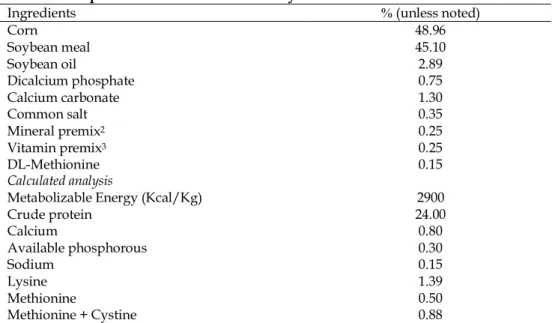
lighting throgthout the experiment. The 4 × 2 factorial experiment was performed with a completely randomized design, considering diet and gender as main fixed effects. Four experimerntal diets were formulated by inclusion of 2 levels (1.5 and 3 percent) of ALM with and without addition of 300 mg/Kg vitamin E to the basal diet. A standard corn-soybean meal based diet (basal diet) was formulated to meet or exceed the nutrient recommendations for quails (Table 2; NRC, 1994) and fed from d 1 until the end of experiment. Quails had free access to feed and fresh water throughout the trial.
Collected data
Table 2. Compositions and calculated analyses of the basal diet1
% (unless noted)
Ingredients
48.96 Corn
45.10 Soybean meal
2.89 Soybean oil
0.75 Dicalcium phosphate
1.30 Calcium carbonate
0.35 Common salt
0.25
Mineral premix2
0.25
Vitamin premix3
0.15 DL-Methionine
Calculated analysis
2900 Metabolizable Energy (Kcal/Kg)
24.00 Crude protein
0.80 Calcium
0.30 Available phosphorous
0.15 Sodium
1.39 Lysine
0.50 Methionine
0.88 Methionine + Cystine
1Calculated composition was according to NRC (1994).
2Mineral premix (each Kg contained): Mn, 50000 mg; Fe, 25000 mg; Zn, 50000 mg; Cu, 5000 mg; Iodine,
500 mg; Choline chloride, 134000 mg.
3Vitamin Premix (each Kg contained): Vitamin A, 3600000 IU; Vitamin D3, 800000 IU; Vitamin K3, 1600
mg; Vitamin B1, 720 mg; Vitamin B2, 3300 mg; Vitamin B3, 4000 mg; Vitamin B5, 15000 mg; Vitamin B6,
150 mg; Vitamin B9, 500 mg; Vitamin B12, 600 mg; Biotin, 2000 mg.
depth of crypt was then defined as the difference between the total mucosal thickness and the villus height. The thickness of the muscularis externa was measured.
Microbial assesments
On d 42, two birds from each replicate were killed by cervical dislocation and processed properly for collection of their intestinal tract. Samples of ileal fresh
digesta (0.2 g) were diluted in physiological serum (saline) to an initial 10–1
dilution. The ileum contents of each bird were pooled for serial dilution. Microbial
populations were determined by serial dilution (10-4 to 10-6) of ileal samples in
anaerobic diluents before inoculation onto petridishes of sterile agar. Lactobacilli,
aerobic bacteriaand coliforms were grown on culture media of Rogosa SL agar,
Plate Count Agar and Violet Red Bile Agar (VRBA), respectively. Plates were
incubated anaerobically (73% N, 20% CO2, 7% H2) at 37°C. Plates were counted
between 24 and 48 hrs after inoculation. Colony forming units were defined as being distinct colonies measuring at least 1 mm in diameter.
Statistical analysis
Data collected were subjected to ANOVA using GLM procedure of SAS software (SAS, 2003). The pen mean was an experimental unit for productive triats (BWG, FI and FCR). Main effect means and the interactions were reported.
Microbiological concentrations were subject to log10 transformation before analysis.
When significant effects were found, comparisons among multiple means were made by Duncan’s multiple range tests. Differences were considered statistical
significance when P<0.05.
Results
Supplementation of basal diet with ALM and vitamin E did not significantly
affect BWG during 22-42 and 1-42 days experimental periods. However, birds fed
diets containing 3 percent ALM and vitamin E showed a decreased and increased
BWG at 21 d of age (P<0.05), respectively, when compared with the birds fed on
the basal diet. In addition, supplementing basal diet with ALM did not affect FI at different rearing experimental periods, whereas vitamin E significantly increased FI at 21 d of age when compared to birds fed basal and Artichoke supplemented
diets (P<0.05). Feed conversion ratio values were similar in quails treated with
vitamin E at different experimatal periods compared to control, whereas it was
increased (P<0.05) in the birds fed on diet containing 3 percent ALM at 21 d of age
Table 3. Influence of supplementation of Artichoke leaf meal and vitamin E in diet on growth performance of Japanese quail in different rearing periods
Treatments BWG1 1 to 21 dFI2 FCR3 BWG1 22 to 42 d FI2 FCR3 BWG1 1 to 42 dFI2 FCR3
Control 1.5% Artichoke 3% Artichoke
300mg vitamin E
SEM P-value 99.30b 96.19b 87.37c 110.87a 1.96 0.01 243.85b 241.04b
238.26 b
277.45 a
25.4 0.04 2.45b 2.50b 2.72a 2.50b 0.20 0.01 133.15 128.81 137.11 130.90 5.76 0.45 669.43 658.06 686.52 698.77 26.15 0.07 5.02 5.11 5.00 5.33 0.25 0.06 232.45ab 225.00b 224.48b 241.77a 3.46 0.02 913.28 899.10 924.78 976.27 25.4 0.34 3.93 3.99 4.12 4.03 0.04 0.45
1Body weight gain (g); 2Feed intake (g); 3Feed conversion ratio (g of feed/g of BWG). a-c Means within a column without a common superscript differ significantly (P<0.05).
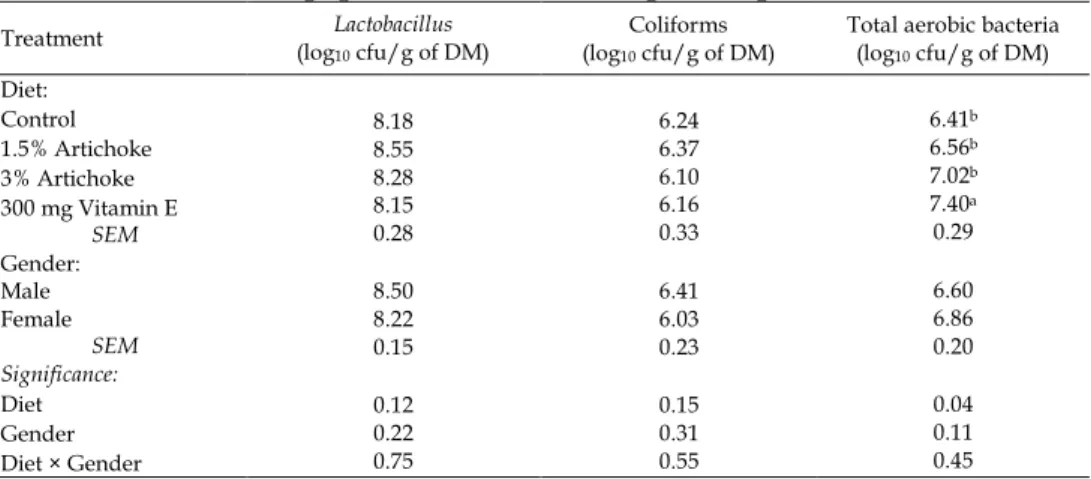
Results for ileal bacterial counts are shown in Table 4. No significant interaction was found between diet and gender on ileal bacterial populations. The coliform population of ileum did not differ by the diet and gender. Supplementing basal diet with ALM (1.5 and 3%) did not affect total aerobic bacteria, whereas diet containing 300 mg/Kg vitamin E increased ileal populations of total aerobic
bacteria(P≤0.04). The ileal population of lactobacillus was increased numerically by
supplementing of basal diet with ALM.
Table 4. Influence of supplementation of Artichoke leaf meal and vitamin E in diet on illeal microbial population of 42-d-old Japanese quail
Total aerobic bacteria (log10 cfu/g of DM)
Coliforms (log10 cfu/g of DM)
Lactobacillus
(log10 cfu/g of DM)
Treatment 6.41b 6.56b 7.02b 7.40a 0.29 6.24 6.37 6.10 6.16 0.33 Diet: 8.18 8.55 8.28 8.15 0.28 Control 1.5% Artichoke 3% Artichoke 300 mg Vitamin E
SEM 6.60 6.86 0.20 6.41 6.03 0.23 8.50 8.22 0.15 Gender: Male Female SEM 0.04 0.11 0.45 0.15 0.31 0.55 0.12 0.22 0.75 Significance: Diet Gender Diet × Gender
a,b Means within a column without a common superscript differ significantly (P<0.05).
Results on ileal morphology in quails are presented in Table 5. No significant interaction between diet and gender and gender effects were found on
morphometrical indices. The ileal villus height (P≤0.01) and crypt depth (P≤0.008)
were reduced in quails treated with ALM and vitamin E, when compared with control birds. The villus height to crypt depth ratio was significantly increased in quails fed diets containing 3 percent ALM and 300 mg/Kg vitamin E compared
mucosa (P≤0.0007) layers in birds fed diet containing ALM (1.5 and 3%) decreased when compred with the control birds.
Table 5. Influence of supplementation of Artichoke leaf meal and vitamin E in diet on ileum mucosa morphometry of Japanese quail
Mucosa thickness (μm) Muscule thickness (μm) Villus height:crypt depth Crypt depth (μm) Villus widthness (μm) Villus height (μm) Treatment 29.85a 15.85b 14.44b 34.33a 1.09 176.01a 105.40c 120.44cb 159.84ab 2.80 5.58b 5.72b 8.16a 6.78a 0.63 143.40a 97.98b 89.87b 109.40b 2.03 104.80 138.69 109.78 112.37 2.85 855.67a 556.63b 707.63b 728.80b 4.97 Diet: Control 1.5%Artichoke 3% Artichoke
300 mg Vitamin E SEM 23.73 23.50 0.77 127.29 153.54 1.98 6.36 6.74 0.44 109.51 110.80 1.4 106.02 126.80 2.01 716.00 708.38 3.5 Gender: Male Female SEM 0.0007 0.92 0.29 0.04 0.13 0.18 0.16 0.65 0.63 0.008 0.87 0.45 0.49 0.23 0.65 0.01 0.88 0.72 Significance: Diet Gender
Diet × Gender
a,b Means within a column without a common superscript differ significantly (P<0.05).
Table 6. Influence of supplementation of Artichoke leaf powder and vitamin E in diet on the intestinal length (cm) and relative weigth of digestive organs (g/100 g live body weight) in 42-d-old Japanese quail
Digestive tract weight Pancrease weight Gizzard weight Proventriculus weight Intestinal weight Intestinal length Treatment 19.55b 23.88a 20.58b 20.75b 0.52 0.89a 0.75ab 0.65b 0.65b 0.16 2.87 2.93 2.97 2.67 0.23 0.55 0.50 0.53 0.54 0.11 7.69 8.27 8.12 8.16 0.43 61.93a 56.75b 56.93b 57.06b 0.68 Diet: Control 1.5%Artichoke 3% Artichoke
300 mg Vitamin E SEM 17.81 24.57 0.36 0.60 0.88 0.11 2.94 2.78 0.16 0.50 0.55 0.07 7.59 8.90 0.03 58.62 57.71 0.47 Gender: Male Female SEM 0.003 0.0001 0.18 0.09 0.00 0.47 0.24 0.14 0.24 0.66 0.59 0.79 0.59 0.001 0.54 0.02 0.53 0.75 Significance: Diet Gender Diet × Gender
No differences were observed in intestinal, proventricular and gizzard relative weights between birds received dietary treatments (Table 6). Birds treated with ALM and vitamin E showed a shorter intestinal length than those fed with basal
diet (P<0.05). The addition of 3 percent ALM and 300 mg/Kg vitamin E resulted in
lower relative weight of pancreas than control diet with no supplmentation. The relative weight of digestive tract was increased by supplementing diet with 1.5 percent ALM compare with control diets.
Discussion
Results of the current study with respect to no change in growth performance (BWG, FI, FCR) by diets supplemanted with ALM are consistent with findings of Melo and Harkes (2007) who revealed no significant differences among broilers treated with two levels of Artichoke extract (300 and 600 g/ton) for BWG and FI at the end of 42-day trial. Nevertheless, our results on FCR disagree with the findings
of Melo and Harkes (2007) and also Azcona et al. (2005). Melo and Harkes, (2007)
reported that supplementing diet with Artichoke extract (600 g/ton) from 1-21 days of age improved feed efficiency in 21 and 42 day-old broilers. These authors concluded that improved feed conversion may be attributed to the reduced feed intake. Moreover, a better conversion in broilers treated with Artichoke extract can be attributed to an improved lipid digestibility due to an increased bile secretion and also increased metabolizable energy of birds during their first weeks of life
(Azcona et al., 2005). In addition, positive results of Artichoke protection were
reported by Stoev et al. (2004) and Mariani (1998). Differences between our results
with others may be attributed to the variation of experimental conditions,
differences in the type of Artichoke used (meal vs. extract) and probably
environmental stresses including handling, vaccination, and various other instances that might negatively affect growth performance through activation of
immune system (Hevener et al., 1999; Takahashi et al., 2000).
We observed no significant effects of ALM and vitamin E on ileal coliform
pathogenic population. However, populations of beneficial Lactobacillus bacteria
increased numerically by supplementating basal diet with ALM. Moreover, ileal total aerobic bacteria count increased in birds treated by 300 mg/Kg vitamin E. These results suggest that the intake of polyphenols compounds such as ALM might favor the growth of beneficial bacteria. It seems that some of these microorganisms might be able to use these compounds as nutritional substrates. For example, lactobacilli bacteria are able to metabolize phenolic compounds as
energy substrate (García-Ruíz et al., 2008). In addition, many in vitro studies
showing that many fungi, bacteria, and yeasts are able to grow and develop on
polyphenolic compoumds (Arunachalam et al., 2003).
villus widthness along with a decreased in crypt depth support digestive function of the intestine as a result of increased absorptive surface area, expression of brush
border enzymes and nutrient transport systems (Caspary, 1992; Zijlstra et al. 1996).
In current study, the inclusion of ALM and vitamin E did not increase villus
height, wherase decreased crypt depth. Liu et al. (2011) reported no changes in
villus height or crypt depth in the jejnum of broilers treated with chicory forage diet (60 and 120 g/Kg). It has been documented that physiological effects of dietary fiber is also effective on intestinal development. In this context, Brunsgaard and Eggum (1995) reported that the physiological effect of dietary fiber is more
dramatic in the distal gasterointestinal tract. Baurhoo et al. (2007) reported that
increased villi length might be due to an increased colonization of beneficial bacteria such as lactobacilli and bifidobacteria. In contrast to the latter report, our findings showed a decreased villius height along with a slight increased
lactobacillus population in quails fed diets supplemented with ALM. Regarding other parameters of gut integrity, crypt depth was reduced in birds treated with ALM and vitamin E compared with those fed basal diet. In contrast to our
findings, Ferket et al. (2002) reported that crypt depth was not affected in turkeys
treated with an antibiotic-free diet. It has been documented that a deeper crypt may show faster tissue turnover to permit renewal of the villus, which suggests that the host’s intestinal response mechanism is trying to compensate for normal
sloughing or atrophy of intestinal mucosal layer (Gao et al., 2008). In the present
study, an increase in ileal villus height:crypt depth ratio in quails fed diets supplemented with ALM (3%) and vitamin E was also found. Moreover, thicknes of muscule and mucosa layers were decreased in birds fed diets containing ALM (1.5 and 3%), which is consistent with reports showing decreased thickness of walls
by the inclusion of feed antibiotics in diets of chicken (Miles et al., 2006). Thinner
muscule and mucosa layers of quails treated with ALM can be partly attributed to the distension of intestine due to increased bulk-forming capacities of fiber diet
(Kalmendal et al., 2011). In the current study, birds treated with dietary treatmants
(1.5 and 3% ALM and 300 mg/Kg vitamin E) had a shorter intestinal length than control birds. In addition, quails feds diet containing 3 percent ALM and 300 mg/Kg vitamin E had a lower pancerease relative weight compared to control quails. This study showed that dietary treatments of ALM and vitamin E did not affect intestinal length and relative weights of intestine, proventriculous and
gizzard which was consistent with Liu et al. (2011), who studied the effects of
chicory (Cichorium intybus L.) forage on broilers. However, the relative weight of
digestive tract was increased by dietary treatment of 1.5 percent ALM; this could be attributed in part due to increased intestinal weight.
Conclusion
weight gain at day 21 of age. The ileal populations of lactobacillus and coliforms did not affect by dietary ALM treatments, whereas vitamin E increased the population of total aerobic bacteria. The ileal villus height and crypt depth were reduced by ALM and vitamin E dietary treatments. The ALM (3%) and 300 mg/Kg vitamin increased villus height:crypt depth ratio. The thickness of muscularies and mucosa layers were decreased by ALM.
Acknowledgments
The authors thank the Gorgan University of Agricultural Sciences and Natural Resources for facilities support of this investigation.
References
AOAC (Association of Official Analytical Chemists). 1999. Official Methods of
Analysis. 15th Ed. Washington, DC.
Arunachalam M, Raj MM, Mohan N & Mahadevan A. 2003. Biodegradation of catechin. Proceedings- Indian National Science Academy Part B, 69: 353–370.
Azcona J, Schang M & Mallo G. 2005. Efecto de la inclusión en la dieta de extracto de
alcachofa (cynara scolymus l.) sobre la respuesta zootécnica de pollos parrilleros [Effect on the zootechnical response of broilers of the inclusion of artichoke extract (Cynara scolymus L.) in the diet]. Reports of the XIXth Latin American Congress
on Poultry Farming, Panamá.
Baurhoo B, Phillip L & Ruiz-Feria CA. 2007. Effects of purified lignin and mannan oligosaccharides on intestinal integrity and microbial populations in the ceca and litter of broiler chickens. Poultry Science, 86: 1070–1078.
Brunsgaard G & Eggum BO. 1995. Small intestinal tissue structure and proliferation as influenced by adaptation period and indigestible polysaccharides. Comparative Biochemistry and Physiology Part A: Physiology, 112: 365-377.
Caspary WF. 1992. Physiology and pathophysiology of intestinal absorption. The American Journal of Clinical Nutrition, 55: 299S-308S.
Ferket PR, Parks CW & Grimes JL. 2002. Mannan oligosaccharides versus antibiotics for turkeys. In: Nutritional Biotechnology In The Feed Industry.
Proceedings of 18th Annual Symposium. Nottingham University Press,
Nottingham, UK. Pages, 155-166.
Gao J, Zhang HJ, Yu SH, Wu SG, Yoon I, Quigley J, Gao YP & Qi GH. 2008. Effects of yeast culture in broiler diets on performance and immunomodulatory functions. Poultry Science, 87:1377–1384.
Gronbaek M, Deis A, Sorensen TIA, Becker U, Schnohr P & Jensen G. 1995. Mortality associated with moderate intakes of wine, beer, or spirits. BMJ, 310: 1165– 1169.
Guo FC, Savelkoul HFJ, Kwakkel RP, Williams BA & Verstegen MWA. 2000. Immunoactive, medicinal properties of mushroom and herb polysaccharides
and their potential use in chicken diets. World’s Poultry Science Journal, 59:
427- 440.
Hertrampf JW. 2001. Alternative antibacterial performance promoters. Poultry
International, 40: 50–52.
Hevener W, Routh PA & Almond GW. 1999. Effects of immune challenge on concentrations of serum insulin-like growth factor-1 and growth performance
in pigs. Canadian Veterinary Journal, 40: 782-786.
Hughes RJ, Brooker JD & Smyl C. 2005. Growth rate of broiler chickens given
condensed tannins extracted from grape seed. Proceedings of the 17th Annual
Australian Poultry Science Symposium. University of Sidney. Sidney, Australia. Pages, 65-68.
Humphrey BD, Huang N & Klasing KC. 2002. Rice expressing lactoferrin and
lysozyme has antibiotic-like properties when fed to chicks. Journal of Nutrition,
132: 1214–1218.
Joy JF & Haber SL. 2007. Clinical uses of artichoke leaf extract. American Journal of
Health-System Pharmacy, 64: 1904–1906.
Kalmendal R, Elwinger K, Holm L & Tauson R. 2011. High-fibre sunflower cake affects small intestinal digestion and health in broiler chickens. British Poultry Science, 52: 86–96.
Knekt P, Kumpulainen J, Järvinen R, Rissanen H, Heliövaara M, Reunanen A, Hakulinen T & Aromaa A. 2002. Flavonoid intake and risk of chronic diseases.
American Journal of Clinical Nutrition, 76: 560–568.
Liu B, Li W, Chang Y, Dong W & Ni L. 2006. Extraction of berberine from rhizome of Coptis chinensis Franch using supercritical fluid extraction. Journal of Pharmaceutical and Biomedical Analysis, 41: 1056–1060.
Liu HY, Ivarsson H, Jönsson L, Holm L, Lundh T & Lindberg JE. 2011. Growth performance, digestibility, and gut development of broiler chickens on diets
with inclusion of chicory (Cichorium intybus L.). Poultry Science, 90: 815-823.
Llorach R, Espin JC, Tomás-Barberán FA & Ferreres F. 2002. Artichoke (Cynara
scolymus L.) byproducts as a potential source of health-promoting antioxidant
phenolics.Journal of Agricultural and Food Chemistry, 50: 3458–3464.
Mariani GVC. 1998. Efeito de aflatoxinas sobre o desempenho produtivo de frangos de
corte em diferentes períodos de desenvolvimento corporal. Universidade Federal de Santa Maria.
Melo JE & Harkes R. 2007. Productive evaluation of broiler chickens consuming
Artichoke extract (Cynara Scolymus L.) during the first three weeks of life. XX
Miles RD, Butcher GD, Henry PR & Littell RC. 2006. Effect of antibiotic growth promoters on broiler performance, intestinal growth parameters, and qualitative morphology. Poultry Science, 85: 476–485.
Nazar FN, Magnoli AP, Dalcero AM & Marin RH. 2012. Effect of feed contamination with aflatoxin B1 and administration of exogenous corticosterone on Japanese quail biochemical and immunological parameters. Poultry Science, 91: 47–54
NRC (National Research Council). 1994. Nutrient Requirement of poultry. 9th Rev.
Ed. National Academy Press, Washington, DC.
Papadopoulou C, Soulti K & Roussis IG. 2005. Potential antimicrobial activity of red
and white wine phenolic extracts against strains of Staphylococcus aureus, Escherichia
coli and Candida albicans. Food Technology and Biotechnology, 43: 41-46.
Sanchez-Rabaneda F, Jauregui O, Lamuela-Raventos RM, Bastida J, Viladomat F & Codina C. 2003. Identification of phenolic compounds in artichoke waste by
high-performance liquid chromatography–tandem mass spectrometry. Journal
of Chromatography A, 1008: 57–72.
SAS Institute. 2003. SAS User’s Guide: Statistics. Version 9. SAS Institute Inc, Cary, NC. Stoev SD, Stefanov M, Radic B, Domijan AM & Peraica M. 2004. Experimental mycotoxicosis in chickens induced by ochratoxin A and Penicillic Acid and intervention with natural plant extract. Veterinary Research Communications, 28: 727-746.
Takahashi K, Mashiko T & Akiba Y. 2000. Effect of dietary concentration of xylitol
on growth in male broiler chicks during immunological stress. Poultry Science,
79: 743-747.
Wang SP & Huang KJ. 2004. Determination of flavonoids by high-performance
liquid chromatography and capillary electrophoresis. Journal of
Chromatography A, 1032: 273–279.
Wang M, Simon JE, Aviles IF, He K, Zheng QY & Tadmor Y. 2003. Analysis of
antioxidative phenolic compounds in artichoke (Cynara scolymus L.).Journal of
Agricultural and Food Chemistry, 51: 601–608.
Zhu X, Zhang H & Lo R. 2004. Phenolic compounds from the leaf extract of
artichoke (Cynara scolymus L.) and their antimicrobial activities. Journal of
Agricultural and Food Chemistry, 52: 7272–7278.