J. res.: fundam. care. online 2015. jul./set. 7(3):3020-3036
3020
RESEARCH
Jovens universitários e o conhecimento acerca das doenças sexualmente transmissíveis – contribuição para cuidar em enfermagem
Young academics and the knowledge about sexually transmitted diseases - contribution to care in nursing
Jóvenes universitarios y el conocimiento de las enfermedades de transmisión sexual - contribución a la atención de enfermeira
Karla Temístocles de Brito Dantas1, Thelma Spíndola2, Selma Villas Boas Teixeira3, Allan Carlos
Mazzoni Lemos4, Luiz Eduardo da Motta Ferreira5
Objective: Analyzing the knowledge of nursing graduate students about sexually transmitted diseases and
identifying practices that young people adopt for STD prevention. Method: A descriptive, quantitative study held in a public higher education institution in Rio de Janeiro with nursing graduates who answered a questionnaire. Research approved by CEP/UERJ n. 063/2012. The data were tabulated with use of simple descriptive statistics and stored in Microsoft Excel 2003 software. Results: Students recognize the importance about the use of condoms for prevention of sexually transmitted diseases, but don’t use it continuously. Many students are unaware of the transmission of STD. Conclusion: The young people investigated do not have enough information about sexually transmitted diseases and preventive measures. Health professionals should contribute with information and educational activities, emphasizing the importance of practicing safe sexual health for young people. Descriptors: Nursing graduating, Young, sexuality, STD/HIV/AIDS, Prevention.
Objetivos: Analisar o conhecimento dos graduandos de enfermagem acerca das doenças sexualmente
transmissíveis, identificar as práticas que os jovens adotam para prevenção de DSTs. Método: Estudo descritivo, quantitativo realizado em instituição pública de ensino superior no Rio de Janeiro, com graduandos de enfermagem que responderam a um questionário. Pesquisa aprovada sob o parecer 063/2012 CEP/UERJ. Os dados foram tabulados com emprego da estatística descritiva simples, armazenados no software Microsoft Excel 2003. Resultados: Os estudantes reconhecem a importância do uso do preservativo para a prevenção das doenças sexualmente transmissíveis, mas não o utilizam de maneira contínua. Dentre os participantes, muitos desconhecem as formas de transmissão das DSTs.
Conclusão: Os jovens investigados apresentam déficit de informações acerca das doenças sexualmente
transmissíveis e das medidas preventivas. Os profissionais de saúde devem contribuir com esclarecimentos e ações educativas, ressaltando a importância da prática sexual segura para a saúde dos jovens.
Descritores: Graduando de enfermagem, Jovem, Sexualidade, DST/HIV/AIDS, Prevenção.
Objetivo: Analizar el conocimiento de los estudiantes de enfermería acerca de las enfermedades de
transmisión sexual, identificar las prácticas los jóvenes que adoptan para la prevención de las ETS.
Método: Es un estudio descriptivo, cuantitativo que se realizó en la institución de educación superior en
Río de Janeiro con estudiantes de enfermería que respondieron a un cuestionario. Investigación homologada de acuerdo con la opinión 063/2012 CEP/UERJ. Se tabularon los datos con el uso de simple estadística descriptiva, almacenada en el software Microsoft Excel 2003. Resultados: Los estudiantes reconocen la importancia del uso del condón para la prevención de enfermedades de transmisión sexual, pero no lo use continuamente. Muchos de los participantes no sabían las formas de transmisión de las ETS.
Conclusión: Los jóvenes investigados no tienen suficiente información sobre las enfermedades de
transmisión sexual y las medidas preventivas. Los profesionales de salud deben contribuir a la clarificación y actividades educativas que enfatizan la importancia de la práctica sexual segura para la salud de los jóvenes. Descriptores: Estudiantes de Graduación en Enfermería, Joven, Sexualidad, ETS/VIH/SIDA, Prevención.
1Nurse, Specialist in Clinical and Surgical Nursing by the Navy/UNIRIO. Email: [email protected]. 2Doctorate in Nursing, Associate Professor of the School of Nursing of the State University of Rio de Janeiro. Brazil. Email: [email protected]. 3Doctorate in Nursing, Associate Professor of the School of Nursing Alfredo Pinto, Federal University of the State of Rio de Janeiro (UNIRIO). Email: [email protected]. 4Nurse, Master's Student at the Federal University of the State of Rio de Janeiro (UNIRIO). Email: [email protected]. 5Physician, Master in Cardiology, Associate Professor of the School of Medicine and Surgery, Federal University of the State of Rio de Janeiro (UNIRIO). Email: [email protected]
ABSTRACT
RESUMEN RESUMO
J. res.: fundam. care. online 2015. jul./set. 7(3):3020-3036
3021
T
his study is a project integrated to the research "Assessing the knowledge, practices and beliefs of university students in relation to sexually transmitted diseases", coordinated by Professor Thelma Spindola in Rio de Janeiro.
The object of this study is "the knowledge of nursing students about sexually transmitted diseases." Sexually transmitted diseases (STDs) are diseases caused by microorganisms such as viruses, fungi, bacteria and protozoa, usually transmitted sexually, and are among the most common problems of existing public health in the countries. Among the existing DST can highlight the Chlamydia infection, Gonorrhea, Genital Herpes of Virus, Human Papilloma Virus (HPV), hepatitis B (HBV), Syphilis, Human Immunodeficiency Virus (HIV), among others.1-2
The DSTs are present in our midst since antiquity, in ancient civilizations, where reigned promiscuity, which is a determining factor for the appearance of them. According to studies3-4-5 young people is the most exposed part to these diseases, due to the discovery and sexual initiation, at which time practicing unsafe sex are vulnerable to illness.
It should be noted, however, that youth refers to a phase of life situated between childhood and adulthood, and also includes a part of adolescence, whose age varies between 12 and 18.6 This moment is marked by external changes brought from puberty, affect reorganization, desire, joy and identification, which is the gradual replacement of the child's body for a sexed body, and the acquisition of genital sexuality that distance of them from the oedipal objects, their parents.7
Sexuality involves gender, sexual identity, sexual orientation, eroticism, emotional involvement, love and reproduction. It is expressed through thoughts, fantasies, desires, beliefs, attitudes, values, activities, practices, roles and relationships, and involves, beyond the body, history, customs, affective relationships and culture.8
According to the Statute of Youth, young people are considered persons aged between 15 and 29 years old.9 They are an important part of the population, and the observed increase in the number of people in this age group since 1945 and reached 1 billion in 1990 and 1.02 billion in 2005, or 15,8% of the population. According to projections of the United Nations, the trend is that the number of people in this age group to reach 1.4 billion by 2025.10
This stage of life is characterized as a step acquisition of social skills, assignments of duties and responsibilities and affirmation of identity, where choices have influence on the future, as magnification factor or limitation of adulthood. Moreover, it is a stage of life that usually receives an ambiguous treatment (sometimes is treated like a child, now as an adult) and presents greater risks regarding the use and consumption of drugs,
INTRODUCTION
J. res.: fundam. care. online 2015. jul./set. 7(3):3020-3036
3022
unemployment, HIV infection or other STDs, pregnancy unplanned, early mortality frompreventable causes, violence and abuse.10
In this context STDs are of significant epidemiological significance, since we have a high transmission rate and may represent a serious problem in reproductive health in young people, because they can cause infertility, pelvic inflammatory disease, cervical cancer, ectopic pregnancy, vertical transmission, puerperal infections, newborns with low birth weight, and have a negative effect on self-esteem and increase the risk for HIV transmission.2
Among the factors that may be listed as responsible for the contamination levels are to promiscuous sexual practices, low socioeconomic conditions, poor state of health services, non-use of preventive methods, lower public fear by these diseases by the ease of diagnosis and treatment, misinformation on the subject and the lack of family preparation to guide their young on sexuality, which may be related to embarrassment, lack of knowledge about STDs and the little freedom of dialogue between parents and children, results of a culture that sex is still subject wrapped in many prejudices.3-4,11
According to Ministry of Health data the prevalence rate of HIV infection among young people has increased. The prevalence in the age group 17-21 years of age, increased from 0,09% in 2002 to 0,12% in 2007, and the most significant increase occurred among men who have sex with men, the prevalence increased from 0,56 % in 2002 to 1,2% in 2007. With regard to population groups older than 18, between 2008 and 2009, HIV prevalence of 5,9% among drug users rates were estimated 10.5% between men who have sex with men and 4,9% among female sex workers.5
Considering the last 10 years, the age profile of cases of Acquired Immunodeficiency Syndrome (AIDS) has also changed for younger individuals, and observed a trend of increase in detection rates among young people 15-24 years old, mostly sex male. In 2012, in Brazil, the case detection rate of AIDS in men 15-24 years was 15,1/100.000 and 8,6 in women.5
Ministry of Health data show, in the period 2005-2012, the highest detection rates of infection by hepatitis for females aged 25-29 years. In the state of Rio de Janeiro in 2012, 4,9 cases were detected per 100 thousand inhabitants, while in men the highest detection rates were observed at older ages, 40-49 years old (9,9 cases per 100 thousand) and 60-69 (11,5 cases per 100.000 inhabitants).12
In the context of the STD study13 indicates that in worldwide over 30% of young sexually active population has tested positive for Chlamydia infection, approximately 40% are infected by human papillomavirus and more than 50% were infected with genital herpes. The infection rates for gonorrhea in the intervals between 15 and 19 years old are the largest compared with other age groups.13
Due to the high number of young people infected by STDs (especially HIV), and the need for development of specific public policies for this population, the nursing professional in caregiver quality, need to be aware of prevention and health promotion that quota population vulnerable to damage to their sexual and reproductive health, such as exposure to STDs. It is worth adding that people who entered the university is comprised largely young people aged ranging between 17 and 24, and that realizes the high vulnerability of this group to STD.
J. res.: fundam. care. online 2015. jul./set. 7(3):3020-3036
3023
METHOD
Given the above, we defined the following problem for the research:
What are the skills of nursing students in relation to sexually transmitted diseases? To answer the research question there was delimited as a general goal:
Analyzing the knowledge of nursing students about sexually transmitted diseases and prevention practices.
And as following objectives:
Describing the sociodemographic profile of graduate nursing students;
Checking the knowledge of young people in relation to sexually transmitted diseases and prevention practices.
The relevance of the study is linked to the fact that it is a significant number of young people infected by STDs, as they become sexually active early are considered vulnerable to sexually transmitted infections, such as HIV, compared to the general population. Therefore it is important that comprehensive care is carried out by qualified health professionals and able to improve the care provided to this population, especially with respect to subjective questions of the health-disease-care process. Fitting professionals, especially nurses, the ability and the commitment to offer a humanized care, based on professional ethics, trust and active listening, creating opportunities for young people to express their feelings, doubts, emotions and feel welcomed and valued.
This is an exploratory, descriptive study with a quantitative approach.14 This study used the research database "Assessing the knowledge, practices and beliefs of university students in relation to sexually transmitted diseases" coordinated by Prof. Dr. Thelma Spindola.
Most survey was conducted in 2012/2013, in the city of Rio de Janeiro, in a public institution of higher education with students of the nursing course.
Those study participants were enrolled, attending the 1st to the 9th academic semester, older than 18. From the research there were excluded students away for sick leave or who were not present at the time of data collection. We selected a sample of intentional and stratified, having selected 40% of students in each group of the course (1st to 9th semester). Initially, we applied 17 instruments per class, having totaled 153 questionnaires. After the loss of 10 questionnaires and the application of the exclusion criteria (fewer than 18 years old and questionnaires completed incorrectly) were excluded 08 instruments. At the end were obtained 135 valid questionnaires stored in Microsoft Excel 2003. To meet the objectives of this research were used all data (N = 135), regardless of sexual condition (sexually active or not).
J. res.: fundam. care. online 2015. jul./set. 7(3):3020-3036
3024
RESULTS AND DISCUSSION
There were selected as variables to compose the study those related to socio-demographic data of the participants and the theme investigated, that is, knowledge about STDs, sexual habits and practices.
The data collection instrument (DCI) used was a structured questionnaire with 50 questions and 47 closed and 03 open. Of the questions were used in this study the variables related to the object selected for a total of 34 questions. The questionnaire was previously scheduled, in a private room of the institution for students to have privacy to answer the instrument, without outside interference.
Participants were informed about the study objectives and signed the Informed Consent according to the recommendations of Resolution 196/96, in force at the time of submission of the project to the Institutional Review Board (IRB).15 The project was approved by the CEP with the number 058.3.2012. Throughout the research were respected the ethical principles set out in Resolution 196/96.
Data were tabulated and organized with use of simple descriptive statistics and stored in Microsoft Excel 2003 software. The findings were analyzed based on the theoretical framework of the study.
In the process of analysis of the findings was defined the profile of all students (135) according to the analysis of socio-demographic variables.
The distribution of the 135 graduates investigated by gender shows that most were female (121/89,6%) were aged between 18 and 29, with a higher concentration of 18 to 21 (89/65,9%). Regarding marital status 47 (34,8%) have no boyfriend, 37 (27,4%) only dating and 36 (26,7%) did not answer. Live with their parents (103/76,3%) or family (13/9,6%). Only 05 (3,7%) students reported having children.
Regarding the level of education of the family, 46 (34,1%) have completed high school and 43 (31,9%) university degree. Regarding employment status, only 15 (11,1%) graduates have employment contract. Considering family income, (with reference to the current national minimum wage at the time of research R$ 678,00) most (50/37%) reported living with 3-5 times the minimum wage (R$ 2034,00 - R$ 3.390,00). With regard to religion were reported mostly Evangelical (40/29,6%) and Catholic (47/34,8%).
It may be noted, then, that the investigated population was predominantly young, single, and childless women, ratified and features shown in other studies on the 07/08/16 university students and the feminization of the workforce in nursing, although there has been significant growth in male graduate degree.
So far the data on the level of education in the family context of young people showed low level of education, considering that most were between the elementary school and high school education, and most respondents had a low family income, comprising a track between 01 to 05 minimum wages (R$ 678,00 to R$ 3390,00). These findings become
J. res.: fundam. care. online 2015. jul./set. 7(3):3020-3036
3025
relevant, as the low family education makes it difficult to address issues related tosexuality, condom use and prevention/contraception with their children (teenagers/youth), because of ignorance on the subject. So many parents end up transferring the task of sexual orientation of their children to school and often finds it difficult to fulfill this mission, considering that the teacher may feel unprepared to deal with the sexual orientation with students.11-9; 20-1
According to authors22, schooling is an indicator of the population's level of education, and it was found that risk practices for transmission of STDs decrease with increasing education. Condom use at first sexual intercourse is also higher in more educated population and higher socioeconomic strata. Schooling has therefore been used as indicator of the impoverishment of the people affected by STDs, more evident among women, which is the feminization of the epidemic process. Epidemiological data from the Ministry of Health have shown that in the Southeast region of Brazil most cases of STDs among women be known among those with low education, between incomplete elementary school or high school education5,22.
In respect to religion the participants reported being Catholic (34,8%) or Evangelical (29,6%), a finding similar to other authors, which is believed to can influence the sexuality of young religious, which often delay the start of activities sex and then conducts and behaviors they believe to be appropriate23-4-5. However, these influences have weakened and others, such as gender, can delay the onset of sexual activity. Friendships outside the religious coexistence and behaviors imposed by religions with a view to shaping young people can anticipate this act24.
Authors25 show that young evangelicals have the exercise of sexuality as a practice to be allowed only in marriage before that sex takes the meaning of "sin" and "fornication." However, young Catholics and other religions, generally show greater openness to sexual experiences before marriage, whereas there is no right age to begin sex life, and yes, ideal conditions for this to happen with responsibility, where the autonomy of each one should result in access to information. Out25, that young Catholics defended the use of condoms and contraception, at odds with the official position of the Catholic Church, leading to other contemporary social standards.
Of the 135 participants in the research only 89 (65,9%) reported sexual activity, 76 (85,4%) were female and 13 (14,6%) were male. The age of onset of sexual activity is shown in Table I.
Table I – Age of the beginning of sexual activity of students. Rio de Janeiro, 2013. N=89
Age (in years) f %
From 12 to 14 13 14,6
15 to 18 48 53,9
19 to 21 23 25,8
Older than 22 04 4,5
Non informed 01 1,1
Source: Search database "Evaluating the knowledge, practices and beliefs of University
J. res.: fundam. care. online 2015. jul./set. 7(3):3020-3036
3026
Most participants began the sex life aged between 15-18 years. This result confirmsthe findings of other authors8; 20-2-3-6claiming to be up to 15 years old the initiation of sexual activity of approximately 50% of young people. Note, also, that the number of young people sexually active older than 22 years has decreased considerably compared to the other intervals (Table I).
Authors20-3 have found that sexual initiation of young people has taken place early on, regardless of the limits imposed by the family in relation to dating. And that faster access to sexuality and information via television, teachers, magazines, newspapers, books and friends, help to configure a general precocity frame in the individual trajectory, faced with the realities of adult life.
According to several studies8; 23-6, the male tends to early initiation of sexual life in relation to the female, where the average age of first sexual intercourse male varied between 13,9 and 14,5 years, while in females, average ages of first intercourse tends to be between 15,2 and 16 years. Thus, this research by presenting a largely female population was the beginning of later sexual life than mentioned in the literature. Scholars24 of the subject state that influences how gender, religion and the expectation of attitudes and different practices for men and women in the field of sexuality, can delay or anticipate the onset of sexual activity.
Among the 89 participants who had sex, 56 (62,9%) reported using a condom during their first sexual practice and 44 (49,4%) reported practicing safely sex ever. When asked about condom use with steady partners, 46 (51,7%) respondents said they have used. In this sense, 10 (11,2%) participants reported that already had intercourse with more than one partner in the same period and a total of 10 (11,2%) respondents also confirmed that they were related to people of the same sex. When asked about the causal relationships in the past 12 months, 19 (21,3%) had relations, and of these 18 (94,7%) used condoms. For persons who knew the Internet, 82 (92,1%) reported not having sexual intercourse occurred, and none of the respondents reported practicing relations with sex workers. These results are consistent with a study conducted in 2008 on the knowledge, attitudes and practices in the Brazilian Population.27
Although the university did not inform the practice of paid sex, studies19,23 with larger populations recorded a small percentage of respondents who reported relationships with sex workers and this behavior is more prevalent in males, especially at first intercourse. In contrast, females reported not having this kind of sexual experience, which shows the difference in sex between men and women. Moreover, the quantity of students and investigated its composition (predominantly women) may explain this result.
The data studies relating to condom use corroborate19; 21-2-6-7-8, which show greater condom use among young people, particularly in the context of sexual initiation and the decline in use with increasing age. However, you can see that there is still a significant number that does not use condom every time, especially during the first sexual intercourse, as well as not using it in intercourse with steady and casual partners, although this sample has revealed only 01 participant not made use. Even with steady partners, some reported having sex with more partners in the same period. This behavior constitutes a sexual practice of risk, making them vulnerable to STDs.
J. res.: fundam. care. online 2015. jul./set. 7(3):3020-3036
3027
Studies21-8 analyzing the knowledge and teenagers practices about STD/HIV/AIDSfound that young people who do not use condoms at first intercourse claim oblivion, did not think the risk of pregnancy or STDs, ignorance on how to obtain condoms and it was by the partner's responsibility. They add that despite the use of condoms among young people is high, does not mean to adopt in all sexual relations, and its use varies during the affective-sexual way. Among the factors associated with the use of contraceptive methods and/or personal protection during relationships may be to list the degree of knowledge about reproductive issues, the performance of contraceptives, specifics related to gender, type of emotional involvement of the moment, issues financial, access methods, and the degree of freedom and autonomy achieved in this age group.19; 21-8
Studies 19; 21-2-3show that in view of the start of early sexual intercourse among young people, the use of contraception is extremely relevant. Contraception, traditionally associated with women in order to avoid an unplanned pregnancy, from the 90s, with the rise in AIDS cases in the female population in many countries, came to be used also as a way of preventing AIDS and other DST seeking safer sex practices.
Thus, one can see the challenge to encourage the adoption of safer sex practices and the importance of women become protagonists in the defense of their sexual rights, reproductive and life. The negotiation of condom use contacts social standards guided by gender relations, leaving most vulnerable young people and particularly women due to emotional insecurity, love notions and fidelity can contribute to not exercise the power of administration fertilization and right to prevent for STD/AIDS.23
About the ways of transmission of some STDs, among the 135 participants questioned, 111 (82,2%) agreed with the statement that the use of alcohol or drugs can cause people having sex without a condom and 12 (9,6%) did not answer. When asked about having knowledge of STDs, a quantitative youth (65/48,1%) concluded that all necessary knowledge. Regarding knowledge related to the mode of transmission of all STDs only 56 (41,5%) knew.
These data show that a considerable number of young people show aware of the factors that can influence the non-use of condoms (male or female) and consider they have all the necessary knowledge about STDs. However, a significant quantitative (79/58,5%) reported not know all the ways of transmission of STDs, which is very worrying considering the number of participants who think they have all the necessary knowledge about the disease (48,1%). Moreover, it is a significant number of young people who showed lack of knowledge about issues related to the transmission of STDs, which is very worrying.
These results serve as a warning for educators, considering that although disseminated in the media information about the importance of preventive measures for HIV/AIDS, and the actions implemented in schools related to health education of young people, the study participants still have knowledge gaps. Thus, there has been an oversimplification and an inconsistent domain on the subject, described in the studies16; 20-1-8 by stating that condom use is not consistent and widespread, and the lack of necessary knowledge about the spread of STDs and preventive measures.
Regarding the use of alcohol (or illicit drugs), studies27-9; 30-1 show that exert a modulating effect on sexual behavior of young people who are vulnerable to STDs,
J. res.: fundam. care. online 2015. jul./set. 7(3):3020-3036
3028
especially AIDS. Psychoactive substances interfere with the functioning of the centralnervous system of the individual, and may be depressants (eg, alcohol), stimulants (eg cocaine) and hallucinogens (eg marijuana) causing, in general, disinhibition, facilitating certain actions such as unsafe and difficult to perform without the drugs. Moreover, the belief that alcohol consumption would increase sexual pleasure influences consumption and the risk for infection of STD/HIV/AIDS. People who drink in contexts where has sex tend to have multiple partners and not using condoms.27-9; 30-1
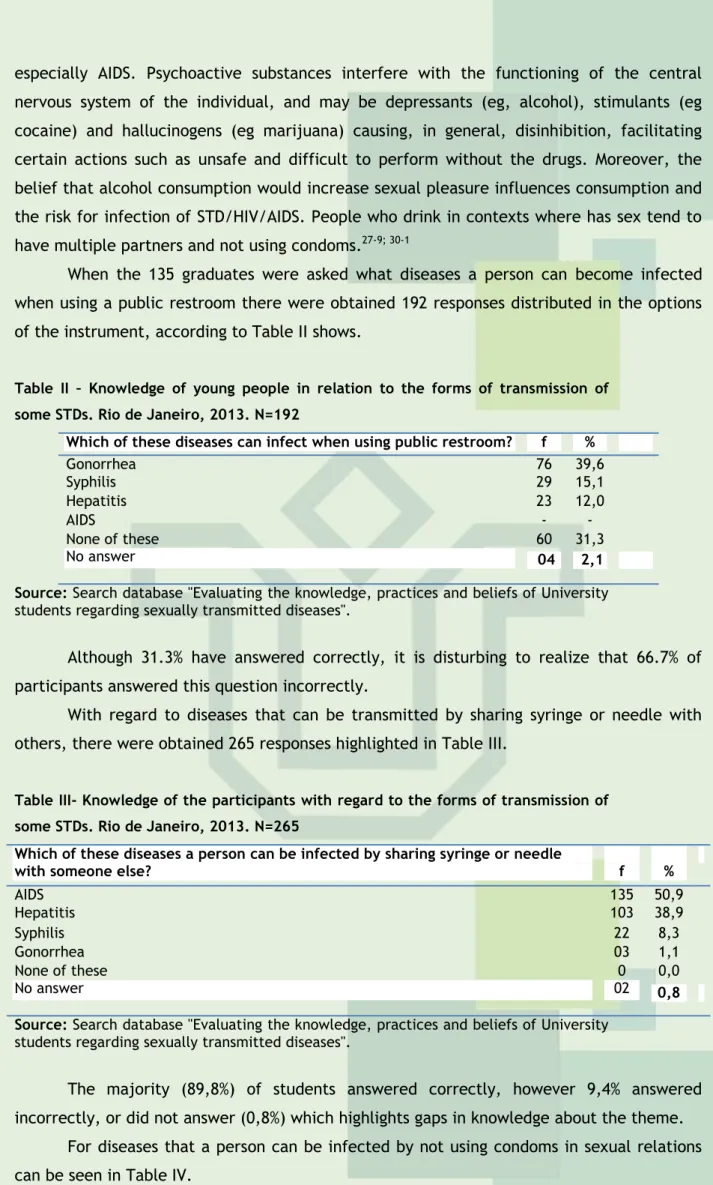
When the 135 graduates were asked what diseases a person can become infected when using a public restroom there were obtained 192 responses distributed in the options of the instrument, according to Table II shows.
Table II – Knowledge of young people in relation to the forms of transmission of some STDs. Rio de Janeiro, 2013. N=192
Which of these diseases can infect when using public restroom? f %
Gonorrhea 76 39,6 Syphilis 29 15,1 Hepatitis 23 12,0 AIDS - - None of these No answer 04 2,1 60 31,3
Source: Search database "Evaluating the knowledge, practices and beliefs of University
students regarding sexually transmitted diseases".
Although 31.3% have answered correctly, it is disturbing to realize that 66.7% of participants answered this question incorrectly.
With regard to diseases that can be transmitted by sharing syringe or needle with others, there were obtained 265 responses highlighted in Table III.
Table III- Knowledge of the participants with regard to the forms of transmission of some STDs. Rio de Janeiro, 2013. N=265
Which of these diseases a person can be infected by sharing syringe or needle
with someone else? f %
AIDS 135 50,9 Hepatitis 103 38,9 Syphilis 22 8,3 Gonorrhea 03 1,1 None of these No answer 02 0 0,8 0,0
Source: Search database "Evaluating the knowledge, practices and beliefs of University
students regarding sexually transmitted diseases".
The majority (89,8%) of students answered correctly, however 9,4% answered incorrectly, or did not answer (0,8%) which highlights gaps in knowledge about the theme.
For diseases that a person can be infected by not using condoms in sexual relations can be seen in Table IV.
Table IV- Knowledge of the participants in relation to the transmission of some STDs. Rio de Janeiro, 2013. N=463
J. res.: fundam. care. online 2015. jul./set. 7(3):3020-3036
3029
Which of these diseases a person may be infected when not using condoms insexual relations? f % AIDS Syphilis Gonorrhea Hepatitis None of these 132 126 113 91 01 28,5 27,2 24,4 19,7 0,2 Source: Search database "Evaluating the knowledge, practices and beliefs of University
students regarding sexually transmitted diseases".
Most of the respondents correctly pointed out the answers; however considering the options of the instrument and the number of survey participants (135), it can be noted that some students did not report all diseases, which would be correct. A student believes is not exposed to disease when not using condoms.
The students' knowledge about the healing of some STDs can be seen in Table V. Table V- Knowledge of graduates in relation to curing some STDs. Rio de Janeiro,
2013. N=238
For which of these diseases there is cure?
f % Gonorrhea 102 42,9 Syphilis 87 36,6 Hepatitis 40 16,8 AIDS - - None of these 07 2,9 No answer 02 0,8
Source: Search database "Evaluating the knowledge, practices and beliefs of University
students regarding sexually transmitted diseases".
According to Table V show students lack of the possibility of curing some diseases listed in the instrument. Note that seven participants answered this question incorrectly and two did not respond.
Studies20-7 state that the Brazilian population has high level of knowledge about the transmission and prevention of STD/AIDS, because it is not an unknown subject. According to Tables II, III, IV, V young people surveyed are unaware of the ways of transmission of some STDs. This finding is of concern considering that participants are graduates of nursing, belong to age group with the highest incidence of STD and 48,1% of respondents believe have all the necessary knowledge about STDs, according to the research.
The modes of transmission of HIV are the ways: sexual (main mode of transmission, and the male and female condoms the only proven effective barriers), blood (transfusion of blood and blood products and the use of injection drugs associated with sharing syringes and needles where the ways to prevent transmission are: quality control for blood banks and use of disposable syringes and needles) and vertical (the child is infected with HIV during pregnancy, childbirth or breastfeeding). In addition to these three most frequent forms, can also occur occupational transmission in healthcare workers by occupational accidents (unintentional injuries with sharp instruments contaminated with the blood of patients with HIV), in this case, the measures and prophylactic treatment should be started shortly after the accident).32
J. res.: fundam. care. online 2015. jul./set. 7(3):3020-3036
3030
The mode of transmission of gonorrhea, caused by the bacterium Neisseriagonorrhoeae, is sexually. Effective treatment stops transmitting. Syphilis is a systemic infectious disease, a chronic disease. The syphilis acquired form of transmission is sexual, caused by the bacteria called Treponema pallidum. It can also be transmitted via blood (placenta) at any stage of pregnancy or clinical stage of maternal disease, causing congenital syphilis. Transmissions by blood transfusion and accidental inoculation are rare. If not treated early it can compromise several organs such as eyes, skin, bone, heart, brain and nervous system. The correct treatment leads to healing.2,33
There are five types of viral hepatitis A, B, C, D and E, and the Hepatitis A and E are not sexually transmitted, but, by the fecal-oral route, for inter-human contact or through water and/or food contaminated by the virus. Hepatitis B and D are transmitted sexually (major route of transmission), vertical, by contact with blood parenteral (transfusion of blood and blood products, tattoos, piercings, needle and syringe sharing) or percutaneous (Client dental offices, podiatrists, manicures, etc.) and body fluids (semen, vaginal secretions, among others). Have Hepatitis C is transmitted by blood-borne mainly by the parenteral route, and sexual and vertical via offbeat.32-3
There are considered risk populations increased for Hepatitis D: individuals who received transfusions of blood and/or blood products before 1993; injecting drug users (cocaine, steroids, vitamin complexes), inhaled (cocaine) or smoking (crack); people who share or use unsterilized instruments for application of piercing, tattoo, objects for personal hygiene (toothbrushes, razors and shaving, etc.). Sexual transmission is rare (risk 2-6% for stable partners), but occurs mainly in people with multiple partners and sexual practices of risk (without condom use), and the coexistence of an STD, including HIV, constitutes an important facilitator of this transfer.32-3
There is no specific treatment for acute forms of viral hepatitis. The prognosis is very good for those caused by viruses A and E and the evolution results in complete recovery. In the case of acute hepatitis B in most cases be cured, as the specific defense cells of the organism to fight the virus, and can eliminate the disease. However, in some cases the hepatitis infection may progress to chronic infection when lasts for more than 6 months. In this context, the risk of seeing severe liver injury such as liver cirrhosis and liver failure, for example, is large and the chances of cure are minimal. Hepatitis C is curable only when the disease is detected early, but only if it is discovered at an advanced stage, which is when symptoms appear, the only chance of cure is to perform a liver transplant. The hepatitis D virus is a defective virus and the need for replication B Virus.32-3
Considering the forms of STD transmission described in the literature2; 32-3 and the options presented in the questionnaire diseases (AIDS, Syphilis, Hepatitis and Gonorrhea) notes that only 60 (31,3%) correctly answered by pointing that these diseases are not acquired when using public restrooms (Table II) . For diseases that can be transmitted by sharing needles and syringes (Table III) 10,2% of the students did not know the ways of transmission; in relation to condom use and STD (Table IV) 0,2% of respondents could not answer, which highlights gaps in knowledge about the prevention of sexually transmitted diseases in this group. This result demonstrates that there are many misconceptions and myths about this subject matter, which agrees with results of other studies.34
J. res.: fundam. care. online 2015. jul./set. 7(3):3020-3036
3031
With respect to diseases that are healing (Table V) the most marked by theparticipants were gonorrhea (42,9%) and syphilis (36,6%). According to authors2; 32-3, with the exception of HIV/AIDS, provided that there is compliance with treatment in a timely manner no cure for Syphilis, Hepatitis and Gonorrhea. They state that the informants demonstrated knowledge of the absence of a cure for HIV/AIDS, and that treatment is a form of control.32
The 135 students were asked about STDs and express their opinions about it. Regarding the statement "the risk of the AIDS virus can be reduced if a person has sex with only faithful, uninfected partner", 82 (60,7%) agreed, 50 (37,0%) disagreed and 03 (2,2%) did not answer.
Most participants agreed with the statement, showing that confidence in partner loyalty is a major factor and affects the behavior of young people for the prevention of STDs. Whereas the participants were mostly young women, and it is known the difficulty to request condom use, this thought can characterize a relationship of subordination and gender differences in relation to the adoption of safe sex.19; 21-3-8 Gender, therefore, is expressed in the organization's sexual and reproductive life plan, and these divisions the construction of affection, feeling, or how one conceives the relationship can be a predictor of preventive behaviors or not.21-3
For some authors26, despite the increasing youth access to information and the ever-changing cultural patterns, which directly affect behavioral changes, especially in sexual love life, the impact of early onset of sexual life and the inconsistent use of condoms have been concerns to society. Was observed in their studies that the greater adherence to condom use is related to marital status, where singles often use more often. However, even with the increase in membership, sexually active young population remains vulnerable, especially those who have a stable relationship and singles in casual or fix/casual relationships.
As for the statement "a person with healthy appearance can be infected by the AIDS virus", the majority (133/98,5%) of respondents agree, 01 (0,7%) disagree and 1 (0,7%) did not replied.
It may be noted that most of the participants agree that a healthy-looking person can be infected by the AIDS virus, demonstrating know that AIDS has no "face" and the people who acquire the virus can live well, contrary to early epidemic. With treatment (use of antiretrovirals) adequate and followed correctly enables the HIV-infected person to live with the virus for a long period without signs or symptoms. Thus, what was considered last a death sentence, currently, AIDS can be considered a chronic disease has no cure, but treatment has32. However, generates trivialization about the disease and many young people believe that no one currently dies of AIDS, contracting the virus is only taking the drug. Unaware that is a serious disease which may acquire opportunistic diseases for which treatment is lifelong and drugs cause side effects.32
To the statement "using condoms is the best way to prevent the AIDS virus is transmitted during sexual intercourse", 131 (97%) agreed, 3 (2,2%) did not agree and 1 (0,7%) did not could answer.
J. res.: fundam. care. online 2015. jul./set. 7(3):3020-3036
3032
Condom use was indicated by most young people as a means of prevention, whichapparently confirms knowledge about the best way to prevent STD when used properly. However, the fact of knowing is not associated with the use by many young people in their sexual practices, knowing the risks they are exposed .20-6; 34 In this study, the 89 students sexually active, 45 (50,6%) did not practice safely sex ever.
Studies19; 21-8 conducted with young people show that, among the reasons given for not preventing include: the absence of condoms at the time of the sexual act, confidence in the partner with whom you are relating, sensation of decreased pleasure with condom use, believe that it is unattainable and runs the risk of getting the AIDS virus, which make them vulnerable. Considering the results of the study, the misinformation of some participants, the vulnerability they are exposed because they are young graduates of nursing, one can infer the importance of investing in education for sexual health of this group.
Regarding the statement "if a teacher has AIDS, but is not sick, she can continue to teach in any school", 132 (97,8%) agreed, 2 (1,5%) did not agree and 1 (0,7%) could not answer.
Most of the students agreed that a teacher infected with the AIDS virus without signs and symptoms, can exercise her labor activities. These findings show that the control of the AIDS epidemic, the wide dissemination in relation to transmission and prevention has helped to reduce the stigma surrounding the disease so that people do not go to be isolated and become refusal target of society, of family, friends and lovers. In addition, the fact that the informants are nursing students with incomplete higher education, may influence the construction of a new vision for the seropositive.27
According to the Ministry of Health, there is no justification to restrict the interaction of HIV-infected individuals in their home environment, school, social or professional.32 Although HIV/AIDS is present in our society since the 80s, 2 (1,5%) said no agree with the statement indicating that there is still prejudice surrounding the disease. This fact contributes to many carriers of the virus omit your diagnosis and self-protection, for fear of suffering discrimination from society, of being judged, labeled as sick/AIDS, people do not want to approach them more, and sometimes end up not performing the treatment properly scared that someone might discover.35
Regarding the statement "the act of urinating immediately after sex helps in preventing STD", the majority (93/68,9%) disagreed, 19 (14,1%) agreed and 23 (17%) could not answer. In another statement "Bathing or washing the genitals with soap and water after sex helps in preventing STD", 87 (64,4%) disagreed and 22 (16,3%) agreed, 26 (19,2%) no answer.
In these findings it notes that the university does not hold sufficient clarification about the claims. Scholars11-9; 20-8; 36 and the Ministry of Health5,12,33 recommend that the safest method for the prevention of STDs is the continuous use of condoms (male or female), and reducing the number of sexual partners. The hygiene of postcoital external genitalia only helps in cleaning the area, but does not prevent the contamination. Can reduce the microorganisms and is recommended by experts for women who have a high incidence of UTI (urinary tract infection), associated with urination. The urination contributes to the elimination of micro-organisms that perhaps are the urethral canal.
J. res.: fundam. care. online 2015. jul./set. 7(3):3020-3036
3033
CONCLUSION
There are many myths regarding prevention of diseases, especially STDs, and the adoption of condoms in all sexual activity is the recommended and most secure resource.
As health professionals we work with the health education of young people. In this context it is known that the sexual practices involve preliminary, oral sex and penetration. In the sexual act beyond the emotion involved and the exchange of strokes between partners there is an exchange of fluids. It is appropriate, therefore, that the actions of education for the health of young people for prevention of STDs are stimulated, as frequent and continuous use of condoms, guide to seek health care services when they see signs and symptoms different from the usual for conducting screening tests, immunization among others. It is essential, therefore, that young people trust the health and education professionals and have them a benchmark for the clarification of doubts.
The study allows analyzing the knowledge of nursing students about STD, identifying the sociodemographic profile, the practices adopted for the prevention of STDs. The investigated population was predominantly young, single, female, no children, no employment, resided with parents, belonging to a family context with a lower level of education and practitioners of the Catholic and Evangelical religions.
Young people showed an unsatisfactory level of knowledge about the ways of transmission, prevention and cure of some STDs such as syphilis, gonorrhea and hepatitis, being more enlightened about HIV/AIDS. Further, they believe that the consumption of alcohol (or drugs) as a way to enhance sexual pleasure, influence in the absence of condom use during sex, and that the best form of prevention is the use of condoms (male or female) correctly, regardless of the sexual-affective relationship.
It was noted that, despite the increase in condom use among young people, the fact of recognizing the importance of this practice does not affect the continued adoption in all sexual contacts, as in the onset of sexual activity, sexual relations with steady partners and/or casual. Condom use can therefore be associated with differences in gender, age, type of emotional involvement, knowledge about contraceptive methods, feelings of omnipotence and sexual pleasure, which leads to situations and experiences with different levels of vulnerability, thus balancing the issue of prevention.
Note, also, that, although AIDS is a stigmatized disease by much of society, the findings show that for participants AIDS has no "face", and apparently healthy people may be infected, living with the virus, and performing their work activities.
The research identified knowledge gaps in the investigated group and clarifications need for young people that does not have enough information about sexually transmitted diseases and preventive measures. In this context it is essential that strategies are
J. res.: fundam. care. online 2015. jul./set. 7(3):3020-3036
3034
REFERENCES
implemented to clarify the young people about STDs, means of exposure and how to prevent it considering the vulnerability of this population group to infections.
Although it was not objective of the research conducting a comparative study analyzing the theoretical content taught in the course and the knowledge of young people about STDs, the results show that although they are students in the health area, too, have knowledge gaps in relation to the theme as other young people.
In this context, health professionals need to be prepared to offer comprehensive service quality and effectively exercise their role as educators (enabling health education, sexual and reproductive), and guidance about STDs, and ways of prevention. Being basic a humanized care, cozy and essential, based on professional ethics and building bond, creating opportunities for young people to express their doubts, feelings and consciousness may have to take responsibility for the care of their health.
The study was limited by the quantity of young investigated, being opportune to be replicated in other institutions. Considering that this theme encompasses a range of research possibilities that did not end in this research, it is believed that further studies should be performed to increase knowledge in the area.
1.Goldman L, Ausiello D. Cecil Tratado de medicina interna. 24 ed. Rio de Janeiro: Elsiever; 2014.
2. Ministério da Saúde (Br). Secretaria de Vigilância em Saúde. Programa Nacional de DST e Aids. Manual de controle das doenças sexualmente transmissíveis. Brasília (DF); 2006. [acesso 2015 fev 20]. Disponível em: http://bvsms.saude.gov.br/bvs/publicacoes/manual_controle_das_dst.pdf 3. Santos SMJ, Rodrigues JA, Carneiro WS. Doenças Sexualmente Transmissíveis: Conhecimento de Alunos do Ensino Médio. DST – j bras doenças sex transm. 2009 nov; 21(2):63-8.
4. Garbin CAS, Lima DP, Dossi AP, Arcieri RM, Rovida TAS. Percepção de adolescentes em relação às doenças sexualmente transmissíveis e métodos contraceptivos. DST – j bras doenças sex transm. 2010 nov;22(2):60-3.
5. Ministério da Saúde (Br). Secretaria de Vigilância em Saúde. Departamento de DST, Aids e Hepatites Virais. Boletim epidemiológico: Aids e DST. Brasília (DF); 2014. [acesso 2015 fev 20].
Disponível em:
http://www.aids.gov.br/sites/default/files/anexos/publicacao/2014/56677/boletim_2014_1_pd f_60254.pdf
6. Brasil. Lei n. 8.069, de 13 de Julho de 1990. Dispõe sobre o estatuto da criança e do adolescente e dá outras providências. Diário Oficial da União, Brasília (DF); 13 jul 1990.
7. Moreira JO, Rosário MAB, Santos AP. Juventude e adolescência: considerações preliminares. Psico. 2011 out-dez;42(4):457-64
J. res.: fundam. care. online 2015. jul./set. 7(3):3020-3036
3035
9. BrasiL. Lei n. 12.852, de 5 de agosto de 2013. Institui o estatuto da juventude e dispõe sobreos direitos dos jovens, os princípios e diretrizes das políticas públicas de juventude e o sistema nacional de juventude - sinajuve. Diário oficial da União, Brasília (DF); 5 ago 2013.
10. Fundo da população das nações unidas (UNFPA). Direito da população jovem: um marco para o desenvolvimento. 2ª ed. Brasília (DF): UNFPA – Fundo de População das Nações Unidas; 2010. 11. Brêtas JRS, Pereira SR. Projeto de extensão universitária: um espaço para formação profissional e promoção da saúde. Trab edc saúde. 2007 jul;5(2):367-80.
12. Governo do Estado do Rio de Janeiro. Secretaria de Estado de Saúde. Boletim epidemiológico DST/AIDS e Hepatite virais 2014. Brasília (DF); 2014. [acesso 2015 fev 20]. Disponível em: http://www.riocomsaude.rj.gov.br/Publico/MostrarArquivo.aspx?C=sF6igzRT%2Fp4%3D
13. Martins LBM, Costa-Paiva LHS, Osis MJD, Sousa MH, Tadini V. Fatores associados ao uso de preservativo masculino e ao conhecimento sobre DST/AIDS em adolescentes de escolas públicas e privadas do Município de São Paulo, Brasil. Cad saúde pública. 2006 fev;22(2):315-23.
14. Gil AC. Métodos e técnicas de pesquisa social. 6ª ed. São Paulo: Atlas; 2008.
15. Ministério da Saúde (BR). Conselho Nacional de Saúde. Resolução n. 196, de 10 de outubro de 1996. Diretrizes e normas regulamentadoras envolvendo seres humanos.
Brasília (DF): Ministério da Saúde; 1996.
16. Silva AP, Machado PRF, Martins ERC, Martins ERC, Costa CMA, Alves RN, Ramos RCA. Conhecimento e percepção de vulnerabilidades para o HIV/aids entre os acadêmicos de uma universidade privada. Rev enferm UERJ. 2013 dez;21:618-23.
17. Donati L, Alves MJ, Camelo SHH. O perfil do estudante ingressante no curso de graduação em enfermagem de uma faculdade privada. Rev enferm UERJ. 2010 jul-set;18(3):446-50.
18. Spindola T, Martins ERC, Francisco MTR. Enfermagem como opção: perfil de graduandos de duas instituições de ensino. Rev bras enferm. 2008 mar-abr;61(2):164-9.
19. Teixeira AMFB, Knauth DR, Fachel JMG, Lel AF. Adolescentes e uso de preservativos: as escolhas dos jovens de três capitais brasileiras na iniciação e na última relação sexual. Cad saúde pública. 2006 jul;22(7):1385-96.
20. Brêtas JRS, Ohara CVS, Jardim DP, Muroya RL. Conhecimento sobre DST/AIDS por estudantes adolescentes. Rev esc enferm USP. 2009 set;43(3):551-57.
21. Dias FLA, Silva, KL, Vieira NFC, Pinheiro PNC, Maia CC. Riscos e vulnerabilidades relacionados à sexualidade na adolescência. Rev enferm UERJ. 2010 jul-set;18(3):456-61.
22. Paiva V, Calazans G, Venturi G, Dias R. Idade e uso de preservativo na iniciação sexual de adolescentes brasileiros. Rev Saúde Pública. 2008 jun;42:45-53.
23. Abramovay M, Andrade ER, Esteves LCG. Juventudes: outros olhares sobre a diversidade. Brasília: Unesco; 2007.
24. Meneses FSM, Santos EC. Sexo e Religião: Um estudo entre jovens evangélicos sobre o sexo antes do casamento. Clínica & Cultura. 2013 jan-jun;2:82-94.
25. Silva CG, Santos AO, Licciardi DC, Paiva V. Religiosidade, juventude e sexualidade: entre a autonomia e a rigidez. Psicol estud. 2008 out-dez;13(4):683-92.
26. Pinho MD, Berquó E, Oliveira KA, Lopes F, Lima LCA, Pereira N. Juventudes, raça e vulnerabilidades. Revista Brasileira de Estudos de População. 2002 jul-dez;19(2):277-94.
27. Ministério da Saúde (BR). Secretaria de Vigilância em Saúde. Departamento de DST, Aids e Hepatites Virais. PCAP: Pesquisa de Conhecimentos, Atitudes e Práticas na População Brasileira,
J. res.: fundam. care. online 2015. jul./set. 7(3):3020-3036
3036
http://bvsms.saude.gov.br/bvs/publicacoes/pesquisa_conhecimentos_atitudes_praticas_populacao_brasileira.pdf
28. Oliveira DC, Pontes APM, Gomes AMT, Ribeiro MCM. Conhecimentos e práticas de adolescentes acerca das DST/HIV/AIDS em duas escolas públicas municipais do Rio de Janeiro. Esc Anna Nery. 2009 out-dez;13(4):833-41.
29. Machado AG, Moura ERF, Conceição MAV, Guedes TG. Uso de drogas e a saúde sexual de adolescentes. Rev enferm UERJ. 2010 abr-jun;18(2):284-90.
30. Bastos FI, Bertoni N, Hacker MA. Consumo de álcool e drogas: principais achados de pesquisa de âmbito nacional, Brasil 2005. Rev saúde pública. 2008 jun;42:109-17.
31. Cardoso L RD, Malbergier A, Figueiredo T B. O consumo de álcool como fator de risco para a transmissão das DSTs/HIV/Aids. Rev Psiq Clín. 2008;35:70-75.
32. Ministério da Saúde (BR). Secretaria de Atenção à Saúde. Departamento de Atenção Básica. HIV/AIDS, hepatites e outras DST. Cadernos de Atenção Básica, Brasília (DF), n.18; 2006. [acesso 2015 fev 20]. Disponível em: http://bvsms.saude.gov.br/bvs/publicacoes/abcad18.pdf
33. Ministério da Saúde (BR). Secretaria de Vigilância em Saúde. Departamento de Vigilância Epidemiológica. Doenças infecciosas e parasitárias : guia de bolso. 8ª Ed. Brasília(DF); 2010.
[acesso 2015 fev 20]. Disponível em:
http://bvsms.saude.gov.br/bvs/publicacoes/doencas_infecciosas_parasitaria_guia_bolso.pdf 34. Coelho RFSC, Souto TG, Soares LR, Lacerda LCM, Matão MEL. Conhecimentos e crenças sobre doenças sexualmente transmissíveis e hiv/aids entre adolescentes e jovens de escolas públicas estaduais da região oeste de Goiânia. Rev patol trop. 2011 jan-mar;40:56-66.
35. Zucchi EM, Barros CRS, Paiva VSF, França Junior I. Intervenções para reduzir o estigma da Aids no Brasil: uma revisão crítica. Temas psicol. 2013 dez;21(3):1067-87.
36. Brêtas JRS, Ohara CVS, Jardim DP, Muroya RL. Conhecimentos de adolescentes sobre Doenças Sexualmente Transmissíveis: subsídios para prevenção. Acta paul enferm. 2009 nov-dez;22(6):786-92.
Received on: 23/03/2014 Required for review: No Approved on: 14/04/2015 Published on: 01/07/2015
Contact of the corresponding author: Thelma Spíndola Endereço: Av. Vinte e Oito de Setembro, n.157 7.andar. Vila Isabel – Rio