ABSTRACT
Difference in the color stability of direct and
indirect resin composites
Yong-Keun LEE1, Bin YU2, Ho-Nam LIM3, Jin Ik LIM4
1- DDS, PhD, Senior Scientist, Institute for Clinical Performance of Biomaterials (ICPB), Seoul, Korea.
2- PhD, Assistant Professor, State Key Laboratory of Multiphase Complex Systems, Institute of Process Engineering, Chinese Academy of Sciences, Beijing, China. 3- DDS, PhD, Professor, Department of Dental Materials and Center for Dental Materials, Dental School, Kyung Hee University, Seoul, Korea.
4- PhD, Principal Researcher Department of Biomedical Engineering and Healthcare Industry Research Institute, College of Medicine, Kyung Hee University, Seoul, Korea.
Corresponding address: Dr. Yong-Keun Lee, DDS, PhD - Institute for Clinical Performance of Biomaterials - #202, Seokwang Art BD., 44-17, Jamwon-Dong, Seocho-Gu - Seoul, Korea - Phone/Fax: 82-2-6465-3470 - e-mail: [email protected]
! "
I
ndirect resin composites are generally regarded to have better color stability than direct resin composites since they possess higher conversion degree. Objective: The present ! "# NG: 16 shades; Sinfony: 26 shades) after thermocycling. Material and Methods: Resins were packed into a mold and light cured; post-curing was performed on indirect resins. Changes in color and color coordinates of 1-mm-thick specimens were determined after $%%% &'(* of 0.3 to 1.2 units for direct resins, and 0.3 to 1.5 units for indirect resins, which were +/&/&"4(* 7 8%&%$* (* 7 +%&%$&9 (* < shade group and shade designation based on three-way ANOVA (p<0.05). Conclusion: Direct and indirect resin composites showed similar color stability after 5,000 cycles of thermocycling; however, their changes in the color coordinates were different.Key words: Color. Resin composites. Dental resins. Dental materials. Dental prosthesis coloring.
INTRODUCTION
Resin-based indirect restorative systems were developed as possible alternatives to metallic or ceramic-based restoratives2. However, concerns
as to wear resistance, color stability, expansion/ contraction and sensitivity of these restorations still remain11.Apparent disadvantage of resin-based
systems stems from the fact that all resins are inherently more porous than ceramics; therefore, there is a greater propensity for these materials to stain or discolor over time and to accumulate plaque2,24. Clinical trial investigating the color
stability of indirect resin composites showed that (4!( 7( in color occurred24.
Color of resin composites is determined not only by more macroscopic phenomena such as matrix
7 7 relatively minor pigments additions and potentially
7 15. Color
changes of resin composites have been attributed to a wide variety of possible causes, such as chemical degradation, oxidation of the unreacted carbon double bonds, stain accumulation, dehydration, water sorption, leakage, poor bonding and surface roughness6,9,12-14,23,24. Color changes of resin
composites are due to exogenous or endogenous reasons6,9,24. Among them, more important for the
entire color stability of a light-curing material is the internal color changes, which mainly depend on the photoinitiator system as well as on the applied form and time-span of polymerization13,14. Color stability
E 74 matrix coupling system6.
There are arguments on the threshold color difference levels based on instrumental color measurements that can be visually perceivable or clinically acceptable8,25.However, the clinically
acceptable value for color difference in dental
JK/&/25. Based on
previous color stability studies of indirect resin composite, all tested indirect resin composite facing *7 +/&/ after UV-irradiation and storage in red wine17.
Q*( 8/&/ were detected in indirect resin composites after accelerated aging for 300 h7 and 383 h28. It has also
8/&/ was observed when indirect resin composite facings were aged in tea, coffee, mouthrinse and UV irradiation27. Therefore, it remains essential to
improve the color stability of these materials. Although there have been a number studies on the properties of indirect resin composites7,16,17,27,
there is limited information on the difference in the color stability based on contemporary direct and indirect resin composites by the type and also by the brand and shade group of indirect resin composites. Besides, indirect resin composites are generally regarded to have better color stability than direct resin composites since they possess higher conversion degree. The purpose of this study was to determine the color stability of one brand of varied shades of direct resin composites and two brands of indirect resin composite after 5,000 cycles of thermocycling. The null hypotheses assumed in the present study were that (1) the color stability of direct and indirect resin composites is be different; (2) the color change of resin composites after aging is not acceptable 8/&/W/ < by the brand, shade group and shade designation in each shade group.
MATERIAL AND METHODS
One brand of direct (Estelite Sigma: ES; Tokuyama, Tokyo, Japan) and two brands of indirect resin composites (BelleGlass NG: BG; Kerr, Orange, CA, USA; Sinfony: SF; 3M ESPE, St. Paul, MN, USA) were investigated (Figure 1). Since the designations for the shade groups in both of the indirect resin composites were similar (Enamel groups of BG material and SF material, Opaceous dentin group of BG material and Dentin group of SF material, and Translucent dentin group of BG material and Transparent opal group of SF material), three corresponding shade groups in two indirect resin composites were regarded as the
same shade group, namely EN, DT and TL.
Re s i n c o m p o s i t e s w e r e p a c k e d i n t o a <! and 1 mm in thickness) on a polyethylene terephthalate film. After packing the resin 7* specimen, and pressed with a 49 N load for 1 min to produce a uniform thickness. Specimens were light cured for 40 s in 3 overlapping areas from one side with a light-curing unit (Spectrum 800; Dentsply/Caulk, Milford, DE, USA) with an intensity setting of 400 mW/cm2. The output of the curing
light was checked with a radiometer (SDS; Kerr). After curing, specimens were removed from the 7*(&
Then, secondary curing was applied to the indirect resin composites. For BG material, specimens were post-cured in a proprietary curing chamber (BelleGlass HP Curing Unit; Kerr) following the manufacturer’s instructions. For SF material, specimens were post-cured in a proprietary curing chamber (Visio Beta Vario Light Curing Unit; 3M ESPE) following the manufacturer’s instructions. Five specimens were made for each shade. After curing, baseline color measurements were made after storage in 37ºC distilled water for 24 h. After then, thermocycling was performed for 5,000 cycles in distilled water at 5°C and 55°C with a dwell time of 15 s.
C o l o r w a s m e a s u r e d b e f o r e a n d a f t e r thermocycling according to the CIELAB color scale relative to the standard illuminant D65 over a white tile (CIE L*=94.3, a =-0.1 and b*=-0.4) on < `4{%%%|W GretagMacbeth, New Windsor, NY, USA) after blot & | ( ~ 7 * 100% UV included condition with the specular component excluded (SCE) geometry. The aperture size was 3 × 8 mm, and illuminating and viewing
7 *` 4geometry4.
Measurements were repeated 3 times for each specimen and averaged.
` * calculated as ¨( 222 ]1/2. Changes
in color coordinates [CIE L*a*
b* * (
thermocycling - the value before thermocycling’. CIE L* is a measure of the lightness, CIE a* is a measure of redness (positive direction) or greenness (negative direction) and CIE b* is a measure of yellowness (positive direction) or blueness (negative direction) of an object.
( composites were analyzed by t-tests.
( *E4*||* 7 factors of the brand (2 brands), shade group (3 groups) and shade designation in each shade group.
RESULTS
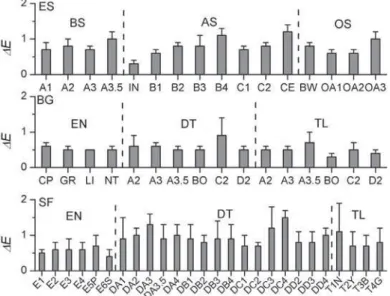
( 9 !4$& ( * range of 0.3 to 1.2 (mean: 0.8±0.2), 0.3 to 0.9
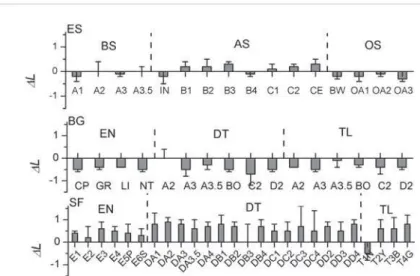
(mean: 0.5±0.2) and 0.4 to 1.5 units (mean: 0.8±0.4) for ES, BG and SF material, respectively 9 !&(* 4%&/ 0.3 (mean: 0.0±0.2), -0.7 to 0.0 (mean: -0.4±0.3) and -0.5 to 0.9 units (mean: 0.5±0.5) for ES, BG 9 (9 /&( were in the range of 0.0 to 0.6 (mean: 0.2±0.1), 0.0 to 0.1 (mean: 0.0±0.0) and 0.0 to 0.3 units (mean: 0.1±0.1) for ES, BG and SF material, ( 9 & ( * range of -1.2 to -0.4 (mean: -0.7±0.3), -0.6 to
Figure 1- Shades and shade groups of resin composites investigated
0.1 (mean: -0.2±0.3) and -0.9 to 0.2 units (mean: -0.3±0.3) for ES, BG and SF material, respectively (Figure 5).
( the type and shade group of resin composites are presented in Table 1. Based on t-test, indirect * 7 ( 8%&%$W *( * ( +%&%$& " ( * < %&%&+%&
(p<0.05).
For indirect resin composites, based on three-* || ( three-* < W ( * < W ( * < W( * < designation, but not by the brand (p=0.05).
Parameter Direct resin Indirect resin
BG SF
Difference* Statistical method
ES-BA (1),
ES-AS (2), ES-OS (3)
BG-EN (4), BG-DT (5), BG-TL (6)
SF-EN (7), SF-DT (8), SF-TL (9)
6,4,7,5,3,2,1,9 / 5,3,2,1,9,8
One-way ANOVA and Scheffe’s post hoc test
ES-BA (1), ES-AS (2), ES-OS (3)
EN (4), DT (5), TL (6) 4,6,3,2,1 / 6,3,2,1,5
ES (1) BG (2) SF (3) 2 / 1,3
ES (1) BGSF (2) 2,1 t-test
ES-BA (1),
ES-AS (2), ES-OS (3)
BG-EN (4), BG-DT (5), BG-TL (6)
SF-EN (7), SF-DT (8), SF-TL (9)
4,5,6,3,1 / 6,3,1,2 / 1,2,9 / 2,9,7 / 9,7,8
One-way ANOVA and Scheffe’s post hoc test
ES-BA (1), ES-AS (2), ES-OS (3)
EN (4), DT (5), TL (6) 3,1,6,4,2 / 1,6,4,2,5
ES (1) BG (2) SF (3) 2/1/3
ES (1) BGSF (2) 1/2 t-test
ES-BA (1),
ES-AS (2), ES-OS (3)
BG-EN (4), BG-DT (5), BG-TL (6)
SF-EN (7), SF-DT (8), SF-TL (9)
9,5,4,6,2,8 / 4,6,2,8,1 / 6,2,8,1,7 / 3
One-way ANOVA and Scheffe’s post hoc test
ES-BA (1), ES-AS (2), ES-OS (3)
EN (4), DT (5), TL (6) 6,5,4,2 / 5,4,2,1 / 3
ES (1) BG (2) SF (3) 2/3/1
ES (1) BGSF (2) 2/1 t-test
ES-BA (1),
ES-AS (2), ES-OS (3)
BG-EN (4), BG-DT (5), BG-TL (6)
SF-EN (7), SF-DT (8), SF-TL (9)
1,2,3,8 / 8,4,6,7,5 / 4,6,7,5,9
One-way ANOVA and Scheffe’s post hoc test
ES-BA (1), ES-AS (2), ES-OS (3)
EN (4), DT (5), TL (6) 1,2,3 / 3,5 / 5,4,6
ES (1) BG (2) SF (3) 1/3/2
ES (1) BGSF (2) 2/1 t-test
Table 1-
DISCUSSION
A wide array of color stability studies of indirect resin composites were focus on accelerated aging by using weathering devices7,26,28. In one study7,
after 300 h of accelerated aging, color changes of the indirect resin composites ranged between
%& /& tested demonstrated color stability at or below a quantitative level that would be considered clinically acceptable. In another study28, color
stability study of indirect resin composites after 383 h of accelerated aging, color changes were varied by the brand of material and the highest (*&/ & Figure 3- Changes in CIE L* after 5,000 cycles of thermocycling
Figure 4- Changes in CIE a* after 5,000 cycles of thermocycling
color changes of indirect resin composites were %&/ &$ $%%% cycles of thermocycling, which was generally lower than those of the previous studies. Although the manufacturer of the weathering device, used in the previously cited studies, estimates that 300 h of weathering is equivalent to one year of service, there was a concern whether an outdoor simulation such as weathering would translate to intraoral conditions7. Therefore, thermocycling instead of
a weathering device can be regarded as more clinically relevant, and direct comparisons between the accelerated aging results using weathering devices and thermocycling could not be made.
Based on a color stability study of 8 brand of direct resin composites (41 shades) after 5,000 cycles of thermocycling, color changes were in the && * * < by the brand of resin composite18. In the present
study, after 5,000 cycles of thermocycling, color changes of the indirect resin composites were %&/ &$ * < designation while the color changes of the direct * %&/&! units, which were generally smaller than those of the previous study18. Since the color change after
thermocycling may be correlated with degradation, stain accumulation, water sorption and others20,
difference in the color changes of resin composites ( < 7 &Q*( the results of the present study, it was a surprising * 7 ( since indirect resin composites are generally regarded to have better color stability than direct resin composites due to their higher conversion degree. As to the changes in color coordinates, (* 7 difference by the type of resin composites (Table 1), the values were very small. It was reported that a minimum CIELAB difference in color coordinates ` * to a human observer depending on the level of L* value, background color and lighting; differences in the 1 to 2 CIE units range would be noticeable
to most observers1&
( ! resin composites were in the range of -0.9 to 0.9 CIE units; therefore, the changes would not perceptible to a human observer in most cases, and clinical implication of these differences would be very limited.
(* <! of 3 factors (brand, shade group and shade designation). With the exception of a few shades,
nearly all the shades shifted to red (increased CIE a* values) and blue (decreased CIE b* values) after thermocycling (Figures 4 and 5). The increased < 4 accelerators in the resin composites; since all amines are known to form by-products during photoreaction, which tend to cause yellow to red-* < or heat3,18,20,21. The decreased yellowness could be
partly explained by the change of camphoroquinone content in the resin composites by the increased degree of polymerization. Camphoroquinone was used as a photoinitiator in most commercial resin composites, and the color of this initiator changed from yellow to almost colorless after polymerization reaction3,18,20,21. Since the conversion degree could
not reach 100% and the polymerization reaction * 7 extent of yellow color was remained, and the yellow color decreased due to the physicochemical reactions induced by the thermal changes during thermocycling process3,18,20,21. Furthermore, since
indirect resin composites possess higher conversion degree, they showed less changes in CIE a* and b* values as compared to direct resin composites in the present study. Almost all the shades of BG material became darker (decreased CIE L* values) after thermocycling; however, almost all the shades of SF material became brighter (increased CIE L* values) after thermocycling. Lightness change is an indicator for increased water sorption during thermocycling which influenced the refractive index of the resin matrix3,18,20,21. The reason for
the discrepancies of the shade dependent changes in CIE L*, a* and b* values might be due to the 7 of the resin composites, since both the matrix 7 roles in the color stability of resin composites9.
Since the direction and magnitude of the color changes differed for the thermally and photo-chemically induced color changes, it seemed that varied mechanisms were involved in color change of resin composites5. However, regardless of the
aging protocols, color shift, chroma change and hue difference were observed in resin composites10,19. It
was reported that lighter or less chromatic shades tended to show larger color changes than more chromatic or darker shades13,26, and higher CIE
a* and b*( ( <
color change after aging22. However, the results
shades showed similar color changes. These results < * < coordinate but also by the translucency. Further < change of resin composites should be performed.
Based on the results of the present study, the 7 color stability of direct and indirect resin composites would be different was partly rejected because the < ((W*(( * < & The second null hypothesis that the color change of resin composites after aging would be not be 8/&/ * color change of the three materials was in the range %&/ &$ & that the color changes after aging in indirect resin * < shade group and shade designation in each shade group was also rejected because color change was <&
CONCLUSIONS
Within the limitations of the present study, it may be concluded that changes in color and color coordinates of contemporary direct and indirect resin composites after 5,000 cycles of thermocycling were clinically acceptable. There * 7 color of direct and indirect resin composites after thermocycling. However, the changes in the lightness, red-green and yellow-blue coordinates * < & Therefore, these differences should be considered in clinical practice when repairing or restoring the same or neighboring teeth with different kinds of resin composites.
REFERENCES
1- Berger-Schunn A. Practical color measurement: a primer for the beginner, a reminder for the expert. New York: Wiley; 1994. 2- Blank JT. Scientifically based rationale and protocol for use of modern indirect resin inlays and onlays. J Esthet Dent. 2000;12:195-208.
3- Choi MS, Lee YK, Lim BS, Rhee SH, Yang HC, Lim YJ. Changes in color and translucency of porcelain repairing resin composites after thermocycling. J Biomed Mat Res B Appl Biomater. 2006;78:1-6. 4- CIE (Commission Internationale de l’Eclairage). Colorimetry - technical report. N.15. 3rd edition. Vienna: Bureau Central de
la CIE; 2004.
5- Cook WD, Chong MP. Color stability and visual perception of dimethacrylate based dental composite resins. Biomaterials. 1985;6:257-64.
6- Dietschi D, Campanile G, Holtz J, Meyer JM. Comparison of the color stability of ten new-generation composites: an in vitro study. Dent Mater. 1994;10:353-62.
7- Douglas RD. Color stability of new-generation indirect resins for prosthodontic application. J Prosthet Dent. 2000;83:166-70. 8- Douglas RD, Brewer JD. Acceptability of shade differences in metal ceramic crowns. J Prosthet Dent. 1998;79:254-60. 9- Faltermeier A, Behr M, Mussig D. In vitro color stability of aesthetic brackets. Eur J Orthod. 2007;29:354-8.
10- Fruits TJ, Duncanson MG Jr, Miranda FJ. In vitro weathering of selected direct esthetic restorative materials. Quintessence Int. 1997;28:409-14.
11- Giordano R 2nd. Fiber reinforced composite resin systems. Gen
Dent 2000;48:244-9.
!4 # |~ # |` & procedures on color stability of composite resins. J Appl Oral Sci. 2009;17:108-12.
13- Hosoya Y. Five-year color changes of light-cured resin composites: influence of light-curing times. Dent Mater. 1999;15:268-74.
4 ' ' 9 7 # & ` stability of resin matrix restorative materials as a function of the method of light activation. Eur J Oral Sci. 2004;112:280-5. 15- Johnston WM, Reisbick MH. Color and translucency changes during and after curing of esthetic restorative materials. Dent Mater. 1997;13:89-97.
16- Knobloch LA, Kerby RE, Clelland N, Lee J. Hardness and degree of conversion of posterior packable composites. Oper Dent. 2004;29:642-9.
17- Kolbeck C, Rosentritt M, Lang R, Handel G. Discoloration of facing and restorative composites by UV-irradiation and staining food. Dent Mater. 2006;22:63-8.
18- Lee SH, Lee YK. Effect of thermocycling on optical parameters of resin composites by the brand and shade. Am J Dent. 2008;21:361-7.
19- Lee YK, El Zawahry M, Noaman KM, Powers JM. Effect of mouthwash and accelerated aging on the color stability of esthetic restorative materials. Am J Dent. 2000;13:159-61.
20- Lee YK, Lim BS, Rhee SH, Yang HC, Powers JM. Changes of 47 curing and thermocycling. J Biomed Mat Res B Appl Biomater. 2004;71:16-21.
21- Lee YK, Lim BS, Rhee SH, Yang HC, Powers JM. Color and translucency of A2 shade resin composites after curing, polishing and thermocycling. Oper Dent. 2005;30:436-42.
22- Lee YK, Powers JM. Color and optical properties of resin-based composites for bleached teeth after polymerization and accelerated aging. Am J Dent. 2001;14:349-54.
23- Powers JM, Dennison JB, Koran A. Color stability of restorative resins under accelerated aging. J Dent Res. 1978;57:964-70. 24- Rosentritt M, Esch J, Behr M, Leibrock A, Handel G. In vivo
color stability of resin composite veneers and acrylic resin teeth in removable partial dentures. Quintessence Int. 1998;29:517-22. 25- Ruyter IE, Nilner K, Moller B. Color stability of dental composite resin materials for crown and bridge veneers. Dent Mater. 1987;3:246-51.
26- Schulze KA, Tinschert J, Marshall SJ, Marshall GW. Spectroscopic analysis of polymer-ceramic dental composites after accelerated aging. Int J Prosthodont. 2003;16:355-61.