*Correspondence: Lakshmi, P. K. Department of Pharmaceutics, G. Pulla Reddy College of Pharmacy, Osmania University, Hyderabad – 500028 - Andhra Pradesh, India. E-mail: [email protected]
A
vol. 48, n. 3, jul./sep., 2012
Overview of P-glycoprotein inhibitors: a rational outlook
Kale Mohana Raghava Srivalli, P. K. Lakshmi
*Department of Pharmaceutics, G. Pulla Reddy College of Pharmacy, Osmania University, India
P-glycoprotein (P-gp), a transmembrane permeability glycoprotein, is a member of ATP binding cassette (ABC) super family that functions speciically as a carrier mediated primary active eflux transporter. It is widely distributed throughout the body and has a diverse range of substrates. Several vital therapeutic agents are substrates to P-gp and their bioavailability is lowered or a resistance is induced because of the protein eflux. Hence P-gp inhibitors were explored for overcoming multidrug resistance and poor bioavailability problems of the therapeutic P-gp substrates. The sensitivity of drug moieties to P-gp and vice versa can be established by various experimental models in silico, in vitro and in vivo. Ever since the discovery of P-gp, the research plethora identiied several chemical structures as P-gp inhibitors. The aim of this review was to emphasize on the discovery and development of newer, inert, non-toxic, and more eficient, speciically targeting P-gp inhibitors, like those among the natural herb extracts, pharmaceutical excipients and formulations, and other rational drug moieties. The applications of cellular and molecular biology knowledge, in silico designed structural databases, molecular modeling studies and quantitative structure-activity relationship (QSAR) analyses in the development of novel rational P-gp inhibitors have also been mentioned.
Uniterms: P-glycoprotein/inhibitors. Multidrug resistence. Cluster of differentiation 243. Sphingolipids. Competitive inhibitors.
Glicoproteína-p (P-gp), uma glicoproteína de transmembrana permeável, é um membro da superfamília (ABC) de cassete de gene de ligação de ATP que funciona especiicamente como um carreador mediado pelo transportador de eluxo ativo primário. É amplamente distribuído por todo o corpo e apresenta uma gama diversiicada de substratos. Diversos agentes terapêuticos vitais são substratos para P-gp e sua biodisponibilidade é reduzida ou a resistência é induzida devido ao eluxo de proteínas. Portanto, os inibidores da P-gp foram explorados para a superação da resistência a múltiplas drogas e problemas de biodisponibilidade deiciente dos substratos terapêuticos da P-gp. A sensibilidade das moléculas da droga à P-gp e vice-versa, pode ser estabelecida por vários modelos experimentais in silico, in vitro e in vivo. Desde a descoberta da P-gp, diversas pesquisas identiicaram várias estruturas químicas como inibidores da P-gp. O objetivo deste presente estudo foi o de enfatizar a descoberta e desenvolvimento de inibidores mais novos, inertes, atóxicos e mais eicazes, visando especiicamente os da P-gp, como aqueles entre os extratos vegetais, excipientes e formulações farmacêuticas, e outras moléculas racionais de droga. As aplicações do conhecimento de biologia celular e molecular, bancos de dados estruturais in silico, estudos de modelagem molecular e análises da relação quantitativa estrutura-atividade (QSAR) no desenvolvimento de novos inibidores racionais da P-gp também foram mencionados.
Unitermos: Glicoproteína-p. Resistência a múltiplas drogas. Cluster de diferenciação 243. Esingolipídeos. Inibidores competitivos.
INTRODUCTION
P-glycoprotein (P-gp), the permeability glycoprotein
or plasma glycoprotein is an active, eflux, membrane bound
transport protein pump discovered in 1976 (Juliano, Ling, 1976). P-gp is a member of ATP binding cassette (ABC) super family, multidrug resistance (MDR)/transporter associated with antigen processing (TAP), sub-family B, and member 1, abbreviated as ABCB1. It is also called as MDR1 and PGY1. It has been recently designated as
involves the protein binding to the ATP and requires energy derived by the hydrolysis of ATP to ADP in the presence of adenosine-triphosphatase enzyme (ATPase) (Shekfeh,
2009). P-gp, which was irst identiied in cancer cells, is en -coded by MDR1/ABCB1 gene in humans. The gene shows
an exclusive over expression in cancer cells. The correlation
between the up regulation of MDR1 gene mRNA
transcrip-tion and the over expression of the P-gp transport system,
leading to multidrug resistance (MDR) phenotype, during the drug therapy for cancer and several microbial infections has been well established. Repetitive treatment with P-gp
substrates may also enhance the P-gp expression (Krishna,
Mayer, 2000). A further support to the correlation between
the P-gp over expression and development of MDR is given
by the role of P-gp in the metabolism of endogenous sphin-golipids. The sphingolipids and their metabolites were
re-ported to confer MDR in concert with the eflux transporters
(Dijkhuis et al., 2003). P-gp was found to be present on the surface of biliary canalicular hepatocytes, luminal surface of columnar epithelial cells of the lower gastrointestinal tract (GIT) including liver, pancreas, small and large intestines,
jejunum and colon, apical surface of proximal convoluted
tubular cells of kidney, capillary endothelial cells of blood-brain barrier (BBB), apical membrane of the placental fetal-membrane barrier function and in various other tissues like lungs, heart, adrenals, prostrate, skin, spleen and skeletal muscle (Thiebut et al., 1987). On account of its distribution, P-gp can be viewed as a unique defensive barrier network
against the entry of xenobiotics into the body. This eflux
carrier decreases the bioavailability of administered drugs
by preventing their suficient accumulation intracellularly. Ultimately, the eficacy of drugs is lowered. It also alters
the pharmacokinetics and pharmacodynamics of its sub-strates by dictating their ADMET (absorption, distribution, metabolism, elimination and toxicity) characteristics (Lin,
2003). The optimal P-gp expression is always appreciated for its protective function. But, P-gp over expression leads to MDR while its low expression leads to toxic reactions.
This review presents a brief note on the mechanism
and kinetics of P-gp eflux and discusses about various P-gp inhibitors identiied under different categories of
chemical, natural, pharmaceutical and biochemical class-es. Different possible strategies that can be developed to circumvent the protein action were mentioned. Further, the interaction between the P-gp substrates/inhibitors/induc-ers and P-gp has been well differentiated and elucidated.
P-GLYCOPROTEIN SUBSTRATES
P-gp transporter has a diverse array of substrates which vary not only in size and structure but also in
several chemical properties. Since the primary criterion
subjecting a substrate to P-gp eflux is its interaction with
the bilayer lipid membrane, a wide range of cationic, li-pophilic and planar drugs become the protein substrates
inspite of their structural dissimilarity. This explains the vast spread structural speciicity or in the practical sense, the non-speciic nature of P-gp (Higgins, Gottesman,
1992). However, there is one unifying structural feature that is commonly shared among all the substrates of P-gp, and that is they all possess spatially separated hydrophilic and hydrophobic moieties. The P-gp substrates
recon-stitute most of the clinically eficient agents. Anticancer
drugs, various pharmacotherapeutic agents that act on central nervous system, cardio vascular system and
an-timicrobials are substrates to this eflux protein (Hunter,
Hirst, 1997; Schinkel, 1999).
MECHANISM AND KINETICS OF
P-GLYCO-PROTEIN EFFLUX
The eflux action of the protein follows a carrier me -diated primary active transport mechanism. In this process,
the protein pump export needs direct ATP requirement
and the energy released from the ATP hydrolysis gives
the driving force for extrusion process. The eflux takes place unidirectionally (out of the cells into the extracellular
space) and transfers only one molecule at a time. Thus, P-gp is a uniporter carrier protein.
Figure 1 explains the mechanism of action of the
competitive and non-competitive (non-transported)
inhibi-tors apart from the P-gp eflux kinetics. While a P-gp sub -strate binds to protein’s transport site and gets translocated by the protein, competitive inhibitors compete with the
substrate drugs for extrusion and occupy all the available
protein transport sites leaving no space for the P-gp and substrate interaction.
Non-competitive inhibitors neither bind to protein’s
transport site nor are translocated by the protein eflux
and hence are as well called as non-transported inhibitors.
They non-competitively inhibit the protein eflux by bind -ing to an allosteric modulatory site.
Since the number of protein carriers is limited, the
transport system is capacity limited. The eflux kinetics is described by the equation (1), as mixed-order kinetics
or Michaelis Menten kinetics or saturation or non-linear
dose dependent kinetics (Jang, Wientjes, Jessie, 2001;
Varma et al., 2003).
Jpgp = Vmax. C / Km+C Equation (1)
Jpgp = P-gp eflux
Vmax = maximum velocity of P-gp eflux per unit surface area
C = substrate concentration
Km = afinity constant or michaelis menten constant (dis
-sociation constant for P-gp mediated eflux).
At low drug concentrations, where Km >> C,
The eflux follows irst order kinetics. The eflux
rate is proportional to the drug concentration and increases linearly with the drug concentration.
At high drug concentrations, where Km << C,
The protein carriers get saturated and the eflux oc
-curs at constant rate. In other words, the eflux rate process
approaches an asymptote and becomes independent of
drug concentration. The eflux follows zero order kinetics
in this case.
In cases where Km = C, the efflux rate is half its
maximum velocity and assumes mixed order (exhibiting zero and irst order kinetics together) kinetics.
Characterization of the interaction of certain compounds with P-Glycoprotein
It is the nature of interaction of a compound with the
protein that identiies and establishes it as a P-gp inhibitor
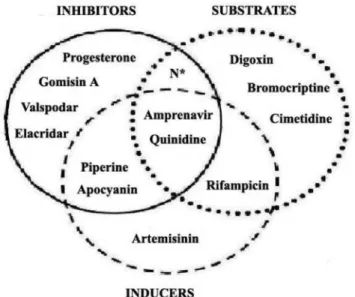
or substrate or inducer. From the Venn diagram (Figure 2) describing the interaction of different compounds with P-gp as inhibitors/substrates/inducers, it is evident that
such a classiication is not very straight forward. Though
an effort has been made in this review to provide a vivid
proile picture of those P-gp interacting compounds dif -ferentiated in the Venn diagram, the characterization of rest other modulators still remains ambiguous. Compounds like progesterone, gomisin A, valspodar, elacridar were
identiied as pure inhibitors since they are not P-gp sub -strates. They neither bind to protein’s transport site nor are
translocated by the protein eflux. They non-competitively inhibit the protein eflux by binding to an allosteric modu -latory site (Haslam et al., 2008). Cis-lupenthixol, a typi -cal/classical antipsychotic is another P-gp reverser
iden-tiied as a non-transported inhibitor, binding to protein’s
allosteric binding site (Maki, Hafkemeyer, Dey, 2003). However, there are “n” numbers of P-gp inhibitors which are its substrates too. They are all competitive inhibitors
as they compete with the substrate drugs for extrusion
and thus favour intracellular accumulation of those
sub-strates. Propafenone and its major metabolites 5-hydroxy
propafenone and N-desalkyl propafenone are all P-gp inhibitors but propafenone and N-desalkyl propafenone
are not P-gp substrates while 5-hydroxy propafenone is
translocated across the cell membrane by human P-gp.
Thus, 5-hydroxy propafenone can be distinguished as a
competitive P-gp inhibitor while the other two compounds act non-competitively (Bachmakov et al., 2005).
Quini-dine and amprenavir exhibit an uncertain combination
of three distinct interactions with P-gp. They act as P-gp substrates, inhibitors and also as P-gp inducers suggesting an indiscriminate characterization. Artemisinin, on the other hand, is a transported P-gp inducer. It is a non-substrate to P-gp and is more or less alike non-competitive
inhibitor in one point that it exerts its action without being
FIGURE 1 – P-gp eflux kinetics obtained by plotting a graph
between substrate concentration (X-axis) and P-gp eflux rate (Y-axis). The mechanism of action of the competitive and
non-competitive inhibitors has also been represented.
subject to P-gp eflux. The most conlicting categoriza -tion is that of piperine and apocyanin. Andrographolide, berberin, glycyrrhizin and magniferin are the other natural
constituents, which are also classiied under this category. The explanation for their characterization as both induc -ers and inhibitors is given by their “biphasic protein
modulation” by which they stimulate the protein eflux at
lower concentrations and inhibit the same at their higher concentrations (Najar et al., 2010). Rifampicin is
classi-ied as an inducing substrate of P-gp as it is transported
by the protein and as well has an up regulating effect on
P-gp expression. Digoxin, bromocriptine and cimetidine
are mere P-gp substrates with neither an inhibitory nor an inductive effect on protein function (Vautier et al., 2006).
Classification of P-Glycoprotein inhibitors: the past & the present perspective
The candidates which block or bypass the P-gp
efflux are called as P-gp inhibitors/P-gp modulators/
chemosensitizers/reversal agents. Co-/concurrent adminis-tration of the P-gp substrate-therapeutics with these P-gp
inhibitors can prevent/overcome the substrate expulsion by P-gp and render the intended therapeutic beneits of the
substrate drugs. Though several P-gp inhibitors were
ear-lier identiied among the available drugs, their toxicity and drug interaction proiles drove the researchers to discover
more rational inhibitors. As of now, the inhibitors were
identiied among various natural products, pharmaceutical inert excipients and formulations. Prodrug strategy is also being applied to escape P-gp eflux. A few novel antitumor drugs, synthetic peptides and P-gp expression suppressors
are under development to circumvent the protein action. The cellular and molecular biologists are now focusing on
designing inhibitors based on the information extracted
about the protein’s vital structural organization. Certain unique developmental strategies which on implementation could hopefully achieve rational prototype molecules have also been discussed in this review. Table I enumerates the possible rational approaches to strategically develop P-gp inhibitors (Balayssaca et al., 2005; Bansal et al., 2009a; Yuan et al., 2008; Bansal et al., 2009b).
Small molecule inhibitors (SMIs)
The first, second and third generation inhibitors, developed based on screening among the available com-pounds, parent molecule optimizations and chemical syntheses by combinational chemistry approaches, respec-tively, are together called as SMIs. All these compounds, though grouped under the same heading, are structurally
unrelated and do not share any properties in common,
except that they are P-gp inhibitors.
First generation inhibitors
This class of inhibitors embodies those pharmaco-logical agents which were primarily developed for other indications but later observed to be P-gp substrates cum inhibitors. Verapamil, an antihypertensive calcium channel
blocker, triluoperazine, a calmodulin antagonist, cyclo -sporine, an immunosuppressant, other antihypertensives such as quinidine and reserpine, yohimbine, antiestrogenic
tamoxifen and toremifene, and antineoplastic vincristine,
all fall under this category. Since most of these compounds were P-gp substrates themselves, they interacted with the protein, competed with the other substrates and acted
as competitive inhibitors. Since all the irst generation inhibitors have been identiied this way, they obviously
were non-selective and less potent. Their P-gp inhibitory
concentrations reached high toxic levels due to which
many of these inhibitors failed in clinical trials (Dantzig, Alwis, Burgess, 2003).
Second generation inhibitors
The irst generation inhibitors were modiied struc -turally viz. their chirality was altered to achieve a better
or a null innate pharmacological proile so as to largely reduce the toxicity of the parent compounds. Dexvera -pamil, the R-isomer of verapamil without any cardiac activity, PSC 833 (valspodar), a cyclosporine A analogue lacking immunosuppressive character, MS-209 and
sev-eral other irst generation drug derivatives or analogues
fall under this category. These resultant modulators still remained P-gp substrates themselves and showed low
protein afinity. As such, their P-gp inhibitory dose was
far beyond the tolerable dose levels. Due to the chiral optimization, these second generation chemosensitizers ended up as inevitable cytochrome P450 3A4 (CYP450 3A4) substrates for metabolism, which made them com-pete with the concurrently administered anticancer P-gp substrate drugs whose metabolism was also affected by
the same system. This caused signiicant pharmacokinetic
alterations that unpredictably affected the metabolic and clearance mechanisms of the substrate drugs which in turn
brought about dificulties in adjusting the chemotherapy
doses in patients. All these problems left this class of in-hibitors deserted (Thomas, Coley, 2003; Darby, Callaghan, McMahon, 2011).
Third generation inhibitors
tech-TABLE I - Possible approaches to strategically achieve P-gp inhibition
INHIBITION STRATEGY EXAMPLES OF INHIBITOR COMPOUNDS REFERENCES
Small molecule inhibitors (SMIs)
Screening among the available compounds (irst generation inhibitors)
Balayssaca et al., 2005
Antiarrhythmics: Amiodarone, quinidine, verapamil, felodipine, niidipine,
dilitiazem.
Anticancer drugs: Actinomycin D, doxorubicin, vinblastine.
Antibiotics: Clarithromycin, erythromycin.
Antidepressants: Paroxetine, sertraline, desmethylsertraline.
Proton pump inhibitors: Esomeprazole, lansoprazole, omeprazole, pantoprazole.
Others: Cyclosporine A, colchicine, fenofibrate, propafenone,
reserpine, trifluoperazine, progesterone, ritonavir, chlorpromazine, lufenazine, tamoxifen.
Parent molecule optimization (second generation inhibitors)
Dexverapamil, gallopamil, PSC 833 (valspodar), MS-209, reversin 121, reversin 125.
Bansal et al., 2009b
Chemical synthesis by combinational chemistry strategies (third generation inhibitors)
XR 9576 (tariquidar), VX-710 (biricodar), GF 120918 (elacridar), OC 144-093, LY335979 (zosuquidar), mitotane (NSC-38721), annamycin.
Bansal et al., 2009b
Others
Natural product screening Herbs, fruits and herbal constituents. Bansal et al., 2009b
Use of pharmaceutical excipients C8/C10 glycerol & polyethylene glycol (PEG) esters, sucrose esters, polysorbates, tocopherol esters, polymers, amphiphilic diblock copolymers.
Bansal et al., 2009a
Pharmaceutical formulation approaches Bansal et al., 2009a
Polymer formulations: Conventional tablets, micellar systems, hydrogels, microgels, nanogels, microparticles, microspheres and nanoparticles.
Lipid formulations: Implantable films, lipid micelle systems, liposomes, solid lipid nanoparticles (SLN), lipid nanocapsules (LNC), composite solid lipid nanoparticle-microsphere systems, emulsifying wax nanoparticles, polymer-lipid hybrid nanoparticles (PLN), micro emulsions and self-microemulsifying drug delivery systems (SMEDDS).
Novel antitumor drugs KP772 (FFC24), 7-benzyl-4-methyl-5-[(2-substituted
phenyl) ethyl]-7H-pyrrolo [2, 3-d]-pyrimidin-2-amines, imitinab and geitinab.
Yuan et al., 2008
Rational drug design strategy
Prodrug design First generation polyamidoamine (PAMAM) dendrimer
prodrug derivatives, val-quinidine.
Yuan et al., 2008
De-novo design To develop competitively inhibiting modulators that can
target the protein’s SBSs, NBDs and residues involved in the protein-pump communication pathways (L339, N508, G346, and I306).
Yuan et al., 2008
Synthetic peptides Transmembrane proteins to disrupt the eflux protein TMDs
assembly.
Yuan et al., 2008
Suppression of P-gp expression Trythanthrin, trifluoperazine, short interfering double stranded RNA, elevated levels of reactive oxygen species (ROS), oxalyl bis (N-phenyl)hydroxomic acid (OBPHA) and copper N-(2-hydroxy acetophenone) glycinate (CuNG) and dopamine and cAMP regulated phosphoprotein (DARPP-32).
niques (HTS) and combinational chemistry methods gave 10-fold more potent compounds when compared to the
irst and second generations. Thus evolved third genera
-tion inhibitors were highly speciic, lacked interac-tions
with CYP450 3A4 system and required no alterations in the chemotherapy doses. XR 9576 (tariquidar, an anthra-nilamide derivative), a non-transported P-gp inhibitor, developed in this pace was stated to inhibit ATPase by interacting with a distinct modulatory binding site on the protein. It was believed to be the most promising but still
suspended due to unfavorable toxicity reports in phase
III trials in lung carcinoma cases. Other compounds discovered by this strategy include VX-710 (biricodar, a cyclopropyldibenzosuberane modulator, developed by Eli
Lilly Inc.), GF 120918 (elacridar, an acridonecarboxamide derivative, developed by GlaxoSmithKline), OC 144-093,
mitotane (NSC-38721), annamycin, R101933, ONT-093 and LY335979 (zosuquidar) (Ozben, 2006).
Upcoming P-glycoprotein inhibitors among the natural product extracts
Discoveries in this natural resources area are gaining
increasing interest since they are safe and non-toxic. The grape fruit interactions with several drugs gave the irst
evidence of herbal applications in P-gp inhibition (Bailey et al., 1991). Several herbal constituents, as listed in Table II (Bansal et al., 2009b; Yuan et al., 2008) were
identi-ied as potent P-gp inhibitors. Though the studies already
proved most of them effective in vitro, it takes still long time to evaluate their suitability for clinical purposes.
Apart from those tabulated inhibitors, ginsenoside Rg3, a red ginseng saponin was reported as a competitive P-gp inhibitor (Kim et al., 2003). Antineoplastic lamellarin D, a novel pro-apoptotic alkaloid agent of marine origin
exhibited insensitivity to P-gp mediated drug eflux (Van -huyse et al., 2005). Gomisin A, a dibenzocyclooctadiene
TABLE II - List of natural constituents identiied as P-gp inhibitors
CATEGORY EXAMPLES REFERENCES
Herbs Garlic, green tea, marine resources. Foster et al., 2001; Jodoin, Demeule, Beliveau, 2002
Peptides Kendarimide A, a novel peptide from a marine sponge of Haliclona oculata.
Aoki et al., 2004
Fruits Citrus fruit, grape, orange. Ikegawa et al., 2000; Takanaga et al., 1998
Herbal constituents
Glycosides Iridoid and polyethanoid lavonoids,
picroside II, acteoside.
Najar et al., 2010
Curcumin Curcuma longa Anuchapreeda et al., 2002
Ginsenosides Ginseng (Panax ginseng) Bansal et al., 2009b
Piperine Piper nigrum. Bhardwaj et al., 2002
Hyperforin and Hypericin St. John’s wort. Mathijssen et al., 2002
Bitter melon leaf extracts Momordica charantia. Limtrakul, Khantamat, Pintha, 2004
Flavonoids Diosmin from citrus fruit, quercetin from
tea, ginkgo and St. John’s wort, naringin, biochanin, silymarin.
Choi, Jo, Kim, 2004; Choi, Shin, 2005; Zhang, Morris, 2003
Terpenoids
Monoterpenoid (R)-(+)-citronellal, (S)-(-)-betacitronellol and others from Zanthoxyli fructus extracts.
Yoshida et al., 2006
Sesquiterpenes Extracts from Zinowiewia costaricensis. Munoz-martinez et al., 2005
Diterpenoids Lathyrane from the seeds of caper spurge (Euphorbia lathyris).
Jiao et al., 2009
Triterpenoids Derived from the red sea sponge,
Siphonachalina siphonella.
Jain et al., 2007
TABLE III - List of pharmaceutical excipients used as P-gp inhibitors and their P-gp inhibitory mechanisms
CATEGORY EXCIPIENT EXAMPLES MECHANISM OF ACTION
Surfactants and solubilizing solvents
C8/C10 Glycerol & PEG esters:
Cremophor, Solutol HS-15, Labrasol, Softigen 767, Aconnon E.
Sucrose esters:
Sucrose monolaurate, sucrose monooleate
Polysorbates:
Tween 80, Tween 20
Tocopherol esters:
Tocopheryl-PEG-1000-succinate (TPGS)
The plasma membrane shows the lipid tails
extending as perturbations. These excipient
molecules insert themselves between those tails of
the lipid bilayer and luidize the membrane. They
may also interact with the bilayer’s polar heads and modify the hydrogen bond or ionic bond forces which may add onto their inhibitory action (Lo, 2003).
Polymers Pluronic block copolymers:
Poly-(ethylene-oxide) /Poly-(propylene-oxide) block copolymers (PEO-PPO)
Pluronics inhibit the enzyme ATPase which causes ATP depletion. Thus they prevent the sensitization and desensitization of protein which are the basic requirements for the working of the protein pump (Batrakova, Kabanov, 2008).
Lipid excipients Peceol and Gelucire When applied onto CaCo-2 cell culture system,
these excipients reduced the protein expression
which can be attributed to their capability of down
regulating the MDR1 gene expression
(Sachs-barrable et al., 2007).
Thiomers Chitosan-thiobutylamidine (chito-TBA) These are polymers with thiol groups. They interact with the cysteine groups located in the P-gp
transmembrane region and thus inhibit its efflux transport function (Werle, Hoffer, 2006).
Others They directly affect the P-gp - substrate binding by inhibiting the protein kinase activity. They decrease the P-gp phosphorylation and thus modulate P-gp
mediated eflux (Cornaire et al., 2004).
compound isolated from Schisandra chinensis, showed an evidence of altering P-gp substrate interaction non-competitively and thereby reversing MDR. It is not a P-gp substrate by itself and can bind simultaneously to both P-gp and substrate. It is also known to inhibit the basal
P-gp associated ATPase activity (Wan et al., 2006). CBT-1 is another novel bisbenzylisoquinoline plant alkaloid in development as a P-gp inhibitor (Robey et al., 2008).
The epoxide moiety of laulimalide, a macrolide obtained
from Hyatella species is a microtubule stabilizing agent which has been established as a P-gp inhibitor as well. Its antitumor activity was found to be a 100-fold more potent
than that of taxol in MDR cell lines (Corley et al., 1988).
Pharmaceutical excipients
An ideal P-gp inhibitor is the one that is non-toxic
with no pharmacological action of its own. Several
phar-maceutical inert additives and functional excipients were
investigated to study their P-gp inhibitory activity and to evaluate their role in enhancing the drug permeability
across the lipid membrane. P-gp activity is modulated by the physical state of lipid bilayer where the protein actu-ally resides. Several pharmaceutical agents of natural or synthetic origin that belong to various categories like the
cosolvents, surfactants, polymer and lipid excipients were identiied to have the P-gp inhibitory action (Buggins,
Dickinson, Taylor, 2007). The mechanism of action differs
with the type of excipient as presented in Table III (Bansal
et al., 2009a). Most of these components increase the P-gp substrates absorption transport by inhibiting their secretion
directed transport. They inhibit P-gp eflux by acting on the lipid membrane and exhibit fewer side effects. Surfactants
and polymers solubilize and stabilize the drug molecule.
They act indirectly and non-speciically by interacting
substrates by micellar structures, modulate P-gp action mostly at concentrations greater than the critical micelle concentrations (Yuan et al., 2008).
Pharmaceutical formulations
Excipients are safe, not absorbed from the intestine
or gut and have wide pharmaceutical acceptance with a fair history of being incorporated into the parenteral and
external formulations as solubilizing and stabilizing agents
(Buggins, Dickinson, Taylor, 2007). Besides, in the present scenario, there is increasing development of novel drug delivery systems (DDS) like microspheres, nanoparticles and liposomes, all of which have inherent P-gp evading activity (Kim, Lim, 2002). The stealth particles (stealth liposomes) are known to saturate the P-gp carrier, reverse
the P-gp eflux and thus deliver concentrated drug levels
across the plasma membrane (Krishna, Mayer, 2000).
Polymeric conjugates and mixed micelles can bypass the P-gp eflux since they are transported into the cells via
receptor mediated endocytosis in contrast to the typical free drug diffusion. The degradation products of poly-mers or carriers may also block P-gp by direct interaction and inhibition (Dabholkar et al., 2006; Kobayashi et al., 2007). Surfactant polymer nanoparticles were reported to
overcome P-gp mediated eflux by undergoing endocytic
vesicular transport (Chavanpatil et al., 2007). As such, a combination of both the approaches where P-gp inhibiting
excipients as well as the novel DDS are applied together,
may serve as more potent P-gp inhibitors. Systems in which the therapeutic agents and sensitizers can be incor-porated into a single carrier for simultaneous delivery to
the cells can be explored to further enhance the eficacy of chemotherapy (Dharmala, Yoo, Lee, 2008; Wong et al., 2004).
Formulation strategies can be:
1. Encapsulating either the chemosensitizer or the drug while the other is freely delivered.
2. Co-encapsulation of the both.
Novel antineoplastic drugs
Novel 7-benzyl-4-methyl-5-[(2-substituted phe-nyl) ethyl] -7H-pyrrolo [2, 3-d] -pyrimidine-2-amine series showed remarkable P-gp mediated MDR reversal potential by binding to a unique site on tubulin which was distinct from other antineoplastic drug binding sites (Gangjee et al., 2007). KP772 (FFC24), a new anticancer
lanthanum compound was reported to block P-gp expres -sion especially in MDR cancerous cells (Heffeter et al., 2007). A selective tyrosine kinase (an epidermal growth
factor receptor) inhibitor, geitinab used for treating lung
cancer interacted directly and inhibited P-gp function (Kitazaki et al., 2005). In vitro studies showed the selective modulation of MDR protein-ATPase activity by several 4-anilinoquinazoline-derived tyrosine kinase inhibitors (TKIs), effective at their submicromolar concentrations. Such TKIs include canertinib, EKI- 485, erlotinib, lapa-tinib, tyrphostin AG1478, and a phenylamino-pyrimidine derivative, imatinib. Another phenylamino-pyrimidine analogue, nilotinib (AMN107, Tasigna), was designed
based on the “imatinib-ABL complex” crystal structure.
Nilotinib proved to be a potent, relatively selective
inhibi-tor of tyrosine kinase activity exhibited by the BCR-ABL
gene, the platelet-derived growth factor and the mast/stem-cell growth factor receptor (Tiwari et al., 2009).
Pharmaceutical prodrugs
One of the successful rational attempts would be to
reduce the substrate-protein afinity by imparting min -ute changes to the drug’s chemical structure, wherever applicable. The limitation with this approach could be loss of the drug’s pharmacological action brought about
by chemical modiication. In a drug discovery process,
prodrugs are often designed to improve the pharmaco-logical and pharmacokinetic properties of the drugs. Val-quinidine, a prodrug obtained by derivatization of quinidine was reported successful in circumventing P-gp transport (Jain et al., 2004). The irst and third generation PAMAM dendrimer based prodrugs showed potency as membrane permeability enhancing P-gp inhibitors for P-gp substrate drugs (Thiagarajan et al., 2010). Pegylated substrate-prodrugs and substrate encapsulated liposomal
pegylation can escape the P-gp eflux (Immordino et al., 2003). Formulations using PEG-derivatized phospholipids altered the pharmacokinetics dramatically by imparting long elimination half-lives and small volumes of distribu-tion (Dadashzadeh, Vali, Rezaie, 2008). Substrates can be
structurally modiied to form conjugates of substrate and
monoclonal antibody (MAb) for delivery as MAb-prodrug
system (Guillemard, Saragovi, 2004). Paclitaxel 2’-ethyl
carbonate, a substrate-prodrug synthesized using radical co-polymerization and substrate-copolymer conjugates of
HPMA are the examples of conjugate DDS which proved to be eficient P-gp bypassing systems (Tanino et al., 2007; Stastny et al., 1999).
Inhibitors of de-Novo origin
ligands and proteins by applying docking programs and molecular modeling methods is called de-Novo design. Homology modeling based on disulphide cross linking established an atomic detailed model for the human ABC transporter, P-gp. However, the secondary and tertiary structures of P-gp still remain incompletely elucidated due to the protein’s crystallization inability for carrying out X-ray crystallographic analysis. Atomic structural resolution models are being generated for P-gp based on the protein homology strategy by utilizing the cellular and molecular biology knowledge of other ABC transporters like LmrA, a bacterial P-gp homologue (from Lactococcus lactis) and MsbA, an E. coli derived MDR-ABC transporter homologue (Pleban et al., 2005; Eckford, Sharom, 2005; Chang, Roth, 2001). The earliest research study suggested the presence of two functional substrate binding sites on the protein’s transmembrane segments. They were named as H and R sites based on their respective selectivity for Hoechst 33342 and Rhodamine 123. They are considered as the protein’s “active transport sites” since the two sites functioned with positive cooperation to bring about P-gp
eflux transport. Drug binding to any one of these sites
stimulated the transport by the other. However, the pres-ence of at least a four more drug binding sites was later
reported. Distinguishing these newly identiied sites as
transport sites or modulatory sites still remains debatable (Haslam et al., 2008; Sharom, Lugo, Eckford, 2005; Mar-tin et al., 2000). Any inhibitor that can bind to the transport site can serve as a competitive inhibitor for P-gp sub-strates. Polyvalence, the presence of multiple drug binding
sites within a large and lexible “common protein drug
pocket”, paves a path to develop a series of inhibitors. Re-ports stated that homodimers of stipiamide separated with
spacers of deined-length reversed with greater eficacy, the P-gp drug eflux (Sauna et al., 2004). Therefore, P-gp
eflux blocking can be accomplished either by developing
inhibitor compounds that can compete with the substrates for drug binding active transport sites or by those inhibi-tors which can bind to distinct modulatory sites affecting the allosteric regulation. The latter is categorized as non-transported inhibitors as they are not substrates for P-gp
eflux and the former can act as competitive P-gp inhibitors (105). The thiomer excipients were reported to covalently
modify the cysteine residues on TMDs and thereby inhibit
P-gp. Inhibitor compounds which can speciically bring about targeted modiication of P-gps NBDs also represent
a challenging contribution since all the ABC transporters
possess highly conserved NBDs (Werle, Hoffer, 2006). If
NBDs are blocked, ATP hydrolysis are affected leading to P-gp functional paralysis. Besides, several signaling
residues have been identiied on the TM segments like
G346, I306, L339 and N508. They are involved in the allosteric communication pathways that are set during drug occupancy. Any chemosensitizing candidate that can cause mutation of these residues can alter the ATP binding and hydrolysis steps assuring promising inhibition of the
protein eflux (Storm et al., 2007).
Peptide inhibitors
Some hydrophobic, linear and cyclic transmembrane peptides were designed based on the protein’s primary structure of the TMDs, presuming their involvement in disrupting the proper assembly of the transporter. There were reports that these peptides could effectively resen-sitize the resistant cancer cells in vitro, to doxorubicin, independent of chirality and without demonstrating any
eminent cell toxicity (Sharom et al., 1998). Research on
reversin 121 [N (α) -Boc-l-Asp (OBn) -l-Lys (Z) -OtBu],
a second generation P-gp inhibitor led to the conception of fully non-competitive and potent peptidomimetic inhibi-tors. The replacement of the compound aspartyl residue
by trans-4-hydroxy-l-Proline (4 (R) Hyp) gave two new
molecules whose IC50 values were 2- and 7-folds lower than that of the parent compound. They were respectively named as reversin 11 and reversin 15. The only difference between these molecules lies in the presence of a reduced carbonyl group of the peptidyl bond in reversin 15. These
compounds were reported as speciically P-gp targeting
non-transported inhibitors by binding to an allosteric modulatory site other than H and R sites on the protein (Arnaud et al., 2010).
P-gp expression suppressers
Since P-gp expression increases by upregulation of
MDR1 gene RNA levels, compounds like trypthanthrin
and triluoperazine, that reverse the MDR1 expression or
down regulate the MDR1 gene RNA levels are anticipated
to ind scope as novel P-gp inhibitors (Yu et al., 2007; Shin et al., 2006). Chemicals such as copper N-(2-hydroxy ace
-tophenone) glycinate (CuNG) and oxalyl bis (N-phenyl) hydroxomic acid (OBPHA) were reported to resensitize
the MDR cells to chemotherapy by down regulating the
P-gp over expression (Majumder et al., 2006). The rever-sal of P-gp mediated MDR, achieved by a form of gene silencer, short hairpin shaped interfering double stranded
RNA (siRNA) in the post-transcriptional phase exhibited
selectivity and plasmid/vector targeted delivery
limita-tions (Katoh, Ueno, Takakura, 2008). The expression of
he-licase A (RHA). Since the phosphorylation is catalyzed by DNA-dependent protein kinase, selection of drugs that can inhibit this subunit can be one of the alternative approaches to abolish MDR developed by P-gp (Zhong, Safa, 2007). Dopamine and cAMP regulated phospho-protein (DARPP-32) induced downregulation of P-gp
expression is another hopeful reversal strategy (Hong et al., 2008). Elevated intracellular reactive oxygen species
(ROS) involved in HIF-1α expression regulation and/or
its stability stands out as one more feasible strategy to
circumvent P-gp eflux. Multicellular tumor spheroids were identiied which could induce endogenous oxidative
stress. Such stress conditions elevate ROS levels which in
turn stimulate the oxidative defensive systems of the body and the defensive systems block the P-gp eflux (Khaitan,
Dwaraknath, 2009).
Future prospects
Rationalization of the course of evolution and emer-gence of P-glycoprotein inhibitors
A rational drug design strategy can be used for characterizing compounds as P-gp inhibitors/substrates/ inducers as it provides an approach to better understand the enigma of P-gp in drug development and delivery. It includes the in silico, in vitro screening techniques and de-Novo design to study P-gp interaction with different compounds so as to establish the protein’s structural basis
for substrate and modulator recognition. The two stages of rational drug design strategy for the evolutionary design
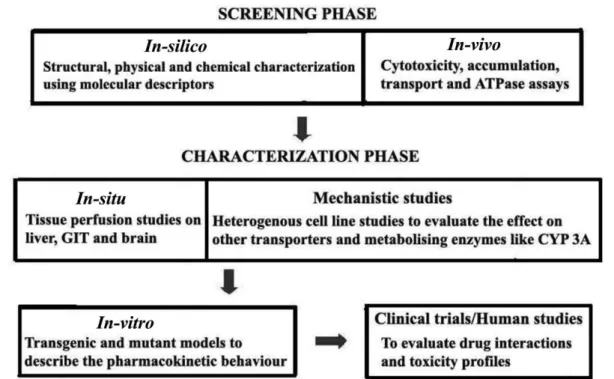
and evaluation of P-gp inhibitors can be classiied as dis -covery or screening and developmental or characterization phases as described in the Figure 3.
The screening phase involves in silico and in vitro studies where the compounds or chemical entities are screened for their P-gp affinity. The in silico analysis involves the use of chemical libraries and structural da-tabases for screening. The in vitro tests used to identify
P-gp interacting compounds include cytotoxicity assays, accumulation/eflux assays (based on luorescent or photo afinity studies), transport assays and ATPase assays.
Thus identiied chemical structures can be estab -lished as P-gp inhibitors/substrates/inducers, based on the tests carried out in the characterization phase which includes in-situ, mechanistic, in vivo and human studies.
These studies provide a deeper insight into the afinity and speciicity of the P-gp inhibitors/substrates/inducers.
By using this sequential strategy, the compounds can be
completely characterized starting from their extent of sensitivity to P-gp or their P-gp sensitizing eficiency to their drug-interaction and toxicity proiles (Bansal et al., 2009b). This kind of a schematic approach can rational-ize the discovery and development of newer, inert/safer,
non-toxic, and more eficient, speciically targeting P-gp
inhibitors.
FIGURE 3 – Schematic low chart for the evaluation of a compound’s interaction with P-gp and to distinguish it as an inhibitor/
CONCLUSION
P-gp eflux drastically affects the bioavailability of its
substrates by decreasing their effective plasma therapeutic concentration levels. Co-/concurrent administration of the P-gp substrate-therapeutics with the P-gp inhibitors can
prevent/overcome the substrate expulsion by P-gp and ren
-der the intended therapeutic beneits of the substrate drugs.
Hence, the research in this area remains an ever-challenging mission to the scientists. However, as a concluding remark,
it should be noted that a caution must be exercised. The drug
therapy/treatment for diseases using those pharmacological agents co-/concurrently administered with P-gp reversal agents should be carefully monitored after assessing all the possible risks associated with their usage.
Several eficient P-gp transport blockers were dis -covered earlier with the aim of enhancing the bioavail-ability of vital therapeutic P-gp substrates, most of them demonstrated shortcomings like unwanted side effects
and toxicities which impeded their clinical utility. Hence
there has always been a solid thrust on the pharmaceutical industry to develop new chemical entities to avoid or at least overcome these restraining phenomena. The
recog-nition of inhibitors among the natural product extracts, inert pharmaceutical excipients and formulations to serve
the cause is gaining utmost importance at present and as
such, several inhibitor candidates identiied under these
categories have been compiled in this review. The safe,
non-toxic nature of herbs and the inert, non-gut absor
-bent characters of excipients make them stand out unique
forever. Though the upcoming researches identify and develop uncountable candidates from these classes, only the clinical trial reports can establish them as perfect ratio-nal P-gp inhibitors. A deeper insight into the ratioratio-nal drug design becomes indispensable at this stage of research
to come out with more promising inert and non-toxic
P-gp inhibitors. Unearthing the promiscuity of the P-gp
structure, expression and substrate interaction is likely
to provide a better understanding and open new vistas to develop novel inhibitory strategies. The development of novel reversal agents requires that the interaction between P-gp and the model compounds is well characterized. An attempt has been made in the current review to provide a
P-gp interaction proile of a few compounds. The review
discussed on several pharmaceutical prodrugs, synthetic peptides, certain novel antitumor drugs, de-Novo
synthe-sized inhibitors, and P-gp expression suppressors which were reported to successfully escape the P-gp eflux. The development of further speciic P-gp targeting inhibitors
is foreseen in the nearest future to tackle and overcome the P-gp induced MDR and bioavailability problems.
REFERENCES
ANUCHAPREEDA, S.; LEECHANACHAI, P.; SMITH, M.M.; AMBUDKAR, S.V.; LIMTRAKUL, P.N. Modulation of
P-glycoprotein expression and function by curcumin in
multidrug-resistant human KB cells. Biochem. Pharmacol., v.64, p.573-582, 2002.
AOKI, S.; CAO, L.W.; MATSUI, K.; RACHMAT, R.;
AKIYAMA, S.; KOBAYASHI, M. Kendarimide A, a novel peptide reversing P-glycoprotein-mediated multidrug resistance in tumor cells, from a marine sponge of Haliclona sp. Tetrahedron, v.60, p.7053-7059, 2004.
ARNAUD, O.; KOUBEISSI, A.; ETTOUATI, L.; TERREUX
R.; ALAMÉ, G.; GRENOT, C.; DUMONTET, C.; DI
PIETRO, A.; PARIS, J.; FALSON, P. Potent and fully noncompetitive peptidomimetic inhibitor of multidrug resistance P-glycoprotein. J. Med. Chem., v.53, p.6720-6729, 2010.
BACHMAKOV, I.; REKERSBRINK, S.; HOFMANN, U.; EICHELBAUM, M.; FROMM, M. F. Characterisation of (R/S)-propafenone and its metabolites as substrates and inhibitors of P-glycoprotein. Naunyn-Schmiedeberg’s Arch. Pharm., v.371, p.195-201, 2005.
BAILEY, D.; SPENCE, J.; MUNOZ, C.; ARNOLD, J. Interaction of citrus juices with felodipine and nifedipine.
Lancet, v.337, p.268-269, 1991.
BALAYSSACA, D.; AUTHIER, N.; CAYRE, A.; COUDORE, F. Does inhibition of P-glycoprotein lead to drug–drug interactions? Toxicol. Lett., v.156, p.319-329, 2005.
BANSAL, T.; AKHTAR, N.; JAGGI, M.; KHAR, R.K.; TALEGAONKAR, S. Novel formulation approaches for optimising delivery of anticancer drugs based on P-glycoprotein modulation. Drug Discov. Today, v.14, p.1067-1074, 2009a.
BANSAL, T.; JAGGI, M.; KHAR, R.K.; TALEGAONKAR,
S. Emerging Signiicance of Flavonoids as P-Glycoprotein
Inhibitors in Cancer Chemotherapy. J. Pharm. Pharm. Sci.,
v.12, p.46-78, 2009b.
BATRAKOVA, E.V.; KABANOV, A.V. Pluronic block copolymers: evolution of drug delivery concept from inert
BHARDWAJ, R.K.; GLAESER, H.; BECQUEMONT, L.;
KLOTZ, U.; GUPTA, S.K.; FROMM, M.F. Piperine, a major constituent of black pepper, inhibits human P-glycoprotein and CYP3A4, J. Pharmacol. Exp. Ther., v.302, p.645-650, 2002.
BUGGINS, T.R.; DICKINSON, P.A.; TAYLOR, G. The effects
of pharmaceutical excipients on drug disposition. Adv. Drug Deliv. Rev., v.59, p.1482-1503, 2007.
CHANG, G.; ROTH, C.B. Structure of MsbA from E. coli: a homolog of the multidrug resistance ATP binding cassette (ABC) transporters. Science, v.293, p.1793-1800, 2001.
CHAVANPATIL, M.D.; KHDAIR, A.; GERARD, B.;
BACHMEIER, C.; MILLER, D.W.; SHEKHAR, M.P.;
PANYAM, J. Surfactant-polymer nanoparticles overcome
Pglycoprotein-mediated drug efflux. Mol. Pharm., v.4, p.730-738, 2007.
CHOI, J.S.; JO, B.W.; KIM, Y.C. Enhanced paclitaxel bioavailability after oral administration of paclitaxel or
prodrug to rats pretreated with quercetin. Eur. J. Pharm. Biopharm., v.57, p.313-318, 2004.
CHOI, J.S.; SHIN, S.C. Enhanced paclitaxel bioavailability after oral coadministration of paclitaxel prodrug with naringin to
rats. Int. J. Pharm., v.292, p.149-156, 2005.
CORLEY, D.G.; HERB, R.; MOORE, R.E.; SCHEUER, P.J.
Laulimalide, new potent cytotoxic macrolides from a
marine sponge and a nudibranch predator. J. Org. Chem.,
v.53, p.3644-3646, 1988.
CORNAIRE, G.; WOODLEY, J.; HERMANN, P.; CLOAREC, A.; ARELLANO, C.; HOUIN, G. Impact of excipients on
the absorption of P-glycoprotein substrates in vitro and in vivo. Int. J. Pharm., v.278, p.119-131, 2004.
DABHOLKAR, R.D.; SAWANT, R.M.; MONGAYT, D.A.;
DEVARAJAN, P.V.; TORCHILIN, V.P. Polyethylene glycol-phosphatidylethanolamine conjugate
(PEG-PE)-based mixed micelles: some properties, loading with paclitaxel, and modulation of P-glycoprotein-mediated eflux. Int. J. Pharm., v.315, p.148-157, 2006.
DADASHZADEH, S.; VALI, A.M.; REZAIE, M. The effect of
PEG coating on in vitro cytotoxicity and in vivo disposition
of topotecan loaded liposomes in rats. Int. J. Pharm., v.353, p.251-259, 2008.
DANTZIG, A.H.; DE ALWIS, D.P.; BURGESS, M.
Considerations in the design and development of transport inhibitors as adjuncts to drug therapy. Adv. Drug Deliv. Rev.,
v.55, p.133-150, 2003.
DARBY, R.A.; CALLAGHAN, R.; MCMAHON, R.M. P-Glycoprotein inhibition; the past, the present and the future. Curr. Drug Metab., v.12, p.722-731, 2011.
DHARMALA, K.; YOO, J.W.; LEE, C.H. Development of
chitosan-SLN microparticles for chemotherapy: in vitro
approach through eflux-transporter modulation. J. Control Rel., v.131, p.190-197, 2008.
DIJKHUIS, A.; DOUWES, J.; KAMPS, W.; SIETSMA, H.; KOK, J.W. Differential expression of sphingolipids in
P-glycoprotein or multidrug resistance-related protein 1
expressing human neuroblastoma cell lines. FEBS Lett.,
v.548, p.28-32, 2003.
ECKFORD, P.D.W.; SHAROM, F.J. The reconstituted
P-glycoprotein multidrug transporter is a flippase for glucosylceramide and other simple glycosphingolipids.
Biochem. J., v.389, p.517-526, 2005.
FOSTER, B.C.; FOSTER, M.S.; VANDENHOEK, S.;
KRANTIS, A.; BUDZINSKI, J.W.; ARNASON, J.T.;
GALLICANO, K.D.; CHOUDRI, S. An in vitro evaluation of human cytochrome P450 3A4 and P-glycoprotein inhibition by garlic. J. Pharm. Pharm. Sci., v.4, p.176-184, 2001.
GANGJEE, A.; YU, J.; COPPER, J.E.; SMITH, C.D. Discovery of novel antitumor antimitotic agents that also reverse tumor resistance. J. Med. Chem., v.50, p.3290-3301, 2007.
G U I L L E M A R D , V. ; S A R A G O V I , H . U . P r o d r u g chemotherapeutics bypass P-glycoprotein resistance and kill tumors in vivo with high eficacy and target dependent
selectivity. Oncogene, v.23, p.3613-3621, 2004.
HASLAM, I.S.; JONES, K.; COLEMAN, T.; SIMMONS,
N.L. Induction of P-glycoprotein expression and function
in human intestinal epithelial cells (T84). Biochem. Pharmacol., v.76, p.850-861, 2008.
HEFFETER, P.; JAKUPEC, M.A.; KORNER, W.; CHIBA,
P.; PIRKER, C.; DORNETSHUBER, R.; ELBLING, L.; SUTTERLUTY, H.; MICKSCHE, M.; KEPPLER,
B.K.; BERGER, W. Multidrug-resistant cancer cells are
HIGGINS, C.F.; GOTTESMAN, M.M. Is the multidrug
transporter a lippase? Trends Biochem. Sci., v.17, p.18-21, 1992.
HONG, L.; ZHAO, Y.; WANG, J.; HAN, Y.; GUO, W.; JIN, H.;
ZHAI, H.; BAI, F.; ZHANG, X.; QIAO, T.; CHEN, Z.; FAN, D. Reversal of multidrug resistance of adriamycin-resistant gastric adenocarcinoma cells through the up-regulation of DARPP-32. Dig. Dis. Sci., v.53, p.101-107, 2008.
HUNTER, J.; HIRST, B.H. Inluence of secretory systems on
drug delivery/targeting. intestinal secretion of drugs. The
role of P-glycoprotein and related drug eflux systems in
limiting oral drug absorption. Adv. Drug Deliv. Rev., v.25, p.129-157, 1997.
IKEGAWA, T.; USHIGOME, F.; KOYABU, N.; MORIMOTO,
S.; SHOYAMA, Y.; NAITO, M.; TSURUO, T.; OHTANI,
H.; SAWADA, Y. Inhibition of P-glycoprotein by orange juice components, polymethoxylavones in
adriamycin-resistant human myelogenous leukemia (K562/ADM) cells.
Cancer Lett., v.160, p.21-28, 2000.
IMMORDINO, M.L.; BRUSA, P.; ARPICCO, S.; STELLA, B.; DOSIO, F.; CATTEL, L. Preparation, characterization,
cytotoxicity and pharmacokinetics of liposomes containing docetaxel. J. Control Rel., v.91, p.417-429, 2003.
JAIN, R.; MAJUMDAR, S.; NASHED, Y.; PAL, D.; MITRA, A.K. Circumventing P-glycoprotein-mediated cellular
eflux of quinidine by prodrug derivatization. Mol. Pharm.,
v.1, p.290-299, 2004.
JAIN, S.; LAPHOOKHIEO, S.; SHI, Z.; FU, L.W.; AKIYAMA, S.; CHEN, Z.S.; YOUSSEF, D.T.; VAN SOEST, R.W.;
EL SAYED, K.A. Reversal of P-glycoprotein-mediated multidrug resistance by sipholane triterpenoids. J. Nat. Prod., v.70, p.928-931, 2007.
JANG, S.H.; WIENTJES, M.G.; JESSIE, L. Kinetics of P-glycoprotein-mediated eflux of paclitaxel. J. Pharmacol. Exp. Ther., v.298, p.1236-1242, 2001.
JIAO, W.; DONG, W.; LI, Z.; DENG, M.; LU, R. Lathyrane
diterpenes from Euphorbia lathyris as modulators of multidrug resistance and their crystal structures. Bioorg. Med. Chem., v.17, p.4786-4792, 2009.
JODOIN, J.; DEMEULE, M.; BELIVEAU, R. Inhibition of the multidrug resistance Pglycoprotein activity by green tea polyphenols. Biochim. Biophys. Acta., v.1542, p.149-159, 2002.
JULIANO, R.L.; LING, V. A surface glycoprotein modulating drug permeability in Chinese hamster ovary cell mutants.
Biochim. Biophys. Acta, v.455, p.152-162, 1976.
KATOH, S.Y.; UENO, M.; TAKAKURA, N. Involvement of MDR1 function in proliferation of tumour cells. J. Biochem., v.143, p.517-524, 2008.
KHAITAN, D.; DWARAKNATH, B.S. Endogenous and induced oxidative stress in multi-cellular tumour spheroids:
implications for improving tumour therapy. Indian J. Biochem. Biophys., v.46, p.16-24, 2009.
KIM, C.K.; LIM, S.J. Recent progress in drug delivery systems for anticancer agents. Arch. Pharm. Res., v.25, p.229-239, 2002.
KIM, S.; KWON, H.; CHI, D.; SHIM, J.; PARK, J.; LEE, Y.H.;
PYO, S.; RHEE, D. Reversal of P-glycoprotein-mediated multidrug resistance by ginsenoside Rg3. Biochem.
Pharmacol., v.65, p.75-82, 2003.
KITAZAKI, T.; OKA, M.; NAKAMURA, Y.; TSURUTANI, J.; DOI, S.; YASUNAGA, M.; TAKEMURA, M.; YABUUCHI, H.; SODA, H.; KOHNO, S. Gefitinib, an EGFR tyrosine kinase inhibitor, directly inhibits the function of P-glycoprotein in multidrug resistant cancer cells. Lung Cancer, v.49, p.337-343, 2005.
KOBAYASHI, T.; ISHIDA, Y.; OKADA, S.; ISE, S.;
HARASHIMA, H.; KIWADA, H. Effect of transferrin receptor-targeted liposomal doxorubicin in
P-glycoprotein-mediated drug resistant tumor cells. Int. J. Pharm., v.329, p.94-102, 2007.
KRISHNA, R.; MAYER, L.D. Multidrug resistance (MDR) in cancer mechanisms, reversal using modulators of
MDR and the role of MDR modulators in inluencing the
pharmacokinetics of anticancer drugs. Eur. J. Pharm. Sci.,
v.11, p.265-283, 2000.
LIMTRAKUL, P.; KHANTAMAT, O.; PINTHA, K. Inhibition of P-glycoprotein activity and reversal of cancer multidrug
resistance by Momordica charantia extract. Cancer Chemother. Pharmacol., v.54, p.525-530, 2004.
LIMTRAKUL, P.; SIWANON, S.; YODKEEREE, S.; DUANGRAT, C. Effect of Stemona curtisii root extract on
LIN, J.H. Drug-drug interaction mediated by inhibition and induction of P-glycoprotein. Adv. Drug Deliv. Rev., v.55, p.53-81, 2003.
LO, Y.L. Relationships between the hydrophilic–lipophilic
balance values of pharmaceutical excipients and their
multidrug resistance modulating effect in Caco-2 cells and rat intestines. J. Control. Rel., v.90, p.37-48, 2003.
MAJUMDER, S.; DUTTA, P; MUKHERJEE, P.; DATTA, E.R.; EFFERTH, T.; BHATTACHARYA, S.; CHOUDHURI, S.K.
Reversal of drug resistance in P-glycoprotein-expressing
T-cell acute lymphoblastic CEM leukemia cells by copper
N-(2-hydroxy acetophenone) glycinate and oxalyl bis (N-phenyl) hydroxamic acid. Cancer Lett., v.244, p.16-23, 2006.
MAKI, N.; HAFKEMEYER, P.; DEY, S. Allosteric modulation of human P-glycoprotein. Inhibition of transport by preventing substrate translocation and dissociation. J. Biol. Chem., v.278, p.18132-18139, 2003.
MARTIN, C.; BERRIDGE, G.; HIGGINS, C.F.; MISTRY, P.; CHARLTON, P.; CALLAGHAN, R. Communication between multiple drug binding sites on P-glycoprotein. Mol. Pharmacol., v.58, p.624-632, 2000.
MATHIJSSEN, R.H.; VERWEIJ, J.; DE BRUIJN, P.; LOOS, W.J.; SPARREBOOM, A. Effects of St. John’s wort on
irinotecan metabolism. J. Natl. Cancer Inst., v.94, p.1247-1249, 2002.
MUNOZ-MARTINEZ, F.; MENDOZA, C.R.; BAZZOCCHI, I.L.; CASTANYS, S.; JIMENEZ, I.A.; GAMARRO, F. Reversion of human Pgp-dependent multidrug resistance by new sesquiterpenes from Zinowiewia costaricensis. J. Med. Chem., v.48, p.4266-4275, 2005.
NAJAR, I.A.; SACHIN, B.S.; SHARMA, S.C.; SATTI, N.K.; SURI, K.A.; JOHRI, R.K. Modulation of P-glycoprotein ATPase Activity by Some Phytoconstituents. Phytother. Res., v.24, p.454-458, 2010.
OZBEN, T. Mechanisms and strategies to overcome multiple drug resistance in cancer. FEBS Lett., v.580, p.2903-2909, 2006.
PLEBAN, K.; KAISER, D.; KOPP, S.; PEER, M.; CHIBA,
P.; ECKER, G.F. Targeting drug-efflux pumps - a
pharmacoinformatic approach. Acta Biochim. Pol., v.52, p.737-740, 2005.
ROBEY, R.W.; SHUKLA, S.; FINLEY, E.M.; OLDHAM, R.K.;
BARNETT, D.; AMBUDKAR, S.V.; FOJO, T.; BATES, S.E. Inhibition of P-glycoprotein (ABCB1) - and multidrug resistance-associated protein 1 (ABCC1)-mediated transport by the orally administered inhibitor, CBT-1.
Biochem. Pharmacol., v.75, p.1302-1312, 2008.
SACHS-BARRABLE, K.; THAMBOO, A.; LEE, S.D.;
WASAN, K.M. Lipid excipients Peceol and Gelucire 44/14 decrease P-glycoprotein mediated efflux of rhodamine
123 partially due to modifying P-glycoprotein protein
expression within Caco-2 cells. J. Pharm. Pharm. Sci., v.10, p.319-331, 2007.
S A U N A , Z . E . ; A N D R U S , M . B . ; T U R N E R , T. M . ; AMBUDKAR, S.V. Biochemical basis of polyvalency
as a strategy for enhancing the eficacy of P-glycoprotein
(ABCB1) modulators: stipiamide homodimers separated
with deined-length spacers reverse drug eflux with greater eficacy. Biochemistry, v.43, p.2262-2271, 2004.
SCHINKEL, A.H. P-Glycoprotein, a gatekeeper in the blood-brain barrier. Adv. Drug Deliv. Rev., v.36, p.179-194, 1999.
SHAROM, F.J.; LUGO, M.R.; ECKFORD, P.D. New insights
into the drug binding, transport and lipid lippase activities
of the pglycoprotein multidrug transporter. J. Bioenerg. Biomembr., v.37, p.481-487, 2005.
SHAROM, F.J.; PEIHUA, L.U.; RONGHUA, L.I.U.; XIAOHONG, Y.U. Linear and cyclic peptides as substrates and modulators of P-glycoprotein: peptide binding and effects on drug transport and accumulation. Biochem. J.,
v.333, p.621-630, 1998.
SHEKFEH, S. Binding sites of P-glycoprotein. Knol, 2009 (Version 5). Available at: http://knol.google. c o m / k / s u h a i b s h e k f e h / b i n d i n g s i t e s o f p -glycoprotein/2v4mv6iwmzf2t/3. Accessed on 15 nov 2010.
SHIN, S.Y.; CHOI, B.H.; KIM, J.R.; KIM, J.H.; LEE, Y.H.
Suppression of P-glycoprotein expression by antipsychotics
trifluoperazine in adriamycin-resistant L1210 mouse leukemia cells. Eur. J. Pharm. Sci., v.28, p.300-306, 2006.
STASTNY, M.; STROHALM, J.; PLOCOVA, D.; ULBRICH, K.; RÍHOVA, B. A possibility to overcome P-glycoprotein (PGP)-mediated multidrug resistance by antibody-targeted
drugs conjugated to N-(2- hydroxypropyl)methacrylamide
STORM, J.; O’MARA, M.L.; CROWLEY, E.H.; PEALL, J.;
TIELEMAN, D.P.; KERR, I.D.; CALLAGHAN, R. Residue
G346 in transmembrane segment six is involved in
inter-domain communication in P-glycoprotein. Biochemistry,
v.46, p.9899-9910, 2007.
TAKANAGA, H.; OHNISHI, A.; MATSUO, H.; SAWADA, Y. Inhibition of vinblastine eflux mediated by P-glycoprotein
by grapefruit juice components in caco-2 cells. Biol. Pharm. Bull., v.21, p.1062-1066, 1998.
TANINO, T.; NAWA, A.; KONDO, E.; KIKKAWA, F.;
DAIKOKU, T.; TSURUMI, T.; LUO, C.; NISHIYAMA, Y.;
TAKAYANAGI, Y.; NISHIMORI, K.; ICHIDA, S.; WADA, T.; MIKI, Y.; IWAKI, M. Paclitaxel-2’-ethylcarbonate
prodrug can circumvent P-glycoprotein- mediated cellular
efflux to increase drug cytotoxicity. Pharm. Res., v.24, p.555-565, 2007.
T H I A G A R A J A N , G . ; R AY, A . ; M A L U G I N , A . ; GHANDEHARI, H. PAMAM-Camptothecin conjugate inhibits proliferation and induces nuclear fragmentation in colorectal carcinoma cells. Pharm. Res., v.27, p.2307-2316, 2010.
THIEBUT, F.; TSURUO, T.; HAMADA, H.; GOTTESMAN, M.M.; PASTAN, I. Cellular localisation of the multidrug resistance gene product P-glycoprotein in normal human tissues. Proc. Natl. Acad. Sci. USA, v.84, p.7735-7738, 1987.
THOMAS, H.; COLEY, H.M. Overcoming multidrug resistance in cancer: an update on the clinical strategy of inhibiting P-glycoprotein. Cancer Control, v.10, p.159-165, 2003.
TIWARI, A.K.; SODANI, K.; WANG, S.; KUANG, Y.; ASHBY,
C.R.; CHEN, X.; CHEN, Z. Nilotinib (AMN107, Tasigna1) reverses multidrug resistance by inhibiting the activity of the ABCB1/Pgp and ABCG2/BCRP/MXR transporters.
Biochem. Pharmacol., v.78, p.153-161, 2009.
VANHUYSE, M.; KLUZA, J.; TARDY, C.; OTERO, G.; CUEVAS, C.; BAILLY, C.; LANSIAUX, A. Lamellarin D: a novel pro-apoptotic agent from marine origin insensitive
to P glycoprotein-mediated drug eflux. Cancer Lett., v.221, p.165-175, 2005.
VA R M A , M . V. S . ; A S H O K R A J , Y. ; D E Y, C . S . ; PANCHAGNULA, R. P-glycoprotein inhibitors and their screening: a perspective from bioavailability enhancement.
Pharmacol. Res., v.48, p.347-359, 2003.
VAUTIER, S.; LACOMBLEZ, L.; CHACUN, H.; PICARD, V.; GIMENEZ, F.; FARINOTTI, R.; FERNANDEZ, C. Interactions between the dopamine agonist, bromocriptine
and the eflux protein, P-glycoprotein at the blood-brain
barrier in the mouse. Eur. J. Pharm. Sci., v.27, p.167-174, 2006.
WAN, C.; ZHU, G.; SHEN, X.; CHATTOPADHYAY, A.; DEY, S.; FONG, W. Gomisin A alters substrate interaction and
reverses P-glycoprotein-mediated multidrug resistance in HepG2-DR cells. Biochem. Pharmacol., v.72, p.824-837, 2006.
WERLE, M.; HOFFER, M. Glutathione and thiolated chitosan
inhibit multidrug resistance P-glycoprotein activity in
excised small intestine. J. Control Rel., v.111, p.41-46, 2006.
WONG, H.L.; BENDAYAN, R.; RAUTH, A.M.; WU, X.Y.
Development of solid lipid nanoparticles containing
ionically complexed chemotherapeutic drugs and
chemosensitizers. J. Pharm. Sci., v.93, p.1993-2008, 2004.
YOSHIDA, N.; KOIZUMI, M.; ADACHI, I.; KAWAKAMI,
J. Inhibition of P-glycoprotein-mediated transport by terpenoids contained in herbal medicines and natural products. Food Chem. Toxicol., v.44, p.2033-2039, 2006.
YU, S.T.; CHEN, T.M.; TSENG, S.Y.; CHEN, Y.H. Tryptanthrin
inhibits MDR1 and reverses doxorubicin resistance in breast
cancer cells. Biochem. Biophys. Res. Commun., v.358, p.79-84, 2007.
YUAN, H.; LI, X.; WU, J.; LI, J.; QU, X.; XU, W.; TANG, W. Strategies to overcome or circumvent p-glycoprotein
mediated multidrug resistance. Curr. Med. Chem., v.35, p.470-476, 2008.
ZHANG, S.; MORRIS, M.E. Effects of the lavonoids biochanin
A, morin, phloretin, and silymarin on P-glycoprotein-mediated transport. J. Pharmacol. Exp. Ther., v.304, p.1258-1267, 2003.
ZHONG, X.; SAFA, A.R. Phosphorylation of RNA helicase A by DNA-dependent protein kinase is indispensable for
expression of the MDR1 gene product P-glycoprotein in
multidrug-resistant human leukemia cells. Biochemistry,
v.46, p.5766-5775, 2007.
Received for publication on 31st October 2011