*Correspondence: H.G. Ferraz. Department of Pharmacy, Faculty of Pharma-ceutical Sciences, University of São Paulo. Rua do Lago, 250 - Prédio Semi-Industrial - Térreo - Cidade Universitária - Butantã - 05508-080 - São Paulo – SP, Brazil. Tel.: +55 11 3091-8954. E-mail: [email protected]
A
vol. 48, n. 3, jul./sep., 2012
Physicochemical and dissolution profile characterization of
pellets containing different binders obtained by the
extrusion-spheronization process
Michele Georges Issa, Letícia Pessole, Andrea Ikeda Takahashi, Newton Andréo Filho,
Humberto Gomes Ferraz
*Department of Pharmacy, Faculty of Pharmaceutical Sciences, University of São Paulo
With the purpose of evaluating the behavior of different polymers employed as binders in small-diameter pellets for oral administration, we prepared formulations containing paracetamol and one of the following polymers: PVP, PEG 1500, hydroxypropylmethylcellulose and methylcellulose, and we evaluated their different binding properties. The pellets were obtained by the extrusion/spheronization process and were
subsequently subjected to luid bed drying. In order to assess drug delivery, the United States Pharmacopeia
(USP) apparatus 3 (Bio-Dis) was employed, in conjunction with the method described by the same pharmacopeia for the dissolution of paracetamol tablets (apparatus 1). The pellets were also evaluated for granulometry, friability, true density and drug content. The results indicate that the different binders used are capable of affecting production in different ways, and some of the physicochemical characteristics of the pellets, as well as the dissolution test, revealed that the formulations acted like immediate-release products. The pellets obtained presented favorable release characteristics for orally disintegrating tablets. USP apparatus 3 seems to be more adequate for discriminating among formulations than the basket method.
Uniterms: Binders/evaluation. Pellets/dissolution proile. Pellets/physicochemical characteristics.
Extrusion/spheronization process. Drug delivery/evaluation.
Com a inalidade de se avaliar o comportamento de diferentes polímeros empregados como aglutinantes
em pellets de pequeno diâmetro para uso oral foram preparadas formulações contendo paracetamol e um
dos seguintes polímeros: PVP, PEG 1500, hidroxipropilmetilcelulose e metilcelulose por apresentarem
diferentes propriedades aglutinantes. Os pellets foram obtidos pelo processo de extrusão/esferonização e
secagem em leito luidizado. Para avaliar a liberação do fármaco, empregou-se o método 3 da Farmacopeia
Americana, também conhecido como Bio-Dis e o método preconizado pela mesma farmacopeia para comprimidos de paracetamol. Os pellets foram avaliados, ainda, com relação à granulometria, friabilidade, densidade verdadeira e teor. Os resultados indicaram que os diferentes aglutinantes empregados são
capazes de afetar a produção e algumas das características físico-químicas dos pellets e o ensaio de
dissolução revelou que as formulações comportam-se como produtos de liberação imediata. Os pellets
obtidos apresentaram características de liberação favoráveis para a obtenção de comprimidos de liberação
instantânea. O aparato 3 da Farmacopeia Americana demonstrou ser um método com melhor capacidade discriminatória entre as formulações, quando comparado com o método da cesta.
Unitermos: Aglutinantes/avaliação. Pellets/peril de dissolução. Pellets/características físico-químicas.
Processo de extrusão/esferonização. Liberação do fármaco.
INTRODUCTION
In recent years, the cost of developing new drugs has
become a signiicant hurdle for the pharmaceutical indus -try, such that innovative product launches are increasingly rare. In an attempt to address this issue, research into
new systems capable of more eficient delivery of dosage
forms already widely-used in treatment processes is on the increase (Mahato, 2007; Qiu et al., 2009).
drug delivery via oral route have increasingly been the subject of pharmaceutical research, thus fairly consistently
fulilling the necessities of clinical medicine by promoting
improvements in bioavailability, with extended action and reduced toxic side-effects (Pezzini, Silva, Ferraz, 2007; Qiu et al., 2009).
Among the different systems/technologies available are the so-called pellets, also known as micro-granules, which are spherical structures of varying diameters used for drug delivery via oral route. They present several tech-nological advantages compared to other dosage forms,
in-cluding improved lowability properties, greater resistance
to abrasion (friability) and ease of coating, etc. (Ghebre-Sellassie, 1989; Santos et al., 2002; Pund et al., 2010).
Pellets can be obtained by means of several different processes, of which extrusion followed by spheronization
and luid bed drying is the most common. Pellets produced
in this manner are suitable for coating, and this is the most
widely-recommended process for producing a modiied
release, multi-particulate dosage form (Ghebre-Sellassie, 1989; Costa et al., 2003; Costa, Pais, Sousa, 2004; Santos et al., 2002; Pund et al., 2010).
Moreover, dissolution testing of solid dosage forms is a very useful resource for developing these formula-tions, since it is an in vitro system capable of predicting the release behavior of a dosage form (Costa et al., 2003; Doukoumetzidis, Macheras, 2006; Azarmi, Roa, Löben-berg, 2007).
For controlled release dosage forms, the device des-ignated by the United States Pharmacopeia as apparatus 3, also known as “reciprocating cylinders” or Bio-Dis, stands out, especially for its ability to subject formulations to different pH conditions, thus simulating their passage through the human gastrointestinal tract (Klein, Rudolph, Dressman, 2002; Yu, Wang, Hussain, 2002; Krämer, Grady, Gajendran, 2005).
In order to obtain a controlled-release dosage form,
the use of agents (excipients) capable of inluencing drug
delivery is essential, thus enabling the acquisition of ad-equate blood levels for extended periods of time, compared to conventional dosage forms (Mahato, 2007).
Accordingly, prior knowledge of the behavior of these materials (in general polymers) is useful for
predict-ing the release proile that they will produce, especially
considering the dynamics of the gastrointestinal tract, which subjects the dosage form to different pH conditions at different points in its trajectory.
Regardless of the desired release proile for a par -ticular drug incorporated into a certain pellet formulation, the binder is, without a doubt, one of the main components of this dosage form. The success of a formulation of this
type largely depends on this excipient, since a pellet is precisely a spherical agglomeration of powders. Therefore, the binder will be responsible for pellet integrity and may also influence the manufacturing process, dissolution, physical stability, among others. (Ghebre-Sellassie, 1989).
Moreover, pellets may be an interesting alternative for producing orally disintegrating tablets (ODTs). These solid dosage forms are designed to rapidly disintegrate in the mouth when in contact with saliva, thus not requir-ing water for administration. A strategy to mask drug
taste, without causing any modiication in drug release,
is necessary. Paracetamol is an analgesic drug and its ad-ministration in ODT form could be applicable in pediatric treatment for acute pain, as an alternative to liquid dosage forms (AlHusban, Perrie, Mohammed, 2011).
The purpose of this study was to evaluate the im-pact of the use of different binders in the manufacture of small-diameter pellets containing paracetamol by means of physicochemical characterization of the formulations
and an assessment of their dissolution proile by means of
two different tests employing apparatuses 1 and 3 from the United States Pharmacopeia.
MATERIAL AND METHODS
Raw material
All raw material used was of pharmaceutical grade and it was used as received. The paracetamol was kindly donated by Medley S.A. Indústria Farmacêutica.
The type-101 microcrystalline cellulose, commer-cially designated Microcel MC101®, and the type 2208
hydroxypropylmethylcellulose (HPMC) (USP 32), com-mercially designated as Methocel K100M®, were kindly
donated by Colorcon do Brasil Ltda.
Formulations
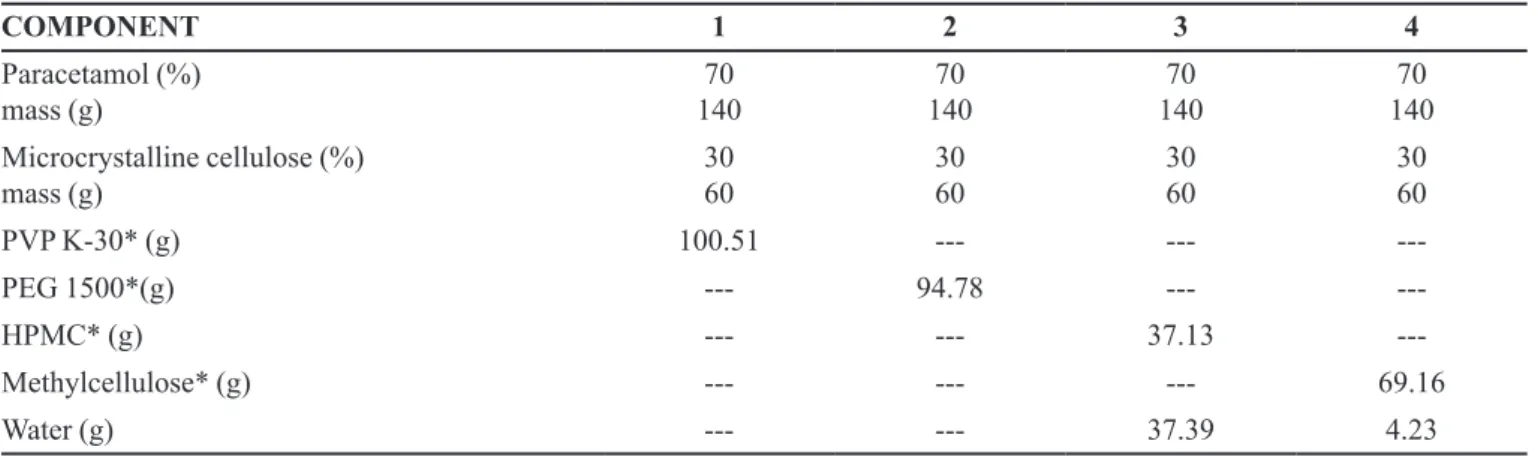
Four formulations, each with a different binder, were prepared, as indicated in Table I.
The concentrations of binders we selected were those commonly used in our laboratory.
The following procedure was adopted for pellet production: after being weighed, the paracetamol and the microcrystalline cellulose were mixed in a household mixer (± 20 rpm) for around 10 minutes. Then the previ-ously prepared binder solution was added, little by little, and homogenization was continued until the mass reached the point where it could be extruded; this was ascertained visually. The material was then placed in an APEX®
set to ± 3 rpm and ixed with a 0.5 mm mesh. The extruded
material was then transferred to a CALEVA® Model 250
spheronizer (Dorset, UK), equipped with a “cross-hatch” plate, rotating at 1,000 rpm for about 4 minutes. The pel-lets were then dried in a HÜTTLIN® Mycrolab luid bed
(Steinen, Germany) for 40 minutes, with an input air
tem-perature of 55°C, at a low rate of 12 m3 per hour.
The process yield was evaluated by comparing the theoretical value (the sum of the formulation components, except water) with the number of pellets obtained.
Evaluation of the pellets obtained
Granulometry
The batches were granulometrically classiied in
a Haver & Bocker EML Digital Plus test sieve shaker (Westfalen, Germany), with an amplitude of 1.0, a stir-ring time of 2 minutes, a 10-second interval between pulses and previously tared test sieves with 0.80, 0.71, 0.59, 0.42, 0.297, 0.250, 0.210, 0.180 meshes and a
collecting pan. After classiication, the test sieves were
weighed separately in order to ascertain whether any mass was retained in them.
Friability
About 10 g of pellets were weighed and then were placed into a Haver & Bocker EML Digital Plus mechani-cal test sieve shaker (Westfalen, Germany), operating un-der the same conditions as the granulometry assay. After
the pellets were classiied, the material was gathered up
and placed in a Logan® FAB-2 friability tester (Somerset,
USA), together with 200 glass spheres measuring 4.3 mm in diameter. The assay time was 8 minutes, totaling 200 rotations. Then the pellets were removed and again sub-jected to another granulometric assay. Besides post-assay
granulometry comparison, the percentage of powder with-held in the collecting pan was also calculated.
True Density
After weighing about 3 g of pellets directly in the
sample recipient, which was illed to half way, the material
was transferred to a Quantachrom Instruments®
Ultrapyc-nometer 1000 gas pycUltrapyc-nometer (Boynton Beach, USA).
Morphological Analysis
Images were obtained for each batch using a Fuji Film Fine Pix S5100® camera coupled to a Motic SMZ
168® stereomicroscope, set to 10x magniication. These
images were then edited with the Image Pro-Plus® version
4.5.0.29 software program, from which the average diam-eter, aspect and sphericity parameters were calculated. For calibration purposes, an image (obtained under the same conditions) of a standard slide containing a straight 1cm segment, with 100 divisions, was employed.
Paracetamol content
In order to quantify the paracetamol contained in the pellets, a spectrophotometer was used in the UV, in accor-dance with the following procedure: one sample of each pellet formulation was ground up using a porcelain mortar and pestle, and from this resulting powder, about 100 mg
was weighed and then placed in a 100 mL volumetric lask. Water was added and the lasks were placed in an
ultrasonic cleaner for 10 minutes. The contents were then
iltered through a 35 µm Logan 200-1035 ilter (Somerset, USA). An aliquot of the iltered material was diluted 200
times and the resulting solution was placed in a 0.5 cm quartz cuvette, and then in a Beckman Coulter DU 640®
spectrophotometer, where a wavelength reading of 242.5 nm was attained.
TABLE I - Qualitative and quantitative composition of the pellet formulations produced
COMPONENT 1 2 3 4
Paracetamol (%) mass (g)
70 140
70 140
70 140
70 140
Microcrystalline cellulose (%) mass (g)
30 60
30 60
30 60
30 60
PVP K-30* (g) 100.51 --- ---
---PEG 1500*(g) --- 94.78 ---
---HPMC* (g) --- --- 37.13
---Methylcellulose* (g) --- --- --- 69.16
Water (g) --- --- 37.39 4.23
Dissolution
Bio-Dis
In order to evaluate the dissolution profile of the formulations, apparatus 3 from the United States Phar-macopeia, also known as Bio-Dis, was employed. The
equipment (Varian Inc., Cary, USA) was conigured to
operate at a temperature of 37 °C with 250 mL of dissolu-tion medium, coupled to a Varian VK 8000 Dissoludissolu-tion Sampling Station (Cary, USA), programmed to collect a volume of 5 mL of the medium, at pre-established time intervals.
Initially, the pellets were dissolved in a pH 7.2 phos-phate buffer and then in HCl 0.1N, since these are used
in the production of ODT. In this case, the irst stage (pH
7.2 phosphate buffer) is used to simulate the conditions encountered by the formulation in the mouth cavity, where drug release needs to be minimal (in order to avoid the unpleasant taste of the product), and in the second stage (HCl 0.1N), the drug needs to be released as fast as pos-sible, in order to ensure its rapid absorption.
• Phosphate buffer pH 7.2 – used in the irst row of
vessels as an initial dissolution medium, with collec-tion times programmed for 2 and 5 minutes and the device operating at 4 oscillations per minute (OPM);
• Hydrochloric acid 0.1 N (HCl 0.1 N) – used in the
second row of vessels, as the stage following the phosphate buffer medium, with collection times at 10, 15, 20, 30 and 45 minutes. In this medium, the stirring speed was 10 oscillations per minute. After weighing (about 100 mg of each formulation), the pellets were transferred to the cylinders of the device
(itted with a 1.25/177 μm “Poly screen”) and then the as -say was initiated, whereby the cylinders at 4 OPM were immersed in the phosphate buffer for 5 minutes. After this time, in accordance with the stipulated programming of the device, the cylinders were automatically transferred to operate at 10 OPM in the second row of vessels, contain-ing the acid medium, for the next 40 minutes. The samples
were quantiied with a Beckman Coulter DU 640 spectro -photometer in a 0.5 cm cuvette at 242.5 nm. Besides the dissolved percentage values used to obtain the dissolution
proiles, the respective dissolution eficiency (DE) values
were also calculated, in the manner described by Khan & Rhodes (1975).
Dissolution profile (apparatus 1 - basket)
A dissolution proile for the formulations in a phos
-phate buffer pH 5.8 was traced, as speciied by USP 32 for
paracetamol tablets, using a VanKel VK 7010 (Cary, USA) automated device coupled to a Varian Cary 50
spectropho-tometer (Cary, USA). As described in the United States Pharmacopeia, 900 mL of medium was employed, at a temperature of 37 °C, a stirring speed of 75 rpm and collec-tion times programmed for 2, 5, 10, 15, 20 and 45 minutes.
RESULTS AND DISCUSSION
The technology for obtaining pellets by means of the extrusion-spheronization process is, among other fac-tors, fairly dependent on the excipients employed in the formulation, with emphasis on the binder. In fact, pellets are agglomerates of powders, which are united precisely by the action of these excipients and, therefore, the search for an adequate binder for a particular formulation is extremely important for the success of the product that is to be obtained (Ghebe-Sallassie, 1989; Wlosnewski, Kumpugdee-Vollrath, Sriamornsak, 2010).
Accordingly, four different binders dissolved in wa-ter were tested in this study and the following yield values were obtained: 74.39%, 67.05% and 81.73% and 63.22% for formulations 1, 2, 3 and 4, respectively.
These results, all less than 82% are, in fact, due largely to two main factors: (a) losses that occurred during extrusion in the APEX® device that, because
of its design, ended up retaining a considerable quan-tity of mass that should have been extruded; and (b) the small size of the batches produced (200 g). The greater the quantity produced, the greater the yield, because the quantity of mass retained in the extruder is always the same, regardless of the volume of material processed. Therefore, we considered it improbable that the differences registered were due to the use of different binders.
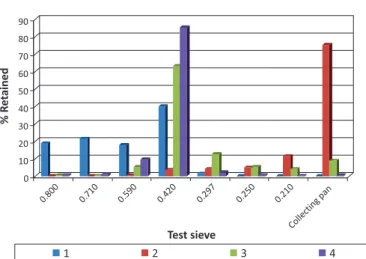
In Figure 1, the granulometric distribution of the pellets obtained is shown, where it is possible to ascertain that, when PEG 1500 was used as a binder, there was practically no pellet formation, with a considerable amount of the material withheld at the bottom of the set of cloth
ilters. In contrast, the use of PVP resulted in larger and
not very homogeneous pellets.
Considering this parameter, the best results were obtained with the use of methylcellulose (MC) and HPMC and, in both cases, there was a concentration of pellets in the 0.42 mm range. Methylcellulose is especially deserv-ing of note, because more than 80% of it was retained in
the 0.42 mm cloth ilter.
was a slight increase in the percentage retained in the 0.42 mm test sieve, and for the formulation in which HPMC was used, there was a greater increase in the percentage retained in the same test sieve. However, there was no powder formation in any of the three cases, as can be ascertained by the quantity of material retained in the col-lecting pan of the test sieve set.
It is important to emphasize that the method
em-ployed here to evaluate pellet friability differs from that normally used and described in literature (Sousa et al., 2002; Cheboyina, Wyandt, 2008), since a change in the granulometry of each formulation has been considered. Accordingly, data has been obtained that enables a more wide-ranging evaluation of pellet behavior, taking into account the wear that the latter may be subject to.
Once density is established, obtained by means of a gas pycnometer, it also becomes a very important pa-rameter in pellet production technology. Density is also a means of differentiating pellets from granules, since the
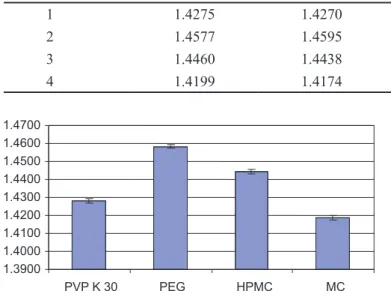
latter are not subject to densiication (by extrusion), con -trary to pellets, which, generally speaking, have greater density. The results (presented in Table II and Figure 3) indicate that the type of binder employed in the
formula-tion is capable of causing considerable modiicaformula-tions to
pellet density, since the values obtained were found to be in the range from 1.4199 for the lowest (pellets with MC) to 1.4595 (PEG) for the highest value.
Although granulometric analysis is an excellent al-ternative for evaluating pellet size, visualizing the particles with the aid of a microscope is, without a doubt, the best alternative for studying pellet morphology. Accordingly, it is possible to ascertain not only measurements for the
FIGURE 1 - Granulometric distribution of the pellets obtained using PVP (1), PEG 1500 (2), HPMC (3) and MC (4) as binders.
pellets formed, but also their shape (Abbaspour, Sadeghi, Afrasiabi, Garekani, 2008).
One quite interesting alternative is to use image-editing software with the capacity to calculate parameters pertaining to the shape of the particle under analysis. In this study, we used the Image Pro Plus® program, which
enables, among other parameters, the average diameter and sphericity of the pellets to be calculated.
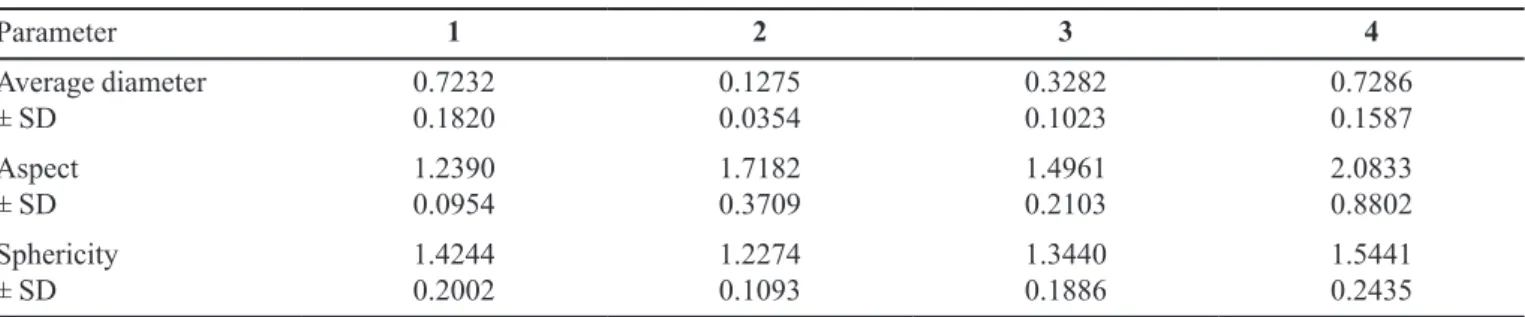
Analysis of these results (Table III) proves that the pellets are not perfectly spherical. According to Podczeck, Rahman, Newton (1999), a pellet should present values of 1.0 for aspect and up to 1.1 for sphericity. Chopra et al. (2002) considers that this value may reach up to 1.2. None of the formulations studied here conformed to these values, and results of more than 1.2 were obtained for both parameters.
Similarly, the average pellet diameter varied consid-erably, with the smallest particles being obtained for PEG, with a diameter of 0.1275 mm, and up to 0.7286 for pellets containing MC. For this latter parameter, a value of close to 0.5 mm was expected, since a screen with this size opening was used with the extrusion device to produce these pellets.
This dificulty in obtaining spherical pellets, with
a diameter close to that of the extruder screen, may be explained by two factors:
(a) the reduced size of the pellets: the production of dosage forms with reduced sizes is a challenge under any circumstances;
(b) the elevated drug content (theoretically 70%) in the pellets: microcrystalline cellulose, a component of fundamental importance in the production of pellets, because of its plasticity, is quite adequate for pellet production (Sousa et al., 2002; Sreie et al., 2005); however, in the formulations proposed here, this
component is signiicantly diluted, as a result of the
necessity to obtain pellets with a high drug concen-tration.
It is also necessary to consider that these two factors
may have had a joint inluence; in other words, the sum of
two unfavorable conditions may have made the attainment
of pellets with a suitable aspect even more dificult.
Therefore, it was ascertained that, in fact, the
mor-phology of the pellets was signiicantly inluenced by the
type of binder used. The formulations containing PEG and MC are at both extremes, since very small pellets, or even powder (average diameter only 0.1275 mm), were obtained with the former, while very large pellets, actu-ally “rod-shaped” (0.7286 mm), were obtained with the latter. Both are the result of “weak” and very intensive
locculation, respectively, thus preventing separation of
the pellets that form during spheronization and resulting in the “rod shapes”.
Thus, upon analyzing such observations, we can state that PVP and HPMC are the binders with the greatest potential in the formulations studied herein.
Considering the paracetamol content found in the pellets (Table IV), it is possible to make adjustments to the quantities of pellets that are to be subjected to the dis-solution test, thus correcting any distortions that may lead to erroneous interpretations with regards to this important assay.
One of the dissolution tests executed in this study, using apparatus 3 from the United States Pharmacopeia,
was conceived in order to evaluate the dissolution proile
of the pellets under changing pH conditions. Although the objective of our study was not the attainment of immediate release tablets, we cannot disregard the potential of these formulations; in other words, small-diameter pellets for this type of dosage form. In fact, the production of
pel-TABLE II - True density values obtained for the formulations produced. SD: standard deviation
Formulation Sample 1 Sample 2 Sample 3 Average SD
1 1.4275 1.4270 1.4298 1.4281 0.00149
2 1.4577 1.4595 1.4579 1.4584 0.00098
3 1.4460 1.4438 1.4435 1.4444 0.00136
4 1.4199 1.4174 1.4187 1.4187 0.00125
TABLE III - Values for average diameter, aspect and sphericity obtained after editing images using the Image Pro Plus® software
program, for the formulations containing PVP (1), PEG (2), HPMC (3) and MC (4). SD = standard deviation
Parameter 1 2 3 4
Average diameter ± SD
0.7232 0.1820
0.1275 0.0354
0.3282 0.1023
0.7286 0.1587
Aspect ± SD
1.2390 0.0954
1.7182 0.3709
1.4961 0.2103
2.0833 0.8802
Sphericity ± SD
1.4244 0.2002
1.2274 0.1093
1.3440 0.1886
1.5441 0.2435
TABLE IV - Paracetamol content (%), considering the theoretical drug value (70%) added to formulations containing PVP (1), PEG (2), HPMC (3) and MC (4)
1 2 3 4
1 56.61 63.77 67.09 55.14
2 59.97 60.64 67.67 58.53
3 57.06 62.04 66.13 60.38
Average 57.88 62.15 66.96 58.02
lets is only justiiable in the event that we wish to obtain a product with controlled (or modiied) release, because
otherwise the production of traditional tablets would be the most rational route to follow, considering the costs involved.
Thus, the dissolution proile of the pellets was traced
under similar conditions to those found for an immediate release tablet when administered in the organism. The tablet is placed in the oral cavity, and remains in this en-vironment for around 20-30 seconds, when it completely disintegrates after being subject to the action of accu-mulated saliva, and the resulting suspension is ingested. Subsequently, the particles containing the drug are subject to the action of gastric acid in the patient’s stomach.
Therefore, the formulation will be subject to the action of saliva, which has a pH of around 7.0 (Pedersen et al., 2002) for a short period of time, but with one im-portant consideration: drug delivery, in this environment, must be minimal, or, at the very most, reduced. This is because many drugs, including paracetamol, have an un-pleasant taste and their dissolution in the oral cavity may lead to rejection of the product on the part of the patient. Total drug delivery would be a disaster in terms of patient
comfort, however, to some degree, the lavor produced in
the oral cavity could be masked with the aid of sweeteners
and lavorings - indispensible components in immediate
release tablet formulations.
On the other hand, when it reaches the stomach (pH
1-3), the drug must be quickly delivered so that it can be absorbed. Under these conditions, the challenge to over-come is considerable: to formulate a product capable of re-taining the drug at a pH of close to 7.0 and then, soon after, to promote its rapid delivery in an acidic pH environment.
It is exactly in this type of situation that Bio-Dis
comes into its own, because it was designed speciically
for tests in which a change in the pH of the medium is a reality (Yu, Wang, Hussain, 2002; Pezzini, Ferraz, 2009; Samaha, Shehayeb, Kyriacos, 2009). Thus, the use of a pH close to neutral for evaluating the initial minutes of dissolution, combined with a very low stirring speed (only 4 OPM) for a short period of time (5 minutes), followed by transposition to a acidic pH value with a higher stirring speed (10 OPM), is the precise basis for the aforemen-tioned conditions.
The dissolution proile obtained in Bio-Dis (Figure
4) shows that the difference registered in the delivery of paracetamol among the evaluated pellets is small and,
therefore, the binder used does not have any signiicant ef -fect on dissolution, at least under the conditions employed in this study. On the other hand, what seems to have been decisive with regards to dissolution was the granulom-etry of the pellets, since the formulation containing PVP, which presented a DE of 69.11% (Table V) was exactly that in which the pellets obtained were the largest in size (Figure 1).
Granulometry was also the reason why the pellets obtained with PEG 1500 could not be evaluated, with regards to dissolution. In this case, as has already been discussed, there was considerable formation of powder (Figure 1), which made it unfeasible to maintain the par-ticles in the cylinders of the dissolution equipment (in this case the Bio-Dis).
delivery; and (b) when the media were changed, the mate-rial remained in the previous vessel (in the phosphate buf-fer) and did not migrate together with the cylinders, to the acidic medium. Under these circumstances, a dissolution test involving the pellets in which PEG 1500 was used as a binder was unfeasible.
Regardless of the problem ascertained for the pellets with PEG, it was observed that the formulations containing PVP, HPMC and MC behaved like rapid-release formu-lations (more than 85% of the drug was released within 15 minutes), which, in fact, indicates the insignificant
inluence of the binders employed in our study.
Thus, when the purpose is to use such pellets to produce immediate release tablets, there is one more fundamentally important stage: coating, since adequate control over drug delivery is essential in this case.
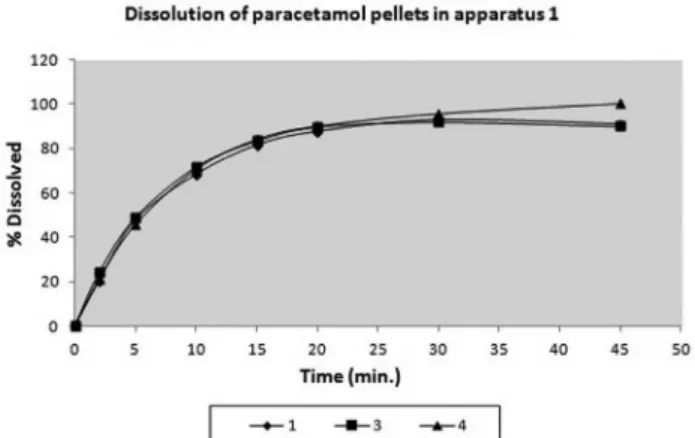
The dissolution of the pellets obtained in the basket (apparatus 1), as proposed by USP 32 ed. (Table VI and
Figure 5), indicated the same tendency as the proile ob -tained by means of the Bio-Dis: the formulations presented
very close dissolution proiles. In fact, we observed that,
with the basket, these values were even closer, almost superimposed, with a slight spread for pellets with PVP, between 10 and 20 minutes of dissolution.
CONCLUSIONS
From the results obtained in this study, it was
ascer-tained that the use of different binders has a signiicant ef
-TABLE V - The dissolved percentage (± standard-deviation) obtained for the formulations containing PVP (1), HPMC (3) and MC (4) and their respective dissolution eficiency values (DE), in Bio-Dis. n = 3
Time (min) 1 3 4
2 38.64 ± 0.1189 45.85 ± 0.1285 45.69 ± 0.0422
5 67.37 ± 0.1279 70.65 ± 0.0756 75.27 ± 0.0173
10 89.46 ± 0.0250 86.40 ± 0.0743 96.60 ± 0.0374
15 100.05 ± 0.0335 95.39 ± 0.0899 106.89 ± 0.0532
20 104.98 ± 0.0628 98.07 ± 0.1546 112.01 ± 0.0144
30 108.07 ± 0.0407 98.01 ± 0.1501 113.86 ± 0.0401
45 108.89 ± 0.0461 97.45 ± 0.1556 113.40 ± 0.0483
DE (%) 69.11 73.86 73.34
TABLE VI - Dissolved percentage (± standard-deviation) obtained for each formulation and the respective dissolution eficiency
values (DE) in apparatus 1 (basket). n = 5
Time (min) 1 3 4
2 20.32 ± 0.0545 24.14 ± 0.0344 21.28 ± 0.0383
5 47.79 ± 0.0721 49.10 ± 0.0594 45.84 ± 0.0404
10 68.27 ± 0.0800 71.86 ± 0.0432 70.80 ± 0.0592
15 81.39 ± 0.1184 83.59 ± 0.0483 84.30 ± 0.0635
20 87.56 ± 0.1590 89.89 ± 0.0655 90.27 ± 0.0422
30 92.80 ± 0.1502 92.09 ± 0.0896 95.88 ± 0.0549
45 90.93 ± 0.0816 90.14 ± 0.0621 100.49 ± 0.0660
DE (%) 68.56 69.31 72.60
FIGURE 5 - Dissolution proiles obtained in apparatus 1 (basket)
for formulations 1, 3 and 4. Medium: phosphate buffer pH 5.8. n=5.
fect on the production of small-diameter pellets containing paracetamol, as well as on some of their physicochemical characteristics, especially density. However, with regards to dissolution, evaluated by two different methods, the formulations all had immediate release characteristics. It was also ascertained that the dissolution test in Bio-Dis seems to be the most adequate for discriminating among formulations, when compared to the basket method.
ACKNOWLEDGEMENTS
The authors are grateful to FINEP (Financiadora de
Estudos e Projetos) for their inancial support.
REFERENCES
ABBASPOUR, M.R.; SADEGHI, F.; AFRASIABI GAREKANI, H. Design and study of ibuprofen disintegrating sustained-release tablets comprising coated pellets. Eur. J. Pharm. Biopharm., v.68, n.3, p.747-759, 2008.
A L H U S B A N , F. ; P E R R I E , Y. ; M O H A M M E D , A . R . Formulation of multiparticulate systems as lyophilized orally disintegrating tablets. Eur. J. Pharm. Biopharm., v.79, n.3, p.627-634, 2011.
AZARMI, S.; ROA, W.; LÖBENBERG, R. Current perspectives in dissolution testing of conventional and novel dosage forms. Int. J. Pharm., v.328, n.1, p.12-21, 2007.
CHEBOYINA, S.; WYANDT, C.M. Wax-based sustained release matrix pellets prepared by a novel freeze pelletization technique I. Formulation and process variables affecting pellet characteristics. Int. J. Pharm., v.359, n.1-2, p.158-166, 2008.
C H O P R A , R . ; A L D E R B O R N , G . ; N E W TO N , J . M . ; PODCZECK, F. The influence of film coating on pellet properties. Pharm. Dev. Technol., v.7, n.1, p.59-68, 2002.
COSTA, F.O.; SOUSA, J.J.S.; PAIS, A.A.C.C.; FORMOSINHO, S.J. Comparison of dissolution proiles of Ibuprofen pellets. J. Control. Release, v.89, n.2, p.199-212, 2003.
COSTA, F.O.; PAIS, A.A.C.C.; SOUSA, J.J.S. Analysis of formulation effects in the dissolution of ibuprofen pellets.
Int. J. Pharm., v.270, n.1-2, p.9-19, 2004.
DOUKOMETZIDIS, A.; MACHERAS, P. A century of dissolution research: from Noyes and Whitney to the Biopharmaceutics Classiication System. Int. J. Pharm., v.321, n.1, p.1-11, 2006.
GHEBRE-SELLASSIE, I. Pharmaceutical pelletization technology. New York: Marcel Dekker, 1989. 274 p.
KHAN, K.A.; RHODES, C.T. The concept of dissolution eficiency. J. Pharm. Pharmacol., v.27, n.1, p.48-49, 1975.
KLEIN, S.; RUDOLPH, M.W.; DRESSMAN, J.B. Drug release characteristics of different mesalazine products using USP apparatus 3 to simulate passage through the GI tract.
Dissolut. Technol., v.9, n.4, p.6-13, 2002.
KRÄMER, J.; GRADY, L.T.; GAJENDRAN, J. Historical development of dissolution tests on the basis of gastrointestinal physiology. In: DRESSMAN, J.; KRÄMER, J. (Eds.). Pharmaceutical dissolution testing. Boca Raton: Taylor & Francis Group, 2005. 429 p.
MAHATO, R.I. Pharmaceutical dosage forms and drug delivery. Boca Raton: Taylor & Francis Group, 2007. 300 p.
P E D E R S E N , A . M . ; B A R D O W, A . ; J E N S E N , S . B . ; NAUNTOFTE, B. Saliva and gastrointestinal functions of taste, mastication, swallowing and digestion. Oral Dis., v.8, n.3, p.117-129, 2002.
PEZZINI, B.R.; SILVA, M.A.S.; FERRAZ, H.G. Formas farmacêuticas sólidas orais de liberação prolongada: sistemas monolíticos e multiparticulados. Braz. J. Pharm. Sci., v.43, n.4, p.491-502, 2007.
PEZZINI, B.R.; FERRAZ, H.G. Bio-Dis and the paddle d i s s o l u t i o n a p p a r a t u s e s a p p l i e d t o t h e r e l e a s e characterization of ketoprofen from hypromellose matrices.
PODEZECK, F.; RAHMAN, S.R.; NEWTON, J.M. Evaluation of a standardized procedure to assess the shape of pellets using image analysis. Int. J. Pharm., v.192, n.2, p.123-128, 1999.
PUND, S.; JOSHI, A.; VASU, K.; NIVSARKAR, M.; SHISHOO, C. Multivariate optimization of formulation and process variables influencing physic-mechanical characteristics of site-speciic release isoniazid pellets. Int. J. Pharm., v.388, n.1-2, p.64-72, 2010.
QIU, Y.; CHEN, Y.; ZHANG, G.G.Z.; LIU, L.; PORTER, W.R.
Developing solid oral dosage forms: pharmaceutical theory and practice. Amsterdam: Elsevier, 2009. 943 p.
SAMAHA, D.; SHEHAYEB, R.; KYRIACOS, S. Modeling and comparison of dissolution proiles of diltiazem modiied-release formulations. Diss. Technol., v.16, n.2, p.41-46, 2009.
SANTOS, H.; VEIGA, F.; PINA, M.; PODEZECK, F.; SOUSA, J. Physical properties of chitosan pellets produced by extrusion-spheronisation: influence of formulation variables. Int. J. Pharm., v.246, n.1-2, p.153-169, 2002.
SOUSA, J.J.; SOUSA, A.; PODCZECK, F.; NEWTON, J.M. Factors inluencing the physical characteristics of pellets obtained by extrusion-spheronization. Int. J. Pharm., v.232, n.1-2, p.91-106, 2002.
SREIE, S.; DREU, R.; SIRCA, J.; PINTYE-HODI, K.; BURJAN, T.; PLANINSEK, O. Physicochemical properties of granulating liquids and their inluence of microcrystalline cellulose pellets obtained by extrusion-spheronization technology. Int. J. Pharm., v.291, n.1-2, p.1-2, p.99-111, 2005.
UNITED STATES PHARMACOPEIA. 32ed. Rockville: United States Pharmacopeial Convention, 2009. 1391 p.
WLOSNEWSKI, J.C.; KUMPUGDEE-VOLLRATH, M.; SRIAMORNSAK, P. Effect of drying technique and disintegrant on physical properties and drug release behavior of microcrystalline cellulose-based pellets prepared by extrusion/spheronization. Chem. Eng. Res. Des., v.88, n.1, p.100-108, 2010.
YU, L.X.; WANG, J.T.; HUSSAIN, A.S. Evaluation of USP apparatus 3 for dissolution testing of immediate-release products. AAPSPharmSci., v.4, n.1, p.1-5, 2002.
Received for publication on 24th January 2012