http://dx.doi.org/10.1590/2317-6431-2015-1662 ISSN 2317-6431
Association between readiness for oral feeding and
feeding performance in preterm neonates
Relação entre prontidão para início da alimentação oral e
desempenho alimentar em recém-nascidos pré-termo
Leila Sauer Prade1, Geovana de Paula Bolzan2, Luana Cristina Berwig1, Raquel Coube de Carvalho Yamamoto1,
Camila Lehnhart Vargas1, Ana Maria Toniolo da Silva3, Angela Regina Maciel Weinmann4
ABSTRACT
Purpose: To verify whether readiness for oral feeding as evaluated by the Preterm Oral Feeding Readiness Scale (POFRAS) is associated with performance on the first oral feeding; length of transition from tube to full oral feeding, and duration of hospitalization. Methods: This was a longitudinal study involving 65 preterm infants. Participants were divi-ded into groups according to readiness for oral feeding as determined by the POFRAS, and gestational age (29-33 weeks and 34-36 weeks). Performance on the first oral feeding (proficiency, transfer rate and overall transfer), number of days from introduction to full independent oral feeding, and length of hospital stay were compared between groups. Continuous variables were compared using Student’s t-test or Wilcoxon’s signed-rank test. Categorical variables were compared using Fisher’s exact test. Results: Readiness for oral feeding was associated with higher proficiency and transfer rates on the first oral feeding, resulting in a shorter transition from tube to independent oral feeding in preterm infants with 29 to 33 weeks of gestational age at birth. Conclusion:
The POFRAS contributed to the prognosis of oral feeding outcomes in preterm neonates with less than 34 weeks of gestational age at bir-th. However, its use does not eliminate the need for an assessment of swallowing mechanisms.
Keywords: Sucking behavior; Infant, Premature; Aptitud; Diagnostic techniques and procedures; Feeding
RESUMO
Objetivo: Verificar se a presença de prontidão para iniciar a alimen-tação oral, obtida por meio do Preterm Oral Feeding Readiness Scale (POFRAS) se relaciona com o desempenho alimentar na primeira oferta oral de leite, com o tempo de transição da sonda para a via oral plena e o tempo de internação hospitalar. Métodos: Estudo longitudinal, que envol-veu 65 recém-nascidos pré-termo. Foi realizada a avaliação da prontidão para início da alimentação oral, por meio do POFRAS, constituindo-se dois grupos: com e sem prontidão para iniciar a alimentação por via oral, em dois estratos de idade gestacional ao nascer: de 28 a 33 semanas e de 34 a 36 semanas. Em cada estrato, os grupos foram comparados entre si, quanto ao desempenho alimentar na primeira oferta oral de leite (por meio das variáveis proficiência, taxa de transferência e desempenho alimentar oral) e quanto ao tempo de transição da sonda para a via oral plena e o tempo de internação hospitalar. O teste t-Student ou o teste de Wilcoxon foram utilizados para comparar as variáveis contínuas e o teste exato de Fisher, para as variáveis categóricas. Resultados: A prontidão para iniciar a alimentação por via oral se relacionou com melhores resultados de profi-ciência e taxa de transferência na primeira alimentação, contribuindo para a transição mais rápida da sonda para a via oral plena, nas crianças nasci-das com idade gestacional entre 28 a 33 semanas. Conclusão: a avaliação por meio do POFRAS permite estabelecer um prognóstico da alimentação oral em recém-nascidos pré-termo, menores de 34 semanas. No entanto, não exclui a necessidade de avaliação da biomecânica da deglutição.
Descritores: Comportamento de sucção; Prematuro; Aptidão; Técnicas e procedimentos diagnósticos; Alimentação
This study was conducted in the Graduate Program in Human Communication Disorders, Universidade Federal de Santa Maria – UFSM – Santa Maria (RS), Brazil. (1) Graduate Program (Doctorate) in Human Communication Disorders, Universidade Federal de Santa Maria – UFSM – Santa Maria (RS), Brazil.
(2) Program (Postdoctorate) in Human Communication Disorders, Universidade Federal de Santa Maria – UFSM – Santa Maria (RS), Brazil. (3) Department of Speech and Language Therapy, Universidade Federal de Santa Maria – UFSM – Santa Maria (RS), Brazil.
(4) Department of Pediatrics and Child Care, Universidade Federal de Santa Maria – UFSM – Santa Maria (RS), Brazil.
Funding:Programa Nacional de Pós-Doutorado (PNPD), Coordenação de Aper feiçoamento de Pessoal de Nível Superior (CAPES).
Conflict of interests: No
Author’s contribution: LSP was responsible for participant assessments and contributed to all stages of manuscript drafting and revision; GPB compiled and analyzed data, and contributed to manuscript drafting and revision; LCB, RCCY, CLV contributed to data collection and manuscript drafting; AMTS and ARMW
supervised the study, analyzed data and revised the manuscript.
Corresponding author: Geovana de Paula Bolzan. E-mail: [email protected]
INTRODUCTION
Preterm neonates (PTN) are often admitted to neonatal intensive care units due to the immaturity of their organs or functions, with circulatory, neurological, thermoregulatory, respiratory and gastrointestinal issues being the most commonly reported(1,2). In most cases, these infants must be fed via tubes
due to their inability to coordinate sucking, swallowing and breathing(3).
The achievement of safe and efficient oral feeding (OF) minimizes the risk of aspiration and consists of a necessary criterion for hospital discharge in PTN(2,4,5,6). The ability or
capability to initiate OF depends on several factors, including weight, the maturation of organs and systems(7), corrected
gestational age(8), clinical status, as well as behavioral
organi-zation state at the time of feeding(9). As a result, it is essential
to evaluate the infant prior to the initiation of OF. Non-nutritive sucking parameters, together with corrected gestational age, posture, muscle tone, and behavioral state, are often used to determine the onset of the transition from tube to OF(10). Several
instruments are available in the literature to assist with this process(10,11,12,13,14,15,16).
The Preterm Oral Feeding Readiness Scale (POFRAS)(10,12)
was developed and validated for use in Brazilian children. It is easy to administer, and allows for an assessment of both physical and behavioral aspects of non-nutritive sucking, which act as indicators of readiness for OF(2). The instrument was
developed using the transfer of 10 ml of milk as a gold stan-dard for adequate OF. However, variables such as proficiency, transfer rate and overall transfer on the first OF have also been used as important quantitative indicators and predictors of rapid attainment of full OF.
Proficiency refers to the volume of milk consumed in the first 5 minutes of the feeding session relative to the total amount prescribed. This variable is considered an indicator of oral motor skill, and is assumed to be unaffected by fatigue given the short time required for its assessment. The transfer rate, sometimes referred to as efficiency, is an indicator of neonate endurance, and is calculated as the ratio of milk con-sumed relative to the length of the feeding session (ml/min). Lastly, the overall transfer describes the percentage of milk consumed relative to the total amount prescribed throughout the entire feeding session (rather than the first 5 minutes). This value accounts for both oral motor skills and endurance(17). In
addition to these variables, the length of the transition from tube to independent OF and the duration of hospitalization are also used as indicators of OF outcomes in preterm in-fants(18,19,20). PTN who present with a more organized sucking
pattern, for instance, consisting of sucking bursts alternated with breathing pauses together with an organized behavioral state, tend to show better proficiency, transfer rates and overall transfer values(21,22), achieving full OF earlier and staying in
hospital for a shorter time than their peers(23) although the
length of hospitalization may also be influenced by additional factors(24).
The aim of the present study was to verify whether rea-diness for OF as assessed by the POFRAS is associated with performance on the first OF, the length of transition from tube to full OF, and the duration of hospitalization.
METHODS
This was an observational, descriptive and longitudinal study involving 65 clinically stable PTN admitted to a neonatal intensive care unit between November 2014 and June 2015. Exclusion criteria consisted of head, neck and/or cardiac mal-formations; genetic syndromes; grade III and IV intracranial hemorrhage; perinatal asphyxia (as defined by a 5-minute Apgar score ≤ 5); bilirubin encephalopathy; pulmonary dysplasia; and shortened or tight frenulum of the tongue.
This study was approved by the Research Ethics Committee of Univeridade Federal de Santa Maria, under protocol num-ber 11155312.7.0000.5346. All parents and/or legal guardians provided written consent for the participation of their children in the study.
Upon meeting criteria for initiating OF as determined by the neonatal care unit (clinical stability, weight of at least 1500 grams and a corrected gestational age of at least 32 weeks), PTN were evaluated by a speech therapist with expertise in neonatal orofacial development using the POFRAS(10,12). For
the assessment, infants were placed in lateral decubitus posi-tion, with upper and lower limbs flexed, and the head in line with the body.
The instrument includes 18 items distributed into five categories. Each item is scored on a scale of zero to 2. Total scores on the POFRAS range from zero to 36, with scores
≥ 30 suggesting readiness for OF and scores <30 indicating insufficient readiness(10,12).
After the administration of the POFRAS, PTN were allowed to rest for 15 minutes prior to engaging in their first OF session. For this procedure, PTN were placed in supine position at a 45 degree angle and their head in midline with the body. Feeding sessions had a maximum duration of 20 minutes, and were inter-rupted upon the identification of any signs of fatigue or distress, such as oxygen desaturation (≤88)(25), bradycardia (≤100)(25),
cya-nosis, apnea, nausea, choking, pallor, skin mottling, hiccupping, vomiting or loss of interest in sucking. The following variables were recorded: volume of milk prescribed, volume consumed in the first 5 minutes of the feeding session, total milk intake, and length of the feeding session. These data were used to calculate the following indicators of feeding performance: proficiency, transfer rate and overall transfer. In the present study, adequate OF was defined as a proficiency of at least 30%, a transfer rate of at least 1.5 ml/min and an overall transfer ≥ 80%(17).
The transition time was calculated as the number of days from the introduction of OF to the first 24-hour period in which all nutrition was taken orally.
The following data were then collected from the medical re-cords of participating infants: weight and gestational age at birth, gender, adequacy of intrauterine growth (small for gestational age, adequate for gestational age and large for gestational age), as well as weight and corrected gestational age at the introduction of OF, the attainment of full OF, and hospital discharge.
Data were stratified according to gestational age at birth (28 to 33 weeks and 34 to 36 weeks). Infants in each age group were then classified according to their readiness for OF (POFRAS scores ≥30 vs. <30).
Data were analyzed using the Stata 10.0 software. Normality was assessed using the Shapiro-Wilk test. Groups were com-pared using Student’s t-tests or Wilcoxon’s signed rank tests for continuous variables, and Fisher’s exact test for categorical variables. Results were considered significant at p<0.05.
RESULTS
PTN in either age group who demonstrated readiness for OF did not differ from those who showed insufficient readiness with regard to gender, adequacy of intrauterine growth, weight and gestational weight at birth, or weight and corrected gestational age at the introduction of OF and hospital discharge. However, PTN with 28 to 33 weeks of age who demonstrated readiness for OF achieved full OF approximately one week earlier, on average, than remaining infants of a similar age (36.4 ±1.4 vs.
35.6 ±1.0 weeks for PTN with scores <30 and ≥30, respectively; p=0.04). The characteristics of infants with POFRAS scores <30 and ≥30 in each age gestational age group, from birth to hospital discharge, are shown in Table 1.
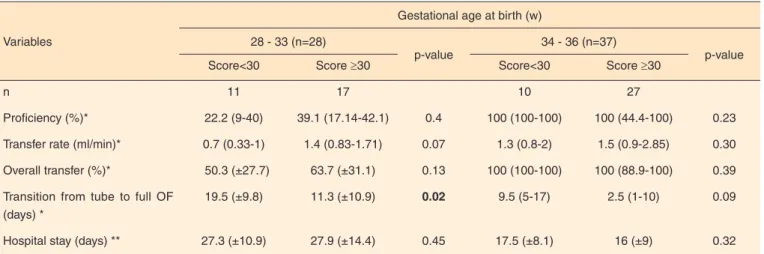
The groups did not differ with regard to proficiency, transfer rates and overall transfer, although PTN in the 28 to 33 age group with insufficient readiness for OF obtained the lowest scores for all three variables. The transition from tube to full
Table 1. Characteristics of PTN from birth to hospital discharge according to POFRAS scores
Variables
Gestational age at birth (w)
28 - 33 (n=28)
p-value
34 - 36 (n=37)
p-value
Score<30 Score ≥30 Score<30 Score ≥30
n 11 17 10 27
Gender (%)
Male 7 (63.6) 11 (64.7) 0.6 4 (40) 20 (74) 0.06
Female 4 (36.4) 6 (35.3) 6 (60) 7 (26)
Adequacy of IUG (n, %)*
SGA 2 (18.2) 3 (17.6) 0.6 3 (30) 10 (37) 0.5
AGA 9 (81.8) 14 (82.4) 7 (70) 17 (63)
At birth
GA (w)** 33.4 (32.4 -33.6) 33 (31.5-33.6) 0.6 35.3 (34.2-35.5) 34.5 (34.2-36) 0.8
Weight (g)*** 1698 (±373) 1736 (±441) 0.4 1855 (1710-2020) 2170 (1690 -2685) 0.9
Beginning of OF
CGA (w)** 34.2 (33.2-34.5) 34.1 (34-34.6) 0.5 35.4 (±0.7) 35.4(±0.9) 0.5
Weight (g)*** 1729 (±292.2) 1829 (±331.4) 0.2 1875.5 (±398) 2053 (±479.9) 0.2
Full OF
CGA (w)*** 36.4 (±1.4) 35.6 (±1) 0.04 37 (±1.5) 36.4 (±1.22) 0.1
Weight (g)*** 2341 (±377) 2226 (±238) 0.2 2270 (±506.5) 2240 (±438.7) 0.4
Hospital discharge
CGA (w)*** 36.5 (±1) 36.4 (±1.4) 0.4 37.6 (±1.3) 37.2 (±1.4) 0.2
Weight (g)** 2410 (2205-2520) 2355 (2140-2545) 0.4 2291 (±631.3) 2461 (±351.3) 0.1
* Values expressed as percentages, analyzed using Fisher’s exact test; ** Values expressed as median and interquartile range, analyzed using Wilcoxon’s signed-rank test; ***Values expressed as mean and standard deviation, analyzed by Student’s t-test
OF, on the other hand, was approximately seven days shorter for PTN who showed readiness for OF than those with insufficient readiness in the 28 to 33 week age group (p=0.02). A similar pattern was observed in the 34 to 36 week age group, but did not reach statistical significance. Although readiness scores were associated with a shorter transition from tube feeding, they did not appear to influence the length of hospitalization. Infant performance on the first OF session, the length of the transition from tube to full OF and the length of hospitalization are shown in Table 2. Data are stratified by PROFAS scores and gestational age at birth.
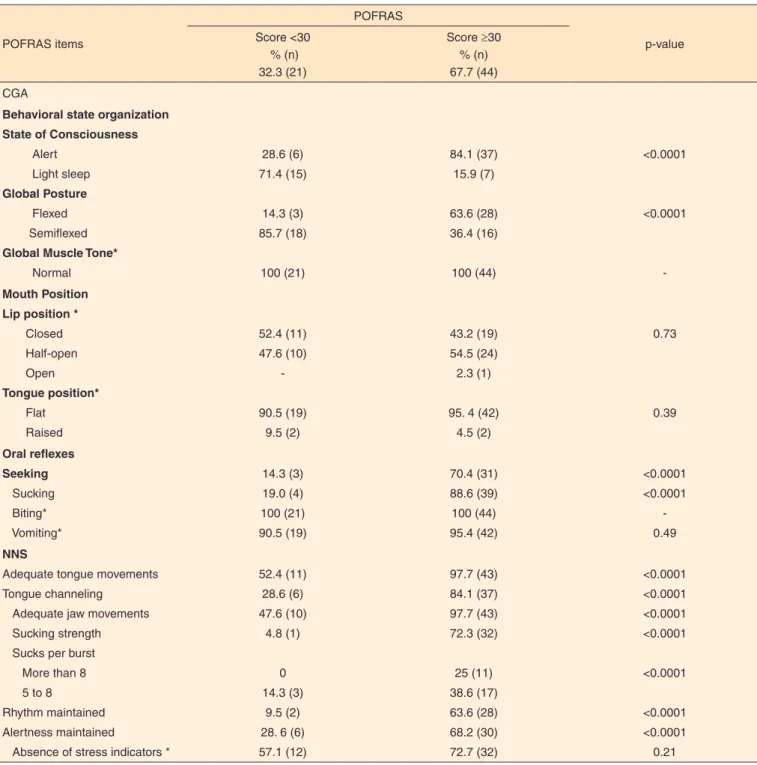
The analysis of PROFAS item scores in infants with total scores ≥30 (readiness for OF) and <30 (insufficient readiness) showed that muscle tone, lip position, biting reflexes, vomiting reflexes and stress indicators did not differ between PTN who demonstrated readiness for OF and those with insufficient readiness. As such, they did not contribute to the assessment of readiness for OF. The results of this analysis are shown in Table 3.
DISCUSSION
Corrected gestational age is considered an important indicator of readiness for OF, although it may not guarantee its efficiency, since the coordination of sucking, swallowing and breathing is closely related to the clinical stability of the neonate(22,25). In the present study, PTN were evaluated
at approximately 34 weeks of corrected gestational age, at which point it is generally believed that infants with normal intrauterine growth are able to engage in OF. However, 39.3% (n=11) of PTN with 28 to 33 weeks of age and 27% (n=10) of PTN with 34 to 36 weeks did not show sufficient readiness for OF according to the POFRAS. These findings underscore the importance of assessment instruments which allow for the
identification of neonates who may require oral motor inter-vention to transition from tube feeding and facilitate the early achievement of independent OF.
The present results showed that PTN with 28 to 33 weeks of age who demonstrated readiness for OF according to the POFRAS achieved full OF at a younger corrected gestational age than their peers (Table 1). A similar pattern was observed in the transition from tube to full OF, which was approximately seven days shorter in children who demonstrated readiness for OF (Table 2). This finding may be attributed to the increased proficiency and transfer rates observed in these individuals, which are much closer to normal values. According to the literature(17,26,27), a proficiency of at least 30% is indicative of
adequate oral skill while a transfer rate of at least 1.5 ml/min suggests sufficient endurance (low fatigue) for OF.
In late PTN, readiness for OF was not associated with feeding performance. However, the length of transition from tube to full OF was approximately seven days longer in infants with insufficient readiness for OF. Although this difference did not reach statistical significance, it has clear clinical relevance due to the importance of early attainment of OF for breastfeeding outcomes and hospital discharge, not least due to the role of independent OF as a necessary criterion for hospital discharge(28).
Overall, it appears that behavioral data and non-nutritive sucking parameters may not be sufficient indicators of success-ful OF(29), since nutritive sucking involves additional processes
such as the coordination of sucking, swallowing and brea-thing(19). As such, readiness for OF should be evaluated based
on both behavioral assessments and an evaluation of swallowing mechanics, so as to provide additional information regarding oral motor interventions in this population.
The present study also examined which POFRAS items would be able to distinguish PTN who demonstrate readiness
Table 2. Performance on first oral feeding session, length of transition from tube to full oral feeding and duration of hospitalization, according to POFRAS score
Variables
Gestational age at birth (w)
28 - 33 (n=28)
p-value
34 - 36 (n=37)
p-value
Score<30 Score ≥30 Score<30 Score ≥30
n 11 17 10 27
Proficiency (%)* 22.2 (9-40) 39.1 (17.14-42.1) 0.4 100 (100-100) 100 (44.4-100) 0.23
Transfer rate (ml/min)* 0.7 (0.33-1) 1.4 (0.83-1.71) 0.07 1.3 (0.8-2) 1.5 (0.9-2.85) 0.30
Overall transfer (%)* 50.3 (±27.7) 63.7 (±31.1) 0.13 100 (100-100) 100 (88.9-100) 0.39
Transition from tube to full OF (days) *
19.5 (±9.8) 11.3 (±10.9) 0.02 9.5 (5-17) 2.5 (1-10) 0.09
Hospital stay (days) ** 27.3 (±10.9) 27.9 (±14.4) 0.45 17.5 (±8.1) 16 (±9) 0.32
* Values expressed as median and interquartile range, analyzed using Wilcoxon’s signed-rank test; **Values expressed as mean and standard deviation, analyzed by Student’s t-test
for OF from those with insufficient readiness. The discriminant validity of the POFRAS was already investigated in a longitudi-nal study of 19 PTN. Infants were administered the instrument when fed exclusively by tube, and reexamined after achieving full OF. Most items differed significantly between assessments, confirming the discriminant validity of the POFRAS. However, posture and muscle tone, lip and tongue position, as well as biting and vomiting reflexes did not differ between time points. As such, the authors suggested that the items be removed from
the POFRAS(30). The present findings revealed that muscle tone,
lip and tongue position, biting and vomiting reflexes, as well as stress indicators did not differ between groups, and as a result, had no discriminant ability. Four of these items were already described in the previous study as having no discriminant validit
(30). The relevance of maintaining these items in the POFRAS
should be evaluated by future research, as it is beyond the scope of the present study.
Table 3. Frequency of item scores in infants with a total POFRAS score <30 (insufficient readiness) and ≥30 (readiness for oral feeding)
POFRAS items POFRAS p-value Score <30 % (n) 32.3 (21)
Score ≥30 % (n) 67.7 (44)
CGA
Behavioral state organization State of Consciousness
Alert Light sleep
Global Posture
Flexed Semiflexed
Global Muscle Tone*
Normal 28.6 (6) 71.4 (15) 14.3 (3) 85.7 (18) 100 (21) 84.1 (37) 15.9 (7) 63.6 (28) 36.4 (16) 100 (44) <0.0001 <0.0001 -Mouth Position Lip position *
Closed Half-open Open Tongue position* Flat Raised 52.4 (11) 47.6 (10) - 90.5 (19) 9.5 (2) 43.2 (19) 54.5 (24) 2.3 (1)
95. 4 (42) 4.5 (2) 0.73 0.39 Oral reflexes Seeking Sucking Biting* Vomiting* 14.3 (3) 19.0 (4) 100 (21) 90.5 (19) 70.4 (31) 88.6 (39) 100 (44) 95.4 (42) <0.0001 <0.0001 - 0.49 NNS
Adequate tongue movements Tongue channeling
Adequate jaw movements Sucking strength Sucks per burst More than 8 5 to 8
Rhythm maintained Alertness maintained
Absence of stress indicators *
52.4 (11) 28.6 (6) 47.6 (10) 4.8 (1) 0 14.3 (3) 9.5 (2) 28. 6 (6) 57.1 (12) 97.7 (43) 84.1 (37) 97.7 (43) 72.3 (32) 25 (11) 38.6 (17) 63.6 (28) 68.2 (30) 72.7 (32) <0.0001 <0.0001 <0.0001 <0.0001 <0.0001 <0.0001 <0.0001 0.21
Fisher’s exact test (p<0.05)
* Items which did not differ between infants who demonstrated readiness for oral feeding and those with insufficient readiness
CONCLUSION
The PROFAS contributed to the prognosis of OF outcomes in PTN younger than 34 weeks of gestational age. However, it does not replace the need for an assessment of swallowing mechanics prior to the onset of OF.
REFERENCES
1. Costa, SP, Engel-Hoek, Bos AF. Sucking and swallowing in infants and diagnostic tools. J Perinatol. 2008;28(4):247-57. http://dx.doi. org/10.1038/sj.jp.7211924
2. Caetano LC, Fujinaga CI, Scochi CGS. Sucção não nutritiva em bebês prematuros: estudo bibliográfico. Rev Lat Am Enfermagem. 2003;11(2):232-36. http://dx.doi.org/10.1590/S0104-11692003000200014
3. Pfitscher AP, Delgado SE. A caracterização do sistema estomatognático, após a transição alimentar, em crianças prematuras de muito baixo peso. Rev Soc Bras Fonoaudiologia. 2006;11(4):215-22.
4. Lau C, Smith EO, Schanler RJ. Coordination of suck-swallow and swallow respiration in preterm infants. Acta Paediatr. 2003;92(6):721-27. http://dx.doi.org/10.1111/j.1651-2227.2003. tb00607.x
5. McCain GC. An evidence-based guideline for introducing oral feeding to healthy preterm infants. Neonatal Netw. 2003;22(5):45-50. http://dx.doi.org/10.1891/0730-0832.22.5.45
6. Briere CE, McGrath J, Cong X, Cusson R. State of the science: a contemporary review of feeding readiness in the preterm infant. J Perinat Neonatal Nurs. 2014;28(1):51-8. http://dx.doi.org/10.1097/ JPN.0000000000000011
7. Lau C, Schanler RJ. Oral feeding in premature infants: advantage of a self-paced milk flow. Acta Paediatr. 2000;89(4):453-9. http:// dx.doi.org/10.1080/080352500750028186
8. Yamamoto RCC, Keske-Soares M, Weinmann ARM. Características da sucção nutritiva na liberação da via oral em recém-nascidos pré-termo de diferentes idades gestacionais. Rev Soc Bras Fonoaudiol. 2009;14(1):98-105. http://dx.doi.org/10.1590/S1516-80342009000100016
9. Prade LS, Bolzan GP, Weinmann ARM. Influencia do estado comportamental nos padrões de sucção de recém-nascidos pré-termo. Audiol Commun Res. 2014;19(3):230-5. http://dx.doi.org/10.1590/ S2317-64312014000300005
10. Fujinaga CI, Moraes SA, Zamberlan-Amorin NE, Castral TC, Silva AA, Scochi CGS. Validação clínica do Instrumento de Avaliação da Prontidão do Prematuro para Início da Alimentação Oral. Rev Lat Am Enfermagem. 2013;21(Spec.):140-5. http://dx.doi.org/10.1590/ S0104-11692013000700018
11. Kish MZ. Oral feeding readiness in preterm infants. Adv Neonatal Care. 2013;13(4):230-7. http://dx.doi.org/10.1097/ ANC.0b013e318281e04e.
12. Fujinaga CI, Scochi CGS, Santos CB, Zamberlan NE, Leite AM. Validação do conteúdo de um instrumento para avaliação da
prontidão do prematuro para início da alimentação oral. Rev Bras Saúde Matern Infant. 2008;8(4):391-9. http://dx.doi.org/10.1590/ S1519-38292008000400004
13. Palmer MM, Crawler K, Blanco IA. Neonatal oral-motor assessment scale: a reliability study. J Perinatol. 1993;13(1):28-35.
14. Fujinaga CI, Rodarte MDO, Amorim NEZ, Gonçalves TC, Scochi CGS. Aplicação de um instrumento de avaliação da prontidão do prematuro para início da alimentação oral: estudo descritivo. Rev Salus-Guarapuava-PR. 2007;1(2):129-37.
15. Thoyre SM, Shaker CS, Pridhan KF. The early feeding skills assessment for preterm infants. Neonat. Network. 2005;24(3):7-16. http://dx.doi.org/10.1891/0730-0832.24.3.7
16. Neiva FCB, Leone C, Leone CR. Non-nutritive sucking scoring system for pre term new borns. Acta Paediatr. 2008;97(10):1370-5. http://dx.doi.org/10.1111/j.1651-2227.2008.00943.x
17. Lau C, Smith EO. A novel approach to assess oral feeding skills of preterm infants. Neonatology. 2011;100(1):64-70. http://dx.doi. org/10.1159/000321987
18. Lessen BS. Effects of the premature infant oral motor intervention on feeding progression and length of stay in preterm infants. Adv Neonatal Care. 2011;11(2):129-39. http://dx.doi.org/10.1097/ ANC.0b013e3182115a2a
19. Crowe L, Chang A, Walace K. Instruments for assessing readiness to commence suck feeds in preterm infants: effects on time to establish full oral feeding and duration of hospitalisation. Cochrane Database of systematic Reviews 2012;CD005586. http://dx.doi. org/10.1002/14651858
20. Bache M, Pizon E, Jacobs J, Vaillant M, Lecomte A. Effects of pre-feeding oral stimulation on oral feeding in preterm infants: a randomized clinical trial. Early Hum Dev. 2014;90(3):125-29. http:// dx.doi.org/10.1016/j.earlhumdev.2013.12.011
21. Pickler RH, Chiaranai C, Reyna BA. Relationship of the First suck burst to feeding outcomes in preterm infants. J Perinat Neonatal Nurs. 2006;20(2):157-62.
22. White-Traut R, Pham T, Rankin K, Norr K, Shapiro N, Yoder J. Exploring factors related to oral feeding progression in premature infants. Adv Neonatal Care. 2013;13(4):288-94. http://dx.doi. org/10.1097/ANC.0b013e31829d8c5a
23. Jefferies AL. Going home: facilitating discharge of the preterm infant. Paediatr Child Health. 2014;19(1):31-6.
24. Flint A, Davies MW, Collie L, Palmer-Field K. Progression from gastric tube feeds to full suckle feeds and discharge home of preterm infants. Aust J Adv Nurs. 2007;25(1):44-8.
25. Ribeiro FGSM. Protocolo para transição da alimentação para via oral em prematuros. In: Furkim AM, Rodrigues, KA. Disfagias nas unidades de terapia intensiva. São Paulo: Roca; 2014. p. 189-99. 26. Lau C, Sheena HR, Shulman RJ, Schanler RJ. Oral feeding in
low birth weight infants. J Pediatr. 1997;130:561-9. http://dx.doi. org/10.1016/S0022-3476(97)70240-3
28. American Academy of Pediatrics. Hospital discharge of the high-risk neonate. Pediatrics. 2008;122(5):1119-26. http://dx.doi. org/10.1053/j.nainr.2013.04.003
29. Ross ES, Browne JV. Feeding outcomes in preterm infants after discharge from the neonatal intensive care unit (NICU): a systematic review. Newborn Infant Nurs Rev. 2013;13(2):87-93. http://dx.doi. org/10.1053/j.nainr.2013.04.003