EFFECTS OF NONNUTRITIVE SUCKING STIMULATION
WITH GLOVED FINGER ON FEEDING TRANSITION
IN VERY LOW BIRTH WEIGHT PREMATURE INFANTS
Efeitos da estimulação da sucção não nutritiva com dedo enluvado na
transição alimentar em recém-nascido prematuro de muito baixo peso
Cláudia MD Moreira(1), Regina PGV Cavalcante-Silva(2), Mitsuru Miyaki(3), Cristina Ide Fujinaga(4)
(1) Universidade Federal do Paraná, Curitiba, PR, Brazil. (2) Department of Pediatrics at Universidade Federal do
Paraná, Curitiba, PR, Brazil.
(3) Department of Pediatrics at Universidade Federal do
Paraná, Curitiba, PR, Brazil.
(4) Department of Speech and Language Therapy at
Universi-dade Estadual do Centro-Oeste do Paraná, Irati, PR, Brazil.
Conlict of interest: non-existent
Upon instituting the Stork Network, the Brazilian Ministry of Health has secured and strengthened a comprehensive care to the newborn at risk, based on principles of quality and humanized care, such as good practices of breastfeeding support and large investments in maternity hospitals which are reference in the country, guaranteeing Neonatal Intensive Care Unit (NICU) beds and Kangaroo beds2.
Preterm infants with gestational age below 28 weeks have been showing increasing survival, despite the forced development of their nervous system under non-physiological and frequently adverse conditions 3. For this population, in addition to the
gastrointestinal maturity, the synchrony between sucking, swallowing and breathing is essential for successful oral feeding 4,5.
When compared with term infants,
breast-feeding of preterm babies is more dificult to be established and maintained. This may be explained
INTRODUCTION
The interest in detecting and preventing develop-mental disorders in premature infants, in whom birth complications impose risk of transitory or permanent
developmental disorders, has intensiied over the
past years. This has promoted a multidisciplinary approach, which lead to a comprehensive and humane care for the infant, in order to favor the global development and the quality of life of the patient, his/ her mother and the entire family1.
ABSTRACT
Purpose: to analyze the inluence of nonnutritive sucking stimulation with the gloved inger technique on readiness and the transition from gastric to oral feeding in very low birthweigth premature infants. Methods: aleatory, prospective, longitudinal, experimental and controlled study in premature infants attended in intense care units in Hospital de Clínicas, with gestational age £ 32 weeks and birth weigths £ 1500g, stable clinical. Newborns were randomly distributed in two groups: the control group, without
stimulation NNS and the experimental group with stimulation NNS with gloved inger, three time for
day, three days in the week. There were measured criteria such as the score of oral feeding readiness evaluation, stress signs during oral feeding and time of transition from gastric to oral feeding. Results:
when compared the experimental group with the control group, it was observed a signiicantly higher
score in the preterm infant oral feeding readiness evaluation, lower of signs of stress and a shorter time of transition from gastric to oral feeding. Conclusion: the NNS stimulation with the gloved inger technique, improved preterm infant oral feeding readiness, reduced stress signals frequency while oral
feeding and inluenced the time of feeding transition in the experimental group when compared to the
control group.
were not considered as exclusion criteria, since the
sucking function in this population is immature due to the infant’s own condition when compared with term infants; its development should occur through
maturity and experience10.
The newborns were randomly and equally
distributed into two groups: Experimental Group
(EG), comprised of infants who received a 10-minute
NNS stimulation with a gloved inger before feeding,
three times a day, thrice a week, with the newborn
on a supine, semilexed position receiving perioral
and oral stimulation11 and the Control Group (CG),
which included infants who did not receive NNS stimulation.
To start receiving oral feeding, the newborns underwent evaluation with an instrument to assess readiness to commence suck feeds in preterm infants. We considered the infant ready to start nutritive sucking (NS) when he/she had achieved a score above 28 points 12.
For preterm infants who were ready to start oral feeding, we offered 05 mL of human breast milk to observe whether signs of distress would occur during NS.
During the feeding transition phase, the nursing team was in charge of offering the milk and collecting information regarding the feeding transition period, starting from the beginning of oral feeding simul-taneously to the feeding via gastric tube, until the gastric tube was totally removed. The removal of the tube followed routine criteria of the NICU, such as effective breastfeeding or total oral acceptance of the offered volume in the absence of the mother. The speech and language therapist conducting the research supervised all newborns during breast-feeding until discharge.
The data were entered in an electronic
spread-sheet (Microsoft Excel®), checked and exported to the software Statistica®. The difference between
continuous variables was assessed by Student’s t test, Mann-Whitney and Anova for repetitive
measures, with minimal signiicance level set at 5%.
RESULTS
During the study, 122 preterm infants with very low birth weight were admitted to the NICU of a public teaching hospital in Paraná. Of these, 47
newborns were excluded due to the occurrence of
bronchopulmonary dysplasia (n=8), sepsis (n=3), respiratory or hemodynamic instability on enrollment or during the study (n=28), intraventricular hemor-rhage grades 3 or 4 (n=3), necrotizing enterocolitis (n=4) and 5-minute Apgar below 5 (n=1). Thirty ive
newborns died before enrollment in the study. The
inal cohort was comprised of 40 newborns (20
by a prolonged separation between mother and infant, inadequate management by breastfeeding
support professionals, dificulties in establishing and
maintaining the production of breast milk due to
maternal anxiety and stress, maternal insecurities
regarding the quality of the breast milk, immature feeding behavior of the preterm infant (mainly those with birth weight below 1500 g or below 32 weeks of
gestational age), and by the inluence of the method
used to transition to oral feeds 4-6.
Nonnutritive sucking (NNS) has been shown to
be beneicial by minimizing the sensorial deprivation
and preparing the preterm infant for early, safe and effective oral feeding 7,8. Performing NNS stimulation
before feeding allows the preterm infant to achieve an appropriate behavioral state and to be able to organize and coordinate the sucking movements 7-9.
Very low weight preterm newborns frequently
present dificulty in establishing the feeding function. It
is believed that the stimulation of the NNS can improve the readiness of these infants to an earlier safe and effective feeding.
Therefore, the aim of this study was to analyze
the effects of NNS stimulation with the gloved inger
technique on the establishment and transition from gastric to oral feeding in very low weight preterm infants.
METHODS
This study was approved by the Committee on Ethics in Human Research at Hospital de Clínicas da Universidade Federal do Paraná, registered with the number 1426.091/2007-05. It has been charac-terized as a randomized, prospective, longitudinal,
experimental and controlled study.
The cohort was selected from preterm infants admitted to the NICU of Hospital de Clínicas da Universidade Federal do Paraná, a teaching hospital, between July 2007 and March 2008.
The inclusion criteria consisted of birth weight
£1500 g, gestational age at birth ≤32 weeks,
5-minute Apgar score above 6, clinical (respiratory and hemodynamic) stability on enrollment and during the study, initiation of enteral feeding by oral or nasogastric tube associated or not with paren-teral nutrition, and Free and Informed Consent
Form signed by the parents. We excluded patients
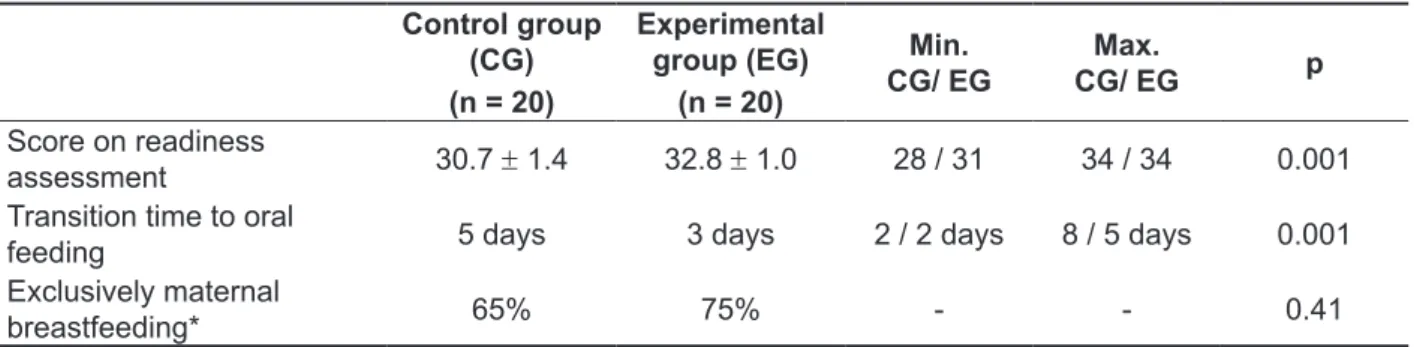
In terms of establishment and transition of the feeding, the scores on the instrument to assess
readiness to commence suck feeds were signiicantly
lower in the CG when compared with the EG. Also, the time to transition from gastric to oral feeding was
signiicantly lower in the EG versus the CG. There was no statistically signiicant difference between groups in rates of exclusive maternal breastfeeding on
hospital discharge (Table 2).
As for the occurrence of distress signals during NS, we observed that they were more frequent in the CG when compared with the EG. The most frequent distress signals were tongue tremor, chest indrawing, chocking and changes in skin color (Table 3).
females) randomly and equally distributed in groups CG and EG.
Mean maternal age was 26.3 ± 8.4 years in the CG group and 24.3 ± 5.7 years in the EG group. Both groups had similar rates of maternal obstetric complications, including hypertensive disorders of pregnancy, maternal-related preterm labor, premature rupture of membranes, preterm labor of unknown cause and placental abruption.
Gestational age and birth weight on study inclusion were also similar between both groups, showing that both cohorts were equally distributed on enrollment (Table 1).
Table 1 - Gestational age and birth weight according to the studied group
Control group (n = 20)
Experimental group
(n = 20) p
Gestacional age (weeks) 29.9 ± 1.6 30.1 ± 1.3 0.79 Birth weight (grams) 1256.5 ± 238.7 1306.7 ± 167.8 0.44
Student’s t test p< 0.05
Table 2 – Feeding transition according to the studied group
Control group (CG) (n = 20)
Experimental group (EG)
(n = 20)
Min. CG/ EG
Max.
CG/ EG p Score on readiness
assessment 30.7 ± 1.4 32.8 ± 1.0 28 / 31 34 / 34 0.001 Transition time to oral
feeding 5 days 3 days 2 / 2 days 8 / 5 days 0.001
Exclusively maternal
breastfeeding* 65% 75% - - 0.41
Mann-Whitney test *Pearson’s chi-square test p< 0.05
Table 3 – Occurrence of distress signals
Control group (n=20)
Experimental group
(n=20) p
Occurrence of distress signals 50% 20% 0.04
Tongue tremor† 5 3
-Chest indrawing† 4 4
-Chocking† 3 1
-Changes in skin color† 3 -
occurrence of a higher frequency of distress signals in the CG may have occurred due to lack of previous
experience13 and better organization of the sucking
pattern 8-26.
The NNS associated with oral stimulation and the way in which the milk is offered may contribute to improve the rates of maternal breastfeeding 9. In
our study, there was no difference in the rates of
exclusive maternal breastfeeding between groups
on hospital discharge.
Considering the population analyzed in our study, with the presence of neonatal disorders associated with prematurity and the factors that hinder the success of breastfeeding such as maternal stress and separation between mother/infant, we observed
that the rate of exclusive maternal breastfeeding in both groups on discharge was high. This inding
strengthens the idea that the intervention, not only from the speech and language therapist, but from the health team as a whole on the work with the mother, the infant and the family in all processes of recovery of the child, and due to the care policies offered by the Clinical Hospital, which is a Child-Friendly Hospital, helped the success of the breastfeeding.
This inding is similar to that of a study that observed
a higher rate of maternal breastfeeding in preterm
infants when compared with term infants, explained
by the work conducted by the multidisciplinary team that assisted the premature infants, their mothers and family members, offering orientation and support necessary for maternal breastfeeding 27.
In the NICU of a teaching hospital, it is routine to use a cup to transition feeding in newborns who do not present physical and behavioral criteria to make this transition directly to the maternal breast.
We chose the NNS technique using a gloved
inger and syringe to evaluate the NS and to make the
feeding transition in our study, with this population of premature infants, with the aim of observing the use of this alternative method. Although applied in many NICUs, this is a controversial method since the
technique lacks proper clariication. This research
did not aim at evaluating the method itself, but we found that there is need for more studies about the use of alternative methods of feeding transition for preterm infants who are unable to directly breastfeed.
In this study, we hypothesized that the suck of
the inger with the syringe would be the closest
possible model to the physiological pattern, not
inluencing negatively the success of the maternal
breastfeeding, since this is a population that needs functional oral stimulation, apart from the need to have their diet offered in a secure and effective way. We also relied on the perception of the method by the team, since it is recognized the importance of
DISCUSSION
The presence of a speech and language therapist in the NICU is no longer restricted to isolate cases,
but have rather expanded to preventive interven
-tions directed towards the preterm infant aiming at stimulating and initiating early oral feeding. The
increase in the number of scientiic studies in this challenging area has conirmed with satisfactory
results the importance of a multidisciplinary approach towards the earliest possible start and continuation of breastfeeding.
In this study, the NNS stimulation accelerated the transition from gastric to oral feeding, and seemed to facilitate the development of sucking movements,
relected by the neurobehavioral maturation and
organization of the preterm infant and corroborating
the indings from other studies 7-9,11-13.
The technique used for NNS stimulation in our study is comparable to the one applied in another
study which suggests the use of a gloved inger to
enhance the sensibility to the intraoral movements of the preterm infant, allowing a more functional stimu-lation11, and preventing the use of nipples for
stimu-lation, strengthening public policies of promoting, protecting and supporting breastfeeding.
As for the evaluation of readiness to feed orally, our study showed that the NNS stimulation favored
a previous sucking experience and inluenced
positively the newborns towards aspects of behav-ioral organization, providing a better oral feeding performance13-21.
The use of a validated and reliable instrument to objectively assess readiness to initiate oral feeds 6,12, 22 brings conidence to the health team,
since it determines with precision the best moment to initiate the transition, with the advantage of using an evaluation that encompasses factors such as maturity, posture and global tonus, posture and oral
relexes, and motor abilities 22.
Another relevant result demonstrated in this study was the time of transition from gastric to oral
feeding, which was signiicantly shorter in the EG (3
days) when compared with the CG (5 days). Similar results have been reported in other studies15-24.
Premature newborns are often unable to integrate the sensorial stimulation due to the immaturity of the nervous system and present some signs indicating their limits, which are called distress signals 11. Newborns in the CG presented an
increased frequency of these distress signals when compared with those in the EG. These results may have occurred because the infants in the EG had improved readiness for oral feeding and better
physi-ological stability during NS since they were exposed
oral feeding makes the assistance of low weight newborns more secure and effective both for the infant, as well as for the health team.
CONCLUSION
The NNS stimulation using a gloved inger in
premature newborns improved the readiness to initiate oral feeding, reduced the frequency of distress during NS and reduced the time to transition to oral feeds in the EG when compared with the CG. the support of all the professionals who care for the
binomial mother/infant, for a conscious use of the alternative method of feeding aiming primarily at stimulating sucking and adjusting the oral patterns
for establishing exclusive maternal breastfeeding as
early as possible.
Conducting this study and reviewing others
allowed us to verify the beneits of the NNS stimu
-lation on the establishment and transition to oral feeding in the preterm infant, and to corroborate that the use of a validated instrument with adequate reliability to evaluate the readiness to initiate
RESUMO
Objetivos: analisar os efeitos da estimulação da sucção não nutritiva com a técnica do dedo enluvado,
sobre o início e a transição alimentar da via gástrica para a via oral em prematuros de muito baixo
peso. Métodos: estudo aleatório, prospectivo, longitudinal, experimental e controlado, que incluiu 40 prematuros internados na UTI Neonatal do Hospital de Clínicas, com idade gestacional £ 32 semanas e peso de nascimento £ 1500g, clinicamente estáveis. Os prematuros foram distribuídos
aleatoria-mente, por meio de sorteio, em 2 grupos: grupo controle, sem SNN e grupo experimental, com SNN
com dedo enluvado, 3 vezes ao dia, 3 dias na semana. Foram avaliados critérios quanto ao escore da avaliação da prontidão para início da alimentação oral, intercorrências durante a sucção nutritiva (SN) e o tempo de transição alimentar. Resultados: quando comparado o grupo experimental em relação
ao grupo controle observou-se um escore signiicantemente maior na avaliação da prontidão para
início da alimentação via oral, uma menor frequência de sinais de estresse durante a sucção nutritiva e um menor tempo de transição alimentar da via gástrica para via oral. Conclusão: a estimulação da sucção não nutritiva com a técnica do dedo enluvado melhorou a prontidão do prematuro para início da alimentação via oral, diminuiu a frequência dos sinais de estresse durante a alimentação via oral e
reduziu o tempo de transição alimentar no grupo experimental quando comparado ao grupo controle.
DESCRITORES: Prematuro; Sucção; Aleitamento Materno
REFERENCES
1. Caetano LC, Fujinaga CI, ScochI CGS. Sucção não nutritiva em bebês prematuros: estudo
bibliográico.Rev Latinoam Enferm. 2003;11:232-6.
2. BRASIL. Ministério da Saúde. Portal da Saúde. Rede Cegonha. Manual prático para a implementação da Rede Cegonha. Brasília, 2013. Disponível em: www.saude.mt.gov.br/arquivo/3062. Acesso em: 24/06/2013.
3. Kenner C, Diaz PF, Valdebenito MR. The transition from tube to nipple in the premature newborn. Newborn and Infant Nursing Reviews. 2007;7(2):114-9.
4. Aquino RR, Osório MM. Alimentação do recém-nascido pré-termo: métodos alternativos de transição
da gavagem para o peito materno. Rev Bras Saúde Matern Infant. 2008;8(1):11-6.
5. Lau C, Smith EO, Schanler RJ. Coordination of suck-swallow and swallow-respiration in preterm infants. Acta Paediatr. 2003;92:721-7.
6. Scochi GS, Gauy JS, Fujinaga CI, Fonseca LMM, Zamberlan NE. Transição alimentar por via oral em prematuros de um hospital amigo da criança. Acta Paul Enferm. 2010;23(4):540-5.
7. Fucile S, Gisel EG, Lau C. Effect of an oral stimulation program on sucking skill maturation of preterm infants. Dev Med Child Neurol. 2005;47:158-62.
19. Mattes RD, Maone T, Wager-Page S, Beauchamp J, Bernbaum J, Stallings V et al. Effects on sweet taste stimulation on growth and sucking in preterm infants. J Obstet Gynecol Neonatal Nurs.1996;25:407-14.
20. Rocha AD, Moreira MEL, Pimenta HP, Ramos
JRM, Lucena SL. A randomized study of the eficacy
of sensory-motor-oral stimulation and nonnutritive sucking in very low birthweigth infant. Early Hum Dev.2007;83:385-8.
21. Calado DFB, Souza R Intervenção fonoaudiológica em recém-nascido pré-termo: estimulação oromotora e sucção não-nutritiva.Rev. CEFAC. 2012; 14(1):176-81
22. Moura LTL, Tolentino GM, Costa TLS, Aline A. Atuação fonoaudiológica na estimulação precoce da sucção não-nutritiva em recém-nascidos pré-termo. Rev CEFAC. 2009;11(Supl3):448-56.
23. Fujinaga CI, Scochi CGS, Santos CB, Zamberlan NE, Leite AM. Validação do conteúdo de um instrumento para avaliação da prontidão do prematuro para início da alimentação oral. Rev. Bras. Saude Mater. Infant. 2008;8(4):391-9.
24. Sehgal SK, Prakash O, Gupta A, Mohan
M Anand NK. Evaluation of beneical effects of
nonnutritive sucking in preterm infants. Indian Pediatr.1990;27:263-6.
25. Bauer MA. Condições fonoaudiológicas, taxa
de transferência e competência alimentar de recém-nascidos prematuros na liberação da via
oral. [Monograia]. Santa Maria (RS): Universidade
Federal de Santa Maria; 2006.
26. Costa PP, Ruedell AM, Weinmann ARM,
Keske-Soares M. Inluência da estimulação
sensório-motora-oral em recém-nascidos pré-termo. Rev. CEFAC. 2011;13(4):599-606.
27. Case-Smith J, Cooper P, Scala V. Feeding
eficiency of premature neonates. Am J Occup Ther.
1989;43:245-50.
28. Silva WF,Guedes ZCF. Tempo de aleitamento
materno exclusivo em recém-nascidos prematuros
e a termo. Rev. CEFAC. 2012. ahead of print. 9. Pimenta HP, Moreira MEL, Rocha AD, Gomes
Junior SC, Pinto LW, Lucena SL. Efeitos da sucção
não nutritiva e da estimulação oral nas taxas de
amamentação em recém-nascidos pré-termos
de muito baixo peso ao nascer: um ensaio clínico
randomizado. J. Pediatr. 2008;84(5):423-7.
10. Fujinaga CI, Duca AP, Petroni RACL, Rosa CH. Indicações e uso da técnica “sonda-dedo”. Rev CEFAC. 2012;14(4):721-4.
11. Neiva FCB. Análise evolutiva do padrão de
sucção e da inluência da estimulação através da
sucção não-nutritiva em recém-nascidos pré-termo.
[Tese]. São Paulo (SP):Faculdade de Medicina,
Universidade de São Paulo; 2003.
12. Fujinaga CI, Zamberlan NE, Rodarte MDO, Scochi CGS. Reliability of an instrument to assess the readiness of preterm infants for oral feeding ( original
title: Coniabilidade do instrumento de avaliação da
prontidão do prematuro para alimentação oral). Pró-fono R Atual. Cient. 2007;19(2):143-50.
13. Pickler RH, Frankel HB, Walsh KM, Thompson NM. Effects of nonnutritive sucking on behavioral organization and feeding performance in preterm infants. Nurs Res.1996;45:132-5.
14. Yu M, Chen Y. The effects of nonnutritive sucking on behavioral state and feeding in premature infants before feeding. Nurs Res.1999;7:468-78.
15. Mccain GC, Gartside PSP, Greenberg J M, Lott JW. A feeding protocol for health preterm infants that shortens time to oral feeding. J Pediatr. 2001;139(3):374-9.
16. Pinelli J, Symington A. Non-nutritive sucking for promotion physiologic stability and nutrition in preterm infants. Cochrane Database Syst Rev. 2001;(3):Cd001071.[ atualizada em 2005 Oct
19;(4);acesso em 2008 Oct 23]
17. Disponível em http://www.ncbi.nlm.nih.gov/ pubmed/16235279
18. Neiva FCB, Leone CR. Efeitos da estimulação da sucção não-nutritiva na idade de início da alimentação via oral em recém-nascidos pré-termo. Rev Paul Pediatr. 2007;25(2):129-34.
Received on: October 10, 2012 Accepted on: August 08, 2013
Mailing address: Cláudia M. D. Moreira Rua E no. 21 – Vila Mariana Cáceres – MT
CEP: 78200-000