RBCCV 44205-1507 DOI: 10.5935/1678-9741.20130085
Development of cardioplegic solution without
potassium: experimental study in rat
Desenvolvimento de solução cardioplégica sem potássio: estudo experimental em ratos
Karla Reichert
1, Helison Rafael Pereira do Carmo
1, Fany Lima
1, Anali Galluce Torina
1, Karlos
Alexandre de Souza Vilarinho
1, PhD; Pedro Paulo Martins de Oliveira
1, PhD; Lindemberg Mota
Silveira Filho
1, PhD; Elaine Soraya Barbosa de Oliveira Severino
1, PhD; Orlando Petrucci
1, MD, PhD
1Faculdade de Ciências Médicas da Universidade Estadual de Campinas
(FCM-Unicamp), Campinas, SP, Brazil.
Work carried out at the Universidade Estadual de Campinas (Unicamp), Fac-uldade de Ciências Médicas, Campinas, SP, Brazil.
This work was funded by Fundação de Amparo a Pesquisa do Estado de São Paulo (FAPESP) grant number 2012/09130-1
Correspondence address: Orlando Petrucci
Rua João Baptista Geraldi, 135 – Campinas, SP Brazil – Zip code: 13085-020
E-mail: [email protected]
Article received on May 21th, 2013 Article accepted on September 9th, 2013 Abstract
Introduction: Myocardial preservation during open heart surgeries and harvesting for transplant are of great importance. The heart at the end of procedure has to resume its functions as soon as possible. All cardioplegic solutions are based on potas-sium for induction of cardioplegic arrest.
Objective: To assess a cardioplegic solution with no potas-sium addition to the formula with two other commercially avai-lable cardioplegic solutions. The comparative assessment was based on cytotoxicity, adenosine triphosphate myocardial pre-servation, and caspase 3 activity. The tested solution (LIRM) uses low doses of sodium channel blocker (lidocaine), potassium channel opener (cromakalin), and actin/myosin cross bridge inhibitor (2,3-butanedione monoxime).
Methods: Wistar rats underwent thoracotomy under mechani-cal ventilation and three different solutions were used for "in situ" perfusion for cardioplegic arrest induction: Custodiol (HTK), Braile (G/A), and LIRM solutions. After cardiac arrest, the hearts
were excised and kept in cold storage for 4 hours. After this period, the hearts were assessed with optical light microscopy, myocardial ATP content and caspase 3 activity. All three solutions were evalua-ted for direct cytotoxicity with L929 and WEHI-164 cells.
Results: The ATP content was higher in the Custodiol group compared to two other solutions (P<0.05). The caspase activity was lower in the HTK group compared to LIRM and G/A solu-tions (P<0.01). The LIRM solution showed lower caspase acti-vity compared to Braile solution (P<0.01). All solutions showed no cytotoxicity effect after 24 hours of cells exposure to cardio-plegic solutions.
Conclusion: Cardioplegia solutions without potassium are promised and aminoacid addition might be an interesting stra-tegy. More evaluation is necessary for an optimal cardioplegic solution development.
INTRODUCTION
Elective cardiac arrest was irst performed by global
myocardial ischemia with aortic cross-clamping in
combina-tion with hypothermia, as reported by Lewis & Tauic [1].
Since then, complex open-heart surgeries with longer aortic cross-clamp periods have been developed. However, the use of longer cross-clamp periods has increased the incidence of
ischemia/reperfusion injury. In 1955, Melrose et al. [2] intro -duced the concept of pharmacologic cardiac arrest, named cardioplegia, which could be obtained by using a solution with a high potassium concentration. Cardioplegic solutions with moderate potassium concentrations were introduced into surgical practice in the mid-1970s and have remained the
gold standard for myocardial protection [3,4]. Today, most
cardiac surgeries are performed by cardiopulmonary bypass with pharmacologic cardioplegic arrest.
The elevated extracellular potassium level provided by the cardioplegic solution shifts the resting myocyte membra-ne potential from -85 mV to a range between -65 and -40 mV. This shift inactivates the fast sodium channels, thereby blocking conduction of the myocardial action potential and inducing a “depolarized” arrest. However, an inward non-i-nactivating sodium “window” current occurs at these higher
membrane potentials [5,6]. This condition can lead to intra -cellular sodium loading and calcium overload of the
myocy-te, resulting in contracture and cell death [7].
Abbreviations, acronyms & symbols
ANOVA Analysis of variance ATP Adenosine triphosphate
G/A Glutamate/aspartate cardioplegic solution HE Hematoxylin and eosin
HTK Histidine-tryptophan cardioplegic solution
The relative beneits provided by different cardioplegic
solutions remain unclear. We idealized a new, potassium-free cardioplegic solution, named LIRM solution, containing: cro-makalim, a potassium adenosine triphosphate (ATP)-channel opener that causes hyperpolarization of the cell membrane
and coronary artery vasodilation [8]; lidocaine, a sodium-channel blocker that inhibits sodium inlux into the myocyte and depolarization of the cell membrane [9]; and 2,3-butane
-dione, a direct myoilament inhibitor that prevents myocyte contraction by desensitizing the myoilament calcium [10].
In the present study, we tested the myocardial protection af-forded by the LIRM solution in terms of the ATP myocardial content and caspase 3 activity, which are important factors for short- and long-term outcomes for heart transplant and
conventional open-heart surgeries [4,11-13]. We compared
the myocardial protection results among the LIRM, histidi-ne-tryptophan (HTK), and glutamate/aspartate (G/A) cardio-plegic solutions after 4 hours of cold storage.
METHODS
Surgical protocol
Wistar male rats (250-350 g) were anesthetized by intra-peritoneal injection of sodium thiopental (150 mg/kg). The protocol design in this study was intended to recreate the heart situation after aortic clamp release and right before heart reper-fusion. The animals underwent tracheostomy and were
mecha-Resumo
Introdução: Preservação do miocárdio durante cirurgias cardíacas abertas e de colheita para transplante são de grande importância. O coração ao inal do processo tem de retomar as suas funções, logo que possível. Todas as soluções cardioplégicas são baseadas em potássio, para indução de parada cardioplé-gica.
Objetivo: Comparar a uma solução cardioplégica sem adi-ção de potássio à sua fórmula com duas outras soluções cardio-plégicas disponíveis comercialmente. A avaliação comparativa foi baseada na citotoxicidade, preservação miocárdica (adeno-sina trifosfato, ATP) e atividade da caspase 3. A solução testada (LIRM) utiliza baixas doses de bloqueador de canal de sódio (li-docaína), abridor do canal de potássio (cromacalina) e inibidor da ponte actina / miosina (2,3-butanodiona monoxima).
Métodos: Ratos Wistar foram submetidos à toracotomia sob ventilação mecânica e três soluções diferentes foram utilizadas para perfusão in situ para a indução de parada cardioplégica: soluções Custodiol (HTK) Braile (G/A) e LIRM. Após parada cardíaca, os corações foram retirados e mantidos em câmara fria por 4 horas. Após esse período, o coração foi avaliado com microscopia de luz ótica, o conteúdo de ATP miocárdico e ativi-dade da caspase 3. Todas as três soluções foram avaliadas quan-to à ciquan-toquan-toxicidade direta com células L929 e WEHI-164.
Resultados: A quantidade de ATP foi maior no grupo Custo-diol em comparação às com outras duas soluções (P<0,05). A ati-vidade de caspase foi menor no grupo HTK quando comparado às soluções LIRM e G/A (P<0,01). A solução LIRM demonstrou menor atividade da caspase em comparação à solução Braile (P<0,01). Todas as soluções não mostraram qualquer efeito de citotoxicidade após 24 horas de exposição das células às soluções cardioplégicas.
Conclusão: Soluções cardioplégicas sem potássio são uma perspectiva e a adição de aminoácido pode ser uma estratégia interessante. Mais avaliações são necessárias para o desenvolvi-mento ideal da solução cardioplégica.
nically ventilated (Minivent, Harvard Apparatus, Holliston, MA, USA). The chest was opened with a median sternotomy, the right carotid artery was catheterized, and the transverse aortic arch was isolated between the brachiocephalic artery and the left carotid artery. The transverse arch was tied, and cardioplegic solution was injected at an infusion rate of 5 mL/ min. The total dose for arresting the heart was recorded. Three different cardioplegic solutions were evaluated.
The heart was excised and kept at 4oC for 4 hours, simu-lating the period of arrest for a transplant or a long period of aortic cross-clamp time. At the end of this period, the heart was snap-frozen in liquid nitrogen. A sample tissue of each group was evaluated with hematoxylin and eosin (HE) stai-ning for gross assessment of the cell anatomy.
All procedures were performed in accordance with the “Guide for the Care and Use of Laboratory Animals” pu-blished by the US National Institutes of Health (NIH Publi-cation No. 85-23, revised 1996) and the Brazilian Council in Animal Experimentation (COBEA).
Cardioplegic solutions
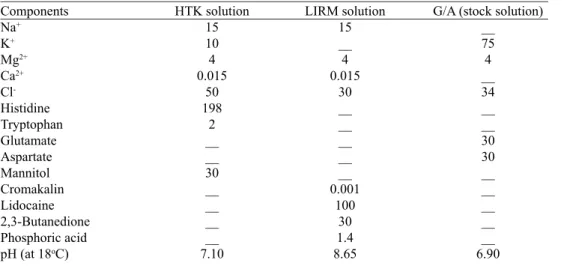
The compositions of the tested cardioplegic solutions are shown in Table 1. The G/A solution (Braile Biomédica, São José do Rio Preto, Brazil) was diluted to 1% before delivery to the heart.
Determination of the myocardial ATP and caspase 3 activity levels
Myocardial tissue was removed from the liquid nitrogen, kept in the same proportion of extraction buffer, and homo-genized with 25 mM Tris-HCL, 150 mM NaCl, 1% NP-40,
1% sodium deoxycholate, and 0.1% SDS. The homogenized tissue was centrifugated at 10,000 × g for 40 minutes at 4oC. The supernatant was used for ATP assessment. Myocardial ATP levels were assessed with the ENLITEN ATP assay system (Promega, Madison, WI, USA) and a Glomax 20/20
(Promega) for bioluminescence quantiication, according to
the manufacturer’s instructions. The ATP level was measured relative to ATP standards provided by the manufacturer. The caspase 3 activity (in relative units of activity) was assessed with the Caspase-Glo 3 Assay (Promega), according to the manufacturer’s instructions.
Determination of cytotoxicity
L929 cells (Genetech Inc. South San Francisco, CA, USA) were incubated at 37oC under an atmosphere of 5% CO2. Cardioplegic solutions were added to the cultured cells at progressive dilutions, and the cells were evaluated 24 hou-rs later. The cell viability was assessed with the MTT (di-methylthiazol-2-yl)-2,5-diphenyltetrazolium bromide) colo-rimetric method. Readings were performed at a wavelength
of 550 nm [14].
Statistical analysis
All values were expressed as the mean ± standard devia-tion (SD). Variables were tested for normal distribudevia-tion. One--way analysis of variance (ANOVA) or Kruskal-Wallis test was applied where appropriate. Differences with a P-value <
0.05 were considered statistically signiicant. All graphs and
statistical analyses were performed with the GraphPad Prism version 6 software package for the Mac OS X (GraphPad Software, La Jolla, CA, USA).
Table 1. Compositions of the tested cardioplegic solutions.
Components Na+ K+ Mg2+ Ca2+ Cl -Histidine Tryptophan Glutamate Aspartate Mannitol Cromakalin Lidocaine 2,3-Butanedione Phosphoric acid pH (at 18oC)
HTK solution 15 10 4 0.015 50 198 2 __ __ 30 __ __ __ __ 7.10 LIRM solution 15 __ 4 0.015 30 __ __ __ __ __ 0.001 100 30 1.4 8.65
G/A (stock solution) __ 75 4 __ 34 __ __ 30 30 __ __ __ __ __ 6.90
RESULTS
The animals showed comparable weights. Compared to the HTK and G/A solutions, less volume of LIRM solution was needed to achieve cardiac arrest (P=0.008) (Table 2).
Histological indings
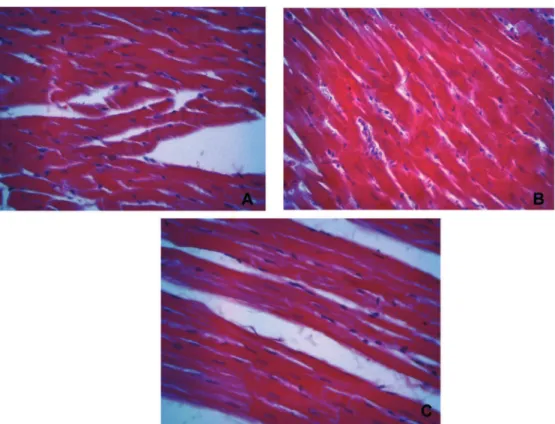
The HE plates of the three cardioplegic solutions
showed similar indings, with no gross disruption of the
cell architecture or edema after 4 hours of cold preservation (Figure 1).
ATP myocardial content and caspase 3 activity levels
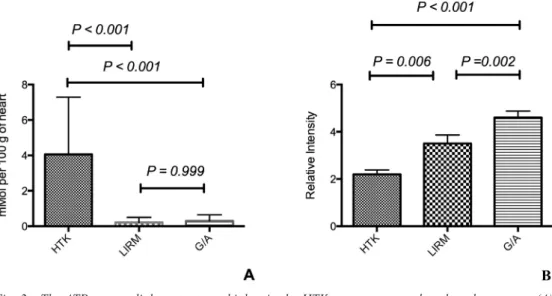
The ATP myocardial content after 4 hours of cold storage was higher in the HTK solution group, with no differences be-tween the LIRM and G/A groups (Figure 2A). The caspase 3 activity was higher in the G/A group compared to that of the LIRM and HTK groups, whereas the LIRM group showed hi-gher caspase activity compared to the HTK group (Figure 2B).
Cell viability
None of the solutions showed cytotoxicity after contact with L929 cells for 24 hours (Figure 3).
Fig. 1 - Representative left ventricle tissue sections stained with hematoxylin and eosin, showing similar
indings of cell preservation in all three groups: (A) HTK, (B) LIRM, and (C) A/G solutions
Table 2. Animal weights and cardioplegic solution volumes required for total cessation of heart activity
Solution Weight (mg)
Dose for heart activity cessation (mL)
HTK (n = 5) 314.4 ± 72.5 15.8 ± 8.5
LIRM (n = 5) 306.2 ± 69.8
2.6 ± 2.5 *
G/A (n = 5) 310.2 ± 81.3 15.8 ± 4.1
* Compared to HTK and G/A solutions by one-way ANOVA
DISCUSSION
In this study, we evaluated the effect of three different car-dioplegic solutions on myocardial ATP content and caspase 3 activity after 4 hours of cold conservation. We also evalua-ted cell cytotoxicity after 24 hours of exposure to the cardio-plegic solutions. The ATP myocardial content was higher in the HTK group compared to the G/A and LIRM groups. The caspase 3 activity was the lowest in the HTK and highest in
Fig. 2 - The ATP myocardial content was higher in the HTK group compared to the other groups (A). Comparison of caspase 3 activity after 4 hours of cold storage (B). All values are expressed as the means; bars indicate standard error of the mean. Differences were assessed by one-way ANOVA. n=5 animals
per group
Fig. 3 - Cell viability of L929 cells after incubation with cardioplegic solution for 24 hours. None of the solutions showed cytotoxicity during the observation period
the G/A group. Peculiarly, the caspase 3 activity showed an intermediate activity with the LIRM solution compared to the two other solutions. None of the solutions demonstrated
cytotoxicity in cell culture, a inding that is not often reported in the literature regarding cardioplegic solutions [15,16].
Our indings conirm the effectiveness of HTK solution
as an organ preservation solution, as demonstrated by ATP
conservation. Another important inding was the lower acti -vity of caspase 3 with HTK solution, which is not often
re-ported [17]. The LIRM solution showed a beneicial effect on
caspase 3 activity and a very effective ability to arrest the he-art without potassium. The ideal cardioplegic solution, which has yet to be determined, should allow a rapid and effective induction of diastolic arrest, should minimize ischemia/re-perfusion injury, and should have no deleterious effects on
other organs [18]. The rapid and effective induction of car -diac arrest may minimize myocardial ATP depletion and con-tribute to the protective effects during the reperfusion period
[18-20]. In the present study, the LIRM solution displayed a
pronounced capacity to promote cardiac arrest compared to the other two solutions. However, the myocardial ATP con-tent was very similar when the LIRM and G/A solutions were used. Regardless of the cause, the caspase 3 activity of the LIRM solution was lower than that of the G/A solution, whi-ch might represent an improvement during the reperfusion period. An analysis of the details of this concept is beyond of the scope of the current study.
The HTK solution effectively reduced the energy
require-ments, as observed in this and previous studies [21]. Howe
ver, other reports have shown an inability of HTK solution to reduce endothelial dysfunction after long periods of cold
storage [22]. The LIRM solution contains cromakalin, which has beneicial effects on endothelial function and coronary vasodilation. Nevertheless, the beneicial effects of this agent were not tested in the present study design [23].
To induce a pharmacologic arrest, the arresting agents of a cardioplegic solution must interact with some targets in-volved in excitation-contraction coupling. This effect can be reached by inhibiting the myocardial action potential
propa-gation and/or inhibiting calcium activation of the myoila -ments. The LIRM solution has components to induce car-diac arrest by both of these mechanisms. The LIRM solution contains three different agents (cromakalin, 2,3-butanedione, and lidocaine) at very low concentrations to induce cardio-plegic arrest without hyperkalemia. All three components were added to the initial formula for sum effect and to avoid any deleterious effects of the higher concentration of one isolated component. The other solutions tested in this report induce cardiac arrest by different mechanisms. The G/A so-lution induces cardiac arrest by inhibiting the action potential by hyperkalemia, leading to depolarization of the cell
mem-brane. The HTK solution does the same, inhibiting the myoi -lament action by providing a very low calcium concentration. Although universally used, the strategy of depolari-zed arrest with hyperkalemia has distinct disadvantages. In particular, cellular ionic currents are maintained during the ischemia/arrested period, which can lead to adverse effects
[18,24]. Hyperkalemia shifts the membrane potential of the
myocytes to a range between -65 and -40 mV. At this voltage, not all of the sodium channels are inactivated. Sodium
in-lux by non-inactivated sodium channels [5,6] can lead to the
activation of the sodium-hydrogen exchanger and
intracellu-lar acidosis [7,25,26]. Consequently, acidosis and ischemia lead to inhibition of the sodium/potassium-ATPase [26] and
further increase the intracellular sodium. Sodium overload causes the sodium/calcium exchanger channel to act in rever-se mode, increasing the calcium loading of the myocyte and
leading to contracture and cell death [7].
One potential disadvantage of the LIRM solution com-pared to the HTK and G/A solutions is the inexistence of components that might supply the Krebs cycle, such as tryp-tophan in the HTK solution or aspartate and glutamate in the G/A solution. The absence such components might be res-ponsible for the lower myocardial ATP content observed with the LIRM solution. The addition of some precursors of the Krebs cycle to the LIRM solution might improve the energy maintenance during cold storage, as assessed by the myocar-dial ATP content.
Study limitations
We did not evaluate hemodynamic data, such as left ven-tricle systolic and diastolic pressures, dP/dt maximun and
mi-nimum, and contractility indexes. Conclusions were limited to the period before reperfusion, but we were able to show a higher myocardial ATP content with the HTK solution, diffe-rent caspase activities in all three groups, and higher effecti-veness of the LIRM solution in achieving cardiac arrest.
CONCLUSIONS
The HTK solution was more effective in promoting hi-gher levels of myocardial ATP content compared to the two other solutions. The LIRM solution was very effective in pro-moting cardiac arrest and reducing caspase 3 activity compa-red to the A/G solution. These preliminary data concerning the use of different pharmacological agents for cardiac arrest are promising. In the future, cardioplegic solutions contai-ning Krebs cycle substrates, such as tryptophan and histidine, might be considered.
Author’s roles & responsibilities
KR Implementation, writing and discussion HRPC Implementation, writing and discussion FL Execution discussion
AGT Writing and discussion
KASV Design, execution, writing and discussion PPMO Discussion and manuscript review LMSF Discussion and manuscript review ESBOS Discussion and writing
OP Design, writing, analysis
REFERENCES
1. Lewis FJ, Tauic M. Closure of atrial septal defects with the aid
of hypothermia; experimental accomplishments and the report of one successful case. Surgery. 1953;33(1):52-9.
2. Melrose DG, Dreyer B, Bentall HH, Baker JB. Elective cardiac arrest. Lancet. 1955;269(6879):21-2.
3. Hearse DJ, Stewart DA, Braimbridge MV. Hypothermic arrest and potassium arrest: metabolic and myocardial protection during elective cardiac arrest. Circ Res. 1975;36(4):481-9.
4. Fallouh HB, Kentish JC, Chambers DJ. Targeting for cardioplegia: arresting agents and their safety. Curr Opin Pharmacol. 2009;9(2):220-6.
5. McAllister RE, Noble D, Tsien RW. Reconstruction of the electrical
activity of cardiac Purkinje ibres. J Physiol. 1975;251(1):1-59.
6. Attwell D, Cohen I, Eisner D, Ohba M, Ojeda C. The steady state TTX-sensitive ("window") sodium current in cardiac Purkinje
7. Satoh H, Hayashi H, Katoh H, Terada H, Kobayashi A. Na+/ H+ and Na+/Ca2+ exchange in regulation of [Na+]i and [Ca2+]
i during metabolic inhibition. Am J Physiol. 1995;268(3 Pt 2):H1239-48.
8. Dunne MJ, Aspinall RJ, Petersen OH. The effects of cromakalim on ATP-sensitive potassium channels in insulin-secreting cells. Br J Pharmacol. 1990;99(1):169-75.
9. Rudd DM, Dobson GP. Eight hours of cold static storage with adenosine and lidocaine (Adenocaine) heart preservation solutions: toward therapeutic suspended animation. J Thorac Cardiovasc Surg. 2011;142(6):1552-61.
10. Stringham JC, Paulsen KL, Southard JH, Fields BL, Belzer FO. Improved myocardial ischemic tolerance by contractile inhibition with 2,3-butanedione monoxime. Ann Thorac Surg. 1992;54(5):852-9.
11. Peart JN, Headrick JP. Clinical cardioprotection and the value of conditioning responses. Am J Physiol Heart Circ Physiol. 2009;296(6):H1705-20.
12. Stringham JC, Paulsen KL, Southard JH, Mentzer RM Jr, Belzer FO. Forty-hour preservation of the rabbit heart: optimal
osmolarity, [Mg2+], and pH of a modiied UW solution. Ann
Thorac Surg. 1994;58(1):7-13.
13. Wei L, Wu RB, Yang CM, Zheng SY, Yu XY. Cardioprotective effect of a hemoglobin-based oxygen carrier on cold ischemia/ reperfusion injury. Cardiology. 2011;120(2):73-83.
14. Stockert JC, Blázquez-Castro A, Cañete M, Horobin RW, Villanueva A. MTT assay for cell viability: Intracellular localization of the formazan product is in lipid droplets. Acta Histochem. 2012;114(8):785-96.
1 5 . P r z y g o d z k i T, L a p s h i n a E , Z a v o d n i k I , S o k a l A , Bryszewska M. 2,3-Butanedione monoxime does not protect cardiomyocytes under oxidative stress. Cell Biochem Funct. 2006;24(5):413-8.
16. Drescher C, Diestel A, Wollersheim S, Berger F, Schmitt KR. How does hypothermia protect cardiomyocytes during cardioplegic ischemia? Eur J Cardiothorac Surg. 2011;40(2):352-9.
17. Viana FF, Shi WY, Hayward PA, Larobina ME, Liskaser F, Matalanis G. Custodiol versus blood cardioplegia in complex cardiac operations: An Australian experience. Eur J Cardiothorac Surg. 2013; 43(3):526-31.
18. Chambers DJ, Fallouh HB. Cardioplegia and cardiac surgery: pharmacological arrest and cardioprotection during global ischemia and reperfusion. Pharmacol Ther. 2010;127(1):41-52.
19. Silveira Filho LM, Petrucci O Jr, Carmo MR, Oliveira PP, Vilarinho KA, Vieira RW, et al. Trimetazidine as cardioplegia addictive without pre-treatment does not improve myocardial protection: study in a swine working heart model. Rev Bras Cir Cardiovasc. 2008;23(2):224-34.
20. Lima-Oliveira APM, Azeredo-Oliveira MTV, Taboga SR, Godoy MF, Braile DM. Cardioplegia utilizando baixo volume de agentes cardioplégicos: Estudo morfológico em coração isolado de coelhos. Rev Bras Cir Cardiovasc. 2003;18:227-34.
21. Hachida M, Ookado A, Nonoyama M, Koyanagi H. Effect of HTK solution for myocardial preservation. J Cardiovasc Surg (Torino). 1996;37(3):269-74.
22. Radovits T, Lin LN, Zotkina J, Koch A, Rauen U, Köhler G, et al. Endothelial dysfunction after long-term cold storage in HTK organ preservation solutions: effects of iron chelators and N-alpha-acetyl-L-histidine. J Heart Lung Transplant. 2008;27(2):208-16.
23. Perrault LP, Menasché P. Preconditioning: can nature’s shield be raised against surgical ischemic-reperfusion injury? Ann Thorac Surg. 1999;68(5):1988-94.
24. Oliveira MAB, Godoy MF, Braile DM, Lima-Oliveira APM. Solução cardioplégica polarizante: estado da arte. Rev Bras Cir Cardiovasc. 2005;20(1):69-74.
25. Pike MM, Luo CS, Clark MD, Kirk KA, Kitakaze M, Madden MC, et al. NMR measurements of Na+ and cellular energy in ischemic rat heart: role of Na(+)-H+ exchange. Am J Physiol. 1993;265(6 Pt 2):H2017-26.