RBCCV 44205-1425 DOI: 10.5935/1678-9741.20120100
Risk factors for hospital mortality in valve
replacement with porcine bioprosthesis at an
universitary institution
Fatores de risco hospitalar para pacientes submetidos à substituição valvar com a bioprótese porcina
em instituição universitária
Ana Carolina Tieppo Fornari
1, Luís Henrique Tieppo Fornari
1, Juan Victor Piccoli Soto Paiva
1,
Pauline Elias Josende
1, João Ricardo Michelin Sant’Anna
2, Paulo Roberto Prates
3, Renato A. K.
Kalil
3, Ivo A. Nesralla
41 - Medical Student with Scholarship at the Support Research Fund of the Institute of Cardiology of Rio Grande do Sul / University Cardiology Foundation (IC / FUC), Porto Alegre, RS, Brazil.
2 - PhD at IC / FUC, Advisor, Porto Alegre, RS, Brazil.
3 - Cardiovascular Surgeon at Cardiovascular Surgery Team of IC / FUC, Porto Alegre, RS, Brazil.
4 - Leader of the Cardiovascular Surgery Team at IC / FUC and CEO of University Cardiology Foundation, Porto Alegre, RS, Brazil.
Work performed at the Institute of Cardiology of Rio Grande do Sul / University Cardiology Foundation. Porto Alegre, Rio Grande do Sul, Brazil.
Correspondence address: João Ricardo Michelin Sant'Anna
Av. Princesa Isabel Avenue, 395 - Porto Alegre, RS, Brazil – Zipcode: 90620-000
E-mail: [email protected]
Article received on July 23rd, 2012 Article accepted on September 5th, 2012 Abstract
Objective: Study designed to identify characteristics of patients related to increased hospital mortality after valve replacement, assumed as risk factors.
Methods: Retrospective study including 808 patients submitted to the implant of St. Jude Biocor porcine bioprosthesis between 1994 and 2009 at Instituto de Cardiologia do Rio Grande do Sul. Primary outcome was hospital death and hospital mortality was related to demographic and surgical characteristics. Statistics include t-test, qui-square test and logistical regression analysis.
Results: There were 80 (9.9%) hospital deaths. Risk
factors identiied with univariable logistical analysis (and
respective odds-ratio) were: tricuspid surgery (OR 6.11); mitral valve replacement (OR 3.98); left ventricular ejection fraction < 30% (OR 3.82); diabetes mellitus (OR
2.55); atrial ibrillation (OR 2.32); pulmonary arterial hypertension (OR 2.30); serum creatinine ≥ 1,4 mg/dL (OR
2.28); previous cardiac surgery (OR 2.17); systemic arterial hypertension (OR 1.93); functional class III e IV (OR 1.92);
coronary bypass (OR 1.81); age ≥ 70 years-old (OR 1.80);
congestive heart failure (OR 1.73); e female gender (OR 1.68). Multivariable logistic regression for independent
factors identiied preponderant risk factors mitral valve
replacement (OR 5.29); tricuspid surgery (OR 3.07); diabetes
bypass (OR 2.43); previous cardiac surgery (OR 1.82); e systemic arterial hypertension (OR 1.79).
Conclusions: Mortality rate is within values found in
literature. Identiication of risk factors could contribute to
changes in surgical indication and medical management in order to reduce hospital mortality.
Descriptors: Risk factors. Prosthesis implantation. Heart valve prosthesis implantation. Prostheses and implants. Cardiac surgical procedures.
Resumo
Objetivo: Identiicar fatores de risco hospitalar em
pacientes submetidos ao implante de bioprótese porcina no Instituto de Cardiologia do Rio Grande do Sul.
Métodos: Estudo retrospectivo, com informações de prontuário, de 808 pacientes submetidos ao implante de pelo menos uma bioprótese porcina St. Jude Medical
Biocor, no período entre 1994 e 2009. Foi analisada a relação entre mortalidade hospitalar e características
clínicas e demográicas deinidas em estudos reconhecidos, visando identiicar fatores de risco. Foram utilizados testes
qui-quadrado, t de Student e regressão logística uni e multivariável (P≤0,05).
Resultados: Ocorreram 80 (9,9%) óbitos hospitalares.
Fatores de risco identiicados na regressão logística univariável
foram: plastia tricúspide (odds ratio 6,11); lesão mitral (OR 3,98); fração de ejeção de ventrículo esquerdo < 30% (OR
3,82); diabete melito (OR 2,55); ibrilação atrial (OR 2,32); hipertensão pulmonar (OR 2,30); creatinina ≥ 1,4 mg/dL
(OR 2,28); cirurgia cardíaca prévia (OR 2,17); hipertensão arterial sistêmica (OR 1,93); classe funcional III e IV (OR
1,92); revascularização miocárdica (OR 1,81); idade ≥ 70 anos (OR 1,80); insuiciência cardíaca congestiva (OR 1,73); e sexo
feminino (OR 1,68). Pela regressão logística multivariável,
para fatores independentes, identiicados: lesão mitral (OR
5,29); plastia tricúspide (OR 3,07); diabete melito (OR 2,72);
idade ≥ 70 anos (OR 2,62); revascularização miocárdica
(OR 2,43); cirurgia cardíaca prévia (OR 1,82); e hipertensão arterial sistêmica (OR 1,79).
Conclusões: A mortalidade observada nesta casuística é compatível com literatura. Fatores de risco preponderantes
são reconhecidos e devem motivar programas especíicos de neutralização.
Descritores: Fatores de risco. Implante de prótese. Implante de prótese de valva cardíaca. Próteses e implantes. Procedimentos cirúrgicos cardíacos.
Abbreviations, acronyms and symbols
CABG Coronary artery by-pass grafting
DM Diabetes mellitus
AF Atrial ibrillation
LVEF Left ventricular ejection fraction
SAH Systemic arterial hypertension
CI Conidence interval CHF Congestive heart failure
NYHA New York Heart Association
OR Odds ratio
INTRODUCTION
The valve replacement surgery is the accepted treatment in structural heart valve disease, representing approximately 20% of all cardiac surgeries performed and accounts for 30% of the total surgery mortality rate [1]. The mortality rate recorded in the literature for this type of surgery ranges from 1% to 15%, regardless of the type of the implanted prosthesis [2-9]. This variation is justified by differences in demographic and clinical characteristics of patients considered for surgery, the surgical techniques, the
About 500 valve surgeries are performed annually at the Institute of Cardiology of Rio Grande do Sul. The porcine bioprostheses are used in approximately 40% of patients who underwent implantation of biological valve replacements, however, the results of these procedures have not been evaluated, unlike what happened with the surgical valve replacement with a bovine pericardial prostheses [13,14] and mechanical prostheses[15], whose analysis has allowed to stratify the implant surgical risk and decrease the operative mortality.
This study objective is to characterize the population of patients undergoing implantation of a porcine biological valve prosthesis model at the Institute of Cardiology of Rio Grande do Sul, and also evaluate deaths and identify risk factors for hospital mortality.
METHODS
Study Design
A retrospective cohort study
Population
We included all patients undergoing implantation of at least one St. Jude Medical Biocor porcine bioprosthesis, from January 1994 to December 2009 at the Institute of Cardiology of Rio Grande do Sul - University Cardiology Foundation, totaling 808 patients. Among them, 351 (43.4%) were female and 457 (56.6%) were male. Their ages ranged between 16 and 90 years, with a mean of 66.5 years and a standard deviation of ± 11.3 years. The functional class according to the standards of the New York Heart Association (NYHA) was I in 75 (10.3%) patients, II in 247 (34%), III in 279 (38.4%) and IV in 125 (17.2%). The left ventricular ejection fraction (LVEF) was over 50% in 620 (81.4%) patients, between 30 and 50% in 124 (16.3%) and less than 30% in 18 (2.4%). Congestive heart failure (CHF) was present in 137 (17%) patients, atrial ibrillation (AF) in 179 (22.2%), systemic arterial hypertension (SAH) in 442 (54.8%), pulmonary hypertension in 212 (26.5%), and diabetes mellitus (DM) in 116 (14.4%). The value of serum creatinine was <1.4 mg / dL in 702 (87.4%) patients and ≥ 1.4 mg / dL in 101 (12.6%).
Valve surgery
Surgical procedures and postoperative care were performed as previously described routines. All patients underwent surgery with cardiopulmonary bypass, membrane oxygenation, variable levels of hemodilution and hypothermia and myocardial preservation by
hypothermic crystalloid cardioplegia with St. Thomas II solution. After surgery, the patients were taken to the recovery room, where they received intensive care for at least 24 hours; the patients were discharged on the ifth postoperative day [16]. After discharge, patients were referred to the clinical assistant or were followed-up at the institution outpatient clinic.
The number of operated patients was 808605 (74.9%) underwent irst heart surgery, 178 (22%) had previously undergone heart surgery and 25 (3.1%) two or more heart surgeries earlier. We performed 193 (23.9%) isolated bioprosthetic mitral implants, 552 (68.3%) isolated bioprosthetic aortic implants and 63 (7.8%) implants associated with mitral and aortic bioprostheses. The valve replacement surgeries were combined with coronary artery bypass grafting (CABG) in 156 (19.3%) patients and with tricuspid valvuloplasty in 21 (2.6%). During hospitalization for surgical interventions, 52 (6.4%) patients were reoperated.
Outcomes and deinition of risk factors
Deaths during hospitalization for surgical valve replacement with porcine bioprosthesis were considered as primary outcomes.
Deaths were classiied according to the preponderant factors in: a surgical cause (such as bleeding), due to cardiac causes (such as acute myocardial infarction and heart failure) or non-cardiac causes (such as infection and nervous, renal and pulmonary complications).
The demographic, clinical and operative characteristics analyzed were: gender, age, functional class (according to the model proposed by NYHA), LVEF, CHF, atrial ibrilation, SAH, pulmonary arterial hypertension (systolic blood pressure greater than 100 mmHg), DM, serum creatinine, previous cardiac surgery, valvular lesion (mitral, aortic or mitral-aortic), associated CABG, associated tricuspid valve replacement and reoperation during hospitalization. The characteristics associated with the increased hospital mortality were considered as predictors of risk.
Ethical Considerations
Collecting and analyzing data
This research was based on four phases: selection of patients, chart review with data logging, tabulation of data and statistical analysis. The latter included the distribution of demographic, clinical and operative characteristics in the study population, determining the percentage of deaths, the mortality ratio with the selected features and the identiication of risk factors for hospital mortality.
We used univariate and multivariate statistical analysis using SPSS for Windows, version 14.0 to determine predictors of prevailing and independent hospital mortality risk. In order to obtain this information, Chi-square test, Student's t test and logistic regression were used. In multivariate analysis, the variables were used in the form that had greater discriminatory power. All signiicant characteristics (P ≤ 0.05) in univariate analysis were
considered for multivariate analysis.
We considered risk characteristics those with signiicant association with hospital mortality, for an alpha level of 0.05. The odds ratio (OR) with a 95% conidence interval was obtained by logistic regression analysis to estimate the relative risk of each analyzed characteristic.
RESULTS
Characterization of the valve disease
Among the 808 patients included in this study, 65 (8%) patients had rheumatic valvular disease and 14 (1.7%) with congenital valve alteration, in which the bicuspid aortic valves were the most common one, 31 (3.8%) patients had valve lesion determined by infective endocarditis and 14 (1.7%) ischemic disease, 684 (84.6%) patients did not have the etiology of valve lesions identiied in their medical record.
The most common signs and symptoms reported by patients at the time of hospital admission were, in decreasing order of frequency: dyspnea (57.9%), angina / chest pain (31.3%), syncope (10.3%), fatigue (8.7%), dizziness (6.8%), palpitations (3%), lower limb edema (1.4%) and fever (1.3%). About 4% of all patients undergoing valve replacement surgery were asymptomatic.
Hospital mortality
There were 80 (9.9%) deaths. As for the causes of death, 10% were due to surgery, 46% of cardiac causes and 44% of non-cardiac causes.
Risk Factors
Table 1 shows the demographic, clinical, surgical
characteristics analyzed, also their distribution in the study population and the association with hospital mortality. These variables were signiicantly associated (P < 0.05) with increased hospital mortality, except for reoperation during hospital admission (P = 0.064, ns). Characteristics associated with greater absolute mortality were associated procedure of tricuspid valve repair (38.1%), LVEF less than 30% (27.8%) and the presence of mitral valve disease (21.2%), as can be noted in Table 1.
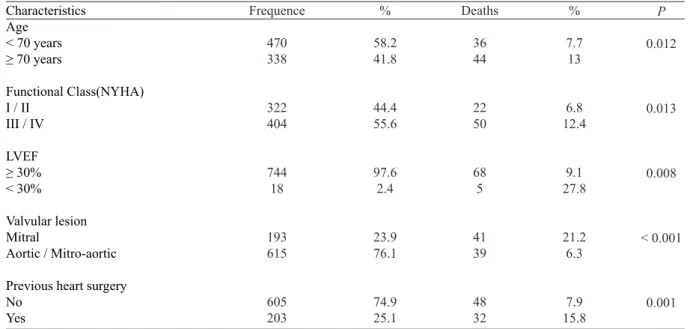
In order to increase the discriminatory power of the statistical analysis, the variables with multiple categories (age, functional class, LVEF, heart valve lesion and previous cardiac surgery) were transformed into dichotomous variables, and its distribution and association with hospital mortality are shown in Table 2.
Estimating the relative risk
By logistic regression analysis OR values were obtained in order to estimate the relative risk of the characteristics considered. Table 3 shows the OR values and their respective 95% conidence intervals (95% CI). Risk factors for hospital mortality with higher OR (OR> 3) were age groups above 60 years (variable OR, but greater than 3), associated tricuspid valve repair (OR 6.111, 95% CI 2.451 to 15.235), mitral valve lesion (OR 3.984, 95% CI 2.481 to 6.396) and LVEF less than 30% (OR 3.824, 95% CI 1.323 to 11.048), although other characteristics have demonstrated OR> 1, a value considered signiicant.
Independent risk factors
The characteristics that were signiicantly associated with increased hospital mortality in univariate analysis were considered for multivariate analysis, and also sought to show independent risk factors. The variables were used in the dichotomous form, which showed greater discriminatory power in the statistical analysis.
Table 1. Hospital mortality according to demographic, clinical and operative characteristics Characteristics Gender Female Male Age group < 50 years 50 - 59 years 60 - 69 years 70 - 79 years ≥ 80 years
Functional Class (NYHA) I II III IV LVEF > 50% 30 - 50% < 30%
Congestive heart failure Absent
Present
Atrial Fibrillation Absent
Present
Systemic arterial hypertension Absent
Present
Pulmonary arterial hypertension Absent Present Diabetes mellitus Ausent Present Serum Creatinine < 1,4 mg/dL ≥ 1,4 mg/dL Valvular Lesion Mitral
Aortic Mitro-aortic
Previous heart surgery No
1 surgery
2 surgeries or more
Myocardial Revascularization Associated No
Yes
Tricuspid valve repair associated No
Yes
Reoperation in hospital stay No Yes Frequence 351 457 57 133 280 268 70 75 247 279 125 620 124 18 668 137 626 179 364 442 587 212 691 116 702 101 193 552 63 605 178 25 652 156 787 21 756 52 % 43.4 56.6 7.1 16.5 34.7 33.2 8.7 10.3 34 38.4 17.2 81.4 16.3 2.4 83 17 77.8 22.2 45.2 54.8 73.5 26.5 85.6 14.4 87.4 12.6 23.9 68.3 7.8 74.9 22 3.1 80.7 19.3 97.4 2.6 93.6 6.4 Deaths 44 36 1 7 28 32 12 5 17 30 20 52 16 5 60 20 50 30 25 55 45 34 58 22 61 18 41 35 4 48 28 4 57 23 72 8 71 9 % 12.5 7.9 1.8 5.3 10 11.9 17.1 6.7 6.9 10.8 16 8.4 12.9 27.8 9 14.6 8 16.8 6.9 12.4 7.7 16 8.4 19 8.7 17.8 21.2 6.3 6.3 7.9 15.7 16 8.7 14.7 9.1 38.1 9.4 17.3 P 0.028 0.012 0.032 0.009 0.045 0.001 0.008 < 0.001 < 0.001 0.004 < 0.001 0.005 0.024 < 0.001 0.064 n.s.
DISCUSSION
The identiication of risk factors for patients undergoing valve replacement surgery has been studied for over 20 years [17]. The quantiication of the factors identiied and its neutralization by clinical and operative measures have decreased the risk of surgery [18]. Patients with severe valvular disease and minor systemic repercussions Table 2. Hospital mortality as modiied variables.
Characteristics Age
< 70 years
≥ 70 years
Functional Class(NYHA) I / II
III / IV
LVEF
≥ 30%
< 30%
Valvular lesion Mitral
Aortic / Mitro-aortic
Previous heart surgery No Yes Frequence 470 338 322 404 744 18 193 615 605 203 % 58.2 41.8 44.4 55.6 97.6 2.4 23.9 76.1 74.9 25.1 Deaths 36 44 22 50 68 5 41 39 48 32 % 7.7 13 6.8 12.4 9.1 27.8 21.2 6.3 7.9 15.8 P 0.012 0.013 0.008 < 0.001 0.001
NYHA: New York Heart Association, LVEF: left ventricular ejection fraction
Table 3. Odds ratios and 95% conidence intervals (95% + OR) for risk factors.
Characteristics
Female 50 - 59 years 60 - 69 years 70 - 79 years
≥ 80 years
Functional Class II Functional Class III Functional Class IV LVEF 30 – 50% LVEF < 30%
Congestive heart failure Atrial Fibrillation
Systemic arterial hypertension Pulmonary hypertension Diabetes mellitus
Serum Creatinine ≥ 1,4 mg/dL
Mitral valve lesion Mitro-aortic valve lesion 1 previous heart surgery Previous surgeries > 2 Myocardial Revascularization Associated tricuspid valve repair Reoperation in hospital stay
Odds ratio 1.676 3.111 6.222 7.593 11.586 1.035 1.687 2.667 1.618 4.201 1.732 2.319 1.927 2.301 2.554 2.279 3.984 1.001 2.166 2.21 1.805 6.111 2.019 1.053 0.374 0.829 1.016 1.458 0.369 0.631 0.956 0.891 1.441 1.006 1.425 1.175 1.429 1.494 1.285 2.451 0.344 1.314 0.729 1.074 2.451 0.945 2.667 25.888 46.697 56.759 92.074 2.905 4.509 7.437 2.94 12.245 2.982 3.775 3.161 3.705 4.368 4.043 6.478 2.917 3.57 6.701 3.034 15.235 4.313
LVEF: left ventricular ejection fraction
95% CI
Fig. 1- Risk factors for hospital mortality, with expression value
are being considered for surgery, due to their tendency to intervene earlier in the disease state, relecting lower prevalence / intensity of recognized risk factors and, thus, resulting in lower hospital mortality [19]. But if some of the demographic or operative characteristics, which in the past increased surgical mortality and morbidity, can now have its inluence minimized, and surgical indication progressively increased of older patients (and with more comorbidities) in different surgical series, can also induce changes in the proile of patients considered for valve surgery [20]. Thus, it is justiied the periodic study of risk factors and keep this subject up-to-date.
The study of risk factors begins with the selection of demographic and surgical characteristics that characterize the population evaluated and the procedures performed. Overall, we can state that the surgical experience conirms the inluence of characteristics such as advanced age, low body mass index, renal insuficiency, low LVEF, indication for emergency surgery, heart surgery and others in the increased in-hospital mortality of patients with valvular heart diseases, and these must receive greater attention from physicians involved in their clinical and surgical management [21-23].
In this research, we used recognized characteristics from the literature [3,4,9,17,18], focusing on those presented by Ambler et al. [2]. This attitude is justiied by the ready availability of medical information considered as part of the hospital record, and also because they had been previously used by the authors [13-15]. We opted to include pulmonary arterial hypertension as an additional factor, but other recognized factors were excluded, such as chronic obstructive pulmonary disease and peripheral vascular disease [3], which were not always correctly referred or quantiied in hospital records.
The risk factors identiied were female gender, age greater than or equal to 70 years, NYHA functional class III and IV, LVEF less than 30%, congestive heart failure, atrial ibrillation, hypertension, pulmonary hypertension, diabetes, serum creatinine greater than or equal to 1.4 mg / dL, mitral valve disease, previous cardiac surgery and CABG or associated tricuspid valve. It is interesting to note that these factors participate with their own score in the risk stratiication model for heart valve surgery proposed by Ambler et al. [2]. These authors highlight the performance of previous cardiac surgery (regardless of type), emergency surgery; age over 79 years and renal failure with dialysis as strong predictors of increased mortality.
For Nowicki et al. [24] in a study on independent risk
factors for surgical aortic valve replacement, previous heart surgery represent a risk factor associated with age over 70 years, small body surface, elevated creatinine, NYHA class IV, previous cardiac arrest, CHF, AF, emergency and associated MR. For the mitral valve surgery, the statistically signiicant characteristics were: female patients, advanced age, DM, CABG, previous cerebrovascular accident, elevated creatinine, NYHA class IV, emergency situations and CHF.
Roques et al. [25], in the EuroSCORE study, which conigures program with score predictor of hospital mortality, found that previous heart surgery and concomitant CABG were associated with increased surgical risk. Other variables signiicantly associated with high mortality were: advanced age, creatinine, low LVEF, heart failure, pulmonary hypertension, emergency situations, multiple valve replacement or tricuspid procedure.
Edwards et al. [26] identiied as independent risk factors for isolated valve replacement surgery, emergency situations, renal failure and cardiac arrest, and also the need for reoperation. This was also identiied by Jamieson et al. [3] as well as emergency surgery, renal failure (whether or not on dialysis), low LVEF, and NYHA functional class IV (NYHA). The need for reoperation during hospitalization was not identiied in this study as a risk factor.
The use of odds ratio or OR as a resource for statistical analysis made it possible to estimate the surgical risk determined by each of the evaluated characteristics [27]. The predictors of increased risk in this study, in descending order, as the clinical characteristics were LVEF below 30%, DM, AF and pulmonary hypertension and as surgical characteristics were concomitant tricuspid valve surgery, mitral valve lesion and previous heart surgery.
Interestingly, age greater than or equal to 70 years, while contributing to increased mortality, it is quantiied in reduced values in the OR, when compared to other factors. Although elderly patients with valvular heart diseases may show more severe cardiac or systemic involvement (and comorbidities may contribute individually as risk factors), it is dificult to deny surgical treatment, so that speciic perioperative care should be developed. This factor has been providing reduction in mortality, as stated in surgical experiments with groups of patients over the age of 70 [28] or 80 [29]. It is possible that the diffusion of percutaneous valve interventions may modify the surgical indication for older patients and may help to reduce surgical mortality.
deinition of hospital risk for mechanical valve prosthesis implantation [15], in which hospital mortality observed was 3.9%, in favor of the present series, 9.9%. It is possible that several demographic characteristics determine the difference in mortality, taking into account the mean age of patients referred for mechanical prostheses implantation and bioprostheses implantation, higher in the latter group (46.8 years and 66.5 years, respectively). Studies comparing results with implantation of a bioprosthesis or mechanical prosthesis in populations with overlapping patients as clinical characteristics, similar to that performed by Feguri et al. [30] can determine whether the observed differences in relation to mortality and risk factors are due to the type of valve replacement or to several characteristics of populations with indications for different cardiac valves.
CONCLUSIONS
Hospital mortality observed in this study (9.9%) is consistent with the literature results. Risk factors for hospital mortality identiied (associated tricuspid valve repair, mitral valve disease, LVEF less than 30% DM, AF, pulmonary hypertension, serum creatinine greater than or equal to 1.4 mg / dL, previous heart surgery, SAH functional class III and IV, associated CABG, aged greater than or equal to 70 years, CHF and female sex) had already been reported by other authors.
The possible neutralization of risk factors through changes in criteria for surgical indications, better clinical preoperative compensation and postoperative routine changes, may contribute to the reduction of surgical morbidity and mortality, as well as the costs of care.
REFERENCES
1. Birkmeyer JD, Siewers AE, Finlayson EV, Stukel TA, Lucas FL, Batista I, et al. Hospital volume and surgical mortality in the United States. N Engl J Med. 2002;346(15):1128-37.
2. Ambler G, Omar RZ, Royston P, Kinsman R, Keogh BE, Taylor
KM. Generic, simple risk stratiication model for heart valve
surgery. Circulation. 2005;112(2):224-31.
3. Jamieson WR, Edwards FH, Schwartz M, Bero JW, Clark RE,
Grover FL. Risk stratiication for cardiac valve replacement.
National Cardiac Surgery Database. Database Committee of the Society of Thoracic Surgeons. Ann Thorac Surg. 1999;67(4):943-51.
4. Jin R, Grunkemeier GL, Starr A; Providence Health System
Cardiovascular Study Group. Validation and reinement of
mortality risk models for heart valve surgery. Ann Thorac Surg. 2005;80(2):471-9.
5. Bueno RM, Ávila Neto V, Melo RFA. Fatores de risco em operações valvares: análise de 412 casos. Rev Bras Cir Cardiovasc. 1997;12(4):348-58.
6. Braile DM, Leal JC, Godoy MF, Braile MCV, Paula Neto A. Substituição valvar aórtica por bioprótese de pericárdio bovino: 12 anos de experiência. Rev Bras Cir Cardiovasc. 2003;18(3):217-20.
7. Almeida AS, Picon PD, Wender OCB. Resultados de pacientes submetidos à cirurgia de substituição valvar aórtica usando próteses mecânicas ou biológicas. Rev Bras Cir Cardiovasc. 2011;26(3):326-37.
8. Brandão CMA, Pomerantzeff PMA, Brandão LCA, Grinberg M, Stolf NAG, Verginelli G, et al. Análise da evolução tardia de 291 pacientes submetidos a substituição valvar por próteses metálicas. Rev Bras Cir Cardiovasc. 1995;10(1):50-5.
9. Anderson AJ, Barros Neto FX, Costa MA, Dantas LD, Hueb AC, Prata MF. Predictors of mortality in patients over 70 years-old undergoing CABG or valve surgery with cardiopulmonary bypass. Rev Bras Cir Cardiovasc. 2011;26(1):69-75.
10. Oliveira Jr JL, Fiorelli AI, Santos RHB, Pomerantzeff PAM, Dallan LAO, Stolf NAG. A doença coronária aumenta a mortalidade hospitalar de portadores de estenose aórtica submetidos à substituição valvar? Rev Bras Cir Cardiovasc. 2009;24(4):453-62.
11. Guaragna JC, Bodanese LC, Bueno FL, Goldani MA. Proposed preoperative risk score for patients candidate to cardiac valve surgery. Arq Bras Cardiol. 2010;94(4):541-8.
12. Andrade IN, Moraes Neto FR, Oliveira JP, Silva IT, Andrade TG, Moraes CR. Assesment of the EuroSCORE as a predictor for mortality in valve cardiac surgery at the Heart Institute of Pernambuco. Rev Bras Cir Cardiovasc. 2010;25(1):11-8.
13. De Bacco MW, Sant’Anna JRM, De Bacco G, Sant’Anna RT, Santos MF, Pereira E, et al. Fatores de risco hospitalar para implante de bioprótese valvar de pericárdio bovino. Arq Bras Cardiol. 2007;89(2):125-30.
14. De Bacco G, De Bacco MW, Sant’Anna JRM, Santos MF, Sant’Anna RT, Prates PR, et al. Aplicabilidade do escore de risco de Ambler para pacientes com substituição valvar por bioprótese de pericárdio bovino. Rev Bras Cir Cardiovasc. 2008;23(3):336-43.
16. Pereira E, Costa AR, Santos MF, Davidt NS, Lara RFA. Avaliação pré-operatória. In: Nesralla I, ed. Cardiologia cirúrgica: perspectivas para o ano 2000. São Paulo: BYK;1994. p.93-100.
17. Scott WC, Miller DC, Haverich A, Dawkins K, Mitchell RS, Jamieson SW, et al. Determinants of operative mortality for patients undergoing aortic valve replacement. Discriminant analysis of 1,479 operations. J Thorac Cardiovasc Surg. 1985;89(3):400-13.
18. Florath I, Rosendahl UP, Mortasawi A, Bauer SF, Dalladaku F, Ennker IC, et al. Current determinants of operative mortality in 1400 patients requiring aortic valve replacement. Ann Thorac Surg. 2003;76(1):75-83.
19. Hellgren L, Kvidal P, Stahle E. Improved early results after heart valve surgery over the last decade. Eur J Cardiothorac Surg. 2002;22(6):904-11.
20. Hokken RB, Steyerberg EW, Verbaan N, van Herwerden LA, van Domburg R, Bos E. 25 years of aortic valve replacement using mechanical valves. Risk factors for early and late mortality. Eur Heart J. 1997;18(7):1157-65.
21. Mistiaen W, Van Cauwelaert P, Muylaert P, Wuyts F, Harrisson F, Bortier H. Risk factors and survival after aortic valve replacement in octogenarians. J Heart Valve Dis. 2004;13(4):538-44.
22. Albeyoglu SC, Filizcan U, Sargin M, Cakmak M, Goksel O, Bayserke O, et al. Determinants of hospital mortality after repeat mitral valve surgery for rheumatic mitral valve disease. Thorac Cardiovasc Surg. 2006;54(4):244-9.
23. Litmathe J, Boeken U, Kurt M, Feindt P, Gams E. Predictive risk factors in double-valve replacement (AVR and MVR)
compared to isolated aortic valve replacement. Thorac Cardiovasc Surg. 2006;54(7):459-63.
24. Nowicki ER, Birkmeyer NJ, Weintraub RW, Leavitt BJ, Sanders JH, Dacey LJ, et al; Northern New England Cardiovascular Disease Study Group and the Center for Evaluative Clinical Sciences, Dartmouth Medical School. Multivariable prediction of in-hospital mortality associated with aortic and mitral valve surgery in Northern New England. Ann Thorac Surg. 2004;77(6):1966-77.
25. Roques F, Nashef SA, Michel P; EuroSCORE study group. Risk factors for early mortality after valve surgery in Europe in the 1990s: lessons from the EuroSCORE pilot program. J Heart Valve Dis. 2001;10(5):572-7.
26. Edwards FH, Peterson ED, Coombs LP, DeLong ER, Jamieson WR, Shroyer ALW, et al. Prediction of operative mortality after valve replacement surgery. J Am Coll Cardiol. 2001;37(3):885-92.
27. Hamilton MA. Choosing the parameter for 2 x 2 table or a 2 x 2 x 2 table analysis. Am J Epidemiol. 1979;109(3):362-75.
28. Tseng EE, Lee CA, Cameron DE, Stuart RS, Greene PS, Sussman MS, et al. Aortic valve replacement in the elderly. Risk factors and long-term results. Ann Surg. 1997;225(6):793-802.
29. Melby SJ, Zierer A, Kaiser SP, Guthrie TJ, Keune JD, Schuessler RB, et al. Aortic valve replacement in octogenarians: risk factors for early and late mortality. Ann Thorac Surg. 2007;83(5):1651-6.