Rev Bras Cir Plást. 2013;28(2):201-4 201 Romberg’s syndrome: a series of cases
Romberg’s syndrome: a series of cases
Síndrome de Romberg: uma série de casos
This study was performed at the Hospital de Clínicas da Universidade Federal do Paraná, Curitiba, PR, Brasil.
Submitted to SGP (Sistema de Gestão de Publicações/Manager Publications System) of RBCP (Revista Brasileira de Cirurgia Plástica/Brazilian Journal of Plastic Surgery).
Article received: January 30, 2012 Article accepted: May 16, 2012
IsIs JulIane GuarezI nasser1
PrIscIlla BalBInot2
adrIana sayurI KuroGI
ascenço3
Ivan Maluf JunIor2
dIrlene taysa BerrI3
Marlon câMara loPes2
PatrícIa BIGolIn2
WIllIan ItIKaWa2
renato da sIlva freItas4
Franco T et al.
Vendramin FS et al.
ORIGINAL ARTICLE
ABSTRACT
Background: The Romberg’s syndrome is a disease that was irst described more than a
century ago, and during this period had several names. It is characterized by a slow and progressive atrophy of the tissues of a hemiface, can affect all tissues and can also display neurological and ocular manifestations. The aim of this study is to report a series of patients with progressive hemifacial atrophy, addressing treatment options for each individual case.
Methods: Was conducted a retrospective, descriptive and analytic study of the patients treated in our service, Plastic Surgery at the Hospital de Clinicas - Universidade Federal do Paraná, and the Centro de Atendimento Integral ao Fissurado Lábio Palatal (CAIF), at Curitiba, PR, Brazil. Results: Were analyzed 13 patients, 10 (76.9%) female and 3 (23.1%)
male. The age of onset of symptoms ranged from 2 to 15 years. The irst medical consultation
with an specialist occurred at 11.7 years. The left hemiface was most commonly affected. Seven (53.8%) patients underwent surgery. Conclusions: The Romberg’s syndrome is a rare disorder, devastating to facial appearance, and it has been widely studied. Despite
great advances in medicine, its etiology deinition and the treatment directed to its cause
is still only a wish.
Keywords: Facial hemiatrophy. Face/surgery. Reconstructive surgical procedures.
RESUMO
Introdução: A síndrome de Romberg é uma moléstia descrita há mais de um século e, nesse
período, recebeu várias denominações. É caracterizada por lenta e progressiva atroia dos
tecidos de uma hemiface, podendo acometer todos os tecidos e apresentar, também, manifes-tações neurológicas e oculares. O objetivo deste estudo é relatar série de casos de pacientes
com atroia hemifacial progressiva, abordando as opções terapêuticas individualizadas para
cada caso. Método: Foi realizado estudo retrospectivo, descritivo e analítico de pacientes atendidos nos ambulatórios de Cirurgia Plástica no Hospital de Clínicas da Universidade Federal do Paraná e no Centro de Atendimento Integral ao Fissurado Lábio Palatal (CAIF), em Curitiba, PR, Brasil. Resultados: Foram analisados 13 pacientes, sendo 10 (76,9%) do sexo feminino e 3 (23,1%) do sexo masculino. A idade de início dos sintomas variou de 2 anos a 15 anos. A primeira consulta ocorreu, em média, aos 11,7 anos. A hemiface mais frequentemente afetada foi a esquerda. Sete (53,8%) pacientes foram submetidos a cirurgia.
Conclusões: A síndrome de Romberg é uma entidade rara, devastadora na aparência facial, que tem sido muito estudada. Apesar dos grandes avanços da medicina, a deinição de sua
etiologia e um tratamento direcionado a sua causa ainda são apenas um desejo.
Descritores: Hemiatroia facial. Face/cirurgia. Procedimentos cirúrgicos reconstrutivos.
1. Resident physician, Department of Plastic and Reconstructive Surgery, Hospital de Clínicas da Universidade Federal do Paraná (Federal University of Paraná – UFPR), Curitiba, PR, Brazil.
2. Specialization in the Service of the Hospital of Plastic and Reconstructive Surgery at UFPR, Curitiba, PR, Brazil. 3. Plastic surgeon at Service of the Hospital of Plastic and Reconstructive Surgery at UFPR, Curitiba, PR, Brazil.
Rev Bras Cir Plást. 2013;28(2):201-4
202
Nasser IJG et al.
INTRODUCTION
The progressive hemifacial atrophy was irst described
by Parry, in 1825, and later by Romberg, in 1846, receiving different names such as: Parry-Romberg syndrome,
proso-podismoria and trofoneurose1.
It is characterized by slow and progressive atrophy of the tissues of a hemiface initially affecting soft tissue, but it can affect all tissues including bone. May also occur: cerebral involvement, the carrier may have seizures2, intracranial vas
-cular malformations3, alterations in cranial nerves,
ral and autonomic nervous system involvement4, as well as
ocular involvement (which occurs in 10%-15% of cases)5.
Symptoms usually begin between the irst and second
decades of life, progresses for a few years and then beco me stationary6. Some authors advocate more common occur
-ren ce in females, a ratio of 3:2 men7, while others consider
the same rate between genders8. The left hemiface is the most
commonly affected.
Its etiology remains controversial, several theories were suggested, such as angiogenic entrapment, trauma, infection, trigeminal neuritis, among others6,9.
The treatment consists in controlling the symptoms (neurological and ocular) while the disease is active. After the atrophy stabilization, the aesthetic treatment can be started. For the treatment of facial asymmetry can be used
ma ny alternatives, including dermal, bone and fat grafts, laps
rotation as well as the use of alloplastic products.
The objective of this study is to report cases of progres sive hemifacial atrophy treated in our service, Plastic Sur -ge ry at the Hospital de Clinicas - Universidade Federal do
Paraná, and the Centro de Atendimento Integral ao Fissurado Lábio Palatal (CAIF), in the period 2000 to 2012.
METHODS
A retrospective, descriptive and analytic study of patients treated in the service of Plastic Surgery at the Hospital de Clinicas - Universidade Federal do Paraná, UFPR-PR and Centro de Atendimento Integral ao Fissurado Lábio Palatal (CAIF), at Curitiba, Brazil, was performed. The medical records of patients with Romberg’s syndrome who were treated in these hospitals during the period 2000 to 2012 we re accessed.
The data included: age of onset of symptoms, age at irst
examination, gender, affected hemiface, family history, other comorbidities, number, age and type of surgical procedure.
RESULTS
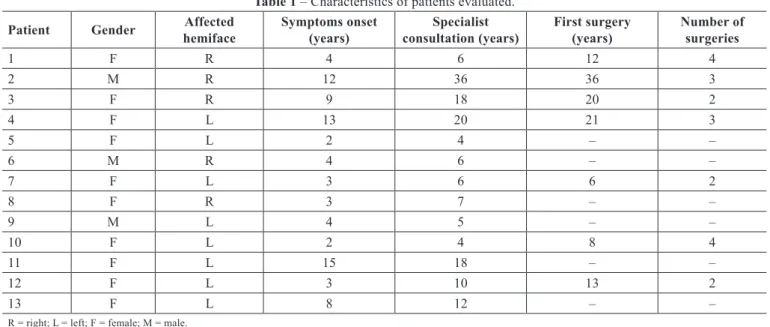
Were analyzed 13 patients, 10 (76.9%) female patients and 3 (23.1%) males.
The age of onset of symptoms ranged from 2 to 15 years,
with an average of 6.3 years. The irst consultation with a
specialist took place with 11.7 years (ranging from 4 to 36 years). The delay in seeking medical care was 5.4 years (Table 1).
The most affected hemiface was the left, corresponding to 61.5% of the total. No patient had family history of facial hemiatrophy. The associated diseases were vitiligo (n = 2), strabismus (n = 2)attention deficit disorder and hyperacti -vity (n = 1) and inguinal hernia (n = 1).
Table 1 – Characteristics of patients evaluated.
Patient Gender Affected
hemiface
Symptoms onset (years)
Specialist consultation (years)
First surgery (years)
Number of surgeries
1 F R 4 6 12 4
2 M R 12 36 36 3
3 F R 9 18 20 2
4 F L 13 20 21 3
5 F L 2 4 – –
6 M R 4 6 – –
7 F L 3 6 6 2
8 F R 3 7 – –
9 M L 4 5 – –
10 F L 2 4 8 4
11 F L 15 18 – –
12 F L 3 10 13 2
13 F L 8 12 – –
Rev Bras Cir Plást. 2013;28(2):201-4 203 Romberg’s syndrome: a series of cases
In our series the patients had involvement of multiple regions simultaneously, with an average of 3.6 affected re -gions in each case (range 2-6). The most commonly region affected was the upper lip (n = 11), followed by: cheek (n = 9), lower lip (n = 6), jaw (n = 5), nose (n = 4), forehead (n = 4 - included 3 patients with deformity coup de sabre), maxilla (n = 2), scalp alopecia (n = 2), lower eyelid (n = 1), neck (n = 1), eyebrow alopecia (n = 1) and important lo -cali zed skin atrophy (n = 1). In all cases of atrophy of the cheek, the upper lip was involved, as in all cases of nasal in volvement upper lip was also affected. In 5 of 6 patients with atrophy of the lower lip, jaw also was affected.
Seven (53.8%) patients underwent surgery. Were per formed 2.8 procedures per patient among these patients, ran -ging from 2 to 4. The surgeries performed: cartilage graft for nasal region (n = 2), temporal fascia graft (n = 1), fat grafting (n = 16), cranioplasty (n = 1), piecemeal resection of scar (n = 1), rhinoplasty (n = 1), and 3 patients submitted to associate procedure.
The volume of fat grafting ranged from 5 to 55 ml per procedure, with an average of 20 ml per session. Four (57.1%)
patients showed signiicant absorption of the fat graft, and
was necessary to repeat the procedure. Three patients had
good graft integration with no signiicant fat resorption.
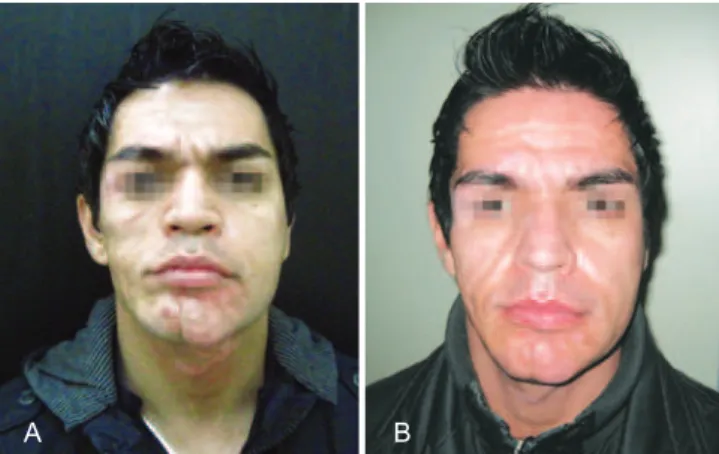
Figures 1 and 2 illustrate some cases in this series.
DISCUSSION
Romberg syndrome is a rare disease and its pathogenesis remains unknown. Despite multiple theories attempting to explain it, none is universally accepted. Clinical presentation is very inconstant notably in the onset of symptoms. The ectoscopy is the main element in the diagnosis of this disease. The facial hemiatrophy in our series affected predominantly female patients, as consistent with other studies7.
The initial symptoms vary: trigeminal paresthesias, sei zures, hypo or hyperchromic spots. As the disease progres ses, become more apparent the alterations of skin, subcuta-neous tissue and later muscle, cartilage and bone. Manifesta-tions progress at a slow pace and tend to become stationary after some years of activity6.
The manifestation begins on the irst or second decades
of life6, from 2 to 15 years in our sample. The bone changes
tend to be more severe as younger the patient is at the onset of symptoms10.
The long period between onset of symptoms and demand for the specialized center may be due to poor knowledge of this syndrome by physicians in general or for the delay to obtain an expert consultation in our health system.
The therapeutic approach of these children can be the use of medications or surgical. The clinical treatment of disease with immunosuppressant (methotrexate) or other medica-tions, such as chloroquine and calcipotriol, is discussed by
several authors; however, there is no scientiic evidence for
the use of this kind of medication11.
Surgical treatment is delayed until stabilization of the di sease. The soft tissues can be treated earlier, however the correction of the osteocartilaginous structures must await the complete facial growth.
Surgical treatment of facial defect can be performed using different techniques12-15. Structural defects can receive
allo-plastic materials such as silicon and porous polyethylene, while soft tissue defects can be reconstructed with autolo-gous dermal fat grafts, sequential fat grafts, and transfer of vascularized tissue (direct or microsurgical).
Mordick et al.14 and Roddi et al.15 conducted studies
com paring the two main techniques: the fat grafting and vas cularized tissue transfer. These studies showed that fat grafts are simple, affordable, with low risk of complications and good cosmetic results, especially for mild to moderate
Figure 1 – In A, patient before the beginning of aesthetic treatment. In B, patient after 3 sessions of fat grafting,
with aesthetic treatment in progress.
A B
A B
Rev Bras Cir Plást. 2013;28(2):201-4
204
Nasser IJG et al.
defects. However, for most severe atrophy, the transfer of vascularized tissue is more effective, due to the low vascu lar supply. Pieces of omentum, muscle and fasciocutaneous
laps, having great divergence in indications, can be used.
We used several techniques for cosmetic improvement of our patients. The indication depends primarily on the de gree and location of the defect, and its indication should be individualized. The approach to the frontal region, we chose to implant a surgical cement (n = 2) and in 1 case associated with fat grafting. There were two patients who underwent conchal cartilage graft for nasal ala, one of whom later received a temporal fascia tissue to increase coverage, and erase the edges of the graft. Other procedures were piece meal resection of scar, and rhinoplasty.
The method of choice, cause of its easy implementation and low morbidity, regardless of the result we obtained, was the fat grafting. This technique allows increase in soft tissues, corrections of other procedures that may have been
insuf-icient, and it’s easy to be repeated. The fat grafting leads to
improvement in the texture of the atrophied tissue, followed by increased local blood supply.
The fat grafting technique has recently evolved in a new research on stem cells that can be isolated from lipoaspirate material in large numbers and its easily grow under standard tissue culture conditions. Because of this, there are excellent prospects for its use in plastic surgery for the treatment of congenital and acquired deformities with aesthetic or resto-rative purpose16.
CONCLUSIONS
Romberg syndrome is a rare disorder, devastating in fa cial appearance, which has been widely studied due to the poten-tial therapeutic improvement with the use of stem cells.
Despite great advances in medicine in all its ields, the etio -logy and treatment directed at its cause is still only a wish. While we do not have enough knowledge to treat the cause, we improve techniques for the treatment of its consequences.
REFERENCES
1. Melega JM. Cirurgia plástica: fundamentos e arte. Rio de Janeiro: Guanabara Koogan; 2004.
2. Duro LAA, Lima JMB, Reis MM, Silva CV. Atroia hemifacial pro -gressiva (doença de Parry-Romberg): estudo de um caso. Arq Neurop-siquiatr. 1982;40(2):193-200.
3. Miedziak AI, Stefanyszyn M, Flanagan J, Eagle RC Jr. Parry-Romberg syndrome associated with intracranial vascular malformations. Arch Ophthalmol. 1998;116(9):1235-7.
4. Brito JCF, Holanda MMA, Holanda G, Silva JAG. Hemiatroia facial
progressiva (doença de Parry-Romberg): relato de dois casos associados a trigeminalgia e câimbras. Arq Neuropsiquiatr. 1997;55(3A):472-7. 5. Muchnick RS, Aston SJ, Rees TD. Ocular manifestations and treatment
of hemifacial atrophy. Am J Ophthalmol. 1979;88(5):889-97. 6. Duymaz A, Karabekmez FE, Keskin M, Tosun Z. Parry-Romberg
syndrome: facial atrophy and its relationship with other regions of the body. Ann Plast Surg. 2009;63(4):457-61.
7. Boer RM. Síndrome de Parry-Romberg. Rev Bras Neurol. 1990;26(1): 71-2.
8. Creus L, Sanchez-Regaña M, Salleras M, Chaussade V, Umbert P. Parry- Romberg syndrome associated with homolateral segmental vitiligo. Ann Dermatol Venereol. 1994;121(10):710-1.
9. Abele DC, Bedingield RB, Chandler FW, Given KS. Progressive facial
hemiatrophy (Parry-Romberg syndrome) and borreliosis. J Am Acad Dermatol. 1990;22(3):531-3.
10. Spraker M. Sclerosing and atrophying conditions. In: Schachner LA, Hansen RC, eds. Pediatric dermatology. New York: Churchill Livings-tone; 1988. p. 925-6.
11. Alencar JCG, Andrade SHC, Pessoa SGP, Dias IS. Lipoenxertia
autólo-ga no tratamento da atroia hemifacial progressiva (síndrome de Parry-
Romberg): relato de caso e revisão da literatura. An Bras Dermatol. 2011;86(4 Supl 1):S85-8.
12. Iñigo F, Rojo P, Ysunza A. Aesthetic treatment of Romberg’s disease: experience with 35 cases. Br J Plast Surg. 1993;46(3):194-200. 13. Morais-Besteiro J, Aki FE, Mendes JA, Ferreira MC. Microsurgical
transplants for facial depressions. Rev Hosp Clin Fac Med Sao Paulo. 1992;47(6):271-5.
14. Mordick TG 2nd, Larossa D, Whitaker L. Soft-tissue reconstruction of the face: a comparison of dermal-fat grafting and vascularized tissue transfer. Ann Plast Surg. 1992;29(5):390-6.
15. Roddi R, Riggio E, Gilbert PM, Hovius SE, Vaandrager JM, van der Meulen JC. Clinical evaluation of techniques used in the surgical treatment of progressive hemifacial atrophy. J Craniomaxillofac Surg. 1994;22(1):23-32.
16. Gomes RS. Perspectivas do uso de células-tronco em Cirurgia Plástica. Rev Bras Cir Plást. 2011;26(1):151-9.
Correspondence to: Renato da Silva Freitas