VOLPATO G, SCHMITT D, SANTOS-JR CAN, CARVALHO LP, KOSHIMIZU RT, MALLMANN ACM. Treatment of patients with colorectal cancer at a public hospital in Porto Alegre. J Coloproctol, 2011;31(4):346-350.
AbstrACt: Objective: the purpose of this study is to demonstrate the current picture of colorectal cancer in a public hospital of rio Grande do sul, focusing on aspects related to diagnosis, staging and surgical therapy addressed in these patients. Methods: A descriptive and retrospective study that includes patients with colorectal cancer admitted to the Proctology service of the Hospital Nossa senhora da Conceição de Porto Alegre, from January 2009 to May 2011. results: this study investigated 61 patients, 65.6% were female. their age ranged from 40 to 84 years. Colonoscopy was performed in 58 patients; 56.9% of them had over 50% impaired colon lumen. the carcinoembryonic antigen (CEA) was collected from 59 patients, 47.5% had CEA>5 ng/mL. Distant metastases were found in 23.3% of total 60 patients. Underwent surgical treatment 58 patients, of a curative intent was 84.5%. the presence of more
than 12 lymph nodes per specimen was 73.1%. All 61 patients were classiied as: Stage I (9.8%), Stage II (29.5%), Stage III (29.5%) and Stage IV (31.1%). Conclusion: The proile of the patients treated at our institution indicates disease in advanced stage; however,
the methods employed have provided a curative surgical treatment in our oncology patients.
Keywords: colorectal neoplasms; colorectal surgery; Uniied Health System.
treatment of patients with colorectal cancer at a public hospital in
Porto Alegre
GABRIEL VOLPATO1, DENIZE SCHMITT1, CLEBER ANTÔNIO NOGUEIRA SANTOS JÚNIOR1, LUCIANO
PINTO DE CARVALHO2, RUY TAKASHI KOSHIMIZU3, AFONSO CALIL MURY MALLMANN3
1Academicians in the 7th semester of the Medical Science Course at the Universidade Luterana do Brasil (ULBRA)
– Canoas (RS), Brazil. 2Physician, Service of Coloproctology, Hospital Nossa Senhora da Conceição de Porto
Alegre – Porto Alegre (RS), Brazil; Assistant Professor at ULBRA – Canoas (RS), Brazil. 3Physician, Service of
Coloproctology, Hospital Nossa Senhora da Conceição de Porto Alegre – Porto Alegre (RS), Brazil.
Study carried out at the Service of Coloproctology, Hospital Nossa Senhora da Conceição de Porto Alegre – Porto Alegre (RS), Brazil. Financing source: none.
Conlict of interest: nothing to declare.
Submitted on: 08/08/2011
INTRODUCTION
Colorectal cancer (CRC) is one of the most pre-valent malignant neoplasms around the globe. Each year, one million new cases are diagnosed, and it is considered the third most frequent cause of cancer in the world, affecting both genders, and the second cau -se in developed countries1. Around 142,570 new cases
of large bowel cancer are diagnosed each year in the United States, 102,900 of which are colorectal cancer and the rest refers to rectal cancer2.
The number of new cases of colorectal and rectal cancer in Brazil in 2010 is estimated to be 13,310 cases in males and 14,800 in females. These numbers corres -pond to estimated risks of 14 new cases in each 100,000 men and 15 in each 100,000 women. Not considering
non-melanoma skin tumors, colorectal and rectal can -cer is the third most frequent can-cer in men in the South (21/100,000) and Southeast (19/100,000) re -gions of Brazil. In the Midwest (11/100,000) region, it is the fourth most frequent cancer. In the Northeast (5/100,000) and North (4/100.000) regions, it is the ifth. In women, it is the second most frequent cancer in the South (22/100,000) and Southeast (21/100,000) regions; the third in the Midwest (11/100,000) and Northeast (6/100,000) regions and the ifth in the Nor -th (4/100,000) region.
Sporadic colorectal cancer (SCRC) accounts for 90% of all large bowel cancers that occur annually and most of them develop from an adenomatous polyp, the pre-malign phase of the anorectal adenocarcinoma4.
Age is an important risk factor for SCRC. It is a rare diagnosis before 40 years of age; the inciden -ce starts to increase considerably between 40 and 50 years of age, and the incidence rates increase at each decade and in general they are not related to genetic or environmental risk factors5.
The periodic preventive exam – colonoscopy – can reduce the mean risk of death due to colorectal cancer by 90%6. In addition, most colorectal tumors,
when diagnosed early, can be completely healed. Although innumerous studies have addressed the prognostic meaning of various histological and mo -lecular types, as well as clinical characteristics, the pathological stage at the diagnosis is still the best in -dicator of long-term prognosis to both colon and rec -tal cancer. The most important characteristics are pre-sence of distant metastases, local extension of tumor, node positivity (number of lymph nodes involved) and residual disease7.
Surgery is the only curative therapy for focal co-lon cancer and a potentially curative option for selec -ted patients with limi-ted metastatic disease in the liver and/or lung. In addition, even patients that are not eli -gible to curative resection can beneit from palliative surgical procedures to relieve the obstruction symp -toms and primary tumor bleeding8.
The purpose of this study is to show the current picture of colorectal cancer at a public hospital in Rio Grande do Sul operates only through the Uniied He -alth System (SUS), providing patients with services focused on aspects related to diagnosis, staging and surgical therapy.
MEtHODs
This descriptive and retrospective study inclu -ded patients with colorectal cancer admitted to the Coloproctology Service of the Hospital Nossa Senhora da Conceição, from January 2009 to May 2011. Patients with rectal cancer were excluded from the study.
The patients’ data were obtained from their clini -cal records and histopathologi-cal reports of colonos -copy and surgical specimens.
The information collected were: gender, age, car -cinoembryonic antigen (CEA), primary tumor location, lesion macroscopy, colon circumference involvement during colonoscopy, the surgery performed – whether curative or palliative, involvement of adjacent organs and whether they have been resected or not and if they presented any malignancy or inlammation, tumor sta -ging, histological type, degree of tumor differentiation, nodal positivity, number of lymph nodes per surgical specimen, presence and location of metastases.
The information was entered in a database especially built for this purpose, on a spreadsheet using Microsoft Excel 2007 and later exported to SPSS v.17.0 for analysis. The quantitative variables were described using the mean value and standard deviation and the categorical variables were described through the frequency.
The study was analyzed and submitted to the ap -proval of the Research Ethics Committee (CEP) of the Hospital Nossa Senhora da Conceição.
rEsULts
The study investigated 61 patients, 21 were male (34.4%) and 40 were female (65.6%). The patients’ age ranged from 40 to 84 years, mean of 65.81±11.95 years.
Regarding the location, most patients presented sigmoid colon tumor (n=28; 45.9%), followed by as -cending colon (n=12; 19.7%), cecum (n=6; 9.8%), splenic lexure (n=5; 8.2%), descending colon (n=5; 8.2%), hepatic lexure (n=3; 4.9%) and transverse co -lon (n=2; 3.3%).
Among the 61 analyzed patients, 58 were submit -ted to colonoscopy. None of them presen-ted perforation and 28 (48.3%) had obstruction in the intestinal lumen that blocked the low of intestinal contents. Ulcerove -getating lesions (48.3%) were the most prevalent and 56.9% of the patients showed more than 50% circumfe -rence involvement due to the lesion size (Table 1).
CEA was collected from 59 patients at the patholo -gy diagnosis; the mean value was 210.97±1401.32 ng/mL (0.22-10754 ng/mL), with 47.5% of them with CEA over 5 ng/mL (Table 2).
Fifty-eight patients (95.1%) were submitted to surgical procedures. The surgery was curative in 49 (84.5%) and the palliative treatment was adopted in 9 patients (15.5%). Involvement of adjacent organs was observed in 19 patients (32.8%); in 12 (63.2%) of them, the anatomopathological result conirmed the presence of malignance, 4 (21.1%) showed organ inlammation only and 3 (15.8%) did not show any alteration, with resection of 11 (57.9%) of total 19 in -volved organs.
Table 3 shows the analysis of the 52 surgical specimens. Regarding the tumor macroscopy, 44.2%
were ulcerovegetating and 67.3% affected more than 50% of the colon lumen. The mean tumor size was 5.2±2.12 cm (1.2–12 cm). Regarding the resection margin, 51 patients (98.15%) had free margins. The mean number of lymph nodes found per specimen was 17.69±9.92 (0–59), and positivity of 50%. More than
12 lymph nodes per specimen were found in 73.1% of the surgical specimens, with 66.7% of them from patients classiied as Stage II (Table 2).
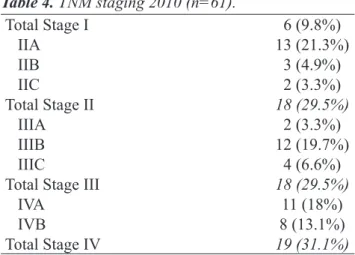
In relation to staging, the patients presented the following distribution: 9.8% were Stage I, 29.5% Sta -ge II, 29.5% Sta-ge III and 31.1% Sta-ge IV (Table 4).
staging Stage I Stage II Stage III Stage IV total
≥12 lymph nodes 5 (83.3%) 12 (66.7%) 15 (83.3%) 6 (60%) 38 (73.1%)
<12 lymph nodes 1 (16.7%) 6 (33.3%) 3 (16.7%) 4 (40%) 14 (26.9%)
Total 6 (100%) 18 (100%) 18 (100%) 10 (100%) 52 (100%)
CEA marker
>5 ng/mL 1 (16.7%) 6 (37.5%) 12 (66.7%) 9 (47.4%) 28 (47.5%)
<5 ng/mL 5 (83.3%) 10 (62.5%) 6 (33.3%) 10 (52.6%) 31 (52.5%)
Total 6 (100%) 16 (100%) 18 (100%) 19 (100%) 59 (100%)
Table 2. Characteristics of surgical prognosis regarding the patients’ staging.
CEA: carcinoembryonic antigen.
Macroscopy
Vegetating 12 (23.1%)
Ulcerovegetating 23 (44.2%)
Ulcerated 8 (15.4%)
Polypoid 1 (1.9%)
Iniltrating 0 (0%)
Ulceroiniltrating 8 (15.4%)
Involvement of circumference
≤25% 9 (17.3%)
≤50% 8 (15.4%)
≤75% 20 (38.5%)
≤100% 15 (28.8%)
Involvement of margins
Free 51 (98.1%)
Compromised 1 (1.9%)
Tumor differentiation degree
Very differentiated 5 (9.6%)
Moderately differentiated 39 (75%)
Little differentiated 8 (15.4%)
Total 52 (100%)
Table 3. Pathology of surgical specimens (n=52).
Macroscopy
Ulcerated 4 (6.9%)
Vegetating 19 (32.8%)
Ulcerovegetating 28 (48%)
Iniltrating 1 (1.7%)
Ulceroiniltrating 6 (10%)
Involvement of circumference
≤25% 8 (13.8%)
≤50% 17 (29.3%)
≤75% 5 (8.6%)
≤100% 28 (48.3%)
Tumor differentiation degree
Very differentiated 1 (1.7%)
Moderately differentiated 55 (94.8%)
Little differentiated 2 (3.4%)
TU blocking the low of intestinal contents
Yes 28 (48.3%)
No 30 (51.7%)
Total 58 (100%)
Table 1. Results of colonoscopy exams (n=58).
DISCUSSION
The purpose of the colon cancer surgery is to per-form the complete removal of the tumor, with the main vascular pedicle of the affected segment of the colon and its lymphatic drainage area. While the segment re -section is sometimes enough to remove the primary tumor, a larger resection is usually required for a satis -factory lymphadenectomy. The blood vessels should be separated at their origin point to allow wider re -section and maximize the number of lymph nodes in the specimen. Block resection of adjacent structures is indicated in case of tumor ligation or adhesion to any other organ or structure.
For a surgery to be oncologically correct, it prioritizes resection with free margins8. In our study, 98.1% of all resected tumors had free distal, proximal and radial margins.
Regional lymphadenectomy provides impor
-tant prognostic and therapeutic information that guide the adjuvant treatment. In a systematic re -view, the number of lymph nodes evaluated after the surgical resection was positively associated with survival of patients classiied as Stage II and Stage III for colon cancer9. Established guidelines recommend that at least 12 lymph nodes should be analyzed for a proper staging10-12. The American
So-ciety of Clinical Oncology (ASCO) encourages the use of adjuvant chemotherapy in patients with co -lon cancer and negative lymph nodes if the surgical specimen has less than 12 lymph nodes13. Although
the use of adjuvant chemotherapy has not been es -tablished in Stage II patients, in our study, 66.7% of
the surgical specimens of Stage II patients had more than 12 lymph nodes and 73.1% of total analyzed specimens had more than 12 lymph nodes14.
A number of serum markers has been associated with CRC, especially CEA and carbohydrate antigen (CA) 19-9. However, these markers have a low diag -nostic capability to detect primary CRC due to the sig -niicant overlap with benign disease (gastritis, peptic ulcer, diverticulitis, liver disease, chronic obstructive pulmonary disease, diabetes or any acute or chronic inlammatory condition) and low sensitivity to the di -sease in its early phase15-18.
However, the serum levels of CEA are useful to the prognosis of patients with recently diagnosed CRC. Patients with serum CEA >5 ng/mL in the pre-operative period have worse prognosis than those with lower levels. In addition, higher levels of preo -perative CEA that do not normalize after the surgical resection require a deeper evaluation to investigate the persistent disease. ASCO guidelines recommend that the serum levels of CEA, when obtained in the preoperative period from patients with colorectal cancer, should help in the surgical treatment prepara -tion and planning and in the prognosis evalua-tion15.
In our study, 47.5% of the patients that had their CEA analyzed presented serum level of >5 ng/mL at the pathological diagnosis.
Around 20% of the patients have metastatic di -sease at the moment they search for care19. The co-lon cancer can spread through lymphatic and hema -togenical dissemination, and through contiguous and transperitoneal pathways. The most frequent areas affected by metastasis are regional lymph nodes, li -ver, lung and peritoneum, and the patients can show signs or symptoms related to any of these areas. As the venous drainage of the intestinal tract is through the portal system, the irst area of hematogenical dissemi -nation is usually the liver, followed by the lungs, bo -nes and many other sites, including the brain19. In our
study, 23.3% of the patients had metastatic diseases at the moment of diagnosis, and the most affected areas were: liver (57.1%), lung (35.7%) and bone (7.1%); in agreement with the literature.
Most of our patients were in advanced stages of the disease, with more than 60% of them classiied as Stages III and IV, in agreement with the absence of tracking measures in our population.
Total Stage I 6 (9.8%)
IIA 13 (21.3%)
IIB 3 (4.9%)
IIC 2 (3.3%)
Total Stage II 18 (29.5%)
IIIA 2 (3.3%)
IIIB 12 (19.7%)
IIIC 4 (6.6%)
Total Stage III 18 (29.5%)
IVA 11 (18%)
IVB 8 (13.1%)
Total Stage IV 19 (31.1%)
CONCLUSION
After evaluating the characteristics of patients with colorectal cancer treated in our service, we con
-clude that most of them are reaching an advanced sta -ge of the disease. However, the methods employed have provided a curative surgical treatment in our on -cology patients.
rEsUMO: Objetivo: O objetivo do presente estudo é demonstrar o panorama atual do câncer colorretal em um hospital público da capital do rio Grande do sul, enfocando aspectos relacionados ao diagnóstico, estadiamento e terapêutica cirúrgica abordada nesses respectivos pacientes. Métodos: Estudo descritivo e retrospectivo que inclui os pacientes com câncer colorretal internados pelo serviço de Coloproctologia do Hospital Conceição durante o período de janeiro de 2009 a maio de 2011. resultados: Foram estudados 61 pa-cientes, 65,6% mulheres. A idade variou de 40 a 84 anos. realizaram colonoscopia 58 papa-cientes, desses 56,9% apresentavam mais de 50% de comprometimento da luz do cólon. O antígeno carcinoembrionário (CEA) foi coletado em 59 pacientes, 47,5% apresentavam CEA>5 ng/mL. Metástases à distância foram encontradas em 23,3% do total de 60 pacientes avaliados. Foram submetidos a trata-mento cirúrgico 58 pacientes, desses a intenção curativa foi em 84,5%. A presença de mais de 12 linfonodos por peça foi de 73,1%. Os
61 pacientes estudados foram estratiicados como 9,8% estádio I, 29,5% estádio II, 29,5% estádio III e 31,1% estádio IV. Conclusão: O peril dos pacientes tratados em nossa instituição é de doença avançada; entretanto, os métodos curativos empregados têm ido ao
encontro de um tratamento cirúrgico oncológico adequado.
Palavras-chave: neoplasias colorretais; cirurgia colorretal; SUS.
rEFErENCEs
1. Andrade SMS, Pereira FL. Câncer colorretal sincrônico - relato de caso e revisão de literatura. J Coloproctol 2007;27(1):69-79.
2. Jemal A, Siegel R, Xu J, Ward E. Cancer statistics, 2010. CA Cancer J Clin 2010;60(5):277-300.
3. INCA. Estimativa 2010 – Incidência de câncer no Brasil [cited 2011 Feb. 22]. Available from: http://www.inca.gov.br/ estimativa/2010.
4. Wills JC, Burt RW. Hereditary aspects of colon cancer. Ochsner J 2002;4:129-38.
5. Eddy DM. Screening for colorectal cancer. Ann Intern Med 1990;113(5):373-84.
6. Obrand DI, Gordon PH. Continued change in the distribution of colorectal carcinoma. Br J Surg 1998;85(2):246-8. 7. Greene FL, Page DL, Fleming ID, Fritz A, Balch CM, Haller DG,
et al (Eds). AJCC (American Joint Committee on Cancer). Cancer staging manual. 6th ed. New York: Springer; 2002. p. 113. 8. Nelson H, Petrelli N, Carlin A, Couture J, Fleshman J,
Guillem J, et al. Guidelines 2000 for colon and rectal cancer surgery. J Natl Cancer Inst 2001;93(8):583-96.
9. Chang GJ, Rodriguez-Bigas MA, Skibber JM, Moyer VA. Lymph node evaluation and survival after curative resection of colon cancer: systematic review. J Natl Cancer Inst 2007;99(6):433-41.
10. Compton CC, Fielding LP, Burgart LJ, Conley B, Cooper HS, Hamilton SR, et al. Prognostic factors in colorectal cancer. College of American Pathologists Consensus Statement 1999. Arch Pathol Lab Med 2000;124(7):979-94.
11. McGory ML, Shekelle PG, Ko CY. Development of quality indicators for patients undergoing colorectal cancer surgery. J Natl Cancer Inst 2006;98(22):1623-33.
12. Otchy D, Hyman NH, Simmang C, Anthony T, Buie WD, Cataldo P, et al. Practice parameters for colon cancer. Dis Colon Rectum 2004;47(8):1269-84.
13. Benson AB 3rd, Schrag D, Somerield MR, Cohen AM, Figueredo AT, Flynn PJ, et al. American Society of Clinical Oncology recommendations on adjuvant chemotherapy for stage II colon cancer. J Clin Oncol 2004;22(16):3408-19. 14. Benson AB III, Schrag D, Somerield MR, Cohen AM,
Figueredo AT, Flynn PJ, et al. American Society of Clinical Oncology recommendations on adjuvant chemotherapy for stage II colon cancer. J Clin Oncol 2004;22(16):3408–19. 15. Locker GY, Hamilton S, Harris J, Jessup JM, Kemeny N,
Macdonald JS, et al. ASCO 2006 update of recommendations for the use of tumor markers in gastrointestinal cancer. J Clin Oncol 2006;24(33):5313-27.
16. Macdonald JS. Carcinoembryonic antigen screening: pros and cons. Semin Oncol 1999;26(5):556-60.
17. Palmqvist R, Engarås B, Lindmark G, Hallmans G, Tavelin B, Nilsson O, et al. Prediagnostic levels of carcinoembryonic antigen and CA 242 in colorectal cancer: a matched case-control study. Dis Colon Rectum 2003;46(11):1538-44. 18. Van der Schouw YT, Verbeek AL, Wobbes T, Segers MF,
Thomas CM. Comparison of four serum tumour markers in the diagnosis of colorectal carcinoma. Br J Cancer 1992;66(1):148-54.
19. Jemal A, Siegel R, Ward E, Hao Y, Xu J, Thun MJ. Cancer statistics, 2009. CA Cancer J Clin 2009;59(4):225-49.
Correspondence to:
Gabriel Volpato