Review
J. Braz. Chem. Soc., Vol. 26, No. 6, 1055-1085, 2015. Printed in Brazil - ©2015 Sociedade Brasileira de Química 0103 - 5053 $6.00+0.00
*e-mail: [email protected]
The Multiple Faces of Eugenol. A Versatile Starting Material and Building Block for
Organic and Bio-Organic Synthesis and a Convenient Precursor Toward Bio-Based
Fine Chemicals
Teodoro S. Kaufman*
Instituto de Química Rosario (IQUIR, CONICET-UNR) and Facultad de Ciencias Bioquímicas y Farmacéuticas, Universidad Nacional de Rosario, Suipacha 531, S2002LRK Rosario, Argentina
Phenylpropenes are produced by plants as part of their defense strategy against microorganisms and animals, and also as floral attractants of pollinators. Eugenol, the main component of clove’s essential oil, is an inexpensive and easily available phenylpropene that has been known by humankind since antiquity, and used as a medicinal agent, but also for food flavoring and preservation. The review includes the most relevant results obtained during the last 15 years with regard to the synthetic uses of eugenol. Discussed here are the multiple applications of eugenol in organic synthesis, including its use as starting material or building block for the total synthesis of natural products, their analogs and derivatives, as well as other structurally interesting or bioactive compounds. The preparation technologically relevant macrocycles and polymeric derivatives of eugenol, is included, and the impact of biotechnology on the use of eugenol as feedstock for biotransformations, leading to other valuable small molecules is also addressed.
Keywords: eugenol, natural products synthesis, polymer science, macrocycles, bioactive
compounds
1. Introduction
All the major groups of angiosperms biosynthesize phenylpropenes. These are stored in their vegetative parts, as a defense against herbivores, parasitic bacteria and fungi, or are easily volatilized, being toxic to insects and microbes. In addition, sometimes they are emitted from flowers to attract insect pollinators.
Eugenol (1, Figure 1)1 is one of these key
phenylpropenes. The natural product is a major aromatic constituent (up to approximately 80% by weight) of the essential oil of clove [Eugenia caryophyllata L. Merr. & Perry (Myrtaceae) = Syzygium aromaticum], which is commonly obtained by hydrodistillation, steam distillation, or Soxhlet (ethanol) extraction from leaves, buds, and stems of clove trees (Myrtaceae).2 Eugenol
is also found in Myristica fragrans Houtt. (nutmeg), Cinnamomum verum J. Presl (true cinnamon), C. loureirii Nees. (Saigon cinnamon), Ocimum gratissimum Forssk. (basil), Ocimum basilicum L. (sweet basil), pimento berry and bay oil, among others.
Since the remote antiquity, medicinal plants have been the mainstay of traditional herbal medicine amongst rural dwellers worldwide. Natural products have been an integral part of the ancient traditional medicine systems including Ayurveda, Chinese and Egyptian. Currently, around 40% of the world population depends directly on plant based medicine for their health care. Hence, the traditional use of plants or parts of plants containing eugenol for medicinal purposes is not an exception.
Eugenol is a natural and generally acting antimicrobial and antianimal toxin, with mild analgesic properties. It is commonly used as a fragrance and flavoring agent in a variety of cosmetics, and food products. In addition, the natural product has shown a number of other interesting biological activities, including antioxidant, anti-inflammatory, antispasmodic, antidepressant, antigenotoxic, and anticarcinogenic. Proof of the interest in this subject is the surprisingly high number of articles reviewing these properties, which have been published in recent times.3
On the other hand, methyl eugenol (4-allyl-1,2-dimethoxybenzene, 2) is the methyl ether derivative of
eugenol. This is also a natural product,4 which has a relevant
and pollination.5 This chemical is easily available and has
attracted some attention to the point that a green chemistry condition for its access (by alkylation of eugenol with dimethyl carbonate),6 has been published. Compound 2 has
been widely used as a test molecule for the development of organic synthetic methodologies,7 it enjoys widespread
use in carbohydrate chemistry, as a reagent to scavenge the PhSOTf formed during sulfoxide glycosylations,8 and has
found some applications as starting material or building block in organic synthesis.
Eugenol is commercially available in large quantities with a market price around US$ 5 per kg; however, despite its easy access, it has been recently used as target for synthesis by a metal-free photoallylation of aryl halides with allyl-tetramethylsilane (TMS) in a MeCN-H2O medium.9 The particular structure and ready availability of
eugenol has turned the natural product into an interesting starting material and a useful building block for complex synthesis, as well as into a valuable substrate for various biotransformations.
In 2000, Costa et al.10 reviewed the chemical reactivity
of eugenol and safrol, and their use in the synthesis of biologically active natural products and their derivatives. Therefore, in an attempt to complement and extend that work, this review will focus mainly on the advances which took place during the last 15 years, in the use of eugenol for different synthetic purposes.
Topics covered range from eugenol being a feedstock for biotransformations to the applications of the natural product as suitable starting material or key building block toward the synthesis of other natural products and their analogs, bioactive compounds, heterocycles, macrocycles and polymers.11However, the numerous applications of the
related isoeugenol (3), a β-methylstyrene natural product, also available from eugenol, will not be covered.
2. Total Synthesis of Natural Products
Eugenol was found to be one of the most suitable starting materials for the total synthesis of structurally different natural products. Since various targets have been reached, the syntheses were grouped and arranged according to the type of objective, and a subjectively determined increasing degree of complexity.
2.1. Hydroxytyrosol and (E)-4-(4-hydroxy-3-methoxyphenyl) but-2-enol
Among the wide variety of bioactive components found in olive oil, several phenolic compounds have been reported to express beneficial effects on human health.12
The average concentration of phenolics can rise up to 1 g kg−1 in the first-pressed ‘extra virgin’ type olive oil.
Hydroxytyrosol (4) is a simple catecholic compound and
one of the major phenolic compounds present in the olive fruit and olive oil, together with oleuropein (5), from which
it can be generated by hydrolysis.13
Due to its remarkable antioxidation activity,14
hydroxytyrosol is suitable as a natural and non-toxic food preservative and a highly promising alternative to synthetic antioxidants. The natural product also contributes to the stability of virgin oil against rancidity caused by oxidation.15
A two-pot four-step synthesis of 4 from eugenol
(Scheme 1) was reported by Deffieux et al.16 The process was initiated by ozonolysis of the double bond of 1,
followed by an in situ hydride reduction of the ozonide to afford alcohol 6 in 98% yield. However, subsequent
cleavage of the methyl aryl ether bond with aluminum iodide17 and a catalytic amount of tetra-n-butylammonium
iodide (TBAI) in MeCN,18 afforded only 54% of the
expected product. Therefore, a better alternative toward
4 was devised, through the dealkylative oxidation of
the monomethyl catechol moiety of 6 with NaIO4 to the
unisolated quinone 6a, followed by a reductive work-up with
sodium thiosulfate, which furnished hydroxytyrosol (4) in
an improved 78% yield.
On the other hand, (E)-4-(4-hydroxy-3-methoxyphenyl) but-2-enol (7)was originally isolated from the roots of
Zingiber cassumunar, a medicinal plant from Southeast Asia possessing antioxidant and antiinflammatory
HO MeO
MeO MeO
HO
MeO Me
1 2 3
Figure 1. Chemical structures of eugenol (1), methyleugenol (2) and
isoeugenol (3).
OMe
HO OH
OMe
HO OH
OH HO
O O
a
c d
1 6 4
6a
OH
b
O
O OH
OH
HO HO
Me CO2Me O
O
HO
HO 5
OMe HO
7
OH
eHO OH
properties.19Taber et al.20 performed a single-step synthesis
of 7 from eugenol, by cross-metathesis with cis -2-butene-1,4-diol, and employing Grubbs II catalyst embedded in paraffin wax. Similarly, direct self-metathesis, and cross-metathesis of eugenol with symmetrical internal olefins and other alkenes,21 and the use of ruthenium-catalyzed
olefin cross-metathesis of eugenol with electron deficient olefins for the synthesis of polyfunctional alkenes have been reported.22
2.2. 6-Gingerol
6-Gingerol (8) is the key phenolic compound isolated
from the rhizomes of ginger (Zingiber officinale Roscoe), a food spice and an important ingredient in Ayurvedic, Tibb-Unani and Chinese herbal medicines, for the treatment of various ailments like catarrh, rheumatism, gingivitis, toothache, asthma, stroke, constipation, and diabetes.23
6-Gingerol is responsible for the flavor and pungency of the spice, as well as for its bioactivity as antioxidant,24
anti-inflammatory,25 anti-tumor-promoting,26 anti-platelet
aggregation,27 and antibacterial agent.28
Isolation of this natural product is complicated by its low abundance and the presence of homologs and other structurally similar compounds. Therefore, Bettadaiah and co-workers29 performed a total synthesis of 6-gingerol
from eugenol (Scheme 2). To that end, these authors first protected its phenolic group as benzyl ether (9) and then
converted the double bond into the primary iodide 10 in
75% yield, by hydroboration followed by iodination.30
Further transformation of the iodide 10 into the
corresponding nitro derivative was best achieved with silver
MeO
RO
MeO
BnO
MeO
BnO
N O
(CH2)4Me
MeO
HO
O OH
(CH2)4Me R
1R= H
9R= Bn
10R= I
11R= NO2 a
b
c
d
e
12
13R= Bn
8R= H f
MeO
HO
O OH
(CH2)4Me F F
8a
Scheme 2. Reagents and conditions: (a) BnBr, K2CO3, MeCN, RT, 4 h (98%); (b) 1. NaBH4, I2, THF, 0 °C, 2.5 h; 2. 9, RT, 3 h; 3. NaOMe, I2, 0 °C, 3 h (75%); (c) AgNO3, NaNO2, H2O, RT, 10 h (75%); (d) Ac2O, 4-dimethylaminopyridine (DMAP), CH2Cl2, RT, 5-6 h (85%); (e) Ra-Ni, H2 (30 psi), EtOH, 6 h; (f) Pd/C, H2, EtOH, 3 h (60%, overall).
nitrate and sodium nitrite, which afforded 11 in 75% yield.
In turn, this was subjected to a [3+2] cycloaddition reaction with 1-heptene in the presence of Et3N and Ac2O, to provide
40% of the intermediate isoxazoline 12.31
The thus prepared heterocycle 12 was hydrogenolyzed
in the presence of Raney nickel in moist ethanol to afford β-hydroxy carbonyl intermediate 13, which was further
debenzylated to furnish 8, by catalytic hydrogenolysis
with Pd/C, furnishing 60% of 8. Interestingly, a chiral
difluorinated analog of 6-gingerol (8a) was previously
synthesized from eugenol, employing a different approach.32
2.3. Cimiracemate B
The cimiracemates are phenylpropanoic acid esters isolated from the rhizomes of Cimifuga racemosa.33 The plant containing these natural products is used in traditional medicine to treat menopausal symptoms34 and
inflammation.35 In addition, it has been shown recently
that cimiracemates could have additional health benefits, as scavengers of reactive oxygen species.36
However, the natural products are produced in extremely low amounts, as the abundance of cimiracemate B (14) is
only 6 parts per million of the dry weight of the methanolic extract of the rhizome. Therefore, Piva and co-workers37
reported a concise and convergent total synthesis of cimiracemate B (Scheme 3) starting from eugenol (1).
Related compounds were also synthesized employing the same strategy.
The synthesis entailed the coupling of building blocks derived from eugenol (17) and cinnamic acid (20). For
the synthesis of the former, eugenol (1) was protected as
the tert-butyldimethylsilyl (TBS) ether 15 in 90% yield,
which was converted into bromohydrin 16 under mild
conditions with N-bromosuccinimide (NBS) in aqueous dimethyl sulfoxide (DMSO), thus avoiding the cleavage of the protecting group.38 This was followed by a Dess-Martin
oxidation39 toward ketone 17, which was accessed in 78%
yield.
On the other hand, the synthesis of the cinnamic acid component 20 was performed in 81% overall
yield by exhaustive silylation of 18 to the bis-silyl
derivative 19, followed by mild and selective hydrolysis
of the silyl ester moiety (20).40 The coupling between
the acid and the α-bromoketone was achieved under phase transfer catalysis, resulting in 57% of the bis-silylated cimiracemate B derivative 21, which was finally
deprotected to furnish 14, with aqueous HF in acetonitrile
in rather low yield,41 due to the lability of the ester
2.4.Imperanene
Imperanene (22), a phenolic compound which displays
the rare C6-C4-C6 pattern, was isolated from the rhizomes of Imperata cylindrica.42 In traditional Chinese medicine, this plant is used as an anti-inflammatory and diuretic agent. However, in rabbits, the compound completely inhibits thrombin-induced platelet aggregation at concentrations as low as 6-10−4 mol L−1. Other members of this rare class
of natural products have also shown biological activity, as antiplatelet aggregation agents.43
The search for new platelet aggregation inhibitors to treat conditions such as heart attack, and the need to elucidate the absolute configuration of the natural product, prompted Shattuck and co-workers44 to devise a total
synthesis of both enantiomers of 22, which was carried out
in eight steps and 82-90% ee from eugenol (1).
The total synthesis of 22 (Scheme 4) was initiated
with the protection of eugenol as the silyl ether 15, in
78% yield. This was followed by the hydroboration of the double bond with disiamyl borane, and furthered by oxidation of the organoborane intermediate to the aldehyde 23 with pyridinium chlorochromate (PCC), in
75% yield.
Access to the aldehyde 23 set the stage for the
diastereoselective introduction of the hydroxymethyl side chain (25), which was performed in approximately 80%
yield via the asymmetric alkylation of the corresponding Enders’ hydrazone (24)and its enantiomer,with BOMCl.45
The hydrazones 24 were prepared in high yield by reaction
of 23 with (S)-1-amino-2-methoxymethylpyrrolidine (SAMP) and the (R)-enantiomer (RAMP), as chiral auxiliaries.46 Only the route employing SAMP is shown.
The chiral auxiliary was removed ozonolytically to form the aldehyde 26,and chiral acetal 27 was prepared with
the aid of (R,R)-diol derivative 28,in order to determine
its enantiomeric excess by nuclear magnetic resonance (NMR) spectroscopy, employing Eu(fod)3 as chiral shift reagent.47On the other hand, the aldehyde 26 was coupled
under optimized conditions with the Wittig reagent 29,
furnishing alkene 30 in a ca. 5:1 E/Z ratio.
Transprotection of the benzyl group into a TMS ether (31) in 65% yield, followed by fluordesilylation with
TBAF, enabled the smooth removal of both silicon-based protecting groups and afforded 22 in 82% yield. This
MeO
RO
MeO
TBSO
Br
1R= H
15R= TBS
16R= H,OH
17R= O a
b
c
R
MeO
RO
18R= H
19R= TBS d
CO2R
e
MeO
TBSO
CO2H
20
MeO
RO
OMe
OR O
O O
21R= TBS
14R= H g
f
Scheme 3. Reagents and conditions: (a) tert-Butyldimethylsilyl chloride (TBDMSCl), imidazole, 4-dimethylaminopyridine (DMAP), CH2Cl2 (90%); (b) NBS, H2O-DMSO (5:95), 0 °C, (78%); (c) Dess-Martin, CH2Cl2 (78%); (d) TBDMSCl, imidazole, DMAP, CH2Cl2 (90%); (e) K2CO3, tetrahydrofuran (THF), MeOH, 30 min, RT (90%); (f) NaOH (aq.), nBu
4NBr, toluene, RT, 12-14 h (57%); (g) 1. HF (aq.), MeCN, RT, 30 min; 2. 8% NaOH (10%).
BnO OR OMe
OTBS OMe
23 1R= H
15R= TBS a
b
OTBS OMe
24
OHC
N N
H MeO
OTBS OMe N
N
H
( S)
MeO
25
RO OTBS
OMe TBSO
MeO
BnO OTBS
OMe O
H
26
OTBS
PPh3Br OMe
29
BnO OTBS
OMe H
27
O O
Me Me
HO OH
OMe
22
HO
MeO
30 R= Bn
31R= TMS
c d
e
g f
h
i
Me OTMS
Me TMSO
28
Scheme 4. Reagents and conditions: (a) TBSCl, imidazole,
dimethylformamide (DMF), RT, 19 h (78%); (b) 1. disiamylborane, 0 °C, 3 h; 2. PCC, CH2Cl2, reflux, 2 h (75%); (c) SAMP, 0 °C → RT, 20 h (84%); (d) 1. lithium di-isopropyl amide (LDA), 0 °C, 5.5 h; 2. benzyloxymethyl chloride (BOMCl), −120 °C, 20 min, then RT, 20 h (77%); (e) nBuLi (2 equiv.), 29 (2 equiv.), THF, 0 °C, 30 min → RT, 19 h (30, 72%); (f) PhSSiMe3 (10 equiv.), nBu
MeO
HO
1R= H
33R= Br a
MeO
MeO Br
MeO
MeO O HO
HO O
b
OH
35
c
d
32
36
R
34
Scheme 5. Reagents and conditions: (a) 1. i-PrMgCl, THF, 30 min,
−78 °C; 2. 1,3-dibromo-5,5-dimethyl hydantoin, 3 h, −78 °C (78%); (b) MeI, K2CO3, DMF, 2 h, RT (90%); (c) 4-HO–C6H4CH2CH=CH2, Cs2CO3, CuI, N,N-dimethylglycine hydrochloride, dioxane, 90 °C, 48 h (75%); (d) BBr3, CH2Cl2, 30 min, −78 °C, RT, 2 h (75%).
HO RO
OMe
R' OMe OMe
a
e
43
OMe
OH
R Me
1
OPiv
c
41R= R'= OH
42R= OPiv;
R'= O-SiMe2CH2CH=CH2 d
Si O
OMe OPiv O
PivO
RO
OMe OH O
HO
HO
RO f
g
45R= Piv
46R= Me
37R= Me;38R= H CHO
RO
PivO
44aR= Me;44bR= Piv
39R= H
40R= CH2CH=CH2 b
Scheme 6. Reagents and conditions: (a) 1. BH3·SMe2, THF; 2. H2O2, NaOH (84%); (b) CH2=CHCH2Br, K2CO3, Me2CO (83%); (c) 1. N,N ’-dimethylaniline, ∆ (100%); 2. NaOtBu, DMSO, ∆ (69%); (d) 1. PivCl, DMAP, pyridine, CH2Cl2 (83%); 2. CH2=CHCH2SiMe2Cl, Et3N, CH2Cl2 (86%); (e) Grubbs II, CH2Cl2, ∆ (75%); (f) BF3·OEt2, CH2Cl2; (g) 1. OsO4, KIO4, THF-H2O (95% from 45; 91% from 46); 2. LiAlH4, THF, –60 °C (37, 84%; 38, 90%).
strategy avoided product instability associated with the hydrogenolytic debenzylation.
2.5. Obovatol
Obovatol (32) was isolated from a Magnolia species, which bark has traditionally been used in East Asia as a folk remedy for gastrointestinal disorders, cough, anxiety and allergic diseases.48 The natural product was found to
inhibit nitric oxide production, and the enzymes chitin synthase 2 and acyl-CoA:cholesterol acyltransferase.49
Recently, it was also reported that obovatol has antitumor and anti-inflammatory activity through inhibition of NF-κB, a transcriptional factor significant to control cancer cell growth activity, and that this diaryl ether compound could be effective against photo-damaged skin.50
Jung and co-workers51 recently reported a concise,
four-steps total synthesis of the natural product (Scheme 5) from eugenol (1), which proceeds in 40% overall yield and
relies on a chemoselective ortho-bromination of a phenol in the presence of a double bond.
Therefore, treatment of eugenol with i-PrMgCl as a base and 1,3-dibromo-5,5-dimethylhydantoin as an electrophile afforded 78% of bromoarene 33.52 Methylation of 33
furnished 90% of 34,the required precursor for the diaryl ether
coupling with p-allylphenol (35). This reaction was better
performed under the conditions of Ma, affording 75% of the Ullmann product 36, uncontaminated with β-methylstyrene derivatives resulting from double bond conjugative migration.53 Final demethylation of the coupling product 36 with BBr3 afforded 75% of the syntheticobovatol (32).
2.6.Dihydrodehydroconiferyl alcohols
Neolignans are widely distributed natural products, which act as plant defense substances.54 They also exhibit
important biological activities as antitumor agents, bactericides, enzymatic inhibitors, antioxidants, etc. Several neolignans have been totally synthesized from eugenol, employing different approaches.
Cis- and trans-dihydrodehydro diconiferyl alcohols (37)
are neolignans that were isolated from the twigs of Taxus mairei.55 Rodríguez-García and co-workers56 devised a six-step synthesis of neolignan 37 and its O-methyl analog
38 carrying a dihydrobenzo[b]furan skeleton (Scheme 6), based on a ring-closing metathesis reaction to produce a benzo[f][1,2]oxasilepine (43) intermediate, which was
condensed with aromatic aldehydes 44, in a modified
Sakurai-Hosomi reaction.57
To that end, eugenol (1) was submitted to a
hydroboration-oxidation reaction, which gave 84% of a mixture containing
mainly the primary alcohol 39. Subsequent allylation of
the free phenol afforded 83% of the allyl ether 40, which
was subjected to sequential Claisen rearrangement and double bond isomerization with NatBuO, furnishing 41
quantitatively.
allylsiloxane 42 (86% yield) and set the stage for a
ring-closing metathesis with Grubbs II catalyst, which gave the key benzo[f][1,2]oxasilepine 43 in 75% yield.
The modified Sakurai-Hosomi reaction of 43 with
aldehydes 44a,b under promotion by BF3·OEt2 took place
without diastereoselectivity,58 affording 1:1 mixtures of
the cis- and trans- dihydrobenzofurans 45 and 46 (70-78%
yield), the relative stereochemistry of which was assigned after NMR analysis. Finally, oxidative fission of the double bond with OsO4/KIO4 afforded the corresponding aldehydes, whereas subsequent treatment with LiAlH4
effected the simultaneous reduction of the aldehyde and deprotection of the pivalate ester, furnishing the target neolignans 37 and 38 in 84% and 90% yield, respectively.
2.7. Carinatol
Carinatol (47) is a neolignan isolated from the
bark of Virola carinata, a tropical evergreen tree in the Myristicaceae family that is indigenous to Colombia, Venezuela and Brazil.59 For the total synthesis of this
natural product (Scheme 7), phosphamidate 50 was
prepared in three steps and 94% yield from eugenol, by means of protection of the free phenol of 1 as the
phosphamidate 48, followed by heteroatom-directed ortho metalation-alkylation to 49 and final lateral
metalation-methylation.
The ethylarene derivative 50 was submitted to an
additional lateral metalation, at the benzylic methylene group ortho to the phosphamidoyl group, and reacted
with 3,4-dimethoxy benzaldehyde (51), furnishing a 77:23
(anti:syn) mixture of carbinols 52 in 71% yield. Then, the
phosphamidoyl protecting group was reductively removed in 53% yield toward phenol 53,which was subsequently
cyclized in 41% yield under acidic conditions, to afford carinatol (47).60
2.8. XH-14
The neolignan XH-14 (54) was isolated from the plant
Salvia miltiorrhiza and found to be a potent antagonist of the A1 adenosine receptor.61 Scammells and co-workers62
reported a short total synthesis of the natural product from eugenol (Scheme 8).
The synthesis was initiated with the hydroboration-oxidation of the double bond of 1, with BH3.SMe2,
followed by selective protection of the resulting primary alcohol 39 (obtained in 84% yield) with Ac2O and
BF3.Et2O,63 which afforded 77% of a 92:8 mixture of
mono- and di-acetylated compounds 55 and 55a. Taking
advantage of the activating and directing potential of the free phenol, 55 was selectively ortho-brominated with NBS in the presence of diisopropylamine, affording 39% of 56.64
In turn, the bromide 56 was coupled with cuprous
(4-benzyloxy-3-methoxy)phenyl acetylide (57) to afford
65% yield of 58, which was subjected to catalytic
debenzylation toward 58, furnishing 92% of the product.
Final formylation of 59 using a Gatterman-Adams reaction
resulted in 59% yield of XH-14 (54).
OMe HO
OMe (Me2N)2OPO
OMe (Me2N)2OPO a
b
c
1
50 52
d
OMe (Me2N)2OPO
53
Me
OH MeO
MeO
OMe MeO
MeO
O Me
Me
f
47
R
48R= H
49R= Me
e
OMe HO
Me
OH MeO
MeO
CHO MeO
MeO
51
Scheme 7. Reagents and conditions: (a) 1. NaH, THF; 2. ClPO(NMe2)2 (97%); (b) 1. sBuLi; 2. MeI (96%); (c) 1. sBuLi; 2. MeI (96%); (d) sBuLi, tetramethylethylenediamine (TMEDA), 3,4-(MeO)2C6H3CHO, −108 °C (71%); (e) LiAlH4 (51%); (f) AcOH (41%).
HO R1O
OMe a
OMe
OR
1 39R= R
1= H
55R= Ac, R1= H
55aR= R1= Ac b
HO OMe
OAc Br
OMe OAc O
BnO
MeO
c CCu
C BnO
MeO 57
d
OMe OH O
HO
MeO R
58 56
e
59R= H
54R= CHO f
2.9. Eupomatenoids 17 and 18
The eupomatenoids are a class of neolignans, which exhibit insecticidal, antimicrobial, antioxidant, and antitumor activity.65 Eupomatenoid 17 (60) was isolated from
Eupomatia bennetti F. Muell,66 whereas eupomatenoid 18
(61) was obtained from Virola pavonis, Eupomatia bennetti F. Muell, and the bark of Virola carinata (Myristicaceae).67
Dong and co-workers68 devised short syntheses
of eupomatenoids 17 and 18, which employ a fully functionalized vinylphenol derived from eugenol and a hydroacylation and cyclocondensation/dehydration reaction to forge the benzofuran core (Scheme 9).
The synthesis of the eugenol derived component 63 was
performed in two steps, by Duff formylation of 1, which
proceeded in 30% yield, followed by Wittig olefination of the resulting aldehyde 62 (82% yield). The vinyl
phenol 63 was then coupled with benzaldehydes 64 and 51 under rhodium catalysis, furnishing the corresponding
hydroacylation products, the ketones 66 and 67, through
the intermediacy of 65. In turn, the phenolic ketones were
cyclodehydrated with TFA, affording 78% and 82% of the targets 60 and 61, respectively.
2.10. Santalin B
Red sandalwood, a rare hardwood, obtained from the tree Pterocarpus santalinus and related species, is one
R
MeO
CHO
R MeO
Me
HO OMe O HO
OMe
63
OMe O Me
MeO
R
60R = H;61R = OMe c
d HO
OMe
HO OMe a
1 62
OHC
b
Rh O
O MeO
R
H
P P
65
MeO
Allyl
64R = H;51R = OMe
66R = H;67R = OMe
Scheme 9. Reagents and conditions: (a) Hexamine, AcOH, 125 °C (30%); (b) PPh3MeBr, nBuLi, THF, 0 °C → RT (81%); (c) Rh(COD) OMe2 (4 mol%), bis(dicyclohexylphosphino)methane (dcpm, 8 mol%), dioxane, 70 °C, 24 h; (d) trifluoroacetic acid (TFA), CH2Cl2 (1:20), 40 °C, 3 h (60, 78%; 61, 82%, overall).
of the colored materials found in nature that has been valued for millennia. In China, it was once reserved for the furniture of the imperial household, whereas in Ayurvedic medicine it is used for treating digestive tract problems and coughs.
Despite chemical investigations of its colored constituents date back to the famous Pelletier,69 the
chemical structures of the santalins A and B (68, 69) and
the santarubins A and B (70, 71), were unequivocally
demonstrated in 1975.70 These heterocycles, which
share a common 9 h-benzo[a]xanthen-9-one core, were synthesized in 2013 by Strych and Trauner (Scheme 10),71
employing pyrilium salt 72 as a common precursor, and
a biomimetic strategy based on a previous speculation.72
Their work demonstrated that complex molecular scaffolds can be assembled along biosynthetic lines, without the need of enzymatic catalysis.
The synthesis of santalin B (69) was performed by
reaction of the building blocks 81 and benzylstyrene 82.
For the preparation of 82, aldehyde 84,73 easily available in
three steps from resorcinol (83), was subjected to a Wittig
olefination to afford 63% of the β-methylstyrene 85, as a
2.1:1 mixture of diastereomers. In turn, the mixture was submitted to a Grubbs II catalyst mediated olefin cross-metathesis reaction74 with eugenol (1) to yield 41% of the
expected benzylstyrene 82 after desilylation.
On the other hand, the synthesis of 81 commenced
with esculetin (73), easily available in 52% yield from the
H2SO4-mediated condensation of 1,3,4-trisacetoxybenzene 83(a) with malic acid, at 120 °C for 2.5 h.75 Esculetin was
protected in 96% yield as the bis(silyl ether) 74 before it was
subjected to a palladium-catalyzed cross-coupling76 with
bromoarene 76 via the di-organozinc intermediate 75, to
afford 84% of the isoflavonoid derivative 79. Compound 76
was accessed in 95% overall yield from phenol 77 through
the intermediacy of aryl bromide 78.77
Compound 79 was then selectively reduced with
DIBAL-H in 85% to the lactol 80, which upon treatment
with HClO4 in AcOH, underwent protonation and
subsequent dehydration with concomitant desilylation to furnish 76% of the isoflavylium perchlorate 72.
Attempts to effect the biomimetic cascade reaction between isoflavylium perchlorate 72 and 82 in the presence
of different bases met with limited success. However, santalin B (69) could be accessed in 62% yield when the
isoflavylium salt was deprotonated in 89% yield to the anhydrobase 81 with 2,6-bis-tert-butylpyridine and then reacted with 82 under aerobic conditions. The mildness
2.11.(−)-Plicatic acid
Plicatic acid (83) was isolated from western red cedar
(Thuja plicata) and its structure was spectroscopically elucidated.78 This lignan has an unusual skeleton, that
is densely functionalized and bears a motif of three contiguous (quaternary-quaternary-tertiary) stereocenters. Plicatic acid has been shown to cause inflammatory and allergic reactions, which are characterized by increased concentrations of immunoglobulins, histamine, leukotrienes, eosinophils, and T-cell levels in the blood.79
Furthermore, the natural product has been identified as the causative agent of occupational asthma.80
With the aim of gaining access to analogues that could be valuable for biomedical studies aimed to elucidate the molecular mechanism underlying the biological activities of plicatic acid, Deng and co-workers81 performed the
first asymmetric total synthesis of the natural product 83
(Scheme 11), employing eugenol (1) as starting material.
Thus, benzylation of eugenol to yield 9, followed
by oxidative cleavage of the olefin moiety afforded quantitative yield of the known aldehyde 84, which was
efficiently converted (92%) into β-ketoester 85.82 In turn,
the Knoevenagel condensation of 85 and 87 gave a 5:3 E/Z separable mixture of olefins 86. Since Z-86 was readily
isomerized to E-86 with pyridine in refluxing benzene, it
could be easily recycled, raising the overall yield of E-86
to 80% in one cycle of the Knoevenagel condensation-isomerization process.
A modification of Seebach’s asymmetric epoxidation with (S,S)-TADOOH as terminal oxidant83 furnished 83%
of epoxide 88 in 98% ee, whereas the regioselective Friedel-Crafts reaction leading to 89 (as a 4:1 diastereomeric
mixture with 89a, in favor of the desired diastereomer)
was optimally performed in 70% yield, in the presence of trifluoromethanesulfonic acid (TfOH). Only the R-hydroxy ketone was isolated. Interestingly, broad and split peaks were observed in the 1H and 13C NMR spectra of this and
more advanced intermediates, including the final product, resulting from the atropisomerism arising from the hindered rotation along the C1−C7’ bond.
The easy enolizability of the ketone forced to implement the stereoselective addition of the hydroxymethyl group to the carbonyl, as an intramolecular stereospecific
O O
HO
OH OMe MeO
R2 R1O R3
OH
R5 R4
68, R = R = R = H, R = OH, R = OMe, Santalin A1 3 4 2 5
69, R = R = R = H, R = OMe, R = OMe, Santalin B1 3 4 2 5
70, R = Me, R = R = H, R = R = OMe, Santarubin A1 2 5 3 4
71, R = Me, R = R = H, R = OMe, R = OH, Santarubin B1 2 5 3 4
CHO
OMe TBSO
OMe TBSO
Me
MeO
HO
MeO
HO
OMe
OH
O O
HO
HO
O O
TBSO
TBSO
O O
TBSO
TBSO
Zn )
2
MeO OMe
OTBS
O O
TBSO
TBSO
73 74 75
79
MeO OMe
OH O+ HO
HO
MeO OMe
OTBS
O OH
TBSO
TBSO ClO4
-O O
HO
81
72 80
84
85
1
82
d e
f
g
h
b
c
i
j Br
OMe MeO
OTBS
76
Br
OMe MeO
OH
78
OMe MeO
OH
77
k l
OR RO
a
83R = R = H1
83aR = Ac, R = OAc1 R1
MeO OH
OMe
RO
MeO
R' BnO
MeO
O CO2Et
BnO
MeO
O CO2Et
BnO OMe BnO
BnO
MeO
O CO2Et
BnO OMe
BnO O
MeO
BnO
MeO OBn
O
OH CO2Et MeO
BnO
MeO OBn
O
O CO2Et
SiMe2CH2Br MeO
BnO
MeO OBn
OH CO2Et HO SiMe2OH MeO
OR'
MeO OR'
OH CO2R OH
OH
OR' OBn OBn OBn
1R = H, R' = CH2
9R = Bn, R' = CH2
84R = Bn, R' = O a
b
c d e
85
86 88
f
g h
i
92R = Et, R' = Bn
93R = Na, R' = Bn
83R = R' = H j
k
91 90 89(+ *-epimer89a)
* MeO
OBn OBn CHO
87
1
7'
Scheme 11. Reagents and conditions:(a) NaH, BnBr, DMF, 0 °C, 1 h (100%); (b) 1. OsO4 (cat.), N-methylmorpholine-N-oxide (NMO), tBuOH:H2O:THF (2:1:4), RT, 1 h; 2. NaIO4 CH2Cl2-H2O (1:1), 0 °C, 40 min (100%); (c) N2CHCOOEt, SnCl2 (cat.), CH2Cl2, −72°C, 5 min, RT, overnight (92%); (d) 87,
piperidine, PhCOOH, benzene, reflux, 2.5 h (80%, after one cycle, E/Z = 5:3); (e) (S,S)-TADOOH (cat.), LiOH, THF, 0 °C, 6 h; RT, overnight (83%, ee = 98%); (f) TfOH (4 mol%), CH2Cl2, −10 °C → RT, 15 min (89, 70%; 89a, 17%); (g) ClSi(Me)2CH2Br, imidazole, DMF, RT, 1 h (75%; 94% brsm); (h) SmI2, NiI2 (0.1 equiv.), THF, 0 °C, 1 h (58%); (i) 35% H2O2, NaHCO3, MeOH-THF, RT, overnight (87%; 90% brsm); (j) nPrSNa, DMF, 50 °C, 24 h (97%); (k) 1. H2 (1 atm), Pd/C, MeOH, RT, 4 h; 2. Dowex-50, MeOH (72% overall).
addition of a masked hydroxymethyl group to the ketone, performing the critical C−C bond formation under nearly neutral conditions. Therefore, 89 was first silylated with
ClSi(Me)2CH2Br to yield 75% of 90, which underwent a
SmI2-mediated, intramolecular Barbier reaction84 in the
presence of NiI285 to afford 59% of silanol 91.
The Fleming-Tamao-Kumada86 oxidation of 91
furnished triol-ester 92 in 50% yield, the treatment of which
with sodium propanethiolate afforded 97% of the sodium carboxylate 93.87 Exhaustive catalytic debenzylation of 93,followed by treatment with a cationic exchange resin
furnished 72% of synthetic (−)-plicatic acid (83).
2.12.Schefferine
Schefferine (tetrahydropalmatrubine, 94) was isolated
from the bark of Schefferomitra subaequalis Diels (Anonaceae), a New Guinea liana found as a climber on rain forest trees.88 Schefferine was postulated as key
intermediate in the biosynthesis of sinactine from reticuline and as a precursor of tetrahydropalmatine.89
Ponzo and Kaufman90 reported a convenient entry into
3-substituted tetrahydro-isoquinolines like schefferine (Scheme 12), featuring the reaction of silicon-based nucleophiles with tosyliminium ions, generated upon addition of Lewis acids to tosylamidals and employed this strategy for the synthesis of a natural product.91 By
capturing the resulting tosyliminium ions with electron rich aromatics, such as phenols and their ethers, Bianchi and Kaufman92 extended the scope of this transformation to
the elaboration of 3-aryl tetrahydroisoquinolines and also performed a total synthesis of schefferine.93
Thus, the known amidal 95 was reacted with
methyleugenol (2) under BF3·Et2O promotion, to afford
88% of the 3-aryl tetrahydroisoquinoline derivative 96.
Next, a two-step dihydroxylation of 96 with OsO4-NMO
followed by a further treatment of the resulting diols 97
with NaIO4 gave 89% of aldehyde 98 avoiding its
over-oxidation. The latter was reducedwith NaBH4 to furnish 92% of alcohol 99.
The reaction of 99 with sodium in liquid ammonia94
was found to cleanly effect the simultaneous cleavage of both, the benzyl and tosyl protective groups,95 providing
amino alcohol 100 in 83% yield. Finally, the intramolecular
Mitsunobu amination of 100 with the DEAD-PPh3 couple
in THF containing 1 equivalent of HBF4 afforded 82%
of schefferine (94). The addition of HBF4 provoked
protonation of the DEAD-derived hydrazide anion intermediate, avoiding its involvement as a competing nucleophile in the amination process.96
2.13.Ningalin C
Ningalin C (110) is a novel pyrrole-type aromatic
alkaloid, isolated in 1997 together with other three congeners, from an unidentified ascidian of the genus Didemnum collected in ascidia-rich habitats near the Ningaloo Reef region, at the northwest cape of Western Australia.97 Biogenetically, the ningalins appear to be derived
(DOPA).98 Compound 110 exhibits anti-cancer activity,
because of its ability to reverse multi drug resistance.99
The Namsa-aid-Ruchirawat synthesis of ningalin C (Scheme 13)100 commenced with the Heck-type
palladium-catalyzed coupling reaction101 between methyl
2-bromoveratrate (102) and methyleugenol (2); this
afforded 65% of ester 103, which was further cyclized102
with LDA to naphthol 104 (76%).103 Next, oxidation of
naphthol 104 with acidic H2O2 containing a trace of iodine,
afforded 62% of the expected naphthoquinone 105, which
was converted into the key aminoquinone intermediate 107
by nucleophilic addition of homoveratrylamine (106).104
Treatment of the aminonaphthoquinone 107 with
the carbanion of methyl homoveratrate (108) effected
the selective addition of the anionic species to the right ketone group of 107, in a process that was completed
with the cyclization and subsequent dehydration towards the lactam, generating the pyrrolinone system of the ningalin C skeleton 109 in 69% yield, accompanied by
9% of the hydrated product 110. The latter could be
quantitatively dehydrated toward 109 by acid treatment.
Finally, permethyl ningalin C (109) was demethylated105
with BBr3 to give 72% of ningalin C (101).
2.14.(−)-Platensimycin
(−)-Platensimycin (111) was isolated from Streptomyces platensis MA7327, which originated from South Africa,106
after a massive screen of 250000 extracts. Compound 111 is
a potent inhibitor of fatty acid synthase that holds promise of being useful for the treatment of metabolic disorders, such as diabetes and “fatty liver”, and pathogenic infections caused by drug-resistant bacteria. Eey and Lear107 reported
an original approach towards a key intermediate for the natural product starting from eugenol (1), which was later
used for its total synthesis (Scheme 14).108
The first intermediate 117 was prepared in 75% overall
chemical yield and 91% ee, in 7 steps from eugenol (1).
The sequence entailed the O-benzylation of the free phenol of eugenol to give 9, followed by a two-stage oxidative
fission of the alkene toward 84, through the intermediacy
of the diol 112. Next, olefination of the aldehyde 84
with phosphorane 113 followed by LiAlH4-mediated
N Ts OMe
MeO OBn
N Ts MeO
OBn
OMe OMe
N Ts MeO
OBn
OMe OMe
OH
OH N
Ts MeO
OBn
OMe OMe
CHO
N R MeO
OR'
OMe OMe
OH
99R = Ts, R' = Bn
100R = R' = H
N MeO
OH
OMe OMe
95 96
97 98
94
a
b
c
d
f
e
OMe MeO
2
Scheme 12. Reagents and conditions:(a) 2, BF3·Et2O, CH2Cl2, –78 °C, 15 min, –30 °C, 30 min (88%); (b) OsO4 (cat.), NMO, Me2CO-H2 O-tBuOH (4:2:1) overnight, RT; (c) NaIO
4, THF-H2O (3:1) overnight, RT (89%, overall); (d) NaBH4, MeOH-Et2O (4:1), 0 °C, 15 min (92%); (e) 1. Na, NH3, –33 °C; 2. NH4Cl, –33 °C → RT (83%); (f) PPh3, diethyl azodicarboxylate (DEAD), HBF4, THF, reflux (82%).
MeO
MeO Br
CO2Me MeO
MeO
CO2Me
OMe OMe
MeO
MeO
OH
OMe OMe
MeO
MeO O
OMe OMe
O
MeO
MeO O
OMe OMe
O N H
OMe OMe
RO
RO O
OR OR
N OR
OR
RO
RO
O
102 103
105
104
107
MeO
MeO O
OMe OMe
N OMe
OMe
MeO
MeO
O HO
110
OMe OMe
2
a
b
c
c
e
f
109R = Me
101R = H g
MeO
MeO NH2
106
MeO
MeO CO2Me
108
d
Scheme 13. Reagents and conditions:(a) Pd(PPh3)4, NaHCO3, DMF, reflux, 24 h (65%); (b) LDA (2 equiv.), THF, −78 °C, 2 h, then RT 2 h (76%); (c) H2O2, I2, H2SO4, MeOH (62%); (d) homoveratrylamine (106),
EtOH, RT, 24 h (80%); (e) 1. LDA (2 equiv.), THF, −78 °C; 2. methyl homoveratrate (109, 1 equiv.), THF, −78 °C, 2 h then RT, 2 h (110, 73%;
reduction of the resulting ester furnished 88% of 114,
which was subjected to a catalytic Sharpless epoxidation with N,N-diisopropyltryptamine, L-(+)-DIPT, to afford the expected epoxy alcohol. Regioselective opening of the oxirane with allyl magnesium chloride,109 followed
by Martinelli’s regioselective catalytic monotosylation to give 115110 in 81% overall yield, established the desired
C12 stereocenter and set the stage for accessing lactol 117.
To that end, the diol mono-tosylate 115 was first
converted into the related bromohydrine 116 in 91% overall
yield, by way of a base-assisted epoxide ring closing followed by LiBr-mediated ring opening.111 The sequence
was completed by oxidative cleavage of the double bond, which took place with concomitant cyclization to the cis-bromolactol 117 in 91% yield over the last 2 steps.
Cyclization of the lactol to afford 118 entailed a Friedel
Crafts type alkylation, that was accomplished under Lewis acid promotion. Despite SnCl4 afforded high yields ofthis compound, the reaction required a large excess of the Lewis acid. This was overcome by employing catalytic amounts of Bi(OTf)3 in the presence of LiClO4 as a co-catalyst,112
to furnish 118 in 94% yield within 3.5 h.
OMe OR
OMe OBn OH
HO
OMe OBn O
OMe OBn Me
b c d
112 84 Me 114
O
OMe PPh3
113 1R = H
9R = Bn a
HO
OMe OBn Me
R OH OMe
OBn
Me Br
O HO
OMe OR O
H
Me Br
118R = Bn
119R = H i
O
OMe O
Me
117 120
O
Me
O
OR
Hα
O
Me
O
O
Me
O Me N
O
OH OH
HO2C H
e
g h
j
k
m
111 (S)
tBuO
2C Ph H2N
121
R H
125R = H
126R = Me n
O
Me
O Me RO
O
o
q
127R =tBu
128R = H p
NH2 OH
OH
MeO2C
129
115R = OTs
116R = Br f
N Me Me
EtO2C CO2Et H
122
123R = Me
124R = H l
TFA
Scheme 14. Reagents and conditions: (a) BnBr, TBAI (cat.), K2CO3, DMF, 55 °C, 16 h (99%); (b) OsO4, NMO, THF-H2O, RT, 16 h; (c) NaIO4, THF-H2O, RT, 4 h; (d) 113, CH2Cl2, RT, 12 h (93% overall); 2. LiAlH4, THF, −10 °C, 20 min; RT, 1.5 h (88%);(e) 1. L-(+)-DIPT, Ti(OiPr)4, t-butyl hydroperoxide (TBHP), CH2Cl2, −25 °C (98%, ee = 91%); 2. ClMgCH2CH=CH2, THF, −20 °C; 3. TsCl, nBu2SnO, Et3N, CH2Cl2 (91%); (f) 1. K2CO3, MeOH (100%); 2. LiBr.H2O, AcOH, THF, 90 °C (91%); (g) 1. OsO4, NMO; 2. NaIO4, THF-H2O (2:1) (85%); (h) Bi(OTf)3 (5 mol%), LiClO4, CH2Cl2, 3.5 h; (i) H2, Pd/C, THF; (j) TBAF, xylene, 130 °C, 4 h (86% overall); (k) 1. 121 (20 mol%), 122 (5 equiv.), dioxane, 60 °C, 130 h; 2. H2, Pd/C, EtOAc-ethanolic KOH (2:1) (73% overall); (l) AlCl3, TBAI, MeCN-CH2Cl2 (2:1), 0 °C (83%); (m) 1. MsCl, Et3N, CH2Cl2, 0 °C to RT; 2. LiBr.H2O, Li2CO3, DMSO, 150 °C (72% overall); (n) potassium bis(trimethylsilyl)amide (KHMDS), MeI, THF-HMPA, −78 °C →−10 °C (80%); (o) H2C =CHCO2tBu, KOtBu, tBuOH, THF, −10 °C → 0 °C (62%); (p) TFA, CH2Cl2, 0 °C (100%); (q) 1. 129, 1-[bis(dimethylamino)methylene]-1H-1,2,3-triazolo[4,5-b]pyridinium 3-oxid hexafluorophosphate (HATU), Et3N, DMF (71%); 2. 2 mol L−1 KOH (aq.), dioxane-MeOH, 35 °C (60%).
Hydrogenolytic debenzylation of 118, followed by
exposure of the resulting phenol 119 to TBAF under
high temperature produced the intramolecular alkylative dearomatization of the latter,113 yielding 86% of the
cage-like dienone 120.
A sequential Hantzsch reagent-based (122) reduction
of the dienone 120 in the presence of D-phenylalanine
derivative 121, followed by a Pd/C-mediated catalytic
hydrogenation afforded 73% of the expected cis-decalinic methoxyketone 123, admixed with the isomeric trans -decalin (dr = 4:1). This was employed as a scaffold to functionalize both α-positions of the ketone.
The installation of the conjugated double bond, which conducted to the synthesis of the key intermediate 125, was
accomplished in three steps and 60% overall yield. This was initiated by demethylation of 123 with AlCl3/TBAI to
yield 83% of 124,114 followed by mesylation of the resulting
alcohol and thermally-assisted elimination of the mesylate with LiBr/Li2CO3 in DMSO.115
(80% yield of 126) and tert-butyl acrylate to give 62% of ester 127.116 TFA-mediated removal of the tert-butyl ester
moiety gave quantitative amounts of platensic acid (128).
This was followed by a HATU-assisted amidation (in 71% yield) of the just uncovered carboxylic acid moiety of 128
with aniline derivative 129117 and final hydrolysis of the
methyl ester to afford 60% of (−)-platensimycin (111).
The synthesis took place in 21 steps for the longest linear sequence, with an overall yield of 3.8% from eugenol.
3. Synthesis of Analogs of Natural Products
3.1. Synthesis of chrysantemic acid esters
Taking into account that eugenol itself is a repellent against mosquitoes and expecting to achieve functional synergy, a series of pyrethroids was synthesized by connecting various eugenol derivatives to chrysanthematic acid and other carboxylic acids. The insecticidal activity of the compounds was evaluated by an immersion method on the fourth instar larvae of Culex pipiensquinquefasciatus. The results revealed that the larvae were sensitive to the synthesized compounds.118
3.2.Synthesis of an analog of rugulactone
Rugulactone (130), a naturally occurring pyrone,
was isolated from the plant Cryptocaria rugulosa.119
The compound is an efficient inhibitor of the nuclear factor (NK-κB) activation pathway. This factor has a major biological role, because once bonded to discrete DNA sequences, it can initiate gene expressions that are implicated in major diseases like cancer and diabetes.
The rugulactone analog 131 was prepared (Scheme 15)
during the synthesis of the natural product as a test of the key ring closing metathesis/cross-metathesis strategy towards the functionalized pyrone core.120 The synthesis
entailed the Grubbs II-mediated reaction of triene 132 with
eugenol, to afford 79% of intermediate 133, followed by
DBU-assisted conjugative isomerization of the internal double bond of the latter, achieved in 52% yield.
3.3. Synthesis of a brominated analog of dihydrodieugenol
5,5’-Biphenyl structures occur frequently in softwood lignins because they arise from the symmetrical coupling of the corresponding monomers. Dehydrodieugenol (134)
is the symmetrical dimer of eugenol (1).121 The compound
(Scheme 16) is a conformationally flexible biphenyl derivative, which manifests biological activity comparable with that observed in eugenol, and others, such as antidepressant.122
The related O-methyldehydrodieugenol 134a123 and
di-O-methyldehydrodieugenol 134c124 have been isolated
from Ocotea cymbanum and Nectandra polita, respectively, whereas magnolol (134b), the symmetrical dimer of
chavicol, was isolated from Magnolia officinalis.125 The
presence of the allyl chains and the four oxygenated groups seem to be a chemostructural requirement for pharmacological activity.126
Dehydrodieugenol and 134b have been studied as
antioxidant and anti-inflammatory agents.127 Compound 134
is less toxic than eugenol and exhibits a stronger scavenging ability for superoxide radicals with respect to hydroxyl radicals (HO●) and a stronger inhibitory effect
on lipid peroxidation.128 Therefore, it has inspired the
synthesis of new biphenyls aiming to improved biological activities.129
During the last 60 years, compound 134 has been
synthesized repeatedly by chemical130 and biochemical131
means, not always in satisfactory yield.132 On the other hand,
compounds 134d and 134e have been recently prepared in
combined 95% yield from dehydrodieugenol (134) by
AlCl3-mediated demethylation.133
Dehydrodieugenol (134) enhances the function
of the gamma-aminobutyric acid (GABAA) receptor
at concentrations higher than 3-10 mmol L−1.134 This
compound, as well as its demethylated derivatives, were less potent as antiproliferative agents when evaluated against a panel of three cell lines (HL-60 PC-3 MOLT-4). Among the compounds 134 and 134a-c, only dehydrodieugenol (134)
was inactive as antimicrobial against Staphylococcus aureus ATCC 29213, Methicillin resistant S. aureus 15187 and Vancomycin resistant Enterococci.
Recently, atropoisomeric bromo-derivatives of 134
have also been prepared. Eugenol was oxidized with K3Fe(CN)6 in an open flask, affording 95% of 134. This
biphenyl was efficiently solved into the homochiral
atropo-O O
O O
OH OMe
O O
OH OMe
O O
O
a
b
132 133
131 130
HO
MeO 1
diastereomeric bromo derivatives aR-137 and aS-137 by
intermediacy of the di-(−)-menthyl dicarbonates 135.
An exhaustive bromination of 135 to afford 136,
followed by a selective zinc-mediated reductive dehydro-debromination135 was devised in order to overcome the
lack of selectivity for nuclear bromination, whereas a final reduction with LiAlH4 was required to remove the menthylcarbonate moieties. The dibromo-derivative proved to be C2-configurationally stable. The atropoisomers 137 was
unable to modulate the function of the GABAA receptor. On
the other hand, methylation of 134 with MeI/K2CO3 afforded
natural product 134c in quantitative yield.
3.4.Synthesis of analogs of hallitulin
A concise synthesis of N-substituted 3,4-diarylpyrroles structurally related to the cytotoxic marine alkaloid halitulin (138) was reported (Scheme 17).136 The synthesis entailed
the condensation of a phenacyl halide with a primary amine and a phenylacetaldehyde. Eugenol was employed as a starting material for the preparation of 139, one of the
phenylacetaldehyde components.
OH
MeO a
1
b
134R1= R2= H, R3= R4= OMe
134aR1= H, R2= Me, R3= R4= OMe
134bR1= R2= R3= R4= H
134cR1= R2= Me, R3= R4= OMe
134dR1= R2= H, R3= OH, R4= OMe
134eR1= R2= H, R3= R4= OH
O
MeO O OMe
O MenthylO
O OMenthyl
Br
Br Br Br
135 136
(aS)-137 (aR)-137
d
e
f Br Br
HO
MeO OH OMe
Br Br
OH OMe HO
MeO
Br Br R1O
R3 OR2 R4
O
MeO O OMe
O MenthylO
O OMenthyl
c
Scheme 16. Reagents and conditions:(a) K3Fe(CN)6, O2, NH4OH, Me2 CO-H2O, RT (95%); (b) K2CO3, CH3I, DMF, 60 °C, 8 h (90%); (c) AlCl3, Me2S, RT, 1 h (134d:134e = 1:4, 95%); (d) (1R,2S,5R)-(−)-menthyl chloroformate, Et3N, PhMe, RT, 1 h (95%); (e) BTEA.Br3 (10 equiv.); (f) 1. ZnCl2, AcOH, 80 °C, 24 h (aS, 90%; aR, 95%); 2. LiAlH4, THF, 0 °C → RT (aS137, 89%; aR137, 90%).
N N
N
N Me
OH OH HO HO
R R
N
N
OH OR1 R1O HO MeO
HO O
MeO
HO NO2
1
139
138
a
142R = NO2 ,R1= Me
142aR = NO2 ,R1= H
142bR = NH2,R1= Me
142cR = NH2,R1= H c
d N Br
MeO
HO NO2
O
NH2
140
141
b
e
Scheme 17. Reagents and conditions:(a) 1. 70% HNO3, AcOH (79%); 2. OsO4, NaIO4, THF-H2O 0 °C → RT (82%); (b) 140, 141, NaI, MeOH (24%); (c) BBr3, CH2Cl2, RT (92%); (d) H2, Pd/C, EtOH (90%); (e) H2, Pd/C, EtOAc (77%).
The synthesis entailed the anchimerically-assisted ortho nitration of the phenol, followed by oxidative fission of the double bond to produce the acetaldehyde side chain. Compound 139 was condensed with bromoketone 140
and diamine 141 to afford pyrrole derivative 142a. In
turn this was transformed into compounds 142b-d by
successive catalytic hydrogenations and BBr3-assisted
demethylations.
One of the eugenol derivatives (142c) was found
to be the analog with the highest cytotoxic activity, the mechanism of which involved in part an autophagic response, without any caspase-dependent cell death mechanism. This compound might be a useful lead for anticancer drug development.
4. Synthesis of Bioactive Compounds
Several bioactive compounds have been synthesized employing eugenol (1), as part of medicinal chemistry
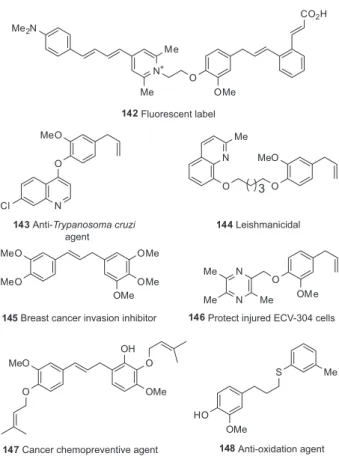
endeavors (Figures 2 and 3). The EP3 receptor is a member of the prostanoid G-protein coupled receptors. Prostanoids are products of the arachidonic acid cascade. Stark and co-workers137 synthesized structures with different
small molecule fluorophoric moieties via a dimethylene spacer, which resulted in human EP3 receptor ligands
such as 142, with affinities in the nanomolar concentration
Quinoline moieties have been attached to the phenolic oxygen of eugenol, directly or through a spacer, in order to generate antiparasitary agents, potentially useful as antitrypanosomics against Trypanosoma cruzi (143)138
or antileishmanial (144)139 agents. The attachment of
a ligustrazine (tetramethylpyrazine) residue afforded compounds with protective effects against hydrogen peroxide (H2O2)-induced oxidative damage on ECV-304 cells. Eugenol ether 146 proved to have a beneficial effect,
protecting injured ECV-304 cells with an EC50 value of 0.20 µM.140
On the other hand, alkylation of the free phenol of eugenol and attachment of a trioxygenated aromatic ring to the end of the three-carbon side chain afforded cytotoxic compounds useful as breast cancer invasion inhibitors (145)141 and cancer chemopreventive agents
(147).142 Other simple derivatives of eugenol have been
prepared and examined as anticancer agents against different cell lines. Simple structure-activity relationships were obtained.143
Hydrothiolation of the double bond of eugenol with thiophenol derivatives afforded antioxidant compounds, such as 148, which were more effective in inhibition of
induced lipid peroxidation compared to the precursor eugenol.144 Alkyl and aryl ethers of eugenol were effective
in reducing lipid peroxidation, protein oxidative damage
by carbonyl formation and increase total thiol content in cerebral cortex homogenates.145
1,3-Dipolar coupling of conveniently substituted eugenyl ethers with aldoximes resulted in pirazolines like 149, endowed with anti-stress activity.146 On the
other hand, etherification of the free phenol of eugenol to produce mimetics of fibrates resulted in hipolipidemic compounds, such as 150,147 whereas introduction of the side
chain of carvedilol afforded a new type of β-adrenoceptor blockers, with ancillary antioxidant activities; the receptor binding affinity of compound 151 was similar to that of
propranolol.148
Alkylation of the free phenol moiety of eugenol with 3,5-diaryl pyrazoline amide derivatives resulted in antibacterial and antifungic agents. Compound 152
exhibited significant antibacterial activity compared with gentamycin and moderate antifungal activity in comparison with griseofulvin.149 Simple derivatives of eugenol have
also been evaluated for their antifungal activity.150 In
addition, eugenol was employed as starting material for the synthesis of substituted dihydronaphthalenes,151 some
of which exhibited activity as inhibitors of the efflux pump of Staphylococcus aureus. These agents have the ability to reduce the minimum inhibitory concentration of antibacterials, such as ciprofloxacin, when delivered associated with them.
5. Cyclizations Involving Eugenol. Synthesis of Heterocycles
5.1.Synthesis of quinolines
The tetrahydroquinoline skeleton is an important heterocycle among natural products,152 and polysubstituted
tetrahydroquinolines display a wide range of biologic activities, including antimalarial, antitumoral and antioxidant.153
MeO
O
N Cl
143Anti-Trypanosoma cruzi
agent
MeO
O O N
Me
3
144Leishmanicidal N+
O OMe Me
Me Me2N
CO2H
142Fluorescent label
MeO MeO
OMe OMe
OMe
O OMe N
N
Me Me
Me
145Breast cancer invasion inhibitor 146Protect injured ECV-304 cells
MeO
O
O
OMe OH
147Cancer chemopreventive agent
HO OMe
S Me
148Anti-oxidation agent
Figure 2. Selected synthetic bioactive compounds prepared from eugenol.
MeO
O O N
N
149Anti-stress
MeO
O N
Cl CO2Me H
150Hipolipidemic
MeO
O N N
O Cl
OH
152Antimicrobial O
MeO
N OH O
OMe H
151Adrenoceptor blocker
Kouznetsov and co-workers154 designed a highly
stereoselective synthesis of polysubstituted tetra-hydroquinolines (156) from isoeugenol (3), obtained by
solid base-mediated isomerization of eugenol (1), based
on a three component imino Diels-Alder cycloaddition reaction (Scheme 18).155 The in situ preformed aldimines
derived from benzaldehydes (154) and 3,4-(methylendioxy)
aniline 155 functioned as the azadiene component, whereas
isoeugenol acted as the required dienophile.
The transformation was best performed in MeCN or polyethylenglycol (PEG) 400. A series of tetrahydroquinolines prepared after this methodology was tested as potential as cytotoxic and antitumor agents.156
Interestingly, use of phthaldehydic acid as the aldehyde component enabled the formation of a isoindolo[2,1-a] quinolin-11(5 h)-one, by lactamization157 of the acid
moiety with the nitrogen atom of the tetrahydroquinoline. Compounds of this family were found to be active as protecting agents against N2-induced hypoxia and inhibitors of human topoisomerase II and bacterial DNA-gyrase.158
On the other side, it is recognized that the quinolines are also an important class of heterocycles, and the quinoline skeleton is at the heart of numerous synthetic antimalarial, antibacterial, antifungal, anti-tuberculosis and anticancer compounds.159 Dinh and co-workers160 reported an efficient
and simple new route towards substituted quinolines employing eugenol. Their sequence entailed protecting
O O
NH2
R3 R4 R2
R1
MeO
RO MeO
HO +
O
O N
MeR1
OH OMe
R3 R4
R2 H
156
154 3
155
a b
H O
O
O
157
HO
O
158
HO2C
HO2C NO2
NO2
N O OH N
SO3
-d
e R = R = R = R = H (40%)1 2 3 4 R = OH, R = R = R = H (55%)1 2 3 4 R = R = R = H, R = OH (47%)1 2 4 3 R = R = H, R = OMe, R = OH (45%)1 4 2 3 R = R = H, R = OH, R = OMe (50%)1 4 2 3 R = R = H, R = R = OMe (58%)1 4 2 3
R = H, R = R = R = OMe (64%)1 2 3 4 1153R = HR = CH 2CO2H c
Scheme 18. Reagents and conditions: (a) 10% KOH/Al2O3 (88%); (b) 10% BF3.Et2O, MeCN, 60 ºC, 6-10 h (40-64%); (c) ClCH2CO2Na; (d) HNO3, AcOH, –5 ºC, 4 h; RT, 4 h (80%); (e) 1. S2O4Na2, conc. NH3, RT, 6 h; 2. AcOH, 72 h (68%).
the free phenol with chloroacetic acid and subjecting the resulting compound (153) to nitration with fuming nitric
acid in AcOH, which effected ether cleavage, a normal nitration, and then an unexpected electrophilic addition to the double bond to form 80% of the quinone-aci compound 157.161 In turn, derivative 157 was reductively
cyclized in 68% yield, upon treatment with thiosulfate. It was conjectured that a Neff reaction of the primary nitro group afforded an intermediate aldehyde, which enabled the cyclization with the nitrogen atom attached to the cycle. The so obtained quinoline 158 could be further functionalized
on C5 and on its free phenol moiety.
5.2.Synthesis of isoquinolines
Since double bonds can be viewed as synthetic equivalents of alcohols, their hydrated counterparts, the capability of eugenol and eugenol derivatives to undergo cyclocondensations toward nitrogen and oxygen heterocycles was examined in several reaction sequences. One of them is a modification inspired in the Ritter-type162
cyclocondensation of nitriles with dialkylbenzylcarbinols to access dihydroisoquinolines (Scheme 19), which was extended to allylbenzenes.163
The free hydroxyl of eugenol was alkylated (MeI, EtI) almost quantitatively (2, 2a) under phase-transfer
catalysis conditions (18-crown-6/KOH), and the Ritter cyclocondensation was performed with different nitriles, including HCN, MeCN, MeSCN, BnCN, ClCH2CN,
homoveratryl nitrile and 3-cyanocoumarin, to yield 160.
Under HBF4 as promoter, the reaction afforded 36% of
the expected product (159),164 whereas the reaction of 2 with
cyanoacetamide afforded the expected enaminoamides 161,
even when eugenol itself was used as starting material. The use of 94% H2SO4 as cyclizing agent furnished lower yields
of these latter compounds.165
5.3. Synthesis of isochromanes
On the other hand, the most commonly used approach toward the pyran ring of isochromanes is the oxa-Pictet-Spengler cyclization of β-phenylethyl alcohols with aldehydes and ketones.166 Since some isochromanes are
relevant for their bioactivity as hypotensive, growth-regulating and antitumor agents, modifications of this cyclization have been explored.167 The reaction of
methyleugenol (2) with methyl trifluoropyruvate (163)
under TfOH promotion directly afforded 84% of the isochromane derivative 163; the benzylic alcohol 162 was