Article
J. Braz. Chem. Soc., Vol. 26, No. 6, 1086-1097, 2015. Printed in Brazil - ©2015 Sociedade Brasileira de Química 0103 - 5053 $6.00+0.00
A
*e-mail: [email protected]
Synthesis and Antitumor Evaluation of New Heterocycles Derived from
3-Methyl-2-benzothiazolinone Hydrazone
Nabila M. Ibrahim,a Hisham A. A. Yosef,a Ewies F. Ewies,a Mohamed R. H. Mahran,*,a
Mamdouh M. Alib and Abeer E. Mahmoudb
aDepartment of Organometallic and Organometalloid Chemistry and bBiochemistry Department,
National Research Centre, El-Buhouth St, 12622 Dokki, Cairo, Egypt
3-Methyl-2-benzothiazolinone hydrazone condensed with some selected aldehydes to give the corresponding Schiff bases. Cyclizing the obtained Schiff base derivatives with thioglycolic acid afforded the respective thiazolylideneaminothiazolidenones. Condensation of 3-methyl-2-benzothiazolinone hydrazone with ethyl cyanoacetate yielded a mixture of the bishydrazine and the cyanoacetohydrazide derivatives. Meanwhile, its condensation with ethyl acetoacetate produced a mixture of the monoketone and the β-diketone derivatives. Besides, the reaction of the starting hydrazone with malononitrile afforded a mixture of the cyanomethylylidene and cyanomethyl hydrazone derivatives beside the bishydrazine derivative. Elementary and spectroscopic measurements were in good accord with the structures postulated for the new compounds. The antitumor activities of certain selected new compounds were screened, in vitro, against a panel of four (liver, HepG2; breast, MCF-7; lung, A549; and colon; HCT116) human solid tumor cell lines. The cells that showed better activity were HepG2 and MCF-7. Structure-activity relationship (SAR) was also discussed.
Keywords: 3-methyl-2-benzothiazolinone hydrazone, aldehydes, Schiff bases, active methylenes, antitumor activity
Introduction
Benzothiazoles are interesting heterocycles which are ubiquitous in nature and show antiviral,1 antibacterial,2
antimicrobial3 and antifungal activities.4 They are also
useful as anti-allergic,5 antidiabetic,6 antitumor,7
anti-inflamatory,8 anthelemintic,9 and anti-HIV agents.10 The
wealth of interest in the chemistry of benzothiazoles is also due to their industrial importance11 and for being
important elements and pharmacophores for designing several biological activities.10,12-14 Many benzothiazole
derivatives have been synthetically and biologically evaluated through reacting 2-aminobenzothiazoles with various reagents.15,16 Limited attention, on the other hand,
has been paid to making use of 2-hydrazonobenzothiazoles for similar purposes.17,18 In context to our interest in this
realm,19 the present work has been endeavored aiming at
designing and synthesizing new compounds bearing the benzothiazole scaffold in their molecules to be evaluated for their anticancer activities. This has been achieved through
reacting 3-methyl-2-benzothiazolinone hydrazone 1 with
certain carbonyl reagents and active methylenes.
Results and Discussion
Chemistry
It has been found that hydrazone 1 condenses with
aldehydes 2a-h in absolute ethanol at the reflux temperature
in the presence of a few drops of piperidine to give the respective Schiff bases 3a-h in high percentage yields
(Scheme1). The assigned structures were attested by compatible analytical and spectroscopic measurements.
For example, correct elementary analyses and molecular weight determination (MS) for 4-(((3-methylbenzo[d]
thiazol-2(3H)-ylidene)hydrazono)methyl)benzonitrile 3f
corresponded to C16H12N4S (MS m/z 292, 48%). Its infrared
(IR) spectrum (KBr) showed absorption bands at ν/cm−1
3084 (aromatic C−H), 2921 (aliphatic C−H), 2219 (C≡N), 1651 (C=N) and 1566 (aromatic C=C). The 1H nuclear
magnetic resonance (NMR) of 3f (500 MHz, DMSO-d6)
7.12 (t, 1H, J 7.8 Hz, ArH, benzothiazole ring), 7.34 (d, 1H, J 8.1 Hz, ArH, benzothiazole ring), 7.62 (t, 1H, J 8.1 Hz,
ArH, benzothiazole ring), 7.88 (d, 1H, J 7.8 Hz, ArH,
benzothiazole ring), 7.91 (d, 2H, J 8.1 Hz, AB system,
ArH, benzene ring), 8.40 (d, 2H, J 8.1 Hz, AB system,
ArH, benzene ring), 8.43 (s, 1H, N=CH).
Schiff bases 3a-e were cyclized upon treatment
with thioglycolic acid to yield the respective thiazolylideneaminothiazolidinones 4a-e (Scheme 2).
Correct elementary analyses and molecular weight determination for 2-(4-chlorophenyl) -3-(3-methylbenzo[d] thiazol-2(3H)-ylideneamino)thiazolidin-4-one 4b taken as
a representative example, corresponded to C17H14ClN3OS2 (MS m/z 375, 100%). Its IR spectrum (KBr) revealed
the presence of bands at ν/cm−1 3081 (aromatic C−H),
2923 (aliphatic C−H), 1688 (C=O), at 1608, 1555 for the C=N, aromatic C=C groups, respectively and 740 (Cl−C, aromatic). The 1H NMR spectrum of 4b (500 Hz,
DSMO-d6) showed signals at d3.36 (s, 3 H, CH3), 5.87
(s, 1 H, NCH−S). Protons of the methylene group (2H) appeared as two doublets (each with J 16.3 Hz) at d3.71 and d3.87 ppm, indicating that they are magnetically not equivalent. The four protons of the benzothiazole ring gave signals at 7.08 (t, J 7.6 Hz), 7.18 (d, J 7.6 Hz), 7.23 (t,
J 7.6 Hz) and at 7.55 (d, J 7.6 Hz), while the two doublets
due to the 1,4-disubstituted benzene ring appeared at d 7.43 (2H, J 8.6 Hz) and d 7.51 (2H, J 8.6 Hz).
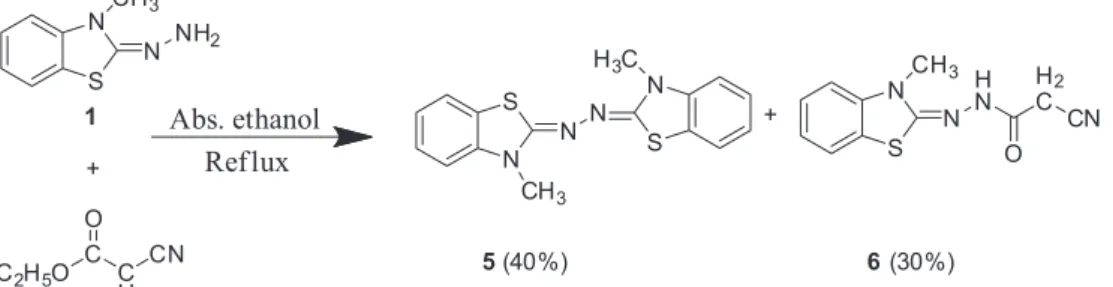
Reaction of hydrazone 1 with ethyl cyanoacetate was
conducted in absolute ethanol to give a mixture of two products, which were separated by column chromatography (Scheme 3).
The first product was proved to be 1,2-bis(3-methylbenzo[d]thiazol-2(3H)-ylidene)hydrazine 5 by
comparing its melting point (mp) and IR spectra with a reference sample.19 An ORTEP overview of compound 5
is represented in Figure 1.19
The second product was formulated as 2-cyano-N
’-(3-methylbenzo[d]thiazol-2(3H)-ylidene)acetohydrazide 6
for the following reasons: (i) correct elementary analyses
and molecular weight determination for compound 6
corresponded to C11H10N4OS (MS m/z 246, M+, 52%);
(ii) its IR spectrum (KBr) showed strong absorption bands
at ν/cm−1 3428 (N−H), 3151 (aromatic C−H), 2981, 2862
(aliphatic C−H), 2257 (C≡N), 1667 (C=O), 1603 (C=N) and 1578 (aromatic C=C); (iii) the 1H NMR spectrum
of 6 (500 MHz, DMSO-d6) disclosed the presence of
signals at d 3.67(s, 3H, NCH3), 3.83 (d, 2H, J 7.4 Hz,
W-conformation, NH−C(O)−CH2), 7.04 (t, 1H, J 8.1 Hz,
S N
N CH3
NH2
1 2a-h
S N
N CH3
3a-h +
C
O
R H
N R
H
-H2O
2,3 a, R = C6H5
b, R = 4-Cl-C6H4
c, R = 4-(piperidin-1-yl)-C6H4
d, R = 4-O2N-C6H4
e, R = 2-thienyl
f, R = 4-CN-C6H4
g,R = 2-ferrocenyl
h, R = 3,4-(HO)2-C6H3
Scheme 1. Synthesis of Schiff bases 3a-h.
S N
N CH3
N R
+
S N
CH3
3a-e 4a-e
3,4 a, R = C6H5
b,R = 4-Cl-C6H4
c,R= 4-(piperidin-1-yl)-C6H4
d, R = 4-NO2-C6H4
e, R = 2-thienyl C O
OH C H2
HS N N
S
H R
O H H
H
- H2O
Scheme 2. Cycloaddtion reaction of thioglycolic acid with Schiff bases 3a-e.
S N
N CH3
NH2
1 2a-h
S N
N CH3
3a-h +
C O
R H
N R
H -H2O
2,3 a, R = C6H5 b, R = 4-Cl-C6H4
c, R = 4-(piperidin-1-yl)-C6H4 d, R = 4-O2N-C6H4
e, R = 2-thienyl f, R = 4-CN-C6H4 g,R = 2-ferrocenyl h, R = 3,4-(HO)2-C6H3
S N
N CH3
N R
+
S N
CH3
3a-e 4a-e
3,4 a, R = C6H5 b,R = 4-Cl-C6H4
c,R= 4-(piperidin-1-yl)-C6H4 d, R = 4-NO2-C6H4
e, R = 2-thienyl C O
OH
C H2
HS N N
S H R
O H
H H
ArH), 7.19 (d, 1H, J 8.1 Hz, ArH), 7.31 (t, 1H, J 7.8 Hz,
ArH), 7.56 (d, 1H, J 7.8 Hz, ArH) and 10.78 (brs, 1H,
NH, D2O exchangeable); (iv) the 13C NMR spectrum of
compound 6 (125 MHz, DMSO-d6) showed signals at d 24.6 (CH2CN), 31.0 (N-CH3), 110.0 (C≡N). The fused carbon atoms (3C) gave signals at d 158.7 (S−C=N), 141.3
(C-4, benzothiazole ring) and 117.0 (C-9, benzothiazole
ring). The aromatic CH signals (4C) appeared at d 127.3, 122.9, 122.1 and 121.8. The signal present at d 164.1 is attributed to the carbonyl carbon atom.
Condensation of hydrazone 1 with ethyl acetoacetate
proceeded also in absolute ethanol to give a mixture of two products, which were separated by column chromatography. The first (25%) was obtained in yellow crystals and formulated as ethyl 3-(3-methylbenzo[d]
thiazol-2(3H)-ylidene)hydrazono)butanoate 7 (Scheme 4).
Correct elementary analyses and molecular weight determination for compound 7 corresponded to C14H17N3O2S
(MS m/z 291, M+, 100%). Its IR spectrum (KBr) showed
strong absorption bands at ν/cm−1 2922, 2857 (aliphatic
C−H), 1732 (C=O, ester), 1633 (C=N) and 1582 (aromatic
C=C). Its 1H NMR spectrum (500 MHz, DMSO-d 6)
showed signals at d1.18 (t, 3H, J 7.6 Hz, ethoxy-CH3),
2.03 (s, 3H, CH3−C=N), 3.43 (s, 2H, N=C−CH2−C=O), 3.48 (s, 3H, NCH3) and 4.08 (q, 2H, J 7.6 Hz,
ethoxy-CH2). The four protons of benzothiazole ring gave signals
at 7.02 (t, 1H, J 8.6 Hz,), 7.20 (d, 1H, J 8.6 Hz), 7.26 (t,
1H, J 7.6 Hz,), 7.51 (d, 1H, J 7.6 Hz). The mass spectrum
of compound 7 shows the molecular ion peak at m/z 291
(100%), which is also the base peak denoting its relative stability upon electron bombardment. Ejection of ethanol molecule from M+ yields the radical cation a at m/z 245
(52%), which can lose CH3 radical to give cation b at m/z
230 (21%). Cleavage of M+ at axis x affords cation c at m/z
163 (24%). Meanwhile, the prominent ion peak present at
m/z 218 (cation d, 10%) can arise viacleavage of M+ at
axis y (Scheme 5).
The second product (35%) was yielded in golden crystals and formulated as N’-(3-methylbenzo[d
]thiazol-2(3H)-ylidene)-3-oxobutanehydrazide 8 for the following
reasons: (i) its elementary analyses and molecular weight
determination (MS) corresponded to C12H13N3O2S (m/z 263,
M+, < 5%); (ii) the IR spectrum of 8 (KBr) showed strong
absorption bands at ν/cm−1 3430 (N−H), 2923, 2855
(aliphatic C−H), 1730 (C=O), 1677 (C=O) and at 1587, 1525 (C=N and aromatic C=C, respectively); (iii) its
1H NMR spectrum (500 MHz, DMSO-d
6) showed signals
at d2.46 (s, 2H, CH2), 3.79 (s, 3H, NCH3), 3.83 (s, 3H,
OCH3), 6.03 (brs, 1H, NH, D2O exchangeable), 6.95-7.90
(m, 4H, benzothiazole ring).
Condensation of hydrazone 1 with malononitrile
proceeded in absolute ethanol at the reflux temperature
Figure 1. ORTEP overview of compound 5.
S N
N
CH3
H N
H2
C CN O
6(30%)
5(40%)
N S
N N
N
S
CH3
H3C
+ S
N N
CH3
NH2
C O + 1
C2H5O C
H2
CN
Abs. ethanol
Ref lux
Scheme 3. Condensation of hydrazone 1 with ethyl cyanoacetate.
S N
N CH3
NH2
O +
+ 1
S N
N CH3 H
N CH2
O O H3C
7(25%) 8(35%)
H3C C
H2
O
OC2H5
S N
N CH3
N CH2
C2H5O
H3C
O
Abs. ethanol
Ref lux
to give a mixture of three products which were separated by column chromatography (Scheme 6). The first (30%) was proved to be compound 5 by comparing its mp and IR
spectra with those of a reference sample.19
The second product (20%, pale brown crystals) was formulated as 2-(2-(3-methylbenzo[d]thiazol-2(3H
)-ylidene)hydrazinyl)acetonitrile 9 for the following
reasons: (i) its elementary analyses and molecular weight
determination (MS) corresponded to C10H10N4S (m/z 218,
M+, < 5%); (ii) the IR spectrum of 9 revealed strong
absorption bands at ν/cm−1 3267 (N−H), 2919, 2849
(aliphatic C−H), 2202 (C≡N), 1628 (C=N) and at 1577, 1523 (aromatic C=C); (iii) its 1H NMR spectrum (500 MHz,
DMSO-d6) showed signals at d3.68 (s, 3H, NCH3) and
3.90 (s, 2 H, CH2). Protons of the benzothiazole ring (4H)
gave a multiplte signal at a range of 6.99-7.52. The NH2
group protons appeared as D2O exchangeable broad signal
at d8.58 ppm.
The third compound (20%, dark brown crystals) was formulated as 2-cyano-N’-(3-methylbenzo[d
]thiazol-2(3H)-ylidene)acetohydrazonamide 10 (Scheme 6). Its
elementary analyses and molecular weight determination corresponded to C11H11N5S (MS m/z 245, 72%). The IR
spectrum of compound 10 (KBr) revealed strong absorption
bands at ν/cm−1 3476, 3370 (NH
2), 3051 (aromatic C−H),
2917 (aliphatic C−H), 2251 (C≡N), 1656, 1617 (C=N) and 1565 (aromatic C=C). Its 1H NMR spectrum (500 MHz,
DMSO-d6) showed signals at d3.44 (s, 3H, NCH3), 4.32
(s, 2H, CH2), 6.32 (brs, 2H, NH2, D2O exchangeable), 6.96
(t, 1H, J 7.6 Hz, benzothiazole ring), 7.09 (d, 1H, J 7.6 Hz,
benzothiazole ring), 7.22 (t, 1H, J 7.6 Hz, benzothiazole
ring), 7.47 (d, 1H, J 7.6 Hz, benzothiazole ring). The
13C NMR spectrum of compound 10 (125 MHz, DMSO-d 6)
showed signals at d22.4 (CH2CN), 30.9 (N−CH3) and 109.4
(CN). The fused carbon atoms (3C) gave signals at d 159.0 (S−C=N), 141.7 (C-4, benzothiazole ring) and 117.4 (C-9,
benzothiazole ring). The aromatic CH signals (4C) appeared
at d 126.6, 123.9, 122.6 and 121.1. The signal present at
d148.2 ppm is attributed to N=C−NH2 carbon atom.
Biological evaluation
Conventional chemotherapy, although directed toward certain macromolecules or enzymes, typically does not discriminate effectively between rapidly dividing normal cells (e.g., bone marrow and gastrointestinal tract) and tumor cells, thus leading to several toxic side effects. Tumor responses from cytotoxic chemotherapy are usually partial, brief and unpredictable. In contrast, targeted therapies interfere with molecular targets that have a role in tumor growth or progression. These targets are usually located in tumor cells, although some like the antiangiogenic agents may target other cells such as endothelial cells.20 Thus, S
N
N N C
H2
C C O
OC2H5
CH3
CH3
+.
S N
N N C
CH3
C CH
CH3
O
S N
N N C
CH3
C CH O
+
S N
N
CH3
+
S N
N N C
CH3
CH3
CH2
7, M+, C
14H17N3O2S,
m/z 291 (100%)
a,C12H11N3OS
m/z 245 (52%)
x y
b, C11H8N3OS
m/z 230 (21%)
c,C8H7N2S
m/z 163 (24%)
d,C11H12N3S
m/z 218 (10%)
+ +.
Scheme 5. The fragmentation pattern of compound 7.
S N
N
CH3
NH2
+
1
5(30%)
H2C
CN
CN
S N
N
CH3
H N
S N
N
CH3
N C
H2
CN HC2
CN
NH2
9(20%)
+ +
10(20%)
N S
N N
N
S
CH3
H3C
Abs. ethanol
Reflux
targeted therapies have a high specificity toward tumor cells, providing a broader therapeutic window with less toxicity. They are also often useful in combination with cytotoxic chemotherapy or radiation to produce additive or synergistic anticancer activity since their toxicity profiles often do not overlap with traditional cytotoxic chemotherapy. Thus, targeted therapies represent a new and promising approach to cancer therapy, leading to beneficial clinical effects. There are multiple types of available targeted therapies, including monoclonal antibodies, inhibitors of tyrosine kinases and antisense inhibitors of growth factor receptors.20
Poly(ADP-ribose)polymerase-1 (PARP-1) is a chromatin-bound nuclear enzyme engaged in the detection and repair of DNA damage.21 During poly(ADP)
ribosylation, PARP-1 consumes nicotinamide adenine dinucleotide to synthesize poly(ADP)-ribose either on itself or on an array of nuclear target proteins such as histones, topoisomerases, DNA polymerases and DNA ligases.22
This results in high negatively charged nuclear proteins that subsequently unwind and repair the damaged DNA through the base excision repair (BER) pathway. Therefore, inhibition of PARP sensitizes tumor cells to cytotoxic drugs that induce DNA damage, which would normally be repaired through the BER pathway. Undeniably PARP inhibition has been shown to sensitize tumors to DNA alkylating agents (e.g., temozolomide) and topoisomerase I poisons (e.g., irinotecan).23 Moreover, some PARP
inhibitors have been shown to display single agent activity for tumors lacking BRCA1- or BRCA2-dependent DNA double-stranded repair mechanisms.24 Thus, development
of PARP inhibitors is an appealing research area offering innovative cancer treatment opportunities.
In the same direction and in continuing effort to find more potent and selective anticancer compounds, herein we designed and synthesized a series of benzothiazole compounds for studying their antiproliferative activities against 4 different human cancer cell lines including liver HepG2, breast MCF-7, lung A549 and colon HCT116 cancer cell lines as well as investigating their mechanism of action on poly(ADP-ribose)polymerase-1 inhibition.
Cell lines and culturing
Anticancer activity screening for the tested compounds utilizing 4 different human tumor cell lines including liver HepG2, breast MCF-7, lung A549 and colon HCT116 cancer cell lines were obtained from the American Type Culture Collection (Rockville, MD, USA). The tumor cells were maintained in Dulbecco’s modified Eagle’s medium (DMEM) supplemented with 10% heat inactivated fetal calf
serum (GIBCO), penicillin (100 U mL−1) and streptomycin
(100 µg mL−1) at 37 °C in humidified atmosphere containing
5% CO2. Cells at a concentration of 0.50 × 10⁶ were grown
in a 25 cm2 flask in 5 mL of complete culture medium.
In vitro cytotoxicity assay
The antiproliferative activity was measured in vitro
using the sulfo-rhodamine-B stain (SRB) assay according to the previously reported standard procedure.25 Cells were
inoculated in 96-well microtiter plate (104 cells well−1) for
24 h before treatment with the tested compounds to allow attachment of cell to the wall of the plate. Test compounds were dissolved in dimethyl sulfoxide (DMSO) at 1 mg mL−1
immediately before use and diluted to the appropriate volume just before addition to the cell culture. Different concentrations of tested compounds (0-50 µg mL−1) and
doxorubicin (DOX) were added to the cells. Triplicate wells were prepared for each individual dose. Monolayer cells were incubated with the compounds for 48 h at 37 °C and in atmosphere of 5% CO2. After 48 h, cells were fixed, washed
and stained for 30 min with 0.4% (m/v) SRB dissolved in 1% acetic acid. Unbound dye was removed by four washes with 1% acetic acid and attached stain was recovered with Tris-EDTA buffer. Color intensity was measured in an enzyme-linked immunosorbent assay (ELISA) reader. The relation between surviving fraction and drug concentration is plotted to get the survival curve for each cell line after the specified time. The concentration required for 50% inhibition of cell viability (IC50) was calculated and the results are given in Table 1. The results were compared to the antiproliferative effects of the reference control DOX.26
PARP-1 inhibitors comprise a promising new class of compounds for the treatment of cancer. The activity of PARP-1 in the lysate of hepatic HepG2 and breast MCF-7 cancer cells treated with the prepared compounds was measured using ELISA kit purchased from Glory Science Co., Ltd (Del Rio, TX78840, USA).
Statistical analysis
The results are reported as mean ± standard error (S.E.) for at least three time experiments. Statistical differences were analyzed according to one way ANOVA test followed by student’s t-test wherein the differences were considered
to be significant at p < 0.05.
Antiproliferative activity of the tested compounds
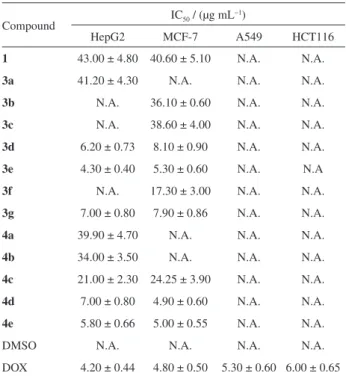
As shown in Table 1 and Figure 2, the antiproliferative activity of the synthetic compounds was evaluated against human hepatocellular carcinoma HepG2, breast adenocarcinoma MCF-7, human lung cancer A549 and colon cancer HCT116 cell lines using SRB assay, in comparison with DOX as a reference drug. The results revealed that all compounds did not exert any activity against human lung A549 and colon HCT116 cancer cell lines. Many of the tested compounds showed remarkable anticancer activity against liver HepG2 cancer cell lines. While compounds 3b, 3c and 3f had no influence on the
cancer cells, compounds 3d, 3e, 3g, 4d, and 4e were found
to be potent anticancer agents having IC50 values near to the standard drug (IC50 7.00 ± 0.80, 6.20 ± 0.73, 4.30 ± 0.40,
7.00 ± 0.80 and 5.80 ± 0.66 µg mL−1, respectively versus
4.20 ± 0.44 µg mL−1 for DOX). The rest of the tested
compounds revealed slight to moderate activity. In the same sense, evaluation of the anticancer effect of the tested compounds against human breast MCF-7 cancer cell lines revealed that although compounds 3a, 4a and 4b had no
effect on the MCF-7 cancer cell, compounds 3d, 3e, 3g, 4d, and 4e showed anticancer activity close to that of
the standard drug (IC50 values 8.10 ± 0.90, 5.30 ± 0.60, 7.90 ± 0.86, 4.90 ± 0.60 and 5.00 ± 0.55 µg mL−1,
respectively, versus 4.80 ± 0.50 µg mL−1 for DOX). The
rest of the tested compounds revealed slight activity. From
the forgoing result, the synthesized compounds especially
3d, 3e, 3g, 4d, and 4e showed cytotoxicity and growth
inhibitory activity on both breast and liver cancer cell lines.
From Table 1 and Figure 2, it is clear that: (i) the
cytotoxic activity of the tested compounds against liver carcinoma (HepG2) decreases in the order: 3e > 4e > 3d > 3g = 4d > 4c > 4b > 4a > 3a > 1; (ii) the cytotoxic activity
of the tested compounds against breast carcinoma (MCF-7) decreases in the order: 4d > 4e > 3e > 3g > 3d > 3f > 4c > 3b > 3c > 1.
Poly(ADP-ribose)polymerase-1 (PARP-1) activity
To identify the mechanism of action responsible for the cytotoxicity of the prepared compounds 3d, 3e, 3g, 4d, and 4e, the activity of PARP-1 expressed in the two
cell lines (hepatic HepG2 and breast MCF-7 cancer cell lines) were estimated quantitatively and the results were calculated as percentage of the control cancer cells as shown in Figure 3.
Table 1. The in vitro cytotoxicity activity of the tested compounds expressed as IC50 values in 4 different human cancer cell linesa,b
Compound IC50 / (µg mL
−1)
HepG2 MCF-7 A549 HCT116
1 43.00 ± 4.80 40.60 ± 5.10 N.A. N.A.
3a 41.20 ± 4.30 N.A. N.A. N.A.
3b N.A. 36.10 ± 0.60 N.A. N.A.
3c N.A. 38.60 ± 4.00 N.A. N.A.
3d 6.20 ± 0.73 8.10 ± 0.90 N.A. N.A.
3e 4.30 ± 0.40 5.30 ± 0.60 N.A. N.A
3f N.A. 17.30 ± 3.00 N.A. N.A.
3g 7.00 ± 0.80 7.90 ± 0.86 N.A. N.A.
4a 39.90 ± 4.70 N.A. N.A. N.A.
4b 34.00 ± 3.50 N.A. N.A. N.A.
4c 21.00 ± 2.30 24.25 ± 3.90 N.A. N.A.
4d 7.00 ± 0.80 4.90 ± 0.60 N.A. N.A.
4e 5.80 ± 0.66 5.00 ± 0.55 N.A. N.A.
DMSO N.A. N.A. N.A. N.A.
DOX 4.20 ± 0.44 4.80 ± 0.50 5.30 ± 0.60 6.00 ± 0.65
aIC
50 dose of the compounds which reduces survival to 50%; bdata were
expressed as average of three independent experiments; N.A.: no activity.
0 5 10 15 20 25 30 35 40 45 50
1 3a 3b 3c 3d 3e 3f 3g 4a 4b 4c 4d 4eDMSODOX
Compounds
IC
/ (µg mL
)
50
–1
HepG2 MCF-7
Figure 2. The in vitro cytotoxicity activity of the tested compounds expressed as IC50 values against HepG2 and MCF-7 human cancer cell
lines.
0 5 10 15 20 25 30 35 40 45 50 55 60 65 70 75 80 85 90
DOX 3d 3e 3g 4d 4e
Compounds
P
ARP-1 inhibition / %
HepG2 MCF-7
Figure 3. The effect of the prepared compounds on inhibition of PARP-1 enzyme activity in HepG2 and MCF-7 cells. The data were compared with the control cancer cells.
0 5 10 15 20 25 30 35 40 45 50
1 3a 3b 3c 3d 3e 3f 3g 4a 4b 4c 4d 4eDMSODOX
Compounds
IC
/ (µg mL
)
50
–1
HepG2 MCF-7
0 5 10 15 20 25 30 35 40 45 50 55 60 65 70 75 80 85 90
DOX 3d 3e 3g 4d 4e
Compounds
P
ARP-1 inhibition / %
In this work, the activity of PARP-1 in the lysate of hepatic HepG2 and breast MCF-7 cancer cells treated with the prepared compounds and DOX as a known inhibitor was measured and the data were calculated as percentage of inhibition as compared to the control untreated cancer cells. Meanwhile, treatment of hepatic HepG2 and breast MCF-7 cancer cells with DOX resulted in 82% and 76% inhibition, respectively as compared with control cancer cells. The treatment with compounds 3d, 3e, 3g, 4d and 4e resulted
in 53%, 61%, 44%, 45% and 60% inhibition, respectively in hepatic HepG2 cells. Similarly, the treatment of breast MCF-7 cells with the compounds resulted in inhibition of the activity of PARP-1 by 47%, 55%, 37%, 40% and 48%, respectively (Figure 3).
In summation, these findings suggest that there are correlation between the cytotoxicity of the tested compounds and inhibition of the PARP-1 activity. The tested compounds exert anti-carcinogenic activity in hepatic HepG2 and breast MCF-7 cancer cell lines through down regulation of the activity of PARP-1 enzyme, which may reduce the cell proliferation and result in significant growth inhibition.
Conclusions
The present study reports on simple and efficient approaches for the synthesis of new benzothiazolinone derivatives. 3-Methyl-2-benzothiazolinone hydrazone 1 was
successfully utilized as a starting material for implementing this goal. Some of the new products recorded pronounced
in vitro antitumor activities when tested against liver (HepG2)
and breast (MCF-7) human solid tumor cell lines. The most promising result against liver carcinoma was recorded by compound 3e (IC50 value of 4.30 ± 0.40 µg mL−1)
which is the closest in value to that recorded by the reference drug (DOX, IC50 value of 4.20 ± 0.44 µg mL−1).
Meanwhile, compounds 4d (IC50 4.90 ± 0.60 µg mL−1), 4e
(IC50 5.00 ± 0.55 µg mL−1) and 3e (IC50 5.30 ± 0.60 µg mL−1)
showed the highest activity compared to the reference drug (DOX, IC50 4.80 ± 0.50 µg mL−1) when tested against breast
carcinoma. The marked cytotoxic and growth inhibitory activity of compound 3e against both liver and breast
carcinoma may be correlated with the presence of the thienyl moiety in its molecule, which is known to promote the biological activity.27 On the other hand, hydrazone 1
showed the least appreciable cytotoxic activity amongst the tested compounds. However, it was successfully used to prepare new products (e.g., 3e, 4d, and 4e) of promise
as antitumor agents; particularly against liver and breast carcinoma. These results, supplement to the well known activity of many benzothiazole derivatives in reducing the incidence of various cancer types.7
Experimental
General
Solvents were purified and dried according to the usual procedures. 2-Hydrazono-3-methyl-2,3-dihydrobenzo[d]
thiazole 1 was prepared according to a known procedure.28
The reacting aldehydes were purified directly before use by distillation and/or recrystallization. They are commercially available except for 4-piperdine-1-ylbenzaldehyde, 2c,
which was prepared by reacting 4-fluorobenzaldehyde with piperidine in DMSO in the presence of K2CO3.29 The
reactions were monitored (thin layer chromatography, TLC) and the purity of the isolated products were controlled by using silica gel with fluorescent indicator F254 coated
on aluminum sheets of layer thickness 0.2 mm [Fluka]. Column chromatography was performed on silica gel, grain size 0.063-0.2 mm (Merck). Melting points were recorded on Electrothermal melting point apparatus and were uncorrected. The IR spectra were measured in KBr pellets using a JASCO FT/IR-300E Fourier Transform Infrared Spectrophotometer and reported in cm−1. NMR
spectra were recorded on a Joel-500 MHz spectrometer (1H NMR at 500 MHz and 13C NMR at 125 MHz) in
deuterated dimethylsulphoxide (DMSO-d6). The proton
chemical shifts are reported in d (ppm) downfield from tetramethylsilane (TMS) as an internal standard. Mass spectra were recorded on a Finnigan SSQ 7000 Spectrometer at 70 eV (Electron Impact). Analytical data were obtained at the analytical laboratory of the National Research Centre (or in the Microanalytical unit, Cairo University, Giza, Egypt). Satisfactory elemental analyses were gained for the new products. The antitumor activity was carried out at the Department of Biochemistry at the National Research Centre (NRC). Fetal bovine serum (FBS) and L-glutamine were obtained from Gibco Invitrogen Company (Scotland, UK). DMEM medium was provided from Cambrex (New Jersey, USA). DMSO, DOX, penicillin, streptomycin and sulfo-rhodamine-B stain (SRB) (3-(4,5-dimethylthiazol-2-yl)-2,5-diphenyltetrazolium bromide) were obtained from Sigma Chemical Company (St. Louis, MO, USA). Human poly(ADP-ribose) polymerase 1 (PARP-1) activity ELISA kit was purchased from Glory Science Co., Ltd (Del Rio, TX78840, USA).
Chemistry
General procedure for the synthesis of Schiff bases 3a-h A mixture of 3-methyl-2-benzothiazolinone hydrazone 1
(1.79 g, 0.01 mol) and the appropriate aldehyde 2a-h
4-6 h in the presence of a few drops of piperidine. After cooling the reaction mixture to room temperature, the formed solid was collected and recrystallized from ethanol to give the new Schiff base derivatives 3a-h.
2-(Benzylidenehydrazono)-3-methyl-2,3-dihydrobenzo[d] thiazole (3a)
Pale yellow crystals; yield 2.22 g, 80%; mp 163-165 °C; IR (KBr) ν/cm−1 3049, 3022 (C−H, aromatic), 2932 (C−H,
aliphatic), 1620 (C=N), 1577 (C=C, aromatic); 1H NMR
(500 MHz, DMSO-d6) d 3.55 (s, 3H, N−CH3), 7.07 (t,
1H, J 7.6 Hz, Ar−H, benzothiazole ring), 7.25 (d, 1H, J 7.6 Hz, ArH, benzothiazole ring), 7.32 (t, 1H, J 6.9 Hz,
ArH, benzene ring), 7.39 (t, 2H, J 6.9 Hz, Ar−H, benzene
ring), 7.41 (t, 1H, J 7.6 Hz, ArH, benzothiazole ring), 7.57
(d, 1H, J 7.6 Hz, ArH, benzothiazole ring), 7.72 (d, 2H, J 8.0 Hz, ArH, benzene ring), 8.35 (s, 1H, N=CH); 13C NMR
(125 MHz, DMSO-d6)d30.0 (N−CH3), 110.6, 122.8, 123.9,
127.0, 127.6, 128.9, 129.2, 130.2 (aromatic C−H), 122.3 (C-9, benzothiazole ring), 135.4 (CH=C−, benzene ring), 141.3 (C-4, benzothiazole ring), 152.7 (N=CH−Ph), 167.1 (S−C=N); MS (EI, 70 eV) m/z (%) 267 (100) [M+]; anal.
calcd.: C15H13N3S (267.35) C 67.39%, H 4.90%, N 15.72%,
S 11.99%; found: C 67.28%, H 4.91%, N 15.77%, S 12.03%.
2-((4-Chlorobenzylidene)hydrazono)-3-methyl-2,3-dihydrobenzo[d]thiazole (3b)
Colorless crystals; yield 2.25 g, 75%; mp 179-180 °C; IR (KBr) νmax/cm−1 3151 (C−H, aromatic), 2928 (C−H,
aliphatic), 1621 (C=N), 1590, 1572 (C=C, aromatic), 740 (Cl−C, aromatic); 1H NMR (500 MHz, DMSO-d
6) d3.60 (s, 3H, NCH3), 7.07 (t, 1H, J 7.6 Hz, ArH, benzothiazole ring),
7.26 (d, 1H, J 6.9 Hz, ArH, benzothiazole ring), 7.31 (t, 1H, J 6.9 Hz, ArH, benzothiazole ring), 7.47 (d, 2H, J 8.4 Hz,
AB system, ArH, benzene ring), 7.58 (d, 1H, J 7.6 Hz, ArH,
benzothiazole ring), 7.72 (d, 2H, J 8.4 Hz, AB system,
ArH, benzene ring), 8.35 (s, 1H, N=CH); MS (EI, 70 eV) m/z (%) 301 (65) based on 35Cl and 303 (28) based on 37Cl;
anal. calcd.: C15H12ClN3S (301.79) C 59.70%, H 4.01%, Cl
11.75%, N 13.92%, S 10.62%; found: C 59.83%, H 3.98%, Cl 11.70%, N 13.88%, S 10.66%.
3-Methyl-2-((4-(piperidin-1-yl)benzylidene)hydrazono)-2,3-dihydrobenzo[d]-thiazole (3c)
Colorless crystals; yield 2.62 g, 75%; mp 157-159 °C; IR (KBr) νmax/cm−1 3070 (C−H, aromatic), 2926, 2849
(C−H, aliphatic), 1612 (C=N), 1568 (C=C); 1H NMR
(500 MHz, DMSO-d6) d 1.52-1.54 (m, 6H, piperidinyl ring), 3.22-3.30 (m, 4H, piperidinyl ring), 3.49 (s, 3H, NCH3), 6.93 (d, 2H, J 8.6Hz, AB system, ArH, benzene
ring), 7.03 (t, 1H, J 7.6 Hz, ArH, benzothiazole ring), 7.22
(d, 1H, J 7.6 Hz, ArH, benzothiazole ring), 7.27 (t, 1H, J 7.6 Hz, ArH, benzothiazole ring), 7.50 (d, 1H, J 7.6 Hz,
ArH, benzothiazole ring), 7.52 (d, 2H, J 8.6 Hz, AB system,
ArH, benzene ring), 8.22 (s,1H, N=CH); MS (EI, 70 eV) m/z (%) 352 (10) [M++2]; anal. calcd.: C20H22N4S (350.48)
C 68.54%; H 6.33%, N 15.99%, S 9.15%; found: C 68.44%, H 6.36%, N 15.94%, S 9.12%.
3-Methyl-2-[(4-nitrobenzylidene)hydrazinylidene]-2,3-dihydro-1,3-benzothiazole (3d)
Red crystals; yield 2.18 g, 70%; mp 247-248 °C; IR (KBr) νmax/cm−1 3062 (C−H, aromatic), 2923 (C−H,
aliphatic), 1611 (C=N), 1590 (C=C, aromatic), 1511,1325 (NO2); 1H NMR (500 MHz, DMSO-d
6) d 3.58 (s, 3H, N−CH3), 7.12 (t, 1H, J 7.8 Hz, ArH, benzothiazole ring),
7.34 (m, 2H, ArH, benzothiazole ring), 7.64 (d, 1H, J 7.6 Hz, ArH, benzothiazole ring), 7.95 (d, 2H, J 8.4 Hz,
AB system, ArH, nitrobenzene ring), 8.27 (d, 2H, J 8.4 Hz,
AB system, ArH, nitrobenzene ring), 8.48 (s, 1H, N=CH);
13C NMR (125 MHz, DMSO-d
6) d31.2 (N−CH3), 111.3,
124.1, 124.2, 126.8, 128.6, 133.1 (aromatic C−H), 122.6 (C-9, benzothiazole ring), 139.4 (N−CH=C−, benzene ring), 141.6 (C-4, benzothiazole ring), 146.2 (N=CH−Ph), 147.9 (C−NO2, benzene ring), 165.2 (S−C=N); MS (EI,
70 eV) m/z (%) 312 (100) [M+]; anal. calcd.: C15H12N4O2S
(312.35) C 57.68%, H 3.87%, N 17.94%, S 10.27%; found: C 57.80%, H 3.83%, N 17.89%, S 10.30%.
3-Methyl-2-((thiophen-2-ylmethylene)hydrazono)-2,3-dihydrobenzo[d]thiazole (3e)
Buff crystals; yield 1.91 g, 70%; mp 185-187 °C; IR (KBr) νmax/cm−1 3050 (C−H, aromatic), 2924 (C−H,
aliphatic), 1610 (C=N), 1558 (C=C, aromatic); 1H NMR
(500 MHz, DMSO-d6) d 3.69 (s, 3H, NCH3), 7.01 (t,
1H, J 7.6 Hz, thiophen-H), 7.13 (t, 1H, J 9.2 Hz, ArH,
benzothiazole ring), 7.33 (m, 2H, ArH, benzothiazole
ring), 7.51 (d, 1H, J 9.2 Hz, ArH, benzothiazole ring),
7.61 (d, 1H, J 7.6 Hz, thiophene-H), 7.77 (d, 1H, J 4.3 Hz,
thiophene-H), 8.02 (s, 1H, N=CH); MS (EI, 70 eV) m/z
(%) 273 (100) [M+]; anal. calcd.: C
13H11N3S2 (273.38) C
57.12%, H 4.06%, N 15.37%, S 23.46%; found: C 57.02%, H 4.05%, N 15.32%, S 23.49 %.
4-(((3-Methylbenzo[d]thiazol-2(3H)-ylidene)hydrazono) methyl)benzonitrile (3f)
Yellow crystals; yield 2.17 g, 70%; mp 215-216 °C; IR (KBr) νmax/cm−1 3084 (C−H, aromatic), 2921 (C−H,
aliphatic), 2219 (C≡N), 1615 (C=N), 1566 (C=C, aromatic);
1H NMR (500 MHz, DMSO-d
6) d3.64 (s, 3H, NCH3), 7.12
ArH, benzothiazole ring), 7.88 (d, 1H, J 7.8 Hz, ArH,
benzothiazole ring), 7.91 (d, 2H, J 8.1 Hz, AB system,
ArH, benzene ring), 8.40 (d, 2H, J 8.1 Hz, AB system,
ArH, benzene ring), 8.43 (s, 1H, N=CH); MS (EI, 70 eV) m/z (%) 292 (48) [M+]; anal. calcd.: C16H12N4S (292.36) C
65.73%, H 4.14%, N 19.16%, S 10.97%; found: C 65.59%, H 4.17%, N 19.18%, S 11.01%.
2-((2-Ferrocenyl)hydrazono)-3-methyl-2,3-dihydrobenzo[d] thiazole (3g)
Orange crystals; yield 2.81 g, 75%; mp 161-162 °C; IR (KBr) νmax/cm−1 3082 (C−H, aromatic), 2927 (C−H,
aliphatic), 1611 (C=N), 1590, 1555 (C=C, aromatic and ferrocenyl); 1H NMR (500 MHz, DMSO-d
6) d3.47 (s, 3H, CH3), 4.17 (s, 5H, ferrocenyl-H), 4.04 (s, 2H,
ferrocenyl-H), 4.61 (s, 2H, ferrocenyl-H), 7.03 (t,
1H, J 7.6 Hz, ArH, benzothiazole ring), 7.20 (d, 1H, J 7.6 Hz, ArH, benzothiazole ring), 7.27 (t, 1H, J 7.6 Hz,
ArH, benzothiazole ring), 7.53 (d, 1H, J 7.6 Hz, ArH,
benzothiazole ring), 8.15 (s, 1H, N=CH); MS (EI, 70 eV) m/z (%) 378 (80) [M++3]; anal. calcd.: C19H17FeN3S
(375.27) C 60.81%, H 4.57%, Fe 14.88%, N 11.20%, S 8.54%; found: C 60.93%, H 4.53%, N 11.17%, S 8.50%.
4-(((3-Methylbenzo[d]thiazol-2(3H)-ylidene)hydrazono) methyl)benzene-1,2-diol (3h)
Dark brown crystals; yield 2.09 g, 70%; mp 255-257 °C; IR (KBr) νmax/cm−1 3468 (O−H), 3080 (C−H, aromatic), 2929
(C−H, aliphatic), 1623 (C=N), 1602 (C=C, olefinic), 1563 (C=C, aromatic); 1H NMR (500 MHz, DMSO-d
6) d3.49 (s, 1H, NCH3), 6.74 (d, 1H, J 8.4 Hz, ArH, benzene ring), 6.94
(d, 1H, J 8.4 Hz, ArH, benzene ring), 7.04 (t, 1H, J 7.6 Hz,
ArH, benzothiazole ring), 7.21 (s, 1H, ArH, benzene ring),
7.22 (d, 1H, J 7.6 Hz, ArH, benzothiazole ring), 7.28 (t, 1H, J 7.6 Hz, ArH, benzothiazole ring), 7.55 (d, 1H, J 7.6 Hz,
ArH, benzothiazole ring), 8.17 (s, 1H, N=CH), 9.16 and
9.34 (s, 2H, 2OH, D2O exchangeable); 13C NMR (125 MHz,
DMSO-d6) d 30.0 (N−CH3), 110.3, 113.5, 116.0, 121.0,
122.0, 122.7 (aryl CH, 7C), 121.0 (C-9, benzothiazole ring),
126.9 (CH=C−, benzene ring), 141.45 (C-4, benzothiazole
ring), 146.0 (C−OH, benzene ring), 148.3 (C−OH, benzene ring), 153.33 (N=CH−Ph), 165.3 (S−C=N); MS (EI, 70 eV) m/z (%) 300 (72) [M++1]; anal. calcd.: C15H13N3O2S (299.35)
C 60.18%, H 4.38%, N 14.04%, S 10.71%; found: C 60.27%, H 4.33%, N 13.98%, S 10.68%.
General procedure for the reaction of Schiff base derivatives
3a-e with thioglycolic acid
Thioglycolic acid (1.4 g, 1.1 mL, 0.015 mol) was added dropwise to a solution of the appropriate Schiff base
derivative 3a-e (0.01 mol) in dry benzene (50 mL) at room
temperature. After refluxing the reaction mixture for 6-8 h, the volatile materials were removed under reduced pressure. The residual substance was collected and chromatographed on silica gel to give the corresponding 4-thiazolidinone derivatives 4a-e as colorless crystals.
3-(3-Methylbenzo[d]thiazol-2(3H)-ylideneamino)-2-phenylthiazolidin-4-one (4a)
Eluent: petroleum ether (60-80 °C)/acetone (85/15, v/v); colorless crystals; yield 2.55 g, 75%; mp 262-263 °C; IR (KBr) νmax/cm−1 3061 (C−H, aromatic), 2924 (C−H,
aliphatic), 1687 (C=O), 1628 (C=C, aromatic), 1571 (C=N);
1H NMR (500 MHz, DMSO-d
6) d3.31 (s, 3H, NCH3), 3.71,
3.83 (2d, 2H, each with J 16.0 Hz, −O=C−CH2−S), 5.86 (s, 1H, NCH−S), 7.20-7.40 (m, 9H, aromatic); 13C NMR
(125 MHz, DMSO-d6) d 31.0 (S−CH2CO), 32.0 (N−CH3),
63.9 (Ph−CH−S), 110.7 (C-9, benzothiazole ring), 129.2 (Ph−C−CH−S), 128.9, 127.9, 127.2, 122.7, 122.5 (aromatic CH, 9C), 140.8 (C-4, benzothiazole ring), 166.9 (S−C=N), 167.8 (C=O); MS (EI, 70 eV) m/z (%) 341 (10) [M+];
anal. calcd.: C17H15N3OS2 (341.45) C 59.80%, H 4.43%, N 12.31%, S 18.78%; found: C 59.77%, H 4.45%, N 12.82%, S 18.73%.
2-(4-Chlorophenyl)-3-(3-methylbenzo[d]thiazol-2(3H)-ylideneamino)-thiazolidin-4-one (4b)
Eluent: petroleum ether (60-80 oC)/acetone (90/10,
v/v); colorless crystals; yield 2.81 g, 75%; mp 194-196 °C; IR (KBr) νmax/cm−1 3081 (C−H, aromatic), 2923 (C−H,
aliphatic), 1688 (C=O), 1608 (C=N), 1555 (C=C, aromatic), 740 (Cl−C, aromatic); 1H NMR (500 MHz, DMSO-d
6)
d 3.36 (s, 3H, NCH3), 3.71, 3.87 (2d, 2H, each with J 16.3 Hz, −O=C−CH2−S), 5.88 (s, 1H, NCH−S), 7.08 (t, 1H, J 7.6 Hz, ArH, benzothiazole ring), 7.18 (d, 1H, J 7.6 Hz, ArH, benzothiazole ring), 7.23 (t, 1H, J 7.6 Hz,
ArH, benzothiazole ring), 7.43 (d, 2H, J 8.6 Hz, AB system,
ArH, benzene ring), 7.51 (d, 2H, J 8.6 Hz, AB system, ArH,
benzene ring), 7.55 (d, 1H, J 7.6 Hz, ArH, benzothiazole
ring); MS (EI, 70 eV) m/z (%) 375 (100) based on 35Cl
and 377 (46) based on 37Cl; anal. calcd.: C
17H14ClN3OS2
(375.90) C 54.32%, H 3.75%, Cl 9.43%, N 11.18%, S 17.06%; found: C 54.44%, H 3.72%, Cl 9.40%, N 11.15%, S 17.11%.
3-(3-Methylbenzo[d]thiazol-2(3H)-ylideneamino)-2-(4-(piperidin-1-yl)-phenyl)thiazolidin-4-one (4c)
Eluent: petroleum ether (60-80 oC)/acetone (75/25,
v/v); colorless crystals; yield 2.33 g, 55%; mp 202-203 °C; IR (KBr) νmax/cm−1 3033 (C−H, aromatic), 2930
symmetric), 1692 (C=O), 1607 (C=N), 1562 (C=C, aromatic); 1H NMR (500 MHz, DMSO-d
6) d1.45-1.51 (m, 6H, piperidinyl ring), 3.07-3.09 (m, 4H, piperidinyl ring), 3.32 (s, 3H, NCH3), 3.68, 3.78 (2d, 2H, each with J 16.0 Hz, −O=C−CH2−S), 5.76 (s, 1H, NCH−S), 6.80 (d, 2H, J 8.1 Hz, AB system, ArH, benzene ring), 7.04 (t, 1H, J 7.6 Hz, ArH, benzothiazole ring), 7.15 (d, 1H, J 6.7 Hz,
ArH, benzothiazole ring), 7.25 (t, 1H, J 7.6 Hz, ArH,
benzothiazole ring), 7.27 (d, 2H, J 8.1 Hz, AB system, ArH,
benzene ring), 7.53 (d, 1H, J 6.7 Hz, ArH, benzothiazole
ring); MS (EI, 70 eV) m/z (%) 425 (83) [M++1]; anal. calcd.:
C22H24N4OS2 (424.58) C 62.23%, H 5.70%, N 13.20%, S 15.10%; found: C 62.14%, H 5.73%, N 13.16%, S 15.11%.
3-(3-Methylbenzo[d]thiazol-2(3H)-ylideneamino)-2-(4-nitrophenyl)- thiazolidin-4-one (4d)
Eluent: petroleum ether (60-80 oC)/acetone (85/15,
v/v); colorless crystals; yield 2.31 g, 60%; mp 140-141 °C; IR (KBr)νmax/cm−1 3080 (C−H, aromatic), 2932 (C−H,
aliphatic), 1703 (C=O), 1619 (C=N), 1590 (C=C, aromatic), 1401, 1378 (NO2); 1H NMR (500 MHz, CDCl3) d 3.38
(s, 3H, NCH3), 3.72, 3.80 (2d, 2H, each with J 15.6 Hz,
−O=C−CH2−S), 5.78 (s, 1H, NCH−S), 7.07 (t, 1H,
J 7.7 Hz, ArH, benzothiazole ring), 7.34 (m, 3H, ArH,
benzothiazole and nitrobenzene rings), 7.64 (d, 1H,
J 7.7 Hz, ArH, benzothiazole ring), 7.88 (d, 1H, J 7.7 Hz,
ArH, benzothiazole ring), 8.17 (d, 2H, J 8.0 Hz, ArH,
nitrobenzene ring); MS (EI, 70 eV) m/z (%) 386 (< 5)
[M+]; anal. calcd.: C
17H14N4O3S2 (386.45) C 52.84%, H
3.65%, N 14.50%, S 16.59%; found: C 2.71%, H 3.68%, N 14.54%, S 16.62%.
3-(3-Methylbenzo[d]thiazol-2(3H)-ylideneamino)-2-(thiophen-2-yl)thiazolidin-4-one (4e)
Eluent: petroleum ether (60-80 oC)/acetone (90/10,
v/v); colorless crystals; yield 1.90 g, yield 55%; mp 122-123 °C; IR (KBr) νmax/cm−1 3046 (C−H, aromatic),
2931 (C−H, aliphatic), 1710 (C=O), 1628 (C=N), 1580 (C=C, aromatic); 1H NMR (500 MHz, CDCl
3) d 3.53
(s, 3H, NCH3), 3.51, 3.65 (2d, 2H, each with J 14.4 Hz,
−O=C−CH2−S), 5.68 (s, 1H, NCH−S), 6.95-7.31 (m, 7H, ArH, benzothiazole and thiophene rings); MS (EI, 70 eV) m/z (%) 164 (5) [M+-C7H5S2N]; anal. calcd.: C15H13N3OS3
(347.48) C 51.85%, H 3.77%, N 12.09%, S 27.68%; found: C 52.02%, H 3.74%, N 12.04%, S 27.72%.
Reaction of 2-hydrazono-3-methyl-2,3-dihydrobenzo[d] thiazole 1 with ethyl cyanoacetate
To a solution of compound 1 (1.79 g, 0.01 mol) in
ethanol (50 mL), ethyl cyanoacetate (1.69 g, 1.6 mL,
0.015 mol) was added at room temperature and the reaction mixture was refluxed for 5 h. The volatile materials were removed under reduced pressure and the residual substance was collected and chromatographed on silica gel to give compounds 5 and 6.
1,2-Bis(3-methylbenzo[d]thiazol-2(3H)-ylidene)hydrazine (5)
Eluent: petroleum ether (60-80 oC)/acetone (95/5,
v/v); pale yellow crystals; yield 1.30 g, yield 40%; mp 259-261 °C (lit. 266 °C);19 IR (KBr) ν
max/cm−1 3049, 3009
(C−H, aromatic), 2923 (C−H, aliphatic, asymmetric), 2854 (C−H, aliphatic, symmetric), 1606 (C=N), 1571 (C=C, aromatic); 1H NMR (500 MHz, DMSO-d
6) d3.67 (s, 6H, 2NCH3), 6.97 (t, 2H, J 8.4 Hz, ArH, benzothiazole ring),
7.10 (d, 2H, J 8.4 Hz, ArH, benzothia-zole ring), 7.23
(t, 2H, J 7.6 Hz, ArH, benzothiazole ring), 7.48 (d, 2H, J 7.6 Hz, ArH, benzothiazole ring); MS (EI, 70 eV) m/z
(%) 326 (100) [M+].
2-Cyano-N’-(3-methylbenzo[d]thiazol-2(3H)-ylidene)
acetohydrazide (6)
Eluent: petroleum ether (60-80 °C)/acetone (50/50, v/v); yellowish brown crystals; yield 0.74 g, 30%; mp 222-224 °C; IR (KBr) νmax/cm−1 3428 (N−NH), 3151
(C−H, aromatic), 2981 (C−H, aliphatic, asymmetric), 2862 (C−H, aliphatic, symmetric), 2257 (C≡N), 1667 (C=O), 1603 (C=N), 1578 (C=C, aromatic); 1H NMR
(500 MHz, DMSO-d6) d 3.67 (s, 3H, NCH3), 3.83 (d,
2H, 4J 7.4 Hz, W-conformation, NH−C(O)−CH 2−CN),
7.04 (t, 1H, J 8.1 Hz, ArH, benzothiazole ring), 7.19
(d, 1H, J 8.1 Hz, ArH, benzothiazole ring), 7.31 (t, 1H, J 7.8 Hz, ArH, benzothiazole ring), 7.56 (d, 1H, J 7.8 Hz,
ArH, benzothiazole ring), 10.48 (brs, 1 H, NH, D2O
exchangeable); 13C NMR (125 MHz, DMSO-d
6) d24.6 (CH2CN), 31.1 (N−CH3), 110.0 (C≡N), 117.0 (C-9, benzo-thiazole ring),127.3, 122.9, 122.1, 121.8 (aromatic
C, 4C), 141.3 (C-4, benzothiazole ring), 158.7 (S−C=N),
164.1 (C=O); MS (EI, 70 eV) m/z (%) 246 (52) [M+];
anal. calcd.: C11H10N4OS (246.29) C 53.65%, H 4.09%, N 22.75%, S 13.02%; found: C 53.79%, H 4.01%, N 22.69%, S 13.06%.
Reaction of hydrazone 1 with ethyl acetoacetate
A mixture of compound 1 (1.79 g, 0.01 mol) and ethyl
Ethyl3-(2-(3-methylbenzo[d]thiazol-2(3H)-ylidene) hydrazinyl)but-2-enoate (7)
Eluent: petroleum ether (60-80 °C)/acetone (90/10, v/v); yellow crystals; yield 0.72 g, 25%; mp 128-130 °C; IR (KBr) νmax/cm−1 3432 (N−H), 2922 (C−H aliphatic,
asymmetric), 2857 (C−H aliphatic, symmetric), 1732 (ester, C=O), 1633 (C=N), 1582 (C=C, aromatic); 1H NMR
(500 MHz, DMSO-d6) d1.18 (t, 3H, J 7.6 Hz, ethoxy-CH3),
2.03 (s, 3H, CH3−C=N), 3.43 (s, 2H, N=C−CH2−C=O), 3.48 (s, 3H, NCH3), 4.08 (q, 2H, J 7.6 Hz, ethoxy-CH2), 7.02
(t, 1H, J 8.6 Hz, ArH, benzothiazole ring), 7.20 (d, 1H, J 8.6 Hz, ArH, benzothiazole ring), 7.26 (t, 1H, J 7.6 Hz,
ArH, benzothiazole ring), 7.51 (d, 1H, J 7.6 Hz, ArH,
benzothiazole ring); MS (EI, 70 eV) m/z (%) 291 (100)
[M+]; anal. calcd.: C
14H17N3O2S (291.37) C 57.71%, H
5.88%, N 14.42%, S 11.00%; found: C 57.83%, H 5.84%, N 14.38%, S 10.97%.
N’ ( 3 M e t hy l b e n z o [ d ] t h i a z o l 2 ( 3 H ) y l i d e n e ) 3
-oxobutanehydrazide (8)
Eluent: petroleum ether (60-80 °C)/acetone (85/15, v/v); golden yellow crystals; yield 0.92 g, 35%; mp 199-202 °C; IR (KBr) νmax/cm−1 3430 (N−H), 2923 (C−H
aliphatic, asymmetric), 2855 (C−H aliphatic, symmetric), 1730, 1677 (C=O), 1587 (C=N), 1525 (C=C, aromatic);
1H NMR (500 MHz, DMSO-d
6) d2.46 (s, 2H, CH2), 3.79
(s, 3H, NCH3), 3.83 (s, 3H, OCH3), 6.03 (brs, 1H, NH, D2O
exchangeable), 6.95-7.90 (m, 4H, benzothiazole protons); MS (EI, 70 eV) m/z (%) 263 (< 5) [M+]; anal. calcd.:
C12H13N3O2S (263.32) C 54.74%, H 4.98%, N 15.96%, S 12.18%; found: C 54.47%, H 4.58%, N 15.75%, S 12.22%.
Reaction of hydrazone 1 with malononitrile
A mixture of compound 1 (1.79 g, 0.01 mol) and
malononitrile (1 g, 0.015 mol) was refluxed in absolute ethanol (20 mL) for 6 h. The volatile materials were removed under reduced pressure and the residual substance was collected and chromatographed on silica gel to give compounds 5, 9 and 10.
1,2-Bis(3-methylbenzo[d]thiazol-2(3H)-ylidene)hydrazine (5)
Eluent: petroleum ether (60-80 °C)/ acetone (95/5, v/v); pale yellow crystals; 1.11 g, yield 40%; mp 259-261 °C (lit. 266 °C).19
2-(2-(3-Methylbenzo[d]thiazol-2(3H)-ylidene)hydrazinyl) acetonitrile (9)
Eluent: petroleum ether (60-80 °C)/acetone (80/20, v/v); pale brown crystals; yield 0.43 g, 20%; mp
175-177 °C; IR (KBr) νmax/cm−1 3267 (N−H), 3064 (C−H,
aromatic), 2919 (C−H aliphatic, asymmetric), 2849 (C−H aliphatic, symmetric), 2202 (C≡N), 1628 (C=N), 1577, 1523 (C=C, aromatic); 1H NMR (500 MHz, DMSO-d
6)
d3.68 (s, 3H, NCH3), 3.90 (s, 2H, CH2), 6.99-7.52 (m,
4H, benzothiazole ring protons), 8.58 (brs, 2H, NH2,
D2O exchangeable); MS (EI, 70 eV) m/z (%) 218 (2)
[M+]; anal. calcd.: C
10H10N4S (218.28) C 55.02%, H
4.62%, N 25.67%, S 14.69%; found: C 55.11%, H 4.59%, N 25.61%, S 14.72%.
2-Cyano-N’-(3-methylbenzo[d]thiazol-2(3H)-ylidene)
acetohydrazonamide (10)
Eluent: petroleum ether (60-80 °C)/acetone (80/20, v/v); dark brown crystals; yield 0.49 g, 20%; mp 140-141 °C; IR (KBr) νmax/cm−1 3476, 3370 (NH
2), 3051
(C−H, aromatic), 2917 (C−H, aliphatic), 2251 (C≡N), 1656, 1617 (C=N), 1565 (aromatic C=C); 1H NMR
(500 MHz, DMSO-d6) d 3.44 (s, 3H, NCH3), 4.32 (s,
2H, CH2), 6.32 (brs, 2H, NH2, D2O exchangeable), 6.96
(t, 1H, J 7.6 Hz, ArH, benzothiazole ring), 7.09 (d, 1H, J 7.6 Hz, ArH, benzothiazole ring), 7.22 (t, 1H, J 7.6 Hz,
ArH, benzothiazole ring), 7.47 (d, 1H, J 7.6 Hz, ArH,
benzothiazole ring); 13C NMR (125 MHz, DMSO-d
6)
d22.5 (CH2CN), 30.9 (N−CH3), 109.5 (CN), 117.4 (C-9,
benzothiazole ring),126.6, 123.9, 122.7, 121.2 (aromatic C,
4C), 141.7 (C-4, benzothiazole ring), 148.3 (N=C−NH2),
159.0 (S−C=N); MS (EI, 70 eV) m/z (%) 245 (72) [M+];
anal. calcd.: C11H11N5S (245.30) C 53.86%, H 4.52%, N
28.55%, S 13.07%; found: C 53.98%, H 4.49%, N 28.59%, S 13.05%.
Supplementary Information
IR, 1H NMR, 13C NMR and MS spectra of new products
are available free of charge at http://jbcs.sbq.org.br as a PDF file.
Acknowledgement
The authors thank the National Research Centre for the financial support (Project No. S1005002).
References
1. Akhtar, T.; Hameed, S.; Al-Masoudi, N. A.; Loddo, R.; Colla, P. L.; Acta Pharm. 2008, 58, 135.
2. Argyropoulou, I.; Geronikaki, A.; Paola, V.; Zani, F.; Arkivok
2009,vi, 89.
4. Catalano, A.; Carocci, A.; Defrenza, I.; Muraglia, M.; Carrieri, A.; Bambeke, F. V.; Rosato, A.; Corbo, F.; Franchin, C.; Eur. J. Med. Chem. 2013, 64, 357.
5. Musser, J. H.; Brown, R. E.; Love, B.; Baily, K.; Jones, H.; Kahen, R.; Haung, F.; Khandwala, A.; Leibowitz, M.; J. Med. Chem. 1984, 27, 121.
6. Moreno-Diaz, H.; Villalobos-Molina, R.; Ortiz-Andrade, R.; Diaz-Coutino, D.; Medina-Franco, J. L.; Webster, S. P.; Binnie, M.; Estrada-Soto, S.; Ibarra-Barajas, M.; León-Rivera, I.; Navarrete-Vázquez, G.; Bioorg. Med. Chem. Lett. 2008, 18, 2871.
7. Song, B.; Jin, L.; Zhang, G.; Xu, R.; Zhang, S.; Gao, X.; Hu, D.; Yang, S.; Bioorg. Med. Chem. Lett. 2006, 16, 1537.
8. Yoshida, M.; Hayakawa, I.; Hayashi, N.; Agatsuma, T.; Oda, Y.; Tanzawa, T.; Iwasaki, S.; Koyama, K.; Furukawa, H.; Kurakata, S.; Sugano, Y.; Bioorg. Med. Chem. Lett. 2005, 15, 3328.
9. Javali, V.; Jayachandran, E.; Shah, R.; Patel, K.; Sreenivasa, G. M.; Int. J. Pharma Bio Sci. 2010, 1, 1.
10. Chaudddhary, P.; Sharma, P. K.; Sharma, A.; Varshney, J.; Int. J. Curr. Pharm. Res. 2010, 2,5.
11. Patel, N. S.; Beranek, P.; Nebyla, M.; Přibyl, M.; Šnita, D.; Int. J. Electrochem. Sci. 2014, 9, 3951.
12. Panda, S.; Dash, S. K.; J. Chem. Pharm. Res. 2010, 2, 449. 13. Siddiqui, N.; Rana, A.; Khan, S. A.; Bhat, M. A.; Haque, S. E.;
Bioorg. Med. Chem. Lett. 2007, 17, 4178.
14. Karal, N.; Güzel, Ö.; Özsoy, N.; Özbey, S.; Salman, A.; Eur. J. Med. Chem. 2010, 45, 1068.
15. Yadav-Sanjay, K.; Malipatel, S. M.; Yadav-Sahdev, K.; International Journal of Drug Discovery and Herbal Research
2011, 1, 42.
16. Patel, P.; Pillai, J.; Darji, N.; Patel, B.; Int. J. Drug Res. Tech.
2012, 2, 170.
17. Bassyouni, F. A.; Sayed, H. H.; Ismail, I.; Afinidad 1999, lvi, 483.
18. Bassyouni, F. A.; Sayed, H. H.; Ismail, I.; Afinidad 2001, lviii, 492.
19. Yosef, H. A. A.; Phosphorus, Sulfur Silicon Relat. Elem.2010, 185, 890.
20. Arora, A.; Scholar, E. M.; J. Pharmacol. Exp. Ther.2005, 315, 971.
21. Otto, H.; Reche, P. A.; Bazan, F.; Dittmar, K.; Haag, F.; Koch-Nolte, F.; BMC Genomics 2005, 139, 1.
22. Schreiber, V.; Dantzer, F.; Ame, J.; de Gilbert, M.; Nat. Rev. Mol. Cell Biol. 2006, 7, 517.
23. Penning, T. D.; Zhu, G.; Gandhi, V. B.; Gong, J.; Liu, X.; Shi, Y.; Klinghofer, V.; Johnson, E. F.; Donawho, C. K.; Frost, D. J.; Bontcheva-Diaz, V.; Bouska, J. J.; Osterling, D. J.; Olson, A. M.; Marsh, K. C.; Luo, Y.; Giranda, V. L.; J. Med. Chem. 2009, 52, 514.
24. Bryant, H. E.; Schultz, N.; Thomas, H. D.; Parker, K. M.; Flower, D.; Lopez, E.; Kyle, S.; Meuth, M.; Curtin, N. J.; Helleday, T.; Nature 2005, 434, 913.
25. Skehan, P.; Storeng, R.; Scudiero, D.; Monks, A.; McMahon, J.; Vistica, D.; Warren, J. T.; Bokesch, H.; Kenney, S.; Boyd, M. R.; J. Natl. Cancer Inst. 1990, 82, 1107.
26. Li, E.; Beard, C.; Jaenisch, R.; Nature 1993, 366, 362. 27. Mishra, R.; Jha, K. K.; Kumar, S.; Tomer, I.; Pharma Chem.
2011, 3, 38.
28. Baker, K.; Fierz-David, H. E.; Helv. Chim. Acta 1950, 33, 2011. 29. Gale, D. J.; Wilshire, J. F. K.; Aust. J. Chem. 1970, 23, 1063.
Submitted: November 26, 2014