Abstract—Sludge level of the secondary sedimentation tank is an important technique parameter affecting the final result of activated wastewater treatment processes. A sludge level meter is usually fixed on the rotary or shuttlecock scraper, so it is difficult to transmit the measured data to the main control unit through a wired connection. This paper presents a wireless data communication solution which is based upon Bluetooth technology. The wireless sludge level monitoring system’s topology, hardware and software design are included.
Index Terms—Wireless monitoring, Bluetooth, Sludge level
I. INTRODUCTION
Sedimentation (settling) is the separation of suspended particles that are heavier than water. The sedimentation of particles is based on the gravity force from the differences in density between particles and the fluid. Secondary sedimentation tanks are fundamental facilities in activated wastewater treatment processes. Usually a secondary sedimentation tank is a cylindrical concrete building with a conic bottom, and a rotary scraper is installed over the tank to clear away the settled sludge in the bottom of the tank. In order to ensure the effluent water’s quality and the back-flow sludge’s density, the sludge level of the secondary sedimentation tank is measured using a sludge level meter, thus the settling sludge level status could be acquired and the back-flow and drained sludge’s quantity could be controlled further according to this value.
For acquiring an overall settling sludge’s distribution status (not just a fixed point’s value), the sludge level meter is installed on the rotary scraper’s supporting bracket, which will also circle around the centre of secondary sedimentation tank along with the scraper. For controlling the drained sludge’s flow quantity, the sludge level data should be transferred to the plant’s main control unit (MCU), but it is difficult to do so through a common wired connection. The rotary scraper’s power is supplied with pre-installed electrical collector rings. Of course the sludge level data can be transferred with this method. But there still exists two problems: (i) the output of sludge level meter is a weak electrical signal, it may be interfered by the power supply line; (ii) the constructed building usually has no extra collector ring to be used. Therefore, a wireless data transmission is a necessary and/or obligatory choice.
The organization of this paper is as follows. Section II presents some related work. Section III describes the
Manuscript received October 11, 2007.
SUN Jinsheng is with the Mechanical and Electrical Engineering Department, Dalian Nationalities University, Dalian, China, (phone: +8641187509520; e-mail: [email protected]).
system’s topology, hardware and software design. Section IV gives out the results. Section V ends with the conclusions.
II. RELATED WORK
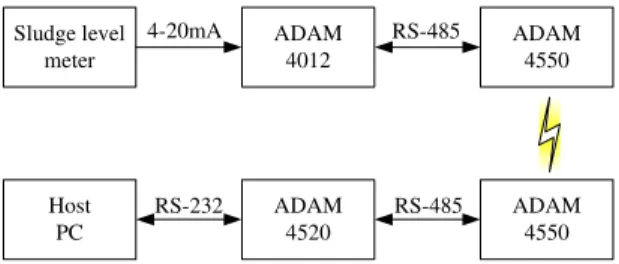
In our early work, a transparent serial data transfer system was designed and implemented using ADAM-series modules, which is shown partly in Figure 1 [1]. The system has four sludge level data transmitting component, each one is composed of an ADAM4012 and an ADAM4550; and one data receiving component composed of an ADAM4550 and an ADAM4520 which obtains four sludge level data and then sends them to a host PC.
Sludge level meter
ADAM 4550 ADAM
4012
Host PC
ADAM 4550 ADAM
4520
4-20mA RS-485
RS-485 RS-232
Figure 1 A former wireless transmission system
The purposes of the above mentioned ADAM modules are shortly described as follows. ADAM4012 is an analogue input module, which uses a microprocessor-controlled integrating A/D converter to convert input voltage, or current signals into digital data. The data is sent out through a standard RS-485 interface. ADAM4550 is a wireless RF transceiver module used to transmit and receive the digital data. It is a wireless RS-232/485 converter designed to interface any bidirectional RS-485 device with a host computer. ADAM 4520 is a RS-232/485 converter to change standard RS-232 port signals into fully isolated RS-485 signals.
Obviously, this kind of data transfer method is just a wireless serial port extension, no transmission error detection and correction or data processing and storage is included. Therefore, while something disturbs the wireless data transfer links, the measured sludge level data will be damaged or even lost. To ensure a complete and correct sludge level data transmission, a microprocessor-based, or smart wireless communication system is needed.
Bluetooth is a low-cost, low-power, secure and robust standard for short-range connectivity. The technology has been designed for ease of use, simultaneous voice and data and multi-point communications. It supports a range of 10m, which can be increased up to 100m with the use of an amplifier. Bluetooth technology has been deployed in many monitoring and control applications [2, 3 and 4], and shown its advantages especially in the aspect of cable replacement.
Wireless Sludge Level Monitoring based on
Bluetooth Sensing Nodes
SUN Jinsheng, Member, IAENG
Proceedings of the International MultiConference of Engineers and Computer Scientists 2008 Vol II IMECS 2008, 19-21 March, 2008, Hong Kong
Bluetooth technology is suitable for our requirement, so it was chosen as the basic wireless communication links in the presented applications.
III. SYSTEM DESCRIPTION
The sludge level monitoring system based on smart sensing channel uses a Bluetooth wireless technology solution for data communication between the sensing nodes and a host computer. Advanced data processing, data logging are also included as software components of the distributed measuring system. The topology, hardware and software utilized for our system is detailed below. A. Topology
Any two Bluetooth devices that come within a range of each other can set up an ad-hoc connection, which is called a piconet. Every piconet consists of up to eight units. There is always a master unit in a piconet and the rest of the units act as slaves. The unit that establishes the piconet becomes the master unit. The master unit can change later but there can never be more than one master. Several piconets can exist in the same area. This is called a scatternet. Figure 2 shows two topology schemes: a piconet and a scatternet [5].
Master Slave
a b c
Figure 2 Topology of: a piconet with one slave device (a); a piconet with several slave devices (b); a scatternet (c)
In our work, four secondary sedimentation tank’s sludge level data are to be measured. The Bluetooth communication system consists of four slave sensing nodes and one master node, forming a typical piconet with one master and several slave devices. The master device is fixed on the ground and located in the geometrical centre of the four secondary sedimentation tanks. It has a distance of about 90m with each slave device attached to the rotating scraper. And the master node is connected through a standard RS-485 wired link to the main control unit, acting as a gateway from wireless to wired data communication.
Slave 1 Slave 2
Slave 3 Slave 4
Master RS-485
Figure 3 Wireless sludge level monitoring system’s topology
The topology of the Bluetooth sludge level monitoring system and its wireless and wired communication links are shown in Figure 3.
B. Hardware
The hardware of the presented wireless communication system consists of two different nodes, i.e., a slave sensing node which converts the input sludge level analogue data into wireless Bluetooth serial signals, and a master node which receives the Bluetooth signals and then sends them to the main control unit via a wired remote connection.
A/D
Con
ver
ter
I/
V
C
ir
cu
it
MAXQ3120 RISC CPU
UART
Flash
M
TS2BTSM
I-L
Sl
ud
ge Level
M
et
er
Figure 4 Hardware structure of the slave sensing node
The slave sensing node’s hardware structure is shown in Figure 4. Its analog-to-digital converter samples the output from the sludge level sensor. We are using the MAXQ3120 microprocessor manufactured by Maxim Integrated Products. The microprocessor runs at 8MHz and samples the analog signal at a frequency rate of 125Hz with 14-bits per sample. The MAXQ3120 development board produces an internal 3.3Vdc power supply to the chip. Since the MAXIM chip measures voltages from 0-1Vdc, the output from the sludge level meter is put through a current to voltage converter and a voltage divider to allow the chip to sample the full range of sludge level signals. The output from the MAXIM chip is sent via a 3.3Vdc TTL voltage-level serial line. On the MAXQ3120 development board the TTL serial signal is also converted to a standard RS-232 voltage-level serial line by the MAX3160C chip.
The Bluetooth module we chose is part MTS2BTSMI-L manufactured by Multi-Tech Systems, Inc. It utilizes a Class 1 Bluetooth chip which is also powered by 3.3Vdc. The module accepts serial data up to 720Kbps. The serial port runs at 3.3Vdc TTL voltage-level with a buffer of 50 bytes and hardware flow control. The maximum Bluetooth transmission rate is 60Kbps in standard mode and 200Kbps in fast data mode. Attached to the Bluetooth module is a 2.4-2.5GHz half-wave dipole antenna with a 20dBi gain.
UART
2
RS-232
/4
85
MAXQ3120 RISC CPU
UART 1
Flash
MT
S2B
T
SMI-L
Host
Computer
Figure 5 Hardware structure of the master node
The master node’s hardware components are shown in Figure 5. It has a very similar structure with the wireless slave sensing node. The Bluetooth communication module
Proceedings of the International MultiConference of Engineers and Computer Scientists 2008 Vol II IMECS 2008, 19-21 March, 2008, Hong Kong
MTS2BTSMI-L which is connected with the microcontroller’s serial port UART 1 receives digital sludge level data from four slave sensing nodes. The serial digital sludge level data then is sent out through the microcontroller’s serial port UART 2 and RS-232/485 interface and a twisted pair of cables to the host computer. C. Software
The software of the wireless sludge level monitoring system is composed of three components: (i) the embedded code in the slave sensing node, (ii) the embedded code in the master node and (iii) the monitoring software in the host computer.
The embedded code for the MAXIM microprocessor was written in assembly using the MAX-IDE development software included with the MAXQ3120 development board. The compiled code was programmed onto the chip using a standard Joint Test Action Group (JTAG) interface board. The microprocessor code uses the internal timers to sample the sludge level signal at 125Hz. With each 14-bit sample a packet is created and then sent to the serial output. The microprocessor code also monitors the Bluetooth connection to ensure that data is not streamed when unconnected. Otherwise the 50 byte buffer overflows preventing a future Bluetooth connection.
The simplified software flowcharts of the master and the slave sensing node are shown in Figure 6 and Figure 7 respectively.
Initialize hardware
Ask for data from slave node
Receive response?
Receive data frame
Produce measuring value
Send data block via UART
End sending?
Exit
N
N
Figure 6 Flow chart of the master node
The monitoring software in the host computer is developed with Microsoft Visual Basic. Its purposes include managing the data communication between the computer and the Bluetooth master node, displaying each sludge level data and their real-time and historical trends, storing the received data and exchanging them with other applications, etc.
Initialize hardware
Get sensor signal
Receive rerequest? Produce data frame
Send data frame
Receive correctly?
Exit
N Wait for data request
Save data
>10s N
N
Figure 7 Flow chart of the slave sensing node
IV. RESULTS
A. Transmission
With the MAXIM microprocessor sampling at 125Hz and each sample being sent in a three byte packet, the microprocessor sends 3,000 bytes per second to the Bluetooth module. The serial line is configured with one start bit, no parity, and one stop bit yielding a 30kbps data transmission rate. This utilizes 26% of the available bandwidth of the 115.2kbps serial line.
Since the Bluetooth module only supports hardware flow control and the MAXQ3120 does not provide RTS/CTS pins for the serial interface, it is possible to overflow the 50 byte buffer on the Bluetooth module. As documented in the Bluetooth module’s specification sheet, random byte gaps of 5ms to 20ms are common for Bluetooth transmission. However these byte gaps are not large enough to overflow the module during normal operations when the sludge level sensor samples at 125Hz. Byte gaps of 133ms or more are required in order to cause buffer overflow when sampling at 125Hz. Gaps of that size are not seen unless the Bluetooth connection requires a significant number of retransmissions. B. Communication range
The range for the Class 1 Bluetooth module was found to be 100 meters when a line-of-sight contact is established between the master device and each wireless slave sensing node. In our application, the wireless sludge level sensing node circles around the centre of the secondary sedimentation tank, the distance between this node and the static master node varies within a range of 35-85m. In a wastewater treatment plant (WWTP), a line-of-sight contact between the master and the sludge level sensing node is easy to be guaranteed. Using an antenna power of 20dBi gain in both side of the Bluetooth wireless communication link, a stable
Proceedings of the International MultiConference of Engineers and Computer Scientists 2008 Vol II IMECS 2008, 19-21 March, 2008, Hong Kong
and reliable data transmission between the master and each slave node has been achieved. The results of communication range are shown to be in accordance with the Bluetooth standard and specifications.
C. Power supply
Compared with other Bluetooth applications, such as a Bluetooth EKG monitoring sensor [4], the battery drains or power supply of the wireless device is not a severe factor to be considered in industrial wireless monitoring and control applications. In our deployment, an AC power supply extracted from the rotary scraper’s power line collector rings is utilized.
D. Comparison with ZigBee
Compared with ZigBee technology and a former related industrial application [6], Bluetooth deployment for wireless sludge level monitoring is easier to be realized, especially while a fewer wireless sensing nodes are needed in the wireless communication system. For small dimension data acquiring and monitoring systems (less than 8 nodes) or cable replacement applications, Bluetooth-based piconet with a master node and several slave sensing nodes seems to be a better choice.
V. CONCLUSION
A wireless sludge level monitoring system based on Bluetooth technology is presented in this paper. It has satisfactorily solved the output data transfer problem of the sludge level meter fixed on the rotating scraper using wireless communication method. The sludge level monitoring system can be easily integrated with the main control unit for implementing a closed loop control for the secondary sedimentation tank’s sludge draining process. The presented wireless data transfer system design can also be introduced into other industrial wireless monitoring applications.
In the near future, deployment of wireless infrastructure in industries will occur incrementally, and interoperability (between different systems) and extendibility (different application needs) will form the requirements of prospective solutions.
REFERENCES
[1] J. Sun, T. Sun, J. Yang, Wireless Telemetric System of Water-Sludge Interface in Secondary Sedimentation Tank, Water and Wastewater Engineering, 27(3), 2002, pp. 94-96.
[2] H. Ramamurthy, B. S. Prabhu, R. Gadh et al, Wireless Industrial Monitoring and Control using a Smart Sensor Platform, IEEE Journal of Sensors, 7(5), 2007, pp. 611-618.
[3] O. Postolache, J. M. Pereira, P. Girao, Distributed Air Quality Monitoring based on Bluetooth Sensing Nodes and Virtual TEDS,
Proceedings of the 8th
International Conference on Electronic Measurement and Instruments, Vol. 4, 2007, pp. 1-6.
[4] J. Proulx, R. Clifford, S. Sorensen et al, Development and Evaluation
of a Bluetooth EKG Monitoring Sensor, Proceedings of the 19th
IEEE International Symposium on Computer-based Medical Systems, 2006, pp. 507-511.
[5] K. Rumiana, A. Boneva, V. Georchev et al, Application of Wireless Protocols Bluetooth and ZigBee in Telemetry System Development, Problems of Industrial Cybernetics and Robotics, Vol. 55, ISSN 0204-9848, Sofia, 2005, pp. 30-38.
[6] J. Sun, N. Wang, L. Liu, A Novel Water-Sludge Interface Data Transfer System applying ZigBee Wireless Network, International Journal of Information Acquisition, 3(4), 2006, pp. 301-309.
Proceedings of the International MultiConference of Engineers and Computer Scientists 2008 Vol II IMECS 2008, 19-21 March, 2008, Hong Kong