original article
Copyright
© ABE&M todos os dir
eitos r
eser
vados.
425 Arq Bras Endocrinol Metab. 2009;53/4
1 Unidade de Diabetes, Divisão de Endocrinologia e Metabologia, Hospital das Clínicas, Faculdade de Medicina, Universidade de São Paulo (USP), São Paulo, SP, Brazil
Correspondence to:
Gustavo Akerman Augusto Rua Paulo Ribeiro da Luz, 170, ap. 72 – Vila Gomes
05590-140 – São Paulo, SP, Brasil [email protected]
Received in Sept/14/2008 Accepted in Jan/12/2009
Continuous glucose monitoring system:
dawn period calibration does not
change accuracy of the method
Sistema de monitorização contínua de glicose: calibração da madrugada não interfere na acurácia do método
Gustavo A. Augusto1, André G. P. Sousa1, Marcela N. A. Perazo1,
Maria L. C. Correa-Giannella1, Marcia Nery1, Karla F. S. de Melo1
ABSTRACT
Introduction: Continuous glucose monitoring system is a valuable instrument to measure glycemic control, which uses a retrospective calibration based upon 3 to 4 capillary glucose meter values inserted by the patient each day. Objective: We evaluated the interference of ca-libration during the dawn period in the system accuracy. Methods: The monitoring data were retrospectively divided into two groups: with (Group A) or without (Group B) the dawn period calibration (between 1:00 and 5:00 AM). Accuracy of the method was expressed by relative absolute difference. Results: Thirty-four continuous glucose monitoring data were evaluated comprising a total of 112 nights. A total of 289 paired readings were analyzed – 195 in Group A and 94 in Group B. We did not find a difference in relative absolute difference (RAD%) in any analyzed period of day by adding dawn calibration. Conclusions: These data suggest that dawn calibration does not alter accuracy of method. Arq Bras Endocrinol Metab. 2009;53(4):425-8.
Keywords
Diabetes mellitus; glycemic control; hypoglycemia; continuous monitoring
RESUMO
Introdução: O CGMS (sigla do inglês continuous glucose monitoring system) é um instrumento valioso no controle glicêmico e utiliza uma calibração por meio de 3 ou 4 medidas de glicemia capilar inseridas pelo paciente em cada dia do exame. Objetivo: Avaliar a interferência da cali-bração durante a madrugada na acurácia do sistema. Métodos: Os dados das monitorizações foram divididos retrospectivamente em dois grupos: com (Grupo A) ou sem (Grupo B) a cali-bração da madrugada (entre 1:00 e 5:00 AM). A acurácia do método foi mostrada pela diferença relativa absoluta (DRA%). Resultados: Trinta e quarto dados de monitorização foram avaliados em um total de 112 noites. Um total de 289 leituras pareadas foi analisado – 195 no Grupo A e 94 no Grupo B. Não foi encontrada diferença em DRA% em nenhum período do dia quando adi-cionada a calibração durante a madrugada. Conclusões: Esses dados sugerem que a calibração da madrugada não altera a acurácia do método. Arq Bras Endocrinol Metab. 2009;53(4):425-8.
Descritores
Diabetes melito; controle glicêmico; hipoglicemia; monitorização contínua
INTRODUCTION
I
n the last years, the continuous glucose monitoring system (CGMS, Medtronic MiniMed, Northridge, CA) has arisen as a useful tool in glycemic evaluation of patients with diabetes, providing clinically relevant information for individuals with diabetes and their care providers (1,2). The CGMS uses a retrospectivecalibra-tion based upon 3 to 4 capillary glucose meter values (CG) inserted by the patient each day, but there is no clear recommendation about the best time to perform CGMS sensor calibration (3,4).
Copyright © ABE&M todos os dir
eitos r
eser
vados.
426 Arq Bras Endocrinol Metab. 2009;53/4
Dawn calibration during CGMS
CG by patients with diabetes is more difficult to obtain. The clinical practice has demonstrated that the number of blood glucose measurements during night-time is less frequent than desired to evaluate the adequacy of bedtime insulin dose, even when it is required by the care providers. Two recent studies (3,5) have suggested a reduction in the accuracy of the CGMS during night-time readings, with a tendency of lower values of interstitial glucose (IG) than CG. Moreover, DirectNet Study Group suggested that the sensor accuracy was much improved by calibrations when there was not a rapid rate of glucose change (3), for example, during the long fasting nocturnal period.
The present study was undertaken to evaluate the interference of CGMS calibration during the dawn pe-riod in the system accuracy.
METHODS
All patients were followed up at the Hospital das Clíni-cas (HC), in São Paulo. The study protocol was ap-proved by the ethics committee of the hospital, and informed consent was obtained from the patients or their guardians. From 2003 to 2006, CGMS data of 30 patients with type 1 and 2 diabetes, using intensive insulin therapy and presenting high levels of HbA1c and/or high frequency of hypoglycemia were retro-spectively analyzed. CGMS sensors were inserted into the subcutaneous abdominal fat tissue. While wearing the CGMS, the patients were asked to perform, at least, four daily self monitoring of blood glucose (SMBG) tests by home glucose meter (Accu-Chek®; Roche®)
and to enter these values into the CGMS for sensor calibration. Accuracy of the method was expressed by relative absolute difference (RAD%), calculated for each IG-CG pair: RAD% = CG-IG/CG (6).
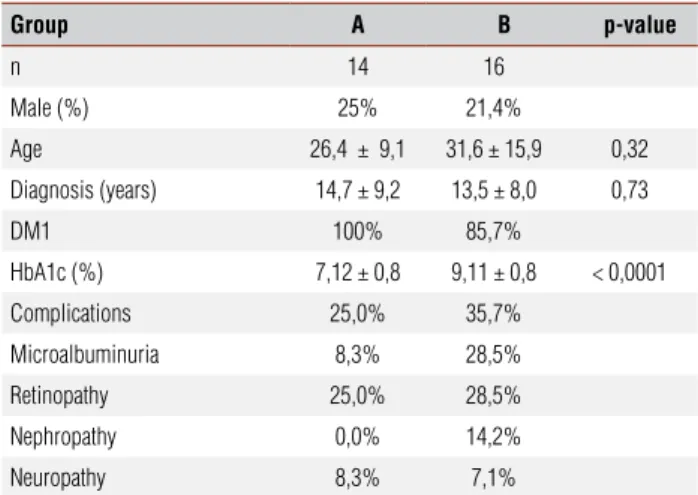
Patients always performed SMBG calibration mea-sures at night and, while fasting, during the exam days. The monitoring data were retrospectively divided into two groups: with (Group A) or without (Group B) the dawn period calibration (between 1:00 and 5:00 AM). A total of 289 paired readings were analyzed, 195 in Group A and 94 in Group B. Differences in the ac-curacy in the morning period in relation to the night period between Groups A and B were studied. Clinical data of patients are showed in table 1.
The Pearson correlation coefficient (r) between CG
and IG of Groups A and B was determined by linear regression. T-Student test was performed to compare
the RAD% of Groups A and B.
Table 1. Characteristics of patients
Group A B p-value
n 14 16
Male (%) 25% 21,4%
Age 26,4 ± 9,1 31,6 ± 15,9 0,32
Diagnosis (years) 14,7 ± 9,2 13,5 ± 8,0 0,73
DM1 100% 85,7%
HbA1c (%) 7,12 ± 0,8 9,11 ± 0,8 < 0,0001 Complications 25,0% 35,7%
Microalbuminuria 8,3% 28,5% Retinopathy 25,0% 28,5%
Nephropathy 0,0% 14,2% Neuropathy 8,3% 7,1%
RESULTS
The 30 diabetic patients who participated in the study had a median age of 24.5 years (range 14 to 63 years); median time since diagnosis of 14.5 years (range 3 to 31 years) and median HbA1c of 8.2% (range 5.6 to 11.2%). Twenty-four patients were female. Thirty-four conti-nuous glucose monitoring data were evaluated comprising a total of 112 nights. Thirty percent of patients (8⁄30) had hypoglycemia during the evaluated nights, with a median duration of 200 minutes (range 30 to 500 minutes).
We identified an adequate correlation between CG and IG in both Groups A and B with Pearson coef-ficient (r) of 0.91 (p < 0.0001) and 0.96 (p < 0.0001),
respectively. There was no difference in median fast-ing RAD% among Groups A and B (7.4 versus 7.8%;
p = 0.73); neither difference was seen in night-fasting RAD% variation between the two groups (-0.34 ver-sus +1.91%; p = 0.75) (Figure 1). The mean RAD% of
Group A was 12 ± 9.4 and, of Group B, it was 11 ± 7.7, with no difference between them.
DISCUSSION
Copyright © ABE&M todos os dir
eitos r
eser
vados.
427 Arq Bras Endocrinol Metab. 2009;53/4
Dawn calibration during CGMS
RAD%
Capilar
y glucose (mg/dL)
Capilar
y glucose (mg/dL)
RAD%
p = NS
r = 0.90 p < 0.0001
r = 0.96 p < 0.0001 p = NS
Night-time
Interstitial glucose (mg/dL) Interstitial glucose (mg/dL)
0 100 200 300 400 0 100 200 300 400
Night-time
Daytime Daytime
Group A
Group A – Morning calibration Group B – Without morning calibration
Group B
130 120 110 100 90 80 70 60 50 40 30 20 10 0
400
300
200
100
0
350
300
250
200
150
100
50
0 50
40
30
20
10
0
One of the most important indications of CGMS is the evaluation of hypoglycemia, especially asymptomatic episodes in the dawn period (11). In the presented study, 1/3 of the patients presented hypoglycemia during sleep. However, it has been noted that accuracy during this period is decreased, as well as in hypoglycemic episodes (3,5). In addition, hypoglycemia can be overestimated during the dawn period, due to physiologic differences in glucose uptake, utilization, and elimination in blood, interstitial space, and cells or a change in bioactivity of sensor (10,12). Furthermore, rapid changes in plasma glucose may not be followed by IG variation of the same degree and speed (13). In our study, we did not find an increased accuracy between CG and IG in the morning measurements of Group A (with dawn calibration) when compared with Group B, using relative absolute difference (RAD%). We also did not observe statistical difference between CG and IG fasting values of both groups.
In their study, Guerci and cols. (14) compared CGMS accuracy with CG and blood sample
glu-cose. Coefficients of correlation ranged from 0.87 to 0.92, and the mean absolute error ranged from 12.8 to 15.7%. Only 39% of the CGMS values satisfied the American Diabetes Association (ADA) precision crite-ria to within ± 10%, and 19% of these values satisfied the future ADA precision criteria of accuracy to within 5%. Although the accuracy of CGMS can be improved, we observed an adequate correlation between CG and IG in our study, therefore we could evaluate glucose control during night-time.
These data suggest that dawn calibration does not alter accuracy of CGMS and it implies a more comfort-able exam without the recommendation to perform a dawn period calibration.
Disclosure: no potential conflict of interest relevant to this article was reported.
REFERENCES
Clarke WL, Anderson S, Farhy L, Breton M, Gonder-Frederick L, 1.
Cox D, et al. Evaluating the clinical accuracy of two continuous
Copyright © ABE&M todos os dir
eitos r
eser
vados.
428 Arq Bras Endocrinol Metab. 2009;53/4
Dawn calibration during CGMS
glucose sensors using continuous glucose-error Grid Analysis. Diabetes Care. 2005;28(10):2412-7.
The Juvenile Diabetes Research Foundation Continuous Glu-2.
cose Monitoring Study G. Continuous glucose monitoring and intensive treatment of type 1 diabetes. N Engl J Med. 2008;359:1464-76.
The accuracy of the
3. CGMS in children with type 1 diabetes: re-sults of the Diabetes Research in Children Network (DirecNet) Ac-curacy Study. Diabetes Tech Therapeut. 2003;5(5):781-9.
Maia FFR, Araújo LR. Uso da monitorização contínua de glicose 4.
(CGMS) por quatro (96 horas) ou cinco (120 horas) dias em pa-cientes com DM1: existe vantagem? Arq Bras Endocrinol Metab. 2008;52:499-505.
McGowan K, Thomas W, Moran A. Spurious reporting of nocturnal 5.
hypoglycemia by CGMS in patients with tightly controlled type 1 diabetes. Diabetes Care. 2002;25(9):1499-503.
Buckingham B, Kollman C, Beck R, Kalajian A, Fiallo-Scharer R, 6.
Tansey MJ, Fox LA, Wilson DM, Weinzimer SA, Ruedy KJ, Tam-borlane WV. Diabetes Research In Children Network (DirecNet) Study Group. Evaluation of factors affecting CGMS calibration. Diabetes Technol Ther. 2006;8(3):318-25.
Kulcu E, Tamada JA, Reach G, Potts RO, Lesho MJ. Physiological 7.
differences between interstitial glucose and blood glucose mea-sured in human subjects. Diabetes Care. 2003;26(8):2405-9.
Puñales MKC, Geremia C, Mondadori P, Pickler M, Fornari A, Ts-8.
chiedel B. Como a monitorização contínua de glicose subcutânea pode colaborar na interpretação dos valores da HbA1c no diabe-tes melito tipo 1? Arq Bras Endocrinol Metab. 2008;52:299-306. Cruzes AL, Bosco CET, Pandini EV, Hernandez MAM, Silva RCQD. 9.
Hiperglicemia pós-prandial em pacientes com diabetes melito tipo 2. Arq Bras Endocrinol Metab. 2008;52:642-8.
Evaluation of factors affecting CGMS calibration. Diabetes Tech 10.
Therapeut. 2006;8(3):318-25.
Maia FFR, Araújo LR. A hipoglicemia silenciosa é parte do contro-11.
le glicêmico ideal em pacientes com DM1? – Tempo de hipogli-cemia pelo CGMS versus média glicêmica. Arq Bras Endocrinol Metab. 2008;52:994-1000.
Kulcu E, Tamada JA, Reach G, Potts RO, Lesho MJ. Physiological 12.
differences between interstitial glucose and blood glucose mea-sured in human subjects. Diabetes Care. 2003;26(8):2405-9. Aussedat B, Dupire-Angel M, Gifford R, Klein JC, Wilson GS, 13.
Reach G. Interstitial glucose concentration and glycemia: impli-cations for continuous subcutaneous glucose monitoring. Am J Physiol Endocrinol Metab. 2000;278(4):E716-28.
Guerci B, Floriot M, Bohme P, Durain D, Benichou M, Jellimann 14.