Use of epidemiological data as the basis for developing a
medical curriculum
O uso de dados epidemiológicos como base para o desenvolvimento de um
currículo médico
José Lúcio Martins Machado
I, Sonia Regina Pereira de Souza
II, Sylvia Michelina Fernandes Brenna
II, Regina Albanese Pose
III,
Valdes Roberto Bollela
IV, Joaquim Edson Vieira
VUniversidade Cidade de São Paulo (Unicid), São Paulo, Brazil
ABSTRACT
CONTEXT AND OBJECTIVE: Epidemiology may help educators to face the challenge of establishing con-tent guidelines for the curricula in medical schools. The aim was to develop learning objectives for a medi-cal curriculum from an epidemiology database.
DESIGN AND SETTING: Descriptive study assessing morbidity and mortality data, conducted in a private university in São Paulo.
METHODS: An epidemiology database was used, with mortality and morbidity recorded as summaries of deaths and the World Health Organization’s Disability-Adjusted Life Year (DALY). The scoring took into consideration probabilities for mortality and morbidity.
RESULTS: The scoring presented a classiication of health conditions to be used by a curriculum design committee, taking into consideration its highest and lowest quartiles, which corresponded respectively to the highest and lowest impact on morbidity and mortality. Data from three countries were used for inter-national comparison and showed distinct results. The resulting scores indicated topics to be developed through educational taxonomy.
CONCLUSION: The frequencies of the health conditions and their statistical treatment made it possible to identify topics that should be fully developed within medical education. The classiication also suggested limits between topics that should be developed in depth, including knowledge and development of skills and attitudes, regarding topics that can be concisely presented at the level of knowledge.
RESUMO
CONTEXTO E OBJETIVO: A epidemiologia pode auxiliar os educadores a enfrentar o desaio de estabele-cer diretrizes para o conteúdo dos currículos em escolas médicas. O objetivo foi desenvolver objetivos de aprendizagem para um currículo médico por meio de um banco de dados epidemiológicos.
TIPO DE ESTUDO E LOCAL: Estudo descritivo avaliando dados de morbidade e mortalidade, realizado por universidade particular em São Paulo.
MÉTODOS: O banco de dados epidemiológicos com morbidade e mortalidade registrados como resumo de causas de morte e o Disability-Adjusted Life Year (DALY) da Organização Mundial de Saúde foi utilizado. A pontuação desenvolvida considerou probabilidades de mortalidade e morbidade.
RESULTADOS: A pontuação apresenta uma classiicação dessas condições de saúde para ser utilizada por uma comissão responsável pelo desenho curricular, considerando seus quartis superior e inferior, desig-nando, respectivamente, maior e menor impacto na morbidade e mortalidade. Dados de três países foram utilizados para comparação internacional, mostrando resultados distintos. As pontuações resultantes indi-caram temas a serem desenvolvidos pela taxonomia educacional.
CONCLUSÃO: A frequência das condições de saúde e seu tratamento estatístico possibilitaram a identi-icação de temas que devem ser plenamente desenvolvidos em educação médica. A classiidenti-icação sugere também limites entre tópicos que devem ser desenvolvidos em profundidade, incluindo o conhecimento e o desenvolvimento de habilidades e atitudes, a respeito de tópicos que podem ser concisamente apre-sentados ao nível de conhecimento.
IMD, PhD. Professor of Medicine and Dean,
Universidade Cidade de São Paulo (Unicid), São Paulo, Brazil.
IIMD, PhD. Assistant Professor, Universidade
Cidade de São Paulo (Unicid), São Paulo, Brazil.
IIIMSc. Mathematician, Centro de
Desenvolvimento de Educação Médica (CEDEM) “Prof. Eduardo Marcondes”, Faculdade de Medicina da Universidade de São Paulo (FMUSP), São Paulo, Brazil.
IVMD, PhD. Assistant Professor, Universidade
Cidade de São Paulo (Unicid), São Paulo, Brazil.
VMD, PhD. Researcher, Centro de
Desenvolvimento de Educação Médica (CEDEM) “Prof. Eduardo Marcondes”, Faculdade de Medicina da Universidade de São Paulo (FMUSP), São Paulo, Brazil.
KEY WORDS:
Curriculum. Epidemiology.
Education, medical, undergraduate. Needs assessment.
Health knowledge, attitudes, practice.
PALAVRAS-CHAVE:
Currículo. Epidemiologia.
Educação de graduação em medicina. Determinação de necessidades de cuidados de saúde.
Conhecimentos, atitudes e prática em saúde.
INTRODUCTION
It is interesting to note that active learning principles would need to be considered as early as possible during medi-cal school in order to provide the benefits of teamwork in areas like primary care.5 Nonetheless, a systematic review has
sug-gested that active learning, like the problem-based learning approach, does not have an impact on knowledge acquisition in undergraduate medical education, even though appropriate outcome measurements need to be considered.6 A generalist
education that could provide skills, knowledge and attitudes that make it possible to understand patients’ expectations, address wellness rather than illness alone, assimilate concepts of clinical epidemiology, develop interpersonal communica-tion and strive to control costs would require shifts in attitude and behavior throughout the academic medical community.7
In Brazil, despite the large number of medical schools, just a few adopt active learning principles, and yet some reports also suggest that the traditional curriculum leaves students poorly educated about the underlying principles of the national health system.8,9
General medical education guidelines usually have clear statements about content and skills, but there are no priorities deining central themes. he core curriculum with special study modules was considered to be a reliable response to content over-load, but there is still no suggestion about how to choose a cen-tral theme.10
OBJECTIVE
he aim of this paper was to present a methodological proposal that could help curriculum managers to address this challenge, taking local and regional morbidity and mortality into consider-ation. We constructed an epidemiological score that can be used by specialists to develop learning objectives or even international requirements.11
METHODS
Data relating to mortality (OBT) and morbidity (MRB) were taken respectively from summaries of deaths and the Disabili-ty-Adjusted Life Year (DALY) measurement of the World Health Organization (WHO) for the year of 2004.12 hese data were
cho-sen to precho-sent an international perspective for educational tax-onomy directed by mathematical treatment.
he reported numbers of registered deaths and diseases were distributed into columns and rows according to the list provided in the WHO database. No ages or genders were identiied. he probabilities were reached by means of R syntax, to reach a cumu-lative distribution function (CDF) for any value x. R is a language and an environment for statistical computing and graphics that is available as free sotware under the terms of the Free Sotware Foundation’s GNU General Public License, in source code form (http://www.r-project.org/).
The final score took into account the square root for the product of morbidity P(MRB) and mortality P(OBT) prob-abilities. Briefly, the frequencies were tested using the Sha-piro-Wilk normality test or after Log10 transformation for both morbidity and mortality. Then, the Z numbers for both morbidity Z(MRB) and mortality Z(OBT) were obtained in order to use the definite integral, from which the results are the probability for each of the diseases from the WHO DALY and death summary lists (see Appendix for equations). In order to obtain a normal distribution, it is advisable to use a large database.
he 75th percentile (quartile) from the score was used to
indi-cate the subjects to be considered for educational taxonomy.
RESULTS
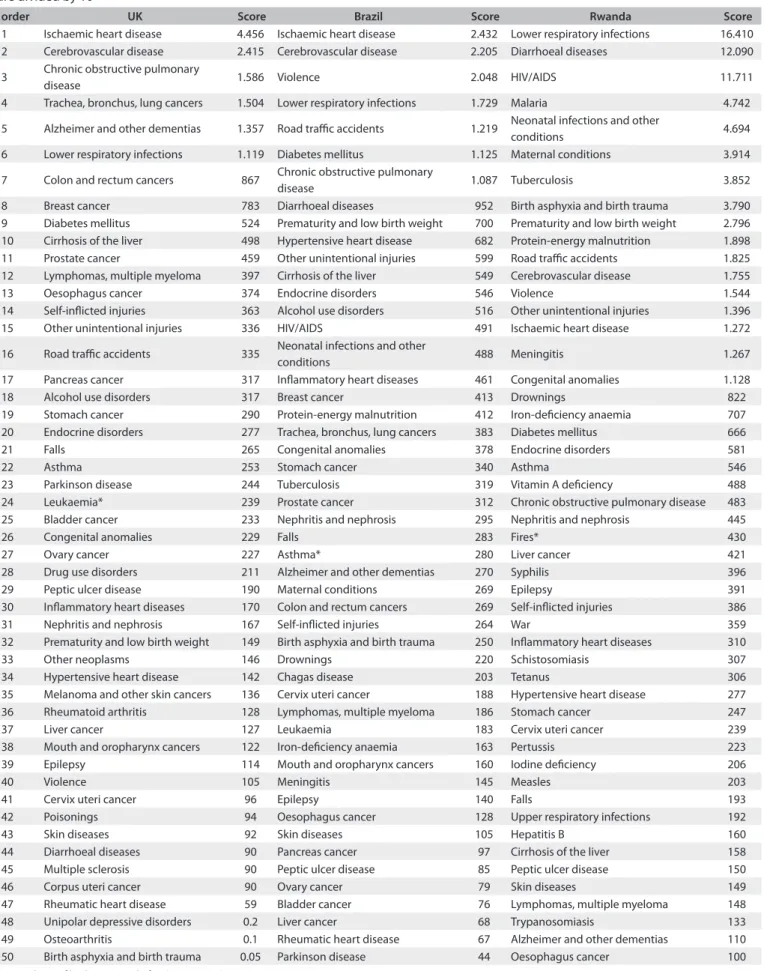
hree countries were selected for comparison: United Kingdom (UK), Brazil (BR) and Rwanda (RW). hey were representative of higher to lower-accuracy database registering, according to the WHO DALY methodology. here were 71 conditions for UK, 82 for Brazil and 87 for Rwanda that reached a score higher than zero (Table 1).
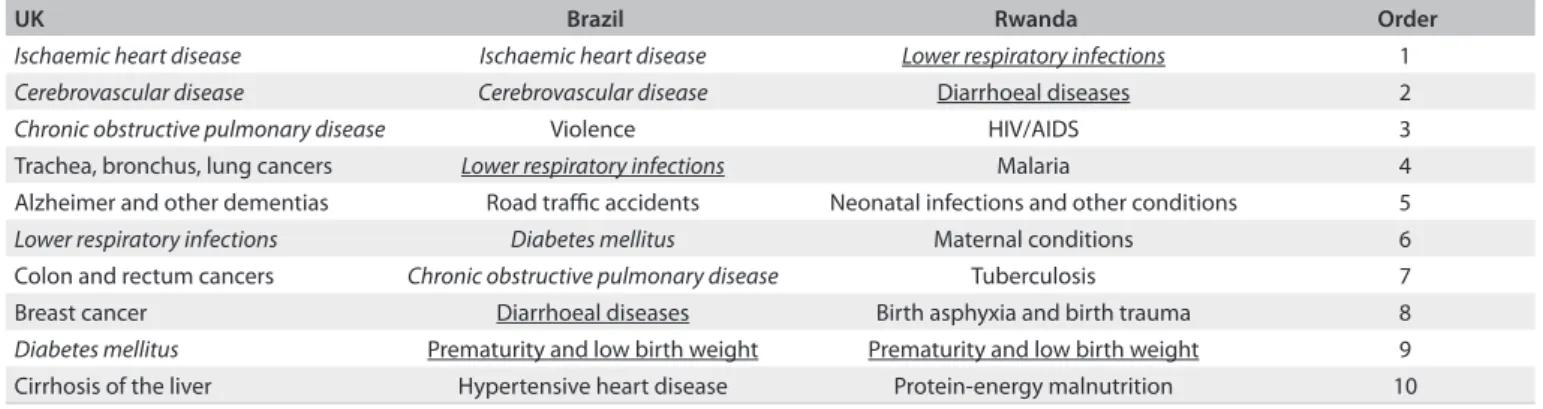
The score allowed separation of the results into quartiles. The highest quartile showed 24 health conditions for the UK, 27 for Brazil and 26 for Rwanda. Among the highest 10 health conditions for the UK, five also appeared in the Brazilian list but only one for Rwanda. On the other hand, among the 10 Brazilian health conditions, three were present in the Rwan-dan list (Table 2).
DISCUSSION
his investigation used statistical data on morbidity and mortality collected by oicial government agencies to list and rank themes to be adopted by an undergraduate curriculum. his framework was proposed in order to manage educational taxonomic levels such as knowledge, skills and attitudes, for those in the highest quartile as well as to ensure knowledge for those in the lowest quartile.
An undergraduate curriculum should be based on and related to the needs of learners and society.13 However, it is not an
easy task to deine what a need is. Needs have a social origin and they may correspond to habits that are gradually created and also legitimized by references to ideals.14 Careful analysis could point
out and identify needs for individuals, groups, institutions and societies. his investigation used statistical frequencies of regis-tered health conditions as a way to identify conditions that might constitute such needs in medical education.
order UK Score Brazil Score Rwanda Score
1 Ischaemic heart disease 4.456 Ischaemic heart disease 2.432 Lower respiratory infections 16.410 2 Cerebrovascular disease 2.415 Cerebrovascular disease 2.205 Diarrhoeal diseases 12.090
3 Chronic obstructive pulmonary
disease 1.586 Violence 2.048 HIV/AIDS 11.711
4 Trachea, bronchus, lung cancers 1.504 Lower respiratory infections 1.729 Malaria 4.742
5 Alzheimer and other dementias 1.357 Road traic accidents 1.219 Neonatal infections and other
conditions 4.694
6 Lower respiratory infections 1.119 Diabetes mellitus 1.125 Maternal conditions 3.914
7 Colon and rectum cancers 867 Chronic obstructive pulmonary
disease 1.087 Tuberculosis 3.852
8 Breast cancer 783 Diarrhoeal diseases 952 Birth asphyxia and birth trauma 3.790 9 Diabetes mellitus 524 Prematurity and low birth weight 700 Prematurity and low birth weight 2.796 10 Cirrhosis of the liver 498 Hypertensive heart disease 682 Protein-energy malnutrition 1.898 11 Prostate cancer 459 Other unintentional injuries 599 Road traic accidents 1.825 12 Lymphomas, multiple myeloma 397 Cirrhosis of the liver 549 Cerebrovascular disease 1.755
13 Oesophagus cancer 374 Endocrine disorders 546 Violence 1.544
14 Self-inlicted injuries 363 Alcohol use disorders 516 Other unintentional injuries 1.396 15 Other unintentional injuries 336 HIV/AIDS 491 Ischaemic heart disease 1.272
16 Road traic accidents 335 Neonatal infections and other
conditions 488 Meningitis 1.267
17 Pancreas cancer 317 Inlammatory heart diseases 461 Congenital anomalies 1.128
18 Alcohol use disorders 317 Breast cancer 413 Drownings 822
19 Stomach cancer 290 Protein-energy malnutrition 412 Iron-deiciency anaemia 707 20 Endocrine disorders 277 Trachea, bronchus, lung cancers 383 Diabetes mellitus 666
21 Falls 265 Congenital anomalies 378 Endocrine disorders 581
22 Asthma 253 Stomach cancer 340 Asthma 546
23 Parkinson disease 244 Tuberculosis 319 Vitamin A deiciency 488
24 Leukaemia* 239 Prostate cancer 312 Chronic obstructive pulmonary disease 483 25 Bladder cancer 233 Nephritis and nephrosis 295 Nephritis and nephrosis 445
26 Congenital anomalies 229 Falls 283 Fires* 430
27 Ovary cancer 227 Asthma* 280 Liver cancer 421
28 Drug use disorders 211 Alzheimer and other dementias 270 Syphilis 396
29 Peptic ulcer disease 190 Maternal conditions 269 Epilepsy 391
30 Inlammatory heart diseases 170 Colon and rectum cancers 269 Self-inlicted injuries 386
31 Nephritis and nephrosis 167 Self-inlicted injuries 264 War 359
32 Prematurity and low birth weight 149 Birth asphyxia and birth trauma 250 Inlammatory heart diseases 310
33 Other neoplasms 146 Drownings 220 Schistosomiasis 307
34 Hypertensive heart disease 142 Chagas disease 203 Tetanus 306
35 Melanoma and other skin cancers 136 Cervix uteri cancer 188 Hypertensive heart disease 277 36 Rheumatoid arthritis 128 Lymphomas, multiple myeloma 186 Stomach cancer 247
37 Liver cancer 127 Leukaemia 183 Cervix uteri cancer 239
38 Mouth and oropharynx cancers 122 Iron-deiciency anaemia 163 Pertussis 223 39 Epilepsy 114 Mouth and oropharynx cancers 160 Iodine deiciency 206
40 Violence 105 Meningitis 145 Measles 203
41 Cervix uteri cancer 96 Epilepsy 140 Falls 193
42 Poisonings 94 Oesophagus cancer 128 Upper respiratory infections 192
43 Skin diseases 92 Skin diseases 105 Hepatitis B 160
44 Diarrhoeal diseases 90 Pancreas cancer 97 Cirrhosis of the liver 158 45 Multiple sclerosis 90 Peptic ulcer disease 85 Peptic ulcer disease 150
46 Corpus uteri cancer 90 Ovary cancer 79 Skin diseases 149
47 Rheumatic heart disease 59 Bladder cancer 76 Lymphomas, multiple myeloma 148 48 Unipolar depressive disorders 0.2 Liver cancer 68 Trypanosomiasis 133 49 Osteoarthritis 0.1 Rheumatic heart disease 67 Alzheimer and other dementias 110 50 Birth asphyxia and birth trauma 0.05 Parkinson disease 44 Oesophagus cancer 100 Table 1. List of conditions and scores derived from World Health Organization Disability-Adjusted Life Year (WHO DALY) database. Scores are divided by 105
Table 1. Continuation
order UK Score Brazil Score Rwanda Score
51 Iron-deiciency anaemia 0.05 Other neoplasms 44 Other neoplasms 94
52 Neonatal infections and other
conditions 0.05 Melanoma and other skin cancers 41 Mouth and oropharynx cancers 78 53 Schizophrenia 0.04 Unipolar depressive disorders 0.1 Rheumatic heart disease 73
54 HIV/AIDS 0.03 Drug use disorders 0.1 Hepatitis C 72
55 Fires 0.03 Schizophrenia 0.1 Poisonings 71
56 Benign prostatic hypertrophy 0.03 Rheumatoid arthritis 0.1 Colon and rectum cancers 62 57 Tuberculosis 0.03 Benign prostatic hypertrophy 0.04 Breast cancer 61
58 Meningitis 0.03 Fires 0.04 Leukaemia 58
59 Macular degeneration and other 0.02 Osteoarthritis 0.04 Pancreas cancer 49
60 Maternal conditions 0.02 Malaria 0.04 Ovary cancer 49
61 Bipolar disorder 0.02 Hepatitis C 0.04 Bladder cancer 45
62 Drownings 0.02 Schistosomiasis 0.03 Prostate cancer 38
63 Appendicitis 0.01 Corpus uteri cancer 0.03 Melanoma and other skin cancers 37 64 Hepatitis C 0.01 Hepatitis B 0.02 Trachea, bronchus, lung cancers 35 65 Upper respiratory infections 0.01 Multiple sclerosis 0.02 Schizophrenia 0.1 66 Otitis media 0.01 Bipolar disorder 0.02 Alcohol use disorders 0.1
67 War 0.005 Leishmaniasis 0.02 Osteoarthritis 0.1
68 Hepatitis B 0.004 Macular degeneration and other 0.02 Unipolar depressive disorders 0.1
69 Glaucoma 0.003 Appendicitis 0.02 Otitis media 0.04
70 Pertussis 0.002 Otitis media 0.02 Leishmaniasis 0.04
71 Periodontal disease 0.001 Upper respiratory infections 0.01 Macular degeneration and other 0.03
72 Dengue 0.01 Rheumatoid arthritis 0.03
73 Syphilis 0.01 Benign prostatic hypertrophy 0.02
74 Poisonings 0.01 Parkinson disease 0.02
75 Leprosy 0.01 Appendicitis 0.02
76 Pertussis 0.01 Gonorrhoea 0.02
77 Tetanus 0.01 Ascariasis 0.01
78 Chlamydia 0.004 Bipolar disorder 0.01
79 Ascariasis 0.003 Multiple sclerosis 0.01
80 Glaucoma 0.002 Chlamydia 0.01
81 Iodine deiciency 0.002 Diphtheria 0.01
82 Periodontal disease 0.001 Post-traumatic stress disorder 0.01
83 Drug use disorders 0.01
84 Corpus uteri cancer 0.01
85 Dental caries 0.004
86 Leprosy 0.004
87 Periodontal disease 0.003
*Lower limit of highest quartile for the country’s score.
UK Brazil Rwanda Order
Ischaemic heart disease Ischaemic heart disease Lower respiratory infections 1
Cerebrovascular disease Cerebrovascular disease Diarrhoeal diseases 2 Chronic obstructive pulmonary disease Violence HIV/AIDS 3 Trachea, bronchus, lung cancers Lower respiratory infections Malaria 4 Alzheimer and other dementias Road traic accidents Neonatal infections and other conditions 5 Lower respiratory infections Diabetes mellitus Maternal conditions 6 Colon and rectum cancers Chronic obstructive pulmonary disease Tuberculosis 7 Breast cancer Diarrhoeal diseases Birth asphyxia and birth trauma 8 Diabetes mellitus Prematurity and low birth weight Prematurity and low birth weight 9 Cirrhosis of the liver Hypertensive heart disease Protein-energy malnutrition 10 Table 2. List of 10 highest scores derived from World Health Organization Disability-Adjusted Life Year (WHO DALY) database
such that the basic level “remember” is considered to be less com-plex than “understand”. From this point on, higher levels are sup-posed to be reached: apply, analyze, evaluate and create.15 Many
educators have proposed that the educational process should pro-ceed from the lowest levels to the highest levels, and also that the main goal should be the highest levels. Although the taxonomy does not propose any priority regarding the three domains (cog-nition, skills and attitudes), it is useful for developing educational objectives. However, one diiculty educators may have is making decisions to identify objectives between adjacent categories. Edu-cators ought to carefully relect on their objectives. In this regard, the taxonomies are valuable tools for deining such objectives.16
In the medical educational ield, there are curriculum pro-posals spanning from single themes to entire competencies.10,17,18
Such discussions have also been reviewed from the point of view of whether to consider that healthcare providers should have an expanded role relating to entire communities or whether the tradition of one patient’s doctor should be maintained, with regard to arranging educational priorities.19 However, discussion
addressing the priorities for the composition of knowledge topics and skills in studying health-related issues seems to be new.
he method proposed in this study identiied health con-ditions that could be used for construction of a medical curric-ulum, no matter what approach is chosen, i.e. involving either medical care providers or individual doctors, as well as in relation to any instructional design. hese results established the morbid-ity and mortalmorbid-ity data as reasonable sources of information for deining curriculum priorities.
Ranking of diseases according to their locally deined mor-bidity and mortality may suggest that some topics could be clas-siied as presenting lower complexity in the educational taxon-omy. However, this action does not eliminate the theme; rather, it instructs the learner that such knowledge could be worth remem-bering rather than studied up to the creative level, as would be the case for designing research proposals (higher educational taxonomic level). A recent survey of some medical schools in the United States found out that the curricula were compressed, with a large quantity of subjects, and there was no emphasis on any core competencies.20 he present method developed here could
direct the eforts of medical educators towards how to priori-tize such subjects, since there would be information to feed their relections on the objectives.
An initiative in the United States, Undergraduate Medical Education for the 21st Century (UME-21), has sponsored
curricu-lar changes focusing on core primary care clinical clerkships and outpatient settings, with an emphasis on learning objectives and competencies that would supposedly be at the center of the future healthcare system.21 However, the content was not taken into
consideration. On the other hand, a recent study describing the process used for curriculum development stated that the disciplines
chosen to run through the course were retrieved from associa-tions of medical specialists.22 he results presented in this work
give prominence to an epidemiological database, ensure that edu-cational expertise from medical societies remains relevant and have the capacity to reveal the reality of local conditions.
his study has some limitations. he score was constructed using a database made available from a WHO inventory (DALY), taken from compulsory notiication of diseases. Given that the data originated from government oicials and agencies, some diseases with high incidence that would be considered to be public health priorities, but with low lethality and low hospi-tal admission rates, would not be tohospi-tally represented by the pro-posed score if they were not in the morbidity database. Proper measurement would rely more on systematic sources derived from outpatient and primary care services. Such reports would capture the spontaneous needs for healthcare, in order to con-stitute the proposed score. he National Ambulatory Medical Care Surveys (NAMCS) and National Hospital Ambulatory Medical Care Surveys (NHAMCS) produce annual estimates of outpatient care in the United States that show these primary diagnoses.23 he issue of why it would not simply be better to
use prevalence to choose which diseases should be taught in undergraduate medical courses would imply accepting unreal equivalence between morbidity and mortality data. his pro-posed method respects both types of data, but does not empha-size either of them and allows the related database to point out their relative importance in time.
CONCLUSIONS
In conclusion, the registered health conditions, their statistical treatment and careful analysis made it possible to identify themes that may constitute needs in medical education that have to be mastered. hey also suggested that there are limits between top-ics that should be considered in depth at higher levels of knowl-edge, skills and attitudes, among those that should be worked on at lower levels of taxonomic educational complexity.
REFERENCES
1. Physicians for the twenty-irst century. Report of the Project Panel
on the General Professional Education of the Physician and College
Preparation for Medicine. J Med Educ. 1984;59(11 Pt 2):1-208.
2. International standards in medical education: assessment and
accreditation of medical schools’--educational programmes. A
WFME position paper. The Executive Council, The World Federation
for Medical Education. Med Educ. 1998;32(5):549-58.
3. World Federation for Medical Education. Basic Medical Education.
WFME Global Standards for Quality Improvement. Denmark:
University of Copenhagen; 2003. Available from: http://www3.sund.
ku.dk/Activities/WFME%20Standard%20Documents%20and%20
4. General Medical Council. Regulating doctors, ensuring good medical
practice. Tomorrow’s Doctors (2003). Available from: http://www.
gmc-uk.org/education/undergraduate/tomorrows_doctors_2003.
asp Accessed in 2011 (Jul 28).
5. Hansson A, Friberg F, Segesten K, Gedda B, Mattsson B. Two sides
of the coin - general practitioners’ experience of working in
multidisciplinary teams. J Interprof Care. 2008;22(1):5-16.
6. Hartling L, Spooner C, Tjosvold L, Oswald A. Problem-based learning
in pre-clinical medical education: 22 years of outcome research. Med
Teach. 2010;32(1):28-35.
7. Glasser M, Stearns J, McCord R. Deining a generalist education: an
idea whose time is still coming. Acad Med. 1995;70(1 Suppl):S69-74.
8. Almeida MJ, Campos JJB, Turini B, et al. Implantação das Diretrizes
Curriculares Nacionais na graduação em Medicina no Paraná
[Implementation of National Guidelines in Medical Schools in
Paraná]. Rev Bras Educ Med. 2007;31(2):156-65.
9. Vieira JE, Lopes Júnior A, Basile MA, Martins MA. Identiicação das
Diretrizes Curriculares Nacionais do curso de graduação em Medicina
pelos alunos da Universidade de São Paulo [Identiication of national
medical school curricular guidelines by University of São Paulo
undergraduate students]. Rev Bras Educ Med. 2003;27(2):96-103.
10. Harden RM, Davis MH. AMEE Medical Education Guide No. 5. The core
curriculum with options or special study modules. Medical Teacher.
1995;17(2):125-48. Available from: http://informahealthcare.com/
doi/abs/10.3109/01421599509008301. Accessed in 2011 (Jul 28).
11. Core Committee, Institute for International Medical Education. Global
minimum essential requirements in medical education. Medical
Teacher. 2002;24(2):130-5. Available from: http://www.iime.org/sys/
gmer_2002.pdf. Accessed in 2011 (Jul 28).
12. World Health Organization. Health statistics and health information
systems. Disease and injury country estimates. Death and DALY
estimates for 2004 by cause for WHO Member States. Available from:
http://www.who.int/healthinfo/global_burden_disease/estimates_
country/en/index.html. Accessed in 2011 (Jul 28).
13. Pratt D. Curriculum planning: a handbook for professionals. Orlando:
Harcourt Brace College Publishers; 1994.
14. Boudon R, Bourricaud F. A critical dictionary of sociology. Chicago:
University of Chicago Press; 1989.
15. Krathwohl DR. A Revision of Bloom’s Taxonomy: An Overview. Theory
into Practice. 2002;41(4):212-8. Available from: http://www.unco.
edu/cetl/sir/stating_outcome/documents/Krathwohl.pdf. Accessed
in 2011 (Jul 28).
16. Ornstein AC, Hunkins FP. Curriculum. Foundations, Principles and
Issues. Boston: Allyn and Bacon; 1988.
17. Kitzes JA, Savich RD, Kalishman S, et al. Fitting it all in: integration of
12 cross-cutting themes into a School of Medicine curriculum. Med
Teach. 2007;29(5):489-94.
18. Swick HM, Szenas P, Danof D, Whitcomb ME. Teaching professionalism
in undergraduate medical education. JAMA. 1999;282(9):830-2.
19. MacDonald PJ, Chong JP, Chongtrakul P, et al. Setting educational
priorities for learning the concepts of population health. Med Educ.
1989;23(5):429-39.
20. Osborn EH, Lancaster C, Bellack JP, O’Neil E, Graber DR. Diferences in
curriculum emphasis in US undergraduate and generalist residency
education programmes. Med Educ. 1999;33(12):921-5.
21. Rabinowitz HK, Babbott D, Bastacky S, et al. Innovative approach
to educating medical students for practice in a changing health
care environment: the National UME-21 Project. Acad Med.
2001;76(6):587-97.
22. Gatenby PA, Martin R. Development of basic medical sciences in
a new medical school with an integrated curriculum: the ANU
experience. Med Teach. 2009;31(9):829-33.
23. Schappert SM, Burt CW. Ambulatory care visits to physician oices,
hospital outpatient departments, and emergency departments:
United States, 2001-02. Vital Health Stat 13. 2006;(159):1-66.
Sources of funding: None Conlict of interest: None
Date of irst submission: April 9, 2011 Last received: August 12, 2011 Accepted: August 23, 2011
Address for correspondence: Joaquim Edson Vieira
Av. Dr. Arnaldo 455 — sala 2.342
São Paulo (SP) — Brasil
CEP 01246-903
Tel. (+55 11) 3082-4076
E-mail: [email protected]
Appendix
Score
Score = P(MRB) × P(OBT)
f
³
2
( ) 2 1
P(MRB) = ×
2π
Z MRB Z
e
MRBi - x( )
Z(MRB ) =
( )
MRB i