Relationship between lower-limb muscle strength and
frailty among elderly people
Relação entre força muscular de membros inferiores e fragilidade em idosos.
Fernanda Sotello Batista
I, Grace Angelica de Oliveira Gomes
II, Anita Liberalesso Neri
III, Maria Elena Guariento
IV, Fernanda
Aparecida Cintra
V, Maria da Luz Rosario de Sousa
VI, Maria José D’Elboux
VIIUniversidade Estadual de Campinas (Unicamp), Campinas, São Paulo, Brazil
ABSTRACT
CONTEXT AND OBJECTIVE: Sarcopenia is the main factor involved in the development of frailty syn-drome. The aims here were to investigate relationships between lower-limb muscle strength and the vari-ables of sex, age and frailty criteria; compare lower-limb muscle strength with each frailty criterion; and assess the power of each criterion for estimating the risk of frailty among elderly outpatients.
DESIGN AND SETTING: Cross-sectional study at the Geriatrics Outpatient Clinic of a university hospital in Campinas.
METHOD: A non-probabilistic convenience sample of 150 elderly people of both sexes who were fol-lowed up as outpatients was assessed. Sociodemographic data (sex and age) and physical health data (frailty criteria and the ive-times sit-to-stand test) were gathered. Descriptive, comparative and multivari-ate logistic regression analyses were performed.
RESULTS: The majority of the elderly people (77.3%) were 70 years of age or over, with predominance of females (64.2%) and had a low score for the ive-times sit-to-stand test (81.4% scored 0 or 1); 55.3% of the elderly people presented three or more frailty criteria. A signiicant association was found between lower-limb muscle strength and the variables of age and number of frailty criteria.
CONCLUSIONS: Lower levels of lower-limb muscle strength were associated with advanced age and greater presence of signs of frailty. Moreover, lower-limb muscle strength was also associated with the criteria of reduced walking speed criteria and hand-grip strength.
RESUMO
CONTEXTO E OBJETIVO: A sarcopenia é o principal fator envolvido no desenvolvimento da síndrome de fragilidade. O objetivo foi investigar a relação entre força muscular de membros inferiores e as variáveis sexo, idade e critérios de fragilidade; comparar a força muscular de membros inferiores com cada critério de fragilidade e veriicar seu poder de estimativa do risco para fragilidade em idosos ambulatoriais.
TIPO DE ESTUDO E LOCAL: Estudo transversal no Ambulatório de Geriatria de um hospital universitário de Campinas.
MÉTODO: Foi avaliada uma amostra de conveniência não-probabilística de 150 idosos de ambos os sexos em acompanhamento ambulatorial, com coleta de dados sócio-demográicos (sexo e idade) e de saúde física (critérios de fragilidade e teste de levantar e sentar da cadeira cinco vezes consecutivamente). Foram realizadas análises descritivas, de comparação e de regressão logística multivariada.
RESULTADOS: A maioria dos idosos (77,3%) apresentou idade igual ou superior a 70 anos, com pre-domínio do sexo feminino (64,0%) e baixo escore no teste de levantar e sentar da cadeira cinco vezes consecutivas (81,4% escore 0 ou 1), 55,3% dos idosos apresentaram três ou mais critérios de fragilidade. Veriicou-se associação signiicativa entre a força muscular de membros inferiores e as variáveis idade e número de critérios de fragilidade.
CONCLUSÕES: Menores níveis de força muscular de membros inferiores estão associados a idade avança-da e maior presença de sinais de fragiliavança-dade. Além disso, a força muscular de membros inferiores também está associada com os critérios redução da velocidade de marcha e da força de preensão palmar.
IMSc. Physiotherapist, Municipal Health
Department, Santos, São Paulo, Brazil.
IIMSc. Physical Educator, Bioscience Institute;
UNESP – Universidade Estadual Paulista; Rio Claro Campus; Physical Education Departament; Physical Activity; Health and Sport Laboratory (NAFES); Rio Claro, São Paulo, Brazil.
IIIMD, PhD. Full Professor, Department of
Education, Universidade Estadual de Campinas (Unicamp), Campinas, São Paulo, Brazil.
IVPhD. Professor, Department of Internal
Medicine, School of Medical Sciences, Universidade Estadual de Campinas (Unicamp), Campinas, São Paulo, Brazil.
VPhD. Nurse, Department of Nursing,
Universidade Estadual de Campinas (Unicamp), Campinas, São Paulo, Brazil.
VIPhD. Professor, Department of Dentistry,
Universidade Estadual de Campinas, (Unicamp), Piracicaba, São Paulo, Brazil.
VIIMD, PhD. Full Professor, Department of Nursing,
Universidade Estadual de Campinas, (Unicamp), Campinas, São Paulo, Brazil.
KEY WORDS:
Aged. Muscle strength. Ambulatory care. Frail elderly. Exercise.
PALAVRAS-CHAVE:
Idoso. Força muscular. Assistência ambulatorial. Idoso fragilizado. Exercício.
INTRODUCTION
Sarcopenia is the loss of muscle mass and consequent loss of muscle strength that is associated with the aging process. It seems to be the main factor involved in the cycle of the frailty syn-drome. Furthermore, sarcopenia also represents the inal common pathway in the pathogenesis of frailty syndrome.1-4
that the factors involved included neuromuscular abnormali-ties, deregulation of the neuroendocrine system, dysfunction of the immunological system and a cycle of frailty. he main com-ponents would be chronic malnutrition, sarcopenia, decline in physical activities and totally consumed energy.
Sarcopenia is seen as the main contributor to the vicious cycle of frailty. Loss of muscle mass is responsible for reductions in the underlying metabolic rate and in physical activity, and these changes may lead to deregulation of energy production and con-sumption, thereby resulting in malnutrition.2-6 In addition, the literature indicates that decreased muscle strength is associated with high levels of interleukin-6 and tumor necrosis factor alpha, and with low levels of growth hormones, growth factors similar to isoform insulin I and sexual hormones.1,6,7
Fried et al.8 established ive criteria for diagnosing frailty: involuntary weight loss, decreased walking speed, low levels of physical activity, exhaustion and decreased grip strength. Sub-jects are considered pre-frail in the presence of one or two frailty criteria and frail if they present three or more criteria.
Although the phenotype elaborated by Fried et al.8 is fre-quently used in research internationally, some researchers have proposed a more simpliied index to detect frailty, with the objec-tive of facilitating clinical practice and identifying individuals at risk.9-11 Purser et al.9 evaluated 309 elderly people to investigate whether single measurements of physical performance, such as walking speed, ive-times sit-to-stand test and grip strength might be good frailty indicators. hey concluded that all of these measures, individually, were able to identify frailty.
he ive-times sit-to-stand test is simple, fast, inexpensive and reproducible. Not much space or special equipment is required to perform it: a chair and a chronometer are enough. he ive-times sit-to-stand test has been used in some studies12-14 as an indica-tor of lower-limb muscle strength, and it is measured as the time taken to complete ive repetitions of the sit/stand movement on an armless chair.
OBJECTIVE
he aims of the present study were: (1) to investigate relation-ships between lower-limb muscle strength and the variables of sex, age and frailty criteria among elderly outpatients; (2) to com-pare the lower-limb muscle strength of these elderly individuals with each frailty criterion; and (3) to assess the power of each cri-terion for estimating the risk of frailty among these individuals.
METHOD
his was a cross-sectional study, extracted from a larger study on frailty developed in the Geriatrics Outpatient Clinic of a uni-versity hospital in Campinas, State of São Paulo, Brazil. It was approved by the institution’s Research Ethics Committee, as deci-sion no. 240/2003. he elderly people treated in the outpatient
clinic had a minimum age of 80 years or a minimum age of 60 years with functional impairment.
he present study used a non-probabilistic convenience sam-ple of 150 subjects between October 2004 and October 2006. he subjects met the following inclusion criteria: agreeing to partici-pate in the study, signing a free and informed consent statement and being in a cognitive condition for oral communication to be established so that an interview could be conducted and the Mini-Mental State Examination could be applied, as prescribed by Bertolucci et al.15
As many older adults as possible per day were approached to inquire about their willingness to take part in the study, their availability for an interview and their compatibility with the inclusion criteria. We were able to interview two older adults a day.
To identify frailty, the criteria of Fried et al.8 were used with some adaptations, as follows:
- Involuntary weight loss of more than 4.5 kilograms or 10% of body weight over the last year.
- Exhaustion: Self-reported fatigue was investigated through two questions: “Did you feel that you had to make an efort to accomplish your habitual tasks?” and “Were you unable to do your things?” hese were taken from the depression track-ing scale developed by Radlof16 at the Center for Epidemio-logic Studies and validated in Brazil for the elderly popula-tion by Batistoni et al.17 In the case of an airmative answer for a period of three or more days of the previous week, the subject was graded as positive for exhaustion.
- Decreased walking speed: he time taken to walk a dis-tance of 4.0 meters one way and 4.0 meters to come back was measured using a chronometer, taking the best time for this course, adjusted according to sex and height. For men of heights < 1.73 and > 1.73 meters respectively, times of > 7 sec-onds and > 6 secsec-onds were considered positive. For women of heights < 1.59 and > 1.59 meters respectively, times of > 7 seconds and > 6 seconds were considered positive.
- Low level of physical activity: his was graded positive for elderly people who were inactive or who performed physical activities < 2 times a week.
Ater the evaluation of frailty criteria, two groups were obtained: one group with one or two criteria (considered pre-frail) and the other with three or more criteria (considered frail), as suggested by Fried et al.8 All of the subjects in this study pre-sented at least one of the criteria.
To evaluate lower-limb muscle strength, the ive-times sit-to-stand test was used. his forms part of the Short Physical Performance Bat-tery instrument, which was proposed by Guralnik et al.12 and adapted to the Brazilian Portuguese language by Nakano.18 he test was under-taken using an armless chair that was 46 centimeters high from its seat to the loor. he individual under evaluation sat on the chair with arms folded across the chest. Points were awarded according to the time needed to complete the test. Zero was attributed when the elderly individual was unable to perform the test or required > 60 seconds to complete it; one point if the time needed was > 16.7 seconds; two points if the time was between 13.70 and 16.69 seconds; three points if the time was between 11.20 and 13.69 seconds; and 4 points if the time was < 11.19 seconds. Scores 3 and 4 for the lower-limb muscle strength test were grouped together because of the small number of subjects with each score (n = 8 and n = 6, respectively).
For the present study, the following variables were extracted from the database of a larger study on frailty: personal identii-cation, sociodemographic data, physical health, anthropometry, mobility and lexibility (walking speed and lower-limb muscle strength), physical activity, mini-mental state examination and state of depression (evaluation of the frailty criterion that was identiied as exhaustion).
Descriptive statistical analyses were performed to draw up tables with absolute frequencies (n) and relative frequencies (percentages or proportions of answers) of the categorical vari-ables. To compare the categorical variables between groups, the chi-square test was used, or when necessary (when the expected values were smaller than 5), Fisher’s exact test was used. Multi-variate logistic regression analysis was used when it was foreseen that classiication in the category y = 1 was likely. P was used to analyze the estimated risk that three to ive frailty criteria might be present, with regard to lower-limb muscle strength and other variables of interest. Elderly people with one or two frailty cri-teria were compared with those presenting three or more frailty criteria. he signiicance level adopted was 5% (P < 0.05).
RESULTS
Table 1 shows that most of the elderly people (77.3%) were
aged 70 years or over, with predominance of female (64.2%), married (46.4%), retired (85.3%) and literate (64.9%) subjects. In this sample, 122 elderly individuals (81.4%) presented low scores
for lower-limb muscle strength (0 and 1); 44.7% presented one or two frailty criteria (considered pre-frail), while 55.3% presented three or more criteria (considered frail).
Comparison between the lower-limb muscle strength scores and the variables of interest showed that were signiicant associations with age (P = 0.044) and the number of frailty criteria (P = 0.010), as presented in Table 2. Low scores (0 and 1) for lower-limb muscle strength correlated with greater numbers of elderly people aged 70 years or over and with greater numbers of frailty criteria.
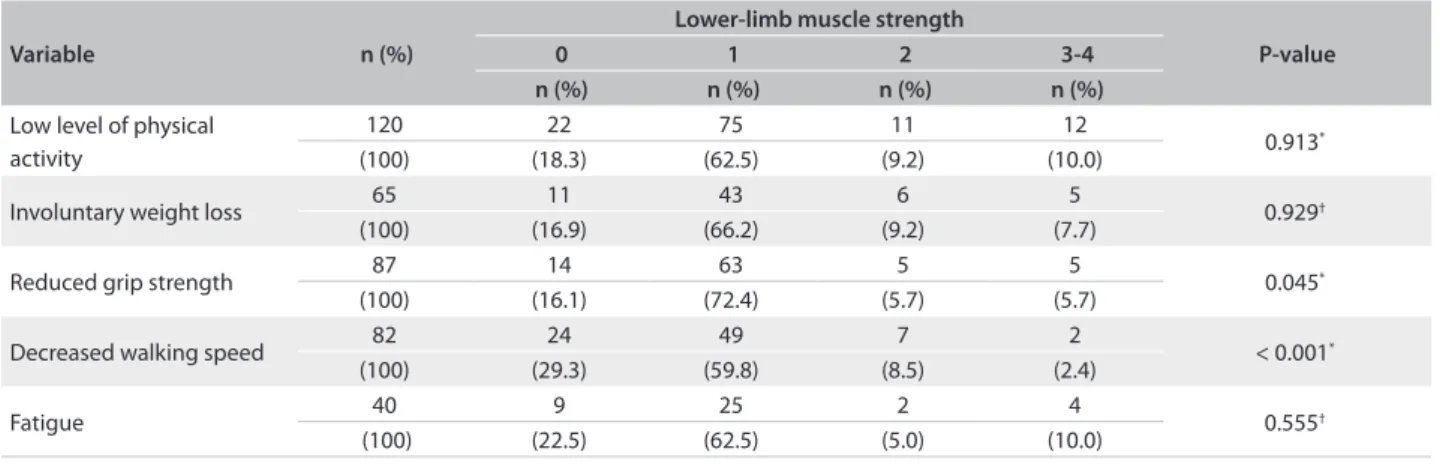
he comparisons between lower-limb muscle strength and each of the frailty criteria (involuntary weight loss, exhaus-tion, decreased walking speed, low level of physical activity and reduced grip strength) are presented in Table 3. Lower-limb muscle strength was signiicantly associated with the criteria of decreased walking speed (P < 0.001) and reduced grip strength (P = 0.045), thus showing that the elderly people with scores for the criteria of decreased walking speed and reduced grip strength presented lower scores for lower-limb muscle strength.
Multivariate logistic regression analysis was carried out to study the risk of presenting frailty (three or more criteria) in rela-tion to lower-limb muscle strength, with comparison between pre-frail and frail elderly people, as shown in Table 4.
he odds ratio for the elderly people to be frail was 4.8 times higher among those who scored zero points for lower-limb muscle strength and 3.5 times higher among those who scored one point.
Regarding the age variable, the elderly people aged 70 to 79 years presented an odds ratio that was 3.82 times higher, and for those aged 80 or over, the odds ratio was 2.83 times higher.
Variables Category n (%)
Age (in years)
60-69 34 (22.7)
70-79 65 (43.5)
≥ 80 51 (33.8)
Sex Female 96 (64.2)
Male 54 (35.8)
Marital status
Married 70 (46.4)
Widowed 64 (42.7)
Divorced 8 (5.3)
Single 8 (5.3)
Literate Yes 97 (64.9)
No 53 (35.1)
Retired Yes 128 (85.3)
No 22 (14.7)
Lower-limb muscle strength (score)
0 26 (17.4)
1 96 (64.0)
2 14 (9.3)
3-4 14 (9.3)
No. of frailty criteria 1-2 67 (44.7)
≥ 3 83 (55.3)
Female sex corresponded to an odds ratio for frailty that was 1.85 times higher than shown by male sex. he odds ratio for frailty was highest among elderly females aged 70 years or over who also had low scores for lower-limb muscle strength.
DISCUSSION
he low performance in the ive-times sit-to-stand test presented by most of the elderly subjects and the presence of at least one frailty criterion in all the subjects evaluated may be related to the
proile of the elderly individuals attended at the Geriatric Outpa-tient Clinic that was used as the study ield. hese paOutpa-tients were either more than 80 years of age or more than 60 years of age if they had some degree of dependence.
In the study sample, the majority presented a low score in the test on lower-limb muscle strength. his result was similar to the indings of Mazzà et al.,19 who observed that there was a higher percentage of elderly outpatients with scores of 0 and 1 in the ive-times sit-to-stand test (27.5% of the subjects for each of
Variable Category n (%)
Lower-limb muscle strength
P-value
0 1 2 3-4
n (%) n (%) n (%) n (%)
Sex Male 54 (36.0) 6 (23.1) 38 (39.6) 7 (50.0) 3 (21.4) 0.179*
Female 96 (64.0) 20 (76.9) 58 (60.4) 7 (50.0) 11 (78.6)
Age (years)
60-69 34 (22.7) 4 (15.4) 18 (18.7) 4 (28.6) 8 (57.1)
0.044†
70-79 65 (43.3) 9 (34.6) 45 (46.9) 7 (50.0) 4 (28.6)
≥ 80 51 (34.0) 13 (50.0) 33 (34.4) 3 (21.4) 2 (14.3)
No. of frailty criteria 1-2 67 (44.7) 8 (30.8) 39 (40.6) 9 (64.3) 11 (78.6) 0.010*
≥ 3 83 (55.3) 18 (69.2) 57 (59.4) 5 (35.7) 3 (21.4)
Table 2. Comparison between the lower-limb muscle strength and the sex, age and frailty criteria of the elderly individuals studied (n = 150)
*Chi-square test; † Fisher’s exact test.
*Chi-square test; † Fisher’s exact test.
Variable n (%)
Lower-limb muscle strength
P-value
0 1 2 3-4
n (%) n (%) n (%) n (%)
Low level of physical activity
120 22 75 11 12
0.913*
(100) (18.3) (62.5) (9.2) (10.0)
Involuntary weight loss 65 11 43 6 5 0.929†
(100) (16.9) (66.2) (9.2) (7.7)
Reduced grip strength 87 14 63 5 5 0.045*
(100) (16.1) (72.4) (5.7) (5.7)
Decreased walking speed 82 24 49 7 2 < 0.001*
(100) (29.3) (59.8) (8.5) (2.4)
Fatigue 40 9 25 2 4 0.555†
(100) (22.5) (62.5) (5.0) (10.0)
Table 3. Comparison of subjects’ scores in the lower-limb muscle strength test, according to the presence of each frailty criterion
Variables Categories P-value OR 95% CI
Age(years)
60-69 (ref) 1.00
---70-79 0.002 4.82 1.80 – 12.91
≥ 80 0.009 3.83 1.39 – 10.51
Sex Male (ref) 1.00
---Female 0.007 2.85 1.33 – 6.11
Lower-limb muscle strength
3 or 4 points (ref) 1.00
---2 points 0.648 1.87 0.31 – 11.29
1 point 0.038 4.50 1.07 – 18.91
0 points 0.031 5.89 1.17 – 29.71
Table 4. Multivariate logistic regression analysis for the risk of three to ive frailty criteria in the sample studied (n = 150)
these scores). However, the present study difered from the stud-ies by Barbosa et al.20 on elderly people within the community and Ferreira et al.21 on elderly outpatients, who both found that the majority of their subjects had higher scores in this test. On the other hand, difering from the present study, one of the criteria used by these authors was a requirement that the subjects should be in a condition to walk.
In relation to lower-limb muscle strength, there was a sig-niicant association with lower scores among individuals aged 70 years or over. his inding is consistent with other research.20,22,23 In evaluations on elderly residents within the community, Bar-bosa et al.,20 Lord et al.22 and Forrest et al.23 found a signiicant correlation (P < 0.001) between the ive-times sit-to-stand test and age, such that the execution time for the test became longer with increasing age.
he results from the present study did not indicate any dif-ference in the ive-times sit-to-stand test between the sexes. his corroborated the results obtained by Singh et al.24 among institu-tionalized elderly people, Mazza et al.19 among elderly outpatients and Lord et al.22 among elderly people living in the community. On the other hand, studies by Barbosa et al.20 among elderly peo-ple within the community and Aslan et al.25 among elderly out-patients obtained signiicant diferences (P < 0.005) in the ive-times sit-to-stand test between the sexes, with higher scores for males. Barbosa et al.20 explained this in terms of the greater pres-ence of chronic sicknesses and obesity among the women in their study population and Aslan et al.25 suggested that new studies should be conducted to clarify their indings.
In addition, low test scores for lower-limb muscle strength correlated with greater concentration of elderly people present-ing three or more frailty criteria. In the literature consulted for this study, it was seen that few studies make reference to the rela-tionship between lower-limb muscle strength, as measured by the ive-times sit-to-stand test and frailty criteria, thereby mak-ing it diicult to compare these indmak-ings. However, the results from the study by Ottenbacher et al.26 showed that lower-limb muscle strength measured through manual dynamometry was a strong predictor of frailty. he study by Boxer et al.27 is notewor-thy, since it found that the six-minute walk test could discrimi-nate between pre-frail and non-frail elderly people sufering from heart failure.
Furthermore, comparison of lower-limb muscle strength with each of the frailty criterion allowed the observation that elderly people with lower scores presented positive scores for the walking-speed and grip-strength criteria. hese results are similar to those obtained by Barbosa et al.,20 Singh et al.24 and Ottenbacher et al.,26 who found correlations between these vari-ables. However, Ottenbacher et al.26 used a diferent test to mea-sure lower-limb muscle strength, instead of the ive-times sit-to-stand test.
he present study enabled the inding that female individuals aged 70 years and over whose lower-limb muscle strength scores were 0 or 1 presented a higher risk of frailty. he results from the studies by Fried et al.,8 Woods et al.,28 Ávila-Funes et al.29 and Ottenbacher et al.30 demonstrated signiicant correlations (P < 0.05) between female sex, advanced age and frailty. Otten-bacher et al.30 only found an association between female sex and frailty, while Purser et al.9 also found that the ive-times sit-to-stand test was a strong predictor of frailty. hese indings show the relevance and applicability of this study, which makes it sim-pler to identify frailty risk groups through an easily applied low-er-limb muscle strength test. It has also been widely reported in the literature31-35 that, with exercise practice guided by qualiied professionals, the loss of muscle strength due to aging is poten-tially reversible.
In the present study, the ive-times sit-to-stand test was found to be suicient for deining the loss of muscle mass. It presented an association with two out of the ive frailty crite-ria (decreased walking speed and reduced grip strength) that are used to detect frailty syndrome. he simplicity of perform-ing this test and comparisons between this test and the walkperform-ing speed and handgrip strength tests make it easier and quicker to evaluate elderly individuals, thereby allowing its use in catego-rizing outpatients according to their risk of frailty.
CONCLUSION
The results obtained in this study reveal that diminished low-er-limb muscle strength is associated with a higher risk of frailty. Diminished lower-limb muscle strength was observed among individuals of greater age (≥ 70 years) and larger numbers of frailty criteria (≥ 3 criteria), without differences between the sexes.
There are some limitations to the present study. Firstly, there was no group of elderly people without frailty criteria (i.e. non-frail individuals). This is possibly related to the pro-file of elderly patients attended by this Geriatric Outpatient Clinic. Nonetheless, it was still possible to prove the discrimi-nation potential of the five-times sit-to-stand test. It was pos-sible to identify significant differences in lower-limb muscle strength between the groups with one or two frailty criteria and with three or more criteria.
REFERENCES
1. Silva TAA, Frisoli Junior A, Pinheiro MM, Szejnfeld VL. Sarcopenia
associada ao envelhecimento: aspectos etiológicos e opções
terapêuticas. [Sarcopenia and aging: etiological aspects and
therapeutic options]. Rev Bras Reumatol. 2006;46(6):391-7.
2. Cesari M, Leeuwenburgh C, Lauretani F, et al. Frailty syndrome and
skeletal muscle: results from the Invecchiare in Chianti study. Am J
Clin Nutr. 2006;83(5):1142-8.
3. Walston J, Hadley EC, Ferrucci L, et al. Research agenda for frailty
in older adults: toward a better understanding of physiology and
etiology: summary from the American Geriatrics Society/National
Institute on Aging Research Conference on Frailty in Older Adults. J
Am Geriatr Soc. 2006;54(6):991-1001.
4. Abate M, Di Iorio A, Di Renzo D, et al. Frailty in the elderly: the physical
dimension. Eura Medicophys.2007;43(3):407-15.
5. Fried LP, Walston J. Frailty and failure to thrive. In: Hazzard WR, Blass JP,
Halter JB, Ouslander JG, Tinetti ME, editors. Principles of geriatric medicine
and gerontology. 5th ed. New York: McGraw-Hill; 2003. p. 1487-502.
6. Macedo C, Gazzola JM, Najas M. Síndrome da fragilidade no
idoso: importância da isioterapia. [Frailty syndrome in elderly
patients: the importance of physiotherapy]. Arq Bras Ciênc Saude.
2008;33(3):177-84.
7. Edström E, Altun M, Bergman E, et al. Factors contributing to
neuromuscular impairment and sarcopenia during aging. Physiol
Behav. 2007;92(1-2):129-35.
8. Fried LP, Tangen CM, Walston J, et al. Frailty in older adults: evidence
for a phenotype. J Gerontol A Biol Sci Med Sci. 2001;56(3):M146-56.
9. Purser JL, Kuchibhatla MN, Fillenbaum GG, et al. Identifying frailty in
hospitalized older adults with signiicant coronary artery disease. J
Am Geriatr Soc. 2006;54(11):1674-81.
10. Ensrud KE, Ewing SK, Taylor BC, et al. Comparison of 2 frailty indexes
for prediction of falls, disability, fractures, and death in older women.
Arch Intern Med. 2008;168(4):382-9.
11. Ensrud KE, Ewing SK, Cawthon PM, et al. A comparison of frailty
indexes for the prediction of falls, disability, fractures, and mortality
in older men. J Am Geriatr Soc. 2009;57(3):492-8.
12. Guralnik JM, Simonsick EM, Ferrucci L, et al. A short physical
performance battery assessing lower extremity function: association
with self-reported disability and prediction of mortality and nursing
home admission. J Gerontol. 1994;49(2):M85-94.
13. McCarthy EK, Horvat MA, Holtsberg PA, Wisenbaker JM. Repeated
chair stands as a measure of lower limb strength in sexagenarian
women. J Gerontol A Biol Sci Med Sci. 2004;59(11):1207-12.
14. Takai Y, Ohta M, Akagi R, et al. Sit-to-stand test to evaluate knee
extensor muscle size and strength in the elderly: a novel approach. J
Physiol Anthropol. 2009;28(3):123-8.
15. Bertolucci PH, Brucki SM, Campacci SR, Juliano Y. O Mini-Exame do
Estado Mental em uma população geral. Impacto da escolaridade
[The Mini-Mental State Examination in a general population: impact
of educational status]. Arq Neuropsiquiatr. 1994;52(1):1-7.
16. Radlof LS. The CES-D Scale: A Self-Report Depression Scale for Research
in the General Population. Applied Psychological Measurement.
1977;1(3):385-401. Available from: http://apm.sagepub.com/
content/1/3/385.full.pdf+html. Accessed 2011 (Jul 25).
17. Batistoni SS, Neri AL, Cupertino AP. Validade da escala de depressão
do Center for Epidemiological Studies entre idosos brasileiros.
[Validity of the Center for Epidemiological Studies Depression Scale
among Brazilian elderly] Rev Saude Publica. 2007;41(4):598-605.
18. Nakano MM. Versão brasileira da Short Physical Performance Battery?
SPPB: adaptação cultural e estudo da coniabilidade [Dissertation]
[Brazilian version of the Short Physical Performance Battery - SPPB:
cross-cultural adaptation and reliability study]. Campinas: Faculdade
de Educação da Universidade Estadual de Campinas, 2007. Available
from: http://cutter.unicamp.br/document/?code=vtls000412296.
Accessed 2011 (Jul 25).
19. Mazzà C, Benvenuti F, Bimbi C, Stanhope SJ. Association between
subject funcional status, seat height, and movement strategy in
sit-to-stand performance. J Am Geriatr Soc. 2004;52(10):1750-4.
20. Barbosa AR, Souza JM, Lebrão ML, Laurenti R, Marucci Mde F. Functional
limitations of Brazilian elderly by age and gender diferences: data
from SABE Survey. Cad Saude Publica. 2005;21(4):1177-85.
21. Ferreira FFP, Izzo H, Jacob Filho W. Impacto da capacidade física
na saúde percebida entre idosos em velhice avançada. Saúde
Coletiva. 2007;4(17):154-7. Available from: http://redalyc.uaemex.mx/
pdf/842/84201705.pdf. Accessed 2011 (Jul 25).
22. Lord SR, Murray SM, Chapman K, Munro B, Tiedemann A.
Sit-to-stand performance depends on sensation, speed, balance and
psychological status in addition to strength in older people. J
Gerontol A Biol Sci Med Sci. 2002;57(8):M539-43.
23. Forrest KY, Zmuda JM, Cauley JA. Correlates of decline in lower
extremity performance in older women: A 10-year follow-up study.
J Gerontol A Biol Sci Med Sci. 2006;61(11):1194-200.
24. Singh AS, Chin A Paw MJ, Bosscher RJ, van Mechelen W.
Cross-sectional relationship between physical itness components and
functional performance in older persons living in long-term care
facilities. BMC Geriatr. 2006;6:4.
25. Aslan UB, Cavlak U, Yagci N, Akdag B. Balance performance, aging and
falling: a comparative study based on a Turkish sample. Arch Gerontol
Geriatr. 2008;46(3):283-92.
26. Ottenbacher KJ, Ostir GV, Peek MK, et al. Frailty in older Mexican
Americans. J Am Geriatr Soc. 2005;53(9):1524-31.
27. Boxer RS, Wang Z, Walsh SJ, Hager D, Kenny AM. The utility of the
6-minute walk test as a measure of frailty in older adults with heart
failure. Am J Geriatr Cardiol. 2008;17(1):7-12.
28. Woods NF, LaCroix AZ, Gray SL, et al. Frailty: emergence and
consequences in women aged 65 and older in the Women’s Health
Initiative Observational Study. J Am Geriatr Soc. 2005;53(8):1321-30.
29. Avila-Funes JA, Helmer C, Amieva H, et al. Frailty among
community-dwelling elderly people in France: the three-city study. J Gerontol A
30. Ottenbacher KJ, Graham JE, Al Snih S, et al. Mexican Americans
and frailty: indings from the Hispanic established populations
epidemiologic studies of the elderly. Am J Public Health.
2009;99(4):673-9.
31. Borst SE. Interventions for sarcopenia and muscle weakness in older
people. Age Ageing. 2004;33(6):548-55.
32. Latham NK, Bennett DA, Stretton CM, Anderson CS. Systematic review
of progressive resistance strength training in older adults. J Gerontol
A Biol Sci Med Sci. 2004;59(1):48-61.
33. Aveiro MC, Granito RN, Navega MT, Driusso P, Oishi J. Inluence
of a physical training program on muscle strength, balance and
gait velocity among women with osteoporosis. Rev Bras Fisioter.
2006;10(4):441-8.
34. Candeloro JM, Caromano FA. Efeito de um programa de hidroterapia
na lexibilidade e na força muscular de idosas [Efect of a hydrotherapy
program on lexibility and muscle strength in elderly women]. Rev
Bras Fisioter. 2007;11(4):303-9.
35. Eyigor S, Karapolat H, Durmaz B. Efects of a group-based exercise
program on the physical performance, muscle strength and quality
of life in older women. Arch Gerontol Geriatr. 2007;45(3):259-71.
Sources of funding: None
Conlict of interest: None
Date of irst submission: February 12, 2011
Last received: August 10, 2011
Accepted: August 11, 2011
Address for correspondence: Fernanda Sotello Batista
Praça Palmares, 26 — apto 1
Embaré — Santos (SP) — Brasil
CEP 11015-330
Tel. (+55 13) 3231-2259