RESUMEN
Estudio descripivo que tuvo como objei -vo: ideniicar y comparar el conocimiento de las enfermeras sobre los patrones de consumo de alcohol y los problemas rela -cionados. En el estudio pariciparon 185 enfermeras, 84 de las cuales habían asisi -do a un curso de formación sobre el tema. Los datos fueron recolectados a través de un cuesionario de conocimientos el cual muestra que, aunque el grupo capacitado haya obtenido mayores aciertos, se obser -vó un déicit de conocimientos en ambos grupos, principalmente en lo referente a la ideniicación de las complicaciones deriva -das del uso de alcohol. Se presentan deini -ciones importantes para la prácica del en -fermero en el área de las adicciones, lo que sugiere que futuras capacitaciones puedan considerar las diversas dimensiones invo -lucradas en la atención a las personas con problemas relacionados con el alcohol.
DESCRIPTORES
Educación en enfermería Alcoholismo
Conocimientos
Acitudes y prácica en salud
RESUMO
Estudo descriivo que objeivou ideniicar e comparar o conhecimento de enfermei -ros frente aos padrões do uso do álcool e questões associadas. Pariciparam do estu -do 185 enfermeiros, -dos quais 84 haviam cursado uma capacitação sobre o tema. Os dados foram coletados por meio de um quesionário de conhecimentos eviden -ciando que, embora o grupo capacitado tenha obido maiores médias de acertos, observou-se déicit de conhecimento em ambos os grupos, principalmente no que se refere à ideniicação das complicações decorrentes do uso do álcool. Deinições importantes para a práica do enfermei -ro na área das adições são apresentadas, sugerindo-se que capacitações futuras possam considerar as várias dimensões envolvidas no cuidado às pessoas com pro -blemas relacionados ao álcool.
DESCRITORES
Educação em enfermagem Alcoolismo
Conhecimentos
Aitudes e práica em saúde
ABSTRACT
Descripive study that aimed to idenify and compare the nurses’ knowledge ad -dressed to paterns of alcohol use and related issues. The study included 185 nurses of which 84 had atended a train -ing course on the subject. Data were col -lected through a quesionnaire of knowl -edge showing that while the trained group obtained the highest average on correct answers, there was a lack of knowledge in both groups, especially with regard to the ideniicaion of complicaions from alco -hol use. Important deiniions to nursing pracice in the area of addicions are pre -sented, suggesing that future training may consider the various dimensions involved in caring for people with problems related to alcohol.
DESCRIPTORS
Educaion, nursing Alcoholism Health knowledge Aitudes, pracice
Patterns of alcohol use and
related issues:
analysis of nurses’ knowledge
O
riginal
a
rticle
Divane de Vargas1, Janaina Soares2
PADRÕES DE USO DO ÁLCOOL E QUESTÕES ASSOCIADAS: UMA ANÁLISE DO CONHECIMENTO DE ENFERMEIROS
PATRONES DE CONSUMO DE ALCOHOL Y PROBLEMAS RELACIONADOS: UN ANÁLISIS DEL CONOCIMIENTO ENTRE LOS ENFERMEROS
INTRODUCTION
Alcohol consumpion is associated with a variety of adverse health and social consequences. The harmful efects of alcohol are well known and there is evidence of its associaion with many diseases, such as liver cir -rhosis, pancreaiis, mental diseases, various cancers and fetal problems. Its use is closely associated with events of social efects, such as deaths and injuries caused by drunk driving, increased aggression, family breakdown and reduced producivity(1).
In Brazil, in 2005, 54% of adults over 15 years old con -sumed beer and 40% disilled drinks. In 2004, the morbi -dity related to alcohol use in the populaion was 7.29% among men and 1.41% among women(2). In addiion to
this, social and health costs caused by problems related to alcohol use in the country, a total of more than 4 million dollars annually to state cofers(3), besides this, there is a
high percentage of people directly or indirectly afected by alcohol use in health services(4-5), which has required
prepared health professionals to deal with the problem. In health services, there has been increasing demand of people with problems related to alcohol use, which is considered one of the major public health problems of the country. However, studies(6-8) have evidenced diicul
-ies of the health professionals to recognize, treat, and re -fer these paients. The main causes for this situaion are the lack of training and litle knowledge about the topics of alcohol and other psychoacive substances, that has prevented a more efecive acion of the professionals on the problems related to alcohol and alcoholism(7-9).
Internaional research indicates that ater professio -nal training there is a signiicant increase in the level of knowledge of generalist nurses on the topic of Alcohol and Other Drugs (AOD). Despite the evidence, there are few studies that have been concerned to idenify such knowledge around the world and especially in Brazil(8),
paricularly those who have seen the inluence of educa -ional intervenions on knowledge regarding the issue(9).
In Brazil, the few studies conducted with the objec -tive of studying this phenomenon showed that these professionals had little knowledge related to the ma -nagement of patients(8) and from every 5 nurses, 4 had
not received information on assistance to people with AOD-related disorders during their educational trai -ning(11), even though there is evidence that training
courses have a positive impact on the knowledge of these professionals(9-10).
Thus, this study aimed to idenify and compare the knowledge of a sample of nurses regarding paterns of alcohol use, complicaions arising from the use, stages of moivaion of paients with problems related to alcohol use and psychosocial approaches that can be used in the care of this populaion.
METHOD
Comparaive-descripive study aimed to idenify and compare the knowledge about AOD between two groups of nurses.
For our study, 280 nurses were invited to paricipate, 140 were from a university general hospital and 140 from various other health services such as basic health units, general hospitals, urgent and emergency care services and psychosocial care centers and those who had under -gone a training course on alcohol and other drugs.
The convenience sample consisted of 185 subjects, of whom ive were excluded from the sample because they did not answer in full the data collecion instru -ments. The remaining 180 (64.2%) were allocated into two groups for comparison purposes. Of the total par -icipants, 80 (44.4%) belonged to the group who had paricipated in a training course in AOD (n=80 Group 1 - training) and 100 (55.6%) were nurses in a general hos -pital who had not received the refered course (n=100 Group 2 - comparison).
Research Instruments
To idenify the paricipants’ knowledge, a previous -ly elaborated(13) and adapted quesionnaire was applied
to meet the research objecives. A total of 10 alterna -ives related to cogniive impairment and pharmacolo -gical treatment of addicion and its complicaions were excluded. Ater adjustments for applicaion in the study populaion, the inal version of the quesionnaire was composed of four muliple-choice quesions and eight statements to be considered true or false. Addressing issues relaing to: (i) ideniicaion of paterns of alcohol use (low risk drinking, harmful use of alcohol and alcohol dependence, (ii) the concept of tolerance, (iii) complica -ions associated with the alcohol use (acute intoxicaion; syndrome of absinence, alcoholic hallucinosis, (iv) moi -vaional stages to change psicoacive drug users and (v) principles of brief intervenion.
Along with the knowledge quesionnaire, a quesion -naire was applied consising of 16 quesions which aggre -gated demographic quesions: age, gender, marital status, length of employment, 3 quesions related to professio -nal experience with people with alcohol use disorders; 4 quesions related to academic training in nursing and 5 quesions on the preparaion received about chemical addicion during training.
Data Collecion
The study was conducted during the period January 2010 to August 2013. Paricipants in Group 2 were invi -ted to personally paricipate in the study by three trained interviewers in their workplaces during the three shits (morning, aternoon, evening). For those who agreed to paricipate in the study, a 48 hours deadline was establi -shed for returning the quesionnaire completed. Parici -pants in group 1 received the invitaion in email addresses and phone provided upon enrollment in online training course and, having agreed to paricipate, the instruments of data collecion were sent via e-mail, seing up the sa -me deadline for group 2 for return of responses.
Staisical analysis
For data analysis, we attributed the value 1 (one) for each question answered correctly and 0 (zero) to each question left blank or answered incorrectly. The total score was obtained by adding the grades of 12 questions. Data were analyzed using the Pro R softwa -re, version 2.15.1 (R). We used descriptive statistical analysis to identify the profile and performance of the participants in the knowledge questionnaire, making use of the measures of central tendency. We used the Pearson correlation analysis to assess the association of variables of interest in the study: gender, marital status, length of employment, work experience with alcoholics, characteristic of the training institution, graduate studies, having received training to work in the field of alcohol addictions and other drugs during training, workload dedicated on the topic AOD recei -ved during Nursing undergraduate and clinical expe -rience in AOD with the number of correct answers for each of the groups on the knowledge questionnaire. The Pearson chi-square test was used to compare the proportions of correct answers of participants know -ledge questionnaire. In all analyzes, we adopted a sig -nificance level of 5%.
Ethical aspects
The study protocol, as well as the Consent Form, which was signed by all paricipants, were approved by the Ethics Commitee in Human beings of the University Hospital, University of Sao Paulo under protocol number 946/09.
RESULTS
Characterisics of the sample
Of the 180 paricipants, 89% were female, aged 38.7 ye -ars (SD= 6.2 ye-ars), married (49.4 %) and up to 8 ye-ars af -ter graduaion (66.7%). With regards to having professional experience with alcoholics, 51% responded airmaively and of these, 40% reported that cared for people related to alcohol use disorders weekly. With regard to nursing educa -ion, more than 60.0% reported being graduated in private
insituions, 82.2% had some type of graduate studies, the majority (90.0%), specializaion.
When asked about having received training on addicions in AOD during their undergraduate nursing course 57.8% re -ported not having received such training. Those who repor -ted having received some preparaion in the area, the ma -jority (60.0%) reported having had between 5 and 10 hours of content on this subject during the four years of academic training. With respect to the irst clinical contact with people related to alcohol use disorders, the majority of the parici -pants 41.0% reported having had contact only ater under -graduaion in nursing, followed by 33.0% who reported ha -ving had such contact during the nursing course.
Knowledge of paricipants about the aspects addressed in the quesionnaire: general analysis
With regard to knowledge covered in the quesionnai -re generally, it was observed that the ones with g-reater number of correct answers on the quesionnaire know -ledge were female nurses, separated, who reported we -ekly work experience with alcoholics, who were trained in private insituions that received at least 20 hours of theoreical training in the ield of alcohol addicions and other drugs and had some clinical experience with these paients during their nursing undergraduate course.
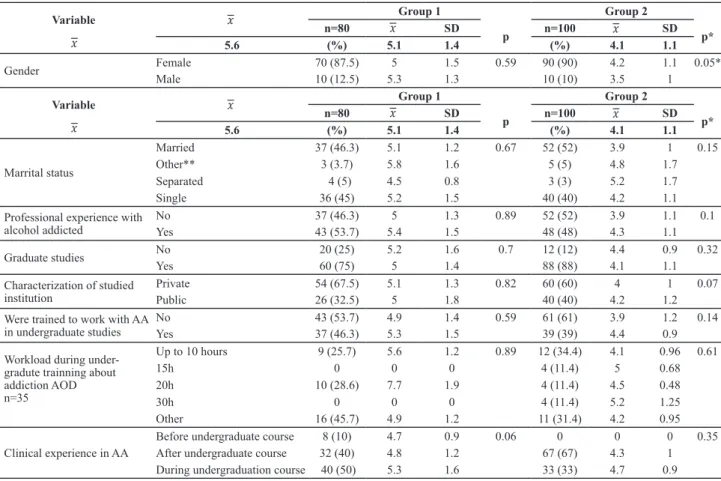
When we analyzed the possible associaion of the va -riables of interest in the study with the number of cor -rect answers on the knowledge quesionnaire, we found that the only variable that showed signiicant associaion with a higher number of correct answers was receiving nursing educaion in private insituion (r= 0:42/p=0.05). Analyzing the mean score on the knowledge quesionnai -re among the paricipants (N=180), it was observed that the overall mean ( ) was 5.6 correct answers (Table 1). Comparison of the means of correct answers in
knowledge quesionnaire between Group 1 and Group 2 When the two groups were compared by their overall means in the knowledge quesionnaire, using the Pearson chi-square test, it was observed that nurses in group 1 achie -ved the highest overall mean ( = 5.1) than those in group 2 ( = 4.1). Analyzing the quesionnaire correct answers in accordance with the sociodemographic variables of the par -icipants divided into groups, it was observed that nurses in group 1 had on average 1 point higher in correct answers, regardless of the variable compared (Table 1).
Knowledge regarding the ideniicaion of paterns of harmful use of alcohol, complicaions arising from such use and the concept of tolerance
In quesions related to the ideniicaion of the patern of harmful use of alcohol, complicaions and ideniicaion of tolerance, the later characterized as a state in which the individual needs to increase the amount of alcohol dose to feel the efects of the drug, it was observed that the number of correct answers was low, as the total number of parici -pants who responded correctly to quesions regarding these
aspects did not reach 50% in any of the quesions addres -sed such knowledge. These indings suggest that the largest deicit of knowledge was in idenifying complicaions related to the use of alcohol, since only 32 nurses (17%) were able to properly idenify the complicaion presented (alcoholic hallucinosis). However, paricipants in group 1 demonstrated increased knowledge in this set of quesions, when compa -red to group 2, staisically signiicant diferences (p≤0.05) with respect to the knowledge related to the ideniicaion of the harmful patern of alcohol use and idenifying the to -lerance related to substance use (Table 2).
Table 1 - Distribution of means of getting the knowledge questionnaire in groups 1 and 2 according to sociodemographic, professional and educational variables of the participants - Sao Paulo, 2013
Variable Group 1 Group 2
n=80 SD
p n=100 SD p*
5.6 (%) 5.1 1.4 (%) 4.1 1.1
Gender Female 70 (87.5) 5 1.5 0.59 90 (90) 4.2 1.1 0.05*
Male 10 (12.5) 5.3 1.3 10 (10) 3.5 1
Variable Group 1 Group 2
n=80 SD
p n=100 SD p*
5.6 (%) 5.1 1.4 (%) 4.1 1.1
Marrital status
Married 37 (46.3) 5.1 1.2 0.67 52 (52) 3.9 1 0.15
Other** 3 (3.7) 5.8 1.6 5 (5) 4.8 1.7
Separated 4 (5) 4.5 0.8 3 (3) 5.2 1.7
Single 36 (45) 5.2 1.5 40 (40) 4.2 1.1
Professional experience with alcohol addicted
No 37 (46.3) 5 1.3 0.89 52 (52) 3.9 1.1 0.1
Yes 43 (53.7) 5.4 1.5 48 (48) 4.3 1.1
Graduate studies No 20 (25) 5.2 1.6 0.7 12 (12) 4.4 0.9 0.32
Yes 60 (75) 5 1.4 88 (88) 4.1 1.1
Characterization of studied institution
Private 54 (67.5) 5.1 1.3 0.82 60 (60) 4 1 0.07
Public 26 (32.5) 5 1.8 40 (40) 4.2 1.2
Were trained to work with AA in undergraduate studies
No 43 (53.7) 4.9 1.4 0.59 61 (61) 3.9 1.2 0.14
Yes 37 (46.3) 5.3 1.5 39 (39) 4.4 0.9
Workload during under-gradute trainning about addiction AOD n=35
Up to 10 hours 9 (25.7) 5.6 1.2 0.89 12 (34.4) 4.1 0.96 0.61
15h 0 0 0 4 (11.4) 5 0.68
20h 10 (28.6) 7.7 1.9 4 (11.4) 4.5 0.48
30h 0 0 0 4 (11.4) 5.2 1.25
Other 16 (45.7) 4.9 1.2 11 (31.4) 4.2 0.95
Clinical experience in AA
Before undergraduate course 8 (10) 4.7 0.9 0.06 0 0 0 0.35
After undergraduate course 32 (40) 4.8 1.2 67 (67) 4.3 1
During undergraduation course 40 (50) 5.3 1.6 33 (33) 4.7 0.9
(*) Values with p≤0.05 presented association probability signiicant with mean knowledge. (**)divorced, widow and living with a partner.
Table 2 - Distribution of proportions of correct answers between groups 1 and 2 regarding questions 1-4 of the questionnaire of knowledge
related to the identiication of patterns of alcohol use, complications arising from the use and recognition of tolerance - Sao Paulo, 2013
Question Correct answer G1 (n=80) G2 (n=100) Total (n=180) pa
1- 50 year-old patient makes use of alcohol since 20 years. Use of distilled drink (whiskey) every day: one dose (50 ml) at lunch and another (50 ml) at dinner. He is married and his wife often gets annoyed with
the amount of drink. Over the past ive months he has
been showing depressive symptoms, such as depres-sion, loss of appetite and insomnia.
Met criteria for harmful use of alcohol. 35 (43.8%) 20 (20%) 55 (30.6%) 0.001
2- Patient with a diagnosis of alcohol dependence, decreased intake for 3 days and present auditory hal-lucinations (voices of men calling his name). No change in level of consciousness.
Table 3 - Distribution of correct answers on true or false statements (7 questions) related to safe drinking, psychosocial approaches (brief intervention) and stages of motivation for change of people with alcohol problems - Sao Paulo, 2013
Question Correct answer G1 (n=80) G2 (n=100) Total (n=180) pa
Correct(%) Correct(%)
5- An adult male can drink up to a maximum of 2 doses of whiskey (total of 100
ml) per day. T 22 (31) 14 (14) 21.10% 0.001
6- Woman can drink less than men because she has proportionally greater amount of
body fat, which increases the bioavailability of alcohol. T 33 (46.5) 43 (43) 44.40% 0.76
7- The Brief Intervention (BI) is a type of non-pharmacological treatment that is
effective for mild addictions and harmful users. T 53 (74.6) 64 (64.6) 68.80% 0.22
8- The BI can be applied to consultations of 10 to 15 minutes by physicians, nurses,
psychologists and other trained professionals. T 57 (80.3) 67 (67.7) 72.90% 0.09
9- The goal of safe drinking (socially) should be avoided for patients who do
harm-ful use of alcohol. T 18 (25.4) 6 (6) 86.00% 0.001
10- For patients who are not motivated for treatment, the doctor should respect his
opinion and wait until he feels motivated to start treatment. F 41 (57.7) 69 (69) 35.70% 0.17
11- Patients in the pre-contemplation stage considers whether to stop drinking or
not, but cannot change their behavior towards drinking. F 34 (47.9) 17 (17) 70.20% <0.001
12 - Once alcohol dependence is identiied, the preliminary orientations should be
done and patient should be refered to a specialist. T 33 (46.5) 99 (99) 77.20% <0.001
(a) signiicant chi-square test, when p≤0,05.
Knowledge about safe drinking, psychosocial approaches (brief intervenion) and stages of
moivaion for changing people with problems related to alcohol use
Analyzing the answers to quesions related to know -ledge about safe drinking, psychosocial approaches (brief intervenion) and stages of moivaion to change behavior of people related to alcohol use disorders, we found that
for this set of quesions, paricipants from group 1 achie -ved greater number of correct answers when compared to Group 2, except for quesion 12, which addresses the knowledge on acion to be taken before the ideniicaion of alcohol dependence. The observed diferences were staisically signiicant for quesions 5, 9, 11 and 12, which relate to safe drinking (quesions 5 and 9), stages of chan -ge (quesion 11) and aitudes towards the ideniicaion of alcohol dependence (quesion 12), as shown in Table 3.
Continuation...
DISCUSSION
This study aimed to idenify and analyze knowledge from a sample of nurses about alcohol and the problems associated with comparing the averages of correct answers on a quesionnaire consising of 12 quesions between two groups of nurses, one of whom had undergone a training course on AOD topic. In general, the paricipants’ knowled -ge on the issues addressed in the quesionnaire showed de -icit, since the mean of correct answer did not reach 50%. As explanaion for this result, one can point out the lack of knowledge about this problem among health workers,
a phenomenon well documented in the literature(7, 11,15-16)
which prevents the recogniion of the problem and a more appropriate approach for these professionals in diferent health services(4,17).
This result also relects the litle atenion being given to the issue of addicions in nursing syllabus(11-12,18) which
was also evidenced in this study where 60% of paricipants received no training on this topic during nursing educaion. Among those who reported receiving some content on the issue, most menioned were ofered between 5 and 10 Question Correct answer G1 (n=80) G2 (n=100) Total (n=180) pa
3- Patient with diagnosis of alcohol dependence was admitted to the emergency room with signs of severe agitation after using large quantities of alcohol.
It is acute poisoning 53 (66.2%) 47(47%) 55.60% 0.015
4- When a person says he needs more and more
alco-hol or another drug to “get high” it can demonstrate: Tolerance 54 (67.5%) 32 (32%) 47.80% <0.001
hours, which is consistent with studies(11,18) that has pointed
out that AOD contents are not taught during Professional training or are ofered in quaniies which are not suicient to ensure proper management of knowledge situaions in -volving the use of AOD(15,19-20).
The nurses in the group that had been subjected to a speciic course of training on the AOD topic, showed higher mean score on the knowledge quesionnaire, regardless of the variables compared. Sill, the diferences between the two groups were not signiicant and, although they have shown beter results in the quesionnaire, the staisical signiicant diference was observed only in the knowledge related to safe drinking and stages of readiness to change in individuals with problems related to alcohol use. This inding suggests that the course had an impact on know -ledge about these aspects, which was expected, given its objecive of uptading professionals with basic knowledge for atending users of psychoacive drugs. For the other aspects addressed in the quesionnaire, the observed di -ference between the two groups could be due to chance, suggesing that the course had litle impact on knowledge in other aspects covered by the quesionnaire, mainly on issues related to the ideniicaion of complicaions of alco -hol dependence, as well as the refering decision of people with these problems. It is speculated that this phenomenon is due to the fact that the training courses are prioriizing knowledge related to problem ideniicaion, without going deep into this issue, in order to prepare its graduates to fa -ce more severe situaions related to the use of substan-ces. This is worrisome, given the exising indings in the literatu -re that undergraduaion has also not ofe-red this knowled -ge to future professionals(11).
However, we cannot think only these aspects of the trai -ning of proissonals, because ideniicaion strategies and rapid intervenions are extremely important and desirable to confront the problem of AOD use currently, we cannot lose sight that nursing care integrates the network of com -prehensive care to the AOD user(21), which implies the need
on recogniion and approach in the face of complicaions from alcohol use.
These results point to the need of courses ofered to emphasize these aspects of care for AOD, covering diferent situaions and scenarios involving assistance to this popula -ion, since with increasing drinking focuses mainly among younger populaions(22). Thus, it is increasingly required the
recogniion of professional and appropriate conduct in the complicaions arising from the use of alcohol.
Moreover, the results evidenced that most paricipants in group 1 did not respond correctly the quesion regarding the referral of people with a suggesive diagnosis of alcohol dependence for specialized treatment. This is alarming, sin -ce it is most appropriate approach when idenifying those cases in general health services and one of the focal points of the course.
Although 33% of paricipants interviewed have reported that their irst contact with people with alcohol use disor -ders was during their nurse training in clinical internships, most of them (41%) reported that this only happened ater training in nursing. This result may be related to the lack of preparaion of nursing educators, or who do not recognize the problem related to alcohol use in the various seings of nursing educaion, given the prevalence of these users in health services(3-4), or when recognized, they prefer to leave
this aspect as secondary, emphasizing the efects of alcohol on health of individuals assisted without properly focus the primary cause of the problem(23). This may contribute to the
perpetuaion of ignorance and lack of ideniicaion of the -se problems in the job rouine.
The results of this study strongly suggest that variables such as workload received during graduaion and clinical experience with these paients during nursing training are able to posiively inluence the knowledge about the is -sue, since it was observed that regardless of the allocaion group, paricipants who reported having had a minimum of 20 hours of theoreical content on AOD during the course, together with clinical experience, obtained beter scores on the knowledge quesionnaire. This result is consistent with previous studies(10,16,18,20,23-25) which cited this as the
most appropriate strategy not only to acquire knowledge for future nurses, but also as promissing for more posiive aitudes towards these paients. Moreover, the knowledge gained during the training in nursing tends to remain ater compleion of the course, encouraging more posiive aitu -des of the professionals towards these people(18-19,25).
Limitaions and advances
This study contributes signiicantly to idenifying the knowledge of nurses related to alcohol use and associa -ted situaions, given the scarcity of research on this topic. The results, however, must be interpreted in the context of several limitaions, including: the group undergoing training course in AOD was not subjected to a pre-test and therefore the results observed cannot be linked to it.
Another limitaion is the fact that the knowledge quesionnaire was not comprehensive enough to ideni -fy other knowledge that were not covered. It is unclear whether the fact that it is a course of mulidisciplinary characterisic exerted some inluence on the results, so it is desirable that future studies elucidate this quesion by invesigaing samples of nurses who have been trained in speciic training courses for nursing.
Furthermore, the internal validity of the results is evi -denced by similar indings in previous studies that also suggest that internships and pracical experiences during training, together with adequate workload in such con -tent, contribute to increase knowledge on these issues.
CONCLUSION
The nurses’ knowledge on the issues addressed in the quesionnaire showed deicit; nurses subjected to a training course on alcohol and other drugs tended to ha -ve greater knowledge in some aspects, especially those related to paterns of alcohol use, acute intoxicaion and tolerance, while those without training performed beter on quesions related to the management and referral of people with symptoms suggesive of alcoholic addicion.
The largest deicit found concern the knowledge in the recogniion of complicaions of alcohol use, sug -gesing that coninuing educaion courses in this area should emphasize these aspects, since complicaions are an important aspect of nursing pracice, regardless of their place of acion.
This study also suggests that the associaion between the theoreical content and pracical experience with pe -ople with AOD related disorders training during nursing training is an efecive strategy for acquiring knowledge and skills on the problem of addicions, suggesing that this educaional experience inluences the uilizaion of trained professionals already graduated. It is suggested that future research should devote themselves to study this phenomenon to elucidate this quesion.
REFERENCES
1. Brasil. Presidência da República. Secretaria Nacional de Políi
-cas sobre Drogas. Relatório brasileiro sobre drogas [Internet] Brasília; 2009 [citado 2013 ago. 06]. Disponível em: htp:// www.obid.senad.gov.br/portais/OBID/biblioteca/documen
-tos/Relatorios/328379.pdf
2. Carlini EA, Galduróz JCF, Noto AR, Nappo AS. II Levantamento domiciliar sobre uso de drogas psicotrópicas no Brasil. Parte A: estudo envolvendo as 108 maiores cidades do país, 2005. Brasília: Centro Brasileiro de Informações Sobre Drogas Psico
-trópicas/ Departamento de Psicobiologia da Escola Paulista de Medicina/Secretaria Nacional Anidrogas; 2005.
3. Sousa FSP, Oliveira EN. Caracterização das internações de de
-pendentes químicos em Unidade de Internação Psiquiátrica do Hospital Geral. Ciênc Saúde Coleiva. 2010;15(3):671-677.
4. Vargas D. Aitudes de enfermeiros frente as habilidades de ideniicação para ajudar o paciente alcoolista. Rev Bras En
-ferm [Internet]. 2010;63(2):190-5.
5. Tran DT, Stone AM, Fernandez RS, Griiths RD, Johnson M. Changes in general nurses’ knowledge of alcohol and substan
-ce use and misuse ater educaion. Perspect Psychiatr Care. 2009;45(2):128-39.
6. Crothers CE Dorrian J. Determinants of Nurses’ Aitudes to
-ward the Care of Paients with Alcohol Problems. ISRN Nurs [Internet]. 2011 [cited 2013 Nov 08]:821514. Available from: htp://www.ncbi.nlm.nih.gov/pmc/aricles/PMC3169239/
7. Vargas D, Duarte FAB. Enfermeiros dos centros de atenção psicossocial em álcool e drogas (CAPS AD): a formação e a busca pelo conhecimento especíico da área. Texto Contexto Enferm. 2011;20(1):119-26.
8. Soares J, Vargas D, Oliveira MAF. Aitudes e conhecimentos de proissionais de saúde diante do álcool, alcoolismo e do al
-coolista: levantamento da produção cieníica nos úlimos 50 anos. SMAD Rev Eletr Saúde Mental Alcool Drog [Internet]. 2011 [citado 2013 nov. 08];7(1):45-52. Disponível em: htp:// www.revistas.usp.br/smad/aricle/viewFile/38739/41594
9. Soares J, Vargas D, Formigoni MLOS. Knowledge and ai
-tudes of nurses towards alcohol and related problems: the impact of an educaional intervenion. Rev Esc Enferm USP [Internet]. 2013 [cited 2013 Nov 28];47(5):1172-9. Available from: htp://www.scielo.br/pdf/reeusp/v47n5/0080-6234-reeusp-47-05-1172.pdf
10. Nehlin C, Fredriksson A, Grönbladh L, Jansson L. Three hours of training improve psychiatric staf’s self-perceived know
-ledge and aitudes toward problem-drinking paients. Drug Alcohol Rev [Internet] 2012 [cited 2013 Nov 08];31:544-9. Available from: htp://www.ncbi.nlm.nih.gov/pub
-med/22050211
11. Pillon CS, Laranjeira R. Formal educaion and nurses’ aitu
-des towards alcohol and alcoholism in a Brazilian sample. São Paulo Med J. 2005;123(4):175-80.
12. Seale JP, Velasquez MM, Johnson JA , Shellenberger S, Ster
-nberg KV, Dodrill C, et al. Skills-vased residency training in alcohol screening and brief intervenion: results from the Georgia-Texas “Improving Brief Intervenion” Project. Subst Abus. 2012;33(3):261-71.
13. Silva CJ. Impacto de um curso em diagnósico e tratamento do uso nocivo e dependência do álcool sobre a aitude e co
-nhecimento de proissionais da rede de atenção primária à saúde [tese doutorado]. São Paulo: Escola Paulista de Medi
14. Brasil. Ministério da Jusiça; Secretaria Nacional de Políicas sobre Drogas; Universidade Federal de São Paulo. Curso SU
-PERA [Internet]. São Paulo; 2012 [citado 2013 set. 05]. Dis
-ponível em: htp://www.supera.senad.gov.br/
15. Cund A. Alcohol educaion revisited: Exploring how much ime we devote to alcohol educaion in the nursing curri
-culum. NursEduc Pract [Internet] 2013 Jan [cited 2013 Nov 08];13(1):35-9. Available from: htp://www.ncbi.nlm.nih. gov/pubmed/22858311
16. Rocha FM, Vargas D, Oliveira MAF, Bitencourt MN. Caring for people with psychoacive substance dependence: nur
-sing student percepions. Rev Esc Enferm USP [Internet]. 2013 [cited 2013 Nov 28];47(3):671-7. Avialable from: htp://www.scielo.br/pdf/reeusp/v47n3/en_0080-6234-reeusp-47-3-00671.pdf
17. Brasil. Ministério da Saúde; Secretaria de Atenção à Saúde, Departamento de Ações Programáicas Estratégicas. Saúde mental e atenção básica: o vínculo e o diálogo necessários. Inclusão das ações de saúde mental na atenção básica [In
-ternet]. 2003 [citado 2013 ago. 06]. Disponível em: htp:// portal.saude.gov.br/portal/arquivos/pdf/diretrizes.pdf
18. Vargas D. Nurses personal knowledge and their aitudes to
-ward alcoholism issues: A study of a sample of specialized services in Brazil. J Nurs Educ Pract. 2014;4(2):123-31.
19. Alves SVF, Cortes PR, Freire SRC, Lemos SLB, Pillon SC, Si
-queira MM. O ensino sobre substâncias psicoaivas na gra
-duação em enfermagem da Universidade Federal do Espírito Santo. Rev Min Enferm. 2010;14(2):244-50.
20. Tsai YF. Nurses’ perceived facilitators and barriers to asses
-sing for alcohol use in Taiwan. J Clin Nurs [Internet]. 2009 [cited 2013 Nov 08];18(14):2078-86. Available from: htp:// www.ncbi.nlm.nih.gov/pubmed/19220620
21. Brasil. Ministério da Saúde; Secretaria de Atenção à Saúde. A Políica do Ministério da Saúde para Atenção Integral a Usuários de Álcool e outras Drogas. Brasília; 2004.
22. Fitzmaurice GJ, Kumar S, Brown R, Hussain A, O’Donnell ME. Are Alcohol-related acute surgical admission rates falling? Ulster Med J. 2010;79(1):6-11.
23. Vargas D, Vargas D. The efect of clinical experience with al
-coholic on Brazilian nursing students aitudes towards alco
-hol and associated problems. J Addict Nurs. 2013. In press
24. Rassol GH, Rawaf S. Predictors of educaional outcomes of undergraduate nursing students in alcohol and drug educa
-ion. Nurse Educ Today. 2008;28(3):691-701.
25. Tsai YF, Tsai MC, Lin YP, Weng CE, Chou YL, Chen CY. An alco
-hol training program improves Chinese nurses’ knowledge, self-eicacy, and pracice: a randomized controlled trial. Al