Cruz ERS, Lise M, Santos TP, Carvalho LP. Knowledge and practice of physicians regarding colorectal cancer screening.
J Coloproctol, 2012;32(4): 385-394.
ABSTRACT: Introduction: Despite the high prevalence and high rates of mortality of colorectal cancer, it is likely to be a secondary prevention disease due to the presentation of characteristics that are ideal for a successful screening program, with a proven positive impact on its outcome. Objective: To describe the knowledge and practice of physicians concerning screening tests for the prevention of colorectal cancer. Methods: Cross-sectional study carried out between November 2011 and February 2012, through a questionnaire administered to 83 physicians who assist adult patients at the University Hospital of Universidade Luterana do Brasil and at basic health units of Canoas, Rio Grande do Sul, Brazil. Results: From the number of physicians par-ticipating in the survey, only 35 (42.0%) reported prescribing tests for colorectal cancer screening. Out of these, only 21 used the screening on patients aged 50 years old or more, as recommended by the guidelines. Only 65.0% of the physicians reported inves-tigating family history of colorectal cancer, and surgical experts were the ones who least investigated this risk factor (p=0.005), when compared with clinical and gynecology specialties. Conclusions: The number of physicians who reported ordering tests for the prevention of colorectal cancer is still low, and their knowledge regarding the recommendations of the guidelines is very limited. The results indicate the immediate need for investment in professional formation and medical staff training concerning preventive measures for colorectal cancer.
Keywords: colorectal cancer; prevention; screening; physicians.
RESUMO:Introdução: O câncer colorretal, apesar de apresentar alta prevalência e elevadas taxas de mortalidade, é uma doença passível de prevenção secundária, devido ao fato de possuir características ideais para um programa de rastreamento bem-sucedi-do. Objetivo: Estudar o conhecimento e a prática dos médicos sobre o rastreamento e a prevenção secundária do câncer colorretal.
Métodos: Estudo transversal, realizado entre novembro de 2011 e fevereiro de 2012, por meio de um questionário aplicado a 83 médicos que atendem diretamente pacientes adultos no Hospital Universitário da Universidade Luterana do Brasil e em unidades básicas de saúde de Canoas, no estado do Rio Grande do Sul. Resultados: Do total de médicos participantes da pesquisa, ape-nas 35 (42,0%) afirmaram solicitar exames de rastreamento do câncer colorretal e desses somente 21 iniciam o rastreamento a partir dos 50 anos, que é a idade recomendada pelas diretrizes. Apenas 65% dos médicos declararam investigar história familiar de câncer colorretal, sendo os especialistas cirúrgicos os que menos afirmaram investigar tal fator de risco (p=0,005), quando comparados com as especialidades clínica e ginecológica. Conclusões: O número de especialistas que afirmaram solicitar exa-mes de prevenção do câncer colorretal foi baixo, e seu conhecimento quanto às recomendações das diretrizes se mostrou muito limitado. Os resultados apontam para uma necessidade imediata de capacitação e treinamento da classe médica sobre prevenção do câncer colorretal.
Palavras-chave: câncer colorretal; prevenção; rastreamento; médicos.
Knowledge and practice of physicians
regarding colorectal cancer screening
Elziane da Cruz Ribeiro e Souza1, Marina Lise1, Thalita Pereira dos Santos1, Luciano Pinto de Carvalho2
1Physicians graduated by Universidade Luterana do Brasil – Canoas (RS), Brazil. 2PhD in Gastroenterology Sciences; Expert in Coloproctology; Adjunct Professor at
Universidade Luterana do Brasil – Canoas (RS), Brazil.
Study carried out at the Universidade Luterana do Brasil – Canoas (RS), Brazil. Financing source: none.
Conlict of interest: nothing to declare.
INTRODUCTION
Colorectal cancer (CRC) involves malignant tu-mors that affect the colon and the rectum, thus consti-tuting all over the world the third most common cause of cancer among males and the second among fe-males1. The National Cancer Institute (Inca) estimates
that, in 2010, the Brazilian population was affected by more than 28,000 new cases of such cancer and, in 2012, 30,1402,3.
Mostly (70 to 90% of the cases), CRC comes from adenomatous polyps, according to the adenoma-carcinoma sequence, which slowly progresses in about ten yeras4,5. Even though this long period of evolution
offers an opportunity to prevent CRC, it is clinically silent; that is, diagnosis and the consequent interrup-tion of the evoluinterrup-tion to a malignant lesion can only happen by the performance of screening tests, which are able to identify the adenomas, or even the carcino-mas, in early stages6.
Screening is a secondary form of prevention that uses tests of asymptomatic subjects for the presumptive
identiication of the disease, which is still unknown7.
A study from 2010 pointed CRC screening as the can-cer with greater chances of success, in terms of preven-tion and early detecpreven-tion8. This is due to the oncogenic
peculiarities of this type of cancer and the availability of effective screening methods, which allow the
identi-ication and, consequently, the treatment both for pre -cursor lesions (preventing CRC) and malignant tumors
at early stages, with the conirmed reduction of mortal -ity incidence and rates caused by the disease9.
Literature shows that the incidence of CRC can be reduced in up to 90% when the detection and the removal of pre-malignant lesions occur10. Likewise,
the survival of patients submitted to screening tests di-agnosed with malignant lesions at early stages reaches
90% in ive years11,12.
In the United States, which has an effective sys-tem of prevention and vigilance, it was observed that between 2003 and 2007 there was a 13% decrease in CRC incidence, and a 12% decrease in mortality, which means the reduction of about 66,000 cases and 32,000 deaths in comparison with 200213.
Contrarily to what is observed in the USA, data from the Department of Data Processing of the
Uni-ied Health System (DATASUS) show that the mortal
-ity rate by CRC in the total of deaths caused by can-cer in Brazil has increased. Rates ranged from 11.6%, from 1989 to 1993, to 14.5%, from 2003 and 200714.
The increasing rates of this type of cancer in Bra-zil and the higher mortality levels throughout the years
indicate a law in screening and prevention. Among
the explanations for this situation, there are medical unawareness and/or the non-application of recom-mended preventive measures.
A study conducted in São Paulo concerning the doctors’ attitude towards prevention and screening of the most prevalent types of cancer showed that CRC was the type that doctors were less concerned about in terms of prevention. When performing it, the adopted screening methods were those that most diverged in relation to the recommendations in the guidelines15.
A research aiming to determine the obstacles to CRC screening showed that the indication from a
doc-tor is the facdoc-tor that most inluences the adhesion of
the patient to screening tests for this type of cancer16.
Considering that the medical class constitutes the main instrument of CRC prevention, and that the un-awareness of these professionals concerning screen-ing is one of the barriers to control the incidence and mortality caused by this cancer, this study aimed to analyze the medical knowledge and practice in rela-tion to CRC screening and secondary prevenrela-tion.
METHODS
It is a cross-sectional study performed between November 2011 and February 2012. The study popu-lation was comprised of 83 doctors who assisted adult patients in the University Hospital of Universidade Luterana do Brasil (ULBRA) and in basic health units of Canoas, Rio Grande do Sul, who agreed to partici-pate in the study. Doctors were randomly selected.
Data collection was based on a self-employment questionnaire composed of open and closed questions concerning the characterization of the study popula-tion and the medical knowledge and practice related to CRC prevention.
medi-cal care. The other variables included: ordering tests for CRC screening and the indication factor of the request, requested examinations, reason to choose the exam, investigation of family history of colorec-tal cancer, screening for other types of cancer and heart disease.
Time of formation was described by median and interquartile amplitude (percentiles 25–75), due to the asymmetric distribution of such variable. The other variables were described by absolute and relative fre-quencies and the association between them was as-sessed by the χ2, Pearson or Fisher’s exact test.
The analysis of the answers concerning the knowledge about CRC prevention was based on guide-lines of polyp and CRC screening from the Agency for Health Care Policy and Research (Chart 1)17.
The adopted signiicance level was 5% (p≤0.05), and the analyses were performed with the software Sta-tistical Package for the Social Sciences (SPSS), 18.0.
Data collection and analysis were conducted only after the approval from the Human and Animal Research Ethics Committee of ULBRA, protocol 2011-248H.
The participants were enlightened as to the nature of the study, the voluntariness of the participation, and then they signed the informed consent form and re-ceived a copy of it. Identity preservation was assured by such term. The study followed the determinations of Resolution 196, from the National Health Council.
RESULTS
The questionnaire was answered by 83 doctors; 76% of them worked at the University Hospital, and 24% in basic health units of Canoas. As to the characterization of the sample, 100% of the doctors graduated in medi-cal schools from Rio Grande do Sul and presented with median nine after graduation (P25–P75=3–20). Around 60% of them had clinical formation, with specialties
dis-Chart 1. Recommendations by the Agency for Healthcare Policy and for colorectal cancer and polyp screening.
†: in 2008, guidelines from the American Cancer Society, the US Multi-Society Task Force on Colorectal Cancer and the American College of Radiology were published concerning colorectal cancer screening and prevention tests for people with medium risk, as follows:
Tests to detect adenomatous polyps and cancer: lexible sigmoidoscopy (FSIG) every ive years; colonoscopy every tem years; barium enema every ive years; computed tomographic colonography every ive years.
Tests to detect especially cancer: stool guaiac test for fecal occult blood (gFOBT) – with high sensitivity for cancer, each year; fecal
immunochemical testing (FIT) with high sensitivity for cancer, each year; stool DNA, with high sensitivity for cancer, uncertain interval20.
Risk category Screening method Age to start screening
Medium risk
(without associated risk factors)
Choose one of the following:
Annual fecal occult blood test (FOBT); Sigmoidoscopy every 5 years;
Annual FOBT and sigmoidoscopy every 5 years; Barium enema every 5–10 years†;
Colonoscopy every 10 years.
50 years.
With family history Choose one of the following
Colonoscopy every 10 years; Barium enema every 5 years.
40 years of age or 10 years before the age the youngest member of the family was
diagnosed, whatever comes irst.
Hereditary nonpolyposis colorectal cancer (HNPCC)
Colonoscopy every 1–3 years; Genetic assistance;
Consider genetic tests.
21 years.
Familial adenomatous polyposis (FAP)
Flexible sigmoidoscopy or colonoscopy every 1 to 3 years;
Genetic assistance; Consider genetic tests.
Puberty
Ulcerative colitis Colonoscopy with biopsy for dysplasia every
1–2 years.
tributed according to Table 1, and 72.3% of them had professional connections with the medical school insti-tution. Most of them worked concomitantly in outpa-tient clinics and admission and, at the same time, both
for the Uniied Health System (SUS) and for private
health insurance companies (Table 1).
Out of the total number of doctors participating
in the study, about 80% conirmed they knew about
CRC screening, but only 35 of them (42.2%) declared ordering any prevention examination for this cancer during routine elective care.
Among the 35 doctors who reported ordering tests for CRC screening, most of them stated this re-quest was based on family history of this type of can-cer. However, only 60% of them reported ordering it for the population aged 50 years or older, according to what is recommended by the guidelines (Chart 1)17.
When these doctors were asked about which CRC prevention tests they order, most of them chose more than one option. The most indicated examinations were colonoscopy and the fecal occult blood test, 83
and 73%, respectively. Eficiency was the most indi -cated reason for choosing these examinations (Table 2). However, at the separate analysis of how many doctors order only colonoscopy as a test to prevent CRC, the frequency decreased from 83 to 40%.
Out of all the doctors who answered the ques-tionnaire, only 65% stated investigating family history of CRC in patients without bowel complaints. More than 90% said they knew which the examination of choice for CRC prevention was and 82.7% mentioned colonoscopy as the examination of choice.
Most doctors, 84%, declared ordering tests or re-ferring asymptomatic patients to screen for other types of cancer, and breast, uterine and prostate cancer are the ones that are mostly screened for: 88.7, 84.5 and 69%, respectively. Likewise, almost 90% of the doc-tors reported screening for heart disease in asymptom-atic patients during routine care (Table 3).
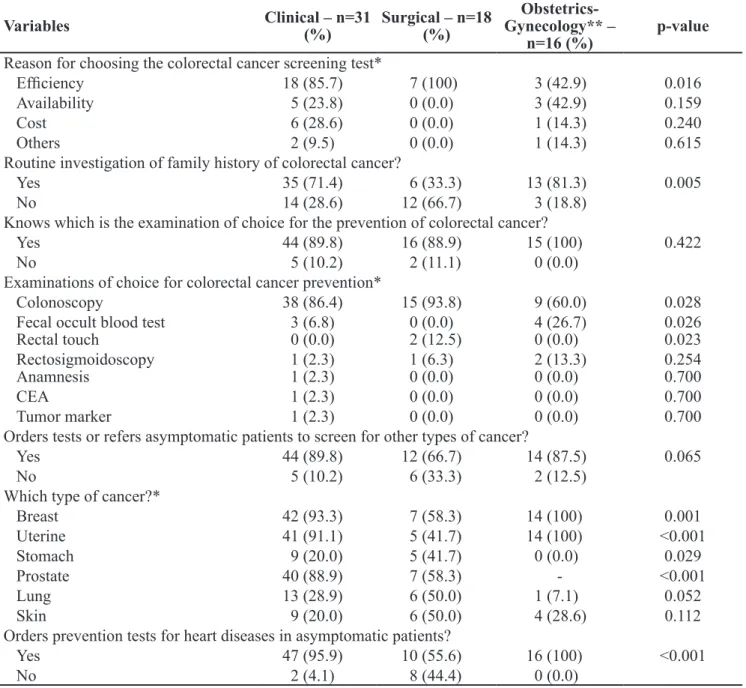
It was observed that doctors who performed CRC screening were the ones who mostly responded having knowledge concerning screening (p=0.043), and also the ones who mostly stated investigating family histo-ry of this cancer (p=0.002) in relation to other doctors. It was also found that 98.5% of the doctors with knowledge concerning CRC declared to know the ex-amination of choice for screening, while amongst the ones who claimed not having this knowledge, only 62.5% reported knowing which was the examination of choice to prevent this cancer (p<0.001).
All variables were analyzed according to the specialties, and those which presented a statistically
signiicant difference are shown in Table 4. Surgical
experts, when compared to the others, are the ones who least analyze family history of CRC (p=0.005).
Obstetrician-gynecologists pointed the eficiency as
a reason to choose the screening test with less fre-quency (p=0.016). Besides, they mentioned more
Table 1. Characterization of doctors who answered the questionnaire of the study as to year and university of graduation, specialty, work place (university hospital or basic health unit), place of medical care (outpatient clinic or admission) and income source of medical care, in Canoas, RS, 2012.
Variables n=83 (%)
Work place
University hospital 63 (75.9)
Basic health unit 20 (24.1)
Graduation university
Private 43 (51.8)
Public 40 (48.2)
Time of graduation conclusion (years) – median (P25–P75)
9 (3–20.0)
<5 25 (30.1)
5–10 18 (21.7)
10-15 11 (13.3)
>15 29 (34.9)
Specialty
Clinical 49 (59.0)
Surgical 18 (21.7)
Obstetrics-Gynecology 16 (19.3)
Connection with medical school institution
Yes 60 (72.3)
No 23 (27.7)
Place of medical care
Only outpatient clinic 23 (27.7)
Only admission 2 (2.4)
Both 58 (69.9)
Income source of medical care
Only the Uniied Health System 25 (30.1)
Only private 2 (2.4)
Table 2. Medical knowledge and practice at the university hospital and the basic health unit concerning colorectal cancer screening in Canoas, RS, 2012.
CRC: colorectal cancer; CEA: carcinoembryonic antigen; *multiple choice question; **basic health units; ***one subject who did not answer this question (1.2%); p-value: Fisher’ test.
Variables Total sample –
n=83 (%)
University hospital – n=63 (%)
Basic health
unit** – n=20 (%) p-value
Is aware of CRC screening? 0.339
Yes 66 (79.5) 52 (82.5) 14 (70.0)
No 17 (20.5) 11 (17.5) 6 (30.0)
Orders any colorectal cancer screening test for patients without bowel complaints?
Yes 35 (42.2) 27 (42.9) 8 (40.0) 1.000
No 48 (57.8) 36 (57.1) 12 (60.0)
If so, in which situation?*
According to age 31 (88.6) 24 (88.9) 7 (87.5) 1.000
Does not order according to age 4 (11.4) 3 (11.1) 1 (12.5) 1.000
Aged > 40 years old 5 (16.1) 3 (12.5) 2 (28.6) 0.562
Aged > 50 years old 21 (67.7) 18 (75.0) 3 (42.9) 0.172
Aged > 60 years old 5 (16.1) 3 (12.5) 2 (28.6) 0.562
According to family history of colorectal cancer
33 (94.3) 25 (92.6) 8 (100) 1.000
Routine for all 3 (8.6) 3 (11.1) 0 (0.0) 1.000
According to associated pathologies 14 (40.0) 9 (33.3) 5 (62.5) 0.221
Ordered examinations*
Fecal occult blood test 13 (37.1) 10 (37.0) 3 (37.5) 1.000
Performs rectal touch 2 (5.7) 2 (7.4) 0 (0.0) 1.000
Rectosigmoidoscopy 1 (2.9) 1 (3.7) 0 (0.0) 1.000
Colonoscopy 29 (82.9) 23 (85.2) 6 (75.0) 0.602
Opaque enema 1 (2.9) 0 (0.0) 1 (12.5) 0.229
Refers to specialist 10 (28.6) 8 (29.6) 2 (25.0) 1.000
Reasons for choosing screening test for colorectal cancer*
Eficiency 28 (80.0) 21 (77.8) 7 (87.5) 1.000
Availability 8 (22.9) 6 (22.2) 2 (25.0) 1.000
Cost 7 (20.0) 5 (18.5) 2 (25.0) 0.648
Others 3 (8.6) 3 (11.1) 0 (0.0) 1.000
Routine investigation of family history of colorectal cancer?
Yes 54 (65.1) 40 (63.5) 14 (70.0) 0.793
No 29 (34.9) 23 (36.5) 6 (30.0)
Knows which is the examination of choice for the prevention of colorectal cancer?***
Yes 75 (91.5) 57 (91.9) 18 (90.0) 1.000
No 7 (8.5) 5 (8.1) 2 (10.0)
If so, what is the examination?*
Colonoscopy 62 (82.7) 48 (84.2) 14 (77.8) 0.499
Fecal occult blood test Rectal touch
7 (9.3) 2 (2.7)
3 (5.3) 2 (3.5)
4 (22.2) 0 (0.0)
0.053 1.000 Rectosigmoidoscopy
Anamnesis
4 (5.3) 1 (1.3)
4 (7.0) 0 (0.0)
0 (0.0) 1 (5.6)
0.567 0.240
CEA 1 (1.3) 1 (1.8) 0 (0.0) 1.000
times the fecal occult blood test as the method of choice for the secondary prevention of CRC, to the detriment of colonoscopy.
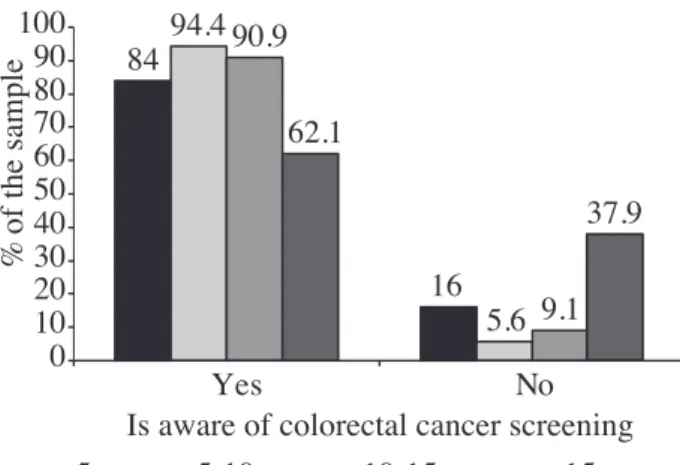
An association between knowledge concerning CRC declared by the professional and time of grad-uation was found (p=0.028). Doctors who had been graduated for more than 15 years were the ones who mostly declared not knowing about CRC screening, as presented in Figure 1. They also investigated uterine cancer less frequently when compared to other doctors, who had been graduated for a fewer years (p=0.048).
Doctors graduated more recently (less than
ive years) were the ones who mostly stated order -ing screen-ing tests for prostate cancer (95.2%), when
compared to those who have been graduated from ive
to ten years (55.6%), from 10 to 15 years (66.7%) and more than 15 years (56.5%), with p=0.019.
Concerning work location, it was observed that doctors from basic health units declared ordering more examinations to prevent uterine and prostate cancer than the doctors in the university hospital (p=0.030;
p=0.011). However, no signiicant differences were
found between these work places and CRC screening.
This study did not ind statistically signiicant
differences between the knowledge and practice of
doctors concerning CRC screening and prevention, university of graduation, professional connections with the medical school institution, work place (out-patient clinic, admission) and the income source of medical care (SUS, private health insurance).
DISCUSSION
Despite presenting high incidence and mortality rates, colonic and rectal cancer can really be prevented by means of screening tests, which are able to detect and remove pre-malignant lesions1,6. However, this
form of prevention is conditioned to a proper medi-cal knowledge and application of the recommended screening examinations.
Out of the doctors who participated in this study, only 42% stated ordering CRC screening and preven-tion tests. This result corresponds approximately to the double of the data found in 2004 by Tucundava et al., who analyzed doctors in a medical school of São Paulo (20.30%)15. However, it is a much lower result than that found in the United States, which has an ef-fective CRC vigilance and screening system. There, Klabunde et al. found that only 2% of primary care doctors do not order prevention examinations for this type of cancer18.
Table 3. Attitude of the doctors who work in the university hospital and in basic health units as to screening for other types of cancer and heart disease in Canoas, RS, 2012.
*multiple choice question; **basic health units; p-value: Fisher’s test.
Variables Total sample –
n=83 (%)
University hospital – n=63 (%)
Basic health
unit** – n=20 (%) p-value
Orders tests or refers asymptomatic patients to screen for other types of cancer?
Yes 70 (84.3) 51 (81.0) 19 (95.0) 0.173
No 13 (15.7) 12 (19.0) 1 (5.0)
What type of cancer?*
Breast 63 (88.7) 44 (84.6) 19 (100) 0.099
Uterine 60 (84.5) 41 (78.8) 19 (100) 0.030
Stomach 14 (19.7) 11 (21.2) 3 (15.8) 0.745
Prostate 49 (69.0) 31 (59.6) 18 (94.7) 0.011
Lung 20 (28.2) 15 (28.8) 5 (26.3) 1.000
Skin 19 (26.8) 14 (26.9) 5 (26.3) 1.000
Orders prevention tests for heart diseases in asymptomatic patients?
Yes 73 (88.0) 53 (84.1) 20 (100) 0.108
Table 4. Medical knowledge and practice concerning colorectal cancer according to specialty in Canoas, RS, 2012.
CEA: carcinoembryonic antigen; *multiple choice question; **obstetricians-gynecologists; statistical analysis for prostate cancer was performed only amongst clinical and surgical specialties
Variables Clinical – n=31
(%)
Surgical – n=18 (%)
Obstetrics-Gynecology** –
n=16 (%)
p-value
Reason for choosing the colorectal cancer screening test*
Eficiency 18 (85.7) 7 (100) 3 (42.9) 0.016
Availability 5 (23.8) 0 (0.0) 3 (42.9) 0.159
Cost 6 (28.6) 0 (0.0) 1 (14.3) 0.240
Others 2 (9.5) 0 (0.0) 1 (14.3) 0.615
Routine investigation of family history of colorectal cancer?
Yes 35 (71.4) 6 (33.3) 13 (81.3) 0.005
No 14 (28.6) 12 (66.7) 3 (18.8)
Knows which is the examination of choice for the prevention of colorectal cancer?
Yes 44 (89.8) 16 (88.9) 15 (100) 0.422
No 5 (10.2) 2 (11.1) 0 (0.0)
Examinations of choice for colorectal cancer prevention*
Colonoscopy 38 (86.4) 15 (93.8) 9 (60.0) 0.028
Fecal occult blood test Rectal touch
3 (6.8) 0 (0.0)
0 (0.0) 2 (12.5)
4 (26.7) 0 (0.0)
0.026 0.023 Rectosigmoidoscopy
Anamnesis
1 (2.3) 1 (2.3)
1 (6.3) 0 (0.0)
2 (13.3) 0 (0.0)
0.254 0.700
CEA 1 (2.3) 0 (0.0) 0 (0.0) 0.700
Tumor marker 1 (2.3) 0 (0.0) 0 (0.0) 0.700
Orders tests or refers asymptomatic patients to screen for other types of cancer?
Yes 44 (89.8) 12 (66.7) 14 (87.5) 0.065
No 5 (10.2) 6 (33.3) 2 (12.5)
Which type of cancer?*
Breast 42 (93.3) 7 (58.3) 14 (100) 0.001
Uterine 41 (91.1) 5 (41.7) 14 (100) <0.001
Stomach 9 (20.0) 5 (41.7) 0 (0.0) 0.029
Prostate 40 (88.9) 7 (58.3) - <0.001
Lung 13 (28.9) 6 (50.0) 1 (7.1) 0.052
Skin 9 (20.0) 6 (50.0) 4 (28.6) 0.112
Orders prevention tests for heart diseases in asymptomatic patients?
Yes 47 (95.9) 10 (55.6) 16 (100) <0.001
No 2 (4.1) 8 (44.4) 0 (0.0)
The age to start CRC screening ranges, espe-cially at the presence of family history for such dis-ease (Chart 1)17. However, when this peculiarity is not
present, it is common sense among the organizations involved in CRC prevention and control that everyone should start screening at the age of 50, period when its increased incidence is observed9,19,20. In this study,
among the 35 doctors who stated ordering CRC
pre-vention tests, 40% of them do not request it for pa-tients aged 50 years old or more. This information points to the low level of knowledge of the doctors as to the CRC screening indications recommended by the
guidelines, and it also conirms the data from a
Generally, CRC screening tests can be divided into two categories. One of them is composed by stool tests, which are more adequate to detect can-cer, once the pre-malignant lesions, especially small polyps, tend not to bleed, and the larger ones can present intermittent bleeding or simply not be de-tectable in a stool sample. The other category is rep-resented by endoscopic examinations, especially colonoscopy, which reaches the double objective of detecting adenocarcinoma and adenomatous polyps, thus enabling the treatment of these lesions and, con-sequently, CRC prevention20.
Since the primary objective of CRC screening is preention, tests that are able to detect both cancer in early stages and pre-malignant lesions should be indi-cated20. Among the doctors who stated ordering CRC
prevention tests in this study, 82.9% indicated colonos-copy as an alternative for screening. However, with the analysis of which ones among them indicate this test exclusively as a prevention method, the frequency de-creased to 40%. This information differs from the result found in the United States, where 95% of the doctors order colonoscopy for CRC prevention21.
From all the doctors who answered the question-naire, only 65% stated investigating family history of CRC in patients without bowel complaints, and an even lower frequency was found among surgeons and doctors who declared not performing screening for
this cancer. These results show the deicient investiga
-tion of this factor, once irst degree relatives of people
with CRC have twice or three times the chance to de-velop this type of cancer in comparison with the Con-trol Group. Therefore, a positive family history deter-mines age anticipation to start screening7,17,19,22.
More than 90% of the doctors participating in this study said they knew which the examination of choice for CRC prevention was, mentioning colo-noscopy80% of the time. This result is similar to that found by Klabunde et al. with doctors in the United
States, who also see colonoscopy as the most efi -cient screening method18. Even though there are no
randomized prospective clinical trials analyzing colonoscopy as a method to reduce the incidence and/or mortality by CRC, it is based on indirect but substantial evidence, which recognizes colonoscopy
as the most eficient prevention method. The advan -tages of colonoscopy include the complete colon and rectum examination, the possibility to diagnose pre-malignant lesions (main objective of CRC screen-ing), the performance of biopsy, as well as the re-moval of adenomas, being the only test that is able to reduce the incidence of this cancer in 66 to 90% of the cases20,23.
In most studies, the coverage rates concern-ing CRC screenconcern-ing are low, usually much lower than those related to other cancer prevention programs7,15.
This data was conirmed in this study. While only 42%
of all the participating doctors stated conducting CRC screening, which is similar to the double, 84% report-ed ordering tests or referring asymptomatic patients to screen for other types of cancer.
Breast and uterine cancers are the ones doctors
mostly screen for, which conirms the results of an -other study from São Paulo, which found these two cancers as being the ones doctors are more concerned about preventing15.
Proportionally to the screening for other cancers, more than the double of doctors participating in the research declared ordering prevention tests for heart diseases in asymptomatic patients. These results are in accordance with the analysis of mortality rates by chronic diseases in Brazil, which point to a 31% re-duction in mortality by heart disease between 1996 and 2007, and an increased mortality rate by CRC, both for men and women24.
Figure 1. Association between colorectal cancer screening
declared by the doctors and time of graduation conclusion, Canoas, RS, 2012.
84
16 94.4
5.6 90.9
9.1 62.1
37.9
0 10 20 30 40 50 60 70 80 90 100
Yes No
Is aware of colorectal cancer screening
%
of t
he
s
am
pl
e
Nowadays, CRC affects women more than gy-necological cancers. Epidemiological studies demon-strated the increased risk of colonic and rectal cancer from 1.5 to 3.0 times in women who have previously had primary malignant neoplasm of endometrium or ovary25. This information points to the need for even
more attention from gynecologists to CRC preven-tion. The American College of Obstetricians and Gy-necologists (ACOG) published, in the beginning of 2011, a report encouraging doctors in this specialty to order screening and prevention CRC tests for women aged more than 50 years old, or earlier, according to the risk. This report also recommends colonos-copy as the method of choice for prevention26.
De-spite that, out of the 16 doctors with this specialty who answered the questionnaire in this study, 56% stated not ordering screening tests for CRC. Besides, when compared to other specialties, they were the ones who most indicated the fecal occult blood test to the detriment of colonoscopy as the examination of choice to prevent such cancer.
In this study, the association between time of grad-uation and knowledge concerning CRC declared by the Professional stood out. Doctors graduated for more than 15 years were the ones who mostly declared not knowing about CRC screening (Figure 1). This can be
related to the fact that guidelines and screening meth-ods have been improved in the past decade, when these
doctors had already inished their basic graduation.
The methodological limitations of this study should be mentioned. As demonstrated in previous studies, there is a gap between what the doctors report doing and what he or she actually does27. However, in
Brazil there are no studies that assess knowledge and
practice of the doctors speciically as to CRC screen
-ing and prevention. Besides, the found results conirm the indings in other studies, suggesting that the infor -mation presented is valid and interpretable.
CONCLUSION
A small number of doctors participating in this study adopt CRC screening and prevention methods. Besides, they demonstrated low level of knowledge concerning the recommendations in the guidelines for the prevention of this cancer, especially as to the age to start screening.
The results in this study point to the need to in-vest in professional formation and training of the
med-ical class, emphasizing the importance and the efi -cacy of secondary prevention to control the incidence and mortality by this cancer.
REFERENCES
1. Jemal A, Bray F, Center M, Ferlay J, Ward E, Forman D. Global Cancer Statistics. CA Cancer J Clin [homepage on the Internet]. 2011 Dec [cited 2011 Nov 28]; 61:69-90. Available from: http://onlinelibrary.wiley.com/doi/10.3322/ caac.20107/pdf
2. Instituto Nacional de Câncer [homepage on the Internet]. Estimativa 2010. Incidência do câncer colorretal no Brasil. [cited 2011 Oct 13]. Available from: http://www2.inca.gov. br/wps/wcm/connect/tiposdecancer/site/home/colorretal/
deinicao
3. Instituto Nacional de Câncer [homepage on the Internet]. Estimativa 2012- Incidência do câncer no Brasil. [cited 2011 Dec 02]. Available from: http://www.inca.gov.br/ estimativa/2012/index.asp?ID=5
4. Bond J. Clinical evidence for the adenoma-carcinoma sequence, and the management of patients with colorectal adenomas. Semin Gastrointest Dis 2000;11(4):176-84. 5. Leslie A, Carey FA, Pratt NR, Steele RJ. The colorectal
adenoma-carcinoma sequence. Br J Surg 2002;89(7):845-60.
6. Lux G, Stabenow-Lohbauer U. Cancer prevention with the endoscope. Search not only for polyps. MMW Fortschr Med 2002;144(51-52):29-33.
7. Secretaria de Estado da Saúde. Grupo Técnico de Avaliação e Informações de Saúde. A relevância do câncer colorretal. BEPA, Bol Epidemiol Paul [periódico na Internet]. 2009 Nov [cited 2011 Nov 12];6(68):01-14. Available from: http://periodicos.ses.sp.bvs.br/scielo.php?script=sci_ arttext&pid=S1806-42722009000800006&lng=pt
8. Edwards BK, Ward E, Kohler BA, Eheman C, Zauber AG, Anderson RN, et al. Annual report to the nation on the status of cancer 1975–2006, featuring colorectal cancer trends and impact of interventions (risk factors, screening, and treatment) to reduce future rates. Cancer 2010;116(3):544-573. 9. Burt RW. Colorectal cancer screening. Curr Opin
Gastroenterol 2010;26(5):466-70.
10. Wehrmann K, Frühmorgen P. Removing adenomas reduces colon carcinoma risk up to 90%. MMW Fortschr Med 2000;142(8):26-9. 11. O’Connell JB, Maggard MA, Ko CY. Colon cancer survival
12. Vasconcelos TA. Pólipos e Cancro do Cólon e Recto. Arq Med 2009;23(6):209-16.
13. Richardson LC, Tai E, Rim SH, Joseph D, Plescia M. Vital Signs: Colorectal Cancer Screening, Incidence, and Mortality. United States, 2002—2010. Centers for Disease Control and Prevention (CDC). MMWR Morb Mortal Wkly Rep 2011;60(26):884-9.
14. Departamento de Informático do SUS [homepage on the Internet]. Taxas de mortalidade por câncer no Brasil [cited 2011 Oct 15]. Available from: http://www.datasus.gov.br 15. Tucunduva LTCM, Sá VHLC, Koshimura ET, Prudente
FVB, Santos ESTS, Samano EST, et al. Estudo da atitude e do conhecimento dos médicos não oncologistas em relação às medidas de prevenção e rastreamento do câncer. Rev Assoc Med Bras 2004;50(3):257-62.
16. Sarfaty M, Wender R. How to increase colorectal cancer screening rates in practice. CA Cancer J Clin 2007;57(6):354-66.
17. Read E, Thomas F, Caushaj P. Screening for Colorectal Neoplasms. In: American Cancer Society. Cancer Facts and Figures 2004. Atlanta, GA: American Cancer Society; 2004. p. 353-8.
18. Klabunde CN, Frame PS, Meadow A, Jones E, Nadel M, Vernon SW. A national survey of primary care physicians’ colorectal cancer screening recommendations and practices. Am J Prev Med 2003;36(3):352-62.
19. Sociedade Brasileira de Endoscopia Digestiva [homepage on the Internet]. Rastreamento e Vigilância do Câncer Colo-retal. Prevenção secundária e detecção precoce. Projeto Diretrizes. SOBED. 2008. [cited 2011 Nov 15]. Available from: http://www.sobed.org.br/web/arquivos_antigos/pdf/ diretrizes/Screening.pdf
20. Levin B, Lieberman DA, McFarland B, Andrews KS, Brooks D, Bond J, et al. Screening and Surveillance for the Early Detection of Colorectal Cancer and Adenomatous Polyps, 2008: A Joint Guideline From the American Cancer Society, the US Multi-Society Task Force on Colorectal Cancer, and the American College of Radiology. Gastroenterology 2008;134(5):1570-95.
21. Klabunde CN, Lanier D, Nadel MR, McLeod C, Yuan G, Vernon SW. Colorectal Cancer Screening by Primary Care Physicians Recommendations and Practices, 2006–2007. Am J Prev Med 2009;37(1):8-16.
22. World Gastroenterology Organization/International Digestive Cancer [homepage on the Internet]. Alliance Practice Guidelines: triagem do câncer colorretal. 2007. [cited 2011 Nov 15]. Available from: http://www.worldgastroenterology. org/assets/downloads/pt/pdf/guidelines/06_colorectal_ cancer_screening_pt.pdf
23. Sonnenberg A, Delco F, Inadomi JM [hompage on the Internet]. Cost-Effectiveness of Colonoscopy in Screening for Colorectal Cancer. 2000; [cited 2011 Nov 15]; 133;8:573-84. Available from: http://www.annals.org/content/133/8/573.sh ort?relatedurls=yes&legid=annintmed;133/8/573
24. Schmid MI, Duncan BD, Silva GA, Menezes AM, Monteiro CA, Barreto SM, et al. Doenças crônicas não
transmissíveis no Brasil: carga e desaios atuais. Séries.
Saúde no Brasil 4 [série na Internet]. 2011 [cited 2011 Nov 13];6736(11):60135-9. Available from: http://download.
thelancet.com/latcontentassets/pdfs/brazil/brazilpor4.pdf
25. Mahayri N, Moreira DCF. A importância dos registros
de câncer de base populacional para identiicar casos de
câncer ginecológico relacionados com câncer colorretal em população de risco. Rev Bras Cancerologia [série na Internet] 2002 [cited 2011 Nov 25];48(3):349-56. Available from: http://www.inca.gov.br/rbc/n_48/v03/pdf/ artigo3.pdf
26. American College of Obstetricians and Gynecologists. Committee Opinion No. 482: Colonoscopy and colorectal cancer screening strategies. Obstetrics & Gynecology [série na internet]. 2011 [cited 2011 Nov 30];117(3):766-71. Available from: http://www.mendeley.com/research/ committee
27. Ganry O, Boche T. Prévention des cancers par les médecins généralistes de Picardie : résultats d’une enquête de type déclarative. Bulletin du Câncer [série na Internet]. 2004 [cited 2011 Nov 13];91(10):785-91. Available from: http:// www.jle.com/fr/revues/medecine/bdc/e-docs/00/04/09/59/ article.phtml
Correspondence to: