Cervical cancer screening
coverage in a high-incidence
region
Cobertura do rastreamento do
câncer de colo de útero em região
de alta incidência
I Programa de Pós-Graduação em Ciências
da Saúde. Universidade Federal de Roraima. Boa Vista, RR, Brasil
II Faculdade de Medicina. Universidade
Federal de Roraima. Boa Vista, RR, Brasil Correspondence:
Cibelli Navarro
Av. Brigadeiro Eduardo Gomes, 3308 bloco C Aeroporto
69310-005 Boa Vista, RR, Brasil E-mail: [email protected] Received: 5/3/2014
Approved: 10/27/2014
Article avaiable from: www.scielo.br/rsp
ABSTRACT
OBJECTIVE: To analyze the coverage of a cervical cancer screening program in a city with a high incidence of the disease in addition to the factors associated with non-adherence to the current preventive program.
METHODS: A cross-sectional study based on household surveys was conducted. The sample was composed of women between 25 and 59 years of age of the city of Boa Vista, RR, Northern Brazil who were covered by the cervical cancer screening program. The cluster sampling method was used. The dependent variable was participation in a women’s health program, deined as undergoing at least one Pap smear in the 36 months prior to the interview; the explanatory variables were extracted from individual data. A generalized linear model was used.
RESULTS: 603 women were analyzed, with an mean age of 38.2 years (SD = 10.2). Five hundred and seventeen women underwent the screening test, and the prevalence of adherence in the last three years was up to 85.7% (95%CI 82.5;88.5). A high per capita household income and recent medical consultation were associated with the lower rate of not being tested in multivariate analysis. Disease ignorance, causes, and prevention methods were correlated with chances of non-adherence to the screening system; 20.0% of the women were reported to have undergone opportunistic and non-routine screening.
CONCLUSIONS: The informed level of coverage is high, exceeding the level recommended for the control of cervical cancer. The preventive program appears to be opportunistic in nature, particularly for the most vulnerable women (with low income and little information on the disease). Studies on the diagnostic quality of cervicovaginal cytology and therapeutic schedules for positive cases are necessary for understanding the barriers to the control of cervical cancer.
DESCRIPTORS: Uterine Cervical Neoplasms, prevention & control. Cervix Neoplasms Prevention. Papanicolaou Test. Health Services Coverage. Mass Screening.
Cibelli NavarroI
Allex Jardim da FonsecaI
Alexander SibajevI
Camila Iasmim de Andrade SouzaII
Daniela Souza AraújoII
Daniele Aparecida de Freitas TelesII
Stéphanie Gomes Lins de CarvalhoII
Kyldery Wendell Moura CavalcanteII
Although cervical cancer (CC) is a neoplasm with great potential for prevention, it is still an important public health problem in Brazil, leading to the highest number of deaths in young women (15-44 years old).a
Until 2013, the Ministry of Health’s efforts to control CC were exclusively focused on using the vaginal smear (Pap smear) for screening the sexually active female population (25-64 years).b Nearly 16,000 new
cases of CC have been estimated in Brazil in 2014 (15.3/100,000).c
RESUMO
OBJETIVO: Analisar a cobertura do programa de rastreamento do câncer do colo uterino em município com alta incidência da doença e os fatores relacionados à não adesão ao programa preventivo vigente.
MÉTODOS: Foi realizado estudo transversal, com base em inquérito domiciliar. A amostra foi composta por mulheres entre 25 e 59 anos de idade do município de Boa vista, RR, Brasil, com cobertura pelo programa de rastreamento do câncer do colo uterino. Foi utilizado o método de amostragem por conglomerado. A variável dependente foi a adesão ao programa de saúde da mulher, deinida como a realização de pelo menos um teste de Papanicolaou nos 36 meses anteriores à data da entrevista; as variáveis explicativas foram extraídas a partir de informações individuais. Foi utilizado modelo linear generalizado. RESULTADOS: Foram analisadas 603 mulheres, com idade média de 38,2 anos (DP = 10,2). Quinhentas e dezessete mulheres realizaram o exame, sendo a prevalência de realização, nos últimos três anos, de 85,7% (IC95% 82,5;88,5). Renda familiar per capita elevada e consulta médica recente associaram-se à menor taxa de não realização do exame na análise multivariada. O desconhecimento da doença, das causas e dos meios de prevenção correlacionou-se com a chance de não adesão ao rastreamento. Vinte por cento das mulheres relataram realização do exame em caráter oportunístico, e não rotineiro.
CONCLUSÕES: A cobertura informada é elevada, acima do recomendado para controle do câncer do colo uterino. O programa preventivo apresenta caráter oportunístico, sobretudo para as mulheres mais vulneráveis (com baixa renda e pouca informação sobre a doença). Estudos sobre a qualidade diagnóstica da citologia cervicovaginal e dos itinerários terapêuticos dos casos positivos são necessários para compreensão das barreiras para o controle do câncer do colo uterino.
DESCRITORES: Neoplasias do Colo do Útero, prevenção & controle. Prevenção de Câncer de Colo Uterino. Teste de Papanicolaou. Cobertura de Serviços de Saúde. Programas de Rastreamento.
INTRODUCTION
In Northern Brazil, CC is an even bigger problem. The National Cancer Institute estimates an incidence of 26.6/100,000 in 2014 for the city of Boa Vista, RR, Northern Brazil, which has remained stable in recent years. However, a population-based study conducted in the state in 20107 revealed a higher cervical cancer
incidence than oficial estimates (46/100,000).
Several factors, such as the cultural characteristics of the native people, geographic isolation, limitations of
a World Health Organization. ICO Information Centre on HPV and Cervical Cancer (HPV Information Centre). Summary report on HPV and
cervical cancer statistics in Brazil. Geneva; 2014 [cited 2014 Jan 1]. Available from: http://www.hpvcentre.net
b Ministério da Saúde. Instituto Nacional de Câncer. Coordenação Geral de Ações Estratégicas. Divisão de Apoio à Rede de Atenção
Oncológica. Diretrizes brasileiras para o rastreamento do câncer do colo de útero. Brasília (DF); 2014 [cited 2014 Jan 1]. Available from: http://www1.inca.gov.br/inca/Arquivos/PROGRAMA_UTERO_internet.PDF
c Ministério da Saúde. Incidência de Câncer no Brasil: estimativa 2014. Brasília (DF); 2014 [cited 2014 Jan 1]. Available from: http://www.
the Pap smear test, failures in the follow-up of pre-malignant lesions, and adoption of improper conduct, may contribute toward explaining the partial success of screening programs in Northern Brazil.8,12 The popu-lation coverage of the preventive strategy is a crucial factor in this process. In Brazil, aspects associated with availability and access to the health systems have been widely studied and identiied as a limitation in control -ling CC in several regions.1,6
Regions with a high incidence of CC usually present predominantly opportunistic screening programs (contrary to systematic and organized programs) that provide limited coverage, generate multiple tests for the same individual, and tend to neglect the women who would beneit the most from the screening test.11
An awareness of the scope of preventive programs and factors associated with poor adherence to the proposed model can help in drafting public policies that are more eficient and better aligned with the status of each region.
The objective of this study was to analyze the coverage of a cervical cancer screening program in a city with a high incidence of the disease as well as the factors associated with non-adherence to the current preventive program.
METHODS
This cross-sectional study using household surveys was conducted in Boa Vista, Roraima, a city with a population of 285,000 inhabitants located in Legal Amazonia in Northern Brazil. Approximately 65.0% of the state’s population is concentrated in Boa Vista,d
and the Family Health Strategy covers 75.0% of its population. The target population of the study included women aged 25-59 years living in the city for at least three years. Although the Ministry of Health has recently extended the age range of the target population to 64, the cut-off of 59 years was used as this study is retroactive to the period when the previous limit was applicable. Considering the estimated prevalence of 80.0% coverage for CC screening based on a national surveyb conducted in 2008 by the Brazilian Institute for
Geography and Statistics (IBGE) and assuming normal distribution for 95% conidence interval (95%CI) and an acceptable error of 5%, a minimum sample size of 550 participants was obtained, assuming a 10.0% loss. To evaluate the risk factors, the sample size has a 90.0% power for detecting an adjusted odds ratio of > 1.5 with a 95%CI, assuming a rejection rate of 10.0%.
The random cluster sampling method was used. The neighborhoods in Boa Vista’s urban area comprise 4,902 blocks. These were numbered and selected by a random number generator software. The selected blocks
d Instituto Brasileiro de Geografia e Estatística. Censo 2010. Brasília (DF); 2010 [cited 2014 Jan 1]. Available from: http://www.ibge.gov.br/
english/estatistica/populacao/censo2010/caracteristicas_da_populacao/resultados_do_universo.pdf
were adjusted (weighted) for the population in each macro area of the municipality. On weekends between June and August 2013, the researchers visited the blocks in the order of random selection to investigate the target samples. All the women living in the selected block were approached in their homes and invited to partic-ipate. Of these, 208 women were excluded for being present but not residing in their homes, not fulilling the age criteria, having resided in another municipality in the last three years, or refusing to participate in the study. A previously tested form was used in a 30-min personal interview at the interviewee’s residence, pref-erably in the absence of any co-residents.
The primary outcome assessed was participation in a women’s health program, deined as undergoing at least one Pap smear test in the 36 months prior to the interview, regardless of the outcome and location of the test. Data collected were sociodemographic data, educational level (primary education being the cut-off), awareness of human papilloma virus and CC, personal and family clinical data, health worker visit, history of medical visits, and personal reasons for not being tested.
After the survey, 10.0% of the forms from each inter -viewer were randomly selected for quality control. These selected women were reinterviewed on telephone regarding what were considered to be “key” questions. The answers to these questions were compared with those obtained in the irst phase. No questionnaires were discarded.
This study was approved by the Ethics Committee of
Universidade Federal de Roraima (Process 111.007 –
CEP/UFRR). All study participants signed the informed consent form.
RESULTS
Of the 603 study participants (mean age), 54.8% were married or in a stable relationship. Almost half (46.0%) had completed high school, with only 1.6% being illiterate (1.6%) and 28.6% having complete or incomplete higher education (Table 1). Furthermore, 517 had undergone a screening test in the last three years, with an adjusted prevalence of adherence of 85.6% (95%CI 82.5;88.5), and 443 had been tested in the last year, with a prevalence of 72.8% (95%CI 68.6;77.0). The highest prevalence of adherence (90.0%) was observed in the 20-34-year age group, and the lowest in the 50-54-year age group (76.0%) (Figure 1). Periodic routine was the main reported reason for undergoing the preventive screening (n = 411; 79.5%). Other reasons provided by 20.5% of the women included pregnancies, gyne -cological complaints, and visits to the clinic for other reasons. Table 2 describes the characteristics of the women who did not adhere to the preventive screening.
Among the 86 volunteers who had never undergone the screening test, 75.6% did not explain not getting tested, 10.5% reported shame or fear, 5.8% stated they did not think it was necessary, 2.4% reported dificulty scheduling an appointment or inding time for it, and 2.4% reported other personal reasons. The lack of time, interest, and medical recommendation were the reasons reported by three other women (1.1% each).
The prevalence of adherence to the preventive program was similar among women under 35 years of age and older than 35 years (12.0% versus 16.0%, respectively).
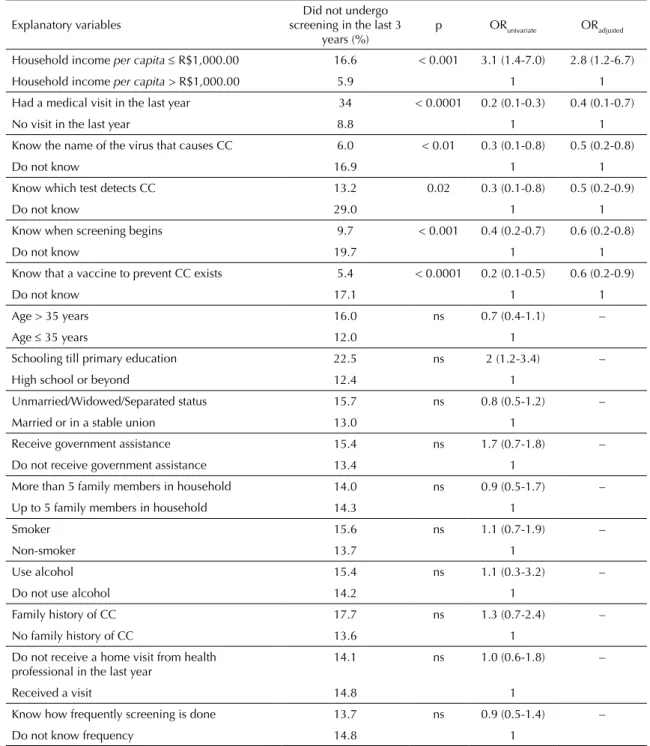
The marital status and educational level did not change the rate of non-adherence to the screening. Table 3 shows indi -vidual variables and variables of awareness of the disease with non-adherence to the program for preventing CC. Two individual variables were shown to inluence the frequency of non-adherence to the screening in univariate analysis, and these were re-evalu-ated in multivariate analysis, namely (i) medical visit in the last year compared with women without medical visit (8.8% versus 34.6%; p < 0.0001) and
(ii) household income per capita of > R$1,000.00
in association with household income per capita
of < R$1,000.000 (5.9% versus 16.6%; p < 0.001).
Of these, medical visits in the previous year had the greatest inluence on the outcome, reducing the chance of non-adherence by approximately 60.0% (ORa = 0.4, 95%CI 0.1;0.7). Of the ive variables
regarding disease awareness and prevention, four
Table 1. Socioeconomic data, knowledge about the disease and lifestyle in women aged 25-59 years. Boa Vista, RR, Northern Brazil, 2013.(N = 603)
Personal and demographic data n % Conjugal status
Married/Stable union 330 54.8
Single 212 35.3
Widowed/Separated 60 9.9 Education
Illiterate 10 1.6 Primary education 144 23.8 High school 277 46.0 Higher education 136 22.6 Postgraduate education 36 6.0 Have a health plan or health insurance
Yes 85 14.1
No 509 84.4
No response 9 1.5 Family income per capita
≤ R$1,000.00 464 77.0 > R$1,000.00 119 19.7 No response 20 3.3 Receive government financial assistance
Yes 260 43.1
No 343 56.9
Number of inhabitants in the household
> 5 people 114 18.9
≤ 5 people 489 81.1 Smoking
Yes 166 27.5
No 437 72.5
Regular use of alcohol
Yes 26 4.3
No 577 95.7
Family history of cervical cancer
Yes 96 15.9
No 507 84.1
Medical visit in the last year
Yes 476 79.0
No 127 21.0
Received home visit from health professionals during the study period
Yes 155 25.7
No 447 74.3
Know that cervical cancer is caused by a virus
Yes 100 16.6
No 503 83.4
Know what virus causes cervical cancer
Yes 100 16.6
No 503 83.4
Know what test detects cervical cancer
Yes 565 93.7
No 38 6.3
Know when screening begins
Yes 329 54.6
No 274 45.4
Know how frequently screening is done
Yes 313 51.9
inluenced the outcome. Being aware of the caus -ative virus reduced the prevalence of non-adherence by 10 percentage points compared to the rate among women who were unaware (6.0% versus 16.9%,
respectively; ORa = 0.5; 95%CI 0.2;0.8). Information of the test that detects CC led to a lower prevalence of non-adherence (13.2% versus 29.0%, respectively;
ORa = 0.5; 95%CI 0.2;0.9). The other assessed vari
-ables were not statistically signiicant.
DISCUSSION
The prevalence of the coverage of the preventive screening in Boa Vista was 85.6%. Two variables were associated with non-adherence to screening: per capita
income exceeding R$1,000.00 and having received medical consultation in the last year.
This study assessed the coverage of a preventive program based on Pap smear testing in the city of Boa Vista, Roraima, Northern Brazil as a function of the high incidence rate of CC in this location, according to a recent population-based study.7 In 2008, IBGE released the results of the Pesquisa Nacional por Amostra de Domicílios (PNAD – National Household
Sample Survey)e referring to the access to and use
of health services, among other data. In this survey, 72.7% of the female residents of Roraima aged 25-60 years claimed to have undergone the screening test, while this number was 76.9% for the Northern region and 78.4% for the country as a whole. Data from the 2012 Sistema de Vigilância de Fatores de Risco
e Proteção para Doenças Crônicas por Inquérito Telefônico (VIGITEL – Chronic Disease Risk Factor
Monitoring and Protection System Telephone Survey)f
conducted by the Ministry of Health has revealed that 79.6% of women in Roraima stated undergoing screening in the last three years, and this prevalence of adherence exceeds the national average.
In this study, the prevalence of women tracked over the last three years was 85.6%, similar to that in the VIGITEL data.f The prevalence of women who
reported undergoing the screening test in the last year was similar to that obtained from IBGE (72.7%). According to the World Health Organization (WHO), 80.0% population coverage is suficient for markedly reducing the incidence of and mortality from CC,a as
registered in the Brazilian state of Paraná, wherein mortality from CC was reduced by 50.0% after a task force expanded the screening coverage from 60.0% to 86.0% between 1997 and 2002.3 However, a different
scenario is observed in this study because Boa Vista still has a high incidence of the disease despite a high coverage rate.
Some factors may explain this paradox. For the women who were adherent to the screening strategy, more than 20.0% underwent testing for opportunistic reasons (pregnancy, medical appointment, or particu-larly, gynecological complaints). When women have complaints, such as itching and leukorrhea, they seek medical attention and are advised to undergo preven-tive testing.12 This model is associated with women’s
perception that the test is only necessary in case of
e Instituto Brasileiro de Geografia e Estatística. Pesquisa Nacional por Amostra de Domicílio: PNAD 2008. Um Panorama da Saúde no Brasil
- Acesso e utilização dos serviços, condições de saúde e fatores de risco e proteção à saúde 2008. Brasília (DF); 2008 [cited 2014 Jan 1]. Available from: http://www.ibge.gov.br/home/estatistica/populacao/panorama_saude_brasil_2003_2008/PNAD_2008_saude.pdf
f Ministério da Saúde. Secretaria de Vigilância em Saúde. Departamento de Vigilância de Doenças e Agravos não Transmissíveis e Promoção
de Saúde. Vigitel Brasil 2012: vigilância de fatores de risco e proteção para doenças crônicas por inquérito telefônico / Ministério da Saúde, Secretaria de Vigilância em Saúde, Departamento de Vigilância de Doenças e Agravos não Transmissíveis e Promoção de Saúde. Brasília (DF): Ministério da Saúde, 2013 [cited 2014 Jan 1]. Available from: http://bvsms.saude.gov.br/bvs/publicacoes/vigitel_brasil_2012.pdf
Note: The horizontal line represents the Ministry of Health’s goal for screening coverage.b
Figure. Prevalence of women non-adherent to preventive screening for cervical cancer over a successive three-year period by age group (N = 517). Boa Vista, RR, Northern Brazil, 2013.
86.0
90.0
86.0
84.0
89.0
76.0
86.0
65.0 70.0 75.0 80.0 85.0 90.0 95.0
Prev
alence (%)
25-29 (n = 107)
30-34 (n = 127)
35-39 (n = 86)
Age (years) 40-44 (n = 84)
45-49 (n = 50)
50-54 (n = 53)
illnesses or symptoms; however, it should be routinely performed in asymptomatic women. In this study, receiving medical consultation in the last year reduced the chances of non-adherence with the screening by 60.0%. One characteristic of opportunistic screening programs is the number of tests conducted on the same woman, in the same year, and at the expense of the exclusion of others who would probably beneit from testing.11
Other factors may explain the ineficiency of the tracking program in Roraima, such as dificulties in the diagnostic conirmation, monitoring, and the treatment of intraepithelial and malignant lesions. Adequate screening program coverage only helps in controlling CC if the subsequent steps are followed. Data indicate the low capacity of the Brazilian Uniied Health System (SUS) laboratory network for identi -fying intraepithelial lesions,10 failures to follow-up positive cases,9 and the lack of adequate human
resources, particularly in the less-developed regions of the country.6,12 The quality of these processes has
not been investigated in Roraima, indicating the need for studies regarding these steps to guide poli-cies and interventions for effectively controlling CC in this state.
The individual factors, such as age, education, and marital status did not demonstrate inluence on the outcome. Low income was the main socioeconomic factor associated with non-adherence in this study. Albuquerque et al2 have revealed that in Pernambuco,
Northeastern Brazil, characteristics associated with the non-completion of testing were incomplete primary education, being single, and not receiving medical consultation in the last year. In Rio Grande do Sul, Southern Brazil, the most important factor for a low adherence to CC prevention was a low educa -tion level,5 with a strong association between the
presence of epithelial cell abnormality and education less than primary school. Borges et al4 conducted a
population-based study in 2012 in the city of Rio Branco, AC, Northern Brazil and revealed that women without a stable relationship, with low income, and schooling only till the primary section presented a higher estimate of risk of not being tested.
Variables related to awareness of CC in women strongly correlated with adherence to the preventive program in this study. Although most respondents have correctly stated that the Pap test can prevent CC, only half have correctly stated the frequency of screening and when screening begins; only 16.6% were able to correlate HPV to CC. These data suggest that governmental actions aimed at improving the public’s awareness of CC can result in a more comprehensive, systematic, and effective model of care.
The cluster sampling method used is one of the limi-tations of this study because it can fail to provide the appropriate representative of the population. Further, the cross-sectional design did not allow the use of temporality as a criterion for causality as risk factors, and outcome were measured at the same time and the bias of reverse causality cannot be eliminated. The issue is personal and intimate in nature, associated with the reproductive health of women, and may have inluenced the results. However, the adopted sample size and correct survey procedures strengthen the reli-ability of the data.
It is concluded that the coverage of the Boa Vista CC screening program was 85.6%, surpassing the WHO target for the control of this disease. However, special attention should be paid to the diagnostic quality of cervical cytology slides and therapeutic schedules of the positive cases in order to clarify barriers and lead to a more effective control of CC. The data also show that ignorance of the disease and prevention mechanisms are risk factors for non-adherence to the preventive programs for a considerable portion of the population,
Table 2. Personal characteristics of the women (N = 517) who underwent the screening test in a successive three-year period. Boa Vista, RR, Northern Brazil, 2013.
Characteristic n %
When was the last preventative screening test?
Less than 1 year ago 443 85.7 2 years ago 73 14.3 3 years ago 0 0.0 What was the reason for the test?
Gynecological complaint 57 11.0 Prenatal care 20 3.9 Prevention campaigns 12 2.3 Undergo periodically 411 79.5 Opportunistic medical appointment 13 2.5 How often are they tested?
Once per year 398 77.0 Every 2 years 44 8.5 Every 3 years 6 1.2
5-10 years 4 0.8
Not sure 65 12.5
Did a health care professional direct them to undergo testing?
Yes 253 49.0
No 264 51.0
After being tested. did they return to get the results?
Yes 495 95.7
particularly for low-income patients. Screening should be expanded to the society’s most vulnerable groups, and broad, effective, and realistic preventative strate-gies should be designed.
ACKNOWLEDGMENTS
To people of Coopebras/Roraima for their assistance with transportation logistics during the ield survey.
Table 3. Correlation between individual variables, knowledge among women, and non-completion of Pap smear in a successive three-year period in univariate and multivariate analyses. Boa Vista, RR, Northern Brazil, 2013.
Explanatory variables screening in the last 3 Did not undergo years (%)
p ORunivariate ORadjusted
Household income per capita≤ R$1,000.00 16.6 < 0.001 3.1 (1.4-7.0) 2.8 (1.2-6.7) Household income per capita > R$1,000.00 5.9 1 1 Had a medical visit in the last year 34 < 0.0001 0.2 (0.1-0.3) 0.4 (0.1-0.7)
No visit in the last year 8.8 1 1
Know the name of the virus that causes CC 6.0 < 0.01 0.3 (0.1-0.8) 0.5 (0.2-0.8)
Do not know 16.9 1 1
Know which test detects CC 13.2 0.02 0.3 (0.1-0.8) 0.5 (0.2-0.9)
Do not know 29.0 1 1
Know when screening begins 9.7 < 0.001 0.4 (0.2-0.7) 0.6 (0.2-0.8)
Do not know 19.7 1 1
Know that a vaccine to prevent CC exists 5.4 < 0.0001 0.2 (0.1-0.5) 0.6 (0.2-0.9)
Do not know 17.1 1 1
Age > 35 years 16.0 ns 0.7 (0.4-1.1) –
Age ≤ 35 years 12.0 1
Schooling till primary education 22.5 ns 2 (1.2-3.4) –
High school or beyond 12.4 1
Unmarried/Widowed/Separated status 15.7 ns 0.8 (0.5-1.2) – Married or in a stable union 13.0 1
Receive government assistance 15.4 ns 1.7 (0.7-1.8) – Do not receive government assistance 13.4 1
More than 5 family members in household 14.0 ns 0.9 (0.5-1.7) – Up to 5 family members in household 14.3 1
Smoker 15.6 ns 1.1 (0.7-1.9) –
Non-smoker 13.7 1
Use alcohol 15.4 ns 1.1 (0.3-3.2) –
Do not use alcohol 14.2 1
Family history of CC 17.7 ns 1.3 (0.7-2.4) –
No family history of CC 13.6 1
Do not receive a home visit from health
professional in the last year 14.1 ns 1.0 (0.6-1.8) –
Received a visit 14.8 1
Know how frequently screening is done 13.7 ns 0.9 (0.5-1.4) –
Do not know frequency 14.8 1
1. Albuquerque CLF, Costa MP, Nunes FM, Freitas RWJF, Azevedo PRM, Fernandes JV, et al. Knowledge, attitudes and practices regarding the Pap test among women in northeastern Brazil. Sao Paulo Medical J. 2014;132(1):3-9. DOI:10.1590/1516-3180.2014.1321551
2. Albuquerque KM, Frias PG, Andrade CLT, Aquino EML, Menezes G, Szwarcwald CL. Cobertura do teste de Papanicolaou e fatores associados à não-realização: um olhar sobre o Programa de Prevenção do Câncer do Colo do Útero em Pernambuco, Brasil.
Cad Saude Publica. 2009;25 Suppl 2:301-9.
DOI:10.1590/S0102-311X2009001400012 3. Bleggi Torres LF, Werner B, Totsugui J, Collaco
LM, Araujo SR, Huculak M, et al. Cervical cancer screening program of Parana: cost-effective model in a developing country. Diagn Cytopathol.
2003;29(1):49-54.
4. Borges MFSO, Dotto LMG, Koifman RJ, Cunha MA, Muniz PT. Prevalência do exame preventivo de câncer do colo do útero em Rio Branco, Acre, Brasil, e fatores associados à não-realização do exame. Cad Saude Publica. 2012;28(6):1156-66. DOI:10.1590/S0102-311X2012000600014 5. Cesar JA, Horta BL, Gomes G, Houlthausen RS,
Willrich RM, Kaercher A, et al. Fatores associados à não realização de exame citopatológico de colo uterino no extremo Sul do Brasil.
Cad Saude Publica. 2003;19(5):1365-72.
DOI:10.1590/S0102-311X2003000500014 6. Corrêa DAD, Villela WV. O controle do câncer
do colo do útero: desafios para implementação de ações programáticas no Amazonas, Brasil.
Rev Bras Saude Mater Infant. 2008;8(4):491-7.
DOI:10.1590/S1519-38292008000400015 7. Fonseca AJ, Ferreira LP, Dalla-Benetta AC,
Navarro C, Ferreira ML. Epidemiologia e impacto economico do cancer de colo de utero no Estado de Roraima: a perspectiva do SUS.
Rev Bras Ginecol Obstet. 2010;32(8):386-92.
DOI:10.1590/S0100-72032010000800005
8. Gontijo RC, Derchain SFM, Montemor EBL, Sarian LOZ, Serra MMP, Zeferino LC, et al. Citologia oncológica, captura de híbridos II e inspeção visual no rastreamento de lesões cervicais. Cad Saude Publica. 2005;21(1):141-9. DOI:10.1590/S0102-311X2005000100016
9. Santos RS, Melo ECP, Santos KM. Análise espacial dos indicadores pactuados para o rastreamento do câncer do colo do útero no Brasil.
Texto Contexto - Enferm. 2012;21(4):800-10.
DOI:10.1590/S0104-07072012000400010 10. Thuler LCS, Zardo LM, Zeferino LC. Perfil dos
laboratórios de citopatologia do Sistema Único de Saúde. J Bras Patol Med Lab. 2007;43(2):103-14. DOI:10.1590/S1676-24442007000200006 11. Vale DBAP, Morais SS, Pimenta AL, Zeferino LC.
Avaliação do rastreamento do câncer do colo do útero na Estratégia Saúde da Família no Município de Amparo, São Paulo, Brasil. Cad Saude Publica. 2010;26(2):383-90. DOI:10.1590/S0102-311X2010000200017
12. Zeferino LC. The challenge of reducing mortality due to cervical cancer. Rev
Bras Ginecol Obstet. 2008;30(5):213-5.
DOI:10.1590/S0100-72032008000500001 REFERENCES
Based on the master’s thesis by Navarro C, titled: “Avaliação da cobertura do exame de Papanicolaou e seus fatores determinantes em capital brasileira de elevada incidência de câncer de colo de útero”, presented to the Universidade
Federal de Roraima in 2014.