*e-mail: [email protected]
Interdiffusion Studies on Hot Rolled U-10Mo/AA1050
Adonis Marcelo Saliba-Silva*, Ilson Carlos Martins, Elita Fontenelle Urano de Carvalho,
Davilson Gomes da Silva, Humberto Gracher Riella, Michelangelo Durazzo
Comissão Nacional de Energia Nuclear – CNEN, Centro de Combustível Nuclear – CCN, Instituto de Pesquisas Energéticas e Nucleares – IPEN, Av. Professor Lineu Prestes, 2242,
Cidade Universitária, CEP 05508-000, São Paulo, SP, Brazil
Received: May 9, 2011; Revised: July 3, 2012
The U-Mo alloys are investigated with the goal to become nuclear material to fabricate high-density fuel elements for high performance research reactors. The enrichment level (20% 235U) suggests that the U-Mo alloys should be between 6 to 10 wt. (%), which can reach up to 9 gU.cm–3 in fuel density. Nevertheless, the U-Mo alloys are very reactive with Al. Interdiffusion reaction products are formed since nuclear fission promotes chemical interaction layer during operation, leading to potential structural failure. Present studies were made with treated hot rolled diffusion couples of U-10Mo inserted in Al (AA1050). The U-10Mo/AA1050 pairs were treated in two temperatures (150 °C and 550 °C) with three soaking times (5, 40 and 80 hours). From microstructure analyses, rapid diffusion of Al happened inside U-10Mo in the first heating at 540 °C during 15 minutes, reaching 8 at% Al in a range of 170 µm towards U-10Mo. Longer time at 550 °C treatment maintain this level of Al-content
up to 1000 µm inside U-10Mo. In this study, the results suggested the formation of a barrier made
by residual elements, which promoted little interdiffusion phenomena between U-10Mo and alloy AA1050. Silicon co-diffusion with Al, along the interdiffusion line, is thought to be an important indication for this interdiffusion blockage.
Keywords: U-Mo, nuclear fuel, research reactors, interaction layer, Al/U-Mo interdiffusion pair
1. Introduction
The need for conversion of HEU(High enriched uranium (enriched 235U more than 20%)) research reactors to LEU (Low enriched uranium (enriched 235U less than 20%)) fronts open goals to seek alternative fuel elements of high uranium density. The developing of a denser core in uranium leads to higher intensity in the neutron flux and smaller amounts of spent fuel to be stored in repositories. The U-Mo alloy has been investigated with the purpose to be nuclear material for making high-density fuel elements for research reactors of high performance. This alloy could have high density in fuel core up to around 9 gU.cm–3[1-4].
During fuel plates fabrication, the U-Mo alloy would employ the technology for the current LEU fuel geometry5-7. U-Mo alloy is very reactive in the presence of aluminum in thermal cycling process. The reaction products are undesirable because they generate a low conductivity interaction layer (IL) by nuclear fission, leading to potential structural failure3,8,9. The thermal experiments are normally carried out below γ-phase temperature formation to simulate
the interdiffusion and phases formation in U-Mo-Al10. The more common observed phases have been (U,Mo)Al2, (U,Mo)Al3 (U,Mo)AL4[9].
Ryu et al.9 simulated heat-treated growth-layer interaction in U-10Mo/Al fuel dispersion with treatments of 550 °C during 40 hours. It was found 3 levels of interaction
layer. The more internal layer had a depth of approximately 500 µm, displaying the UAl3 (77.5 at% Al) as the most
structured one (>400 µm) towards the center of U-10Mo
alloy. Near the contact region, there were 2 other layers (~50 µm each), having 81.6 at% Al (UAl4) and 88.3 at% Al
respectively.
Mirandou et al.11 studied thermal treatments at 580 °C in couples of U-7Mo/Al and found the formation of (U,Mo)Al3, (U,Mo)Al4. A very thin layer near the interface was found to be Al20UMo2. Mirandou et al.11,12 studying pairs U-7Mo/Al-6061 and U-7Mo/Al-A356 at 550 °C and 340 °C, confirmed the presence of Si-phases (U3Si5). The interaction layer depth in this work had just few micrometers accounted to a probable participation with Si diffusion. Al-Si stable alloys were formed and hindered the evolution of aluminum interdiffusion into the U-Mo structure. In the present study, U-10Mo alloy was chosen for presenting a more stable γ-phase, since α-phase
of 540 °C. In this context, it is feasible to check how far the chemical interaction would happen in practical fuel fabrication.
2. Experimental
Natural uranium metal produced by IPEN’s magnesiothermic process6,7,13,14 was used to produce U-10 wt. (%) Mo. The uranium ingot, with the composition in Table 1, was pickled with nitric acid (65%). Stoichiometric amount of Mo was added as cylinders (3.175 × 3.175 mm) produced by Alpha Aesar (purity 99.95%). The mixture (U + Mo) was loaded in a zirconia crucible and the melting was performed in an induction furnace. Before induction, 3-cycles of vacuum and argon purging were made. Finally, the melting was made less than 2.0 × 10² mbar (argon atmosphere). A U-10Mo ingot was produced with density of 16.80 g.cm–3. A homogenization heat treatment 1000 °C during 72 hours was made in the U-10Mo alloy to ensure better compositional variation in metastable γ-phase
in U-10Mo. This treatment was made inside a sealed retort of SS310 stainless steel with continuous 1 L/min flow of argon at 2.45 bar. After annealing, the retort was removed from the oven and kept until reaching room temperature. To prepare the diffusion pairs of U-10Mo/AA1050, the samples U-10Mo were cut in tablet format using diamond wheel cutter, followed
by metallographic preparation of interfaces for contact with the aluminum in the diffusion couples. The tablets were polished by diamond paste of 3 µm.
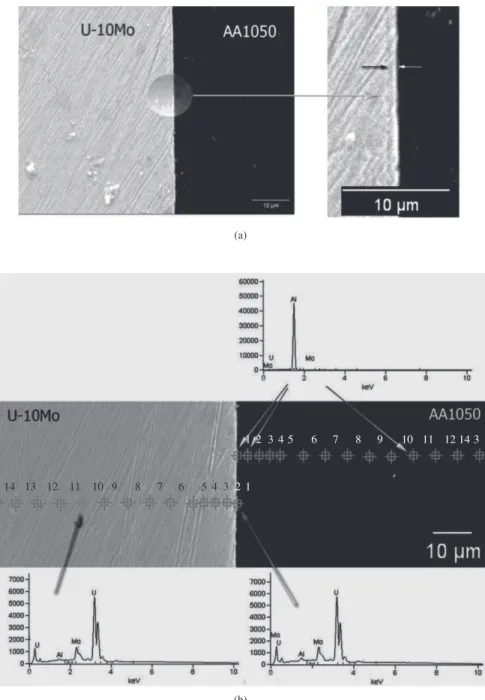
The sets containing the tablets were welded. Each set was then heated at 540 °C during 15 minutes before being hot rolled, then hot rolled by a single pass of 38% reduction. The final thickness of the plate was 7.35 ± 0.01 mm. The samples were identified and cut by guillotine. X-ray images were taken to guide the pairs positioning. The hot rolling fabrication had no material losses. The SEM in Figure 4a shows how uniform was formed the interdiffusion line. The heat treatment of diffusion couples was made in a resistance furnace with no atmosphere conditioning. These treatments are listed in Table 2. The cooling was made in room conditions.
The microstructure of the samples was observed and analyzed with optical microscopy (OM) and scanning electron microscopy (SEM JXA system Jedle 6400) with (EDS). The XRD was made by Rigato Multiflex diffractometer (CuKα 1.54056 Å). The raw materials were
chemically characterized by infrared techniques, ICP-OES, X-ray fluorescence spectrometry and gravimetry.
3. Results and Discussion
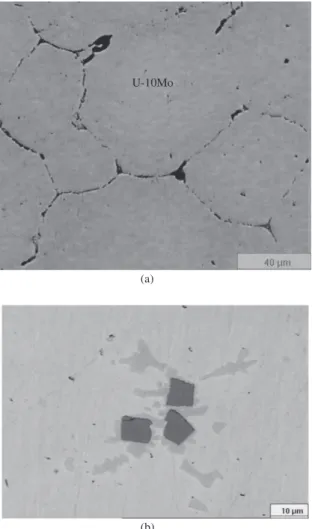
The chemical analyses of the uranium and the aluminum alloy AA1050 brought many constituents to the system of interdiffusion analysis. Silicon impurity is the major concern since the literature cogitates of its hindrance for interdiffusion between Al and U-Mo pairs. Microstructures of U-10Mo alloy prior to heat treatment are shown in Figure 1a, b. In these micrographs, there are punctual regions of a second phase. By SEM/EDS, these regions displayed high content of U and absence of Mo. These regions are probably associated with oxides of uranium as observed in XRD shown in Figure 2.
The major material phase is γ-phase (U, Mo) (light area).
This phase, as seen in Figure 1, by means of SEM, revealed a dendrite formation caused by the peritectic solidification of γ-phase. The difference in composition of (U, Mo),
estimated qualitatively by EDS, was around 1 at% U. After homogenization of U-10Mo sample by means of heat treatment at 1000 °C during 72 hours, no greater structural changes were observed by XRD. The main result was to get slightly better definition in U-10Mo peaks after heat treatment. As shown in Figure 2, the XDR diffraction pattern revealed only the presence of metastable γ-phase with minor
presence of uranium oxides.
Seong et al.15 suggested, by means of neutron diffraction, that the formed phase in U-10Mo is U2Mo with structural Table 1. Raw Materials to prepare the interdiffusion pairs of
U-Mo/AA1050.
Uranium U-10Mo AA1050
Elem. µg.g–1 µg.g–1 g.g–1
Al 110 ± 3 90.5 ± 2.7 99.4 ± 0.1
B <0.4 <0.4
-Ba <0.2 1.34 ± 0.16
-C 0.11% 0.09%
-Ca 6.0 ± 1.4 55.3 ± 5.6
-Cd <0.10 3.75 ± 0.01
-Co 0.60 ± 0.02 3.71 ± 0.02
-Cr 17.2 ± 0.5 43.5 ± 5.3
-Cu 20.3 ± 0.6 79.2 ± 0.2 0.033 ± 0.003
Fe 423 ± 17 579 ± 9 0.27 ± 0.03
Ga - - <0.01
Li <0.1 <0.1
-Mg 5.17 ± 0.15 11.5 ± 1.6 <0.01
Mn 196 ± 5 228 ± 7 <0.01
Mo <3,0 9.74 g.g–1
-Ni 73.0 ± 2.2 75.8 ± 1.4 <0.01
Pb <6.0 <6,0
-S - - 0.031 ± 0.002
Si 36.4 ± 1.9 500 ± 10 0.20 ± 0.07
Sn 11.1 ± 2.5 216 ± 18
-Ti - - <0.01
U Balance Balance
-V 0.80 ± 0.21 10.1 ± 0.2
-Zn 1.64 ± 0.28 <1.0 <0.01
Table 2. Sample heat treatments to simulate IL formation.
Samples Id Time (minutes) Temperature (°C)
PL (1A) 4800 550
PL (1B) 2400 550
PL (2A) 300 550
PL (2B) 2400 150
substitutional Mo atoms in γ-uranium. In this work, it was
found the same pattern as proposed by Sinha, as shown in diffractogram of Figure 2.
The analysis of heat treated samples allowed preliminary evaluation of the interdiffusion of Al in the area of U-10Mo alloy. The resulting structure revealed a layer of chemical interaction between the constituents AA1050 and γ (U, Mo).
The heating time to reach rolling temperature of the samples showed to be very important. Heating during 15 minutes at 540 °C was sufficient to promote a rapid evolution in aluminum diffusion inside U-10Mo, as shown in Figure 3a. Within this short soaking time, it was sufficient to allow aluminum diffusion towards the alloy. It reached a fixed amount of ~8 at% Al in more than 170 µm
inside U-10Mo region. It suggested that Al reaches the maximum solid solubility around this level in U-10Mo. No corroboration to this fact was found in known literature for the alloy studied in this work. By EDS analysis, it was detected that no saturation of Al happened during this small soaking time at 550 °C. Nevertheless, the interdiffusion phenomena allowed reaching 2 at% Al at sample center (~1000 µm from interface) within 15 minutes of heating at
550 °C. From technological point of view, this heat treatment time simulated the heating for the hot rolling first pass of a MTR fuel plate, which would allow Al-diffusion occurring towards U-10Mo, before any neutron irradiation would promote this interdiffusion.
The heating treatments (150 °C and 550 °C) at higher time (5, 40 and 80 hours) in this study did not reproduced expected continuous raise of Al contents beyond 8 at% Al, as it would be forecast considering the majority of other interaction layer studies4,9. With longer periods of soaking, it was observed that the level of aluminum did not surpass the level of 8 at% in the material bulk.
After 80 hours of soaking, the interdiffusion sample at 550 °C, as could be seen in Figure 4, showed a very thin region (~1 µm), where Al reached an amount of 11 at% Al
in average by means of qualitative EDS measurements. This amount is not far beyond the 8 at% Al and should be considered insecure from experimental basis, since the Figure 1. SEM Microscopy of (a) U-10Mo as cast (b) Region with
second phase evidence.
Figure 2. X-ray diffraction pattern showing U-10Mo treated at 1000 °C during 72 hours.
characteristics of the space group P-4m2 (115 tetragonal: a = b = 4.8305 Å, c = 3.418 Å). According to a more updated article, Sinha et al.16 proposed that the major structure might be analyzed as a bcc-structure (Im-3m) of uranium receiving
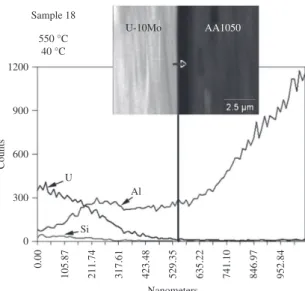
evaluations of EDS analysis is very close to the interface of aluminum interface. Comparing this data with Ryu9, it is possible to say that the present study results did not show an intense Al-interdiffusion inside U-10Mo, as expected. Relevant information was obtained by EDS line-scanning, since it was perceived a silicon interdiffusion towards the U-10Mo very near the interface, as shown in Figure 5. This could be an explanation for the interference of another element participating in alloying process. The results of Mirandou et al.12 in relation to silicon influence in formation
of interaction layer U-10Mo/AA6061 is relevant and in the present work may be indicative of blockage cause.
As an argument to the present experimental results, the results led to think that an interdiffusion barrier was formed by residual elements co-diffusion with aluminum. As a consequence, this barrier promoted lesser interdiffusion phenomena between U-10Mo and alloy AA1050. Silicon co-diffusion with Al, along the interdiffusion line, is thought to be an important indication for this interdiffusion blockage, as shown in Figure 5.
4. Conclusions
As U-Mo alloys are very reactive with Al, interdiffusion reaction are normally expected to be formed in the interface U-Mo/Al. In this work, experiments with interdiffusion couples of U-10Mo/AA1050 revealed that interaction layer was very poorly formed.
During sample heat treatment with 15 minutes at 540 °C, there was a rapid Al-diffusion inside U-10Mo structure, sufficient to reach steadily 8 at% Al until 170 µm from interdiffusion interface. Experimental
evidences indicated that this might be a limit level for the considered experimental pair U-10Mo/AA1050. This experimentation showed, along the interdiffusion line, that a very thin interaction layer was formed by residual elements co-diffusion with Al, which highly prevented aluminum interdiffusion towards U-10Mo bulk. Silicon, which is residually present in AA1050, is supposed to have promoted this blockage.
Figure 5. EDS curves at U-10Mo/AA1050 interface showing the
evidence of Si-diffusion towards U-Mo area after 40 hours at 550 °C.
References
1. Hofman GL. A short note on high density dispersion fuel. Argonne National Laboratory; 1996. http://dx.doi. org/10.2172/373920
2. Hofman GL and Meyer MK. Design of high density gamma-phase uranium alloys for LEU dispersion fuel applications. In: Proceedings of the 1998 International Reduced Enrichment for Test Reactor Conference; 1998; Sao Paulo. Sao Paulo: RERTR; 1998.
3. Hofman GL, Meyer MK, Snelgrove JL, Dietz ML, Strain RV and Kim K-H. Initial assessment of radiation behavior of very-high-density LEU fuels. In: Proceedings of the 1999 International Meeting RERTR; 1999; Budapest. Budapest: RERTR; 1999.
4. Hofman GL, Snelgrove JL, Hayes SL and Meyer MK. Progress in development of low enriched U-Mo dispersion fuels. In: Transactions of the Internacional Meeting on Research Reactor Fuel Manegement; 2002; Ghent. Ghent; 2002.
5. Durand JP, Lavastre Y and Grasse M. Report ANL/TD/TM99-06. RERTR, ANL; 1999.
6. Saliba-Silva AM, Durazzo M, Urano de Carvalho EF and Riella HG. Fabrication of U3Si2 powder for fuels used in IEA-R1 nuclear research reactor. Materials Science Forum. 2008; 591-593:194-199. http://dx.doi.org/10.4028/www. scientific.net/MSF.591-593.194
7. Saliba-Silva AM, Urano de Carvalho EF, Riella HG and Durazzo M. Research Reactor Fuel Fabrication to Produce Radioisotopes. In: Singh N, editor. Radioisotopes - Applications in Physical Sciences. InTech; 2011.
8. Mazaudier F, Proye C and Hodaj F. Further insight into mechanisms of solid-state interactions in UMo/Al system. Journal of Nuclear Materials. 2008; 377(3):476-485. http:// dx.doi.org/10.1016/j.jnucmat.2008.04.016
9. Ryu HJ, Kim YS and Hofman GL. Characterization of the interaction products in U-Mo/Al dispersion fuel from in-pile and out-pile tests. In: Proceedings of the 2006 International Reduced Enrichment for Research and Test Reactors Meeting; 2006; Cape Town. Cape Town: RERTR; 2006.
10. Palancher H, Martin P, Nassif V, Tucoulou R, Proux O, Hazemannet J-L et al. Evidence for the presence of U–Mo–Al ternary compounds in the U–Mo/Al interaction layer grown by thermal annealing: a coupled micro X-ray diffraction and micro X-ray absorption spectroscopy study. Journal of Applied Crystallography. 2007; 40(6):1064-1075. http://dx.doi. org/10.1107/S0021889807040010
11. Mirandou M, Aricó S, Rosenbusch M, Ortiz M, Balart S and Gribaudo L. Characterization of the interaction layer grown by interdiffusion between U–7wt%Mo and Al A356 alloy at 550 and 340 °C. Journal of Nuclear Materials. 2009; 384(3):268-273. http://dx.doi.org/10.1016/j.jnucmat.2008.11.035
12. Mirandou MI, Aricó SF, Balart SN and Gribaudo LM. Characterization of the interaction layer in diffusion couples U-7 wt.%Mo/Al 6061 alloy at 550 °C and 340 °C. Effect of the γU(Mo) cellular decomposition. Materials Characterization. 2009; 60(8):888-893. http://dx.doi. org/10.1016/j.matchar.2009.02.010
13. Saliba-Silva AM, Martins IC, Oliveira ET, Pereira JV and Durazzo M. Estudos térmicos e físicos para viabilizar a redução metalotérmica de urânio metálico a partir de UF4. Revista Brasileira de Pesquisa e Desenvolvimento. 2006; 8:85-90. 14. Saliba-Silva AM, Souza JAB, Frajndlich EUC, Perrotta, JA and
Durazzo M. First Results of U3Si2 Production and its Relevance in the Power Scaleup of IPEN Research Reactor IEA-R1m. In: Proceedings of the 1997 International Reduced Enrichment for Research and Test Reactors Meeting; 1997; Jackson Hole. Jackson Hole: RERTR; 1997.
15. Seong B-S, Leea C-H, Leea J-S, Shima H-S, Leea J-H, Kim KH et al. Neutron diffraction study of U±10 wt% Mo alloy. Journal of Nuclear Materials. 2000; 277(2-3):274-279. http:// dx.doi.org/10.1016/S0022-3115(99)00198-1