INFLUENCE OF SESTON QUANTITY AND QUALITY ON
GROWTH OF TROPICAL CLADOCERANS
FERRÃO-FILHO, A. S., ARCIFA, M. S. and FILETO, C.
Departamento de Biologia, FFCLRP, Universidade de São Paulo, Av. Bandeirantes, 3900, CEP 14040-901, Ribeirão Preto, SP, Brazil
Correspondence to: Marlene Sofia Arcifa, Laboratório de Limnologia, Departamento de Biologia, FFCLRP, Universidade de São Paulo, Av. Bandeirantes, 3900, CEP 14040-901, Ribeirão Preto, SP,
Brazil, e-mail: [email protected]
Received April 29, 2003 – Accepted October 28, 2003 – Distributed February 28, 2005 (With 7 figures)
ABSTRACT
The seston of the small, shallow, and tropical lake Monte Alegre was tested for quantity and quality for cladocerans by growth bioassays, which were carried out in spring (Daphnia gessneri and Moina micrura), summer (D. gessneri,M.micrura, Ceriodaphnia cornuta, and Simocephalus mixtus), and winter (D. gessneri and D. ambigua). Cohorts of newborns originating from ovigerous females collected in the lake or from laboratory cultures were submitted, at a room temperature of 23°°C to the following treatments: (1) the chlorophytes Ankistrodesmus falcatus and/orScenedesmus spinosus; (2) lake seston; and (3) lake seston + chlorophytes. Growth rate, clutch size, and fecundity were evaluated. Seston alone was not the best food for promoting cladoceran growth. There were seasonal differences in food quantity and quality with spring and summer seston being better for growth than that of the winter. Adding chlorophytes to the seston increased clutch size and fecundity for most species in summer and winter, but not in spring. Energy limitation seems to be the most important factor influencing cladoceran growth in summer and especially in winter.
Key words: tropical cladocerans, growth bioassays, food quantity and quality.
RESUMO
Influência da quantidade e qualidade do séston sobre o crescimento de cladóceros tropicais
O séston do lago Monte Alegre, um lago tropical pequeno e raso, foi testado em relação à quantidade e qualidade para os cladóceros por meio de experimentos de crescimento realizados na primavera (Daphnia gessneri e Moina micrura), no verão (D. gessneri,M.micrura, Ceriodaphnia cornuta e Simocephalus mixtus) e no inverno (D. gessneri e D. ambigua). Coortes de recém-nascidos oriundos de fêmeas ovígeras coletadas no lago ou de culturas de laboratório foram submetidas à temperatura de 23oC aos seguintes tratamentos: (1) as clorofíceas Ankistrodesmus falcatus e/ou Scenedesmus
spinosus, (2) séston do lago e (3) séston + clorofíceas. Foram avaliados a taxa de crescimento, o
tamanho da ninhada e a fecundidade. O séston sozinho não foi o melhor alimento para promover o crescimento dos cladóceros. Houve diferenças sazonais quanto à quantidade e à qualidade do alimento, sendo o séston da primavera e o do verão melhores para promover o crescimento que o do inverno. A adição de clorofíceas ao séston aumentou o tamanho da ninhada e a fecundidade para a maioria das espécies no verão e no inverno, mas não na primavera. A limitação de energia parece ser o fator mais importante para o crescimento de cladóceros no verão e, especialmente, no inverno.
INTRODUCTION
The study of food quality for zooplankton has recently progressed considerably, mainly in the temperate zone (revisions by Gulati & DeMott, 1997, and Sterner & Schulz, 1998) compared to the tropics (Bozelli, 1998; Pinto-Coelho, 1998; Ferrão-Filhoet al., 2000; Nandini, 2000). As the dynamics of plankton communities in the tropi-cal zone may be very different from that in the temperate one, different patterns in the interaction between phytoplankton and zooplankton can also be expected. Furthermore, tropical cladoceran species are generally smaller than their temperate counterparts, so that interactions can have particular characteristics in tropical communities.
Size, shape, and digestibility of algae are points that have been cited as limiting food quality for herbivores (Burns, 1968; Lampert, 1987; Gulati & DeMott, 1997; Kurmayer, 2000, 2001). Included in such factors are P-limitation and deficiency in essential polyunsaturated fatty acids (PUFA). The P-limitation hypothesis predicts that zooplankton growth would be limited if the molar C:P ratio of available food exceeds some threshold ratio (around 300), particularly for Daphnia (Urabe & Watanabe, 1992; Sterner & Schulz, 1998; Elser et al., 2001). Algae deficiency in PUFA has also been proposed for explaining poor growth of zooplankton (Müller-Navarra, 1995; DeMott & Müller-(Müller-Navarra, 1997). However, most studies on the role of phosphorus and the PUFA limitation have been undertaken with zooplankton fed on algal cultures in laboratory experiments. Although there is evidence that zooplankton can be limited by phosphorus (DeMott & Gulati, 1999; DeMott et al., 2001; Boersma et al., 2001; Elser et al., 2001) and PUFA in nature (Müller-Navarra, 1995; Müller-Navarra et al., 2000; Wacker & von Elert, 2001), more studies on the limiting effect of natural food, as well as on other algae constraints, are needed (Gulati & DeMott, 1997; DeMott & Tessier, 2002).
Since 1985 several studies have been under-taken in lake Monte Alegre for the purpose of charac-terizing the ecosystem and formulating hypotheses on interactions (Arcifa, 1999). Arcifa et al. (1992) analyzed the factors limiting zooplankton growth in lake Monte Alegre, with food quantity and/or quality emerging as the main factor in the cool-dry season, and Chaoboruspredation in the warm-wet
season. Phytoplankton fractions and seston quantity and quality have been tested for their effects mainly on reproduction of cladocerans in the lake (Fileto
et al., 2004; Ferrão-Filho et al., 2003), in addition to the effects of predation by Chaoborusand plank-tonic Hydracarina (Castilho-Noll, 2002; Cassano
et al., 2002).
In this study, the potential limitation by seston in lake Monte Alegre was tested using growth bioassays with the cladocerans Ceriodaphnia cornuta
Sars,Daphnia ambigua Scourfield, D.gessneri Herbst,
Moina micrura Kurz, and Simocephalus mixtus Sars submitted to treatments with seston, seston supplemented with edible chlorophytes, and chloro-phytes alone. Experiments were carried out in spring (November 1998), summer (February 1999), and winter (July 1999), along with analysis of sestonic C, N, and P, and phytoplankton composition and size, in order to raise hypotheses on factors possibly constraining cladoceran growth in the lake in different seasons.
Study area
Lake Monte Alegre (21o11’S, 47o43’W) is a small (area = 7 ha), shallow (Zmax= 5 m), eutrophic, and warm discontinuous polymictic reservoir, located in the State of São Paulo, southern Brazil. Its strati-fication during summer leads to oxygen depletion near the bottom (Arcifa et al., 1990). As the outlet is superficial and the dam is not manipulated by man, it functions as a small lake, having a retention time of about 45 days at the end of the wet season. The region is characterized by a tropical climate, with a marked dry-cool season (May-September) and a wet-warm season (October-April). The average surface temperature was 28.5 °C in the spring of 1998, and 30.5°°C in the summer and 23°°C in the winter of 1999.
Cyanobacterial blooms are uncommon in the lake, despite its eutrophic condition (Silva, 1995). Eight planktonic cladoceran species have been recorded in four year-long studies (1985-86, 1988-89, 1999, and 2001-02) at the lake (Arcifa et al., 1992, 1998; Fileto, 2001; Bunioto, 2003): Bosmina tubicen,
Ceriodaphnia cornuta, C. richardi, Daphnia ambigua, D. gessneri,Diaphanosoma birgei, Moina micrura, andM. minuta. From 1998 to 2001, the most frequent and sometimes the most abundant were D. gessneri
MATERIALS AND METHODS
Seston analyses
Water samples were collected in the deepest region of the lake, using a bilge pump (Model 34600-0000, Jabsco ITT Ind., Costa Mesa, USA) delivering 30 L min–1 and integrating the water column in a 5 L container. In the laboratory, subsamples of 500 and 1000 ml were filtered in glass fiber filters (Sartorius AG 37070, Goettingen, Germany) for the analysis of particulate organic carbon (Strickland & Parsons, 1972), nitrogen (Kjedahl method, Mackereth et al., 1978), particulate phosphorus (Fassbender, 1973), and chlorophyll a
(Lorenzen, 1967). Phytoplankton was counted according to Utermöhl (1958) and carbon content of algae was calculated as 10% of their biovolume (Vollenweider, 1974). Phytoplankton species composition was analyzed and, according to algae size, separated in the fractions < 20 and ≥ 20 µm. Algae groups and size fractions were represented in terms of algal carbon.
Algae and cladoceran cultures
The green algae used as food for cladocerans,Ankistrodesmus falcatus (Braun) (length 40µm) and Scenedesmus spinosus R. Chodat (length 14 µm), were cultivated in MBL medium (Stemberger, 1981) in an incubation chamber (model 347 CDG, FANEM, SP, Brazil) at 23°C and using a 12L:12D photoperiod cycle. The same temperature and light conditions were used in the experiments and in maintaining the cladoceran cultures.
Cladocerans were collected in the lake with a 60 µm mesh-size net and kept for several generations
in the laboratory in 500 and 1000 ml stoppered bottles (Schott, Germany) with lake water filtered in glass fiber filters. They were fed 1.0 mg C L–1 of A. falcatus orS. spinosus algae chosen because previous tests had indicated their suitability for promoting the best growth rates for most cladocerans. As Moina micrura
grew better with A. falcatus, this alga was used as the sole food source for this species.
Growth bioassays
Growth bioassays were carried out in spring (11-17/XI/98) with Daphnia gessneri (1.16 mm) and
Moina micrura (0.85 mm); in summer (21-27/II/99) with Ceriodaphnia cornuta (0.45 mm), Daphnia gessneri,Moina micrura, and Simocephalus mixtus
(1.40 mm); and in winter (01-07/VII/99) with Daphnia
ambigua(0.90 mm) andDaphnia gessneri. These species were chosen as representative of the cladocerans of the lake and for testing different-sized organisms. However, as a large number of individuals per species was necessary for the experiments, the cladocerans used varied according to their availability in the cultures or in the lake.
Cohorts originating from ovigerous females (D. gessneri and D. ambigua) collected in the lake, when the necessary number of individuals not reached in the cultures, and from laboratory cultures for the other species were used in the experiments. At the beginning of the experiments, about 10 neonates were placed in pieces of small pre-tared aluminum foil, dried at 60°C, and weighed in a microbalance (model UMT-2, Mettler Toledo, Greifensee, Switzerland) to the nearest 0.1 µg. Initially, 20 animals of each species were placed in 500 ml stoppered bottles for each treat-ment. Every other day, the animals were transferred to new algal suspensions and 10 individuals (day 2) and 5 (at the end of the experiment) of each replicate were weighed on a small piece of aluminum foil and then discarded. Treatments in the spring were: (1)
Ankistrodesmus falcatus alone, (2) seston, and (3) seston + chlorophyte. In the summer treatments were: (1) chlorophytes (A. falcatus for M. micrura and
Scenedesmus spinosus for the other species), (2) seston, and (3) seston + chlorophytes. In the winter treatments were: (1) S. spinosus alone, (2) seston, and (3) seston + chlorophyte. Chlorophytes were offered alone at a concentration of 1.0 mg C L–1 (ca. 3 x 10⁷ cells.ml–1 for S. spinosus and 3 x 10⁴cells.ml–1 for A.
falcatus) or mixed with seston at a concentration of 0.5 mg C L–1. Three replicate bottles were used per treatment; the average individual biomass was obtained using groups of animals removed from each of the three bottles. The exponential growth rate was calculated by the equation:
g = [ln (Wt) – ln (Wo)]/t where:
Wo and Wt are the animals’ average weight at time 0 and after t days, respectively.
Growth rates were evaluated only during the pre-reproductive period of the cladocerans, which lasted 2 days for Moina micrura (although Figs. 2
calculating clutch size (number of eggs produced by the ovigerous females) and fecundity (total of eggs produced by the total of females).
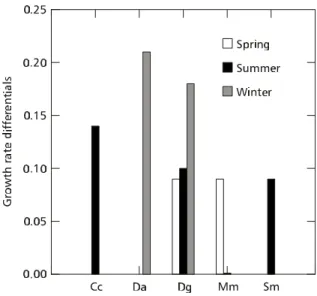
The purpose of the addition of edible chlorophytes to the seston was to test for any food limitation in the lake seston. If cladocerans improved growth in the seston plus chlorophytes, as opposed to seston alone, this would indicate that lake seston quantity and/or quality were limiting. Growth rate differentials were calculated by subtracting growth rate in the seston treatment from growth rate in seston + chlorophytes. According to DeMott et al. (2001), growth rate differentials are the best way of estimating the effect of food limitation.
Chlorophyte feeding treatments were excluded from the statistical analyses since they could not be considered as controls for seston. In this case, seston treatments were considered controls and the effects of green algae additions were estimated as growth differentials. Growth with chlorophytes alone was an estimate of growth rates with suitable algae used for culturing cladocerans in the laboratory.
RESULTS
Sestonic elemental analyses, chlorophyll a, and phytoplankton composition
Higher concentrations of carbon (C) and chlorophylla were found in spring and summer (Table 1). Nitrogen and phosphorus were measured only in summer and winter. Phosphorus concentration and C:P ratio were higher in winter and in summer, respectively. Higher values of nitrogen concentration and C:N ratio were found in summer and in winter, respectively.
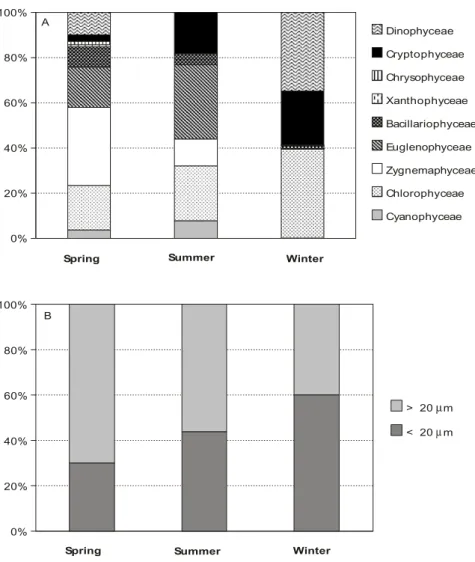
In spring, Zygnemaphyceae, Chlorophyceae, and Euglenophyceae contributed most to the phytoplankton carbon (Fig. 1A). In summer, the importance of Euglenophyceae and Cryptophyceae
increased, with dinophyceans virtually disappearing. In winter, phytoplankton diversity was lower than in the previous seasons, increasing the contribution of Dinophyceae and Chlorophyceae, which together comprised 75% of the algal carbon, while Cryptophyceae contributed the remaining 25%.
The average algal carbon was ca. 0.35, 0.06, and 0.04 mg C L–1, in spring, summer, and winter, respectively. Nanoplankton contribution (< 20 µm) to the algal carbon was ca. 0.16, 0.026, and 0.023 mg C L–1 in the same seasons. In spring and summer, microplankton (≥ 20 µm) carbon dominated the phytoplankton, whereas in winter the nanoplanktonic fraction was the most important despite a higher contribution of dinophyceans (Fig. 1B).
Growth bioassays
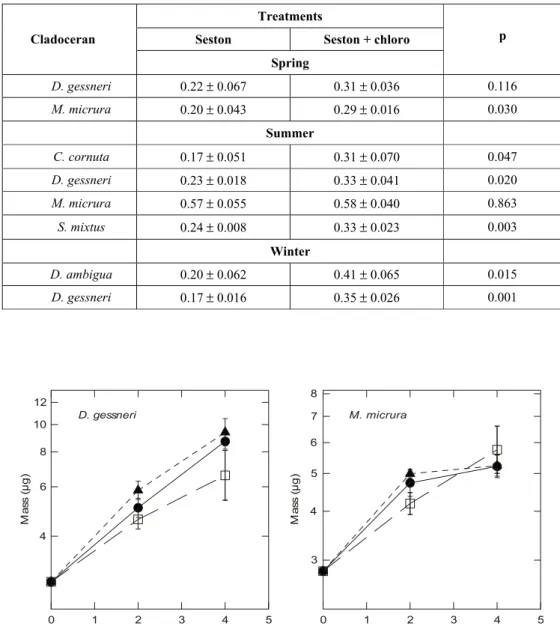
In spring (Fig. 2), the addition of the chlorophyte to seston improved growth rates of both cladocerans, although significant differences between treatments were found only for Moina micrura (Table 2; p = 0.03). In summer (Fig. 3), Daphnia gessneri,
Simocephalus mixtus, and Ceriodaphnia cornuta
experienced a significant improved growth when chlorophytes were added to seston (Table 2: p = 0.02, p = 0.003, p = 0.05, respectively). For M. micrura, growth rates were nearly the same in both treatments. Thus, summer seston was unable to promote the best growth for most species. In winter (Fig. 4), there were significant improvements again in growth rates ofD. gessneri and D. ambigua when seston was mixed with chlorophytes (Table 2: p = 0.001 and p = 0.015, respectively). Therefore, lake seston was generally not the best food for promoting growth. These results indicated that cladoceran growth was more affected by lake seston in winter than in the warm seasons (spring and summer), as is also shown by the higher growth rate differential in winter for
D. gessneri (Fig. 5).
TABLE 1
Average concentrations (± SD) of carbon (C), nitrogen (N), phosphorus (P), and chlorophyll ain the seston. C:N and C:P are molar ratios.
Season C
(mg L–l)
N (mg L–l)
P (µµg L–1
) C:N C:P
Chlorophylla (µµg L–1
)
Spring 0.72± 0.00 – – – – 16.29± 4.04
Summer 1.03± 0.09 0.31± 0.08 3.80± 0.06 3.95± 0.64 703.00± 52.32 12.55± 1.68
Fig. 1 — Composition (A) and size fraction (B) of phytoplankton in lake Monte Alegre in the three seasons studied. Data are expressed as percent carbon, based on biovolume of algae.
Statistical differences appeared between treatments in each season (Table 3). Except in summer, in the other seasons there were no statistical diffe-rences among species, with most species responding in a similar way to green algae additions. Only M. micrura showed a consistently higher growth rate for both treatments, which was responsible for the diffe-rence between the species in summer (Table 3). A comparison of speciesvs. treatments showed no significant interaction in any season.
Clutch size and fecundity
In spring, similarly to growth, the addition of the chlorophyte to seston significantly improved clutch size and fecundity of M. micrura (Fig. 6).
As occurred for growth, there was no difference between clutch size and fecundity in both treatments for D. gessneri. In summer, the addition of chlorophytes to seston significantly improved clutch size and fecundity of all cladoceran species, except forD. gessneri despite its higher growth rate with 0%
20% 40% 60% 80% 100%
Dinophyceae
Cryptophyceae
Chrysophyceae
Xanthophyceae
Bacillariophyceae
Euglenophyceae
Zygnemaphyceae
Chlorophyceae
Cyanophyceae
Summer
Spring Winter
A
0% 20% 40% 60% 80% 100%
> 20µm
< 20µm
Summer
Spring Winter
food supplement. In winter, paralleling data on growth, clutch size and fecundity of both Daphnia
species were significantly improved with the addition of chlorophytes to seston.
Only in summer did clutch size and fecundity coincide in both treatments for most species, meaning that the majority of females produced eggs at the end of the experiment.
TABLE 2
Juvenile growth rates (± SD) of cladocerans in different treatments (Two-sample t-test, αα= 0.05).
Fig. 2 — Growth bioassay carried out in spring with the cladocerans D. gessneri and M. micrura in three treatments: (•) Chlorophyte (Ankistrodesmus falcatus; 1.0 mg C L–1); () seston and (c) seston + chlorophyte (0.5 mg C L–1).
0 1 2 3 4 5
Time (days) 4
6 8 10 12
0 1 2 3 4 5
Time (days) 3
4 5 6 7 8
Ma
ss
(
g
)
µ
D. gessneri M. micrura
Ma
ss
(
g
)
µ
Treatments
Seston Seston + chloro Cladoceran
Spring
p
D. gessneri 0.22± 0.067 0.31± 0.036 0.116
M. micrura 0.20± 0.043 0.29± 0.016 0.030
Summer
C. cornuta 0.17± 0.051 0.31± 0.070 0.047
D. gessneri 0.23± 0.018 0.33± 0.041 0.020
M. micrura 0.57± 0.055 0.58± 0.040 0.863
S. mixtus 0.24± 0.008 0.33± 0.023 0.003
Winter
D. ambigua 0.20± 0.062 0.41± 0.065 0.015
Fig. 3 — Growth bioassay carried out in summer with the cladocerans C. cornuta,D. gessneri,M. micrura, and S. mixtus in three treatments: (•) Chlorophytes (Ankistrodesmus falcatus or Scenedesmus spinosus; 1.0 mg C L–1); () seston and (c) seston +
chlorophytes.M. micrura was fed A. falcatus and other cladocerans S. spinosus. Both chlorophytes were added to seston at a total concentration of 0.5 mg C L–1.
DISCUSSION
Considering that growth differentials may be a measure of any kind of food limitation for indi-vidual growth (DeMott et al., 2001), population growth differentials (subtracting r of seston treatment fromr of seston + chlorophytes) would measure the food limitation for population growth. Performing a Pearson correlation between the individual growth differentials obtained in this study for all species and seasons, and the population growth differentials
calculated with data of Ferrão-Filho et al. (2003), resulted in a significant positive correlation (r2= 0.712; p = 0.008; Fig. 7). Therefore, the data on growth bioassays presented here showed the same trend for cladoceran reproduction (Ferrão-Filhoet al., 2003), indicating that the seston of lake Monte Alegre was limiting for individual and population growth of cladocerans in all seasons. Fig. 7 also shows a seasonal difference in food limitation, with better performance of cladocerans, in terms of growth and reproduction, in the warm seasons (spring and summer) than in
0 1 2 3 4 5
Time (days) 2
3 4 5 6 7 8
Ma
ss
(
g
)
µ
0 1 2 3 4 5
Time (days) 4
6 8 10 12 14
4 6 8 10 12 14 16
5 10 15 20 25 30
C. cornuta D. gessneri
M. micrura S. mixtus
Ma
ss
(
g
)
µ
Ma
ss
(
g
)
µ
Ma
ss
(
g
)
µ
0 1 2 3 4 5
Time (days)
0 1 2 3 4 5
winter. In natural populations of lake Monte Alegre, a trend towards larger clutch sizes of D. gessneri and
D. ambigua has been always observed in the warm season (Arcifaet al., 1992, 1998; Fileto, 2001).
TABLE 3
Results of one-way ANOVA for the effect of species, treatments, and interactions in the different seasons. Treatments: seston and seston + chlorophytes.
Fig. 4 — Growth bioassay carried out in winter with the cladocerans D. ambigua and D. gessneri in three treatments: (•) Chlorophyte (Scenedesmus spinosus; 1.0 mg C L–1); () seston and (c) seston + chlorophyte (0.5 mg C L–1).
0 1 2 3 4 5
Time (days) 2
4 6 8 10
0 1 2 3 4 5
Time (days) 4
8 12 16 20
Ma
ss
(
g
)
µ
D. ambigua D. gessneri
Ma
ss
(
g
)
µ
Spring
Effect Sum-of-squares Df Mean-square F p
Species 0.001 1 0.001 0.57 0.470
Treatments 0.023 1 0.023 11.73 0.009
Treatmentx species 0.000 1 0.000 0.000 0.995
Error 0.016 8 0.002
Summer
Species 0.425 3 0.142 78.00 0.000
Treatments 0.042 1 0.042 23.24 0.000
Treatmentx species 0.014 3 0.005 2.50 0.096
Error 0.29 16 0.002
Winter
Species 0.007 1 0.007 3.05 0.119
Treatments 0.117 1 0.117 52.30 0.001
Treatmentx species 0.000 1 0.000 0.19 0.672
Fig. 5 — Growth rate differentials for cladocerans in the growth bioassays in all seasons. Growth rate differential is the difference in growth rate between seston and seston + chlorophytes treatments. Cc = Ceriodaphnia cornuta; Da = Daphnia ambigua; Dg =
Daphnia gessneri; Mm = Moina micrura; Sm = Simocephalus mixtus.
In lake Monte Alegre, energy (carbon) seemed to be the most important factor influencing cladoceran growth in winter and summer. In winter, algal carbon concentration (0.04 mg C L–1) was within the threshold range (0.01-0.05 mg C L–1) reported for several Daphnia species (Gliwicz, 1990), including the South American D. gessneri (Hardy
& Duncan, 1994). Nonalgal carbon contribution was also low, but cryptophyceans, known for being high quality food (Ahlgren et al., 1992), comprised 25% of the algal carbon. Other phytoplankton features representing constraints to cladocerans were also important in that season, such as the relatively higher abundance of inedible dinophyceans. In summer, algal carbon concentration (0.06 mg C L–1) was close to the threshold level, but particulate carbon concentration was relatively high, and thus other carbon sources such as detritus and bacteria were available to the cladocerans in the lake. Phytoplankton biomass during the experiments in summer was unusually low, relative to the higher values recorded during the same season during a previous study (Arcifa et al., 1998). In spring, algal
carbon concentration (0.35 mg C L–1) was apparently non-limiting to cladocerans, but growth rates were not high compared to those of the other seasons.
However, reproductive performance was better in spring, with higher values of clutch size and fecundity.
Poor ingestion or digestibility of carbon may cause low carbon-transfer efficiency (Wacker & von Elert, 2001). Actually, part of the algal carbon available in the seston during the experiments could be inedible for cladocerans due to large size, shape, and other algal features. Experiments with
Ceriodaphnia cornuta,Daphnia gessneri, and Moina micrura from the lake showed higher population
growth and reproductive performance in the nanoplankton (< 20 µm) compared to the
micro-plankton (≥ 20 µm), despite their mutual conta-mination after net filtration procedure (Fileto et al.,
2004). This paper also reports a significant lower growth rate ofM. micrura in the microplankton.
Although during the present study the nanoplankton numerically dominated the phytoplankton, its contri-bution to the algal carbon was usually low during the experiments: 0.10, 0.026, and 0.023 mg C L–1, in spring, summer, and winter, respectively. However, according to Burns (1968) and Vanni (1987), 35 µm
Apparently, there was also a P-limitation in summer, as the seston molar C:P ratio exceeded the limit of 300 reported by Urabe & Watanabe (1992). But in lake Monte Alegre, the addition of phosphate to the summer seston with high C:P ratio did not improve cladoceran growth in experiments carried out later (Ferrão-Filho & Arcifa, un-published). Other experiments with N and P added to the lake seston from the four seasons did not enhance cladoceran growth rates in relation to seston alone (Fileto et al., 2004). Thus, the influence
of mineral content of algae on cladoceran growth in the lake is questionable. It is possible that a hierarchy exists among factors influencing cladoceran growth, with energy being more important than the P-limitation. If energy is in fact limiting, all possible mineral limitations would be prevented. DeMott & Tessier (2002), in growth biossays with seston of six North American lakes, suggested that energy limitation would be more important than limitation by sestonic phosphorus and essential fatty acids for Daphnia growth. Their hypothesis that algae digestibility plays an important role, which leads to energy limitation, is supported by a positive correlation between individual growth rate and food assimilation efficiency.
Actually, in spite of all the literature on the importance of fatty acids in algal food for herbivores, there is no consensus among authors that essential fatty acids can limit zooplankton in nature. Experiments with addition of PUFA to seston showed a nonsignificant effect on growth and reproduction of cladocerans from lake Mon-te Alegre (Ferrão-Filho & Arcifa, unpublished). Despite a higher algal carbon concentration in spring, growth rates of cladocerans were higher in summer or similar to that observed with the spring and summer seston. In comparison with what happened in the spring, dinophyceans virtually disappeared in summer, increasing the contribution of high-quality cryptomonads. Thus, algae composition, as well as other carbon sources, made summer seston, in spite of its lower algal carbon content, as suitable as or better than spring seston for cladoceran growth.
Differences in life history are evident when comparingMoina micrura with the other cladocerans. Ferrão-Filhoet al. (2000, 2003) and this study showed
that this species allocates more energy for repro-duction, starting egg production earlier (2 days) than the others (4 days). However, in the lake M. micrura
is not a frequent and successful species, appearing sporadically in periods of low densities of Daphnia
Fig. 7 — Correlation between growth differentials in the bioassays (this study) and population growth differentials (Ferrão-Filho
gessneri, which is commonly the dominant cladoceran in lake Monte Alegre (Arcifaet al., 1992, 1998; Fileto, 2001). Differences in threshold food concentration among cladoceran species can also partially explain this fact, since M. micrura has higher food-quantity requirements than the other species (Romanovsky, 1985).
In conclusion, this study supports the hypothesis of food limitation for cladoceran population growth in lake Monte Alegre suggested by Ferrão-Filhoet al. (2003). Quali- and quantitative aspects of phytoplankton may cause more constraints for cladocerans in the cool season (winter) than in the warm seasons (spring, summer), corroborating the conceptual model presented by Arcifa et al. (1992) that explains zooplankton population fluctuations in Lake Monte Alegre.
Acknowledgements — We thank Lucia Helena Sampaio da Silva for providing phytoplankton data, W. R. DeMott for valuable suggestions on an earlier draft, and Lourdes M. A. Elmoor-Loureiro for identifying Simocephalus mixtus. We also thank FAPESP for a research grant to MSA (97/10407-6) and for grants to ASFF (98/12999-0) and CF (98/14823-7).
REFERENCES
AHLGREN, G., GUSTAFSSON, I-B. & BOBERG, M., 1992, Fatty-acid content and chemical composition of freshwater microalgae.J. Phycol.,28: 37-50.
ARCIFA, M. S., 1999, Lago Monte Alegre: uma visão sobre a estrutura e hipóteses de funcionamento. pp. 55-76. In: R. Henry (ed.), Ecologia de reservatórios: estrutura, função e aspectos sociais. Fundibio/Fapesp, Botucatu, S. Paulo. ARCIFA, M. S., MESCHIATTI, A. J. & GOMES, E. A. T., 1990,
Thermal regime and stability of a tropical shallow reservoir: Lake Monte Alegre, Brazil. Rev. Hydrobiol.Trop., 23: 271-281.
ARCIFA, M. S., GOMES, E. A. T. & MESCHIATTI, A. J., 1992, Composition and fluctuations of the zooplankton of a tropical Brazilian reservoir. Arch. Hydrobiol., 123: 479-495. ARCIFA, M. S., SILVA, L. H. S. & SILVA, M. H. L., 1998, The
planktonic community in a tropical Brazilian reservoir: composition, fluctuations and interactions. Rev. Brasil. Biol.,
58: 241-254.
BOERSMA, M., SHOPS, C. & MCCAULEY, E., 2001, Nutri-tional quality of seston for the freshwater herbivore Daphnia galeata x hyalina: biochemical versus mineral limitations.
Oecologia, 129: 342-348.
BOZELLI, R. L., 1998, The influence of bauxite tailings on the functional response of carbon incorporation rates of three species of tropical cladocerans. Verh. Int. Ver. Limnol.,26: 1894-1897.
BUNIOTO, T. C., 2003,Variação temporal e distribuição horizontal do zooplâncton no lago Monte Alegre e a influência do alimento e da temperatura sobre cladóceros.
Dissertação de Mestrado, FFCLRP/USP, Ribeirão Preto, 96p.
BURNS, C. W., 1968, The relationship between body size of filter-feeding Cladocera and the maximum size of particles ingested.Limnol. Oceanogr.,13: 675-678.
CASSANO, C. R., CASTILHO-NOLL, M. S. M. & ARCIFA, M. S., 2002, Water mite predation on zooplankton in a tropical Brazilian lake. Braz. J.Biol., 62(4A): 565-571. CASTILHO-NOLL, M. S. M., 2002, A predação de larvas de
Chaoborus brasiliensis sobre populações zooplanctônicas.
Tese de Doutorado, IB/USP, São Paulo, 101p.
DeMOTT, W. R. & MÜLLER-NAVARRA, D. C., 1997, The importance of highly unsaturated fatty acids in zooplankton nutrition: evidence from experiments withDaphnia, a cyanobacterium and lipid emulsions. Freshwater Biol., 38: 649-664.
DeMOTT, W. R. & GULATI, R. D., 1999, Phosphorus limitation inDaphnia: evidence from a long-term study of three hypereutrophic Dutch lakes. Limnol. Oceanogr., 44: 1557-1564.
DeMOTT, W. R., GULATI, R. D. & DONK, E. VAN, 2001, Effects of dietary phosphorus deficiency on the abundance, phosphorus balance, and growth of Daphnia cucullata in three hypereutrophic Dutch lakes. Limnol. Oceanogr., 46: 1871-1880.
DeMOTT, W. R. & TESSIER, A. J., 2002, Stoichiometric constraints vs. algal defences: testing mechanisms of zooplankton food limitation. Ecology,83: 3426-3433. ELSER, J. J., HAYAKAWA, K. & URABE, J., 2001, Nutrient
limitation reduces food quality for zooplankton: Daphnia
response to seston phosphorus enrichment. Ecology, 82: 898-903.
FASSBENDER, H. W., 1973, Simultane P-Bestimmung in N-Kjeldahl-AusfschluB von Bodenproben. Die Phosphorsäure,
30: 40-53.
FERRÃO-FILHO, A. S., AZEVEDO, S. M. F. O. & DEMOTT, W. R., 2000, Effects of toxic and non-toxic cyanobacteria on the life history of tropical and temperate cladocerans.
Freshwater Biol., 43: 1-19.
FERRÃO-FILHO, A. S., ARCIFA, M. S. & FILETO, C., 2003, Resource limitation and food quality for cladocerans in a tropical Brazilian lake. Hydrobiologia,491: 201-210. FILETO, C., 2001,O zooplâncton do lago Monte Alegre: variação
temporal e a influência das frações do fitoplâncton sobre o crescimento e reprodução de cladóceros. Dissertação de Mestrado, FFCLRP/USP, 100p.
FILETO, C., ARCIFA, M. S., FERRÃO-FILHO, A. S. & SILVA, L. H. S., 2004, Influence of phytoplankton fractions on growth and reproduction of tropical cladocerans. Aquat.
Ecol.,38: 503-514.
GULATI, R. D. & DeMOTT, W. R., 1997, The role of food quality for zooplankton: remarks on the state-of-the-art, perspectives and priorities. Freshwater Biol., 38: 753-768. HARDY, E. R. & DUNCAN, A., 1994, Food concentration and temperature effects on life-cycle characteristics of tropical CladoceraDaphnia gessneri Herbst, Diaphanosoma sarsi
Richard, and Moina reticulata Daday. I. Development time.
Acta Amazonica, 24: 119-134.
KURMAYER, R., 2000, Nutritive versus interfering effects of
Anabaena on Daphnia and Ceriodaphnia.Verh. Int. Ver. Limnol.,27: 1-4.
KURMAYER, R., 2001, Competitive ability of Daphniaunder dominance of non-toxic filamentous cyanobacteria.
Hydrobiologia,442: 279-289.
LAMPERT, W., 1987, Feeding and nutrition in Daphnia. pp. 143-192.In: R. H. Peters & R. De Bernardi (eds.), Daphnia.
Mem. Ist. Ital. Idrobiol, 45. Verbania, Pallanza. LORENZEN, C. F., 1967, Determination of chlorophyll and
pheopigments: spectrophotometric equations. Limnol. Oceanogr., 16: 990-992.
MACKERETH, F. J. H., HERON, J. & TALLING, J. F., 1978,
Water analysis: some revised methods for limnologists. Freshwater Biological Association Scientific Publication n. 36, Cumbria and Dorser, England, 120p.
MÜLLER-NAVARRA, D. C., 1995, Evidence that a highly unsaturated fatty acid limits Daphnia growth in nature. Arch. Hydrobiol., 132: 297-307.
MÜLLER-NAVARRA, D. C., BRETT, M. T., LISTON, A. M. & GOLDMAN, C. R., 2000, A highly unsaturated fatty acid predicts carbon transfer between primary producers and consumers.Nature, 401: 74-77.
NANDINI, S., 2000, Responses of rotifers and cladocerans to
Microcystis aeruginosa (Cyanophyceae): a demographic study.Aquat. Ecol.,34: 227-242.
PINTO-COELHO, R. M., 1998, Effects of eutrophication on seasonal patterns of mesozooplankton in a tropical reservoir: a 4-year study in Pampulha lake, Brazil. Freshwater Biol., 40: 159-173.
ROMANOVSKY, Y. E., 1985, Food limitation and life-history strategies in cladoceran crustaceans. Arch. Hydrobiol. Beih. Ergebn. Limnol, 21: 363-372.
SILVA, L. H. S., 1995, Variabilidade temporal na estrutura da comunidade planctônica de um reservatório eutrófico – Lago Monte Alegre, Ribeirão Preto, São Paulo, Brasil. Dissertação de Mestrado, URFJ, Rio de Janeiro, 141p.
STEMBERGER, R. S., 1981, A general approach to the culture of planktonic rotifers. Can. J. Fish. Aquat. Sci., 38: 721-724.
STERNER, R. W. & SCHULZ, K. L., 1998, Zooplankton nutrition: recent progress and a reality check. Aquat.Ecol.,
32: 261-279.
STRICKLAND, J. D. H. & PARSONS, T. R., 1972,A practical handbook of seawater analysis. Bulletin of Fishery Research. Bd., Canada, 310p.
URABE, J. & WATANABE, Y., 1992, Possibility of N or P limitation for planktonic cladocerans: an experimental test.
Limnol. Oceanogr., 37: 244-251.
UTERMÖHL, H., 1958, Zur Vervollkommung der quantitativen Phytoplankton-Methodik. Mitt. Int. Ver. Limnol., 9: 1-38. VANNI, M. J., 1987, Effects of food availabity and fish predation on a zooplankton community.Ecological Monographs, 57: 61-68.
VOLLENWEIDER, R. A., 1974,A manual on methods for measuring primary production in aquatic environments. IBP Handbook 12, 2nd ed. Blackwell Scientific Publications,
London, 213p.