The Office of the Dead in Portuguese Medieval Uses
João Pedro d’Alvarenga
CESEM Faculdade de Ciências Sociais e Humanas
Universidade Nova de Lisboa [email protected]
Resumo
Este artigo procura determinar a procedência dos formulários do Ofício de Defuntos dos principais usos litúrgicos medievais portugueses (Braga, Coimbra, Évora e Santa Cruz de Coimbra) e percorrer as mudanças que neles ocorreram até ao início do período moderno. São consideradas as circunstâncias históricas da restauração das diferentes dioceses depois da reconquista, a origem e o percurso dos seus primeiros prelados, as fontes subsistentes de cada uso litúrgico e as suas características específicas, com referência à literatura especializada entretanto produzida. A exemplo do estudo pioneiro de Knud Ottosen, a metodologia assenta também numa ampla comparação das séries de responsórios e versos das Matinas de Defuntos e outras particularidades textuais e musicais de fontes locais e de fontes ibéricas e francesas seleccionadas. Em apêndice, são fornecidas listas exaustivas das fontes manuscritas e impressas dos usos de Braga, Évora e Santa Cruz, incluindo as respectivas localizações e referências bibliográficas relevantes.
Palavras-chave
Ofício de Defuntos; Usos litúrgicos portugueses; Filiações litúrgicas; Séries de responsórios e de versos; Portugal no período medieval e início do período moderno.
Abstract
This article aims to establish the ancestry of the formularies of the Office of the Dead in the main Portuguese medieval liturgical uses (Braga, Coimbra, Évora and Santa Cruz in Coimbra) and track their changes up to the early modern period. This is mainly achieved by considering the historical circumstances of the restoration of the different dioceses after the reconquest, the background of their first prelates, the extant sources of each liturgical use and their distinctive characteristics with reference to previous scholarship. Following Knud Ottosen’s seminal study, methodology also relies on an extensive comparison of the series of responsories and verses of the Matins of the Dead and other textual and musical details in local and selected Iberian and French sources. Comprehensive lists of the manuscript and printed sources of the uses of Braga, Évora and Santa Cruz, their location and relevant bibliographical references are also provided at the end.
Keywords
Office of the Dead; Portuguese liturgical uses; Liturgical affiliations; Series of responsories and verses; Medieval and early modern Portugal.
nova série | new series
*
ETTING ASIDE THE USES OF THE MENDICANT AND THE MONASTIC, including military, orders
and the uses of the different orders of canons regular like the Augustinian Canons and the
Premonstratensians, existing evidence point to only three different formularies for the
Office of the Dead in late medieval and early modern, pre-Tridentine Portuguese diocesan uses
(including the Roman use). As we shall see later on, though originally distinct, Braga and Coimbra
shared the same formularies as far as the Office of the Dead is concerned.
1Évora received the
Office of the Dead, albeit partly indirectly, from different institutions in Coimbra, even if the whole
of its liturgical use seems to be, according to present knowledge, mostly dependent on Braga.
Nothing is known for sure about the medieval uses of Oporto and Lisbon, though it has been
suggested that the former might have followed Braga and the latter might have consisted of some
variation of the use of Salisbury.
2Little is known about pre-Tridentine liturgical uses in the dioceses of Viseu—restored after the
definitive reconquest of the city in 1058 but annexed to that of Coimbra perhaps in 1101 until its
own bishop was appointed in 1147, and a suffragan diocese of Braga; Lamego—restored in 1071
and also initially ruled by the bishop of Coimbra possibly from 1092 until it was provided with a
bishop also in 1147, although a suffragan diocese of Compostela until 1394;
3Guarda—heir of the
Visigothic diocese of Egitanea (Idanha-a-Velha), from where the episcopal seat was transferred in
1199, and also initially a suffragan diocese of Compostela and later of Lisbon (1490); and Silves—
first restored in 1189 and a suffragan diocese of Seville (1253) and then of Lisbon (1393) and Évora
(1540).
*
This article stems from an ongoing project on the music and rituals for the dead in late medieval and early modern Portugal. I acknowledge the assistance of the FCT–Portuguese Foundation for Science and Technology and CESEM– Centre for the Study of Sociology and Aesthetics of Music at the Universidade Nova de Lisboa. I warmly thank Barbara Haggh-Huglo, Manuel Pedro Ferreira and my colleagues in the Early Music Studies Research Group of CESEM for having read and commented upon early drafts of this text, and my wife, Isabel, for her support. Previous versions of parts of this article, superseded here, were delivered as invited papers at the 3rd International Symposium on
Iberian-American Music, jointly organized by the Universidade Nova de Lisboa, Universidad de Salamanca, Spain, and
Universidade do Estado do Amazonas, Brazil (Lisbon, 12-15 October 2014), and the Doctoral Summer Seminar ‘Music as Culture and Cognition’, 2016 edition, FCSH, Universidade Nova de Lisboa (Lisbon, 20-21 June 2016).
1
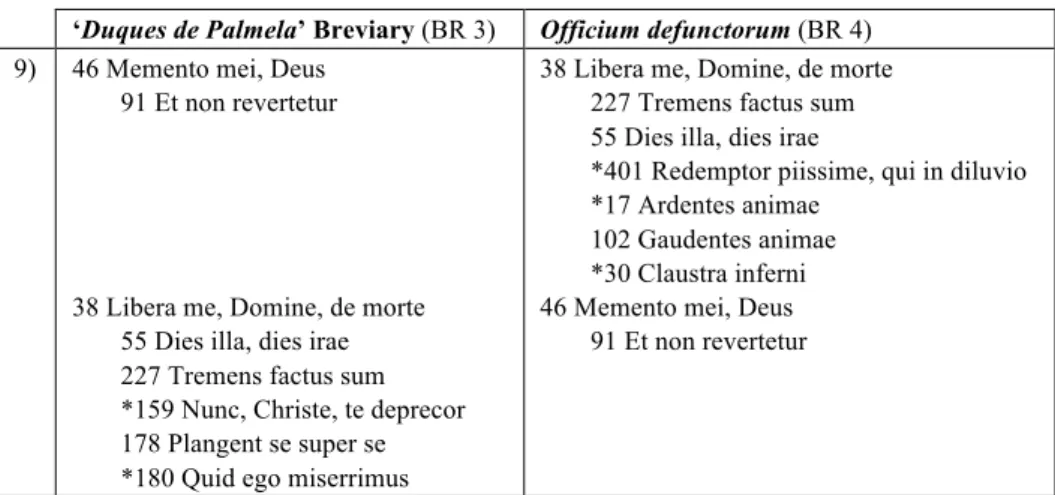
Other formularies in Braga and Coimbra are also similar but for instance, the late-twelfth-century Pontifical de
Coimbra, P-Pm Ms. 353 (Santa Cruz 59), copied in St Rufus or Toulouse and probably used by the bishops of Coimbra,
is different from the roughly contemporary Pontifical de Braga, P-Pm Ms. 1134 (Santa Cruz 83), ff. 1r-141v, surely organized in the region of Toulouse and possibly copied in Portugal for the use of the Church of Braga; see Joaquim O. BRAGANÇA, ‘L’influence de la liturgie languedocienne au Portugal (Missel, Pontifical, Rituel)’, in Liturgie et musique
(IXe - XIVe s.), Cahiers de Fanjeaux 17 (Toulouse, Privat, 1982), pp. 173-84, at pp. 176-80.
2
On the issue of the medieval use of Lisbon, needing further study, see João Pedro d’ALVARENGA, ‘Polifonia portuguesa sacra tardo-quinhentista: Estudo de fontes e edição crítica do Livro de São Vicente, manuscrito P-Lf FSVL 1P/H-6’ (Ph.D. dissertation, Universidade de Évora, 2005), vol. 1, pp. 5-6; and Manuel Pedro FERREIRA, ‘A música religiosa em Portugal por volta de 1500’, in Actas do III Congresso Histórico de Guimarães: D. Manuel e a sua época (Guimarães, Câmara Municipal de Guimarães, 2004), vol. 2, pp. 203-16, at pp. 207-8.
3
The so-called Pontifical de Lamego, P-Lant Ms. C. 22, E. 9-10, P. 7, n.º 3, dated to the thirteenth century, is however related to the late-twelfth-century Pontifical de Braga, of which it seems to be an abridgment, or a copy from a different and less complete exemplar also from the region of Toulouse; see BRAGANÇA, ‘L’influence de la liturgie languedocienne’ (see note 1), pp. 180-1.
The Dioceses of Braga and Coimbra
As early as the latter half of the eighteenth century, António Pereira de Figueiredo, an Oratorian
priest and liturgist, pointed out the influence of Cluny in the liturgy of Braga Cathedral.
4Modern
historians had long acknowledged the influence of the great Burgundian abbey and of its
southern-French and Leonese dependencies and Cluny-modelled independent monasteries on the geopolitics
of late eleventh- and early twelfth-century reconquered Iberia and their central role in the process of
introducing the Franco-Roman rite and uses into its Christian kingdoms, particularly following the
Council of Burgos of 1080, which officially abolished the old Visigothic rite.
5The See of Braga had been restored in 1071. Shortly before 1080, the Franco-Roman rite was
already spreading through the diocese (and in fact through the whole of the north and northwest of
the Iberian Peninsula) by means of the action of Benedictine monks of Cluniac influence.
6Ferdinand I, King of León and Castile, reconquered the city of Coimbra in 1064. Bishop Paterno
(1080-7) instituted, or re-organized, the chapter of the cathedral there in 1086. However, the local
Mozarabic community resisted the imposition of the Franco-Roman rite. This was definitely
introduced and consolidated in both dioceses, Braga and Coimbra, by French bishops, who were
brought by the Cluniac Bernard de Sédirac when he occupied the archiepiscopal seat of Toledo in
1086, after he had reformed the Leonese Monastery of Sts Facundus and Primitivus in Sahagún
(1080): Gerald, or Gérauld, of Moissac in Braga and Maurice Bourdin of Limoges in Coimbra.
Gerald received his education at the Cluniac Abbey of St Peter in Moissac (affiliated to Cluny
in 1048), where he was
custos
armarii
and cantor—that is, the librarian and the one who supervised
liturgy and chant. He lived in Toulouse at the Priory of Notre-Dame de la Daurade for several years
until late 1095 and was then schoolmaster and cantor at Toledo Cathedral. Gerald was made bishop
of Braga in 1099. The following year, he obtained from Pope Paschal II metropolitan dignity for his
church, thus becoming the first archbishop of Braga; he died on 5 December 1108.
7The
ecclesiastical independence of Braga was a first critical step towards the political independence of
Portugal.
4
António Pereira de FIGUEIREDO, Dissertação Crítica sobre o antigo e moderno Calendário Bracarense, para servir de Plano à emenda e reformação que no Breviário e Missal da mesma Santa Igreja medita fazer o Sereníssimo Senhor D.
Gaspar, Arcebispo Primaz, autograph dated Lisbon, 1770, revised in 1781, P-Lac Ms. 259 Azul; fair copies in P-EVp
Ms. CXI/2-14 and Ms. CXII/2-16; see Manuel Pedro FERREIRA, ‘Liturgia bracarense: Origens, fontes, posteridade’, in
O Clero secular medieval e as suas catedrais: Novas perspectivas e abordagens, edited by Anísio Miguel de Sousa
Saraiva and Maria do Rosário Barbosa Morujão (Lisbon, Centro de Estudos de História Religiosa, 2014), pp. 123-40.
5
See the comprehensive overview in Manuel Pedro FERREIRA, ‘Cluny at Fynystere: One Use, Three Fragments’, in
Studies in Medieval Chant and Liturgy: In Honour of David Hiley, edited by Terence Bailey and László Dobszay
(Ottawa, The Institute of Mediaeval Music, 2007), pp. 179-228, at pp. 179-91.
6
See José MATTOSO, ‘Data da introdução da liturgia romana na diocese de Braga’, in Religião e cultura na Idade Média
portuguesa (Lisbon, Imprensa Nacional-Casa da Moeda, 1982), pp. 91-102.
7
On the date of Gerald’s arrival in Braga, see Avelino de Jesus da COSTA, A vacância da Sé de Braga e o episcopado de
S. Geraldo (Braga, Author, 1991); see also Patrick HENRIET, ‘Géraud de Braga (+1108): La problématique Vita d’un
moine-évêque grégorien entre Moissac et Braga (BHL 3415)’, in La reforme ‘grégorienne’ dans le Midi (milieu XIe
Maurice Bourdin took the Benedictine habit in St Martial of Limoges (reformed by Cluny in
1062), was abbot of St Peter in Uzerche in the south Limousin and was then an archdeacon at
Toledo Cathedral. He was also made bishop of Coimbra in 1099, ruling the diocese until early 1109.
On 23 January of that year Maurice had already taken over the archbishopric of Braga, to which he
had been elected upon the death of Gerald.
8The first known complete sources of the use of Braga are the so-called
Missal de Mateus
,
P-BRad
Ms. 1000, and the
Pontifical of Braga
from the twelfth century,
P-Pm
Ms. 1134, ff. 1
r
-141
v
.
The first of these codices was copied in a
scriptorium
of the Limousin region certainly in around
1130-50, was possibly intended for the Priory of Notre-Dame de Bayne, near Moissac, and was then
brought to Portugal and adapted to the use of Braga (the added calendar can be dated to c.1176).
The other was possibly copied in Portugal, surely after 1175, from an exemplar originating in the
region of Toulouse, but with strong connections with Normandy not yet fully explained.
9All the
liturgical and musicological evidence studied so far points to the origins of the use of Braga in a late
eleventh-century liturgy from the diocese of Cahors, though permeated by elements from Limoges,
Toulouse and Tours. Its core is in an abbey reformed by Cluny, which, given the historical
circumstances, cannot be other than that of St Peter of Moissac. In fact, the oldest surviving
breviary from Braga, the so-called ‘
Soeiro
’ Breviary,
P-BRad
Ms. 657, copied in the late fourteenth
or early fifteenth century from an exemplar not later than the mid-1340s, shows a high degree of
affinity with a Moissac breviary from the latter half of the thirteenth century,
F-Pic
Ms. Lat. 1,
10and, with specific regard to the Office responsories and the rubrics, a frequent coincidence with the
so-called
Aquitanian Antiphoner
,
E-Tc
Ms. 44-2. This antiphoner is a manuscript with a Cluniac
background sharing distinctive liturgical elements with Moissac, probably copied in around 1095; if
this was not for Toledo Cathedral, it may at least have been used there. Other elements of the Night
Office in sources from Braga also have parallels in the antiphoner
E-Tc
Ms. 44-1, a manuscript
copied from Aquitanian models possibly in 1020-3 at Sant Sadurní de Tavernòles for the royal court
of Sancho III of Navarre, which eventually reached Toledo.
11The melodic substance in all notated
8
He was then antipope, known as Gregory VIII, from 8 March 1118 until April 1121, and died in Salerno, Italy, sometime after August 1137.
9
On the origins of P-BRad Ms. 1000 and P-Pm Ms. 1134, see Joaquim O. BRAGANÇA, Missal de Mateus: Manuscrito
1000 da Biblioteca Pública e Arquivo Distrital de Braga (Lisbon, Fundação Calouste Gulbenkian, 1975), pp.
xvii-xxxviii; Joaquim O. BRAGANÇA, ‘Pontifical de Braga do século XII’, Didaskalia, 7 (1977), pp. 309-98, at pp. 316-37; and Manuel Pedro FERREIRA, ‘As origens do Gradual de Braga’, Didaskalia, 25 (1995), pp. 57-96, at pp. 70-3.
10
On this important manuscript, see Pedro Romano ROCHA, ‘Les sources languedociennes du bréviaire de Braga’, in
Liturgie et musique (see note 1), pp. 185-207, at pp. 203-5.
11
On E-Tc Ms. 44-1, see Lila COLLAMORE, ‘Toledo, Biblioteca Capitular, 44.1-Its Origin and Date’, in The Past and the Present: Papers Read at the IMS Intercongressional Symposium and the 10th Meeting of the Cantus Planus, Budapest
& Visegrád, 2000, edited by László Dobszay (Budapest, Liszt Ferenc Academy of Music, 2003), vol. 2, pp. 179-206.
(10-manuscripts seems to have its origin in southwestern France, probably around Toulouse, but all
derive from independent sources.
12In contrast to the case of Braga, the origins of the medieval use of Coimbra Cathedral are not at
all clear. This is essentially due to the fact that only a few complete or nearly complete liturgical
sources certainly originating there, or used there, are extant.
13Coimbra was a suffragan see of Braga
from 1103; it is also known that the document of commitment for the division of the cathedral
revenues between the bishop and the chapter, dated 1210, declares the intent of adopting the
organizational model and usage of Braga. This could also have included liturgy. Indeed, a few late
twelfth-century and later sources, mostly fragments, seem to confirm close liturgical and musical
proximity, if not identity, between Coimbra and Braga.
14But a recent analysis of melodic variants
in the corpus of the
Alleluia
from the mass suggests a more complex picture, with sources located in
Coimbra (though not all necessarily from Coimbra) showing closeness to Toledan, Toulousaine,
Limousin and, in a few instances, north-Italian chant traditions.
15This is not at odds with the
12th Centuries), edited by Susana Zapke (Bilbao, Fundación BBVA, 2007), pp. 400 and 404, where different origins
and dates are suggested for E-Tc Ms. 44-1—‘late eleventh-century’, from ‘Central Aquitaine, Sahagún or Toledo, scribes from the south of France’—and E-Tc Ms. 44-2—‘early twelfth-century’, from ‘Aquitaine (Moissac, Aurillac, Toulouse), Sahagún or Toledo’. The first manuscript would represent the beginning of the process of introducing the Franco-Roman rite in Toledo after the reconquest of the city in 1085 and the restoration of its cathedral in 1086 and the latter manuscript would represent the second stage of that process. On E-Tc Ms. 44-2, see also Michel HUGLO and Manuel Pedro FERREIRA, ‘O processional português de Chicago’, Revista Portuguesa de Musicologia, 14-5 (2004-5; published in 2010), pp. 57-78, at p. 62 n. 11 (including the references to the relevant literature on the manuscript), available online at <http://rpm-ns.pt/index.php/rpm/article/view/251/266> (accessed 23 August 2016).
12
Tables 1 and 2 in Appendix I give all the known complete or nearly complete manuscripts and early printed books of the use of Braga. On the origins of the use of Braga and its sources, see the updated survey in Manuel Pedro FERREIRA, ‘A música na Sé de Braga durante a Idade Média: Estado da questão’, in A Catedral de Braga: Arte, liturgia e música,
dos fins do século XI à época tridentina, edited by Ana Maria S. A. Rodrigues and Manuel Pedro Ferreira (Lisbon, Arte
das Musas - CESEM, 2009), pp. 93-135; and the historical overview and bibliography in FERREIRA, ‘Liturgia bracarense’ (see note 4). Although it disregards all previous musicological research on the subject, namely the important work of Manuel Pedro Ferreira, see also Joaquim Félix de CARVALHO, ‘A liturgia em Braga’, Didaskalia, 37 (2007), pp. 139-84. On the relations with Moissac, see Diogo Alte da VEIGA, ‘Twelfth and Thirteenth-Century Breviary Fragments in Moissac and the Rite of Braga: Some Preliminary Insights’, in Musical Exchanges, 1100-1650: Iberian
Connections, edited by Manuel Pedro Ferreira, Iberian Early Music Studies 2 (Kassel, Reichenberger, 2016), pp. 49-58.
13
Besides the two manuscripts on Table 1 below (Co 1 and Co 2), there is only a late processional, P-Cug MM 220, and a printed ritual: Manuale secundum consuetudinem alme Colymbriensis ecclesie (in preclara Lixbonensis civitate, per Nicolaum Gazini, 1518); copy in P-Ln Res. 152 V. digitised at <http://purl.pt/15166>. Solange Corbin also refers to a fourteenth- or fifteenth-century noted breviary opening with the Office of the Dead existing in P-Cua, which is however nowadays untraceable; see her Essai sur la musique religieuse portugaise au Moyen Age (1100-1385) (Paris, Les Belles Lettres, 1952), p. 172, n. 1. On the Missale mixtum (Co 1), see Abílio QUEIRÓS, ‘Missal medieval da Sé de Coimbra’ (Master’s thesis, Universidade de Coimbra, 1993). The so-called Pontifical de Coimbra, P-Pm Ms. 353 (Santa Cruz 59), copied in St Rufus or Toulouse in the late twelfth century, was probably used by the bishops of Coimbra.
14
See Joaquim O. BRAGANÇA, ‘Unctio Infirmorum: Tradições portuguesas do Sacramento dos doentes’, Didaskalia, 2 (1972), pp. 299-360, at pp. 307-9, on the formulary for the Last Sacrament in late sources from Braga, Coimbra and Évora, which is the same in the three uses; and FERREIRA, ‘Cluny at Fynystere’ (see note 5), p. 217 and n. 89, on the invitatory tones in P-Lant Casa Forte, Fragmentos, Caixa 20, n.º 14 (Coimbra Cathedral, late twelfth century) with reference to his ‘Braga’s Invitatory Tones’, in Cantus Planus: Papers Read at the 9th Meeting, Esztergom & Visegrád,
1998 (Budapest, Hungarian Academy of Sciences, 2001), pp. 127-50, and mentioning P-Cug Fragmentos 42 and 43
(first half of the thirteenth century, with no declared provenance), which, Ferreira says, ‘are pure Braga liturgy’.
15
historical circumstances of the imposing of the Franco-Roman rite in Coimbra, given in the first
place the background of Bishop Maurice Bourdin.
The Office of the Dead, as a central element in Cluniac votive liturgy and spirituality, must
have been introduced early in Braga and Coimbra.
16Pre-Tridentine extant sources including it from
both dioceses—all rather late—are shown on Table 1 in approximate chronological order.
Co 1 Votive and festive noted Missal known as Missale
mixtum, Coimbra, second quarter of the 14th
century, with music
P-Cua Cofre 42, olim Estante XVI, tab. 5, n.º 5
(digitised at <http://pemdatabase.eu/source/157>)
BR 1 ‘Soeiro’ Breviary, Braga, late-14th/early-15th century, from a mid-14th century exemplar (c.1340) with readings from a lectionary in use in 1282
P-BRad Ms. 657
Co 2 Psalter-hymnal known as Liber catenatus, Coimbra, mid 14th century (c.1350)17
P-Cua Cofre 27 (digitised at
<http://pemdatabase.eu/source/165>) BR 2 ‘Valasco’ Breviary, Braga, mid 15th century
(1430-40)
GB-Ob Ms. Lat. liturg. e.12
BR 3 ‘Duques de Palmela’ Breviary, Braga, mid 15th century (1431-57)
P-BRs s.s. (from the collection of Avelino de Jesus
da Costa) BR 4 Officium defunctorum, Braga, mid 15th century,
with music
P-BRsem s.s. (presently missing)
BR 5 ‘Fernão Duarte’ Breviary, Braga, latter half of the 15th century (1450-70)
E-E e-IV-10
BR 6 BREVIARIUM bracharense, in augusta Bracharensi ciuitate, per Johannem Gherlinc, 1494
P-AR Res. L 1; P-Cantanhede, Câmara Municipal
s.s. (incomplete copy); P-Ln Inc. 94 (incomplete copy; digitised at <http://purl.pt/22000>) BR 7 BREVIARIUM bracarense, Salmanticae, in prelo
Joannis d’ Porres, 1511-2
E-Mn R. 3305 (dated 1512; incomplete copy); GB-Lbl C.41.a.2 (dated 1511; incomplete copy) BR 8 Gradual, Braga, c.1510-5, with music P-BRs Ms. 34 (digitised at
<http://pemdatabase.eu/source/2350>) BR 9 Sanctoral Antiphoner, Braga, c.1510-20, with music P-BRad Ms. 949
BR 10 Sanctoral Antiphoner, Braga, c.1510-20, with music P-BRs Ms. 28 (digitised at
<http://pemdatabase.eu/source/4547>) BR 11 Psalter, Braga, c.1520, with music P-BRs Ms. 27
BR 12 [BREVIARIUM bracarense, Salamanca, Juan de Porres, 1529]
P-Gms BG 22-1-25 (incomplete copy)
BR 13 BREUIARIUM bracarense, Bracharae, Ioannes Aluarus & Ioannes Barrerius, 1549
E-Mn R. 20798 (incomplete copy); I-Rvat
R.G.Liturg.VI.164; P-Cug R-5-22, R-5-23; P-EVp
Séc. XVI-2423; P-Ln Res. 83 P., Res. 84 P., Res. 1684 P.; P-Universidade de Lisboa, Faculdade de
Letras Res. 231 (digitised at <http://purl.pt/14279>)
Table 1. Sources from Braga and Coimbra including the Office of the Dead
16
The Office of the Dead in the use of Braga is the object of two brief descriptions in Pedro Romano ROCHA, L’Office Divin au Moyen Age dans l'Eglise de Braga: Originalité et dépendances d'une liturgie particulière au Moyen Age
(Paris, Fundação Calouste Gulbenkian - Centro Cultural Português, 1980), p. 101, n. 162, and Pedro Romano ROCHA, ‘Os responsórios do Ofício de Defuntos na liturgia bracarense’, in A Catedral de Braga: Arte, liturgia e música, dos fins
do século XI à época tridentina, edited by Ana Maria S. A. Rodrigues and Manuel Pedro Ferreira (Lisbon, Arte das
Musas - CESEM, 2009), pp. 148-51.
17
A brief look at Table 2 below containing the series of responsories and verses of the Office of
the Dead in Braga and Coimbra shows that the oldest source in each of the dioceses has different
though related series, suggesting different origins within the same liturgical family.
18It also shows
that the series became the same in sources from the mid fourteenth century onwards, suggesting that
one of the dioceses may have adopted the use of the other, at least as regards the Office of the
Dead—though there is no source from Coimbra other than the
Liber catenatus
to confirm this; and
that responsory 82,
Requiem aeternam
, replaces responsory 90,
Subvenite sancti Dei
, in the fourth
position, it would seem sometime in the second quarter of the fourteenth century, the former
responsory appearing as an addition in the ‘
Soeiro
’ Breviary.
Missale mixtum, Coimbra, second
quarter of the 14th c.
‘Soeiro’ Breviary, Braga, late-
14th/early-15th c., from an exemplar from c.1340
Liber catenatus, Coimbra,
c.1350; ‘Valasco’ Breviary, Braga, 1430-40; Braga Breviary printed 1494 and later sources19
1) 14 Credo, quod redemptor 177 Quem visurus
14 Credo, quod redemptor 177 Quem visurus
14 Credo, quod redemptor 177 Quem visurus 2) 72 Qui Lazarum
188 Qui venturus es
72 Qui Lazarum
188 Qui venturus es
72 Qui Lazarum
188 Qui venturus es 3) 24 Domine, quando veneris
34 Commissa mea
24 Domine, quando veneris 34 Commissa mea
24 Domine, quando veneris 34 Commissa mea 4) 90 Subvenite
221 Suscipiat te Christus
90 Subvenite
198 Requiem aeternam 221 Suscipiat te Christus
82 Requiem aeternam[add.]
82 Requiem aeternam
15 Animae eorum in bonis
5) 32 Heu mihi
12 Anima mea turbata
32 Heu mihi
12 Anima mea turbata
32 Heu mihi
12 Anima mea turbata 6) 57 Ne recorderis
59 Dirige, Domine
57 Ne recorderis 59 Dirige, Domine
57 Ne recorderis 59 Dirige, Domine 7) 68 Peccantem me
53 Deus in nomine tuo
68 Peccantem me
53 Deus in nomine tuo
68 Peccantem me
53 Deus in nomine tuo 8) 28 Domine, secundum actum
8 Amplius lava me
28 Domine, secundum actum 222 Tibi soli peccavi
28 Domine, secundum actum 222 Tibi soli peccavi 9) 38 Libera me, Domine, de morte
55 Dies illa, dies irae 227 Tremens factus sum 198 Requiem aeternam
46 Memento mei, Deus 91 Et non revertetur
38 Libera me, Domine, de morte 55 Dies illa, dies irae 227 Tremens factus sum 198 Requiem aeternam
46 Memento mei, Deus 91 Et non revertetur
38 Libera me, Domine, de morte 55 Dies illa, dies irae 227 Tremens factus sum 198 Requiem aeternam
Table 2. The series of responsories and verses of the Office of the Dead in Braga and Coimbra
18
The numbers in Table 2 and thereafter on other tables and the main text before the incipit of responsories and verses refer to their respective catalogue in Knud OTTOSEN, The Responsories and Versicles of the Latin Office of the Dead
(Norderstedt, Tyskland, Books on Demand GmbH, 2007); online interactive version at <http://www.uni-regensburg.de/ Fakultaeten/phil_Fak_I/Musikwissenschaft/cantus/>. I am deeply grateful to Professor David Hiley for kindly providing me with copies of some of Ottosen’s original research materials held by the Institut für Musikwissenschaft at the Universität Regensburg.
19
Since the second nocturn in the
Missale mixtum
—which is in fact a votive and festive missal
for the use of Coimbra Cathedral’s Confraternity of Our Lady—and the ‘
Soeiro
’ Breviary includes
responsories 90,
Subvenite
, 32,
Heu mihi
, and 57,
Ne recorderis
, in the fourth, fifth and sixth
positions respectively, the origins of the Office of the Dead in Braga and Coimbra should be sought
within the realm of the Cluniac reforms. The oldest source of the Office of the Dead from the
Abbey of Cluny is a late thirteenth- or early-fourteenth-century noted breviary copied there for a
parish church in Cluny,
F-SO
Ms. 334.
20The main series of responsories is that of
GB-Ob
Ms.
D’Orville 45, an eleventh-century liturgical collection including a psalter and a hymnal from
Moissac datable to around 1075, which, characteristically, have responsory 46,
Memento mei, Deus
,
in the ninth position. Later sources have responsory 38,
Libera me, Domine, de morte
, as an
alternating responsory in that same position (see Table 3a). This is precisely the series of
responsories in the ‘
Soeiro
’ Breviary.
A variant of the Cluny series has responsory 38,
Libera me, Domine, de morte
, as either the
only final responsory, or responsory 38 as the first of two alternative responsories in position nine.
In St Martial of Limoges, the alternative ninth responsory is 46,
Memento mei, Deus
, in two of its
later manuscript sources: the fourteenth-century noted breviary
F-Pn
Ms. Lat. 783 and the
fifteenth-century fragmentary psalter and book of hours
F-Pn
Ms. Lat. 774
C(see Table 3b). The series of
responsories in the
Missale mixtum
from Coimbra Cathedral, with only responsory 38,
Libera me,
Domine, de morte
, in the ninth position, is thus likely to derive from St Martial, just as Braga’s
earliest series most probably derived from Moissac. In both cases, however, the offices were not
simply transplanted. They must have been introduced in the early twelfth century and they must
have been exposed to other uses and to intermediate exemplars before their earliest extant sources
were copied, because of the discarding of the alternative responsories other than those in the ninth
position, the textual variant at the opening of the third responsory (
Domine, dum veneris
/
Domine,
quando veneris
) and especially the differences in some of the verses attached to the responsories.
Moreover, in both Braga and Coimbra, the readings with which the responsories were sung are not
those of the majority of Cluniac offices—that is, the usual eight Job readings with 2 Macc 12:
42b-46, ‘In diebus illis, vir fortissimus Juda’, as the ninth reading—but the set ending with Job 10:
18-22, ‘Quare de vulva... sempiternus horror inhabitat’, which became the standard Roman readings
from the twelfth century and the most widespread set of readings of the Office of the Dead in the
Middle Ages, particularly in France, England and the Iberian Peninsula.
2120
The Office of the Dead in F-SO Ms. 334 including a transcription and comparison with F-Pn Ms. Lat. 774C is the subject of Suzanne M. HILTON, ‘A Cluniac Office of the Dead’ (MA thesis, University of Maryland, College Park, 2005), available online at <http://drum.lib.umd.edu/handle/1903/3268> (accessed 31 July 2016).
21
F-SO Ms. 334, Noted Breviary, Cluny, late 13th c./early 14th c.
GB-Ob Ms. D’Orville 45,
Psalter-hymnal with complements, Moissac, c.1075
F-Pic Ms. Lat. 1, Breviary,
Moissac, latter half of the 13th c.
1) 14 Credo, quod redemptor 177 Quem visurus
14 Credo, quod redemptor 177 Quem visurus
14 Credo, quod redemptor 177 Quem visurus 2) 72 Qui Lazarum
198 Requiem aeternam
72 Qui Lazarum
198 Requiem aeternam
72 Qui Lazarum
198 Requiem aeternam 3) 24 Domine, dum veneris
34 Commissa mea
36 Induta est caro
60 Nocte os meum perforatur
24 Domine, dum veneris 34 Commissa mea
24 Domine, dum veneris 34 Commissa mea
36 Induta est caro 58 Dies mei velocius
4) 90 Subvenite
198 Requiem aeternam
90 Subvenite
198 Requiem aeternam
90 Subvenite
198 Requiem aeternam 5) 32 Heu mihi
12 Anima mea turbata
32 Heu mihi
12 Anima mea turbata
32 Heu mihi
12 Anima mea turbata 6) 57 Ne recorderis
151 Non intres in judicio
67 Paucitas dierum
84 Scio, Domine
57 Ne recorderis
151 Ne intres in judicio
57 Ne recorderis
151 Ne intres in judicio
67 Paucitas dierum 135 Manus tue, Domine
7) 68 Peccantem me 53 Deus in nomine tuo
68 Peccantem me 53 Deus in nomine tuo
68 Peccantem me 53 Deus in nomine tuo 8) 28 Domine, secundum actum
8 Amplius lava me
46 Memento mei, Deus
28 Domine, secundum actum 8 Amplius lava me
28 Domine, secundum actum 8 Amplius lava me
60 Nocte os meum perforatur 158 Nunc autem in memetipso
9) 46 Memento mei, Deus 91 Et non revertetur
38 Libera me, Domine, de morte 55 Dies illa, dies irae 227 Tremens factus sum 180 Quid ego miserrimus 178 Plangent se super se 38 Creator omnium rerum
46 Memento mei, Deus 91 Et non revertetur
46 Memento mei, Deus 91 Et non revertetur 38 Libera me, Domine, de morte
55 Dies illa, dies irae 198 Requiem aeternam 38 Creator omnium rerum 392 Mortis mors, o Jesu Christe 173 Quando Deus, filius virginis 261 Post haec dicit
393 Bonum est confidere 227 Tremens factus sum 55 Dies illa, dies irae
159 Nunc, Christe, te deprecor 178 Plangent se super se
Table 3a. The Cluniac series: Cluny and Moissac22
12: 42b-46; in the Roman office it is Job 10: 18-22. See OTTOSEN, The Responsories and Versicles (see note 18), pp. 53-60, 62-4.
22
F-Pn Ms. Lat. 1088 (2),
Antiphoner, St Martial, late 13th c./early 14th c.
F-Pn Ms. Lat. 783, Noted Breviary, St Martial, 14th c.
F-Pn Ms. Lat. 774C, Psalter and book of hours, St Martial, 15th c.
1) 14 Credo, quod redemptor 177 Quem visurus
14 Credo, quod redemptor 177 Quem visurus
14 Credo, quod redemptor 177 Quem visurus 2) 72 Qui Lazarum
198 Requiem aeternam
72 Qui Lazarum
198 Requiem aeternam
72 Qui Lazarum
198 Requiem aeternam 3) 24 Domine, dum veneris
34 Commissa mea
24 Domine, quando veneris 34 Commissa mea
36 Induta est caro
57 Dies mei sicut umbra
24 Domine, quando veneris 34 Commissa mea
36 Induta est caro 58 Dies mei velocius
4) 90 Subvenite
221 Suscipiat te Christus 198 Requiem aeternam
90 Subvenite
221 Suscipiat te Christus 198 Requiem aeternam
56 Ne perdideris me 144 Miserere mei Deus
90 Subvenite
198 Requiem aeternam
56 Ne perdideris me 144 Miserere mei Deus
5) 32 Heu mihi
12 Anima mea turbata
32 Heu mihi
12 Anima mea turbata
32 Heu mihi
12 Anima mea turbata 6) 57 Ne recorderis
151 Non intres in judicio
57 Ne recorderis
151 Non intres in judicio
67 Paucitas dierum 82 Ecce in pulvere
57 Ne recorderis
151 Non intres in judicio
67 Paucitas dierum 82 Ecce in pulvere
7) 68 Peccantem me
53 Deus in nomine tuo
68 Peccantem me
53 Deus in nomine tuo
68 Peccantem me
53 Deus in nomine tuo 8) 28 Domine, secundum actum
8 Amplius lava me
40 Libera me, Domine, de viis 31 Clamantes et dicentes
28 Domine, secundum actum 8 Amplius lava me
84 Scio, Domine
387 Tu quidem gressus
28 Domine, secundum actum 8 Amplius lava me
84 Scio, Domine
387 Tu quidem gressus
9) 38 Libera me, Domine, de morte 227 Tremens factus sum 55 Dies illa, dies irae 243 Vix justus... et ego
38 Libera me, Domine, de morte 227 Tremens factus sum 55 Dies illa, dies irae 243 Vix justus... et ego 46 Memento mei, Deus
91 Et non revertetur
38 Libera me, Domine, de morte 227 Tremens factus sum 55 Dies illa, dies irae 243 Vix justus... et ego 46 Memento mei, Deus
91 Et non revertetur
Table 3b. The Cluniac series: St Martial
The first different verse in the earliest known sources from Braga and Coimbra is the one
attached to responsory 72,
Qui Lazarum
. All Cluniac series dating from before the twelfth century
have verse 198, ‘Requiem aeternam’, with this responsory. Verse 188, ‘Qui venturus es’—which
Ottosen says is the usual verse with responsory 72, belonging to ‘the current repertoire in France in
the 11th century’
23—appears more frequently in series from central-French Benedictine abbeys
independent from Cluny, even if their Office of the Dead is a variation of, or derives from, the
Cluniac office. This is the case for instance, of Montier-la-Celle in the diocese of Troyes, south
Champagne, whose breviary,
F-T
Ms. 109, dated to the latter half of the thirteenth century, has both
verses, 188, ‘Qui venturus es’, and 198, ‘Requiem aeternam’, in that order, attached to responsory
72,
Qui Lazarum
, probably signifying that the first verse is an addition; a fifteenth-century hymnal
and diurnal from Saint-Vanne in Verdun,
F-VN
Ms. 131,
has only verse 188, ‘Qui venturus es’. This
is also the case with all Iberian Benedictine late printed sources.
24Responsory 90,
Subvenite sancti Dei
, arguably one of the oldest elements of the funeral liturgy
since it belonged to the Old Roman repertory, has two verses in the majority of the Cluniac series:
221, ‘Suscipiat te Christus’ (or ‘Suscipiat eas’/‘eam’ in a few cases), and 198, ‘Requiem aeternam’,
which seems to be the commonest and oldest one. In some series both verses appear in succession,
suggesting that the first verse, 221, is an addition. Such are the cases of the first two sources from St
Martial on Table 3b and also of older sources such as
F-Pn
Ms. Lat. 12042, a collectar from
Saint-Maur-des-Fossés datable to the latter half of the twelfth century.
25In Saint-Maur, verse 198,
‘Requiem aeternam’, was eventually discarded, judging from its early-thirteenth-century breviary,
F-T
Ms. 1752 (with only the variant of verse 221, ‘Suscipiat eas Christus’, since the office it
contains is intended for ‘memoria defunctorum’). This could have been the case in Coimbra as
regards responsory 90,
Subvenite sancti Dei
, although a few early Iberian sources apparently with
no Cluniac connections, such as the late-eleventh-century
Antiphoner of Silos
,
GB-Lbl
Add. Ms.
30850, have only verse 221 with responsory 90. The ‘
Soeiro
’ Breviary parallels two late sources
from Cluny, the 1479 printed breviary
26and the book of hours printed in around 1502 and later
adapted to the use of St Peter of Corbie,
27which also have responsory 90 followed by verses 198,
‘Requiem aeternam’, and 221, ‘Suscipiat te Christus’, in that order.
23
OTTOSEN, The Responsories and Versicles (see note 18), p. 224. In the 1672 occurrences of responsory 72, Qui
Lazarum, recorded by Ottosen, verse 188, ‘Qui venturus es’, is attached to it in 796 different series.
24
As for instance, the Officium defunctorum printed in Montserrat by Juan Luschner in 1500 for San Benito el Real in Valladolid (copy in GB-Lbl K.8.f.18); on this print, see Màrius BERNADÓ, ‘Un programa de libros litúrgicos para la Congregación de San Benito de Valladolid: Los impressos de Luschner en Montserrat’, in ‘New Music’1400-1600: Papers from an International Colloquium on the Theory, Authorship and Transmission of Music in the Age of the
Renaissance (Lisbon-Évora, 27-29 May 2003), edited by João Pedro d’Alvarenga and Manuel Pedro Ferreira (Lisbon -
Évora, CESEM - Centro de História da Arte e Investigação Artística - Casa do Sul Editora, 2009) pp. 77-127, at pp. 110-3 and 126-7.
25
It also happens in the 1500 printed Officium defunctorum (see note 24) and all later Iberian Benedictine prints.
26
Breviarium Cluniacense (Venezia, Franz Renner, 1479), copy in F-Pn Res.B.27827.
27
Horae ad usum Cluniacensem (Paris, [Philippe Pigouchet], c.1502), with manuscript additions datable to c.1530, F-Pn
Verses 59, ‘Dirige Domine’, with responsory 57,
Ne recorderis
, and 222, ‘Tibi soli peccavi’,
with responsory 28,
Domine, secundum actum
, could have resulted from a similar process of
addition eventually leading to the substitution of the newest verse for the earlier one (151,
‘Non’/‘Ne intres in judicio’, and 8, ‘Amplius lava me’, respectively). The mid thirteenth-century
breviary
F-VENbm
Ms. 17 E from La Trinité de Vendôme, a Benedictine abbey not dependent on
Cluny, serves as an illustration of this phenomenon as it has verses 59 and 151 in succession
following responsory 57. A number of both early and late Benedictine Iberian sources, however,
have verses 59, ‘Dirige Domine’, and 222, ‘Tibi soli peccavi’, as the apparently original choices to
go with responsories 57,
Ne recorderis
, and 28,
Domine, secundum actum
, respectively. An
example of the latter case is again the
Antiphoner of Silos
. But the more likely explanation for the
presence of verses 188, ‘Qui venturus es’, and 59, ‘Dirige Domine’, in the first extant series from
Coimbra Cathedral and of verses 188, 59, and 222, ‘Tibi soli peccavi’, in the earliest known series
from Braga is contamination, either through the mediation of Toledo or later Dominican influence
and, in the latter case, also because of the geographical proximity to Compostela.
28In addition,
given the relatively late date of the
Missale mixtum
and the ‘
Soeiro
’ Breviary and the common tail
of verses following responsory 38,
Libera me, Domine, de morte
, acquaintanceship with the
Roman-Franciscan Office of the Dead is not to be overruled, even if the influence of the mendicants
on diocesan uses is not wholly acknowledged before the sixteenth century.
29Studies on the liturgical use of Braga and its chant tradition, at times touching upon the uses of
Évora and Coimbra, have stressed the role of late eleventh- and early twelfth-century French
prelates and Cluniac monks, and the mediation of Toledo and the Cluniac Leonese monasteries in
the importation of the Franco-Roman rite and the shaping of Portuguese medieval diocesan uses.
However, the important wave of southern-French bishops and clergymen in Coimbra in the latter
quarter of the thirteenth century and the first half of the fourteenth century coming from the region
of Quercy and particularly from the diocese of Cahors, mainly members of the Ébrard family and of
28
The popularity of the use of Compostela in the archdiocese of Braga is acknowledged by Sisto Figueira who, in the prologue to his Arte d’ rezar as horas canonicas ordenada segundo as regras & costume Bracharensse (Salamanca, Lourenço de Leon d’ Dei, 1521), says that it is ‘em especial o costume compostelano que em estas partes mais se usa depois do bracarense’ [especially the use of Compostela that is most used in these parts after the use of Braga]. The series of responsories of the Office of the Dead in Compostela is 14, 72, 24, 32, 57, 40, 68, 28, 38 and the respective series of verses is 197, 188, 47, 12, 59, 31, 50, 222, 55, 198 and 116; see Breviarium ad ritum et consuetudinem almae
Compostellanae ecclesiae (Ulyssipone, Nicolaus de Saxonia, 1497), ff. Kiiiiv-[Kvi]v, incomplete copies in E-Mn Inc.
874 and E-Mh Inc. 148, digitised at <http://bibliotecadigital.rah.es/dgbrah/es/consulta/registro.cmd?id=44556> (accessed 22 August 2016). The series of responsories in Toledo is 14, 72, 82, 32, 57, 40, 68, 46, 38 and the respective series of verses is 177, 188, 15, 12, 59, 31, 53, 50, 55, 227 and 198; see Breviarium secundum morem ecclesiae
Toletanae (Venezia, Johannes [Hamman] Hertzog, 1492), ff. 253r-254v, copy in E-Mn Inc. 415, digitised at
<http://bdh.bne.es/bnesearch/biblioteca//qls/bdh0000097182> (accessed 22 August 2016).
29
other related families, a number of them having previously served in Spanish dioceses, should not
be overlooked. During this period—which is the period when most of the earliest complete extant
liturgical sources at stake were compiled—the chapters of Lisbon, Évora and Coimbra cathedrals
especially admitted many French canons and dignitaries, thanks to the common practice of
nepotism. Coimbra had four French bishops: Aymeric d’Ébrard (1279-95), Raymond d’Ébrard I
(1319-24), Raymond d’Ébrard II (1325-33) and Jean des Prez (1334-8;
in absentia
). In the mid
fourteenth century too, Lisbon had French bishops (though often absent and relying on vicars of
southern-French origin)—Étienne de la Garde (1344-8), Théobald de Castillon (1348-56) and
Reginald de Maubernard (1356-8)—and so had Braga—Guillaume de la Garde (1349-61) and Jean
de Cardaillac (1361-71).
30That Coimbra had some degree of independence not only in pastoral but also in liturgical
matters can be seen from the early introduction of new feasts into the diocese:
Corpus Christi
by
Bishop Aymeric in the 1280s or early 1290s and the Immaculate Conception by his nephew,
Raymond I, on 17 October
1320.
31This latter feast was introduced in Braga five years later, in
1325.
32It is thus quite possible that some of the elements of the use of Braga common to other
diocesan uses and attested only by relatively late sources were after all brought from its suffragan
dioceses. This could have been the case with the Office of the Dead in the form that first appears in
the mid fourteenth-century
Liber catenatus
from Coimbra Cathedral and was then adopted in the
fifteenth-century breviaries from Braga including the 1494 printed
Breviarium bracharense
and
later sources as far as the choice of texts is concerned. A detail, however—the presence of verse
222, ‘Tibi soli peccavi’, in the
Liber catenatus
, which was already part of the oldest known series in
Braga—suggests otherwise, that Coimbra adopted the ‘new’ office from Braga.
The most prominent feature of this ‘new’ office is the substitution of responsory 82,
Requiem
aeternam
, for responsory 90,
Subvenite
, making the series of responsories similar to that of the
Abbey of La Croix-Saint-Leufroy in the diocese of Évreux, Normandy, and to a number of series
30
See Maria do Rosário Barbosa MORUJÃO, ‘La famille d’Ébrard et le clergé de Coimbra aux XIIIe et XIVe siècles’, in A
Igreja e o Clero português no contexto europeu (Lisbon, Centro de Estudos de História Religiosa, 2005), pp. 77-91,
taking up an issue already addressed by Pierre DAVID, ‘Français du Midi dans les évêchés portugais (1279-1390)’,
Bulletin des Études Portugaises, 9 (1943), pp. 16-70, and Gérard PRADALIÉ, ‘Quercynois et autres méridionaux au
Portugal à la fin du XIIIe et au XIVe siècle: L’exemplede l’Église de Coimbra’,Annales du Midi:Revue archéologique,
historique et philologique de la France méridionale, 94 (1982), pp. 369-86.
31
In 1324, Raymond d’Ébrard I bequeathed to the chapter of Coimbra Cathedral a manuscript containing the new feasts of
Corpus Christi and the Immaculate Conception of Our Lady, which he wanted to be celebrated solemnly; DAVID,
‘Français du Midi’ (see note 30), p. 30. Both feasts already appear in the Missale mixtum the latter, however, still without a proper office and mass, most of their texts being taken from the Feast of the Nativity of Our Lady; see QUEIRÓS, ‘Missal medieval’ (see note 13), pp. 154-5.
32
See ROCHA, L’Office Divin (see note 16), pp. 192-3 n. 324. The first reference to the feast of Corpus Christi in Braga is in the inventory of the chapel of Archbishop Lourenço Vicente in 1397 (see note 29); see again ROCHA, L’Office Divin
from churches in the orbit of Rheims.
33However, aside from a long-lasting trading relation, no
other institutional or ecclesiastical connection with Normandy and the north of France is known at
that time.
34A number of Spanish uses also have responsory 82,
Requiem aeternam
, with verse 15,
‘Animae eorum’, in the third position (for instance, Toledo and Seville) or in the fourth position
(Lleida). The Carmelite and the Sarum series include it in position eight, but coupled with verse
185, ‘Qui Lazarum resuscitasti’.
35It should be noted that responsory 90,
Subvenite sancti Dei
, even
if replaced in the Office of the Dead, still remained in the commendation rites of both dioceses,
whose formularies are nevertheless different in Braga and Coimbra. The replacement of responsory
90,
Subvenite sancti Dei
, with responsory 82,
Requiem aeternam
, must have taken place between
1320-5 and 1341-55,
termini post quem
for the
Missale mixtum
and the
Liber catenatus
respectively.
36This possibly occurred during the prelacy of Archbishop Gonçalo Pereira in Braga
(1326-48) or his successor, Guillaume de la Garde (1349-61), and Bishop Jorge Eanes in Coimbra
(1338-56).
37The introduction of responsory 82,
Requiem aeternam
—it being a plea for the everlasting peace
of the soul of the deceased—was perhaps a response to the slow acceptance of the idea of a
necessary suffering in purgatory before the ultimate redemption of the individual. The perception of
death, purgation and final salvation as a matter of each one’s body and soul became more and more
acute in the course of the thirteenth century and the early fourteenth century.
38The change in the
series of responsories might however have been prompted by a major event with heavy social and
33
Except for the responsories in position nine: La Croix-Saint-Leufroy has only 46, Memento mei, Deus, as the final responsory; Rheims has 38, Libera me, Domine, de morte, or this latter one as an alternating to responsory 40, Libera
me, Domine, de viis. See OTTOSEN, The Responsories and Versicles (see note 18), pp. 144-5. It should be noted that the
series of La Croix-Saint-Leufroy came from sixteenth-century sources; being a Benedictine abbey, though independent from Cluny, its earliest series, as in Braga, could have had responsory 90, Subvenite, in the fourth position.
34
The Archbishop of Rheims, Jean de Vienne, was however in the Iberian Peninsula in 1337 as an envoy of the king of France in order to mediate in a conflict between Portugal and Castile, which ended with the signing of a peace treaty in Seville in late 1338. See Ardian MUHAJ, ‘Quando todos os caminhos levavam a Portugal: Impacto da Guerra dos Cem Anos na vida económica e política de Portugal (séculos XIV-XV)’ (Ph.D. dissertation, Faculdade de Letras da Universidade de Lisboa, 2013), pp. 51-3.
35
This is also the case with the late-eleventh-century Antiphoner of Silos, which has responsory 82 with verse 185 as the first responsory in position nine. Verse 185 is by far the most common with responsory 82.
36
The first manuscript includes the feast of the Immaculate Conception of Our Lady, instituted in Coimbra in 1320 (see note 31); the second one already has the hymns for the feast of the Victoria Christianorum, instituted in commemoration of the Battle of Salado immediately after it had taken place near Tarifa, southern Andalusia, on 30 October 1340. On this feast, see Solange CORBIN, ‘Fêtes portugaises: Commémoration de la victoire chrétienne de 1340 (Rio-Salado)’, Bulletin Hispanique, 49/2 (1947), pp. 205-18.
37
It is worth noting that Archbishop Gonçalo Pereira was previously Prior of the Hospitallers before the headquarters of the Order was moved from Leça do Bailio in the north of Oporto to Crato in the northeast of the Alentejo province in 1340 and that at least three late Hospitallers liturgical sources of different provenance include responsory 82 in the series of the Office of the Dead (two of them by adopting the Sarum series; see OTTOSEN, The Responsories and
Versicles (see note 18), p. 237).
38
spiritual impact. Such an event could have been the outbreak of bubonic plague which began
suddenly in autumn 1348, and which, within just a few months, wiped out a third to half of the
Portuguese population. There is an additional circumstance that could have favoured the inclusion
of responsory 82,
Requiem aeternam
, into the series of responsories of the Office of the Dead in
Braga and Coimbra. This is its likely use in the anniversary memorial service of Kings Afonso
Henriques and Sancho I, performed annually on 6 December at the church of the Monastery of
Santa Cruz in Coimbra. In the existing descriptions of the ceremony, no mention is made of a
specific responsory, but a mid-sixteenth-century polyphonic source suggests that responsory 82,
Requiem aeternam
, was used in that context.
39Three lesser-known fifteenth-century sources from Braga feature untypical elements as regards
the Office of the Dead. The ‘
Fernão Duarte
’ Breviary, written possibly in 1478 though representing
the breviary used in Braga between 1450 and 1470,
40has the series of responsories proper to Santa
Cruz in Coimbra. This manuscript still awaits a comprehensive study, but the final remarks of its
brief presentation by Pedro Romano Rocha suggest the possibility of it having been compiled not
for Braga, but for a church in its suffragan diocese of Oporto.
41The mid-fifteenth-century
Officium defunctorum
inverts the alternative responsories in position
nine. This manuscript and the likely contemporary ‘
Duques de Palmela
’ Breviary present different
sequences of verses after responsory 38,
Libera me, Domine, de morte
(see Table 4).
42A rubric in
this breviary explains the circumstances when responsory 38 is to be used: at the obsequies when
the body of the deceased is present and on the anniversaries of important people, such as the king or
the bishop. Four of the verses in these mid-fifteenth-century sources are unique variants of existing
texts. One, ‘Redemptor piisime, qui in diluvio’, is an abridgment of verse 401, ‘Rector
clementissime’, which is unique to
GB-Ob
Lat. liturg. g.1, an early fifteenth-century English psalter
from the Benedictine Priory of St Bees in Cumbria (or, on the contrary, verse 401 is an elaboration
of the text in the Braga source; see Table 5). The first four verses in the ‘
Duques de Palmela
’
Breviary also occur in the Moissac Breviary,
F-Pic
Ms. Lat. 1. According to Solange Corbin, not
only the versions of the texts but also the chant of the uncommon verses in the now missing
Officium defunctorum
are proper to Braga.
4339
See João Pedro d’ALVARENGA, ‘A Neglected Anonymous Requiem Mass of the Early Sixteenth Century and its Possible Context’, Musica Disciplina, 57 (2012), pp. 155-89.
40
See Pedro Romano ROCHA, ‘Um breviário bracarense na Biblioteca do Escorial’, Lusitania Sacra, 9 (1970-1), pp. 41-54, at p. 42.
41
ROCHA, ‘Um breviário bracarense’ (see note 40), p. 54.
42
Since the Officium defunctorum, P-BRsem s.s., is now missing, for its contents and texts I relied on ROCHA, ‘Os responsórios do Ofício de Defuntos’ (see note 16), pp. 150-1.
43
‘Duques de Palmela’ Breviary (BR 3) Officium defunctorum (BR 4) 9) 46 Memento mei, Deus
91 Et non revertetur
38 Libera me, Domine, de morte 55 Dies illa, dies irae 227 Tremens factus sum *159 Nunc, Christe, te deprecor 178 Plangent se super se *180 Quid ego miserrimus
38 Libera me, Domine, de morte 227 Tremens factus sum 55 Dies illa, dies irae
*401 Redemptor piissime, qui in diluvio *17 Ardentes animae
102 Gaudentes animae *30 Claustra inferni 46 Memento mei, Deus
91 Et non revertetur
Table 4. Untypical features in the final alternative responsories in two mid-fifteenth-century sources from Braga
[17] Ardentes animae *ardent* sine fine, *ardent* sine fine, ambulant per tenebras, dicuntque singulae: vae, vae, vae, quantae sunt tenebrae.
*flent* in all other 28 known sources.44
[30] Claustra inferni confractae sunt, *portae paradisi apertae sunt, sed tu, Domine, dona eis requiem.*
*et monumenta sanctorum aperta sunt, et vox omnium eorum dicit: Jam advenisti rex* in the two other sources, F-AI Ms. 15 and an unidentified source from Oviedo dated 1556, where the verse is attached not to responsory 38 but to responsory
40, Libera me, Domine, de viis.45
[159] Nunc, Christe, te deprecor, miserere, peto, qui venisti redimere *perditum*, veni salvare.
*perpetim* in all other 175 sources where this verse occurs, except in two English and two northern-central-French sources including F-Pn Ms. Lat. 12042, which have ‘perditum, noli damnare redemptum’, and F-AI Ms. 15, which has a completely different and unique text after ‘miserere, peto’.46
[180] Quid ego miserrimus, quid dicam vel quid faciam *cum vil bonis perferam ante tantum indicem indicantem.* *cum nil boni perferam ante tantum judicium* in all other 653 known sources.47
GB-Ob Lat. liturg. g.1 P-BRsem s.s. (BR 4)
[401] Rector clementissime, qui in diluvio reservasti Noe,
et Abrahe demonstrasti trinitatem ad radicem Mambre, in
specie columbae descendisti in Jordanis flumine, aquam vertisti in vinum in Chana Galilee. Hely, hely clamasti
suspensus in cruce, ad latronem dixisti: amen dico tibi
hodie mecum eris in paradiso sine crimine. Alme pater,
Jesu Christe, dum veneris in regnum tuum, memento mei,
Domine.
[401] Redemptor piisime,* qui in diluvio salvasti Noe, in specie columbae descendisti in Jordanem, aqua vinum mutasti in Cana Galilae, Hely, hely clamasti in cruce, ad latronem dixisti: amen dico tibi hodie mecum eris in paradiso. Domine memento mei, dum veneris in regnum tuum.
* The vocative ‘Redemptor piisime’ is taken from verse 302, which occurs in only six sources including F-AI Ms. 15, its earliest source, and is composed in the same vein.48
Table 5. The text of the uncommon verses from Braga
44
See OTTOSEN, The Responsories and Versicles (see note 18), p. 404.
45
See OTTOSEN, The Responsories and Versicles (see note 18), p. 405.
46
See OTTOSEN, The Responsories and Versicles (see note 18), p. 413; three other sources feature different minor variants.
47
See OTTOSEN, The Responsories and Versicles (see note 18), p. 416; the incipit of this verse is ‘Quid ergo miserrimus’ in 497 cases.
48
Owing to the fact that
F-AI
Ms. 15—a lectionary followed by a fragmentary antiphoner
possibly used in Nîmes (because it includes a special office for St Baudile) but originating in Albi
or St Michel of Gaillac (because of its palaeographical characteristics) and datable to before 1042—
is an early source not only for some of the rare verses much later edited in Braga but also for
responsory 82,
Requiem aeternam
, with verse 15, ‘Animae eorum’,
49one would be tempted to think
that a copy of its contents, or a similar manuscript from the same liturgical orbit, could have reached
Portugal either through Braga in the early twelfth century or through Coimbra in the late thirteenth
or early fourteenth century. However, the versions of the verses in the Albi-Gaillac/Nîmes source
(including a unique text for the final part of verse 159, ‘Nunc, Christe’) are not compatible with the
versions in Braga. In addition, the version of responsory 82,
Requiem aeternam
, it contains could
hardly have been the model for this responsory in Braga, though they both clearly belong to the
same southwestern French melodic tradition.
50There are six points of variation between
F-AI
Ms.
15 and the available manuscripts from Braga (
P-BRs
Mss. 27, 28 and 34, and
P-BRad
Ms. 949).
Three of these differences are particularly significant: two in the melisma on the first syllable of
‘luceat’ and the termination of the verse tone. One other southern-French source, the late
fourteenth-century Pontifical of Couserans,
F-SOM
Ms. 250, presents even more marked variance
(see Example 1 in Appendix I). As regards specifically the uncommon verses attached to responsory
38,
Libera me, Domine, de morte
, the fact that the long version of ‘Rector clementissime, qui in
diluvio’ is, to our knowledge so far, unique to an English Benedictine source suggests a
northern-French connection rather than a southern one.
51The series of responsories and verses established in
the mid-fifteenth-century ‘
Valasco
’ Breviary is however the one that prevailed in the first printed
breviary from Braga and later sources (see Table 2 above).
49
See OTTOSEN, The Responsories and Versicles (see note 18), pp. 317-8 and n. 351; Olivier CULLIN, ‘Une pièce gallicane conservée par la liturgie de Gaillac. L’offertoire Salvator mundi pour les défunts’, in Liturgie et musique (see note 1), pp. 287-96, at pp. 289-90. The oldest source for verse 15, ‘Animae eorum’, seems to be the late ninth-century Gradual and Antiphoner from Albi, F-AI Ms. 44.
50
The common, certainly northern, chant for this responsory begins with one of mode-7 characteristic opening gestures: G-a (G) G-a-c, or G-a (G) F-a-C; for a structural analysis of mode-7 responsories, see Kate HELSEN, ‘The Great Responsories of the Divine Office: Aspects of Structure and Transmission’ (Ph.D. dissertation, Universität Regensburg, 2008), pp. 202-31.
51
The Diocese of Évora and the Augustinian Monastery of Santa Cruz in Coimbra
Except for a late missal and a set of processionals, no other manuscripts of the use of Évora have
been certainly identified so far.
52The main liturgical books—missal, breviary and ritual—were
however printed before the acceptance of the reformed Roman liturgy.
53The restoration of the See of Évora took place in 1166, shortly after the reconquest of the city
from the Almoravid Moors by the troops of Giraldo Giraldes in September 1165 on behalf of King
Afonso Henriques. In order to attract people who could defend it, the city of Évora was granted its
charter in April 1166. A bishop was immediately appointed and consecrated by the archbishop of
Braga. Although in 1120 Pope Calixtus II had assigned to Compostela metropolitan rights over
Évora and all other suffragan dioceses of the old Visigothic metropolis of Merida (even if they were
at the time under Moorish rule), the archbishops of Braga and the Portuguese kings never ceased to
plead for the cause of the jurisdiction of Braga over Portuguese dioceses, as this was a vital political
matter for the independence of the newly-founded kingdom.
54But in 1199, Pope Innocent III
definitely determined that the archbishop of Compostela exerted full metropolitan authority over
most of the ancient province of Lusitania including the dioceses of Évora and Lisbon, while Braga
retained authority over its Galician suffragan dioceses.
55Even if initially dependent on Braga, Évora
thus remained a suffragan diocese of Compostela until 1394, when Lisbon was raised to the dignity
of a metropolitan church.
56Évora passed to the jurisdiction of the new metropolis until it was in its
turn raised to metropolitan archbishopric in 1540.
57The background of the first two bishops of Évora after the restoration of the diocese, Dom
Soeiro I (1166-76) and Dom Fernando I (1177-9), is not known. But the third bishop, Dom Paio
(elected 1180-6; in residence 1186-1204), was apparently an Augustinian Canon Regular. If
Nicolau de Santa Maria is accurate in his
Chronica
,
58in 1152, shortly after his return from Paris
where he had studied at the University, Dom Paio took the habit at the Monastery of Santa Cruz in
Coimbra. Sometime between 1160 and 1162, when Dom Godinho, a canon from Santa Cruz who
was then charged with the reformation of the Monastery of São Salvador de Banho near Barcelos in
52
See Table 1 in Appendix II. In addition, there is an Évora-related festive missal, P-SEad Ms. 317 (24/17111/4), copied for the use of the Confraternity of Nossa Senhora da Anunciada in Setúbal by João de Beja, bacharel of Évora Cathedral, and dated 25 April 1474.
53
Table 2 in Appendix II gives all the known printed books of the use of Évora, including an incunabulum of which no copy is apparently extant.
54
The establishment of an independent Kingdom of Portugal was a complex political, military and diplomatic process, which of course involved many issues of ecclesiastical jurisdiction. This is thoroughly detailed and explained most notably and recently in José MATTOSO, D. Afonso Henriques (Lisbon, Temas e Debates, 2006).
55
Bull In causa duorum, issued on 2 June 1199.
56
Bull In eminentissimae dignitatis, issued by Pope Boniface IX on 10 November 1394.
57
Bull Gratiae divinae praemium, issued by Pope Paul III on 24 September 1540.
58