BY CORYNEBACTERUIM PSEUDOTUBERCULOSIS EGYPTIAN ISOLATES FROM SHEEP AND BUFFALOES
Selim, S.A.1; Mousa, W.M.1; Mohamed, K.F.2; Moussa, I.M.3*
1
Biotechnology Center for Veterinary Services and Research (BCVSR), Faculty of Veterinary Medicine, Cairo University; 2
Department of Microbiology, Faculty of Veterinary Medicine, Cairo University; 3Center of Excellence in Biotechnology (CEBER) King Saud University, P. O. 2460 Riyadh King Saudi Arabia.
Submitted: February 26, 2011; Returned to authors for corrections: May 09, 2011; Approved: January 16, 2012.
ABSTRACT
Fourteen isolates of Corynebacteruim pseudotuberculosis of them 7 were isolated from sheep with Caseous
Lymphadenitis “biotype 1” and 7 isolated from buffaloes with Oedematous Skin Disease “biotype 2”. All
isolates were identified by standard microbiological techniques and by polymerase chain reaction targeting,
16S rRNA and phospholipase D genes. Synergistic haemolytic titers of all isolates were assayed by plate
technique. The presences of phospholipase D gene in supernatants of all isolates were performed by sodium
dodecyl sulfate polyacrylamide gel electrophoresis immunoblot technique by using hyperimmune serum
raised in rabbit immunized with recombinant phospholipase D gene antigen. The concentration of phospholipase D gene was assayed by scanning the bound phospholipase D gene with specific antibodies
that appeared at 31.5 kDa. Results presented that there is no correlation between titer of Synergistic
haemolytic activity and the actual phospholipase D genes concentration in culture supernatants. Also results
presented that Synergistic haemolytic activity and phospholipase D genes produced by biotype 2 (buffalo
isolates) was generally higher than those by biotype 1(sheep isolates).
Key words: Corynebacteruim pseudotuberculosis, Oedematous Skin Disease, Caseous Lymphadenitis,
recombinant PLD, Synergistic haemolysis.
INTRODUCTION
Phospholipase D (PLD) is a potent exotoxin produced by
Corynebacteruim pseudotuberculosis of sheep origin (9, 11,
26) and by buffalo isolates (8). PLD is a secreted exotoxin that
possesses sphingomyelinase activity and has been shown to increase vascular permeability IN vivo (2, 30), exhibit
synergistic haemolysis (SH) of sheep blood cells in the
presence of products from Rhodococcus equi and reduce the viability of ovine neutrophilis (2). Depending upon the
information that PLD is the major virulence factor in C.
pseudotuberculosis , many significant efforts have been made
to produce effective caseous lymphadenitis (CLA) vaccines.
The majority of prepared vaccines were derived from PLD-rich
culture supernatants, inactivated with formalin to produce
toxoid vaccine (6, 20, 21, 29). But field application of these
Selim, S.A. et al. Phospholipase D productivity by C. pseudotuberculosis
toxoid vaccines showed controversy character while Eggleton
et al. (7) were satisfactory about protective efficacy of PLD
toxoid vaccines. Other researchers reported that toxoid vaccines and inactivated corynebacterial cells (bacterins)
provide partial protection (3).
The reason of inadequate toxoid vaccines is still obscure,
although Paton et al. (18) attributed this low effective
protection to the inappropriate use of the vaccine and reported
that although 43% of the farmers applied commercial CLA
vaccines, only 12% used them correctly. One of the propositions that may help in explanation of the inadequacy of
some toxiod vaccines may be attributed to variation in
concentration of PLD included in culture supernatants used for
preparation of the toxoid vaccine.
Concentration of PLD in culture supernatants is evaluated
by indirect methods depending upon its synergistic haemolytic
activity. They considered the increase in SH activity is
correlated to the concentration of PLD included in culture supernatants, although there is still no definitive evidence that
PLD and SH activity are one and the same (6). The fixed
optimal amount of antigen in any vaccine is an important factor
in preparation of vaccine, this condition cannot be guaranteed
in toxoid vaccines in which the PLD antigen is measured by
SH activity of culture supernatants.
The correlation between SH activity and the actual
concentration of PLD included in culture supernatants has not been previously explored. The present investigation was
undertaken to evaluate the correlation between SH activity and
the actual concentration of PLD involved in culture
supernatants of C. pseudotuberculosis obtained from sheep
with Caseous Lymphadenitis (CLA) and buffaloes with
Oedematous Skin Disease (OSD).
MATERIALS AND METHODS
Clinical specimens
Fourteen pus samples were collected aseptically from
abscessedlymph nodes of naturally infected sheep (n=7) and
buffaloes (n=7) found in two CLA- OSD endemic areas of
Egypt. Microbiological examinations, followed by biochemical identification, were used as a gold standardto confirm infection
with C. pseudotuberculosis. In brief, bacteriological cultures
were made of pus specimens and the resultant C.
pseudotuberculosis-resembling colonies that stained
Gram-positive were tested further forbiochemical properties (glucose
fermentation, urease and catalase) (7, 31). Synergistic
haemolysis with Rhodococcus equi ATCC 33701 and inhibition of ß-haemolysis by Staphylococcus aureus ATCC
25923 werealso evaluated (7, 31).
Bacterial strains and culture condition
The study was undertaken with 7 isolates recovered from
buffaloes infected with OSD and 7 isolates recovered from
sheep infected with (CLA). Isolates were cultured initially into
brain heart agar supplied with fosfomzein and nalidixic acid (31).
Biotypes were determined by conventional tests as
described previously (1) in addition to starch hydrolysis.
Starch agar hydrolysis test
It is prepared as in welcome to microbugs starch agar
medium with some modification. Briefly the differential
medium was prepared by suspension of 25 g of starch powder in 1 L of purified water, mixed thoroughly and boiled for 1 min
to completely dissolve the powder, then 15 g of brain heart
agar (Oxoid ®) were added, mixed thoroughly, then
autoclaved at 121°C for 15 min. Isolates were streaked on
plates of starch agar and incubated for 48 hours at 37°C. The
surfaces of inoculated media were flooded with Gram iodine.
Starch hydrolysis was indicated by the development of a clear
zone around the colonies against a dark blue back ground. DNA isolation: Two different protocols were adapted for
extracting DNA from pure bacterial cultures and clinical
Bacterial cultures: Chromosomal DNA extraction from
bacterial strains was carried out according to the standard
protocol of Sambrook et al. 22 with some modification .The DNA concentrations was determined spectrophotometrically.
Clinical samples: 100 mg puswas resuspended in1 ml
TE/lysozyme. Samples were incubated for 1 h at37 °C; 20 µl
proteinase K (20 mg ml–1;Invitrogen) was added, followed by incubation for 2 h at56 °C. Samples were divided into two
aliquots of 500 µl,and 25 µl 30 % (w/v) sarcosyl was added to
each;mixtures were incubated for 20 min at 65 °C and thenfor 5 min at 4 °C. DNA was purified and precipitatedas described
above.
Primers and PCR conditions
The oligonucleotide primers used in this study were
designed to detect 16S rRNA and PLD genes of C.
pseudotuberculosis. Both of them were obtained from
previously published work (4,13,17). The oligonucleotide primers specific for 16S rRNA; 16S-F 5' ACC GCA CTT TAG
TGT GTG TG3' and 16S-R 5' TCT CTA CGC CGA TCT
TGT AT 3' could amplify 816 base pair fragments. The
oligonucleotide primers specific for PLD genes of C.
pseudotuberculosis; PLD F5': CGG CCC GGG ATT ATG
GCG ATC ATG CTT C3' and PLD R5': CGC AAG CTT TCA
CCA CGG GTT ATC CGC T 3' could amplify 930 base pair
fragments. The PCR reactions will carry out according to Cetinkaya et al.,4.
Anti-recombinant phospholipase D hyperimmune sera A highly specific rabbit hyperimmune serum was prepared
by inoculation of rabbits with recombinant PLD (rPLD)
antigen prepared and provided from Biotechnology Center of
Veterinary Services and Researches (BCVSR) Cairo University
(8). Three Boscat rabbits weighing 2.5 Kg were inoculated subcutaneously with 1 ml dose containing 25 μg rPLD protein
mixed with complete Freund’s adjuvant (Sigma) followed by 2
doses of 25 μg rPLD mixed with incomplete Freund’s adjuvant
(Sigma) at weekly intervals. One week post last dose
antibodies were assayed by ELISA (23) using rPLD protein as
a coating antigen. Titers were expressed as the reciprocal of the dilution which gave an OD three fold above the OD of
preimmune serum analysed on the same plate. Titers obtained
from immunized rabbits were more than 128 and sera were
pooled, aliquoted and stored in – 20°C.
Selective media for obtaining maximum yield of PLD
C. pseudotuberculosis loses its power of PLD production under laboratory storage conditions and it needs reactivation
process during subculturing from the stock cultures. To
guarantee the maximum yield of PLD produced by stock
cultures of Corynebacteria, we used the 2 stages media
recommended by Soheir (24) that activate stock culture to
produce maximum amounts of PLD.
The first stage of cultivation was performed by inoculation
of bacteria into cooked meat medium (Oxoid ®) and incubated at 37°C for 24 hours, then the whole constituents of incubated
culture were transferred into flasks that contain brain heart
broth (Oxoid ®) supplied with 0.1% v/v Tween 80 and 3%
glucose in a percent of 1 part cooked meat medium to 3 parts
of BH broth. Mixed media were incubated in shaker incubator
for 48 hours at 37°C.
Titration of synergistic haemolytic activity of culture
filtrates
Synergistic haemolytic (SH) activity of culture filtrates
(CF) that rich in PLD was titrated by plate method according to
Tachedjian et al. (27).
Briefly in 96 round button plates 200 μl of filtered culture
supernatant were dispensed in the first well and 50 μl of sterile
PBS to subsequent wells, taken 150 μl from the first well were
mixed with the second well and so on in subsequent wells. To each well defibrinated sheep blood and filtered Rhodococcus
equi culture supernatants were added to all wells in a final
Selim, S.A. et al. Phospholipase D productivity by C. pseudotuberculosis
incubated overnight at 37°C and titers were red as the last well
to exhibit complete haemolysis.
Electrophoresis and immunoblotting
Total proteins in each culture filtrate were measured by
Lowry et al. (12), then concentrated to 1/20 of the original
volume (1 ml to 50 μl) by using the dry vacuum concentration (
Speedvac System-Savant # SS11).
Each concentration sample was treated with reducing
buffer (Tris 91 g, SDS 1%, distilled water 500 ml) in the ratio of 1:1; the treated samples were immersed in a boiling water
bath for 2 minutes to ensure protein denaturation.
Electrophoresis was performed (10). Briefly 10 μl of each
treated concentrate were loaded into each lane and
electrophoresis was done for 4 to 6 hours at 100 volt. Gels
were fixed overnight in 50% ethanol and 5% glacial acetic
acid, followed by staining with 0.25% commasie dissolved in
destaining solution (45% methanol, 5% glacial acetic acid, 50% distilled water) for 1 hour, followed by destaining of the
gels till the background become completely clear. Proteins in
some unstained gels were electrotransferred to nitrocellulose
membranes (28). Membranes that were blocked with blocking
buffer (5% bovine serum albumin in 0.3% PBS-Tween, pH
7.2) for 2 hours were washed in washing buffer and spliced
into strips. In this investigation, we used highly purified
recombinant PLD produced in BCVRS by Ghoneim et al. (8). The rPLD antigen was used for preparation of highly specific
hyperimmune serum against PLD. This rabbit hyperimmune
serum was used for binding to specific electrophorotic bands
resulted in SDS-PAGE immunoblot technique
The strips were exposed to diluted rabbit hyperimmune
serum (1:50) and incubated for 1 hour at 25°C. The strips were
washed 3 times (5 minutes each) in washing buffer and then
were exposed to goat antirabbit IgG peroxidase conjugate
(Sigma) diluted 1:1000. Bound antibody was visualized by use
of 4-chloro-1-naphthol/H2O2 (0.5 mg /ml/0.15% in PBS with 17% methanol) as substrate. Inoculation with substrate was in dark at 25°C for 45 minutes.
Analysis of immunoblotted bands
PLD protein in bound bands was assayed by Gel-Pro-program (USA).
RESULTS
Characteristics of strains
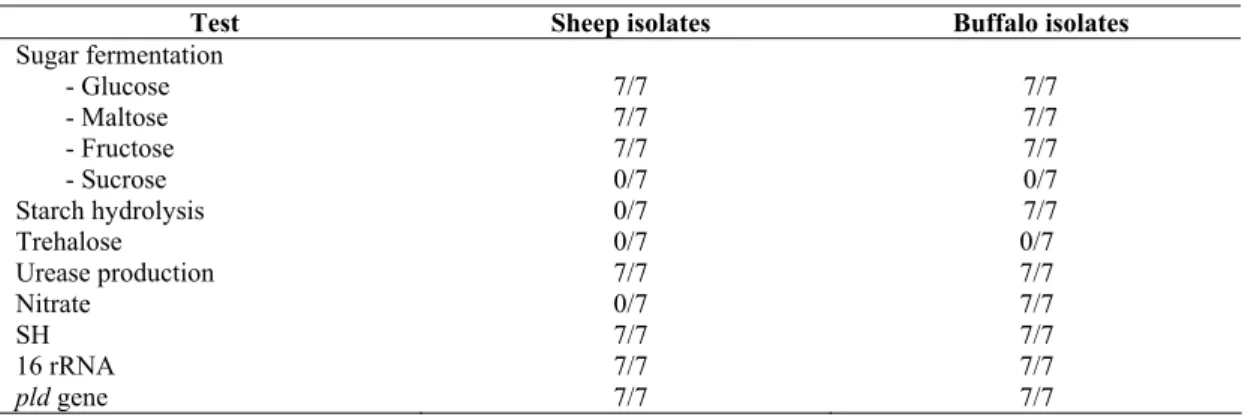
The pattern of diagnostic tests for 14 strains revealed 7
strains of C. pseudotuberculosis of sheep origin and 7 strains of
buffalo origin. Results in Table 1 revealed that the two
biotypes could only be distinguished by nitrate reduction test
and starch hydrolysis. C. pseudotuberculosis biotype 2 is
nitrate positive and could hydrolyse starch. Moreover, it had
been noticed that the two major criteria which are nitrate
reduction and starch hydrolysis can distinguish these organisms as shown in Figure 1.
Table 1: Diagnostic reaction of C. pseudotuberculosis of sheep origin and buffalo origin
Test Sheep isolates Buffalo isolates
Sugar fermentation - Glucose - Maltose - Fructose - Sucrose
7/7 7/7 7/7 0/7
7/7 7/7 7/7 0/7
Starch hydrolysis 0/7 7/7
Trehalose 0/7 0/7
Urease production 7/7 7/7
Nitrate 0/7 7/7
SH 7/7 7/7
16 rRNA 7/7 7/7
Figure 1: Starch hydrolysis plate showing clear zone of hydrolysis around colonies of C. pseudotuberculosis of buffalo origin
Number. (4, 5, 6) and sheep isolates Number (1, 2, 3) showing no hydrolysis.
Characterization of the isolates using PCR
Amplification of 816 bp fragments specific for 16S rRNA
of C. pseudotuberculosis were observed with all strains collected from sheep and buffaloes as shown in Figure 2.
Moreover, amplification of 910 bp fragments specific for PLD
gene were also observed with all sheep and buffaloes strains of
C. pseudotuberculosis as shown in Figure 3.
Figure 2: Agarose gel electrophoresis showing amplification
of 816 bp fragments specific for 16S rRNA of C.
pseudotuberculosis. While lane 6 showing negative control.
Figure 3: Agarose gel electrophoresis showing amplification
of 910 bp bands specific for PLD gene from 4 sheep isolates
no. (1,2,3,4) and 4 buffalo isolates No. (5,6,7,8) of C. pseudotuberculosis. Lane 9 negative control.
Maximum yield of PLD produced by isolates of C. pseudotuberculosis
All isolates revealed SH activity by streaking on BH agar
media and all isolates revealed synergistic haemolytic zones
Selim, S.A. et al. Phospholipase D productivity by C. pseudotuberculosis
reaction, but all buffalo isolates showed the wider zones of
haemolysis if compared with sheep isolates. The titers of
haemolytic activity of C. pseudotuberculosis and the SH activity
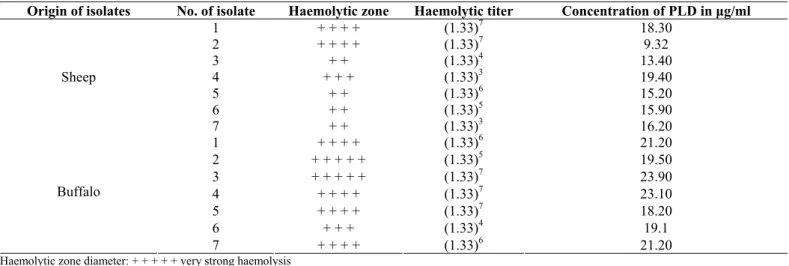
of both sheep and buffalo isolates are shown in Table 2.
Table 2: Synergistic haemolytic activity of C. pseudotuberculosis of sheep and buffalo isolates measured by haemolysis zone diameter
Origin of isolates No. of isolate Haemolytic zone Haemolytic titer Concentration of PLD in μg/ml
1 + + + + (1.33)7 18.30
2 + + + + (1.33)7 9.32
3 + + (1.33)4 13.40
4 + + + (1.33)3 19.40
5 + + (1.33)6 15.20
6 + + (1.33)5 15.90
Sheep
7 + + (1.33)3 16.20
1 + + + + (1.33)6 21.20
2 + + + + + (1.33)5 19.50
3 + + + + + (1.33)7 23.90
4 + + + + (1.33)7 23.10
5 + + + + (1.33)7 18.20
6 + + + (1.33)4 19.1
Buffalo
7 + + + + (1.33)6 21.20
Haemolytic zone diameter: + + + + + very strong haemolysis + + + + strong haemolysis + + + moderate haemolysis + + weak haemolysis + very weak haemolysis
Detection of PLD concentration in culture filtrates of C.
pseudotuberculosis of sheep and buffalo origin by SDS-PAGE
and immunoblot technique
Results in Table 2 show that buffalo isolates produced PLD in concentration range from 18.2 μg /ml up to 23.9 μg /ml, while
sheep isolates produced PLD in amounts ranged from 9.32 μg/ml
up to 19.4 μg/ml. It can be observed that the highest concentration of PLD (19.4 μg/ml) was produced by sheep strain showing the
least titer of SH activity (1.33)3. Also in buffalo isolates, it can noticed that strain No. 6 with haemolytic titre of (1.33)4 produced PLD in concentration of 19.1 μg/ml in comparison to strain No. 5
which produced higher titer of SH activity (1.33)7 but lower PLD productivity (18.2 μg/ml). Also it can be observed that all isolates
that revealed the same titer of SH activity (1.33)7 produced variable amounts of PLD 23.9 μg/ml, 23.1 μg/ml and 18.1 μg/ml
from buffalo isolates No 3, 4, 5, respectively as shown in Table 2.
DISCUSSION
To assess the SH of the two biotypes of C. pseudotuberculosis and its correlation to the actual concentration
of PLD in the culture supernatants, 7 isolates (biotype 1) were
collected from sheep showing clinical symptom of CLA and 7 isolates (biotype 2) were collected from buffaloes diseased with
OSD. During our investigation about characterization of C. pseudotuberculosis of sheep origin (biotype 1) and of buffalo
origin (biotype 2), we noticed that, during investigation of SH
activity of both biotypes, the stock culture of Corynebacteria revealed lower SH activity if compared with recently isolated
strains and the extent of decrease that is reversibly related to the period of storage of the isolates which may be attributed to the
decrease of PLD production by stock cultures. Moreover, many
commercial toxoid vaccines depend upon measuring the SH activity as indicator for the concentration of PLD secreted into
culture supernatants, which needs accurate evaluation of the correlation between SH activity and the indeed concentration of
PLD included in supernatants used for preparation of toxoid vaccines. Purification of PLD to homogeneity is a necessary
prerequisite to molecular investigation of the enzyme and each
extractivity to it including it's SH activity. Purification to near homogeneity has been reported, but it was a method that yields
would allow us to process large volumes of culture supernatant fluid and yield nearly homogenous PLD (6).
All buffalo isolates showed higher SH activity if
compared with sheep isolates (biotype 1) as shown in Table 2.
It can be collectively observed that buffalo isolates are more
potent in SH activity if compared with biotype 2 (sheep
isolates). The reason is not clear but it can be proposed that
biotype 2 (buffalo isolates) may produce other hemolytic
factors beside PLD that increase the extent of SH activity. The resulting correlation between the extent of SH activity
and actual contents of PLD in supernatants of biotype 1 and
biotype 2 isolates is shown in Table 2. It can be noticed that
sheep isolate (No.1) had strong SH activity titer and produced
high yield of PLD in culture f supernatants, while isolate (No.
2) having the same high titer of SH but produced half the
amount produced by isolate No. (1). at the same time, strain
No. (6) showing less SH titer and produced high concentration of PLD in culture supernatants. The same poor correlation
between SH activity and actual amounts of PLD in culture
supernatants is observed in strains of biotype 2 (buffalo
isolates). Isolate (No. 1) having the least titer of SH activity
and produced PLD in large amounts. Moreover, biotype 2
isolates No. 3, 4, 5 had the highest SH titer, but they produced
variable amounts of PLD enzyme in culture supernatants 23.9, 23.1, 18.2 μg/ml, respectively. The obtained results indicate a
poor correlation between SH activity of C. pseudotuberculosis
isolate and production of PLD enzyme in culture supernatants.
Poor correlation was also reported by previous investigation,
Muckle and Gyles, (14, 15) reported a poor correlation
between PLD enzyme contents in supernatants of C.
pseudotuberculosis measured by radiometric assay. Egen et al.
(6) reported that isolates having 3 fold variations in PLD concentration measured by radiometric assay produced nearly
identical areas of haemolysis on Rhodococus blood agar plates.
The explanation of the reason of poor correlation between
SH activity and the actual contents of PLD in supernatants of
C. pseudotuberculosis still unexplained. Egen et al. (6)
reported that there is still no definitive evidence that PLD and
SH activity are one. The SH activity can be used as a
predictive assay for the production of PLD by C. pseudotuberculosis, but it is inadequate technique to detect the
actual concentration of PLD in culture supernatants which can
be achieved by SDS-PAGE and immunoblotting technique
using highly specific anti-PLD antibodies to maintain a proper
amount of PLD antigen in each dose of toxoid vaccine.
ACKNOWLEDGEMENTS
" This work was supported by the National Plane for
Science and Technology Program, Vice Rectorate for Graduate
Studies and Scientific Research, King Saud University,
10-AGR1316-2".
REFERENCES
1. Barakat, A.A.; Selim, S.A.; Atef, A.; Saber, M.S.; Nafie, E.K; El-ebeedy, A.A. (1984). Two serotypes of Corynebacterium pseudotuberculosis isolated from different animal species. Rev. Sci. Tech. Off. Int. Epiz. 3(1), 151-168.
2. Batey, R.G. (1986). Pathogenesis of caseous lymphadenitis in sheep and goats. Aust. Vet. J. 63, 269-272.
3. Brogden, K.A.; Glenn, J.S; East, N; Audibert, F.A. (1996).
Corynebacterium pseudotuberculosis bacterin with muramyl dipeptide induces antibody titers, increases the time of onset, and decreases naturally occurring external abscesses in sheep & goats. Small Rumin. Res. 19, 161-168.
4. Cetinkaya, B.; Karahan, M.; Atil, E.; Kalin, R.; De Baere, T. ; Vaneechoutte, M. (2002). Identification of Corynebacterium pseudotuberculosis isolates from sheep and goats by PCR. Vet. Microbiol. 88, 75–83.
5. Dercksen, D. P.; Brinkhof, J. M. A.; Dekker-Nooren, T.; van Maanen, K.; Bode, C. F.; Baird, G. ; Kamp, E. M. (2000). A comparison of four serological tests for the diagnosis of caseous lymphadenitis in sheep and goats. Vet. Microbiol. 75, 167–175.
6. Egen, N.B.; Cuevas, W.A.; McNamara, P.J.; Sammons, D.W.; Humphrey, R; Songer, J.G. (1989). Purification of PLD of
Corynebacterium pseudotuberculosis by recycling isoelectric focussing.
Am. J. Vet. Res. 50, 1319-1322.
Selim, S.A. et al. Phospholipase D productivity by C. pseudotuberculosis
clostridial corynebacterium vaccines. Aust. Vet. J. 68(10),320-321. 8. Ghoneim, M.A.; Mousa, A.W.; Ibrahim, A.K.; Amin, A.S; Khafagi, A;
Selim, S.A. (2001). Role of Hippobosca eqiuna as a transmitter of C. pseudotuberculosis among buffaloes as revealed by PCR and dot blot hybridization. J. Egypt Vet. Med.Ass. 61, 165-176.
9. Hodgson, A.L.; Bird, P; Nisbet, I.T. (1990). Cloning, nucleotide sequence, and expression in Escherichia coli of the phospholipase D gen from C. pseudotuberculosis.J. Bacteriol. 172(3),1256-12561.
10. Laemmli, U.K. (1970). Cleavage of structural proteins during the assembly of the head of bacteriophage T4. Nature. 227(259), 680-685. 11. Lipsky, B.A.; Goldberger, A.C.; Tompkins, L.S. and Plorde, J.J. (1982).
Infections caused by non-diphtheria Corynebacteria. Rev. Infect. Dis.
4(6), 1220-1235.
12. Lowry, O.H,.; Rosenbrough, N.J.; Farr, A.l. and Randali, R.J. (1951). 13. Protein measurement with Folin-phenol reagent. J. Biol. Chem. 193,
265-275.
14. McNamara, P. J.; Bradley, G. A. ;Songer, J. G. (1994). Targeted mutagenesis of the phospholipase D gene results in decreased virulence of Corynebacterium pseudotuberculosis. Mol. Microbiol. 12,921–930. 15. Muckle, C.A; Gyles, C.L. (1983). Relation of lipid content and exotoxin
production to virulence of C. pseudotuberculosis in mice. Am. J. Vet. Res. 44 (6), 1149- 1153.
16. Muckle, C.A; Gyles, C.L. (1986). Exotic activities of C. pseudotuberculosis.Current Microbiology, 13:57-60.
17. Murray, P.R.; Baron, E.J.; Pfaller, M.A.; Tenover, F.C; Yolken, R.H. (eds.) (1999). Manual of Clinical Microbiology, 7th ed., ASM Press,
Washington, DC, USA.
18. Pacheco, L.G.C.; Pena, R.R.; Castro, T.L.P.; Dorella, F. A.; Bahia, R. C.; Carminati, R.; Frota, M.N.L.; Oliveira, S.C.; Meyer, R.; Alves, F.S.F.; Miyoshi, A; Azevedo, V. (2007). Multiplex PCR assay for identification of Corynebacterium pseudotuberculosis from pure cultures and for rapid detection of this pathogen in clinical samples. J. Med. Microbiol. 56(5), 480-486.
19. Paton, M.W.; Sutherland, S.S; Rose, I.R.; Hart, R.A.; Mercy, A.R; Ellis, T.M. (1995). The speed of Corynebacterium pseudotuberculosis
infection to vaccinated and unvaccinated sheep. Aust. Vet. J. 72(7), 266-269.
20. Paton, M.W.; Walker, S.B.; Rose, LR; Watt, G.F. (2003). Prevalence of caseous lymphadenitis and usage of caseous lymphadenitis vaccines in
sheep flocks. Aust. Vet. J. 81, 91-95.
21. Piontkowski, M.D.; Micheal D.M; Shivers, D.W. (1998). Evaluation of a commercially available vaccine against Corynebacterium pseudotuberculosis for use in sheep. J. Am. Vet. Med. Assoc. 212 (11), 1765-1768.
22. Sambrook, J.; Fritsch, E. F. ; Maniatis, T. (1989). Molecular Cloning: a Laboratory Manual, 2nd edn. Cold Spring Harbor, NY: Cold Spring Harbor Laboratory.
23. Simmons, C.P.; Dunstan, S.J.; Tachedjian, M.; Krywult, J.; Hodgson, A.L; Strugnell, R.A. (1998). Vaccine potential of attenuated mutants of
C. pseudotuberculosis in sheep. Infect Immun. 66(2), 474- 479.
24. Soheir, M.F. S. (2006). Characterization of secretory proteins that secreted from Corynebacterium pseudotuberculosis. Giza, Egypt, 80p (Ph. D. Thesis. Bacteriology, Fac. Vet. Med., Cairo Univ.).
25. Smibert, R. M.; Krieg, N. R. (1994). Phenotypic characterization. In Methods for General and Molecular Bacteriology, pp. 607–654. Edited by P. Gerhardt, R. G. E. Murray, W. A. Wood & N. R. Krieg. Washington, DC: American Society for Microbiology.
26. Tashjian, J.J; Campbell, S.G. (1983). Interaction between caprine macrophages and C. pseudotuberculosis: an electron microscopic study.
Am. J. Vet. Res. 44(4), 690–693.
27. Tachedjian, M.; Krywult, L.; Moore, R.J; Hodgson, A.L. (1995). Caseous lymphadenitis vaccine development:site-specific inactivation of the C. pseudotuberculosis phospholipase D gene. Vaccine 13: 1785- 1792.
28. Towbin, H.; Stachelin, T; Gordon, J. (1979). Electrophoretic transfer of proteins from polyacrylamide gels to nitrocellulose sheets. Procedures and some applications. Proc. Nati. Acad. Sci. USA, 76, 4350- 4354. 29. Williamson, L.H. (2001). Caseous lymphadenitis in small ruminates.Vet.
Clin. North. Am. Food. Anim. Pract. 17 (2), 359-371.
30. Yozwiak, M.L; Songer, J.G. (1993). Effect of Corynebacterium pseudotuberculosis phospholipase D on viability and chemotactic responses of ovine neutrophils.
Am. J. Vet. Res. 53, 417-431.
31. Zhao, H.K.; Hiramune, T.; Kikuchi, N.; Yanagawa, R.; Ito, S.; Hatta, T.; Serikawa, S; Oe, Y. (1991). Selective medium containing fosfomycin, nalidixic acid and culture supernatant of Rhodococcus equi for isolation of Corynebacterium pseudotuberculosis.J.Vet. Med. Series B. (10), 743-748.