online | memorias.ioc.fiocruz.br The integral role transgenesis plays in the study of
various models and biomedically significant species is well documented. Unquestionably the vast majority of scientific information available in regard to pathogens has been generated through transgenesis studies of model species (e.g. Ding et al. 2005). The technologies have sub-sequently been transferred to other systems (Langridge et al. 2009). Schistosomes along with other helminths are the causative agents of neglected tropical diseases; there is a paucity of genetic manipulation techniques available for investigation of their physiology. Nonetheless, the scope of functional genomics studies in schistosomes has advanced in recent years mainly due to the availability of draft genome sequences for two of the medically impor-tant schistosome species, namely Schistosoma mansoni and Schistosoma japonicum (Berriman et al. 2009, Schis-tosoma japonicum Genome Sequencing and Functional Analysis Consortium 2009). Progress made on this front includes the use of integration competent vectors, i.e. transposons and retroviruses for the delivery of reporter transgenes into the schistosome genome (Morales et al. 2007, Kines et al. 2008). Additionally, both conventional and vector based RNAi studies have been successfully
employed for gene expression studies in schistosomes, this could potentially identify future drug targets in ex-perimental chemotherapeutic studies. However, despite these advances the attainment of a stable heritable system for transgenesis has not been brought to fruition.
Pioneering reports - functional genomics for schis-tosomes - Unlike some protozoan parasites for which techniques for genetic manipulation are well advanced (e.g. Balu et al. 2005), schistosomes and other helminths lag substantially in terms of tools for genetic manipula-tion. The transfer of exogenously derived nucleic acids into a target organism or cells referred to as transgen-esis is a relatively recent accomplishment in the field of schistosome molecular biology. Functional genomics approaches would enable manipulation of the genome of these worms, including forward and reverse genetics. However, the fundamental nature of parasitic helminths, such as the blood flukes - intricate developmental cycles, large size, multicellular tissues and complex organiza-tion - along with the absence of immortalized cell lines and our inability to rear the entire life cycle in vitro has hindered development of tractable transgenesis tools and models (Brindley & Pearce 2007).
Nevertheless, the first reports of successful transgen-esis in schistosomes utilized biolistic particle delivery (gene gun) to introduce plasmids encoding firefly lu-ciferase or jellyfish green fluorescent protein reporters (Davis et al. 1999, Wippersteg et al. 2002). These reports were able to demonstrate the utility of particle bombard-ment for foreign gene introduction into adult (Davis et al. 1999, Wippersteg et al. 2002) and sporocyst (Wipper-steg et al. 2002) stages. Following these successes, Cor-renti and Pearce (2004) introduced a luciferase encoding Financial support: NIAID (RO1 AI072773, RO1 AI072773/S1),
PAAET (Kuwait)
All authors contributed equally to this work. + Corresponding author: [email protected] Received 22 April 2011
Accepted 20 May 2011
Progress with schistosome transgenesis
Yousef Noori Alrefaei1, Tunika Ida Okatcha1,2, Danielle Elaine Skinner1, Paul James Brindley1/+
1Department of Microbiology, Immunology and Tropical Medicine, George Washington University Medical Center,
Ross Hall Room 448, 2300 I Street NW, 20037 Washington DC, USA 2Department of Tropical Medicine,
School of Public Health and Tropical Medicine, Tulane University, New Orleans, LA, USA
Genome sequences for Schistosoma japonicum and Schistosoma mansoni are now available. The schistosome genome encodes ~13,000 protein encoding genes for which the function of only a minority is understood. There is a valuable role for transgenesis in functional genomic investigations of these new schistosome gene sequences. In gain-of-function approaches, transgenesis can lead to integration of transgenes into the schistosome genome which can facilitate insertional mutagenesis screens. By contrast, transgene driven, vector-based RNA interfer-ence (RNAi) offers powerful loss-of-function manipulations. Our laboratory has focused on development of tools to facilitate schistosome transgenesis. We have investigated the utility of retroviruses and transposons to transduce schistosomes. Vesicular stomatitis virus glycoprotein (VSVG) pseudotyped murine leukemia virus (MLV) can trans-duce developmental stages of S. mansoni including eggs. We have also observed that the piggyBac transposon is transpositionally active in schistosomes. Approaches with both VSVG-MLV and piggyBac have resulted in somatic transgenesis and have lead to integration of active reporter transgenes into schistosome chromosomes. These find-ings provided the first reports of integration of reporter transgenes into schistosome chromosomes. Experience with these systems is reviewed herewith, along with findings with transgene mediated RNAi and germ line transgenesis, in addition to pioneering and earlier reports of gene manipulation for schistosomes.
RNA into schistosomules using square wave electropo-ration for the delivery of the transgene. In a time course experiment they observed that transfection efficiency was highest in schistosomules that had been cultured for 18 h prior to electroporation (Correnti & Pearce 2004). Moreover, the findings indicated that the electroporation was a less damaging method than biolistics with regard to transfer of nucleic acids into cultured schistosomes. Both of these gain-of-function approaches have shown success in the transfer of mRNAs and plasmid based re-porter genes to several developmental stages of S. man-soni and S. japonicum. These and other pioneering stud-ies into genetic manipulation of schistosomes have been reviewed (Grevelding 2006, Brindley & Pearce 2007, Kalinna & Brindley 2007, Mann et al. 2008).
Loss-of-function procedures involving RNA interfer-ence (RNAi) targeting schistosome genes in several de-velopmental stages have been reported (e. g. Skelly et al. 2003, Correnti et al. 2005, Dinguirard & Yoshino 2006, Osman et al. 2006) and reviewed in Brindley and Pearce (2007), Geldhof et al. (2007) and Kalinna and Brindley (2007). RNAi was first demonstrated in schistosomes by targeting the hemoglobinolytic protease cathepsin B in schistosomules of S. mansoni soaked with double stranded RNA (dsRNA) (Skelly et al. 2003). Correnti et al. (2005) extended the investigation by introducing dsR-NA in schistosomules by square wave electroporation. These important advances have demonstrated transgene delivery and activity of functional promoters. However, they are unlikely to lead to integration of transgenes into schistosome chromosomes, without which the transgene effect would likely only be transitory.
Accessing the germ line - In order to advance our ability to develop novel interventions for schistosomia-sis, there is likely to be a valuable role for stable heri-table transgenic lines of schistosomes. Establishment of lines of transgenic schistosomes will require integration of transgenes into the chromosomes of the schistosome germ line. In order to achieve germ line transgenesis in any organism several obstacles have to be overcome. The vectors containing the constructs have to be able to achieve stable integration into the genome. The trans-genes not only have to integrate into the genome, they have to specifically integrate into the germ cells. The fundamental nature of the schistosome makes this chal-lenging. Blood flukes are large, complex, multicellular organisms composed of both somatic and germinal tis-sues further lowering the chances of transforming the germ line. In addition, once integrated, the transgenic schistosome has to be viable to continue the develop- mental cycle producing subsequent generations of trans-genic progeny (Heyers et al. 2003). Using transfer by particle bombardment, earlier investigations into germ line transgenesis in schistosomes circumvented the latter impediment by introducing the transgene in the miracidia (Heyers et al. 2003) and allowing the trans-formed miracidia to infect the intermediate host snail via the natural route thereby obviating the need for ad-ditional manipulation of the transformed organisms, e.g. microinjection of sporocysts into snails. Furthermore, these workers demonstrated the possibility of
penetrat-ing the germ cells through biolistic approaches. Though their studies and others similar investigations provided suitable methods in introducing constructs in the germ cells, strategies for integration into the germ cells still require further development.
The germ cell cycle in schistosomes - The conven-tional meaning of “germ line” connotes the fusion of gametes from the male and female gonads (testis and ova, respectively) through the process of fertilization resulting in the formation of a zygote that contains half the DNA of each of the two parents, culminating in the formation of the embryo from which individuals de-velop, this is, the hallmark of sexual reproduction. Thus the germ line of an organism contains the germ cells that contain heritable genetic material that may be passed on to offspring. Theoretically, if exogenous genetic ma- terial was introduced into the germ line, the transgene would constitute part of the heritable genetic material and would be present in subsequent generations since germ line cells, unlike somatic cells, are not constrained by the Hayflick limit (Shay & Wright 2000), and are therefore immortal because they can divide indefinitely. Therefore the ratio of germ cells to somatic cells is high-est during gastrulation and progressively decreases after onset of organogenesis due to cellular differentiation.
Schistosomes have a complex developmental cycle that encompasses both an asexual and a sexual phase in an intermediate and a definitive host, respectively. The asexual cycle is characterized by a series of germ cell rich developmental stages that result in the progression of the organism from the egg, to the miracidium, to the mother/ primary sporocyst, to the daughter/secondary sporocyst and the cercariae (Yoshino & Laursen 1995). Although the intramolluscan development of S. mansoni is asex-ual in nature, studies into the method of schistosome reproduction in the snail host have demonstrated that larval development commences when daughter sporo-cysts arise from the multiplication of germ cell derived germinal cells in the mother sporocysts (Cort & Olivier 1943). This process is then followed sequentially by the formation of cercariae which arise from the germ cells in the daughter sporocysts. It should be further noted that during progression through both the asexual and sexual life cycle the germ cells are the only continuous cell line in the schistosome life cycle (Grevelding 2006). And in general, these germ cells as they progress through the life stages form a cell lineage that is ultimately dedicated to the production of future gametes.
about five days at 37ºC. Therefore, to increase the prob-ability of transforming the germ line introduction of transgenes in the egg stage when the ratio of germ cells to somatic cells is highest during the developmental cy-cle would be optimal. Miracidia and sporocysts are also attractive stages to target the germ line because at these stages of development the schistosome exhibits a com-paratively high germ to somatic cell ratio. The miracidia, on average has ~20 germinal cells that are located at the posterior of the larval fluke (Pan 1980). After penetrat-ing the snail host, the miracidium discards its ciliated epidermal plates, forms a new tegument and transforms into a mother sporocyst (Olivier & Mao 1949, Pan 1996). The mother sporocyst asexually produces 200-400 germ balls from the 20 germinal cells of the miracidium (Pan 1980). Each of these germ balls develops into daughter sporocysts that in turn produce thousands of cercariae. The miracidia and sporocyst stage are also suitable for in vitro cultivation (Grevelding 2006).
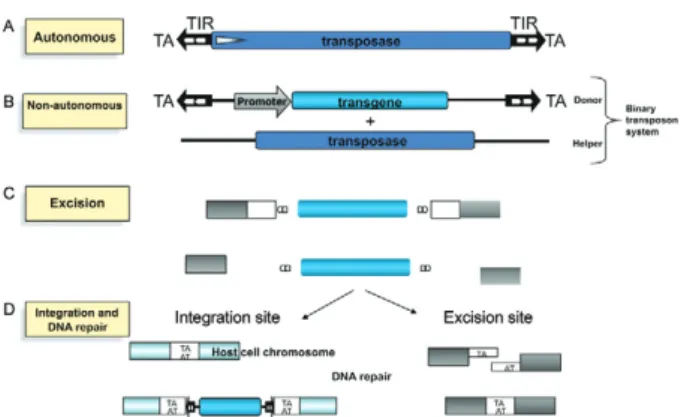
Transposable elements - Transposons are mobile ge-netic elements that colonize the genomes of a variety of organisms. Discovered by Barbara McClintock through her studies of mutations in maize (McClintock 1950), transposons move within and between genomes via a process referred to as transposition. Transposons are classified into two classes based on their mechanism of transposition. piggyBac, a class II DNA transposon has been used to mediate somatic transgenesis of S. mansoni (Morales et al. 2007). DNA transposons move within the genome via a “cut and paste” mechanism mediated by a single or double stranded DNA intermediate and fa-cilitated by a self encoded transposase enzyme. In addi-tion to encoding transposase enzyme, autonomous DNA transposons are characterized by the presence of termi-nal inverted repeats (TIRs) (Feschotte & Pritham 2007). Transposition is initiated when the transposase recog-nizes the TIRs and excises the transposon. Depending on the particular transposon and the transposase it en-codes, the enzyme either arbitrarily or sequence specifi-cally binds to a target site. The transposase then makes a staggered cut producing sticky ends, excises the transpo-son and ligates it into the target site. A DNA polymerase fills in the resulting gaps from the sticky ends and DNA ligase closes the sugar-phosphate backbone resulting in target site duplication. DNA transposons can be classi-fied into three groups: those that excise as double strand-ed DNA and reinsert elsewhere in the genome, i.e., the classic cut and paste transposons (Fig. 1) (Mann et al. 2008), helitrons that may use a mechanism similar to rolling circle replication (Kapitonov & Jurka 2001) and mavericks/politrons, for which the mechanism of trans-position is not yet well characterized but may replicate using a self encoded DNA polymerase (Kapitonov & Jurka 2006, Pritham et al. 2007). [Notably, in nature, parasitism appears to provide a bridge for dispersal of transposons among phylogenetically unrelated host spe-cies genomes (Gilbert et al. 2010).]
piggyBac - piggyBac, a lepidopteran class II DNA transposon originally isolated from the genome of the cabbage looper moth Trichoplusia ni (Fraser et al. 1983),
is a short inverted terminal repeat element that is 2.5 kilo-bases (kb) in length with 13 bp inverted terminal repeat sequences and a 2.1 kb open reading frame (Cary et al. 1989, Elick et al. 1996). Being a class II transposon, this element moves via cut and paste transposition mediated by a self encoded transposase enzyme. Unlike other trans-posons, piggyBac demonstrates precise excision upon transposition (Cary et al. 1989, Fraser et al. 1996) as well as an affinity for TTAA target sites (Fraser et al. 1996). This element has been harnessed for somatic transgenesis in a variety of model and pathogenic organisms including Plasmodium falciparum (Balu et al. 2005), the planarian Girardia tigrina (González-Estévez et al. 2003), S. man-soni (Morales et al. 2007) and mammalian cell lines, in-cluding human cell lines (Wilson et al. 2007). piggyBac is not known to be active in prokaryotic cells (Elick et al. 1996). In addition, piggyBac has facilitated stable herit-able (germ line) transgenesis in various insects including the Mediterranean fruit fly Ceratitis capitata (Handler et al. 1998), the silkworm Bombyx mori L (Tamura et al. 2000), the pink bollworm Ectinophora gossypiella (Pelo-quin et al. 2000), the oriental fruit fly Bactrocera dorsa-lis and the malaria mosquito Anopheles stephensi (Nolan et al. 2002). With the ability of piggyBac to jump within phylogenetically diverse taxa and the successful somatic transgenesis of S. mansoni (Fig. 2), this system has the
potential to achieve the vertical transmission of trans-genes within the S. mansoni genome in both the sexual and asexual phases of the lifecycle.
Investigations with human and mouse cell lines fur-ther demonstrate the versatility of piggyBac as a vector for the delivery of transgenes (Ding et al. 2005, Wilson et al. 2007). piggyBac, unlike some other transposons (e.g. the P element of Drosophila) is active in numerous spe-cies from diverse phyla (Handler 2002, Sumitani et al. 2003). In addition, it has a high cargo capacity, endowing the capacity to efficiently transpose transgenes ranging in size from 9.1-14.3 kb without a reduction in transposition frequency (Ding et al. 2005, Wilson et al. 2007). By con-trast, sleeping beauty loses transposition efficiency with larger transgenes (Karsi et al. 2001, Geurts et al. 2003). piggyBac also appears to be unaffected by overproduc-tion inhibioverproduc-tion a phenomenon whereby an extremely high ratio of transposase (helper) to the donor construct results in a decrease in transposition efficiency and frequency (Geurts et al. 2003, Zayed et al. 2004, Wilson et al. 2005). Overproduction inhibition has been observed in mem-bers of the Tc1/mariner family of transposons, including sleeping beauty (Lampe et al. 1998).
Mos-1 mariner - Mos-1 mariner is a member of Tc1/ mariner superfamily. It is a small (1.3 kb) transposon that is flanked by short inverted repeats sequence of 28 bp. It was isolated originally from the fruit fly Drosophila mauritania (Jacobson et al. 1986, Medhora et al. 1991) and also been found in closely related species, including Drosophila simulans and Drosophila sechellia (Capy et al. 1991). It exhibits widespread natural distribution - with orthologues known from nematodes, arthropods, fish, dogs and humans (Plasterk et al. 1999). The Mos-1 mariner transposon gene encodes a single gene, trans-posase, which is necessary for the transposition process (Lampe et al. 1996). Transposition involves excision at the donor site followed by insertion at the integration target site. Mos-1 is capable of transposition in vivo in the absence of host cell factors and in diverse species including chicken (Sherman et al. 1998) and mouse em-bryonic cells (Luo et al. 1998) and indeed Mos-1 mariner appears to be transpositionally active in S. mansoni (YN Alrefaei et al., unpublished observations).
Retroviral based transgenesis - Retroviral transgen-esis offers a tractable method to introduce foreign genes into schistosomes. In general, viral vectors are capable of transducing ≥ 90% of the cells to which they are exposed while other non-viral transfection methods as those de-scribed above are often much less proficient (Burns et al. 1993). Critically retroviruses such as gammaretroviruses [e.g. murine leukemia virus (MLV)] and lentiviruses [e.g. human immunodeficiency virus (HIV-1)] integrate into the host cell chromosomes (Coffin et al. 1997). Retrovi-ruses have been used to transfect, integrate and express reporter genes in various complex organisms including zebrafish, rhesus macaque, Xenopus (oocytes), newts, mollusks, parasitic amoebae, mosquitoes and fruit flies (Burns et al. 1994, 1996, Lin et al. 1994, Lu et al. 1996, Matsubara et al. 1996, Franco et al. 1998, Jordan et al. 1998, Que et al. 1999, Boulo et al. 2000, Calmels et al. 2005). Moreover, transgenic cell lines from zebrafish,
dwarf surfclams and other complex species have been established through this method (Lin et al. 1994, Lu et al. 1996). These successes indicated that retroviruses would be good candidates as vectors to insert transgenes into schistosome chromosomes.
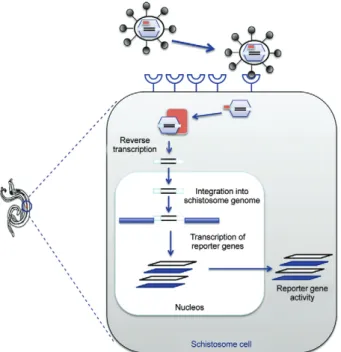
Kines et al. (2006) demonstrated that the infectious replication incompetent MLV retrovirus pseudotyped with vesicular stomatitis virus glycoprotein (VSVG) was capable of transfecting S. mansoni (Fig. 3). An MLV de-rived vector, pLNHX, was modified to include a report-er gene undreport-er the control of an endogenous schistosome gene promoter. The constructs along with a plasmid en-coding the VSVG gene were used to transfect GP2-293 packaging cells modified to express the MLV Gag and Pol gene (Kines et al. 2006). Sporocysts, schistosomules and adults of S. mansoni were exposed to the resulting virions. Analysis by two-colour immunofluorescence, southern hybridization and reverse transcription-poly-merase chain reaction (RT-PCR) indicated successful transduction of these schistosome developmental stages by this retrovirus. A follow-up study confirmed that VSVG-MLV could transduce blood-stage forms of S. mansoni and demonstrated that the provirus integrates into the schistosome genome with possible target site preferences (Kines et al. 2008). This study also showed that the S. mansoni actin promoter (Correnti et al. 2007) can drive the reporter luciferase transgene.
Fig. 2: southern hybridization analysis of piggyBac transposon inte-gration into schistosome chromosomes. A: representation of the (BssS 1)-linearized pXL-BacII-SmAct-Luc transposon construct. The trans-poson cassette included the firefly luciferase reporter (gray arrow) fol-lowed by the SV40 polyadenylation site (black box), driven by the schis-tosomeactin gene promoter (black arrow) and flanked by the piggyBac
In the studies of Kines et al. (2006) and Kines et al. (2008), it is likely that the cells transduced by the virions were tegumental and/or intestinal cells (Mann et al. 2008). In order for heritable transmission to oc-cur, germline transduction would have to have taken place. The schistosome egg represents a potentially advantageous developmental stage at which to direct transgenes (Mann et al. 2011). Accordingly Kines et al. (2010) proceeded to transduce schistosome eggs with VSVG-pseudotyped MLV facilitated by electropora-tion. These workers showed that square wave elec-troporation was more effective in delivering VSVG-pseudotyped Moloney MLV (MMLV) into schistosome eggs then passive soaking. Quantitative PCR analysis revealed that schistosome eggs electroporated with virions had several fold more copies of provirus than eggs simply soaked in virions (Kines et al. 2010). This analysis confirmed the potential of the schistosome egg as a target for germ line transgenesis.
Although the studies by Kines et al. (2006, 2008, 2010) reported successful transduction and integra-tion of transgenes in several S. mansoni developmen-tal stages, the reporter genes were not especially large (< 2 kb). To investigate the cargo capacity of MLV in schistosomes, Yang et al. (2010) transduced S. japoni-cum schistosomules with a longer transgene, human telomerase reverse transcriptase (hTERT) gene that is 3.5 kb in length. RT-PCR, in situ hybridization immu-nohistochemistry and immunoblot analysis determined that S. japonicum can be successfully transduced with VSVG-pseudotyped MMLV and that the MLV vector can transport sizeable genes as cargo (Yang et al. 2010). These findings also suggested a possible route to estab-lishing immortalized cell lines from schistosome tissues utilizing the oncogenic potential of hTERT. Retroviral transgenesis for schistosomes is reviewed in greater de-tail in Mann et al. (2008, 2010, 2011).
In summary, these findings confirmed that VSVG-pseudotyped MMLV is capable of integrating trans-genes into schistosomes. Although the studies only demonstrated somatic transgenesis, these findings markedly enhance the likelihood that transgenic lines of schistosomes will be a reality. In addition to MMLV, other retroviral vectors can be investigated for trans-ducing schistosomes, including lentiviruses, which have the ability to transduce non-dividing cells making them attractive for transgenesis approaches for schis-tosomes (Mann et al. 2008). Lentiviral vectors derived from HIV-1 and feline immunodeficiency viruses have been developed (Dull et al. 1998, Poeschla 2008) and are commercially available.
RNAi and vector based RNAi - Along with the now available draft genome sequences of two of the three medically important schistosome species, S. japoni-cum and S. mansoni (Berriman et al. 2009, Schistosoma japonicum Genome Sequencing and Functional Analysis Consortium 2009), RNAi (Fire et al. 1998) has revolu- tionized the world of functional genomics for schisto-somes. This allows for among other things the ability to identify potentially novel drug targets in a variety of medically important organisms. It has been determined
that schistosomes possess the various components of the RNAi machinery (Krautz-Peterson & Skelly 2008a), (Verjovski-Almeida et al. 2003) and that RNAi is active in schistosomes. Previous studies in RNAi in schistosomes targeted various enzymes and biochemical pathways in an effort to elucidate their function and garner an overall bet-ter understanding of these organisms. For instance, RNAi has been used to disrupt the haemoglobin degradation pathway by specifically targeting enzymes involved in this process, cathepsin B (Correnti et al. 2005) and cathe-psin D (Morales et al. 2008), both of which resulted in the stunting of the growth of the parasites, underscoring the importance of the pathway to the survival of the organism and utility as a potential drug target (Correnti et al. 2005, Delcroix et al. 2006, Krautz-Peterson & Skelly 2008b). Other areas of schistosome biology investigated using RNAi include water movement and drug uptake across the parasite tegument, as well as various aspects of para-site physiology and development (Faghiri & Skelly 2009). As versatile a tool as RNAi is, its utility in functional genomics is hampered by the fact that it is transitory in nature (resulting in a temporary downregulation of gene expression). In addition, it may be inaccessible to some developmental stages and/or tissues of schistosomes.
Conventional RNAi using dsRNA frequently leads to transient gene silencing and, in addition, may be inac-cessible to some developmental stages and/or tissues of schistosomes. Vector based RNAi approaches that lead to integration of transgene encoding cassettes that express short interfering RNAs can circumvent deficiencies with exogenous RNAi approaches by providing continuous and/or conditional gene silencing (Brummelkamp et al. 2002, ter Brake et al. 2006). It was recently demonstrated that MLV encoding long hairpin RNAs, ~120 bp long, driven by a RNA polymerase II promoter (S. mansoni actin) targeting S. mansoni cathepsin B in adult worms delivers strong silencing (Tchoubrieva et al. 2010). On the other hand, in many species, including insects, mam-mals, birds and pathogenic protozoa, Pol III promoter-based DNA vectors have been employed to express small interfering RNA or short hairpin RNA (shRNA) (~21 bp long) (Brummelkamp et al. 2002, Wakiyama et al. 2005). Aiming to establish vector-based RNAi driven by a Pol III promoter, Ayuk et al. (2011) cloned S. mansoni and human U6 gene promoters (~270 bp) into pLNHX driving shR-NA targeting firefly luciferase. These workers targeted luciferase because the effect of RNAi against luciferase can be readily discerned (in contrast to many endogenous genes) (Rinaldi et al. 2008, Ayuk et al. 2011). The findings reveal that the putative S. mansoni U6 gene promoter of 270 bp in length is active in schistosomes. Given that the U6 gene promoter drove expression of shRNA from an episome, the findings also indicate the potential of this putative RNA polymerase III dependent promoter as a component regulatory element in vector-based RNAi for functional genomics of schistosomes. Together the re-cent reports from Tchoubrieva et al. (2010) and Ayuk et al. (2011) demonstrate that vector based RNAi utilizing integration-competent and/or episomal vectors that carry transgene cassettes that include Pol II or Pol III promot-ers can provide sustained endogenous gene knockdown in schistosomes. This technology can be expected to find wide utility in functional genomics for schistosomes.
Outlook - Significant progress has been made in schis-tosome transgenesis (Grevelding 2006, Beckmann et al. 2007, Morales et al. 2007, Kines et al. 2008, 2010, Yang et al. 2010, Tchoubrieva et al. 2010, Ayuk et al. 2011, Rinaldi et al. 2011). Although the establishment of transgenic schisto-some lines remains to be reported, transgene integration in the germ cells holds the promise for development of lines of transgenic schistosomes. Strategies for integrating con-structs into the germ cells still need further development. Two methods now proven to insert transgenes into schisto-some chromoschisto-somes, MLV retroviral mediated transgen-esis and piggyBac transposon mediated transgentransgen-esis, have been successfully utilized for stable germ line transgen-esis in vertebrate and invertebrate organisms (Burns et al. 1994, Franco et al. 1998, Jasinskiene et al. 1998, Jordan et al. 1998, Boulo et al. 2000, González-Estévez et al. 2003, Balu et al. 2005). These findings suggest that establish-ment of stable heritable lines of transgenic schistosomes could be achieved in the not too distant future. If so, schis-tosome transgenesis can be expected contribute substan-tially to functional genomics analysis of schistosomes.
ACKNOWLEDGEMENTS
To Gabriel Rinaldi, Victoria Mann, Sutas Suttiprapa and Mary Ayuk, for informative discussions.
REFERENCES
Ayuk MA, Suttiprapa S, Rinaldi G, Mann VH, Lee CM, Brindley PJ 2011. Schistosoma mansoni U6 gene promoter-driven short hair-pin RNA induces RNA interference in human fibrosarcoma cells and schistosomules. Int J Parasitol 41: 783-789.
Balu B, Shoue DA, Fraser MJ Jr, Adams JH 2005. High-efficiency trans-formation of Plasmodium falciparum by the lepidopteran transpos-able element piggyBac. Proc Natl Aca Sci USA 102: 16391-16396.
Beckmann S, Wippersteg V, El-Bahay A, Hirzmann J, Oliveira G, Grevelding CG 2007. Schistosoma mansoni: germ-line transfor-mation approaches and actin-promoter analysis. Exp Parasitol 117: 292-303.
Berriman M, Haas BJ, LoVerde PT, Wilson RA, Dillon GP, Cerqueira GC, Mashiyama ST, Al-Lazikani B, Andrade LF, Ashton PD, As-lett MA, Bartholomeu DC, Blandin G, Caffrey CR, Coghlan A, Coulson R, Day TA, Delcher A, DeMarco R, Djikeng A, Eyre T, Gamble JA, Ghedin E, Gu Y, Hertz-Fowler C, Hirai H, Hirai Y, Houston R, Ivens A, Johnston DA, Lacerda D, Macedo CD, McVeigh P, Ning Z, Oliveira G, Overington JP, Parkhill J, Pertea M, Pierce RJ, Protasio AV, Quail MA, Rajandream MA, Rogers J, Sajid M, Salzberg SL, Stanke M, Tivey AR, White O, Williams DL, Wortman J, Wu W, Zamanian M, Zerlotini A, Fraser-Liggett CM, Barrell BG, El-Sayed NM 2009. The genome of the blood fluke Schistosoma mansoni. Nature 460: 352-358.
Boulo V, Cadoret JP, Shike H, Shimizu C, Miyanohara A, Burns JC 2000. Infection of cultured embryo cells of the pacific oyster,
Crassostrea gigas, by pantropic retroviral vectors. In Vitro Cell Dev Biol Anim 36: 395-399.
Brindley PJ, Pearce EJ 2007. Genetic manipulation of schistosomes.
Int J Parasitol 37: 465-473.
Brummelkamp TR, Bernards R, Agami R 2002. A system for stable expression of short interfering RNAs in mammalian cells. Sci-ence 296: 550-553.
Burns JC, Friedmann T, Driever W, Burrascano M, Yee JK 1993. Vesicular stomatitis virus G glycoprotein pseudotyped retroviral vectors: concentration to very high titer and efficient gene trans-fer into mammalian and nonmammalian cells. Proc Natl Acad Sci USA 90: 8033-8037.
Burns JC, Matsubara T, Lozinski G, Yee JK, Friedmann T, Washa-baugh CH, Tsonis PA 1994. Pantropic retroviral vector-mediated gene transfer, integration and expression in cultured newt limb cells. Dev Biol 165: 285-289.
Burns JC, McNeill L, Shimizu C, Matsubara T, Yee JK, Friedmann T, Kurdi-Haidar B, Maliwat E, Holt CE 1996. Retrovirol gene transfer in Xenopus cell lines and embryos. In Vitro Cell Dev Biol Anim 32: 78-84.
Calmels B, Ferguson C, Laukkanen MO, Adler R, Faulhaber M, Kim HJ, Sellers S, Hematti P, Schmidt M, von Kalle C, Akagi K, Do-nahue RE, Dunbar CE 2005. Recurrent retroviral vector integra-tion at the Mds1/Evi1 locus in nonhuman primate hematopoietic cells. Blood 106: 2530-2533.
Capy P, Maruyama K, David JR, Hartl DL 1991. Insertion sites of the transposable element mariner are fixed in the genome of Droso-phila sechellia. J Mol Evol 33: 450-456.
Cary LC, Goebel M, Corsaro BG, Wang HG, Rosen E, Fraser MJ 1989. Transposon mutagenesis of baculoviruses: analysis of
Coffin JM, Hughes SH, Varmus HE 1997. Retroviruses, Cold Spring Harbor Laboratory Press, New York, 843 pp.
Correnti JM, Brindley PJ, Pearce EJ 2005. Long-term suppression of cathepsin B levels by RNA interference retards schistosome growth. Mol Biochem Parasitol 143: 209-215.
Correnti JM, Jung E, Freitas TC, Pearce EJ 2007. Transfection of
Schistosoma mansoni by electroporation and the description of a new promoter sequence for transgene expression. Int J Para-sitol 37: 1107-1115.
Correnti JM, Pearce EJ 2004. Transgene expression in Schistosoma mansoni: introduction of RNA into schistosomula by electropo-ration. Mol Biochem Parasitol 137: 75-79.
Cort WW, Olivier L 1943. The development of the sporocysts of a schis-tosome, Cercaria stagnicolae Talbot, 1936. J Parasitol 29: 164-176.
Davis RE, Parra A, LoVerde PT, Ribeiro E, Glorioso G, Hodgson S 1999. Transient expression of DNA and RNA in parasitic hel- minths by using particle bombardment. Proc Natl Acad Sci USA 96: 8687-8692.
Delcroix M, Sajid M, Caffrey CR, Lim KC, Dvorák J, Hsieh I, Bah-gat M, Dissous C, McKerrow JH 2006. A multienzyme network functions in intestinal protein digestion by a platyhelminth para-site. J Biol Chem 281: 39316-39329.
Ding S, Wu X, Li G, Han M, Zhuang Y, Xu T 2005. Efficient transpo-sition of the piggyBac (PB) transposon in mammalian cells and mice. Cell 122: 473-483.
Dinguirard N, Yoshino TP 2006. Potential role of a CD36-like class B scavenger receptor in the binding of modified low-density lipo-protein (acLDL) to the tegumental surface of Schistosoma man-soni sporocysts. Mol Biochem Parasitol 146: 219-230.
Dull T, Zufferey R, Kelly M, Mandel RJ, Nguyen M, Trono D, Naldini L 1998. A third-generation lentivirus vector with a conditional packaging system. J Virol 72: 8463-8471.
Elick TA, Bauser CA, Fraser MJ 1996. Excision of the piggyBac trans-posable element in vitro is a precise event that is enhanced by the expression of its encoded transposase. Genetica 98: 33-41.
Faghiri Z, Skelly PJ 2009. The role of tegumental aquaporin from the human parasitic worm, Schistosoma mansoni, in osmoregulation and drug uptake. FASEB J 23: 2780-2789.
Feschotte C, Pritham EJ 2007. DNA transposons and the evolution of eukaryotic genomes. Annu Rev Genet 41: 331-368.
Fire A, Xu S, Montgomery MK, Kostas SA, Driver SE, Mello CC 1998. Potent and specific genetic interference by double-stranded RNA in Caenorhabditis elegans. Nature 391: 806-811.
Franco M, Rogers ME, Shimizu C, Shike H, Vogt RG, Burns JC 1998. Infection of lepidoptera with a pseudotyped retroviral vector. In-sect Biochem Mol Biol 28: 819-825.
Fraser MJ, Ciszczon T, Elick T, Bauser C 1996. Precise excision of TTAA-specific lepidopteran transposons piggyBac (IFP2) and tagalong (TFP3) from the baculovirus genome in cell lines from two species of Lepidoptera. Insect Mol Biol 5: 141-151.
Fraser MJ, Smith GE, Summers MD 1983. Acquisition of host cell DNA sequences by Baculoviruses: relationship between host DNA insertions and FP mutants of Autographa californica and Galleria mellonella nuclear polyhedrosis viruses. J Virol 47: 287-300.
Freitas TC, Jung E, Pearce EJ 2007. TGF-beta signaling controls em-bryo development in the parasitic flatworm Schistosoma man-soni. PLoS Pathog 3: e52.
Geldhof P, Visser A, Clark D, Saunders G, Britton C, Gilleard J, Ber-riman M, Knox D 2007. RNA interference in parasitic helminths: current situation, potential pitfalls and future prospects. Parasi-tology 134: 609-619.
Geurts AM, Yang Y, Clark KJ, Liu G, Cui Z, Dupuy AJ, Bell JB, Largaespada DA, Hackett PB 2003. Gene transfer into genomes of human cells by the sleeping beauty transposon system. Mol Ther 8: 108-117.
Gilbert C, Schaack S, Pace JK 2nd, Brindley PJ, Feschotte C 2010. A role for host-parasite interactions in the horizontal transfer of transposons across phyla. Nature 464: 1347-1350.
González-Estévez C, Momose T, Gehring WJ, Saló E 2003. Transgen-ic planarian lines obtained by electroporation using transposon-derived vectors and an eye-specific GFP marker. Proc Natl Acad Sci USA 100: 14046-14051.
Grevelding CG 2006. Transgenic flatworms in parasitic flatworms. AG Maule, NJ Marks (eds.), Molecular biology, biochemistry, immunology and physiology, CABI, Wallingford, p. 149-179.
Handler AM 2002. Use of the piggyBac transposon for germ-line trans-formation of insects. Insect Biochem Mol Biol 32: 1211-1220.
Handler AM, McCombs SD, Fraser MJ, Saul SH 1998. The lepi-dopteran transposon vector, piggyBac, mediates germ-line transformation in the Mediterranean fruit fly. Proc Natl Acad Sci USA 95: 7520-7525.
Heyers O, Walduck AK, Brindley PJ, Bleiss W, Lucius R, Dorbic T, Wittig B, Kalinna BH 2003. Schistosoma mansoni miracid-ia transformed by particle bombardment infect Biomphalaria glabrata snails and develop into transgenic sporocysts. Exp Par-asitol 105: 174-178.
Jacobson JW, Medhora MM, Hartl DL 1986. Molecular structure of a somatically unstable transposable element in Drosophila. Proc Natl Acad Sci USA 83: 8684-8688.
Jasinskiene N, Coates CJ, Benedict MQ, Cornel AJ, Rafferty CS, James AA, Collins FH 1998. Stable transformation of the yellow fever mosquito, Aedes aegypti, with the Hermes element from the housefly. Proc Natl Acad Sci USA 95: 3743-3747.
Jordan TV, Shike H, Boulo V, Cedeno V, Fang Q, Davis BS, Jacobs-Lorena M, Higgs S, Fryxell KJ, Burns JC 1998. Pantropic retrovi-ral vectors mediate somatic cell transformation and expression of foreign genes in dipteran insects. Insect Mol Biol 7: 215-222.
Jurberg AD, Gonçalves T, Costa TA, de Mattos AC, Pascarelli BM, de Manso PP, Ribeiro-Alves M, Pelajo-Machado M, Peralta JM, Coelho PM, Lenzi HL 2009. The embryonic development of
Schistosoma mansoni eggs: proposal for a new staging system.
Dev Genes Evol 219: 219-234.
Kalinna BH, Brindley PJ 2007. Manipulating the manipulators: ad-vances in parasitic helminth transgenesis and RNAi. Trends Parasitol 23: 197-204.
Kapitonov VV, Jurka J 2001. Rolling-circle transposons in eukary-otes. Proc Natl Acad Sci USA 98: 8714-8719.
Kapitonov VV, Jurka J 2006. Self-synthesizing DNA transposons in eukaryotes. Proc Natl Acad Sci USA 103: 4540-4545.
Karsi A, Moav B, Hackett P, Liu Z 2001. Effects of insert size on transposition efficiency of the sleeping beauty transposon in mouse cells. Mar Biotechnol (NY) 3: 241-245.
Kines KJ, Mann VH, Morales ME, Shelby BD, Kalinna BH, Gobert GN, Chirgwin SR, Brindley PJ 2006. Transduction of Schistosoma mansoni by vesicular stomatitis virus glycoprotein-pseudotyped Moloney murine leukemia retrovirus. Exp Parasitol 112: 209-220.
Kines KJ, Morales ME, Mann VH, Gobert GN, Brindley PJ 2008. Integration of reporter transgenes into Schistosoma mansoni
chromosomes mediated by pseudotyped murine leukemia virus.
FASEB J 22: 2936-2948.
re-porter transgenes and virions into schistosome eggs. PLoS Negl Trop Dis 4: e593.
Krautz-Peterson G, Skelly PJ 2008a. Schistosoma mansoni: the dicer gene and its expression. Exp Parasitol 118: 122-128.
Krautz-Peterson G, Skelly PJ 2008b. Schistosome asparaginyl endo-peptidase (legumain) is not essential for cathepsin B1 activation
in vivo. Mol Biochem Parasitol 159: 54-58.
Lampe DJ, Churchill ME, Robertson HM 1996. A purified mariner transposase is sufficient to mediate transposition in vitro. EMBO J 15: 5470-5479.
Lampe DJ, Grant TE, Robertson HM 1998. Factors affecting trans-position of the Himar1 mariner transposon in vitro. Genetics 149: 179-187.
Langridge GC, Phan MD, Turner DJ, Perkins TT, Parts L, Haase J, Charles I, Maskell DJ, Peters SE, Dougan G, Wain J, Parkhill J, Turner AK 2009. Simultaneous assay of every Salmonella
Typhi gene using one million transposon mutants. Genome Res 19: 2308-2316.
Lin S, Gaiano N, Culp P, Burns JC, Friedmann T, Yee JK, Hopkins N 1994. Integration and germ-line transmission of a pseudotyped retroviral vector in zebrafish. Science 265: 666-669.
Lu JK, Chen TT, Allen SK, Matsubara T, Burns JC 1996. Production of transgenic dwarf surfclams, Mulinia lateralis, with pantropic retroviral vectors. Proc Natl Acad Sci USA 93: 3482-3486.
Luo G, Ivics Z, Izsvák Z, Bradley A 1998. Chromosomal transpo-sition of a Tc1/mariner-like element in mouse embryonic stem cells. Proc Natl Acad Sci USA 95: 10769-10773.
Mann VH, Morales ME, Kines KJ, Brindley PJ 2008. Transgenesis of schistosomes: approaches employing mobile genetic elements.
Parasitology 135: 141-153.
Mann VH, Morales ME, Rinaldi G, Brindley PJ 2010. Culture for ge-netic manipulation of developmental stages of Schistosoma man-soni. Parasitology 137: 451-462.
Mann VH, Suttiprapa S, Rinaldi G, Brindley PJ 2011. Establishing transgenic schistosomes. PLoS Negl Trop Dis5: e-1230.
Matsubara T, Beeman RW, Shike H, Besansky NJ, Mukabayire O, Higgs S, James AA, Burns JC 1996. Pantropic retroviral vectors integrate and express in cells of the malaria mosquito, Anopheles gambiae. Proc Natl Acad Sci USA 93: 6181-6185.
McClintock B 1950. The origin and behavior of mutable loci in maize.
Proc Natl Acad Sci USA 36: 344-355.
Medhora M, Maruyama K, Hartl DL 1991. Molecular and functional analysis of the mariner mutator element Mos-1 in Drosophila.
Genetics 128: 311-318.
Miskey C, Izsvák Z, Kawakami K, Ivics Z 2005. DNA transposons in vertebrate functional genomics. Cell Mol Life Sci 62: 629-641.
Morales ME, Mann VH, Kines KJ, Gobert GN, Fraser MJ Jr, Kalinna BH, Correnti JM, Pearce EJ, Brindley PJ 2007. piggyBac trans-poson mediated transgenesis of the human blood fluke, Schisto-soma mansoni. FASEB J 21: 3479-3489.
Morales ME, Rinaldi G, Gobert GN, Kines KJ, Tort JF, Brindley PJ 2008. RNA interference of Schistosoma mansoni cathepsin D, the apical enzyme of the hemoglobin proteolysis cascade. Mol Bio-chem Parasitol 157: 160-168.
Nolan T, Bower TM, Brown AE, Crisanti A, Catteruccia F 2002. pig-gyBac-mediated germline transformation of the malaria mosqui-to Anopheles stephensi using the red fluorescent protein dsRED as a selectable marker. J Biol Chem 277: 8759-8762.
Olivier L, Mao CP 1949. The early larval stages of Schistosoma man-soni Sambon, 1907 in the snail host, Australorbis glabratus (Say, 1818). J Parasitol 35: 267-275.
Osman A, Niles EG, Verjovski-Almeida S, LoVerde PT 2006. Schis-tosoma mansoni TGF-beta receptor II: role in host ligand-induced regulation of a schistosome target gene. PLoS Pathog 2: e54.
Pan SC 1980. The fine structure of the miracidium of Schistosoma mansoni. J Invertebr Pathol 36: 307-372.
Pan SC 1996. Schistosoma mansoni: the ultrastructure of larval mor-phogenesis in Biomphalaria glabrata and of associated host-par-asite interactions. Jpn J Med Sci Biol 49: 129-149.
Peloquin JJ, Thibault ST, Staten R, Miller TA 2000. Germ-line trans-formation of pink bollworm (Lepidoptera: gelechiidae) mediated by the piggyBac transposable element. Insect Mol Biol 9: 323-333.
Plasterk RH, Izsvák Z, Ivics Z 1999. Resident aliens: the Tc1/mariner superfamily of transposable elements. Trends Genet 15: 326-332.
Poeschla EM 2008. Integrase, LEDGF/p75 and HIV replication. Cell Mol Life Sci 65: 1403-1424.
Pritham EJ, Putliwala T, Feschotte C 2007. Mavericks, a novel class of giant transposable elements widespread in eukaryotes and related to DNA viruses. Gene 390: 3-17.
Que X, Kim D, Alagon A, Hirata K, Shike H, Shimizu C, Gonzalez A, Burns JC, Reed SL 1999. Pantropic retroviral vectors mediate gene transfer and expression in Entamoeba histolytica. Mol Bio-chem Parasitol 99: 237-245.
Rinaldi G, Morales ME, Cancela M, Castillo E, Brindley PJ, Tort JF 2008. Development of functional genomic tools in trematodes: RNA interference and luciferase reporter gene activity in Fas-ciola hepatica. PLoS Negl Trop Dis 2: e260.
Rinaldi G, Suttiprapa S, Brindley PJ 2011. Quantitative retrotransposon anchored PCR confirms transduction efficiency of transgenes in adult Schistosoma mansoni. Mol Biochem Parasitol 177: 70-76.
Schistosoma japonicum Genome Sequencing and Functional Analysis Consortium 2009. The Schistosoma japonicum genome reveals features of host-parasite interplay. Nature 460: 345-351.
Shay JW, Wright WE 2000. Hayflick, his limit and cellular ageing.
Nat Rev Mol Cell Biol 1: 72-76.
Sherman A, Dawson A, Mather C, Gilhooley H, Li Y, Mitchell R, Finnegan D, Sang H 1998. Transposition of the Drosophila element mariner into the chicken germ line. Nat Biotechnol 16: 1050-1053.
Skelly PJ, Da’dara A, Harn DA 2003. Suppression of cathepsin B expression in Schistosoma mansoni by RNA interference. Int J Parasitol 33: 363-369.
Strauss JH, Strauss EG 2002. Viruses and human disease, Academic Press, San Diego, 383 pp.
Sumitani M, Yamamoto DS, Oishi K, Lee JM, Hatakeyama M 2003. Germline transformation of the sawfly, Athalia rosae (Hy-menoptera: Symphyta), mediated by a piggyBac-derived vector.
Insect Biochem Mol Biol 33: 449-458.
Tamura T, Thibert C, Royer C, Kanda T, Abraham E, Kamba M, Ko-moto N, Thomas JL, Mauchamp B, Chavancy G, Shirk P, Fraser M, Prudhomme JC, Couble P 2000. Germline transformation of the silkworm Bombyx mori L. using a piggyBac transposon-de-rived vector. Nat Biotechnol 18: 81-84.
Tchoubrieva EB, Ong PC, Pike RN, Brindley PJ, Kalinna BH 2010. Vector-based RNA interference of cathepsin B1 in Schistosoma mansoni. Cell Mol Life Sci 67: 3739-3748.
ter Brake O, Konstantinova P, Ceylan M, Berkhout B 2006. Silencing of HIV-1 with RNA interference: a multiple shRNA approach.
Mol Ther 14: 883-892.
GP, Farias LP, Gregorio SP, Ho PL, Leite RA, Malaquias LC, Marques RC, Miyasato PA, Nascimento AL, Ohlweiler FP, Reis EM, Ribeiro MA, Sá RG, Stukart GC, Soares MB, Gargioni C, Kawano T, Rodrigues V, Madeira AM, Wilson RA, Menck CF, Setubal JC, Leite LC, Dias-Neto E 2003. Transcriptome analy-sis of the acoelomate human parasite Schistosoma mansoni. Nat Genet 35: 148-157.
Wakiyama M, Matsumoto T, Yokoyama S 2005. Drosophila U6 promoter-driven short hairpin RNAs effectively induce RNA interference in Schneider 2 cells. Biochem Biophys Res Com-mun 331: 1163-1170.
Wilson MH, Coates CJ, George AL Jr 2007. piggyBac transposon-mediated gene transfer in human cells. Mol Ther 15: 139-145.
Wilson MH, Kaminski JM, George AL Jr 2005. Functional zinc finger/sleeping beauty transposase chimeras exhibit attenuated overproduction inhibition. FEBS Lett 579: 6205-6209.
Wippersteg V, Kapp K, Kunz W, Grevelding CG 2002. Characteri-sation of the cysteine protease ER60 in transgenic Schistosoma mansoni larvae. Int J Parasitol 32: 1219-1224.
Yang S, Brindley PJ, Zeng Q, Li Y, Zhou J, Liu Y, Liu B, Cai L, Zeng T, Wei Q, Lan L, McManus DP 2010. Transduction of Schistoso-ma japonicum schistosomules with vesicular stomatitis virus gly-coprotein pseudotyped murine leukemia retrovirus and expres-sion of reporter human telomerase reverse transcriptase in the transgenic schistosomes. Mol Biochem Parasitol 174: 109-116.
Yoshino TP, Laursen JR 1995. Production of Schistosoma mansoni
daughter sporocysts from mother sporocysts maintained in synx-enic culture with Biomphalaria glabrata embryonic (Bge) cells.
J Parasitol 81: 714-722.
Zayed H, Izsvák Z, Walisko O, Ivics Z 2004. Development of hyper-active sleeping beauty transposon vectors by mutational analysis.