J of Evolution of Med and Dent Sci/ eISSN- 2278-4802, pISSN- 2278-4748/ Vol. 4/ Issue 32/ Apr 20, 2015 Page 5462
A COMPARATIVE STUDY OF PROPHYLACTIC ANTIBIOTICS VERSUS
EMPIRIC THERAPY IN CLEAN AND CLEAN CONTAMINATED ELECTIVE
GENERAL SURGICAL PROCEDURES
Sapna Purushotham1, Tejaswini Udachan2
HOW TO CITE THIS ARTICLE:
Sapna Purushotham, Tejaswini Udachan. A Comparative Study of Prophylactic Antibiotics Versus Empiric Therapy in Clean and Clean Contaminated Elective General Surgical Procedures . Journal of Evolution of Medical and Dental Sciences 2015; Vol. 4, Issue 32, April 20; Page: 5462-5471, DOI: 10.14260/jemds/2015/801
ABSTRACT: BACKGROUND: The role of prophylactic antibiotic alone to prevent surgical site infection (SSI) in clean and clean contaminated cases has been recognized. Inappropriate use of antibiotics as empiric therapy does not give any added advantage. OBJECTIVE: To compare the efficacy of prophylactic antibiotics with empirical antibiotic usage in clean and clean contaminated general surgical procedures. METHODS: Pre-operative single dose of antibiotic in 52 patients who underwent class I procedures were compared with 52 patients who received empiric therapy after the procedure. Pre-operative single dose of antibiotic in 52 patients who underwent class II procedures were compared with 52 patients who received empiric therapy after the procedure. RESULTS: 4 of the 52 cases of class I surgeries developed SSI, and 2 of the 52 control cases of class I surgeries had significant SSI. Among the clean contaminated group, 8 of the 52 study cases and 6 of the 52 control cases developed significant post-operative SSI. The overall p value when prophylactic group was compared to empiric group was found to be 0.271. There is no significant difference between the two groups. CONCLUSION: The use of antibiotic prophylaxis alone is as effective as that of empiric antibiotics in clean and clean contaminated cases. This prevents the inadvertent use of antibiotics, multi-drug resistance and drug toxicity.
KEYWORDS: Prophylactic antibiotic therapy, single dose prophylaxis, empiric therapy, clean class I surgeries, clean contaminated class II surgeries.
INTRODUCTION: Although the treatment of infection has been an integral part of the surgeon s practice since the dawn of time, the body of knowledge that led to the present field of surgical infections was derived from the evolution of germ theory and antisepsis. Application of the latter to clinical practice, concurrent with the development of anesthesia, was pivotal in allowing surgeons to expand their repertoire to encompass complex procedures that previously were associated with extremely high rates of morbidity and mortality due to post-operative infections.
However, it was not until the late 1860s after Joseph Lister introduced the principles of antisepsis that post-operative infections decreased substantially. Lister s work radically changed surgery from an activity associated with infection and death to a discipline that could eliminate suffering and prolong life.
The work of Holmes, Pasteur and Koch in infectious diseases as well as operating room environment and discipline established by Halsted continued to prove the aseptic and antiseptic theory to be the first effective measure in preventing infection in surgical patients.
J of Evolution of Med and Dent Sci/ eISSN- 2278-4802, pISSN- 2278-4748/ Vol. 4/ Issue 32/ Apr 20, 2015 Page 5463 Based on NNIS system reports, SSIs (Surgical site infections) are the third most frequently reported nosocomial infection, accounting for 14% to 16% of all nosocomial infections among hospitalized patients.1
Among surgical patients, SSIs (Previously known as surgical wound infections) were the most common nosocomial infection, accounting for 38% of all such infections. Of these SSIs, two thirds were confined to the incision and one third involved organs or spaces accessed during operation.
The surveillance of SSIs brings about the awareness to the present day modern surgeon the need of having the knowledge of the appropriate use of aseptic and antiseptic technique, proper use of prophylactic and therapeutic antibiotics and adequate monitoring and support with novel surgical and pharmacological as well as non-pharmacological aids.
`Prophylactic antibiotic therapy is clearly more effective when begun pre-operatively and continued through intra-operative period, with the aim of achieving therapeutic blood levels throughout the operative period.
A single dose, depending on the drug used and the length of the procedure, is often sufficient. Prophylactic antibiotic coverage for more than 12 hours for a planned operation is never indicated.
This study compares the efficacy of prophylactic antibiotics with empirical antibiotic usage in clean and clean contaminated elective general surgical procedures.
METHODOLOGY: Source of data: Patients admitted as inpatients in B. L. D. E. A s Shri B. M. Patil Medical College Hospital for class I (clean) and class II (clean contaminated) elective general surgical procedures between September 2007 and May 2009.
Calculated sample size: 208. Clean surgeries – 104.
Clean contaminated surgeries – 104.
Inclusion criteria: Patients who underwent clean (class I) and clean contaminated (class II) elective general surgical procedures in B. L. D. E. A s Shri B. M. Patil Medical College Hospital and Research Centre, Bijapur.
Exclusion Criteria: Patients with implants or prosthetic materials: Patients with Diabetes mellitus.
Patients on steroids, chemotherapy or immune-suppression.
Method of Collection of Data:
Details of cases were recorded including history and clinical examination. Routine pre-operative investigations performed in both the groups.
The study group received one dose of prophylactic antibiotic, Ceftriaxone, one hour before or at the time of induction of anesthesia followed by a second dose within 12 hours when the surgery was prolonged for more than 2 hours. In cases where anaerobic organisms were likely to be encountered pre-operative dose of Metronidazole was added. While the control group received antibiotics post-operatively for 72 hours or more.
Operative wound was examined on the second, fifth and eighth post-operative say for signs of surgical site infection like seroma, edema, erythema, tenderness, abscess, pus discharge and gaping of wound.
J of Evolution of Med and Dent Sci/ eISSN- 2278-4802, pISSN- 2278-4748/ Vol. 4/ Issue 32/ Apr 20, 2015 Page 5464 Statistical Analysis: The data was analyzed by Z test, p value of <0. 05 was considered statistically significant.
RESULTS: The study was conducted on a total of 208 patients aged between 2 – 80 years, of which 104 underwent clean general surgical procedures and the other 104 underwent clean contaminated general surgical procedures in BLDEA s Shri B. M. Patil Medical College and Research Hospital, Bijapur from September 2007 to May 2009.
Among the 104 clean surgical cases 52 received single pre-operative dose of antibiotic and 52 received post-operative empiric antibiotics for 3 or more days.
Among the 104 clean contaminated surgical cases 52 received single pre-operative dose of antibiotic and 52 received post-operative empiric antibiotics for 3 or more days.
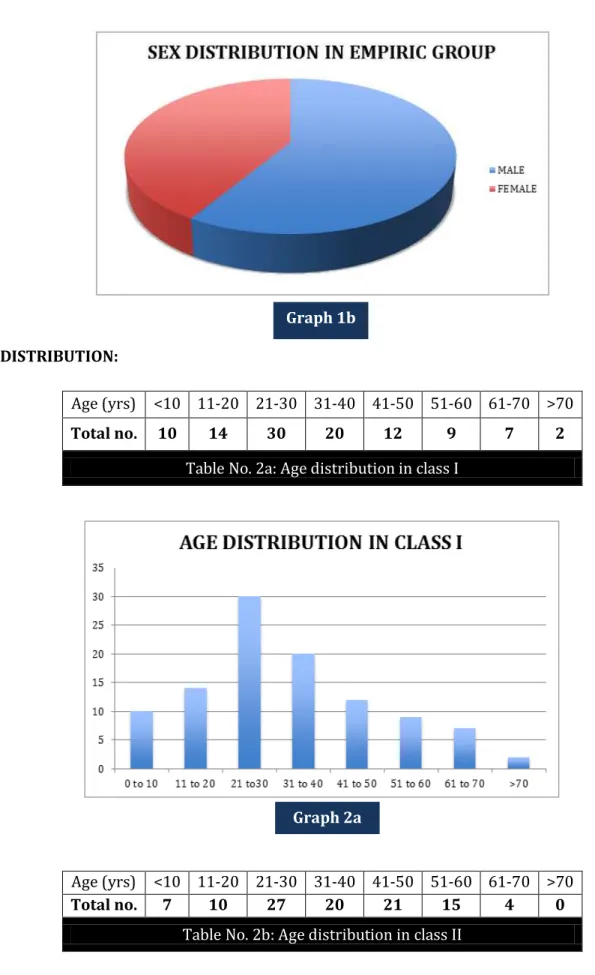
SEX DISTRIBUTION:
Sex Number Percentage (%)
Male 65 62. 5%
Female 39 37. 5%
Table No. 1a: Sex distribution in prophylactic group
Of the 104 cases that received single dose prophylactic antibiotic pre-operatively 62. 5% were males and 37. 5% were females.
Sex Number Percentage (%)
Male 61 58.6%
Female 43 41.4%
Table No. 1b: Sex distribution in empiric group
J of Evolution of Med and Dent Sci/ eISSN- 2278-4802, pISSN- 2278-4748/ Vol. 4/ Issue 32/ Apr 20, 2015 Page 5465 AGE DISTRIBUTION:
Age (yrs) <10 11-20 21-30 31-40 41-50 51-60 61-70 >70
Total no. 10 14 30 20 12 9 7 2
Table No. 2a: Age distribution in class I
Age (yrs) <10 11-20 21-30 31-40 41-50 51-60 61-70 >70
Total no. 7 10 27 20 21 15 4 0
Table No. 2b: Age distribution in class II
Graph 1b
J of Evolution of Med and Dent Sci/ eISSN- 2278-4802, pISSN- 2278-4748/ Vol. 4/ Issue 32/ Apr 20, 2015 Page 5466 Among the patients who received single dose pre-operative prophylaxis, the age varied from 1-80 years. The number of patients in the 21-30 years group was highest. Among the patients who received multiple dose antibiotics post-operatively, the age varied from 1-70 years. The number of patients in 21-30 years group was the highest.
SSI NO SSI PERCENTAGE (%)
Prophylactic 4 48 7.6%
Empiric 2 50 3.8%
Table No. 3a: Results in class I group
Of the 104 patients who underwent class I surgeries, 52 patients received only one dose of pre-operative prophylactic antibiotic. 4 of these patients developed features of SSI (7. 6%)
2 (seroma collection with tenderness).
1 (erythema and tenderness around incision site). 1 (frank purulent discharge).
Of the 52 class I surgery group who received empiric therapy for 3 days or more post-operatively, 2 developed features of SSI (3. 8%).
1 (edema and erythema).
1 (seroma collection with tenderness).
The p value in class I surgeries, when prophylactic group was compared with that of empiric group, was found to be 0.68 (>0.05). Thus there was no statistically significant difference between the two groups.
SSI NO. SSI PERCENTAGE (%)
Prophylactic 8 44 15.3%
Empiric 6 46 11.5%
Table No. 3b: Results in class II group
J of Evolution of Med and Dent Sci/ eISSN- 2278-4802, pISSN- 2278-4748/ Vol. 4/ Issue 32/ Apr 20, 2015 Page 5467 Of the 104 patients who underwent class II surgeries, 52 patients received only one dose of pre-operative prophylactic antibiotic. 8 of these patients developed features of SSI (15.3%).
2 (Sero-purulent discharge).
3 (Seroma collection at the incision site). 1 (Erythema and tenderness).
2 (Frank purulent discharge).
Of the 52 class I surgery group who received empiric therapy for 3 days or more post-operatively, 6 developed features of SSI (11.5%).
4 (Edema and erythema and tenderness with seroma). 2 (Frank purulent discharge).
The p value in class II surgeries, when prophylactic group was compared with that of empiric group, was found to be 0.271 (>0.05). Thus there was no statistically significant difference between the two groups.
SSI NO. SSI PERCENTAGE (%)
Prophylactic 12 92 11.5%
Empiric 8 96 7.6%
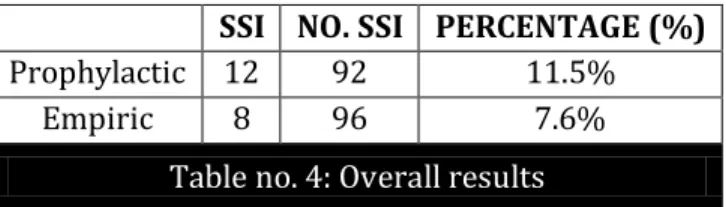
Table no. 4: Overall results
Thus it was seen that the 12 out of 104 patients who received a single dose of antibiotic pre-operatively developed surgical site infections.
8 of the 104 patients who received multiple doses of antibiotics post-operatively developed surgical site infections.
The p value between these two groups was found to be 0.29 (>0.05). Hence there was no statistical difference between the two groups.
J of Evolution of Med and Dent Sci/ eISSN- 2278-4802, pISSN- 2278-4748/ Vol. 4/ Issue 32/ Apr 20, 2015 Page 5468 DISCUSSION: Postoperative antibiotic prophylaxis is widely used, and probably overused, for the prevention of SSI. The general principles regarding anti-microbial prophylaxis include.1:
Selection of anti-microbial agents based on likely pathogens responsible for a SSI with a particular operation.
Administration of antibiotics shortly before the commencement of that operation such that the serum and tissue levels are high at the time of incision and during the course of that procedure.
To achieve high concentrations of antibiotic in the tissues during an operative procedure, the timing of prophylactic antibiotics is critical. A study conducted by Classen et al2 showed that subjects who received antibiotics within a two hour period before the incision was made had the lowest incidence of SSI. Several studies conducted by Mangram et al,3 Bratzler and Hunt4, Springer et al and Classen et al1 showed that the use of antibiotic appropriate for the potential pathogen and administration of prophylactic antibiotics within one hour before incision reduced the incidence of surgical site infections.
The proper duration of antimicrobial use for the prevention of post-operative surgical infection has been a subject of controversy. Currently, more than 40 published clinical trials are available in which the efficacy of single dose surgical prophylaxis with parenteral antimicrobials has been studied. These studies have compared single doses versus multiple doses of same agent, single doses of antimicrobials versus placebo, single doses of various antimicrobials, and a single dose of one agent versus multiple doses of another agent. Dipro JT et al5 in his study proved that single dose regimens resulted in a similar frequency of post-operative wound infections.
McDonald et al6 in his study of single versus multiple dose microbial prophylaxis for major surgery, observed that combined odds ratio by both fixed (1.06, 95% CI, 0.89-1.25) and random effects (1.04, 95% CI, 0.86-1.25) models indicated no clear advantage of either single or multiple dose regimens in preventing SSI.
Scher K7 conducted a randomized controlled study where in, patients undergoing 801 elective, clean-contaminated operations were assigned to one of the following antibiotic regimens: 1) 1g of Cefazolin pre-operatively, 2) 1g of cefazolin pre-operatively and another 1g dose 3 hours later, and 3) 1g of cefotetan pre-operatively. These antibiotic regimens resulted in similar wound infection rates for procedures completed within 3 hours. When the procedure lasted more than 3 hours, the 6. 1 % infection rate noted when a single dose of cefazolin was given proved significantly greater than the 1. 3% infection rates associated with the use of two doses of cefazolin or a single dose of longer acting antibiotic, cefotetan (p <0.01) .
J of Evolution of Med and Dent Sci/ eISSN- 2278-4802, pISSN- 2278-4748/ Vol. 4/ Issue 32/ Apr 20, 2015 Page 5469 Mohri Y et al8 conducted a study in Mie University Graduate School of medicine, Japan comparing a single dose with multiple dose regimen of antimicrobial prophylaxis for prevention of surgical site infection between May 2001 and December 2004. It was found that surgical site infection was seen in 9.5% in the first group and 8.6% in the second group. Thus they concluded that incidence of surgical site infection in elective gastric cancer surgery was similar with both antibiotic prophylaxis regimens.
Fonseca SN et al9 conducted a study in Brazil from February 2002 to August 2003 by replacing a 24-hour regimen with a single antibiotic prophylaxis for elective surgery. 12299 patients were followed up during their hospital stay. They found that the rate of surgical site infection did not change. Thus they concluded that one-dose antibiotic prophylaxis did not lead to an increase in rates of SSI.
Oostvogel HJ et al10 conducted a prospective, randomized double-blind trials to investigate the effectiveness of a single dose antibiotic regimen for preventing post-operative wound infection at St Elisabeth Hospital in Netherlands. Patients undergoing clean contaminated , contaminated or clean surgeries were included. Single-dose (pre-operative) prophylaxis was compared with short term prophylaxis (1 dose pre-operatively and 2 doses post-operatively). They found that the incidence of wound infection was 1.8% in the short-term group and 3. 1% in the single dose group.
The difference was not statistically significant. Thus they concluded that single dose of antibiotic prophylaxis lowered the rates of post-operative wound infection, even in clean -contaminated or -contaminated cases.
The present study had infection rates of 7.6% and 15.4% in class I and class II respectively among those who received only pre-operative antibiotic prophylaxis. Whereas in those that received post-operative empiric therapy the infection rates were found to be 3.8% and 11.5% in class I and class II respectively.
On comparing the single dose prophylaxis group with that of the group that received multiple post-operative doses of antibiotics, the p value was found to be 0. 49 and thus it was concluded that there was no statistical significance between the two groups.
STUDY PERCENTAGE OF SSI P VALUE
MOHRI ET AL EMPIRIC – 8.6%
PROPHYLACTIC – 9.5% <0.05
OOSTVOGEL ET AL EMPIRIC – 1.8%
PROPHYLACTIC – 3.1% <0.05
FONSECA ET AL - <0.05
PRESENT STUDY EMPIRIC – 3.8% AND 11.5%
PROPHYLACTIC – 7.6% AND 15.4% <0.05
CONCLUSION: Our study shows that a single dose of antibiotic given prior to surgery in clean and clean contaminated surgeries is effective in preventing post-operative surgical site infection.
J of Evolution of Med and Dent Sci/ eISSN- 2278-4802, pISSN- 2278-4748/ Vol. 4/ Issue 32/ Apr 20, 2015 Page 5470 Thus it can be concluded from this study that a single dose antibiotic prophylaxis prior to surgery is sufficient to prevent post-operative surgical site infections in clean and clean-contaminated surgeries thus preventing adverse outcomes of inadvertent antibiotic usage, such as multi-drug resistance and drug toxicity.
REFERENCES:
1. Centres for disesase control and prevention. National Nosocomial Infection Surveillance (NNIS). Report, data summary from October 1986 to April 1996, issued May 1996. A report from NNIS System. Am J Infect Control 1996; 24: 380-8.
2. Classen DC, Evans RS, Pestonik SL, et al. The timing of prophylactic administration of antibiotics and the risk of surgical wound infection. N Engl J Med 1992; 326: 281-6.
3. Mangram AJ, Horan TC, Pearson ML, silver LC, Jarvis WR. Guideline for prevention of surgical site infection. Infect Control Hosp Epidemiol; 1999. p. 247-78.
4. Cobb JP, Schmieg R, Hunt TK, Mundy LM. Inflammation, infection and antibiotics. I n: Way LW, Doherty, Current surgical diagnosis and treatment. Tata McGraw-Hill Companies; 2003. P. 112-41.
5. DiPiro JT, Cheung RP, Bowden TA Jr., et al. Single dose systemic antibiotic prophylaxis of surgical wound infections. Am J Surg 1986; 152: 552-9.
6. McDonald M, Grabsch E, Marshall C, et al. Single versus multiple dose antimicrobial prophylaxis for major surgery: a systemic review. Aust N Z J Surg 1998; 68: 388-96.
7. Scher K. Studies on the duration of antibiotic administration for surgical prophylaxis. Am Surg 1997; 63: 59-62.
8. Mohri Y, Tonouchi H, Kobayashi M, Nakai K, Kusunoki M. Randomised clinical trial of single-dose versus multiple single-dose anti-microbial prophylaxis in gastric cancer surgery. Br J Surg 2007; 94 (6): 683-8.
9. Fonseca SN, Kunzle SR, Junqueira MJ, Nascimento RT, de Andrade JI, Leven AS. Implementing 1-dose antibiotic prophylaxis for prevention of surgical site infection. Arch Surg 2006; 141 (11): 1109-14.
J of Evolution of Med and Dent Sci/ eISSN- 2278-4802, pISSN- 2278-4748/ Vol. 4/ Issue 32/ Apr 20, 2015 Page 5471
AUTHORS:
1. Sapna Purushotham
2. Tejaswini Udachan
PARTICULARS OF CONTRIBUTORS:
1. PG and Tutor, Department of General Surgery, BLDEA S Sri B. M. Patil Medical College and Hospital.
2. Professor & HOD, Department of General Surgery, BLDEA S Sri B. M. Patil Medical College and Hospital.
FINANCIAL OR OTHER
COMPETING INTERESTS: None
NAME ADDRESS EMAIL ID OF THE CORRESPONDING AUTHOR:
Dr. Sapna Purushotham, #66 TAPAS ,
Taponagara Main Road, Chikkagubbi,
Bangalore-560077.
E-mail: [email protected]